

ISO 13315-1:2024
(Main)Environmental management for concrete and concrete structures — Part 1: General principles
General Information
- Abstract
This document provides a framework and basic rules on environmental management related to concrete and concrete structures. This includes the assessment of the environmental impacts and methods of implementing environmental improvement based on the assessment. This document is used for the environmental consideration in activities related to the production of concrete constituents, the production, recycling and disposal of concrete, and the design, execution, use and demolition of concrete structures. It is applied for their entire lifecycles, respective stages of the lifecycles, or certain ranges of the lifecycles. This document is applicable to newly produced concrete and newly constructed concrete structures, and also existing concrete and concrete structures. This document applies to single concretes, concrete families, single concrete structures, and concrete structure complexes. For materials other than concrete, the related ISO standards are applied where available. In the case where no ISO standard is available, such materials are appropriately dealt with referring to this document and the normative references. This document covers global, regional and local environments. This document does not directly deal with the environmental impacts resulting from the operation of equipment installed in concrete structures. However, the special properties of concrete and concrete structures affecting the operational efficiency of such equipment are considered in this document. This document covers secondary effects of the production of concrete and execution of concrete structures. NOTE The secondary effects of the production of concrete include the future possibility of leaching of heavy metals from concrete or the absorption of heavy metals from the environment, the effect of waste treatments on the environment, etc. This document covers the economic and social effects of environmental consideration in the production of concrete and execution of concrete structures.
- Status
- Published
- Publication Date
- 07-Jan-2024
- Drafting Committee
- ISO/TC 71/SC 8/WG 1 - General principles
- Current Stage
- 6060 - International Standard published
- Start Date
- 08-Jan-2024
- Due Date
- 19-Nov-2023
- Completion Date
- 08-Jan-2024
Overview
ISO 13315-1:2024 - Environmental management for concrete and concrete structures - Part 1: General principles provides a framework and basic rules for assessing and improving the environmental performance of concrete and concrete structures. It applies across entire lifecycles (design, production/execution, use and end-of-life), to newly produced and existing concretes and structures, and to single concretes, concrete families, single structures and structure complexes. The standard addresses global, regional and local environmental aspects and includes consideration of secondary effects (for example, potential leaching of heavy metals) and the economic and social implications of environmental measures.
Key Topics and Requirements
- Lifecycle approach: Guidance for environmental consideration across all lifecycle phases - design, production/execution, use, demolition, recycling and disposal.
- Assessment framework: Principles for identifying environmental impact categories, defining system boundaries and compiling inventory data for life cycle assessment (LCA).
- Analysis and indicators: Use of category indicators and inventory inputs to quantify environmental impacts and support improvement measures.
- Design & production guidance: Environmental design considerations and practices for concrete structures and concrete production, including reuse, recycling and waste management.
- End-of-life management: Rules for demolition, recovery, recycling and disposal with attention to secondary environmental effects.
- Labels and declarations: Framework for environmental labels, declarations and verification relevant to concrete products and structures.
- Scope and applicability: Applies to materials other than concrete by referencing relevant ISO standards where available; addresses local to global environmental effects.
- Limitations: Does not directly cover environmental impacts from operation of equipment installed in concrete structures, though it considers concrete properties that affect operational efficiency.
Practical Applications
- Who uses it: Owners, designers, concrete manufacturers, contractors, facility managers, certification bodies and standard developers.
- Use cases:
- Integrating LCA-based environmental criteria into design and procurement of concrete structures.
- Developing environmental product declarations (EPDs) and labels for concrete products and families.
- Guiding recycling and demolition strategies to minimize environmental harm.
- Informing sustainability assessments and corporate environmental management systems for construction projects.
Related Standards
- ISO 13315 series (Parts 2, 4, 6, 8) - expanded guidance on system boundaries, environmental design, use phase and labels/declarations.
- ISO 14040 / ISO 14044 - Life cycle assessment principles and requirements.
- ISO 14050 - Environmental management vocabulary.
- ISO 21930 / ISO 21931 - Environmental declarations and sustainability for construction products and works.
Keywords: ISO 13315-1:2024, environmental management for concrete, life cycle assessment, concrete structures, environmental impacts, sustainability, inventory data, system boundary, environmental labels.
Relations
- Effective Date
- 18-Dec-2021
Get Certified
Connect with accredited certification bodies for this standard

BSI Group
BSI (British Standards Institution) is the business standards company that helps organizations make excellence a habit.

Bureau Veritas
Bureau Veritas is a world leader in laboratory testing, inspection and certification services.

DNV
DNV is an independent assurance and risk management provider.
Sponsored listings
Frequently Asked Questions
ISO 13315-1:2024 is a standard published by the International Organization for Standardization (ISO). Its full title is "Environmental management for concrete and concrete structures — Part 1: General principles". This standard covers: This document provides a framework and basic rules on environmental management related to concrete and concrete structures. This includes the assessment of the environmental impacts and methods of implementing environmental improvement based on the assessment. This document is used for the environmental consideration in activities related to the production of concrete constituents, the production, recycling and disposal of concrete, and the design, execution, use and demolition of concrete structures. It is applied for their entire lifecycles, respective stages of the lifecycles, or certain ranges of the lifecycles. This document is applicable to newly produced concrete and newly constructed concrete structures, and also existing concrete and concrete structures. This document applies to single concretes, concrete families, single concrete structures, and concrete structure complexes. For materials other than concrete, the related ISO standards are applied where available. In the case where no ISO standard is available, such materials are appropriately dealt with referring to this document and the normative references. This document covers global, regional and local environments. This document does not directly deal with the environmental impacts resulting from the operation of equipment installed in concrete structures. However, the special properties of concrete and concrete structures affecting the operational efficiency of such equipment are considered in this document. This document covers secondary effects of the production of concrete and execution of concrete structures. NOTE The secondary effects of the production of concrete include the future possibility of leaching of heavy metals from concrete or the absorption of heavy metals from the environment, the effect of waste treatments on the environment, etc. This document covers the economic and social effects of environmental consideration in the production of concrete and execution of concrete structures.
This document provides a framework and basic rules on environmental management related to concrete and concrete structures. This includes the assessment of the environmental impacts and methods of implementing environmental improvement based on the assessment. This document is used for the environmental consideration in activities related to the production of concrete constituents, the production, recycling and disposal of concrete, and the design, execution, use and demolition of concrete structures. It is applied for their entire lifecycles, respective stages of the lifecycles, or certain ranges of the lifecycles. This document is applicable to newly produced concrete and newly constructed concrete structures, and also existing concrete and concrete structures. This document applies to single concretes, concrete families, single concrete structures, and concrete structure complexes. For materials other than concrete, the related ISO standards are applied where available. In the case where no ISO standard is available, such materials are appropriately dealt with referring to this document and the normative references. This document covers global, regional and local environments. This document does not directly deal with the environmental impacts resulting from the operation of equipment installed in concrete structures. However, the special properties of concrete and concrete structures affecting the operational efficiency of such equipment are considered in this document. This document covers secondary effects of the production of concrete and execution of concrete structures. NOTE The secondary effects of the production of concrete include the future possibility of leaching of heavy metals from concrete or the absorption of heavy metals from the environment, the effect of waste treatments on the environment, etc. This document covers the economic and social effects of environmental consideration in the production of concrete and execution of concrete structures.
ISO 13315-1:2024 is classified under the following ICS (International Classification for Standards) categories: 13.020.10 - Environmental management; 91.080.40 - Concrete structures; 91.100.30 - Concrete and concrete products. The ICS classification helps identify the subject area and facilitates finding related standards.
ISO 13315-1:2024 has the following relationships with other standards: It is inter standard links to ISO 13315-1:2012. Understanding these relationships helps ensure you are using the most current and applicable version of the standard.
ISO 13315-1:2024 is available in PDF format for immediate download after purchase. The document can be added to your cart and obtained through the secure checkout process. Digital delivery ensures instant access to the complete standard document.
Standards Content (Sample)
International
Standard
ISO 13315-1
Second edition
Environmental management for
2024-01
concrete and concrete structures —
Part 1:
General principles
Management environnemental du béton et des structures en
béton —
Partie 1: Principes généraux
Reference number
© ISO 2024
All rights reserved. Unless otherwise specified, or required in the context of its implementation, no part of this publication may
be reproduced or utilized otherwise in any form or by any means, electronic or mechanical, including photocopying, or posting on
the internet or an intranet, without prior written permission. Permission can be requested from either ISO at the address below
or ISO’s member body in the country of the requester.
ISO copyright office
CP 401 • Ch. de Blandonnet 8
CH-1214 Vernier, Geneva
Phone: +41 22 749 01 11
Email: copyright@iso.org
Website: www.iso.org
Published in Switzerland
ii
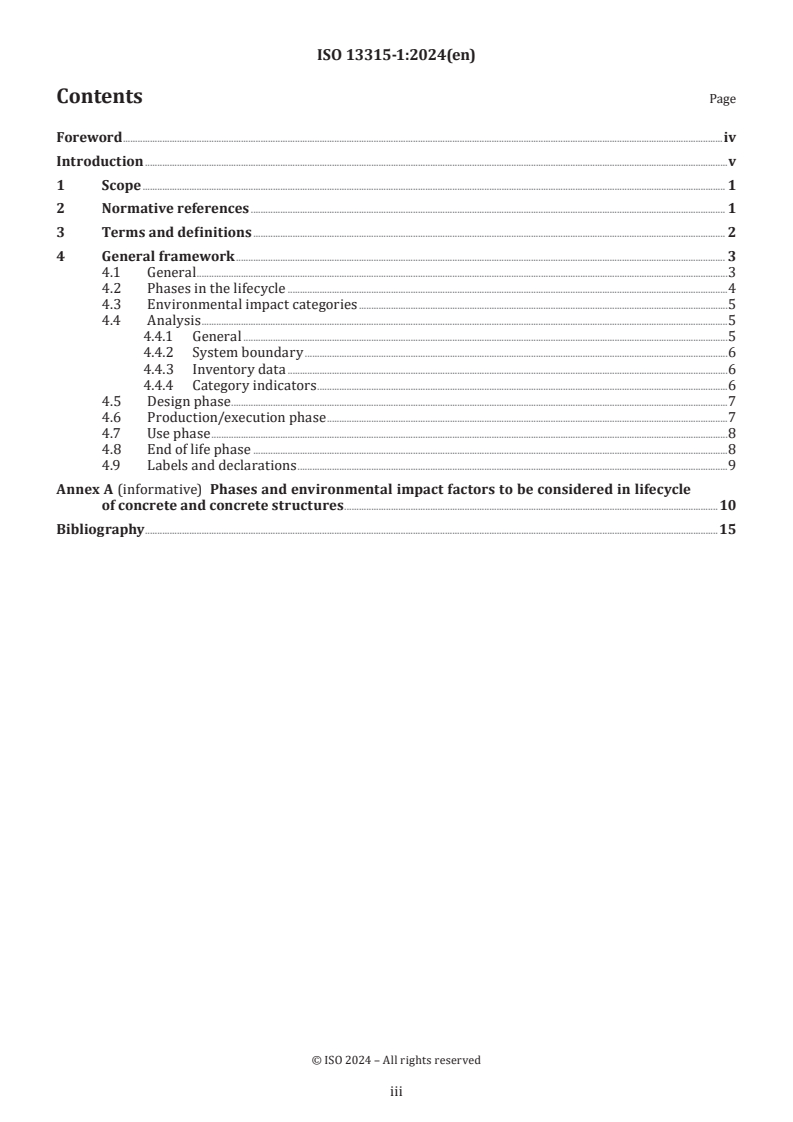
Contents Page
Foreword .iv
Introduction .v
1 Scope . 1
2 Normative references . 1
3 Terms and definitions . 2
4 General framework . 3
4.1 General .3
4.2 Phases in the lifecycle .4
4.3 Environmental impact categories .5
4.4 Analysis .5
4.4.1 General .5
4.4.2 System boundary .6
4.4.3 Inventory data .6
4.4.4 Category indicators .6
4.5 Design phase .7
4.6 Production/execution phase .7
4.7 Use phase .8
4.8 End of life phase .8
4.9 Labels and declarations .9
Annex A (informative) Phases and environmental impact factors to be considered in lifecycle
of concrete and concrete structures . 10
Bibliography .15
iii
Foreword
ISO (the International Organization for Standardization) is a worldwide federation of national standards
bodies (ISO member bodies). The work of preparing International Standards is normally carried out through
ISO technical committees. Each member body interested in a subject for which a technical committee
has been established has the right to be represented on that committee. International organizations,
governmental and non-governmental, in liaison with ISO, also take part in the work. ISO collaborates closely
with the International Electrotechnical Commission (IEC) on all matters of electrotechnical standardization.
The procedures used to develop this document and those intended for its further maintenance are described
in the ISO/IEC Directives, Part 1. In particular, the different approval criteria needed for the different types
of ISO document should be noted. This document was drafted in accordance with the editorial rules of the
ISO/IEC Directives, Part 2 (see www.iso.org/directives).
ISO draws attention to the possibility that the implementation of this document may involve the use of (a)
patent(s). ISO takes no position concerning the evidence, validity or applicability of any claimed patent
rights in respect thereof. As of the date of publication of this document, ISO had not received notice of (a)
patent(s) which may be required to implement this document. However, implementers are cautioned that
this may not represent the latest information, which may be obtained from the patent database available at
www.iso.org/patents. ISO shall not be held responsible for identifying any or all such patent rights.
Any trade name used in this document is information given for the convenience of users and does not
constitute an endorsement.
For an explanation of the voluntary nature of standards, the meaning of ISO specific terms and expressions
related to conformity assessment, as well as information about ISO's adherence to the World Trade
Organization (WTO) principles in the Technical Barriers to Trade (TBT), see www.iso.org/iso/foreword.html.
This document was prepared by Technical Committee ISO/TC 71, Concrete, reinforced concrete and
prestressed concrete, Subcommittee SC 8, Environmental management for concrete and concrete structures.
This second edition cancels and replaces the first edition (ISO 13315-1:2012), which has been technically
revised.
The main changes are as follows:
— the Scope has been revised to be succinct and partially moved to other clauses;
— references to ISO 13315-2 that was subsequently developed have been added to Figure 1, Figure 2,
Clause 3 and 4.4.2;
— references to ISO 13315-4 that was subsequently developed have been added to Figure 1, Figure 2,
Clause 3 and 4.5;
— references to ISO 13315-6 that was subsequently developed have been added to Figure 1, Figure 2,
Clause 3 and 4.7;
— references to ISO 13315-8 that was subsequently developed have been added to Figure 1, Figure 2,
Clause 3 and 4.9.
A list of all parts in the ISO 13315 series can be found on the ISO website.
Any feedback or questions on this document should be directed to the user’s national standards body. A
complete listing of these bodies can be found at www.iso.org/members.html.
iv
Introduction
Environmental issues are serious subjects for the human race. The nature of the problem has been clearly
recognized and the concept of "sustainable development" which can be regarded as an environmental
revolution, has been created. This concept means development that meets the needs of not only present but
also future generations without endangering the natural systems that support life on earth, the atmosphere,
the waters, the soils and the living things, and at the same time acknowledging that global economic growth
is a basis for future global welfare. The incorporation of the concept of sustainability is necessary in every
aspect of social, economic, and cultural activities. The construction industry, which consumes enormous
amounts of resources and energy to provide the infrastructure for the diversified activities of mankind, has
a strong impact on the environment.
The ISO 14000 series on environmental management for goods and services as a system for improving the
impact on the environment has already been published. This series of International Standards provides
general rules for assessing the impact on the environment, as well as for environmental labels/declarations
based on such an assessment. ISO 21931 and ISO 21930 are formulated to tailor this series to construction
works and construction products and services, respectively.
Concrete is widely used as one of the key materials for constructing infrastructures such as buildings,
bridges, dams, tunnels, etc., with its consumption being the second largest on the planet after water. While
construction activities using concrete naturally entail adverse environmental impacts, they also provide
environmental beneficial impacts. Improved infrastructures alleviate traffic congestion and prevent natural
disasters. The development of compact cities can control the expansion of adverse environmental impacts.
Industrial wastes and byproducts from other industries are used as materials, fuels, and supplementary
materials for producing cement. Accurate assessment of environmental impacts is therefore essential for
minimizing adverse environmental impacts derived from construction activities using concrete while
maximizing beneficial environmental impacts.
Concrete structures consume large amounts of aggregates, cement and steel, which emit large amounts of
CO in their production processes. Concrete utilizes industrial waste and byproducts, and uses different
aggregates in different regions. Concrete is delivered to the construction site in the form of partially
finished products. Concrete structures are built in a wide variety of forms with specific requirements, used
in various environments for a long time, and demolished, recycled and disposed of in various forms. The
ISO 13315 series is intended to provide the basic rules on environmental management for concrete and
concrete structures having such characteristics. It is also intended to contribute to continued improvement
of the environmental impacts resulting from the activities related to concrete and concrete structures.
This series ensures consistency with the existing environmental ISO 14000 series, as well as ISO 21930 and
ISO 21931. Figure 1 shows the relationship between the ISO 13315 series and other existing ISO standards.
Figure 2 shows the basic framework of the ISO 13315 series.
The ISO 13315 series covers all people involved in concrete and concrete structures: owners, designers,
concrete manufacturers, constructors, users, certification bodies and those who develop environmental
standard specifications.
v
Figure 1 — Relationship between the ISO 13315 series and other existing ISO environmental
standards
Figure 2 — Basic framework of the ISO 13315 series of standards
vi
International Standard ISO 13315-1:2024(en)
Environmental management for concrete and concrete
structures —
Part 1:
General principles
1 Scope
This document provides a framework and basic rules on environmental management related to concrete
and concrete structures. This includes the assessment of the environmental impacts and methods of
implementing environmental improvement based on the assessment.
This document is used for the environmental consideration in activities related to the production of
concrete constituents, the production, recycling and disposal of concrete, and the design, execution, use and
demolition of concrete structures. It is applied for their entire lifecycles, respective stages of the lifecycles,
or certain ranges of the lifecycles. This document is applicable to newly produced concrete and newly
constructed concrete structures, and also existing concrete and concrete structures.
This document applies to single concretes, concrete families, single concrete structures, and concrete
structure complexes. For materials other than concrete, the related ISO standards are applied where
available. In the case where no ISO standard is available, such materials are appropriately dealt with
referring to this document and the normative references.
This document covers global, regional and local environments. This document does not directly deal with
the environmental impacts resulting from the operation of equipment installed in concrete structures.
However, the special properties of concrete and concrete structures affecting the operational efficiency of
such equipment are considered in this document.
This document covers secondary effects of the production of concrete and execution of concrete structures.
NOTE The secondary effects of the production of concrete include the future possibility of leaching of heavy
metals from concrete or the absorption of heavy metals from the environment, the effect of waste treatments on the
environment, etc.
This document covers the economic and social effects of environmental consideration in the production of
concrete and execution of concrete structures.
2 Normative references
The following documents are referred to in the text in such a way that some or all of their content constitutes
requirements of this document. For dated references, only the edition cited applies. For undated references,
the latest edition of the referenced document (including any amendments) applies.
ISO 13315-2, Environmental management for concrete and concrete structures — Part 2: System boundary and
inventory data
ISO 13315-4, Environmental management for concrete and concrete structures — Part 4: Environmental design
of concrete structures
ISO 13315-6, Environmental management for concrete and concrete structures — Part 6: Use of concrete
structures
ISO 13315-8, Environmental management for concrete and concrete structures — Part 8: Environmental labels
and declarations
ISO 14040, Environmental management — Life cycle assessment — Principles and framework
ISO 14044, Environmental management — Life cycle assessment — Requirements and guidelines
ISO 14050, Environmental management — Vocabulary
3 Terms and definitions
For the purposes of this document, the terms and definitions given in ISO 13315-2, ISO 13315-4, ISO 13315-6,
ISO 13315-8, ISO 14050, and the following apply.
ISO and IEC maintain terminology databases for use in standardization at the following addresses:
— ISO Online browsing platform: available at https:// www .iso .org/ obp
— IEC Electropedia: available at https:// www .electropedia .org/
3.1
byproduct
secondary substance produced by an industrial process
3.2
client's brief
working document which specifies at any point in time the relevant needs and aims, resources of the client
and user, the context of the project and any appropriate design requirements
3.3
concrete demolition material
material generated in demolition of concrete structures
3.4
ecosystem
system of interrelations among nature, animals and human beings
3.5
environmental monetary cost
costs necessary to fulfil environmental requirements
3.6
environmental design
design of a structure in which environmental impacts (3.7) are considered
3.7
environmental impact
any change, which can be adverse or beneficial, to the environment, wholly or partially resulting from
concrete-related activities
3.8
environmental performance
quantitative or qualitative results of environmental influence from activities related to concrete and
concrete structures
3.9
execution
activities carried out for the physical completion of the work, and the inspection and documentation thereof
EXAMPLE Procurement, scaffolding, formwork, reinforcing, concreting, curing, erection of precast elements, etc.
3.10
global environment
environment that is affected by global climate change, ozone depletion, changes in ecosystems, resource use
and other factors on a global scale
3.11
inspection
examination to determine whether environmental performance (3.8) attained in a product or an activity
satisfies specified requirements
3.12
local environment
environment that is affected by noise, vibration, dust and other factors in a built environment
3.13
regional environment
environment that is affected by air pollution, soil contamination, or water pollution on an intermediate scale
EXAMPLE City, province and country.
3.14
sustainability
state in which components of the ecosystem and their functions are maintained for present and future
generations
Note 1 to entry: Sustainability is the goal of sustainable development and can result from the application of the concept
of sustainable development.
Note 2 to entry: “Components of the ecosystem” includes plants and animals, as well as humans and their physical
environment. For humans, this includes a balancing of key elements of human needs: the economic, environmental,
social and cultural conditions for societies’ existence.
3.15
soil contamination
phenomenon in which soil is polluted by deleterious substances
3.16
verification
process to check whether environmental performances estimated in a product or an activity satisfy specified
requirements
3.17
waste
unusable substances emitted from activities related to concrete and concrete structures
3.18
water pollution
phenomenon in which water is polluted by deleterious substances
4 General framework
4.1 General
The concept of sustainability through environmental management shall be considered in various activities
related to the production of concrete and execution of concrete structures. In addition to the environmental
aspect, sustainability has economic and social aspects which influence one another. Consideration of the
environmental aspect can relate to the economic aspect such as environmental monetary cost. Consideration
of the environmental aspect can relate to the social aspect, which involves issues of intergenerational ethics,
such as securement of the quality of society and life, inheritance of tradition and culture, and consensus
building for preserving ecosystems. The economic and social aspects of environmental consideration should
therefore be clearly recognized in activities related to the production of concrete and execution of concrete
structures, and these aspects may be appropriately considered based on the required priorities.
Environmental management of concrete and concrete structures shall be implemented with the aim of
minimizing the adverse environmental impacts and maximizing the beneficial environmental impacts.
The objects of environmental management shall include the environmental impacts generated in the entire
lifecycle of concrete and concrete structures or its phases including design, production, execution, use and
end of life phase.
The basic flow of environmental management for concrete and concrete structures is shown in Figure 3.
Environmental management shall be carried out with the plan-do-check-act process at the respective phases
of the concrete structures or through the lifecycle. This includes determining or confirming the types and
values of environmental performance requirements; analysing the environmental performance of concrete,
concrete structures and related activities, and verifying that the environmental performances satisfy or
dissatisfy the required values; inspecting actual environmental performance during the respective phases
or after them; and taking appropriate measures in the event of problems. The activities and their results
shall be documented, and the documents shall be stored.
Figure 3 — Basic flow of environmental management for concrete and concrete structures
4.2 Phases in the lifecycle
The lifecycle of concrete and concrete structures consists of the following phases:
— Design phase (see 4.5): phase in which the specifications of concrete structures are determined to satisfy
the environmental performance requirements based on the client’s brief and legislation, and they are
documented.
— Production/execution phase (Phase A, see 4.6): phases including the production of concrete constituents
(Phase A-1), the production of concrete and concrete products (Phase A-2), and the execution of concrete
structures (Phase A-3).
— Use phase (Phase B, see 4.7): phase of operation and maintenance and remedial activities of concrete
structures.
— End of life phase (Phase C, see 4.8): phase of demolition of concrete structures, reuse of some elements,
and recycling an
...