

ISO 13315-3:2023
(Main)Environmental management for concrete and concrete structures — Part 3: Production of concrete constituents and concrete
General Information
- Abstract
This document provides the principles and procedures for environmental management related to production of concrete constituents and concrete. This document covers the following: — concrete constituents: cement, admixtures, additions, aggregate and mixing water; — concrete and precast concrete.
- Status
- Published
- Publication Date
- 08-Nov-2023
- Current Stage
- 6060 - International Standard published
- Start Date
- 09-Nov-2023
- Due Date
- 25-Jan-2024
- Completion Date
- 09-Nov-2023
Overview - ISO 13315-3:2023 (Environmental management for concrete production)
ISO 13315-3:2023 specifies principles and procedures for environmental management during the production of concrete constituents (cement, admixtures, additions, aggregate, mixing water) and concrete / precast concrete. The standard guides producers to identify environmental aspects, set measurable environmental performance requirements, design production to meet those requirements, estimate expected performance, verify outcomes, and maintain inspection and documentation.
Key topics and technical requirements
- Scope and procedure: A clear workflow is defined - setting performance requirements, production design, estimation, verification, production & related works, inspection, and documentation.
- Environmental performance requirements: Producers collect environmental, social and economic data to set quantitative indicators and targets (upper/lower limits or ranges) for selected impact categories.
- Impact categories: Guidance on selecting suitable categories including global climate change (GHG/CO2), natural resources use (materials, water, fuel), land use/habitat alteration, eutrophication, acidification, air and water pollution, particulate matter, waste generation, noise/vibration, and others. (Note: mandatory categories for Environmental Product Declarations are specified in ISO 21930.)
- Indicators: Examples include reduction amount or reduction rate of impact relative to a reference product or process; Annex A provides indicator examples.
- Production design and mitigation methods: Strategies to meet targets such as material selection (use of byproducts), low-impact energy sources, equipment choices, emission control, dust/waste management, noise mitigation and supplier/transport considerations. Annex B provides example methods.
- Estimation & verification: Expected performance is estimated via trial production, production experience, or published inventory data (LCA reference standards ISO 14040/14044 and ISO 21930 are referenced). Verification processes and documentation requirements are mandated.
Practical applications - who uses ISO 13315-3:2023
- Concrete and precast manufacturers seeking to reduce lifecycle environmental impacts and demonstrate compliance with sustainability targets.
- Cement, admixture and aggregate suppliers implementing environmental management for their products.
- Environmental managers, LCA practitioners and sustainability consultants conducting impact assessments and setting performance indicators.
- Specifiers, asset owners and regulators who require environmental performance evidence for procurement, labeling or regulatory compliance.
- Facility designers and plant operators implementing process changes (fuel switches, emissions controls, material substitutions).
Related standards
- ISO 13315 series: Parts 1, 2, 4, 6, 8 (general principles, system boundaries, environmental design, use phase, labels/declarations)
- ISO 14040 / ISO 14044 (Life Cycle Assessment)
- ISO 21930 (EPDs for construction products)
- ISO 22965-2 (concrete specification and production reference)
ISO 13315-3:2023 supports sustainable concrete production by combining LCA-based indicators, practical mitigation methods, and a repeatable management procedure to reduce environmental impacts across concrete supply chains.
Get Certified
Connect with accredited certification bodies for this standard

BSI Group
BSI (British Standards Institution) is the business standards company that helps organizations make excellence a habit.

Bureau Veritas
Bureau Veritas is a world leader in laboratory testing, inspection and certification services.

DNV
DNV is an independent assurance and risk management provider.
Sponsored listings
Frequently Asked Questions
ISO 13315-3:2023 is a standard published by the International Organization for Standardization (ISO). Its full title is "Environmental management for concrete and concrete structures — Part 3: Production of concrete constituents and concrete". This standard covers: This document provides the principles and procedures for environmental management related to production of concrete constituents and concrete. This document covers the following: — concrete constituents: cement, admixtures, additions, aggregate and mixing water; — concrete and precast concrete.
This document provides the principles and procedures for environmental management related to production of concrete constituents and concrete. This document covers the following: — concrete constituents: cement, admixtures, additions, aggregate and mixing water; — concrete and precast concrete.
ISO 13315-3:2023 is classified under the following ICS (International Classification for Standards) categories: 13.020.10 - Environmental management; 91.080.40 - Concrete structures; 91.100.30 - Concrete and concrete products. The ICS classification helps identify the subject area and facilitates finding related standards.
ISO 13315-3:2023 is available in PDF format for immediate download after purchase. The document can be added to your cart and obtained through the secure checkout process. Digital delivery ensures instant access to the complete standard document.
Standards Content (Sample)
INTERNATIONAL ISO
STANDARD 13315-3
First edition
2023-11
Environmental management for
concrete and concrete structures —
Part 3:
Production of concrete constituents
and concrete
Reference number
© ISO 2023
All rights reserved. Unless otherwise specified, or required in the context of its implementation, no part of this publication may
be reproduced or utilized otherwise in any form or by any means, electronic or mechanical, including photocopying, or posting on
the internet or an intranet, without prior written permission. Permission can be requested from either ISO at the address below
or ISO’s member body in the country of the requester.
ISO copyright office
CP 401 • Ch. de Blandonnet 8
CH-1214 Vernier, Geneva
Phone: +41 22 749 01 11
Email: copyright@iso.org
Website: www.iso.org
Published in Switzerland
ii
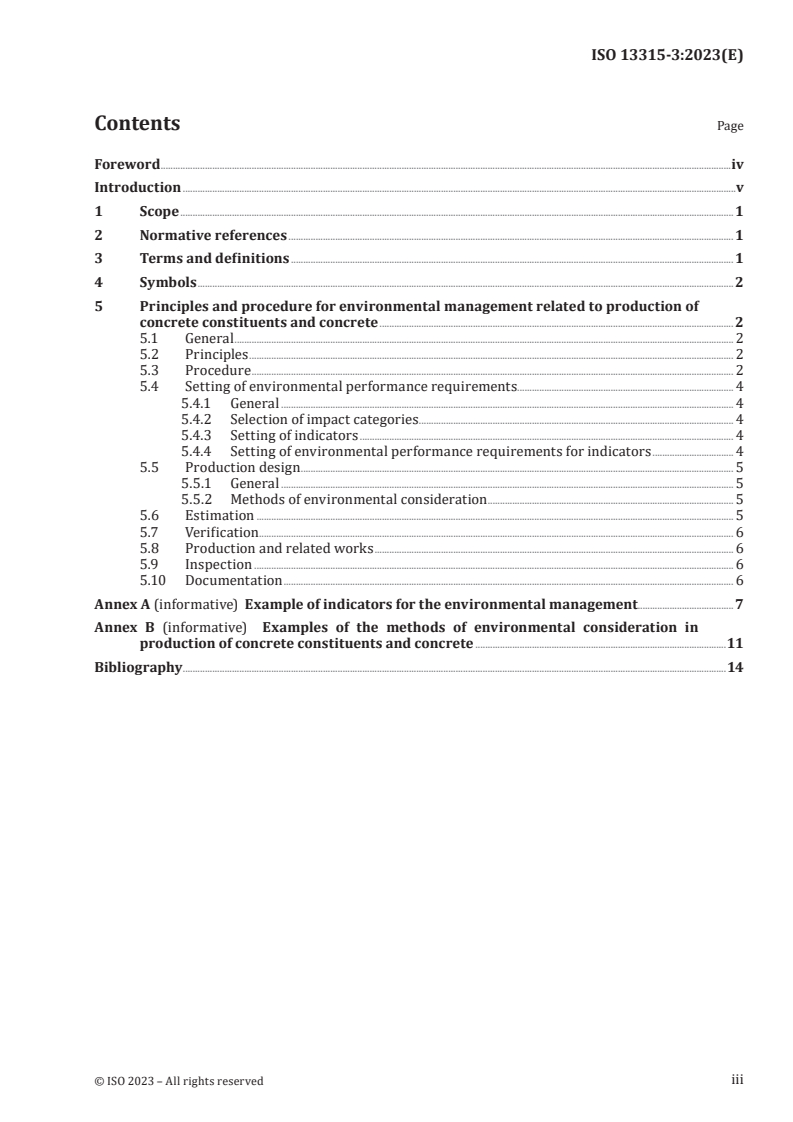
Contents Page
Foreword .iv
Introduction .v
1 Scope . 1
2 Normative references . 1
3 Terms and definitions . 1
4 Symbols . 2
5 Principles and procedure for environmental management related to production of
concrete constituents and concrete . 2
5.1 General . 2
5.2 Principles . 2
5.3 Procedure . 2
5.4 Setting of environmental performance requirements. 4
5.4.1 General . 4
5.4.2 Selection of impact categories . 4
5.4.3 Setting of indicators . 4
5.4.4 Setting of environmental performance requirements for indicators . 4
5.5 Production design . 5
5.5.1 General . 5
5.5.2 Methods of environmental consideration . 5
5.6 Estimation . 5
5.7 Verification . . 6
5.8 Production and related works . 6
5.9 Inspection . 6
5.10 Documentation . 6
Annex A (informative) Example of indicators for the environmental management .7
Annex B (informative) Examples of the methods of environmental consideration in
production of concrete constituents and concrete .11
Bibliography .14
iii
Foreword
ISO (the International Organization for Standardization) is a worldwide federation of national standards
bodies (ISO member bodies). The work of preparing International Standards is normally carried out
through ISO technical committees. Each member body interested in a subject for which a technical
committee has been established has the right to be represented on that committee. International
organizations, governmental and non-governmental, in liaison with ISO, also take part in the work.
ISO collaborates closely with the International Electrotechnical Commission (IEC) on all matters of
electrotechnical standardization.
The procedures used to develop this document and those intended for its further maintenance are
described in the ISO/IEC Directives, Part 1. In particular, the different approval criteria needed for the
different types of ISO document should be noted. This document was drafted in accordance with the
editorial rules of the ISO/IEC Directives, Part 2 (see www.iso.org/directives).
ISO draws attention to the possibility that the implementation of this document may involve the use
of (a) patent(s). ISO takes no position concerning the evidence, validity or applicability of any claimed
patent rights in respect thereof. As of the date of publication of this document, ISO had not received
notice of (a) patent(s) which may be required to implement this document. However, implementers are
cautioned that this may not represent the latest information, which may be obtained from the patent
database available at www.iso.org/patents. ISO shall not be held responsible for identifying any or all
such patent rights.
Any trade name used in this document is information given for the convenience of users and does not
constitute an endorsement.
For an explanation of the voluntary nature of standards, the meaning of ISO specific terms and
expressions related to conformity assessment, as well as information about ISO's adherence to
the World Trade Organization (WTO) principles in the Technical Barriers to Trade (TBT), see
www.iso.org/iso/foreword.html.
This document was prepared by Technical Committee ISO/TC 71, Concrete, reinforced concrete and pre-
stressed concrete, Subcommittee SC 8, Environmental management for concrete and concrete structures.
A list of all parts in the ISO 13315 series can be found on the ISO website.
Any feedback or questions on this document should be directed to the user’s national standards body. A
complete listing of these bodies can be found at www.iso.org/members.html.
iv
Introduction
Concrete, a material essential for constructing buildings and civil structures forming infrastructure, is
extensively used worldwide, requiring huge amounts of natural resources for its production, including
the production of its constituents. A variety of byproducts from other industries are also used for
their production. Moreover, the production of concrete constituents and concrete causes emissions of
global warming gases including CO and air pollutants such as NOx and SOx, water pollutants, as well
as discharges of waste such as concrete rubble. Cement, one of the primary constituents of concrete,
causes a large amount of CO emissions during its production. Extraction of mineral resources, which
are materials for concrete constituents, can also change the land use and alter the habitats of flora and
fauna.
In this context, when producing concrete constituents and concrete, environmental consideration is
necessary from every aspect including effective use of resources and prevention of global warming.
v
INTERNATIONAL STANDARD ISO 13315-3:2023(E)
Environmental management for concrete and concrete
structures —
Part 3:
Production of concrete constituents and concrete
1 Scope
This document provides the principles and procedures for environmental management related to
production of concrete constituents and concrete. This document covers the following:
— concrete constituents: cement, admixtures, additions, aggregate and mixing water;
— concrete and precast concrete.
2 Normative references
The following documents are referred to in the text in such a way that some or all of their content
constitutes requirements of this document. For dated references, only the edition cited applies. For
undated references, the latest edition of the referenced document (including any amendments) applies.
ISO 13315-1, Environmental management for concrete and concrete structures — Part 1: General principles
ISO 13315-2, Environmental management for concrete and concrete structures — Part 2: System boundary
and inventory data
ISO 13315-4, Environmental management for concrete and concrete structures — Part 4: Environmental
design of concrete structures
ISO 13315-6, Environmental management for concrete and concrete structures — Part 6: Use of concrete
structures
ISO 13315-8, Environmental management for concrete and concrete structures — Part 8: Environmental
labels and declarations
ISO 14040, Environmental management — Life cycle assessment — Principles and framework
ISO 14044, Environmental management — Life cycle assessment — Requirements and guidelines
ISO 14050, Environmental management — Vocabulary
3 Terms and definitions
For the purposes of this document, the terms and definitions given in ISO 13315-1, ISO 13315-2,
ISO 13315-4, ISO 13315-6, ISO 13315-8, ISO 14040 and ISO 14050 and the following apply.
ISO and IEC maintain terminology databases for use in standardization at the following addresses:
— ISO Online browsing platform: available at https:// www .iso .org/ obp
— IEC Electropedia: available at https:// www .electropedia .org/
3.1
target product
product for which environmental consideration is given
3.2
reference product
standard product, having the same function as a target product, or a product prior to environmental
improvement, to be used for comparison in the environmental management related to production of
concrete constituents and concrete
4 Symbols
Symbols used in this document are as follows:
Pi()
expected or attained environmental performance of the target product expressed as
tpr
a function of indicator i;
e
expected environmental performance of the target product expressed as a function
Pi()
tpr
of indicator i;
a
attained environmental performance of the target product expressed as a function of
Pi()
tpr
indicator i;
Pi()
environmental performance of the reference product expressed as a function of indicator i;
rpr
Si()
environmental performance requirement of the product expressed as a function of
pr
indicator i;
a
reduction amount of environmental impact of the target product in comparison with
Ri()
tpr
reference product;
r
reduction rate of environmental impact of the target product in comparison with ref-
Ri()
tpr
erence product.
5 Principles and procedure for environmental management related to
production of concrete constituents and concrete
5.1 General
This clause provides the principles and procedures to appropriately carry out environmental
management related to production of concrete constituents and concrete.
NOTE ISO 22965-2 serves as a reference for the specification of constituent materials, production of concrete
and compliance of concrete.
5.2 Principles
In the production of concrete constituents and concrete, environmental management shall be carried
out to reduce the environmental impacts of these products.
5.3 Procedure
Environmental management for the production of concrete constituents and concrete shall be
conducted in accordance with ISO 14040, ISO 14044, and with the following procedure:
a) setting of the environmental performance requirements (see 5.4);
b) production design (see 5.5);
c) estimation (see 5.6);
d) verification (see 5.7);
e) production and related works (see 5.8);
f) inspection (see 5.9);
g) documentation (see 5.10).
Figure 1 shows the flow chart of the procedure.
Figure 1 — Procedure for environmental management of production of concrete constituents
and concrete
5.4 Setting of environmental performance requirements
5.4.1 General
The producer shall collect information on environmental, social and economic aspects necessary for the
setting of environmental performance requirements. The environmental performance requirements
can be set either based on the goals set by the producer or based on requests from users of the
products. The producer shall select impact categories suitable for the performance requirements and
set necessary indicators.
5.4.2 Selection of impact categories
Impact categories to be considered shall be selected from the following items:
— global climate change;
— natural resources use (materials, water and fuel);
— stratospheric ozone level;
— land use/habitat alteration;
— eutrophication;
— acidification;
— air pollution;
— photochemical oxidant creation,
— particulate matter air pollution,
— other air pollution (toxics, etc.),
— indoor air pollution;
— water pollution;
— soil contamination;
— pollution due to radioactive substances;
— impacts due to waste generation;
— noise/vibration.
NOTE Mandatory impact categories are specified for an environmental product declaration in ISO 21930.
5.4.3 Setting of indicators
Appropriate indicators shall be set for each category selected.
The reduction amount of environmental impact or the reduction rate of environmental impact of
the target execution activity in comparison with the reference execution activity may be used as an
indicator. The environmental performance of the reference execution activity shall be appropriately
estimated.
NOTE Annex A serves as a reference for setting indicators.
5.4.4 Setting of environmental performance requirements for indicators
An environmental performance requirement shall be set for each indicator.
The environmental performance requirements shall be quantitatively set in the form of upper limits,
lower limits, or ranges, when the indicators are expressible in numerals.
a
NOTE The reduction amount of environmental impact of the target product, Ri() , refers to the difference
tpr
between the environmental performance of the reference product and the expected or attained environmental
performance of the target product. It is defined as Formula (1).
a
Ri()=−Pi() Pi() (1)
tpr rprtpr
r
The reduction rate of environmental impact of the target product, Ri() , refers to the ratio of the reduction of
tpr
a
the environmental impact, Ri() , to the environmental performance of the reference product. It is defined as
tpr
Formula (2).
Pi()−Pi()
rprtpr
r
Ri()= (2)
tpr
Pi()
rpr
5.5 Production design
5.5.1 General
Production design shall be conducted to meet the environmental performance requirements set in 5.4.
5.5.2 Methods of environmental consideration
Methods to ensure the require
...