

ISO 22785-3:2026
(Main)Paints and varnishes — Coatings on plastics and composites — Part 3: Constant climate and alternating climate testing
- Abstract
This document specifies the constant climate and alternating climate testing of coatings on plastics, plastics composites and similar substrates, hereinafter collectively referred to as plastics. This document shows the potential effect of plastics on the behaviour of the coating during climate testing.
- Status
- Published
- Publication Date
- 01-Jul-2026
- Technical Committee
- ISO/TC 35/SC 9 - General test methods for paints and varnishes
- Drafting Committee
- ISO/TC 35/SC 9/WG 31 - Properties after application
- Current Stage
- 6060 - International Standard published
- Start Date
- 02-Jul-2026
- Due Date
- 06-May-2027
- Completion Date
- 30-Jun-2026
ISO 22785-3:2026 is an International Standard from ISO for testing coatings on plastics, plastics composites and similar substrates. It specifies constant climate and alternating climate testing, and it explains how the plastic substrate can influence coating behaviour during exposure. It is written for people who need to choose, run, or interpret climate tests on coated plastic parts.
What does ISO 22785-3:2026 specify?
ISO 22785-3:2026 specifies climate exposure methods for coated plastics and the related evaluation after exposure. The document is organized into scope, normative references, terms and definitions, substrate characteristics, an overview of test methods, and evaluation.
- Clause 1 sets the scope for coatings on plastics, plastics composites and similar substrates.
- Clause 3 defines the climate terms used throughout the document.
- Clause 4 explains which plastic-substrate properties can change test behaviour.
- Clause 5 compares constant climate, alternating climate, and immersion in water.
- Clause 6 gives the common ways to assess the coating after exposure.
What are the key requirements of ISO 22785-3:2026?
ISO 22785-3:2026 is mainly a method-selection and interpretation standard. It helps users choose a climate test that fits coated plastics, and it links exposure results to visual and mechanical checks after testing.
Climate exposure and specimen behaviour
Clause 4 highlights why plastics behave differently from metals in climate testing. Thermal conductivity, specific heat, thickness, deformation, phase transitions, ageing, additive migration, moisture barrier behaviour, thermal expansion, water absorption and release, adhesive strength, density and elasticity can all affect the coating response.
In practice, this means the same coating may react differently on plastics than on metal. Users need to consider substrate type, thickness, and water uptake when selecting test conditions and when comparing results from different parts or materials.
Clause 5.1 states that demineralized water as specified in ISO 23321 is used for all tests, unless another condition is agreed. This keeps the exposure media consistent.
Clause 5.2 covers constant climate tests:
- wet climate for water absorption under high humidity,
- dry climate for heat exposure or cold storage,
- condensation atmosphere with constant humidity, where uniform dew formation matters.
For the condensation atmosphere test, specimen position in the chamber is important, because standing or hanging orientation can change how water forms on the surface. In practice, the setup has to be fixed before testing so results are comparable.
Clause 5.3 covers alternating climate tests. ISO 22785-3:2026 describes cyclic changes in temperature and/or humidity, with no added salt and no salt contamination in the chamber. It includes condensation alternating climate, cold/warm climate, and warm and humid/cold climate.
For users, this means the method is aimed at repeated environmental stress, not steady exposure. The cycle design and specimen positioning need to reflect the part’s real use, especially for automotive exterior and interior applications.
Clause 5.4 covers immersion in water, either complete or partial. The specimen can be suspended or standing, and partial immersion may create different effects. That matters when parts can collect water or have only part of the surface exposed.
Evaluation after exposure
Clause 6 says assessment can be done directly after removal or after reconditioning. The waiting time, temperature and relative humidity before inspection or mechanical testing should be agreed in advance, because the result can change with recovery time.
Clause 6 then points to three main assessment routes:
- visual surface assessment,
- gloss and colour assessment,
- adhesive strength assessment.
In practice, this gives users a common way to document blistering, cracking, flaking, colour change, gloss loss and adhesion loss after climate exposure.
What terms does ISO 22785-3:2026 define?
ISO 22785-3:2026 defines the climate terms used for exposure and interpretation.
- Constant climate - an environment with constant climatic conditions.
- Wet climate - a humid environment with usually more than 90% relative humidity and no condensation.
- Dry climate - an environment with usually less than 20% relative humidity.
- Condensation atmosphere with constant humidity - an environment with condensing humidity on the specimen surface.
- Alternating climate - a cyclic succession of phases with different climatic conditions.
- Condensation alternating climate - an alternating climate with at least one phase of condensing air humidity.
- Immersion in water - partial or complete immersion of the sample in water.
- Glass transition temperature (Tg) - the temperature region where some plastics change from a glass-like state to a more flexible state, which can affect coating behaviour during testing.
Who uses ISO 22785-3:2026?
ISO 22785-3:2026 is used by coating laboratories, automotive paint and material teams, quality managers, and test engineers working with coated plastics. The introduction says the methods are used in particular for coatings on automotive exteriors and interiors.
It is also relevant to suppliers and buyers who need to compare climate resistance data for coated plastic parts. The document helps them decide how to expose specimens and how to read the result after exposure.
What changed in ISO 22785-3:2026 from the previous edition?
ISO 22785-3:2026 is the first edition of this part.
Which standards are used with ISO 22785-3:2026?
ISO 22785-3:2026 cites ISO 4618 for coating vocabulary and ISO 22785-1 for the general introduction to coatings on plastics and composites. It also uses ISO 23321 for the demineralized water used in the tests.
The method and evaluation clauses also point to related standards such as ISO 6270-2, ISO 6270-3, ISO 2812-2, ISO 4628-1, ISO 4628-2, ISO 4628-4, ISO 4628-5, ISO 2813, ISO 18314-1 and ISO 2409 for specific exposure or assessment techniques.
What does the ISO 22785-3:2026 document contain?
ISO 22785-3:2026 contains a technical overview of climate testing for coated plastics, including substrate effects, exposure types and post-exposure evaluation. Clause 4 gives practical background on how plastics can change heat flow, moisture behaviour, adhesion and deformation during testing.
Clause 5 describes the exposure setups for wet climate, dry climate, condensation, cycling climate and immersion in water. Clause 6 lists the common inspection and measurement routes for surface condition, gloss, colour and adhesive strength.
The document also links these assessments to established test methods, so users can choose the matching visual, colour or mechanical follow-up test after climate exposure.
Get Certified
Connect with accredited certification bodies for this standard

DIN CERTCO
DIN Group product certification.

Smithers Quality Assessments
US management systems and product certification.
Sponsored listings
Frequently Asked Questions
ISO 22785-3:2026 is a standard published by the International Organization for Standardization (ISO). Its full title is "Paints and varnishes — Coatings on plastics and composites — Part 3: Constant climate and alternating climate testing". This standard covers: This document specifies the constant climate and alternating climate testing of coatings on plastics, plastics composites and similar substrates, hereinafter collectively referred to as plastics. This document shows the potential effect of plastics on the behaviour of the coating during climate testing.
This document specifies the constant climate and alternating climate testing of coatings on plastics, plastics composites and similar substrates, hereinafter collectively referred to as plastics. This document shows the potential effect of plastics on the behaviour of the coating during climate testing.
ISO 22785-3:2026 is classified under the following ICS (International Classification for Standards) categories: 83.080.01 - Plastics in general; 83.120 - Reinforced plastics; 87.040 - Paints and varnishes. The ICS classification helps identify the subject area and facilitates finding related standards.
ISO 22785-3:2026 is available in PDF format for immediate download after purchase. The document can be added to your cart and obtained through the secure checkout process. Digital delivery ensures instant access to the complete standard document.
Standards Content (Sample)
International
Standard
ISO 22785-3
First edition
Paints and varnishes — Coatings on
2026-06
plastics and composites —
Part 3:
Constant climate and alternating
climate testing
Reference number
© ISO 2026
All rights reserved. Unless otherwise specified, or required in the context of its implementation, no part of this publication may
be reproduced or utilized otherwise in any form or by any means, electronic or mechanical, including photocopying, or posting on
the internet or an intranet, without prior written permission. Permission can be requested from either ISO at the address below
or ISO’s member body in the country of the requester.
ISO copyright office
CP 401 • Ch. de Blandonnet 8
CH-1214 Vernier, Geneva
Phone: +41 22 749 01 11
Email: copyright@iso.org
Website: www.iso.org
Published in Switzerland
ii
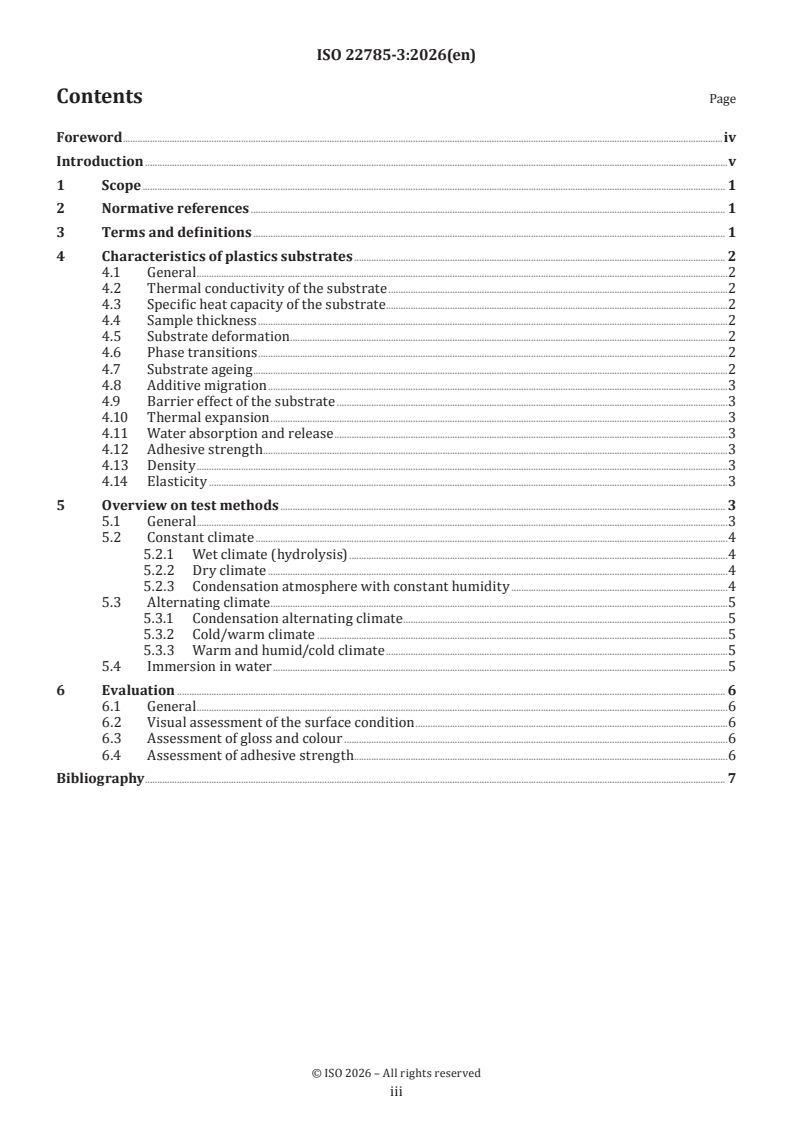
Contents Page
Foreword .iv
Introduction .v
1 Scope . 1
2 Normative references . 1
3 Terms and definitions . 1
4 Characteristics of plastics substrates . 2
4.1 General .2
4.2 Thermal conductivity of the substrate .2
4.3 Specific heat capacity of the substrate .2
4.4 Sample thickness .2
4.5 Substrate deformation .2
4.6 Phase transitions .2
4.7 Substrate ageing .2
4.8 Additive migration .3
4.9 Barrier effect of the substrate .3
4.10 Thermal expansion .3
4.11 Water absorption and release .3
4.12 Adhesive strength . .3
4.13 Density .3
4.14 Elasticity .3
5 Overview on test methods . 3
5.1 General .3
5.2 Constant climate .4
5.2.1 Wet climate (hydrolysis) .4
5.2.2 Dry climate .4
5.2.3 Condensation atmosphere with constant humidity .4
5.3 Alternating climate .5
5.3.1 Condensation alternating climate .5
5.3.2 Cold/warm climate .5
5.3.3 Warm and humid/cold climate .5
5.4 Immersion in water .5
6 Evaluation . 6
6.1 General .6
6.2 Visual assessment of the surface condition .6
6.3 Assessment of gloss and colour .6
6.4 Assessment of adhesive strength.6
Bibliography . 7
iii
Foreword
ISO (the International Organization for Standardization) is a worldwide federation of national standards
bodies (ISO member bodies). The work of preparing International Standards is normally carried out through
ISO technical committees. Each member body interested in a subject for which a technical committee
has been established has the right to be represented on that committee. International organizations,
governmental and non-governmental, in liaison with ISO, also take part in the work. ISO collaborates closely
with the International Electrotechnical Commission (IEC) on all matters of electrotechnical standardization.
The procedures used to develop this document and those intended for its further maintenance are described
in the ISO/IEC Directives, Part 1. In particular, the different approval criteria needed for the different types
of ISO document should be noted. This document was drafted in accordance with the editorial rules of the
ISO/IEC Directives, Part 2 (see www.iso.org/directives).
ISO draws attention to the possibility that the implementation of this document may involve the use of (a)
patent(s). ISO takes no position concerning the evidence, validity or applicability of any claimed patent
rights in respect thereof. As of the date of publication of this document, ISO had not received notice of (a)
patent(s) which may be required to implement this document. However, implementers are cautioned that
this may not represent the latest information, which may be obtained from the patent database available at
www.iso.org/patents. ISO shall not be held responsible for identifying any or all such patent rights.
Any trade name used in this document is information given for the convenience of users and does not
constitute an endorsement.
For an explanation of the voluntary nature of standards, the meaning of ISO specific terms and expressions
related to conformity assessment, as well as information about ISO's adherence to the World Trade
Organization (WTO) principles in the Technical Barriers to Trade (TBT), see www.iso.org/iso/foreword.html.
This document was prepared by Technical Committee ISO/TC 35, Paints and varnishes, Subcommittee SC 9,
General test methods for paints and varnishes.
A list of all parts in the ISO 22785 series can be found on the ISO website.
Any feedback or questions on this document should be directed to the user’s national standards body. A
complete listing of these bodies can be found at www.iso.org/members.html.
iv
Introduction
The ISO 22785 series explains the characteristics of plastics and the differences between plastics substrates
and metallic substrates.
This document gives an overview of the common climate test methods used in particular for coatings of
automotive exteriors and interiors. Many of the existing test methods have been developed for coatings on
metals. This document specifies the test methods that can lead to a deviating behaviour of the coating on
plastics substrates and the measures that can be taken, where appropriate. It is possible that the substrate
has an effect on the behaviour of the coating during the test. At times, it can be useful to select test conditions
which are based on standards from the plastics sector and not on standards from the coating sector, in order
to take into account the thermal conductivity of a plastics substrate which is normally lower.
The methods listed in this document refer to simple, flat test specimens, but also components. For three-
dimensional samples, different results can be obtained during the exposure; therefore, the installation
position or test position are specified in advance or taken from a sampling plan.
v
International Standard ISO 22785-3:2026(en)
Paints and varnishes — Coatings on plastics and
composites —
Part 3:
Constant climate and alternating climate testing
1 Scope
This document specifies the constant climate and alternating climate testing of coatings on plastics, plastics
composites and similar substrates, hereinafter collectively referred to as plastics.
This document shows the potential effect of plastics on the behaviour of the coating during climate testing.
2 Normative references
The following documents are referred to in the text in such a way that some or all of their content constitutes
requirements of this document. For dated references, only the edition cited applies. For undated references,
the latest edition of the referenced document (including any amendments) applies.
ISO 4618, Paints and varnishes — Vocabulary
ISO 22785-1, Paints and varnishes — Coatings on plastics and composites — Part 3: General introduction
3 Terms and definitions
For the purposes of this document, the terms and definitions given in ISO 4618, ISO 22785-1 and the
following apply.
ISO and IEC maintain terminology databases for use in standardization at the following addresses:
— ISO Online browsing platform: available at https:// www .iso .org/ obp
— IEC Electropedia: available at https:// www .electropedia .org/
3.1
constant climate
environment with constant climatic conditions
3.2
wet climate
environment with a relative humidity of usually > 90 %, non-condensing
3.3
dry climate
environment with a relative humidity of usually < 20 %
3.4
condensation atmosphere with constant humidity
environment with condensing humidity
3.5
alternating climate
cyclic succession of phases with different climatic conditions
3.6
condensation alternating climate
alternating climate (3.5) with at least one phase with condensing air humidity
3.7
immersion in water
partial or complete immersion of the sample in water
4 Characteristics of plastics substrates
4.1 General
Plastics-specific characteristics for pure plastics can be taken from Reference [33]. For recyclates or plastics
mixtures, the characteristics can deviate from the information in Reference [33].
4.2 Thermal conductivity of the su
...