

ISO 22785-6:2026
(Main)Paints and varnishes — Coatings on plastics and composites — Part 6: Stone-chip resistance testing
- Abstract
This document specifies the testing of the stone-chip resistance testing of coatings on plastics, plastics composites and similar substrates, hereinafter collectively referred to as plastics. This document shows the potential effect of plastics on the behaviour of the coating during stone-chip resistance testing.
- Status
- Published
- Publication Date
- 01-Jul-2026
- Technical Committee
- ISO/TC 35/SC 9 - General test methods for paints and varnishes
- Drafting Committee
- ISO/TC 35/SC 9/WG 31 - Properties after application
- Current Stage
- 6060 - International Standard published
- Start Date
- 02-Jul-2026
- Due Date
- 06-May-2027
- Completion Date
- 30-Jun-2026
ISO 22785-6:2026 is an International Standard from ISO for testing the stone-chip resistance of coatings on plastics, plastics composites and similar substrates. It explains how the substrate can influence coating behaviour during stone-chip resistance testing, so laboratories and product teams can judge results on plastics in a controlled way.
What does ISO 22785-6:2026 specify?
ISO 22785-6:2026 specifies stone-chip resistance testing for coatings on plastics, plastics composites and similar substrates, which the document treats collectively as plastics. It organizes the subject into sample preparation, the influence of the plastics substrate, an overview of test methods, and evaluation.
The document is structured in Clauses 1 to 7, followed by a bibliography. In practice, that means the user can move from specimen preparation to test selection and then to result interpretation in one place.
What are the key requirements of ISO 22785-6:2026?
ISO 22785-6:2026 focuses on how to prepare samples, how to condition them, which test temperatures to use, and how to evaluate damage. The main point is that plastics behave differently from metal, so the standard makes substrate effects part of the test interpretation.
Test samples and geometry - Clause 4.1 covers coatings on standard test panels specified in ISO 1514 and on components. Flat panels are usually used, but other specimen geometries have to be agreed between the interested parties and stated in the test report. In practice, this means the test setup must match the part being assessed and the report must record any non-standard shape.
Surface preparation and film thickness - Clause 4.1 says the coating system, substrate, pre-treatment and coating method are selected together to achieve a homogeneous coating, and cleaning substances must not change the material properties of the panel. Film thickness is documented according to the technical requirements for appearance, coating, or both. This matters because the condition of the sample can change the stone-chip result.
Conditioning - Clause 4.2 says conditioning is used to improve repeatability and reproducibility, and that plastics often need longer conditioning than metals because humidity affects them more strongly. Unless otherwise specified, the test samples are conditioned for 16 h under the standard climatic conditions in ISO 3270. In practice, the conditioning step is part of making results comparable.
Substrate influence - Clause 5 explains that hardness and flexibility depend on temperature and can influence the stone-chip test result. Results from flexible plastics substrates and hard plastics substrates are not comparable. This is important when comparing coatings across different plastic types or across different use temperatures.
Test temperature - Clause 6.1 says tests should be carried out at temperatures where the substrate is in the same form of appearance as in use. The note says room temperature is typically 18 °C to 28 °C. For users, this means the test should reflect the service condition rather than only a laboratory default.
Stationary multi-impact test - Clause 6.2 refers to ISO 20567-1. The coating is hit by many small, sharp-edged impact bodies, using specified iron grit and compressed air. Damage is judged by comparison with reference pictures after loose fragments are removed. The test area is 8 cm × 8 cm. This method suits screening and visual comparison of damage severity.
Single-impact tests - Clause 6.3 refers to ISO 20567-2, using a guided impact body with a wedge-shaped blade and a steel ball accelerated by compressed air. Clause 6.4 refers to ISO 20567-3, using a free-flying impact body where angle, speed, mass and geometry are specified. The first measures detached width including the imprint; the second records damaged area, and for multilayer systems the main separation planes. These methods are used when a single, defined impact is needed.
Evaluation - Clause 7 says the surface is evaluated as described in the relevant test standards, and that colour or transparency can make visual assessment harder. For release tests, a high-contrast colour layer is selected, and wetting the samples with water can improve contrast on plastics. That helps the examiner see chip damage more clearly.
What terms does ISO 22785-6:2026 define?
ISO 22785-6:2026 uses the terms and definitions from ISO 4618 and ISO 22785-1. Key terms in the document include:
- Plastics - The collective term used here for plastics, plastics composites and similar substrates.
- Coating system - The coating, substrate and pre-treatment considered together when preparing test samples.
- Test panel - The standard flat specimen used for many of the tests.
- Conditioning - The controlled exposure used before testing to stabilize the sample.
- Stationary multi-impact test - A repeated-impact method that uses iron grit and compressed air.
- Single-impact test with guided impact body - A one-hit method that uses a guided wedge-shaped impact body.
- Single-impact test with a free-flying impact body - A one-hit method where the impact body is launched toward the sample.
Who uses ISO 22785-6:2026?
ISO 22785-6:2026 is used by paint and varnish laboratories, coating developers, plastics and composites manufacturers, and quality managers who need to assess stone-chip resistance on plastic-based parts. It is also relevant to buyers and technical teams that compare coating performance on plastic substrates and need a common test approach for reporting and agreement.
Which standards are used with ISO 22785-6:2026?
ISO 22785-6:2026 refers to ISO 4618 for vocabulary and ISO 22785-1 for the general introduction to coatings on plastics and composites. Its bibliography also names ISO 1514 for standard panels, ISO 3270 for conditioning and testing climates, and ISO 20567-1, ISO 20567-2, ISO 20567-3 and ISO 20567-4 for the stone-chip test methods it points to.
What does the ISO 22785-6:2026 document contain?
ISO 22785-6:2026 contains sample preparation guidance, conditioning guidance, an explanation of how plastics substrates affect test results, and an overview of the main stone-chip test methods. It also gives practical evaluation guidance for visual assessment and describes how contrast can be improved for plastics.
Figures 1 to 3 show example test devices for the stationary multi-impact test, the guided single-impact test, and the free-flying single-impact test. Those figures help laboratories understand the type of equipment and arrangement the methods refer to without reproducing the full test procedures.
Get Certified
Connect with accredited certification bodies for this standard

DIN CERTCO
DIN Group product certification.

Smithers Quality Assessments
US management systems and product certification.
Sponsored listings
Frequently Asked Questions
ISO 22785-6:2026 is a standard published by the International Organization for Standardization (ISO). Its full title is "Paints and varnishes — Coatings on plastics and composites — Part 6: Stone-chip resistance testing". This standard covers: This document specifies the testing of the stone-chip resistance testing of coatings on plastics, plastics composites and similar substrates, hereinafter collectively referred to as plastics. This document shows the potential effect of plastics on the behaviour of the coating during stone-chip resistance testing.
This document specifies the testing of the stone-chip resistance testing of coatings on plastics, plastics composites and similar substrates, hereinafter collectively referred to as plastics. This document shows the potential effect of plastics on the behaviour of the coating during stone-chip resistance testing.
ISO 22785-6:2026 is classified under the following ICS (International Classification for Standards) categories: 83.080.01 - Plastics in general; 83.120 - Reinforced plastics; 87.040 - Paints and varnishes. The ICS classification helps identify the subject area and facilitates finding related standards.
ISO 22785-6:2026 is available in PDF format for immediate download after purchase. The document can be added to your cart and obtained through the secure checkout process. Digital delivery ensures instant access to the complete standard document.
Standards Content (Sample)
International
Standard
ISO 22785-6
First edition
Paints and varnishes — Coatings on
2026-06
plastics and composites —
Part 6:
Stone-chip resistance testing
Reference number
© ISO 2026
All rights reserved. Unless otherwise specified, or required in the context of its implementation, no part of this publication may
be reproduced or utilized otherwise in any form or by any means, electronic or mechanical, including photocopying, or posting on
the internet or an intranet, without prior written permission. Permission can be requested from either ISO at the address below
or ISO’s member body in the country of the requester.
ISO copyright office
CP 401 • Ch. de Blandonnet 8
CH-1214 Vernier, Geneva
Phone: +41 22 749 01 11
Email: copyright@iso.org
Website: www.iso.org
Published in Switzerland
ii
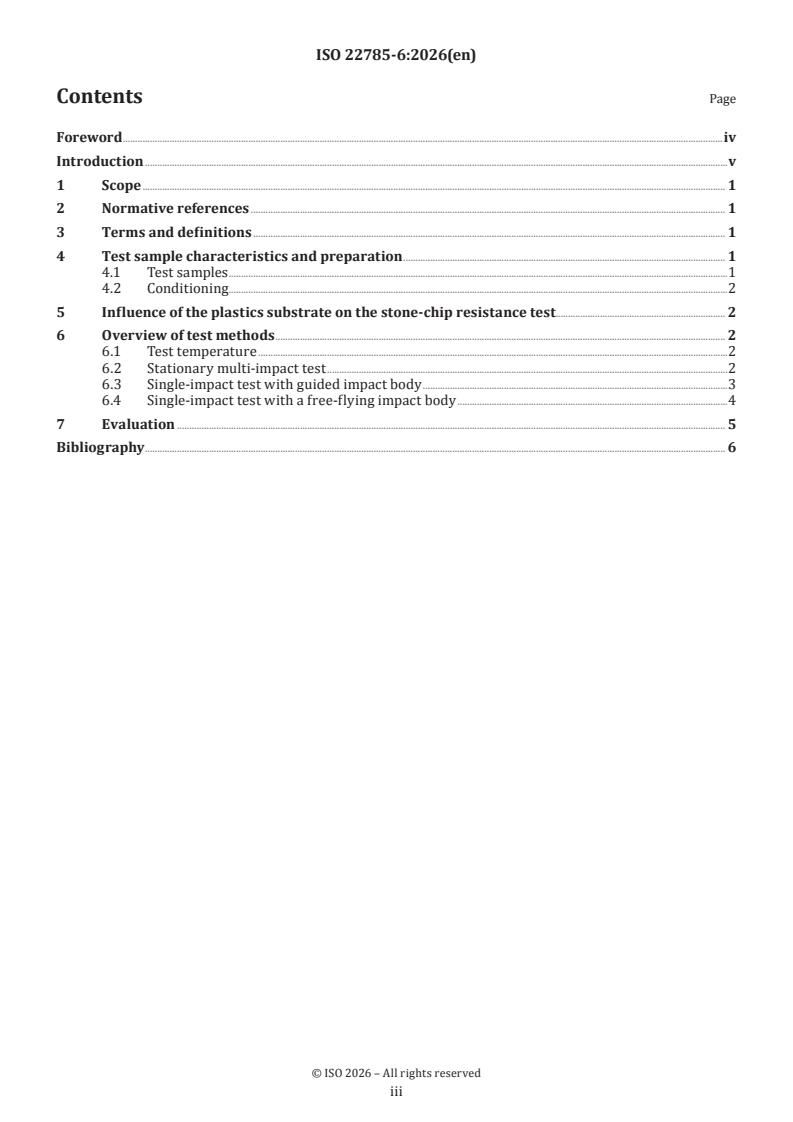
Contents Page
Foreword .iv
Introduction .v
1 Scope . 1
2 Normative references . 1
3 Terms and definitions . 1
4 Test sample characteristics and preparation . 1
4.1 Test samples .1
4.2 Conditioning.2
5 Influence of the plastics substrate on the stone-chip resistance test. 2
6 Overview of test methods . 2
6.1 Test temperature .2
6.2 Stationary multi-impact test .2
6.3 Single-impact test with guided impact body .3
6.4 Single-impact test with a free-flying impact body .4
7 Evaluation . 5
Bibliography . 6
iii
Foreword
ISO (the International Organization for Standardization) is a worldwide federation of national standards
bodies (ISO member bodies). The work of preparing International Standards is normally carried out through
ISO technical committees. Each member body interested in a subject for which a technical committee
has been established has the right to be represented on that committee. International organizations,
governmental and non-governmental, in liaison with ISO, also take part in the work. ISO collaborates closely
with the International Electrotechnical Commission (IEC) on all matters of electrotechnical standardization.
The procedures used to develop this document and those intended for its further maintenance are described
in the ISO/IEC Directives, Part 1. In particular, the different approval criteria needed for the different types
of ISO document should be noted. This document was drafted in accordance with the editorial rules of the
ISO/IEC Directives, Part 2 (see www.iso.org/directives).
ISO draws attention to the possibility that the implementation of this document may involve the use of (a)
patent(s). ISO takes no position concerning the evidence, validity or applicability of any claimed patent
rights in respect thereof. As of the date of publication of this document, ISO had not received notice of (a)
patent(s) which may be required to implement this document. However, implementers are cautioned that
this may not represent the latest information, which may be obtained from the patent database available at
www.iso.org/patents. ISO shall not be held responsible for identifying any or all such patent rights.
Any trade name used in this document is information given for the convenience of users and does not
constitute an endorsement.
For an explanation of the voluntary nature of standards, the meaning of ISO specific terms and expressions
related to conformity assessment, as well as information about ISO's adherence to the World Trade
Organization (WTO) principles in the Technical Barriers to Trade (TBT), see www.iso.org/iso/foreword.html.
This document was prepared by Technical Committee ISO/TC 35, Paints and varnishes, Subcommittee SC 9,
General test methods for paints and varnishes.
A list of all parts in the ISO 22785 series can be found on the ISO website.
Any feedback or questions on this document should be directed to the user’s national standards body. A
complete listing of these bodies can be found at www.iso.org/members.html.
iv
Introduction
The ISO 22785 series explains the characteristics of plastics and the differences between plastics substrates
and metallic substrates.
Stone-chip resistance is usually assessed through surface tests; nonetheless, the substrate also has an
influence on the stone-chip resistance of the coating and is considered when testing stone-chip resistance.
Impacts due to loose chippings on a road surface or other materials can cause damage to paint finishes. Such
damage can result in single layers or all layers flaking off from the substrate.
Stone-chip damage can be replicated with single-impact and multi-impact test procedures. ISO 20567-1 and
ISO 20567-4 describe multi-impact test procedures, while ISO 20567-2 and ISO 20567-3 describe single-
impact test procedures.
Many of the existing test procedures for coatings have been developed for metallic substrates, and in the
past they have often also been applied to plastics substrates.
v
International Standard ISO 22785-6:2026(en)
Paints and varnishes — Coatings on plastics and
composites —
Part 6:
Stone-chip resistance testing
1 Scope
This document specifies the testing of the stone-chip resistance testing of coatings on plastics, plastics
composites and similar substrates, hereinafter collectively referred to as plastics.
This document shows the potential effect of plastics on the behaviour of the coating during stone-chip
resistance testing.
2 Normative reference
...