

ISO/DTS 10832
(Main)Soil quality — Effects of pollutants on mycorrhizal fungi — Spore germination test
- Abstract
ISO/TS 10832:2009 specifies a method to evaluate the effects of pollutants on spore germination of a mycorrhizal fungus, Glomus mosseae. This direct acute toxicity bioassay allows the evaluation of potential effects of pollutants and contaminated soils on beneficial soil microorganisms important for plant growth within the concept of sustainable agriculture. ISO/TS 10832:2009 is applicable to chemical substances, and contaminated soils, waste and soil-waste mixture and sludge.
- Status
- Not Published
- Technical Committee
- ISO/TC 190/SC 4 - Biological characterization
- Drafting Committee
- ISO/TC 190/SC 4/WG 4 - Soil micro-organisms
- Current Stage
- 5020 - Proof sent to secretariat or FDIS ballot initiated: 8 weeks - 50 Approval
- Start Date
- 11-Nov-2026
- Due Date
- 11-Nov-2026
- Completion Date
- 11-Nov-2026
Buy Documents
ISO/DTS 10832 - Soil quality — Effects of pollutants on mycorrhizal fungi — Spore germination test

REDLINE ISO/DTS 10832 - Soil quality — Effects of pollutants on mycorrhizal fungi — Spore germination test
ISO/TS 10832 is an ISO technical specification from ISO for assessing pollutant effects on spores of the arbuscular mycorrhizal fungus Funneliformis mosseae (formerly Glomus mosseae). It defines a direct acute toxicity bioassay for contaminated soils, wastes, soil-waste mixtures and sludge, and it can also be used for chemical substances.
What does ISO/TS 10832 specify?
ISO/TS 10832 specifies a laboratory method for measuring how pollutants affect spore germination in a mycorrhizal fungus. The document is written for soil quality and ecotoxicity work, where the result is used to judge possible impacts on beneficial soil microorganisms that matter for plant growth.
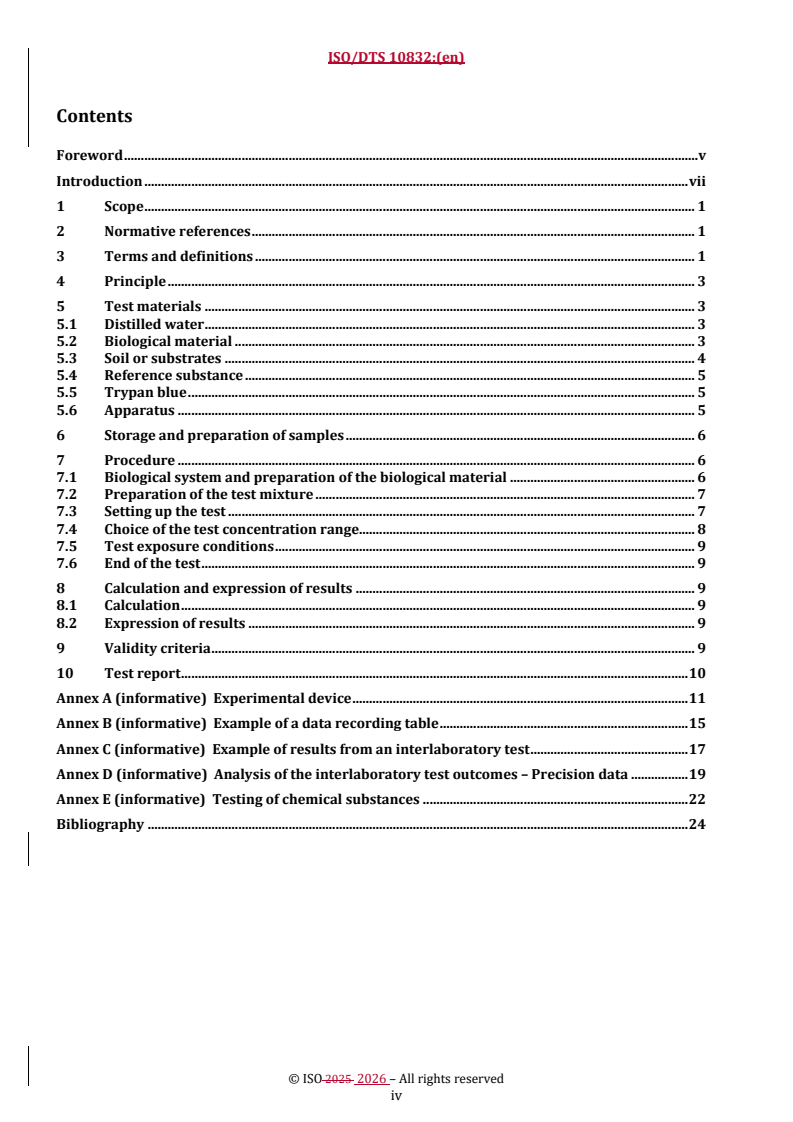
The standard is organized into clauses 1 to 10 and five informative annexes. The main flow is scope, normative references, terms, principle, materials, sample preparation, procedure, calculation, validity criteria and test report.
| Annex | What it covers |
|---|---|
| Annex A | Experimental device and how the sandwich and Petri dish setup is assembled |
| Annex B | Example of a data recording table |
| Annex C | Example results from an interlaboratory test |
| Annex D | Analysis of interlaboratory test outcomes and precision data |
| Annex E | Testing of chemical substances |
What are the key requirements of ISO/TS 10832?
ISO/TS 10832 requires spores of Funneliformis mosseae to be exposed in a defined sandwich arrangement between nitrocellulose membrane filters and then incubated under controlled conditions. The practice matters because the method depends on keeping the spores alive, evenly exposed, and comparable from one treatment to another.
Test setup and exposure
Clause 4 sets the basic principle: spores are placed in a sandwich, set in a Petri dish with the test mixture, and exposed for 14 days at (24 ± 2) °C in the dark. The result is compared with a control substrate and used to estimate inhibition concentration values such as IC50. In practice, the test is designed to show whether a soil, waste, sludge or substance slows or blocks germination.
Materials and biological system
Clause 5 specifies distilled water, biological material, substrates, a reference substance, trypan blue and the apparatus. The fungus must be Funneliformis mosseae, with mature spores taken from sporocarps, and the spores used only if control germination is high enough. This matters because poor spore quality can make the test unreliable before any pollutant effect is measured.
Control substrate, reference soil and moisture
Clause 5 also requires a control substrate such as sand or artificial soil, and it allows a reference soil for site-specific assessment. Both the control substrate and reference soil are brought to 90 % of their water-holding capacity. In practice, that moisture target is important because germination depends strongly on water availability.
Sample preparation and characterization
Clause 6 covers collection, storage and pre-characterization of soil, waste and sludge samples. It calls for storage at (4 ± 2) °C, usually for up to 4 weeks, and for measurement of properties such as pH, water content, water-holding capacity, effective cation exchange capacity, available phosphorus, organic carbon, soluble phosphorus and texture. This gives the test context needed to interpret the biological response and to prepare comparable mixtures.
Test procedure and concentration range
Clause 7 describes how to prepare the spores, build the sandwich, prepare the test mixture, and set up the exposure. The method uses a preliminary test to check moistening and a final test with at least five dilutions or concentrations in a geometric progression, preferably with a ratio not greater than 2. In practice, this helps the laboratory find both non-effect levels and levels that inhibit germination.
Counting, calculation and reporting
Clause 8 requires counting recovered spores and germinated spores, calculating germination percentage, and comparing treatment results with the control or reference condition. The document also asks for the average, standard deviation and, when relevant, an inhibition concentration estimate with a 95 % confidence interval. This means the laboratory reports both the raw biological response and the summary result used for interpretation.
Validity criteria and report content
Clause 9 makes the test valid only when the average number of recovered spores is at least 25 per condition and the control germination is at least 75 %. Clause 10 sets the test report content, including the document reference, test dates, environmental conditions, sample details, spore source, control substrate information, test mixture preparation, results table, plot and any incidents. That gives users the information needed for audit trail, comparison and re-use of the data.
What terms does ISO/TS 10832 define?
- Mycorrhizal fungus - a fungus that forms a mutualistic symbiosis with vascular plant roots.
- Spore - the asexual reproductive unit of a fungus.
- Control substrate - an inert substrate used as the control or diluting matrix because it does not affect spore germination.
- Reference soil - uncontaminated soil from a nearby site with properties similar to the test soil.
- Test matrix - the material under test, such as soil, sludge or waste.
- Sandwich - the assembly of two nitrocellulose membrane filters holding the spores between them.
- Control test - the test condition using only control substrate and distilled water to the specified water-holding capacity.
- Reference test - the test condition using reference soil and distilled water to the specified water-holding capacity.
Who uses ISO/TS 10832?
ISO/TS 10832 is used by soil and environmental laboratories, ecotoxicology teams, waste and sludge testing providers, and organizations assessing contaminated sites. It is also relevant to agricultural and soil quality work because it measures effects on a microorganism linked to plant health.
In practice, users apply it to compare contaminated soils, wastes, soil-waste mixtures, sludge and chemical substances against a control substrate or reference soil. Quality managers and technical buyers use it when they need a standardized biological test for pollutant effects on soil microorganisms.
What changed in ISO/TS 10832 from the previous edition?
ISO/TS 10832:2025 cancels and replaces ISO/TS 10832:2009. The foreword states that the document has been technically revised.
The listed changes are:
- the scope wording was updated from “mix” to “mixture and sludge”
- the fungus name was updated to Funneliformis mosseae (formerly Glomus mosseae)
- the list of normative references was updated
- the definitions were revised, including the addition of control test and reference test
- “Petri plate” was changed to “Petri dish”
- information on mature spores was moved to 5.2.3
- the spore control information was moved into 7.1
- a new Annex E was added for testing chemical substances
- Equation (1) for germination percentage was added to 8.1
- the bibliography was amended and unassigned references were moved into the main text
Which standards are used with ISO/TS 10832?
ISO/TS 10832 refers to several standards that support sampling, vocabulary and sample preparation.
- ISO 5667-15 - guidance for preservation and handling of sludge, sediment and suspended matter samples
- ISO 11074 - vocabulary for soil quality terms used in the document
- ISO 11268-1 - a related soil ecotoxicity method for earthworms, used as a companion reference for artificial soil
- ISO 18400-206 - guidance for collecting, handling and storing soil under aerobic conditions for microbiological assessment
- EN 14735 - preparation of waste samples for ecotoxicity tests
- CEN/TR 15310-1 - guidance on selecting and applying sampling criteria for waste materials
What does the ISO/TS 10832 document contain?
ISO/TS 10832 contains a full laboratory method, including the biological principle, the test materials, the sample handling requirements and the step-by-step procedure. It also gives the apparatus setup and an illustrated experimental device in Annex A.
The document includes a calculation formula for germination percentage, a requirement to express results against the control or reference condition, and validity criteria that laboratories must check before accepting the outcome. Annex B provides a model results table for recording recoveries and germination rates.
Annex C gives an example dataset from an interlaboratory test, while Annex D discusses precision data from that exercise. Annex E extends the method to chemical substances and explains how to prepare water-soluble, organic-solvent-soluble and non-soluble substances for testing.
Relations
- Effective Date
- 28-Oct-2023
Buy Documents
ISO/DTS 10832 - Soil quality — Effects of pollutants on mycorrhizal fungi — Spore germination test
REDLINE ISO/DTS 10832 - Soil quality — Effects of pollutants on mycorrhizal fungi — Spore germination test
Get Certified
Connect with accredited certification bodies for this standard

CIS Institut d.o.o.
Personal Protective Equipment (PPE) certification body. Notified Body NB-2890 for EU Regulation 2016/425 PPE.

Kiwa BDA Testing
Building and construction product certification.
Kmetijski inštitut Slovenije
Agricultural Institute of Slovenia. Soil testing, plant health, agricultural product analysis.
Sponsored listings
Frequently Asked Questions
ISO/DTS 10832 is a draft published by the International Organization for Standardization (ISO). Its full title is "Soil quality — Effects of pollutants on mycorrhizal fungi — Spore germination test". This standard covers: ISO/TS 10832:2009 specifies a method to evaluate the effects of pollutants on spore germination of a mycorrhizal fungus, Glomus mosseae. This direct acute toxicity bioassay allows the evaluation of potential effects of pollutants and contaminated soils on beneficial soil microorganisms important for plant growth within the concept of sustainable agriculture. ISO/TS 10832:2009 is applicable to chemical substances, and contaminated soils, waste and soil-waste mixture and sludge.
ISO/TS 10832:2009 specifies a method to evaluate the effects of pollutants on spore germination of a mycorrhizal fungus, Glomus mosseae. This direct acute toxicity bioassay allows the evaluation of potential effects of pollutants and contaminated soils on beneficial soil microorganisms important for plant growth within the concept of sustainable agriculture. ISO/TS 10832:2009 is applicable to chemical substances, and contaminated soils, waste and soil-waste mixture and sludge.
ISO/DTS 10832 is classified under the following ICS (International Classification for Standards) categories: 13.080.30 - Biological properties of soils. The ICS classification helps identify the subject area and facilitates finding related standards.
ISO/DTS 10832 has the following relationships with other standards: It is inter standard links to ISO/TS 10832:2009. Understanding these relationships helps ensure you are using the most current and applicable version of the standard.
ISO/DTS 10832 is available in PDF format for immediate download after purchase. The document can be added to your cart and obtained through the secure checkout process. Digital delivery ensures instant access to the complete standard document.
Standards Content (Sample)
Contents
- Introduction
- 1 Scope
- 2 Normative references
- 3 Terms and definitions
- 3.1 spore
- 3.2 sporocarps
- 3.3 test matrix
- 3.4 sandwich
- 3.5 inhibition concentration
- 3.6 control test
- 3.7 reference test
- 4 Principle
- 5 Test materials
- 5.1 Distilled water
- 5.2 Biological material
- 5.3 Soil or substrates
- 5.4 Reference substance
- 5.5 Trypan blue
- 5.6 Apparatus
- 6 Storage and preparation of samples
- 7 Procedure
- 7.1 Biological system and preparation of the biological material
- 7.2 Preparation of the test mixture
- 7.3 Setting up the test
- 7.4 Choice of the test concentration range
- 1 Petri dish lined by a moistened filter paper
- 7.5 Test exposure conditions
- 7.6 End of the test
- 8 Calculation and expression of results
- 8.1 Calculation
- 8.2 Expression of results
- 9 Validity criteria
- 10 Test report
- Annex A
- Annex B
- Annex C
- Annex D
- Annex E
- Bibliography
Introduction
Arbuscular mycorrhizal fungi are important components of the soil microbial community and key organisms [11] in plant and soil systems. The root symbiosis they form represents a direct link between the soil and the large majority (80 %) of vascular plant species, in natural and agricultural environments. Arbuscular mycorrhizal fungi provide several benefits to the host plant, including enhanced growth, improved mineral [12] nutrition, greater drought resistance, and protection against pathogens and metal stress. Several studies have shown that arbuscular mycorrhizal fungi are sensitive to pollutants such as metallic [13][14][15][16] trace elements and polycyclic aromatic hydrocarbons, and to sewage sludges even when no [17][18][19] phytotoxic effects on the host plant are observed. As arbuscular mycorrhizal fungi fulfil most of the criteria for bioindicator organisms (they are ubiquitous in soil, sensitive to pollutants, ecologically [12] relevant role in plant health and ecosystems), they can be relevant towards hazard and environmental [20] risk assessments of contaminated soils, the use of sewage sludge in agriculture, and pollutants. Spore germination by an arbuscular mycorrhizal fungus, Funneliformis mosseae (formerly Glomus [21] mosseae), makes up the basis of the test proposed in this document, which focuses on the fungus presymbiotic phase. This test can be directly performed with soils, wastes or sludges without any extraction step.
FINAL DRAFT Technical Specification ISO/DTS 10832:2026(en) Soil quality — Effects of pollutants on mycorrhizal fungi — Spore germination test
1 Scope
This document describes a method to evaluate the effects of pollutants on spore germination of an arbuscular mycorrhizal fungus, Funneliformis mosseae (formerly Glomus mosseae). This direct acute toxicity bioassay allows the evaluation of potential effects of contaminated soils and pollutants on beneficial soil microorganisms important for plant growth within the concept of sustainable agriculture. This document is applicable to contaminated soils, waste, soil-waste mixture and sludge. The assay can also be used to test chemical substances as described in Annex E.
2 Normative references
The following documents are referred to in the text in such a way that some or all of their content constitutes requirements of this document. For dated references, only the edition cited applies. For undated references, the latest edition of the referenced document (including any amendments) applies. ISO 5667-15, Water quality — Sampling — Part 15: Preservation and handling of samples of sludge, sediment and suspended matter ISO 11074, Soil quality — Vocabulary 1) ISO 11268-1 , Soil quality — Effects of pollutants on earthworms — Part 1: Determination of acute toxicity to Eisenia fetida/Eisenia andrei and other earthworm species ISO 18400-206, Soil quality — Sampling — Part 206: Collection, handling and storage of soil under aerobic conditions for the assessment of microbiological processes, biomass and diversity in the laboratory EN 14735, Characterization of waste - Preparation of waste samples for ecotoxicity tests CEN/TR 15310-1, Characterization of waste - Sampling of waste materials - Part 1: Guidance on selection and application of criteria for sampling under various conditions
3 Terms and definitions
For the purposes of this document, the terms and definitions given in ISO 11074 and the following apply. ISO and IEC maintain terminology databases for use in standardization at the following addresses:
- ISO Online browsing platform: available at https:// www .iso .org/ obp
- IEC Electropedia: available at https:// www .electropedia .org/
3.1 spore
asexual reproductive unit of a fungus
3.2 sporocarps
clusters of spores (3.1) that can be covered by peridium 1) Under preparation. Stage at the time of balloting: ISO/DIS 11268-1.
ISO/DTS 10832:2026(en)
3.3 test matrix
test soil, sludge or waste
3.4 sandwich
device composed of two nitrocellulose membrane filters containing the spores (3.1) in between Note 1 to entry: The two membranes are held together with two slide frames.
3.5 inhibition concentration
IC
concentration of test substance or test matrix (3.3) inducing x % spore-germination inhibition compared to the control
3.6 control test
testing condition in which the control substrate is only added with distilled water to obtain 90 % of its water holding capacity
3.7 reference test
testing condition in which the reference soil is only added with distilled water to obtain 90 % of its water holding capacity
4 Principle
Spores of Funneliformis mosseae are placed between two nitrocellulose membrane filters forming a sandwich that is placed in a Petri dish containing the test mixture, which is composed of the test matrix or substance at different dilutions/concentrations, diluted or not with the control substrate. The percentage of germinated spores is determined after 14 days of exposure at (24 ± 2) °C in the dark. The results are compared with a control substrate and used to estimate the 50 % spore-germinationinhibition concentration (IC ). Determination of another IC is also possible, but not required. 50 x NOTE This method can be used to determine the effect of a single concentration as well.
5 Test materials
5.1 Distilled water
The pH of distilled water should be neutral and never less than 5,5. Sterilize in autoclave at (121 ± 1) ᵒC for 15 min.
5.2 Biological material
5.2.1 Fungus
Taxonomic group: Eumycota, Glomeromycota division, Glomeromycetes class, Glomerales order. Species: Funneliformis mosseae (formerly Glomus mosseae) (T.H. Nicolson & Gerd.) C. Walker & A. Schüßler
2010 (BEG 12 ).
ISO/DTS 10832:2026(en)
5.2.2 Fungus identification
[22] Genbank identification number: JX461236.1 (Funneliformis mosseae partial sequence of 18s rRNA gene) ; U96139 (Glomus mosseae 18 s rDNA sub-unit), YO7656 (Glomus mosseae partial sequence of the 25s rDNA [23][24] sub-unit) .
5.2.3 Test organism for the assay
2) Use sporocarps containing mature spores (see Figure 1) , following the procedures described in 7.1. Pot cultures less than five months old can be used to extract the sporocarps. Conserve the spores and sporocarps in distilled water (5.1) at (4 ± 2) °C. The sporocarps should be used within one week, and the spores within two days. The spore-germination percentage should be previously confirmed to be higher than 75 % in the control substrate.
a) Sporocarps b) Opened sporocarp c) Intact spore d) Broken spore 3) Figure 1 — Sporocarps and spores of Funneliformis mosseae
5.3 Soil or substrates
5.3.1 Control substrate
Use sand, or artificial soil in accordance with ISO 11268-1, as control substrate. The sand should be characterized by > 99 % silica, pH 6,6 to 7,5, particle size 0,8 mm to 1,6 mm. Wash the sand three times with distilled water (5.1) and dry it. The final pH should be > 6 (see ISO 10390). 2) Sporocarps or spores of the fungus Funneliformis mosseae can be acquired from MycAgro Lab, or from the culture collection of the International Bank for the Glomeromycota (BEG, Dijon, France). This information is given for the convenience of users of this document and does not constitute an endorsement by ISO of this product. 3) Additional photos can be viewed at https:// www .i -beg .eu/ and https:// invam .ku .edu/ .
ISO/DTS 10832:2026(en) Before setting up the bioassay check that the spore germination in the control substrate is > 75 %.
5.3.2 Reference soil
Under the framework of site-specific soil quality assessment a reference soil from an uncontaminated area located near the contaminated site under evaluation can be used. If the pedological properties of the reference soil are not known, it should be characterized as specified in Clause 6. The reference soil should be collected and processed as detailed in Clause 6 as well.
Before setting up the bioassay check that spore germination in the reference soil substrate is > 75 %.
5.4 Reference substance
Cadmium nitrate (CdNO ⋅4H O) can be used as a reference substance in a positive control, considering that 3 2 −1 −1 in a ring test (n = 4), the IC value of CdNO ⋅4H O in sand was between 0,15 mg⋅kg and 1,7 mg⋅kg . 50 3 2
5.5 Trypan blue
®4) 5) Trypan blue (CAS Registry Number : 72-57-1) can be used to visualize the fungus structures (coloured in blue), enabling a non-vital staining. To prepare the trypan blue working solution dilute 0,5 g of trypan blue in 50 ml of HCl (1 %), 450 ml of distilled water (5.1), and 500 ml of glycerol (CAS RN: 56-81-5).
5.6 Apparatus
5.6.1 Binocular microscope, 32× magnification.
5.6.2 Sterile plastic Petri dishes, 9 cm diameter.
5.6.3 Acrylic slide frames, 24 mm × 36 mm, with a rectangular opening in the centre. 5.6.4 Nitrocellulose membrane filters, 47 mm diameter, and porosity 0,45 µm, white, 3 mm gridline. 6) 5.6.5 Ultra-thin nippers/tweezers or a 1 ml plastic Pasteur pipette or a 200 µl micropipette tip. 5.6.6 Filter paper.
5.6.7 Plastic microtube, of 1,5 ml capacity.
5.6.8 Plastic film.
5.6.9 Micropipette and steriletips with cut ends; alternatively use sterile disposable Pasteur pipettes of 1 to 3 ml.
5.6.10 Balance, able to weigh from 0 g to 200 g, with an accuracy of 0,001 g. 4) Chemical Abstracts Service (CAS) Registry Number® is a trademark of the American Chemical Society (ACS). This information is given for the convenience of users of this document and does not constitute an endorsement by ISO of the product named. Equivalent products may be used if they can be shown to lead to the same results. 5) An already prepared solution of Trypan blue 0,4 % referenced 93595, distributed by Merck, is an example of a suitable product available commercially. This information is given for the convenience of users of this document and does not constitute an endorsement by ISO of this product.
6) Ultra-thin tweezers such as Dumont 5 HP Tweezers distributed by Oxford Instruments, are an example of a suitable product available commercially. This information is given for the convenience of users of this document and does not constitute an endorsement by ISO of this product.
ISO/DTS 10832:2026(en) 5.6.11 Funnel.
5.6.12 Incubator that enables temperature control (24 ± 2) °C.
6 Storage and preparation of samples
Soil samples shall be collected as specified in ISO 18400-206. They should be stored in the dark at (4 ± 2) °C, preferably not longer than 4 weeks to avoid biochemical changes in the soil. Waste and sludge samples shall be sampled according to ISO 5667-15, EN 14735 or CEN/TR 15310-1, and stored at (4 ± 2) °C in tight containers up to 4 weeks. Containers used for microbiologically active sludge and waste should not be filled completely.
NOTE For waste samples not microbially-active or not prone to (bio)chemical changes that can lead to a variation in the ecotoxicity testing results, a storage up to two months at (4 ± 2) °C can be considered, upon the judgment of the operator (as per EN 14735).
The following parameters should be determined for the soils, wastes and sludges to be tested:
- pH (see ISO 10390 for soil samples), use soil with a pH not lower than 5,5 (see Reference [25]); for biowaste samples and sludges refer to EN 15933, and for other solid wastes consider ISO 10390;
- water content (see ISO 11465 for soil samples and EN 15934 for biowaste samples);
- water-holding capacity (see ISO 11274);
- effective cation exchange capacity (see ISO 11260);
- available phosphorus content (see ISO 11263);
- organic carbon (ISO 10694); −1
- concentration of soluble phosphorus which shall be below 100 mg kg (see References [26] and [27]);
- texture (sand, loam, silt) (see ISO 11277).
Use soils or wastes with a particle size below 4 mm in order to perform the bioassay. Otherwise, wastes should be ground and sieved to 4 mm, and soils should be sieved to 4 mm before preparing the test mixture. NOTE ISO 18400-206 recommends to sieve soil samples through a 2-mm mesh-pore size sieve.
7 Procedure
7.1 Biological system and preparation of the biological material
Spores are carefully collected from the sporocarps under a binocular microscope (5.6.1). The sporocarps are placed on a filter paper (5.6.6) slightly humidified so that the spores adhere to it. Sporocarps are gently opened with ultra-thin tweezers or a Pasteur plastic pipette (5.6.5), to avoid damaging the spores. The spores can then be taken and transferred to a microtube (5.6.7) containing distilled water (5.1). As a quality control measure, Funneliformis mosseae spores should be yellow and bright, and present an intact and clean envelope [see Figure 1c)]. Thus, empty and crushed spores should be eliminated [see Figure 1d)]. A gridded filtration membrane (5.6.4) is humidified with distilled water (5.1) and placed on a moistened filter paper (5.6.6) under a binocular microscope (5.6.1). With a micropipette (5.6.9), remove F. mosseae spores from the microtube (5.6.7) and place them individually on each square in the middle zone of the filtration membrane, totalling 30 spores (or squares) per membrane (see 2b in Figure A.1). The spores are carefully covered with a second filtration membrane (see 2a in Figure A.1) previously humidified, so the gridlines of both membranes are superposed. The two membranes are held together within two acrylic slide frames opened in the middle (5.6.3), forming a sandwich (see 1a and 1b in Figure A.1).
ISO/DTS 10832:2026(en) Spore sandwiches should be quickly placed in the Petri dishes as described in 7.3. Consider six replicates (i.e. sandwiches) per concentration and/or test matrix, and substrate, which totals 180 spores for each tested treatment.
...
Contents
- Introduction
- 1 Scope
- 2 Normative references
- 3 Terms and definitions
- 3.1 mycorrhizal fungus
- 3.4 mycelium
- 3.5 hyphae
- 3.6 control substrate
- 3.7 reference soil
- 3.10 test mixture
- 4 Principle
- 5 Test materials
- 5.1 Distilled water
- 5.2 Biological material
- 5.3 Soil or substrates
- 5.4 Reference substance
- 5.5 Trypan blue
- 5.6 Apparatus
- 6 Storage and preparation of samples
- 7 Procedure
- 7.1 Biological system and preparation of the biological material
- 7.2 Preparation of the test mixture
- 1 Petri dish lined by a moistened filter paper
- 1 Petri dish lined by a moistened filter paper
- 8 Calculation and expression of results
- 8.1 Calculation
- 8.2 Expression of results
- 9 Validity criteria
- 10 Test report
- 7 Petri dish representing one test replicate
- 4 Petri dish
- Bibliography
Introduction
Arbuscular mycorrhizal fungi are important components of the soil microbial community and key organisms [11] in plant/ and soil systems [2].. The root symbiosis they form represents a direct link between the soil and the large majority (80 %) of vascular plant species, in natural and agricultural environments. Arbuscular mycorrhizal fungi provide several benefits to the host plant, including enhanced growth, improved mineral [12] nutrition, greater drought resistance, and protection against pathogens and metal stress [3].. Several studies have shown that arbuscular mycorrhizal fungi are sensitive to pollutants such as metallic trace [13] [14] [15] [16] elements [e.g. 4-7] and polycyclic aromatic hydrocarbons, and to sewage sludges even when no [17] [18] [19] phytotoxic effects on the host plant are observed [8, 9, 10].. As arbuscular mycorrhizal fungi fulfil most of the criteria for bioindicator organisms (they are ubiquitous in soil, sensitive to pollutants, ecologically [12] relevant role in plant health and ecosystems) [3],), they can be relevant towards hazard and environmental [20] risk assessments of contaminated soils, the use of sewage sludge in agriculture [11],, and pollutants. Spore germination by an arbuscular mycorrhizal fungus, Funneliformis mosseae (formerly Glomus mosseae) [21] [12],), makes up the basis of the test proposed testin this document, which focuses on the fungus presymbiotic phase. This test can be directly performed with soils, wastes or sludges without any extraction step.
ISO/DTS 10832:(en) Soil quality — Effects of pollutants on mycorrhizal fungi — Spore germination test
1 Scope
This document describes a method to evaluate the effects of pollutants on spore germination of an arbuscular mycorrhizal fungus, Funneliformis mosseae (formerly Glomus mosseae). This direct acute toxicity bioassay allows the evaluation of potential effects of contaminated soils and pollutants on beneficial soil microorganisms important for plant growth within the concept of sustainable agriculture. This document is applicable to contaminated soils, waste, soil-waste mixture and sludge. The assay can also be used to test chemical substances as described in Annex EAnnex E..
2 Normative references
The following documents are referred to in the text in such a way that some or all of their content constitutes requirements of this document. For dated references, only the edition cited applies. For undated references, the latest edition of the referenced document (including any amendments) applies. ISO 5667-15, Water quality — Sampling — Part 15: Guidance on the preservationPreservation and handling of samples of sludge and, sediment samplesand suspended matter ISO 11074, Soil quality — Vocabulary 1) ISO 11268-1, , Soil quality — Effects of pollutants on earthworms — Part 1: Determination of acute toxicity to Eisenia fetida/Eisenia andrei and other earthworm species ISO 18400-206, Soil quality — Sampling — Part 206: Collection, handling and storage of soil under aerobic conditions for the assessment of microbiological processes, biomass and diversity in the laboratory EN 14735, Characterization of waste - Preparation of waste samples for ecotoxicity tests CEN/TR 15310-1, Characterization of waste —- Sampling of waste materials —- Part 1: Guidance on selection and application of criteria for sampling under various conditions EN 14735, Characterization of waste — Preparation of waste samples for ecotoxicity tests
3 Terms and definitions
For the purposes of this document, the terms and definitions given in ISO 11074 [1] and the following apply. ISO and IEC maintain terminology databases for use in standardization at the following addresses:
- ISO Online browsing platform: available at https://www.iso.org/obp
- IEC Electropedia: available at https://www.electropedia.org/
3.1 mycorrhizal fungus
ubiquitous microorganism forming mutualistic symbiotic association with the roots of vascular plant species
1) Under preparation. Stage at the time of balloting: ISO/DIS 11268-1.
ISO/DTS 10832:(en) 3.1 3.2 spore asexual reproductive unit of a fungus 3.2 3.3 sporocarps clusters of spores (3.1) that may or may notcan be covered by peridium
3.4 mycelium
branched hyphae network
3.5 hyphae
filaments which compose fungus mycelium
3.6 control substrate
inert substrate, which does not affect spore germination, used as a control or diluting matrix
3.7 reference soil
uncontaminated site-specific soil (e.g. collected in the vicinity of a contaminated site) with properties (nutrient concentrations, pH, organic carbon content and texture) similar to the test soil 3.3 3.8 test matrix test soil, sludge or waste 3.4 3.9 sandwich device composed of two nitrocellulose membrane filters containing the spores (3.1) in between Note 1 to entry: The two membranes are held together with two slide frames.
3.10 test mixture
mixture of contaminated soil or the test substance (e.g. chemical, biosolid, waste) with control substrate 3.5 3.11 inhibition concentration ICx concentration of test substance or test matrix (3.3) inducing x % spore-germination inhibition compared to the control 3.6 3.12 control test testing condition in which the control substrate (3.6) is only added with distilled water as to obtain 90 % of its water holding capacity 3.7 3.13 reference test testing condition in which the reference soil (3.7) is only added with distilled water as to obtain 90 % of its water holding capacity
ISO/DTS 10832:(en)
4 Principle
Spores of Funneliformis mosseae are placed between two nitrocellulose membrane filters forming a sandwich (3.9) that is placed in a Petri dish containing the test mixture (3.10),, which is composed of the test matrix (3.8) or substance at different dilutions/concentrations, diluted or not with the control substrate (3.6).. The percentage of germinated spores is determined after 14 days of exposure at (24 ± 2) °C in the dark. The results are compared with a control substrate and used to estimate the 50 % spore-germinationinhibition concentration (IC ). Determination of another IC is also possible, but not required. 50 x NOTE This method can be used to determine the effect of a single concentration as well.
5 Test materials
5.1 Distilled water
The pH of distilled water should be neutral and never less than 5,5. SterilizedSterilize in autoclave at (121 ± ± 1) ᵒC for 15 min.
5.2 Biological material
5.2.1 Fungus
Taxonomic group: Eumycota, Glomeromycota division, Glomeromycetes class, Glomerales order. Species: Funneliformis mosseae (formerly Glomus mosseae) (T.H. Nicolson & Gerd.) C. Walker & A. Schüßler 1 1 2010 (BEG 12 12 ).
5.2.2 Fungus identification
[22] Genbank identification number: JX461236.1 (Funneliformis mosseae partial sequence of 18s rRNA gene) ) [13];; U96139 (Glomus mosseae 18s18 s rDNA sub-unit), YO7656 (Glomus mosseae partial sequence of the [23] [24] 25s rDNA sub-unit) ) [14,15]..
5.2.3 Test organism for the assay
1 2) Use sporocarps (3.3) containing mature spores (3.2) (see Figure 1Figure 1) ,) , following the procedures described in 7.17.1.. Pot cultures less than five months old can be used to extract the sporocarps. Conserve the spores and sporocarps in distilled water (5.1(5.1)) at (4 ± 2) °C. The sporocarps should be used within one week, and the spores within two days. The spore-germination percentage should be previously confirmed that isto be higher than 75 % in the control substrate.
Sporocarps or spores of the fungus Funneliformis mosseae can be acquired from MycAgro Lab, or from the culture collection of the International Bank for the Glomeromycota (BEG, Dijon, France). This information is given for
the convenience of users of this document and does not constitute an endorsement by ISO of this product. 2) Sporocarps or spores of the fungus Funneliformis mosseae can be acquired from MycAgro Lab, or from the culture collection of the International Bank for the Glomeromycota (BEG, Dijon, France). This information is given for the convenience of users of this document and does not constitute an endorsement by ISO of this product.
ISO/DTS 10832:(en)
a) Sporocarps b) Opened sporocarp
c) Intact spore d) Broken spore Figure 1 — Sporocarps and spores of Funneliformis mosseae (additional photos can be viewed in
https://www.i-beg.eu/ and https://invam.ku.edu/)
5.3 Soil or substrates
5.3.1 Control substrate
Use sand, or artificial soil in accordance with ISO 11268-1, as control substrate (3.6).. The sand should be characterized by > 99 % silica, pH 6,6 to 7,5, particle size 0,8 mm to 1,6 mm. Wash the sand three times with distilled water (5.1(5.1)) and dry it. The final pH should be > 6 (see ISO 10390 [16]).). Before setting up the bioassay check that the spore germination in the control substrate is > 75 %.
5.3.2 Reference soil
Under the framework of site-specific soil quality assessment, it can be used a reference soil (3.7) from an uncontaminated area located near the contaminated site under evaluation can be used. If the pedological properties of the reference soil are not known, it should be characterized as specified in Clause 6Clause 6.. The reference soil should be collected and processed as detailed in Clause 6Clause 6 as well. Before setting up the bioassay check that spore germination in the reference soil substrate is > 75 %.
3) Additional photos can be viewed at https://www.i-beg.eu/ and https://invam.ku.edu/.
ISO/DTS 10832:(en)
5.4 Reference substance
Cadmium nitrate (CdNO⋅⋅4H O) can be used as a reference substance in a positive control, considering that 3 2 −1 −1 in a ring test (n = 4), the IC value of CdNO⋅⋅4H O in sand was between 0,15 mg⋅kg and 1,7 mg⋅kg . 50 3 2
5.5 Trypan blue
®4) 35) Trypan blue (CAS: Registry Number : 72-57-1) can be used to visualize the fungus structures (coloured in blue), enabling a non-vital staining. To prepare the trypan blue working solution dilute 0,5 g of trypan blue in 50 ml of HCl (1 %), 450 ml of distilled water (5.1(5.1),), and 500 ml of glycerol (CAS RN: 56-81-5).
5.6 Apparatus
5.6.1 5.6.1 Binocular microscope, 32× magnification.
5.6.2 5.6.2 Sterile plastic Petri dishes, of 9 -cm diameter.
5.6.3 5.6.3 Acrylic slide frames, 24 mm × 36 mm, with a rectangular opening in the centre. 5.6.4 5.6.4 Nitrocellulose membrane filters, of 47 -mm diameter, and porosity 0,45 µm, white, 3 mm gridline.
46) 5.6.5 5.6.5 Ultra-thin nippers/tweezers or a 1 -ml plastic Pasteur pipette or a 200 µl micropipette tip of 200 µl.
5.6.6 5.6.6 Filter paper.
5.6.7 5.6.7 Plastic microtube, of 1,5 ml capacity.
5.6.8 5.6.8 Plastic film.
5.6.9 5.6.9 Micropipette and sterile tipssteriletips with cut ends; alternatively use sterile disposable Pasteur pipettes of 1 to 3 ml.
5.6.10 5.6.10 Balance, able to weigh from 0 g to 200 g, with an accuracy of 0,001 g. 5.6.11 5.6.11 Funnel.
5.6.12 5.6.12 Incubator that enables temperature control (24 ± 2) °C.
4) Chemical Abstracts Service (CAS) Registry Number® is a trademark of the American Chemical Society (ACS). This information is given for the convenience of users of this document and does not constitute an endorsement by ISO of the product named. Equivalent products may be used if they can be shown to lead to the same results.
An already prepared solution of Trypan blue 0,4 % referenced 93595, distributed by Merck, is an example of a suitable product available commercially. This information is given for the convenience of users of this
document and does not constitute an endorsement by ISO of this product. 5) An already prepared solution of Trypan blue 0,4 % referenced 93595, distributed by Merck, is an example of a suitable product available commercially. This information is given for the convenience of users of this document and does not constitute an endorsement by ISO of this product.
Ultra-thin tweezers such as Dumont 5 HP Tweezers distributed by Oxford Instruments, are an example of a suitable product available commercially. This information is given for the convenience of users of this document and
does not constitute an endorsement by ISO of this product.
6) Ultra-thin tweezers such as Dumont 5 HP Tweezers distributed by Oxford Instruments, are an example of a suitable product available commercially. This information is given for the convenience of users of this document and does not constitute an endorsement by ISO of this product.
ISO/DTS 10832:(en)
6 Storage and preparation of samples
Soil samples shall be collected as specified in ISO 18400-206, being recommended its storage. They should be stored in the dark at (4 ± 2) °C, preferably not longer than 4 weeks to avoid biochemical changes in the soil. Waste and sludge samples shall be sampled according to ISO 5667-15, EN 14735 or CEN/TR 15310--1, and stored at (4 ± 2) °C in tight containers up to 4 weeks. Containers used for microbiologically active sludge and waste should not be filled completely.
NOTE For waste samples not microbially-active or not prone to (bio)chemical changes that can lead to a variation in the ecotoxicity testing results, a storage up to two months at (4 ± 2) °C can be considered, upon the judgment of the operator (as per EN 14735).
The following parameters should be determined for the soils, wastes and sludges to be tested:
[25] - pH (see ISO 10390 [16] for soil samples), use soil with a pH not lower than 5,5 (see Reference [17] in the Bibliography). For ); for biowaste samples and sludges refer to EN 15933 [18],, and for other solid wastes consider ISO 10390 [16];; - water content (see ISO 11465 [19] for soil samples and EN 15934 [20] for biowaste samples); - water-holding capacity (see ISO 11274 [21]);); - effective cation exchange capacity (see ISO 11260 [22]);); - available phosphorus content (see ISO 11263 [23]);); - organic carbon (ISO 10694 [24]);); −1 [26] [27] - concentration of soluble phosphorus which shall be below 100 mg kg (see References [25] and [26]);); - texture (sand, loam, silt) (in accordance withsee ISO 11277 [27]).). Use soils or wastes with a particle size below 4 mm in order to perform the bioassay. Otherwise, wastes should be ground and sieved to 4 mm, and soils should be sieved to 4 mm before preparing the test mixture. NOTE According to ISO 18400-206, recommends to sieve soil samples should be sieved through a 2-mm mesh-pore size sieve. This requirement is intended to be evaluated in a potential interlaboratory validation trial in a near future.
7 Procedure
7.1 Biological system and preparation of the biological material
Spores (3.2) are carefully collected from the sporocarps under a binocular microscope (5.6.1(5.6.1) from the). The sporocarps (3.3), which are placed on a filter paper (5.6.6(5.6.6)) slightly humidified so that the spores adhere to it. Sporocarps are gently opened with ultra-thin tweezers or a Pasteur plastic pipette (5.6.5(), to avoid damaging the spores) (5.6.5), and. The spores can then be taken and transferred to a microtube (5.6.7(5.6.7)) containing distilled water (5.1(5.1).). As a quality control measure, Funneliformis mosseae spores (3.2) should be yellow and bright, and present an intact and clean envelope ([see Figure 1Figure 1c)).c)]. Thus, empty and crushed spores should be eliminated ([see Figure 1dFigure 1d)).)]. A gridded filtration membrane (5.6.4(5.6.4)) is humidified with distilled water (5.1(5.1)) and placed on a moistened filter paper (5.6.6(5.6.6)) under a binocular microscope (5.6.1(5.6.1).). With a micropipette (5.6.9(5.6.9),), remove F. mosseae spores (3.2) from the microtube (5.6.7(5.6.7)) and place them individually on each square in the middle zone of the filtration membrane, totalling 30 spores (or squares) per membrane
...