

ISO 33408:2025
(Main)Guidance for the production of pure inorganic substance certified reference materials
General Information
- Abstract
This document gives specific technical guidance for the production of pure metals or their corresponding crystalline salt certified reference materials (CRMs) in accordance with the general requirements of ISO 17034. This document is only applicable to solid pure metal and crystalline salt CRMs, including candidate materials, unless otherwise noted.
- Status
- Published
- Publication Date
- 23-Oct-2025
- Technical Committee
- ISO/TC 334 - Reference materials
- Drafting Committee
- ISO/TC 334 - Reference materials
- Current Stage
- 6060 - International Standard published
- Start Date
- 24-Oct-2025
- Due Date
- 16-Aug-2025
- Completion Date
- 24-Oct-2025


Overview
ISO 33408:2025 - Guidance for the production of pure inorganic substance certified reference materials (CRMs) provides targeted technical guidance for producing solid pure metal and crystalline salt CRMs in alignment with the general competence requirements of ISO 17034. The standard focuses on steps from production planning to final documentation for CRMs intended for direct calibration use or for preparing solution calibration CRMs. It emphasizes best practices for purity assessment, homogeneity, stability, and metrological traceability of certified purity values.
Key technical topics and requirements
ISO 33408:2025 covers practical production elements and quality requirements, including:
- Specification of the CRM and measurand
- Define intended use, measurand, safety, and fitness for purpose.
- Production planning
- Systematic workflow covering sourcing, testing, packaging, characterization, and documentation.
- Candidate material sourcing and verification
- Verification of primary component (PC) identity and demonstration of adequate purity before certification.
- Measurement strategies and characterization
- Recommended approaches for purity determination, use of multiple methods, and strategies to achieve target measurement uncertainty.
- Homogeneity assessment
- Sampling strategies, minimum sample size, and experimental assessment to ensure batch uniformity.
- Stability assessment and monitoring
- Identification of instability sources, repeated use stability, and ongoing stability monitoring.
- Packaging, storage and handling
- Selection and treatment of containers, label requirements, and transport/storage conditions to preserve CRM integrity.
- Metrological traceability
- Linking the certified property values to appropriate metrological references.
- Documentation
- Preparation of RM documents and certification reports; includes informative annexes on analytical strategies and production examples.
Practical applications and target users
ISO 33408:2025 is intended for organizations and professionals involved in producing or using high-purity inorganic CRMs, including:
- Reference material producers (RMPs) and national metrology institutes
- Analytical and calibration laboratories establishing traceability and calibrating instruments
- Quality managers in industries that require ultra-high-purity metals and salts (e.g., electronics, semiconductors, advanced materials)
- Regulatory bodies and auditors assessing CRM production competence
Practical uses include calibration of measurement instrumentation, validation of analytical methods, and creation of solution calibration CRMs derived from solid-inorganic CRMs.
Related standards (selected)
- ISO 17034 - General requirements for competence of reference material producers
- ISO Guide 30, ISO/IEC Guide 99 (VIM), ISO/IEC 17000, ISO/IEC 9000, ISO 80000-9 - complementary vocabulary and metrology guidance
- ISO 33405 - referenced for broader production planning aspects
Keywords: ISO 33408:2025, pure inorganic substance certified reference materials, CRMs, purity assessment, homogeneity, stability, metrological traceability, ISO 17034, metal CRMs, crystalline salt CRMs.
Get Certified
Connect with accredited certification bodies for this standard

Element Materials Technology
Materials testing and product certification.

Inštitut za kovinske materiale in tehnologije
Institute of Metals and Technology. Materials testing, metallurgical analysis, NDT.
Sponsored listings
Frequently Asked Questions
ISO 33408:2025 is a standard published by the International Organization for Standardization (ISO). Its full title is "Guidance for the production of pure inorganic substance certified reference materials". This standard covers: This document gives specific technical guidance for the production of pure metals or their corresponding crystalline salt certified reference materials (CRMs) in accordance with the general requirements of ISO 17034. This document is only applicable to solid pure metal and crystalline salt CRMs, including candidate materials, unless otherwise noted.
This document gives specific technical guidance for the production of pure metals or their corresponding crystalline salt certified reference materials (CRMs) in accordance with the general requirements of ISO 17034. This document is only applicable to solid pure metal and crystalline salt CRMs, including candidate materials, unless otherwise noted.
ISO 33408:2025 is classified under the following ICS (International Classification for Standards) categories: 77.020 - Production of metals. The ICS classification helps identify the subject area and facilitates finding related standards.
ISO 33408:2025 is available in PDF format for immediate download after purchase. The document can be added to your cart and obtained through the secure checkout process. Digital delivery ensures instant access to the complete standard document.
Standards Content (Sample)
International
Standard
ISO 33408
First edition
Guidance for the production of
2025-10
pure inorganic substance certified
reference materials
Recommandations pour la production des matériaux de référence
certifiés pour des substances inorganiques pures
Reference number
© ISO 2025
All rights reserved. Unless otherwise specified, or required in the context of its implementation, no part of this publication may
be reproduced or utilized otherwise in any form or by any means, electronic or mechanical, including photocopying, or posting on
the internet or an intranet, without prior written permission. Permission can be requested from either ISO at the address below
or ISO’s member body in the country of the requester.
ISO copyright office
CP 401 • Ch. de Blandonnet 8
CH-1214 Vernier, Geneva
Phone: +41 22 749 01 11
Email: copyright@iso.org
Website: www.iso.org
Published in Switzerland
ii
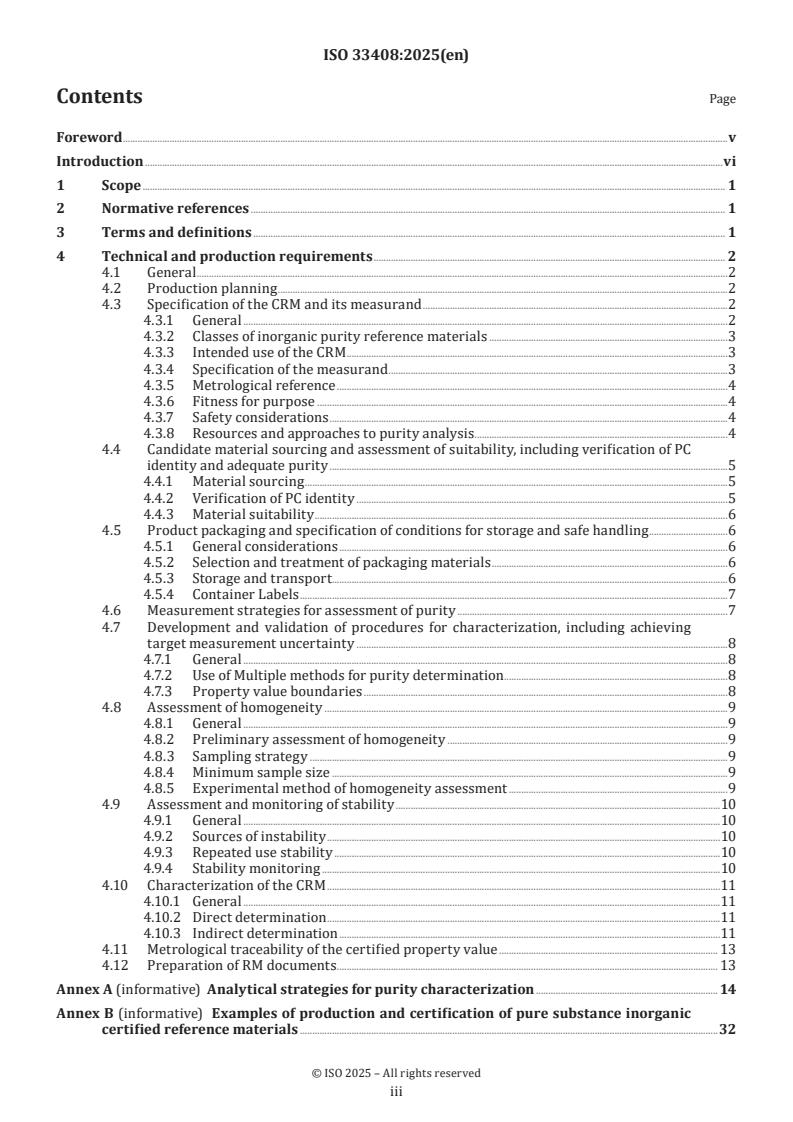
Contents Page
Foreword .v
Introduction .vi
1 Scope . 1
2 Normative references . 1
3 Terms and definitions . 1
4 Technical and production requirements . 2
4.1 General .2
4.2 Production planning .2
4.3 Specification of the CRM and its measurand .2
4.3.1 General .2
4.3.2 Classes of inorganic purity reference materials .3
4.3.3 Intended use of the CRM .3
4.3.4 Specification of the measurand .3
4.3.5 Metrological reference .4
4.3.6 Fitness for purpose .4
4.3.7 Safety considerations .4
4.3.8 Resources and approaches to purity analysis .4
4.4 Candidate material sourcing and assessment of suitability, including verification of PC
identity and adequate purity .5
4.4.1 Material sourcing .5
4.4.2 Verification of PC identity .5
4.4.3 Material suitability .6
4.5 Product packaging and specification of conditions for storage and safe handling .6
4.5.1 General considerations .6
4.5.2 Selection and treatment of packaging materials .6
4.5.3 Storage and transport.6
4.5.4 Container Labels .7
4.6 Measurement strategies for assessment of purity .7
4.7 Development and validation of procedures for characterization, including achieving
target measurement uncertainty .8
4.7.1 General .8
4.7.2 Use of Multiple methods for purity determination .8
4.7.3 Property value boundaries .8
4.8 Assessment of homogeneity .9
4.8.1 General .9
4.8.2 Preliminary assessment of homogeneity .9
4.8.3 Sampling strategy .9
4.8.4 Minimum sample size .9
4.8.5 Experimental method of homogeneity assessment .9
4.9 Assessment and monitoring of stability .10
4.9.1 General .10
4.9.2 Sources of instability .10
4.9.3 Repeated use stability .10
4.9.4 Stability monitoring .10
4.10 Characterization of the CRM .11
4.10.1 General .11
4.10.2 Direct determination .11
4.10.3 Indirect determination .11
4.11 Metrological traceability of the certified property value . 13
4.12 Preparation of RM documents . 13
Annex A (informative) Analytical strategies for purity characterization . 14
Annex B (informative) Examples of production and certification of pure substance inorganic
certified reference materials .32
iii
Bibliography .52
iv
Foreword
ISO (the International Organization for Standardization) is a worldwide federation of national standards
bodies (ISO member bodies). The work of preparing International Standards is normally carried out through
ISO technical committees. Each member body interested in a subject for which a technical committee
has been established has the right to be represented on that committee. International organizations,
governmental and non-governmental, in liaison with ISO, also take part in the work. ISO collaborates closely
with the International Electrotechnical Commission (IEC) on all matters of electrotechnical standardization.
The procedures used to develop this document and those intended for its further maintenance are described
in the ISO/IEC Directives, Part 1. In particular, the different approval criteria needed for the different types
of ISO document should be noted. This document was drafted in accordance with the editorial rules of the
ISO/IEC Directives, Part 2 (see www.iso.org/directives).
ISO draws attention to the possibility that the implementation of this document may involve the use of (a)
patent(s). ISO takes no position concerning the evidence, validity or applicability of any claimed patent
rights in respect thereof. As of the date of publication of this document, ISO had not received notice of (a)
patent(s) which may be required to implement this document. However, implementers are cautioned that
this may not represent the latest information, which may be obtained from the patent database available at
www.iso.org/patents. ISO shall not be held responsible for identifying any or all such patent rights.
Any trade name or trademark used in this document is information given for the convenience of users and
does not constitute an endorsement.
For an explanation of the voluntary nature of standards, the meaning of ISO specific terms and expressions
related to conformity assessment, as well as information about ISO's adherence to the World Trade
Organization (WTO) principles in the Technical Barriers to Trade (TBT), see www.iso.org/iso/foreword.html.
This document was prepared by Technical Committee ISO/TC 334, Reference materials.
Any feedback or questions on this document should be directed to the user’s national standards body. A
complete listing of these bodies can be found at www.iso.org/members.html.
v
Introduction
Reference materials (RMs) play an important role in measurement processes and support sound, widely
recognized measurement systems. ISO 17034 specifies general requirements to be met by reference material
producers (RMPs), including for the production of certified reference materials (CRMs). CRMs play a key
role in ensuring that measurements are comparable across time and space and are used by laboratories to
establish metrological traceability of their measurement results to appropriate references.
This document outlines recommendations conforming to the general requirements of ISO 17034 for
production of pure metal or their corresponding crystalline salt CRMs intended for direct use for calibration
of appropriate measurement instrumentation or subsequent preparation of solution calibration CRMs.
Technical guidance is provided on key aspects of the production of such CRMs, including assessment of
their homogeneity and stability as well as recommended approaches for characterization and assignment of
certified purity values.
vi
International Standard ISO 33408:2025(en)
Guidance for the production of pure inorganic substance
certified reference materials
1 Scope
This document gives specific technical guidance for the production of pure metals or their corresponding
crystalline salt certified reference materials (CRMs) in accordance with the general requirements of
ISO 17034.
This document is only applicable to solid pure metal and crystalline salt CRMs, including candidate materials,
unless otherwise noted.
2 Normative references
The following documents are referred to in the text in such a way that some or all of their content constitutes
requirements of this document. For dated references, only the edition cited applies. For undated references,
the latest edition of the referenced document (including any amendments) applies.
ISO/IEC 9000, Quality management systems — Fundamentals and vocabulary
ISO/IEC 17000, Conformity assessment — Vocabulary and general principles
ISO 17034:2016, General requirements for the competence of reference material producers
ISO/IEC 80000-9, Quantities and units — Part 9: Physical chemistry and molecular physics
ISO Guide 30, Reference materials — Selected terms and definitions
ISO/IEC Guide 99, International vocabulary of metrology — Basic and general concepts and associated terms (VIM)
3 Terms and definitions
For the purposes of this document, the terms and definitions given in ISO/IEC 17000, ISO 9000, ISO 80000-9,
ISO Guide 30, ISO/IEC Guide 99 and the following apply.
ISO and IEC maintain terminology databases for use in standardization at the following addresses:
— ISO Online browsing platform: available at https:// www .iso .org/ obp
— IEC Electropedia: available at https:// www .electropedia .org/
3.1
primary component
PC
principal chemical species of interest in the certified reference material
Note 1 to entry: A perfectly pure material remains an ideal concept because chemical species other than the PC will
always be present in a material, even in very small amounts.
Note 2 to entry: The chemical species of interest is either an element or a compound of an element.
Note 3 to entry: For certain elements, unambiguous definition of the chemical species requires the specification of
isotopic composition or molar mass.
3.2
impurity component
IC
any chemical component of the certified reference material that is not the primary component (3.1)
3.3
purity
quantity ratio of the primary component (3.1) in the certified reference material
Note 1 to entry: Purity of metal and metal salt CRMs is usually expressed as the mass fraction of the primary component
(3.1) PC in the CRM.
Note 2 to entry: Purity of a salt is the sum of the fractions of the cation and the anion. For example, w = w + w ,
NaCl Na Cl
where w is the mass fraction of component x.
x
4 Technical and production requirements
4.1 General
[1]
The production of a CRM requires diligent planning, as generally described in ISO 17034 and in ISO 33405 .
Central to this effort is clear specification of the intended uses of the CRM and characterization appropriate
for these purposes. The following subclauses (4.2 to 4.12) provide an overview of considerations relevant to
the production of high-purity inorganic CRMs.
4.2 Production planning
The production of a CRM requires the following:
a) specification of the CRM and its measurand;
b) candidate material sourcing and assessment of suitability, including verification of PC identity and
demonstration of adequate purity;
c) product packaging and specification of conditions for storage and safe handling;
d) selection of approaches to purity assessment of the CRM;
e) development and validation of procedures to achieve target measurement uncertainty;
f) assessment of homogeneity;
g) assessment and monitoring of stability;
h) characterization of the CRM;
i) consideration of metrological traceability of the certified property value;
j) preparation of reference material (RM) documents.
4.3 Specification of the CRM and its measurand
4.3.1 General
The intended use, specifications and relevant properties of the CRM should be clearly stated at the outset of
the production process. This can include, but is not limited to: intended use, specification of the measurand,
appropriate metrological reference of the certified value, fitness for purpose, safety and resources.
4.3.2 Classes of inorganic purity reference materials
For industrial applications of high-purity materials, the key quality parameter is the overall purity, which
is often denoted as “N”. N refers to the number of nines in the purity statement of a metal. For example, 4N
nickel corresponds to a purity of 99,99 % (four nines). For reference materials, especially CRMs intended for
calibration, the most relevant indicator is the overall uncertainty. As metal purity CRMs represent direct
realizations of an SI unit and appear within the chain of subsequent calibrations (or sometimes material
preparations), low uncertainties are of paramount importance.
[2]
Inorganic reference materials could be classed into the following categories :
a) Class A: target expanded uncertainties below 0,001 %.
Purity determination of metallic element CRMs using the indirect assessment approach (i.e., mass
balance), and associated expanded measurement uncertainties, is most adequate. A commercial purity
statement above 5N is best for material sourcing.
b) Class B: target expanded uncertainties between 0,001 % and 0,01 %.
Purity determination of metallic element CRMs using the indirect assessment approach (i.e., mass
balance), and associated expanded measurement uncertainties, is most adequate. A commercial purity
statement between 4N and 5N is best for material sourcing.
c) Class C: target expanded uncertainties between 0,01 % and 0,1 %.
Purity determination of metallic elements to be used for preparation of calibration solutions using a
direct metal assay approach yielding expanded measurement uncertainties typically above 0,05 % is
most adequate. A commercial purity statement above 3N is adequate for material sourcing.
d) Class D: target uncertainties equal or greater than 0,1 %.
Adequate for in-house standard preparation, verified by atomic spectroscopy methods against a
solution CRM.
Inorganic purity CRMs intended for calibration purposes should typically be of class C or above.
4.3.3 Intended use of the CRM
It is important to consider the intended use of the CRM because it can affect various aspects of the CRM
production process, including the verification of the suitability of the sourced material. Pure substances
constitute the source of primary measurement standards in most traceability chains in chemistry. The
demand for such a CRM is usually recognized through engagement with the intended user community.
The measurement needs that are commonly served include improved accuracy of relevant measurement
procedures, establishment of metrological traceability and regulatory compliance for chemical testing
laboratories.
Such CRMs are typically used for the calibration of measuring instruments and measurement systems.
Impurities in a CRM used for this purpose may create interferences in a measurement method. While the
presence of such interferences (impurities) would not invalidate the certified purity value of the CRM, it may
render the CRM suboptimal for use with some measurement methods. When the PC of the CRM is intended
to be used as a spike for the preparation of a multiple-component calibration solution, any co-introduced
impurity species may lead to biases derived from the gravimetric preparation process of the multi-
component calibration solution. Species in each of these materials, present as either a PC or impurity species,
should be comprehensively evaluated during purity assessments. The decision as to which impurities are
significant depends on the intended use of the CRM and the producer should include them as part of the
specification for the material.
4.3.4 Specification of the measurand
A clear and unambiguous specification of the measurand is key to the production planning. The certified
purity value of a CRM is usually expressed as the mass fraction and sometimes as amount fraction or amount
content of the PC in the material. The definition of the PC can require specification of its molar mass or
isotopic composition.
4.3.5 Metrological reference
ISO 17034 requires the metrological traceability of certified values to be established for CRMs in accordance
[3]
with ISO/IEC 17025 .
The metrological reference system is principally dependent upon the purpose of the CRM and the
measurement community it is intended to serve. The SI, a coherent system widely used in commerce and
science, is the most appropriate system of units for most chemical measurements. The certified purity value
of a CRM is ideally obtained by, but not limited to, the practical realization of SI measurement units.
4.3.6 Fitness for purpose
Fitness for purpose of a measurement is the extent to which the measurement result meets the stated
requirement for which the measurements are being made. Formal definitions can be found in various
sources, such as Reference [4]. For the CRM to be fit-for-purpose, the uncertainty in the certified value should
be small enough to be useful in the measurement process. This is especially crucial for CRMs intended for
calibration.
NOTE A measured property value without associated uncertainty does not conform to the definition of the
certified value of a CRM specified in ISO 17034.
4.3.7 Safety considerations
In regard to workplace health and safety considerations, the reference material producer (RMP) should
conduct a risk assessment, which can be replaced by the RMP’s pre-established standard safety procedures
compliant with local regulations, to establish that appropriate facilities and safeguards are in place to
process the candidate material.
4.3.8 Resources and approaches to purity analysis
Considerations for resource requirements are described in ISO 17034. CRM characterization should be fit-
for-purpose and achievable with available laboratory resources, including labour, packaging materials and
candidate materials. Allocation of these resources and anticipated cost recovery through CRM distribution
are key considerations that govern the practicality of CRM production. Costs largely depend upon the rigour
of analytical methods selected for characterization. For CRMs, purity determination can be accomplished
through either one or a combination of two basic approaches, “direct” and “indirect”, as described in 4.6.
[5],[6]
The target measurement uncertainty should be considered prior to characterization. If available, the
use of two or more independent methods underpinned by different measurement principles can be used to
evaluate possible systematic errors. Analyst expertise and preliminary experiments conducted for method
development can generally provide realistic expectations of measurement uncertainty associated with
specific measurement techniques and assist with experimental design for CRM characterization using either
approach to purity analysis.
Statistical methods can also be employed to estimate optimal experiment design for a given set of
[7]
constraints, including the target measurement uncertainty. Such experimental design should take into
account sampling that is required to adequately assess homogeneity across the entire lot of candidate CRM.
[1]
As such, the number of units in the production lot should be known prior to development of methods for
CRM characterization.
4.4 Candidate material sourcing and assessment of suitability, including verification of PC
identity and adequate purity
4.4.1 Material sourcing
Candidate materials can be sourced commercially, through custom synthesis or from refinement of materials.
Factors that should be considered in screening such materials include affordability, purity, homogeneity and
stability.
Impurities can have a significant effect on the accuracy of purity analyses. The RMP can conduct further
purification of the candidate material when a sufficiently pure material cannot be sourced. The RMP should
weigh the advantages of purification against the cost of the process and any other potential changes to
material composition during this process.
High-purity metallic materials are commercially available for a number of elements and represent an
ideal starting point for CRM development. RMPs should seek to acquire sufficiently pure material. Metallic
materials should be sourced in a form (ingot, pellets, shots, powder, etc.) most appropriate for future use,
taking into consideration the RMPs’ capability to further process or subdivide the material. Effort should
be invested to acquire candidate materials offering low surface-to-volume ratios to reduce the impact of
adsorbed gases and the degree of surface oxidation and contamination; denser forms such as ingots,
rods or wires are recommended, powders are to be avoided. Note that even some compact materials can
contain higher mass fractions of impurities such as oxides, depending on the production technique; spheres
produced by rolling a metal sheet into a ball should be avoided.
When the candidate PC material can only be sourced as a corresponding salt, usually because of the
reactivity of the metallic form (e.g., lithium as carbonate or sodium as chloride), the RMP may grind and
sieve the bulk material to needed consistency to improve homogeneity. Material with uniform particle size
distribution is less prone to spatial stratification during packaging, storage and transportation.
Usually, any processing such as cutting, grinding or sieving should be carefully considered from a
contamination control point of view and should be kept to minimum.
It is desirable that the estimated PC mass fraction is at least 0,999 (3N, see 4.3.2) in the candidate material,
but this requirement is commensurate with its desired fit-for-purpose end use. During material sourcing,
commercial purity specification (certificates of analysis, information sheets, etc.) claiming various levels
of purity should be carefully examined along with the impurity profile of the material to ensure that all
possible sources of impurity were considered by the manufacturer for the purpose of purity assignment.
It is an industry practice of reporting only functionally relevant impurities, often omitting dissolved gases,
halogens, etc., which could be the most significant impurities in high-purity metals.
4.4.2 Verification of PC identity
The identity of a PC is critical for any chemical CRM. ISO 17034 requires the RMP to address the verification
of the identity of the PC.
The identity of the PC can be specified as an element, metal, or compound with defined composition
containing the given metal (i.e., metal halide, oxide, etc.).
When the target uncertainty for purity of the PC is comparable to that of typical variation of its isotopic
composition and consequently the molar mass of the PC, definition of the PC may require assessment of the
molar mass or isotopic composition of the PC.
The RMP should utilize analytical techniques such as inductively coupled plasma optical emission
spectrometry (ICP-OES), inductively coupled plasma mass spectrometry (ICP-MS) or X-ray fluorescence
spectrometry (XRF) to confirm the identity of the PC. When isotopic analysis is warranted, isotope ratio mass
spectrometry (IR-MS), multicollector ICP-MS or thermal ionization mass spectrometry (TIMS) may be used.
4.4.3 Material suitability
A suitable candidate material is one that is of the correct physical form for its intended use and can be
sufficiently characterized to achieve target uncertainties. Overall impurity levels and profiles are often
good initial indicators of suitability. A preliminary experimental effort should be made to verify that a
candidate material meets acceptance criteria for purity and homogeneity. The suitability assessment should
be conducted with an appropriate rigor to provide a go/no-go decision for further processing of the CRM.
4.5 Product packaging and specification of conditions for storage and safe handling
4.5.1 General considerations
The nature of the product packaging, especially the primary packaging material, can significantly impact
the integrity of the material and the stability of the property values. Therefore, packaging should be selected
carefully and its impacts studied under storage and transport conditions.
Factors that can influence the choice of packaging material include, but are not limited to:
— hygroscopicity, air, moisture sensitivity of the CRM material;
— the physical state and form of the CRM material (e.g., liquid vs. solid; ingot vs. powder);
— the amount per unit to be packaged;
— temperature conditions for storage and transport;
— inertness;
— handling aspects at the user laboratory.
4.5.2 Selection and treatment of packaging materials
Preliminary studies to assess candidate packaging materials or different storage conditions are
recommended. The CRMs can be packaged in primary containment glass vessels, such as sealed ampoules or
vials. In order to protect the material from environmental conditions that could impact the integrity of the
CRM (e.g., moisture, contact with oxygen), the following packaging options should be considered:
— amber or clear glass vials;
— screw cap or septum lid with crimped aluminium cap;
— inert gas/nitrogen or air to fill the glass storage vial headspace.
Ampoules could be sealed under an inert atmosphere (e.g., nitrogen, argon), whereas with bottles this is not
typically the case.
The RMP should also consider any necessary pre-treatment of the packaging materials, e.g., cleaning.
To ensure that the candidate CRM material is properly transferred to a selected packaging material upon
production, the process should be controlled and documented, see ISO 17034.
After the establishment of a suitable process for packaging or filling, ISO 17034 requires the RMP to conduct
a stability assessment of all relevant properties of the CRM under expected storage and transport conditions,
[1]
as specified in ISO 17034 and ISO 33405 .
4.5.3 Storage and transport
Containers for CRM storage should sufficiently isolate the material from the environment. Isolation from
moisture or air can be key considerations for material selection for the storage conditions for many CRMs.
Equally important is the nature of the transport conditions. The conditions of shipment, including the
provision to provide all necessary documents (e.g., permits, statement of origin) for customs clearance, are
the responsibility of the RMP.
4.5.4 Container Labels
ISO 17034 requires appropriate labels to be applied during product packaging; guidance can be found in
[8]
ISO 33401 .
4.6 Measurement strategies for assessment of purity
The RMP should plan a measurement strategy for determination of purity of the candidate material that is
fit for its intended use and should consider measurement procedures that collectively ensure:
a) adequate specificity for PC measurement;
b) an adequate survey of impurities;
c) sufficient accuracy of measured purity value;
d) sound evidence for assigning a sufficiently small measurement uncertainty.
NOTE 1 Numerous complementary instrumental techniques are available for purity assessment. Hence, it is
possible for the strategy adopted to vary with the instrumentation and other resources available to the RMP.
The use of one or a combination of appropriate measurement procedures can meet the objectives for
producing a CRM with metrologically traceable certified values. Direct and/or indirect approaches to the
certification of purity may be pursued, as outlined below.
— Direct approach: determination of relative quantities, such as mass fraction of the PC, without
necessarily quantifying all impurities. This approach commonly implements techniques such as quantitative
coulometry, titrimetry, gravimetry or ICP-MS and a number of other atomic spectroscopy methods.
NOTE 2 Purity values obtained using the direct approach can require correction for some relevant impurities. For
example, argentometry of sodium chloride determines the total halogen content in the material and requires assaying
of substances that react with silver to form precipitates such as bromine and iodine to obtain chlorine contents.
Further, EDTA titration determines the total EDTA-chelatable elemental content and requires the assessment of EDTA-
chelatable impurity content by other means.
— Indirect approach: determination of purity through a comprehensive survey of impurity components,
where the purity, w , is calculated using Formula (1):
PC
ww=−1 ∑ (1)
PC IC
i
where
w is the mass fraction of the PC (kg/kg);
PC
th
w is the mass fraction of the i impurity component (kg/kg).
IC
i
A thorough indirect approach requires more resources and varied expertise than a direct approach;
however, it can lead to significantly lower uncertainties on purity estimates when the starting material is
highly pure. All stable elements of the Periodic Table should be considered as potential impurities and efforts
made for their characterization. Carbon, nitrogen, oxygen and hydrogen, and in some cases the halogens, are
frequently present in high-purity metals. More than one analytical approach is typically required to detect
all potential elemental impurities. Typically, highly sensitive atomic spectroscopy approaches such as glow
discharge mass spectrometry (GD-MS) and ICP-MS are used for metallic impurity characterization along
with CNOH combustion analysers for carbon, nitrogen, oxygen and hydrogen detection and carrier gas hot
extraction for other elements (dissolved gases).
Selection of methods for purity assessment should leverage information about material composition
gathered during the initial suitability analysis. A preliminary investigation of impurities should indicate
the most appropriate methods for purity assessment. Furthermore, the achievable uncertainty in the
certified value is likely larger for materials with high levels of impurities than for those with lower levels
of impurities, simply as a result of the quadrature summation of all relative uncertainties of impurities.
When applying the indirect approach to assess purity of a candidate material, the time and effort required
to identify and quantify each impurity increases as the number of impurities increases. If such an analysis
becomes too complicated or costly, the RMP may consider the purification of the candidate material to
remove impurities and reduce the effort required for purity assessment, or undertake a reassessment of
the availability of alternative starting materials. Materials of higher purity are also generally more suitable
from the perspectives of the end user.
4.7 Development and validation of procedures for characterization, including achieving
target measurement uncertainty
4.7.1 General
Specification of acceptable uncertainty in the certified purity value should be made with a clear
understanding of the intended use of the CRM.
CRM purity and associated uncertainty should be fit for intended use when used to establish metrological
traceability for a measurement procedure. Note that the uncertainty of the certified purity value should also
realistically reflect the homogeneity and stability of the production batch. General guidance for the evaluation
[9] [10],[11]
of measurement uncertainty is provided in ISO/IEC Guide 98-3 (GUM) and its supplements .
[1]
Assessment of batch homogeneity and stability for CRM production is discussed in ISO 33405. These
sources of uncertainty should be evaluated during material suitability tests and considered when planning
experiments.
An optimal experimental design is one which uses a minimum amount of resources to provide a sufficient
amount of information. For CRMs, this means efficiently conducting measurements to achieve results with
suitably small uncertainty. Expert judgement should ultimately decide the combination of appropriate
analytical procedures best suited to the nature and composition of the material. In addition to achieving
the smallest practical measurement uncertainty of a certified value, the execution of a plan for adequate
characterization is contingent upon resources available to the RMP. Batch size is an important factor in
sampling schemes and experimental design. General guidance on approaches to experimental design
and adequate material sampling to achieve target measurement uncertainty under these criteria is
[1],[7],[12]
available .
Examples of purity analyses for characterization of CRMs are provided in Annex B.
4.7.2 Use of Multiple methods for purity determination
When well-characterized CRMs are needed, the use of multiple, uncorrelated methods for characterization
is recommended. This is often challenging, considering the scope, especially when indirect approaches are
used that require the determination/assessment of all possible elemental impurities.
When multiple measurement results are consistent, confidence gained through this corroboration can be
reflected in the evaluation of uncertainty of a certified purity value. Information collected through several
[13]
procedures should be combined in a way that is chemically and metrologically justifiable. This is crucial
when results from different methods are inconsistent or the composition of the material is complex. When
a direct approach is used for purity determination, a survey of key elemental impurities (representing a
minimum of 90 % of total impurities) should be conducted and reported along with the PC mass fraction in
the CRM.
4.7.3 Property value boundaries
The RMP should consider the natural limit of chemical purity, 1 kg/kg (i.e., 100 %), during the characterization
of CRMs. This is particularly relevant to candidate materials with very few low-level impurities. Generally,
the entire coverage interval defined by the uncertainty of a certified value should lie between 0 kg/kg and
1 kg/kg.
When a material is known to contain a small mass fraction of total impurities, the variability of data from a
direct measurement (e.g., coulometry) can yield purity estimates that are not entirely within this interval.
For such cases, the measurement function or coverage interval can be constrained to observe the natural
[14]-
limits. This can be achieved in accordance with approaches described in the GUM and other documents.
[18]
Additional resources for the practical treatment of asymmetric coverage intervals near natural limits
[14],[18]
are available .
Similar considerations should be made for measurements w that are near limits of detection. If the
Ii
uncertainty of a high-purity value determined by an indirect mass balance method is expected to be small, it
should be substantiated by evidence from appropriately sensitive procedures used to determine w .
Ii
4.8 Assessment of homogeneity
4.8.1 General
Candidate materials selected for CRM preparation are expected to have a high degree of homogeneity.
Certified values for such materials are often expected to have very small uncertainties, making even a small
amount of heterogeneity potentially impactful.
Generally, only the homogeneity of the PC should be assessed. Depending on the circumstances, other
aspects should be assessed; e.g., if the content of an impurity is also certified in the CRM, the homogeneity of
the impurity should be assessed as well.
4.8.2 Preliminary assessment of homogeneity
Before packaging, it is recommended that a preliminary assessment of homogeneity be performed to
ensure that the candidate material is suitably uniform. This can be particularly beneficial if the sample is
an agglomerated powder or granular. In the event that the candidate material demonstrates a significant
degree of heterogeneity, the RMP can consider further homogenization of the sample. To avoid unnecessary
risk of contamination and exposure to reactive environments, homogenization need only to be performed
when the variance due to heterogeneity would otherwise be too large to achieve a target uncertainty in the
certified purity value. If there is an unacceptable risk of contamination or environmental exposure expected
during homogenization, a new candidate material should be sought.
4.8.3 Sampling strategy
When sampling crystalline solids or agglomerated powders, the position of the samples within the material
container should be considered to address impurity content stratification throughout the unit, in addition
to the need for adequately representative sampling across units of the produced batch. For example, the
material should be collected from the upper, middle and lower portions of the container, from the inside and
outside portions of the bulk, or from portions of the co
...