

ISO/TR 20123:2023
(Main)Automation systems and integration — Industrial data — Nuclear digital ecosystem specifications
General Information
- Abstract
This document provides: — a review and summary of the adoption of digital methods and technology in the national nuclear sectors; — a summary of the state of the art of some of the standards supporting the digital representation and interoperability of industrial data; — orientation on the use of these standards for model-based systems engineering (MBSE) in order to achieve a nuclear digital ecosystem (NDE); — a high-level roadmap of the stages by which this ecosystem can be achieved, taking into account the maturity of the actors of the ecosystem, their relationships and the added value of using advanced standards. NOTE The complete reports from the participating entities are presented in Annexes A to G. This document includes the following: — the systems composing the nuclear facilities and their input, output, and other products resulting from interactions in the nuclear system or with its environment; — the material accounting and the corresponding requirements; — waste management: all types of nuclear waste produced during processes and activities, and their properties are considered for a seamless management of information in the whole value chain of the nuclear ecosystem.
- Status
- Published
- Publication Date
- 11-Sep-2023
- Technical Committee
- ISO/TC 184/SC 4 - Industrial data
- Drafting Committee
- ISO/TC 184/SC 4 - Industrial data
- Current Stage
- 6060 - International Standard published
- Start Date
- 12-Sep-2023
- Due Date
- 18-May-2024
- Completion Date
- 12-Sep-2023


Overview
ISO/TR 20123:2023 - "Automation systems and integration - Industrial data - Nuclear digital ecosystem specifications" is a technical report (first edition, 2023) that provides a consolidated review and practical orientation for adopting digital methods and standards across the national nuclear sectors. The report outlines how to build a Nuclear Digital Ecosystem (NDE) by applying industrial data standards and Model-Based Systems Engineering (MBSE) to the full nuclear lifecycle: new build, operations & maintenance, decommissioning, material accounting and waste management. Annexes A–G contain detailed national reports from participating entities.
Key topics and requirements
The document focuses on high‑level guidance and standardization priorities rather than prescriptive technical specifications. Key technical topics include:
- Model‑based Systems Engineering (MBSE) orientation and how standardized models support systems engineering across nuclear facilities.
- Industrial data and interoperability: review of standards that enable digital representation and exchange of engineering data for plants, components and processes.
- Fundamental NDE pillars such as configuration management, requirements management, breakdown structure management and reference data management.
- Standards‑based models and formats: discussion of standardized industrial models (e.g., ISO 15926, ISO 10303 series, and BIM standards referenced in the TR) for semantic and geometric data exchange.
- Advanced methodologies: property/process modelling, semantic modelling, knowledge representation, digital twin (DT) considerations, 3‑D geometry/topology and long‑term archiving (LOTAR).
- Enterprise interoperability framework: barriers (organizational, methodological, technological, semantic), cybersecurity considerations and maturity roadmap for stakeholders.
- Roadmap and strategy: high‑level staged roadmap for achieving an NDE aligned with actor maturity and added value of advanced standards.
Practical applications
ISO/TR 20123:2023 is intended to guide the development and integration of digital tools and data flows across the nuclear value chain. Practical applications include:
- Creating standardized digital models for plant design, construction, operation and decommissioning.
- Establishing configuration and reference data management practices that support traceability and material accounting.
- Enabling semantic interoperability between engineering, maintenance, safety and waste‑management systems.
- Informing cybersecurity and long‑term archiving strategies for nuclear digital assets.
- Supporting business cases for digital transformation in national nuclear programs.
Who should use this standard
- Nuclear systems engineers and MBSE practitioners
- Digital transformation and IT/OT integration managers in the nuclear sector
- Plant operators, regulators and safety authorities interested in digital records and material accounting
- Vendors, integrators and software developers delivering digital twins, PLM, BIM and industrial data solutions for nuclear facilities
Related standards
The report references and reviews relevant industrial data standards such as ISO 15926, ISO 10303 series and BIM standards; readers should consult these standards for detailed data models and exchange formats.
Get Certified
Connect with accredited certification bodies for this standard

BSI Group
BSI (British Standards Institution) is the business standards company that helps organizations make excellence a habit.

DVS-ZERT GmbH
German welding certification society.
CARES (UK Certification Authority for Reinforcing Steels)
UK certification for reinforcing steels and construction.
Sponsored listings
Frequently Asked Questions
ISO/TR 20123:2023 is a technical report published by the International Organization for Standardization (ISO). Its full title is "Automation systems and integration — Industrial data — Nuclear digital ecosystem specifications". This standard covers: This document provides: — a review and summary of the adoption of digital methods and technology in the national nuclear sectors; — a summary of the state of the art of some of the standards supporting the digital representation and interoperability of industrial data; — orientation on the use of these standards for model-based systems engineering (MBSE) in order to achieve a nuclear digital ecosystem (NDE); — a high-level roadmap of the stages by which this ecosystem can be achieved, taking into account the maturity of the actors of the ecosystem, their relationships and the added value of using advanced standards. NOTE The complete reports from the participating entities are presented in Annexes A to G. This document includes the following: — the systems composing the nuclear facilities and their input, output, and other products resulting from interactions in the nuclear system or with its environment; — the material accounting and the corresponding requirements; — waste management: all types of nuclear waste produced during processes and activities, and their properties are considered for a seamless management of information in the whole value chain of the nuclear ecosystem.
This document provides: — a review and summary of the adoption of digital methods and technology in the national nuclear sectors; — a summary of the state of the art of some of the standards supporting the digital representation and interoperability of industrial data; — orientation on the use of these standards for model-based systems engineering (MBSE) in order to achieve a nuclear digital ecosystem (NDE); — a high-level roadmap of the stages by which this ecosystem can be achieved, taking into account the maturity of the actors of the ecosystem, their relationships and the added value of using advanced standards. NOTE The complete reports from the participating entities are presented in Annexes A to G. This document includes the following: — the systems composing the nuclear facilities and their input, output, and other products resulting from interactions in the nuclear system or with its environment; — the material accounting and the corresponding requirements; — waste management: all types of nuclear waste produced during processes and activities, and their properties are considered for a seamless management of information in the whole value chain of the nuclear ecosystem.
ISO/TR 20123:2023 is classified under the following ICS (International Classification for Standards) categories: 25.040.40 - Industrial process measurement and control; 35.240.63 - IT applications in trade. The ICS classification helps identify the subject area and facilitates finding related standards.
ISO/TR 20123:2023 is available in PDF format for immediate download after purchase. The document can be added to your cart and obtained through the secure checkout process. Digital delivery ensures instant access to the complete standard document.
Standards Content (Sample)
TECHNICAL ISO/TR
REPORT 20123
First edition
2023-09
Automation systems and
integration — Industrial data
— Nuclear digital ecosystem
specifications
Systèmes d'automatisation et intégration — Données industrielles —
Spécifications de l'écosystème numérique nucléaire
Reference number
© ISO 2023
All rights reserved. Unless otherwise specified, or required in the context of its implementation, no part of this publication may
be reproduced or utilized otherwise in any form or by any means, electronic or mechanical, including photocopying, or posting on
the internet or an intranet, without prior written permission. Permission can be requested from either ISO at the address below
or ISO’s member body in the country of the requester.
ISO copyright office
CP 401 • Ch. de Blandonnet 8
CH-1214 Vernier, Geneva
Phone: +41 22 749 01 11
Email: copyright@iso.org
Website: www.iso.org
Published in Switzerland
ii
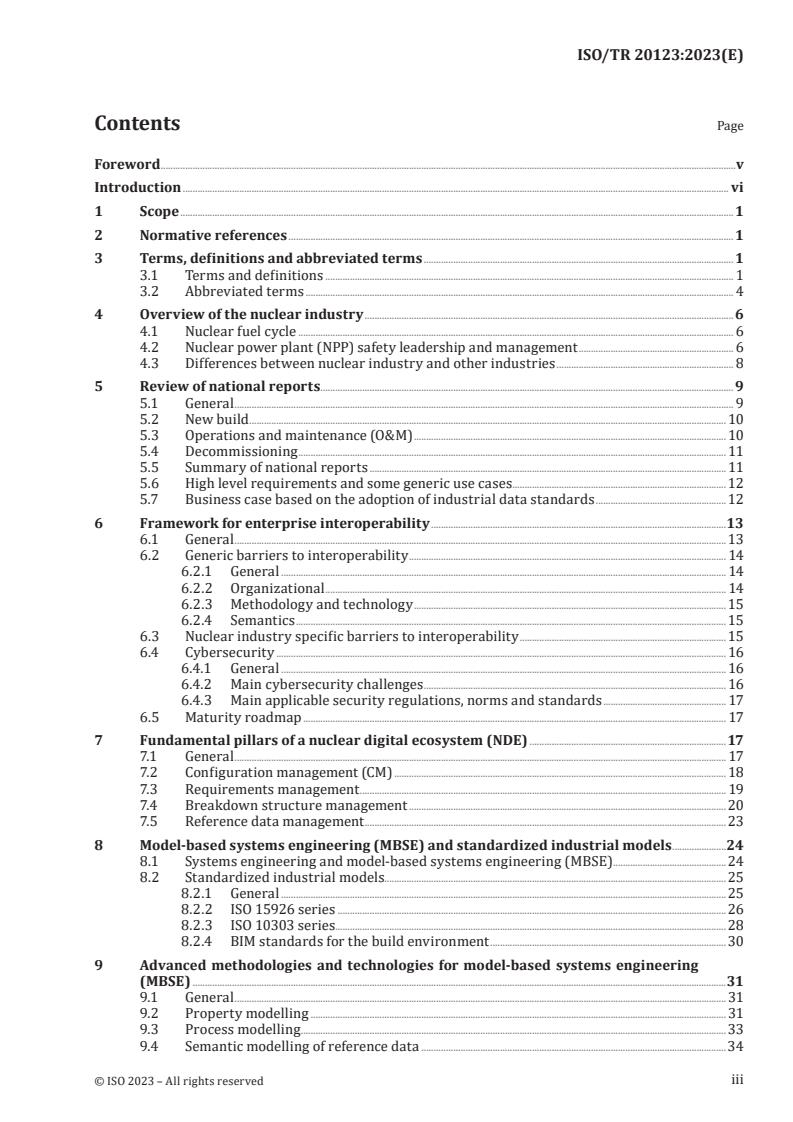
Contents Page
Foreword .v
Introduction . vi
1 Scope . 1
2 Normative references . 1
3 Terms, definitions and abbreviated terms . 1
3.1 Terms and definitions . 1
3.2 Abbreviated terms . 4
4 Overview of the nuclear industry .6
4.1 Nuclear fuel cycle . 6
4.2 Nuclear power plant (NPP) safety leadership and management . 6
4.3 Differences between nuclear industry and other industries . 8
5 Review of national reports . 9
5.1 General . 9
5.2 New build . 10
5.3 Operations and maintenance (O&M) . 10
5.4 Decommissioning . 11
5.5 Summary of national reports . 11
5.6 High level requirements and some generic use cases .12
5.7 Business case based on the adoption of industrial data standards .12
6 Framework for enterprise interoperability .13
6.1 General .13
6.2 Generic barriers to interoperability . 14
6.2.1 General . 14
6.2.2 Organizational . 14
6.2.3 Methodology and technology . 15
6.2.4 Semantics . 15
6.3 Nuclear industry specific barriers to interoperability . 15
6.4 Cybersecurity . 16
6.4.1 General . 16
6.4.2 Main cybersecurity challenges . 16
6.4.3 Main applicable security regulations, norms and standards . 17
6.5 Maturity roadmap . 17
7 Fundamental pillars of a nuclear digital ecosystem (NDE) .17
7.1 General . 17
7.2 Configuration management (CM) . 18
7.3 Requirements management . 19
7.4 Breakdown structure management . 20
7.5 Reference data management . 23
8 Model-based systems engineering (MBSE) and standardized industrial models .24
8.1 Systems engineering and model-based systems engineering (MBSE). 24
8.2 Standardized industrial models. 25
8.2.1 General . 25
8.2.2 ISO 15926 series .26
8.2.3 ISO 10303 series . .28
8.2.4 BIM standards for the build environment .30
9 Advanced methodologies and technologies for model-based systems engineering
(MBSE) .31
9.1 General . 31
9.2 Property modelling . 31
9.3 Process modelling . 33
9.4 Semantic modelling of reference data .34
iii
9.5 Knowledge representation .34
9.6 Data quality .34
9.7 3-D geometry and topology. 35
9.8 Digital twin (DT) . 35
9.9 Long term archiving (LOTAR) . 37
9.10 Alternative methods, standards and tools to be explored .38
10 Proposed strategy and high-level road map .38
10.1 General .38
10.2 Proposed strategy . 39
10.3 Strategic structured roadmap for future standards development .40
10.3.1 General .40
10.3.2 Strong, simple, shared framework . 41
10.3.3 Methodology of application . 42
10.3.4 Technical guidelines . 42
10.3.5 Future work items . . . 42
10.4 Orientation for managers and practitioners of the nuclear industry . 43
10.4.1 General . 43
10.4.2 Systems engineering . 43
10.4.3 Methods and knowledge representation .44
10.4.4 Impact of digital technology on standards for the nuclear ecosystem .44
Annex A (informative) Nuclear power in China .45
Annex B (Informative) Nuclear power in France .52
Annex C (informative) Nuclear power in Japan .57
Annex D (informative) Nuclear power in the Netherlands .61
Annex E (informative) Nuclear power in the Republic of Korea .69
Annex F (informative) Nuclear power in the United Kingdom .71
Annex G (informative) Nuclear power in the United States of America (USA).74
Bibliography .82
iv
Foreword
ISO (the International Organization for Standardization) is a worldwide federation of national standards
bodies (ISO member bodies). The work of preparing International Standards is normally carried out
through ISO technical committees. Each member body interested in a subject for which a technical
committee has been established has the right to be represented on that committee. International
organizations, governmental and non-governmental, in liaison with ISO, also take part in the work.
ISO collaborates closely with the International Electrotechnical Commission (IEC) on all matters of
electrotechnical standardization.
The procedures used to develop this document and those intended for its further maintenance are
described in the ISO/IEC Directives, Part 1. In particular, the different approval criteria needed for the
different types of ISO document should be noted. This document was drafted in accordance with the
editorial rules of the ISO/IEC Directives, Part 2 (see www.iso.org/directives).
ISO draws attention to the possibility that the implementation of this document may involve the use
of (a) patent(s). ISO takes no position concerning the evidence, validity or applicability of any claimed
patent rights in respect thereof. As of the date of publication of this document, ISO had not received
notice of (a) patent(s) which may be required to implement this document. However, implementers are
cautioned that this may not represent the latest information, which may be obtained from the patent
database available at www.iso.org/patents. ISO shall not be held responsible for identifying any or all
such patent rights.
Any trade name used in this document is information given for the convenience of users and does not
constitute an endorsement.
For an explanation of the voluntary nature of standards, the meaning of ISO specific terms and
expressions related to conformity assessment, as well as information about ISO's adherence to
the World Trade Organization (WTO) principles in the Technical Barriers to Trade (TBT), see
www.iso.org/iso/foreword.html.
This document was prepared by Technical Committee ISO/TC 184, Automation systems and integration,
Subcommittee SC 04 Industrial data.
Any feedback or questions on this document should be directed to the user’s national standards body. A
complete listing of these bodies can be found at www.iso.org/members.html.
v
Introduction
The purpose of this document is to bring all current knowledge together about standardization of
information on nuclear installations in the nuclear industry.
This document provides orientations for how the concept of an industrial digital ecosystem can
be realised for the nuclear industry, its installations and practices. These orientations are based on
surveys of the state of the art for the adoption of digital methods and technology for the nuclear sectors
by the participating members of ISO/TC 184/SC 4 and a review of the current state of the standards
for the digital representation of engineering data that are the responsibility of ISO/TC 184/SC 4 and
international standards from other TCs/SCs from ISO, IEC, CEN and some de-facto international
industry standards.
The objective is to provide the nuclear industry with a common framework to address the intertwined
aspects to manage digital information based on standards and related to nuclear facilities and materials.
The nuclear facilities are composed of all the physical structures, systems, and components: mining,
fuel manufacturing, nuclear material transport, nuclear power plants (NPPs), reprocessing plants,
waste management and disposal facilities.
This document aims to support operational processes in a nuclear ecosystem using digital tools to
produce, manage and share information.
It is based on the experience and skills of experts with generic competencies in standards for industrial
data, developed during the past years in the edition of standards for product modelling, plant modelling
and construction modelling associated with some specific experience of some members in nuclear
facilities lifecycle, the corresponding information and records management in the lifecycle.
This document will be updated when new technological advances become available, as many initiatives
in the field of the “Industry of the future” are underway, the most relevant of which is the development
of the digital twin (DT). The corresponding outcomes can be integrated in a viable roadmap with
steps to effectively guide practitioners of the nuclear ecosystem in implementing methodologies and
technologies to make effective the benefit of the proposed standards.
This document does not provide answers to all of the issues but does raise questions and identifies
barriers for successful implementation which will be addressed to create a digital ecosystem in the
nuclear industry. It does provide a simple conceptual framework and a roadmap to guide the actors of
the nuclear ecosystem.
To consolidate this perspective, this document has taken into account nuclear technology and the
constraints on the nuclear industry. Developing a standardization framework for the nuclear industry
could also be useful in order to face long standing issues met in conventional industries regarding
information management.
Radioactivity structures all of the activities in the nuclear industry and strongly impacts the needs and
the way of modelling facilities and of organising information to support the business processes.
Innovation and standardization will enable a nuclear digital ecosystem (NDE), which could be
downsized for conventional industries with specific lighter requirements.
This methodology offers the best guarantee to meet the specific needs of a nuclear ecosystem and to
reuse generic models, relationships, and standards already available or prepare their adaptation or
extension for the future.
vi
TECHNICAL REPORT ISO/TR 20123:2023(E)
Automation systems and integration — Industrial data —
Nuclear digital ecosystem specifications
1 Scope
This document provides:
— a review and summary of the adoption of digital methods and technology in the national nuclear
sectors;
— a summary of the state of the art of some of the standards supporting the digital representation and
interoperability of industrial data;
— orientation on the use of these standards for model-based systems engineering (MBSE) in order to
achieve a nuclear digital ecosystem (NDE);
— a high-level roadmap of the stages by which this ecosystem can be achieved, taking into account the
maturity of the actors of the ecosystem, their relationships and the added value of using advanced
standards.
NOTE The complete reports from the participating entities are presented in Annexes A to G.
This document includes the following:
— the systems composing the nuclear facilities and their input, output, and other products resulting
from interactions in the nuclear system or with its environment;
— the material accounting and the corresponding requirements;
— waste management: all types of nuclear waste produced during processes and activities, and their
properties are considered for a seamless management of information in the whole value chain of the
nuclear ecosystem.
2 Normative references
There are no normative references in this document.
3 Terms, definitions and abbreviated terms
3.1 Terms and definitions
For the purposes of this document, the following terms and definitions apply.
ISO and IEC maintain terminology databases for use in standardization at the following addresses:
— ISO Online browsing platform: available at https:// www .iso .org/ obp
— IEC Electropedia: available at https:// www .electropedia .org/
3.1.1
asset
item, thing or entity that has potential or actual value to an organization
[SOURCE: ISO/TS 18101:2019]
3.1.2
information
knowledge concerning objects, such as facts, events, things, processes (3.1.13), or ideas, including
concepts, that within a certain context has a particular meaning
[SOURCE: ISO/IEC 2382:2015, 2121271, modified — Field of application and notes to entry have been
removed]
3.1.3
data
reinterpretable representation of information (3.1.2) in a formalized manner suitable for communication,
interpretation, or processing
[SOURCE: ISO/IEC 2382:2015, 2121272, modified — Notes to entry have been removed]
3.1.4
data element
member of a data set (3.1.5)
3.1.5
data set
logically meaningful group of data
[SOURCE: ISO/TS 18101-1:2019]
3.1.6
data quality
degree to which a set of inherent characteristics of data fulfils requirements
Note 1 to entry: Examples of requirements for quality data also include data integrity, data validation, data
portability, data synchronization and the data provenance record.
[SOURCE: ISO 8000-2:2022, 3.8.1, modified — Note 1 to entry has been modified.]
3.1.7
digital ecosystem
distributed, adaptive, open, socio-technical system with properties of self-organisation, scalability and
sustainability inspired from natural ecosystems
[SOURCE: ISO/TS 18101-1:2019]
3.1.8
digital representation
manner in which information is stored for interpretation by a machine
[SOURCE: ASME Y 14.47 – 2019]
3.1.9
domain
field of special knowledge, which can be further subdivided according to requirements to support a
higher level of specialized detail
[SOURCE: ISO/TS 18101-1:2019]
3.1.10
information model
formal model of a bounded set of facts, concepts or instructions to meet a specified requirement
Note 1 to entry: In this context, the description of domain (3.1.9) entities in a digital ecosystem (3.1.7) addressing
lifecycle asset (3.1.1) management.
[SOURCE: ISO/TS 18101-1:2019]
3.1.11
interoperability
capability of two or more entities to exchange items in accordance with a set of rules and mechanisms
implemented by an interface in each entity, order to perform their specific tasks
Note 1 to entry: Examples of entities include devices, equipment, machines, people, processes, applications,
computer firmware and application software units, data exchange systems (3.1.17) and enterprises.
Note 2 to entry: Examples of items include services information, material in standards, design documents and
drawings, improvement projects, energy reduction programs, control activities, asset (3.1.1) description and
ideas.
Note 3 to entry: In this context, entities provide items to, and accept items from, other entities, and they use the
items exchanged in this way to enable them to operate effectively together.
[SOURCE: ISO/TS 18101-1:2019]
3.1.12
nuclear digital ecosystem
NDE
digital ecosystem (3.1.7) specialised for application to nuclear power facilities and related activities
Note 1 to entry: The objective is to provide principles, methodologies and technologies to enable sharing of shared
resources across nuclear industry and beyond, and their specialization in each specific domain and discipline.
Note 2 to entry: There is a trend to name these shared resources “Commons”
3.1.13
process, noun
set of interrelated or interacting activities that use inputs to deliver an intended result
[SOURCE: ISO 9000:2015, 3.4.1, modified — Notes to entry have been removed.]
3.1.14
property
named measurable or observable attribute, quality or characteristic of a system
3.1.15
reference data library
RDL
managed collection of reference data
[SOURCE: ISO 15926-1:2004]
3.1.16
requirement
need or expectation that is stated, generally implied or obligatory
[SOURCE: ISO 9000:2015, 3.6.4, modified — Notes to entry have been removed.]
3.1.17
system
combination of interacting elements organized to achieve one or more stated purposes
Note 1 to entry: A system is sometimes considered as a product or as the services it provides.
Note 2 to entry: In practice, the interpretation of its meaning is frequently clarified by the use of an associative
noun, e.g. aircraft system. Alternatively, the word “system” is substituted simply by a context-dependent
synonym, e.g. aircraft, though this potentially obscures a system principles perspective.
Note 3 to entry: A complete system includes all of the associated equipment, facilities, material, computer
programs, firmware, technical documentation, services and personnel required for operations and support to
the degree necessary for self-sufficient use in its intended environment.
Note 4 to entry: A system is also interacting with its environment.
3.1.18
system element
member of the combination of elements that constitutes a system (3.1.17)
3.2 Abbreviated terms
AI artificial intelligence
ALARA as low as reasonably achievable
ANN artificial neural network
APR advanced pattern recognition
BIM building information model (see ISO 16739-1)
BWR boiling water reactor
CAD computer aided design
CAE computer aided engineering
CDE common data environment
CDF core damage frequency
CFIHOS Capital Facilities Information Handover Specification
CM configuration management
CNS Convention on Nuclear Safety
DMS document management system
DT digital twin
EAM enterprise asset management
EPC engineering, procurement and construction
ERP enterprise resource planning
eSOMS electronic shift operations management system
ESPN nuclear pressure equipment (equipement sous pression nucléaire)
FAIR findable, accessible, interoperable end reusable
HLW high-level waste
HVAC heating, ventilation and air conditioning
ISDC International Structure for Decommissioning Costs (ISDC) of the OECD
IAEA International Atomic Energy Agency
IFC industry foundation classes (see ISO 16739-1)
IIoT industrial internet of things
IVV integration, verification and validation
K-PIM knowledge-centric plant information model
LD linked data
LLW low-level waste
LOTAR long term archiving
LTKR long term knowledge retention
MBSE model-based systems engineering
MR micro reactor
NIST National Institute of Standards and Technology (USA)
NLP natural language processing
NPP nuclear power plant
NRC Nuclear Regulatory Commission (USA)
O&M operation and maintenance
OECD Organisation for Economic Co-operation and Development
OO owner and operator
O&M operations and maintenance
PIM plant information model
PLM product lifecycle management
plant lifecycle management
PWR pressurized water reactor
RDF resource description framework
RDL reference data library
SMR small modular reactor
SNF spent nuclear fuel
SSC structure system component
SSoT single source of truth
SW semantic web
WANO World Association of Nuclear Operators
WBS work breakdown structure
4 Overview of the nuclear industry
4.1 Nuclear fuel cycle
[1]
The nuclear industry can be analysed starting with the fuel cycle, and includes all activities from
the uranium mining, fuel fabrication, construction of the nuclear installations, O&M of the nuclear
installations, decommissioning, fuel reprocessing, waste management and waste disposal.
Whilst reprocessing of nuclear fuel is possible, with facilities to manage the valuable material and the
waste produced during the whole fuel cycle, which prefigures a circular economy, it is currently not
regularly practiced in a large fraction of the world’s NPP fleet.
An integrated management of the data produced during all the fuel cycle and in all the facilities involved
in this cycle will bring a clear added value.
The lack of interoperability of data along this cycle is conservatively estimated from 1 % to 3 % of the
[2]
cost of investment of all of these facilities. At an international level, this represents tens of billions
of Euros. Data interoperability and traceability is moreover a regulatory requirement for the nuclear
industry.
With the extended use of digital tools at every step of the cycle, it is of the utmost importance that
standards support the interoperability of data which must be accessible for reuse for time spans of
more than 100 years.
Sharing a global understanding of the situation of the nuclear industry as a system of systems is key.
Systems engineering combined with MBSE in a digital environment offer the best available framework
of a global understanding.
Standards to support interoperability of the nuclear ecosystem are numerous and various and concern
plants, products, buildings, material, fuel, waste and the environment. The governance of these
standards is managed locally by subject matter experts to support specific needs of the actors.
4.2 Nuclear power plant (NPP) safety leadership and management
Safety is a critical issue in the nuclear industry, and the prime public concern of the 1986 Chernobyl
accident and the 2011 Fukushima I accident confirmed the concerns. This is reflected in IAEA CNS [73]:
— New NPPs are to be designed, sited, and constructed, consistent with the objective of preventing
accidents in the commissioning and operation and, should an accident occur, mitigating possible
releases of radionuclides causing long-term off-site contamination and avoiding early radioactive
releases or radioactive releases large enough to require long-term protective measures and actions.
— Comprehensive and systematic safety assessments are to be carried out periodically and regularly
for existing installations throughout their lifetime to identify safety improvements that are oriented
to meet the above objective. Reasonably practicable or achievable safety improvements are to be
implemented in a timely manner.
— National requirements and regulations for addressing this objective throughout the lifetime of
NPPs are to consider the relevant IAEA Safety Standards and, as appropriate, other good practices
as identified inter alia in the Review Meetings of the CNS.
Safety in this clause focuses on key radiation-related aspects of NPP O&M safety, namely nuclear safety,
radiation protection and radioactive waste management. Safety data is essential for safety management.
When considering safety in relation to nuclear facilities there are a number of different domains to be
considered (both nuclear industry specific and general) including: nuclear safety supervision according
to regulations and operation license documents, change management of safety justification basis for the
license extension (e.g. change of safety related SSCs, change of operating limits and conditions). Nuclear
safety inspection requires the recording data of NPP operation Limiting Condition for Operation (LCO),
periodic test data related to safety, parameters of safety system, the defect reporting data, etc.
Radiation protection: the goal of NPP radiation protection is to ensure that O&M personnel are exposed
to doses below the limits, and to maintain the radiation at reasonable and feasible levels, and to
protect the public and the environment. The main work of radiation protection includes radiation work
management, radiation dose control, radiation pollution control, radioactive material control, radiation
monitoring, all of which require Radiation Work Permit (RWP) data, ALARA, radiographic testing
permit, individual dose record, personnel RP (radiation protection) certificate, etc.
Radioactive waste management: The principles of radioactive waste management are radioactive
waste minimization and radioactive effluent optimization. Radioactive waste management requires
continuous monitoring data of the effluents, the sampling analysis data, etc.
Safety leadership and management requires the involvement and active participation of all parties and
benefits from a system engineering approach. The ISO 8000 series is an important standard which
helps to improve NPP safety data quality.
IAEA has provided a series of safety standards as well as international cooperation to ensure that high
safety performance is attained. All countries with operating NPPs report on the implementation of their
obligations under CNS for international peer review. WANO also has programs to help improve safety.
Digital technology has been implemented to help improve NPP safety, as NPP safety management is still
largely paper-based. In China, blockchain technology is used for personal exposure data management.
In France, a unique collaborative ‘ESPN digital’ platform centralizes safety requirement management
for all stakeholders. In the Pallas project in the Netherlands blockchain principles are adopted by
means of attaching a digital signature to each digital statement in the project repository [common data
environment (CDE)] which defines meta data such as provenance, access rights, confidentiality, and
when applicable, the replace chain (history) of each statement (as per ISO/TS 15926-11).
A few data interoperability barriers hinder NPP safety, for example, the lack of an international standard
for the safety classification of equipment, as shown in Table 1.
Table 1 — Illustration of the framework for safety management — Source [74]:
Organizations or coun-
Safety classification of I&C functions and systems in nuclear plants
tries
Main international standards organizations
Items important to safety
IAEA safety glossary Safety-related items
Safety sys-
tems
Safety features (for DEC) Items not important to
safety
Safety catego-
Function Safety category 2 Safety category 3
IAEA SSG-
ry 1
System Safety class 1 Safety class 2 Safety class 3
Systems not Important to
Systems important to safety
Safety
I&C function Category A Category B Category C Non-categorized
EC 61226
I&C system Class 1 Class 2 Class 3 Non-classified
Systems important to safety
IEEE Non-safety-related
Safety-related
Safety level
NS
EUR of functions / 1 2 3
(non-safety)
I&C systems
Selected states with nuclear power programs
Canada Category 1 Category 2 Category 3 Category 4
China F1A F1B F2 Non-classified
TTaabbllee 11 ((ccoonnttiinnueuedd))
EYT
Finland Class 2 Class 3 EYT/ STUK
(Classified non-nuclear)
France Class 1 Class 2 Class 3 Non-classified
I&C function Category 1 Category 2 Category 3 Non-classified
Germany
I&C equipment E1 E2
India IA IB IC NINS
Japan PS1/MS1 PS2/MS2 PS3/MS3 Non-nuclear safety
Korea IC-1 IC-2 IC-3 Non-classified
I&C function Category A Category B Category C Non-categorized
Russia
Class 4 (Systems not im-
I&C system Class 2 Class 3
portant to safety)
Level 1 Level 2 Level 3
Non-safety or availability
Direct influence Products impor- All products
South Africa
related
on safety per- tant to nuclear of the nuclear
formance safety installation
Switzerland 1 2 3 Non-classified
UK Class 1 Class 2 Class 3 Non-classified
System important to safety
USA (Not specified)
Safety related
4.3 Differences between nuclear industry and other industries
The nuclear industry is a modern industry; the first power plant, Calder Hall, in the United Kingdom,
opened on 17 October 1956.
Nuclear energy has great potential, considering the increase of electrical power in the future, to satisfy
the needs of the global population with low carbon emissions. Nuclear energy is characterized by its
compactness: a 1 000 MWe power plant uses 27 tons of enriched uranium per year when an equivalent
thermal power plant uses 1 500 000 tons of fossil fuel per year.
The nuclear industry is a capital-intensive industry, which is sensitive to financial costs. Thus, it is
key, during the lifecyle of the power plant and nuclear fuel cycle, to share data of quality, reduce the
design, construction and commissioning duration and costs as well as the periods of shut down for
maintenance and inspection because of the availability of the required data for the actors.
Fission produces heat by splitting fissile material and producing radioactive elements. When storing
and handling fissile material, care is required to respect mass and geometric constraints to avoid
unexpected chain reactions. The different types of radiation interact with the environment, components
of the NPP, the atmosphere which results in specific issues for the reliability of the equipment in an
environment with high levels of radiation.
The nuclear industry is a strictly controlled industry with high requirements on the traceability of the
materials and of the activities.
There are some limitations on the ability to share information on nuclear topics, especially when this
crosses national boundaries as with export control regulations.
The activities linked to safety classified equipment complies with regulations on the information
management.
Otherwise, common principles are shared globally through rules and orientations edited by the IAEA.
However, national regulations are often specific and there is a lack of international standardization in
some domains, e.g. the classification of nuclear waste.
Some forms of fuel cycles are adopted for the economic operation of NPPs, such as MOX fuels, by
reprocessing the spent UOX fuels. The amount of the final disposal of the spent nuclear fuel (SNF) and
the high-level waste (HLW) differs among which types of fuel cycles are used. Therefore, financial
1)
planning is important for the management of SNF and HLW during the NPP operations.
In the decommissioning phase, there is large amount of low-level waste (LLW) by dismantling NPPs.
The cost structure of decommissioning NPPs is well summarised by the Nuclear Energy Agency (NEA)
[75]
of the Organisation for Economic Co-operation and Development (OECD). In this document, the
scope of decommissioning cost estimates among European countries and the US is described and there
are differences for estimation items between countries due to the different regulations of each country.
Beyond these specificities, the nuclear industry has commonalities and shares the following common
concerns with other industries:
— The initial safety philosophy was partially inherited from the aerospace and chemical industries.
— The nuclear industry uses complex calculation codes and simulation tools similar to other advanced
industries.
— Nuclear engineering has developed tools for 3D representation to support the design activities.
— A NPP has mechanical equipment, heat exchanger, piping, air conditioning and other systems with
similarities with equipment involved in other process industries.
— Nuclear engineering has commonalities with other process industries, and uses P&IDs, other
functional schemas and data sheets as in the oil and gas industry.
— Buildings and concrete for biological protection are important components of a NPP or a fuel
reprocessing plant and civil works have strong interaction with process and corresponding
equipment with periodic data exchange between the corresponding teams.
— The work breakdown structure (WBS) into the international structure for decommissioning costs
(ISDC) format, as summarised by OECD/NEA can be a guidance document for the decommissioning
phase of NPPs.
— As for all other industries, the nuclear industry encourages the opportunities brought by use of new
information technologies and to organize its digital transformation.
In summary, the nuclear industry brings together various domains of manufacturing, process plants
and construction and has an interest in the corresponding standards for industrial data and their
interoperability.
5 Review of national reports
5.1 General
Descriptions of the current state of digitization in the nuclear sectors of China, France, Japan, Republic
of Korea, the Netherlands, the United Kingdom (UK), and the United States of America (USA) are
presented for information. These examples can be regarded as a sample from the 20 participating
members and 8 observing members of ISO/TC 85/SC6 (Nuclear energy, nuclear technologies, and
radiological protection — Reactor technology). The complete reports are reproduced in Annexes A to G.
The degree of digitization varies across the sample. Each country has a strategy to increase the use of
digitization to an extent that varies according to the distribution of requirements between new build,
operations and maintenance (O&M), and decommissioning. The use of advanced digital methods and
software technology is increasing amongst all members of the sample.
1) OECD NEA presentation -- TM on FRs and related FC facilities with improved economics characteristics, Vienna,
Austria, 11-13 Sep 2013 (iaea.org).
5.2 New build
China also has a national strategy for digital or smart or intelligent nuclear power, has developed digital
handover systems
...