


ISO 19615:2026
(Main)Meat and fish products — Determination of total volatile basic nitrogen — Semi-micro nitrogen determination method
Meat and fish products — Determination of total volatile basic nitrogen — Semi-micro nitrogen determination method
This document specifies a semi-micro nitrogen determination method for total volatile basic nitrogen in meat, including livestock and poultry, and fish products.
Produits à base de viande et de poisson — Détermination de l’azote basique volatil total — Méthode de détermination par semi- microdosage de l’azote
Le présent document spécifie une méthode de détermination de l’azote basique volatil total par semi-microdosage de l’azote dans les produits à base de viande et de poisson, y compris les produits d’animaux de boucherie, de volaille et de poisson.
General Information
- Status
- Published
- Publication Date
- 13-Jan-2026
- Technical Committee
- ISO/TC 34/SC 6 - Meat, poultry, fish, eggs and their products
- Drafting Committee
- ISO/TC 34/SC 6 - Meat, poultry, fish, eggs and their products
- Current Stage
- 6060 - International Standard published
- Start Date
- 14-Jan-2026
- Due Date
- 17-Apr-2026
- Completion Date
- 14-Jan-2026
Overview
ISO 19615:2026 establishes an internationally recognized method for the determination of total volatile basic nitrogen (TVBN) in meat and fish products using a semi-micro nitrogen determination procedure. This standard is applicable to a wide variety of animal-derived foods, including livestock, poultry, and fish products. The primary objective is to provide a reliable analytical method for quantifying TVBN, which serves as a critical indicator of freshness and potential spoilage in protein-rich foods.
TVBN analysis is essential in the food industry for assessing meat and fish product quality, ensuring food safety, and complying with regulatory requirements. Using the semi-micro nitrogen determination method enhances both sensitivity and accuracy, addressing the demands of modern laboratories.
Key Topics
- Total Volatile Basic Nitrogen (TVBN): Measures the sum of volatile nitrogenous compounds, including ammonia and amines, produced during decomposition by enzymatic and bacterial activity.
- Sample Preparation: Focuses on representative sampling, homogenization, and prevention of deterioration prior to analysis.
- Analytical Method: Incorporates deproteinization, steam distillation, and acid-base titration to accurately quantify nitrogenous bases.
- Precision and Reporting: Defines procedures for calculating and expressing results, including repeatability and reproducibility limits, with clear guidelines for test reporting.
- Laboratory Protocols: Specifies the required reagents, apparatus (notably the steam distillation setup), and environmental conditions to ensure consistency and reliability.
Applications
ISO 19615:2026 is widely applicable across the meat and seafood industry, as well as in food safety regulatory ecosystems:
- Quality Assurance Laboratories: Used to monitor freshness and detect spoilage in incoming and processed animal protein products, helping optimize shelf life and maintain consumer trust.
- Regulatory Compliance: Provides a validated method for meeting national and international food safety regulations concerning meat and fish product quality.
- Production and Processing Facilities: Enables regular in-process monitoring to control quality standards throughout production and distribution chains.
- Research and Development: Assists in studying preservation methods, packaging efficacy, and shelf-life extension by quantifying TVBN under varying conditions.
- Trade and Export: Facilitates standardized and transparent quality evaluations for international trade, addressing requirements for importing countries.
Related Standards
Organizations implementing ISO 19615:2026 may also find the following standards relevant:
- ISO 5725-2:2019: Accuracy (trueness and precision) of measurement methods and results - Basic method for determination of repeatability and reproducibility.
- ISO 3696: Water for analytical laboratory use - Specification and test methods.
- CAC/GL 50-2004: General guidelines on sampling for food-related analyses.
- Other ISO/TC 34 Standards: Related documents on food product testing and evaluation, particularly meat, fish, and seafood items.
Practical Value
Adopting ISO 19615:2026 supports food businesses by ensuring their meat and fish products meet internationally accepted quality and safety benchmarks. The semi-micro nitrogen determination method offers laboratories a robust tool for reliable TVBN analysis, enabling proactive product control and safeguarding both brand reputation and consumer health. Using this standard also streamlines compliance with multiple regulatory regimes, promoting efficiency in global food trade and market access.
For laboratories and food producers, implementing ISO 19615:2026 ensures precise, comparable, and repeatable measurement results for total volatile basic nitrogen across a wide range of animal-derived food products.
Buy Documents
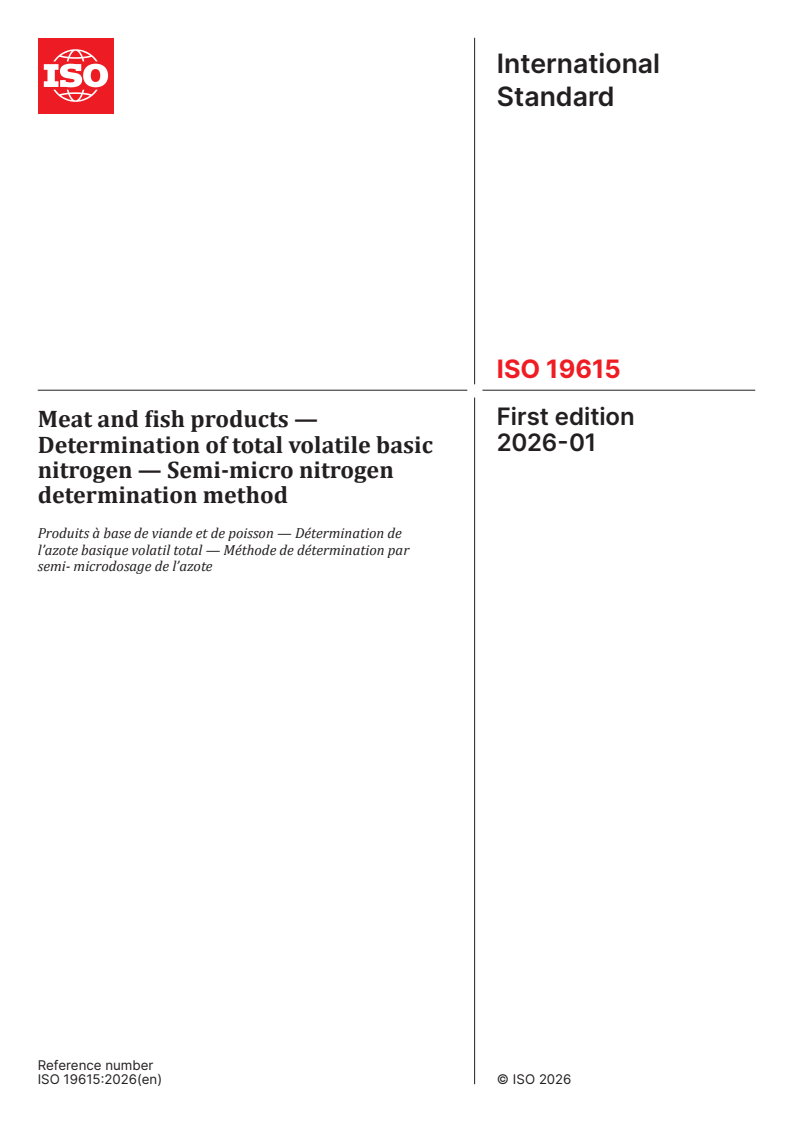
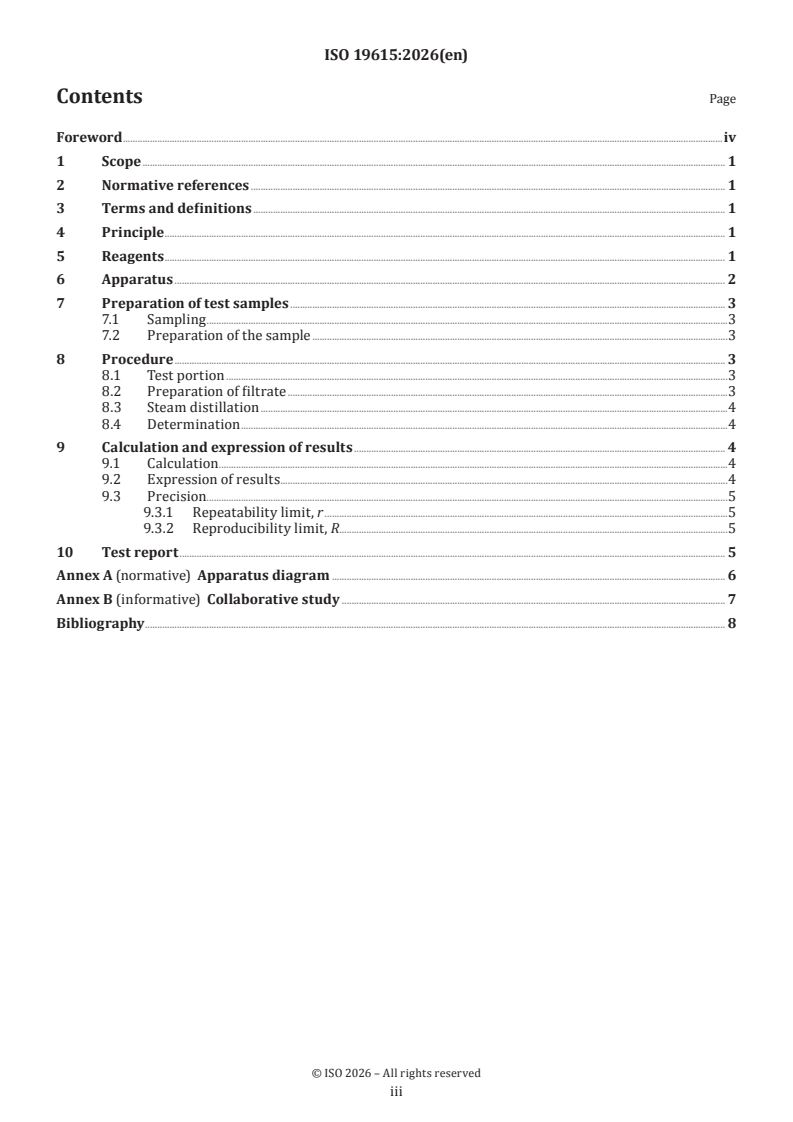
ISO 19615:2026 - Meat and fish products — Determination of total volatile basic nitrogen — Semi-micro nitrogen determination method Released:14. 01. 2026
ISO 19615:2026 - Produits a base de viande et de poisson — Détermination de l’azote basique volatil total — Méthode de détermination par semi- microdosage de l’azote Released:14. 01. 2026
Get Certified
Connect with accredited certification bodies for this standard

BSI Group
BSI (British Standards Institution) is the business standards company that helps organizations make excellence a habit.

Bureau Veritas
Bureau Veritas is a world leader in laboratory testing, inspection and certification services.

DNV
DNV is an independent assurance and risk management provider.
Sponsored listings
Frequently Asked Questions
ISO 19615:2026 is a standard published by the International Organization for Standardization (ISO). Its full title is "Meat and fish products — Determination of total volatile basic nitrogen — Semi-micro nitrogen determination method". This standard covers: This document specifies a semi-micro nitrogen determination method for total volatile basic nitrogen in meat, including livestock and poultry, and fish products.
This document specifies a semi-micro nitrogen determination method for total volatile basic nitrogen in meat, including livestock and poultry, and fish products.
ISO 19615:2026 is classified under the following ICS (International Classification for Standards) categories: 67.120.10 - Meat and meat products; 67.120.30 - Fish and fishery products. The ICS classification helps identify the subject area and facilitates finding related standards.
ISO 19615:2026 is available in PDF format for immediate download after purchase. The document can be added to your cart and obtained through the secure checkout process. Digital delivery ensures instant access to the complete standard document.
Standards Content (Sample)
International
Standard
ISO 19615
First edition
Meat and fish products —
2026-01
Determination of total volatile basic
nitrogen — Semi-micro nitrogen
determination method
Produits à base de viande et de poisson — Détermination de
l’azote basique volatil total — Méthode de détermination par
semi- microdosage de l’azote
Reference number
© ISO 2026
All rights reserved. Unless otherwise specified, or required in the context of its implementation, no part of this publication may
be reproduced or utilized otherwise in any form or by any means, electronic or mechanical, including photocopying, or posting on
the internet or an intranet, without prior written permission. Permission can be requested from either ISO at the address below
or ISO’s member body in the country of the requester.
ISO copyright office
CP 401 • Ch. de Blandonnet 8
CH-1214 Vernier, Geneva
Phone: +41 22 749 01 11
Email: copyright@iso.org
Website: www.iso.org
Published in Switzerland
ii
Contents Page
Foreword .iv
1 Scope . 1
2 Normative references . 1
3 Terms and definitions . 1
4 Principle . 1
5 Reagents . 1
6 Apparatus . 2
7 Preparation of test samples . 3
7.1 Sampling .3
7.2 Preparation of the sample .3
8 Procedure . 3
8.1 Test portion .3
8.2 Preparation of filtrate .3
8.3 Steam distillation .4
8.4 Determination .4
9 Calculation and expression of results . 4
9.1 Calculation .4
9.2 Expression of results . .4
9.3 Precision . . .5
9.3.1 Repeatability limit, r .5
9.3.2 Reproducibility limit, R.5
10 Test report . 5
Annex A (normative) Apparatus diagram . 6
Annex B (informative) Collaborative study . 7
Bibliography . 8
iii
Foreword
ISO (the International Organization for Standardization) is a worldwide federation of national standards
bodies (ISO member bodies). The work of preparing International Standards is normally carried out through
ISO technical committees. Each member body interested in a subject for which a technical committee
has been established has the right to be represented on that committee. International organizations,
governmental and non-governmental, in liaison with ISO, also take part in the work. ISO collaborates closely
with the International Electrotechnical Commission (IEC) on all matters of electrotechnical standardization.
The procedures used to develop this document and those intended for its further maintenance are described
in the ISO/IEC Directives, Part 1. In particular, the different approval criteria needed for the different types
of ISO document should be noted. This document was drafted in accordance with the editorial rules of the
ISO/IEC Directives, Part 2 (see www.iso.org/directives).
ISO draws attention to the possibility that the implementation of this document may involve the use of (a)
patent(s). ISO takes no position concerning the evidence, validity or applicability of any claimed patent
rights in respect thereof. As of the date of publication of this document, ISO had not received notice of (a)
patent(s) which may be required to implement this document. However, implementers are cautioned that
this may not represent the latest information, which may be obtained from the patent database available at
www.iso.org/patents. ISO shall not be held responsible for identifying any or all such patent rights.
Any trade name used in this document is information given for the convenience of users and does not
constitute an endorsement.
For an explanation of the voluntary nature of standards, the meaning of ISO specific terms and expressions
related to conformity assessment, as well as information about ISO’s adherence to the World Trade
Organization (WTO) principles in the Technical Barriers to Trade (TBT), see www.iso.org/iso/foreword.html.
This document was prepared by Technical Committee ISO/TC 34, Food products, Subcommittee SC 6, Meat,
poultry, fish, eggs and their products.
Any feedback or questions on this document should be directed to the user’s national standards body. A
complete listing of these bodies can be found at www.iso.org/members.html.
iv
International Standard ISO 19615:2026(en)
Meat and fish products — Determination of total volatile
basic nitrogen — Semi-micro nitrogen determination method
1 Scope
This document specifies a semi-micro nitrogen determination method for total volatile basic nitrogen in
meat, including livestock and poultry, and fish products.
2 Normative references
The following documents are referred to in the text in such a way that some or all of their content constitutes
requirements of this document. For dated references, only the edition cited applies. For undated references,
the latest edition of the referenced document (including any amendments) applies.
ISO 3696, Water for analytical laboratory use — Specification and test methods
3 Terms and definitions
For the purposes of this document, the following terms and definitions apply.
ISO and IEC maintain terminology databases for use in standardization at the following addresses:
— ISO Online browsing platform: available at https:// www .iso .org/ obp
— IEC Electropedia: available at https:// www .electropedia .org/
3.1
total volatile basic nitrogen
all of the volatile nitrogen-containing compounds including ammonia, amines and other alkaline substances
Note 1 to entry: When an animal-derived food is in the process of spoilage, the enzymes and bacteria cause the
proteins to decompose and produce volatile nitrogen-containing compounds.
Note 2 to entry: Mass fraction of total volatile basic nitrogen in meat and fish products is expressed in mg/100 g.
Note 3 to entry: The content of total volatile basic nitrogen is determined according to the procedure specified in this
document.
4 Principle
The test sample is deprotonated using a trichloroacetic acid solution. After that, the filtrate is transferred
into a steam distillation apparatus. During steam distillation, the total volatile basic nitrogen in the filtrate
is produced easily through the process of alkalinization. The resulting total volatile nitrogenous base
components are then absorbed by an acid receiver. Finally, the concentration of total volatile basic nitrogen
is determined by performing an acid-base titration of the absorbed bases.
5 Reagents
Use only reagents of recognized analytical grade, unless otherwise specified.
5.1 Water, conforming to at least grade 3 in accordance with ISO 3696. The water shall be free o
...
Norme
internationale
ISO 19615
Première édition
Produits à base de viande et de
2026-01
poisson — Détermination de l’azote
basique volatil total — Méthode
de détermination par semi-
microdosage de l’azote
Meat and fish products — Determination of total volatile basic
nitrogen — Semi-micro nitrogen determination method
Numéro de référence
DOCUMENT PROTÉGÉ PAR COPYRIGHT
© ISO 2026
Tous droits réservés. Sauf prescription différente ou nécessité dans le contexte de sa mise en œuvre, aucune partie de cette
publication ne peut être reproduite ni utilisée sous quelque forme que ce soit et par aucun procédé, électronique ou mécanique,
y compris la photocopie, ou la diffusion sur l’internet ou sur un intranet, sans autorisation écrite préalable. Une autorisation peut
être demandée à l’ISO à l’adresse ci-après ou au comité membre de l’ISO dans le pays du demandeur.
ISO copyright office
Case postale 401 • Ch. de Blandonnet 8
CH-1214 Vernier, Genève
Tél.: +41 22 749 01 11
E-mail: copyright@iso.org
Web: www.iso.org
Publié en Suisse
ii
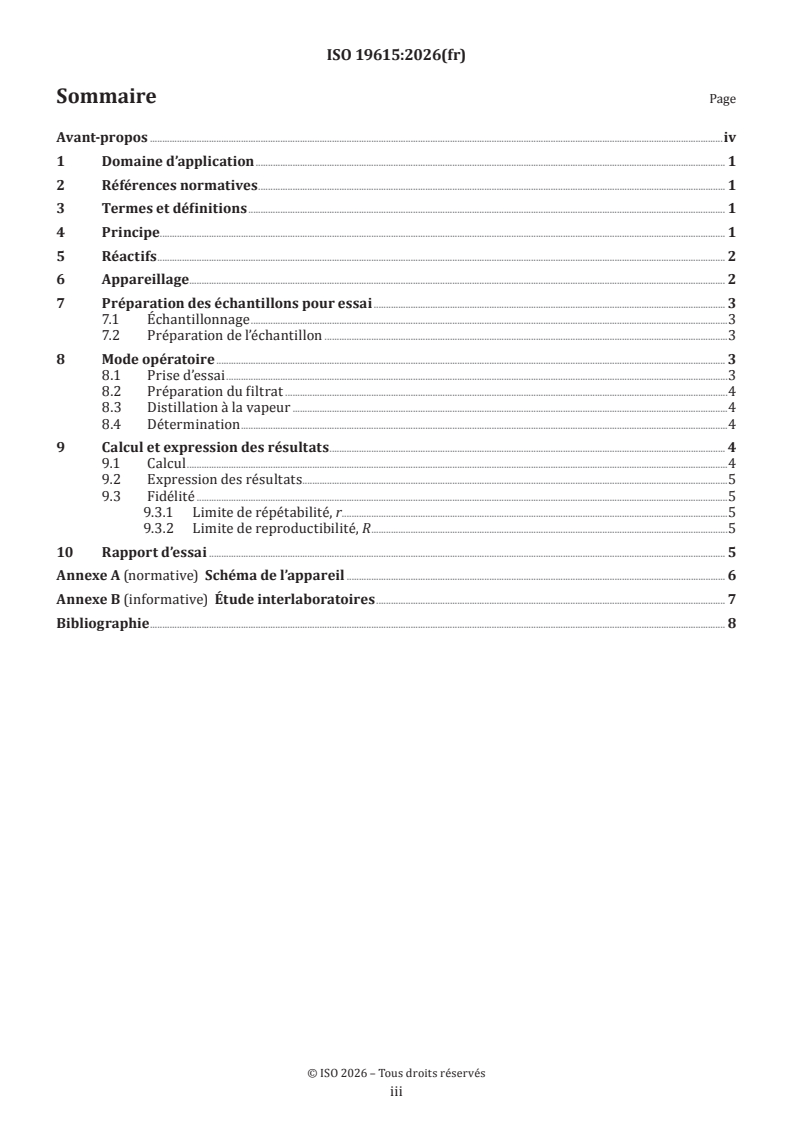
Sommaire Page
Avant-propos .iv
1 Domaine d’application . 1
2 Références normatives . 1
3 Termes et définitions . 1
4 Principe. 1
5 Réactifs . 2
6 Appareillage . 2
7 Préparation des échantillons pour essai . 3
7.1 Échantillonnage .3
7.2 Préparation de l’échantillon .3
8 Mode opératoire . 3
8.1 Prise d’essai .3
8.2 Préparation du filtrat .4
8.3 Distillation à la vapeur .4
8.4 Détermination .4
9 Calcul et expression des résultats . 4
9.1 Calcul .4
9.2 Expression des résultats .5
9.3 Fidélité .5
9.3.1 Limite de répétabilité, r . .5
9.3.2 Limite de reproductibilité, R .5
10 Rapport d’essai . 5
Annexe A (normative) Schéma de l’appareil . 6
Annexe B (informative) Étude interlaboratoires . 7
Bibliographie . 8
iii
Avant-propos
L’ISO (Organisation internationale de normalisation) est une fédération mondiale d’organismes nationaux
de normalisation (comités membres de l’ISO). L’élaboration des Normes internationales est en général
confiée aux comités techniques de l’ISO. Chaque comité membre intéressé par une étude a le droit de faire
partie du comité technique créé à cet effet. Les organisations internationales, gouvernementales et non
gouvernementales, en liaison avec l’ISO participent également aux travaux. L’ISO collabore étroitement avec
la Commission électrotechnique internationale (IEC) en ce qui concerne la normalisation électrotechnique.
Les procédures utilisées pour élaborer le présent document et celles destinées à sa mise à jour sont
décrites dans les Directives ISO/IEC, Partie 1. Il convient, en particulier, de prendre note des différents
critères d’approbation requis pour les différents types de documents ISO. Le présent document a
été rédigé conformément aux règles de rédaction données dans les Directives ISO/IEC, Partie 2 (voir
www.iso.org/directives).
L’ISO attire l’attention sur le fait que la mise en application du présent document peut entraîner l’utilisation
d’un ou de plusieurs brevets. L’ISO ne prend pas position quant à la preuve, à la validité et à l’applicabilité de
tout droit de brevet revendiqué à cet égard. À la date de publication du présent document, l’ISO n’avait pas
reçu notification qu’un ou plusieurs brevets pouvaient être nécessaires à sa mise en application. Toutefois,
il y a lieu d’avertir les responsables de la mise en application du présent document que des informations
plus récentes sont susceptibles de figurer dans la base de données de brevets, disponible à l’adresse
www.iso.org/brevets. L’ISO ne saurait être tenue pour responsable de ne pas avoir identifié tout ou partie de
tels droits de propriété.
Les appellations commerciales éventuellement mentionnées dans le présent document sont données pour
information, par souci de commodité, à l’intention des utilisateurs et ne sauraient constituer un engagement.
Pour une explication de la nature volontaire des normes, la signification des termes et expressions
spécifiques de l’ISO liés à l’évaluation de la conformité, ou pour toute information au sujet de l’adhésion de
l’ISO aux principes de l’Organisation mondiale du commerce (OMC) concernant les obstacles techniques au
commerce (OTC), voir www.iso.org/avant-propos.
Le présent document a été élaboré par le comité technique ISO/TC 34, Produits alimentaires, sous-comité
SC 6, Viandes, volailles, poissons, œufs et leurs produits dérivés.
Il convient que l’utilisateur adresse tout retour d’information ou toute question concernant le présent
document à l’organisme national de normalisation de son pays. Une liste exhaustive desdits organismes se
trouve à l’adresse www.iso.org/fr/members.html.
iv
Norme internationale ISO 19615:2026(fr)
Produits à base de viande et de poisson — Détermination de
l’azote basique volatil total — Méthode de détermination par
semi- microdosage de l’azote
1 Domaine d’application
Le présent document spécifie une méthode de détermination de l’azote basique volatil total par semi-
microdosage de l’azote dans les produits à base de viande et de poisson, y compris les produits d’animaux de
boucherie, de volaille et de poisson.
2 Références normatives
Les documents suivants sont cités dans le texte de sorte qu’ils constituent, pour tout ou partie de leur
contenu, des exigences du présent document. Pour les références datées, seule l’édition citée s’applique. Pour
les références non datées, la dernière édition du document de référence s'applique (y compris les éventuels
amendements).
ISO 3696, Eau pour laboratoire à usage analytique — Spécification et méthodes d'essai
3 Termes et définitions
Pour les besoins du présent document, les termes et définitions suivants s’appliquent.
L’ISO et l’IEC tiennent à jour des bases de données terminologiques destinées à être utilisées en normalisation,
consultables aux adresses suivantes:
— ISO Online browsing platform: disponible à l’adresse https:// www .iso .org/ obp
— IEC Electropedia: disponible à l’adresse https:// www .electropedia .org/
3.1
azote basique volatil total
tous les composés volatils contenant de l’azote, y compris l’ammoniac, les amines et d’autres substances
alcalines
Note 1 à l'article: Lorsqu’un aliment d’origine animale est en train de se détériorer, les enzymes et les bactéries
provoquent la décomposition des protéines et la production de composés volatils contenant de l’azote.
Note 2 à l'article: La fraction massique de l’azote basique volatil total dans les produits à base de viande et de poisson
est exprimée en mg/100 g.
Note 3 à l'article: La teneur en azote basique volatil total est déterminée selon le mode opératoire spécifié dans le
présent document.
4 Principe
L’échantillon pour essai est déprotéiné à l’aide d’une solution d’acide trichloracétique. Après cela, le filtrat
est transféré dans un dispositif de distillation à la vapeur. Pendant la distillation à la vapeur, l’azote basique
volatil total dans le filtrat est produit facilement par le processus d’alcalinisation. Les constituants azotés
basiques volatils totaux résultants sont ensuite absorbés par un récepteur acide. Enfin, la concentration de
l’azote basique volatil total est déterminée en effectuant un titrage acide-base des bases absorbées.
5 Réactifs
Utiliser uniquement des réactifs de qualité analytique reconnue, sauf indication contraire.
5.1 Eau, au minimum de qualité 3 selon l’ISO 3696. L’eau doit être exempte de composés organiques.
5.2 Suspension d’oxyde de magnésium, 10 g/l.
Peser, à 0,01 g près, 10 g d’oxyde de magnésium et ajouter lentement à 1 000
...
Questions, Comments and Discussion
Ask us and Technical Secretary will try to provide an answer. You can facilitate discussion about the standard in here.
Loading comments...