

ISO 20187-2:2022
(Main)Inflatable play equipment — Part 2: Additional safety requirements for inflatable bouncing pillows intended for permanent installation
General Information
- Abstract
This part of ISO 20187 specifies additional safety requirements for inflatable bouncing pillows intended for permanent installation. This part of ISO 20187 is applicable to inflatable play equipment intended for use by children fourteen years and under, both individually and collectively. This part of ISO 20187 specifies safety requirements for inflatable play equipment for which the primary activity is bouncing. It sets measures to address risks and also to minimize accidents to users for those involved in the design, manufacture and supply of inflatable play equipment. It specifies information to be supplied with the equipment. The requirements have been laid down bearing in mind the risk factor based on available data. This part of ISO 20187 specifies the requirements that will protect a child from hazards that he or she might be unable to foresee when using the equipment as intended, or in a manner that can be reasonably anticipated. This part of ISO 20187 is not applicable to inflatables dealt with in ISO 20187‑1:2022, inflatable water-borne play and leisure equipment, domestic inflatable toys, air-supported buildings, inflatables used solely for protection, inflatables used for rescue, or other types of inflatable toys where the primary activity is not bouncing or sliding.
- Status
- Published
- Publication Date
- 27-Nov-2022
- Technical Committee
- ISO/TC 83 - Sports and other recreational facilities and equipment
- Drafting Committee
- ISO/TC 83 - Sports and other recreational facilities and equipment
- Current Stage
- 6060 - International Standard published
- Start Date
- 28-Nov-2022
- Due Date
- 06-Dec-2023
- Completion Date
- 28-Nov-2022
Overview
ISO 20187-2:2022 - Inflatable play equipment: Part 2 specifies additional safety requirements for inflatable bouncing pillows intended for permanent installation. It applies to inflatables designed for children up to 14 years old whose primary activity is bouncing. The standard complements ISO 20187‑1 and focuses on hazards, design and construction measures, information to be supplied, and inspection/maintenance to minimize injury risk for intended and reasonably anticipated use.
Key topics and technical requirements
- Scope & exclusions
- Applies to permanently installed bouncing pillows for children ≤14 years.
- Not applicable to items covered by ISO 20187‑1:2022, water‑borne equipment, domestic toys, air‑supported buildings, rescue/protective inflatables, or equipment where bouncing is not the primary activity.
- Materials
- Fabrics must be flame retardant.
- Structural fabrics and seams: minimum tear strength 500 N, minimum tensile strength 3 500 N (ISO 1421), and minimum coating adhesion 100 N (ISO 2411).
- Decorative finishes must conform to EN 71‑3 and avoid dangerous substances.
- Construction & foundations
- Fabric securely fastened to underground foundation (e.g., concrete, timber, metal) with a minimum depth of 400 mm.
- Internal pressure shall not exceed 0.7 kPa and must meet grounding test requirements (Annex A).
- Fabric gradient: average angle to ground ≤ 20°.
- Structure must support the heaviest intended user.
- Blowers, electricals & siting
- Safety requirements for blowers, air supply tubes (buried), electrical installations and safe siting are specified to reduce trip/impact/electrical hazards (see main text).
- Impact area, signage and supervision
- Defined impact area around open sides, clear signage, and supervision guidance to mitigate misuse and collisions.
- Testing, information & maintenance
- Test methods and reporting (including grounding test), and comprehensive information to be supplied: pre‑information, installation, operation, inspection and maintenance, marking and alteration guidance.
Applications and users
Who uses ISO 20187-2:2022:
- Manufacturers and designers of permanent inflatable bouncing pillows - to ensure compliant design and material selection.
- Installers and site owners (parks, leisure centres, theme parks) - for correct foundation, siting and blower installation.
- Facility managers and operators - for operation, inspection and routine/annual maintenance schedules.
- Safety inspectors, certifiers and regulators - to assess conformity and risk control measures. Practical uses include design verification, procurement specifications, installation checklists, operator manuals and inspection protocols.
Related standards
- ISO 20187‑1:2022 (general safety requirements and test methods)
- EN 71‑3 (safety of toys - migration of certain elements)
- EN 1176‑1:2017 (playground equipment general safety)
- ISO 1421, ISO 2411 (fabric test methods)
Keywords: ISO 20187-2:2022, inflatable bouncing pillows, safety requirements, permanent installation, inflatable play equipment, playground safety, inspection and maintenance.
Relations
- Effective Date
- 12-Feb-2026
- Parent
ISO 17842-2:2015 - Safety of amusement rides and amusement devices — Part 2: Operation and use - Effective Date
- 07-Jul-2022
- Effective Date
- 06-Jun-2022
Frequently Asked Questions
ISO 20187-2:2022 is a standard published by the International Organization for Standardization (ISO). Its full title is "Inflatable play equipment — Part 2: Additional safety requirements for inflatable bouncing pillows intended for permanent installation". This standard covers: This part of ISO 20187 specifies additional safety requirements for inflatable bouncing pillows intended for permanent installation. This part of ISO 20187 is applicable to inflatable play equipment intended for use by children fourteen years and under, both individually and collectively. This part of ISO 20187 specifies safety requirements for inflatable play equipment for which the primary activity is bouncing. It sets measures to address risks and also to minimize accidents to users for those involved in the design, manufacture and supply of inflatable play equipment. It specifies information to be supplied with the equipment. The requirements have been laid down bearing in mind the risk factor based on available data. This part of ISO 20187 specifies the requirements that will protect a child from hazards that he or she might be unable to foresee when using the equipment as intended, or in a manner that can be reasonably anticipated. This part of ISO 20187 is not applicable to inflatables dealt with in ISO 20187‑1:2022, inflatable water-borne play and leisure equipment, domestic inflatable toys, air-supported buildings, inflatables used solely for protection, inflatables used for rescue, or other types of inflatable toys where the primary activity is not bouncing or sliding.
This part of ISO 20187 specifies additional safety requirements for inflatable bouncing pillows intended for permanent installation. This part of ISO 20187 is applicable to inflatable play equipment intended for use by children fourteen years and under, both individually and collectively. This part of ISO 20187 specifies safety requirements for inflatable play equipment for which the primary activity is bouncing. It sets measures to address risks and also to minimize accidents to users for those involved in the design, manufacture and supply of inflatable play equipment. It specifies information to be supplied with the equipment. The requirements have been laid down bearing in mind the risk factor based on available data. This part of ISO 20187 specifies the requirements that will protect a child from hazards that he or she might be unable to foresee when using the equipment as intended, or in a manner that can be reasonably anticipated. This part of ISO 20187 is not applicable to inflatables dealt with in ISO 20187‑1:2022, inflatable water-borne play and leisure equipment, domestic inflatable toys, air-supported buildings, inflatables used solely for protection, inflatables used for rescue, or other types of inflatable toys where the primary activity is not bouncing or sliding.
ISO 20187-2:2022 is classified under the following ICS (International Classification for Standards) categories: 97.200.99 - Other equipment for entertainment. The ICS classification helps identify the subject area and facilitates finding related standards.
ISO 20187-2:2022 has the following relationships with other standards: It is inter standard links to EN 14960-2:2019, ISO 17842-2:2015, ISO 20187:2016. Understanding these relationships helps ensure you are using the most current and applicable version of the standard.
ISO 20187-2:2022 is available in PDF format for immediate download after purchase. The document can be added to your cart and obtained through the secure checkout process. Digital delivery ensures instant access to the complete standard document.
Standards Content (Sample)
INTERNATIONAL ISO
STANDARD 20187-2
First edition
2022-11
Inflatable play equipment —
Part 2:
Additional safety requirements for
inflatable bouncing pillows intended
for permanent installation
Reference number
© ISO 2022
All rights reserved. Unless otherwise specified, or required in the context of its implementation, no part of this publication may
be reproduced or utilized otherwise in any form or by any means, electronic or mechanical, including photocopying, or posting on
the internet or an intranet, without prior written permission. Permission can be requested from either ISO at the address below
or ISO’s member body in the country of the requester.
ISO copyright office
CP 401 • Ch. de Blandonnet 8
CH-1214 Vernier, Geneva
Phone: +41 22 749 01 11
Email: copyright@iso.org
Website: www.iso.org
Published in Switzerland
ii
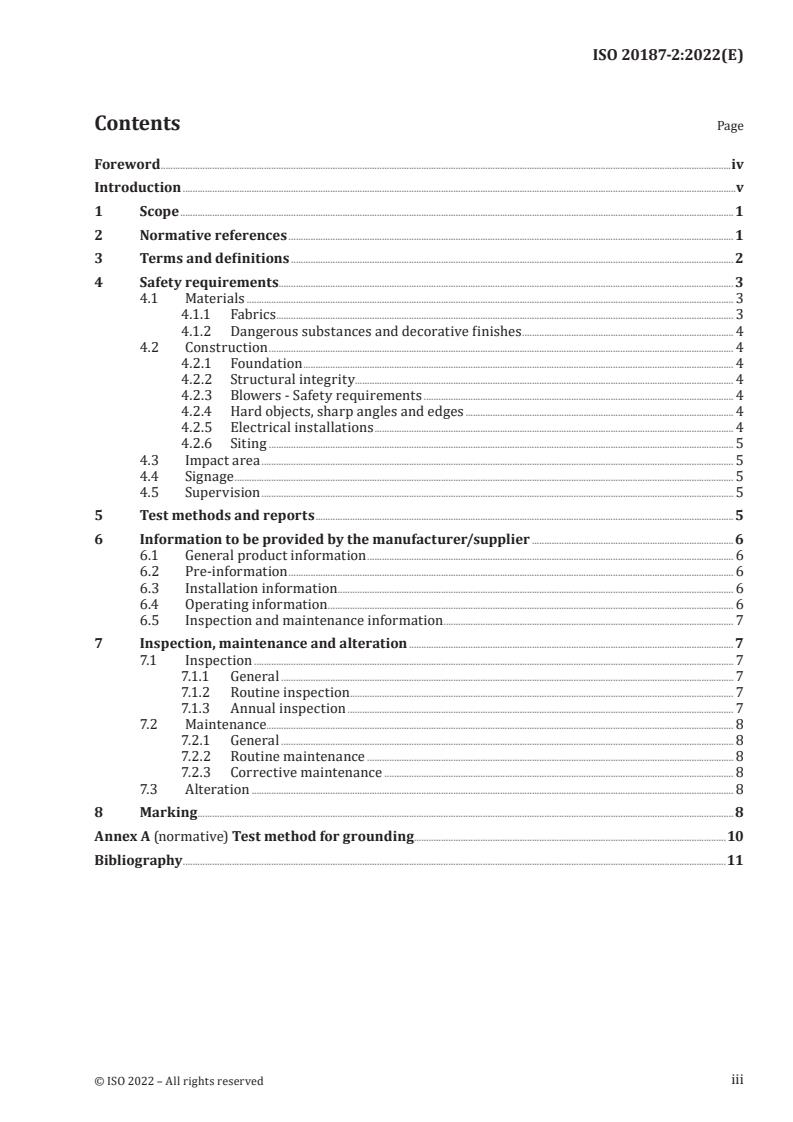
Contents Page
Foreword .iv
Introduction .v
1 Scope .1
2 Normative references .1
3 Terms and definitions .2
4 Safety requirements.3
4.1 Materials . 3
4.1.1 Fabrics . 3
4.1.2 Dangerous substances and decorative finishes . 4
4.2 Construction . 4
4.2.1 Foundation . 4
4.2.2 Structural integrity. 4
4.2.3 Blowers - Safety requirements . 4
4.2.4 Hard objects, sharp angles and edges . 4
4.2.5 Electrical installations . 4
4.2.6 Siting . 5
4.3 Impact area . 5
4.4 Signage . 5
4.5 Supervision . 5
5 Test methods and reports .5
6 Information to be provided by the manufacturer/supplier .6
6.1 General product information . 6
6.2 Pre-information . 6
6.3 Installation information . 6
6.4 Operating information . 6
6.5 Inspection and maintenance information . 7
7 Inspection, maintenance and alteration .7
7.1 Inspection . 7
7.1.1 General . 7
7.1.2 Routine inspection . 7
7.1.3 Annual inspection . 7
7.2 Maintenance . 8
7.2.1 General . 8
7.2.2 Routine maintenance . 8
7.2.3 Corrective maintenance . 8
7.3 Alteration . 8
8 Marking . .8
Annex A (normative) Test method for grounding.10
Bibliography .11
iii
Foreword
ISO (the International Organization for Standardization) is a worldwide federation of national standards
bodies (ISO member bodies). The work of preparing International Standards is normally carried out
through ISO technical committees. Each member body interested in a subject for which a technical
committee has been established has the right to be represented on that committee. International
organizations, governmental and non-governmental, in liaison with ISO, also take part in the work.
ISO collaborates closely with the International Electrotechnical Commission (IEC) on all matters of
electrotechnical standardization.
The procedures used to develop this document and those intended for its further maintenance are
described in the ISO/IEC Directives, Part 1. In particular, the different approval criteria needed for the
different types of ISO documents should be noted (see www.iso.org/directives).
Attention is drawn to the possibility that some of the elements of this document may be the subject of
patent rights. ISO shall not be held responsible for identifying any or all such patent rights. Details of
any patent rights identified during the development of the document will be in the Introduction and/or
on the ISO list of patent declarations received (see www.iso.org/patents).
Any trade name used in this document is information given for the convenience of users and does not
constitute an endorsement.
For an explanation of the voluntary nature of standards, the meaning of ISO specific terms and
expressions related to conformity assessment, as well as information about ISO's adherence to
the World Trade Organization (WTO) principles in the Technical Barriers to Trade (TBT), see
www.iso.org/iso/foreword.html.
This document was prepared by the European Committee for Standardization (CEN), Technical
Committee CEN/TC 136, Sports, playground and other recreational equipment (as EN 14960-2:2019) and
drafted in accordance with its editorial rules. It was assigned to Technical Committee ISO/TC 83, Sports
and other recreational facilities and equipment and adopted, without modification other than those given
below, under the "fast-track procedure":
— references to EN documents were replaced with their equivalent ISO standards.
This first edition of ISO 20187-2, together with ISO 20187-1 and ISO 20187-3, cancels and replaces
ISO 20187:2016, which has been technically revised.
The main changes are as follows:
— changes with regard to inflatables sited on hard standing;
— minor editing to improve the content accuracy of the document.
A list of all parts in the ISO 20187 series can be found on the ISO website.
Any feedback or questions on this document should be directed to the user’s national standards body. A
complete listing of these bodies can be found at www.iso.org/members.html.
iv
Introduction
Play is the means by which children discover and understand the world in which they live and is an
essential element in a child’s physical and mental growth.
It is important for children’s rounded development that, through play, they arrive at an understanding
of danger, which provides a basis for assessing safety in a variety of situations. The balance between
challenge and safety is an important consideration.
The inflatable play equipment referred to in this document can provide different levels of challenge and
excitement. This document aims to minimize the level of risk and the possibility of serious injury while
allowing children to enjoy themselves when playing in or on inflatable equipment.
This document acknowledges the difficulties of addressing safety issues by age criteria alone because
the ability to handle risk is based on the individual user’s level of skill and not age. Moreover, users other
than the intended age range might make use of the inflatable equipment, in which case, the provisions
of this standard still apply.
It is not the purpose of the requirements of this document to affect a child’s need to play nor to lessen
the contribution that inflatable play equipment makes either to the child’s development or meaningful
play from an educational point of view.
Where inflatable play equipment is combined with other items of children’s playground equipment, the
relevant standards applying to the other items of equipment should also be consulted.
v
INTERNATIONAL STANDARD ISO 20187-2:2022(E)
Inflatable play equipment —
Part 2:
Additional safety requirements for inflatable bouncing
pillows intended for permanent installation
1 Scope
This part of ISO 20187 specifies additional safety requirements for inflatable bouncing pillows intended
for permanent installation.
This part of ISO 20187 is applicable to inflatable play equipment intended for use by children fourteen
years and under, both individually and collectively.
This part of ISO 20187 specifies safety requirements for inflatable play equipment for which the
primary activity is bouncing. It sets measures to address risks and also to minimize accidents to users
for those involved in the design, manufacture and supply of inflatable play equipment.
It specifies information to be supplied with the equipment. The requirements have been laid down
bearing in mind the risk factor based on available data.
This part of ISO 20187 specifies the requirements that will protect a child from hazards that he or she
might be unable to foresee when using the equipment as intended, or in a manner that can be reasonably
anticipated.
This part of ISO 20187 is not applicable to inflatables dealt with in ISO 20187-1:2022, inflatable water-
borne play and leisure equipment, domestic inflatable toys, air-supported buildings, inflatables used
solely for protection, inflatables used for rescue, or other types of inflatable toys where the primary
activity is not bouncing or sliding.
2 Normative references
The following documents are referred to in the text in such a way that some or all of their content
constitutes
...