


ISO 7504:1984
(Main)Gas analysis — Vocabulary
Gas analysis — Vocabulary
Defines terms relating to gas analysis, in English and in French. The vocabulary is restricted to the presentation of the methods most currently used in gas analysis. Alphabetical indexes in english and french languages are also given.
Analyse des gaz — Vocabulaire
Analiza plinov - Slovar
General Information
- Status
- Withdrawn
- Publication Date
- 31-Aug-1984
- Withdrawal Date
- 31-Aug-1984
- Technical Committee
- ISO/TC 158 - Analysis of gases
- Drafting Committee
- ISO/TC 158 - Analysis of gases
- Current Stage
- 9599 - Withdrawal of International Standard
- Start Date
- 22-Nov-2001
- Completion Date
- 12-Feb-2026
Relations
- Effective Date
- 10-Feb-2026
- Effective Date
- 15-Apr-2008

Get Certified
Connect with accredited certification bodies for this standard

ECOCERT
Organic and sustainability certification.

Eurofins Food Testing Global
Global leader in food, environment, and pharmaceutical product testing.

Intertek Bangladesh
Intertek certification and testing services in Bangladesh.
Sponsored listings
Frequently Asked Questions
ISO 7504:1984 is a standard published by the International Organization for Standardization (ISO). Its full title is "Gas analysis — Vocabulary". This standard covers: Defines terms relating to gas analysis, in English and in French. The vocabulary is restricted to the presentation of the methods most currently used in gas analysis. Alphabetical indexes in english and french languages are also given.
Defines terms relating to gas analysis, in English and in French. The vocabulary is restricted to the presentation of the methods most currently used in gas analysis. Alphabetical indexes in english and french languages are also given.
ISO 7504:1984 is classified under the following ICS (International Classification for Standards) categories: 01.040.71 - Chemical technology (Vocabularies); 71.040.40 - Chemical analysis. The ICS classification helps identify the subject area and facilitates finding related standards.
ISO 7504:1984 has the following relationships with other standards: It is inter standard links to EN 45544-4:1999, ISO 7504:2001. Understanding these relationships helps ensure you are using the most current and applicable version of the standard.
ISO 7504:1984 is available in PDF format for immediate download after purchase. The document can be added to your cart and obtained through the secure checkout process. Digital delivery ensures instant access to the complete standard document.
Standards Content (Sample)
International Standard
Norme internationale
INTERNATIONAL ORGANIZATION FOR STANDARDIZATlON.MEWYHAPOJIlHAR OPTAHM3AL&lR IlO CTAH~APTbl3A~MlWORGANISATION INTERNATIONALE DE NORMALISATION
Gas analysis - Vocabulary
First edition - 1984-10-01
Analyse des gaz - Vocabulaire
Premihe 6dition - 1984-10-01
Ref. No./Rhf. no : IS0 7504-1984 (E/F)
UDWCDU 543.27 : 001.4
Descriptors : gas analysis, vocabulary. / Descripteurs : analyse de gaz, vocabulaire.
Price based on 27 pages/Prix base sur 27 pages
Foreword
IS0 (the International Organization for Standardization) is a worldwide federation of
national standards bodies (IS0 member bodies). The work of preparing International
Standards is normally carried out through IS0 technical committees. Every member
body interested in a subject for which a technical committee has been established has
the right to be represented on that committee. International organizations, govern-
mental and non-governmental, in liaison with ISO, also take part in the work.
Draft International Standards adopted by the technical committees are circulated to
the member bodies for approval before their acceptance as International Standards by
the IS0 Council. They are approved in accordance with IS0 procedures requiring at
least 75 % approval by the member bodies voting.
International Standard IS0 7504 was prepared by Technical Committee ISO/TC 158,
Analysis of gases.
0 International Organization for Standardization, 1984
Printed in Switzerland
Avant-propos
L’ISO (Organisation internationale de normalisation) est une federation mondiale
d’organismes nationaux de normalisation (comites membres de I’ISO). L’elaboration
des Normes internationales est confide aux comites techniques de I’ISO. Chaque
comite membre inter-es& par une etude a le droit de faire partie du comite technique
tree a cet effet. Les organisations internationales, gouvernementales et non gouverne-
mentales, en liaison avec I’ISO, participent egalement aux travaux.
Les projets de Normes internationales adopt& par les comites techniques sont soumis
aux comites membres pour approbation, avant leur acceptation comme Normes inter-
nationales par le Conseil de I’ISO. Les Normes internationales sont approuvees confor-
mement aux procedures de I’ISO qui requierent I’approbation de 75 % au moins des
comites membres votants.
La Norme internationale IS0 7504 a ete elaboree par le comite technique ISO/TC 158,
Analyse des gaz.
Organisation internationale de normalisation, 1984
Imprim en Suisse
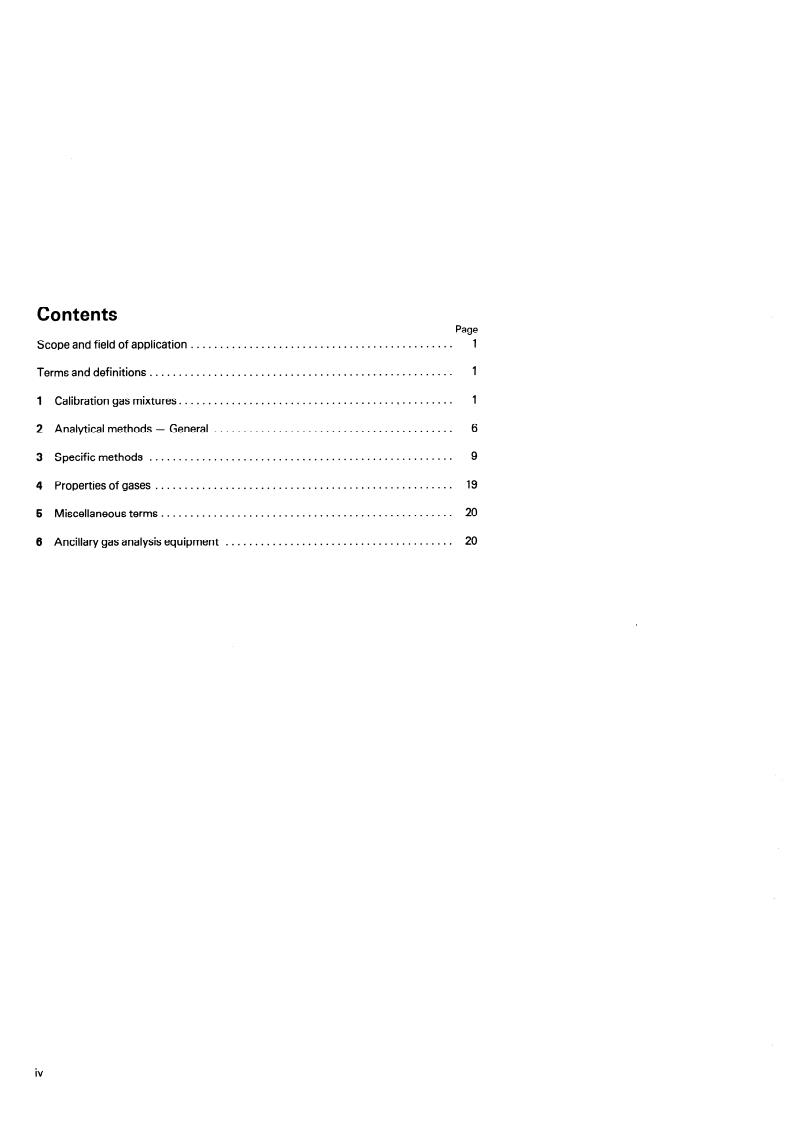
Contents
Page
Scope and field of application . . . . . . . . . . . . . . . . . . . . . . . . . . . . . . . . . . . . . . . . . . . . .
Terms and definitions. . . . . . . . . . . . . . . . . . . . . . . . . . . . . . . . . . . . . . . . . . . . . . . . . . . . 1
1 Calibration gas mixtures. . . . . . . . . . . . . . . . . . . . . . . . . . . . . . . . . . . . . , . . . . . . . . .
2 Analytical methods - General . 6
3 Specific methods .
4 Propertiesofgases. 19
5 Miscellaneous terms. . . . . . . . . . . . . . . . . . . . . . . . . . . . . . . . . . . . . . . . . . . . . . . . . .
6 Ancillary gas analysis equipment . . . . . . . . . . . . . . . . . . . . . . . . . . . . . . . . . . . . . . . 20
IV
Sommaire
Page
Objet et domaine d’application . . . . . . . . . . . . . . . . . . . . . . . . . . . . . . . . . . . . . . . . . . . .
Termes et definitions . . . . . . . . . . . . . . . . . . . . . . . . . . . . . . . . . . . . . . . . . . . . . . . . . . . .
1 Melanges de gaz pour etalonnage. . . . . . . . . . . . . . . . . . . . . . . . . . . . . . . . . . . . . . .
2 Methodes d’analyse - Generalites. . . . . . . . . . . . . . . . . . . . . . . . . . . . . . . . . . . . . .
3 Methodes specifiques. . . . . . . . . . . . . . . . . . . . . . . . . . . . . . . . . . . . . . . . . . . . . . . . .
4 Proprietesdesgaz. 19
5 Termesdivers . . . . . . . . . . . . . . . . . . . . . . . . . . . . . . . . . . . . . . . . . . . . . . . . . . . . . . .
6 Appareils auxiliaires de I’analyse des gaz . . . . . . . . . . . . . . . . . . . . . . . . . . . . . . . . .
This page intentionally left blank
INTERNATIONAL STANDARD
IS0 7504-1984 (E/F)
NORME INTERNATIONALE
Gas analysis - Vocabulary Analyse des gaz -
Vocabulaire
Scope and field of application Objet et domaine d’application
La presente Norme internationale definit les termes relatifs a
This International Standard defines terms relating to gas .
analysis, in English and in French. I’analyse des gaz, en anglais et en francais.
This International Standard is restricted to the presentation of La presente Norme internationale se limite a la presentation des
methodes les plus couramment utilisees en analyse des gaz.
the methods most currently used in gas analysis.
Termes et definitions
Terms and definitions
1 M6langes de gaz pour htalonnage
1 Calibration gas mixtures
1 .I Concentration (general term) 1 .I Concentration (terme general)
NOTE - In current practice, for practical reasons, the term concen- NOTE - Dans la pratique courante, par commodite, on emploiera le
tration is used to designate a concentration, a mass ratio, a volume terme concentration pour designer soit une concentration, soit un titre
ratio, a mole ratio or a ratio of pressures (see the table). massique, volumique ou molaire, soit un rapport de pressions (voir le
tableau).
1.1.1 concentration (of a gas mixture component) : The 1.1.1 concentration (d’un constituant dans un melange de
quotient of the mass of a component to the volume of the gas gaz): Quotient de la masse de ce constituant par le volume du
mixture under specified conditions of temperature and melange de gaz dans des conditions de temperature et de pres-
pressure. sion specifiees.
The unit of concentration is the kilogram per cubic metre. L’unite de concentration est le kilogramme par metre cube.
However, in the field of gas analysis, the units currently used Toutefois, dans le domaine de I’analyse des gaz, les unites
are the gram per cubic metre and its submultiples. couramment employees sont le gramme par metre cube et ses
sous-multiples.
1.1.2 mass ratio : Ratio of the mass of a component to the 1.1.2 titre massique: Rapport de la masse du constituant a
mass of the gas mixture. la masse du melange de gaz.
1.1.3 volume ratio : Ratio of the volume of a component to
1 .I .3 titre volumique : Rapport du volume du constituant au
volume du melange de gaz dans des conditions de temperature
the volume of the gas mixture under specified conditions of
temperature and pressure. et de pression specifiees.
1.1.4 mole ratio : Ratio of the number of moles of a compo- 1.1.4 titre molaire: Rapport d’un nombre de moles du con-
stituant au nombre de moles du melange de gaz.
nent to the number of moles of the gas mixture.
1.1.5 ratio of pressures: Ratio of the partial pressure of a 1.1.5 rapport de pressions: Rapport de la pression partielle
component to the pressure of the gas mixture. du constituant a la pression du melange de gaz.
IS0 7504-1984 (E/F)
Table/Tableau - Units of concentration/Unites de concentration
1 Concentration expressed as/Mode d’expression 1 Units and notation/lJnitks et notations
High concentrations/ Fortes concentrations Low concentrations/ Faibles concentrations
~~
Concentration/ Concentration g/m3 pg/rns or/au mg/m3
Mass ratio/Titre massique % bnlm) ppml) (m/m)
Volume ratio/Titre volumique
% w/P7 ppm ( V/ v)
Mole ratio/Titre molaire % (mol/mol) ppm (mol/mol)
Ratio of pressures/ Rapport de pressions
% (p/p)
PPm (P/P)
1) Part per million/ Partie par million.
NOTES
NOTES
1 Dans le cas de tres faibles concentrations, I’unite partie par billion
1 In the case of very low concentrations, the unit parts per billion
(ppb) ne doit pas etre utilisee car le mot ((billion)) a des significations
(ppb) is not to be used since the word “billion” has different meanings
differentes dans divers pays. L’emploi de puissances negatives de 10
in different countries. The use of negative powers of ten followed by an
suivies de I’indication masse, volume, pression ou mole elimine toute
indication of mass, volume, pressure or mole ratio would eliminate
possible confusion. confusion eventuelle.
2 Only the mass and mole ratios are theoretically invariant but in cur- 2 Seuls les titres massiques et molaires sont theoriquement invariants
mais, dans la pratique courante des analyses, sont difficiles 8 atteindre
rent analytical practice they are difficult of strict attainment. Indeed,
the determination of a component is generally effected by comparing de facon rigoureuse. En effet, le dosage d’un constituant est generale-
ment effect& en comparant deux signaux obtenus par I’introduction
two signals obtained by introducing into the analyser, under well de-
fined conditions, identical volumes of the gas to be analysed and of the dans I’analyseur, dans des conditions bien definies, de volumes identi-
ques de gaz 5 analyser et de gaz pour etalonnage. Souvent le gaz 6
calibration gas. Frequently, the gas to be analysed is qualitatively dif-
ferent from the calibration gas; it may contain components whose analyser est qualitativement different du gaz pour etalonnage, il peut
contenir des constituants dont le comportement s’ecarte sensiblement
behaviour departs substantially from that of perfect gases; the result is
that the masses (and the number of moles) introduced in the two cases de celui des gaz parfaits; il en resulte que les masses (et le nombre de
moles) introduits dans les deux cas peuvent etre significativement
may be significantly different.
differents.
The values of the other, more commonly used expressions of the con-
centration (volume ratio, ratio of pressures) vary with the temperature Les valeurs des autres expressions de la concentration, plus couram-
and pressure condititions of the calibration gas in the cylinder. ment utilisees (titre volumiquc, rapport de pressions) varient avec les
However, these values are most generally given under the temperature conditions de temperature et de pression du gaz pour etalonnage dans
la bouteille. Cependant, ces valeurs sont le plus generalement donnees
and pressure conditions specified for the use of the calibration gas (ef-
fectively 20 OC, 101,3 kPaL In most cases encountered in practice, the dans les conditions de temperature et de pression specifiees pour
I’utilisation du gaz pour etalonnage (en realite 20 OC, 101,3 kPa). Dans
temperature and pressure corrections may, therefore, be neglected.
These second order corrections are difficult to derive at the present la plupart des cas rencontres dans la pratique, les corrections de
temperature et de pression peuvent en consequence etre negligees.
state of knowledge.
Ces corrections du second ordre sont difficilement accessibles dans
3 Concentration limits may also be specified for chemical or physical
I’etat actuel des connaissances.
reasons or for reasons of safety; for example condensation limits, flam-
3 Des limites de concentration peuvent egalement etre specifiees
mability limits.
pour des raisons chimiques ou physiques ou pour des raisons de secu-
rite; par exemple: limites de condensation, limites d’inflammabilite.
1.2 Metrology 1.2 Mktrologie
1.2.1 calibration : The combination of operations to be per-
1.2.1 Qtalonnage : Ensemble d’operations a effectuer dans le
formed for the purpose of establishing the relation between the but d’etablir la correlation entre I’indication ou les indications
indication or indications of a given analytical unit and the value
d’une unite analytique donnee et la ou les valeurs du parametre
or values of the parameter studied.
etudie.
1.2.2 Uncertainty of the value of the concentration 1.2.2 Incertitude sur la valeur de la concentration
This is expressed, under normal ambient conditions, by the ab- Elle est exprimee, dans les conditions ambiantes normales, par
solute error AC or by the value AC/C relative to the given I’erreur absolue AC ou la valeur AC/C se rapportant a la valeur
value C of the concentration: the concentration of the con-
C don&e de la concentration; la concentration du constituant
stituent falls within the range of C + AC. est situee dans le domaine C + AC.
NOTE - The evaluation of this uncertainty is related to the method on NOTE - L’evaluation de cette incertitude est lice a la methode sur la-
which the knowledge of the concentration of the component in the
quelle est basee la connaissance de la concentration du constituant
cali bration mixture is based.
dans le melange pour etalonnage.
a) If the value of that concentration is obtained by a direct method a) Si le melange pour etalonnage est obtenu par une methode de
of preparation based on the measurement of physical quantities
preparation directe reposant sur la mesure de grandeurs physiques
such as mass, volume or pressure, the uncertainty is given by the telles que masse, volume ou pression, I’incertitude est donnee par
error calculation associated with the mode of preparation.
le calcul d’erreur associe au mode de preparation.
IS0 75044984 (E/F)
b) If the value of the concentration of the component is the result b) Si la valeur de la concentration du constituant est le r6sultat du ’
dosage par une m&hode analytique directe des differents consti-
of the determination by a direct analytical method of the different
constituents present, the evaluation of the uncertainty is linked to tuants prksents, I’&aluation de I’incertitude est li6e au mode
the mode of analysis. d’analyse.
c) If the value of the concentration of the component of the c) Si la valeur de la concentration du constituant du melange pour
calibration mixture is derived by comparing it by means of an 6talonnage est dkduite de sa comparaison a I’aide d’un appareil
analytical instrument with one or more mixtures obtained accor- d’analyse avec un ou plusieurs melanges obtenus selon les metho-
des mentionn6es en a) ou b), I’incertitude est obtenue par un calcul
ding to the methods mentioned in a) or b), the uncertainty is ob-
tained by a calculation involving at the same time faisant intervenir 5 la fois
-
the uncertainty concerning the concentration of the com- - I’incertitude sur la concentration du constitua nt consid&
ponent in question in the mixture or mixtures used for dans le ou les melanges pris comme reference;
reference;
- la repeta bil it6 de la m6thode d’analyse dans le domaine
-
the repeatability of the analytical procedure over the range
utilis6.
used.
1.2.3 accuracy : The closeness of agreement between the 1.2.3 prkision : Etroitesse de I’accord entre la valeur vraie et
true value and the measured value. la valeur mesurf?e.
term that is difficult to define or to but is an NOTE - C’est un terme qu’il est diff icile de definir ou d’appliquer mais
NOTE - Th is is a
apply
integral part of the uncertainty of any measurement. qui fait partie integrante de I’ ‘incertitude de toute mesure.
1.2.4 precision : The closeness of agreement between the 1.2.4 fidelit : itroitesse de I’accord entre les ksultats
results obtained by applying the experimental procedure several obtenus en appliquant le pro&d6 expbrimental 3 plusieurs
times under prescribed conditions. reprises dans des conditions d&erminees.
The smaller the random part of the experimental errors which Le pro&d6 est d’autant plus fiddle la par-tie aleatoire des
we
affect the results, the m ore precise is the procedure. erreurs expkimentales q ui affectent les ksultats est moindre.
1.2.5 rep&abilitG : Qualitativement, &roitesse de I’accord
1.2.5 repeatability : Qualitatively, the closeness of agree-
entre les rkultats successifs obtenus avec la m&me m&hode
ment between successive results obtained with the same
sur une mati&e identique soumise 3 I’essai dans les memes
method on identical test material, under the same conditions
conditions (meme opkateur, m6me appareil, meme laboratoire
(same operator, same apparatus, same laboratory and short
intervals of time). Quantitatively, the value below which the et court intervalle de temps). Quantitativement, la valeur au-
dessous de laquelle est situde, avec une probabilite spkif@e, la
absolute difference between two single test results obtained in
valeur absolue de la diffkrence entre deux rkultats individuels
the above conditions may be expected to lie with a specified
obtenus dans les conditions ci-dessus. En l’absence d’indica-
probability. In the absence of other indication, the probability
tion, la probabilit6 est de 95 %.
is 95 %.
1.2.6 reproducibility : Qualitatively, the closeness of agree- 1.2.6 reproductibilitb : Qualitativement, koitesse de I’ac-
ment between individual results obtained with the same cord entre les rksultats individuels obtenus avec la meme
method on identical test material but under different conditions m6thode sur une mat&e identique soumise a l’essai, mais dans
(different operators, different apparatus, different laboratories des conditions differentes (op&ateurs diffhrents, appareils dif-
and/or different times). Quantitatively, the value below which f&ents, Iaboratoires differents et/au 6poques differentes).
Quantitativement, la valeur au-dessous de laquelle est sitke,
the absolute difference between two single test results on
identical material obtained by operators in different avec une probabilite spkifibe, la valeur absolue de la diffkence
laboratories, using the standardized test method, may be ex- entre deux rksultats individuels obtenus dans les conditions ci-
pected to lie with a specified probability. In the absence of dessus. En l’absence d’indication, la probabilit6 est de 95 %.
other indication, the probability is 95 %.
1.3 Methods of preparation of calibration gas
1.3 M&ho des de preparation des melanges de
mixtures pour 6t alonnage
cw
1.3.1 gravimetric method: A method in which each com- 1.3.1 m&hode gravimbtrique : M6thode dans laquelle cha-
ponent of a mixture is successively added to a gas cylinder que constituant d’un melange est introduit successivement
which is weighed first empty and then after each addition. The dans une bouteille 3 gaz pes6e d’abord vide puis apr&s chaque
addition. La concentration de chaque constituant est exprim6e
concentration of each component is expressed as a mass ratio
or mole ratio. sous la forme d’un titre massique ou molaire.
IS0 7504-1984 (E/F)
1.3.2 methode manometrique : M6thode dans laquelle cha-
1.3.2 manometric method: A method in which each com-
que constituant d’un melange est introduit successivement
ponent of a mixture is added successively to a gas cylinder
dans une bouteille ZJ gaz pr6alablement vid6e et oti la pression
previously emptied and where the pressure is measured after
totale est mesur6e apt-&s chaque addition. Le titre molaire ne
each addition. The mole ratio can only be calculated from the
peut &re calcuE 5 partir des donnees de pression que si I’6cart
pressure data if the deviation from ideality of the particular
CI I’id6alit6 du systeme particulier est connu (voir le tableau).
system is known (see the table).
1.3.3 methode volumetrique statique: Methode dans
1.3.3 static volumetric method: A method in which a mix-
laquelle on melange deux gaz ou plus, contenus dans des volu-
ture is prepared by combining two or more gases, contained in
mes 6talonn6s distincts, tous 2 des tempkratures et pressions
two or more separate calibrated volumes, all at known
connues. Le titre volumique d’un constituant dans le mblange
temperatures and pressures. The volume ratio of a component
qui en r&ulte peut 6tre calcul6 ZI partir des rapports connus des
in the resulting mixture may be calculated from the known
volumes 6talonn6s. Le titre volumique calcul6 peut diff&er du
ratios of the calibrated volumes. The calculated volume ratio
titre molaire si le melange ne se comporte pas de facon idkale
may differ from the molar ratio if the mixture does not behave
(voir le tableau).
ideally (see the table).
1.3.4 methode volumetrique dynamique: M6thode dans
1.3.4 dynamic volumetric method: A method in which
two or more gas streams, flowing at known volume flow rates laquelle des courants de deux gaz ou plus, s’6coulant a des
dbbits-volumes connus dans des conditions d6finies sont Gunis
under specified conditions are combined into a single stream.
en un courant unique. Le titre volumique de tout constituant se
The volume ratio of any component in the resulting mixture is
calculated from the ratio of the volume flow rates. Deviations trouvant dans le melange qui en r6sulte est calcul6 3 partir du
rapport des dbbits-volumes. Les &arts 3 I’id6alite du melange
from ideality of the mixture must be known in order to calculate
the molar ratio unless the flow rates are measured in mass flow doivent &re connus afin de calculer le titre molaire, a moins que
per unit time for all gases in which case the mass or molar ratio les d6bits ne soient mesur& en masse par unit6 de temps pour
can be directly calculated (see the table). tous les gaz, auquel cas le titre massique ou le titre molaire peut
&r-e calcuE directement (voir le tableau).
1.3.5 methode par saturation: Methode dans laquelle un
1.3.5 saturation method: A method in which a stream of
gas is passed over or through a substance capable of evapor- courant de gaz passe sur ou traverse une substance susceptible
de s’6vaporer ou de se sublimer maintenue a une temp6rature
ation or sublimation held at a fixed temperature. At equilibrium
the concentration of the substance in the stream of gas will be determinbe. A I’equilibre, la concentration de la substance dans
determined by the vapour pressure of the substance at the le courant de gaz sera determinhe 8 partir de sa pression de
temperature given. vapeur a la temperature donn6e.
1.3.6 permeation method: A method in which a stream of
1.3.6 methode par permeation: Methode dans laquelle un
gas is passed over a porous or permeable tube or vessel con- courant de gaz passe sur un tube ou un rkcipient poreux ou
taining a volatile substance usually present at the liquid and
permeable contenant une substance volatile se trouvant
saturated vapour phases. habituellement en phases liquide et de vapeur sat&e.
NOTE - The rate at which the substance permeates through the walls
NOTE - Le ta ux de permeation de la substance au travers des parois
of the tube or vessel is constant at any given temperature. du tube ou du recipient est constant 8 une tempkature do lnnke.
The concentration of the substance in the stream of gas is La concentration de la substance dans le courant de gaz est
determined by the rate of flow of the gas stream and the
determinhe a partir du d6bit du courant de gaz et du taux de
permeation rate of the substance. If the gas flow is measured in permeation de celle-ci. Si I’6coulement de gaz est mesur6 en
terms of mass per unit time and the permeation rate is known in
masse par unit6 de temps et si le taux de permeation est connu
the same units then the mass ratio or molar ratio can be
dans les memes unit&, le titre massique ou le titre molaire peut
calculated.
6tre calcult&
1.3.7 diffusion method : A method in which a gas or vapour
1.3.7 methode par diffusion : M6thode dans laquelle un gaz
diffuses through a restriction into a stream of gas flowing at
ou une vapeur diffuse 3 travers un r&tr+cissement dans un
constant rate. If the temperature and pressure of the diffusing
courant de gaz ZI debit constant. Si la tempbrature et la pression
species remain constant at the inlet to and within the restriction
des substances qui diffusent restent constantes ZI I’entr6e et a
the mass rate of flow of the diffusing species will remain con-
I’inGrieur du r&&issement, le debit-masse des substances qui
stant.
diffusent restera constant.
1.3.8 comparison method : A method in which the concen-
1.3.8 methode par comparaison : Methode dans laquelle la
tration of a component in a mixture is measured by comparison concentration d’un constituant dans un melange est mesur6e
with another mixture or other mixtures containing the same
par comparaison avec un autre melange ou des melanges con-
component at known concentrations.
tenant le meme constituant 3 des concentrations connues.
IS0 75044984 (E/F)
associated calibration gas 1.4 Termes associ 6s aux melanges de gaz pour
1.4 Terms with
mixtures &al onnage
1.4.1 complementary gas: Generally the most abundant 1.4.1 gaz de complement: Constituant (gaz pur ou melange
de gaz) ghnbralement le plus abondant qui cornpEte le m6lange
component (pure gas or gas mixture) which makes up the mix-
ture intended for the calibration. destine a IWalonnage.
1.4.2 calibration component: A component of a calibration 1.4.2 constituant pour htalonnage : Constituant d’un
m6lange pour etalonnage, se trouvant 3 IBat de gaz ou de
mixture, present in the gaseous or vapour state, quantitatively
and qualitatively defined, and used directly for testing and for vapeur, defini quantitativement et qualitativement, et servant
directement aux essais et a IWalonnage.
calibration.
1.4.3 calibration gas mixture: A gas mixture of known 1.4.3 melange de gaz pour btalonnage : M6lange de gaz de
composition, generally comprising one or more calibration composition connue compos6 en g&t%-al d’un ou plusieurs
components and a complementary gas. constituants pour etalonnage et d’un gaz de compl6ment.
1.4.4 zero gas: An arbitrary term for a gas or a gas mixture 1.4.4 gaz (
used to establish the zero point of a calibration curve when un melange de gaz utilis6 pour 6tablir le point z&-o d’une courbe
used with a given analytical procedure within a given concen- d’etalonnage lorsqu’on I’utilise avec une methode d’analyse
tration range. donnke dans des limites de concentration donn6es.
1.4.5 primary mixture : A mixture obtained directly from 1.4.5 mblange primaire : MBlange obtenu directement 3 par-
two or more components intended for the preparation of more tir de deux constituants ou plus, destine 3 la preparation de
dilute calibration mixtures (called secondary or tertiary mix- melanges pour etalonnage plus dilu6s (appel6s melanges
secondaires ou tertiaires).
tures).
1.4.6 carrier gas : A gas introduced in order to transport a 1.4.6 gaz porteur : Gaz introduit en vue de transporter un
sample for an.alytical purposes. 6chantillon aux fins d ‘analyse.
1.4.7 diluent gas: A gas of known quality introduced for
1.4.7 gaz diluant: Gaz de qualit connue introduit aux fins
analytical purposes so that it quantitatively lowers the concen- d’analyse en vue d’abaisser quantitativement la concentration
tration of the components of a gaseous sample. des constituants d’un 6chantillon gazeux.
complement tel que defini
NOTE - A diluent gas may be the complementary gas as given by NOTE - Un gaz diluant peut etre le gaz de
1.4.1. en 1.4.1.
1.4.8 undetermined components : Components of the 1.4.8 indo&s Constituants de I’6chantillon dont les concen-
lors de I’analyse.
sample the concentrations of which are not measured during tratio ns ne sont pas mesur6es
the analysis.
1.5 Limiting conditions for u se of calib 1.5 Conditions limites d’utilisation des melanges
mixtures in gas cylinders de gaz pour Malonnage conditionnk en bouteilles
gas
1.5.1 temphature minimale de conservation : Tempkra-
1.5.1 minimum storage temperature : Temperature below
ture au-dessous de laquelle I’incertitude annonc6e sur la com-
which the indicated uncertainty of the composition of the mix-
position du melange peut &e altSe par exemple pour I’une
ture may be altered, for example, for one of the following
des raisons suivantes :
reasons :
-
-
sorption d’un ou plusieurs constituants par les parois
sorption of one or more components by the walls of the
cylinder; de la bouteille a gaz;
gas
- -
condensation of one or more components. condensation d’un ou plusieurs constituants.
1.5.2 maximum storage temperature: Temperature above
1.5.2 temperature maximale de conservation : Tempera-
which the indicated uncertainty of the composition may be
ture au-dessus de laquelle I’incertitude annonc6e sur la com-
altered because of physical, chemical, or physico-chemical re-
position peut &t-e altt%e ti cause de reactions physiques, chi-
actions of the components of the mixture with each other or miques ou physico-chimiques des constituants du melange
with the walls of the gas cylinder.
entre eux ou avec les parois de la bouteille 5 gaz.
Is0 75041984 (E/F)
1.5.3 pression minimale d’utilisation : Valeur limite inf&
1.5.3 minimum pressure of utilization : Lower limiting
rieure de la pression qui permet encore I’utilisation du mklange
value of the pressure which still permits the use of the cali-
bration gas mixture. The concentrations of the components are de gaz pour etalonnage. Les concentrations des constituants
ne sont plus garanties au-dessous de cette limite pour I’une des
no longer guaranteed below this limit for one of the following
raisons suivantes :
reasons :
-
-
d6sorption du constituant consid&- se produisant lors
desorption of the component of interest occurs as the
cylinder pressure drops; d’une chute de pression dans la bouteille;
-
- d&orption d’autres substances telles que la vapeur
desorption of other species such as water vapour oc-
curs as the cylinder pressure drops. d’eau se produisant lors d’une chute de pression dans la
bouteille.
1.5.4 maximum storage life: Period during which there is
1.5.4 temps maximal de conservation : Temps pendant le-
no change in concentration in excess of the value of the uncer-
quel il n’y a pas de variation de la concentration sup&ieure 5 la
tainty of the concentration. valeur de I’incertitude sur la concentration.
2 Analytical methods - General 2 M6thodes d’analyse - G&&alit&
2.1 Analytical systems 2.1 Systemes d’analyse
2.1 .I gas analysis installation : Assembly for the purpose of
2.1.1 installation d’analyse des gaz: Ensemble servant 5
determining one or more components in a gaseous mixture. It
doser un ou plusieurs constituants dans un melange gazeux.
generally comprises the elements shown in figure 1. Elle comporte g&&alement les elements sch6matis6s ZI la
figure 1.
2.1.2 sample: Portion of material on which observations can 2.1.2 khantillon : Quantit6 de matigre sur laquelle des
be made in order to furnish data on the entity from which the
observations peuvent &-e faites en vue de fournir des donkes
portion of material has been removed. sur I’ensemble dans lequel la quantit6 de mati&e a 6t6 prklevbe.
2.1.3 sample probe: Device inserted into the gas to be
2.1.3 prise de gaz : Dispositif ins&-6 dans le gaz 3 pklever et
sampled and to which is connected a sample line or a container auquel est reli6e une ligne de pt46vement ou un kipient pour
for collecting the sample.
recueillir I’khantillon.
Sampling line/
Ligne de pr&vement
Gas to be
To the
Secondary treatment of gases/
Primary treatment of gases/
analysed/ * atmosphere/
--m
Traitement primaire des gaz Traitement secondaire des gaz
Gaz & Vers
t
analyser I’atmosph&e
Sample point and point of injection of carrier gas and/or calibration gas/
Point d’khantillonnage et injection du gaz porteur et/au du gaz pour 6talonnage
Analytical unit/
Transfer line/
Unit6 analytique
Ligne de transfer-t
t--
Figure 1 -
Diagram of a gas analysis instaIIation/Sch6ma d’une installation d’analyse des gaz
IS0 7504-‘1984 (E/F)
Point in the gas analysis installation 2.1.4 point d’echantillonnage : Point de I’installation d’ana-
2.1.4 sample point :
beyond which it is assumed that no alteration of the sample lyse des gaz au-de@ duquel aucune modification de I’khan-
tillon n’est cen&e se produire et air I%chantillon peut We con-
occurs and the sample can be considered representative.
sid&6 comme repkentatif.
2.1.5 line: Gastight system of tubing equipped with acces- 2.1.5 ligne : Systkme de canalisation etanche 6quip6 d’acces-
soires (robinets, manom&es, etc.) permettant de vkhiculer un
sories (valves, manometers, etc.) enabling gas to be
gaz d’un point a un autre.
transported from one point to another.
2.1.6 sample line: Line provided to remove a representative
2.1.6 ligne de prelevement: Ligne destike ZI prklever un
sample of the gas to be analysed and to conduct it to the
khantillon reprkentatif du gaz 5 analyser et 8 le conduire au
sample point. It may include devices such as filters, dryers, or
point d’khantillonnage. Elle peut cornporter des dispositifs tels
condensers (primary and secondary treatments of gas) which
que filtres, dessiccateurs ou condenseurs, nkessaires 6 la pr6-
are necessary to prepare the sample for analysis. paration de I’6chantillon pour I’analyse (traitements primaire et
secondaire des gaz).
transfer line: Line provided to carry the sample to be
2.1.7
2.1.7 ligne de transfert: Ligne destinee 2 transporter
analysed from the sample point to the analytical unit without
I’khantillon 8 analyser du point d%chantillonnage 3 I’unit6
altering the composition of the sample. analytique sans qu’en soit alt&e sa composition.
analytical unit; analyser : An assembly comprising :
2.1.8 2.1.8 unite analytique; analyseur : Ensemble comprenant :
a) lines permitting the introduction and removal of the a) des lignes permettant I’introduction et I%vacuation du
gas
t0 be analysed and/or of calibration 2 analyser et/au du gaz pour 6talonnage;
gas wz
b) a measuring cell which, from the physical or chemical b) une cellule de mesure delivrant B partir de propri&s
properties of the components of the gas to be analysed, physiques ou chimiques des constituants du gaz ti analyser,
gives signals allowing their identification or measurement;
des signaux permettant leur identification ou leur mesure;
signal processing devices (amplifica tion, recording) or, c) des dispositifs de traitement des signaux (amplification,
c)
if need be, data processing devices. enregistrement) ou, si nkessaire, des dispositifs de traite-
ment de I’information.
2.1.9 continuous analyser: An analyser in which sub-
2.1.9 analyseur continu : Analyseur dont les sous-
assemblies operate continuously. These subassemblies would
ensembles fonctionnent de facon continue. Ces sous-
include sampling, measuring cell, and indicators.
ensembles comprennent I%chantillonnage, la cellule de mesure
et les indicateurs.
2.1 .I0 discontinuous analyser : An an alyser with at 2.1.10 a nalyseur discontinu : Ana yseur comportant au
one discontinuous subassembly. moins un sous-ensemble discontinu.
2.1.11 sequentia I analyser : A discontinuous anal yser in 2.1.11 a nalyseur sequentiel: Analyseur discontinu dont au
which at least one subassembly moins #nne de facon s6quentielle.
operates sequentially. un sous-ensemble fonctio
2.2 Sampling 2.2 khantillonnage
2.2.1 continuous sampling: Sampling in which the sample
2.2.1 echantillonnage continu : khantillonnage dans
is drawn continuously from the gas to be analysed. lequel I’6chantillon est pr6lev6 de faGon continue 5 partir du gaz
ZI analyser.
2.2.2 discontinuous sampling: Sampling in which the
2.2.2 Qchantillonnage discontinu : khantillonnage dans
sample flow is periodically interrupted but not necessarily at
lequel le debit de prkl&ement est interrompu periodiquement
equal time intervals. mais non nkessairement 3 des intervalles de temps 6gaux.
2.2.3 sequential sampling : Repetitive sampling from the
2.2.3 Qchantillonnage sequentiel: lkhantillonnage rep&itif
same gas to be analysed or from several gases to be analysed
ti partir d’un meme gaz 3 analyser ou de plusieurs gaz ZI analyser
successively.
successivement.
IS0 7504-1984 (E/F)
2.3 Cellule de mesure
2.3 Measuring cell
which 2. 3.1 cellule de mesure continue : Cellule de mesure dont
2.3.1 continuous measurin g cell: A measur ,ing cell
le fonctionnement est permanent.
operates continuously.
Cellule de mesure
2.3.2 discontinuous measuring cell: A measuring cell 2.3.2 cellule de mes ure discontinue :
nterrompu ou irr6gulier.
which operates intermittently and not necessarily at fixed time dont le fonctionnement est i
intervals.
2.3.3 sequential measuring cell: A measuring cell which
2.3.3 cellule de mesure sbquentielle: Cellule dont le fonc-
operates according to a succession of operations on the sample tionnement s’effectue g&e 8 une succession d’opbrations sur
or on the sensitive elements (or on both), these operations I’6chantillon ou sur les organes sensibles (ou sur les deux), ces
being carried out according to one or more repetitive pro- op6rations s’effectuant selon des programmes r6pWifs.
grammes.
2.4 Indication de I’analyseur
24 . Indication by the analyser
2.4.1 continuous indication : Permanent indication related 2.4.1 indication continue; signal continu : Indication per-
manente reliee a la concentration (I%chantillonnage et la cellule
to the concentration (to obtain a continuous indication, the
sampling and the measuring cell need to be continuous). de mesure 6tant n6cessairement continus).
2.4.2 discontinuous indication : Indication related to the 2.4.2 indication discontinue; signal discontinu : Indica-
concentration during intervals of time which are not con- tion reli6e a la concentration pendant des intervalles de temps
tinuous. ne se succedant pas n6cessairement.
2.4.3 sequential indication : Indication obtained following
2.4.3 indication shquentielle; signal sequentiel: Indica-
sequential sampling or received from a sequential cell or from
tion obtenue 5 la suite d’un 6chantillonnage Gquentiel, ou
data processing comprising a succession of predetermined d’une cellule s6quentielle ou d’un traitement d’information
repetitive operations (or a combination of the three). comportant une succession d’op6rations pr6d6termitGes rep&
titives (ou d’une association des trois).
2.5 Characteristics asso ciated with analysers 2.5 Caracteristiques associ6es aux analyseurs
analytical systems
and et aux systemes d’analyse
2.5.1 accuracy of an analyser [analytical system]: The 2.5.1 prbcision d’un analyseur ou d’un systeme
quality which characterizes the ability of a device to give indi- d’analyse: Qualit qui caracterise l’aptitude du dispositif 3
cations approximating to the true value of the quantity donner des indications proches de la valeur vraie de la grandeur
mesur6e.
measured.
NOTE - La precision est la qualite globale du dispositif du point de vue
NOTE - Accuracy is an overall quality of a device from the point of
view of errors. Accuracy is greater when the indications are closer to des erreurs. La precision est d’autant plus grande que les indications
the true value. sont plus proches de la valeur vraie.
2.5.2 precision of an analyser [analytical system]: The 2.5.2 fidelit d’un analyseur ou d’un systeme d’analyse:
quality which characterizes the ability of a device to give for the Qualit qui caractbrise I’aptitude du dispositif 5 donner, pour
same value of the quantity measured, indications which agree une m6me valeur de la grandeur mesuree, des indications con-
amongst themselves, not taking into consideration the cordant entre elles, les erreurs syst6matiques des valeurs
systematic errors associated with variations of the indications. variables n’etant pas prises en consid&ation.
NOTE - According to this definition, repeatability characterizes the
NOTE - D’apres cette definition, la fidelite caracterise I’aptitude d’un
ability of a device to give indications which are unaffected by random dispositif a donner des indications qui ne sont pas entachees d’erreurs
errors. fot-tuites.
2.5.3 uncertainty of an analyser [analytical system]: The
2.5.3 incertitude d’un analyseur ou d’un systeme
dispersion of results around the true value obtained with a
d’analyse: Dispersion des r6sultats autour de la valeur vraie
system, including random and systematic errors. obtenue avec un syst&me et incluant les erreurs systematiques
et fortuites.
IS0 7504-1984 (E/F)
2.5.4 sensitivity of an analyser [analytical system]: The
2.5.4 sensibilite d’un analyseur ou d’un systeme
response of the measuring cell of a system in indicated output d’analyse: RBponse de la cellule de mesure d’un systeme en
units per unit concentration of the component being measured. unites d’indications de sortie par unit6 de concentration du
It is the slope, at the concentration being measured, of the constituant mesure. C’est la pente, 2 la concentration mesuree,
tangent to the calibration curve. de la tangente 2 la courbe d’etalonnage.
2.5.5 resolution of an analyser [analytical system]: A
2.5.5 resolution d’un analyseur ou d’un systeme
general term which defines the ability of a device to differen- d’analyse : Terme g6n6ral definissant la capacE du dispositif 5
diffkrencier des signaux adjacents.
tiate between adjacent signals.
d: 2.5.6 seuil de detection : Concentration mini male d’une
2.5.6 detection threshol The minimum concentration of a
substance which produces an observable response. substance produisant une kponse observable
2.5.7 seuil de mesure: Concentration minimale d’une sub-
2.5.7 measurement threshold : The minimum concen-
tration of a substance which produces a quantifiable signal with stance produisant un signal quantifiable avec une incertitude
a given uncertainty. donke.
Gamme de concentrations
2.5.8 range of measurement: Range of concentration be- 2.5.8 &endue de mesurage :
tween the measurement threshold and the maximum usable entre le seuil de mesure et I’indication maximale utilisable.
indication.
2.5.9 dynamic range: Ratio between the maximum usable 2.5.9 dynamique de mesure: Rapport entre I’indication
indication and the minimum usable indication (measurement maximale utilisable et I/indication minimale utilisable (seuil de
mesure).
threshold).
NOTE - A distinction may be made between the linear dynamic range, NOTE - Une distinction peut 6tre fake entre la dynamique likaire,
where the response is directly proportional to concentration, and the dans laquelle la kponse est directement proportionnelle ZI la concentra-
dynamic range where the response may be non-linear, especially at tion, et la dynamique dans laquelle la rkponse peut ne pas &re lineaire
higher concentrations. surtout dans la zone des concentrations klevees.
2.5.10 selectivity of an analyser [analytical system]:
2.5.10 selectivite d’un analyseur ou d’un systeme
Ability of a device to exhibit a low or zero sensitivity to gases d’analyse: Aptitude du dispositif 5 presenter une sensibilite
other than the one it is intended to measure. faible ou nulle aux gaz autres que celui qu’il est cens6 mesurer.
2.5.11 coefficient of interaction : Coefficient describing the 2.5.11 facteur d’interaction : Facteur caractkisant la selec-
It is the ratio of the device response to the
selectivity. tivitk C’est le rapport de la r6ponse du dispositif vis-5-vis de la
substance to be measured to that of the interferent, both being substance 3 mesurer ZI celle de la substance interfbrante, toutes
at the same concentration. les deux 6tant 3 la meme concentration.
2.5.12 response time: Time which elapses, when there is a 2.5.12 temps de reponse: Temps qui s’koule lors d’une
stepwise change in the quantity to be measured, between the variation brusque de la grandeur 5 mesurer, entre le moment oti
moment when this change is produced and the moment when se produit cette variation et le moment air I’indication atteint
the indication reaches a value conventionally fixed at 90 % of une valeur fix6e conventionnellement 6 90 % de la variation
the final change in indication. finale d’indication.
2.5.13 dead time: Time which elapses between th
...
SLOVENSKI STANDARD
01-avgust-1995
Analiza plinov - Slovar
Gas analysis -- Vocabulary
Analyse des gaz -- Vocabulaire
Ta slovenski standard je istoveten z: ISO 7504:1984
ICS:
01.040.71 Kemijska tehnologija Chemical technology
(Slovarji) (Vocabularies)
71.040.40 Kemijska analiza Chemical analysis
2003-01.Slovenski inštitut za standardizacijo. Razmnoževanje celote ali delov tega standarda ni dovoljeno.
International Standard
Norme internationale
INTERNATIONAL ORGANIZATION FOR STANDARDIZATlON.MEWYHAPOJIlHAR OPTAHM3AL&lR IlO CTAH~APTbl3A~MlWORGANISATION INTERNATIONALE DE NORMALISATION
Gas analysis - Vocabulary
First edition - 1984-10-01
Analyse des gaz - Vocabulaire
Premihe 6dition - 1984-10-01
Ref. No./Rhf. no : IS0 7504-1984 (E/F)
UDWCDU 543.27 : 001.4
Descriptors : gas analysis, vocabulary. / Descripteurs : analyse de gaz, vocabulaire.
Price based on 27 pages/Prix base sur 27 pages
Foreword
IS0 (the International Organization for Standardization) is a worldwide federation of
national standards bodies (IS0 member bodies). The work of preparing International
Standards is normally carried out through IS0 technical committees. Every member
body interested in a subject for which a technical committee has been established has
the right to be represented on that committee. International organizations, govern-
mental and non-governmental, in liaison with ISO, also take part in the work.
Draft International Standards adopted by the technical committees are circulated to
the member bodies for approval before their acceptance as International Standards by
the IS0 Council. They are approved in accordance with IS0 procedures requiring at
least 75 % approval by the member bodies voting.
International Standard IS0 7504 was prepared by Technical Committee ISO/TC 158,
Analysis of gases.
0 International Organization for Standardization, 1984
Printed in Switzerland
Avant-propos
L’ISO (Organisation internationale de normalisation) est une federation mondiale
d’organismes nationaux de normalisation (comites membres de I’ISO). L’elaboration
des Normes internationales est confide aux comites techniques de I’ISO. Chaque
comite membre inter-es& par une etude a le droit de faire partie du comite technique
tree a cet effet. Les organisations internationales, gouvernementales et non gouverne-
mentales, en liaison avec I’ISO, participent egalement aux travaux.
Les projets de Normes internationales adopt& par les comites techniques sont soumis
aux comites membres pour approbation, avant leur acceptation comme Normes inter-
nationales par le Conseil de I’ISO. Les Normes internationales sont approuvees confor-
mement aux procedures de I’ISO qui requierent I’approbation de 75 % au moins des
comites membres votants.
La Norme internationale IS0 7504 a ete elaboree par le comite technique ISO/TC 158,
Analyse des gaz.
Organisation internationale de normalisation, 1984
Imprim en Suisse
Contents
Page
Scope and field of application . . . . . . . . . . . . . . . . . . . . . . . . . . . . . . . . . . . . . . . . . . . . .
Terms and definitions. . . . . . . . . . . . . . . . . . . . . . . . . . . . . . . . . . . . . . . . . . . . . . . . . . . . 1
1 Calibration gas mixtures. . . . . . . . . . . . . . . . . . . . . . . . . . . . . . . . . . . . . , . . . . . . . . .
2 Analytical methods - General . 6
3 Specific methods .
4 Propertiesofgases. 19
5 Miscellaneous terms. . . . . . . . . . . . . . . . . . . . . . . . . . . . . . . . . . . . . . . . . . . . . . . . . .
6 Ancillary gas analysis equipment . . . . . . . . . . . . . . . . . . . . . . . . . . . . . . . . . . . . . . . 20
IV
Sommaire
Page
Objet et domaine d’application . . . . . . . . . . . . . . . . . . . . . . . . . . . . . . . . . . . . . . . . . . . .
Termes et definitions . . . . . . . . . . . . . . . . . . . . . . . . . . . . . . . . . . . . . . . . . . . . . . . . . . . .
1 Melanges de gaz pour etalonnage. . . . . . . . . . . . . . . . . . . . . . . . . . . . . . . . . . . . . . .
2 Methodes d’analyse - Generalites. . . . . . . . . . . . . . . . . . . . . . . . . . . . . . . . . . . . . .
3 Methodes specifiques. . . . . . . . . . . . . . . . . . . . . . . . . . . . . . . . . . . . . . . . . . . . . . . . .
4 Proprietesdesgaz. 19
5 Termesdivers . . . . . . . . . . . . . . . . . . . . . . . . . . . . . . . . . . . . . . . . . . . . . . . . . . . . . . .
6 Appareils auxiliaires de I’analyse des gaz . . . . . . . . . . . . . . . . . . . . . . . . . . . . . . . . .
This page intentionally left blank
INTERNATIONAL STANDARD
IS0 7504-1984 (E/F)
NORME INTERNATIONALE
Gas analysis - Vocabulary Analyse des gaz -
Vocabulaire
Scope and field of application Objet et domaine d’application
La presente Norme internationale definit les termes relatifs a
This International Standard defines terms relating to gas .
analysis, in English and in French. I’analyse des gaz, en anglais et en francais.
This International Standard is restricted to the presentation of La presente Norme internationale se limite a la presentation des
methodes les plus couramment utilisees en analyse des gaz.
the methods most currently used in gas analysis.
Termes et definitions
Terms and definitions
1 M6langes de gaz pour htalonnage
1 Calibration gas mixtures
1 .I Concentration (general term) 1 .I Concentration (terme general)
NOTE - In current practice, for practical reasons, the term concen- NOTE - Dans la pratique courante, par commodite, on emploiera le
tration is used to designate a concentration, a mass ratio, a volume terme concentration pour designer soit une concentration, soit un titre
ratio, a mole ratio or a ratio of pressures (see the table). massique, volumique ou molaire, soit un rapport de pressions (voir le
tableau).
1.1.1 concentration (of a gas mixture component) : The 1.1.1 concentration (d’un constituant dans un melange de
quotient of the mass of a component to the volume of the gas gaz): Quotient de la masse de ce constituant par le volume du
mixture under specified conditions of temperature and melange de gaz dans des conditions de temperature et de pres-
pressure. sion specifiees.
The unit of concentration is the kilogram per cubic metre. L’unite de concentration est le kilogramme par metre cube.
However, in the field of gas analysis, the units currently used Toutefois, dans le domaine de I’analyse des gaz, les unites
are the gram per cubic metre and its submultiples. couramment employees sont le gramme par metre cube et ses
sous-multiples.
1.1.2 mass ratio : Ratio of the mass of a component to the 1.1.2 titre massique: Rapport de la masse du constituant a
mass of the gas mixture. la masse du melange de gaz.
1.1.3 volume ratio : Ratio of the volume of a component to
1 .I .3 titre volumique : Rapport du volume du constituant au
volume du melange de gaz dans des conditions de temperature
the volume of the gas mixture under specified conditions of
temperature and pressure. et de pression specifiees.
1.1.4 mole ratio : Ratio of the number of moles of a compo- 1.1.4 titre molaire: Rapport d’un nombre de moles du con-
stituant au nombre de moles du melange de gaz.
nent to the number of moles of the gas mixture.
1.1.5 ratio of pressures: Ratio of the partial pressure of a 1.1.5 rapport de pressions: Rapport de la pression partielle
component to the pressure of the gas mixture. du constituant a la pression du melange de gaz.
IS0 7504-1984 (E/F)
Table/Tableau - Units of concentration/Unites de concentration
1 Concentration expressed as/Mode d’expression 1 Units and notation/lJnitks et notations
High concentrations/ Fortes concentrations Low concentrations/ Faibles concentrations
~~
Concentration/ Concentration g/m3 pg/rns or/au mg/m3
Mass ratio/Titre massique % bnlm) ppml) (m/m)
Volume ratio/Titre volumique
% w/P7 ppm ( V/ v)
Mole ratio/Titre molaire % (mol/mol) ppm (mol/mol)
Ratio of pressures/ Rapport de pressions
% (p/p)
PPm (P/P)
1) Part per million/ Partie par million.
NOTES
NOTES
1 Dans le cas de tres faibles concentrations, I’unite partie par billion
1 In the case of very low concentrations, the unit parts per billion
(ppb) ne doit pas etre utilisee car le mot ((billion)) a des significations
(ppb) is not to be used since the word “billion” has different meanings
differentes dans divers pays. L’emploi de puissances negatives de 10
in different countries. The use of negative powers of ten followed by an
suivies de I’indication masse, volume, pression ou mole elimine toute
indication of mass, volume, pressure or mole ratio would eliminate
possible confusion. confusion eventuelle.
2 Only the mass and mole ratios are theoretically invariant but in cur- 2 Seuls les titres massiques et molaires sont theoriquement invariants
mais, dans la pratique courante des analyses, sont difficiles 8 atteindre
rent analytical practice they are difficult of strict attainment. Indeed,
the determination of a component is generally effected by comparing de facon rigoureuse. En effet, le dosage d’un constituant est generale-
ment effect& en comparant deux signaux obtenus par I’introduction
two signals obtained by introducing into the analyser, under well de-
fined conditions, identical volumes of the gas to be analysed and of the dans I’analyseur, dans des conditions bien definies, de volumes identi-
ques de gaz 5 analyser et de gaz pour etalonnage. Souvent le gaz 6
calibration gas. Frequently, the gas to be analysed is qualitatively dif-
ferent from the calibration gas; it may contain components whose analyser est qualitativement different du gaz pour etalonnage, il peut
contenir des constituants dont le comportement s’ecarte sensiblement
behaviour departs substantially from that of perfect gases; the result is
that the masses (and the number of moles) introduced in the two cases de celui des gaz parfaits; il en resulte que les masses (et le nombre de
moles) introduits dans les deux cas peuvent etre significativement
may be significantly different.
differents.
The values of the other, more commonly used expressions of the con-
centration (volume ratio, ratio of pressures) vary with the temperature Les valeurs des autres expressions de la concentration, plus couram-
and pressure condititions of the calibration gas in the cylinder. ment utilisees (titre volumiquc, rapport de pressions) varient avec les
However, these values are most generally given under the temperature conditions de temperature et de pression du gaz pour etalonnage dans
la bouteille. Cependant, ces valeurs sont le plus generalement donnees
and pressure conditions specified for the use of the calibration gas (ef-
fectively 20 OC, 101,3 kPaL In most cases encountered in practice, the dans les conditions de temperature et de pression specifiees pour
I’utilisation du gaz pour etalonnage (en realite 20 OC, 101,3 kPa). Dans
temperature and pressure corrections may, therefore, be neglected.
These second order corrections are difficult to derive at the present la plupart des cas rencontres dans la pratique, les corrections de
temperature et de pression peuvent en consequence etre negligees.
state of knowledge.
Ces corrections du second ordre sont difficilement accessibles dans
3 Concentration limits may also be specified for chemical or physical
I’etat actuel des connaissances.
reasons or for reasons of safety; for example condensation limits, flam-
3 Des limites de concentration peuvent egalement etre specifiees
mability limits.
pour des raisons chimiques ou physiques ou pour des raisons de secu-
rite; par exemple: limites de condensation, limites d’inflammabilite.
1.2 Metrology 1.2 Mktrologie
1.2.1 calibration : The combination of operations to be per-
1.2.1 Qtalonnage : Ensemble d’operations a effectuer dans le
formed for the purpose of establishing the relation between the but d’etablir la correlation entre I’indication ou les indications
indication or indications of a given analytical unit and the value
d’une unite analytique donnee et la ou les valeurs du parametre
or values of the parameter studied.
etudie.
1.2.2 Uncertainty of the value of the concentration 1.2.2 Incertitude sur la valeur de la concentration
This is expressed, under normal ambient conditions, by the ab- Elle est exprimee, dans les conditions ambiantes normales, par
solute error AC or by the value AC/C relative to the given I’erreur absolue AC ou la valeur AC/C se rapportant a la valeur
value C of the concentration: the concentration of the con-
C don&e de la concentration; la concentration du constituant
stituent falls within the range of C + AC. est situee dans le domaine C + AC.
NOTE - The evaluation of this uncertainty is related to the method on NOTE - L’evaluation de cette incertitude est lice a la methode sur la-
which the knowledge of the concentration of the component in the
quelle est basee la connaissance de la concentration du constituant
cali bration mixture is based.
dans le melange pour etalonnage.
a) If the value of that concentration is obtained by a direct method a) Si le melange pour etalonnage est obtenu par une methode de
of preparation based on the measurement of physical quantities
preparation directe reposant sur la mesure de grandeurs physiques
such as mass, volume or pressure, the uncertainty is given by the telles que masse, volume ou pression, I’incertitude est donnee par
error calculation associated with the mode of preparation.
le calcul d’erreur associe au mode de preparation.
IS0 75044984 (E/F)
b) If the value of the concentration of the component is the result b) Si la valeur de la concentration du constituant est le r6sultat du ’
dosage par une m&hode analytique directe des differents consti-
of the determination by a direct analytical method of the different
constituents present, the evaluation of the uncertainty is linked to tuants prksents, I’&aluation de I’incertitude est li6e au mode
the mode of analysis. d’analyse.
c) If the value of the concentration of the component of the c) Si la valeur de la concentration du constituant du melange pour
calibration mixture is derived by comparing it by means of an 6talonnage est dkduite de sa comparaison a I’aide d’un appareil
analytical instrument with one or more mixtures obtained accor- d’analyse avec un ou plusieurs melanges obtenus selon les metho-
des mentionn6es en a) ou b), I’incertitude est obtenue par un calcul
ding to the methods mentioned in a) or b), the uncertainty is ob-
tained by a calculation involving at the same time faisant intervenir 5 la fois
-
the uncertainty concerning the concentration of the com- - I’incertitude sur la concentration du constitua nt consid&
ponent in question in the mixture or mixtures used for dans le ou les melanges pris comme reference;
reference;
- la repeta bil it6 de la m6thode d’analyse dans le domaine
-
the repeatability of the analytical procedure over the range
utilis6.
used.
1.2.3 accuracy : The closeness of agreement between the 1.2.3 prkision : Etroitesse de I’accord entre la valeur vraie et
true value and the measured value. la valeur mesurf?e.
term that is difficult to define or to but is an NOTE - C’est un terme qu’il est diff icile de definir ou d’appliquer mais
NOTE - Th is is a
apply
integral part of the uncertainty of any measurement. qui fait partie integrante de I’ ‘incertitude de toute mesure.
1.2.4 precision : The closeness of agreement between the 1.2.4 fidelit : itroitesse de I’accord entre les ksultats
results obtained by applying the experimental procedure several obtenus en appliquant le pro&d6 expbrimental 3 plusieurs
times under prescribed conditions. reprises dans des conditions d&erminees.
The smaller the random part of the experimental errors which Le pro&d6 est d’autant plus fiddle la par-tie aleatoire des
we
affect the results, the m ore precise is the procedure. erreurs expkimentales q ui affectent les ksultats est moindre.
1.2.5 rep&abilitG : Qualitativement, &roitesse de I’accord
1.2.5 repeatability : Qualitatively, the closeness of agree-
entre les rkultats successifs obtenus avec la m&me m&hode
ment between successive results obtained with the same
sur une mati&e identique soumise 3 I’essai dans les memes
method on identical test material, under the same conditions
conditions (meme opkateur, m6me appareil, meme laboratoire
(same operator, same apparatus, same laboratory and short
intervals of time). Quantitatively, the value below which the et court intervalle de temps). Quantitativement, la valeur au-
dessous de laquelle est situde, avec une probabilite spkif@e, la
absolute difference between two single test results obtained in
valeur absolue de la diffkrence entre deux rkultats individuels
the above conditions may be expected to lie with a specified
obtenus dans les conditions ci-dessus. En l’absence d’indica-
probability. In the absence of other indication, the probability
tion, la probabilit6 est de 95 %.
is 95 %.
1.2.6 reproducibility : Qualitatively, the closeness of agree- 1.2.6 reproductibilitb : Qualitativement, koitesse de I’ac-
ment between individual results obtained with the same cord entre les rksultats individuels obtenus avec la meme
method on identical test material but under different conditions m6thode sur une mat&e identique soumise a l’essai, mais dans
(different operators, different apparatus, different laboratories des conditions differentes (op&ateurs diffhrents, appareils dif-
and/or different times). Quantitatively, the value below which f&ents, Iaboratoires differents et/au 6poques differentes).
Quantitativement, la valeur au-dessous de laquelle est sitke,
the absolute difference between two single test results on
identical material obtained by operators in different avec une probabilite spkifibe, la valeur absolue de la diffkence
laboratories, using the standardized test method, may be ex- entre deux rksultats individuels obtenus dans les conditions ci-
pected to lie with a specified probability. In the absence of dessus. En l’absence d’indication, la probabilit6 est de 95 %.
other indication, the probability is 95 %.
1.3 Methods of preparation of calibration gas
1.3 M&ho des de preparation des melanges de
mixtures pour 6t alonnage
cw
1.3.1 gravimetric method: A method in which each com- 1.3.1 m&hode gravimbtrique : M6thode dans laquelle cha-
ponent of a mixture is successively added to a gas cylinder que constituant d’un melange est introduit successivement
which is weighed first empty and then after each addition. The dans une bouteille 3 gaz pes6e d’abord vide puis apr&s chaque
addition. La concentration de chaque constituant est exprim6e
concentration of each component is expressed as a mass ratio
or mole ratio. sous la forme d’un titre massique ou molaire.
IS0 7504-1984 (E/F)
1.3.2 methode manometrique : M6thode dans laquelle cha-
1.3.2 manometric method: A method in which each com-
que constituant d’un melange est introduit successivement
ponent of a mixture is added successively to a gas cylinder
dans une bouteille ZJ gaz pr6alablement vid6e et oti la pression
previously emptied and where the pressure is measured after
totale est mesur6e apt-&s chaque addition. Le titre molaire ne
each addition. The mole ratio can only be calculated from the
peut &re calcuE 5 partir des donnees de pression que si I’6cart
pressure data if the deviation from ideality of the particular
CI I’id6alit6 du systeme particulier est connu (voir le tableau).
system is known (see the table).
1.3.3 methode volumetrique statique: Methode dans
1.3.3 static volumetric method: A method in which a mix-
laquelle on melange deux gaz ou plus, contenus dans des volu-
ture is prepared by combining two or more gases, contained in
mes 6talonn6s distincts, tous 2 des tempkratures et pressions
two or more separate calibrated volumes, all at known
connues. Le titre volumique d’un constituant dans le mblange
temperatures and pressures. The volume ratio of a component
qui en r&ulte peut 6tre calcul6 ZI partir des rapports connus des
in the resulting mixture may be calculated from the known
volumes 6talonn6s. Le titre volumique calcul6 peut diff&er du
ratios of the calibrated volumes. The calculated volume ratio
titre molaire si le melange ne se comporte pas de facon idkale
may differ from the molar ratio if the mixture does not behave
(voir le tableau).
ideally (see the table).
1.3.4 methode volumetrique dynamique: M6thode dans
1.3.4 dynamic volumetric method: A method in which
two or more gas streams, flowing at known volume flow rates laquelle des courants de deux gaz ou plus, s’6coulant a des
dbbits-volumes connus dans des conditions d6finies sont Gunis
under specified conditions are combined into a single stream.
en un courant unique. Le titre volumique de tout constituant se
The volume ratio of any component in the resulting mixture is
calculated from the ratio of the volume flow rates. Deviations trouvant dans le melange qui en r6sulte est calcul6 3 partir du
rapport des dbbits-volumes. Les &arts 3 I’id6alite du melange
from ideality of the mixture must be known in order to calculate
the molar ratio unless the flow rates are measured in mass flow doivent &re connus afin de calculer le titre molaire, a moins que
per unit time for all gases in which case the mass or molar ratio les d6bits ne soient mesur& en masse par unit6 de temps pour
can be directly calculated (see the table). tous les gaz, auquel cas le titre massique ou le titre molaire peut
&r-e calcuE directement (voir le tableau).
1.3.5 methode par saturation: Methode dans laquelle un
1.3.5 saturation method: A method in which a stream of
gas is passed over or through a substance capable of evapor- courant de gaz passe sur ou traverse une substance susceptible
de s’6vaporer ou de se sublimer maintenue a une temp6rature
ation or sublimation held at a fixed temperature. At equilibrium
the concentration of the substance in the stream of gas will be determinbe. A I’equilibre, la concentration de la substance dans
determined by the vapour pressure of the substance at the le courant de gaz sera determinhe 8 partir de sa pression de
temperature given. vapeur a la temperature donn6e.
1.3.6 permeation method: A method in which a stream of
1.3.6 methode par permeation: Methode dans laquelle un
gas is passed over a porous or permeable tube or vessel con- courant de gaz passe sur un tube ou un rkcipient poreux ou
taining a volatile substance usually present at the liquid and
permeable contenant une substance volatile se trouvant
saturated vapour phases. habituellement en phases liquide et de vapeur sat&e.
NOTE - The rate at which the substance permeates through the walls
NOTE - Le ta ux de permeation de la substance au travers des parois
of the tube or vessel is constant at any given temperature. du tube ou du recipient est constant 8 une tempkature do lnnke.
The concentration of the substance in the stream of gas is La concentration de la substance dans le courant de gaz est
determined by the rate of flow of the gas stream and the
determinhe a partir du d6bit du courant de gaz et du taux de
permeation rate of the substance. If the gas flow is measured in permeation de celle-ci. Si I’6coulement de gaz est mesur6 en
terms of mass per unit time and the permeation rate is known in
masse par unit6 de temps et si le taux de permeation est connu
the same units then the mass ratio or molar ratio can be
dans les memes unit&, le titre massique ou le titre molaire peut
calculated.
6tre calcult&
1.3.7 diffusion method : A method in which a gas or vapour
1.3.7 methode par diffusion : M6thode dans laquelle un gaz
diffuses through a restriction into a stream of gas flowing at
ou une vapeur diffuse 3 travers un r&tr+cissement dans un
constant rate. If the temperature and pressure of the diffusing
courant de gaz ZI debit constant. Si la tempbrature et la pression
species remain constant at the inlet to and within the restriction
des substances qui diffusent restent constantes ZI I’entr6e et a
the mass rate of flow of the diffusing species will remain con-
I’inGrieur du r&&issement, le debit-masse des substances qui
stant.
diffusent restera constant.
1.3.8 comparison method : A method in which the concen-
1.3.8 methode par comparaison : Methode dans laquelle la
tration of a component in a mixture is measured by comparison concentration d’un constituant dans un melange est mesur6e
with another mixture or other mixtures containing the same
par comparaison avec un autre melange ou des melanges con-
component at known concentrations.
tenant le meme constituant 3 des concentrations connues.
IS0 75044984 (E/F)
associated calibration gas 1.4 Termes associ 6s aux melanges de gaz pour
1.4 Terms with
mixtures &al onnage
1.4.1 complementary gas: Generally the most abundant 1.4.1 gaz de complement: Constituant (gaz pur ou melange
de gaz) ghnbralement le plus abondant qui cornpEte le m6lange
component (pure gas or gas mixture) which makes up the mix-
ture intended for the calibration. destine a IWalonnage.
1.4.2 calibration component: A component of a calibration 1.4.2 constituant pour htalonnage : Constituant d’un
m6lange pour etalonnage, se trouvant 3 IBat de gaz ou de
mixture, present in the gaseous or vapour state, quantitatively
and qualitatively defined, and used directly for testing and for vapeur, defini quantitativement et qualitativement, et servant
directement aux essais et a IWalonnage.
calibration.
1.4.3 calibration gas mixture: A gas mixture of known 1.4.3 melange de gaz pour btalonnage : M6lange de gaz de
composition, generally comprising one or more calibration composition connue compos6 en g&t%-al d’un ou plusieurs
components and a complementary gas. constituants pour etalonnage et d’un gaz de compl6ment.
1.4.4 zero gas: An arbitrary term for a gas or a gas mixture 1.4.4 gaz (
used to establish the zero point of a calibration curve when un melange de gaz utilis6 pour 6tablir le point z&-o d’une courbe
used with a given analytical procedure within a given concen- d’etalonnage lorsqu’on I’utilise avec une methode d’analyse
tration range. donnke dans des limites de concentration donn6es.
1.4.5 primary mixture : A mixture obtained directly from 1.4.5 mblange primaire : MBlange obtenu directement 3 par-
two or more components intended for the preparation of more tir de deux constituants ou plus, destine 3 la preparation de
dilute calibration mixtures (called secondary or tertiary mix- melanges pour etalonnage plus dilu6s (appel6s melanges
secondaires ou tertiaires).
tures).
1.4.6 carrier gas : A gas introduced in order to transport a 1.4.6 gaz porteur : Gaz introduit en vue de transporter un
sample for an.alytical purposes. 6chantillon aux fins d ‘analyse.
1.4.7 diluent gas: A gas of known quality introduced for
1.4.7 gaz diluant: Gaz de qualit connue introduit aux fins
analytical purposes so that it quantitatively lowers the concen- d’analyse en vue d’abaisser quantitativement la concentration
tration of the components of a gaseous sample. des constituants d’un 6chantillon gazeux.
complement tel que defini
NOTE - A diluent gas may be the complementary gas as given by NOTE - Un gaz diluant peut etre le gaz de
1.4.1. en 1.4.1.
1.4.8 undetermined components : Components of the 1.4.8 indo&s Constituants de I’6chantillon dont les concen-
lors de I’analyse.
sample the concentrations of which are not measured during tratio ns ne sont pas mesur6es
the analysis.
1.5 Limiting conditions for u se of calib 1.5 Conditions limites d’utilisation des melanges
mixtures in gas cylinders de gaz pour Malonnage conditionnk en bouteilles
gas
1.5.1 temphature minimale de conservation : Tempkra-
1.5.1 minimum storage temperature : Temperature below
ture au-dessous de laquelle I’incertitude annonc6e sur la com-
which the indicated uncertainty of the composition of the mix-
position du melange peut &e altSe par exemple pour I’une
ture may be altered, for example, for one of the following
des raisons suivantes :
reasons :
-
-
sorption d’un ou plusieurs constituants par les parois
sorption of one or more components by the walls of the
cylinder; de la bouteille a gaz;
gas
- -
condensation of one or more components. condensation d’un ou plusieurs constituants.
1.5.2 maximum storage temperature: Temperature above
1.5.2 temperature maximale de conservation : Tempera-
which the indicated uncertainty of the composition may be
ture au-dessus de laquelle I’incertitude annonc6e sur la com-
altered because of physical, chemical, or physico-chemical re-
position peut &t-e altt%e ti cause de reactions physiques, chi-
actions of the components of the mixture with each other or miques ou physico-chimiques des constituants du melange
with the walls of the gas cylinder.
entre eux ou avec les parois de la bouteille 5 gaz.
Is0 75041984 (E/F)
1.5.3 pression minimale d’utilisation : Valeur limite inf&
1.5.3 minimum pressure of utilization : Lower limiting
rieure de la pression qui permet encore I’utilisation du mklange
value of the pressure which still permits the use of the cali-
bration gas mixture. The concentrations of the components are de gaz pour etalonnage. Les concentrations des constituants
ne sont plus garanties au-dessous de cette limite pour I’une des
no longer guaranteed below this limit for one of the following
raisons suivantes :
reasons :
-
-
d6sorption du constituant consid&- se produisant lors
desorption of the component of interest occurs as the
cylinder pressure drops; d’une chute de pression dans la bouteille;
-
- d&orption d’autres substances telles que la vapeur
desorption of other species such as water vapour oc-
curs as the cylinder pressure drops. d’eau se produisant lors d’une chute de pression dans la
bouteille.
1.5.4 maximum storage life: Period during which there is
1.5.4 temps maximal de conservation : Temps pendant le-
no change in concentration in excess of the value of the uncer-
quel il n’y a pas de variation de la concentration sup&ieure 5 la
tainty of the concentration. valeur de I’incertitude sur la concentration.
2 Analytical methods - General 2 M6thodes d’analyse - G&&alit&
2.1 Analytical systems 2.1 Systemes d’analyse
2.1 .I gas analysis installation : Assembly for the purpose of
2.1.1 installation d’analyse des gaz: Ensemble servant 5
determining one or more components in a gaseous mixture. It
doser un ou plusieurs constituants dans un melange gazeux.
generally comprises the elements shown in figure 1. Elle comporte g&&alement les elements sch6matis6s ZI la
figure 1.
2.1.2 sample: Portion of material on which observations can 2.1.2 khantillon : Quantit6 de matigre sur laquelle des
be made in order to furnish data on the entity from which the
observations peuvent &-e faites en vue de fournir des donkes
portion of material has been removed. sur I’ensemble dans lequel la quantit6 de mati&e a 6t6 prklevbe.
2.1.3 sample probe: Device inserted into the gas to be
2.1.3 prise de gaz : Dispositif ins&-6 dans le gaz 3 pklever et
sampled and to which is connected a sample line or a container auquel est reli6e une ligne de pt46vement ou un kipient pour
for collecting the sample.
recueillir I’khantillon.
Sampling line/
Ligne de pr&vement
Gas to be
To the
Secondary treatment of gases/
Primary treatment of gases/
analysed/ * atmosphere/
--m
Traitement primaire des gaz Traitement secondaire des gaz
Gaz & Vers
t
analyser I’atmosph&e
Sample point and point of injection of carrier gas and/or calibration gas/
Point d’khantillonnage et injection du gaz porteur et/au du gaz pour 6talonnage
Analytical unit/
Transfer line/
Unit6 analytique
Ligne de transfer-t
t--
Figure 1 -
Diagram of a gas analysis instaIIation/Sch6ma d’une installation d’analyse des gaz
IS0 7504-‘1984 (E/F)
Point in the gas analysis installation 2.1.4 point d’echantillonnage : Point de I’installation d’ana-
2.1.4 sample point :
beyond which it is assumed that no alteration of the sample lyse des gaz au-de@ duquel aucune modification de I’khan-
tillon n’est cen&e se produire et air I%chantillon peut We con-
occurs and the sample can be considered representative.
sid&6 comme repkentatif.
2.1.5 line: Gastight system of tubing equipped with acces- 2.1.5 ligne : Systkme de canalisation etanche 6quip6 d’acces-
soires (robinets, manom&es, etc.) permettant de vkhiculer un
sories (valves, manometers, etc.) enabling gas to be
gaz d’un point a un autre.
transported from one point to another.
2.1.6 sample line: Line provided to remove a representative
2.1.6 ligne de prelevement: Ligne destike ZI prklever un
sample of the gas to be analysed and to conduct it to the
khantillon reprkentatif du gaz 5 analyser et 8 le conduire au
sample point. It may include devices such as filters, dryers, or
point d’khantillonnage. Elle peut cornporter des dispositifs tels
condensers (primary and secondary treatments of gas) which
que filtres, dessiccateurs ou condenseurs, nkessaires 6 la pr6-
are necessary to prepare the sample for analysis. paration de I’6chantillon pour I’analyse (traitements primaire et
secondaire des gaz).
transfer line: Line provided to carry the sample to be
2.1.7
2.1.7 ligne de transfert: Ligne destinee 2 transporter
analysed from the sample point to the analytical unit without
I’khantillon 8 analyser du point d%chantillonnage 3 I’unit6
altering the composition of the sample. analytique sans qu’en soit alt&e sa composition.
analytical unit; analyser : An assembly comprising :
2.1.8 2.1.8 unite analytique; analyseur : Ensemble comprenant :
a) lines permitting the introduction and removal of the a) des lignes permettant I’introduction et I%vacuation du
gas
t0 be analysed and/or of calibration 2 analyser et/au du gaz pour 6talonnage;
gas wz
b) a measuring cell which, from the physical or chemical b) une cellule de mesure delivrant B partir de propri&s
properties of the components of the gas to be analysed, physiques ou chimiques des constituants du gaz ti analyser,
gives signals allowing their identification or measurement;
des signaux permettant leur identification ou leur mesure;
signal processing devices (amplifica tion, recording) or, c) des dispositifs de traitement des signaux (amplification,
c)
if need be, data processing devices. enregistrement) ou, si nkessaire, des dispositifs de traite-
ment de I’information.
2.1.9 continuous analyser: An analyser in which sub-
2.1.9 analyseur continu : Analyseur dont les sous-
assemblies operate continuously. These subassemblies would
ensembles fonctionnent de facon continue. Ces sous-
include sampling, measuring cell, and indicators.
ensembles comprennent I%chantillonnage, la cellule de mesure
et les indicateurs.
2.1 .I0 discontinuous analyser : An an alyser with at 2.1.10 a nalyseur discontinu : Ana yseur comportant au
one discontinuous subassembly. moins un sous-ensemble discontinu.
2.1.11 sequentia I analyser : A discontinuous anal yser in 2.1.11 a nalyseur sequentiel: Analyseur discontinu dont au
which at least one subassembly moins #nne de facon s6quentielle.
operates sequentially. un sous-ensemble fonctio
2.2 Sampling 2.2 khantillonnage
2.2.1 continuous sampling: Sampling in which the sample
2.2.1 echantillonnage continu : khantillonnage dans
is drawn continuously from the gas to be analysed. lequel I’6chantillon est pr6lev6 de faGon continue 5 partir du gaz
ZI analyser.
2.2.2 discontinuous sampling: Sampling in which the
2.2.2 Qchantillonnage discontinu : khantillonnage dans
sample flow is periodically interrupted but not necessarily at
lequel le debit de prkl&ement est interrompu periodiquement
equal time intervals. mais non nkessairement 3 des intervalles de temps 6gaux.
2.2.3 sequential sampling : Repetitive sampling from the
2.2.3 Qchantillonnage sequentiel: lkhantillonnage rep&itif
same gas to be analysed or from several gases to be analysed
ti partir d’un meme gaz 3 analyser ou de plusieurs gaz ZI analyser
successively.
successivement.
IS0 7504-1984 (E/F)
2.3 Cellule de mesure
2.3 Measuring cell
which 2. 3.1 cellule de mesure continue : Cellule de mesure dont
2.3.1 continuous measurin g cell: A measur ,ing cell
le fonctionnement est permanent.
operates continuously.
Cellule de mesure
2.3.2 discontinuous measuring cell: A measuring cell 2.3.2 cellule de mes ure discontinue :
nterrompu ou irr6gulier.
which operates intermittently and not necessarily at fixed time dont le fonctionnement est i
intervals.
2.3.3 sequential measuring cell: A measuring cell which
2.3.3 cellule de mesure sbquentielle: Cellule dont le fonc-
operates according to a succession of operations on the sample tionnement s’effectue g&e 8 une succession d’opbrations sur
or on the sensitive elements (or on both), these operations I’6chantillon ou sur les organes sensibles (ou sur les deux), ces
being carried out according to one or more repetitive pro- op6rations s’effectuant selon des programmes r6pWifs.
grammes.
2.4 Indication de I’analyseur
24 . Indication by the analyser
2.4.1 continuous indication : Permanent indication related 2.4.1 indication continue; signal continu : Indication per-
manente reliee a la concentration (I%chantillonnage et la cellule
to the concentration (to obtain a continuous indication, the
sampling and the measuring cell need to be continuous). de mesure 6tant n6cessairement continus).
2.4.2 discontinuous indication : Indication related to the 2.4.2 indication discontinue; signal discontinu : Indica-
concentration during intervals of time which are not con- tion reli6e a la concentration pendant des intervalles de temps
tinuous. ne se succedant pas n6cessairement.
2.4.3 sequential indication : Indication obtained following
2.4.3 indication shquentielle; signal sequentiel: Indica-
sequential sampling or received from a sequential cell or from
tion obtenue 5 la suite d’un 6chantillonnage Gquentiel, ou
data processing comprising a succession of predetermined d’une cellule s6quentielle ou d’un traitement d’information
repetitive operations (or a combination of the three). comportant une succession d’op6rations pr6d6termitGes rep&
titives (ou d’une association des trois).
2.5 Characteristics asso ciated with analysers 2.5 Caracteristiques associ6es aux analyseurs
analytical systems
and et aux systemes d’analyse
2.5.1 accuracy of an analyser [analytical system]: The 2.5.1 prbcision d’un analyseur ou d’un systeme
quality which characterizes the ability of a device to give indi- d’analyse: Qualit qui caracterise l’aptitude du dispositif 3
cations approximating to the true value of the quantity donner des indications proches de la valeur vraie de la grandeur
mesur6e.
measured.
NOTE - La precision est la qualite globale du dispositif du point de vue
NOTE - Accuracy is an overall quality of a device from the point of
view of errors. Accuracy is greater when the indications are closer to des erreurs. La precision est d’autant plus grande que les indications
the true value. sont plus proches de la valeur vraie.
2.5.2 precision of an analyser [analytical system]: The 2.5.2 fidelit d’un analyseur ou d’un systeme d’analyse:
quality which characterizes the ability of a device to give for the Qualit qui caractbrise I’aptitude du dispositif 5 donner, pour
same value of the quantity measured, indications which agree une m6me valeur de la grandeur mesuree, des indications con-
amongst themselves, not taking into consideration the cordant entre elles, les erreurs syst6matiques des valeurs
systematic errors associated with variations of the indications. variables n’etant pas prises en consid&ation.
NOTE - According to this definition, repeatability characterizes the
NOTE - D’apres cette definition, la fidelite caracterise I’aptitude d’un
ability of a device to give indications which are unaffected by random dispositif a donner des indications qui ne sont pas entachees d’erreurs
errors. fot-tuites.
2.5.3 uncertainty of an analyser [analytical system]: The
2.5.3 incertitude d’un analyseur ou d’un systeme
dispersion of results around the true value obtained with a
d’analyse: Dispersion des r6sultats autour de la valeur vraie
system, including random and systematic errors. obtenue avec un syst&me et incluant les erreurs systematiques
et fortuites.
IS0 7504-1984 (E/F)
2.5.4 sensitivity of an analyser [analytical system]: The
2.5.4 sensibilite d’un analyseur ou d’un systeme
response of the measuring cell of a system in indicated output d’analyse: RBponse de la cellule de mesure d’un systeme en
units per unit concentration of the component being measured. unites d’indications de sortie par unit6 de concentration du
It is the slope, at the concentration being measured, of the constituant mesure. C’est la pente, 2 la concentration mesuree,
tangent to the calibration curve. de la tangente 2 la courbe d’etalonnage.
2.5.5 resolution of an analyser [analytical system]: A
2.5.5 resolution d’un analyseur ou d’un systeme
general term which defines the ability of a device to differen- d’analyse : Terme g6n6ral definissant la capacE du dispositif 5
diffkrencier des signaux adjacents.
tiate between adjacent signals.
d: 2.5.6 seuil de detection : Concentration mini male d’une
2.5.6 detection threshol The minimum concentration of a
substance which produces an observable response. substance produisant une kponse observable
2.5.7 seuil de mesure: Concentration minimale d’une sub-
2.5.7 measurement threshold : The minimum concen-
tration of a substance which produces a quantifiable signal with stance produisant un signal quantifiable avec une incertitude
a given uncertainty. donke.
Gamme de concentrations
2.5.8 range of measurement: Range of concentration be- 2.5.8 &endue de mesurage :
tween the measurement threshold and the maximum usable entre le seuil de mesure et I’indication maximale utilisable.
indication.
2.5.9 dynamic range: Ratio between the maximum usable 2.5.9 dynamique de mesure: Rapport entre I’indication
indication and the minimum usable indication (measurement maximale utilisable et I/indication minimale utilisable (seuil de
mesure).
threshold).
NOTE - A distinction may be made between the linear dynamic range, NOTE - Une distinction peut 6tre fake entre la dynamique likaire,
where the response is directly proportional to concentration, and the dans laquelle la kponse est directement proportionnelle ZI la concentra-
dynamic range where the response may be non-linear, especially at tion, et la dynamique dans laquelle la rkponse peut ne pas &re lineaire
higher concentrations. surtout dans la zone des concentrations klevees.
2.5.10 selectivity of an analyser [analytical system]:
2.5.10 selectivite d’un analyseur ou d’un systeme
Ability of a device to exhibit a low or zero sensitivity to gases d’analyse: Aptitude du dispositif 5 presenter une sensibilite
other than the one it is intended to measure. faible ou nulle aux gaz autres que celui qu’il est cens6 mesurer.
2.5.11 coefficient of interaction : Coefficient describing the 2.5.11 facteur d’interaction : Facteur caractkisant la selec-
It is the rati
...
Questions, Comments and Discussion
Ask us and Technical Secretary will try to provide an answer. You can facilitate discussion about the standard in here.
Loading comments...