

ISO 18933:2012
(Main)Imaging materials — Magnetic tape — Care and handling practices for extended usage
General Information
- Abstract
- Status
- Published
- Publication Date
- 10-May-2012
- Technical Committee
- ISO/TC 42 - Photography
- Current Stage
- 9093 - International Standard confirmed
- Start Date
- 15-Jun-2022
- Completion Date
- 29-Aug-2026
Overview
ISO 18933:2012 - Imaging materials: Magnetic tape - Care and handling practices for extended usage provides recommended practices for the safe use, handling and maintenance of magnetic recording tape during active use. The standard focuses on preserving the physical integrity of tape so that recorded information remains retrievable by machines. It complements storage-focused standards (e.g., ISO 18923) by addressing damage and wear that occur during playback, transfer, inspection and transport.
Key topics and technical requirements
ISO 18933:2012 covers a comprehensive set of topics that affect tape longevity and data access. Major areas include:
- Tape pack integrity
- Causes and prevention of pack problems, correct pack tension, winding speed and reel/hub design considerations.
- Contamination control
- Management of particulate, gaseous and organic contaminants; use of protective cases and field-use precautions.
- Handling techniques
- Recommended handling orientation, safe access procedures, appropriate forces and assessment of tape condition before use.
- Environment and conditioning
- Guidance on temperature and humidity, air quality and cleanroom considerations, magnetic fields, light exposure and acclimatization.
- Inspection procedures
- Systematic inspection routines (physical checks) to detect damage and degradation prior to playback.
- Cleaning and maintenance
- Principles for debris removal, adhesive and biological contaminants, machine maintenance and cleaning frequency indicators.
- Transportation and security screening
- Preparation for transport, permitted transport methods and handling of exposure during transit.
- Disaster response
- High-level guidance on responding to water, fire and debris contamination events.
- Staff training and minimum handling checklist
- Emphasis on training paths, schedules and a practical checklist of do’s and don’ts to reduce user-caused damage.
The standard stresses following manufacturers’ recommendations and establishing training programs and migration plans for obsolete formats.
Practical applications and who should use it
ISO 18933:2012 is applicable to organizations and professionals who handle magnetic tape during active use, including:
- Archives, libraries and museums preserving audiovisual collections
- Broadcast and post-production facilities
- Audio/video restoration labs and digitization projects
- Data centers and IT departments managing tape-based backups
- Museums, cultural heritage institutions and academic repositories
- Manufacturers, service technicians and quality/control personnel
Using ISO 18933 helps minimize tape damage during playback and transfers, improves successful data recovery rates, and informs policies for cleaning, transport and disaster response.
Related standards
- ISO 18923 - Preservation and storage recommendations for polyester-base magnetic tape (storage-focused complement)
- ISO 14644 series - Cleanroom standards referenced for controlled environments
Keywords: ISO 18933:2012, magnetic tape care, tape handling practices, tape preservation, imaging materials, tape maintenance, archival standards.
Relations
- Revises
ISO 18933:2006 - Imaging materials — Magnetic tape — Care and handling practices for extended usage - Effective Date
- 19-Nov-2011
Get Certified
Connect with accredited certification bodies for this standard

BSI Group
BSI (British Standards Institution) is the business standards company that helps organizations make excellence a habit.

NYCE
Mexican standards and certification body.
Sponsored listings
Frequently Asked Questions
ISO 18933:2012 is a standard published by the International Organization for Standardization (ISO). Its full title is "Imaging materials — Magnetic tape — Care and handling practices for extended usage". This standard covers: Imaging materials — Magnetic tape — Care and handling practices for extended usage
Imaging materials — Magnetic tape — Care and handling practices for extended usage
ISO 18933:2012 is classified under the following ICS (International Classification for Standards) categories: 35.220.22 - Magnetic tapes; 37.040.99 - Other standards related to photography. The ICS classification helps identify the subject area and facilitates finding related standards.
ISO 18933:2012 has the following relationships with other standards: It is inter standard links to ISO 18933:2006. Understanding these relationships helps ensure you are using the most current and applicable version of the standard.
ISO 18933:2012 is available in PDF format for immediate download after purchase. The document can be added to your cart and obtained through the secure checkout process. Digital delivery ensures instant access to the complete standard document.
Standards Content (Sample)
INTERNATIONAL ISO
STANDARD 18933
Second edition
2012-05-15
Imaging materials — Magnetic tape — Care
and handling practices for extended usage
Matériaux pour l’image — Bande magnétique — Précautions et
pratiques de manutention pour usage prolongé
Reference number
©
ISO 2012
All rights reserved. Unless otherwise specified, no part of this publication may be reproduced or utilized in any form or by any means,
electronic or mechanical, including photocopying and microfilm, without permission in writing from either ISO at the address below or ISO’s
member body in the country of the requester.
ISO copyright office
Case postale 56 • CH-1211 Geneva 20
Tel. + 41 22 749 01 11
Fax + 41 22 749 09 47
E-mail copyright@iso.org
Web www.iso.org
Published in Switzerland
ii © ISO 2012 – All rights reserved
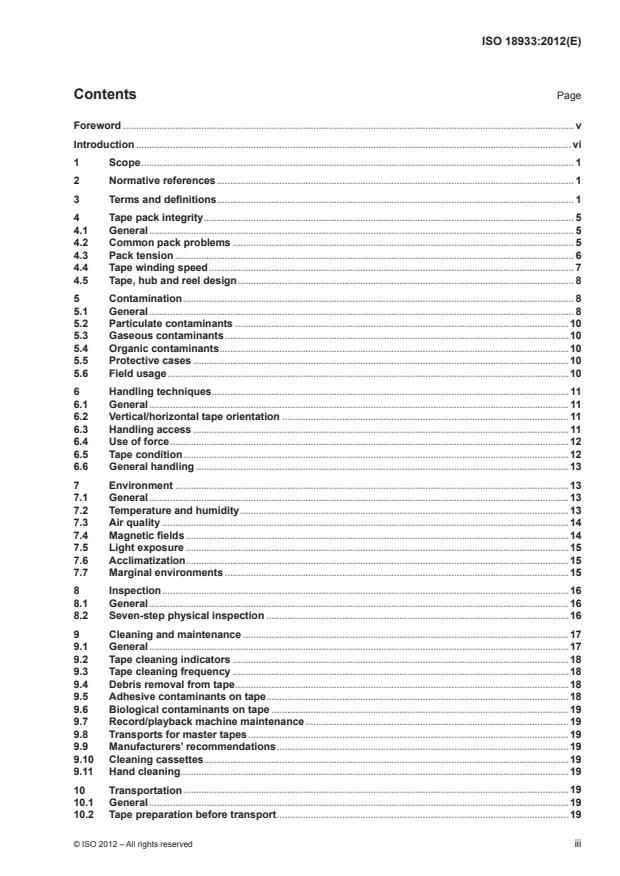
Contents Page
Foreword . v
Introduction .vi
1 Scope . 1
2 Normative references . 1
3 Terms and definitions . 1
4 Tape pack integrity . 5
4.1 General . 5
4.2 Common pack problems . 5
4.3 Pack tension . 6
4.4 Tape winding speed . 7
4.5 Tape, hub and reel design . 8
5 Contamination . 8
5.1 General . 8
5.2 Particulate contaminants .10
5.3 Gaseous contaminants .10
5.4 Organic contaminants .10
5.5 Protective cases .10
5.6 Field usage .10
6 Handling techniques . 11
6.1 General . 11
6.2 Vertical/horizontal tape orientation . 11
6.3 Handling access . 11
6.4 Use of force .12
6.5 Tape condition .12
6.6 General handling .13
7 Environment .13
7.1 General .13
7.2 Temperature and humidity .13
7.3 Air quality .14
7.4 Magnetic fields .14
7.5 Light exposure .15
7.6 Acclimatization .15
7.7 Marginal environments .15
8 Inspection .16
8.1 General .16
8.2 Seven-step physical inspection .16
9 Cleaning and maintenance .17
9.1 General .17
9.2 Tape cleaning indicators .18
9.3 Tape cleaning frequency .18
9.4 Debris removal from tape .18
9.5 Adhesive contaminants on tape .18
9.6 Biological contaminants on tape .19
9.7 Record/playback machine maintenance .19
9.8 Transports for master tapes .19
9.9 Manufacturers’ recommendations .19
9.10 Cleaning cassettes .19
9.11 Hand cleaning .19
10 Transportation .19
10.1 General .19
10.2 Tape preparation before transport .19
10.3 Transport methods .20
10.4 General exposure .21
10.5 External fields and security scanning of material .21
11 Disasters .21
11.1 General .21
11.2 Water .22
11.3 Fire .22
11.4 Dry debris .22
11.5 Disaster response .22
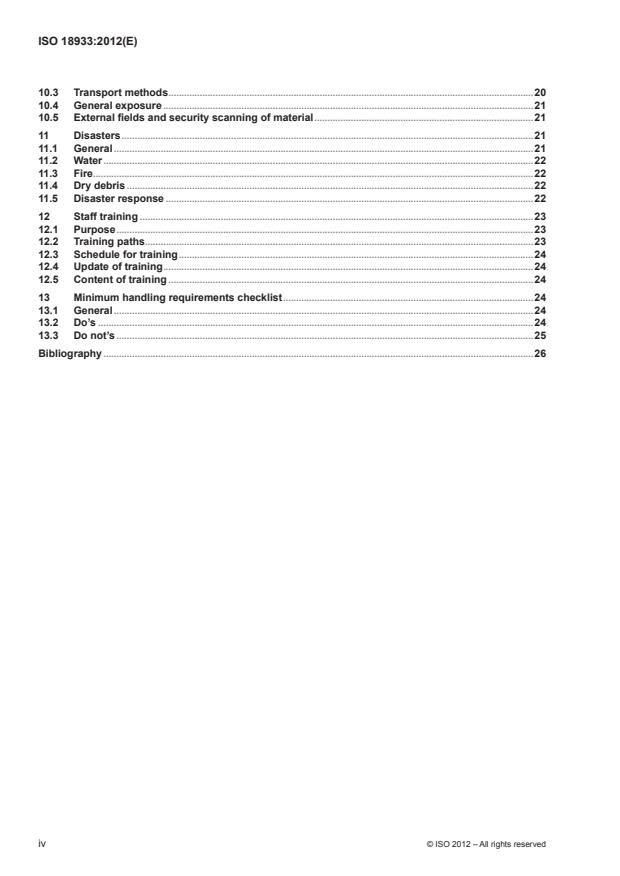
12 Staff training .23
12.1 Purpose .23
12.2 Training paths .23
12.3 Schedule for training .24
12.4 Update of training .24
12.5 Content of training .24
13 Minimum handling requirements checklist .24
13.1 General .24
13.2 Do’s .24
13.3 Do not’s .25
Bibliography .26
iv © ISO 2012 – All rights reserved
Foreword
ISO (the International Organization for Standardization) is a worldwide federation of national standards bodies
(ISO member bodies). The work of preparing International Standards is normally carried out through ISO
technical committees. Each member body interested in a subject for which a technical committee has been
established has the right to be represented on that committee. International organizations, governmental and
non-governmental, in liaison with ISO, also take part in the work. ISO collaborates closely with the International
Electrotechnical Commission (IEC) on all matters of electrotechnical standardization.
International Standards are drafted in accordance with the rules given in the ISO/IEC Directives, Part 2.
The main task of technical committees is to prepare International Standards. Draft International Standards
adopted by the technical committees are circulated to the member bodies for voting. Publication as an
International Standard requires approval by at least 75 % of the member bodies casting a vote.
Attention is drawn to the possibility that some of the elements of this document may be the subject of patent
rights. ISO shall not be held responsible for identifying any or all such patent rights.
ISO 18933 was prepared by Technical Committee ISO/TC 42, Photography.
This second edition cancels and replaces the first edition (ISO 18933:2006), of which it constitutes a minor
revision with the following changes:
1) Annex A has been removed, to be consistent with same change made in other ISO/TC 42 standards.
2) In Clause 2, the titles of ISO 14644-1 and ISO 14644-2 have been updated to reflect the latest versions.
3) In the definition for backcoat (3.2), “increase friction” has been changed to “modify friction”.
4) The terminological entry for class 100 000 cleanroom (formerly 3.10) has been removed and the
remaining terms re-numbered. The reference to a “class 100 000” cleanroom has been added to 7.3.3
Cleanroom specifications.
5) In the definition for master (now 3.26; formerly 3.27), “e.g. camera master, edited master, foreign
language master” has been moved into an example.
6) In the definition for tape pack (now 3.43; formerly 3.44), “length of magnetic tape” has been changed
to “magnetic tape wound on a reel or hub”.
7) The terminological entry for wind (formerly 3.45) included two separate definitions; it has been split
into two entries (3.44 and 3.45), differentiated by the use of parts of speech.
8) The terminological entry for windows (formerly 3.46) included three definitions; the first has been
retained and the singular tense has been used.
9) In 4.5.2 Backcoat surface of the tape, “increases friction” has been changed to “modifies friction”.
Introduction
This International Standard is one of a series of International Standards dealing with the physical properties
and stability of imaging materials.
Magnetic recording tape has served as a major means of processing, distributing and preserving information,
including video, audio, computer and other data since the 1930s. Unlike earlier data-recording media such as
paper and photographic material, the information recorded on magnetic tape is not directly human-readable
and requires a machine interface and interpretation. In addition, the machine/medium interface must occur
within precise conditions in order for the machine interpretation to be accurate. Therefore, the physical integrity
of magnetic tape necessary to provide a proper interface with the interpreting machinery is critical. Correct
care and handling is essential to preserve the needed physical integrity of magnetic tape both for short-term
usage and long-term archiving.
Magnetic tape has proven itself an easy-to-use and versatile medium. Yet despite the substantial resources
put into creating recordings and the historical, intellectual and financial assets they represent, tapes often are
not treated as valuable objects. Many important and unique recordings are lost due to inadequate care and
handling of the tape. This poses problems for users who wish to preserve the content. Among these problems
are the following.
Improper handling can damage magnetic tapes and compromise the future ability to retrieve content.
Due to the enormous volume of existing tapes, the impracticality and cost of making copies of each and every
one frequently results in large numbers of unique records being subjected to excessive use and wear without
any back-up or protection. Repeated use of magnetic tape can cause wear or physical damage that shortens
its effective life.
Some magnetic tapes are known to have a finite shelf life and will eventually decay. Recorded documents on
these tapes must be copied to new media before decay precludes access.
The ability to play back a tape in the future depends on the existence of functional playback equipment. As
new tape formats become popular, equipment manufacturers discontinue the production and support of older,
superseded equipment. Eventually, usable equipment to play older, obsolete magnetic tape formats becomes
impossible to find. Before this occurs, a migration plan should be in place.
Like all media, magnetic tape is subject to both damage and decay. Consequently, its effective life can increase
or decrease significantly depending on the conditions under which it is stored and handled. This International
Standard contains recommendations for the care and handling of magnetic tape. Recommendations
for the preservation and storage of polyester-base magnetic tape appear in ISO 18923. Following these
recommendations promotes the physical integrity of the media and increases the effective life of magnetic tape.
vi © ISO 2012 – All rights reserved
INTERNATIONAL STANDARD ISO 18933:2012(E)
Imaging materials — Magnetic tape — Care and handling
practices for extended usage
1 Scope
This International Standard concerns the care and handling of magnetic recording tape during use. It addresses
the issues of physical integrity of the medium necessary to preserve access to the data (information) recorded
on the tape. This International Standard recommends handling procedures to maximize the effective life
of magnetic tape. Faulty handling, packing and transporting techniques and methods often cause damage
to magnetic tape and the content recorded thereon. Extending the longevity of magnetic tape requires the
identification of appropriate handling methods and well-developed training programmes.
While some of the recommendations in this International Standard, such as staff training, apply specifically to
large-scale or archival usage, the basics of all recommendations in this document can and should be applied in all
circumstances where the desired result is long-term usage of the medium whether archival, commercial or personal.
This International Standard addresses the following subjects:
— handling techniques, including common hazards and methods to mitigate those hazards;
— handling environments, including pollutants, temperature and humidity, lighting, magnetic fields and robotics;
— use of tape, including inspection, playback, mounting/loading and removing, winding speed, tension and
robotic systems;
— cleaning and maintenance techniques, including contaminants, cleaning methods and frequency;
— transportation, both in-house and shipping outside the storage facility;
— disasters, including water, fire, construction and post-disaster procedures;
— staff training, including schedule for training and contents of the training programme;
— archival issues.
2 Normative references
The following referenced documents are indispensable for the application of this document. For dated
references, only the edition cited applies. For undated references, the latest edition of the referenced document
(including any amendments) applies.
ISO 14644-1, Cleanrooms and associated controlled environments — Part 1: Classification of air cleanliness
by particle concentration
ISO 14644-2, Cleanrooms and associated controlled environments — Part 2: Specifications for monitoring and
periodic testing to prove continued compliance with ISO 14644-1
ISO 18923, Imaging materials — Polyester-base magnetic tape — Storage practices
3 Terms and definitions
For the purposes of this document, the following terms and definitions apply.
3.1
acclimatization
staging
process of conditioning material from one set of temperature/moisture conditions to another
3.2
backcoat
rough surface layer added to the back of the basefilm to modify friction and minimize slippage
between tape strands
3.3
basefilm
base
plastic (polymer) substrate to which the magnetic layers are attached
3.4
binder
plastic (polymer) in which the magnetic particles are bound in order to create the recording
layers of the tape and which binds the recording layers to the basefilm
3.5
carrier
medium upon which the information is recorded
3.6
carton box
outer container that can hold one or more individual units and may be a fabrication of paper, card stock or plastic
3.7
cartridge
housing for a roll of recording material, such as photographic film or magnetic tape, wound on a single hub or reel
See cassette (3.8).
3.8
cassette
housing for a roll of recording material, such as photographic film or magnetic tape, whose ends are attached
to two hubs or reels
3.9
cinching
tape folding back upon itself within the tape pack
3.10
conditioning
exposure of a specimen to air at a given relative humidity and temperature until equilibrium is reached
3.11
container
box, can or carton used for storage and shipping of recording materials
NOTE Reels, cassettes, cartridges, or shells are not containers; the box into which a reel, cassette, cartridge or shell
is placed is defined as a container.
3.12
copy
reproduction of the information from a master
3.13
domain
magnetic domain
cluster of the embedded magnetic particles which all align in the same north-south direction
2 © ISO 2012 – All rights reserved
3.14
extended-term storage conditions
storage conditions suitable for the preservation of recorded information having permanent value
3.15
flange
fixed or removable circular disc that is connected to the hub to make a reel for the purpose of protecting the
roll of recording materials
See reel (3.33).
3.16
flange pack
condition where the whole tape pack rests against one flange
3.17
format
dimensions of the magnetic recording and its assembly as well as the physical and magnetic specifications of
the recording on the tape
3.18
heads out
configuration of magnetic tape stored on its reel or in its cassette such that the tape is positioned to play from
the beginning of the recorded information
3.19
hub
cylindrical object around which the recording material is wound
3.20
hydrolysis
decomposition involving a reaction with water that results in the splitting of chemical bonds
3.21
leader
flexible plastic or paper strip which can be spliced to either end of a roll of recording material
NOTE This practice is not recommended for extended-term storage.
3.22
leafing
multiple popped strands in a magnetic-tape wind
See popped strand (3.31) and stepped pack (3.40).
3.23
library wind
low-speed rewind at controlled tension to achieve a smooth tape pack
NOTE The low speed rewind is typically 1 m/s to 3 m/s.
3.24
loose pack
undesirable pack condition in a roll of recording material, such that the outer portion of the roll can be moved
and tightened by pulling on the end
3.25
magnetic field intensity
magnitude of the magnetic field, in amperes per meter, at a point in space
3.26
master
original or primary recording of the data or any version of the data
EXAMPLE Camera master, edited master, foreign language master.
3.27
medium
media, pl
material on which information is recorded
See carrier (3.5).
3.28
medium-term storage conditions
storage conditions suitable for the preservation of recorded information for a minimum of 10 years
3.29
migration
transferring information from one format to another
3.30
oligomer
low molecular-weight polymer which can be produced by degradation of the magnetic tape binder
3.31
popped strand
lateral displacement of a single strand or wrap of magnetic tape extending beyond the plane of the tape pack
See leafing (3.22) and stepped pack (3.40).
3.32
print-through
unintentional magnetic transfer of the recording on one layer of magnetic tape to the adjacent layers during
storage on a reel/hub
3.33
reel
metal or plastic hub or core with flanges (protective sides) onto which recording material is wound
3.34
shell
outer housing of a cassette or cartridge
3.35
slot
space or slit in the winding surface of a reel or hub
3.36
splice
union of two pieces of recording or leader material to form a single piece
3.37
splicing tape
paper or plastic strip coated with a thermal or pressure-sensitive adhesive, used in splicing
3.38
spoking
deformations in a roll pack that appear radially outward and disrupt the circular nature of the wind
4 © ISO 2012 – All rights reserved
3.39
staging acclimatization
process of conditioning material from one set of temperature/moisture conditions to another
3.40
stepped pack
multiple adjacent strands of magnetic tape extending beyond the level of a tape pack
See leafing (3.22) and popped strand (3.31).
3.41
storage environment
conditions for storing materials, i.e. temperature, relative humidity, cleanliness of facilities and atmospheric pollutants
3.42
tails out
configuration of magnetic tape stored on its reel, or in its cassette, such that the tape must be fully rewound in
order to correctly play from the beginning of the recorded information
3.43
tape pack
magnetic tape wound on a reel or hub
3.44
wind, noun
physical appearance and tension of the magnetic tape pack
3.45
wind, verb
process of transferring a roll of recording material from one spool or reel to another
3.46
window
windage hole
opening in the flanges of a tape reel
4 Tape pack integrity
4.1 General
The physical integrity of the tape pack shall be maintained to avoid damage to the tape and allow for proper
retrieval of the recorded content. Tape pack integrity is dependent on several variables and loss of pack
integrity can have a variety of negative effects.
4.2 Common pack problems
4.2.1 Pack deformation
Edge damage and tape deformation will alter the quality of the tape pack, resulting in spoking or a lipped-edged
pack (see Figure 1).
4.2.2 Flange pack
If the tape pack is against one flange, then there is a misalignment between the tape reel and the tape edge
guide nearest the tape reel.
4.2.3 Pack slippage
Vibration or impact will often result in slippage of the pack causing edge damage if the winding tension is too
low. The pack is most susceptible to slippage while a tape is held horizontally.
4.2.4 Pack penetration or abrasion
Any portion of the tape pack that is exposed is especially vulnerable to damage. Fingers shall not be inserted
through the window of a flange except in an empty reel when threading an open reel tape.
4.2.5 Edge compression
Mounting and unmounting large reels of tape requires special care. Tape reels shall be handled by the hub and
the flanges shall not be squeezed. Compressing the flanges can crack the magnetic coating on tape edges and
deform the basefilm resulting in poor head-to-tape contact. Tape with laterally misaligned strands is extremely
susceptible to edge compression damage [see popped strand (3.31)].
4.3 Pack tension
4.3.1 General
If a tape is not wound at the proper tension, the tape pack is likely to become distorted during storage. When a
distorted pack is unwound, tape surface deformation will be noticed at spacings equal to the circumference of
the tape pack at that point. Tape surface deformation is likely to cause poor head-to-tape contact.
NOTE Most tape deformation can be returned to normal by a knowledgeable tape restoration professional - except
where a tape layer has been folded.
4.3.2 Tension control
The tape tension is controlled by the design and maintenance of the tape machine. Tape tension can be
measured by a technician with a special tape tension gauge.
6 © ISO 2012 – All rights reserved
4.3.3 Winding tension
Tape shall be wound on a hub, not touching a flange, within a range of tensions that allows the tape to maintain
a uniform pack without imposing unnecessary longitudinal stress.
a) Good pack b) Popped strands c) Slipped pack d) Flange pack with lipped edge
Key
1 reel flange
2 tape pack
3 hub
Figure 1 — Examples of tape packs
4.4 Tape winding speed
4.4.1 General
The speed of the tape while it is being packed onto the reel can affect the tape pack. When tape is wound
at high speed, air is trapped between the tape strands and can cause pack irregularities. At play or record
speeds, air is not trapped between layers and the tape will develop a smooth-edged pack, unless the tape
edges have been damaged.
4.4.2 Library wind
Library wind mode shall be used, when available, before storage. This mode is a special option on some tape
machines that wind the tape at low speed.
4.4.3 Winding loose packs
If a tape pack is loose, it shall not be run at fast forward or fast rewind speeds. The tape shall be run in play
mode to the end and then rewound. Very loose tape packs shall be hand wound or wound on a machine with
reduced tension to avoid cinching and other damage. For cassette tapes, this may require special handling or
machinery and expert assistance to avoid tape damage.
4.5 Tape, hub and reel design
4.5.1 General
Design elements of the tape, hub and reel can affect the tape pack.
4.5.2 Backcoat surface of the tape
Backcoated tape has a rough surface that modifies friction, thus minimizing slippage between tape strands and
loss of tape pack integrity.
4.5.3 Splices
Tapes shall not be spliced except as required for repair prior to playback or when the splice is part of the
manufacturing process (i.e. attaching tape ends to leader). The problems created by splices include deformation,
delamination, adhesive bleed, alignment problems and tape head damage.
4.5.4 Hub diameter
Pack slippage is less likely to occur on reels where the ratio of the outer pack to hub diameter is less than 2,5.
4.5.5 Flangeless hubs
Sometimes magnetic tape is stored on flangeless hubs. When this practice is used, the following
recommendations shall be observed.
a) Only backcoated tape designed for storage on a flangeless hub shall be stored in this manner. Non-
backcoated tape will not wind properly and is at high risk of falling off the tape pack.
b) Tape tension is especially critical; too loose a wind will result in immediate disintegration of the tape pack.
c) The loose end of the tape shall be fixed down with non-residue-producing adhesive tape. Tapes shall be
held only between the hub and the outside wind, without touching the surface of the tape pack.
d) Extreme caution shall be used when handling tapes without flanges. Loose tapes shall be rewound on a
correctly adjusted tape machine.
4.5.6 Reel flanges with openings (windows)
When tape is wound at high speed (fast forward or rewind), air is trapped between the tape strands but can escape
if the flange is designed with openings. This ensures good contact between the surfaces of adjacent strands.
4.5.7 Cassettes and cartridges
Tape cassettes and cartridges shall be wound entirely to one end at play speed or to a special parking area
designated by the machine manufacturer to avoid deformation of recorded sections of the tape from prolonged
contact with internal guide posts.
5 Contamination
5.1 General
Magnetic tapes are highly susceptible to contamination.
Figure 2 shows the relative size of debris commonly found on magnetic recording tapes and in tape machines,
relative to the head-to-tape spacing. It is clear from this diagram that even the smallest airborne particles can
result in errors if the debris gets between the head and the tape.
8 © ISO 2012 – All rights reserved
Key
1 video head
2 cotton fibre
3 finger print
4 gap
5 dust
6 human hair
7 magnetic tape surface
Figure 2 — Debris on the surface of the tape
Figure 3 is a photograph of a small section of tape that has been covered with very fine iron particles to show
10 recorded video tracks. The “mountain” in the middle of the photograph is a small piece of debris. It is
surrounded by empty space caused when the video head skipped over the debris and did not record part of
two video tracks.
a
One track.
Figure 3 — Loss of data due to a clump of debris on the surface of the tape
5.2 Particulate contaminants
Particulate contaminants will block access to material recorded on a tape and can cause physical damage to
both tape and machinery. Dust, smoke and debris-generating objects or materials (e.g. carpets, draperies,
unsealed insulation, packaging blankets and other padding materials, fibrous wall coverings and furnishings)
shall not be present in any area where extended-life tapes are being handled or used. In areas where sound
levels shall be minimized, special non-debris generating material shall be used.
5.3 Gaseous contaminants
Gaseous pollutants, such as exhaust fumes and fumes from ammonia- and chloride-based cleansers, cause
chemical reactions that are harmful to magnetic recording tapes. Positive air pressure shall be maintained
in tape usage areas to reduce ingress of gaseous contaminants (see 7.3.2). Ammonia- and chloride-based
cleansers shall not be used in tape handling or usage areas.
5.4 Organic contaminants
5.4.1 General
Organic contaminants damage tape in two ways: by directly damaging the tape and by attracting and holding
other contaminants in contact with the tape.
5.4.2 Human-transferred contaminants
Personnel shall wash their hands before handling magnetic tapes or protective cases since human skin
is constantly being shed. Epidermal oils and artificial substances such as lotions are easily transferred to
magnetic recording tape. Such oils can be destructive to the tape and may carry other damaging contaminants
and debris. Consequently, small flakes of skin and oily fingerprints are among the most common contaminants
found on tape.
5.4.3 Consumables
Magnetic tape use and handling areas shall be kept free of food, beverages and smoke. Food and drink pose a
threat to magnetic recording tape both because they contain destructive agents and because they can attract
and hold other pollutants. Many foods, especially those that contain sugars, have adhesive characteristics
that will cause tape to stick to itself and other objects. Decaying food also can result in fungal growth or the
attraction of destructive vermin.
5.4.4 Biological contaminants
The most common biological contaminant of tape is fungus. Fungus shall be considered toxic and treated with
great care. Unprotected personnel shall not handle tapes containing fungus.
5.5 Protective cases
Protective cases shall not be opened, and magnetic recording tapes shall not be removed from their cases,
in environments where a large amount of particulate matter is present or is likely to be generated such as in
shipping rooms or machine shops.
5.6 Field usage
For field applications, tapes shall be transported in their protective cases and left in the recorder only during
use. In the field, tapes and tape cases shall be shielded at all times from exposure to moisture, temperature
extremes, dust and sunlight.
10 © ISO 2012 – All rights reserved
6 Handling techniques
6.1 General
Magnetic tape is easily damaged by improper handling. Proper techniques shall be used when handling
magnetic tapes to avoid damaging the medium in ways that will shorten the usable life of the tape or interfere
with the future ability to retrieve information from the tape.
6.2 Vertical/horizontal tape orientation
6.2.1 Tape position
The position of the tape during handling and the user’s grip will affect the tape’s susceptibility to damage.
6.2.2 Reel-to-reel tapes
Reels of magnetic recording tape shall be held vertically, by the centre hub or supported by the edges of the
flanges, without putting pressure on the flat surfaces of the flanges.
6.2.3 Cassettes and cartridges
Cassettes and cartridges shall be positioned vertically except when it is necessary to change their orientation
in order to insert or remove them from equipment. Cassettes and cartridges shall be held touching only the
rigid outer casing or shell and not the movable lid or the hub.
6.2.4 Transportation
Magnetic tape recordings shall be transported, in-house as well as between facilities, vertically in their protective
cases. Tapes shall be removed from their cases only for inspection or immediate use.
6.2.5 Removal from protective cases
Protective cases shall be placed horizontally on a clean, flat, uncluttered surface when opening the case
to remove the magnetic recording tape. Other than during this operation or when positioning in a machine,
magnetic tapes shall not be left in a horizontal position.
6.3 Handling access
6.3.1 Staff
Only trained staff shall hold and use master magnetic tape recordings.
6.3.2 Physical contact
Magnetic recording tape shall not be touched by fingers except at the beginning and the end of the tape. When
magnetic tape must be touched, hands and fingers shall be washed immediately prior to performing the work
and/or dye-free, lint-free gloves shall be worn.
6.3.3 Frequency of access
Master recordings shall be handled and moved as infrequently as possible. Procedures shall be established to
provide alternate copies of the recordings when frequent usage is required.
6.4 Use of force
6.4.1 General
Magnetic recording tapes shall be held in ways that minimize stress (e.g. pressure or torque) on the tape and
the support structure.
6.4.2 Loading force
Excessive force shall not be used to load a magnetic recording tape into either a container or a machine.
Pressure shall only be exerted in the hub area for tapes on reels.
6.4.3 Releasing force
Releasing or putting magnetic recording tapes on any surface shall be done gently, minimizing vibration and
impact. Tapes and protective cases should never be thrown or dropped.
6.4.4 Flange compression
When the flanges on a reel are forced closer together, serious deformation or crushing damage to the tape can
result. Typical actions that cause flange compression are:
a) picking up or holding a flanged reel from the outer edge with the fingers on one flange and the thumb on
the other flange (unfortunately, this is often seen as the most common and convenient way to hold a reel);
b) stacking tapes or other objects on top of an unprotected reel;
c) sudden impact such as dropping a tape or hitting it against the edge of a table;
d) forced closing of a protective case on a tape when there is other material in the case.
6.5 Tape condition
6.5.1 General
Tapes shall be as secure from damage as possible before handling or transportation.
6.5.2 Open reels
During handling or transport, the outer wrap of tapes on open reels shall be secured by the use of non-
destructive hold-down tape or reel guard bands specifically made for this purpose.
6.5.3 Cassettes and cartridges
Many cassettes and cartridges have internal mechanisms that prevent the hubs from turning. Cassettes and
cartridges that do not have such mechanisms shall be handled and transported with suitable retainers or in
protective cases that are designed to prevent hub movement.
6.5.4 Tape position on hub
Tapes shall be wound to the end before being removed from the machine and before storage. The tape pack
shall be as smooth as possible.
6.5.5 Robotic systems
Some robotic systems are designed to wind the tape to special “parking” zones on the tape for threading/unthreading
of the tape. But, when a tape is removed from the robotic system, it shall be wound to the end.
12 © ISO 2012 – All rights reserved
6.6 General handling
6.6.1 General
Handling of master tapes shall be done so as not to compromise the ability of future users to gain access to
the recording.
6.6.2 Labelling
All tapes and their containers shall be clearly labelled with all information necessary to identify content for the
life of the recording. Labels shall not interfere with the use of the tape.
6.6.3 Print-through
Print-through can be accelerated by high winding tension, magnetic fields and heat. Analogue audio tapes shall
be stored on the take-up reel (tails out) to minimize the effects of print-through [see print-through (3.32)]. Print-
through is reduced by rewinding several times.
6.6.4 Erasure
The record protection feature of all master cassettes shall be activated immediately after they have been
recorded (see also 7.4).
Erasure of tape content is a virtually non-recoverable problem. Erasure requires close proximity of a strong
magnetic field. The strength of field necessary is seldom found in the environment, and erasure of tape data is
almost always the result of human error or intent.
7 Environment
7.1 General
During use and handling, many environmental factors affect the functioning and life expectancy of magnetic
recording tape. Among the most critical factors are temperature, humidity, cleanliness and the presence of
potential contaminants.
Magnetic tape life is affected by chemical deterioration, including binder hydrolysis, loss of lubricant and
binder/base separation. The rate at which these events occur varies depending on the chemical formulation
used by the manufacturer and the environmental conditions to which the tape is exposed. Although there have
been numerous studies about tape longevity and stability that have produced valuable qualitative information,
an accelerated life test that produces meaningful quantitative data does not exist yet. Hence, no method is
known which will indicate the specific life expectancy of various brands and formulations of magnetic tape.
The environmental conditions given in this clause shall be followed for tapes intended for extended life. They
are also recommended for all handling environments in order to prolong the life of all tapes.
7.2 Temperature and humidity
7.2.1 Environmental condition
Magnetic tape life is influenced directly by temperature and humidity. Master tapes shall be handled at stable
temperatures between 18 °C and 25 °C and at stable relative humidities between 15 % and 50 %.
7.2.2 Life expectancy
Life expectancy increases when magnetic tape is stored in a cool, dry environment characterized by stable
temperature
...