


ISO/FDIS 6909
(Main)Machine tools — Safety — Press brakes
Machine tools — Safety — Press brakes
This document specifies technical safety requirements and measures to be adopted by persons undertaking the design, manufacture and supply of press brakes which are intended to work cold metal or material partly of cold metal but which can be used in the same way to work other sheet materials (e.g. cardboard, plastic, rubber, leather, etc.) and also referred to as machines. NOTE 1 The design of a machine includes the study of the machine itself, taking into account all phases of the “life” of the machine mentioned in ISO 12100:2010, 5.4, and the drafting of the instructions related to all the above phases. This document covers the following types of machines (see Annex J) : - Hydraulic press brakes - Hydraulic servo-drive press brakes - Screw servo-drive press brakes - Belt-spring servo-drive press brakes The requirements in this document take account of intended use, as defined in ISO 12100:2010, 3.23, as well as reasonably foreseeable misuse, as defined in ISO 12100:2010, 3.24. This document presumes access to the press brake from all directions, deals with all significant hazards during the various phases of the life of the machine described in Clause 4, and specifies the safety measures for both the operator and other exposed persons. NOTE 2 All significant hazards means those identified or associated with press brakes at the time of the publication of this document. This document applies to press brakes which can function independently or in combination (e.g. two machines in tandem or more) and can also be used as a guide for the design of press brakes which are intended to be integrated in a manufacturing system. This document deals with the significant hazards, hazardous situations and events relevant to press brakes and ancillary devices (see Clause 4). This document specifies the safety requirements for press brakes defined in this clause. This document does not cover press brakes which transmit energy to impart beam motion by using pneumatic means or mechanical clutch or press brakes that use combination of technologies (e.g. combined hydraulic and screw servo-drive press brake or combined hydraulic servo-drive and screw servo-drive press brake) This document does not cover machines whose principal designed purpose is: a) sheet folding by rotary action; b) tube and pipe bending by rotary action; c) roll bending. This document does not cover hazards related to the use of press brakes in explosive atmospheres. This document is not applicable to press brakes which are manufactured before the date of its publication. This document does not cover the safety aspect of equipment for automatic loading and unloading where provided. Guidance on how to take into account additional automatic loading and unloading equipment can be found in ISO 11161.
Machines outils — Sécurité — Presses plieuses
General Information
- Status
- Not Published
- Technical Committee
- ISO/TC 39/SC 10 - Safety
- Drafting Committee
- ISO/TC 39/SC 10 - Safety
- Current Stage
- 5020 - FDIS ballot initiated: 2 months. Proof sent to secretariat
- Start Date
- 19-Nov-2025
- Completion Date
- 19-Nov-2025
Relations
- Effective Date
- 06-Jun-2022
Overview
ISO/FDIS 6909 - Machine tools - Safety - Press brakes is the FDIS-stage international standard that specifies technical safety requirements for press brakes used to bend cold metal and similar sheet materials. It covers the design, manufacture and supply of press brakes (including hydraulic, hydraulic servo‑drive, screw servo‑drive and belt‑spring servo‑drive types) and addresses hazards throughout the machine’s life cycle in accordance with ISO 12100 principles. The document focuses on operator and bystander protection, control system safety, verification and information for use.
Key Topics
- Scope and machine types: Applies to hydraulic and several servo‑drive press brake technologies; excludes pneumatic or mechanical‑clutch driven brakes and machines whose primary purpose is rotary folding, tube bending or roll bending.
- Hazard identification: Lists significant hazards and hazardous situations specific to press brakes (access from all sides, tandem operation, integration into systems).
- Safeguarding and mechanical protections: Requirements for guards, separation distances and side safeguarding for manually loaded/unloaded machines.
- Control systems and functional safety: Design and validation expectations for safety‑related control parts (references to ISO 13849/IEC 62061, IEC 61800‑5‑2).
- Modes of operation: Safe modes for set‑up, production, maintenance and reasonably foreseeable misuse.
- Verification and testing: Procedures for verifying stopping performance, response times and overall safety measures (including noise test code and AOPD laser tests in annexes).
- Information for use: Marking, instruction handbook content and requirements for documentation supplied with the machine.
- Normative and informative annexes: Include calculation of separation distances, example redundant hydraulic circuits, noise measurement methods, laser AOPD tests and technology descriptions.
Applications
- Who uses it: Machine manufacturers, design engineers, safety compliance officers, system integrators, machine users, maintenance and service providers, and regulatory bodies.
- Practical uses:
- Designing press brakes to meet international safety expectations and reduce liability.
- Specifying control system architecture and safety functions during product development.
- Verifying retrofit or integration of press brakes into automated manufacturing lines.
- Developing operator manuals, markings and risk‑reduction measures for safe operation.
- Supporting conformity assessment and market surveillance against machinery safety directives.
Related Standards
- ISO 12100 (risk assessment and risk reduction)
- ISO 13849 / IEC 62061 (safety‑related control systems)
- IEC 61496 series (AOPDs)
- ISO 4413 / ISO 4414 (hydraulic/pneumatic safety)
- ISO/FDIS 6909 includes annexes that reference noise measurement standards (ISO 3744/3746) and other machine safety standards for alignment with regulatory requirements.
Keywords: ISO/FDIS 6909, press brakes safety, machine tools safety, press brake standards, hydraulic press brakes, servo‑drive press brakes, risk assessment, safeguarding, control systems.

ISO/FDIS 6909 - Machine tools — Safety — Press brakes Released:5. 11. 2025


REDLINE ISO/FDIS 6909 - Machine tools — Safety — Press brakes Released:5. 11. 2025

ISO/FDIS 6909 - Machines outils — Sécurité — Presses plieuses Released:5. 01. 2026
Frequently Asked Questions
ISO/FDIS 6909 is a draft published by the International Organization for Standardization (ISO). Its full title is "Machine tools — Safety — Press brakes". This standard covers: This document specifies technical safety requirements and measures to be adopted by persons undertaking the design, manufacture and supply of press brakes which are intended to work cold metal or material partly of cold metal but which can be used in the same way to work other sheet materials (e.g. cardboard, plastic, rubber, leather, etc.) and also referred to as machines. NOTE 1 The design of a machine includes the study of the machine itself, taking into account all phases of the “life” of the machine mentioned in ISO 12100:2010, 5.4, and the drafting of the instructions related to all the above phases. This document covers the following types of machines (see Annex J) : - Hydraulic press brakes - Hydraulic servo-drive press brakes - Screw servo-drive press brakes - Belt-spring servo-drive press brakes The requirements in this document take account of intended use, as defined in ISO 12100:2010, 3.23, as well as reasonably foreseeable misuse, as defined in ISO 12100:2010, 3.24. This document presumes access to the press brake from all directions, deals with all significant hazards during the various phases of the life of the machine described in Clause 4, and specifies the safety measures for both the operator and other exposed persons. NOTE 2 All significant hazards means those identified or associated with press brakes at the time of the publication of this document. This document applies to press brakes which can function independently or in combination (e.g. two machines in tandem or more) and can also be used as a guide for the design of press brakes which are intended to be integrated in a manufacturing system. This document deals with the significant hazards, hazardous situations and events relevant to press brakes and ancillary devices (see Clause 4). This document specifies the safety requirements for press brakes defined in this clause. This document does not cover press brakes which transmit energy to impart beam motion by using pneumatic means or mechanical clutch or press brakes that use combination of technologies (e.g. combined hydraulic and screw servo-drive press brake or combined hydraulic servo-drive and screw servo-drive press brake) This document does not cover machines whose principal designed purpose is: a) sheet folding by rotary action; b) tube and pipe bending by rotary action; c) roll bending. This document does not cover hazards related to the use of press brakes in explosive atmospheres. This document is not applicable to press brakes which are manufactured before the date of its publication. This document does not cover the safety aspect of equipment for automatic loading and unloading where provided. Guidance on how to take into account additional automatic loading and unloading equipment can be found in ISO 11161.
This document specifies technical safety requirements and measures to be adopted by persons undertaking the design, manufacture and supply of press brakes which are intended to work cold metal or material partly of cold metal but which can be used in the same way to work other sheet materials (e.g. cardboard, plastic, rubber, leather, etc.) and also referred to as machines. NOTE 1 The design of a machine includes the study of the machine itself, taking into account all phases of the “life” of the machine mentioned in ISO 12100:2010, 5.4, and the drafting of the instructions related to all the above phases. This document covers the following types of machines (see Annex J) : - Hydraulic press brakes - Hydraulic servo-drive press brakes - Screw servo-drive press brakes - Belt-spring servo-drive press brakes The requirements in this document take account of intended use, as defined in ISO 12100:2010, 3.23, as well as reasonably foreseeable misuse, as defined in ISO 12100:2010, 3.24. This document presumes access to the press brake from all directions, deals with all significant hazards during the various phases of the life of the machine described in Clause 4, and specifies the safety measures for both the operator and other exposed persons. NOTE 2 All significant hazards means those identified or associated with press brakes at the time of the publication of this document. This document applies to press brakes which can function independently or in combination (e.g. two machines in tandem or more) and can also be used as a guide for the design of press brakes which are intended to be integrated in a manufacturing system. This document deals with the significant hazards, hazardous situations and events relevant to press brakes and ancillary devices (see Clause 4). This document specifies the safety requirements for press brakes defined in this clause. This document does not cover press brakes which transmit energy to impart beam motion by using pneumatic means or mechanical clutch or press brakes that use combination of technologies (e.g. combined hydraulic and screw servo-drive press brake or combined hydraulic servo-drive and screw servo-drive press brake) This document does not cover machines whose principal designed purpose is: a) sheet folding by rotary action; b) tube and pipe bending by rotary action; c) roll bending. This document does not cover hazards related to the use of press brakes in explosive atmospheres. This document is not applicable to press brakes which are manufactured before the date of its publication. This document does not cover the safety aspect of equipment for automatic loading and unloading where provided. Guidance on how to take into account additional automatic loading and unloading equipment can be found in ISO 11161.
ISO/FDIS 6909 is classified under the following ICS (International Classification for Standards) categories: 13.110 - Safety of machinery; 25.080.01 - Machine tools in general. The ICS classification helps identify the subject area and facilitates finding related standards.
ISO/FDIS 6909 has the following relationships with other standards: It is inter standard links to ISO 7612:2018. Understanding these relationships helps ensure you are using the most current and applicable version of the standard.
ISO/FDIS 6909 is available in PDF format for immediate download after purchase. The document can be added to your cart and obtained through the secure checkout process. Digital delivery ensures instant access to the complete standard document.
Standards Content (Sample)
FINAL DRAFT
International
Standard
ISO/TC 39/SC 10
Machine tools — Safety — Press
Secretariat: SNV
brakes
Voting begins on:
Machines outils — Sécurité — Presses plieuses 2025-11-19
Voting terminates on:
2026-01-14
RECIPIENTS OF THIS DRAFT ARE INVITED TO SUBMIT,
WITH THEIR COMMENTS, NOTIFICATION OF ANY
RELEVANT PATENT RIGHTS OF WHICH THEY ARE AWARE
AND TO PROVIDE SUPPOR TING DOCUMENTATION.
IN ADDITION TO THEIR EVALUATION AS
BEING ACCEPTABLE FOR INDUSTRIAL, TECHNO
ISO/CEN PARALLEL PROCESSING LOGICAL, COMMERCIAL AND USER PURPOSES, DRAFT
INTERNATIONAL STANDARDS MAY ON OCCASION HAVE
TO BE CONSIDERED IN THE LIGHT OF THEIR POTENTIAL
TO BECOME STAN DARDS TO WHICH REFERENCE MAY BE
MADE IN NATIONAL REGULATIONS.
Reference number
FINAL DRAFT
International
Standard
ISO/TC 39/SC 10
Machine tools — Safety — Press
Secretariat: SNV
brakes
Voting begins on:
Machines outils — Sécurité — Presses plieuses
Voting terminates on:
RECIPIENTS OF THIS DRAFT ARE INVITED TO SUBMIT,
WITH THEIR COMMENTS, NOTIFICATION OF ANY
RELEVANT PATENT RIGHTS OF WHICH THEY ARE AWARE
AND TO PROVIDE SUPPOR TING DOCUMENTATION.
© ISO 2025
IN ADDITION TO THEIR EVALUATION AS
All rights reserved. Unless otherwise specified, or required in the context of its implementation, no part of this publication may
BEING ACCEPTABLE FOR INDUSTRIAL, TECHNO
ISO/CEN PARALLEL PROCESSING
LOGICAL, COMMERCIAL AND USER PURPOSES, DRAFT
be reproduced or utilized otherwise in any form or by any means, electronic or mechanical, including photocopying, or posting on
INTERNATIONAL STANDARDS MAY ON OCCASION HAVE
the internet or an intranet, without prior written permission. Permission can be requested from either ISO at the address below
TO BE CONSIDERED IN THE LIGHT OF THEIR POTENTIAL
or ISO’s member body in the country of the requester.
TO BECOME STAN DARDS TO WHICH REFERENCE MAY BE
MADE IN NATIONAL REGULATIONS.
ISO copyright office
CP 401 • Ch. de Blandonnet 8
CH-1214 Vernier, Geneva
Phone: +41 22 749 01 11
Email: copyright@iso.org
Website: www.iso.org
Published in Switzerland Reference number
ii
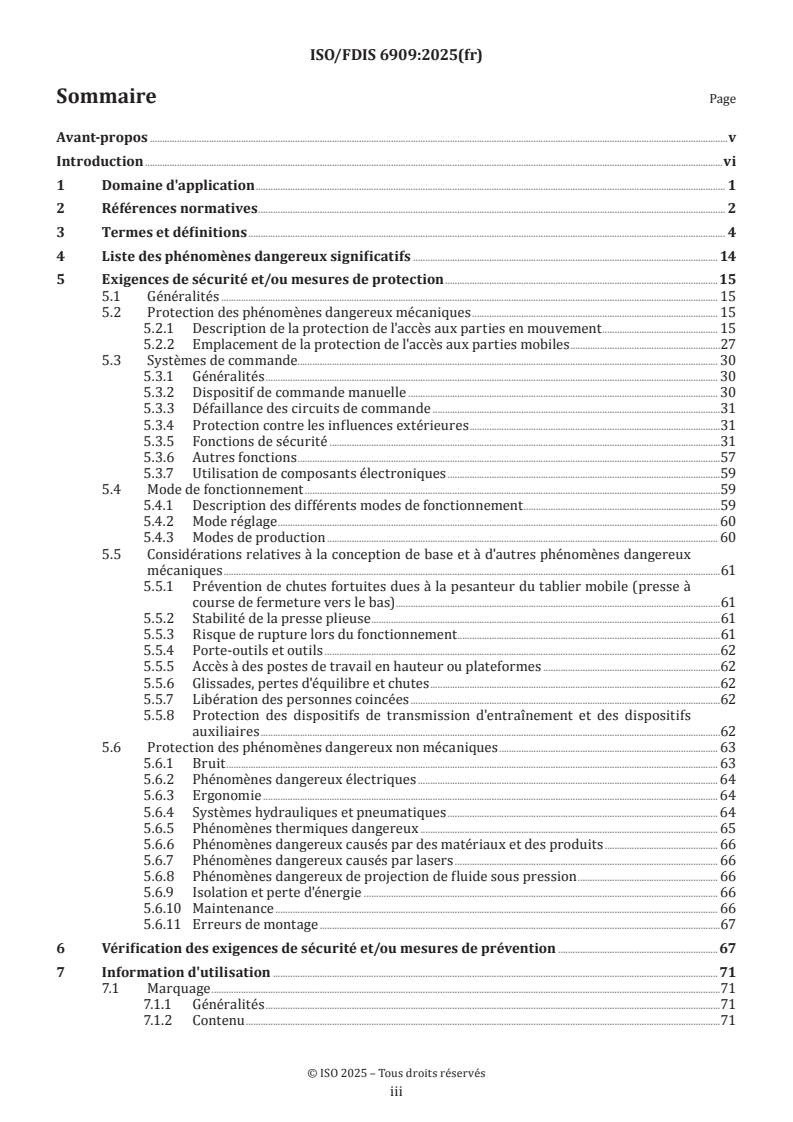
Contents Page
Foreword .v
Introduction .vi
1 Scope . 1
2 Normative references . 2
3 Terms and definitions . 4
4 List of significant hazards . 14
5 Safety requirements and/or protective measures .15
5.1 General . 15
5.2 Protection of mechanical hazards . 15
5.2.1 Description of the safeguarding of access to moving parts . 15
5.2.2 Location of the safeguarding of access to moving parts . . 26
5.3 Control systems . 28
5.3.1 General . 28
5.3.2 Manual control devices . 28
5.3.3 Failure of power supply . 28
5.3.4 Protection against external influences . 29
5.3.5 Safety functions . 29
5.3.6 Other functions .52
5.3.7 Use of electronic components . 53
5.4 Mode of operation . 53
5.4.1 Description of the various modes of operation . 53
5.4.2 Setting mode . 53
5.4.3 Production modes . 54
5.5 Consideration of basic design and other mechanical hazards . 54
5.5.1 Prevention of unintended gravity fall of the beam (down stroking press brakes) . 54
5.5.2 Stability of the press brake . 55
5.5.3 Risk of break up during operation . 55
5.5.4 Tool holder and tool design . 55
5.5.5 Access to raised work stations or platforms . 55
5.5.6 Slips, trips and falls . 55
5.5.7 Release of trapped persons . 56
5.5.8 Safeguarding of drives, transmission machinery and ancillary devices . 56
5.6 Protection against non-mechanical hazard . 56
5.6.1 Noise . 56
5.6.2 Electrical hazards.57
5.6.3 Ergonomics .57
5.6.4 Hydraulic and pneumatic systems .57
5.6.5 Thermal hazards .59
5.6.6 Hazards generated by materials and substances.59
5.6.7 Hazards generated by lasers.59
5.6.8 High pressure fluid ejection hazards .59
5.6.9 Isolation and energy dissipation .59
5.6.10 Maintenance .59
5.6.11 Errors of fitting . 60
6 Verification of the safety requirements and/or protective measures .60
7 Information for use .63
7.1 Marking . 63
7.1.1 General . 63
7.1.2 Content . 64
7.2 Instruction handbook. 64
7.2.1 General . 64
7.2.2 Content . 64
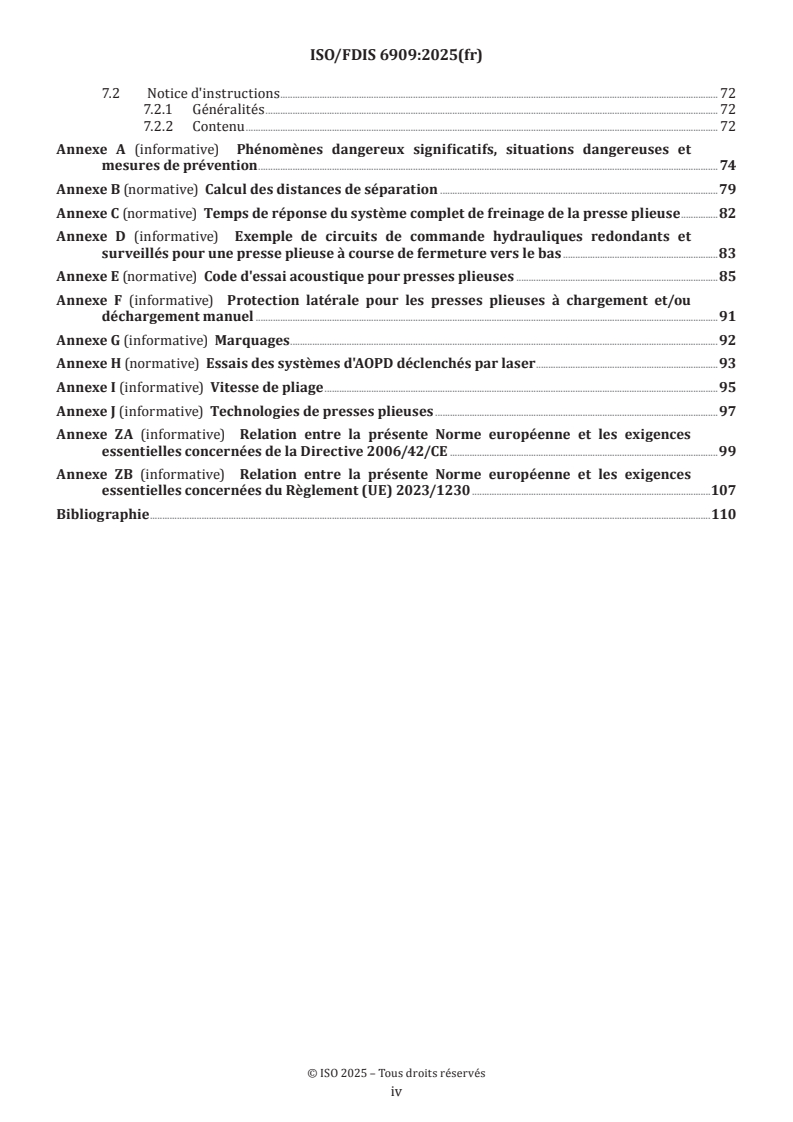
iii
Annex A (informative) Significant hazards, hazardous situations and protective measures .67
Annex B (normative) Calculation of separation distances .71
Annex C (normative) Overall system response time of the press brake stopping performance . 74
Annex D (informative) Example of redundant and monitored hydraulic control circuits for a
down-stroking press brake .75
Annex E (normative) Noise test code for press brakes . 76
Annex F (informative) Side safeguarding for press brakes with manually loaded and/or
unloaded .81
Annex G (normative) Markings .82
Annex H (normative) Laser actuated AOPD system tests .83
Annex I (informative) Bending speed .85
Annex J (informative) Press brakes technologies .87
Annex ZA (informative) Relationship between this European Standard and the essential
requirements of EU Directive 2006/42/EC aimed to be covered .88
Annex ZB (informative) Relationship between this European Standard and the essential
requirements of Regulation (EU) 2023/1230 aimed to be covered .94
Bibliography .97
iv
Foreword
ISO (the International Organization for Standardization) is a worldwide federation of national standards
bodies (ISO member bodies). The work of preparing International Standards is normally carried out through
ISO technical committees. Each member body interested in a subject for which a technical committee
has been established has the right to be represented on that committee. International organizations,
governmental and non-governmental, in liaison with ISO, also take part in the work. ISO collaborates closely
with the International Electrotechnical Commission (IEC) on all matters of electrotechnical standardization.
The procedures used to develop this document and those intended for its further maintenance are described
in the ISO/IEC Directives, Part 1. In particular, the different approval criteria needed for the different types
of ISO documents should be noted. This document was drafted in accordance with the editorial rules of the
ISO/IEC Directives, Part 2 (see www.iso.org/directives).
ISO draws attention to the possibility that the implementation of this document may involve the use of (a)
patent(s). ISO takes no position concerning the evidence, validity or applicability of any claimed patent
rights in respect thereof. As of the date of publication of this document, ISO had not received notice of (a)
patent(s) which may be required to implement this document. However, implementers are cautioned that
this may not represent the latest information, which may be obtained from the patent database available at
www.iso.org/patents. ISO shall not be held responsible for identifying any or all such patent rights.
Any trade name used in this document is information given for the convenience of users and does not
constitute an endorsement.
For an explanation of the voluntary nature of standards, the meaning of ISO specific terms and expressions
related to conformity assessment, as well as information about ISO's adherence to the World Trade
Organization (WTO) principles in the Technical Barriers to Trade (TBT), see www.iso.org/iso/foreword.html.
This document was prepared by Technical Committee ISO/TC 39, Machine tools, Subcommittee SC 10, Safety,
in collaboration with the European Committee for Standardization (CEN) Technical Committee CEN/TC 143,
Machine tools - Safety, in accordance with the Agreement on technical cooperation between ISO and CEN
(Vienna Agreement).
Any feedback or questions on this document should be directed to the user’s national standards body. A
complete listing of these bodies can be found at www.iso.org/members.html.
v
Introduction
This document is a type C standard as stated in ISO 12100:2010.
This document is of relevance, in particular, for the following stakeholder groups representing the market
players with regard to machinery safety:
— machine manufacturers (small, medium and large enterprises);
— health and safety bodies (regulators, accident prevention organizations, market surveillance etc.).
Others can be affected by the level of machinery safety achieved with the means of the document by the
above-mentioned stakeholder groups:
— machine users/employers (small, medium and large enterprises);
— machine users/employees (e.g. trade unions, organizations for people with special needs);
— service providers, for example, for maintenance (small, medium and large enterprises);
— consumers (in the case of machinery intended for use by consumers).
The above-mentioned stakeholder groups have been given the possibility to participate at the drafting
process of this document.
The machinery concerned and the extent to which hazards, hazardous situations or hazardous events are
covered are indicated in the Scope of this document.
When requirements of this type-C standard are different from those which are stated in type-A or type-B
standards, the requirements of this type-C standard take precedence over the requirements of the other
standards for machines that have been designed and built according to the requirements of this type-C
standard.
vi
FINAL DRAFT International Standard ISO/FDIS 6909:2025(en)
Machine tools — Safety — Press brakes
1 Scope
This document specifies technical safety requirements and measures to be adopted by persons undertaking
the design, manufacture and supply of press brakes which are intended to work cold metal or material partly
of cold metal but which can be used in the same way to work other sheet materials (e.g. cardboard, plastic,
rubber, leather) and also referred to as machines.
NOTE 1 The design of a machine includes the study of the machine itself, taking into account all phases of the “life”
of the machine mentioned in ISO 12100:2010, 5.4, and the drafting of the instructions related to all the above phases.
This document covers the following types of machines (see Annex J):
— hydraulic press brakes;
— hydraulic servo-drive press brakes;
— screw servo-drive press brakes;
— belt-spring servo-drive press brakes.
The requirements in this document take account of intended use, as defined in ISO 12100:2010, 3.23, as well
as reasonably foreseeable misuse, as defined in ISO 12100:2010, 3.24. This document presumes access to the
press brake from all directions, deals with all significant hazards during the various phases of the life of the
machine described in Clause 4, and specifies the safety measures for both the operator and other exposed
persons.
NOTE 2 All significant hazards means those identified or associated with press brakes at the time of the publication
of this document.
This document can also be used as a guide for the design of press brakes which are intended to be integrated
in a manufacturing system.
This document deals with all significant hazards, hazardous situations or hazardous events relevant to
press brakes and ancillary devices (see Clause 4) when it is used as intended and under conditions of misuse
which are reasonably foreseeable by the manufacturer. This document specifies the safety requirements for
press brakes defined in Clause 3.
This document does not cover press brakes which transmit energy to impart beam motion by using
pneumatic means or mechanical clutch or press brakes that use combination of technologies (e.g. combined
hydraulic and screw servo-drive press brake or combined hydraulic servo-drive and screw servo-drive
press brake).
This document does not cover machines whose principal designed purpose is:
a) sheet folding by rotary action;
b) tube and pipe bending by rotary action;
c) roll bending.
This document does not cover hazards related to the use of press brakes in explosive atmospheres.
This document is not applicable to press brakes which are manufactured before the date of its publication.
This document does not cover the safety aspect of equipment for automatic workpiece loading and unloading
where provided. Guidance on how to take into account additional automatic loading and unloading
equipment can be found in ISO 11161:2007.
2 Normative references
The following documents are referred to in the text in such a way that some or all of their content constitutes
requirements of this document. For dated references, only the edition cited applies. For undated references,
the latest edition of the referenced document (including any amendments) applies.
ISO 3744:2010, Acoustics — Determination of sound power levels and sound energy levels of noise sources using
sound pressure — Engineering methods for an essentially free field over a reflecting plane
ISO 3746:2010, Acoustics — Determination of sound power levels and sound energy levels of noise sources using
sound pressure — Survey method using an enveloping measurement surface over a reflecting plane
ISO 4413:2010, Hydraulic fluid power — General rules and safety requirements for systems and their components
ISO 4414:2010, Pneumatic fluid power — General rules and safety requirements for systems and their
components
ISO 4871:1996, Acoustics — Declaration and verification of noise emission values of machinery and equipment
ISO 5774:2023, Plastics hoses — Textile-reinforced types for compressed-air applications — Specification
ISO 11202:2010, Acoustics — Noise emitted by machinery and equipment — Determination of emission
sound pressure levels at a work station and at other specified positions applying approximate environmental
corrections
ISO 11237:2025, Rubber hoses and hose assemblies — Compact wire-braid-reinforced hydraulic types for oil-
based or water-based fluids — Specification
ISO 12100:2010, Safety of machinery — General principles for design — Risk assessment and risk reduction
ISO 13732-1:2006, Ergonomics of the thermal environment — Methods for the assessment of human responses
to contact with surfaces — Part 1: Hot surfaces
ISO 13849-1:2023, Safety of machinery — Safety-related parts of control systems — Part 1: General principles
for design
ISO 13849-2:2012, Safety of machinery — Safety-related parts of control systems — Part 2: Validation
ISO 13850:2015, Safety of machinery — Emergency stop function — Principles for design
ISO 13851:2019, Safety of machinery — Two-hand control devices — Principles for design and selection
ISO 13855:2024, Safety of machinery — Positioning of safeguards with respect to the approach of the human body
ISO 13857:2019, Safety of machinery — Safety distances to prevent hazard zones being reached by upper and
lower limbs
ISO 14118:2017, Safety of machinery — Prevention of unexpected start-up
ISO 14119:2024, Safety of machinery — Interlocking devices associated with guards — Principles for design and
selection
ISO 14120:2015, Safety of machinery — Guards — General requirements for the design and construction of fixed
and movable guards
ISO 14122-1:2016, Safety of machinery — Permanent means of access to machinery — Part 1: Choice of fixed
means and general requirements of access
ISO 14122-2:2016, Safety of machinery — Permanent means of access to machinery — Part 2: Working platforms
and walkways
ISO 14122-3:2016, Safety of machinery — Permanent means of access to machinery — Part 3: Stairs, stepladders
and guard-rails
ISO 14738:2002, Safety of machinery — Anthropometric requirements for the design of workstations at
machinery
ISO 14738:2002/Cor 2:2005, Safety of machinery — Anthropometric requirements for the design of workstations
at machinery — Technical Corrigendum 2
IEC 60204-1:2016+AMD1:2021, Safety of machinery — Electrical equipment of machines — Part 1: General
requirements
IEC 60529:1989, Degrees of protection provided by enclosures (IP code)
IEC 60529:1989/AMD1:1999, Degrees of protection provided by enclosures (IP code)
IEC 60529:1989/AMD2:2013/COR 1:2019, Degrees of protection provided by enclosures (IP code)
IEC 60825-1:2014, Safety of laser products — Part 1: Equipment classification and requirements
IEC 60947-5-1:2025, Low-voltage switchgear and control gear — Part 5-1: Control circuit devices and switching
elements — Electromechanical control circuit devices
IEC 61310-2:2007, Safety of machinery — Indication, marking and actuation — Part 2: Requirements for marking
IEC 61310-3:2007, Safety of machinery — Indication, marking and actuation — Part 3: Requirements for the
location and operation of actuators
IEC 61496-1:2020, Safety of machinery — Electro-sensitive protective equipment — Part 1: General requirements
and test
IEC 61496-2:2020, Safety of machinery — Electro-sensitive protective equipment — Part 2: Particular
requirements for equipment using active opto-electronic protective devices (AOPDs)
IEC 61496-3:2018, Safety of machinery — Electro-sensitive protective equipment — Part 3: Particular
requirements for Active Opto-electronic Protective Devices responsive to Diffuse Reflection (AOPDDR)
IEC 61508-1:2010, Functional safety of electrical/electronic/programmable electronic safety-related systems —
Part 1: General requirements
IEC 61508-2:2010, Functional safety of electrical/electronic/programmable electronic safety-related systems —
Part 2: Requirements for electrical/electronic/programmable electronic safety-related systems
IEC 61508-3:2010, Functional safety of electrical/electronic/programmable electronic safety-related systems —
Part 3: Software requirements
IEC 61800-5-2:2016, Adjustable speed electrical power drive systems — Part 5-2: Safety requirements —
Functional
IEC 62061:2021+AMD1:2024, Safety of machinery — Functional safety of safety-related control systems
EN 1005-1:2001+A1:2008, Safety of machinery — Human physical performance — Part 1: Terms and definitions
EN 1005-2:2003+A1:2008, Safety of machinery — Human physical performance — Part 2: Manual handling of
machinery and component parts of machinery
EN 1005-3:2002+A1:2008, Safety of machinery — Human physical performance — Part 3: Recommended force
limits for machinery operation
EN 1005-4:2005+A1:2008, Safety of machinery — Human physical performance — Part 4: Evaluation of
working postures and movements in relation to machinery
EN 1837:2020, Safety of machinery — Integral lighting of machines
EN 50370-1:2005, Electromagnetic compatibility (EMC) — Product family standard for machine tools — Part 1:
Emission
EN 50370-2:2003, Electromagnetic compatibility (EMC) — Product family standard for machine tools — Part 2:
Immunity
3 Terms and definitions
For the purposes of this document, the terms and definitions given in in ISO 12100:2010 apply.
ISO and IEC maintain terminology databases for use in standardization at the following addresses:
— ISO Online browsing platform: available at https:// www .iso .org/ obp
— IEC Electropedia: available at https:// www .electropedia .org/
3.1
press brake
machine designed or intended to transmit energy to the moving part of the tools (3.13) principally for the
purpose of bending between narrow forming tools along straight lines
3.2
up-stroking hydraulic press brake
hydraulic press brake (3.4) in which the moving part of tools (3.13) moves upwards during the closing stroke
Note 1 to entry: The movement is reciprocal to a down-stroking press brake (3.3); see Figure 1.
3.3
down-stroking press brake
press brake (3.1) in which the moving part of tools (3.13) moves downwards during the closing stroke
Key
1 press cylinder
2 control panel
3 electrical switch gear cabinet
4 foot pedal
5 workpiece support
6 backgauge (3.53)
7 hydraulic system
8 beam (3.14)
9 tools (3.13)
10 bed
11 side safeguard
12 light curtain (3.17)
Figure 1 — Example of a down-stroking hydraulic press brake
3.4
hydraulic press brake
press brake (3.1) utilising hydraulic power to impart the movement of the beam (3.14) whose characteristics
are dependent on hydraulic valve(s)
Note 1 to entry: The hydraulic valve(s) includes servo-valve(s) and proportional control valve(s).
Note 2 to entry: Examples of characteristics are speed, pressure and direction.
Note 3 to entry: For an example of a down-stroking hydraulic press brake, see Figure 1.
3.5
hydraulic servo-drive press brake
press brake (3.1) utilising hydraulic power to impart the movement of the beam (3.14) whose characteristics
are directly dependent on servo-pump(s) (3.31)
Note 1 to entry: Examples of characteristics are speed, pressure and direction.
3.6
screw servo-drive press brake
press brake (3.1) utilising servo-motor(s) and screw(s) to impart the movement of the beam (3.14)
Note 1 to entry: The characteristics of movements (e.g. speed, force, direction) are directly dependent on servo-
motor(s).
Note 2 to entry: For an example of a down-stroking screw servo-drive press brake, see Figure 2.
Key
1 down-stroking beam
2 bed
3 left side servomotor
4 right side screw
5 right side brake
6 frame
Figure 2 — Example of a down-stroking screw servo-drive press brake
3.7
belt-spring servo-drive press brake
press brake (3.1) utilising servo-motor(s), belt(s), pulley(s) and spring(s) to impart the movement of the
beam (3.14)
Note 1 to entry: The characteristics of movements (e.g. speed, force, direction) are directly dependent on servo-
motor(s).
Note 2 to entry: For an example of a down-stroking belt-spring servo-drive press brake, see Figure 3.
Key
1 down-stroking beam
2 bed
3 left side servomotor
4 left side twin spring arrangement
5 right side belt
6 idle pulley mounted on the beam
7 idle pulley mounted on a fixed part
8 attachment of the belt
Figure 3 — Example of a down-stroking belt-spring servo-drive press brake
3.8
tools area
area between moving and stationary tools (3.13)
EXAMPLE Space between the punch and the die of a press brake (3.1).
3.9
ancillary device
device intended for use with the press brake (3.1) and/or integrated with it
Note 1 to entry: Examples of these devices are backgauges (3.53), adjustable front sheet supports, tool loading devices.
3.10
dead centre
point at which the tools (3.13), during its travel, is either
— nearest to the die (generally it corresponds to the end of the closing stroke), or
— furthest from the die (generally it corresponds to the end of the opening stroke)
Note 1 to entry: The point at which the tool (3.13) is either nearest to the die is known as the bottom dead centre
(BDC). The point at which the tool is furthest from the die is known as the top dead centre (TDC).
Note 2 to entry: On an up-stroking hydraulic press brake (3.2), the centres are reversed.
3.11
guard locking
means to maintain an interlocking guard in the closed position until the risk of injury from the hazardous
machine functions (3.46) has ceased
[SOURCE: ISO 16092-1:2017, 3.2.8, modified —"measures" has been replaced by "means".]
3.12
position switch
switch which is operated by a moving part of the machine when this part reaches or leaves a predetermined
position
3.13
tool
combination of a moving part (e.g. punch) and a stationary part (e.g. die)
3.14
beam
main reciprocating press brake (3.1) member which normally holds the punch on a down-stroking press brake
(3.3) and which normally holds the die on an up-stroking press brake (3.2)
3.15
electro-sensitive protective equipment
ESPE
assembly of devices and/or components working together for protective tripping or presence-sensing
purposes comprising
— a sensing device;
— controlling/monitoring (3.20) devices;
— output signal switching devices (3.49);
— a safety-related data interface
Note 1 to entry: For the purposes of this document, electro-sensitive protective equipment covers active opto-
electronic protective devices (3.16), active opto-electronic protective devices responsive to diffuse reflection (3.19) and
laser actuated active opto-electronic protective devices.
[SOURCE: ISO 13855:2024, 3.1.5, modified — “as a minimum” has been deleted after "comprising" in the
definition, the last list item has been replaced by two list items and Note 1 to entry has been replaced.]
3.16
active opto-electronic protective device
AOPD
device whose sensing function (3.46) is performed by opto-electronic emitting and receiving elements
detecting the interruption of optical radiation, generated within the device, by an opaque object present in
the specified detection zone
[SOURCE: IEC 61496-2:2020, 3.201]
3.17
light curtain
active opto-electronic protective device (3.16) comprising an integrated assembly of one or more emitting
element(s) and one or more receiving element(s) forming a detection zone with a detection capability
specified by the supplier
[SOURCE: IEC 61496-2:2020, 3.205]
3.18
blanking
optional function (3.46) that permits an object of a size greater than the detection capability of the active
opto-electronic protective device (3.16) to be located within the detection zone without causing an OFF-state
of the output signal switching device(s) (3.49)
Note 1 to entry: Fixed blanking is a technique wherein the locations of the blanked areas of the detection zone do not
change during operation. The detection capability of the other parts of the detection zone remains unchanged.
Note 2 to entry: Floating blanking is a technique wherein the blanked area of the detection zone follows the location of
a moving object(s) during operation. The detection capability of the other areas remains unchanged.
Note 3 to entry: Progressive blanking also known as successive blanking or sequential blanking is a particular blanking
technique related to laser actuated active opto-electronic protective device, where the blanking is done progressively
at a high speed, at less than a 10 mm gap to the workpiece.
[SOURCE: ISO 16092-1:2017, 3.2.19]
3.19
active opto-electronic protective device responsive to diffuse reflection
AOPDDR
device, whose sensing function (3.46) is performed by opto-electronic emitting and receiving elements, that
detects the diffuse reflection of optical radiations generated within the device by an object present in a
detection zone specified in two dimensions
[SOURCE: IEC 61496-3:2018, 3.301]
3.20
monitoring
safety function (3.46) which ensures that a safety measure is initiated if the ability of a component or an
element to perform its function is diminished, or if the process conditions are changed in such a way that
hazards are generated
[SOURCE: ISO 16092-1:2017, 3.3.1]
3.21
muting
temporary automatic suspension of a safety function(s) (3.46) by safety-related parts of the control system
during otherwise safe conditions in the operation of a machine
[SOURCE: ISO 16092-1:2017, 3.3.2]
3.22
overall system response time
time occurring from actuating the protective device to the cessation of hazardous motion, or to the machine
assuming a safe condition
3.23
reset
function (3.46) within the safety-related part of a control system (3.50) used to restore manually one or more
safety functions before re-starting a machine
[SOURCE: ISO 16092-1:2017, 3.3.4]
3.24
restraint valve
hydraulic device which protects against a gravity fall of the beam (3.14)
3.25
brake
mechanism for slowing, stopping and holding the beam (3.14)
3.26
mechanical brake
brake (3.25) using dry or fluid friction
3.27
moving direction monitoring
monitoring (3.20) which monitors the beam (3.14) moving direction, directly or indirectly
3.28
standstill monitoring
monitoring (3.20) which monitors the beam (3.14) position, directly or indirectly
3.29
stopping-performance (overrun) monitoring
monitoring (3.20) which monitors the beam (3.14) stopping time or distance
3.30
servo drive system
system directly connecting a servo-motor to the transmission system such as gear (motor reducer), timing
belt drive mechanism, mechanical link, ball screw, harmonic drive reducer
3.31
servopump
hydraulic pump driven by a servo-motor
3.32
protective stop
protective stop function
stop function (3.46) initiated by a protective measure
3.33
safe energized standstill
safety function (3.46) preventing an unexpected movement of the beam (3.14) of more than a defined
amount from the stopped position, with energy supplied to the servomotor(s) to resist to external forces,
and without actuation of the mechanical brake(s) (3.26) or the hydraulic/mechanical restraint device(s)
3.34
safe de-energized standstill
safety function (3.46) preventing an unexpected movement of the beam (3.14) by removing the energy
supply to the servomotor(s) and either the mechanical brake(s) (3.26) or the hydraulic/mechanical restraint
device(s)
3.35
safe stop
safe stop function
stop function (3.46) initiated by a monitoring (3.20)
3.36
safe torque off
STO
function (3.46) which prevents force-producing power from being provided to the servo-motor
Note 1 to entry: For further details on STO, see also IEC 61800-5-2:2016, 4.2.3.2.
3.37
worst case
condition of the press brake (3.1) when it would be under foreseeably unfavourable situations
EXAMPLE The press beam (3.14) is in its most disadvantageous position, with a tool (3.13) of maximum weight
being used.
3.38
operating mode
specific manner of operation of a press brake (3.1) or press brake production system determined by the
control system
Note 1 to entry: For specifications on safety facilities and security measures relating to different operating modes, see
Clause 5.
3.39
OFF
operating mode (3.38) in which the press brake (3.1) is rendered inoperative
3.40
single cycle
operating mode (3.38) where each operating cycle (3.47) of the beam (3.14) is positively actuated by the
operator
3.41
single stroke function
function (3.46) used to limit the motion of the tool (3.13) to one operating cycle (3.47) even if the stroke
initiating means is held in the operating position
Note 1 to entry: The initiating means can be a foot pedal.
3.42
automatic cycle
operating mode (3.38) where the operating cycle is repeated continuously or intermittently, all functions
(3.46) achieved without manual intervention after initiation
3.43
light curtain single break
single cycle (3.40) where a light curtain (3.17) is used for cycle (3.47) initiation after clearing the light curtain
following a single interruption for manual loading and unloading
3.44
light curtain double break
single cycle (3.40) where a light curtain (3.17) is used for cycle (3.47) initiation after clearing the light curtain
following a double interruption for manual loading and unloading
3.45
operating mode selection device
facility consisting of an access, selection and activation system for manual selection of the machine’s
operating mode (3.38) to which only a restricted group of persons has access
[SOURCE: ISO 16092-1:2017, 3.4.2]
3.46
function
operation of a machine or a part of a machine which is specific or required for the intended machine task
[SOURCE: ISO 16092-1:2017, 3.4.3]
3.47
cycle
complete movement of the beam (3.14) and other devices of the press brake (3.1) used for production
EXAMPLE Ancillary devices (3.9) including feeding and removal of the material or workpiece along a programmed
motion path from the programmed start position [top dead centre (TDC)] back to the programmed end position (TDC).
3.48
programmable electronic system
PES
system for control, protection or monitoring (3.20) based on one or more programmable electronic devices,
including all elements of the system such as power supplies, sensors and other input devices, data highways
and other communication paths, and actuators and other output devices
[SOURCE: IEC 61508-4:2010, 3.3.1, modified — “(see Figure 2)”, Note 1 to entry and Figure 2 have been
deleted.]
3.49
output signal switching device
OSSD
component of the electro-sensitive protective equipment (3.15) connected to the machine control system
which, when the sensing device is actuated during normal operation, responds by going to the OFF-state
[SOURCE: IEC 61496-1:2020, 3.19]
3.50
safety-related part of a control system
SRP/CS
part of a control system that performs a safety function (3.46), starting from a safety-related input(s) to
generating a safety-related output(s)
Note 1 to entry: The combined safety related parts of a control system start at the point where the safety related input
signals are initiated [including, for example, the actuating cam and the roller of the position switch (3.12)] and end at
the output of the power control elements (including, for example, the main contact of a contactor).
Note 2 to entry: SRP/CS generally use mechanical, hydraulic, electrical, pneumatic or software parts.
[SOURCE: ISO 13849-1:2023, 3.1.1, modified — "combined" has been added to Note 1 to entry and Note 2 to
entry has been added.]
3.51
overrun monitoring device
device which provides a signal to inhibit further complete stroke when the overrun exceeds the pre-set
limit(s)
3.52
bending plane
vertical plane passing through the first contact line with the material from the moving part of the tools
(3.13) nearest to the operator
3.53
backgauge
mechanism comprising all necessary parts to move backgauge finger(s) (3.54), including transmission parts
and mobile supports of backgauge finger(s)
Note 1 to entry: For an example of a backgauge, see Figure 4.
Figure 4 — Example of a backgauge for a press brake
3.54
backgauge finger
mechanical part moved by backgauge (3.53) against which the workpiece is positioned before bending
Note 1 to entry: For an example of a backgauge finger
...
ISO/TC 39/SC 10/WG 1
Secretariat: SNV
Date: 2025-10-30
Machine tools — Safety — Press brakes
Machines outils — Sécurité des machines outils — Presses plieuses
FDIS stage
First edition
Date: 2024-11-04
FINAL DRAFT International Standard ISO/FDIS 6909:2024(E)
All rights reserved. Unless otherwise specified, or required in the context of its implementation, no part of this publication
may be reproduced or utilized otherwise in any form or by any means, electronic or mechanical, including photocopying,
or posting on the internet or an intranet, without prior written permission. Permission can be requested from either ISO
at the address below or ISO’s member body in the country of the requester.
ISO copyright office
CP 401 • Ch. de Blandonnet 8
CH-1214 Vernier, Geneva
Phone: + 41 22 749 01 11
EmailE-mail: copyright@iso.org
Website: www.iso.org
Published in Switzerland
Contents
Foreword . vi
Introduction . vii
1 Scope . 1
2 Normative references . 2
3 Terms and definitions . 4
4 List of significant hazards . 18
5 Safety requirements and/or protective measures . 19
5.1 General . 19
5.2 Protection of mechanical hazards . 19
5.3 Control systems . 36
5.4 Mode of operation . 79
5.5 Consideration of basic design and other mechanical hazards . 80
5.6 Protection against non-mechanical hazard . 83
6 Verification of the safety requirements and/or protective measures . 87
7 Information for use . 94
7.1 Marking . 94
7.2 Instruction handbook . 95
Annex A (informative) Significant hazards, hazardous situations and protective measures . 98
Annex B (normative) Calculation of separation distances . 103
Annex C (normative) Overall system response time of the press brake stopping performance 107
Annex D (informative) Example of redundant and monitored hydraulic control circuits for a
down-stroking press brake . 108
Annex E (normative) Noise test code for press brakes . 111
Annex F (informative) Side safeguarding for press brakes with manually loaded and/or
unloaded . 118
Annex G (normative) Markings . 122
Annex H (normative) Laser actuated AOPD system tests . 124
Annex I (informative) Bending speed . 126
Annex J (informative) Press brakes technologies . 129
Annex ZA (informative) Relationship between this European Standard and the essential
requirements of EU Directive 2006/42/EC aimed to be covered . 131
Annex ZB (informative) Relationship between this European Standard and the essential
requirements of Regulation (EU) 2023/1230 aimed to be covered. 138
Bibliography . 142
v
Foreword
ISO (the International Organization for Standardization) is a worldwide federation of national standards
bodies (ISO member bodies). The work of preparing International Standards is normally carried out through
ISO technical committees. Each member body interested in a subject for which a technical committee has been
established has the right to be represented on that committee. International organizations, governmental and
non-governmental, in liaison with ISO, also take part in the work. ISO collaborates closely with the
International Electrotechnical Commission (IEC) on all matters of electrotechnical standardization.
The procedures used to develop this document and those intended for its further maintenance are described
in the ISO/IEC Directives, Part 1. In particular, the different approval criteria needed for the different types of
ISO documents should be noted. This document was drafted in accordance with the editorial rules of the
ISO/IEC Directives, Part 2 (see www.iso.org/directives).
Field Code Changed
ISO draws attention to the possibility that the implementation of this document may involve the use of (a)
patent(s). ISO takes no position concerning the evidence, validity or applicability of any claimed patent rights
in respect thereof. As of the date of publication of this document, ISO had not received notice of (a) patent(s)
which may be required to implement this document. However, implementers are cautioned that this may not
represent the latest information, which may be obtained from the patent database available at
www.iso.org/patents. ISO shall not be held responsible for identifying any or all such patent rights.
Any trade name used in this document is information given for the convenience of users and does not
constitute an endorsement.
For an explanation of the voluntary nature of standards, the meaning of ISO specific terms and expressions
related to conformity assessment, as well as information about ISO's adherence to the World Trade
Organization (WTO) principles in the Technical Barriers to Trade (TBT), see www.iso.org/iso/foreword.html.
Field Code Changed
This document was prepared by Technical Committee ISO/TC 39, Machine tools, Subcommittee SC 10, Safety,
in collaboration with the European Committee for Standardization (CEN) Technical Committee CEN/TC 143,
Machine tools - Safety, in accordance with the Agreement on technical cooperation between ISO and CEN
(Vienna Agreement).
Any feedback or questions on this document should be directed to the user’s national standards body. A
complete listing of these bodies can be found at www.iso.org/members.html.
Field Code Changed
vi
Introduction
This document is a type C standard as stated in ISO 12100:2010.
This document is of relevance, in particular, for the following stakeholder groups representing the market
players with regard to machinery safety:
— — machine manufacturers (small, medium and large enterprises);
— — health and safety bodies (regulators, accident prevention organizations, market surveillance etc.).
Others can be affected by the level of machinery safety achieved with the means of the document by the above-
mentioned stakeholder groups:
— — machine users/employers (small, medium and large enterprises);
— — machine users/employees (e.g. trade unions, organizations for people with special needs);
— — service providers, e.g.for example, for maintenance (small, medium and large enterprises);
— — consumers (in the case of machinery intended for use by consumers).
The above-mentioned stakeholder groups have been given the possibility to participate at the drafting process
of this document.
The machinery concerned and the extent to which hazards, hazardous situations or hazardous events are
covered are indicated in the Scope of this document.
When requirements of this type-C standard are different from those which are stated in type-A or type-B
standards, the requirements of this type-C standard take precedence over the requirements of the other
standards for machines that have been designed and built according to the requirements of this type-C
standard.
vii
Machine tools — Safety — Press brakes
1 Scope
This document specifies technical safety requirements and measures to be adopted by persons undertaking
the design, manufacture and supply of press brakes which are intended to work cold metal or material partly
of cold metal but which can be used in the same way to work other sheet materials (e.g. cardboard, plastic,
rubber, leather, etc.)) and also referred to as machines.
NOTE 1 The design of a machine includes the study of the machine itself, taking into account all phases of the “life” of
the machine mentioned in ISO 12100:2010, 5.4, and the drafting of the instructions related to all the above phases.
This document covers the following types of machines (see Annex JAnnex J):):
— — hydraulic press brakes;
— — hydraulic servo-drive press brakes;
— — screw servo-drive press brakes;
— — belt-spring servo-drive press brakes.
The requirements in this document take account of intended use, as defined in ISO 12100:2010, 3.23, as well
as reasonably foreseeable misuse, as defined in ISO 12100:2010, 3.24. This document presumes access to the
press brake from all directions, deals with all significant hazards during the various phases of the life of the
machine described in Clause 4Clause 4,, and specifies the safety measures for both the operator and other
exposed persons.
NOTE 2 All significant hazards means those identified or associated with press brakes at the time of the publication
of this document.
This document applies to press brakes which can function independently or in combination (e.g. two machines
in tandem or more) and can also be used as a guide for the design of press brakes which are intended to be
integrated in a manufacturing system.
This document deals with theall significant hazards, hazardous situations andor hazardous events relevant to
press brakes and ancillary devices (see Clause 4Clause 4).) when it is used as intended and under conditions
of misuse which are reasonably foreseeable by the manufacturer. This document specifies the safety
requirements for press brakes defined in Clause 3this clause.
This document does not cover press brakes which transmit energy to impart beam motion by using pneumatic
means or mechanical clutch or press brakes that use combination of technologies (e.g. combined hydraulic
and screw servo-drive press brake or combined hydraulic servo-drive and screw servo-drive press brake).
This document does not cover machines whose principal designed purpose is:
a) a) sheet folding by rotary action;
b) b) tube and pipe bending by rotary action;
c) c) roll bending.
This document does not cover hazards related to the use of press brakes in explosive atmospheres.
This document is not applicable to press brakes which are manufactured before the date of its publication.
This document does not cover the safety aspect of equipment for automatic workpiece loading and unloading
where provided. Guidance on how to take into account additional automatic loading and unloading equipment
can be found in ISO 11161:2007.
2 Normative references
The following documents are referred to in the text in such a way that some or all of their content constitutes
requirements of this document. For dated references, only the edition cited applies. For undated references,
the latest edition of the referenced document (including any amendments) applies.
ISO 3744:2010, Acoustics — Determination of sound power levels and sound energy levels of noise sources using
sound pressure — Engineering methods for an essentially free field over a reflecting plane
ISO 3746:2010, Acoustics — Determination of sound power levels and sound energy levels of noise sources using
sound pressure — Survey method using an enveloping measurement surface over a reflecting plane
ISO 4413:2010, Hydraulic fluid power — General rules and safety requirements for systems and their
components
ISO 4414:2010, Pneumatic fluid power — General rules and safety requirements for systems and their
components
ISO 4871:1996, Acoustics — Declaration and verification of noise emission values of machinery and equipment
ISO 5774:2023, Plastics hoses — Textile-reinforced types for compressed-air applications — Specification
ISO 11202:2010, Acoustics — Noise emitted by machinery and equipment — Determination of emission sound
pressure levels at a work station and at other specified positions applying approximate environmental
corrections
ISO 11237:2025, Rubber hoses and hose assemblies — Compact wire-braid-reinforced hydraulic types for oil-
based or water-based fluids — Specification
ISO 12100:2010, Safety of machinery — General principles for design — Risk assessment and risk reduction
ISO 13732-1:2006, Ergonomics of the thermal environment — Methods for the assessment of human responses
to contact with surfaces — Part 1: Hot surfaces
ISO 13849--1:2023, Safety of machinery — Safety-related parts of control systems — Part 1: General principles
for design
ISO 13849--2:2012, Safety of machinery — Safety-related parts of control systems — Part 2: Validation
ISO 13850:2015, Safety of machinery — Emergency stop function — Principles for design
ISO 13851:2019, Safety of machinery — Two-hand control devices — Functional aspects and Principles for
design principlesand selection
ISO FDIS 13855:2024, Safety of machinery — Positioning of safeguards with respect to the approach of parts of
the human body
ISO 13857:2019, Safety of machinery — Safety distances to prevent hazard zones being reached by upper and
lower limbs
ISO 14118:2017, Safety of machinery — Prevention of unexpected start-up
ISO 14119:20132024, Safety of machinery — Interlocking devices associated with guards — Principles for
design and selection
ISO 14120:2015, Safety of machinery — Guards — General requirements for the design and construction of fixed
and movable guards
ISO 14122--1:2016, Safety of machinery — Permanent means of access to machinery — Part 1: Choice of fixed
means and general requirements of access
ISO 14122--2:2016, Safety of machinery — Permanent means of access to machinery — Part 2: Working
platforms and walkways
ISO 14122--3:2016, Safety of machinery — Permanent means of access to machinery — Part 3: Stairs,
stepladders and guard-rails
ISO/TR 11688-1:1995, Acoustics — Recommended practice 14738:2002, Safety of machinery —
Anthropometric requirements for the design of low-noiseworkstations at machinery and equipment — Part 1:
Planning
ISO/TS 15066:2016, Robots and robotic devices — Collaborative robots
ISO 14738:2002/Cor 2:2005, Safety of machinery — Anthropometric requirements for the design of
workstations at machinery — Technical Corrigendum 2
IEC 60204--1:2016+AMD1:2021, Safety of machinery — Electrical equipment of machines — Part 1: General
requirements
IEC 60529:1989, Degrees of protection provided by enclosures (IP code)
IEC 60529:1989/AMD1:1999, Degrees of protection provided by enclosures (IP code)
IEC 60529:1989/AMD2:2013/COR 1:2019, Degrees of protection provided by enclosures (IP code)
IEC 60825--1:2014, Safety of laser products — Part 1: Equipment classification and requirements
IEC 60947-5-1:2025, Low-voltage switchgear and control gear — Part 5-1: Control circuit devices and switching
elements — Electromechanical control circuit devices
IEC 61310--2:2007, Safety of machinery — Indication, marking and actuation — Part 2: Requirements for
marking
IEC 61310-3:2007, Safety of machinery — Indication, marking and actuation — Part 3: Requirements for the
location and operation of actuators
IEC 61496--1:2020, Safety of machinery — Electro-sensitive protective equipment — Part 1: General
requirements and test
IEC 61496--2:2020, Safety of machinery — Electro-sensitive protective equipment — Part 2: Particular
requirements for equipment using active opto-electronic protective devices (AOPDs)
IEC 61496--3:2018, Safety of machinery — Electro-sensitive protective equipment — Part 3: Particular
requirements for Active Opto-electronic Protective Devices responsive to Diffuse Reflection (AOPDDR)
IEC 61508--1:2010, Functional safety of electrical/electronic/programmable electronic safety-related systems
— Part 1: General requirements
IEC 61508--2:2010, Functional safety of electrical/electronic/programmable electronic safety-related systems
— Part 2: Requirements for electrical/electronic/programmable electronic safety-related systems
IEC 61508--3:2010, Functional safety of electrical/electronic/programmable electronic safety-related systems
— Part 3: Software requirements
IEC 61800--5-2:2016, Adjustable speed electrical power drive systems — Part 5-2: Safety requirements —
Functional
IEC 62061:2021+AMD1:2024, Safety of machinery — Functional safety of safety-related control systems
EN 1005-1:2001+A1:2008, Safety of machinery — Human physical performance — Part 1: Terms and
definitions
EN 1005-2:2003+A1:2008, Safety of machinery — Human physical performance — Part 2: Manual handling of
machinery and component parts of machinery
EN 1005-3:2002+A1:2008, Safety of machinery — Human physical performance — Part 3: Recommended force
limits for machinery operation
EN 1005-4:2005+A1:2008, Safety of machinery — Human physical performance — Part 4: Evaluation of
working postures and movements in relation to machinery
EN 1837:2020, Safety of machinery — Integral lighting of machines
EN 50370--1:2005, Electromagnetic compatibility (EMC) — Product family standard for machine tools —
Part 1: Emission
EN 50370--2:2003, Electromagnetic compatibility (EMC) — Product family standard for machine tools —
Part 2: Immunity
ISO 61310-3, Safety of machinery — Indication, marking and actuation — Part 3: Requirements for the location
and operation of actuators
3 Terms and definitions
For the purposes of this document, the terms and definitions given in in ISO 12100:2010 apply.
ISO and IEC maintain terminology databases for use in standardization at the following addresses:
— — ISO Online browsing platform: available at https://www.iso.org/obp
— — IEC Electropedia: available at https://www.electropedia.org/
3.1 3.1
press brake
machine designed or intended to transmit energy to the moving part of the tools (3.13(3.13)) principally for
the purpose of bending between narrow forming tools along straight lines
3.2 3.2
up-stroking hydraulic press brake
hydraulic press brake (3.4(3.1)) in which the moving part of tools (3.13(3.13)) moves upwards during the
closing stroke
Note 1 to entry: The movement is reciprocal to a down-stroking press brake (3.3,); see Figure 1Figure 1.
3.3 3.3
down-stroking press brake
press brake (3.1(3.1)) in which the moving part of tools (3.13(3.13)) moves downwards during the closing
stroke
Key
1 press cylinder
2 control panel
3 electrical switch gear cabinet
4 foot pedal
5 workpiece support
6 backgauge (3.53)
7 hydraulic system
8 beam (3.14)
9 tools (3.13)
10 bed
11 side safeguard
12 light curtain (3.17
1 press cylinder 6 backgauge (3.53) 11 side safeguard
2 control panel 7 hydraulic system 12 light curtain (3.17)
3 electrical switch gear cabinet 8 beam (3.14)
4 foot pedal 9 tools (3.13)
5 workpiece support 10 bed
)
Figure 1 — Example of a down-stroking hydraulic press brake
3.4 3.4
hydraulic press brake
press brake (3.1(3.1)) utilising hydraulic power to impart the movement of the beam (3.14(3.14)) whose
characteristics are dependent on hydraulic valve(s)
Note 1 to entry: The hydraulic valve(s) includes servo-valve(s) and proportional control valve(s).
Note 2 to entry: Examples of characteristics are the speed, the pressure, the and direction.
Note 3 to entry: Example For an example of a down-stroking (3.3) hydraulic press brake (3.4),, see Figure 1Figure 1.
3.5 3.5
hydraulic servo-drive press brake
press brake (3.1(3.1)) utilising hydraulic power to impart the movement of the beam (3.14(3.14)) whose
characteristics are directly dependent on servo-pump(s) (3.31(3.31))
Note 1 to entry: Examples of characteristics are speed, pressure, and direction.
3.6 3.6
screw servo-drive press brake
press brake (3.1(3.1)) utilising servo-motor(s) and screw(s) to impart the movement of the beam (3.14(3.14))
Note 1 to entry: The characteristics of movements (e.g. speed, force, direction) are directly dependent on servo-motor(s).
Note 2 to entry: Example For an example of a down-stroking screw servo-drive press brake (3.6),, see Figure 2Figure 2.
Key
1 down-stroking beam 4 right side screw
2 bed 5 right side brake
3 left side servomotor 6 frame
1 down-stroking beam
2 bed
3 left side servomotor
4 right side screw
5 right side brake
6 frame
Figure 2 — Example of a down-stroking screw servo-drive press brake
3.7 3.7
belt-spring servo-drive press brake
press brake (3.1(3.1)) utilising servo-motor(s), belt(s), pulley(s) and spring(s) to impart the movement of the
beam (3.14(3.14))
Note 1 to entry: The characteristics of movements (e.g. speed, force, direction) are directly dependent on servo-motor(s).
Note 2 to entry: For an example of a down-stroking belt-spring servo-drive press brake, see Figure 3
.
Key
1 down-stroking beam 5 right side belt
2 bed 6 idle pulley mounted on the beam
3 left side servomotor 7 idle pulley mounted on a fixed part
4 left side twin spring arrangement 8 attachment of the belt
1 down-stroking beam
2 bed
3 left side servomotor
4 left side twin spring arrangement
5 right side belt
6 idle pulley mounted on the beam
7 idle pulley mounted on a fixed part
8 attachment of the belt
Figure 3 —— Example of a down-stroking belt-spring servo-drive press brake
3.8 3.8
tools area
area between moving and stationary tools (3.13(3.13))
EXAMPLE Space between the punch and the die of a press brake (3.1.).
3.9 3.9
ancillary device
any device intended for use with the press brake (3.1(3.1)) and/or integrated with it
Note 1 to entry: Examples of these devices are backgauges (3.53(3.53),), adjustable front sheet supports, tool loading
devices.
3.10 3.10
dead centre
point at which the tools (3.13(3.13),), during its travel, is :
— either
— nearest/closest to the die (generally it corresponds to the end of the closing stroke);
— — ), or
— furthest from the die (generally it corresponds to the end of the opening stroke).)
Note 1 to entry: On an up-stroking hydraulic press brake (3.2), the centres are reversed.
Note 2 to entry: the The point at which the tool (3.13(3.13)) is either nearest or closest to the die is also known as the
bottom dead centre (BDC). The point at which the tool is furthest from the die is also known as the top dead centre (TDC).
Note 2 to entry: On an up-stroking hydraulic press brake (3.23.11
), the centres are reversed.
3.11
guard locking
measuresmeans to maintain an interlocking guard in the closed position until the risk of injury from the
hazardous machine functions (3.46(3.46)) has ceased
[SOURCE: ISO 16092-1:2017, 3.2.8, modified — “(3.4.3)” was deleted.]—"measures" has been replaced by
"means".]
3.113.12 3.12
position switch
switch which is operated by a moving part of the machine when this part reaches or leaves a predetermined
position
3.13
tools
3.13
tool
combination of a moving part (e.g. punch) and a stationary part (e.g. die)
3.14 3.14
beam
main reciprocating press brake (3.1(3.1)) member which normally holds the punch on a down-stroking press
brake (3.3(3.3),) and which normally holds the die on an up-stroking press brake (3.2(3.2))
3.15 3.15
electro-sensitive protective equipment
ESPE
assembly of devices and/or components working together for protective tripping or presence-sensing
purposes comprising
— — a sensing device;
— — controlling/monitoring (3.20) devices;
— — output signal switching devices (3.49;);
— — a safety-related data interface.
Note 1 to entry: For the purposes of this document, electro-sensitive protective equipment covers active opto-electronic
protective devices (3.16), active opto-electronic protective devices responsive to diffuse reflection (3.19) and laser actuated
active opto-electronic protective devices.
[SOURCE: ISO FDIS 13855:2024, 3.1.5, modified — “as a minimum” washas been deleted after "comprising" in
the first part of the definition, and the last list item has been replaced by 2two list items] and Note 1 to entry
has been replaced.]
Note 1 to entry: For the purposes of this document, ESPE (3.15) covers AOPD (3.16), AOPDDR (3.19), laser actuated AOPD
(3.16).
3.16 3.16
active opto-electronic protective device
AOPD
device whose sensing function (3.46(3.46)) is performed by opto-electronic emitting and receiving elements
detecting the interruption of optical radiation, generated within the device, by an opaque object present in the
specified detection zone
[SOURCE: IEC 61496-2:2020, 3.201]
3.17 3.17
light curtain
active opto-electronic protective device (3.16AOPD (3.16)) comprising an integrated assembly of one or more
emitting element(s) and one or more receiving element(s) forming a detection zone with a detection capability
specified by the supplier
[SOURCE: IEC 61496-2:2020, definition 3.205]
3.18 3.18
blanking
optional function (3.46(3.46)) that permits an object of a size greater than the detection capability of the active
opto-electronic protective device (3.16AOPD (3.16)) to be located within the detection zone without causing an
OFF-state of the OSSDoutput signal switching device(s) (3.49(3.49))
Note 1 to entry: Fixed blanking (3.18) is a technique wherein the locations of the blanked areas of the detection zone do
not change during operation. The detection capability of the other parts of the detection zone remains unchanged.
Note 2 to entry: Floating blanking (3.18) is a technique wherein the blanked area of the detection zone follows the
location of a moving object(s) during operation. The detection capability of the other areas remains unchanged.
Note 3 to entry: Progressive blanking (3.18) also known as successive blanking (3.18) or sequential blanking (3.18) is a
particular blanking (3.18) technique related to laser actuated AOPDactive opto-electronic protective device, where the
blanking (3.18) is done progressively at a high speed, at less than a 10 mm gap to the workpiece.
[SOURCE: ISO 16092-1:2017, 3.2.19]
3.19 3.19
active opto-electronic protective device responsive to diffuse reflection
AOPDDR
device, whose sensing function (3.46(3.46)) is performed by opto-electronic emitting and receiving elements,
that detects the diffuse reflection of optical radiations generated within the device by an object present in a
detection zone specified in two dimensions
[SOURCE: IEC 61496-3:2018, 3.301]
3.20 3.20
monitoring
safety function (3.46(3.46)) which ensures that a safety measure is initiated if the ability of a component or an
element to perform its function (3.46) is diminished, or if the process conditions are changed in such a way
that hazards are generated
[SOURCE: ISO 16092-1:2017, 3.3.1, modified — “(3.4.3)” was deleted]
3.21 3.21
muting
temporary automatic suspension of a safety function(s) (3.46(3.46)) by safety-related parts of the control
system during otherwise safe conditions in the operation of a machine
[SOURCE: ISO 16092-1:2017, 3.3.2, modified — “(3.4.3)” was deleted]
3.22 3.22
overall system response time
time occurring from actuating the protective device to the cessation of hazardous motion, or to the machine
assuming a safe condition
3.23 3.23
reset
function (3.46(3.46)) within the safety-related part of a control system (3.50SRP/CS (3.50)) used to restore
manually one or more safety functions (3.46) before re-starting a machine
[SOURCE: ISO 16092-1:2017, 3.3.4, modified — “(3.4.3)” was deleted.]]
3.24 3.24
restraint valve
hydraulic device which protects against a gravity fall of the beam (3.14(3.14))
3.25 3.25
brake
mechanism for slowing, stopping and holding the beam (3.14(3.14))
3.26 3.26
mechanical brake
brake (3.25(3.25)) using dry or fluid friction
3.27 3.27
moving direction monitoring
monitoring (3.20(3.20) function (3.46)) which monitors the beam (3.14(3.14)) moving direction, directly or
indirectly
3.28 3.28
standstill monitoring
monitoring (3.20(3.20) function (3.46)) which monitors the beam (3.14(3.14)) position, directly or indirectly
3.29 3.29
stopping-performance (overrun) monitoring
monitoring (3.20(3.20) function (3.46)) which monitors the beam (3.14(3.14)) stopping time or distance
3.30 3.30
servo drive system
system directly connecting a servo-motor to the transmission system such as gear (motor reducer), timing
belt drive mechanism, mechanical link, ball screw, harmonic drive reducer
3.31 3.31
servopump
hydraulic pump driven by a servo-motor
3.32 3.32
protective stop
protective stop function
stop function (3.46(3.46)) initiated by a protective measure
3.33 3.33
safe energized standstill
safety function (3.46(3.46)) preventing an unexpected movement of the beam (3.14(3.14)) of more than a
defined amount from the stopped position, with energy supplied to the servomotor(s) to resist to external
forces, and without actuation of the mechanical brake(s) (3.26(3.26)) or the hydraulic/mechanical restraint
device(s)
3.34 3.34
safe de-energized standstill
safety function (3.46(3.46)) preventing an unexpected movement of the beam (3.14(3.14)) by removing the
energy supply to the servomotor(s) and either the mechanical brake(s) (3.26(3.26)) or the
hydraulic/mechanical restraint device(s)
3.35 3.35
safe stop
safe stop function
stop function (3.46(3.46)) initiated by a monitoring (3.20(3.20) function (3.46))
3.36 3.36
safe torque off
STO
function (3.46(3.46)) which prevents force-producing power from being provided to the servo-motor
Note 1 to entry: For further details on STO, see also IEC 61800-5-2:2016, 4.2.3.2.
3.37 3.37
worst case
condition of the press brake (3.1(3.1)) when it would be under foreseeably unfavourable situations
EXAMPLE The press beam (3.14(3.14)) is in its most disadvantageous position, with a tool (3.13(3.13)) of maximum
weight being used, etc.
3.38 3.38
operating mode
specific manner of operation of a press brake (3.1(3.1)) or press brake production system determined by the
control system
Note 1 to entry: For specifications on safety facilities and security measures relating to different operating modes, see
Clause 5Clause 5.
3.39 3.39
OFF
operating mode (3.38(3.38)) in which the press brake (3.1(3.1)) is rendered inoperative
3.40 3.40
single cycle
operating mode (3.38(3.38)) where each operating cycle (3.47) of the beam (3.14(3.14)) is positively actuated
by the operator
3.41 3.41
single stroke function
function (3.46(3.46)) used to limit the motion of the tool (3.13(3.13)) to one operating cycle (3.47) even if the
stroke initiating means is held in the operating position
Note 1 to entry: Initiating mean The initiating means can be a foot pedal.
3.42 3.42
automatic cycle
operating mode (3.38(3.38)) where the operating cycle is repeated continuously or intermittently, all functions
(3.46(3.46)) achieved without manual intervention after initiation
3.43 3.43
light curtain single break
single cycle (3.40) where a light curtain (3.17(3.17)) is used for cycle (3.47) initiation after clearing the light
curtain (3.17) following a single interruption for manual loading and unloading
3.44 3.44
light curtain double break
single cycle (3.40) where a light curtain (3.17(3.17)) is used for cycle (3.47) initiation after clearing the light
curtain (3.17) following a double interruption for manual loading and unloading
3.45 3.45
operating mode selection device
facility consisting of an access, selection and activation system for manual selection of the machine’s operating
mode (3.38(3.38)) to which only a restricted group of persons has access
[SOURCE: ISO 16092-1:2017, 3.4.2, modified — “(3.4.1)” and Note 1 were deleted.]]
3.46 3.46
function
operation of a machine or a part of a machine which is specific or required for the intended machine task
[SOURCE: ISO 16092-1:2017, 3.4.3]
3.47 3.47
cycle
complete movement of the beam (3.14(3.14)) and other devices of the press brake (3.1(3.1)) used for
production
EXAMPLE Ancillary devices (3.9(3.9)) including feeding and removal of the material or workpiece along a
programmed motion path from the programmed start position [top dead centre (TDC (3.10)))] back to the programmed
end position (TDC (3.10))).
3.48 3.48
programmable electronic system
PES
system for control, protection or monitoring (3.20) based on one or more programmable electronic devices,
including all elements of the system such as power supplies, sensors and other input devices, data highways
and other communication paths, and actuators and other output devices
[SOURCE: IEC 61508-4:2010, 3.3.1, modified — “(see Figure 2Figure 2)”,)”, Note 1 to entry and
Figure 2Figure 2 were have been deleted.]
3.49 3.49
output signal switching device
OSSD
component of the electro-sensitive protective equipment (3.15ESPE (3.15)) connected to the machine control
system which, when the sensing device is actuated during normal operation, responds by going to the OFF-
state
[SOURCE: IEC 61496-1:2020, 3.19]
3.50 3.50
safety-related part of a control system
SRP/CS
part of a control system that performs a safety function (3.46,), starting from a safety-related input(s) to
generating a safety-related output(s)
Note 1 to entry: the The combined safety related parts of a control system start at the point where the safety related input
signals are initiated ([including, for example, the actuating cam and the roller of the position switch (3.12))] and end at
the output of the power control elements (including, for example, the main contact of a contactor).
Note 2 to entry: SRP/CS (3.50) generally use mechanical, hydraulic, electrical, pneumatic or software parts.
[SOURCE: ISO 13849-1:2023, 3.1.1, modified –— "combined" has been added to Note 1 to entry and Note 2 to
entry has been added].]
3.51 3.51
overrun monitoring device
device which provides a signal to inhibit further complete stroke when the overrun exceeds the pre-set limit(s)
3.52 3.52
bending plane
vertical plane passing through the first contact line with the material from the moving part of the tools
(3.13(3.13)) nearest to the operator
3.53 3.53
backgauge
mechanism comprising all necessary parts to move backgauge finger(s) (3.54(3.54),), including transmission
parts and mobile supports of backgauge finger(s) (3.54)
Note 1 to entry: For an example of a backgauge, see Figure 4 See Figure 4.
Figure 4 — Example of a backgauge for a press brake
3.54 3.54
backgauge finger
mechanical part moved by backgauge (3.53(3.53)) against which the workpiece is positioned before bending
Note 1 to entry: For an example of a backgauge finger, see Figure 5 See Figure 5.
Figure 5 — Example of a backgauge finger for a backgauge
3.55 3.55
numerical control
NC
automatic control of a process performed by a device that makes use of numeric data introduced while the
operation is in progress
3.56 3.56
programmable logic controller
PLC
digitally operating electronic system, designed for use in an industrial environment, which uses a
programmable memory for the internal storage of user-oriented instructions for implementing specific
functions (3.46) such as logic, sequencing, timing, counting and arithmetic, to control, through digital or
analogue inputs and outputs, various types of machines or processes
Note 1 to entry: Both the PLC and its associated peripherals are designed so that they can be easily integrated into an
industrial control system and easily used in all their intended functions.
[SOURCE: IEC 61131-1:2003, 3.5, modified] — Note 1 to the entry has been deleted and part of the definition
has been moved to the new Note 1 to entry.]
3.57
human machine interface
HMI
controls and displays that allow a human to interact with a manufactured device or system
[SOURCE: ISO/TR 12204:2012, 3.9]
3.58
reference plane
level at which persons would normally stand during the use of the machine or access to the hazard zone
Note 1 to entry: The reference plane is not necessarily the ground or the floor (e.g. a working platform can be the
reference plane).
[SOURCE: ISO 13855:2024, 3.1.10, modified — "or safety-related manual control device (SRMCD)" has been
deleted from the definition.]
4 List of significant hazards
This clause contains all significant hazards, hazardous situations and events as far as they are dealt with in
this document, identified by risk assessment as significant for the machines defined in the scope and which
require a specific action to eliminate or reduce the risk:
These hazards are listed in Table A.1Table A.1.
Particular attention is given to hazards dealing with the following:
— — crushing and shearing between moving parts such as tools, beam, back gauges, workpiece supports;
— — entanglement on or drawing into moving parts of the machine, guards, motor and drive machinery;
— — ejection of machine components;
— — release of hydraulic fluids.
Main danger zones are the following:
— — tools area with beam, back gauges, workpiece supports, front gauges, angle correction device,
automatic tools changer;
— — workpiece handling device;
— — motor and drive machinery.
5 Safety requirements and/or protective measures
5.1 General
The methods or measures to be implemented to eliminate the significant hazards or reduce their associated
risks are detailed in this clause in the following manner:
— — Protectionprotection of mechanical hazards (5.2(5.2););
— — Controlcontrol systems (5.3(5.3););
— — Modemode of operation (5.4(5.4););
— — Considerationconsideration of basic design and other mechanical hazards (5.5(5.5););
— — Protectionprotection against non-mechanical hazard (5.6(5.6).).
5.2 Protection of mechanical hazards
5.2.1 Description of the safeguarding of access to moving parts
5.2.1.1 General
The major danger zones at press brakes are the tools, associated area and ancillary loading and unloading
devices which are an integral part of the machine. Preventive measures shall be taken to deal with the relevant
hazards.
Safeguarding measures described in ISO 12100:2010, 6.3 which are appropriate for the protection of any
operator at the tools are listed in 5.2.1below. Designers, manufacturers and suppliers shall select the
safeguarding measures which reduce the risks as far as possible, considering the significant hazards (see
Table A.1Table A.1)) and the mode of production.
The selected combination of safeguarding measures shall protect all exposed persons, i.e. those who can gain
access to the danger zone during operation, setting, maintenance, cleaning and inspection activities.
Access to the danger zone(s) shall be prevented by one or a combination of the following safeguarding
measures.
5.2.1.2 Guards
Guards shall complybe in accordance with ISO 14120:2015. They shall be firmly secured to the machine,
another rigid structure or the floor. Any openings in the guards or between the guard and the machine shall
meet the requirements of ISO 13857:2019, Table 4.
5.2.1.3 Interlocking guards with or without guard locking
Interlocking guards shall comply withconform to ISO 14120:2015 and prevent, in conjunction with fixed
guards, access to the danger zone, during any dangerous movement. Initiation of the dangerous movement
shall be prevented until the guard is closed. The associated interlocking devices shall be designed and
constructed in accordance with ISO 14119:20132024 and the safety-related parts of the control system shall
conform to Table 1Table 1 or Table 22.
Interlocking guards without guard locking shall be placed in such a position that the operator does not have
time to reach the danger zone before any dangerous movement has ceased (see, in accordance with ISO
FDIS 13855:2024).
...
PROJET FINAL
Norme
internationale
ISO/TC 39/SC 10
Machines outils — Sécurité —
Secrétariat: SNV
Presses plieuses
Début de vote:
Machine tools — Safety — Press brakes 2025-11-19
Vote clos le:
2026-01-14
LES DESTINATAIRES DU PRÉSENT PROJET SONT
INVITÉS À PRÉSENTER, AVEC LEURS OBSERVATIONS,
NOTIFICATION DES DROITS DE PROPRIÉTÉ DONT ILS
AURAIENT ÉVENTUELLEMENT CONNAISSANCE ET À
FOURNIR UNE DOCUMENTATION EXPLICATIVE.
OUTRE LE FAIT D’ÊTRE EXAMINÉS POUR
ÉTABLIR S’ILS SONT ACCEPTABLES À DES FINS
INDUSTRIELLES, TECHNOLOGIQUES ET COM-MERCIALES,
AINSI QUE DU POINT DE VUE DES UTILISATEURS, LES
PROJETS DE NORMES
TRAITEMENT PARALLÈLE ISO/CEN
INTERNATIONALES DOIVENT PARFOIS ÊTRE CONSIDÉRÉS
DU POINT DE VUE DE LEUR POSSI BILITÉ DE DEVENIR DES
NORMES POUVANT
SERVIR DE RÉFÉRENCE DANS LA RÉGLEMENTATION
NATIONALE.
Numéro de référence
PROJET FINAL
Norme
internationale
ISO/TC 39/SC 10
Machines outils — Sécurité —
Secrétariat: SNV
Presses plieuses
Début de vote:
Machine tools — Safety — Press brakes
2025-11-19
Vote clos le:
2026-01-14
LES DESTINATAIRES DU PRÉSENT PROJET SONT
INVITÉS À PRÉSENTER, AVEC LEURS OBSERVATIONS,
NOTIFICATION DES DROITS DE PROPRIÉTÉ DONT ILS
AURAIENT ÉVENTUELLEMENT CONNAISSANCE ET À
FOURNIR UNE DOCUMENTATION EXPLICATIVE.
DOCUMENT PROTÉGÉ PAR COPYRIGHT
OUTRE LE FAIT D’ÊTRE EXAMINÉS POUR
ÉTABLIR S’ILS SONT ACCEPTABLES À DES FINS
© ISO 2025 INDUSTRIELLES, TECHNOLOGIQUES ET COM-MERCIALES,
AINSI QUE DU POINT DE VUE DES UTILISATEURS, LES
Tous droits réservés. Sauf prescription différente ou nécessité dans le contexte de sa mise en œuvre, aucune partie de cette
PROJETS DE NORMES
TRAITEMENT PARALLÈLE ISO/CEN
INTERNATIONALES DOIVENT PARFOIS ÊTRE CONSIDÉRÉS
publication ne peut être reproduite ni utilisée sous quelque forme que ce soit et par aucun procédé, électronique ou mécanique,
DU POINT DE VUE DE LEUR POSSI BILITÉ DE DEVENIR DES
y compris la photocopie, ou la diffusion sur l’internet ou sur un intranet, sans autorisation écrite préalable. Une autorisation peut
NORMES POUVANT
être demandée à l’ISO à l’adresse ci-après ou au comité membre de l’ISO dans le pays du demandeur.
SERVIR DE RÉFÉRENCE DANS LA RÉGLEMENTATION
NATIONALE.
ISO copyright office
Case postale 401 • Ch. de Blandonnet 8
CH-1214 Vernier, Genève
Tél.: +41 22 749 01 11
E-mail: copyright@iso.org
Web: www.iso.org
Publié en Suisse Numéro de référence
ii
Sommaire Page
Avant-propos .v
Introduction .vi
1 Domaine d'application . 1
2 Références normatives . 2
3 Termes et définitions . 4
4 Liste des phénomènes dangereux significatifs . 14
5 Exigences de sécurité et/ou mesures de protection .15
5.1 Généralités . 15
5.2 Protection des phénomènes dangereux mécaniques . 15
5.2.1 Description de la protection de l'accès aux parties en mouvement . 15
5.2.2 Emplacement de la protection de l'accès aux parties mobiles .27
5.3 Systèmes de commande. 30
5.3.1 Généralités . 30
5.3.2 Dispositif de commande manuelle . 30
5.3.3 Défaillance des circuits de commande .31
5.3.4 Protection contre les influences extérieures .31
5.3.5 Fonctions de sécurité .31
5.3.6 Autres fonctions .57
5.3.7 Utilisation de composants électroniques .59
5.4 Mode de fonctionnement .59
5.4.1 Description des différents modes de fonctionnement .59
5.4.2 Mode réglage . 60
5.4.3 Modes de production . 60
5.5 Considérations relatives à la conception de base et à d'autres phénomènes dangereux
mécaniques .61
5.5.1 Prévention de chutes fortuites dues à la pesanteur du tablier mobile (presse à
course de fermeture vers le bas) .61
5.5.2 Stabilité de la presse plieuse .61
5.5.3 Risque de rupture lors du fonctionnement .61
5.5.4 Porte-outils et outils .62
5.5.5 Accès à des postes de travail en hauteur ou plateformes .62
5.5.6 Glissades, pertes d'équilibre et chutes .62
5.5.7 Libération des personnes coincées .62
5.5.8 Protection des dispositifs de transmission d'entraînement et des dispositifs
auxiliaires .62
5.6 Protection des phénomènes dangereux non mécaniques . 63
5.6.1 Bruit . 63
5.6.2 Phénomènes dangereux électriques . 64
5.6.3 Ergonomie . 64
5.6.4 Systèmes hydrauliques et pneumatiques . 64
5.6.5 Phénomènes thermiques dangereux . 65
5.6.6 Phénomènes dangereux causés par des matériaux et des produits . 66
5.6.7 Phénomènes dangereux causés par lasers . 66
5.6.8 Phénomènes dangereux de projection de fluide sous pression . 66
5.6.9 Isolation et perte d'énergie . 66
5.6.10 Maintenance . 66
5.6.11 Erreurs de montage .67
6 Vérification des exigences de sécurité et/ou mesures de prévention . 67
7 Information d'utilisation .71
7.1 Marquage .71
7.1.1 Généralités .71
7.1.2 Contenu .71
iii
7.2 Notice d'instructions . . 72
7.2.1 Généralités . 72
7.2.2 Contenu . 72
Annexe A (informative) Phénomènes dangereux significatifs, situations dangereuses et
mesures de prévention . 74
Annexe B (normative) Calcul des distances de séparation .79
Annexe C (normative) Temps de réponse du système complet de freinage de la presse plieuse .82
Annexe D (informative) Exemple de circuits de commande hydrauliques redondants et
surveillés pour une presse plieuse à course de fermeture vers le bas .83
Annexe E (normative) Code d'essai acoustique pour presses plieuses .85
Annexe F (informative) Protection latérale pour les presses plieuses à chargement et/ou
déchargement manuel .91
Annexe G (informative) Marquages .92
Annexe H (normative) Essais des systèmes d'AOPD déclenchés par laser .93
Annexe I (informative) Vitesse de pliage .95
Annexe J (informative) Technologies de presses plieuses .97
Annexe ZA (informative) Relation entre la présente Norme européenne et les exigences
essentielles concernées de la Directive 2006/42/CE .99
Annexe ZB (informative) Relation entre la présente Norme européenne et les exigences
essentielles concernées du Règlement (UE) 2023/1230 .107
Bibliographie .110
iv
Avant-propos
L'ISO (Organisation internationale de normalisation) est une fédération mondiale d'organismes nationaux
de normalisation (comités membres de l'ISO). L'élaboration des Normes internationales est en général
confiée aux comités techniques de l'ISO. Chaque comité membre intéressé par une étude a le droit de faire
partie du comité technique créé à cet effet. Les organisations internationales, gouvernementales et non
gouvernementales, en liaison avec l'ISO participent également aux travaux. L'ISO collabore étroitement avec
la Commission électrotechnique internationale (IEC) en ce qui concerne la normalisation électrotechnique.
Les procédures utilisées pour élaborer le présent document et celles destinées à sa mise à jour sont
décrites dans les Directives ISO/IEC, Partie 1. Il convient, en particulier, de prendre note des différents
critères d'approbation requis pour les différents types de documents ISO. Le présent document
a été rédigé conformément aux règles de rédaction données dans les Directives ISO/IEC, Partie 2
(voir www.iso.org/directives).
L'ISO attire l'attention sur le fait que la mise en application du présent document peut entraîner l'utilisation
d'un ou de plusieurs brevets. L'ISO ne prend pas position quant à la preuve, à la validité et à l'applicabilité
de tout droit de propriété revendiqué à cet égard. À la date de publication du présent document, l'ISO
n'avait pas reçu notification qu'un ou plusieurs brevets pouvaient être nécessaires à sa mise en application.
Toutefois, il y a lieu d'avertir les responsables de la mise en application du présent document que des
informations plus récentes sont susceptibles de figurer dans la base de données de brevets, disponible à
l'adresse www.iso.org/brevets. L'ISO ne saurait être tenue pour responsable de ne pas avoir identifié tout ou
partie de tels droits de brevet.
Les appellations commerciales éventuellement mentionnées dans le présent document sont données pour
information, par souci de commodité, à l'intention des utilisateurs et ne sauraient constituer un engagement.
Pour une explication de la nature volontaire des normes, la signification des termes et expressions
spécifiques de l'ISO liés à l'évaluation de la conformité, ou pour toute information au sujet de l'adhésion de
l'ISO aux principes de l'Organisation mondiale du commerce (OMC) concernant les obstacles techniques au
commerce (OTC), voir www.iso.org/avant-propos.
Le présent document a été élaboré par le comité technique ISO/TC 39, Machine-outils, sous-comité SC 10,
Sécurité, en collaboration avec le comité technique CEN/TC 143, Machines-outils – Sécurité, du Comité
européen de normalisation (CEN) conformément à l’Accord de coopération technique entre l’ISO et le CEN
(Accord de Vienne).
Il convient que l'utilisateur adresse tout retour d'information ou toute question concernant le présent
document à l'organisme national de normalisation de son pays. Une liste exhaustive desdits organismes se
trouve à l'adresse www.iso.org/fr/members.html.
v
Introduction
Le présent document est une norme de type C tel que mentionné dans l'ISO 12100:2010.
Le présent document concerne, en particulier, les groupes de parties prenantes suivants, représentant les
acteurs du marché dans le domaine de la sécurité des machines:
— fabricants de machines (petites, moyennes et grandes entreprises);
— organismes de santé et de sécurité (autorités réglementaires, organismes de prévention des risques
professionnels, surveillance du marché, etc.).
D'autres partenaires peuvent être concernés par le niveau de sécurité des machines atteint à l'aide du
document par les groupes de parties prenantes mentionnés ci-dessous:
— utilisateurs de machines/employeurs (petites, moyennes et grandes entreprises);
— utilisateurs de machines/salariés (par exemple syndicats de salariés, organisations représentant des
personnes ayant des besoins particuliers);
— prestataires de services, par exemple sociétés de maintenance (petites, moyennes et grandes entreprises);
— consommateurs (dans le cas de machines destinées à être utilisées par des consommateurs).
Les groupes de parties prenantes mentionnés ci-dessus ont eu la possibilité de participer à l'élaboration du
présent document.
Les machines concernées et l'étendue des phénomènes, situations et événements dangereux couverts sont
indiquées dans le domaine d'application du présent document.
Lorsque des exigences de la présente norme de type C sont différentes de celles énoncées dans les normes
de type A ou les normes de type B, les exigences de la présente norme de type C ont priorité sur celles des
autres normes pour les machines ayant été conçues et fabriquées conformément aux exigences de la présente
norme de type C.
vi
PROJET FINAL Norme internationale ISO/FDIS 6909:2025(fr)
Machines outils — Sécurité — Presses plieuses
1 Domaine d'application
Le présent document spécifie les exigences techniques de sécurité et les dispositions que à respecter par
les personnes chargées de la conception, de la construction et de la fourniture des presses plieuses qui sont
conçues pour le travail à froid des métaux ou des matériaux partiellement constitués de métal froid, mais
qui peuvent être utilisées de la même manière pour le travail d'autres matériaux en feuilles (par exemple: le
carton, le plastique, le caoutchouc, le cuir) et peuvent également être appelées «machines».
NOTE 1 La conception d'une machine comprend l'étude de la machine à proprement parler, en tenant compte de
toutes les phases de la «vie» de la machine mentionnées au paragraphe 5.4 de l'ISO 12100:2010, et l'élaboration des
instructions relatives à l'ensemble des phases susmentionnées.
Le présent document couvre les types de machines suivants (voir Annexe J):
— presses plieuses hydrauliques;
— presses plieuses hydrauliques à servomoteur;
— presses plieuses à vis et à servomoteur;
— presses plieuses à servomoteur par système de poulies et courroies.
Les exigences du présent document tiennent compte de l'utilisation normale, telle que définie en 3.23 de
l'ISO 12100:2010, ainsi que d'un mauvais usage raisonnablement prévisible, tel que défini en 3.24 de
l'ISO 12100:2010. Le présent document suppose un accès possible à la presse de tous les côtés, traite de
tous les phénomènes dangereux significatifs pendant les différentes phases de la vie de la machine, tels que
décrits à l'Article 4, et spécifie les exigences de sécurité à la fois pour l'opérateur et les autres personnes
exposées.
NOTE 2 L'expression «tous les phénomènes dangereux significatifs» fait référence à ceux qui sont identifiés ou
associés aux presses plieuses au moment de la publication du présent document.
Le présent document peut également servir de guide pour la conception de presses plieuses destinées à être
intégrées dans un système de fabrication.
Le présent document traite de tous les phénomènes dangereux, situations dangereuses ou événements
dangereux significatifs qui sont pertinents pour les presses plieuses et les dispositifs auxiliaires (voir
Article 4) lorsqu'ils sont utilisés comme prévu et dans des conditions de mauvais usage raisonnablement
prévisibles par le fabricant. Le présent document spécifie les exigences de sécurité pour les presses plieuses
définies à l'Article 3.
Le présent document ne traite pas des presses plieuses qui transmettent de l'énergie pour donner un
mouvement de tablier mobile en utilisant des moyens pneumatiques ou un embrayage mécanique, ni les
presses plieuses qui utilisent une combinaison de technologies (par exemple, une combinaison presse
plieuse hydraulique-presse plieuse à vis et à servomoteur ou presse plieuse hydraulique à servomoteur-
presse plieuse à vis et à servomoteur).
Le présent document ne couvre pas les machines principalement conçues pour:
a) le pliage de feuille par rotation;
b) le pliage de tube et tuyau par rotation;
c) le cintrage.
Le présent document ne traite pas des phénomènes dangereux liés à l'utilisation de presses plieuses en
atmosphères explosives.
Le présent document n'est pas applicable aux presses plieuses qui ont été fabriquées avant sa date de
publication.
Le présent document ne traite pas de la sécurité des équipements de chargement et de déchargement
automatique de la pièce à plier lorsqu'ils sont prévus. Quelques conseils pour tenir compte de l'équipement
automatique additionnel de chargement et de déchargement sont donnés dans l'ISO 11161:2007.
2 Références normatives
Les documents suivants sont cités dans le texte de sorte qu'ils constituent, pour tout ou partie de leur
contenu, des exigences du présent document. Pour les références datées, seule l'édition citée s'applique. Pour
les références non datées, la dernière édition du document de référence s'applique (y compris les éventuels
amendements).
ISO 3744:2010, Acoustique — Détermination des niveaux de puissance acoustique émis par les sources de bruit
à partir de la pression acoustique — Méthodes d’expertise dans des conditions approchant celles du champ libre
sur plan réfléchissant
ISO 3746:2010, Acoustique — Détermination des niveaux de puissance acoustique et des niveaux d'énergie
acoustique émis par les sources de bruit à partir de la pression acoustique — Méthode de contrôle employant
une surface de mesure enveloppante au-dessus d'un plan réfléchissant
ISO 4413:2010, Transmissions hydrauliques — Règles générales et exigences de sécurité relatives aux systèmes
et leurs composants
ISO 4414:2010, Transmissions pneumatiques — Règles générales et exigences de sécurité pour les systèmes et
leurs composants
ISO 4871:1996, Acoustique — Déclaration et vérification des valeurs d'émission sonore des machines et
équipements
ISO 5774:2023, Tuyaux en plastique — Types armés de textile pour applications avec de l'air comprimé —
Spécifications
ISO 11202:2010, Acoustique — Bruit émis par les machines et équipements — Détermination des niveaux
de pression acoustique d'émission au poste de travail et en d'autres positions spécifiées en appliquant des
corrections d'environnement approximatives
ISO 11237:2025, Tuyaux et flexibles en caoutchouc — Types hydrauliques compacts avec armature de fils
métalliques tressés pour fluides à base d'huile ou à base d'eau — Spécifications
ISO 12100:2010, Sécurité des machines — Principes généraux de conception — Appréciation du risque et
réduction du risque
ISO 13732-1:2006, Ergonomie des ambiances thermiques — Méthodes d'évaluation de la réponse humaine au
contact avec des surfaces — Partie 1: Surfaces chaudes
ISO 13849-1:2023, Sécurité des machines — Parties des systèmes de commande relatives à la sécurité — Partie
1: Principes généraux de conception
ISO 13849-2:2012, Sécurité des machines — Parties des systèmes de commande relatives à la sécurité — Partie
2: Validation
ISO 13850:2015, Sécurité des machines — Fonction d'arrêt d'urgence — Principes de conception
ISO 13851:2019, Sécurité des machines — Dispositifs de commande bimanuelle — Principes de conception et de
choix
ISO 13855:2024, Sécurité des machines — Positionnement des moyens de protection par rapport à l’approche du
corps humain
ISO 13857:2019, Sécurité des machines — Distances de sécurité empêchant les membres supérieurs et inférieurs
d'atteindre les zones dangereuses
ISO 14118:2017, Sécurité des machines — Prévention de la mise en marche intempestive
ISO 14119:2024, Sécurité des machines — Dispositifs de verrouillage associés à des protecteurs — Principes de
conception et de choix
ISO 14120:2015, Sécurité des machines — Protecteurs — Prescriptions générales pour la conception et la
construction des protecteurs fixes et mobiles
ISO 14122-1:2016, Sécurité des machines — Moyens d'accès permanents aux machines — Partie 1: Choix d'un
moyen d'accès et des exigences générales d'accès
ISO 14122-2:2016, Sécurité des machines — Moyens d'accès permanents aux machines — Partie 2: Plates-formes
de travail et passerelles
ISO 14122-3:2016, Sécurité des machines — Moyens d'accès permanents aux machines — Partie 3: Escaliers,
échelles à marches et garde-corps
ISO 14738:2002, Sécurité des machines — Prescriptions anthropométriques relatives à la conception des postes
de travail sur les machines
14738:20 02/C or2: 20 05, Sécurité des machines — Prescriptions anthropométriques relatives à la conception
des postes de travail sur les machines — Rectificatif technique 2
I EC 6 020 4 -1:2016 +A M D1: 2021, Sécurité des machines — Équipement électrique des machines —
Partie 1: Exigences générales
IEC 60529:1989, Degrés de protection procurés par les enveloppes (Code IP)
I EC 6 0529:198 9/A M D1: 19 9 9, Degrés de protection procurés par les enveloppes (Code IP)
I EC 6 0529:198 9/A M D2: 2013, Degrés de protection procurés par les enveloppes (Code IP)
IEC 60825-1:2014, Sécurité des appareils à laser — Partie 1: Classification et exigences des équipements
IEC 60947-5-1:2025, Appareillage à basse tension — Partie 5–1: Appareils et éléments de commutation pour
circuits de commande — Appareils électromécaniques pour circuits de commande
IEC 61310-2:2007, Sécurité des machines — Indication, marquage et manœuvre — Partie 2: Exigences en
matière de marquage
IEC 61310-3:2007, Sécurité des machines — Indication, marquage, manœuvre — Partie 3: Exigences sur la
position et le fonctionnement des organes de commande
IEC 61496-1:2020, Sécurité des machines — Équipements de protection électrosensibles — Partie 1: Exigences
générales et essais
IEC 61496-2:2020, Sécurité des machines — Équipements de protection électrosensibles — Partie 2: Exigences
particulières pour les équipements utilisant des dispositifs de protection optoélectroniques actifs (AOPD)
IEC 61496-3:2018, Sécurité des machines — Équipements de protection électrosensibles — Partie 3: Exigences
particulières pour les dispositifs protecteurs optoélectroniques actifs sensibles aux réflexions diffuses (AOPDDR)
IEC 61508-1:2010, Sécurité fonctionnelle des systèmes électriques/électroniques/électroniques programmables
relatifs à la sécurité — Partie 1: Exigences générales
IEC 61508-2:2010, Sécurité fonctionnelle des systèmes électriques/électroniques/électroniques programmables
relatifs à la sécurité — Partie 2: Exigences pour les systèmes électriques/électroniques/électroniques
programmables relatifs à la sécurité
IEC 61508-3:2010, Sécurité fonctionnelle des systèmes électriques/électroniques/électroniques programmables
relatifs à la sécurité — Partie 3: Exigences concernant les logiciels
IEC 61800-5-2:2016, Entraînements électriques de puissance à vitesse variable — Partie 5-2: Exigences de
sécurité — Spécifications
I EC 62061:2021+A M D1: 2024, Sécurité des machines — Sécurité fonctionnelle des systèmes de commande
relatifs à la sécurité
E N 1005 -1:2001+A 1: 2008 , Sécurité des machines — Performance physique humaine — Partie 1: Termes et
définitions
E N 1005 -2:2003+A 1: 2008 , Sécurité des machines — Performance physique humaine — Partie 2: Manutention
manuelle de machines et d’éléments de machines
E N 1005 -3:2002+A 1: 2008 , Sécurité des machines — Performance physique humaine — Partie 3: Limites des
forces recommandées pour l’utilisation de machines
E N 1005 - 4:2005+A 1: 2008 , Sécurité des machines — Performance physique humaine — Partie 4: Évaluation des
postures et mouvements lors du travail en relation avec les machines
EN 1837:2020, Sécurité des machines — Éclairage intégré aux machines
EN 50370-1:2005, Compatibilité électromagnétique (CEM) — Norme de famille de produits pour les machines-
outils — Partie 1: Émission
EN 50370-2:2003, Compatibilité électromagnétique (CEM) — Norme de famille de produits pour les machines-
outils — Partie 2: Immunité
3 Termes et définitions
Pour les besoins du présent document, les termes et les définitions de l'ISO 12100:2010 ainsi que les suivants
s'appliquent.
L'ISO et l'IEC tiennent à jour des bases de données terminologiques destinées à être utilisées en normalisation,
consultables aux adresses suivantes:
— ISO Online browsing platform: disponible à l'adresse https:// www .iso .org/ obp
— IEC Electropedia: disponible à l'adresse https:// www .electropedia .org/
3.1
presse-plieuse
machine conçue ou prévue pour transmettre l'énergie à l'élément mobile de l'outil (3.13) et destinée
principalement à effectuer des plis par rapprochement d'outils étroits suivant des lignes droites
3.2
presse plieuse hydraulique à course de fermeture vers le haut
presse plieuse hydraulique (3.4) dans laquelle l'élément mobile des outils (3.13) se déplace vers le haut durant
la course de fermeture
Note 1 à l'article: Le mouvement est à l'inverse de celui d'une presse plieuse à course de fermeture vers le bas (3.3), voir
Figure 1.
3.3
presse plieuse à course de fermeture vers le bas
presse plieuse (3.1) dans laquelle l'élément mobile de l'outil (3.13) se déplace vers le bas durant la course de
fermeture
Légende
1 vérin de presse
2 panneau de contrôle
3 armoire de commande électrique
4 pédale
5 support de pièce à plier
6 butée arrière (3.53)
7 système hydraulique
8 tablier mobile (3.14)
9 outils (3.13)
10 table
11 protecteur latéral
12 barrière immatérielle (3.17)
Figure 1 — Exemple de presse plieuse hydraulique à course de fermeture vers le bas
3.4
presse plieuse hydraulique
presse plieuse (3.1) utilisant la puissance hydraulique pour provoquer le mouvement du tablier mobile (3.14)
dont les caractéristiques dépendent de la (des) vanne(s) hydraulique(s)
Note 1 à l'article: La (les) vanne(s) hydraulique(s) comprend (comprennent) une (des) servo-vanne(s) et une (des)
vanne(s) de commande proportionnelle(s).
Note 2 à l'article: Des exemples de caractéristiques sont la vitesse, la pression, la direction.
Note 3 à l'article: Pour un exemple de presse plieuse hydraulique à course de fermeture vers le bas, voir la Figure 1.
3.5
presse plieuse hydraulique à servomoteur
presse plieuse (3.1) utilisant l'énergie hydraulique pour provoquer le mouvement du tablier mobile (3.14) dont
les caractéristiques dépendent directement de la (des) servopompe(s) (3.31)
Note 1 à l'article: Des exemples de caractéristiques sont la vitesse, la pression et la direction.
3.6
presse plieuse à servomoteur et à vis
presse plieuse (3.1) utilisant un (des) servomoteur(s) et une (des) vis pour provoquer le mouvement du tablier
mobile (3.14)
Note 1 à l'article: Les caractéristiques des mouvements (par exemple la vitesse, la force, la direction) dépendent
directement du (des) servomoteur(s).
Note 2 à l'article: Pour un exemple de presse plieuse à servomoteur et à vis à course de fermeture vers le bas, voir la
Figure 2.
Légende
1 tablier mobile à course de fermeture vers le bas
2 table
3 servomoteur sur le côté gauche
4 vis sur le côté droit
5 frein sur le côté droit
6 bâti
Figure 2 — Exemple de presse plieuse à servomoteur et à vis et à course de fermeture vers le bas
3.7
presse plieuse à servomoteur par système de poulies et de courroies
presse plieuse (3.1) utilisant un (des) servomoteur(s), une (des) courroie(s), une (des) poulie(s) et un (des)
ressort(s) pour provoquer le mouvement du tablier mobile (3.14)
Note 1 à l'article: Les caractéristiques des mouvements (par exemple la vitesse, la force, la direction) dépendent
directement du (des) servomoteur(s).
Note 2 à l'article: Pour un exemple de presse plieuse à servomoteur par système de poulies et de courroies à course de
fermeture vers le bas, voir la Figure 3.
Légende
1 tablier mobile à course de fermeture vers le bas
2 table
3 servomoteur sur le côté gauche
4 disposition des ressorts doubles sur le côté gauche
5 courroie sur le côté droit
6 poulie de renvoi montée sur le tablier mobile
7 poulie de renvoi montée sur une partie fixe
8 fixation de la courroie
Figure 3 — Exemple de presse plieuse à servomoteur par systèmes de poulies et courroies à course
de fermeture vers le bas
3.8
zone des outils
zone située entre les outils (3.13) mobiles et fixes
EXEMPLE Espace situé entre le poinçon et la matrice de la presse plieuse (3.1).
3.9
dispositif auxiliaire
dispositif destiné à être utilisé avec la presse plieuse (3.1) et/ou intégré à celle-ci
Note 1 à l'article: Les butées arrière (3.53), les supports de tôle avant réglables, les dispositifs de chargement d'outils
sont des exemples de dispositifs auxiliaires
3.10
point mort
point où les outils (3.13), pendant sa course, se trouvent soit
— le plus près de la matrice (ce point correspond généralement à la fin de la course de fermeture), ou
— le plus éloigné de la matrice (ce point correspond généralement à la fin de la course d'ouverture)
Note 1 à l'article: Le point où l'outil (3.13) est le plus près de la matrice est appelé point mort bas (PMB). Le point où
l'outil est le plus éloigné de la matrice est appelé point mort haut (PMH).
Note 2 à l'article: Sur une presse plieuse hydraulique à course de fermeture vers le haut (3.2), les points morts sont
inversés.
3.11
blocage du protecteur
moyens destinées à maintenir un protecteur avec dispositif de verrouillage en position fermée jusqu'à ce
que le risque de blessure par la machine (3.46) ait disparu
[SOURCE: ISO 16092‑1:2017, 3.2.8, modifié — «mesures» a été remplacé par «moyens».]
3.12
interrupteur de position
interrupteur actionné par un élément mobile de la machine lorsque cet élément atteint ou quitte une position
prédéterminée
3.13
outil
combinaison d'un élément mobile (par exemple, le poinçon) et d'un élément fixe (par exemple, la matrice)
3.14
tablier mobile
principal élément mobile de la presse plieuse (3.1) à mouvement alternatif qui porte normalement le poinçon
sur une presse plieuse à course de fermeture vers le bas (3.3) et qui normalement porte la matrice sur une
presse plieuse à course de fermeture vers le haut (3.2)
3.15
matériel de protection électrosensible
ESPE
ensemble de dispositifs et/ou de composants travaillant conjointement pour obtenir un déclenchement de
protection ou une détection de présence et comprenant au minimum
— un dispositif de détection;
— des dispositifs de commande/surveillance (3.20);
— des dispositifs de commutation du signal de sortie (3.49);
— une interface des données relatives à la sécurité
Note 1 à l'article: Pour les besoins du présent document, l'équipement de protection électrosensible couvre les
dispositifs de protection optoélectronique (3.16), les dispositifs de protection optoélectroniques actifs sensibles aux
réflexions diffuses (3.19) et dispositifs de protection optoélectroniques actifs déclenchés par laser.
[SOURCE: ISO 13855:2025, 3.1.5, modifiée — «au minimum» a été supprimé après «comprenant» dans la
définition, le dernier élément de la liste a été remplacé par deux éléments de liste et la Note 1 à l'article a été
remplacée].
3.16
dispositif de protection optoélectronique actif
AOPD
dispositif dont la fonction (3.46) de détection est assurée par des éléments optoélectroniques émetteurs et
récepteurs qui détectent l'interruption, du fait de la présence d'un objet opaque dans la zone de détection
spécifiée, de rayonnements optiques générés dans le dispositif
[SOURCE: IEC 61496‑2: 2020, 3.201]
3.17
barrière immatérielle
dispositif de protection optoélectronique actif (3.16) comprenant un ensemble intégré d'un ou de plusieurs
émetteurs et d'un ou de plusieurs récepteurs formant une zone de détection et disposant d'une capacité de
détection spécifiée par le fournisseur
[SOURCE: IEC 61496‑2:2020, 3.205]
3.18
blanking
fonction (3.46) optionnelle qui permet à un objet dont la taille est supérieure à la capacité de détection du
dispositif de protection électronique actif (3.16) d'être présent dans la zone de détection sans provoquer le
passage à l'état INACTIF du ou des dispositif(s) de commutation du signal de sortie (3.49)
Note 1 à l'article: Le blanking fixe est une technique pour laquelle les localisations des parties faisant l'objet d'un
blanking ne changent pas pendant le fonctionnement. La capacité de détection des autres parties de la zone de
détection demeure inchangée.
Note 2 à l'article: Le blanking flottant est une technique pour laquelle la partie de la zone de détection faisant l'objet
d'un blanking suit la localisation d'un (des) objet (s) se déplaçant pendant le fonctionnement. La capacité de détection
des autres parties demeure inchangée.
Note 3 à l'article: Le blanking progressif, également connu sous le nom de blanking successif ou de blanking séquentiel,
est une technique de blanking particulière liée au dispositif de protection électronique actif déclenché par laser, dans
laquelle le blanking est effectué progressivement et à grande vitesse, à moins de 10 mm par rapport à la pièce à plier.
[SOURCE: ISO 16092‑1:2017, 3.2.19]
3.19
dispositifs de protection optoélectroniques actifs sensibles aux réflexions diffuses
AOPDDR
dispositif dont la fonction (3.46) de détection est réalisée par des émetteurs et récepteurs optoélectroniques
détectant la réflexion diffuse du rayonnement optique généré, à l'intérieur du dispositif, par un objet présent
dans la zone de détection spécifiée à deux dimensions
[SOURCE: IEC 61496‑3:2018, 3.301]
3.20
surveillance
fonction (3.46) de sécurité grâce à laquelle une action de sécurité est déclenchée si l'aptitude d'un composant
ou d'un élément assurant sa fonction (3.46) diminue, ou si les conditions de fonctionnement sont modifiées
de telle façon qu'il en résulte un risque
[SOURCE: ISO 16092‑1:2017, 3.3.1]
3.21
inhibition
interruption automatique et temporaire de fonction(s) (3.46) de sécurité par des parties du système de
commande relatives à la sécurité, durant le fonctionnement normal d'une machine
[SOURCE: ISO 16092‑1:2017, 3.3.2]
3.22
temps de réponse du système complet
temps écoulé entre le déclenchement d'un dispositif de protection et l'arrêt des mouvements dangereux ou
la mise de la machine en condition de sécurité
3.23
réarmement
fonction (3.46) interne aux parties d'un système de commande relative à la sécurité (3.50) permettant de
rétablir manuellement des fonctions de sécurité données avant la remise en marche d'une machine
[SOURCE: ISO 16092‑1:2017, 3.3.4]
3.24
vanne de retenue
dispositif hydraulique qui protège contre la descente par gravité du tablier mobile (3.14)
3.25
frein
mécanisme de ralentissement, d'arrêt et de maintien du tablier mobile (3.14)
3.26
frein mécanique
frein (3.25) par frottement à sec ou par frottement de fluide
3.27
surveillance du sens de déplacement
surveillance (3.20) contrôlant le sens de déplacement du tablier mobile (3.14), directement ou indirectement
3.28
surveillance de maintien à l'arrêt
surveillance (3.20) contrôlant l'emplacement du tablier mobile (3.14), directement ou indirectement
3.29
surveillance de la performance d'arrêt (surcourse)
surveillance (3.20) contrôlant le temps d'arrêt ou la distance d'arrêt du tablier mobile (3.14)
3.30
système de servo-entraînement
système connectant directement un servomoteur au système de transmission tel qu'un engrenage
(motoréducteur), un mécanisme d'entraînement par courroie synchrone, une liaison mécanique, une vis à
billes, un réducteur d'entraînement harmonique
3.31
servopompe
pompe hydraulique entraînée par un servomoteur
3.32
arrêt de protection
fonction d'arrêt de protection
fonction (3.46) d'arrêt déclenchée par un dispositif de protection
3.33
maintien à l'arrêt sûr sous énergie
fonction (3.46) de sécurité empêchant un mouvement inopiné du tablier mobile (3.14) de plus d'une quantité
définie à partir de la position arrêtée, avec fourniture d'énergie au(x) servomoteur(s) pour résister aux
forces extérieures, et sans activation du (des) frein(s) (3.26) mécanique(s) ou du (des) dispositif(s) de retenue
mécanique/hydraulique
3.34
maintien à l'arrêt sûr hors énergie
fonction (3.46) de sécurité empêchant un mouvement inopiné du tablier mobile (3.14) en supprimant
l'alimentation en énergie du (des) servomoteur(s) et du (des) frein(s) (3.26) mécanique(s) ou du (des)
dispositif(s) de retenue mécanique/hydraulique
3.35
fonction d'arrêt d'urgence
fonction (3.46) d'arrêt déclenchée par une surveillance (3.20)
3.36
arrêt sécurisé du couple
STO
fonction (3.46) qui assure qu'aucune énergie n'est appliquée au servomoteur
Note 1 à l'article: Pour des
...
Questions, Comments and Discussion
Ask us and Technical Secretary will try to provide an answer. You can facilitate discussion about the standard in here.
Loading comments...