

ISO 3869:2017
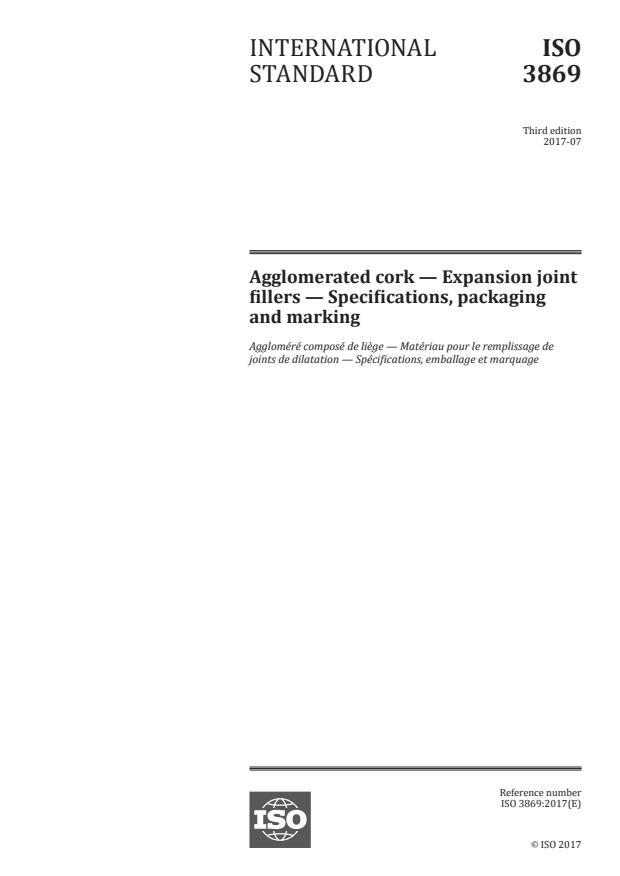
(Main)Agglomerated cork — Expansion joint fillers — Specifications, packaging and marking
General Information
- Abstract
ISO 3869:2017 specifies the characteristics of composition cork intended to be used as expansion joint filler between concrete elements or other construction products.
- Status
- Published
- Publication Date
- 24-Jul-2017
- Technical Committee
- ISO/TC 87 - Cork
- Drafting Committee
- ISO/TC 87 - Cork
- Current Stage
- 9093 - International Standard confirmed
- Start Date
- 21-Mar-2023
- Completion Date
- 29-Aug-2026
Buy Documents
ISO 3869:2017 - Agglomerated cork -- Expansion joint fillers -- Specifications, packaging and marking
ISO 3869:2017 - Agglomerated cork — Expansion joint fillers — Specifications, packaging and marking/25/2017
ISO 3869:2017 - Aggloméré composé de liege -- Matériau pour le remplissage de joints de dilatation -- Spécifications, emballage et marquage
REDLINE ISO 3869:2017 - Agglomerated cork — Expansion joint fillers — Specifications, packaging and marking Released:7/25/2017
ISO 3869:2017 - Aggloméré composé de liège — Matériau pour le remplissage de joints de dilatation — Spécifications, emballage et marquage/25/2017
Overview
ISO 3869:2017 specifies requirements for agglomerated (composition) cork used as expansion joint fillers in construction, primarily between concrete elements or other building products. The standard defines material types, key mechanical characteristics, dimensional tolerances, packaging and marking requirements to ensure reliable performance of cork-based expansion joint systems.
Key Topics and Technical Requirements
ISO 3869 covers the following technical topics and test-based requirements (tests referenced to ISO 3867):
Types
- Type II - composition cork
- Type III - self‑expanding cork
Materials
- Made from clean granulated cork bonded with a non‑soluble synthetic resin.
- Sheets or preformed strips must resist deformation and breakage during normal handling and exposure.
Dimensions and tolerances
- Declared sizes agreed between supplier and customer.
- Standard tolerances: length ±6 mm, width ±3 mm, thickness ±1.5 mm.
Mechanical properties
- Recovery after compression: not less than 90% of initial thickness.
- Compression resistance: between 340 kPa and 1 035 kPa.
- Extrusion (material squeezed out under load): maximum 6 mm.
- Expansion in water (self‑expanding cork): thickness increase ≥140% of initial thickness.
- Apparent density to be declared by the manufacturer.
Packaging and marking
- Store and transport on pallets or flat surfaces to avoid breakage/permanent deformation.
- Self‑expanding cork must be wrapped in waterproof paper and sealed to prevent moisture ingress.
- Packages must be marked with reference to ISO 3869, product designation, manufacturer identification and source/origin.
Applications and Who Uses This Standard
ISO 3869 is essential for ensuring consistent, fit‑for‑purpose expansion joint fillers in civil and structural construction. Typical users include:
- Manufacturers and suppliers of agglomerated cork products
- Structural and civil engineers specifying concrete expansion joint materials
- Architects and façade consultants
- Contractors and installers applying expansion joint fillers on site
- Quality assurance teams and procurement specialists verifying compliance
Common applications: movement joints in concrete pavements, bridge decks, precast concrete elements, building façades and other joints requiring compressible, resilient fillers.
Related Standards
- ISO 3867 - Composition cork - Expansion joint fillers - Test methods (referenced for testing)
- ISO 633 - Cork - Vocabulary
- ASTM D1752a - Comparable specification referenced in the ISO bibliography
Keywords: ISO 3869, agglomerated cork, expansion joint filler, composition cork, self‑expanding cork, concrete expansion joints, packaging and marking.
Relations
- Consolidated By
ISO 1043-4:2021 - Plastics — Symbols and abbreviated terms — Part 4: Flame retardants - Effective Date
- 06-Jun-2022
- Revises
ISO 3869:2001 - Composition cork — Expansion joint fillers — Specifications, packaging and marking - Effective Date
- 23-Apr-2016
Buy Documents
ISO 3869:2017 - Agglomerated cork -- Expansion joint fillers -- Specifications, packaging and marking
ISO 3869:2017 - Agglomerated cork — Expansion joint fillers — Specifications, packaging and marking/25/2017
ISO 3869:2017 - Aggloméré composé de liege -- Matériau pour le remplissage de joints de dilatation -- Spécifications, emballage et marquage
REDLINE ISO 3869:2017 - Agglomerated cork — Expansion joint fillers — Specifications, packaging and marking Released:7/25/2017
ISO 3869:2017 - Aggloméré composé de liège — Matériau pour le remplissage de joints de dilatation — Spécifications, emballage et marquage/25/2017
Get Certified
Connect with accredited certification bodies for this standard

DIBt (Deutsches Institut für Bautechnik)
German Institute for Building Technology.
DIN CERTCO
DIN Group product certification.

Aboma Certification B.V.
Specialized in construction, metal, and transport sectors.
Sponsored listings
Frequently Asked Questions
ISO 3869:2017 is a standard published by the International Organization for Standardization (ISO). Its full title is "Agglomerated cork — Expansion joint fillers — Specifications, packaging and marking". This standard covers: ISO 3869:2017 specifies the characteristics of composition cork intended to be used as expansion joint filler between concrete elements or other construction products.
ISO 3869:2017 specifies the characteristics of composition cork intended to be used as expansion joint filler between concrete elements or other construction products.
ISO 3869:2017 is classified under the following ICS (International Classification for Standards) categories: 79.100 - Cork and cork products; 91.100.50 - Binders. Sealing materials. The ICS classification helps identify the subject area and facilitates finding related standards.
ISO 3869:2017 has the following relationships with other standards: It is inter standard links to ISO 1043-4:2021, ISO 3869:2001. Understanding these relationships helps ensure you are using the most current and applicable version of the standard.
ISO 3869:2017 is available in PDF format for immediate download after purchase. The document can be added to your cart and obtained through the secure checkout process. Digital delivery ensures instant access to the complete standard document.
Standards Content (Sample)
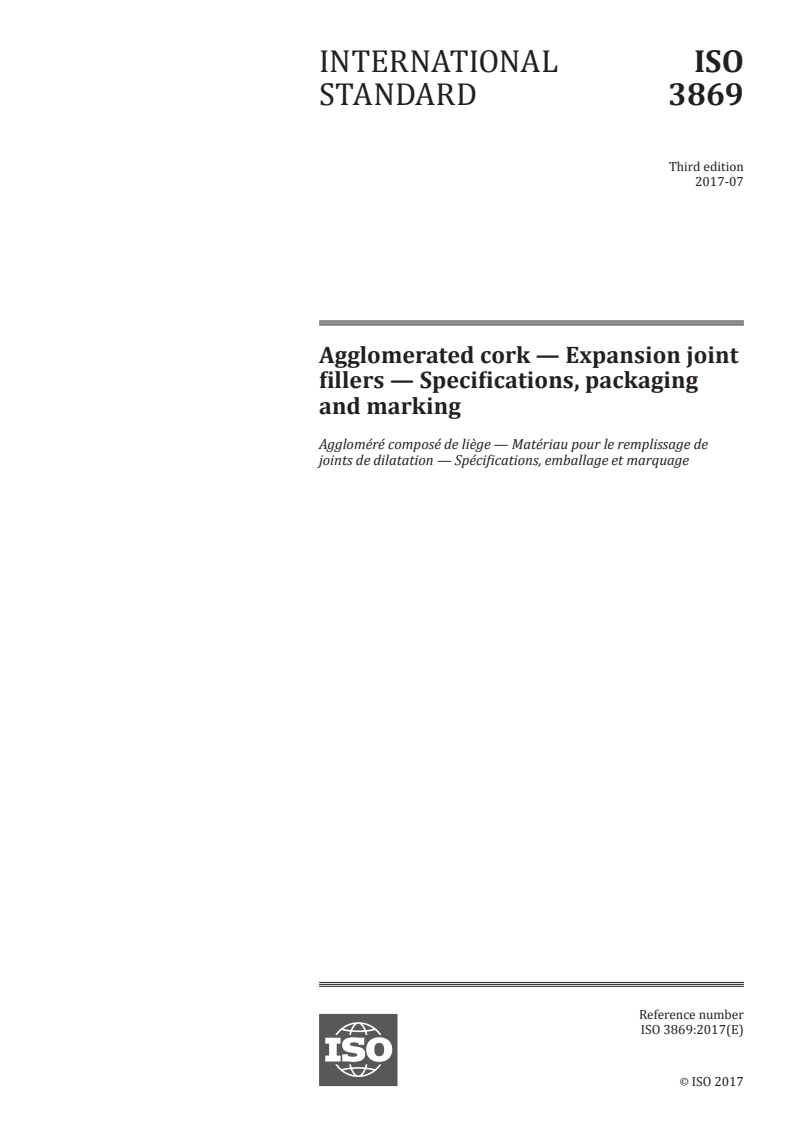
INTERNATIONAL ISO
STANDARD 3869
Third edition
2017-07
Agglomerated cork — Expansion joint
fillers — Specifications, packaging
and marking
Aggloméré composé de liège — Matériau pour le remplissage de
joints de dilatation — Spécifications, emballage et marquage
Reference number
©
ISO 2017
© ISO 2017, Published in Switzerland
All rights reserved. Unless otherwise specified, no part of this publication may be reproduced or utilized otherwise in any form
or by any means, electronic or mechanical, including photocopying, or posting on the internet or an intranet, without prior
written permission. Permission can be requested from either ISO at the address below or ISO’s member body in the country of
the requester.
ISO copyright office
Ch. de Blandonnet 8 • CP 401
CH-1214 Vernier, Geneva, Switzerland
Tel. +41 22 749 01 11
Fax +41 22 749 09 47
copyright@iso.org
www.iso.org
ii © ISO 2017 – All rights reserved
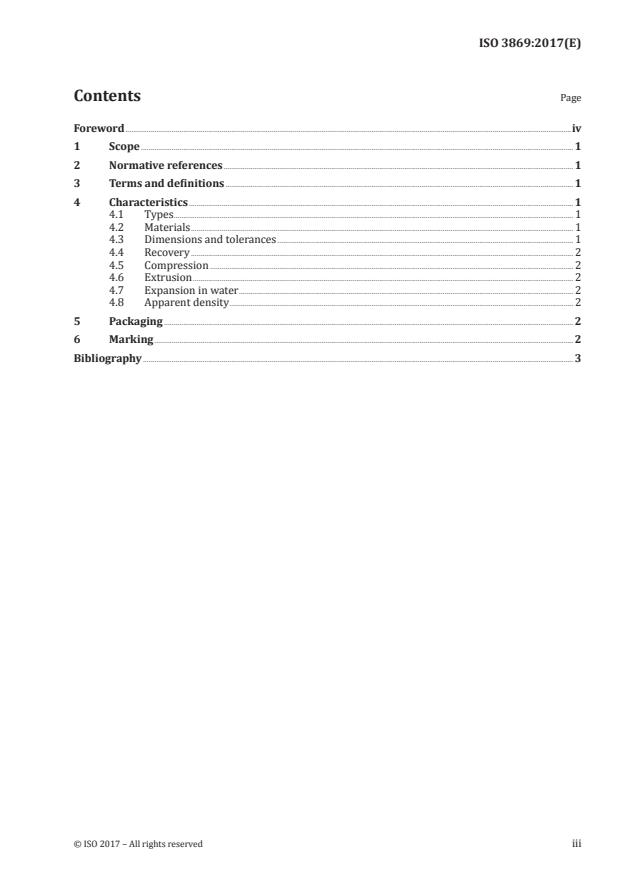
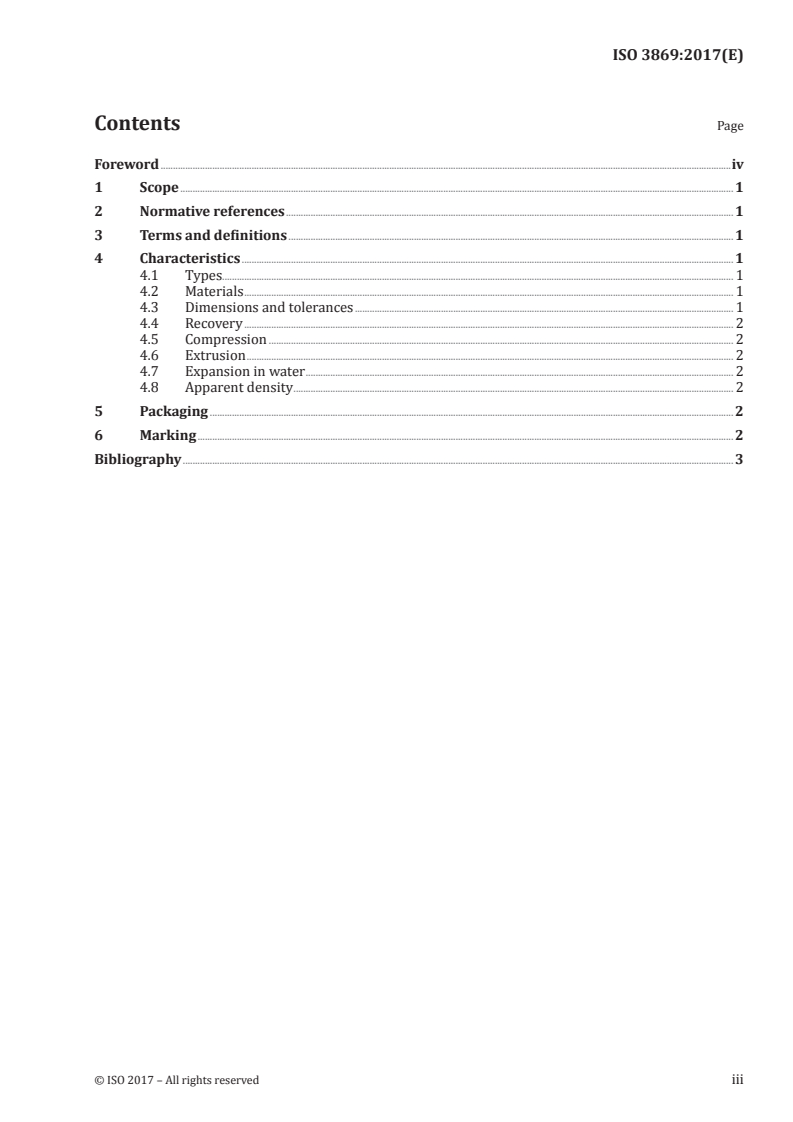
Contents Page
Foreword .iv
1 Scope . 1
2 Normative references . 1
3 Terms and definitions . 1
4 Characteristics . 1
4.1 Types. 1
4.2 Materials . 1
4.3 Dimensions and tolerances . 1
4.4 Recovery . 2
4.5 Compression . 2
4.6 Extrusion . 2
4.7 Expansion in water . 2
4.8 Apparent density . 2
5 Packaging . 2
6 Marking . 2
Bibliography . 3
Foreword
ISO (the International Organization for Standardization) is a worldwide federation of national standards
bodies (ISO member bodies). The work of preparing International Standards is normally carried out
through ISO technical committees. Each member body interested in a subject for which a technical
committee has been established has the right to be represented on that committee. International
organizations, governmental and non-governmental, in liaison with ISO, also take part in the work.
ISO collaborates closely with the International Electrotechnical Commission (IEC) on all matters of
electrotechnical standardization.
The procedures used to develop this document and those intended for its further maintenance are
described in the ISO/IEC Directives, Part 1. In particular the different approval criteria needed for the
different types of ISO documents should be noted. This document was drafted in accordance with the
edito
...
INTERNATIONAL ISO
STANDARD 3869
Third edition
2017-07
Agglomerated cork — Expansion joint
fillers — Specifications, packaging
and marking
Aggloméré composé de liège — Matériau pour le remplissage de
joints de dilatation — Spécifications, emballage et marquage
Reference number
©
ISO 2017
© ISO 2017, Published in Switzerland
All rights reserved. Unless otherwise specified, no part of this publication may be reproduced or utilized otherwise in any form
or by any means, electronic or mechanical, including photocopying, or posting on the internet or an intranet, without prior
written permission. Permission can be requested from either ISO at the address below or ISO’s member body in the country of
the requester.
ISO copyright office
Ch. de Blandonnet 8 • CP 401
CH-1214 Vernier, Geneva, Switzerland
Tel. +41 22 749 01 11
Fax +41 22 749 09 47
copyright@iso.org
www.iso.org
ii © ISO 2017 – All rights reserved
Contents Page
Foreword .iv
1 Scope . 1
2 Normative references . 1
3 Terms and definitions . 1
4 Characteristics . 1
4.1 Types. 1
4.2 Materials . 1
4.3 Dimensions and tolerances . 1
4.4 Recovery . 2
4.5 Compression . 2
4.6 Extrusion . 2
4.7 Expansion in water . 2
4.8 Apparent density . 2
5 Packaging . 2
6 Marking . 2
Bibliography . 3
Foreword
ISO (the International Organization for Standardization) is a worldwide federation of national standards
bodies (ISO member bodies). The work of preparing International Standards is normally carried out
through ISO technical committees. Each member body interested in a subject for which a technical
committee has been established has the right to be represented on that committee. International
organizations, governmental and non-governmental, in liaison with ISO, also take part in the work.
ISO collaborates closely with the International Electrotechnical Commission (IEC) on all matters of
electrotechnical standardization.
The procedures used to develop this document and those intended for its further maintenance are
described in the ISO/IEC Directives, Part 1. In particular the different approval criteria needed for the
different types of ISO documents should be noted. This document was drafted in accordance with the
edito
...
NORME ISO
INTERNATIONALE 3869
Troisième édition
2017-07
Aggloméré composé de liège —
Matériau pour le remplissage de
joints de dilatation — Spécifications,
emballage et marquage
Agglomerated cork — Expansion joint fillers — Specifications,
packaging and marking
Numéro de référence
©
ISO 2017
DOCUMENT PROTÉGÉ PAR COPYRIGHT
© ISO 2017, Publié en Suisse
Droits de reproduction réservés. Sauf indication contraire, aucune partie de cette publication ne peut être reproduite ni utilisée
sous quelque forme que ce soit et par aucun procédé, électronique ou mécanique, y compris la photocopie, l’affichage sur
l’internet ou sur un Intranet, sans autorisation écrite préalable. Les demandes d’autorisation peuvent être adressées à l’ISO à
l’adresse ci-après ou au comité membre de l’ISO dans le pays du demandeur.
ISO copyright office
Ch. de Blandonnet 8 • CP 401
CH-1214 Vernier, Geneva, Switzerland
Tel. +41 22 749 01 11
Fax +41 22 749 09 47
copyright@iso.org
www.iso.org
ii © ISO 2017 – Tous droits réservés
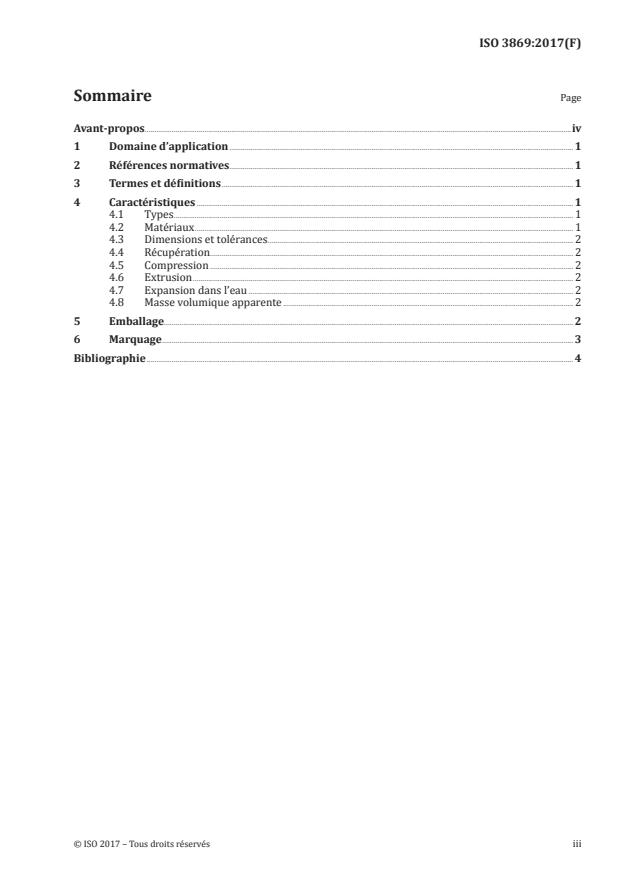
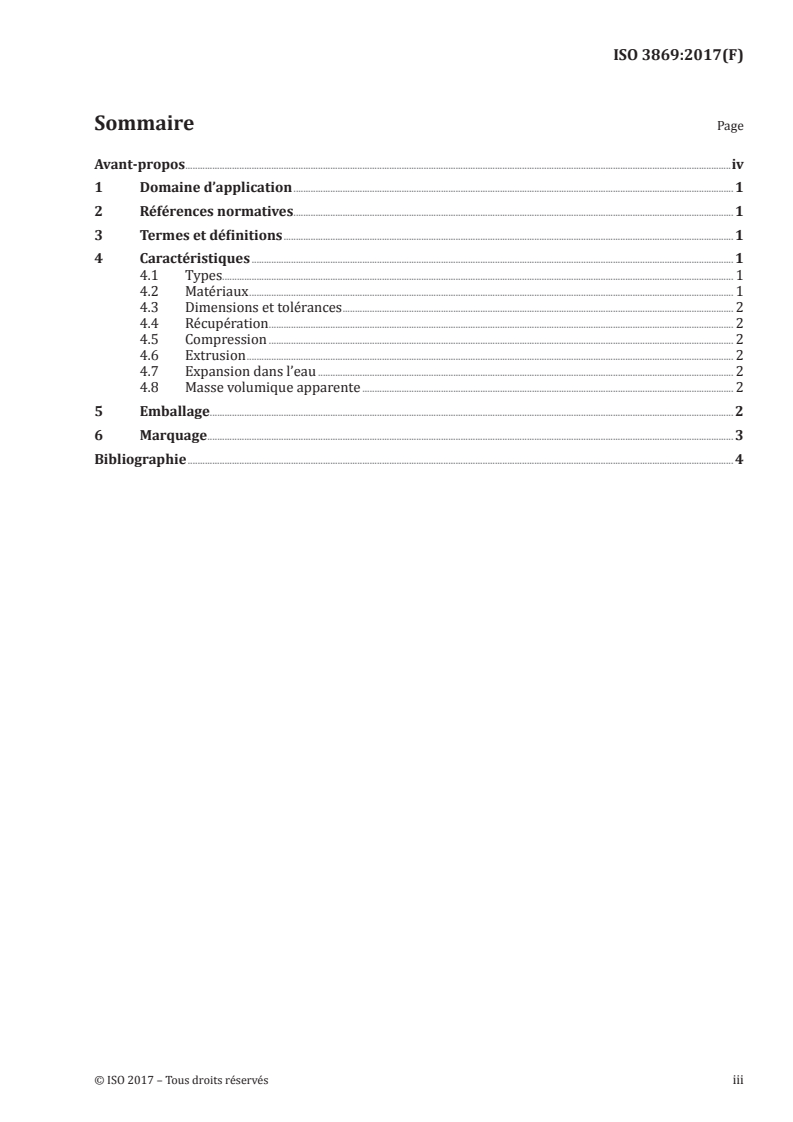
Sommaire Page
Avant-propos .iv
1 Domaine d’application . 1
2 Références normatives . 1
3 Termes et définitions . 1
4 Caractéristiques . 1
4.1 Types. 1
4.2 Matériaux . 1
4.3 Dimensions et tolérances . 2
4.4 Récupération . 2
4.5 Compression . 2
4.6 Extrusion . 2
4.7 Expansion dans l’eau . 2
4.8 Masse volumique apparente . 2
5 Emballage. 2
6 Marquage . 3
Bibliographie . 4
Avant-propos
L’ISO (Organisation internationale de normalisation) est une fédération mondiale d’organismes
nationaux de normalisation (comités membres de l’ISO). L’élaboration des Normes internationales est
en général confiée aux comités techniques de l’ISO. Chaque comité membre intéressé par une étude
a le droit de faire partie du comité technique créé à cet effet. Les organisations internationales,
gouvernementales et non gouvernementales, en liaison avec l’ISO participent également aux travaux.
L’ISO collabore étroitement avec la Commission électrotechnique internationale (IEC) en ce qui
concerne la normalisation électrotechnique.
Les procédures utilisées pour élaborer le présent document et celles destinées à sa mise à jour sont
décrites dans les Directives ISO/IEC, Partie 1. Il convient, en particulier de prendre note des différents
critères d’approbation requis pour les différents types de documents ISO. Le présent document a été
rédigé conformément aux règles de rédaction données dans les Directives ISO/IEC, Partie 2 (voir www
.iso .org/ directives).
L’attention est appelée sur le fait que certains des éléments du présent document peuvent faire l’objet de
droits de propriété intellectuelle ou de droits analogues. L’ISO ne saurait être tenue pour responsable
de ne pas avoir identifié de tels droits de propriété et averti de leur existence. Les détails concernant
les références aux droits de propriété intellectuelle ou autres droits analogues identifiés lors de
l’élaboration du document sont indiqué
...
Deleted: TC 
ISO/TC 87
Date: 2017‐07
Deleted: 
ISO/TC 87
Secrétariat: IPQ
Deleted: 
Aggloméré composé de liège — Matériau pour le remplissage de joints

de dilatation — Spécifications, emballage et marquage
Agglomerated cork — Expansion joint fillers — Specifications, packaging and marking
DOCUMENT PROTÉGÉ PAR COPYRIGHT
Droits de reproduction réservés. Sauf indication contraire, aucune partie de cette publication ne
peut être reproduite ni utilisée sous quelque forme que ce soit et par aucun procédé, électronique
ou mécanique, y compris la photocopie, l’affichage sur l’internet ou sur un Intranet, sans
autorisation écrite préalable. Les demandes d’autorisation peuvent être adressées à l’ISO à
l’adresse ci‐après ou au comité membre de l’ISO dans le pays du demandeur.
ISO copyright office
Ch. de Blandonnet 8 • CP 401
CH‐1214 Vernier, Geneva, Switzerland
Tel. + 41 22 749 01 11
Fax + 41 22 749 09 47
copyright@iso.org
www.iso.org Deleted: 
© ISO 2017 – Tous droits réservés
ii
Sommaire Page
Avant-propos . iv
1 Domaine d'application . 1
2 Références normatives . 1
3 Termes et définitions . 1
4 Caractéristiques . 1
4.1 Types . 1
4.2 Matéria ux . . . . . . . . . . . . . . . . . . 2
4.3 Dimensions et tolérances . 2
4.4 Récupération . 2
4.5 Compression . 2
4.6 Extrusion . 2
4.7 Expansion dans l’eau . 2
4.8 Masse volumique apparente. . 3
5 Emballage . 3
6 Marquage . 3
Bibliographie . 4
Deleted: 
© ISO 2017 – Tous droits réservés
iii
Avant-propos
L'ISO (Organisation internationale de normalisation) est une fédération mondiale d'organismes
nationaux de normalisation (comités membres de l'ISO). L'élaboration des Normes internationales est
en général confiée aux comités techniques de l'ISO. Chaque comité membre intéressé par une étude a le
droit de faire partie du comité technique créé à cet effet. Les organisations internationales,
gouvernementales et non gouvernementales, en liaison avec l'ISO participent également aux travaux.
L'ISO collabore étroitement avec la Commission électrotechnique internationale (IEC) en ce qui
concerne la normalisation électrotechnique.
Les procédures utilisées pour élaborer le présent document et celles destinées à sa mise à jour sont
décrites dans les Directives ISO/IEC, Partie 1. Il convient, en particulier de prendre note des différents
critères d'approbation requis pour les différents types de documents ISO. Le présent document a été
rédigé conformément aux règles de rédaction données dans les Directives ISO/IEC, Partie 2
(voir www.iso.org/directives). Deleted: ).
L'attention est appelée sur le fait que certains des éléments du présent document peuvent faire l'objet
de droits de propriété intellectuelle ou de droits analogues. L'ISO ne saurait être tenue pour
responsable de ne pas avoir identifié de tels droits de propriété et averti de leur existence. Les détails
concernant les références aux droits de propriété intellectuelle ou autres droits analogues identifiés
lors de l'élaboration du document sont indiqués dans l'Introduction et/ou dans la liste des déclarations
de brevets reçues par l’ISO (voir www.iso.org/brevets).
Deleted: ).
Les appellations commerciales éventuellement mentionnées dans le présent document sont données
pour information, par souci de commodité à l'intention des utilisateurs et ne sauraient constituer un
engagement.
Pour une explication de la
...
NORME ISO
INTERNATIONALE 3869
Troisième édition
2017-07
Aggloméré composé de liège —
Matériau pour le remplissage de
joints de dilatation — Spécifications,
emballage et marquage
Agglomerated cork — Expansion joint fillers — Specifications,
packaging and marking
Numéro de référence
©
ISO 2017
DOCUMENT PROTÉGÉ PAR COPYRIGHT
© ISO 2017, Publié en Suisse
Droits de reproduction réservés. Sauf indication contraire, aucune partie de cette publication ne peut être reproduite ni utilisée
sous quelque forme que ce soit et par aucun procédé, électronique ou mécanique, y compris la photocopie, l’affichage sur
l’internet ou sur un Intranet, sans autorisation écrite préalable. Les demandes d’autorisation peuvent être adressées à l’ISO à
l’adresse ci-après ou au comité membre de l’ISO dans le pays du demandeur.
ISO copyright office
Ch. de Blandonnet 8 • CP 401
CH-1214 Vernier, Geneva, Switzerland
Tel. +41 22 749 01 11
Fax +41 22 749 09 47
copyright@iso.org
www.iso.org
ii © ISO 2017 – Tous droits réservés
Sommaire Page
Avant-propos .iv
1 Domaine d’application . 1
2 Références normatives . 1
3 Termes et définitions . 1
4 Caractéristiques . 1
4.1 Types. 1
4.2 Matériaux . 1
4.3 Dimensions et tolérances . 2
4.4 Récupération . 2
4.5 Compression . 2
4.6 Extrusion . 2
4.7 Expansion dans l’eau . 2
4.8 Masse volumique apparente . 2
5 Emballage. 2
6 Marquage . 3
Bibliographie . 4
Avant-propos
L’ISO (Organisation internationale de normalisation) est une fédération mondiale d’organismes
nationaux de normalisation (comités membres de l’ISO). L’élaboration des Normes internationales est
en général confiée aux comités techniques de l’ISO. Chaque comité membre intéressé par une étude
a le droit de faire partie du comité technique créé à cet effet. Les organisations internationales,
gouvernementales et non gouvernementales, en liaison avec l’ISO participent également aux travaux.
L’ISO collabore étroitement avec la Commission électrotechnique internationale (IEC) en ce qui
concerne la normalisation électrotechnique.
Les procédures utilisées pour élaborer le présent document et celles destinées à sa mise à jour sont
décrites dans les Directives ISO/IEC, Partie 1. Il convient, en particulier de prendre note des différents
critères d’approbation requis pour les différents types de documents ISO. Le présent document a été
rédigé conformément aux règles de rédaction données dans les Directives ISO/IEC, Partie 2 (voir www
.iso .org/ directives).
L’attention est appelée sur le fait que certains des éléments du présent document peuvent faire l’objet de
droits de propriété intellectuelle ou de droits analogues. L’ISO ne saurait être tenue pour responsable
de ne pas avoir identifié de tels droits de propriété et averti de leur existence. Les détails concernant
les références aux droits de propriété intellectuelle ou autres droits analogues identifiés lors de
l’élaboration du document sont indiqué
...