

ISO 2820:1974
(Main)Leather — Raw hides of cattle and horses — Method of trim
General Information
- Abstract
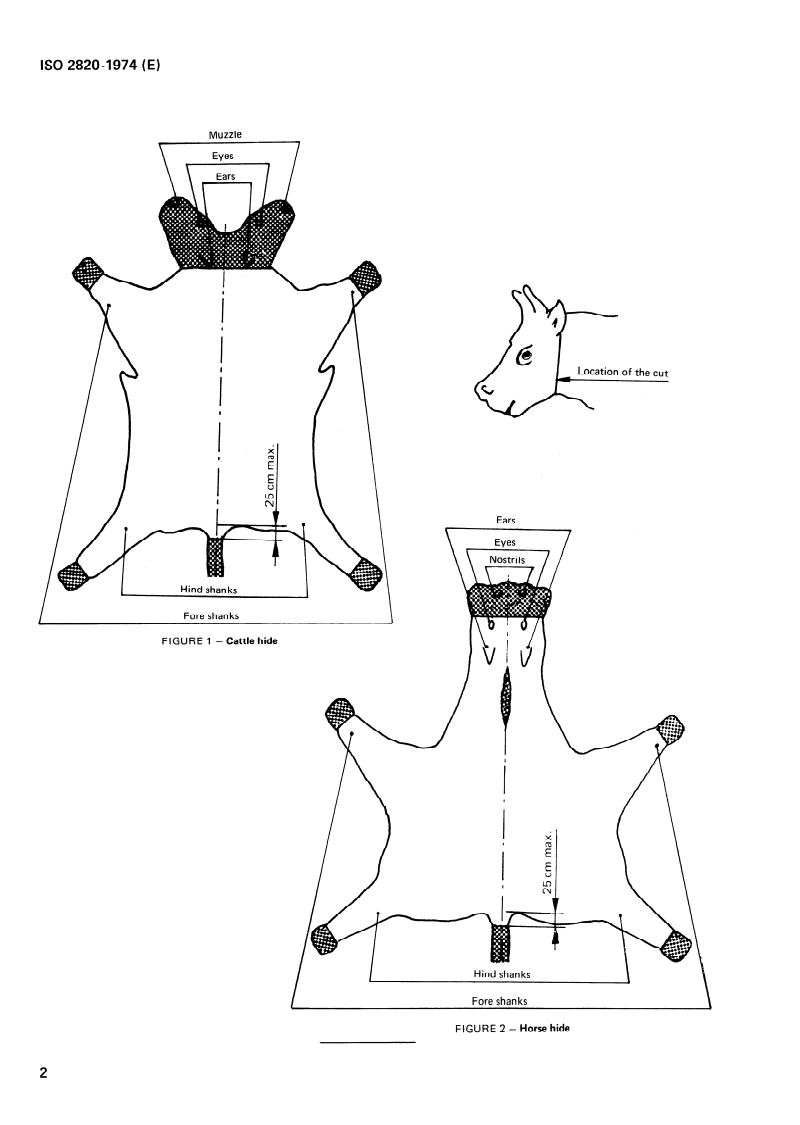
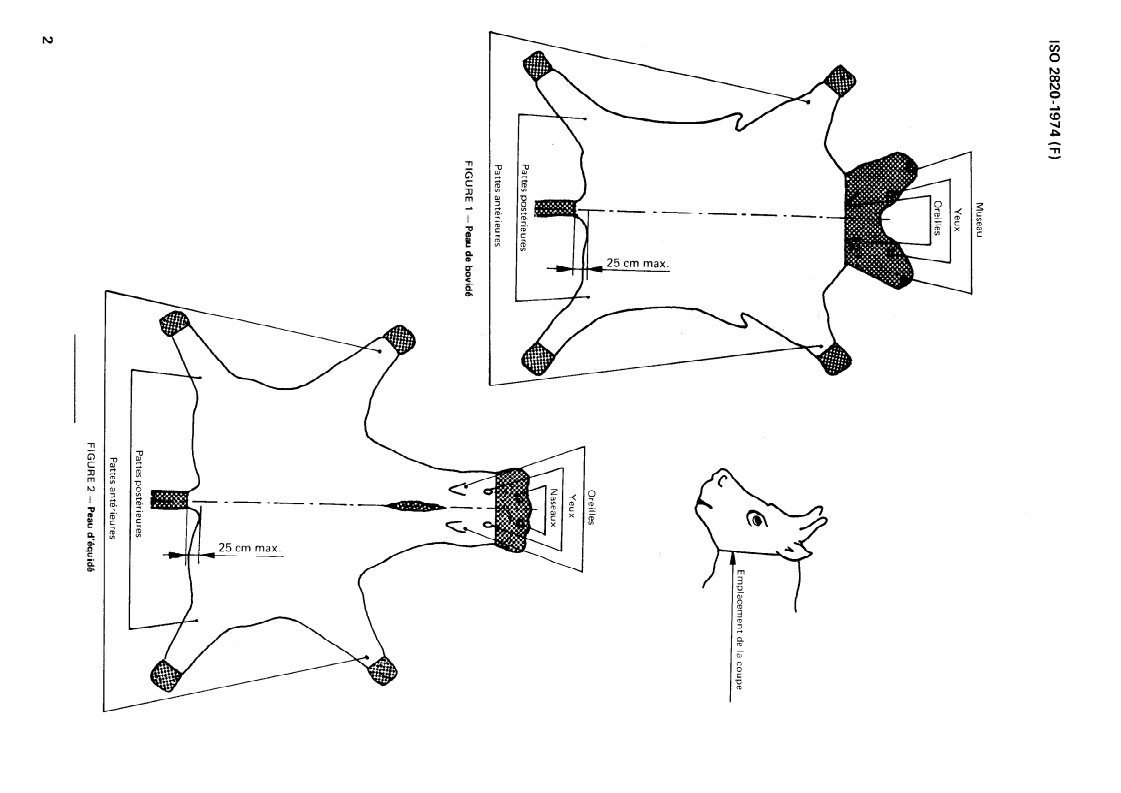
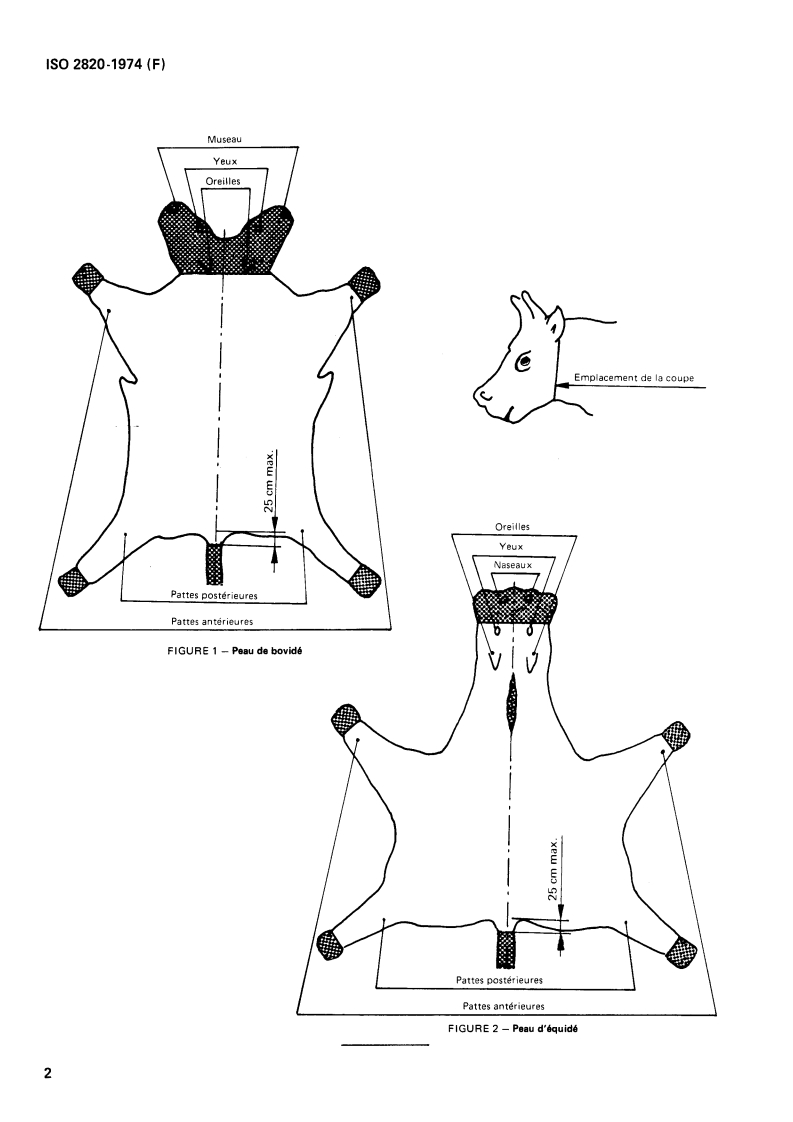
Applicable to all cattle and horse raw hides, obtained after slaughtering and flaying, intended for the tanning industrie. Two figures show the shape requirements.
- Status
- Published
- Publication Date
- 30-Sep-1974
- Technical Committee
- ISO/TC 120/SC 1 - Raw hides and skins, including pickled pelts
- Drafting Committee
- ISO/TC 120/SC 1 - Raw hides and skins, including pickled pelts
- Current Stage
- 9093 - International Standard confirmed
- Start Date
- 11-May-2023
- Completion Date
- 29-Aug-2026
Buy Documents


ISO 2820:1974 - Leather -- Raw hides of cattle and horses -- Method of trim
ISO 2820:1974 - Leather — Raw hides of cattle and horses — Method of trim/1/1974



ISO 2820:1974 - Cuir -- Peaux brutes de bovidés et d'équidés -- Mode de présentation

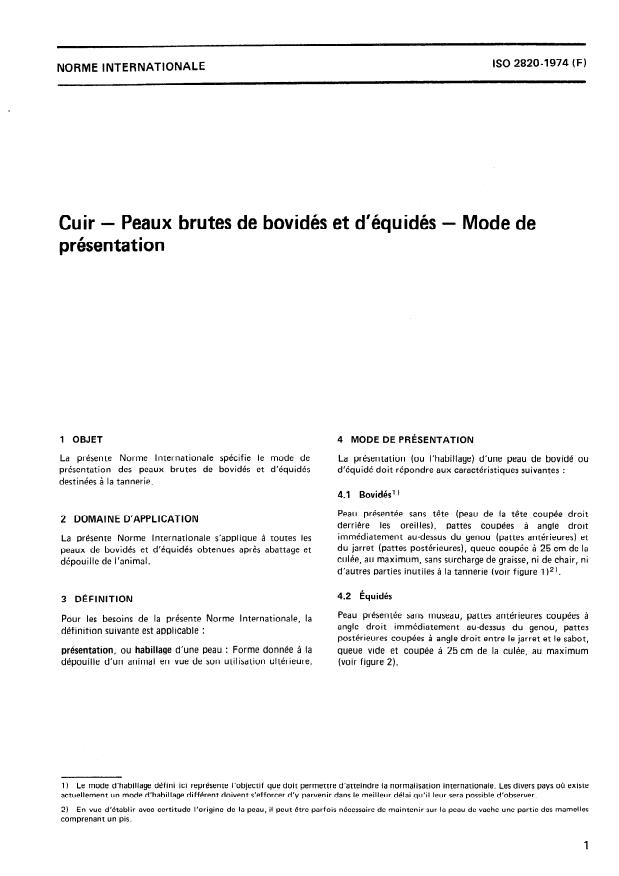

ISO 2820:1974 - Cuir -- Peaux brutes de bovidés et d'équidés -- Mode de présentation
ISO 2820:1974 - Cuir — Peaux brutes de bovidés et d'équidés — Mode de présentation/1/1974
ISO 2820:1974 - Cuir — Peaux brutes de bovidés et d'équidés — Mode de présentation/1/1974
Overview
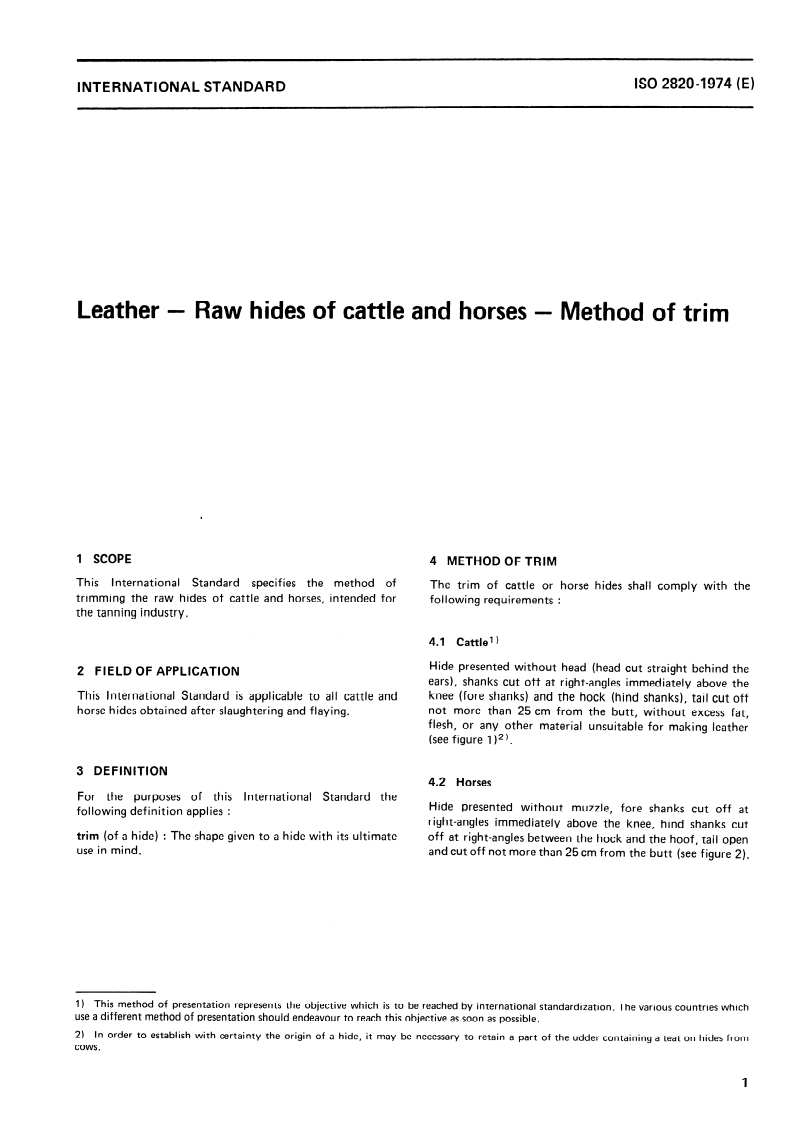
ISO 2820:1974 - Leather - Raw hides of cattle and horses - Method of trim specifies a uniform method for trimming and presenting cattle and horse raw hides intended for the tanning industry. Published by ISO/TC 120 (Leather) in 1974, the standard defines the intended shape and cut lines for hides after slaughtering and flaying, with two illustrative figures showing the required shape.
Key topics and requirements
- Scope and application
- Applies to all cattle and horse raw hides obtained after slaughtering and flaying and intended for tanning.
- Definition
- Trim (of a hide): the shape given to a hide with its ultimate use in mind.
- Method of trim - cattle
- Hide presented without head (head cut straight behind the ears).
- Fore shanks cut at right angles immediately above the knee; hind shanks cut at right angles at the hock.
- Tail cut off not more than 25 cm from the butt.
- Hides must be presented without excess fat, flesh, or any other material unsuitable for making leather.
- Method of trim - horses
- Hide presented without muzzle.
- Fore shanks cut at right angles immediately above the knee.
- Hind shanks cut at right angles between the hock and the hoof.
- Tail open and cut off not more than 25 cm from the butt.
- Illustrations
- Two figures in the standard show the required shape and cut lines for cattle and horse hides.
- Practical note
- To establish origin, part of the udder containing a teat may be retained on cow hides.
Applications and who uses it
- Primary users
- Tanneries, hide processors and leather manufacturers.
- Slaughterhouses and abattoirs preparing hides for sale or shipment.
- Quality inspectors, graders and trading intermediaries in the hide and leather supply chain.
- Practical benefits
- Ensures consistent presentation for grading, inspection and processing.
- Facilitates international trade by harmonizing hide preparation and reducing disputes.
- Minimizes contamination and unnecessary material on hides, improving yield and processing efficiency.
Related standards (if applicable)
- ISO 2820 is one of several standards produced by ISO/TC 120 (Leather). Organizations handling raw hides should also consult other ISO leather and material standards and national regulations covering hide hygiene, transport and traceability.
Keywords: ISO 2820, leather, raw hides, cattle hides, horse hides, method of trim, trimming, tanning industry, hide presentation.
Relations
- Amended By
ISO 2820:1974/Amd 1:1996 - Leather — Raw hides of cattle and horses — Method of trim — Amendment 1 - Effective Date
- 06-Jun-2022
- Parent
ISO 2820:1974/Amd 1:1996 - Leather — Raw hides of cattle and horses — Method of trim — Amendment 1 - Effective Date
- 15-Apr-2008
Buy Documents
ISO 2820:1974 - Leather -- Raw hides of cattle and horses -- Method of trim
ISO 2820:1974 - Leather — Raw hides of cattle and horses — Method of trim/1/1974
ISO 2820:1974 - Cuir -- Peaux brutes de bovidés et d'équidés -- Mode de présentation
ISO 2820:1974 - Cuir -- Peaux brutes de bovidés et d'équidés -- Mode de présentation
ISO 2820:1974 - Cuir — Peaux brutes de bovidés et d'équidés — Mode de présentation/1/1974
ISO 2820:1974 - Cuir — Peaux brutes de bovidés et d'équidés — Mode de présentation/1/1974
Get Certified
Connect with accredited certification bodies for this standard

Control Union Certifications
Global certification for agriculture and sustainability.

Hohenstein Institut
Textile testing and certification.

Bureau Veritas Bangladesh
Bureau Veritas certification services in Bangladesh.
Sponsored listings
Frequently Asked Questions
ISO 2820:1974 is a standard published by the International Organization for Standardization (ISO). Its full title is "Leather — Raw hides of cattle and horses — Method of trim". This standard covers: Applicable to all cattle and horse raw hides, obtained after slaughtering and flaying, intended for the tanning industrie. Two figures show the shape requirements.
Applicable to all cattle and horse raw hides, obtained after slaughtering and flaying, intended for the tanning industrie. Two figures show the shape requirements.
ISO 2820:1974 is classified under the following ICS (International Classification for Standards) categories: 59.140.20 - Raw skins, hides and pelts. The ICS classification helps identify the subject area and facilitates finding related standards.
ISO 2820:1974 has the following relationships with other standards: It is inter standard links to ISO 2820:1974/Amd 1:1996; is excused to ISO 2820:1974/Amd 1:1996. Understanding these relationships helps ensure you are using the most current and applicable version of the standard.
ISO 2820:1974 is available in PDF format for immediate download after purchase. The document can be added to your cart and obtained through the secure checkout process. Digital delivery ensures instant access to the complete standard document.
Standards Content (Sample)
~~
INTERNATIONAL STANDARD ~
INTERNATIONAL ORGANIZATION FOR STANDARDIZATION l MEXAYHAPOAHAJI OPl-AHM3ALIMfi I-Io CTAHAAPTWSALW4 *ORGANISATION INTERNATIONALE DE NORMALISATION
Leather - Raw hides of cattle and horses - Method of trim
Coir - f eaux bru tes de bovidh et d’equides - Mode de pr6sen ta tion
First edition - 1974-10-01
UDC 675.031.1/.5 : 675.021 Ref. No. ISO 2820-1974 (E)
Descriptors : leather, hides, trimming, presentation.
Price based on 2 pages
.h
FOREWORD
ISO (the International Organization for Standardization) is a worldwide federation
of national Standards institutes (ISO Member Bodies). The work of developing
International Standards is carried out through ISO Technical Committees. Every
Member Body interested in a subject for which a Technical Committee has been set
up has the right to be represented on that Committee. International organizations,
governmental and non-governmental, in liaison with ISO, also take part in the work.
Draft International Standards adopted by the Technical Committees are circulated
to the Member Bodies for approval before their acceptance as International
Standards by the ISO Council.
International Standard ISO 2820 was drawn up by Technical Committee
ISO/TC 120, Leather, and circulated to the Member Bodies in April 1972.
lt has been approved by the Member Bodies sf the following countries :
Australia Iran Spain
Chile Ireland Thailand
Czechoslovakia Israel Turkey
U.S.S. R.
Egypt, Arab Rep. of Italy
France New Zealand
Hungary Poland
lndia Romania
disapproval sf the
The Member Bodi es of the following countries expressed
document on techn ical gr ounds
United Kingdom
U.S.A.
0 International Organkation for Standardkation, 1974 l
Printed in Switzerland
...
~~
INTERNATIONAL STANDARD ~
INTERNATIONAL ORGANIZATION FOR STANDARDIZATION l MEXAYHAPOAHAJI OPl-AHM3ALIMfi I-Io CTAHAAPTWSALW4 *ORGANISATION INTERNATIONALE DE NORMALISATION
Leather - Raw hides of cattle and horses - Method of trim
Coir - f eaux bru tes de bovidh et d’equides - Mode de pr6sen ta tion
First edition - 1974-10-01
UDC 675.031.1/.5 : 675.021 Ref. No. ISO 2820-1974 (E)
Descriptors : leather, hides, trimming, presentation.
Price based on 2 pages
.h
FOREWORD
ISO (the International Organization for Standardization) is a worldwide federation
of national Standards institutes (ISO Member Bodies). The work of developing
International Standards is carried out through ISO Technical Committees. Every
Member Body interested in a subject for which a Technical Committee has been set
up has the right to be represented on that Committee. International organizations,
governmental and non-governmental, in liaison with ISO, also take part in the work.
Draft International Standards adopted by the Technical Committees are circulated
to the Member Bodies for approval before their acceptance as International
Standards by the ISO Council.
International Standard ISO 2820 was drawn up by Technical Committee
ISO/TC 120, Leather, and circulated to the Member Bodies in April 1972.
lt has been approved by the Member Bodies sf the following countries :
Australia Iran Spain
Chile Ireland Thailand
Czechoslovakia Israel Turkey
U.S.S. R.
Egypt, Arab Rep. of Italy
France New Zealand
Hungary Poland
lndia Romania
disapproval sf the
The Member Bodi es of the following countries expressed
document on techn ical gr ounds
United Kingdom
U.S.A.
0 International Organkation for Standardkation, 1974 l
Printed in Switzerland
...
NORME INTERNATIONALE 2820
~~~ ~ ~~ ~~
INTERNATIONAL ORGANIZATION FOR STANDARDIZATION MEXAYHAPOAHAR OPrAHH3AUIIR ll0 CTAHAAPTHJAUHH *ORGANISATION INTERNATIONALE DE NORMALISATION
Cuir - Peaux brutes de bovidés et d'équidés - Mode de
présentation
Leather - Raw hides of cattle and horses - Method of trim
Premiere edition - 1974-10-01
U
CDU 675.031.1/.5 : 675.021
Réf. No : IS0 2820-1974 (F)
r?
O Descripteurs : cuir, peau, taillage, présentation.
N
w
Prix basé sur 2 pages
AVANT-PROPOS
L'ISO (Organisation Internationale de Normalisation) est une fédération mondiale
d'organismes nationaux de normalisation (Comités Membres ISO). L'élaboration de
Normes Internationales est confiée aux Comités Techniques ISO. Chaque Comité
Membre intéressé par une étude a le droit de faire partie du Comité Technique
correspondant. Les organisations internationales, gouvernementales et non
gouvernementales, en liaison avec I'ISO, participent également aux travaux.
Les Projets de Normes Internationales adoptés par les Comités Techniques sont
soumis aux Comités Membres pour approbation, avant leur acceptation comme
Normes Internationales par le Conseil de I'ISO.
La Norme Internationale IS0 2820 a été établie par le Comité Technique
ISO/TC 120, Cuir, et soumise aux Comités Membres en avril 1972.
Elle a été approuvée par les Comités Membres des pays suivants :
Australie Iran Tchécoslovaquie
Chili Irlande Thaïlande
Egypte, Rép. arabe d' Israël Turquie
Espagne Italie U.R.S.S.
France Nouvelle-Zélande
Hongrie Pologne
Inde Roumanie
Les Comités Membres des pays suivants ont désapprouvé le document pour des
raisons techniques :
Royaume-Uni
U.S.A.
O Organisation Internationale de Normalisation, 1974 O
Imprime en Suisse
IS0 2820-1974 (F)
NORM E INTER NAT1 ONA LE
Cuir - Peaux brutes de bovidés et d'équidés - Mode de
présentation
1 OBJET 4 MODE D
...
NORME INTERNATIONALE
INTERNATIONAL ORGANIZATION FOR STANDARDIZATION l MEXflYHAPOAHAfi OPI-AHM3AUWR l-I0 CTAHAAPTM3AIjMM: l ORGANISATION INTERNATIONALE DE NORMALISATION
Cuir - Peaux brutes de bovidés et d’équidés - Mode de
présentation
Leather - Raw hides of cattle and horses - Method of trim
Première édition - 1974-10-01
c
Y
CDU 675.031.1/.5 : 675.021
Réf. No : ISO 2820-1974 (F)
Descripteurs : cuir, peau, taillage, présentation.
Prix basé sur 2 pages
AVANT-PROPOS
L’ISO (Organisation Internationale de Normalisation) est une fédération mondiale
d’organismes nationaux de normalisation (Comités Membres ISO). L’élaboration de
Normes Internationales est confiée aux Comités Techniques ISO. Chaque Comité
Membre intéressé par une étude a le droit de faire partie du Comité Technique
correspondant. Les organisations internationales, gouvernementales et non
gouvernementales, en liaison avec I’ISO, participent également aux travaux.
Les Projets de Normes Internationales adoptés par les Comités Techniques sont
soumis aux Comités Membres pour approbation, avant leur acceptation comme
Normes Internationales par le Conseil de I’ISO.
La Norme Internationale ISO 2820 a été établie par le Comité Technique
ISO/TC 120, Cuir, et soumise aux Comités Membres en avril 1972.
Elle a été approuvée par les Comités Membres des pays suivants :
Tchécoslovaquie
Australie Iran
Irlande Thaïlande
Chili
Egypte, Rép. arabe d’ Israël Turquie
Italie U.R.S.S.
Espagne
France Nouvelle-Zélande
Pologne
Hongrie
Roumanie
Inde
des pays suivants ont désapprouvé le document pour des
Les Comités Membres
raisons techniques :
Royaume-Uni
U.S.A.
0 Organisation Internationale de Normalisation, 1974 l
Imprimé en Suisse
ISO 2820-1974 (F)
NORME INTERNATIO
...
NORME INTERNATIONALE
INTERNATIONAL ORGANIZATION FOR STANDARDIZATION l MEXflYHAPOAHAfi OPI-AHM3AUWR l-I0 CTAHAAPTM3AIjMM: l ORGANISATION INTERNATIONALE DE NORMALISATION
Cuir - Peaux brutes de bovidés et d’équidés - Mode de
présentation
Leather - Raw hides of cattle and horses - Method of trim
Première édition - 1974-10-01
c
Y
CDU 675.031.1/.5 : 675.021
Réf. No : ISO 2820-1974 (F)
Descripteurs : cuir, peau, taillage, présentation.
Prix basé sur 2 pages
AVANT-PROPOS
L’ISO (Organisation Internationale de Normalisation) est une fédération mondiale
d’organismes nationaux de normalisation (Comités Membres ISO). L’élaboration de
Normes Internationales est confiée aux Comités Techniques ISO. Chaque Comité
Membre intéressé par une étude a le droit de faire partie du Comité Technique
correspondant. Les organisations internationales, gouvernementales et non
gouvernementales, en liaison avec I’ISO, participent également aux travaux.
Les Projets de Normes Internationales adoptés par les Comités Techniques sont
soumis aux Comités Membres pour approbation, avant leur acceptation comme
Normes Internationales par le Conseil de I’ISO.
La Norme Internationale ISO 2820 a été établie par le Comité Technique
ISO/TC 120, Cuir, et soumise aux Comités Membres en avril 1972.
Elle a été approuvée par les Comités Membres des pays suivants :
Tchécoslovaquie
Australie Iran
Irlande Thaïlande
Chili
Egypte, Rép. arabe d’ Israël Turquie
Italie U.R.S.S.
Espagne
France Nouvelle-Zélande
Pologne
Hongrie
Roumanie
Inde
des pays suivants ont désapprouvé le document pour des
Les Comités Membres
raisons techniques :
Royaume-Uni
U.S.A.
0 Organisation Internationale de Normalisation, 1974 l
Imprimé en Suisse
ISO 2820-1974 (F)
NORME INTERNATIO
...
NORME INTERNATIONALE 2820
~~~ ~ ~~ ~~
INTERNATIONAL ORGANIZATION FOR STANDARDIZATION MEXAYHAPOAHAR OPrAHH3AUIIR ll0 CTAHAAPTHJAUHH *ORGANISATION INTERNATIONALE DE NORMALISATION
Cuir - Peaux brutes de bovidés et d'équidés - Mode de
présentation
Leather - Raw hides of cattle and horses - Method of trim
Premiere edition - 1974-10-01
U
CDU 675.031.1/.5 : 675.021
Réf. No : IS0 2820-1974 (F)
r?
O Descripteurs : cuir, peau, taillage, présentation.
N
w
Prix basé sur 2 pages
AVANT-PROPOS
L'ISO (Organisation Internationale de Normalisation) est une fédération mondiale
d'organismes nationaux de normalisation (Comités Membres ISO). L'élaboration de
Normes Internationales est confiée aux Comités Techniques ISO. Chaque Comité
Membre intéressé par une étude a le droit de faire partie du Comité Technique
correspondant. Les organisations internationales, gouvernementales et non
gouvernementales, en liaison avec I'ISO, participent également aux travaux.
Les Projets de Normes Internationales adoptés par les Comités Techniques sont
soumis aux Comités Membres pour approbation, avant leur acceptation comme
Normes Internationales par le Conseil de I'ISO.
La Norme Internationale IS0 2820 a été établie par le Comité Technique
ISO/TC 120, Cuir, et soumise aux Comités Membres en avril 1972.
Elle a été approuvée par les Comités Membres des pays suivants :
Australie Iran Tchécoslovaquie
Chili Irlande Thaïlande
Egypte, Rép. arabe d' Israël Turquie
Espagne Italie U.R.S.S.
France Nouvelle-Zélande
Hongrie Pologne
Inde Roumanie
Les Comités Membres des pays suivants ont désapprouvé le document pour des
raisons techniques :
Royaume-Uni
U.S.A.
O Organisation Internationale de Normalisation, 1974 O
Imprime en Suisse
IS0 2820-1974 (F)
NORM E INTER NAT1 ONA LE
Cuir - Peaux brutes de bovidés et d'équidés - Mode de
présentation
1 OBJET 4 MODE D
...