

ISO/TR 2822-3:2017
(Main)Leather — Raw cattle hides and calf skins — Part 3: Guidelines for grading on the basis of defects
General Information
- Abstract
ISO/TR 2822-3:2017 provides guidelines for the grading of raw cattle hides and calf skins based on visible defects.
- Status
- Published
- Publication Date
- 12-Jan-2017
- Technical Committee
- ISO/TC 120/SC 1 - Raw hides and skins, including pickled pelts
- Drafting Committee
- ISO/TC 120/SC 1 - Raw hides and skins, including pickled pelts
- Current Stage
- 6060 - International Standard published
- Start Date
- 13-Jan-2017
- Due Date
- 20-Apr-2018
- Completion Date
- 20-Apr-2018
Buy Documents
ISO/TR 2822-3:2017 - Leather -- Raw cattle hides and calf skins
ISO/TR 2822-3:2017 - Leather — Raw cattle hides and calf skins — Part 3: Guidelines for grading on the basis of defects/13/2017
Overview
ISO/TR 2822-3:2017 - Leather - Raw cattle hides and calf skins - Part 3: Guidelines for grading on the basis of defects - is a technical report from ISO that provides practical, visual and descriptive guidance for grading raw cattle hides and calf skins according to visible defects. The document defines terms, recommended trimming and preservation methods, a defect-based classification system (First to Fourth grade and Rejects), and pictorial schematics to support consistent hide grading across the supply chain.
Key Topics
- Scope and purpose
- Guidelines for grading hides and skins based solely on visible defects to support quality control and pricing.
- Terms and definitions
- Clear definitions for hide-specific issues such as fallen hide, pritch hole, healed warble, flay mark, knive mark, latent defect, pattern, trimming and curing.
- Trimming requirements
- Presentation expectations (e.g., head removed behind ears, shanks cut above knee/hock, tail ≤ 25 cm from butt, no excess fat/flesh).
- Preservation methods
- Recommended techniques: frame or suspension drying, stack salting, brining, dry salting, freezing.
- Classification by defects
- Four grade levels plus rejects, with quantitative guidance:
- First grade: good pattern, well cured, no brand marks, ≤ five blind warbles, utilizable area ≥ 90%.
- Second grade: acceptable small belly/neck holes, one brand allowed within 18 cm of perimeter, utilizable area ≥ 80%.
- Third grade: defects up to ~30% area, utilizable area ≥ 70%.
- Fourth grade: defects covering up to 50% of hide; very poor pattern/curing.
- Rejects: hides with more defects than fourth grade or < 50% useful area.
- Four grade levels plus rejects, with quantitative guidance:
- Defect coding guidance
- Table-based approach classifying defects by location, concentration, depth and surface (grain/flesh).
Applications
- Used by tanneries, hide traders, slaughterhouses, quality inspectors, auditors and procurement teams to:
- Standardize hide grading and pricing decisions across regions.
- Improve upstream practices (flaying, curing, handling) by linking defects to economic value.
- Train staff using pictograms and clear defect definitions for repeatable inspections.
- Support procurement specifications and acceptance criteria for raw hides and calf skins.
Related Standards
- Part of the ISO 2822 series; the list of all parts is available on the ISO website.
- Prepared by ISO/TC 120 (Leather), Subcommittee SC1 (Raw hides and skins). For complementary procedures or conformity assessment guidance, consult other ISO leather standards and ISO’s online resources.
Keywords: ISO/TR 2822-3:2017, leather grading, raw cattle hides, calf skins, defect grading, hide preservation, trimming, tanneries, hide classification.
Buy Documents
ISO/TR 2822-3:2017 - Leather -- Raw cattle hides and calf skins
ISO/TR 2822-3:2017 - Leather — Raw cattle hides and calf skins — Part 3: Guidelines for grading on the basis of defects/13/2017
Get Certified
Connect with accredited certification bodies for this standard

Control Union Certifications
Global certification for agriculture and sustainability.

Hohenstein Institut
Textile testing and certification.

Bureau Veritas Bangladesh
Bureau Veritas certification services in Bangladesh.
Sponsored listings
Frequently Asked Questions
ISO/TR 2822-3:2017 is a technical report published by the International Organization for Standardization (ISO). Its full title is "Leather — Raw cattle hides and calf skins — Part 3: Guidelines for grading on the basis of defects". This standard covers: ISO/TR 2822-3:2017 provides guidelines for the grading of raw cattle hides and calf skins based on visible defects.
ISO/TR 2822-3:2017 provides guidelines for the grading of raw cattle hides and calf skins based on visible defects.
ISO/TR 2822-3:2017 is classified under the following ICS (International Classification for Standards) categories: 59.140.20 - Raw skins, hides and pelts. The ICS classification helps identify the subject area and facilitates finding related standards.
ISO/TR 2822-3:2017 is available in PDF format for immediate download after purchase. The document can be added to your cart and obtained through the secure checkout process. Digital delivery ensures instant access to the complete standard document.
Standards Content (Sample)
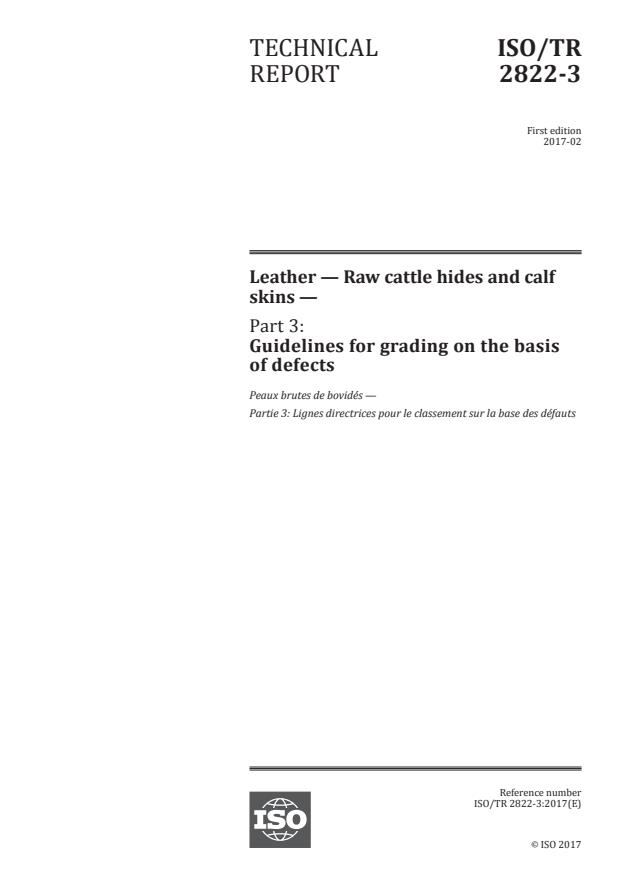
TECHNICAL ISO/TR
REPORT 2822-3
First edition
2017-02
Leather — Raw cattle hides and calf
skins —
Part 3:
Guidelines for grading on the basis
of defects
Peaux brutes de bovidés —
Partie 3: Lignes directrices pour le classement sur la base des défauts
Reference number
©
ISO 2017
© ISO 2017, Published in Switzerland
All rights reserved. Unless otherwise specified, no part of this publication may be reproduced or utilized otherwise in any form
or by any means, electronic or mechanical, including photocopying, or posting on the internet or an intranet, without prior
written permission. Permission can be requested from either ISO at the address below or ISO’s member body in the country of
the requester.
ISO copyright office
Ch. de Blandonnet 8 • CP 401
CH-1214 Vernier, Geneva, Switzerland
Tel. +41 22 749 01 11
Fax +41 22 749 09 47
copyright@iso.org
www.iso.org
ii © ISO 2017 – All rights reserved
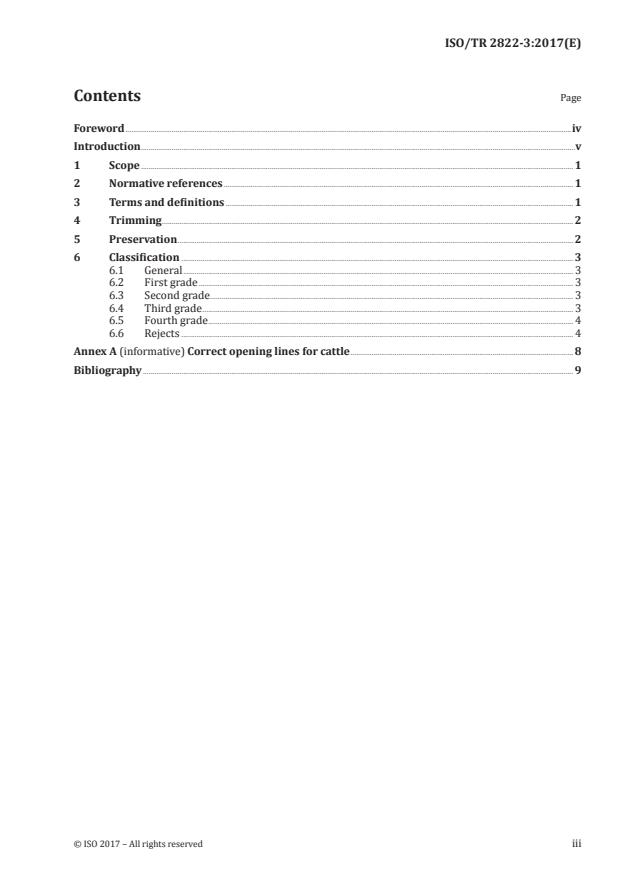
Contents Page
Foreword .iv
Introduction .v
1 Scope . 1
2 Normative references . 1
3 Terms and definitions . 1
4 Trimming . 2
5 Preservation . 2
6 Classification . 3
6.1 General . 3
6.2 First grade . 3
6.3 Second grade . 3
6.4 Third grade . 3
6.5 Fourth grade . 4
6.6 Rejects . 4
Annex A (informative) Correct opening lines for cattle . 8
Bibliography . 9
Foreword
ISO (the International Organization for Standardization) is a worldwide federation of national standards
bodies (ISO member bodies). The work of preparing International Standards is normally carried out
through ISO technical committees. Each member body interested in a subject for which a technical
committee has been established has the right to be represented on that committee. International
organizations, governmental and non-governmental, in liaison with ISO, also take part in the work.
ISO collaborates closely with the International Electrotechnical Commission (IEC) on all matters of
electrotechnical standardization.
The procedures used to develop this document and those intended for its further maintenance are
described in the ISO/IEC Directives, Part 1. In particular the different approval criteria needed for the
different types of ISO documents should be noted. This document was drafted in accordance with the
editorial rules of the ISO/IEC Directives, Part 2 (see www .iso .org/ directives).
Attention is drawn to the possibility that some of the elements of this document may be the subject of
patent rights. ISO shall not be held responsible for identifying any or all such patent rights. Details of
any patent rights identified during the development of the document will be in the Introduction and/or
on the ISO list of patent declarations received (see www .iso .org/ patents).
Any trade name used in this document is information given for the convenience of users and does not
constitute an endorsement.
For an explanation on the meaning of ISO specific terms and expressions related to conformity assessment,
as well as information about ISO’s adherence to the World Trade Organization (WTO) principles in the
Technical Barriers to Trade (TBT) see the following URL: www . i so .org/ iso/ foreword .html
This document was prepared by Technical Committee ISO/TC 120, Leather, Subcommittee SC 1, Raw
hides and skins including pickled pelts.
A list of all parts in the ISO 2822 series can be found on the ISO website.
iv © ISO 2017 – All rights reserved
Introduction
It is widely understood that improvement of hide quality can be achieved only if quality grading norms
are applied. The primary producer as well as the whole production chain, including flaying, curing,
handling and storing, should be rewarded by better prices for improved quality.
The main purpose of this document is to provide a basis for quality grading.
This document shows a graphic representation visualizing the different grades or classes through a
schematic pictogram of a hide. There is no relation to breed, size, weight or the origin of the carcass.
Acknowledgement is made for References [1] and [2].
TECHNICAL REPORT ISO/TR 2822-3:2017(E)
Leather — Raw cattle hides and calf skins —
Part 3:
Guidelines for grading on the basis of defects
1 Scope
This document provides guidelines for the grading of raw cattle hides and calf skins based on visible
defects.
2 Normative references
There are no normative references in this document.
3 Terms and definitions
For the purposes of this document, the following terms and definitions apply.
ISO and IEC maintain terminological databases for use in standardization at the following addresses:
— IEC
...
TECHNICAL ISO/TR
REPORT 2822-3
First edition
2017-02
Leather — Raw cattle hides and calf
skins —
Part 3:
Guidelines for grading on the basis
of defects
Peaux brutes de bovidés —
Partie 3: Lignes directrices pour le classement sur la base des défauts
Reference number
©
ISO 2017
© ISO 2017, Published in Switzerland
All rights reserved. Unless otherwise specified, no part of this publication may be reproduced or utilized otherwise in any form
or by any means, electronic or mechanical, including photocopying, or posting on the internet or an intranet, without prior
written permission. Permission can be requested from either ISO at the address below or ISO’s member body in the country of
the requester.
ISO copyright office
Ch. de Blandonnet 8 • CP 401
CH-1214 Vernier, Geneva, Switzerland
Tel. +41 22 749 01 11
Fax +41 22 749 09 47
copyright@iso.org
www.iso.org
ii © ISO 2017 – All rights reserved
Contents Page
Foreword .iv
Introduction .v
1 Scope . 1
2 Normative references . 1
3 Terms and definitions . 1
4 Trimming . 2
5 Preservation . 2
6 Classification . 3
6.1 General . 3
6.2 First grade . 3
6.3 Second grade . 3
6.4 Third grade . 3
6.5 Fourth grade . 4
6.6 Rejects . 4
Annex A (informative) Correct opening lines for cattle . 8
Bibliography . 9
Foreword
ISO (the International Organization for Standardization) is a worldwide federation of national standards
bodies (ISO member bodies). The work of preparing International Standards is normally carried out
through ISO technical committees. Each member body interested in a subject for which a technical
committee has been established has the right to be represented on that committee. International
organizations, governmental and non-governmental, in liaison with ISO, also take part in the work.
ISO collaborates closely with the International Electrotechnical Commission (IEC) on all matters of
electrotechnical standardization.
The procedures used to develop this document and those intended for its further maintenance are
described in the ISO/IEC Directives, Part 1. In particular the different approval criteria needed for the
different types of ISO documents should be noted. This document was drafted in accordance with the
editorial rules of the ISO/IEC Directives, Part 2 (see www .iso .org/ directives).
Attention is drawn to the possibility that some of the elements of this document may be the subject of
patent rights. ISO shall not be held responsible for identifying any or all such patent rights. Details of
any patent rights identified during the development of the document will be in the Introduction and/or
on the ISO list of patent declarations received (see www .iso .org/ patents).
Any trade name used in this document is information given for the convenience of users and does not
constitute an endorsement.
For an explanation on the meaning of ISO specific terms and expressions related to conformity assessment,
as well as information about ISO’s adherence to the World Trade Organization (WTO) principles in the
Technical Barriers to Trade (TBT) see the following URL: www . i so .org/ iso/ foreword .html
This document was prepared by Technical Committee ISO/TC 120, Leather, Subcommittee SC 1, Raw
hides and skins including pickled pelts.
A list of all parts in the ISO 2822 series can be found on the ISO website.
iv © ISO 2017 – All rights reserved
Introduction
It is widely understood that improvement of hide quality can be achieved only if quality grading norms
are applied. The primary producer as well as the whole production chain, including flaying, curing,
handling and storing, should be rewarded by better prices for improved quality.
The main purpose of this document is to provide a basis for quality grading.
This document shows a graphic representation visualizing the different grades or classes through a
schematic pictogram of a hide. There is no relation to breed, size, weight or the origin of the carcass.
Acknowledgement is made for References [1] and [2].
TECHNICAL REPORT ISO/TR 2822-3:2017(E)
Leather — Raw cattle hides and calf skins —
Part 3:
Guidelines for grading on the basis of defects
1 Scope
This document provides guidelines for the grading of raw cattle hides and calf skins based on visible
defects.
2 Normative references
There are no normative references in this document.
3 Terms and definitions
For the purposes of this document, the following terms and definitions apply.
ISO and IEC maintain terminological databases for use in standardization at the following addresses:
— IEC
...