

ISO 22244:2020
(Main)Leather — Raw hides — Guidelines for preservation of hides
General Information
- Abstract
This document defines various preservation methods for raw hides. These preservation methods are intended to suppress microbiological activity and to maintain the quality and commercial value of the hides during storage. This document applies to all raw hides of cattle and horses.
- Status
- Published
- Publication Date
- 14-May-2020
- Technical Committee
- ISO/TC 120/SC 1 - Raw hides and skins, including pickled pelts
- Drafting Committee
- ISO/TC 120/SC 1 - Raw hides and skins, including pickled pelts
- Current Stage
- 9093 - International Standard confirmed
- Start Date
- 29-Oct-2025
- Completion Date
- 29-Aug-2026
Buy Documents
ISO 22244:2020 - Leather -- Raw hides -- Guidelines for preservation of hides
ISO 22244:2020 - Leather — Raw hides — Guidelines for preservation of hides/15/2020
Overview
ISO 22244:2020 provides comprehensive guidelines for the preservation of raw hides, specifically targeting hides from cattle and horses. This international standard defines various preservation methods designed to suppress microbiological activity and maintain the hides’ quality and commercial value during storage. Proper preservation is critical to ensure hides remain in optimal condition for subsequent leather production processes. The preservation techniques outlined help prevent microbial spoilage, physical and chemical damage, and defects caused during storage and handling.
Key Topics
Preservation Methods: ISO 22244:2020 covers essential preservation techniques including drying, wet salting, dry salting, brining, and chilling. Each method is described in detail with emphasis on maintaining moisture content and preventing biological decay.
Salt Characteristics: Guidelines specify the use of high-quality rock salt containing at least 98% sodium chloride, with minimal impurities such as calcium, magnesium, and iron compounds. Salt particle size (2-3 mm) is critical for effective preservation to avoid uneven salt coverage or loss during handling.
Salt Quantity: The standard recommends using salt at 25% to 30% of the fresh hide weight for adequate dehydration, crucial to inhibiting microbial growth.
Auxiliary Substances: It advises on safe additives, such as sodium carbonate, to prevent staining and deterioration, while strictly prohibiting toxic substances like pentachlorophenol.
Quality and Defect Prevention: The document highlights defects to avoid in preserved hides, including overdrying, insect infestation, salt stains, discolorations (such as red-heat caused by halophilic bacteria), and cracks from freezing or improper storage.
Applications
ISO 22244:2020 serves as an essential reference for professionals involved in the leather industry:
Slaughterhouses and Tanneries: Ensures proper initial treatment and conditioning of hides before preservation, optimizing quality for leather processing.
Leather Manufacturers: Provides best practices that help maintain hide integrity, facilitating easier processing and superior end-product quality.
Storage and Transportation: Helps in planning effective storage conditions and transport logistics by reducing hide weight and volume through dry salting and chilling methods.
Quality Control Teams: Assists in identifying potential preservation-related defects and establishing quality assurance protocols to minimize economic losses.
Related Standards
For further guidance and integration within the leather production chain, stakeholders should consider associated ISO standards including:
ISO/TC 120: Technical committee responsible for leather standards, offering broader frameworks and related norms.
ISO 20486: Covers leather testing methods to assess hide quality post-preservation.
ISO 2418: Standards for raw materials and chemicals used in tanning and hide preservation.
Implementing ISO 22244:2020 guidelines supports sustainable leather production by minimizing waste and ensuring hides retain maximum commercial value through scientifically backed preservation processes. Adherence to this standard strengthens product consistency, safety, and market acceptance in the global leather industry.
Buy Documents
ISO 22244:2020 - Leather -- Raw hides -- Guidelines for preservation of hides
ISO 22244:2020 - Leather — Raw hides — Guidelines for preservation of hides/15/2020
Get Certified
Connect with accredited certification bodies for this standard

Control Union Certifications
Global certification for agriculture and sustainability.

Hohenstein Institut
Textile testing and certification.

Bureau Veritas Bangladesh
Bureau Veritas certification services in Bangladesh.
Sponsored listings
Frequently Asked Questions
ISO 22244:2020 is a standard published by the International Organization for Standardization (ISO). Its full title is "Leather — Raw hides — Guidelines for preservation of hides". This standard covers: This document defines various preservation methods for raw hides. These preservation methods are intended to suppress microbiological activity and to maintain the quality and commercial value of the hides during storage. This document applies to all raw hides of cattle and horses.
This document defines various preservation methods for raw hides. These preservation methods are intended to suppress microbiological activity and to maintain the quality and commercial value of the hides during storage. This document applies to all raw hides of cattle and horses.
ISO 22244:2020 is classified under the following ICS (International Classification for Standards) categories: 59.140.20 - Raw skins, hides and pelts. The ICS classification helps identify the subject area and facilitates finding related standards.
ISO 22244:2020 is available in PDF format for immediate download after purchase. The document can be added to your cart and obtained through the secure checkout process. Digital delivery ensures instant access to the complete standard document.
Standards Content (Sample)
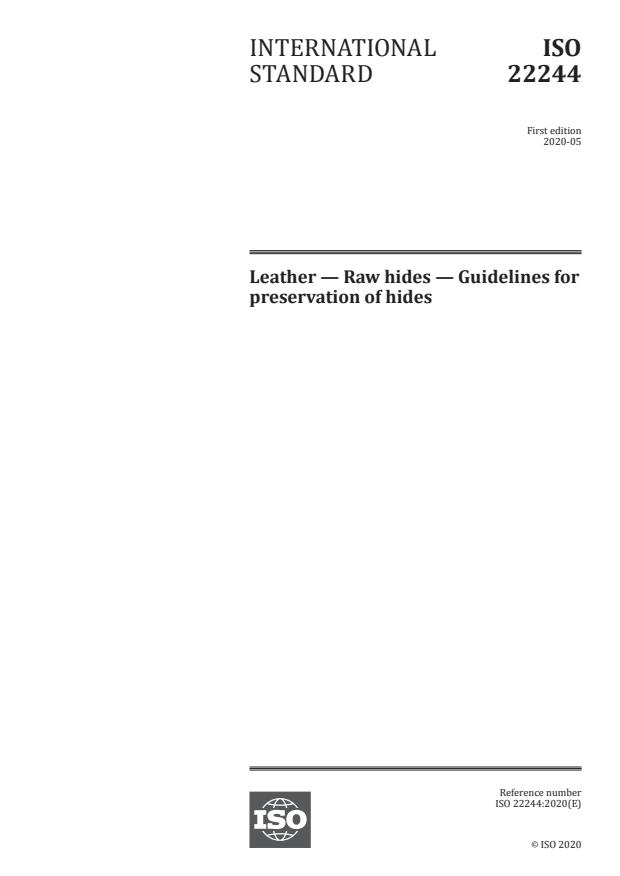
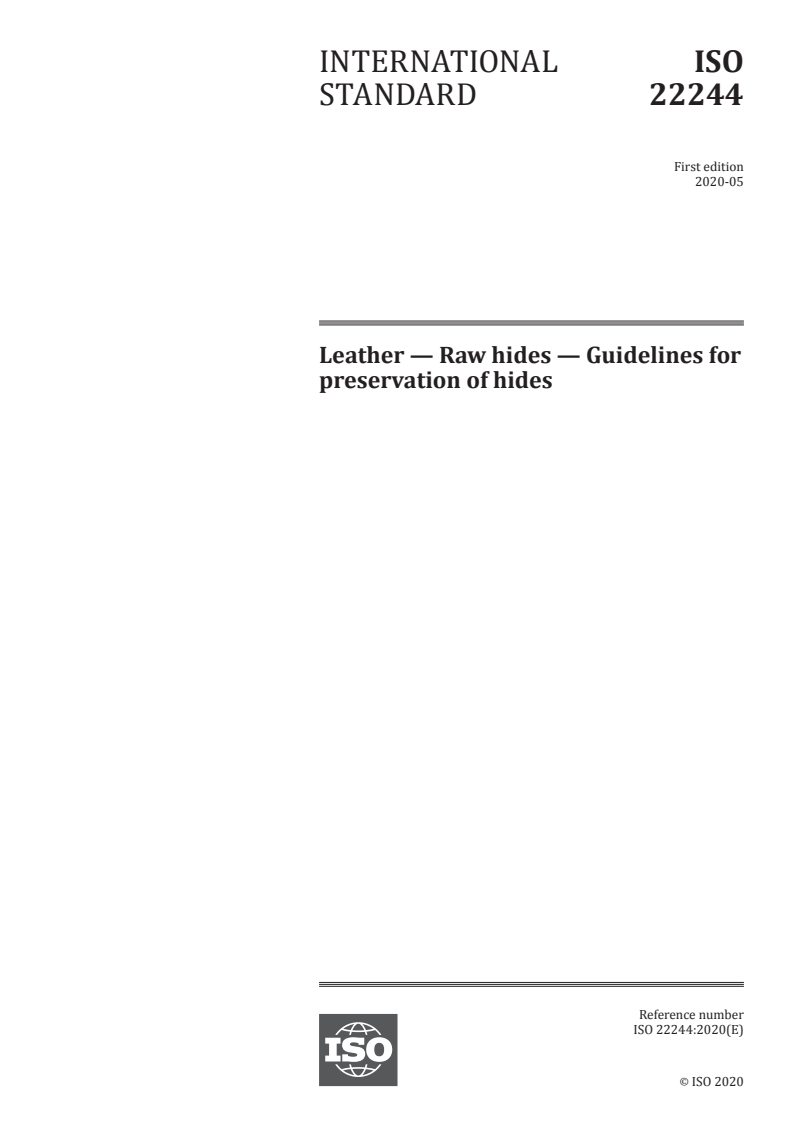
INTERNATIONAL ISO
STANDARD 22244
First edition
2020-05
Leather — Raw hides — Guidelines for
preservation of hides
Reference number
©
ISO 2020
© ISO 2020
All rights reserved. Unless otherwise specified, or required in the context of its implementation, no part of this publication may
be reproduced or utilized otherwise in any form or by any means, electronic or mechanical, including photocopying, or posting
on the internet or an intranet, without prior written permission. Permission can be requested from either ISO at the address
below or ISO’s member body in the country of the requester.
ISO copyright office
CP 401 • Ch. de Blandonnet 8
CH-1214 Vernier, Geneva
Phone: +41 22 749 01 11
Fax: +41 22 749 09 47
Email: copyright@iso.org
Website: www.iso.org
Published in Switzerland
ii © ISO 2020 – All rights reserved
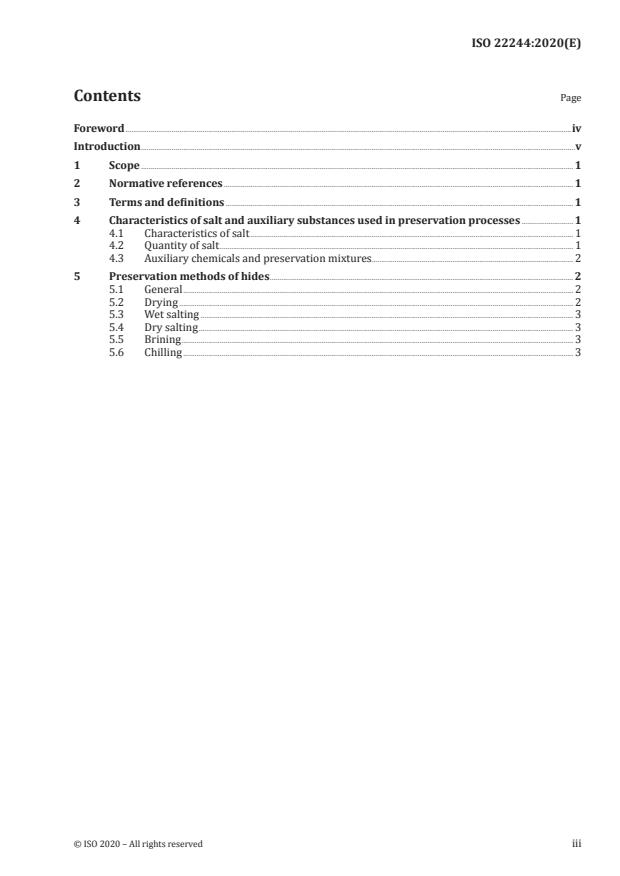
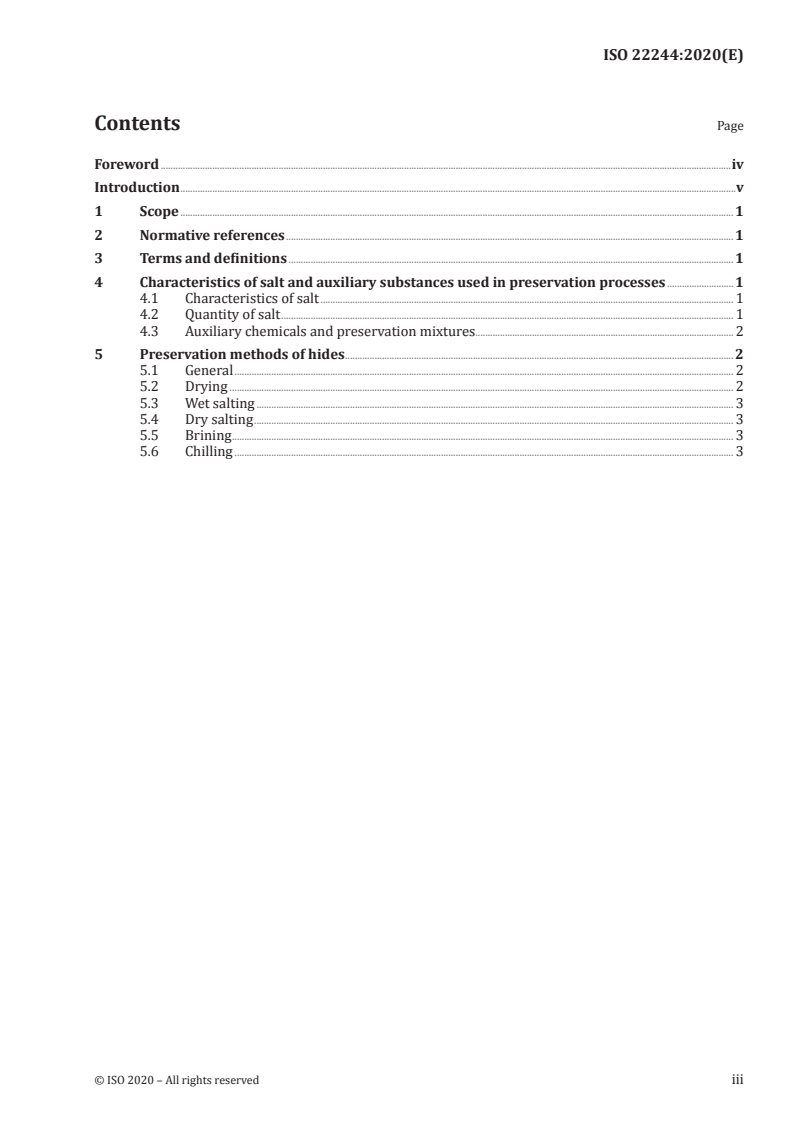
Contents Page
Foreword .iv
Introduction .v
1 Scope . 1
2 Normative references . 1
3 Terms and definitions . 1
4 Characteristics of salt and auxiliary substances used in preservation processes .1
4.1 Characteristics of salt . 1
4.2 Quantity of salt . 1
4.3 Auxiliary chemicals and preservation mixtures. 2
5 Preservation methods of hides . 2
5.1 General . 2
5.2 Drying . 2
5.3 Wet salting . 3
5.4 Dry salting . 3
5.5 Brining . 3
5.6 Chilling . 3
Foreword
ISO (the International Organization for Standardization) is a worldwide federation of national standards
bodies (ISO member bodies). The work of preparing International Standards is normally carried out
through ISO technical committees. Each member body interested in a subject for which a technical
committee has been established has the right to be represented on that committee. International
organizations, governmental and non-governmental, in liaison with ISO, also take part in the work.
ISO collaborates closely with the International Electrotechnical Commission (IEC) on all matters of
electrotechnical standardization.
The procedures used to develop this document and those intended for its further maintenance are
described in the ISO/IEC Directives, Part 1. In particular, the different approval criteria needed for the
different types of ISO documents should be noted. This document was drafted in accordance with the
editorial rules of the ISO/IEC Directives, Part 2 (see www .iso .org/ directives).
Attention is drawn to the possibility that some of the elements of this document may be the subject of
patent rights. ISO shall not be held responsible for identifying any or all such patent rights. Details of
any patent rights identified during the development of the document will be in the Introduction and/or
on the ISO list of patent declarations received (see www .iso .org/ patents).
Any trade name used in this document is information given for the convenience of users and does not
constitute an endorsement.
For an explanation of the voluntary nature of standards, the meaning of ISO specific terms and
expressions related to conformity assessment, as well as information about ISO's adherence to the
World Trade Organization (WTO) principles in the Technical Barriers to Trade (TBT) see www .iso .org/
iso/ foreword .html.
This document was prepared by Technical Committee ISO/TC 120, Leather, Subcommittee SC 1, Raw
hides and skins, including pickled pelts.
Any feedback or questions on this document should be directed to the user’s national standards body. A
complete listing of these bodies can be found at www .iso .org/ members .html.
iv © ISO 2020 – All rights reserved
Introduction
This document has been developed to define processes of preservation that lead to higher quality
of preserved hides. Such preserved hides are subsequently subjected to further treatments for
manufacturing of leather and eventually for production of leather goods.
This document has indicated preservation procedures that should be followed to prevent either of the
following situations:
— conditions occurring through the preservation treatments which affect the processability of hides;
— various defects that can form on hides due to inadequate preservation conditions and during the
period of storage and delivery to users.
INTERNATIONAL STANDARD ISO 22244:2020(E)
Leather — Raw hides — Guidelines for preservation of hides
1 Scope
This document defines various preservation methods for raw hides. These preservation methods are
intended to suppress microbiological activity and to maintain the quality and commercial value of the
hides during storage.
This document applies to all raw hides of cattle and horses.
2 Normative references
There are no normative references in this document.
3 Terms and definitions
For the purposes of this document, the following terms and definitions apply.
ISO and IEC maintain terminological databases for use in standardization at the following addresses:
— ISO Online browsing platform: available at https:
...
INTERNATIONAL ISO
STANDARD 22244
First edition
2020-05
Leather — Raw hides — Guidelines for
preservation of hides
Reference number
©
ISO 2020
© ISO 2020
All rights reserved. Unless otherwise specified, or required in the context of its implementation, no part of this publication may
be reproduced or utilized otherwise in any form or by any means, electronic or mechanical, including photocopying, or posting
on the internet or an intranet, without prior written permission. Permission can be requested from either ISO at the address
below or ISO’s member body in the country of the requester.
ISO copyright office
CP 401 • Ch. de Blandonnet 8
CH-1214 Vernier, Geneva
Phone: +41 22 749 01 11
Fax: +41 22 749 09 47
Email: copyright@iso.org
Website: www.iso.org
Published in Switzerland
ii © ISO 2020 – All rights reserved
Contents Page
Foreword .iv
Introduction .v
1 Scope . 1
2 Normative references . 1
3 Terms and definitions . 1
4 Characteristics of salt and auxiliary substances used in preservation processes .1
4.1 Characteristics of salt . 1
4.2 Quantity of salt . 1
4.3 Auxiliary chemicals and preservation mixtures. 2
5 Preservation methods of hides . 2
5.1 General . 2
5.2 Drying . 2
5.3 Wet salting . 3
5.4 Dry salting . 3
5.5 Brining . 3
5.6 Chilling . 3
Foreword
ISO (the International Organization for Standardization) is a worldwide federation of national standards
bodies (ISO member bodies). The work of preparing International Standards is normally carried out
through ISO technical committees. Each member body interested in a subject for which a technical
committee has been established has the right to be represented on that committee. International
organizations, governmental and non-governmental, in liaison with ISO, also take part in the work.
ISO collaborates closely with the International Electrotechnical Commission (IEC) on all matters of
electrotechnical standardization.
The procedures used to develop this document and those intended for its further maintenance are
described in the ISO/IEC Directives, Part 1. In particular, the different approval criteria needed for the
different types of ISO documents should be noted. This document was drafted in accordance with the
editorial rules of the ISO/IEC Directives, Part 2 (see www .iso .org/ directives).
Attention is drawn to the possibility that some of the elements of this document may be the subject of
patent rights. ISO shall not be held responsible for identifying any or all such patent rights. Details of
any patent rights identified during the development of the document will be in the Introduction and/or
on the ISO list of patent declarations received (see www .iso .org/ patents).
Any trade name used in this document is information given for the convenience of users and does not
constitute an endorsement.
For an explanation of the voluntary nature of standards, the meaning of ISO specific terms and
expressions related to conformity assessment, as well as information about ISO's adherence to the
World Trade Organization (WTO) principles in the Technical Barriers to Trade (TBT) see www .iso .org/
iso/ foreword .html.
This document was prepared by Technical Committee ISO/TC 120, Leather, Subcommittee SC 1, Raw
hides and skins, including pickled pelts.
Any feedback or questions on this document should be directed to the user’s national standards body. A
complete listing of these bodies can be found at www .iso .org/ members .html.
iv © ISO 2020 – All rights reserved
Introduction
This document has been developed to define processes of preservation that lead to higher quality
of preserved hides. Such preserved hides are subsequently subjected to further treatments for
manufacturing of leather and eventually for production of leather goods.
This document has indicated preservation procedures that should be followed to prevent either of the
following situations:
— conditions occurring through the preservation treatments which affect the processability of hides;
— various defects that can form on hides due to inadequate preservation conditions and during the
period of storage and delivery to users.
INTERNATIONAL STANDARD ISO 22244:2020(E)
Leather — Raw hides — Guidelines for preservation of hides
1 Scope
This document defines various preservation methods for raw hides. These preservation methods are
intended to suppress microbiological activity and to maintain the quality and commercial value of the
hides during storage.
This document applies to all raw hides of cattle and horses.
2 Normative references
There are no normative references in this document.
3 Terms and definitions
For the purposes of this document, the following terms and definitions apply.
ISO and IEC maintain terminological databases for use in standardization at the following addresses:
— ISO Online browsing platform: available at https:
...