

ISO 28499-3:2009
(Main)Buffalo hides and buffalo calf skins — Part 3: Grading on the basis of defects
General Information
- Abstract
ISO 28499-3:2009 provides guidance on the classification of raw or cured, trimmed buffalo hides and buffalo calf skins, intended for tanning, on the basis of visually apparent defects. It applies to water-buffalo hides and water-buffalo calf skins and not to those of wild buffalo and American bison (Bison bison).
- Status
- Published
- Publication Date
- 30-Sep-2009
- Technical Committee
- ISO/TC 120/SC 1 - Raw hides and skins, including pickled pelts
- Drafting Committee
- ISO/TC 120/SC 1 - Raw hides and skins, including pickled pelts
- Current Stage
- 9093 - International Standard confirmed
- Start Date
- 11-May-2023
- Completion Date
- 29-Aug-2026

Overview
ISO 28499-3:2009 specifies guidance for the visual classification of raw or cured, trimmed water-buffalo hides and buffalo calf skins intended for tanning, based on visually apparent defects. The part applies to water-buffalo only and explicitly excludes wild buffalo and American bison (Bison bison). The standard supports consistent grading for tannery acceptance, quality control and commercial trading.
Key Topics
- Scope and applicability: Applies to raw or cured, trimmed water-buffalo hides and calf skins intended for leather production; excludes wild buffalo and American bison.
- Terms and definitions: Key terms include curing (temporary preservation) and defect (any damage likely to depreciate leather value).
- Classification of defects: Defects are grouped into five categories:
- Natural defects caused by diseases and parasites (warble holes, ringworm, tick marks, scars, tumour marks)
- Mechanical defects on the living animal (brands, bruises, scratches, horn rakes, goad marks)
- Dirt-related defects (dung and urine stains)
- Flaying defects (cuts, excess flesh, poor pattern, grain cracks, holes, corduroy)
- Curing and storage defects (putrefaction, hair slip, red heat, salt stains)
- Grading by defects: Hides are classified into three grades (First, Second, Third) plus a rejection category, with measurable defect thresholds described for practical sorting:
- First grade: Good pattern, well cured, no putrefaction, free of defects especially in butt and neck, no brand marks.
- Second grade: Good pattern, well cured, flay cuts up to 20% in the butt, moderate healed defects, light tick marks, dung/urine stains ≤10% on each hind shank.
- Third grade: Poor pattern, open defects up to 50% area, flay cuts up to 40%, pin holes up to 50%, some putrefaction defects, heavier dung/urine stains than second grade.
- Rejection: Very poor pattern, large holes, brand/scar marks, or defects covering ≥50% of hide area.
Applications
- Provides a standardized basis for hide sorting and acceptance at tannery intake.
- Facilitates consistent quality control and communication between suppliers, traders and tanners.
- Supports commercial grading, pricing and batch segregation for processing and inventory planning.
Related Standards
- ISO 28499-1 - Description of defects (companion document defining defect types)
- ISO 28499-2 - Grading on the basis of mass and size (complements defect-based grading)
- Prepared by ISO/TC 120, Leather, Subcommittee SC1 (Raw hides and skins)
This part of ISO 28499 is a practical tool for graders, buyers and tanners to ensure repeatable visual classification of water-buffalo hides and calf skins based on observable defects.
Get Certified
Connect with accredited certification bodies for this standard

Control Union Certifications
Global certification for agriculture and sustainability.

Hohenstein Institut
Textile testing and certification.

Bureau Veritas Bangladesh
Bureau Veritas certification services in Bangladesh.
Sponsored listings
Frequently Asked Questions
ISO 28499-3:2009 is a standard published by the International Organization for Standardization (ISO). Its full title is "Buffalo hides and buffalo calf skins — Part 3: Grading on the basis of defects". This standard covers: ISO 28499-3:2009 provides guidance on the classification of raw or cured, trimmed buffalo hides and buffalo calf skins, intended for tanning, on the basis of visually apparent defects. It applies to water-buffalo hides and water-buffalo calf skins and not to those of wild buffalo and American bison (Bison bison).
ISO 28499-3:2009 provides guidance on the classification of raw or cured, trimmed buffalo hides and buffalo calf skins, intended for tanning, on the basis of visually apparent defects. It applies to water-buffalo hides and water-buffalo calf skins and not to those of wild buffalo and American bison (Bison bison).
ISO 28499-3:2009 is classified under the following ICS (International Classification for Standards) categories: 59.140.20 - Raw skins, hides and pelts. The ICS classification helps identify the subject area and facilitates finding related standards.
ISO 28499-3:2009 is available in PDF format for immediate download after purchase. The document can be added to your cart and obtained through the secure checkout process. Digital delivery ensures instant access to the complete standard document.
Standards Content (Sample)
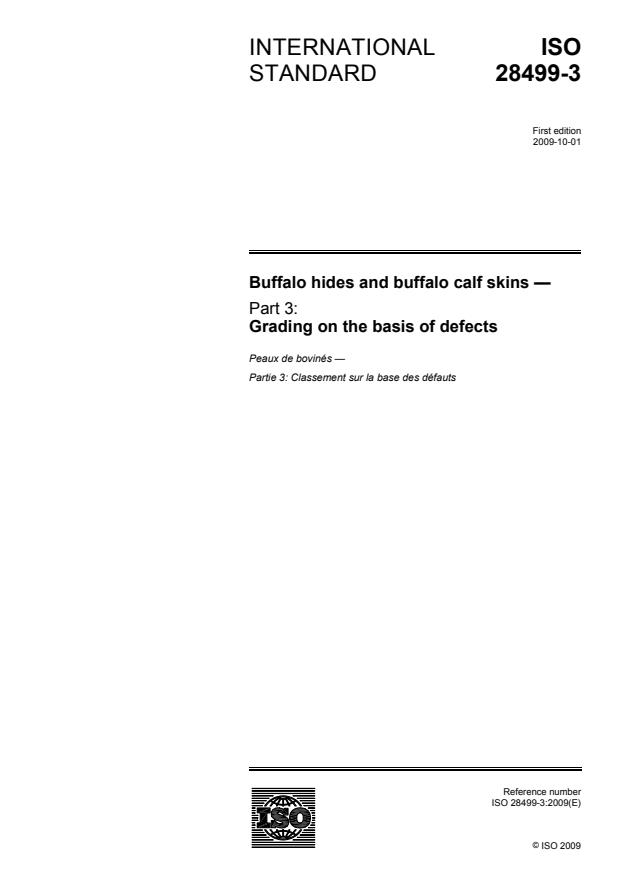
INTERNATIONAL ISO
STANDARD 28499-3
First edition
2009-10-01
Buffalo hides and buffalo calf skins —
Part 3:
Grading on the basis of defects
Peaux de bovinés —
Partie 3: Classement sur la base des défauts
Reference number
©
ISO 2009
PDF disclaimer
This PDF file may contain embedded typefaces. In accordance with Adobe's licensing policy, this file may be printed or viewed but
shall not be edited unless the typefaces which are embedded are licensed to and installed on the computer performing the editing. In
downloading this file, parties accept therein the responsibility of not infringing Adobe's licensing policy. The ISO Central Secretariat
accepts no liability in this area.
Adobe is a trademark of Adobe Systems Incorporated.
Details of the software products used to create this PDF file can be found in the General Info relative to the file; the PDF-creation
parameters were optimized for printing. Every care has been taken to ensure that the file is suitable for use by ISO member bodies. In
the unlikely event that a problem relating to it is found, please inform the Central Secretariat at the address given below.
© ISO 2009
All rights reserved. Unless otherwise specified, no part of this publication may be reproduced or utilized in any form or by any means,
electronic or mechanical, including photocopying and microfilm, without permission in writing from either ISO at the address below or
ISO's member body in the country of the requester.
ISO copyright office
Case postale 56 • CH-1211 Geneva 20
Tel. + 41 22 749 01 11
Fax + 41 22 749 09 47
E-mail copyright@iso.org
Web www.iso.org
Published in Switzerland
ii © ISO 2009 – All rights reserved
Foreword
ISO (the International Organization for Standardization) is a worldwide federation of national standards bodies
(ISO member bodies). The work of preparing International Standards is normally carried out through ISO
technical committees. Each member body interested in a subject for which a technical committee has been
established has the right to be represented on that committee. International organizations, governmental and
non-governmental, in liaison with ISO, also take part in the work. ISO collaborates closely with the
International Electrotechnical Commission (IEC) on all matters of electrotechnical standardization.
International Standards are drafted in accordance with the rules given in the ISO/IEC Directives, Part 2.
The main task of technical committees is to prepare International Standards. Draft International Standards
adopted by the technical committees are circulated to the member bodies for voting. Publication as an
International Standard requires approval by at least 75 % of the member bodies casting a vote.
Attention is drawn to the possibility that some of the elements of this document may be the subject of patent
rights. ISO shall not be held responsible for identifying any or all such patent rights.
ISO 28499-3 was prepared by Technical Committee ISO/TC 120, Leather, Subcommittee SC 1, Raw hides
and skins, including pickled pelts.
ISO 28499 consists of the following parts, under the general title Buffalo hides and buffalo calf skins:
⎯ Part 1: Description of defects
⎯ Part 2: Grading on the basis of mass and size
⎯ Part 3: Grading on the basis of defects
IN
...