

ISO 4901:2011
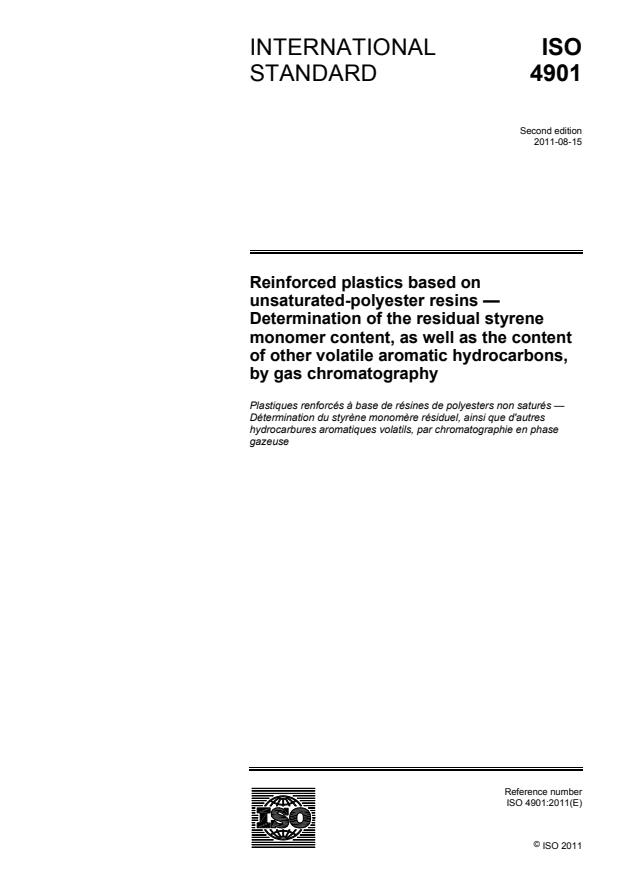
(Main)Reinforced plastics based on unsaturated-polyester resins — Determination of the residual styrene monomer content, as well as the content of other volatile aromatic hydrocarbons, by gas chromatography
General Information
- Abstract
ISO 4901:2011 specifies a method for the determination, by gas chromatography, of the residual styrene monomer in reinforced plastics based on unsaturated polyester (UP) resins in the polymerized state. The residual styrene monomer content is an important criterion in evaluating the degree of cure of UP resins in the polymerized state. The method can also be used for the simultaneous determination of other volatile aromatic hydrocarbons in UP resins. The method is not applicable to UP resins of high chemical resistance.
- Status
- Published
- Publication Date
- 08-Aug-2011
- Technical Committee
- ISO/TC 61/SC 12 - Thermosetting materials
- Current Stage
- 9020 - International Standard under periodical review
- Start Date
- 15-Jul-2026
- Completion Date
- 15-Jul-2026
Buy Documents
ISO 4901:2011 - Reinforced plastics based on unsaturated-polyester resins — Determination of the residual styrene monomer content, as well as the content of other volatile aromatic hydrocarbons, by gas chromatography Released:8/9/2011
ISO 4901:2011 - Reinforced plastics based on unsaturated-polyester resins — Determination of the residual styrene monomer content, as well as the content of other volatile aromatic hydrocarbons, by gas chromatography Released:3/4/2014
Overview - ISO 4901:2011 (Residual styrene in UP resins)
ISO 4901:2011 specifies a standardized laboratory method for determining residual styrene monomer - and other volatile aromatic hydrocarbons - in reinforced plastics based on unsaturated polyester (UP) resins, using gas chromatography (GC). The residual styrene content is an important indicator of the degree of cure of polymerized UP resins. The method covers sample preparation, extraction, calibration, GC operating requirements and result calculation. It is not applicable to UP resins of high chemical resistance.
Key topics and technical requirements
- Analytical principle: extraction of styrene from polymerized UP resin with an organic solvent, followed by GC quantification using an internal standard and calibration curve.
- Extraction: sample pieces cut into 1–2 mm strips, dried, then extracted (suspension) in solvent; typical standing time 15–20 hours with occasional shaking. Temperature during prep and extraction must remain ≤ 25 °C.
- Solvent & internal standard: dichloromethane is specified for extraction; n‑butylbenzene is used as internal standard. Note: dichloromethane has health and safety risks; acetone/ethyl acetate are being evaluated as alternatives.
- Gas chromatography: open, tubular fused‑silica column (capillary), carrier gas helium or nitrogen, FID detector with hydrogen/air flame. GC conditions must achieve adequate separation - peak resolution R > 1.5 between target peaks and neighboring peaks.
- Calibration & quantification: prepare stock and multiple calibration solutions; use peak area ratios normalized to the internal standard and compute styrene content per the calibration graph.
- Supplementary requirements: determine glass or mineral filler content (ISO 1172) if results are to be expressed on resin-only basis.
- Safety note: the standard warns about solvent toxicity and laboratory safety practices.
Practical applications and users
Who uses ISO 4901:2011:
- Quality control laboratories in composite and reinforced-plastics manufacturing
- Materials engineers monitoring degree of cure and residual monomer levels
- R&D teams developing UP resin formulations and cure cycles
- External testing and certification labs assessing compliance with material specifications
Practical benefits:
- Provides a reproducible, internationally accepted GC procedure for reporting residual styrene and other volatile aromatic hydrocarbons
- Supports process control, product acceptance, failure investigation and regulatory reporting
- Enables comparable data between laboratories through defined sample prep, calibration and chromatographic performance criteria
Related standards
- ISO 472 - Plastics - Vocabulary (terms and definitions referenced)
- ISO 1172 - Textile-glass-reinforced plastics - Determination of glass and mineral-filler content (calcination), used when expressing results on resin basis
Keywords: ISO 4901:2011, residual styrene monomer, unsaturated polyester (UP) resins, gas chromatography, reinforced plastics, volatile aromatic hydrocarbons, degree of cure, n‑butylbenzene, dichloromethane, FID.
Relations
- Effective Date
- 09-Feb-2026
- Effective Date
- 09-Feb-2026
- Effective Date
- 18-Dec-2008
Buy Documents
ISO 4901:2011 - Reinforced plastics based on unsaturated-polyester resins — Determination of the residual styrene monomer content, as well as the content of other volatile aromatic hydrocarbons, by gas chromatography Released:8/9/2011
ISO 4901:2011 - Reinforced plastics based on unsaturated-polyester resins — Determination of the residual styrene monomer content, as well as the content of other volatile aromatic hydrocarbons, by gas chromatography Released:3/4/2014
Get Certified
Connect with accredited certification bodies for this standard

DIN CERTCO
DIN Group product certification.

Smithers Quality Assessments
US management systems and product certification.
Sponsored listings
Frequently Asked Questions
ISO 4901:2011 is a standard published by the International Organization for Standardization (ISO). Its full title is "Reinforced plastics based on unsaturated-polyester resins — Determination of the residual styrene monomer content, as well as the content of other volatile aromatic hydrocarbons, by gas chromatography". This standard covers: ISO 4901:2011 specifies a method for the determination, by gas chromatography, of the residual styrene monomer in reinforced plastics based on unsaturated polyester (UP) resins in the polymerized state. The residual styrene monomer content is an important criterion in evaluating the degree of cure of UP resins in the polymerized state. The method can also be used for the simultaneous determination of other volatile aromatic hydrocarbons in UP resins. The method is not applicable to UP resins of high chemical resistance.
ISO 4901:2011 specifies a method for the determination, by gas chromatography, of the residual styrene monomer in reinforced plastics based on unsaturated polyester (UP) resins in the polymerized state. The residual styrene monomer content is an important criterion in evaluating the degree of cure of UP resins in the polymerized state. The method can also be used for the simultaneous determination of other volatile aromatic hydrocarbons in UP resins. The method is not applicable to UP resins of high chemical resistance.
ISO 4901:2011 is classified under the following ICS (International Classification for Standards) categories: 83.120 - Reinforced plastics. The ICS classification helps identify the subject area and facilitates finding related standards.
ISO 4901:2011 has the following relationships with other standards: It is inter standard links to EN ISO 14692-2:2017, EN ISO 14692-2:2002, ISO 4901:1985. Understanding these relationships helps ensure you are using the most current and applicable version of the standard.
ISO 4901:2011 is available in PDF format for immediate download after purchase. The document can be added to your cart and obtained through the secure checkout process. Digital delivery ensures instant access to the complete standard document.
Standards Content (Sample)
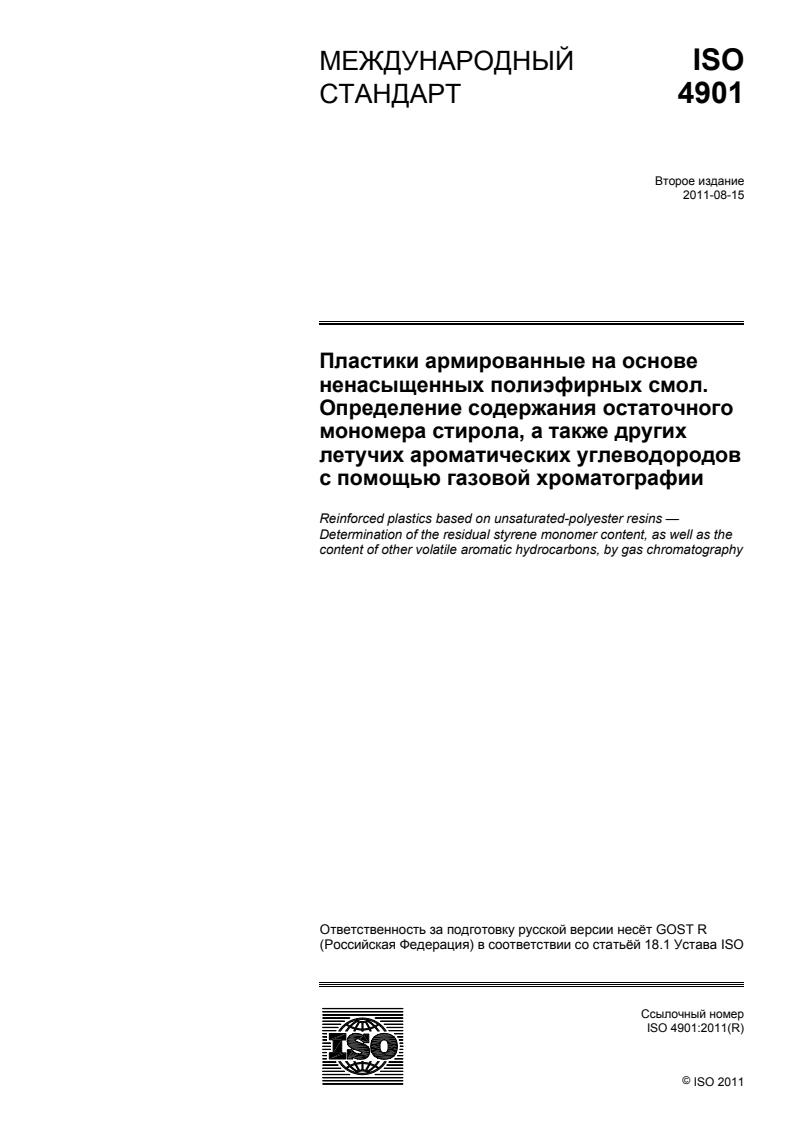
INTERNATIONAL ISO
STANDARD 4901
Second edition
2011-08-15
Reinforced plastics based on
unsaturated-polyester resins —
Determination of the residual styrene
monomer content, as well as the content
of other volatile aromatic hydrocarbons,
by gas chromatography
Plastiques renforcés à base de résines de polyesters non saturés —
Détermination du styrène monomère résiduel, ainsi que d'autres
hydrocarbures aromatiques volatils, par chromatographie en phase
gazeuse
Reference number
©
ISO 2011
© ISO 2011
All rights reserved. Unless otherwise specified, no part of this publication may be reproduced or utilized in any form or by any means,
electronic or mechanical, including photocopying and microfilm, without permission in writing from either ISO at the address below or
ISO's member body in the country of the requester.
ISO copyright office
Case postale 56 CH-1211 Geneva 20
Tel. + 41 22 749 01 11
Fax + 41 22 749 09 47
E-mail copyright@iso.org
Web www.iso.org
Published in Switzerland
ii © ISO 2011 – All rights reserved
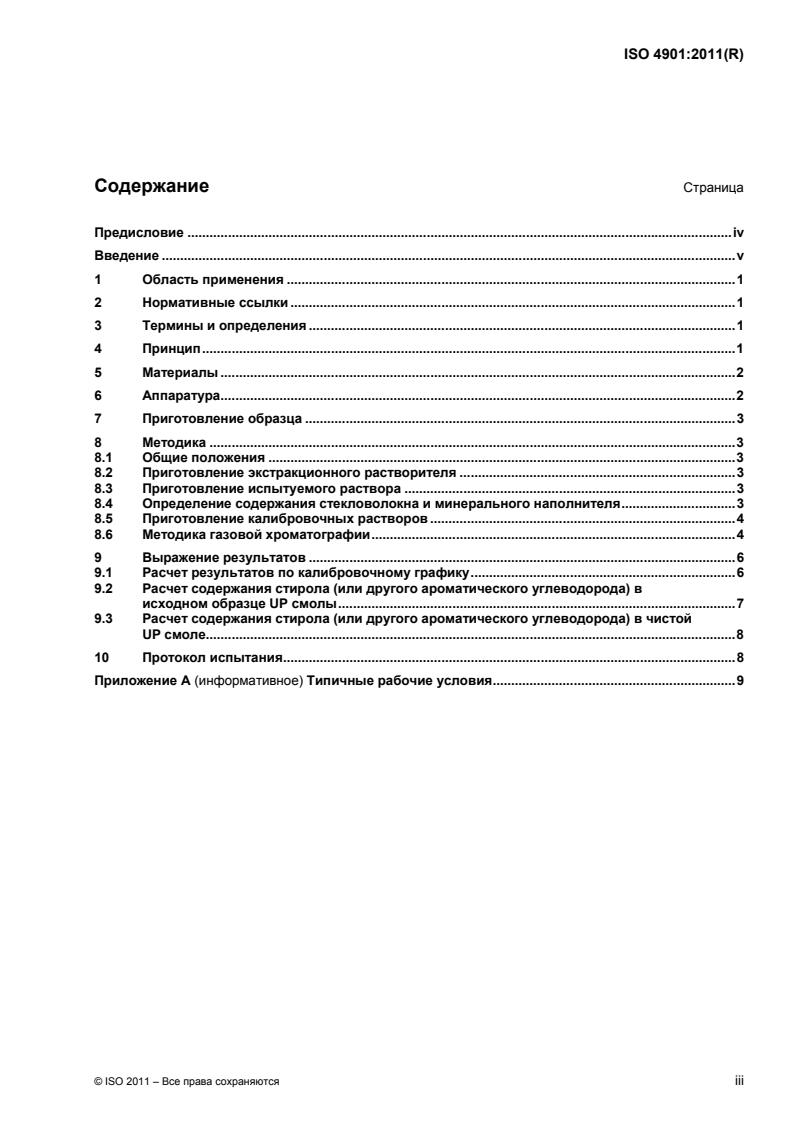
Contents Page
Foreword . iv
Introduction . v
1 Scope . 1
2 Normative references . 1
3 Terms and definitions . 1
4 Principle . 1
5 Materials . 2
6 Apparatus . 2
7 Preparation of sample . 3
8 Procedure . 3
8.1 General . 3
8.2 Preparation of extraction solvent . 3
8.3 Preparation of test solution . 3
8.4 Determination of glass and mineral content . 3
8.5 Preparation of calibration solutions . 4
8.6 Gas-chromatographic procedure . 4
9 Expression of results . 6
9.1 Calculation of results from a calibration graph . 6
9.2 Calculation of the content of styrene (or another aromatic hydrocarbon) in the original UP
resin sample . 7
9.3 Calculation of the content of styrene (or another aromatic hydrocarbon) in the pure UP
resin . 8
10 Test report . 8
Annex A (informative) Typical operating conditions . 9
Foreword
ISO (the International Organization for Standardization) is a worldwide federation of national standards bodies
(ISO member bodies). The work of preparing International Standards is normally carried out through ISO
technical committees. Each member body interested in a subject for which a technical committee has been
established has the right to be represented on that committee. International organizations, governmental and
non-governmental, in liaison with ISO, also take part in the work. ISO collaborates closely with the
International Electrotechnical Commission (IEC) on all matters of electrotechnical standardization.
International Standards are drafted in accordance with the rules given in the ISO/IEC Directives, Part 2.
The main task of technical committees is to prepare International Standards. Draft International Standards
adopted by the technical committees are circulated to the member bodies for voting. Publication as an
International Standard requires approval by at least 75 % of the member bodies casting a vote.
Attention is drawn to the possibility that some of the elements of this document may be the subject of patent
rights. ISO shall not be held responsible for identifying any or all such patent rights.
ISO 4901 was prepared by Technical Committee ISO/TC 61, Plastics, Subcommittee SC 12, Thermosetting
materials.
This second edition cancels and replaces the first edition (ISO 4901:1985), which has been technically revised
(for details, see the Introduction).
iv © ISO 2011 – All rights reserved
Introduction
During the 25 years since publication of the first edition of this International Standard, ISO 4901:1985,
significant advances have been made in analytical techniques such as gas chromatography. The standard
has therefore been completely revised. The following are the main changes which have been made:
a) In addition to a gas-chromatographic method, the first edition of ISO 4901 included, as an alternative, a
classical method, Wijs' method, based on an iodometric titration. This method had been included in the
first edition for laboratories in which gas chromatography was not available. As, nowadays,
chromatography is considered to be a routine analytical tool, Wijs' method has been removed from the
standard.
b) Packed gas-chromatography columns have generally been replaced by open, tubular columns which
operate under completely different conditions. In the revised test method, therefore, only an open, tubular
column is used.
c) In addition, the gas-chromatographic method has been extended to cover not only styrene but also other
aromatic hydrocarbons which might have been used as solvents or starting materials in producing the
unsaturated polyester resin.
INTERNATIONAL STANDARD ISO 4901:2011(E)
Reinforced plastics based on unsaturated-polyester resins —
Determination of the residual styrene monomer content, as well
as the content of other volatile aromatic hydrocarbons, by gas
chromatography
WARNING — Persons using this document should be familiar with normal laboratory practice, if
applicable. This document does not purport to address all of the safety concerns, if any, associated
with its use. It is the responsibility of the user to establish appropriate safety and health practices and
to ensure compliance with any regulatory requirements.
1 Scope
This International Standard specifies a method for the determination, by gas chromatography, of the residual
styrene monomer in reinforced plastics based on unsaturated polyester (UP) resins in the polymerized state.
The residual styrene monomer content is an important criterion in evaluating the degree of cure of UP resins
in the polymerized state. The method can also be used for the simultaneous determination of other volatile
aromatic hydrocarbons in UP resins.
The method is not applicable to UP resins of high chemical resistance.
2 Normative references
The following referenced documents are indispensable for the application of this document. For dated
references, only the edition cited applies. For undated references, the latest edition of the referenced
document (including any amendments) applies.
ISO 472, Plastics — Vocabulary
ISO 1172, Textile-glass-reinforced plastics — Prepregs, moulding compounds and laminates — Determination
of the textile-glass and mineral-filler content — Calcination methods
3 Terms and definitions
For the purposes of this document, the terms and definitions given in ISO 472 apply.
4 Principle
Styrene is extracted from the UP resin in the polymerized state using dichloromethane. The styrene in the
extract is determined by gas chromatography, using an internal standard and a calibration curve.
5 Materials
5.1 n-Butylbenzene, analytical grade, for use as an internal standard.
5.2 Dichloromethane, analytical grade, for use as the extraction solvent.
WARNING — Dichloromethane is harmful when swallowed, inhaled or absorbed through the skin. It
affects the central nervous system, the liver, the cardiovascular system and the blood. It causes
irritation of the skin, eyes and respiratory tract. It is also a suspected cancer hazard, the risk of cancer
depending on the level and duration of exposure.
NOTE In view of the toxicity and suspected carcinogenic characterics of dichloromethane, acetone and ethyl acetate
are being tested as replacements. If the results of this work demonstrate conclusively that either one or both of these
solvents are suitable, this International Standard will be revised accordingly.
5.3 Styrene, analytical grade, and, if relevant, other aromatic hydrocarbons, such as toluene,
ethylbenzene and α-methylstyrene, also analytical grade.
NOTE An aromatic hydrocarbon is considered to be relevant if it is used as a solvent or starting material in the UP
resin production process.
5.4 Carrier gas and FID fuel gases:
carrier gas: helium or nitrogen;
FID fuel gases: hydrogen and air.
6 Apparatus
Normal laboratory equipment and the following apparatus are required:
6.1 Cutting device, equipped with a water-cooled diamond blade, for cutting the UP resin into strips of
width 1 mm to 2 mm.
6.2 Gas chromatograph, including the following components:
6.2.1 Injection port, equipped with a splitter, for use with liquid samples.
6.2.2 Open, tubular column, e.g. meeting the specifications given in Annex A.
6.2.3 Flame ionization detector (FID).
A typical instrument setup and typical operating conditions are given in Annex A. Other setups and operating
conditions may be used provided that the chromatograms obtained comply with the requirements given in
8.6.1.
6.3 Data processor, e.g. a computer (or the equivalent), to record the signals from the detector.
6.4 Sample injection syringe, i.e. a 1 µl microsyringe, either as a separate item of apparatus or
incorporated in the auto-injector of the gas chromatograph.
6.5 Analytical balance, accurate to 0,1 mg.
2 © ISO 2011 – All rights reserved
7 Preparation of sample
Polymerized UP resin pieces of any shape that will permit the production of strips of width 1 mm to 2 mm may
be used. Cut the polymerized pieces into strips of width 1 mm to 2 mm. Dry the strips and break them into
pieces of length approximately 10 mm. During cutting and drying, avoid any operation that could affect the
styrene and/or volatile-hydrocarbon content.
8 Procedure
8.1 General
Three test portions of the sample (see Clause 7) shall be analysed.
During the preparation, dilution and extraction processes described below, the temperature of all solutions
shall remain 25 °C.
8.2 Preparation of extraction solvent
Weigh, to the nearest 0,1 mg, (250 50) mg of n-butylbenzene (5.1) into a 1 000 ml volumetric flask
containing approximately 500 ml of dichloromethane (5.2). Make up to the mark with dichloromethane (see,
however, next paragraph) and mix.
Alternatively, acetone (see Note to 5.2) may be used instead of dichloromethane, provided that the results can
be demonstrated to
...
МЕЖДУНАРОДНЫЙ ISO
СТАНДАРТ 4901
Второе издание
2011-08-15
Пластики армированные на основе
ненасыщенных полиэфирных смол.
Определение содержания остаточного
мономера стирола, а также других
летучих ароматических углеводородов
с помощью газовой хроматографии
Reinforced plastics based on unsaturated-polyester resins —
Determination of the residual styrene monomer content, as well as the
content of other volatile aromatic hydrocarbons, by gas chromatography
Ответственность за подготовку русской версии несёт GOST R
(Российская Федерация) в соответствии со статьёй 18.1 Устава ISO
Ссылочный номер
©
ISO 2011
ДОКУМЕНТ ЗАЩИЩЕН АВТОРСКИМ ПРАВОМ
© ISO 2011
Все права сохраняются. Если не указано иное, никакую часть настоящей публикации нельзя копировать или использовать в
какой-либо форме или каким-либо электронным или механическим способом, включая фотокопии и микрофильмы, без
предварительного письменного согласия ISO по соответствующему адресу, указанному ниже, или комитета-члена ISO в стране
заявителя.
ISO copyright office
Case postale 56 • CH-1211 Geneva 20
Tel. + 41 22 749 01 11
Fax + 41 22 749 09 47
E-mail copyright@iso.org
Web www.iso.org
Опубликовано в Швейцарии
ii © ISO 2011 – Все права сохраняются
Содержание Страница
Предисловие .iv
Введение .v
1 Область применения .1
2 Нормативные ссылки .1
3 Термины и определения .1
4 Принцип.1
5 Материалы .2
6 Аппаратура.2
7 Приготовление образца .3
8 Методика .3
8.1 Общие положения .3
8.2 Приготовление экстракционного растворителя .3
8.3 Приготовление испытуемого раствора .3
8.4 Определение содержания стекловолокна и минерального наполнителя.3
8.5 Приготовление калибровочных растворов .4
8.6 Методика газовой хроматографии.4
9 Выражение результатов .6
9.1 Расчет результатов по калибровочному графику.6
9.2 Расчет содержания стирола (или другого ароматического углеводорода) в
исходном образце UP смолы.7
9.3 Расчет содержания стирола (или другого ароматического углеводорода) в чистой
UP смоле.8
10 Протокол испытания.8
Приложение A (информативное) Типичные рабочие условия.9
Предисловие
Международная организация по стандартизации (ISO) является всемирной федерацией национальных
организаций по стандартизации (комитетов-членов ISO). Разработка международных стандартов
обычно осуществляется техническими комитетами ISO. Каждый комитет-член ISO, заинтересованный
в деятельности, для которой был создан технический комитет, имеет право быть представленным в
этом комитете. Международные организации, правительственные и неправительственные, имеющие
связи с ISO, также принимают участие в работах. ISO непосредственно сотрудничает с
Международной электротехнической комиссией (IEC) по всем вопросам электротехнической
стандартизации.
Международные стандарты разрабатываются в соответствии с правилами, приведенными в
Директивах ISO/IEC, Часть 2.
Основная задача технических комитетов состоит в подготовке международных стандартов. Проекты
международных стандартов, одобренные техническими комитетами, рассылаются комитетам-членам
на голосование. Их опубликование в качестве международных стандартов требует одобрения, по
меньшей мере, 75 % комитетов-членов, принимающих участие в голосовании.
Следует иметь в виду, что некоторые элементы настоящего документа могут быть объектом патентных
прав. ISO не должен нести ответственность за идентификацию какого-либо одного или всех патентных
прав.
ISO 4901 разработан Техническим комитетом ISO/TC 61, Пластмассы, Подкомитетом SC 12,
Термореактивные материалы.
Настоящее второе издание отменяет и заменяет первое издание (ISO 4901:1985), которое подверглось
техническому пересмотру (относительно подробностей см. Введение).
iv © ISO 2011 – Все права сохраняются
Введение
За 25 лет с момента публикации первого издания ISO 4901:1985, был достигнут значительный
прогресс в аналитических методиках, например, газовой хроматографии. Поэтому данный стандарт
был подвергнут полному пересмотру. Были сделаны следующие основные изменения:
a) Кроме метода газовой хроматографии первое издание ISO 4901 включало, в качестве
альтернативного, классический метод Виха на основе йодометрического титрования. Этот метод
был включен в первое издание для лабораторий, в которых нет возможности осуществлять
газовую хроматографию. Поскольку в настоящее время хроматография является
распространенным аналитическим методом, метод Виха был исключен из стандарта.
b) Как правило, наполненные газохроматографические колонки заменялись на капиллярные колонки,
которые эксплуатируются при совершенно других условиях. Поэтому в пересмотренном методе
испытания используются только капиллярные колонки.
c) Кроме того, область применения газохроматографического метода была расширена за счет
определения не только стирола, но также и других ароматических углеводородов, которые могут
использоваться как растворители или исходные материалы в производстве ненасыщенных
полиэфирных смол.
МЕЖДУНАРОДНЫЙ СТАНДАРТ ISO 4901:2011(R)
Пластики армированные на основе ненасыщенных
полиэфирных смол. Определение содержания остаточного
мономера стирола, а также других летучих ароматических
углеводородов с помощью газовой хроматографии
ПРЕДОСТЕРЕЖЕНИЕ — Лица, использующие настоящий документ, должны знать обычную
лабораторную практику. В этом стандарте не ставится цель решить все проблемы
безопасности, связанные с его применением. Пользователь этого стандарта сам несет
ответственность за принятие соответствующих мер по безопасности и охране здоровья, а
также за обеспечение соответствия требованиям любых регламентов.
1 Область применения
Настоящий международный стандарт устанавливает метод определения содержания остаточного
мономера стирола в армированных пластиках на основе полимеризованных ненасыщенных
полиэфирных смол (UP) с помощью газовой хроматографии. Содержание остаточного мономера
стирола является важным критерием для оценки степени отверждения полимеризованных UP смол.
Данный метод также применяется для одновременного определения содержания других летучих
ароматических углеводородов в UP смолах.
Метод не применим к UP смолам с высокой химической стойкостью.
2 Нормативные ссылки
Следующие ссылочные нормативные документы являются обязательными при применении данного
документа. Для жестких ссылок применяется только цитированное издание документа. Для плавающих
ссылок необходимо использовать самое последнее издание нормативного ссылочного документа
(включая любые изменения).
ISO 472, Пластмассы. Словарь
ISO 1172, Стеклопластики. Препреги, формовочные массы и слоистые материалы. Определение
содержания стекловолокна и минеральных наполнителей. Методы сжигания
3 Термины и определения
Применительно к данному документу используются термины и определения, приведенные в ISO 472.
4 Принцип
Стирол экстрагируют из полимеризованной UP смолы при помощи дихлорметана. Содержание
стирола в экстракте определяют методом газовой хроматографии, используя внутренний стандарт и
калибровочный график.
5 Материалы
5.1 н-Бутилбензол, аналитического качества, используемый в качестве внутреннего стандарта.
5.2 Дихлорметан, аналитического качества, используемый в качестве экстракционного
растворителя.
ПРЕДОСТЕРЕЖЕНИЕ — Дихлорметан вреден для здоровья при глотании, вдыхании или
впитывании через кожу. Он поражает центральную нервную систему, печень, сердечно-
сосудистую систему и кровь. Он вызывает раздражение кожи, глаз и дыхательных путей.
Предполагают также, что он имеет канцерогенное воздействие, причем риск развития рака
зависит от уровня и продолжительности его воздействия.
ПРИМЕЧАНИЕ Ввиду токсичности и предполагаемых канцерогенных свойств дихлорметана в качестве его
заменителей исследуют ацетон и этилацетат. Если результаты этого исследования окончательно подтвердят
пригодность либо одного, либо обоих этих растворителей, то данный международный стандарт будет
соответствующим образом пересмотрен.
5.3 Стирол, аналитического качества, и, при необходимости, другие ароматические
углеводороды, например, толуол, этилбензол и α-метилстирол, также аналитического качества.
ПРИМЕЧАНИЕ Считают, что ароматический углеводород подходит для данного определения в том случае,
если он используется как растворитель или исходный материал в процессе производства UP смол.
5.4 Газ-носитель и топливные газы для пламенно-ионизационного детектора (FID):
⎯ газ-носитель: гелий или азот;
⎯ FID топливные газы: водород и воздух.
6 Аппаратура
Используется обычная лабораторная аппаратура и требуется следующее оборудование:
6.1 Режущее устройство, оборудованное охлаждаемым водой алмазным лезвием, для нарезания
из UP смол полосок шириной 1 мм – 2 мм.
6.2 Газовый хроматограф, оборудованный следующими компонентами:
6.2.1 Отверстие для ввода пробы, снабженное делителем, используемое для жидких образцов.
6.2.2 Капиллярная колонка, например, соответствующая требованиям, приведенным в
Приложении A.
6.2.3 Пламенно-ионизационный детектор (FID).
Типичная настройка прибора и типичные рабочие условия приводятся в Приложении A. Могут
использоваться другие настройки и рабочие условия при условии, что полученные хроматограммы
соответствуют требованиям, приведенным в 8.6.1.
6.3 Процессор для обработки данных, например, компьютер (или эквивалентное устройство) для
записи сигналов от детектора.
6.4 Шприц для ввода проб, например, микрошприц вместимостью 1 мкл, либо как отдельный
предмет, либо встроенный в автодозатор газового хроматографа.
6.5 Аналитические весы, с точностью до 0,1 мг.
2 © ISO 2011 – Все права сохраняются
7 Приготовление образца
Могут использоваться куски полимеризованной UP смолы любой формы, из которых можно нарезать
полоски шириной 1 мм – 2 мм. Из полимеризованных кусков нарезают полоски шириной 1 мм – 2 мм.
Сушат полоски и измельчают их на кусочки длиной приблизительно 10 мм. Во время резки и сушки
избегают любой операции, которая может оказать воздействие на содержание стирола и/или других
летучих углеводородов.
8 Методика
8.1 Общие положения
Необходимо проанализировать по три пробы для анализа от образца (см.Раздел 7).
Во время процессов приготовления, разбавления и экстрагирования, описанных ниже, температура
всех растворов должна оставаться ≤25 °C.
8.2 Приготовление экстракционного растворителя
Взвешивают (250 ± 50) мг н-бутилбензола (5.1) с точностью до 0,1 мг в мерную колбу вместимостью
1 000 мл, содержащую приблизительно 500 мл дихлорметана (5.2). Доводят до метки дихлорметаном
(см. следующий параграф) и перемешивают.
Альтернативно, можно использовать ацетон (см. Примечание к 5.2) вместо дихлорметана при условии,
что полученные результаты будут эквивалентны результатам, полученным с дихлорметаном. В случае
разногласий должен использоваться дихлорметан.
8.3 Приготовление испытуемого раствора
Взвешивают с точностью до 0,1 мг в конической колбе
...