

ISO 8203-2:2025
(Main)Fibre-reinforced plastic composites — Non-destructive testing — Part 2: Array and air-coupled ultrasonics
General Information
- Abstract
This document describes procedures for mechanized ultrasonic testing of FRP composite materials using array probes in conjunction with the application of synthetic focusing signal processing algorithms, as well as testing using air-coupled ultrasonic probes and the evaluation of the test result. This document is intended for array ultrasonic testing (A-UT) and for air-coupled ultrasonic testing (AC-UT) techniques applied to non-destructive testing of carbon fibre-reinforced plastic (CFRP) and glass fibre-reinforced plastic (GFRP) composites with thermoset or thermoplastic matrices. The procedures are primarily intended for inspection of continuous unidirectional or multidirectional composites; however, this does not exclude their use on other formats of structural composites including woven and stitched fabrics and pultrusions. The techniques contained within this document are intended to be used on flat, plane test objects where the material thickness differs by less than 20 %. This document addresses ultrasonic testing via contact or immersion techniques using ultrasonic array probes as well as testing in pitch-catch or through-transmission technique using single element air-coupled ultrasonic probes.
- Status
- Published
- Publication Date
- 24-Aug-2025
- Technical Committee
- ISO/TC 61/SC 13 - Composites and reinforcement fibres
- Drafting Committee
- ISO/TC 61/SC 13 - Composites and reinforcement fibres
- Current Stage
- 6060 - International Standard published
- Start Date
- 25-Aug-2025
- Due Date
- 18-Apr-2026
- Completion Date
- 25-Aug-2025

Overview
ISO 8203-2:2025 - Fibre-reinforced plastic composites - Non-destructive testing - Part 2: Array and air-coupled ultrasonics provides standardized procedures for mechanized ultrasonic inspection of FRP composites using array ultrasonic testing (A-UT) and air-coupled ultrasonic testing (AC-UT). The standard covers use of linear and matrix array probes together with synthetic-focusing signal processing (e.g., SAFT, FMC/TFM, PWI/TFM, FFM), as well as single‑element air‑coupled transmission testing (pitch‑catch/through‑transmission). It is intended for inspection of CFRP and GFRP with thermoset or thermoplastic matrices, primarily on flat test objects with thickness variations less than 20%.
Key topics and technical requirements
- Scope and materials: Applies to continuous unidirectional and multidirectional composites; also usable on woven, stitched fabrics and pultrusions. Targets CFRP and GFRP.
- Inspection techniques:
- Mechanized array ultrasonic testing (contact or immersion) using array probes and electronic beam steering.
- Air‑coupled ultrasonic testing in transmission using single‑element probes and air as the couplant.
- Signal processing: Use of synthetic focusing algorithms (SAFT, FMC/TFM, plane wave imaging and related methods) to generate space‑resolved C‑scan, B‑scan and voxel images.
- Test setup and equipment: Guidance on selection and configuration of array systems, air‑coupled systems, manipulators, delay paths and reference blocks.
- Procedure elements: Preparation (cleaning, visual inspection, surface roughness), scan grid definition, determination of sound velocity and damping, scanning, recording and signal processing.
- Data analysis and reporting: Image evaluation, sizing of discontinuities, signal‑to‑noise and contrast metrics, qualification of personnel and standardized test reporting (annexes for A‑UT and AC‑UT report sheets).
Practical applications
- Detection and sizing of manufacturing defects (delaminations, inclusions, porosity) and in‑service damage in structural FRP components.
- Thickness measurement, material characterization (sound velocity), and depth localization of flaws.
- Quality control in aerospace, wind energy (blades), marine, automotive and industrial composite production lines where mechanized, repeatable NDT is required.
- Non-contact inspection where water or couplant use is impractical (air‑coupled transmission).
Who should use ISO 8203-2:2025
- NDT engineers and inspection technicians specifying or performing ultrasonic inspections on composites.
- Quality managers and production engineers in aerospace, wind, marine and automotive sectors.
- Manufacturers of ultrasonic array and air‑coupled equipment developing compliant procedures.
- Certification bodies and training providers aligning personnel qualification and reporting.
Related standards
- ISO 5577 (Ultrasonic testing - Vocabulary)
- ISO 9712 (Qualification and certification of NDT personnel)
- ISO 22232-3 (Characterization and verification of ultrasonic test equipment)
- ISO 23243 (Ultrasonic testing with arrays - Vocabulary)
- ISO 23865 (FMC/TFM and related techniques)
Keywords: ISO 8203-2:2025, fibre‑reinforced plastic composites, non‑destructive testing, array ultrasonics, air‑coupled ultrasonics, CFRP, GFRP, FMC/TFM, SAFT, mechanized ultrasonic testing.
Get Certified
Connect with accredited certification bodies for this standard

DIN CERTCO
DIN Group product certification.

Smithers Quality Assessments
US management systems and product certification.
Sponsored listings
Frequently Asked Questions
ISO 8203-2:2025 is a standard published by the International Organization for Standardization (ISO). Its full title is "Fibre-reinforced plastic composites — Non-destructive testing — Part 2: Array and air-coupled ultrasonics". This standard covers: This document describes procedures for mechanized ultrasonic testing of FRP composite materials using array probes in conjunction with the application of synthetic focusing signal processing algorithms, as well as testing using air-coupled ultrasonic probes and the evaluation of the test result. This document is intended for array ultrasonic testing (A-UT) and for air-coupled ultrasonic testing (AC-UT) techniques applied to non-destructive testing of carbon fibre-reinforced plastic (CFRP) and glass fibre-reinforced plastic (GFRP) composites with thermoset or thermoplastic matrices. The procedures are primarily intended for inspection of continuous unidirectional or multidirectional composites; however, this does not exclude their use on other formats of structural composites including woven and stitched fabrics and pultrusions. The techniques contained within this document are intended to be used on flat, plane test objects where the material thickness differs by less than 20 %. This document addresses ultrasonic testing via contact or immersion techniques using ultrasonic array probes as well as testing in pitch-catch or through-transmission technique using single element air-coupled ultrasonic probes.
This document describes procedures for mechanized ultrasonic testing of FRP composite materials using array probes in conjunction with the application of synthetic focusing signal processing algorithms, as well as testing using air-coupled ultrasonic probes and the evaluation of the test result. This document is intended for array ultrasonic testing (A-UT) and for air-coupled ultrasonic testing (AC-UT) techniques applied to non-destructive testing of carbon fibre-reinforced plastic (CFRP) and glass fibre-reinforced plastic (GFRP) composites with thermoset or thermoplastic matrices. The procedures are primarily intended for inspection of continuous unidirectional or multidirectional composites; however, this does not exclude their use on other formats of structural composites including woven and stitched fabrics and pultrusions. The techniques contained within this document are intended to be used on flat, plane test objects where the material thickness differs by less than 20 %. This document addresses ultrasonic testing via contact or immersion techniques using ultrasonic array probes as well as testing in pitch-catch or through-transmission technique using single element air-coupled ultrasonic probes.
ISO 8203-2:2025 is classified under the following ICS (International Classification for Standards) categories: 83.120 - Reinforced plastics. The ICS classification helps identify the subject area and facilitates finding related standards.
ISO 8203-2:2025 is available in PDF format for immediate download after purchase. The document can be added to your cart and obtained through the secure checkout process. Digital delivery ensures instant access to the complete standard document.
Standards Content (Sample)
International
Standard
ISO 8203-2
First edition
Fibre-reinforced plastic
2025-08
composites — Non-destructive
testing —
Part 2:
Array and air-coupled ultrasonics
Composites plastiques renforcés de fibres — Contrôle non
destructif —
Partie 2: Ultrasons à réseau et couplés à l'air
Reference number
© ISO 2025
All rights reserved. Unless otherwise specified, or required in the context of its implementation, no part of this publication may
be reproduced or utilized otherwise in any form or by any means, electronic or mechanical, including photocopying, or posting on
the internet or an intranet, without prior written permission. Permission can be requested from either ISO at the address below
or ISO’s member body in the country of the requester.
ISO copyright office
CP 401 • Ch. de Blandonnet 8
CH-1214 Vernier, Geneva
Phone: +41 22 749 01 11
Email: copyright@iso.org
Website: www.iso.org
Published in Switzerland
ii
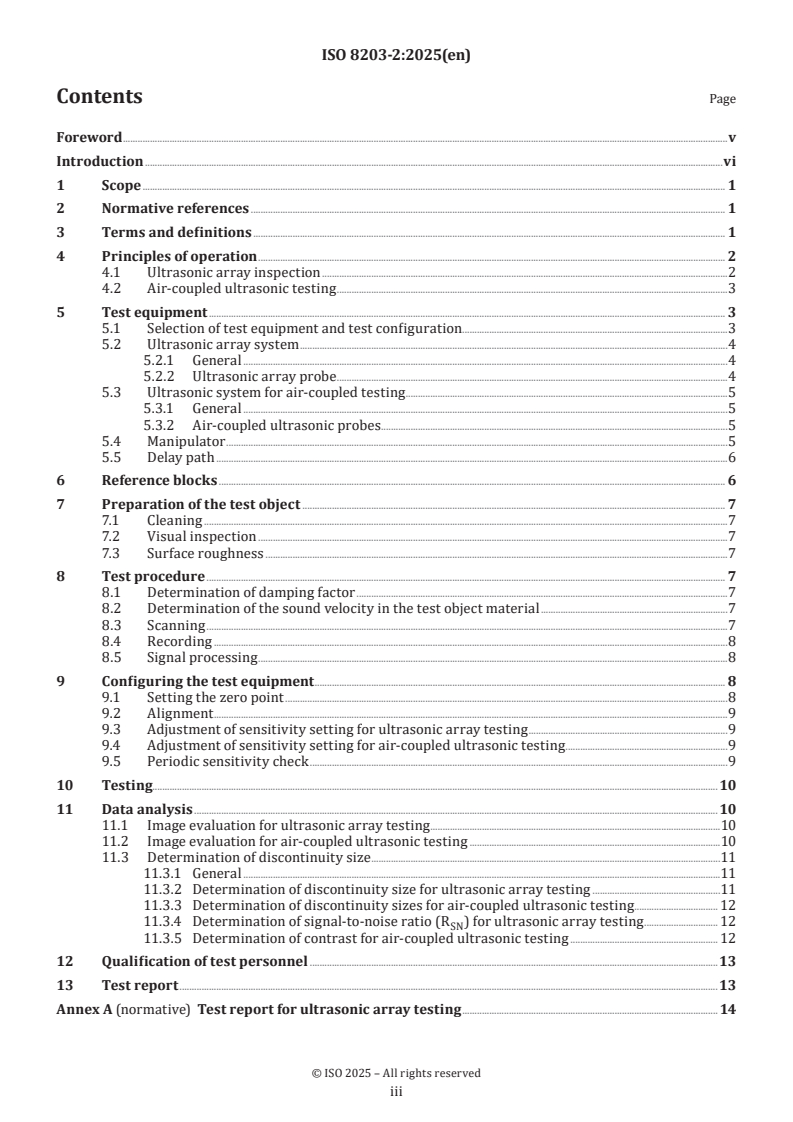
Contents Page
Foreword .v
Introduction .vi
1 Scope . 1
2 Normative references . 1
3 Terms and definitions . 1
4 Principles of operation . 2
4.1 Ultrasonic array inspection .2
4.2 Air-coupled ultrasonic testing .3
5 Test equipment . 3
5.1 Selection of test equipment and test configuration .3
5.2 Ultrasonic array system .4
5.2.1 General .4
5.2.2 Ultrasonic array probe .4
5.3 Ultrasonic system for air-coupled testing .5
5.3.1 General .5
5.3.2 Air-coupled ultrasonic probes . .5
5.4 Manipulator .5
5.5 Delay path .6
6 Reference blocks . 6
7 Preparation of the test object . 7
7.1 Cleaning .7
7.2 Visual inspection .7
7.3 Surface roughness .7
8 Test procedure . 7
8.1 Determination of damping factor .7
8.2 Determination of the sound velocity in the test object material .7
8.3 Scanning .7
8.4 Recording .8
8.5 Signal processing .8
9 Configuring the test equipment . 8
9.1 Setting the zero point .8
9.2 Alignment .9
9.3 Adjustment of sensitivity setting for ultrasonic array testing .9
9.4 Adjustment of sensitivity setting for air-coupled ultrasonic testing .9
9.5 Periodic sensitivity check .9
10 Testing. 10
11 Data analysis . 10
11.1 Image evaluation for ultrasonic array testing .10
11.2 Image evaluation for air-coupled ultrasonic testing .10
11.3 Determination of discontinuity size .11
11.3.1 General .11
11.3.2 Determination of discontinuity size for ultrasonic array testing .11
11.3.3 Determination of discontinuity sizes for air-coupled ultrasonic testing . 12
11.3.4 Determination of signal-to-noise ratio (R ) for ultrasonic array testing . 12
SN
11.3.5 Determination of contrast for air-coupled ultrasonic testing . 12
12 Qualification of test personnel .13
13 Test report .13
Annex A (normative) Test report for ultrasonic array testing . 14
iii
Annex B (normative) Test report sheet for air-coupled ultrasonic testing .16
iv
Foreword
ISO (the International Organization for Standardization) is a worldwide federation of national standards
bodies (ISO member bodies). The work of preparing International Standards is normally carried out through
ISO technical committees. Each member body interested in a subject for which a technical committee
has been established has the right to be represented on that committee. International organizations,
governmental and non-governmental, in liaison with ISO, also take part in the work. ISO collaborates closely
with the International Electrotechnical Commission (IEC) on all matters of electrotechnical standardization.
The procedures used to develop this document and those intended for its further maintenance are described
in the ISO/IEC Directives, Part 1. In particular, the different approval criteria needed for the different types
of ISO document should be noted. This document was drafted in accordance with the editorial rules of the
ISO/IEC Directives, Part 2 (see www.iso.org/directives).
ISO draws attention to the possibility that the implementation of this document may involve the use of (a)
patent(s). ISO takes no position concerning the evidence, validity or applicability of any claimed patent
rights in respect thereof. As of the date of publication of this document, ISO had not received notice of (a)
patent(s) which may be required to implement this document. However, implementers are cautioned that
this may not represent the latest information, which may be obtained from the patent database available at
www.iso.org/patents. ISO shall not be held responsible for identifying any or all such patent rights.
Any trade name used in this document is information given for the convenience of users and does not
constitute an endorsement.
For an explanation of the voluntary nature of standards, the meaning of ISO specific terms and expressions
related to conformity assessment, as well as information about ISO's adherence to the World Trade
Organization (WTO) principles in the Technical Barriers to Trade (TBT), see www.iso.org/iso/foreword.html.
This document was prepared by Technical Committee ISO/TC 61, Plastics, Subcommittee SC 13, Composites
and reinforcement fibres.
A list of all parts in the ISO 8203 series can be found on the ISO website.
Any feedback or questions on this document should be directed to the user’s national standards body. A
complete listing of these bodies can be found at www.iso.org/members.html.
v
Introduction
Advanced mechanized ultrasonic testing using array probes and signal processing, or air-coupled probes
enables the detection, sizing, and characterization of a wide range of manufacturing and in-service
imperfections in fibre-reinforced plastic (FRP) composites by image evaluation.
By scanning the test object using linear or matrix array ultrasonic probes or air-coupled ultrasonic probes,
inhomogeneities and discontinuities can be detected and characterized by the evaluation of C-scan and
B-scan images generated by the space-resolved and processed acoustical response from the test object.
The objectives of testing with array probes are:
— detection of imperfections, inclusions and inhomogeneities;
— determination of material thickness;
— determination of sound velocities;
— determination of position and size of imperfections;
— determination of depth position of imperfections (coverage).
The objectives of testing with air-coupled probes are:
— detection of imperfections, inclusions and inhomogeneities;
— determination of lateral position and size of imperfections.
Usually, ultrasonic array tests are performed from one side of the test object. If access to both sides of
the test object is possible, additional testing from the opposite side of the test object can be performed to
enhance the outcome of the tests. Ultrasonic array testing can be performed in contact with the test object
using a suitable couplant or in an immersion tank using a defined water-path between the probes and the
test object.
Testing with air-coupled ultrasonic probes is usually performed in transmission, meaning that the test
object is positioned between the transmitting and receiving probes. Air-coupled testing is performed using
air as the couplant.
vi
International Standard ISO 8203-2:2025(en)
Fibre-reinforced plastic composites — Non-destructive
testing —
Part 2:
Array and air-coupled ultrasonics
1 Scope
This document describes procedures for mechanized ultrasonic testing of FRP composite materials using
array probes in conjunction with the application of synthetic focusing signal processing algorithms, as well
as testing using air-coupled ultrasonic probes and the evaluation of the test result.
This document is intended for array ultrasonic testing (A-UT) and for air-coupled ultrasonic testing (AC-
UT) techniques applied to non-destructive testing of carbon fibre-reinforced plastic (CFRP) and glass
fibre-reinforced plastic (GFRP) composites with thermoset or thermoplastic matrices. The procedures are
primarily intended for inspection of continuous unidirectional or multidirectional composites; however, this
does not exclude their use on other formats of structural composites including woven and stitched fabrics
and pultrusions.
The techniques contained within this document are intended to be used on flat, plane test objects where the
material thickness differs by less than 20 %.
This document addresses ultrasonic testing via contact or immersion techniques using ultrasonic array
probes as well as testing in pitch-catch or through-transmission technique using single element air-coupled
ultrasonic probes.
2 Normative references
The following documents are referred to in the text in such a way that some or all of their content constitutes
requirements of this document. For dated references, only the edition cited applies. For undated references,
the latest edition of the referenced document (including any amendments) applies.
ISO 5577, Non-destructive testing — Ultrasonic testing — Vocabulary
ISO 9712, Non-destructive testing — Qualification and certification of NDT personnel
ISO 22232-3, Non-destructive testing — Characterization and verification of ultrasonic test equipment — Part
3: Combined equipment
ISO 23243, Non-destructive testing — Ultrasonic testing with arrays — Vocabulary
ISO 23865, Non-destructive testing — Ultrasonic testing — General use of full matrix capture/total focusing
technique (FMC/TFM) and related technologies
3 Terms and definitions
For the purposes of this document, the terms and definitions given in ISO 5577, ISO 23243 and the
following apply.
ISO and IEC maintain terminology databases for use in standardization at the following addresses:
— ISO Online browsing platform: available at https:// www .iso .org/ obp
— IEC Electropedia: available at https:// www .electropedia .org/
3.1
area of interest
region of the test object which is to be tested
3.2
scan grid
region spanned by the two scanning axes x and y on the surface of the test object
Note 1 to entry: The resolution of the grid is given by the grid step size g and g (see Figure 1)
x y
Key
1 test object
2 scan axis in x-direction
3 scan axis in y-direction
4 grid step size g
x
5 grid step size g
y
Figure 1 — Schematic of scanning grid indicating scan axes and grid step sizes g and g
x y
3.3
grid point
crossing point on the scan grid (3.2)
3.4
evaluation grid
grid spanned by the axes used for reconstruction of the recorded data
4 Principles of operation
4.1 Ultrasonic array inspection
Ultrasound produced by an ultrasonic array probe shall be used to inspect the FRP material. The array
probe shall have a linear or matrix element layout.
Electronic beam steering using a subset of elements of the array probe may be used to form a group of array
elements to set aperture focus and swivel the sound field.
During testing, the probe(s) is(are) moved over the surface of the test object by a manipulator device
recording data at the defined step grid of the scanning axes.
A synthetic focusing signal processing algorithm is applied to map the recorded data in 2D pixel fields or
a 3D voxel field. For this task, synthetic aperture focussing techniques (SAFT), full matrix capture (FMC)/
total focussing method (TFM), plane wave imaging (PWI)/TFM or focus field method (FFM) techniques
shall be applied as per ISO 23865. As a result, a volumetric acoustical 3D image from the recorded raw data
of the test object is generated.
C-scan and B-scan 2D projection images shall be used for the display of the processed data. Evaluation of
test results shall be based on the amplitude, sound path and lateral position(s) of the recorded indications.
The test shall be performed either in contact with the test object with the use of an adequate couplant (e.g.
water supplied by a pump) or in an immersion tank using a defined water path between the probe and sample.
Usually, testing is performed from one side of the test object only.
The minimum requirements for the test equipment setup are:
a) ultrasonic array probe (with linear or matrix element layout);
b) ultrasonic array instrument (the minimum number of active channels shall match the number of probe
elements);
c) manipulator with two orthogonal scanning axes that coincide with the main geometric axes of the
test object;
d) evaluation software incorporating synthetic focusing signal processing algorithms [e.g., total focusing
method (TFM) or focus field method (FFM)];
e) immersion tank (if immersion testing is selected).
The use of analytical models, semi-analytical models, or finite element methods should be considered for a
deeper understanding of sound field behaviour and establishing optimized equipment setups.
4.2 Air-coupled ultrasonic testing
Air-coupled ultrasonic probes, each placed on opposite sides of and at set stand-off distances from the test
object, are moved over the surface of the test object by a manipulator recording data at defined steps along
the scanning axes. C-scan images should be used for the display of the processed data.
Evaluation of the test result is based on the amplitude and lateral position(s) of the recorded indications.
The minimum requirements for the test equipment setup are:
a) air-coupled ultrasonic probe;
b) ultrasonic instrument;
c) manipulator with two orthogonal scanning axes that coincide with the main geometric axes of the
test object;
d) evaluation software incorporating capability for C-scan imaging.
5 Test equipment
5.1 Selection of test equipment and test configuration
A test configuration using either contact or immersion ultrasonic array probes or air-coupled ultrasonic
probes shall be chosen. The selection of technique is open to the user depending on the application.
Typically for tests with high resolution a higher probe frequency and a smaller scan grid is used and for tests
with high wall thicknesses a lower probe frequency and a larger scan grid is used.
The frequency range for air-coupled testing is typically one decade lower than that used for array testing.
5.2 Ultrasonic array system
5.2.1 General
a) The ultrasonic array system shall be able to operate linear and matrix array probes with at least 32
active elements.
b) The minimum number of active channels shall match the number of the probe elements.
c) The frequency range of the ultrasonic array system shall at the least cover the range from f =1 MHz to f
P P
= 10 MHz.
d) The number of focal laws to apply shall at least cover that needed to record data according to the selected
signal processing in one measurement cycle.
e) For mechanized testing, the ultrasonic array system shall support the connection of two position
encoders for recording of ultrasonic echo signals traceable to the position on the test object.
f) For optimum performance, the system shall be able to be triggered on position encoder events.
g) A minimum resolution for A-scan amplitude of at least 8 bit or 48 dB is recommended.
h) A minimum resolution for A-scan sound path of at least 0,1 mm in FRP material or 60 ns is recommended.
i) The system shall incorporate a distance-amplitude-curve (DAC) correction unit.
5.2.2 Ultrasonic array probe
a) The ultrasonic array probe frequency shall be in the range of f =1 MHz to f =10 MHz.
P P
Selection of the probe shall be undertaken with care because of the complex behaviour of FRP material.
For higher frequencies, a high degree of spatial resolution can be achieved but with a reduction in depth
coverage.
At lower frequencies, the degradation of the signal through attenuation and scattering by the structure
in the material has only a minor influence on the test results.
b) The test frequency shall be selected after consideration of the thickness of the test object and the type of
fibre used as the reinforcement.
c) The number and size of the elements of the ultrasonic array probe shall be selected individually based
on the test object’s geometry to allow focus on the mid-plane of the test object. For linear (1D) arrays,
a minimum number of 16 elements are recommended. For matrix (2D) arrays, 64 to 128 elements are
recommended.
d) Focal distance, diameter and length applied by the selected synthetic focussing algorithm shall match
the application.
The shortest possible focal distance, the smallest focal diameter and the largest focal length shall be
chosen for the selection of the probe.
e) For optimal selection of probe parameters, an evaluation for each test setup using simulation tools
should be undertaken.
f) Acoustic impedance matching of the probe shall follow the technique used.
5.3 Ultrasonic system for air-coupled testing
5.3.1 General
The ultrasonic system for air-coupled testing shall be able to operate air-coupled ultrasonic probes in the
frequency range from 50 to a maximum of 1 000 kHz.
5.3.2 Air-coupled ultrasonic probes
a) Only air-coupled ultrasonic probes shall be used for air-coupled testing.
b) The air-coupled ultrasonic probe centre frequency shall be in the range of f = 50 kHz to f = 1 MHz.
P P
c) Selection of the ultrasonic probe should be undertaken with care because of the complex behaviour of
FRP material and the sound propagation in air and in the test object.
As an example, a 4 mm thick CFRP test object can be tested using AC-UT with probe centre frequencies
between 100 kHz and 500 kHz.
d) When plane transducers are used, the transmission coefficient has its maximum at test object
thicknesses equal to a multiple of half of the wavelength of
...