

ISO 8606:2025
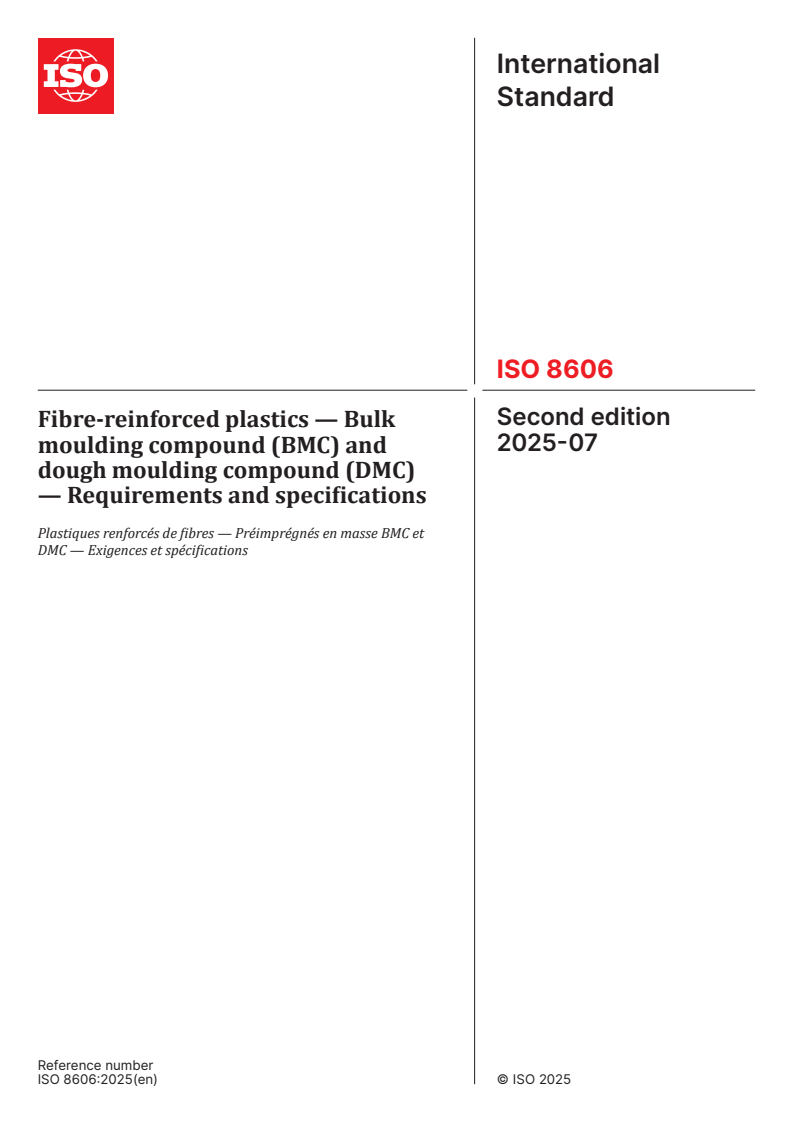
(Main)Fibre-reinforced plastics — Bulk moulding compound (BMC) and dough moulding compound (DMC) — Requirements and specifications
General Information
- Abstract
This document establishes requirements and specifications of the bulk moulding compound (BMC) and dough moulding compound (DMC) with or without thickening agents. This document is applicable to BMC and DMC, which are different types of preimpregnated product used for the production, by moulding, of various parts made of composite materials. The scope is not limited to types of fibres and resins.
- Status
- Published
- Publication Date
- 07-Jul-2025
- Technical Committee
- ISO/TC 61/SC 13 - Composites and reinforcement fibres
- Drafting Committee
- ISO/TC 61/SC 13 - Composites and reinforcement fibres
- Current Stage
- 6060 - International Standard published
- Start Date
- 08-Jul-2025
- Due Date
- 08-May-2026
- Completion Date
- 08-Jul-2025
Overview
ISO 8606:2025 - Fibre-reinforced plastics - Bulk moulding compound (BMC) and dough moulding compound (DMC) - Requirements and specifications defines the requirements, classification and specification framework for BMC and DMC used to produce moulded composite parts. This second edition updates and expands the 1990 version, adding fibre-type and shrinkage codes, formal designation rules and specific test properties. The standard applies to preimpregnated moulding compounds with or without thickening agents and is not limited to particular fibre or resin types.
Key topics and technical requirements
- Scope and definitions: Clear definitions of BMC (thickened by chemical thickeners) and DMC (high viscosity by filler content).
- Classification:
- By composition: resin/matrix (e.g., UP, EP, VE, PU, phenolic), reinforcement type (glass, carbon, natural, hybrids), fillers and additives.
- By linear shrinkage: general-purpose, low-shrink, very-low-shrink (low-profile), and zero-shrink grades.
- Designation: standardized naming and coding including fibre type and shrinkage class to support unambiguous material specification.
- Properties and testing:
- Properties for acceptance testing of the compound (physical, chemical, appearance).
- Properties for moulded specimens: mechanical (tensile, flexural, impact), physical (density, shrinkage, water absorption), and electrical properties.
- Reference to established test methods (e.g., ISO 527-4, ISO 14125, ISO 12115, IEC and other normative standards).
- Quality controls:
- Sampling and conditioning procedures for consistent testing.
- Shelf life determination and guidance on maturation.
- Packaging and marking requirements for traceability and handling.
Applications and who uses it
ISO 8606:2025 is practical for:
- Manufacturers of BMC/DMC compounds and compound formulators.
- Composite part producers using compression or transfer moulding.
- Material specifiers, procurement and quality assurance teams requiring traceable material designations and test criteria.
- R&D and testing laboratories performing acceptance tests and characterisation of moulding compounds.
- Designers and engineers in automotive, electrical, consumer goods and industrial applications where controlled shrinkage, mechanical and electrical performance are critical.
- Recyclers and producers working with recycled carbon fibre (RCF), as the standard supports various reinforcement types.
Related standards
ISO 8606 references and aligns with multiple test and material standards for composites and plastics, for example:
- ISO 12115 (flowability, maturation, shelf life)
- ISO 14125 (flexural properties)
- ISO 527-4 (tensile properties for fibre-reinforced composites)
- ISO 1172 / ISO 11667 (fibre and filler content)
- IEC and ISO electrical and flammability test methods
Using ISO 8606:2025 helps ensure consistent specification, testing and communication of BMC/DMC materials across supply chains and industries.
Relations
- Effective Date
- 20-May-2023
Get Certified
Connect with accredited certification bodies for this standard

DIN CERTCO
DIN Group product certification.

Smithers Quality Assessments
US management systems and product certification.
Sponsored listings
Frequently Asked Questions
ISO 8606:2025 is a standard published by the International Organization for Standardization (ISO). Its full title is "Fibre-reinforced plastics — Bulk moulding compound (BMC) and dough moulding compound (DMC) — Requirements and specifications". This standard covers: This document establishes requirements and specifications of the bulk moulding compound (BMC) and dough moulding compound (DMC) with or without thickening agents. This document is applicable to BMC and DMC, which are different types of preimpregnated product used for the production, by moulding, of various parts made of composite materials. The scope is not limited to types of fibres and resins.
This document establishes requirements and specifications of the bulk moulding compound (BMC) and dough moulding compound (DMC) with or without thickening agents. This document is applicable to BMC and DMC, which are different types of preimpregnated product used for the production, by moulding, of various parts made of composite materials. The scope is not limited to types of fibres and resins.
ISO 8606:2025 is classified under the following ICS (International Classification for Standards) categories: 83.120 - Reinforced plastics. The ICS classification helps identify the subject area and facilitates finding related standards.
ISO 8606:2025 has the following relationships with other standards: It is inter standard links to ISO 8606:1990. Understanding these relationships helps ensure you are using the most current and applicable version of the standard.
ISO 8606:2025 is available in PDF format for immediate download after purchase. The document can be added to your cart and obtained through the secure checkout process. Digital delivery ensures instant access to the complete standard document.
Standards Content (Sample)
International
Standard
ISO 8606
Second edition
Fibre-reinforced plastics — Bulk
2025-07
moulding compound (BMC) and
dough moulding compound (DMC)
— Requirements and specifications
Plastiques renforcés de fibres — Préimprégnés en masse BMC et
DMC — Exigences et spécifications
Reference number
© ISO 2025
All rights reserved. Unless otherwise specified, or required in the context of its implementation, no part of this publication may
be reproduced or utilized otherwise in any form or by any means, electronic or mechanical, including photocopying, or posting on
the internet or an intranet, without prior written permission. Permission can be requested from either ISO at the address below
or ISO’s member body in the country of the requester.
ISO copyright office
CP 401 • Ch. de Blandonnet 8
CH-1214 Vernier, Geneva
Phone: +41 22 749 01 11
Email: copyright@iso.org
Website: www.iso.org
Published in Switzerland
ii
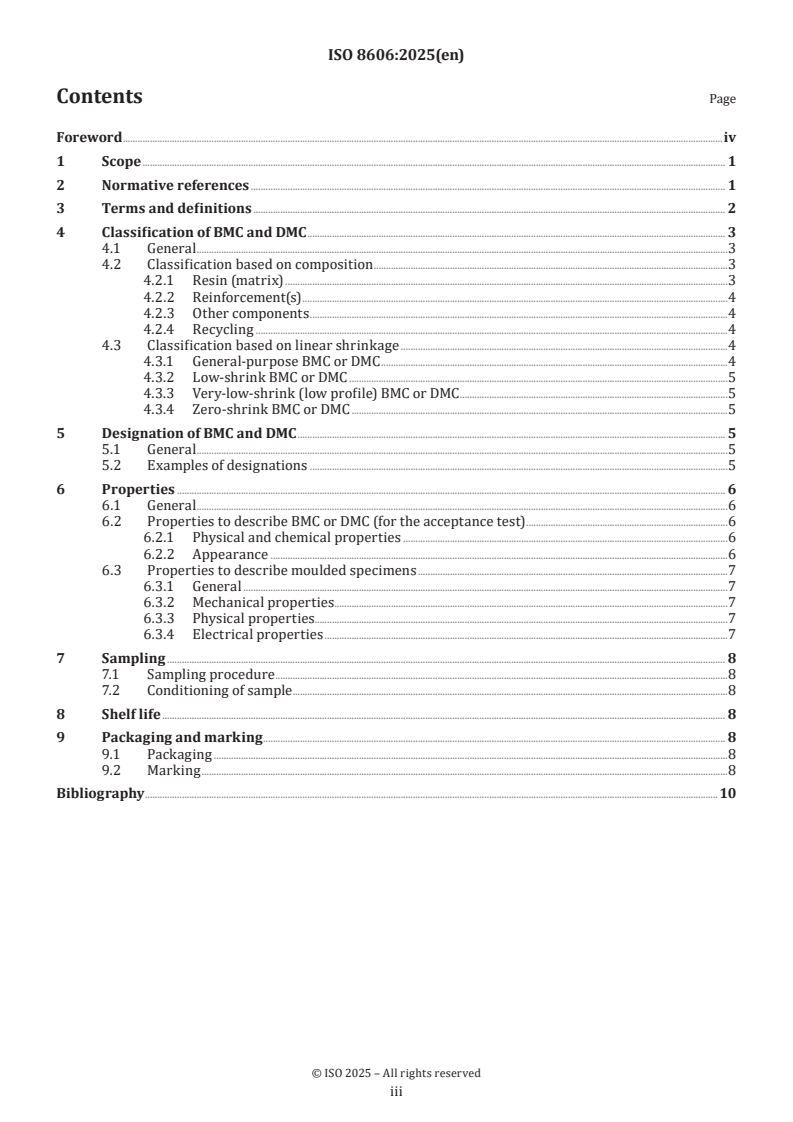
Contents Page
Foreword .iv
1 Scope . 1
2 Normative references . 1
3 Terms and definitions . 2
4 Classification of BMC and DMC . 3
4.1 General .3
4.2 Classification based on composition .3
4.2.1 Resin (matrix) .3
4.2.2 Reinforcement(s) .4
4.2.3 Other components .4
4.2.4 Recycling .4
4.3 Classification based on linear shrinkage .4
4.3.1 General-purpose BMC or DMC .4
4.3.2 Low-shrink BMC or DMC .5
4.3.3 Very-low-shrink (low profile) BMC or DMC .5
4.3.4 Zero-shrink BMC or DMC .5
5 Designation of BMC and DMC . 5
5.1 General .5
5.2 Examples of designations .5
6 Properties . 6
6.1 General .6
6.2 Properties to describe BMC or DMC (for the acceptance test) .6
6.2.1 Physical and chemical properties .6
6.2.2 Appearance .6
6.3 Properties to describe moulded specimens .7
6.3.1 General .7
6.3.2 Mechanical properties . .7
6.3.3 Physical properties.7
6.3.4 Electrical properties .7
7 Sampling . 8
7.1 Sampling procedure .8
7.2 Conditioning of sample .8
8 Shelf life . 8
9 Packaging and marking . 8
9.1 Packaging .8
9.2 Marking .8
Bibliography .10
iii
Foreword
ISO (the International Organization for Standardization) is a worldwide federation of national standards
bodies (ISO member bodies). The work of preparing International Standards is normally carried out through
ISO technical committees. Each member body interested in a subject for which a technical committee
has been established has the right to be represented on that committee. International organizations,
governmental and non-governmental, in liaison with ISO, also take part in the work. ISO collaborates closely
with the International Electrotechnical Commission (IEC) on all matters of electrotechnical standardization.
The procedures used to develop this document and those intended for its further maintenance are described
in the ISO/IEC Directives, Part 1. In particular, the different approval criteria needed for the different types
of ISO documents should be noted. This document was drafted in accordance with the editorial rules of the
ISO/IEC Directives, Part 2 (see www.iso.org/directives).
ISO draws attention to the possibility that the implementation of this document may involve the use of (a)
patent(s). ISO takes no position concerning the evidence, validity or applicability of any claimed patent
rights in respect thereof. As of the date of publication of this document, ISO had not received notice of (a)
patent(s) which may be required to implement this document. However, implementers are cautioned that
this may not represent the latest information, which may be obtained from the patent database available at
www.iso.org/patents. ISO shall not be held responsible for identifying any or all such patent rights.
Any trade name used in this document is information given for the convenience of users and does not
constitute an endorsement.
For an explanation of the voluntary nature of standards, the meaning of ISO specific terms and expressions
related to conformity assessment, as well as information about ISO's adherence to the World Trade
Organization (WTO) principles in the Technical Barriers to Trade (TBT), see www.iso.org/iso/foreword.html.
This document was prepared by Technical Committee ISO/TC 61, Plastics, Subcommittee SC 13, Composites
and reinforcement fibres.
This second edition cancels and replaces the first edition (ISO 8606:1990), which has been technically
revised.
The main changes are as follows:
— the title has been modified from “Plastics — Prepregs — Bulk moulding compound (BMC) and dough
moulding compound (DMC) — Basis for a specification” to “Fibre-reinforced plastics — Bulk moulding
compound (BMC) and dough moulding compound (DMC) — Requirements and specifications”;
— fibre type and shrinkage code have been added;
— the designation of BMC or DMC has been added;
— test properties have been added.
Any feedback or questions on this document should be directed to the user’s national standards body. A
complete listing of these bodies can be found at www.iso.org/members.html.
iv
International Standard ISO 8606:2025(en)
Fibre-reinforced plastics — Bulk moulding compound (BMC)
and dough moulding compound (DMC) — Requirements and
specifications
1 Scope
This document establishes requirements and specifications of the bulk moulding compound (BMC) and
dough moulding compound (DMC) with or without thickening agents.
This document is applicable to BMC and DMC, which are different types of preimpregnated product used for
the production, by moulding, of various parts made of composite materials.
The scope is not limited to types of fibres and resins.
2 Normative references
The following documents are referred to in the text in such a way that some or all of their content constitutes
requirements of this document. For dated references, only the edition cited applies. For undated references,
the latest edition of the referenced document (including any amendments) applies.
ISO 62:2008, Plastics — Determination of water absorption
ISO 75-2, Plastics — Determination of temperature of deflection under load — Part 2: Plastics and ebonite
ISO 179-1, Plastics — Determination of Charpy impact properties — Part 1: Non-instrumented impact test
ISO 179-2, Plastics — Determination of Charpy impact properties — Part 2: Instrumented impact test
ISO 180, Plastics — Determination of Izod impact strength
ISO 291, Plastics — Standard atmospheres for conditioning and testing
ISO 472, Plastics — Vocabulary
ISO 527-4, Plastics — Determination of tensile properties — Part 4: Test conditions for isotropic and orthotropic
fibre-reinforced plastic composites
ISO 1172, Textile-glass-reinforced plastics — Prepregs, moulding compounds and laminates — Determination of
the textile-glass and mineral-filler content using calcination methods
ISO 1183 (all parts), Plastics — Methods for determining the density of non-cellular plastics
ISO 2577, Plastics — Thermosetting moulding materials — Determination of shrinkage
ISO 4589-2, Plastics — Determination of burning behaviour by oxygen index — Part 2: Ambient-temperature test
ISO 9782, Plastics — Reinforced moulding compounds and prepregs — Determination of apparent volatile-
matter content
ISO 11359-2, Plastics — Thermomechanical analysis (TMA) — Part 2: Determination of coefficient of linear
thermal expansion and glass transition temperature
ISO 11667, Fibre-reinforced plastics — Moulding compounds and prepregs — Determination of resin, reinforced-
fibre and mineral-filler content — Dissolution methods
ISO 12114, Fibre-reinforced plastics — Thermosetting moulding compounds and prepregs — Determination of
cure characteristics
ISO 12115, Fibre-reinforced plastics — Thermosetting moulding compounds and prepregs — Determination of
flowability, maturation and shelf life
ISO 14125, Fibre-reinforced plastic composites — Determination of flexural properties
ISO 14126, Fibre-reinforced plastic composites — Determination of compressive properties in the in-plane
direction
ISO 14127, Carbon-fibre-reinforced composites — Determination of the resin, fibre and void contents
ISO 14130, Fibre-reinforced plastic composites — Determination of apparent interlaminar shear strength by
short-beam method
ISO 19927, Fibre-reinforced plastic composites — Determination of interlaminar strength and modulus by
double beam shear test
ISO 22821, Carbon-fibre-reinforc
...