

ISO 14127:2024
(Main)Carbon-fibre-reinforced composites — Determination of the resin, fibre and void contents
General Information
- Abstract
This document specifies methods for calculating the resin, fibre and void contents of a carbon-fibre-reinforced composite from the densities of the resin, the fibre and the composite and the mass of fibre in the composite (using method A), for calculating the fibre content from the thickness of the composite (using method B), and for calculating the fibre content by volume and areal void content through microscopic analysis (using method C). Method A specifies three different resin removal procedures for the determination of the mass of fibre in the composite (viz a combustion procedure, a procedure by digestion in nitric acid and a procedure by digestion in a mixture of sulfuric acid and hydrogen peroxide). The selection of the procedure to be used is made by considering the combustibility of the resin used in the composite, its ability to decompose and the type of resin concerned. Method A is only of limited applicability when filled resins are present that can prevent complete dissolution and/or combustibility of the resin. Method B (thickness measurement method) is only applicable to composites moulded from prepregs of known fibre mass per unit area. Method C (microscopic method) is only applicable to carbon-fibre-reinforced composites with unidirectional, orthogonal and multidirectional laminates. It can also be used as reference for determination of the areal void content and fibre volume content of aramid- or glass-fibre-reinforced plastics, but is not applicable to fabric reinforced composites.
- Status
- Published
- Publication Date
- 07-Jul-2024
- Technical Committee
- ISO/TC 61/SC 13 - Composites and reinforcement fibres
- Drafting Committee
- ISO/TC 61/SC 13 - Composites and reinforcement fibres
- Current Stage
- 6060 - International Standard published
- Start Date
- 08-Jul-2024
- Due Date
- 05-Oct-2024
- Completion Date
- 08-Jul-2024
Overview
ISO 14127:2024 - Carbon‑fibre‑reinforced composites - Determination of the resin, fibre and void contents - defines standardized laboratory methods to quantify resin content, fibre content and void content in carbon‑fibre‑reinforced composites. The second edition (2024) replaces and updates the 2008 edition, adding a new microscopic method (Method C) and refining resin removal procedures. The standard supports reliable material characterization and processing quality control for composite parts.
Key topics and technical requirements
- Three measurement routes:
- Method A (resin removal) - determines fibre mass using resin removal by one of three procedures: combustion, nitric acid digestion, or sulfuric acid / hydrogen peroxide digestion. Choice depends on the resin type, combustibility and decomposition behaviour. Note: Method A has limited applicability with filled resins that resist complete dissolution/combustion.
- Method B (thickness measurement) - calculates fibre content from composite thickness and known prepreg fibre mass per unit area. Applicable only for parts moulded from prepregs with established areal fibre mass.
- Method C (microscopic method) - determines fibre volume content and areal void content by image analysis of polished cross‑sections. Applicable to unidirectional, orthogonal and multidirectional laminates; can be a reference for aramid or glass fibre composites but is not for fabric‑reinforced composites.
- Specimen requirements: Randomly distributed locations, minimum distance from edges, edges smoothed; at least three specimens per assessment unless otherwise agreed.
- Conditioning and measurement: Conditioning per ISO standard atmospheres (ISO 291); density determinations reference ISO 1183 parts; fibre density reference ISO 10119.
- Results and reporting: Methods include expression of results, precision statements and required test report contents.
Practical applications
ISO 14127:2024 is used for:
- Quality control during manufacturing of carbon‑fibre composites (aerospace, automotive, marine, sports).
- Material verification for acceptance testing, supplier qualification and batch comparison.
- Failure analysis and process optimization by correlating fibre/void/resin contents with mechanical performance.
- Research and development where accurate fibre volume/void measurements are needed for property prediction and modelling.
Who should use this standard
- Composites manufacturers and process engineers
- Materials testing laboratories and certification bodies
- Quality assurance and R&D teams in aerospace, automotive, wind energy and marine industries
- Standards developers and procurement specialists specifying composite acceptance criteria
Related standards
- ISO 291 - Standard atmospheres for conditioning and testing
- ISO 1183‑1 / ‑2 / ‑3 - Density determination methods for plastics
- ISO 10119 - Carbon fibre density determination
- ISO 9344, ISO 10934 - Microscopy related references
Using ISO 14127:2024 helps ensure consistent, traceable measurement of resin, fibre and void contents for carbon‑fibre‑reinforced composites, improving material qualification and process control.
Relations
- Effective Date
- 09-Feb-2026
- Effective Date
- 06-Jun-2022
Get Certified
Connect with accredited certification bodies for this standard

DIN CERTCO
DIN Group product certification.

Smithers Quality Assessments
US management systems and product certification.
Sponsored listings
Frequently Asked Questions
ISO 14127:2024 is a standard published by the International Organization for Standardization (ISO). Its full title is "Carbon-fibre-reinforced composites — Determination of the resin, fibre and void contents". This standard covers: This document specifies methods for calculating the resin, fibre and void contents of a carbon-fibre-reinforced composite from the densities of the resin, the fibre and the composite and the mass of fibre in the composite (using method A), for calculating the fibre content from the thickness of the composite (using method B), and for calculating the fibre content by volume and areal void content through microscopic analysis (using method C). Method A specifies three different resin removal procedures for the determination of the mass of fibre in the composite (viz a combustion procedure, a procedure by digestion in nitric acid and a procedure by digestion in a mixture of sulfuric acid and hydrogen peroxide). The selection of the procedure to be used is made by considering the combustibility of the resin used in the composite, its ability to decompose and the type of resin concerned. Method A is only of limited applicability when filled resins are present that can prevent complete dissolution and/or combustibility of the resin. Method B (thickness measurement method) is only applicable to composites moulded from prepregs of known fibre mass per unit area. Method C (microscopic method) is only applicable to carbon-fibre-reinforced composites with unidirectional, orthogonal and multidirectional laminates. It can also be used as reference for determination of the areal void content and fibre volume content of aramid- or glass-fibre-reinforced plastics, but is not applicable to fabric reinforced composites.
This document specifies methods for calculating the resin, fibre and void contents of a carbon-fibre-reinforced composite from the densities of the resin, the fibre and the composite and the mass of fibre in the composite (using method A), for calculating the fibre content from the thickness of the composite (using method B), and for calculating the fibre content by volume and areal void content through microscopic analysis (using method C). Method A specifies three different resin removal procedures for the determination of the mass of fibre in the composite (viz a combustion procedure, a procedure by digestion in nitric acid and a procedure by digestion in a mixture of sulfuric acid and hydrogen peroxide). The selection of the procedure to be used is made by considering the combustibility of the resin used in the composite, its ability to decompose and the type of resin concerned. Method A is only of limited applicability when filled resins are present that can prevent complete dissolution and/or combustibility of the resin. Method B (thickness measurement method) is only applicable to composites moulded from prepregs of known fibre mass per unit area. Method C (microscopic method) is only applicable to carbon-fibre-reinforced composites with unidirectional, orthogonal and multidirectional laminates. It can also be used as reference for determination of the areal void content and fibre volume content of aramid- or glass-fibre-reinforced plastics, but is not applicable to fabric reinforced composites.
ISO 14127:2024 is classified under the following ICS (International Classification for Standards) categories: 83.120 - Reinforced plastics. The ICS classification helps identify the subject area and facilitates finding related standards.
ISO 14127:2024 has the following relationships with other standards: It is inter standard links to EN ISO 23936-4:2024, ISO 14127:2008. Understanding these relationships helps ensure you are using the most current and applicable version of the standard.
ISO 14127:2024 is available in PDF format for immediate download after purchase. The document can be added to your cart and obtained through the secure checkout process. Digital delivery ensures instant access to the complete standard document.
Standards Content (Sample)
International
Standard
ISO 14127
Second edition
Carbon-fibre-reinforced
2024-07
composites — Determination of the
resin, fibre and void contents
Composites renforcés de fibres de carbone — Détermination des
teneurs en résine, en fibre et en vide
Reference number
© ISO 2024
All rights reserved. Unless otherwise specified, or required in the context of its implementation, no part of this publication may
be reproduced or utilized otherwise in any form or by any means, electronic or mechanical, including photocopying, or posting on
the internet or an intranet, without prior written permission. Permission can be requested from either ISO at the address below
or ISO’s member body in the country of the requester.
ISO copyright office
CP 401 • Ch. de Blandonnet 8
CH-1214 Vernier, Geneva
Phone: +41 22 749 01 11
Email: copyright@iso.org
Website: www.iso.org
Published in Switzerland
ii
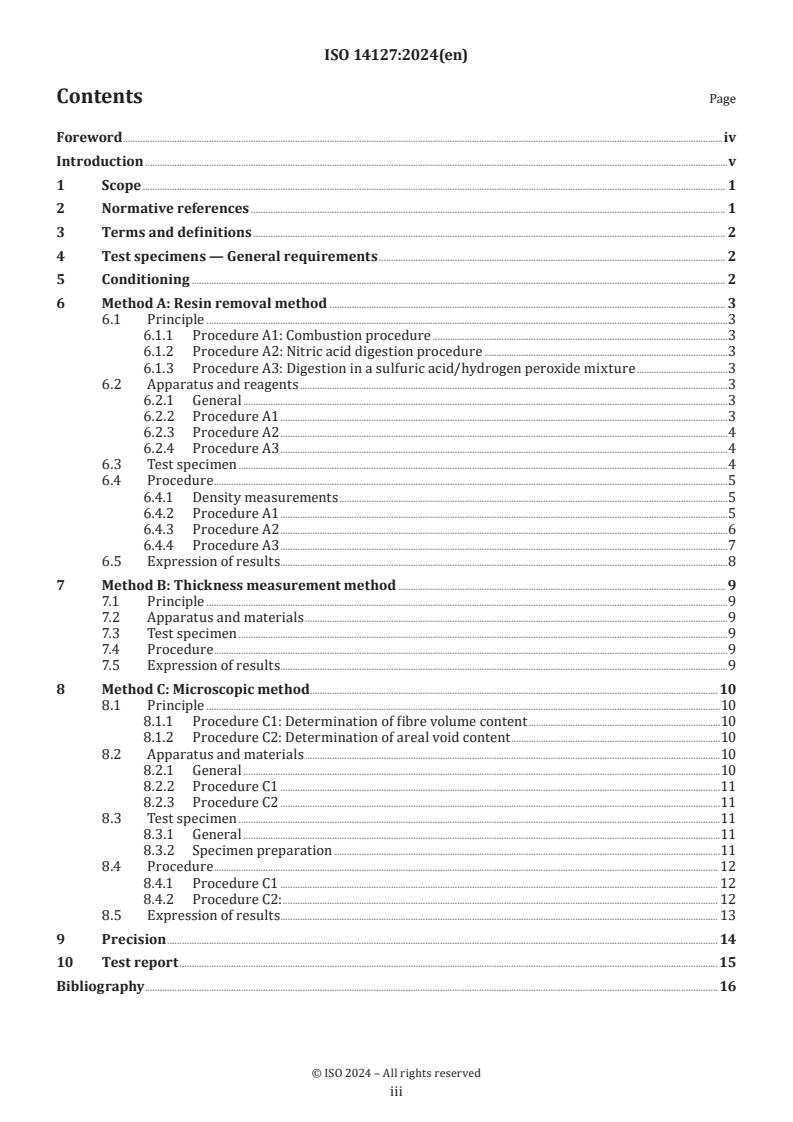
Contents Page
Foreword .iv
Introduction .v
1 Scope . 1
2 Normative references . 1
3 Terms and definitions . 2
4 Test specimens — General requirements . 2
5 Conditioning . 2
6 Method A: Resin removal method .3
6.1 Principle .3
6.1.1 Procedure A1: Combustion procedure .3
6.1.2 Procedure A2: Nitric acid digestion procedure .3
6.1.3 Procedure A3: Digestion in a sulfuric acid/hydrogen peroxide mixture .3
6.2 Apparatus and reagents .3
6.2.1 General .3
6.2.2 Procedure A1 .3
6.2.3 Procedure A2 .4
6.2.4 Procedure A3 .4
6.3 Test specimen .4
6.4 Procedure .5
6.4.1 Density measurements .5
6.4.2 Procedure A1 .5
6.4.3 Procedure A2 .6
6.4.4 Procedure A3 .7
6.5 Expression of results . .8
7 Method B: Thickness measurement method .9
7.1 Principle .9
7.2 Apparatus and materials .9
7.3 Test specimen .9
7.4 Procedure .9
7.5 Expression of results .9
8 Method C: Microscopic method . 10
8.1 Principle .10
8.1.1 Procedure C1: Determination of fibre volume content .10
8.1.2 Procedure C2: Determination of areal void content .10
8.2 Apparatus and materials .10
8.2.1 General .10
8.2.2 Procedure C1 .11
8.2.3 Procedure C2 .11
8.3 Test specimen .11
8.3.1 General .11
8.3.2 Specimen preparation .11
8.4 Procedure . 12
8.4.1 Procedure C1 . 12
8.4.2 Procedure C2: . 12
8.5 Expression of results . . 13
9 Precision . 14
10 Test report .15
Bibliography .16
iii
Foreword
ISO (the International Organization for Standardization) is a worldwide federation of national standards
bodies (ISO member bodies). The work of preparing International Standards is normally carried out through
ISO technical committees. Each member body interested in a subject for which a technical committee
has been established has the right to be represented on that committee. International organizations,
governmental and non-governmental, in liaison with ISO, also take part in the work. ISO collaborates closely
with the International Electrotechnical Commission (IEC) on all matters of electrotechnical standardization.
The procedures used to develop this document and those intended for its further maintenance are described
in the ISO/IEC Directives, Part 1. In particular, the different approval criteria needed for the different types
of ISO document should be noted. This document was drafted in accordance with the editorial rules of the
ISO/IEC Directives, Part 2 (see www.iso.org/directives).
ISO draws attention to the possibility that the implementation of this document may involve the use of (a)
patent(s). ISO takes no position concerning the evidence, validity or applicability of any claimed patent
rights in respect thereof. As of the date of publication of this document, ISO had not received notice of (a)
patent(s) which may be required to implement this document. However, implementers are cautioned that
this may not represent the latest information, which may be obtained from the patent database available at
www.iso.org/patents. ISO shall not be held responsible for identifying any or all such patent rights.
Any trade name used in this document is information given for the convenience of users and does not
constitute an endorsement.
For an explanation of the voluntary nature of standards, the meaning of ISO specific terms and expressions
related to conformity assessment, as well as information about ISO's adherence to the World Trade
Organization (WTO) principles in the Technical Barriers to Trade (TBT), see www.iso.org/iso/foreword.html.
This document was prepared by Technical Committee ISO/TC 61, Plastics, Subcommittee SC 13, Composites
and reinforcement fibres.
This second edition cancels and replaces the first edition (ISO 14127:2008), which has been technically
revised.
The main changes are as follows:
— the new method: Method C (microscopic method) as means to determinate fibre content by volume and
areal void content has been added;
— technical details related to the new method have been edited;
— procedure A3 has been modified by replacing the heating plate, beaker and watch glass with a heating
mantle and round bottom flask;
— in subclauses 4.3,6.3 and 7.3, where provisions for the number of test samples per assessment have been
newly added;
— “m ” has been corrected to “ϕ ” in Formula (4).
r r
Any feedback or questions on this document should be directed to the user’s national standards body. A
complete listing of these bodies can be found at www.iso.org/members.html.
iv
Introduction
The constituent contents such as fibre content, resin content as well as void content are parameters
characterize physical/structural properties of carbon-fibre-reinforced composites. Such properties are
proven to have influence on mechanical performances of carbon-fibre-reinforced composites; thus, the
constituent contents are always required as important index for processing quality control.
Microscopic method calculates the fibre volume content/areal void content from measured fibre area/void
area and the area of cross-section of a specimen. The principle of this method differs from method A or B,
so that method C might be available when some of the types of resin were so hard to remove or in the case
of lacking information of the prepregs. Meanwhile, thanks to the development of electronic and information
technology, equipment integrated with image analysis functions is commercially available. The microscopic
method has multiple advantages of being efficient, safe, commercial and environment friendly.
v
International Standard ISO 14127:2024(en)
Carbon-fibre-reinforced composites — Determination of the
resin, fibre and void contents
1 Scope
This document specifies methods for calculating the resin, fibre and void contents of a carbon-fibre-
reinforced composite from the densities of the resin, the fibre and the composite and the mass of fibre in
the composite (using method A), for calculating the fibre content from the thickness of the composite (using
method B), and for calculating the fibre content by volume and areal void content through microscopic
analysis (using method C).
Method A specifies three different resin removal procedures for the determination of the mass of fibre in the
composite (viz a combustion procedure, a procedure by digestion in nitric acid and a procedure by digestion
in a mixture of sulfuric acid and hydrogen peroxide). The selection of the procedure to be used is made by
considering the combustibility of the resin used in the composite, its ability to decompose and the type of
resin concerned. Method A is only of limited applicability when filled resins are present that can prevent
complete dissolution and/or combustibility of the resin.
Method B (thickness measurement method) is only applicable to composites moulded from prepregs of
known fibre mass per unit area.
Method C (microscopic method) is only applicable to carbon-fibre-reinforced composites with unidirectional,
orthogonal and multidirectional laminates. It can also be used as reference for determination of the areal
void content and fibre volume content of aramid- or glass-fibre-reinforced plastics, but is not applicable to
fabric reinforced composites.
2 Normative references
The following documents are referred to in the text in such a way that some or all of their content constitutes
requirements of this document. For dated references, only the edition cited applies. For undated references,
the latest edition of the referenced document (including any amendments) applies.
ISO 291, Plastics — Standard atmospheres for conditioning and testing
ISO 472, Plastics — Vocabulary
ISO 1183-1, Plastics — Methods for determining the density of non-cellular plastics — Part 1: Immersion method,
liquid pycnometer method and titration method
ISO 1183-2, Plastics — Methods for determining the density of non-cellular plastics — Part 2: Density gradient
column method
ISO 1183-3, Plastics — Methods for determining the density of non-cellular plastics — Part 3: Gas pyknometer method
ISO 6353-2, Reagents for chemical analysis — Part 2: Specifications — First series
ISO 9344, Microscopes — Graticules for eyepieces
ISO 10119, Carbon fibre — Determination of density
ISO 10934, Microscopes — Vocabulary for light microscopy
3 Terms and definitions
For the purposes of this document, the terms and definitions given in ISO 472, ISO 10934 and the following apply.
ISO and IEC maintain terminological databases for use in standardization at the following addresses:
— ISO Online browsing platform: available at https:// www .iso .org/ obp
— IEC Electropedia: available at https:// www .electropedia .org/
3.1
fibre content by mass
ratio of the mass of fibre in a composite to the total mass of the composite
Note 1 to entry: It is expressed as a percentage.
3.2
fibre content by volume
ratio of the volume of fibre in a composite to the total volume of the composite
Note 1 to entry: It is expressed as a percentage.
3.3
void content
ratio of the volume of the voids (hollow spaces) in a composite to the total volume of the composite
Note 1 to entry: It is expressed as a percentage.
3.4
areal void content
ratio of the total area of the voids (hollow spaces) on the whole observed cross-section of the specimen
taken from the composite sample
Note 1 to entry: It is expressed as a percentage.
4 Test specimens — General requirements
4.1 The locations from which the test specimens are taken shall be distributed randomly over the sample
and be no nearer than 10 mm to any edge.
4.2 Delamination and cracking shall be prevented during the machining process. The edges of the test
specimens shall be ground square and smoothed with abrasive paper (6.2.3).
4.3 At least three test specimens shall be taken unless otherwise specified by the party requesting the test.
5 Conditioning
This conditioning shall be carried out in one of the standard atmospheres specified in ISO 291.
6 Method A: Resin removal method
6.1 Principle
6.1.1 Procedure A1: Combustion procedure
The mass of a test specimen is determined before and after combustion of the resin in the upper part of the
reducing (non-oxygen) flame of a Bunsen burner.
NOTE The combustion procedure makes use of the relative ease of decomposition of resins, compared to carbon
fibres, in inert gases. The procedure consists of heating a specimen of composite material with the reducing flame of
a Bunsen burner so that only the resin is removed by combustion. However, its application is limited to resins that
decompose completely by combustion. Therefore, this procedure is not applicable to resins that are not completely
combustible, such as epoxy novolac and brominated systems. There are also drawbacks such as the fact that the
accuracy of the combustion procedure is slightly inferior to that of the nitric acid digestion procedure and the sulfuric
acid/hydrogen peroxide digestion procedure. Nonetheless, it is useful as a rapid test procedure which can be carried
out safely and simply.
Because of the lack of reliability of the combustion procedure, its use shall be as agreed between the
purchaser and supplier.
6.1.2 Procedure A2: Nitric acid digestion procedure
The mass of a test specimen is determined before and after digestion of the resin with concentrated nitric
acid, which does not attack the carbon fibres excessively.
NOTE Both the nitric acid digestion procedure and the sulfuric acid/hydrogen peroxide digestion procedure
make use of the fact that digestion of resins in a hot bath of nitric acid or sulfuric acid/hydrogen peroxide mixture
is rapid compared to carbon fibres (which resist digestion in such conditions). The procedure consists of soaking the
composite in a hot bath of one of these reagents so that only the resins are removed by digestion. The nitric acid
digestion procedure is applicable to all epoxy resins except acid anhydride curing substances. The sulfuric acid/
hydrogen peroxide digestion procedure is applicable to all epoxy resins, phenolic resins and polyamide resins.
6.1.3 Procedure A3: Digestion in a sulfuric acid/hydrogen peroxide mixture
The mass of a test specimen is determined before and after digestion of the resin with an aqueous mixture
of sulfuric acid and hydrogen peroxide, provided that the carbon fibres are not attacked.
See also the Note to 6.1.2.
6.2 Apparatus and reagents
6.2.1 General
6.2.1.1 Desiccator, containing a suitable drying agent (e.g. silica gel).
6.2.1.2 Analytical balance, accurate to 0,1 mg.
6.2.1.3 Abrasive paper, with grain size finer than 180 grit.
6.2.2 Procedure A1
6.2.2.1 Bunsen burner, compatible with the gas used.
6.2.2.2 Nichrome wire, about 0,2 mm in diameter.
6.2.3 Procedure A2
6.2.3.1 Borosilicate-glass vacuum filter.
6.2.3.2 200 ml conical flask.
6.2.3.3 100 ml measuring cylinder.
6.2.3.4 Water reflux condenser, with a standard taper joint to fit the conical flask.
6.2.3.5 Air-circulation drying oven, capable of heating up to about 200 °C.
6.2.3.6 Acetone, as specified in ISO 6353-2.
6.2.3.7 Concentrated nitric acid, 62 % by mass.
6.2.4 Procedure A3
6.2.4.1 Borosilicate-glass vacuum filter.
6.2.4.2 Borosilicate-glass round bottom flask, minimum volume 200 ml.
6.2.4.3 100 ml measuring cylinder.
6.2.4.4 Reflux condenser, with a standard taper joint to fit the round bottom flask.
6.2.4.5 Heating mantle, capable of heating up to about 200 °C.
6.2.4.6 Air-circulation drying oven, capable of heating up to about 200 °C.
6.2.4.7 Acetone, as specified in ISO 6353-2.
6.2.4.8 Concentrated sulfuric acid, 96 % by mass.
6.2.4.9 30 % to 35 % hydrogen peroxide solution.
SAFETY PRECAUTION
...