

ISO 10406-1:2025
(Main)Fibre-reinforced polymer (FRP) reinforcement of concrete — Test methods — Part 1: FRP bars
General Information
- Abstract
This document specifies test methods applicable to fibre-reinforced polymer (FRP) bars as reinforcement or pre-stressing tendons in concrete, including physical, mechanical, durability, and long-term properties. FRP bars in this document are made of fibre and resin matrix. Types of fibres are aramid fibre, basalt fibre, carbon fibre or glass fibre. The matrix includes thermosetting resins, such as vinylester, unsaturated polyester resins, as well as thermoplastic resins, including polypropylene, polyamides, and polymethyl methacrylate.
- Status
- Published
- Publication Date
- 01-Sep-2025
- Current Stage
- 6060 - International Standard published
- Start Date
- 02-Sep-2025
- Due Date
- 12-Dec-2025
- Completion Date
- 02-Sep-2025
Overview
ISO 10406-1:2025 - Fibre-reinforced polymer (FRP) reinforcement of concrete - Test methods - Part 1: FRP bars - is an international standard that specifies standardized test methods for FRP bars used as reinforcement or pre-stressing tendons in concrete. The document covers physical, short-term mechanical, durability and long-term mechanical properties for FRP bars manufactured from fibres (aramid, basalt, carbon, glass) embedded in thermosetting (e.g., vinylester, unsaturated polyester) or thermoplastic (e.g., polypropylene, polyamides, polymethyl methacrylate) matrices.
Key topics and technical requirements
The standard defines required test procedures and reporting for core property categories, including:
- Physical properties
- Cross-sectional area, fibre volume fraction, coefficient of thermal expansion.
- Short-term mechanical properties
- Tensile properties, bond strength to concrete, anchorages and couplers, transverse shear strength, flexural tensile properties.
- Durability tests
- Alkali resistance (immersion, mass change, tensile retention, visual inspection).
- Long-term mechanical properties
- Long-term relaxation, tensile fatigue strength, creep rupture strength.
Each test section specifies:
- Test piece preparation and geometry
- Test equipment and environmental conditions (e.g., temperature)
- Step-by-step test procedures and calculations
- Required test report content
These systematic requirements enable consistent measurement of properties such as tensile strength, bond strength, fatigue performance, and alkali resistance - key metrics for evaluating FRP bars for concrete reinforcement.
Practical applications and who uses this standard
ISO 10406-1:2025 is a practical resource for stakeholders involved in the design, manufacture, testing and specification of FRP reinforcement:
- Manufacturers - quality control, material development and product certification.
- Testing laboratories - standardized methods for reproducible test data.
- Structural and civil engineers - material selection, design verification and performance assessment.
- Construction and precast producers - procurement specifications and compliance checks.
- Researchers and standards bodies - comparative studies, validation of novel fibre/resin combinations.
Adopting the standard supports reliable performance data for designers and specifiers, facilitates regulatory acceptance, and helps ensure long-term durability in concrete structures where corrosion-resistant, lightweight reinforcement is required.
Related standards
- ISO 10406-1 is part of the ISO 10406 series on FRP reinforcement test methods. Users should consult other ISO and national standards on FRP design, installation and complementary test methods to ensure complete compliance and application-specific guidance.
Keywords: ISO 10406-1:2025, FRP bars, fibre-reinforced polymer reinforcement, concrete reinforcement testing, tensile strength, durability testing, bond strength.
Relations
- Effective Date
- 06-Jun-2022
Get Certified
Connect with accredited certification bodies for this standard

DIN CERTCO
DIN Group product certification.
DIBt (Deutsches Institut für Bautechnik)
German Institute for Building Technology.

Aboma Certification B.V.
Specialized in construction, metal, and transport sectors.
Sponsored listings
Frequently Asked Questions
ISO 10406-1:2025 is a standard published by the International Organization for Standardization (ISO). Its full title is "Fibre-reinforced polymer (FRP) reinforcement of concrete — Test methods — Part 1: FRP bars". This standard covers: This document specifies test methods applicable to fibre-reinforced polymer (FRP) bars as reinforcement or pre-stressing tendons in concrete, including physical, mechanical, durability, and long-term properties. FRP bars in this document are made of fibre and resin matrix. Types of fibres are aramid fibre, basalt fibre, carbon fibre or glass fibre. The matrix includes thermosetting resins, such as vinylester, unsaturated polyester resins, as well as thermoplastic resins, including polypropylene, polyamides, and polymethyl methacrylate.
This document specifies test methods applicable to fibre-reinforced polymer (FRP) bars as reinforcement or pre-stressing tendons in concrete, including physical, mechanical, durability, and long-term properties. FRP bars in this document are made of fibre and resin matrix. Types of fibres are aramid fibre, basalt fibre, carbon fibre or glass fibre. The matrix includes thermosetting resins, such as vinylester, unsaturated polyester resins, as well as thermoplastic resins, including polypropylene, polyamides, and polymethyl methacrylate.
ISO 10406-1:2025 is classified under the following ICS (International Classification for Standards) categories: 83.120 - Reinforced plastics; 91.100.30 - Concrete and concrete products. The ICS classification helps identify the subject area and facilitates finding related standards.
ISO 10406-1:2025 has the following relationships with other standards: It is inter standard links to ISO 10406-1:2015. Understanding these relationships helps ensure you are using the most current and applicable version of the standard.
ISO 10406-1:2025 is available in PDF format for immediate download after purchase. The document can be added to your cart and obtained through the secure checkout process. Digital delivery ensures instant access to the complete standard document.
Standards Content (Sample)
International
Standard
ISO 10406-1
Third edition
Fibre-reinforced polymer (FRP)
2025-09
reinforcement of concrete — Test
methods —
Part 1:
FRP bars
Reference number
© ISO 2025
All rights reserved. Unless otherwise specified, or required in the context of its implementation, no part of this publication may
be reproduced or utilized otherwise in any form or by any means, electronic or mechanical, including photocopying, or posting on
the internet or an intranet, without prior written permission. Permission can be requested from either ISO at the address below
or ISO’s member body in the country of the requester.
ISO copyright office
CP 401 • Ch. de Blandonnet 8
CH-1214 Vernier, Geneva
Phone: +41 22 749 01 11
Email: copyright@iso.org
Website: www.iso.org
Published in Switzerland
ii
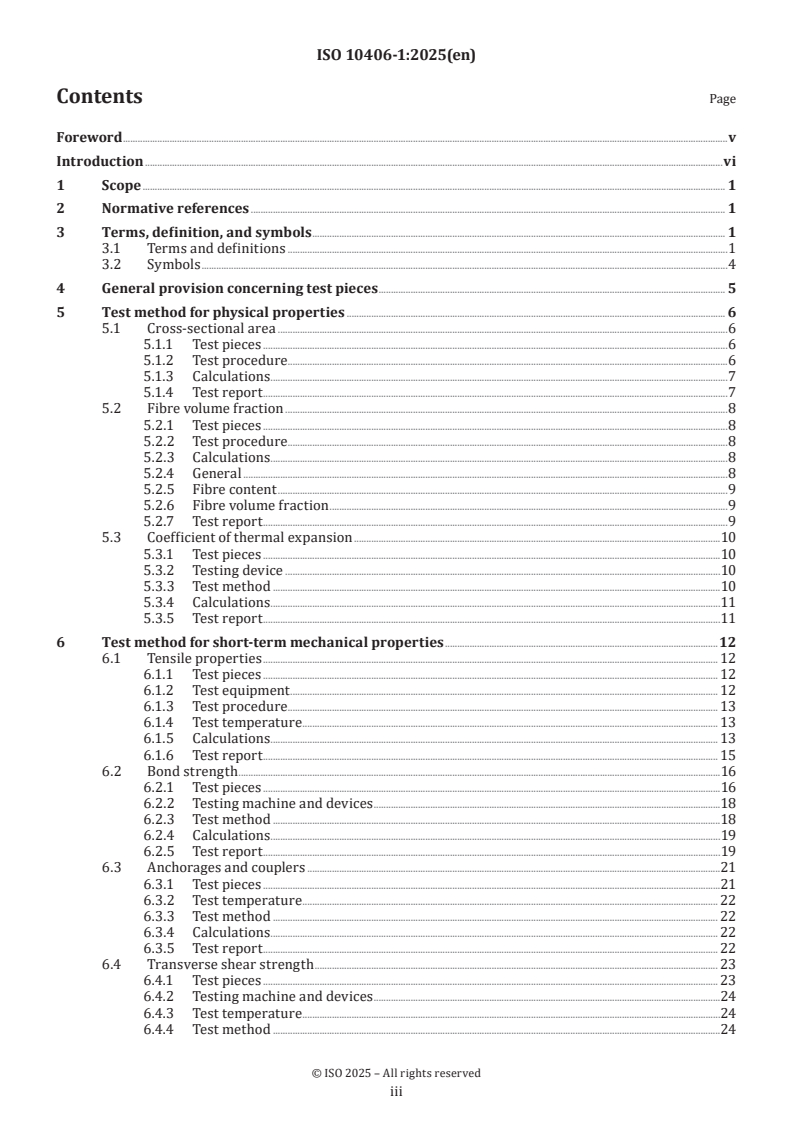
Contents Page
Foreword .v
Introduction .vi
1 Scope . 1
2 Normative references . 1
3 Terms, definition, and symbols . 1
3.1 Terms and definitions .1
3.2 Symbols .4
4 General provision concerning test pieces . 5
5 Test method for physical properties . 6
5.1 Cross-sectional area .6
5.1.1 Test pieces .6
5.1.2 Test procedure.6
5.1.3 Calculations . .7
5.1.4 Test report .7
5.2 Fibre volume fraction .8
5.2.1 Test pieces .8
5.2.2 Test procedure.8
5.2.3 Calculations . .8
5.2.4 General .8
5.2.5 Fibre content .9
5.2.6 Fibre volume fraction .9
5.2.7 Test report .9
5.3 Coefficient of thermal expansion .10
5.3.1 Test pieces .10
5.3.2 Testing device .10
5.3.3 Test method .10
5.3.4 Calculations . .11
5.3.5 Test report .11
6 Test method for short-term mechanical properties .12
6.1 Tensile properties . 12
6.1.1 Test pieces . 12
6.1.2 Test equipment . 12
6.1.3 Test procedure. 13
6.1.4 Test temperature . 13
6.1.5 Calculations . . 13
6.1.6 Test report . 15
6.2 Bond strength .16
6.2.1 Test pieces .16
6.2.2 Testing machine and devices .18
6.2.3 Test method .18
6.2.4 Calculations . .19
6.2.5 Test report .19
6.3 Anchorages and couplers .21
6.3.1 Test pieces .21
6.3.2 Test temperature . 22
6.3.3 Test method . 22
6.3.4 Calculations . . 22
6.3.5 Test report . 22
6.4 Transverse shear strength . 23
6.4.1 Test pieces . 23
6.4.2 Testing machine and devices .24
6.4.3 Test temperature . .24
6.4.4 Test method .24
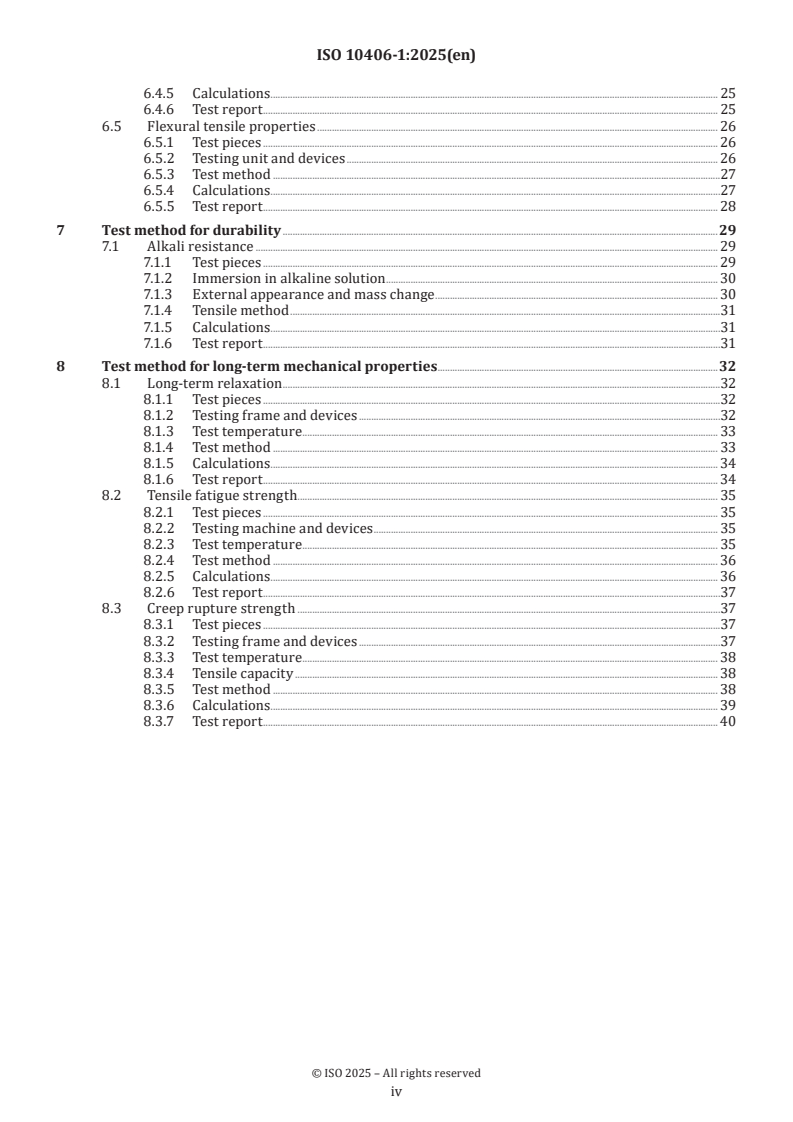
iii
6.4.5 Calculations . . 25
6.4.6 Test report . 25
6.5 Flexural tensile properties . 26
6.5.1 Test pieces . 26
6.5.2 Testing unit and devices . 26
6.5.3 Test method .27
6.5.4 Calculations . .27
6.5.5 Test report . 28
7 Test method for durability .29
7.1 Alkali resistance . 29
7.1.1 Test pieces . 29
7.1.2 Immersion in alkaline solution . 30
7.1.3 External appearance and mass change . 30
7.1.4 Tensile method .31
7.1.5 Calculations . .31
7.1.6 Test report .31
8 Test method for long-term mechanical properties .32
8.1 Long-term relaxation .32
8.1.1 Test pieces .32
8.1.2 Testing frame and devices .32
8.1.3 Test temperature . . 33
8.1.4 Test method . 33
8.1.5 Calculations . . 34
8.1.6 Test report . 34
8.2 Tensile fatigue strength. 35
8.2.1 Test pieces . 35
8.2.2 Testing machine and devices . 35
8.2.3 Test temperature . 35
8.2.4 Test method . 36
8.2.5 Calculations . . 36
8.2.6 Test report .37
8.3 Creep rupture strength .37
8.3.1 Test pieces .37
8.3.2 Testing frame and devices .37
8.3.3 Test temperature . 38
8.3.4 Tensile capacity . 38
8.3.5 Test method . 38
8.3.6 Calculations . . 39
8.3.7 Test report . 40
iv
Foreword
ISO (the International Organization for Standardization) is a worldwide federation of national standards
bodies (ISO member bodies). The work of preparing International Standards is normally carried out through
ISO technical committees. Each member body interested in a subject for which a technical committee
has been established has the right to be represented on that committee. International organizations,
governmental and non-governmental, in liaison with ISO, also take part in the work. ISO collaborates closely
with the International Electrotechnical Commission (IEC) on all matters of electrotechnical standardization.
The procedures used to develop this document and those intended for its further maintenance are described
in the ISO/IEC Directives, Part 1. In particular, the different approval criteria needed for the different types
of ISO document should be noted. This document was drafted in accordance with the editorial rules of the
ISO/IEC Directives, Part 2 (see www.iso.org/directives).
ISO draws attention to the possibility that the implementation of this document may involve the use of (a)
patent(s). ISO takes no position concerning the evidence, validity or applicability of any claimed patent
rights in respect thereof. As of the date of publication of this document, ISO had not received notice of (a)
patent(s) which may be required to implement this document. However, implementers are cautioned that
this may not represent the latest information, which may be obtained from the patent database available at
www.iso.org/patents. ISO shall not be held responsible for identifying any or all such patent rights.
Any trade name used in this document is information given for the convenience of users and does not
constitute an endorsement.
For an explanation of the voluntary nature of standards, the meaning of ISO specific terms and expressions
related to conformity assessment, as well as information about ISO's adherence to the World Trade
Organization (WTO) principles in the Technical Barriers to Trade (TBT), see www.iso.org/iso/foreword.html.
This document was prepared by Technical Committee ISO/TC 71, Concrete, reinforced concrete and pre-
stressed concrete, Subcommittee SC 6, Non-traditional reinforcing materials for concrete structures.
This third edition cancels and replaces the second edition (ISO 10406-1:2015), which has been technically
revised.
The main changes are as follows:
— inclusion of thermoplastic resin for FRP bars;
— addition of the test method for fibre volume fraction of FRP bars;
— revision of test methods for alkaline resistance, long-term relaxation, tensile fatigue strength, and creep
failure strength to enhance rigor and comprehensiveness;
— increase in the minimum number of test specimens from 3 to 5 for all test methods to ensure data
reliability.
A list of all parts in the ISO 10406 series can be found on the ISO website.
Any feedback or questions on this document should be directed to the user’s national standards body. A
complete listing of these bodies can be found at www.iso.org/members.html.
v
Introduction
Fibre reinforced polymer (FRP) bars, renowned for their high strength, lightweight nature, excellent bond
behaviour, and superior durability, serve a pivotal role in reinforcing new constructions and rehabilitating
existing reinforced concrete structures. As the global use of FRP bars continues to expand, the need for
standardized test methods has become paramount. Unlike steel, FRP bars exhibit anisotropic behaviour
and their performance is influenced by the type of fibres, resin matrix, and manufacturing processes. As
such, rigorous and consistent test methods are essential to accurately evaluate the physical properties,
mechanical properties, long-term durability, and reliability of FRP bars in various environmental and
loading conditions.
This document provides a comprehensive framework for evaluating the physical properties, mechanical
properties, durability, and long-term performance of FRP bars. It aims to promote uniformity in test
methods globally, thereby ensuring consistency in product quality and facilitating international trade. By
establishing these test methods, this document supports engineers, manufacturers, and regulators in the
design, production, and certification of FRP reinforcement systems for safe and sustainable infrastructure.
vi
International Standard ISO 10406-1:2025(en)
Fibre-reinforced polymer (FRP) reinforcement of concrete —
Test methods —
Part 1:
FRP bars
1 Scope
This document specifies test methods applicable to fibre-reinforced polymer (FRP) bars as reinforcement or
pre-stressing tendons in concrete, including physical, mechanical, durability, and long-term properties.
FRP bars in this document are made of fibre and resin matrix. Types of fibres are aramid fibre, basalt
fibre, carbon fibre or glass fibre. The matrix includes thermosetting resins, such as vinylester, unsaturated
polyester resins, as well as thermoplastic resins, including polypropylene, polyamides, and polymethyl
methacrylate.
2 Normative references
The following documents are referred to in the text in such a way that some or all of their content constitutes
requirements of this document. For dated references, only the edition cited applies. For undated references,
the latest edition of the referenced document (including any amendments) applies.
ISO 291:2008, Plastics — Standard atmospheres for conditioning and testing
ISO 3611, Geometrical product specifications (GPS) — Dimensional measuring equipment — Design and
metrological characteristics of micrometers for external measurements
ISO 4788, Laboratory glassware — Graduated measuring cylinders
ISO 7500-1, Metallic materials — Calibration and verification of static uniaxial testing machines — Part 1:
Tension/compression testing machines — Calibration and verification of the force-measuring system
ISO 13385-1, Geometrical product specifications (GPS) — Dimensional measuring equipment — Part 1: Design
and metrological characteristics of callipers
3 Terms, definition, and symbols
3.1 Terms and definitions
For the purposes of this document, the following terms and definitions apply.
ISO and IEC maintain terminology databases for use in standardization at the following addresses:
— ISO Online browsing platform: available at https:// www .iso .org/ obp
— IEC Electropedia: available at https:// www .electropedia .org/
3.1.1
average load
average of the maximum and minimum repeated load
3.1.2
bending angle
angle formed by the straight sections of a test piece on either side of the deflector
3.1.3
bending diameter ratio
ratio of the external diameter of the deflector surface in contact with the fibre-reinforced polymer (FRP)
bar, and the nominal diameter of the fibre-reinforced polymer (FRP) bar
3.1.4
bending tensile capacity
tensile load at the moment of failure of the test piece
3.1.5
coefficient of thermal expansion
average coefficient of linear thermal expansion between given temperatures
Note 1 to entry: The average of the given temperatures is taken as the representative temperature.
3.1.6
creep failure capacity
load causing failure after a specified period of time from the start of a sustained load
Note 1 to entry: In particular, the load causing failure after 1 million hours is referred to as the million-hour creep
failure capacity.
3.1.7
creep failure strength
stress causing failure after a specified period of time from the start of a sustained load
Note 1 to entry: In particular, the load causing failure after 1 million hours is referred to as the million-hour creep
failure strength.
3.1.8
creep failure time
time between the start of a sustained load and failure of a test piece
3.1.9
creep failure
failure occurring in a test piece due to a sustained load
3.1.10
creep strain
differential change in length per unit length occurring in a test piece due to creep
3.1.11
creep
time-dependent deformation of a fibre-reinforced polymer (FRP) bar subjected to a sustained load at a
constant temperature
3.1.12
deflected section
section of a fibre-reinforced polymer (FRP) bar which is bent and maintained at the required bending angle
and bending diameter ratio
3.1.13
deflector
device used to maintain the position, alter the bending angle, or alleviate the stress concentrations in the
fibre-reinforced polymer (FRP) bar; sometimes installed in the deflected section
3.1.14
fatigue strength
maximum repeated stress at which the test piece does not fail at the prescribed number of cycles
3.1.15
fibre-reinforced polymer
FRP
composite material, moulded and hardened to the intended shape, consisting of continuous fibre impregnated
with a fibre-binding polymer
3.1.16
fibre-reinforced polymer bar
FRP bar
composite material, moulded and hardened to the intended shape, consisting of continuous fibres
impregnated with a fibre-binding polymer
3.1.17
fibre volume fraction
the ratio of the volume of fibres to the volume of the composite
3.1.18
frequency
number of loading (stressing) cycles in one second during the test
3.1.19
gauge length
straight portion along the length of a test piece used to measure the elongation using an extensometer, or a
similar device
3.1.20
load amplitude
one-half of the load range
3.1.21
minimum repeated load
minimum load during repeated loading
3.1.22
nominal cross-sectional area
value obtained upon dividing the volume of the fibre-reinforced polymer (FRP) specimen by its length
3.1.23
nominal diameter
diameter of fibre-reinforced polymer (FRP) calculated assuming a circular section
3.1.24
nominal peripheral length
peripheral length of the fibre-reinforced polymer (FRP), which forms the basis for calculation of bond
strength
3.1.25
number of cycles
number of times the repeated load is applied to the test piece
3.1.26
relaxation
time-dependent decrease in load in a fibre-reinforced polymer (FRP) held at a given constant temperature
with a prescribed initial load applied and held at a given constant strain
3.1.27
relaxation rate
percentage reduction in load relative to the initial load after a given period of time, under a fixed strain
Note 1 to entry: In particular, the relaxation value after 1 million hours (approximately 114 years) is referred to as the
hundred-year relaxation rate.
3.1.28
repeated load
load alternating cyclically between fixed maximum and minimum values
3.1.29
S-N curve
curve plotted on a graph with repeated stress on the vertical axis and the number of cycles to fatigue failure
on the horizontal axis
3.1.30
Fibre-reinforced polymer (FRP) tendon
resin-bound construction made of continuous fibres in the shape of a tendon used to reinforce concrete
uniaxially
Note 1 to entry: Tendons are usually used in prestressed concrete
3.1.31
thermomechanical analysis (TMA)
method for measuring deformation of a material as a function of either temperature or time, by varying the
temperature of the material according to a calibrated program, under a non-vibrating load
3.1.32
TMA curve
a graph with temperature or time represented on the horizontal axis, and deformation on the vertical axis
3.1.33
ultimate strain
strain corresponding to the maximum tensile force
3.2 Symbols
See Table 1.
Table 1 — Symbols
Symbol Unit Description Reference
A mm Nominal cross-sectional area of test piece 5.1.3, 6.1.5
a ─ Empirical constant 8.1.5
b ─ Empirical constant 8.1.5
D mm Nominal diameter 5.1.3
E N/mm Young’s modulus 6.1.5
F N Million-hour creep rupture capacity 8.3.6
r
F N Tensile capacity after immersion 7.1.5
u0
F N Tensile capacity before immersion 7.1.5
u1
f N/mm Million-hour creep rupture strength 8.3.6
r
f N/mm Tensile strength 6.1.5
u
L mm Length of test piece at room temperature 5.3.4
L mm Length before immersion 7.1.3
L mm Length after immersion 7.1.3
l mm Length of test piece 5.1.3
o
TTabablele 1 1 ((ccoonnttiinnueuedd))
Symbol Unit Description Reference
l mm Bonded length 6.2.4
b
M ─ Fibre content of FRP bar 5.2.6
f
m g Initial mass of the dry boat or crucible 5.2.6
m g Initial mass of the boat or crucible plus dried specimen 5.2.6
m g Final mass of the boat or crucible plus residue after calcination 5.2.6
P N Maximum pull-out load 6.2.4
bmax
P N Maximum tensile load 6.1.5
max
P N Shear failure load (N) 6.4.5
su
R % Tensile capacity retention rate 7.1.5
et
Minimum temperature for calculation of coefficient of thermal expansion
T °C 5.3.4
(normally 0 °C)
Maximum temperature for calculation of coefficient of thermal expansion
T °C 5.3.4
(normally 60 °C)
t h Time 8.1.5
u mm Nominal peripheral length of test piece 6.2.4
V mm Volume of water in the measuring cylinder 5.1.3
o
V mm Volume of the sum total of water and test piece 5.1.3
s
W g Mass before immersion 7.1.3
W g Mass after immersion 7.1.3
Y % Relaxation rate 8.1.5
Y ─ Creep load ratio 8.3.6
c
Coefficient of thermal expansion calculated for specifications test piece for
α 1/°C 5.3.4
set
length calibration between temperatures T and T
1 2
α 1/°C Coefficient of thermal expansion 5.3.4
sp
ΔL mm Difference in length of test piece between temperatures T and T 5.3.4
spm 1 2
Difference in length of specifications test piece for length calibration be-
ΔL mm 5.3.4
refm
tween temperatures T and T
1 2
ΔP N Difference between loads at 20 % and 50 % of maximum tensile load 6.1.5
Δε ─ Strain difference between ΔP 6.1.5
ε ─ Ultimate strain 6.1.5
u
τ N/mm Bond strength 6.2.4
bu
2 2
τ N/mm Shear strength (N/mm ) 6.4.5
su
4 General provision concerning test pieces
Unless otherwise agreed, test pieces shall be taken from the bar in the ‘as-delivered’ condition.
In cases when test pieces are taken from a coil, the test piece shall be straightened prior to any test by simple
bending operation with a minimum amount of plastic deformation.
For the determination of the mechanical properties in the tensile, bond and anchorage tests, the test piece
can be artificially aged (after straightening if applicable) depending on the performance requirements of the
product.
When a test piece is ‘aged’, the conditions of the ageing treatment shall be stated in the test report.
5 Test method for physical properties
5.1 Cross-sectional area
5.1.1 Test pieces
5.1.1.1 Preparation of test pieces
Test pieces shall be cut to predetermined length and finished flat at its cut end from the mother material
(FRP) for tensile test.
5.1.1.2 Length of test pieces
The length of test pieces shall be 100 mm when nominal approximate diameter is 20 mm or less, and shall be
200 mm when approximate diameter is over 20 mm.
5.1.1.3 Number of test pieces
The number of test pieces shall be five from the mother material of the same lot at least.
5.1.2 Test procedure
The test procedure is as follows:
a) The length of the test piece shall be measured using the vernier callipers specified by ISO 13385-1.
Measurements shall be taken at three locations along the test piece, and the average of the three values
shall be rounded off to one figure below a decimal point; it is the length of test piece.
b) The volume of the test piece shall be measured using the measuring cylinder specified by ISO-4788
according to approximate diameter of test piece. Table 2 shows the relationship between approximate
diameter of test piece and capacity of measuring cylinder. When there are two or more capacities, the
minimum capacity cylinder in the range that can be measured shall be chosen.
c) Put the waterworks water of a proper quantity into the measuring cylinder and measure the volume.
When the air bubbles, which can cause an error of measurement, are generated on the surface of the test
piece, the surface-tension-reducing solvent such as ethanol etc. may be added in water for the purpose
to control generating of air bubbles. When the test piece is in the measuring cylinder, the water shall
cover the test piece, and the top of the water shall be in the range of scale.
d) Insert the test piece into the measuring cylinder and measure the volume of the sum total of water and
the test piece.
e) The test temperature shall be within the range 15 °C to 25 °C (or 20 °C to 30 °C for warm countries).
Table 2 — Relationship between the approximate diameter of test piece and the capacity of
measuring cylinder
Approximate width of test piece (mm) Capacity of measuring cylinder (ml)
under 10 10 or 20
11 to 13 25
14 to 20 50 or 100
21 to 25 100
over 25 300 or 500
5.1.3 Calculations
Nominal cross-sectional area shall be calculated from Formula (1), rounded off to one figure below a
decimal point.
VV−
s0
A= (1)
l
where
A nominal cross-sectional area, in mm ;
V volume of the sum total of water and test piece, in mm ;
s
V volume of water in the measuring cylinder, in mm ;
l length of test piece, in mm.
NOTE The nominal cross-section area includes the area of surface-bonded sand particles, surface-bonded
transverse wraps, and other non-load-bearing area.
Nominal diameter shall be calculated from Formula (2), rounded off to one figure below a decimal point.
A
D= 2 (2)
π
where
D nominal diameter, in mm;
A nominal cross-sectional area, in mm .
5.1.4 Test report
The test report shall include the following mandatory information:
a) name, shape, date of manufacture and lot number of FRP tested;
b) the International Standard used (including its year of publication);
c) the method used (if the standard includes several);
d) nominal cross-sectional area, nominal diameter;
e) any deviations from the procedure;
f) any unusual features observed;
g) test temperature;
h) the date of the test;
The test report may include the following additional information:
a) capacity of measuring cylinder used in the test;
b) length of test piece;
c) volume of water in the measuring cylinder;
d) volume of the sum total of water and the test piece;
e) name of the solvent, if any solvent is used in the test.
5.2 Fibre volume fraction
5.2.1 Test pieces
5.2.1.1 Preparation of test pieces
The test pieces shall be fully representative of the FRP bar examined.
5.2.1.2 Mass of test pieces
The test pieces may be any size and shape that may conveniently be prepared and tested, provided that its
volume shall be not less than 1 cm . A test piece with a mass of 1 g to 5 g usually can be found convenient, but
test pieces up to approximately 50 g may be used.
5.2.1.3 Number of test pieces
The number of test pieces shall be five from the mother material of the same lot at least.
5.2.2 Test procedure
The test procedure is as follows:
a) weigh the clean, dry boat or crucible to the nearest 0,1 mg on the balance. Place it in the muffle furnace
set to the chosen temperature, and leave it for 10 min. After cooling to ambient temperature in a
desiccator, verify that the mass has not changed. If there has been a change, repeat these steps until
constant mass is reached. Record the mass in grams m ;
b) place a test piece in the boat or crucible and dry it in a ventilated drying oven at 105 °C until a constant
mass is achieved;
c) cool to ambient temperature in the desiccator and reweigh. Record the mass in grams as m ;
d) place the boat or crucible into a preheated muffle furnace at 500 °C or lower depending on the composite
system (a temperature below the temperature at which the test piece will spontaneously ignite). Heat
to 565 °C ± 30 °C, or other temperature compatible with the composite system, that will burn off the
matrix and leave the reinforcement;
e) allow the boat or crucible, together with the residue, to cool in the desiccator to ambient temperature
and reweigh. Record the mass in grams as m ;
5.2.3 Calculations
5.2.4 General
If the results of the individual measurements differ by more than 5 % in relative value, carry out an additional
determination on a third test piece taken from the same location in the elementary unit or laboratory sample.
5.2.5 Fibre content
Calculate, for each specimen, the fibre content M , expressed as a percentage of the initial mass, using
f
Formula (3):
mm−
M = ×100 (3)
f
mm−
where
M fibre content of FRP bar (%);
f
m initial mass, in grams, of the dry boat or crucible;
m initial mass, in grams, of the boat or crucible plus dried specimen;
m final mass, in grams, of the boat or crucible plus residue after calcination.
5.2.6 Fibre volume fraction
The fibre volume fraction shall be calculated according to Formula (4):
ρ
f
VM= (4)
ff
ρ
g
where
M fibre content (%);
f
ρ density of fibre (g/cm );
f
ρ density of FRP bar (g/cm ).
g
5.2.7 Test report
The test report shall include the following items:
a) name, shape, date of manufacture and lot number of FRP tested;
b) type of fibre and fibre binding material;
c) numbers or identification marks of test pieces;
d) the dimensions and or mass of the test pieces;
e) the International Standard used (including its year of publication);
f) the method used (if the standard includes several);
g) the result(s), including a reference to the clause which explains how the results were calculated;
h) any deviations from the procedure;
i) any unusual features observed;
j) the calcination temperature;
k) the date of the test.
5.3 Coefficient of thermal expansion
5.3.1 Test pieces
5.3.1.1 Pre-test curing of test pieces
Prior to testing, test pieces shall be kept for a minimum of 24 h at a temperature of 23 °C ± 2 °C and relative
humidity of 50 % ± 10 %, under Specifications Temperature Conditions Class II and Specifications Humidity
Conditions Class II, in accordance with ISO 291:2008. The test pieces shall be then normally kept for 48 h at
the maximum test temperature, in order to eliminate strain resulting from bending, and for dehumidification
and deaeration.
5.3.1.2 Dimensions of test piece
The test pieces cut from the FRP bar shall be 20 mm in length, with a round or square cross-section of a
diameter or breadth not more than 5 mm.
5.3.1.3 Number of test pieces
The number of test pieces shall be not less than five.
5.3.2 Testing device
5.3.2.1 Testing device
The thermomechanical analysis (TMA) apparatus used for testing shall be capable of measuring in
compression mode, of maintaining a constant atmosphere around the test piece, and of raising the
temperature of the test piece at a constant rate.
5.3.2.2 Calibration of testing device
a) Sensitivity calibration of the displacement gauge shall be carried out periodically using either an
external micrometre as defined in ISO 3611, or a micrometre attached to the testing machine.
b) Calibration of the temperature gauge shall be carried out using a pure substance of known melting point.
5.3.2.3 Installation of testing device
The TMA apparatus shall be installed in a location not subject to vibration during testing.
5.3.3 Test method
The test procedure is as follows:
a) The test piece, gauge rod and test platform shall be cleaned, and the test piece placed upright and if
possible bonded to the platform.
b) The gauge rod shall be placed in the centre of the test piece, with no pressure applied.
c) The atmosphere around the test piece shall consist of dry air (water content not more than 0,1 % w/w)
or nitrogen (water content not more than 0,001 % w/w, oxygen content not more than 0,001 % w/w),
maintained at a flow rate in the range of 50 ml/min to 100 ml/min.
d) The load shall be applied gently to the tip of the gauge rod at room temperature, and the temperature
shall first be lowered to 0 °C then raised to 60 °C, and the full process of displacement of the test piece
shall be recorded.
e) The rate of temperature increase shall not be more than 5 °C per minute.
f) The compressive stre
...