

ISO 10406-1:2015
(Main)Fibre-reinforced polymer (FRP) reinforcement of concrete — Test methods — Part 1: FRP bars and grids
General Information
- Abstract
ISO 10406-1:2014 specifies test methods applicable to fibre-reinforced polymer (FRP) bars and grids as reinforcements or pre-stressing tendons in concrete.
- Status
- Withdrawn
- Publication Date
- 11-Jan-2015
- Current Stage
- 9599 - Withdrawal of International Standard
- Start Date
- 02-Sep-2025
- Completion Date
- 29-Aug-2026
Buy Documents
ISO 10406-1:2015 - Fibre-reinforced polymer (FRP) reinforcement of concrete — Test methods — Part 1: FRP bars and grids/12/2015
ISO 10406-1:2015 - Fibre-reinforced polymer (FRP) reinforcement of concrete -- Test methods
Overview
ISO 10406-1:2015 - Fibre-reinforced polymer (FRP) reinforcement of concrete - Test methods - Part 1: FRP bars and grids is an international standard that specifies standardized test methods for FRP bars and grids used as reinforcements or pre‑stressing tendons in concrete. Published by ISO (ISO/TC 71, Subcommittee SC 6), this second edition updates and consolidates recognized test procedures to assess the mechanical, durability and dimensional properties of FRP reinforcement.
Keywords: ISO 10406-1:2015, FRP bars and grids, fibre-reinforced polymer, test methods, reinforcement of concrete, FRP testing
Key topics and technical requirements
The standard defines the types of test pieces, required test equipment and the data to be reported. Major technical topics covered include:
- Cross‑sectional properties
- Measurement and reporting of cross‑sectional area and geometry for bars and grids.
- Tensile properties
- Determination of tensile strength, modulus and elongation characteristics.
- Bond strength (pull‑out testing)
- Methods to evaluate bond between FRP reinforcement and concrete.
- Anchorages and couplers
- Performance testing for anchorage and mechanical coupler systems.
- Long‑term relaxation and creep
- Procedures to assess time‑dependent stress relaxation and creep failure behavior.
- Tensile fatigue
- Fatigue testing under cyclic tensile loading to assess endurance.
- Alkali resistance
- Exposure and tensile testing to evaluate durability in alkaline environments.
- Transverse shear and flexural tensile properties
- Tests for shear strength across fibres and flexural performance.
- Thermal expansion
- Measurement of coefficient of longitudinal thermal expansion by thermo‑mechanical analysis.
Each test section identifies specimen preparation, testing apparatus, calculation methods and essential items for the test report - ensuring consistent, comparable results across laboratories.
Practical applications and users
ISO 10406-1:2015 is used to:
- Qualify and certify FRP reinforcement products (bars, grids) for structural use.
- Provide test evidence for product development, quality control and material specifications.
- Support design decisions by structural and materials engineers considering FRP for new or retrofit concrete structures.
- Inform procurement, regulatory compliance and acceptance testing by testing laboratories and certifiers.
Primary users: manufacturers of FRP bars and grids, independent testing laboratories, structural engineers, specification authors, infrastructure owners and regulatory bodies.
Related standards
- ISO 10406-2 - FRP sheets (companion part)
- ISO 291 - Plastics - Standard atmospheres for conditioning and testing
- ISO 3611 - GPS - Dimensional measuring equipment (micrometers)
ISO 10406-1:2015 provides a comprehensive, standardized basis for assessing FRP reinforcement performance and durability in concrete applications.
Relations
- Effective Date
- 25-Aug-2026
- Effective Date
- 17-Dec-2022
- Effective Date
- 06-Jun-2022
- Effective Date
- 02-Mar-2013
Buy Documents
ISO 10406-1:2015 - Fibre-reinforced polymer (FRP) reinforcement of concrete — Test methods — Part 1: FRP bars and grids/12/2015
ISO 10406-1:2015 - Fibre-reinforced polymer (FRP) reinforcement of concrete -- Test methods
Get Certified
Connect with accredited certification bodies for this standard

DIN CERTCO
DIN Group product certification.
DIBt (Deutsches Institut für Bautechnik)
German Institute for Building Technology.

Aboma Certification B.V.
Specialized in construction, metal, and transport sectors.
Sponsored listings
Frequently Asked Questions
ISO 10406-1:2015 is a standard published by the International Organization for Standardization (ISO). Its full title is "Fibre-reinforced polymer (FRP) reinforcement of concrete — Test methods — Part 1: FRP bars and grids". This standard covers: ISO 10406-1:2014 specifies test methods applicable to fibre-reinforced polymer (FRP) bars and grids as reinforcements or pre-stressing tendons in concrete.
ISO 10406-1:2014 specifies test methods applicable to fibre-reinforced polymer (FRP) bars and grids as reinforcements or pre-stressing tendons in concrete.
ISO 10406-1:2015 is classified under the following ICS (International Classification for Standards) categories: 83.120 - Reinforced plastics; 91.100.30 - Concrete and concrete products. The ICS classification helps identify the subject area and facilitates finding related standards.
ISO 10406-1:2015 has the following relationships with other standards: It is inter standard links to EN 1992-1-1:2023, ISO 10406-4:2025, ISO 10406-1:2025, ISO 10406-1:2008. Understanding these relationships helps ensure you are using the most current and applicable version of the standard.
ISO 10406-1:2015 is available in PDF format for immediate download after purchase. The document can be added to your cart and obtained through the secure checkout process. Digital delivery ensures instant access to the complete standard document.
Standards Content (Sample)
INTERNATIONAL ISO
STANDARD 10406-1
Second edition
2015-01-15
Fibre-reinforced polymer (FRP)
reinforcement of concrete — Test
methods —
Part 1:
FRP bars and grids
Polymère renforcé par des fibres (PRF) pour l’armature du béton —
Méthodes d’essai —
Partie 1: Barres et grilles en PRF
Reference number
©
ISO 2015
© ISO 2015
All rights reserved. Unless otherwise specified, no part of this publication may be reproduced or utilized otherwise in any form
or by any means, electronic or mechanical, including photocopying, or posting on the internet or an intranet, without prior
written permission. Permission can be requested from either ISO at the address below or ISO’s member body in the country of
the requester.
ISO copyright office
Case postale 56 • CH-1211 Geneva 20
Tel. + 41 22 749 01 11
Fax + 41 22 749 09 47
E-mail copyright@iso.org
Web www.iso.org
Published in Switzerland
ii © ISO 2015 – All rights reserved
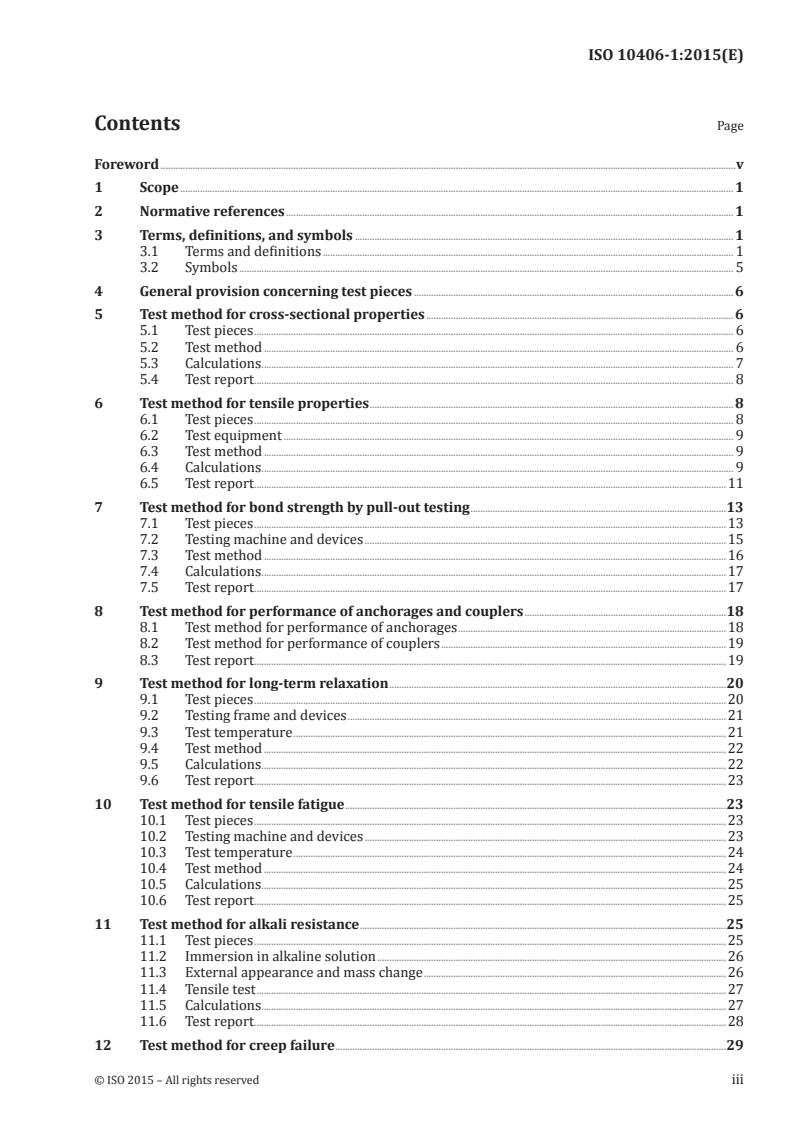
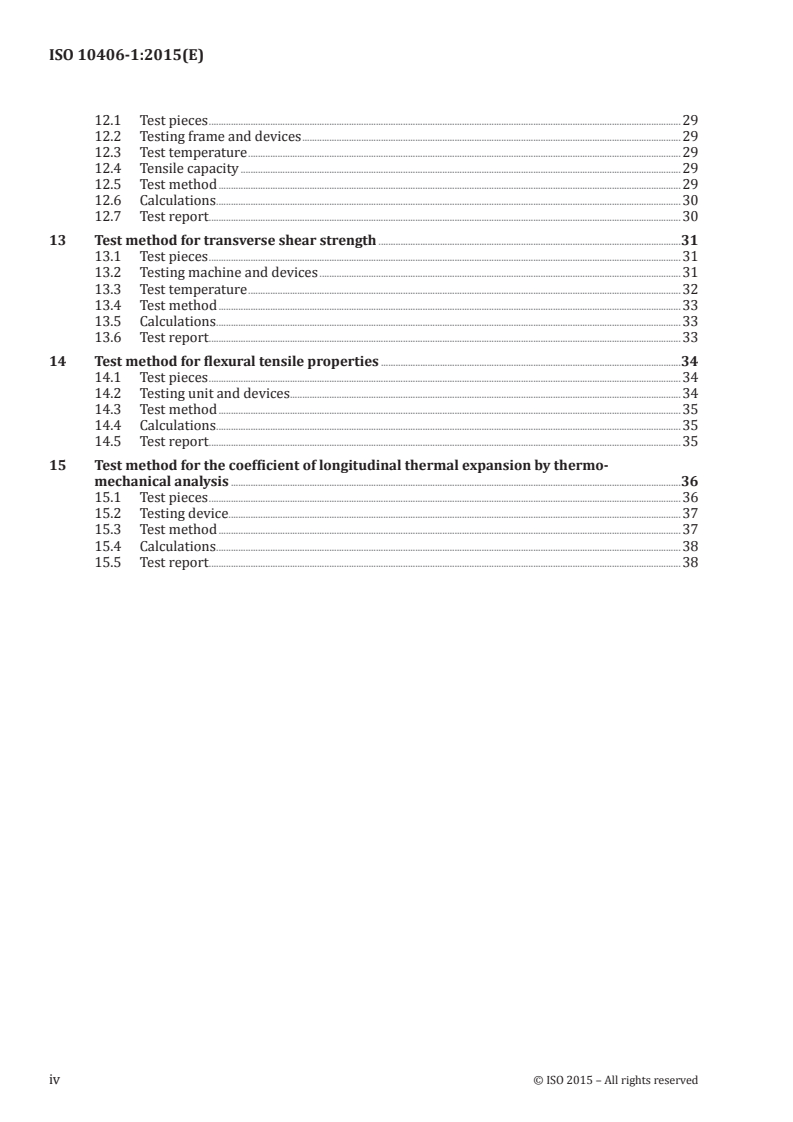
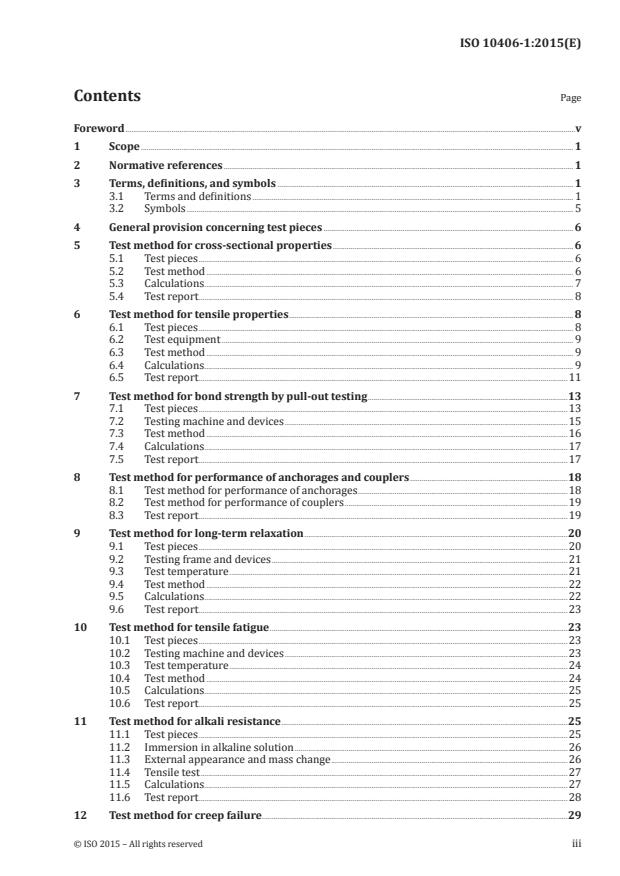
Contents Page
Foreword .v
1 Scope . 1
2 Normative references . 1
3 Terms, definitions, and symbols . 1
3.1 Terms and definitions . 1
3.2 Symbols . 5
4 General provision concerning test pieces . 6
5 Test method for cross-sectional properties . 6
5.1 Test pieces . 6
5.2 Test method . 6
5.3 Calculations . 7
5.4 Test report . 8
6 Test method for tensile properties . 8
6.1 Test pieces . 8
6.2 Test equipment . 9
6.3 Test method . 9
6.4 Calculations . 9
6.5 Test report .11
7 Test method for bond strength by pull-out testing .13
7.1 Test pieces .13
7.2 Testing machine and devices .15
7.3 Test method .16
7.4 Calculations .17
7.5 Test report .17
8 Test method for performance of anchorages and couplers .18
8.1 Test method for performance of anchorages .18
8.2 Test method for performance of couplers .19
8.3 Test report .19
9 Test method for long-term relaxation .20
9.1 Test pieces .20
9.2 Testing frame and devices .21
9.3 Test temperature .21
9.4 Test method .22
9.5 Calculations .22
9.6 Test report .23
10 Test method for tensile fatigue .23
10.1 Test pieces .23
10.2 Testing machine and devices .23
10.3 Test temperature .24
10.4 Test method .24
10.5 Calculations .25
10.6 Test report .25
11 Test method for alkali resistance .25
11.1 Test pieces .25
11.2 Immersion in alkaline solution .26
11.3 External appearance and mass change .26
11.4 Tensile test .27
11.5 Calculations .27
11.6 Test report .28
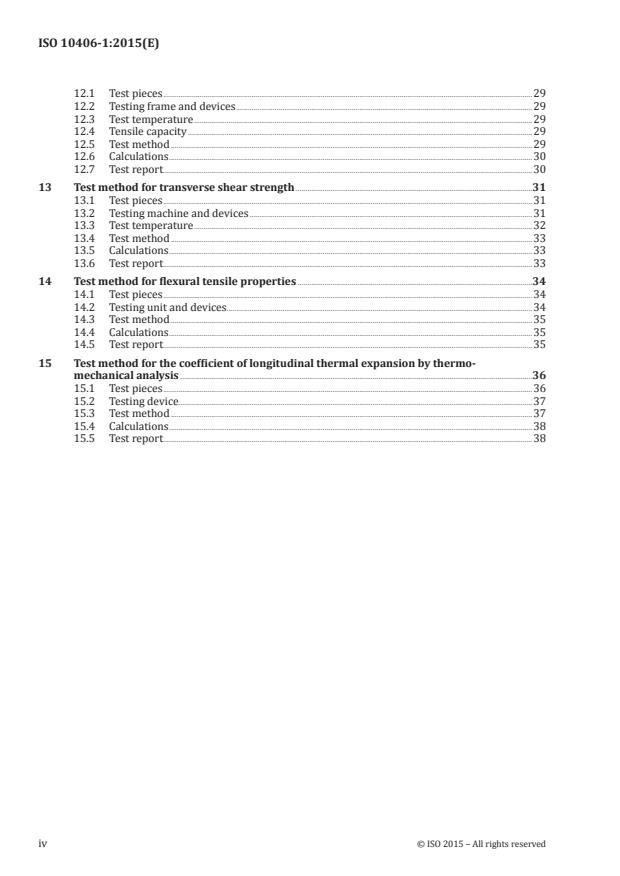
12 Test method for creep failure .29
12.1 Test pieces .29
12.2 Testing frame and devices .29
12.3 Test temperature .29
12.4 Tensile capacity .29
12.5 Test method .29
12.6 Calculations .30
12.7 Test report .30
13 Test method for transverse shear strength .31
13.1 Test pieces .31
13.2 Testing machine and devices .31
13.3 Test temperature .32
13.4 Test method .33
13.5 Calculations .33
13.6 Test report .33
14 Test method for flexural tensile properties .34
14.1 Test pieces .34
14.2 Testing unit and devices . .34
14.3 Test method .35
14.4 Calculations .35
14.5 Test report .35
15 Test method for the coefficient of longitudinal thermal expansion by thermo-
mechanical analysis .36
15.1 Test pieces .36
15.2 Testing device .37
15.3 Test method .37
15.4 Calculations .38
15.5 Test report .38
iv © ISO 2015 – All rights reserved
Foreword
ISO (the International Organization for Standardization) is a worldwide federation of national standards
bodies (ISO member bodies). The work of preparing International Standards is normally carried out
through ISO technical committees. Each member body interested in a subject for which a technical
committee has been established has the right to be represented on that committee. International
organizations, governmental and non-governmental, in liaison with ISO, also take part in the work.
ISO collaborates closely with the International Electrotechnical Commission (IEC) on all matters of
electrotechnical standardization.
The procedures used to develop this document and those intended for its further maintenance are
described in the ISO/IEC Directives, Part 1. In particular the different approval criteria needed for the
different types of ISO documents should be noted. This document was drafted in accordance with the
editorial rules of the ISO/IEC Directives, Part 2 (see www.iso.org/directives).
Attention is drawn to the possibility that some of the elements of this document may be the subject of
patent rights. ISO shall not be held responsible for identifying any or all such patent rights. Details of any
patent rights identified during the development of the document will be in the Introduction and/or on
the ISO list of patent declarations received (see www.iso.org/patents).
Any trade name used in this document is information given for the convenience of users and does not
constitute an endorsement.
For an explanation on the meaning of ISO specific terms and expressions related to conformity
assessment, as well as information about ISO’s adherence to the WTO principles in the Technical Barriers
to Trade (TBT), see the following URL: Foreword — Supplementary information.
The committee responsible for this document is ISO/TC 71, Concrete, reinforced concrete and pre-stressed
concrete, Subcommittee SC 6, Non-traditional reinforcing materials for concrete structures.
This second edition cancels and replaces the first edition (ISO 10406-1:2008), which has been technically
revised.
ISO 10406 consists of the following parts, under the general title Fibre-reinforced polymer (FRP)
reinforcement of concrete — Test methods:
— Part 1: FRP bars and grids
— Part 2: FRP sheets
INTERNATIONAL STANDARD ISO 10406-1:2015(E)
Fibre-reinforced polymer (FRP) reinforcement of
concrete — Test methods —
Part 1:
FRP bars and grids
1 Scope
This part of ISO 10406 specifies test methods applicable to fibre-reinforced polymer (FRP) bars and
grids as reinforcements or pre-stressing tendons in concrete.
2 Normative references
The following documents, in whole or in part, are normatively referenced in this document and are
indispensable for its application. For dated references, only the edition cited applies. For undated
references, the latest edition of the referenced document (including any amendments) applies.
ISO 291:2008, Plastics — Standard atmospheres for conditioning and testing
ISO 3611, Geometrical product specifications (GPS) — Dimensional measuring equipment: Micrometers for
external measurements — Design and metrological characteristics
ISO 4788, Laboratory glassware — Graduated measuring cylinders
ISO 7500-1, Metallic materials — Verification of static uniaxial testing machines — Part 1: Tension/compression
testing machines — Verification and calibration of the force-measuring system
ISO 13385-1, Geometrical product specifications (GPS) — Dimensional measuring equipment — Part 1:
Callipers; Design and metrological characteristics
3 Terms, definitions, and symbols
3.1 Terms and definitions
For the purposes of this document, the following terms and definitions apply.
3.1.1
alkalinity
condition of having or containing hydroxyl (OH-) ions; containing alkaline substances
Note 1 to entry: In concrete, the initial alkaline environment has a pH above 13.
3.1.2
anchorage reinforcement
latticed or spiral reinforcing steel or FRP connected with the anchorage and arranged behind it
3.1.3
anchoring section
end part of a test piece where an anchorage is fitted to transmit loads from the testing machine to the
test section
3.1.4
average load
average of the maximum and minimum repeated load (stress)
3.1.5
bending angle
angle formed by the straight sections of a test piece on either side of the deflector
3.1.6
bending diameter ratio
ratio of the external diameter of the deflector surface in contact with the FRP bar, and the nominal
diameter of the FRP bar
3.1.7
bending tensile capacity
tensile load at the moment of failure of the test piece
3.1.8
coefficient of thermal expansion
average coefficient of linear thermal expansion between given temperatures
Note 1 to entry: The average of the given temperatures is taken as the representative temperature.
3.1.9
continuous fibre
general term for continuous fibres of materials such as carbon, aramid, and glass
3.1.10
coupler
device coupling tendons
3.1.11
creep failure capacity
load causing failure after a specified period of time from the start of a sustained load
Note 1 to entry: In particular, the load causing failure after 1 million hours is referred to as the million-hour creep
failure capacity.
3.1.12
creep failure strength
stress causing failure after a specified period of time from the start of a sustained load
Note 1 to entry: In particular, the load causing failure after 1 million hours is referred to as the million-hour creep
failure strength.
3.1.13
creep failure time
time between the start of a sustained load and failure of a test piece
3.1.14
creep failure
failure occurring in a test piece due to a sustained load
3.1.15
creep strain
differential change in length per unit length occurring in a test piece due to creep
3.1.16
creep
time-dependent deformation of an FRP bar subjected to a sustained load at a constant temperature
2 © ISO 2015 – All rights reserved
3.1.17
deflected section
section of an FRP bar that is bent and maintained at the required bending angle and bending diameter
ratio
3.1.18
deflector
device used to maintain the position, alter the bending angle, or alleviate the stress concentrations in
the FRP bar and which is sometimes installed in the deflected section
3.1.19
fatigue strength
maximum repeated stress at which the test piece does not fail at the prescribed number of cycles
3.1.20
fibre-reinforced polymer
FRP
composite material, moulded and hardened to the intended shape, consisting of continuous fibres
impregnated with a fibre-binding polymer
3.1.21
frequency
number of loading (stressing) cycles in 1 s during the test
3.1.22
FRP bar
composite material formed into a long, slender structural shape suitable for use as reinforcement in
concrete and consisting primarily of longitudinal unidirectional fibres bound and shaped by a rigid
polymer resin material
3.1.23
gauge length
straight portion along the length of a test piece used to measure the elongation using an extensometer
or a similar device
3.1.24
grid
two-dimensional (planar) or three-dimensional (spatial) rigid array of interconnected FRP bars that
form a continuous lattice that can be used to reinforce concrete
3.1.25
load amplitude
load (stress) amplitude
one-half of the load (stress) range
3.1.26
load (stress) range
difference between maximum and minimum repeated load (stress)
3.1.27
maximum repeated load (stress)
maximum load (stress) during repeated loading
3.1.28
maximum tensile force
maximum tensile load sustained by a test piece during the tensile test
3.1.29
minimum repeated load (stress)
minimum load (stress) during repeated loading
3.1.30
nominal cross-sectional area
value obtained upon dividing the volume of the FRP specimen by its length
3.1.31
nominal diameter
diameter of FRP calculated assuming a circular section
3.1.32
nominal peripheral length
peripheral length of the FRP that forms the basis for calculating the bond strength and that shall be
determined separately for each FRP
3.1.33
number of cycles
number of times the repeated load (stress) is applied to the test piece
3.1.34
relaxation
stress relaxation
time-dependent decrease in load in an FRP held at a given constant temperature with a prescribed initial
load applied and held at a given constant strain
3.1.35
relaxation rate
percentage reduction in load relative to the initial load after a given period of time, under a fixed strain
Note 1 to entry: In particular, the relaxation value after 1 million hours (approximately 114 years) is referred to
as the hundred-year relaxation rate.
3.1.36
repeated load (stress)
load (stress) alternating cyclically between fixed maximum and minimum values
3.1.37
S-N curve
curve plotted on a graph with repeated stress on the vertical axis and the number of cycles to fatigue
failure on the horizontal axis
3.1.38
tendon
FRP
resin-bound construction made of continuous fibres in the shape of a tendon used to reinforce concrete
uniaxially
Note 1 to entry: Tendons are usually used in pre-stressed concrete.
3.1.39
thermo-mechanical analysis
TMA
method for measuring deformation of a material as a function of either temperature or time, by varying
the temperature of the material according to a calibrated programme, under a non-vibrating load
3.1.40
TMA curve
graph with temperature or time represented on the horizontal axis and deformation on the
vertical axis
3.1.41
ultimate strain
strain corresponding to the maximum tensile force
4 © ISO 2015 – All rights reserved
3.2 Symbols
See Table 1.
Table 1 — Symbols
Symbol Unit Description Reference
A mm Nominal cross-sectional area of test piece 5.3, 6.4
D mm Nominal diameter 5.3
E N/mm Young’s modulus 6.4
F N Maximum tensile force 6.4
u
f N/mm Tensile strength 6.4
u
ε — Ultimate strain 6.4
u
ΔF N Difference between loads at 20 % and 50 % of maximum 6.4
tensile force
Δε — Strain difference between ΔF 6.4
τ N/mm Bond stress 7.4
P N Tensile load in the pull-out test 7.4
u mm Nominal peripheral length of test piece 7.4
l mm Bonded length 7.4
Y % Relaxation rate 9.5.2
t h Time 9.5.2
k — Empirical constant 9.5.2
a
k — Empirical constant 9.5.2
b
R % Mass loss ratio
Δm
V mm Volume of water in the measuring cylinder 5.3
o
V mm Volume of the sum total of water and test piece 5.3
s
l mm Length of test piece 5.3
o
m g Mass before immersion 11.4
L mm Length before immersion 11.4
m g Mass after immersion 11.4
L mm Length after immersion 11.4
R % Tensile capacity retention rate 11.5.2
et
F N Tensile capacity before immersion 11.5.2
u1
F N Tensile capacity after immersion 11.5.2
u0
R — Creep load ratio 12.6.3
Yc
τ N/mm Shear stress 13.5.2
s
P N Shear failure load 13.5.2
s
α 1/°C Coefficient of thermal expansion 15.4.1
sp
ΔL µ Difference in length of test piece between temperatures 15.4.1
spm
T and T
1 2
ΔL µ Difference in length of specification test piece for length 15.4.1
refm
calibration between temperatures T and T
1 2
L m Length of test piece at room temperature 15.4.1
Table 1 (continued)
Symbol Unit Description Reference
T °C Maximum temperature for calculation of coefficient of 15.4.1
thermal expansion (normally 60 °C)
T °C Minimum temperature for calculation of coefficient of 15.4.1
thermal expansion (normally 0 °C)
α 1/°C Coefficient of thermal expansion calculated for specification 15.4.1
set
test piece for length calibration between temperatures
T and T
1 2
4 General provision concerning test pieces
Unless otherwise agreed, test pieces shall be taken from the bar or grid in the “as-delivered” condition.
In cases where test pieces are taken from a coil, they shall be straightened prior to any test by a simple
bending operation with a minimum amount of plastic deformation.
For the determination of the mechanical properties in the tensile, bond, and anchorage tests, the
test piece may be artificially aged (after straightening, if applicable) depending on the performance
requirements of the product.
When a test piece is “aged”, the conditions of the ageing treatment shall be stated in the test report.
5 Test method for cross-sectional properties
5.1 Test pieces
5.1.1 Preparation of test pieces
Test pieces shall be cut to a predetermined length and finished flat at their cut end from the mother
material (FRP) for tensile test.
5.1.2 Length of test pieces
The length of test pieces shall be 100 mm when approximate nominal diameter is 20 mm or less, and
shall be 200 mm when approximate diameter is over 20 mm.
5.1.3 Number of test pieces
The number of test pieces is at least three, taken from the mother material of the same lot.
5.2 Test method
The test procedure is as follows.
a) Measure the length of the test piece using the vernier callipers in accordance with ISO 13385-1.
Measure a part and record the result to three places; round off the three averaged values to one
place after the decimal point. Take this as the length of the test piece.
b) Measure the volume of the test piece using a measuring cylinder in accordance with ISO 4788:2005,
type 1a or 1b (class A or class B), according to the approximate diameter of the test piece. Table 2
shows the relationship between the approximate diameter of the test piece and the capacity of the
measuring cylinder. When two capacities are listed, choose the smaller-capacity cylinder for that
range.
6 © ISO 2015 – All rights reserved
c) Add the proper quantity of water to the measuring cylinder and measure the volume. When the test
piece is in the measuring cylinder, the water should cover the test piece and the top of the water
shall be in the range of scale.
NOTE If air bubbles are generated on the surface of the test piece, which can cause an error of
measurement, a surface-tension-reducing solvent, such as ethanol, can be added to the water for the purpose
of controlling the generation of air bubbles.
d) Insert the test piece into the measuring cylinder and measure the volume of the combined water
and the test piece.
e) The test temperature shall be within the range of 15 °C to 25 °C. The temperature range of 20 °C to
30 °C is applicable for warm countries.
Table 2 — Relationship between the approximate diameter of test piece
and the capacity of measuring cylinder
Approximate diameter of Capacity of measuring
test piece cylinder
mm ml
under 10 10 or 20
11 to 13 25
14 to 20 50 or 100
21 to 25 100
over 25 300 or 500
5.3 Calculations
Calculate the nominal cross-sectional area, A, of the test piece from Formula (1) and round off to one
place after the decimal point:
VV−
so
A= (1)
l
o
where
V is the volume of the sum total of water and test piece, expressed in cubic millimetres;
s
V is the volume of water in the measuring cylinder, expressed in cubic millimetres;
o
l is the length of the test piece, expressed in millimetres.
o
NOTE The nominal cross-sectional area includes the area of surface-bonded sand particles, surface-bonded
transverse wraps, and other non-load-bearing areas.
Calculate the nominal diameter, D, from Formula (2) and round off to one place after the decimal point:
A
D= 2 (2)
π
where
A is the nominal cross-sectional area, expressed in square millimetres.
5.4 Test report
5.4.1 Mandatory information
The test report shall include the following items:
a) date of testing;
b) name, shape, date of manufacture, and lot number of FRP tested;
c) nominal cross-sectional area;
d) nominal diameter.
5.4.2 Additional information
The test report may include the following additional items:
a) capacity of measuring cylinder used in the test;
b) length of test piece;
c) volume of water in the measuring cylinder;
d) volume of the sum total of water and the test piece;
e) name of the solvent, if any solvent is used in the test.
6 Test method for tensile properties
6.1 Test pieces
6.1.1 Preparation of test pieces
Cut test pieces to predetermined length in accordance with 6.1.2, in such a way as not to affect the
performance of the part being tested. For FRP grids, linear test pieces can be prepared by cutting away
the extraneous part. Leaving a 2 mm projection of the crossbars is recommended.
6.1.2 Length of test pieces
The length of test pieces shall be taken to be the sum of the length of the test section and the anchoring
section (see Figure 1).
The length of the test section shall be taken to be as follows.
a) For bars, the length shall be not less than 300 mm and not less than 40 times the nominal diameter.
b) For strands, the length shall be in accordance with the provision in 6.1.2 a) and not less than 2 times
the strand pitch.
c) For grids, the length shall be in accordance with the provision in 6.1.2 a) and shall include not less
than three cross-points.
6.1.3 Storage of test pieces
Store the test pieces carefully and protect against deformation, heating, and exposure to ultraviolet
light, which can cause changes to the material properties of the test pieces.
8 © ISO 2015 – All rights reserved
6.1.4 Number of test pieces
The total number of test pieces shall be at least five.
6.2 Test equipment
6.2.1 Testing machine
The testing machine should conform to the requirements for the tension-testing machine in accordance
with ISO 7500-1.
6.2.2 Anchorage
The anchorage shall be suited to the geometry of the test pieces and shall have the capacity to transmit
only the tensile force along the longitudinal axis of the test pieces.
6.2.3 Extensometers and strain gauges
The extensometers and strain gauges used to measure the elongation of the test piece under loading
shall be capable of recording variations in the gauge length or elongation during testing with an accuracy
−5
of at least 10 . The gauge length of the extensometer shall be not less than 100 mm and not less than
8 times the nominal diameter of the FRP bar. For stranded bars, in addition to the above provision, the
gauge length shall not be less than the strand pitch (see Figure 1). In systems with an unbonded external
sheath, make sure that the extensometer is measuring the strain in the core fibre, not that in the sheath.
6.3 Test method
6.3.1 Mounting of the test piece
Mount the test piece on the testing machine, such that only the axial load is transmitted (see Figure 2).
6.3.2 Mounting of extensometer
Mount the extensometer along the axis of the central portion of the test piece.
6.3.3 Loading method
Carry out the loading in accordance with the following requirements.
a) Apply the load at a constant rate without impact to the test piece. The rate of loading shall be 0,5 %
to 1,5 % strain per minute. The test time shall not exceed 5 min.
b) Measure the strain at not fewer than 10 equally spaced loading increments until approximately two
thirds of the maximum tensile force.
c) Record the maximum tensile force with a precision of three significant digits.
6.3.4 Test temperature
The test temperature shall be within the range of 5 °C to 35 °C.
6.4 Calculations
6.4.1 General
All results, except for the cases where the location of the failure position is within anchorage, shall be
used as a rule. However, if the failure location is often found to be within anchorage, the results of the
failure within anchorage may be included. In cases when a result (in terms of the maximum tensile
force) deviates by 10 % or more from the average value, that result shall be ignored and only the four
remaining results shall be used. In such cases, if one result deviates by 10 % or more from the average
value calculated using the four results, all results shall be rejected and a new test shall be performed.
Rejected test results shall not be used for the calculation of tensile rigidity, Young’s modulus, or ultimate
strain.
The average, x , deviation, Δx , and standard deviation, σ, are defined as given in Formulae (3) to (5),
i
respectively:
N
x= x (3)
i
∑
N
i=1
Δxx=− x (4)
ii
N
1 2
σ =−xx (5)
()
∑ i
N
i=1
where
N is the number of test pieces;
x are the sampling data.
i
6.4.2 Cross-sectional area
The cross-sectional area shall be the nominal cross-sectional area calculated in accordance with
Clause 5. If the standard cross-sectional area is reported by the manufacturer of the FRP, the standard
cross-sectional area may be used as the cross-sectional area. It is necessary to include the nominal
cross-sectional area, effective fibre area, polymer area, and fibre strength in the value of the standard
cross-sectional area.
6.4.3 Tensile strength
Calculate the tensile strength, f , expressed in newtons per square millimetre, to a precision of three
u
significant digits using Formula (6):
fF= /A (6)
uu
where
F is the maximum tensile force, expressed in newtons;
u
A is the cross-sectional area, expressed in square millimetres.
6.4.4 Tensile rigidity and Young’s modulus
Calculate the tensile rigidity, E , expressed in newtons and Young’s modulus, E, expressed in newtons
A
per square millimetre, both to a precision of three significant digits, using Formulae (7) and (8),
respectively. It shall be calculated from the difference between the load (stress)-strain curve obtained
from the load level at 20 % and 50 % of the tensile capacity. For materials where a guaranteed tensile
capacity is given, the values at 20 % and 50 % of the guaranteed tensile capacity may be used.
ΔF
E = (7)
A
Δε
10 © ISO 2015 – All rights reserved
ΔF
E= (8)
Δε×A
where
ΔF is the difference between loads at 20 % and 50 % of the maximum tensile force, expressed in
newtons;
Δε is the strain difference for ΔF.
6.4.5 Ultimate strain
Ultimate strain shall be the strain corresponding to the ultimate tensile capacity when strain-gauge
measurements of the test piece are available up to failure. In the event that the measurements from an
extensometer or strain gauge are not available up to failure, the ultimate strain, ε , shall be calculated
u
to a precision of three significant digits using Formula (9):
F
u
ε = (9)
u
EA×
6.5 Test report
6.5.1 Mandatory information
The test report shall include the following items:
a) name, shape, date of manufacture, and lot number of FRP tested;
b) type of fibre and fibre binding polymer;
c) numbers or identification marks of test pieces;
d) designation, nominal cross-sectional area, and diameter;
e) date of testing, temperature, loading rate;
f) calculation method;
g) average and standard deviation of the maximum tensile force (strength), and maximum tensile
force (strength) for each test piece;
h) tensile rigidity and Young’s modulus for each test piece and average;
i) average ultimate strain and ultimate strain for each test piece;
j) stress-strain curve for each test piece;
k) mode of failure for each test piece;
l) name of person in charge of carrying out the test.
6.5.2 Additional information
When the standard cross-sectional area is used as the cross-sectional area, the following may be added:
a) standard cross-sectional area, diameter, and assumed polymer area;
b) average and standard deviation of the maximum tensile strength, and maximum tensile strength
for each test piece;
c) Young’s modulus for each test piece and average;
d) stress-strain curve for each test piece;
e) fibre strength.
L
L
ga
L L
g g
d
1 3 1
L = L + 2 L
tot g
length of test section, L
gauge length, L
ga
100 mm, 8 d
≥
- bar, grid : L
- bar ga
: L ≥ 300 mm, 40 d
, strand-pitch
d
100 mm, 8
: L ≥
- strand
: L ≥ 300 mm, 40 d, 2 strand-pitch ga
- strand
: L ≥ 300 mm, 40 d, 3 cross-points
- grid
Key
1 anchoring section
2 extensometer
3 test section
Figure 1 — Test piece for tensile test
12 © ISO 2015 – All rights reserved
Key
1 anchoring section
2 FRP rod
3 strain gauge
4 extensometer
5 anchoring devices
Figure 2 — Outline of tensile test
7 Test method for bond strength by pull-out testing
7.1 Test pieces
The provisions of 6.1 shall apply.
7.1.1 Fabrication of test pieces
Test pieces should normally be cubes, with a single FRP bar embedded vertically along the central axis
(see Figure 3). The bonded length of the FRP bar shall be a typical section of the surface of the FRP bar
and shall be located at the free-end side of the test pieces. The bonded length of the FRP bar shall be four
times the diameter of the FRP bar. In order to equalize the stress from the loading plate on the loaded
side, the embedded bar outside the bonded section shall be sheathed with PVC or other suitable material
to prevent bonding.
7.1.2 Dimensions of test pieces
Determine the dimensions of the test pieces as a function of the nominal diameter of the FRP bars as
shown in Table 3 (see also Figure 3).
Dimensions in millimetres
H
dH d
sh
<17 100
80≤ d ≤ 100
sh
17 to 30 150
120≤ d ≤ 150
sh
d 2
sh
d
Key
1 spiral reinforcement ϕ = 6
2 concrete prism
3 anchoring section
4 FRP bar
a
At least 300 mm and 40d
Figure 3 — Test piece for bond test (pull-out test)
Table 3 — Dimensions of test pieces
External diameter of spiral
FRP nominal
a
Size of cube Bonded length reinforcement
diameter
d
sh
mm mm mm
<17 100 × 100 × 100 4 times nominal diameter 80 ≤ d ≤ 100
sh
17 to 30 150 × 150 × 150 4 times nominal diameter 120 ≤ d ≤ 150
sh
a
If it is necessary to test bars larger than 30 mm in diameter, the size of the concrete cube may be increased accordingly.
7.1.3 Dimensions of FRP bars
Allow the FRP bar to protrude by around 10 mm at the free-end side and structure the end face so as
to allow the attachment of a dial gauge, etc., for measuring the length of pull-out. The loading end of the
FRP bar shall be extended sufficiently to allow the pull-out test to be carried out, and shall be fitted
with an anchoring section, gripping device, or similar apparatus capable of transmitting axial loads to
the FRP bar.
14 © ISO 2015 – All rights reserved
H a
H
d
7.1.4 Arrangement of FRP bars
Arrange the FRP bars on the central axis of the test piece.
7.1.5 Spiral reinforcements
Test pieces can be provided with spiral reinforcements along the central axis to prevent splitting failure.
Spiral reinforcements shall be 6 mm in diameter, with a spiral pitch of 40 mm. The external diameter of
spiral reinforcements is dependent on the nominal diameter of the FRP bars as specified in Table 3. The
ends of the spiral reinforcements shall be welded, or 1,5 times extra turns shall be provided.
7.1.6 Number of test pieces
Test at least three test pieces. When a test piece fails at, or slips out of, the anchoring section, carry out
an additional test on a separate test piece prepared using FRP bars from the same lot as the failed test
piece.
7.1.7 Concrete quality
Make up the concrete with normal aggregates, with the coarse aggregates having a maximum dimension
of 20 mm or 25 mm. The concrete shall have a slump of 10 cm ± 2 cm, and a 28-day cylinder compressive
2 2
strength of 30 N/mm ± 3 N/mm for bond testing.
7.1.8 Placing of concrete
— Clean the bon
...
INTERNATIONAL ISO
STANDARD 10406-1
Second edition
2015-01-15
Fibre-reinforced polymer (FRP)
reinforcement of concrete — Test
methods —
Part 1:
FRP bars and grids
Polymère renforcé par des fibres (PRF) pour l’armature du béton —
Méthodes d’essai —
Partie 1: Barres et grilles en PRF
Reference number
©
ISO 2015
© ISO 2015
All rights reserved. Unless otherwise specified, no part of this publication may be reproduced or utilized otherwise in any form
or by any means, electronic or mechanical, including photocopying, or posting on the internet or an intranet, without prior
written permission. Permission can be requested from either ISO at the address below or ISO’s member body in the country of
the requester.
ISO copyright office
Case postale 56 • CH-1211 Geneva 20
Tel. + 41 22 749 01 11
Fax + 41 22 749 09 47
E-mail copyright@iso.org
Web www.iso.org
Published in Switzerland
ii © ISO 2015 – All rights reserved
Contents Page
Foreword .v
1 Scope . 1
2 Normative references . 1
3 Terms, definitions, and symbols . 1
3.1 Terms and definitions . 1
3.2 Symbols . 5
4 General provision concerning test pieces . 6
5 Test method for cross-sectional properties . 6
5.1 Test pieces . 6
5.2 Test method . 6
5.3 Calculations . 7
5.4 Test report . 8
6 Test method for tensile properties . 8
6.1 Test pieces . 8
6.2 Test equipment . 9
6.3 Test method . 9
6.4 Calculations . 9
6.5 Test report .11
7 Test method for bond strength by pull-out testing .13
7.1 Test pieces .13
7.2 Testing machine and devices .15
7.3 Test method .16
7.4 Calculations .17
7.5 Test report .17
8 Test method for performance of anchorages and couplers .18
8.1 Test method for performance of anchorages .18
8.2 Test method for performance of couplers .19
8.3 Test report .19
9 Test method for long-term relaxation .20
9.1 Test pieces .20
9.2 Testing frame and devices .21
9.3 Test temperature .21
9.4 Test method .22
9.5 Calculations .22
9.6 Test report .23
10 Test method for tensile fatigue .23
10.1 Test pieces .23
10.2 Testing machine and devices .23
10.3 Test temperature .24
10.4 Test method .24
10.5 Calculations .25
10.6 Test report .25
11 Test method for alkali resistance .25
11.1 Test pieces .25
11.2 Immersion in alkaline solution .26
11.3 External appearance and mass change .26
11.4 Tensile test .27
11.5 Calculations .27
11.6 Test report .28
12 Test method for creep failure .29
12.1 Test pieces .29
12.2 Testing frame and devices .29
12.3 Test temperature .29
12.4 Tensile capacity .29
12.5 Test method .29
12.6 Calculations .30
12.7 Test report .30
13 Test method for transverse shear strength .31
13.1 Test pieces .31
13.2 Testing machine and devices .31
13.3 Test temperature .32
13.4 Test method .33
13.5 Calculations .33
13.6 Test report .33
14 Test method for flexural tensile properties .34
14.1 Test pieces .34
14.2 Testing unit and devices . .34
14.3 Test method .35
14.4 Calculations .35
14.5 Test report .35
15 Test method for the coefficient of longitudinal thermal expansion by thermo-
mechanical analysis .36
15.1 Test pieces .36
15.2 Testing device .37
15.3 Test method .37
15.4 Calculations .38
15.5 Test report .38
iv © ISO 2015 – All rights reserved
Foreword
ISO (the International Organization for Standardization) is a worldwide federation of national standards
bodies (ISO member bodies). The work of preparing International Standards is normally carried out
through ISO technical committees. Each member body interested in a subject for which a technical
committee has been established has the right to be represented on that committee. International
organizations, governmental and non-governmental, in liaison with ISO, also take part in the work.
ISO collaborates closely with the International Electrotechnical Commission (IEC) on all matters of
electrotechnical standardization.
The procedures used to develop this document and those intended for its further maintenance are
described in the ISO/IEC Directives, Part 1. In particular the different approval criteria needed for the
different types of ISO documents should be noted. This document was drafted in accordance with the
editorial rules of the ISO/IEC Directives, Part 2 (see www.iso.org/directives).
Attention is drawn to the possibility that some of the elements of this document may be the subject of
patent rights. ISO shall not be held responsible for identifying any or all such patent rights. Details of any
patent rights identified during the development of the document will be in the Introduction and/or on
the ISO list of patent declarations received (see www.iso.org/patents).
Any trade name used in this document is information given for the convenience of users and does not
constitute an endorsement.
For an explanation on the meaning of ISO specific terms and expressions related to conformity
assessment, as well as information about ISO’s adherence to the WTO principles in the Technical Barriers
to Trade (TBT), see the following URL: Foreword — Supplementary information.
The committee responsible for this document is ISO/TC 71, Concrete, reinforced concrete and pre-stressed
concrete, Subcommittee SC 6, Non-traditional reinforcing materials for concrete structures.
This second edition cancels and replaces the first edition (ISO 10406-1:2008), which has been technically
revised.
ISO 10406 consists of the following parts, under the general title Fibre-reinforced polymer (FRP)
reinforcement of concrete — Test methods:
— Part 1: FRP bars and grids
— Part 2: FRP sheets
INTERNATIONAL STANDARD ISO 10406-1:2015(E)
Fibre-reinforced polymer (FRP) reinforcement of
concrete — Test methods —
Part 1:
FRP bars and grids
1 Scope
This part of ISO 10406 specifies test methods applicable to fibre-reinforced polymer (FRP) bars and
grids as reinforcements or pre-stressing tendons in concrete.
2 Normative references
The following documents, in whole or in part, are normatively referenced in this document and are
indispensable for its application. For dated references, only the edition cited applies. For undated
references, the latest edition of the referenced document (including any amendments) applies.
ISO 291:2008, Plastics — Standard atmospheres for conditioning and testing
ISO 3611, Geometrical product specifications (GPS) — Dimensional measuring equipment: Micrometers for
external measurements — Design and metrological characteristics
ISO 4788, Laboratory glassware — Graduated measuring cylinders
ISO 7500-1, Metallic materials — Verification of static uniaxial testing machines — Part 1: Tension/compression
testing machines — Verification and calibration of the force-measuring system
ISO 13385-1, Geometrical product specifications (GPS) — Dimensional measuring equipment — Part 1:
Callipers; Design and metrological characteristics
3 Terms, definitions, and symbols
3.1 Terms and definitions
For the purposes of this document, the following terms and definitions apply.
3.1.1
alkalinity
condition of having or containing hydroxyl (OH-) ions; containing alkaline substances
Note 1 to entry: In concrete, the initial alkaline environment has a pH above 13.
3.1.2
anchorage reinforcement
latticed or spiral reinforcing steel or FRP connected with the anchorage and arranged behind it
3.1.3
anchoring section
end part of a test piece where an anchorage is fitted to transmit loads from the testing machine to the
test section
3.1.4
average load
average of the maximum and minimum repeated load (stress)
3.1.5
bending angle
angle formed by the straight sections of a test piece on either side of the deflector
3.1.6
bending diameter ratio
ratio of the external diameter of the deflector surface in contact with the FRP bar, and the nominal
diameter of the FRP bar
3.1.7
bending tensile capacity
tensile load at the moment of failure of the test piece
3.1.8
coefficient of thermal expansion
average coefficient of linear thermal expansion between given temperatures
Note 1 to entry: The average of the given temperatures is taken as the representative temperature.
3.1.9
continuous fibre
general term for continuous fibres of materials such as carbon, aramid, and glass
3.1.10
coupler
device coupling tendons
3.1.11
creep failure capacity
load causing failure after a specified period of time from the start of a sustained load
Note 1 to entry: In particular, the load causing failure after 1 million hours is referred to as the million-hour creep
failure capacity.
3.1.12
creep failure strength
stress causing failure after a specified period of time from the start of a sustained load
Note 1 to entry: In particular, the load causing failure after 1 million hours is referred to as the million-hour creep
failure strength.
3.1.13
creep failure time
time between the start of a sustained load and failure of a test piece
3.1.14
creep failure
failure occurring in a test piece due to a sustained load
3.1.15
creep strain
differential change in length per unit length occurring in a test piece due to creep
3.1.16
creep
time-dependent deformation of an FRP bar subjected to a sustained load at a constant temperature
2 © ISO 2015 – All rights reserved
3.1.17
deflected section
section of an FRP bar that is bent and maintained at the required bending angle and bending diameter
ratio
3.1.18
deflector
device used to maintain the position, alter the bending angle, or alleviate the stress concentrations in
the FRP bar and which is sometimes installed in the deflected section
3.1.19
fatigue strength
maximum repeated stress at which the test piece does not fail at the prescribed number of cycles
3.1.20
fibre-reinforced polymer
FRP
composite material, moulded and hardened to the intended shape, consisting of continuous fibres
impregnated with a fibre-binding polymer
3.1.21
frequency
number of loading (stressing) cycles in 1 s during the test
3.1.22
FRP bar
composite material formed into a long, slender structural shape suitable for use as reinforcement in
concrete and consisting primarily of longitudinal unidirectional fibres bound and shaped by a rigid
polymer resin material
3.1.23
gauge length
straight portion along the length of a test piece used to measure the elongation using an extensometer
or a similar device
3.1.24
grid
two-dimensional (planar) or three-dimensional (spatial) rigid array of interconnected FRP bars that
form a continuous lattice that can be used to reinforce concrete
3.1.25
load amplitude
load (stress) amplitude
one-half of the load (stress) range
3.1.26
load (stress) range
difference between maximum and minimum repeated load (stress)
3.1.27
maximum repeated load (stress)
maximum load (stress) during repeated loading
3.1.28
maximum tensile force
maximum tensile load sustained by a test piece during the tensile test
3.1.29
minimum repeated load (stress)
minimum load (stress) during repeated loading
3.1.30
nominal cross-sectional area
value obtained upon dividing the volume of the FRP specimen by its length
3.1.31
nominal diameter
diameter of FRP calculated assuming a circular section
3.1.32
nominal peripheral length
peripheral length of the FRP that forms the basis for calculating the bond strength and that shall be
determined separately for each FRP
3.1.33
number of cycles
number of times the repeated load (stress) is applied to the test piece
3.1.34
relaxation
stress relaxation
time-dependent decrease in load in an FRP held at a given constant temperature with a prescribed initial
load applied and held at a given constant strain
3.1.35
relaxation rate
percentage reduction in load relative to the initial load after a given period of time, under a fixed strain
Note 1 to entry: In particular, the relaxation value after 1 million hours (approximately 114 years) is referred to
as the hundred-year relaxation rate.
3.1.36
repeated load (stress)
load (stress) alternating cyclically between fixed maximum and minimum values
3.1.37
S-N curve
curve plotted on a graph with repeated stress on the vertical axis and the number of cycles to fatigue
failure on the horizontal axis
3.1.38
tendon
FRP
resin-bound construction made of continuous fibres in the shape of a tendon used to reinforce concrete
uniaxially
Note 1 to entry: Tendons are usually used in pre-stressed concrete.
3.1.39
thermo-mechanical analysis
TMA
method for measuring deformation of a material as a function of either temperature or time, by varying
the temperature of the material according to a calibrated programme, under a non-vibrating load
3.1.40
TMA curve
graph with temperature or time represented on the horizontal axis and deformation on the
vertical axis
3.1.41
ultimate strain
strain corresponding to the maximum tensile force
4 © ISO 2015 – All rights reserved
3.2 Symbols
See Table 1.
Table 1 — Symbols
Symbol Unit Description Reference
A mm Nominal cross-sectional area of test piece 5.3, 6.4
D mm Nominal diameter 5.3
E N/mm Young’s modulus 6.4
F N Maximum tensile force 6.4
u
f N/mm Tensile strength 6.4
u
ε — Ultimate strain 6.4
u
ΔF N Difference between loads at 20 % and 50 % of maximum 6.4
tensile force
Δε — Strain difference between ΔF 6.4
τ N/mm Bond stress 7.4
P N Tensile load in the pull-out test 7.4
u mm Nominal peripheral length of test piece 7.4
l mm Bonded length 7.4
Y % Relaxation rate 9.5.2
t h Time 9.5.2
k — Empirical constant 9.5.2
a
k — Empirical constant 9.5.2
b
R % Mass loss ratio
Δm
V mm Volume of water in the measuring cylinder 5.3
o
V mm Volume of the sum total of water and test piece 5.3
s
l mm Length of test piece 5.3
o
m g Mass before immersion 11.4
L mm Length before immersion 11.4
m g Mass after immersion 11.4
L mm Length after immersion 11.4
R % Tensile capacity retention rate 11.5.2
et
F N Tensile capacity before immersion 11.5.2
u1
F N Tensile capacity after immersion 11.5.2
u0
R — Creep load ratio 12.6.3
Yc
τ N/mm Shear stress 13.5.2
s
P N Shear failure load 13.5.2
s
α 1/°C Coefficient of thermal expansion 15.4.1
sp
ΔL µ Difference in length of test piece between temperatures 15.4.1
spm
T and T
1 2
ΔL µ Difference in length of specification test piece for length 15.4.1
refm
calibration between temperatures T and T
1 2
L m Length of test piece at room temperature 15.4.1
Table 1 (continued)
Symbol Unit Description Reference
T °C Maximum temperature for calculation of coefficient of 15.4.1
thermal expansion (normally 60 °C)
T °C Minimum temperature for calculation of coefficient of 15.4.1
thermal expansion (normally 0 °C)
α 1/°C Coefficient of thermal expansion calculated for specification 15.4.1
set
test piece for length calibration between temperatures
T and T
1 2
4 General provision concerning test pieces
Unless otherwise agreed, test pieces shall be taken from the bar or grid in the “as-delivered” condition.
In cases where test pieces are taken from a coil, they shall be straightened prior to any test by a simple
bending operation with a minimum amount of plastic deformation.
For the determination of the mechanical properties in the tensile, bond, and anchorage tests, the
test piece may be artificially aged (after straightening, if applicable) depending on the performance
requirements of the product.
When a test piece is “aged”, the conditions of the ageing treatment shall be stated in the test report.
5 Test method for cross-sectional properties
5.1 Test pieces
5.1.1 Preparation of test pieces
Test pieces shall be cut to a predetermined length and finished flat at their cut end from the mother
material (FRP) for tensile test.
5.1.2 Length of test pieces
The length of test pieces shall be 100 mm when approximate nominal diameter is 20 mm or less, and
shall be 200 mm when approximate diameter is over 20 mm.
5.1.3 Number of test pieces
The number of test pieces is at least three, taken from the mother material of the same lot.
5.2 Test method
The test procedure is as follows.
a) Measure the length of the test piece using the vernier callipers in accordance with ISO 13385-1.
Measure a part and record the result to three places; round off the three averaged values to one
place after the decimal point. Take this as the length of the test piece.
b) Measure the volume of the test piece using a measuring cylinder in accordance with ISO 4788:2005,
type 1a or 1b (class A or class B), according to the approximate diameter of the test piece. Table 2
shows the relationship between the approximate diameter of the test piece and the capacity of the
measuring cylinder. When two capacities are listed, choose the smaller-capacity cylinder for that
range.
6 © ISO 2015 – All rights reserved
c) Add the proper quantity of water to the measuring cylinder and measure the volume. When the test
piece is in the measuring cylinder, the water should cover the test piece and the top of the water
shall be in the range of scale.
NOTE If air bubbles are generated on the surface of the test piece, which can cause an error of
measurement, a surface-tension-reducing solvent, such as ethanol, can be added to the water for the purpose
of controlling the generation of air bubbles.
d) Insert the test piece into the measuring cylinder and measure the volume of the combined water
and the test piece.
e) The test temperature shall be within the range of 15 °C to 25 °C. The temperature range of 20 °C to
30 °C is applicable for warm countries.
Table 2 — Relationship between the approximate diameter of test piece
and the capacity of measuring cylinder
Approximate diameter of Capacity of measuring
test piece cylinder
mm ml
under 10 10 or 20
11 to 13 25
14 to 20 50 or 100
21 to 25 100
over 25 300 or 500
5.3 Calculations
Calculate the nominal cross-sectional area, A, of the test piece from Formula (1) and round off to one
place after the decimal point:
VV−
so
A= (1)
l
o
where
V is the volume of the sum total of water and test piece, expressed in cubic millimetres;
s
V is the volume of water in the measuring cylinder, expressed in cubic millimetres;
o
l is the length of the test piece, expressed in millimetres.
o
NOTE The nominal cross-sectional area includes the area of surface-bonded sand particles, surface-bonded
transverse wraps, and other non-load-bearing areas.
Calculate the nominal diameter, D, from Formula (2) and round off to one place after the decimal point:
A
D= 2 (2)
π
where
A is the nominal cross-sectional area, expressed in square millimetres.
5.4 Test report
5.4.1 Mandatory information
The test report shall include the following items:
a) date of testing;
b) name, shape, date of manufacture, and lot number of FRP tested;
c) nominal cross-sectional area;
d) nominal diameter.
5.4.2 Additional information
The test report may include the following additional items:
a) capacity of measuring cylinder used in the test;
b) length of test piece;
c) volume of water in the measuring cylinder;
d) volume of the sum total of water and the test piece;
e) name of the solvent, if any solvent is used in the test.
6 Test method for tensile properties
6.1 Test pieces
6.1.1 Preparation of test pieces
Cut test pieces to predetermined length in accordance with 6.1.2, in such a way as not to affect the
performance of the part being tested. For FRP grids, linear test pieces can be prepared by cutting away
the extraneous part. Leaving a 2 mm projection of the crossbars is recommended.
6.1.2 Length of test pieces
The length of test pieces shall be taken to be the sum of the length of the test section and the anchoring
section (see Figure 1).
The length of the test section shall be taken to be as follows.
a) For bars, the length shall be not less than 300 mm and not less than 40 times the nominal diameter.
b) For strands, the length shall be in accordance with the provision in 6.1.2 a) and not less than 2 times
the strand pitch.
c) For grids, the length shall be in accordance with the provision in 6.1.2 a) and shall include not less
than three cross-points.
6.1.3 Storage of test pieces
Store the test pieces carefully and protect against deformation, heating, and exposure to ultraviolet
light, which can cause changes to the material properties of the test pieces.
8 © ISO 2015 – All rights reserved
6.1.4 Number of test pieces
The total number of test pieces shall be at least five.
6.2 Test equipment
6.2.1 Testing machine
The testing machine should conform to the requirements for the tension-testing machine in accordance
with ISO 7500-1.
6.2.2 Anchorage
The anchorage shall be suited to the geometry of the test pieces and shall have the capacity to transmit
only the tensile force along the longitudinal axis of the test pieces.
6.2.3 Extensometers and strain gauges
The extensometers and strain gauges used to measure the elongation of the test piece under loading
shall be capable of recording variations in the gauge length or elongation during testing with an accuracy
−5
of at least 10 . The gauge length of the extensometer shall be not less than 100 mm and not less than
8 times the nominal diameter of the FRP bar. For stranded bars, in addition to the above provision, the
gauge length shall not be less than the strand pitch (see Figure 1). In systems with an unbonded external
sheath, make sure that the extensometer is measuring the strain in the core fibre, not that in the sheath.
6.3 Test method
6.3.1 Mounting of the test piece
Mount the test piece on the testing machine, such that only the axial load is transmitted (see Figure 2).
6.3.2 Mounting of extensometer
Mount the extensometer along the axis of the central portion of the test piece.
6.3.3 Loading method
Carry out the loading in accordance with the following requirements.
a) Apply the load at a constant rate without impact to the test piece. The rate of loading shall be 0,5 %
to 1,5 % strain per minute. The test time shall not exceed 5 min.
b) Measure the strain at not fewer than 10 equally spaced loading increments until approximately two
thirds of the maximum tensile force.
c) Record the maximum tensile force with a precision of three significant digits.
6.3.4 Test temperature
The test temperature shall be within the range of 5 °C to 35 °C.
6.4 Calculations
6.4.1 General
All results, except for the cases where the location of the failure position is within anchorage, shall be
used as a rule. However, if the failure location is often found to be within anchorage, the results of the
failure within anchorage may be included. In cases when a result (in terms of the maximum tensile
force) deviates by 10 % or more from the average value, that result shall be ignored and only the four
remaining results shall be used. In such cases, if one result deviates by 10 % or more from the average
value calculated using the four results, all results shall be rejected and a new test shall be performed.
Rejected test results shall not be used for the calculation of tensile rigidity, Young’s modulus, or ultimate
strain.
The average, x , deviation, Δx , and standard deviation, σ, are defined as given in Formulae (3) to (5),
i
respectively:
N
x= x (3)
i
∑
N
i=1
Δxx=− x (4)
ii
N
1 2
σ =−xx (5)
()
∑ i
N
i=1
where
N is the number of test pieces;
x are the sampling data.
i
6.4.2 Cross-sectional area
The cross-sectional area shall be the nominal cross-sectional area calculated in accordance with
Clause 5. If the standard cross-sectional area is reported by the manufacturer of the FRP, the standard
cross-sectional area may be used as the cross-sectional area. It is necessary to include the nominal
cross-sectional area, effective fibre area, polymer area, and fibre strength in the value of the standard
cross-sectional area.
6.4.3 Tensile strength
Calculate the tensile strength, f , expressed in newtons per square millimetre, to a precision of three
u
significant digits using Formula (6):
fF= /A (6)
uu
where
F is the maximum tensile force, expressed in newtons;
u
A is the cross-sectional area, expressed in square millimetres.
6.4.4 Tensile rigidity and Young’s modulus
Calculate the tensile rigidity, E , expressed in newtons and Young’s modulus, E, expressed in newtons
A
per square millimetre, both to a precision of three significant digits, using Formulae (7) and (8),
respectively. It shall be calculated from the difference between the load (stress)-strain curve obtained
from the load level at 20 % and 50 % of the tensile capacity. For materials where a guaranteed tensile
capacity is given, the values at 20 % and 50 % of the guaranteed tensile capacity may be used.
ΔF
E = (7)
A
Δε
10 © ISO 2015 – All rights reserved
ΔF
E= (8)
Δε×A
where
ΔF is the difference between loads at 20 % and 50 % of the maximum tensile force, expressed in
newtons;
Δε is the strain difference for ΔF.
6.4.5 Ultimate strain
Ultimate strain shall be the strain corresponding to the ultimate tensile capacity when strain-gauge
measurements of the test piece are available up to failure. In the event that the measurements from an
extensometer or strain gauge are not available up to failure, the ultimate strain, ε , shall be calculated
u
to a precision of three significant digits using Formula (9):
F
u
ε = (9)
u
EA×
6.5 Test report
6.5.1 Mandatory information
The test report shall include the following items:
a) name, shape, date of manufacture, and lot number of FRP tested;
b) type of fibre and fibre binding polymer;
c) numbers or identification marks of test pieces;
d) designation, nominal cross-sectional area, and diameter;
e) date of testing, temperature, loading rate;
f) calculation method;
g) average and standard deviation of the maximum tensile force (strength), and maximum tensile
force (strength) for each test piece;
h) tensile rigidity and Young’s modulus for each test piece and average;
i) average ultimate strain and ultimate strain for each test piece;
j) stress-strain curve for each test piece;
k) mode of failure for each test piece;
l) name of person in charge of carrying out the test.
6.5.2 Additional information
When the standard cross-sectional area is used as the cross-sectional area, the following may be added:
a) standard cross-sectional area, diameter, and assumed polymer area;
b) average and standard deviation of the maximum tensile strength, and maximum tensile strength
for each test piece;
c) Young’s modulus for each test piece and average;
d) stress-strain curve for each test piece;
e) fibre strength.
L
L
ga
L L
g g
d
1 3 1
L = L + 2 L
tot g
length of test section, L
gauge length, L
ga
100 mm, 8 d
≥
- bar, grid : L
- bar ga
: L ≥ 300 mm, 40 d
, strand-pitch
d
100 mm, 8
: L ≥
- strand
: L ≥ 300 mm, 40 d, 2 strand-pitch ga
- strand
: L ≥ 300 mm, 40 d, 3 cross-points
- grid
Key
1 anchoring section
2 extensometer
3 test section
Figure 1 — Test piece for tensile test
12 © ISO 2015 – All rights reserved
Key
1 anchoring section
2 FRP rod
3 strain gauge
4 extensometer
5 anchoring devices
Figure 2 — Outline of tensile test
7 Test method for bond strength by pull-out testing
7.1 Test pieces
The provisions of 6.1 shall apply.
7.1.1 Fabrication of test pieces
Test pieces should normally be cubes, with a single FRP bar embedded vertically along the central axis
(see Figure 3). The bonded length of the FRP bar shall be a typical section of the surface of the FRP bar
and shall be located at the free-end side of the test pieces. The bonded length of the FRP bar shall be four
times the diameter of the FRP bar. In order to equalize the stress from the loading plate on the loaded
side, the embedded bar outside the bonded section shall be sheathed with PVC or other suitable material
to prevent bonding.
7.1.2 Dimensions of test pieces
Determine the dimensions of the test pieces as a function of the nominal diameter of the FRP bars as
shown in Table 3 (see also Figure 3).
Dimensions in millimetres
H
dH d
sh
<17 100
80≤ d ≤ 100
sh
17 to 30 150
120≤ d ≤ 150
sh
d 2
sh
d
Key
1 spiral reinforcement ϕ = 6
2 concrete prism
3 anchoring section
4 FRP bar
a
At least 300 mm and 40d
Figure 3 — Test piece for bond test (pull-out test)
Table 3 — Dimensions of test pieces
External diameter of spiral
FRP nominal
a
Size of cube Bonded length reinforcement
diameter
d
sh
mm mm mm
<17 100 × 100 × 100 4 times nominal diameter 80 ≤ d ≤ 100
sh
17 to 30 150 × 150 × 150 4 times nominal diameter 120 ≤ d ≤ 150
sh
a
If it is necessary to test bars larger than 30 mm in diameter, the size of the concrete cube may be increased accordingly.
7.1.3 Dimensions of FRP bars
Allow the FRP bar to protrude by around 10 mm at the free-end side and structure the end face so as
to allow the attachment of a dial gauge, etc., for measuring the length of pull-out. The loading end of the
FRP bar shall be extended sufficiently to allow the pull-out test to be carried out, and shall be fitted
with an anchoring section, gripping device, or similar apparatus capable of transmitting axial loads to
the FRP bar.
14 © ISO 2015 – All rights reserved
H a
H
d
7.1.4 Arrangement of FRP bars
Arrange the FRP bars on the central axis of the test piece.
7.1.5 Spiral reinforcements
Test pieces can be provided with spiral reinforcements along the central axis to prevent splitting failure.
Spiral reinforcements shall be 6 mm in diameter, with a spiral pitch of 40 mm. The external diameter of
spiral reinforcements is dependent on the nominal diameter of the FRP bars as specified in Table 3. The
ends of the spiral reinforcements shall be welded, or 1,5 times extra turns shall be provided.
7.1.6 Number of test pieces
Test at least three test pieces. When a test piece fails at, or slips out of, the anchoring section, carry out
an additional test on a separate test piece prepared using FRP bars from the same lot as the failed test
piece.
7.1.7 Concrete quality
Make up the concrete with normal aggregates, with the coarse aggregates having a maximum dimension
of 20 mm or 25 mm. The concrete shall have a slump of 10 cm ± 2 cm, and a 28-day cylinder compressive
2 2
strength of 30 N/mm ± 3 N/mm for bond testing.
7.1.8 Placing of concrete
— Clean the bon
...