

ISO 20816-2:2017/Amd 1:2024
(Amendment)Mechanical vibration — Measurement and evaluation of machine vibration — Part 2: Land-based gas turbines, steam turbines and generators in excess of 40 MW, with fluid-film bearings and rated speeds of 1 500 r/min, 1 800 r/min, 3 000 r/min and 3 600 r/min — Amendment 1
General Information
- Abstract
- Status
- Published
- Publication Date
- 06-Jun-2024
- Current Stage
- 6060 - International Standard published
- Start Date
- 07-Jun-2024
- Due Date
- 19-Jun-2026
- Completion Date
- 07-Jun-2024
Buy Documents

ISO 20816-2:2017/Amd 1:2024 - Mechanical vibration — Measurement and evaluation of machine vibration — Part 2: Land-based gas turbines, steam turbines and generators in excess of 40 MW, with fluid-film bearings and rated speeds of 1 500 r/min, 1 800 r/min, 3 000 r/min and 3 600 r/min — Amendment 1 Released:6/7/2024

ISO 20816-2:2017/Amd 1:2024 - Vibrations mécaniques — Mesurage et évaluation des vibrations de machines — Partie 2: Turbines à gaz, turbines à vapeur et alternateurs à paliers à film fluide excédant 40 MW pour applications terrestres, avec des vitesses nominales de fonctionnement de 1 500 r/min, 1 800 r/min, 3 000 r/min et 3 600 r/min — Amendement 1/2/2024

REDLINE ISO 20816-2:2017/Amd 1:2024 - Vibrations mécaniques — Mesurage et évaluation des vibrations de machines — Partie 2: Turbines à gaz, turbines à vapeur et alternateurs à paliers à film fluide excédant 40 MW pour applications terrestres, avec des vitesses nominales de fonctionnement de 1 500 r/min, 1 800 r/min, 3 000 r/min et 3 600 r/min — Amendement 1/2/2024
Overview
ISO 20816-2:2017/Amd 1:2024 is an important amendment to the international standard covering mechanical vibration measurement and evaluation for land-based gas turbines, steam turbines, and generators with power outputs exceeding 40 MW. This document specifically addresses machines with fluid-film bearings operating at rated speeds of 1,500 r/min, 1,800 r/min, 3,000 r/min, and 3,600 r/min. The amendment updates the scope and references, ensuring best practices for monitoring the vibration levels of critical large-scale rotating machinery are current and comprehensive.
The ISO 20816 series, developed by ISO Technical Committee ISO/TC 108 and its subcommittee SC 2, focuses on ensuring reliability and performance of heavy industrial machinery through standardized vibration assessment. This latest amendment highlights the need for precise evaluation criteria applicable not just to turbines and generators but also to ancillary shaftline components such as synchronizing clutches, exciters, and flywheel masses.
Key Topics
Vibration Measurement Criteria
The standard provides clear criteria for vibration levels to be measured and evaluated in large land-based turbines and generators. It emphasizes the interpretation of vibration data to ensure machinery operates within safe limits to prevent failure.Application to Shaftline Components
Beyond turbines and generators, the document includes guidelines for related components like synchronizing clutches and exciters, underscoring the holistic approach to vibration monitoring across the entire shaftline.Rated Speeds and Power Thresholds
The amendment maintains focus on machines rated at 1,500 r/min, 1,800 r/min, 3,000 r/min, and 3,600 r/min, with power outputs greater than 40 MW, ensuring targeted standards for large, critical equipment.Scope Clarifications
It delineates machinery not covered under this part of ISO 20816, directing attention to ISO 20816-3 and ISO 20816-4 for machines with lower power ratings or different speed ranges, specifically smaller turbines and generators below 40 MW and machines operating at other speeds.Updated References and Bibliography
The amendment deletes certain outdated references and incorporates the latest related parts of ISO 20816, ensuring users have access to the full suite of standards relevant to mechanical vibration in industrial machinery.
Practical Applications
Power Generation Sector
Essential for power plant operations, this standard guides maintenance teams in monitoring vibration levels of large gas and steam turbines as well as generators, enhancing operational reliability and lifespan.Condition Monitoring Programs
Integrated into predictive maintenance and condition monitoring practices, the guidelines enable early detection of mechanical faults, reducing the risk of unplanned downtime.Engineering and Design
Manufacturers and engineers use the standard to design and test large rotating machinery to comply with internationally recognized vibration limits, ensuring safety and performance.Plant Safety and Compliance
Compliance with ISO 20816-2:2017/Amd 1 helps organizations meet regulatory and safety requirements related to mechanical vibration, contributing to safer working environments.
Related Standards
ISO 20816-3
Focuses on industrial machinery with power ratings above 15 kW and operating speeds between 120 r/min and 30,000 r/min, covering smaller turbines and generators outside the scope of Part 2.ISO 20816-4
Addresses gas turbines above 3 MW with fluid-film bearings but with different operational parameters, supplementing vibration measurement protocols for a broader range of equipment.ISO 10816 Series
Provides foundational guidance on measurement and evaluation of vibration across various machine types and sizes, forming the basis for specific detailed standards like ISO 20816.
Keywords: ISO 20816-2:2017/Amd 1:2024, mechanical vibration, land-based gas turbines, steam turbines, generators, fluid-film bearings, vibration measurement, vibration evaluation, turbine vibration standards, power plant machinery monitoring, condition monitoring, industrial machinery vibration.
Relations
- Effective Date
- 24-Jun-2023
Buy Documents
ISO 20816-2:2017/Amd 1:2024 - Mechanical vibration — Measurement and evaluation of machine vibration — Part 2: Land-based gas turbines, steam turbines and generators in excess of 40 MW, with fluid-film bearings and rated speeds of 1 500 r/min, 1 800 r/min, 3 000 r/min and 3 600 r/min — Amendment 1 Released:6/7/2024
ISO 20816-2:2017/Amd 1:2024 - Vibrations mécaniques — Mesurage et évaluation des vibrations de machines — Partie 2: Turbines à gaz, turbines à vapeur et alternateurs à paliers à film fluide excédant 40 MW pour applications terrestres, avec des vitesses nominales de fonctionnement de 1 500 r/min, 1 800 r/min, 3 000 r/min et 3 600 r/min — Amendement 1/2/2024
REDLINE ISO 20816-2:2017/Amd 1:2024 - Vibrations mécaniques — Mesurage et évaluation des vibrations de machines — Partie 2: Turbines à gaz, turbines à vapeur et alternateurs à paliers à film fluide excédant 40 MW pour applications terrestres, avec des vitesses nominales de fonctionnement de 1 500 r/min, 1 800 r/min, 3 000 r/min et 3 600 r/min — Amendement 1/2/2024
Get Certified
Connect with accredited certification bodies for this standard

DNV
DNV is an independent assurance and risk management provider.

Lloyd's Register
Lloyd's Register is a global professional services organisation specialising in engineering and technology.
DNV Energy Systems
Energy and renewable energy certification.
Sponsored listings
Frequently Asked Questions
ISO 20816-2:2017/Amd 1:2024 is a standard published by the International Organization for Standardization (ISO). Its full title is "Mechanical vibration — Measurement and evaluation of machine vibration — Part 2: Land-based gas turbines, steam turbines and generators in excess of 40 MW, with fluid-film bearings and rated speeds of 1 500 r/min, 1 800 r/min, 3 000 r/min and 3 600 r/min — Amendment 1". This standard covers: Mechanical vibration — Measurement and evaluation of machine vibration — Part 2: Land-based gas turbines, steam turbines and generators in excess of 40 MW, with fluid-film bearings and rated speeds of 1 500 r/min, 1 800 r/min, 3 000 r/min and 3 600 r/min — Amendment 1
Mechanical vibration — Measurement and evaluation of machine vibration — Part 2: Land-based gas turbines, steam turbines and generators in excess of 40 MW, with fluid-film bearings and rated speeds of 1 500 r/min, 1 800 r/min, 3 000 r/min and 3 600 r/min — Amendment 1
ISO 20816-2:2017/Amd 1:2024 is classified under the following ICS (International Classification for Standards) categories: 17.160 - Vibrations, shock and vibration measurements; 27.040 - Gas and steam turbines. Steam engines; 29.160.40 - Generating sets. The ICS classification helps identify the subject area and facilitates finding related standards.
ISO 20816-2:2017/Amd 1:2024 has the following relationships with other standards: It is inter standard links to ISO 20816-2:2017. Understanding these relationships helps ensure you are using the most current and applicable version of the standard.
ISO 20816-2:2017/Amd 1:2024 is available in PDF format for immediate download after purchase. The document can be added to your cart and obtained through the secure checkout process. Digital delivery ensures instant access to the complete standard document.
Standards Content (Sample)
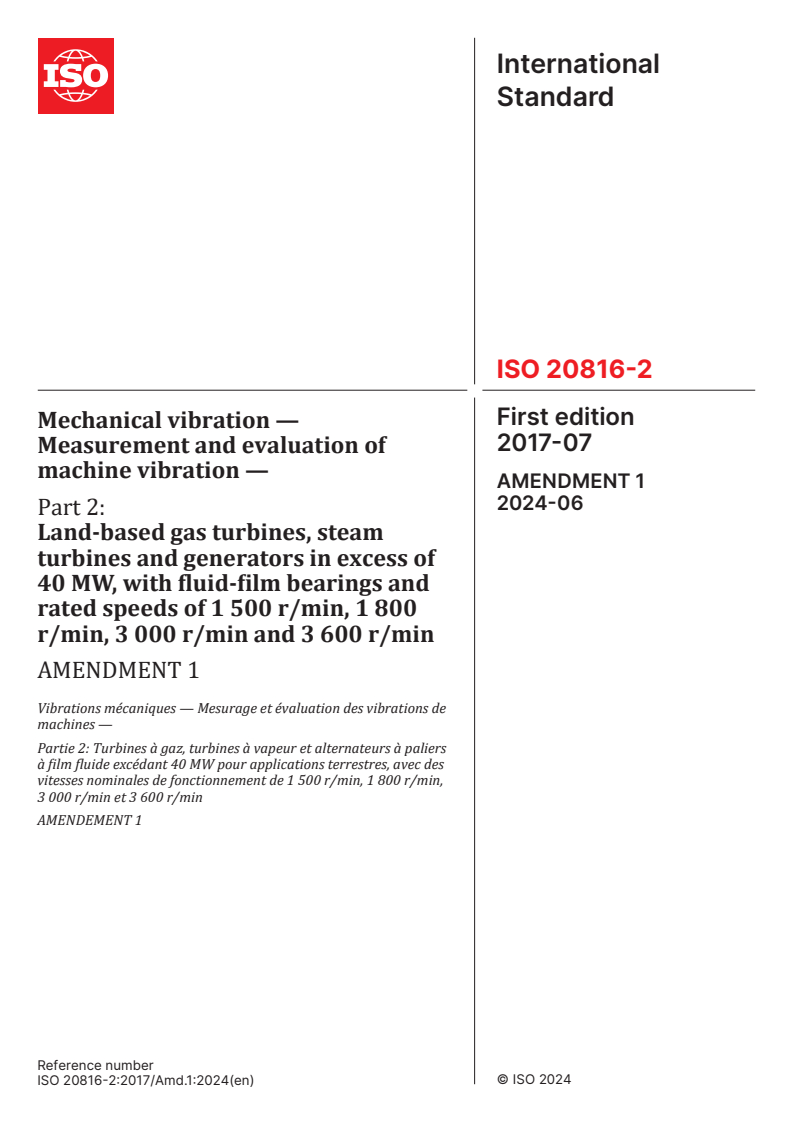
International
Standard
ISO 20816-2
First edition
Mechanical vibration —
2017-07
Measurement and evaluation of
machine vibration —
AMENDMENT 1
2024-06
Part 2:
Land-based gas turbines, steam
turbines and generators in excess of
40 MW, with fluid-film bearings and
rated speeds of 1 500 r/min, 1 800
r/min, 3 000 r/min and 3 600 r/min
AMENDMENT 1
Vibrations mécaniques — Mesurage et évaluation des vibrations de
machines —
Partie 2: Turbines à gaz, turbines à vapeur et alternateurs à paliers
à film fluide excédant 40 MW pour applications terrestres, avec des
vitesses nominales de fonctionnement de 1 500 r/min, 1 800 r/min,
3 000 r/min et 3 600 r/min
AMENDEMENT 1
Reference number
ISO 20816-2:2017/Amd.1:2024(en) © ISO 2024
ISO 20816-2:2017/Amd.1:2024(en)
© ISO 2024
All rights reserved. Unless otherwise specified, or required in the context of its implementation, no part of this publication may
be reproduced or utilized otherwise in any form or by any means, electronic or mechanical, including photocopying, or posting on
the internet or an intranet, without prior written permission. Permission can be requested from either ISO at the address below
or ISO’s member body in the country of the requester.
ISO copyright office
CP 401 • Ch. de Blandonnet 8
CH-1214 Vernier, Geneva
Phone: +41 22 749 01 11
Email: copyright@iso.org
Website: www.iso.org
Published in Switzerland
ii
ISO 20816-2:2017/Amd.1:2024(en)
Foreword
ISO (the International Organization for Standardization) is a worldwide federation of national standards
bodies (ISO member bodies). The work of preparing International Standards is normally carried out through
ISO technical committees. Each member body interested in a subject for which a technical committee
has been established has the right to be represented on that committee. International organizations,
governmental and non-governmental, in liaison with ISO, also take part in the work. ISO collaborates closely
with the International Electrotechnical Commission (IEC) on all matters of electrotechnical standardization.
The procedures used to develop this document and those intended for its further maintenance are described
in the ISO/IEC Directives, Part 1. In particular, the different approval criteria needed for the different types
of ISO document should be noted. This document was drafted in accordance with the editorial rules of the
ISO/IEC Directives, Part 2 (see www.iso.org/directives).
ISO draws attention to the possibility that the implementation of this document may involve the use of (a)
patent(s). ISO takes no position concerning the evidence, validity or applicability of any claimed patent
rights in respect thereof. As of the date of publication of this document, ISO had not received notice of (a)
patent(s) which may be required to implement this document. However, implementers are cautioned that
this may not represent the latest inf
...
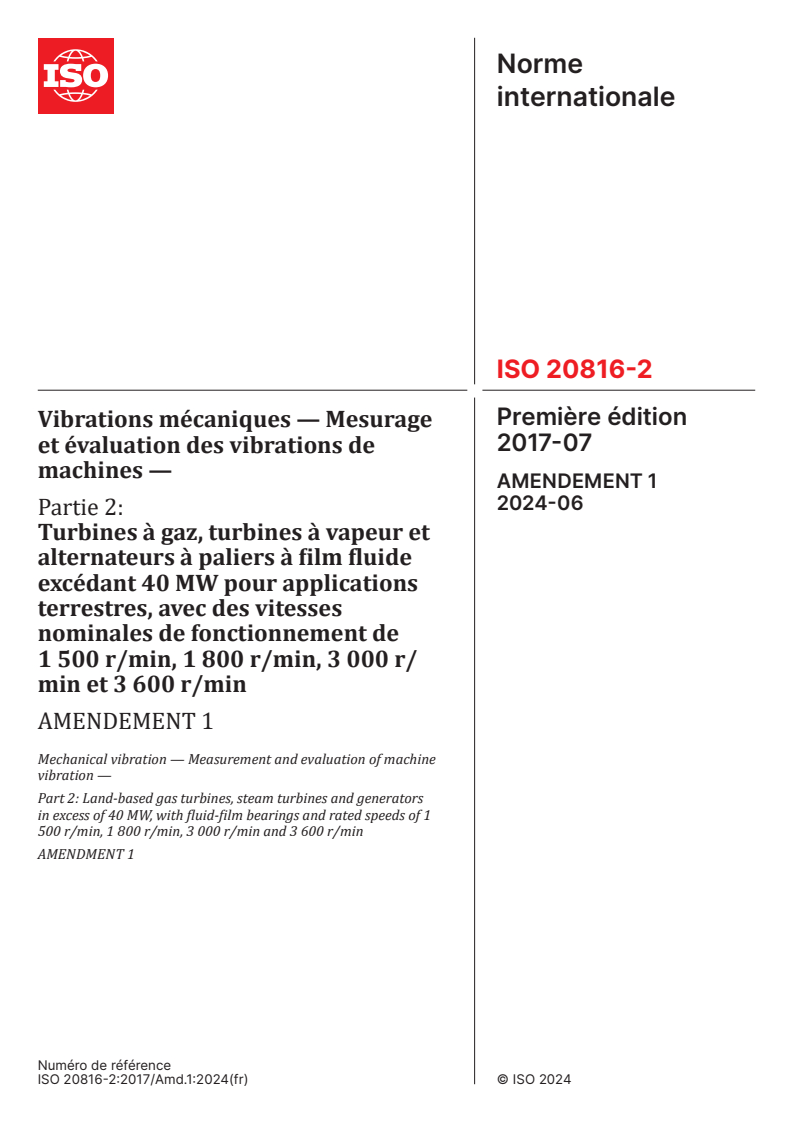
Norme
internationale
ISO 20816-2
Première édition
Vibrations mécaniques — Mesurage
2017-07
et évaluation des vibrations de
machines —
AMENDEMENT 1
2024-06
Partie 2:
Turbines à gaz, turbines à vapeur et
alternateurs à paliers à film fluide
excédant 40 MW pour applications
terrestres, avec des vitesses
nominales de fonctionnement de
1 500 r/min, 1 800 r/min, 3 000 r/
min et 3 600 r/min
AMENDEMENT 1
Mechanical vibration — Measurement and evaluation of machine
vibration —
Part 2: Land-based gas turbines, steam turbines and generators
in excess of 40 MW, with fluid-film bearings and rated speeds of 1
500 r/min, 1 800 r/min, 3 000 r/min and 3 600 r/min
AMENDMENT 1
Numéro de référence
ISO 20816-2:2017/Amd.1:2024(fr) © ISO 2024
ISO 20816-2:2017/Amd.1:2024(fr)
DOCUMENT PROTÉGÉ PAR COPYRIGHT
© ISO 2024
Tous droits réservés. Sauf prescription différente ou nécessité dans le contexte de sa mise en œuvre, aucune partie de cette
publication ne peut être reproduite ni utilisée sous quelque forme que ce soit et par aucun procédé, électronique ou mécanique,
y compris la photocopie, ou la diffusion sur l’internet ou sur un intranet, sans autorisation écrite préalable. Une autorisation peut
être demandée à l’ISO à l’adresse ci-après ou au comité membre de l’ISO dans le pays du demandeur.
ISO copyright office
Case postale 401 • Ch. de Blandonnet 8
CH-1214 Vernier, Genève
Tél.: +41 22 749 01 11
E-mail: copyright@iso.org
Web: www.iso.org
Publié en Suisse
ii
ISO 20816-2:2017/Amd.1:2024(fr)
Avant-propos
L'ISO (Organisation internationale de normalisation) est une fédération mondiale d'organismes nationaux
de normalisation (comités membres de l'ISO). L'élaboration des Normes internationales est en général
confiée aux comités techniques de l'ISO. Chaque comité membre intéressé par une étude a le droit de faire
partie du comité technique créé à cet effet. Les organisations internationales, gouvernementales et non
gouvernementales, en liaison avec l'ISO participent également aux travaux. L'ISO collabore étroitement avec
la Commission électrotechnique internationale (IEC) en ce qui concerne la normalisation électrotechnique.
Les procédures utilisées pour élaborer le présent document et celles destinées à sa mise à jour sont
décrites dans les Directives ISO/IEC, Partie 1. Il convient, en particulier, de prendre note des différents
critères d'approbation requis pour les différents types de documents ISO. Le présent document a
été rédigé conformément aux règles de rédaction données dans les Directives ISO/IEC, Partie 2 (voir
www.iso.org/directives).
L’attention est attirée sur le fait que certains des éléments du présent document peuvent faire l’objet
de droits de propriété intellectuelle ou de droits analogues. L’ISO ne saurait être tenue pour responsable
de ne pas avoir identifié de tels droits de propriété et averti de leur existence. Les détails concernant les
références aux droits de propriété intellectuelle ou autres droits analogues identifiés lors de l’élaboration du
document sont indiqués dans l’Introduction et/ou dans la liste des déclarations de brevets reçues par l’ISO
(voir www.iso.org/brevets).
Les appellations commerciales éventuellement mentionnées dans le présent document sont données pour
informati
...
ISO 20816-2:2017/DAMAmd 1:2023(F)
ISO TC 108/SC 2/WG #
Date: 2024-05-24(fr)
Première édition
2024-06
Vibrations mécaniques — Mesurage et évaluation des vibrations de
machines —
Partie 2 : :
Turbines à gaz, turbines à vapeur et alternateurs à paliers à film
fluide excédant 40 MW pour applications terrestres, avec des vitesses
nominales de fonctionnement de 1 500 r/min, 1 800 r/min, 3 000
r/min et 3 600 r/min
AMENDEMENT 1
Mechanical vibration - — Measurement and evaluation of machine vibration —
Part 2 :
: Land-based gas turbines, steam turbines and generators in excess of 40 MW, with fluid-film bearings and rated
speeds of 1 500 r/min, 1 800 r/min, 3 000 r/min and 3 600 r/min
AMENDMENT 1
ISO 20816-2:2017/DAMAmd 1:2023(F2024(fr)
Tous droits réservés. Sauf prescription différente ou nécessité dans le contexte de sa mise en œuvreoeuvre, aucune partie
de cette publication ne peut être reproduite ni utilisée sous quelque forme que ce soit et par aucun procédé, électronique
ou mécanique, y compris la photocopie, ou la diffusion sur l’internet ou sur un intranet, sans autorisation écrite préalable.
Une autorisation peut être demandée à l’ISO à l’adresse ci-après ou au comité membre de l’ISO dans le pays du
demandeur.
ISO copyright office
CP 401 • Ch. de Blandonnet 8
CH-1214 Vernier, Geneva
Téléphone : +Phone: + 41 22 749 01 11
E-mail : copyright@iso.org
Site web : www.iso.org
Website: www.iso.org
Publié en Suisse
ii
ISO 20816-2:2017/A1Amd 1:2024(fr)
Avant-propos
L'ISO (Organisation internationale de normalisation) est une fédération mondiale d'organismes nationaux de
normalisation (comités membres de l'ISO). L'élaboration des Normes internationales est en général confiée
aux comités techniques de l'ISO. Chaque comité membre intéressé par une étude a le droit de faire partie du
comité technique créé à cet effet. Les organisations internationales, gouvernementales et non
gouvernementales, en liaison avec l'ISO participent également aux travaux. L'ISO collabore étroitement avec
la Commission électrotechnique internationale (IEC) en ce qui concerne la normalisation électrotechnique.
Les procédures utilisées pour élaborer le présent document et celles destinées à sa mise à jour sont décrites
dans les Directives ISO/IEC, Partie 1. Il convient, en particulier, de prendre note des différents critères
d'approbation requis pour les différents types de documents ISO. Le présent document a été rédigé
conformément aux règles de rédaction données dans les Directives ISO/IEC, Partie 2 (voir
www.iso.org/directiveswww.iso.org/directives).
L’attention est attirée sur le fait que certains des éléments du présent document peuvent faire l’objet de droits
de propriété intellectuelle ou de droits analogues. L’ISO ne saurait être tenue pour responsable de ne pas avoir
identifié de tels droits de propriété et averti de leur existence. Les détails concernant les références aux droits
de propriété intellectuelle ou autres droits analogues identifiés lors de l’élaboration du document sont
indiqués dans l’Introduction et/ou dans la liste des déclarations de brevets reçues par l’ISO (voir
).
www.iso.org/brevetswww.iso.org/brevets
Les appellations commerciales éventuellem
...