


ISO 11134:1994
(Main)Sterilization of health care products — Requirements for validation and routine control — Industrial moist heat sterilization
Sterilization of health care products — Requirements for validation and routine control — Industrial moist heat sterilization
Specifies requirements for the use of moist heat in sterilization process development, validation of the sterilization process and control of routine sterilization. Covers all moist heat processes, including saturated steam and air-steam mixtures, and applies to all industrial manufacturers and all others who perform contract moist heat sterilization. Although moist heat sterilization in non-industrial health care facilities is not specifically covered, the principles outlined may be useful to the user of moist heat sterilization in these facilities.
Stérilisation des produits de santé — Prescriptions pour la validation et le contrôle de routine — Stérilisation industrielle à la vapeur d'eau
General Information
- Status
- Withdrawn
- Publication Date
- 26-Jan-1994
- Withdrawal Date
- 26-Jan-1994
- Technical Committee
- ISO/TC 198 - Sterilization of health care products
- Drafting Committee
- ISO/TC 198/WG 3 - Moist heat sterilization
- Current Stage
- 9599 - Withdrawal of International Standard
- Start Date
- 17-Aug-2006
- Completion Date
- 12-Feb-2026
Relations
- Effective Date
- 10-Feb-2026
- Effective Date
- 09-Feb-2026
- Effective Date
- 09-Feb-2026
- Effective Date
- 09-Feb-2026
- Effective Date
- 15-Apr-2008
Get Certified
Connect with accredited certification bodies for this standard

BSI Group
BSI (British Standards Institution) is the business standards company that helps organizations make excellence a habit.

TÜV Rheinland
TÜV Rheinland is a leading international provider of technical services.

TÜV SÜD
TÜV SÜD is a trusted partner of choice for safety, security and sustainability solutions.
Sponsored listings
Frequently Asked Questions
ISO 11134:1994 is a standard published by the International Organization for Standardization (ISO). Its full title is "Sterilization of health care products — Requirements for validation and routine control — Industrial moist heat sterilization". This standard covers: Specifies requirements for the use of moist heat in sterilization process development, validation of the sterilization process and control of routine sterilization. Covers all moist heat processes, including saturated steam and air-steam mixtures, and applies to all industrial manufacturers and all others who perform contract moist heat sterilization. Although moist heat sterilization in non-industrial health care facilities is not specifically covered, the principles outlined may be useful to the user of moist heat sterilization in these facilities.
Specifies requirements for the use of moist heat in sterilization process development, validation of the sterilization process and control of routine sterilization. Covers all moist heat processes, including saturated steam and air-steam mixtures, and applies to all industrial manufacturers and all others who perform contract moist heat sterilization. Although moist heat sterilization in non-industrial health care facilities is not specifically covered, the principles outlined may be useful to the user of moist heat sterilization in these facilities.
ISO 11134:1994 is classified under the following ICS (International Classification for Standards) categories: 11.080.01 - Sterilization and disinfection in general. The ICS classification helps identify the subject area and facilitates finding related standards.
ISO 11134:1994 has the following relationships with other standards: It is inter standard links to EN 60601-2-12:2006, EN ISO 22803:2005, EN ISO 25539-1:2009, EN ISO 5840:2009, ISO 17665-1:2006. Understanding these relationships helps ensure you are using the most current and applicable version of the standard.
ISO 11134:1994 is available in PDF format for immediate download after purchase. The document can be added to your cart and obtained through the secure checkout process. Digital delivery ensures instant access to the complete standard document.
Standards Content (Sample)
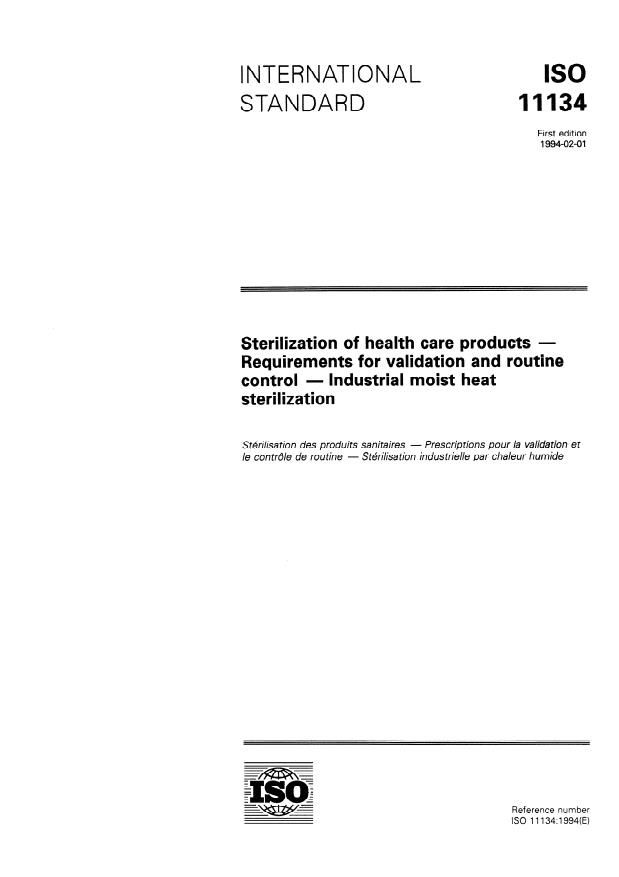
INTERNATIONAL IS0
STANDARD
First edition
1994-02-01
Sterilization of health care products -
Requirements for validation and routine
control - Industrial moist heat
sterilization
St&ilisa tion des produits sanitaires - Prescriptions pour la validation et
le contrdle de routine - St&ilisa tion indus trielle par chaleur humide
Reference number
IS0 11134:1994(E)
IS0 11134:1994(E)
Contents
Page
1 Scope . . . . . . . . . . . . . . . . . . .~.*.*.*.~
.~.,,.,.,,,.,~.~.~.
2 Normative references
. . . . . . . . . . .*.*.
3 Definitions
4 General . . . . . . . . . . . . . . . . . . . . . . . . . . . . . . . . . . . . . . . . . . . . . . . . . . . . . . . . . . . . . . . . . . . . . . . . . . . . . . . . . . . . . .
5 Equipment . . . . . . . . . . . . . . . . . . . . . . . . . . . . . . .*.*.
. . . . . . . . . . . . . . . . . . . . . . . . . . . . . . . . . . . . . . . . . . . . 5
6 Sterilization process development
..,....,,.,.,,,..,.,,............................. 5
7 Sterilization process validation
. . . . . . . . . . . . . . . . . . . . . . . . . . . .*.
8 Routine moist heat sterilization
Annexes
A Guidance for validation and routine control of industrial moist heat
sterilization . . . . . . . . . . . . . . . . . . . . . . . . . . . . . . . . . . . . . . . . . . . . . . . . . . . . . . . . . . . . . . . . . . . . . . . . . . . . . . .
. . . . . . . . . . . . . . . . . . . . . . . . . . . . . . . . . . . . . . . . . . .*.
B Sterilization cycles
C Bibliography .,.,,,.,.,.,,,,,.,,,.,.,.,.
0 IS0 1994
All rights reserved. No part of this publication may be reproduced or utilized in any form or
by any means, electronic or mechanical, including photocopying and microfilm, without per-
mission in writing from the publisher.
International Organization for Standardization
Case Postale 56 l CH-1211 Geneve 20 l Switzerland
Printed in Switzerland
ii
IS0 11134:1994(E)
Foreword
IS0 (the International Organization for Standardization) is a worldwide
federation of national standards bodies (IS0 member bodies). The work
of preparing International Standards is normally carried out through IS0
technical committees. Each member body interested in a subject for
which a technical committee has been established has the right to be
represented on that committee. International organizations, governmental
and non-governmental, in liaison with ISO, also take part in the work. IS0
collaborates closely with the International Electrotechnical Commission
(IEC) on all matters of electrotechnical standardization.
Draft International Standards adopted by the technical committees are
circulated to the member bodies for voting. Publication as an International
Standard requires approval by at least 75 % of the member bodies casting
a vote.
International Standard IS0 11134 was prepared by Technical Committee
lSO/TC 198, Sterilization of health care products.
Annexes A, B and C of this International Standard are for information only.
IS0 11134:1994(E)
Introduction
The manufacture of a safe and sterile health care product requires atten-
tion to product characteristics and to sterilization methods and controls.
This International Standard provides the essential elements of good
manufacturing practice for moist heat sterilization of health care products.
A sterile product is one that is free of viable microorganisms. Even items
produced under controlled manufacturing conditions may, prior to steril-
ization, have microorganisms on them. Such products are, by definition,
non-sterile. The purpose of sterilization processing is to destroy the
microbiological contaminants on these non-sterile products.
The destruction of microorganisms by physical and chemical agents fol-
lows an exponential law. Accordingly, one can calculate a finite probability
of a surviving microorganism regardless of the magnitude of the delivered
sterilization dose or treatment.
The probability of survival is a function of the number and types (species)
of microorganisms present on the product, the sterilization process
lethality, and, in some instances, the environment in which the organisms
exist during treatment.
It follows that the sterility of individual items in a population of products
sterilized cannot be guaranteed in the absolute sense. The probability of
non-sterility of each individual product unit is derived mathematically. For
example, with a probability of 10w6, the likelihood of a non-sterile product
unit is less than or equal to one in a million.
Requirements for the quality system for the design, development, pro-
duction, supply, installation and servicing of health care products are given
in the IS0 9000 series of Standards.
The IS0 9000 series of Standards designates certain processes used in
the manufacture of health care products as “special” in that the result
cannot be fully verified by subsequent inspection or testing of the product.
Sterilization is an example of a special process because efficacy cannot
be verified by inspection or testing of the product. For this reason, steril-
ization processes must be validated before use, the process routinely
monitored and the equipment maintained.
iv
INTERNATIONAL STANDARD IS0 11134:1994(E)
Sterilization of health care products - Requirements
- Industrial moist
for validation and routine control
heat sterilization
IS0 9001: 1987, Quality systems - Model for quality
1 Scope
assurance in design/development, production, instal-
la tion and servicing.
This International Standard specifies requirements for
the use of moist heat in sterilization process devel-
IS0 9002:1987, Quality systems - Model for quality
opment, validation of the sterilization process and
assurance in production and ins talla tion.
control of routine sterilization.
IS0 9003: 1987, Quality systems - Model for quality
It covers all moist heat processes, including saturated
assurance in final inspection and test.
steam and air-steam mixtures, and applies to all in-
dustrial manufacturers and all others who perform
IS0 11138-I: -1) Sterilization of health care products
contract moist heat sterilization. Although moist heat
- Biological indi’cators - Part I: General.
sterilization in non-industrial health care facilities is not
specifically covered in this International Standard, the
I EC 101 O-l : 1990, Safety requirements for electrical
principles outlined may be useful to the user of moist
equipment for measurement, control, and labora tory
heat sterilization in these facilities.
use - Part I: General requirements.
NOTE 1
While the general requirements of this Inter-
I EC 101 o-2-041 , Safety requirements for electrical
national Standard may apply to the sterilization of pharma-
ceuticals, other technical or regulatory requirements may equipment for measurement, control, and labora tory
also apply.
use - Part 2-04 1: Particular requirements for
autoclaves using steam for the treatment of medical
This International Standard does not cover the quality materials and for labora tory purposes.
assurance system which is necessary to control all
stages of manufacture, including the sterilization pro-
cess.
3 Definitions
For the purposes of this International Standard, the
following definitions apply.
2 Normative references
The following standards contain provisions which, 3.1 air-steam mixture: Uniform mixture of air and
through reference in this text, constitute provisions saturated steam used for sterilization.
of this International Standard. At the time of publi-
NOTE 2 Air is used to compensate for pressures gener-
cation, the editions indicated were valid. All standards
ated within sealed containers that exceed saturated steam
are subject to revision, and parties to agreements
pressures.
based on this International Standard are encouraged
to investigate the possibility of applying the most re-
cent editions of the standards indicated below. 3.2 bioburden: Population of viable microorganisms
Members of IEC and IS0 maintain registers of cur- on a raw material, component, a finished product
rently valid International Standards. and/or a package.
1) To be published.
IS0 11134:1994(E)
3.3 certification: Documented review and approval functions within predetermined limits when operated
process carried out as a final step in the validation in accordance with operational instructions.
programme to permit product release.
3.17 recommissioning: Repetition of part or all of
the commissioning test requirements for the purpose
3.4 D value: Exposure time required under a defined
of reconfirming process reliability.
set of conditions to cause a l-logarithm or 90 % re-
duction in the population of a particular microorgan-
3.18 revalidation: Repetition of part or all of the
ism.
validation test requirements for the purpose of re-
confirming process reliability.
35 electromechanical control: Control system that
uses mechanical means (e.g. cams or punch cards) to
3.19 saturated steam: Water vapour at a tempera-
time and initiate the electrical control signals.
ture corresponding to the boiling point of the source
liquid.
36 . environmental controls: Controls established
in the product manufacturing areas to control biobur-
3.20 simulated product load: Load that is used as
den.
an alternative to the actual product load and that rep-
resents an equal or greater challenge to the process.
NOTE 3 These may include air and fluid filters, surface
disinfection, personnel uniforms and administrative pro-
3.21 sterile: State of being free from viable micro-
cedures.
organisms.
.
37 F ’ value: Measure of the micro lb1 ological inacti-
NOTE 6 In practice no such absolute statement regarding
v&i0 in capability of a heat sterilization recess.
P
the absence of microorganisms can be proven (see steril-
ization).
3.8 FO value: F value calculated at 121,l “C
(250 “F) with a z value of 10 K and a D value of
3.22 sterilization: Validated process used to render
1 min.
a product free of all forms of viable microorganisms.
3.9 materials of construction: Materials used in
NOTE 7 In a sterilization process, the nature of micro-
the sterilization equipment composition.
biological death is described by an exponential function.
Therefore, the presence of microorganisms on any individ-
ual item may be expressed in terms of probability. While
3.10 microbiological challenge: Biological indi-
this probability may be reduced to a very low number, it can
cators, biological-indicator test packs, or inoculated
never be reduced to zero.
product that contain known populations of micro-
organisms and can be used in testing sterilization cy-
3.23 sterilization cycle: Automatic sequence of op-
cles.
erating stages performed in the sterilizer.
3.11
moist heat: Heat that is derived from water,
3.24 sterilization process development: Studies
either as a liq uid or as steam under pressure.
conducted to develop a reproducible process by
which the product may be sterilized to the desired
3.12 moist heat sterilization: Process of using
probability of a non-sterile unit without damage.
moist heat to produce a sterile product.
3.25 validation: Documented procedure for obtain-
3.13 primary packaging: Element of the packaging
ing, recording and interpreting the results required to
system that maintains the sterility of the product.
establish that a process will consistently yield product
complying with predetermined specifications.
3.14 process lethality: Capability of the sterilization
process to destroy microorganisms.
NOTE 8 Validation covers three activities: commission-
ing, verification of process specification and performance
NOTE 4 This may be determined by measurements of qualification.
microbial death or by establishing and measuring the re-
quired physical parameters.
3.26 z value: Number of degrees of temperature
required for a l-logarithm change in the D value.
3.15 product carrier system: Mechanism used to
hold the product and its packaging for sterilization.
4 General
NOTE 5 The carrier system should prevent product dam-
age and allow uniform access by the sterilizing agent. 4.1 Responsibilities and training of
personnel
3.16 commissioning: Obtaining and documenting
evidence that equipment has been provided and in- Responsibility for the installation and maintenance of
stalled in accordance with its specification and that it moist heat sterilizers, for the validation and routine
IS0 11134:1994(E)
control of moist heat sterilization, and for the release 5.1.2 Safety
of sterilized product shall be assigned to qualified
all be provided to demon-
personnel as specified in IS0 9001 or IS0 9002. Documen taty evidence sh
strate tha t the sterilization system compli es with the
safety requirements specified in IEC 1010-l and
4.2 Product considerations
IEC 1010-2 and any other standards or regulatory re-
quirements applicable in the country of use.
The product shall be designed to comply with its
specification and requirements for safety and efficacy
following exposure to the maximum number of steril-
5.1.3 Manuals and instructions
ization cycles specified for the product. If any treat-
ment is required prior to sterilization (for example,
As a minimum, the following information shall be
cleaning) this shall also be validated as part of the re-
available for each identified sterilizer in the language
sterilization procedure. The product shall be designed
agreed to by the user:
and materials shall be selected to be compatible with
environmental changes occurring in the sterilization
a) instructions for the installation of the sterilization
chamber during the sterilization cycle.
system sufficient to ensure safe and effective op-
eration of the equipment;
43 . Packaging considerations
b) a list of materials of construction exposed to the
sterilant or to inadvertent contact with the product;
4.3.1 General
c) instructions for safe and effective operation, in-
The packaging shall consist of at least a primary
cluding recommendations for vessel temperature
package and a secondary package.
and pressure limits as well as safety precautions;
The primary package and, if present at the time of
SC hedu les for rou-
d) instr ,uctions and recommended
sterilization, the secondary package shall comply with
tine preventive maintenance;
its specification following sterilization.
e) a repair manual including a list of recommended
4.3.2 Packaging permeability
replacement parts;
The packaging shall permit the attainment of steriliz-
f) chamber drawings sufficient to define configur-
ing, conditions on or within the product either by the
ation and hardware, pipe-work and control system
removal of air and penetration of steam or, for non-
schematic drawings, recommended installation
permeable packaging (e.g. for vials containing liquids),
drawings, and a parts list defining all significant
by heat transfer.
system components;
g) process-control logic and/or software documen-
5 Equipment
tation necessary to operate and maintain the
equipment control system (see 5.2.6). Any soft-
5.1 Documentation
ware supplied shall be accompanied by proof of
validation of its release and revision level.
5.1 .I Identification
5.1.4 Additional information
Each sterilization system shall have one or more in-
formation plates, permanently fastened and marked,
The specifications for a sterilizer to be used for moist
that provide the following information in the language
heat sterilization, including its installation and instal-
agreed to by the user:
lation tests, shall be documented.
name and address of the manufacturer;
a)
b) serial number or other system identification; 5.2 Sterilizer performance, utilities,
components, accessories and controls
c) chamber design pressure and maximum working
temperature;
5.2.1 Performance
d) jacket pressure rating (if applicable);
Sterilization systems used to process health care
e) stamp of inspe ction authority and identif i- products by moist heat shall be provided in accord-
cation ma rk; ance with regulations or standards for sterilization
equipment performance applying in the country of
f) date of primary construction of the vessel. use.
IS0 11134:1994(E)
5.2.2 Utilities 5.2.6 Control programmes
Programmes used to execute and control the steril-
5.2.2.1 Steam purity and quality shall be specified
ization process, whether microprocessor or electro-
and demonstrated to be adequate for its intended
mechanically based, shall be validated. The
documented control programme shall be evaluated by
procedures designed to demonstrate the correctness
5.2.2.2 The purity of the compressed air used in the
of the programme logic in both process simulated
sterilization chamber shall be such that the safety of
conditions and actual sterilizer use. Any subsequent
the product is not impaired.
changes shall be similarly documented, be evaluated
to assess whether revalidation is required and be ap-
proved by the user.
5.2.2.3 Ambient air admitted to the chamber to re-
lieve the vacuum shall pass through a
microbiological-retentive filter for all products with
5.3 Performance of instruments
packaging that is permeable by air.
5.3.1 Instrument accuracy
5.2.2.4 Water used in the sterilizer as a means of
direct cooling of product shall be specified and verified
5.3.1.1 Accuracy of instruments used for validation
to meet the requirements established during product
shall exceed the accuracy of the controller and re-
development. This shall be documented.
corder system.
5.2.2.5 Electrical power supplied to the sterilization
5.3.1.2 Temperature and pressure sensors shall be
system shall comply with the manufacturer’s specifi-
selected, installed and used in a manner which will
cation.
ensure that the stated accuracy is maintained.
5.2.3 Components 5.3.2 Calibration standards
The materials and components used in the con- The accuracy of standards used to calibrate process
struction of the sterilization system shall be selected measurement instruments shall be specified and cali-
to minimize the potential for microbiological or bration shall be traceable to a national reference
chemical contamination. standard as specified in IS0 9003.
5.3.3 Sterilizer reference instruments
5.2.4 Accessories
The sterilizer shall be equipped with a separate
The system designed to support the product in the
measuring system to verify that values measured by
chamber shall be designed to allow uniform steam
controlling instruments are within the specified tem-
penetration and/or heat transfer. The carrier system
perature and pressure limits during each cycle.
shall also allow drainage of condensate and/or cooling
water, prevent damage to the product and retain the
integrity of the load.
5.3.4 Calibration programme
An effective procedure shall be established, docu-
5.2.5 Control and recording systems
mented and maintained for the calibration of all
controlling, indicating and recording instruments used
The following process paramete rs shall be au toma ti-
for validation and routine control of the sterilization
tally controlled and recorded:
cycle. The procedure shall comply with the require-
ments of IS0 9001, IS0 9002 and, for instruments
a) temperature;
used for validation, IS0 9003.
b) time;
5.4 Maintenance
c) pressure;
5.4.1 A sterilizer shall be maintained in accordance
d) rate of change of temperature and pressure, if re-
with a documented planned preventive maintenance
quired for product integrity.
scheme.
The recorder and process control systems shall either
be independent or designed in a manner that will
5.4.2 Person(s) carrying out maintenance shall have
cause a warning to occur should the difference be- documentary evidence to demonstrate successful
tween a controlled and recorded variable exceed
training in the skills needed to maintain the specified
specified limits. sterilizer(s).
IS0 11134:1994(E)
5.4.3 The procedure for each planned maintenance
7 Sterilization process validation
task and the frequency with which it is carried out
shall be specified and documented.
7.1 The validation programme shall be performed
using an approved protocol that conforms to the prin-
5.4.4 A sterilizer shall not be used to process health
ciples outlined in IS0 9002.
care products until scheduled and unscheduled main-
tenance tasks have been satisfactorily completed and
recorded accordingly.
7.2 Each production sterilizer shall be commissioned
upon installation. New products and new sterilization
equipment or process conditions shall be validated.
5.4.5 Records of maintenance shall be retained in
an equipment file.
7.3 Validation activities shall be assigned to a des-
5.4.6 The maintenance scheme, maintenance pro-
ignated person experienced in this task.
cedures and maintenance records shall be reviewed
periodically by a designated person.
7.4 The process validation shall consist of a com-
missioning of the systems, a performance quali-
6 Sterilization process development
fication, and certification.
6.1 Except where compliance with the product
7.4.1 The commissioning shall include:
specification would be compromised, sterilization by
saturated steam shall be used. Where other methods
demonstration of compliance with design per-
a)
are to be used (e.g. air-steam mixtures) reproducibility
formance specifications;
of the environment within the chamber shall be dem-
onstrated.
documentation of the equipment (see 5.1.3);
b)
Air-steam mixtures shall only be used in combination
d demonstration of conformance of the quality and
with effective circulation that creates a uniform heat-
capacity of utilities;
ing medium throughout the sterilizer. Where air-steam
mixtures are used and steam penetration is required,
calibration of both operating and test instrumen-
d)
the circulation system shall create a uniform air-steam
tation; and
mixture within the load.
when applicable, demonstration of efficacy of air
e)
6.2 The sterilization cycle shall be developed to be
removal.
reproducible during routine processing.
7.4.2 The performance qualification shall include:
6.3 The attainment of sterilizing conditions in the
product processed in newly-developed moist heat
demonstration of process reproducibility (through
a)
sterilization cycles shall be demonstrated.
the use of sufficient cycles);
6.4 Any product handling or storage after steril- demonstration of uniformity within specified limits
b)
ization at the site of sterilization shall not compromise throughout the chamber and load (through the use
the qualities of the product. of sufficient cycles and sensors);
d demonstration of the relationship between control
6.5 The probability of a non-sterile product unit shall
and load parameters;
be selected to ensure that the sterile health care
product has a sufficiently low probability of a surviving
demonstration of the correlation of physical par-
d)
microorganism to be safe for its intended use.
ameters to microbiological lethality by data taken
from established literature or from original re-
6.6 If indicator microorganisms are used, they shall
search;
be selected with reference to the sterilization process
and shall meet the requirements of IS0 11138-I.
e) demonstration that both maximum and minimum
loading (or specified product mix) are compatible;
6.7 Data generated during cycle development shall
demonstrate that the required probability of survival
if simulated product loads are used, demonstration
f )
of the bioburden has been achieved.
that the simulated product loads are represen-
tative of actual products;
6.8 For sterilization processes based upon biobur-
den, there shall be a bioburden programme which demonstration that qualification loads that will be
9)
determines the numbers and resistance of the bio- re-used have returned to specified conditions be-
burden prior to sterilization. fore re-use; and
IS0 11134:1994(E)
h) demonstration that the product and packaging d) operator identification and signature;
comply with the specification after sterilization
and, where applicable, resterilization. e) cycle start time (real time);
f) chamber pressure throughout the cycle;
7.4.3 The number of temperature sensors to be
used for performance qualification and performance
g) chamber temperature throughout the cycle;
requalification shall be specified. Documented evi-
dence shall be provided to demonstrate that this
h) timing of critical process parameters.
number is sufficient to establish that the process
conforms to specifications generated during process
development.
8.2 Change control
7.4.4 The calibration of temperature measurement
There shall be documented procedures in place to
systems used for validation shall be verified before
ensure that no changes take place in equipment, pro-
and after each programme of sequential tests. cess or materials that could affect the sterilization
process. If such changes do occur as a planned event,
the new sterilization cycle shall be validated. Process
7.5 At the completion of the validation there shall
failures that cannot be attributed to lack of adherence
be a formal review and approval of the recorded data.
to process specifications shall be examined to deter-
mine the need for requalification.
7.6 Revalidation shall be done whenever there has
been a major repair to the sterilization system that
8.3 Periodic testing
could affect the efficacy of the process. Revalidation
shall also be performed at least once every
Steri lizers shall be tested periodically in accordance
12 months.
with a documen ted plan.
7.7 Procedures for revalidation, review and im-
8.4 Microbiological testing
plementation of changes to the process, sterilization
system (hardware and software), product or packag-
If the efficacy of the process cycle is based on a study
ing shall be documented. The procedures shall include
or estimate of the bioburden on the product,
the assignment of responsibility for determining the
necessity and extent of repeating elements of the
the method used to determine the bioburden or
original validation studies. a)
the estimate of the bioburden shall be validated
Modifications to equipment or control systems shall
and documented;
be evaluated to confirm that the process conditions
delivered to the product load are comparable to those
means shall be provided to ensure that the limits
b)
originally qualified.
specified for bioburden are not exceeded; and
a continuing programme of product bioburden
d
8 Routine moist heat sterilization
monitoring shall be carried out at a prescribed fre-
quency and the rationale documented.
8.1 Steam sterilization process control
8.5 Release of sterilized products
8.1.1 The accuracy and reliability of instrumentation
To release the product, the process parameters
used to monitor each production cycle shall be
monitored during routine sterilization shall be within
periodically checked for compliance with their specifi-
the validated limits. A system to differentiate between
cation.
processed and unprocessed items shall be used. Only
authorized persons shall release products after steril-
8.1.2 Documented procedures for the routine moni-
ization.
toring of the sterilization cycle shall be provided.
8.6 Audit of operations
8.1.3 For each cycle, a record shall be retained of
the following:
Production and quality control procedures and records
shall be reviewed in accordance with IS0 9001 at
a) date;
least annually. Competent personnel not directly in-
volved in these procedures shall ensure that the pro-
b) sterilizer identification;
cess specifications established during qualification
testing are followed and remain valid.
c) cycle identification;
IS0 11134:1994(E)
reviewed by a designated person to determine the
8.7 Corrective action
proper steps and corrective action required.
Procedures and documentation for corrective action
shall comply with IS0 9001. Any deviations from
8.8 Records
specifications or procedures uncovered during oper-
ations, audits, calibrations or maintenance shall be
Records to demonstrate that the product has been
sterilized in accordance with all specifications shall be
produced and maintained as specified in IS0 9001.
IS0 11134:1994(E)
Annex A
(informative)
Guidance for validation and routine control of industrial moist heat
sterilization
NOTE 9 The clauses in this annex provide guidance on A.4.2.2 Selection of materials
the related clause in the body of the Standard.
In selecting materials, the ability to withstand the
physical stresses inherent in moist heat sterilization is
A.1 Scope
essential. For some materials, it is also essential that
the material be readily permeable by air and steam.
No guidance is offered.
Procedures should be specified and followed to en-
sure that the materials used in the production are of
A.2 Normative references
equivalent qualities as those used in the validated
products. As improving one quality can lead to a
No guidance is offered.
negative effect on another quality, any change could
require revalidation.
A.3 Definitions
A.4.3 Packaging considerations
No guidance is offered.
The same considerations given to product design (see
A.4.2.1) and selection of materials (see A.4.2.2) apply
A.4 General
to packaging. Also, to allow proper transportation and
handling of the sterile product, the packaging should
A.4.1 Responsibilities and training of
be designed to accommodate shelf-life requirements.
personnel
The product and its packaging should withstand the
rates of change of temperatures and pressures oc-
No guidance is offered.
curring during the sterilization cycle.
This packaging design should consist of not less than
A.4.2 Product considerations
two layers, which may include:
A.4.2.1 Product design
a) primary packaging containing the product, or the
product itself where only the inside is considered
When moist heat is to be used to sterilize health care
sterile (such as the fluid path of tubing);
products, the product should
NOTES
a) be able to withstand moisture and the relative high
values and rates of changes in temperature and
10 Fittings and closures intended to keep the inside
pressure;
of the product sterile are designed and validated to at
least the same standards as the primary packaging ma-
b) facilitate the contact between the sterilant and all
terials.
the surfaces to be sterilized;
11 The primary packaging may consist of more than
one layer to ensure that, after the outer layer has been
c) remain sterile (for those parts intended to be ster-
removed and the product is presented to the user,
ile) when properly stored.
particulate and biological carryover is at a minimum.
These points should be considered when the product
b) secondary packaging containing one or more
is designed. Simple design changes that do not affect
primary packages intended to facilitate proper
product performance could possibly prevent steril-
storage and internal transport by the user;
ization and validation problems.
Any change in design should not be implemented
c) transport packaging protecting the product(s)
before the factors mentioned above are considered
and the primary and secondary packaging during
and, if necessary, validated.
external transport.
IS0 11134:1994(E)
For sterile products, the total packaging configuration to allow the emergency shutdown from inside the
should perform the functions of a primary package, chamber.
secondary package and transport package as de-
scribed above. For sterile fluid path products, the
A.5.1.3 Manuals and instructions
packaging should perform at least the functions of a
secondary package and transport package. Also, all
Information should be supplied to enable the pur-
packaging configurations should be strong enough to
chaser to prepare for installation, to install and operate
protect the product during intended handling and
the sterilizer system, and to perform routine main-
shipping.
tenance.
During sterilization, the product will be contained in
A.5.1.3.1 The installation instructions should include
at least the primary packaging but sterilizing products
in the secondary or
transport package is not uncom-
a) the overall dimensions and mass of the sterilizer
mon.
system;
The properties needed for a good packaging design
b) the type of electrical supply, voltage, frequency
for sterilization are, in general, in contradiction with
and power;
those needed for optimum protection of the product.
A compromise may be made in either the selection
c) the flow and pressure for steam, water and com-
of packaging materials or in the level to which the
pressed air supplies;
product is packed prior to and during sterilization.
d) sound power.
In contract sterilization, the use of temporary second
and third packaging layers should be considered dur-
ing transport prior to sterilization. A.5.1.3.2 The instructions for safe and effective
system operation should include
A.5 Equipment
a) the range of application, type of load, kind of
packing;
A.5.1 Documentation
b) the capacity;
A.5.1 .l Identification
c) a description of the available sterilizing cycles;
No guidance is offered.
d) a description of controls and indicating devices;
A.5.1.2 Safety
e) a description of safety devices;
Written instructions should be available to alert the
user of potential hazards associated with equipment
f) safety instructions;
use.
g) instructions in the event of a malfunction.
The equipment, including the pressure vessel, should
comply with IEC 101 O-l and IEC 101 O-2 and addition-
A.5.1.3.3 The maintenance/repair instructions
ally, where appropriate, to national safety regulations
should include
applying in the country of intended use.
a) maintenance procedures;
Means should be provided to ensure that the system
cannot be accidentally operated unless the chamber
b) the recommended maintenance interval or time-
door(s) is (are) closed, sealed and locked. The sterilizer
table;
should be provided with means to prevent the door(s)
from being unsealed when the chamber is pressur-
c) electrical diagrams and circuits;
ized. Unless a fault condition is indicated, the sterilizer
door(s) should only be able to be unsealed, unlocked
d) hydraulic plans and circuits;
and opened at the end of a sterilization cycle. The
sterilizer should also be provided with means to return
e) a spare parts list;
the chamber to atmospheric condition and open the
loading door(s) if a breakdown of the automatic cycle
f) safety procedures.
occurs.
If a loading, unloading or maintenance operation re-
A.5.1.3.4 The process-control logic and/or software
quires entrance into the chamber, means should be
documentation necessary to operate and maintain the
provided to enable the door(s) to be locked open and
equipment control system (or any other software
the key removed and retained by the operator before
supplied) should be provided and should be accom-
entry into the chamber, or means should be provided
panied by proof of validation. This validation may be
IS0 11134:1994(E)
performed either by an independent party or by the cal penetration which would not occur under normal
manufacturer of the software in accordance with the conditions. Also, normally sealed packaging can
requirements of the appropriate Standards in the breathe if heat-induced expansion of components
IS0 9000 series. and/or internal vacuums, caused by cooling of air in
the product, occur.
A.5.1.4 Installation
A.5.2.2.3 Water
A series of checks and tests should be performed af-
ter installation of the sterilizers in the location of in- The feed water for steam production and the water
for direct cooling should be free from contaminants in
tended use. The manufacturer, the supplier and the
purchaser should agree upon the assignment of re- a concentration that could impair the sterilization pro-
sponsibility for performing these checks and tests. cess, harm the sterilizer or damage the products to
be sterilized. See tableA. for typical limiting values
of contaminants. The water for the vacuum system
A.5.2 Sterilizer performance, utilities,
should be of potable quality, supplied at a temperature
components, accessories and controls
not exceeding 15 “C, and should be of a hardness
value less than or equal to 0,2 mmol/l.
A.5.2.1 Performance
The performance of the sterilizer should be checked
Table A.1 - Typical limiting values of
through a test programme that complies with appro-
contaminants of steam and/or water in contact
priate national regulations or standards.
with product and/or product packaging
Contaminant Limiting value
A.5.2.2 Utilities
evaporation residue < 15 mg/l
A.5.2.2.1 Steam
silicie
The sterilizer should be designed to operate with < 2 mg/l
saturated steam or preset air-steam mixtures. Where
saturated steam is used, the steam should have a
iron < 02 mg/l
dryness value not less than 0,95 containing not more
than 3,5 % (VW) of non-condensable gases and not
cadmium G 0,005 mg/l
superheated more than 5 “C. To ensure continued
steam quality, the steam, on condensing, should not
lead G 0,05 mg/l
contain contaminants in a quantity that could impair
the sterilization process, harm the sterilizer or com-
rest of heavy metals
G 0,l mg/l
promise the product integrity. The steam pressure
fluctuation before the sterilizer pressure reduction
chloride < 3 mg/l
valve should not exceed 10 % and the reduction ratio
should not be greater than 2 to I.
phosphate G 0,5 mg/l
A.5.2.2.2 Air
conductivity < 50 ps/cm
I
A.5.2.2.2.1 The sterilizer should be designed to op-
erate with a compressed air supply, free of liquid wa-
6,5 to 8
PH
ter, filtered to 5 pm and containing not more than
0,5 mg of oil per cubic metre of free air. Compressed
colourless, clean, without
appearance
air should be passed through a microbiological
sediment
retentive filter at the point of use. The filter should
retain not less than 99,5 % of particles greater than
hardness < 0,l mmol/l
0,3 pm.
A.5.2.2.2.2 For sterilizers where the operating cycle
A.5.2.2.4 Electrical power
requires the admission of air directly from the atmos-
phere into the chamber, the air should be admitted
The sterilizer should be designed to operate when the
through a filter that retains not less than 99,5 % of
main voltage is maintained with & 10 % of the nom-
particles greater than 0,3 pm.
inal supply voltage. The sterilizer should be designed
to operate with an electrical supply provided with
A.5.2.2.2.3 Sealed products may not require air ad-
means simultaneously to isolate all poles from the
mitted to the chamber to be microbiologically filtered.
mains supply and where each pole is separately
Permeable packaging under conditions of vacuum,
fused.
heat and humidity may, however, allow microbiologi-
IS0 11134:1994(E)
A.5.2.3 Components and to which standard(s) the validation was per-
formed.
The materials used should resist the attack of steam
The logic of electromechanical or other means of
and condensate, should not lead to deterioration of
control should also be validated.
the quality of the steam and should not release any
substances known to be toxic in quantities that could
create a health hazard. A.5.3
Performance of instruments
Pipe joints and fittings should be pressure-tight and
A.5.3.1 Instrument accuracy
vacuum-tight. The pipe-work for steam or water at a
temperature greater than 70 “C should be thermally
A.5.3.1.1 The temperature control device should
insulated. The cold water pipe-work should be insu-
lated. The design of the piping system should take
a) be either digital or analogue;
into account the needs of drainage and sterilization.
b) have an accuracy of + 1 % over the scale range
Lines should not connect directly to a drain without
50 “C to 150 “C; -
means to avoid back-syphoning. Heat exchangers
should prevent leakage of external media into the cir-
c) be adjusted to + 0,5 K at the sterilization tem-
culation system.
perature;
Connections should be provided so that temperature
d) have broken sensor protection;
sensors can be inserted for testing temperature dis-
tribution and product heat penetration. Sterilizers with
stable key, code or tool
a vacuum stage should be equipped with a threaded e) be adju the use of a
by
without disma ntli ng th e instrum ent.
connection to the sterilization chamber for test in-
struments.
A.5.3.1.2 The pressure control device should
A.5.2.4 Accessories
a) be either digital or analogue;
No guidance is offered.
b) have an accuracy of + I,6 % or better over the
scale range 0 to 5 bar-
A.5.2.5 Control and recording system
c) have broken sensor protection;
The sterilization cycle should be controlled by an
automatic programme control that has one or more
d) be adjustable in situ by the use of a key, code or
preset sterilization cycles. Provisions may be made to
tool without dismantling the instrument.
adjust the stage parameters of the preset sterilization
cycles. Access to the control device should be re-
A.5.3.1.3 The time control device should have an
stricted through the use of a special key, code or tool.
accuracy of + 1 % or better for time periods above
For maintenance, test purposes and in any case of
5 min and have an accuracy of + 2,5 % or better for
emergency, means should be provided to permit
time periods of up to 5 min.
manual progression of the programme. During the
Where possible, the systematic errors should be
manual process, any safety devices should not be
quantified and corrected by applying the appropriate
circumvented.
correction factors.
The recorder may be either analogue or digital and
should produce permanent, legible records of the val-
A.5.3.2 Calibration standards
ues of the process parameters throughout the steril-
ization cycle. The rate of change of temperature and
No guidance is offered.
pressure may be derived from the time, temperature
and pressure recordings, rather than from a distinct
A.5.3.3 Sterilizer reference instruments
recording.
The sterilizer reference instruments should enable
A.5.2.6 Control programmes
detection of controlling instrument drift or changes in
performance. Both measurement systems should be
The sterilizer manufacturer is responsible for the
under the same calibration programmes. The refer-
quality of the software. For proprietary reasons the
ence measuring instrument performance should equal
sterilizer manufacturer may decide not to disclose the
or exceed that of the controlling system.
software source list. In this case, the manufacturer
should supply the user with a validation statement The maximum allowable deviation between the two
that includes a reference indicating on which points measurement systems should be established in the
system design, process development, or equipment
IS0 11134:1994(E)
qualification phase. The measurement system should
A.6 Sterilization process development
be recalibrated if the deviation between the two
measurements exceeds the specified limit.
NOTE 12 See also annex B.
A.5.3.4 Calibration programme
A.6.1 Selection of the type of sterilization cycle to
be used depends upon the product configuration and
A documented calibration prog
...
Questions, Comments and Discussion
Ask us and Technical Secretary will try to provide an answer. You can facilitate discussion about the standard in here.
Loading comments...