


ISO 2041:2009
(Main)Mechanical vibration, shock and condition monitoring — Vocabulary
Mechanical vibration, shock and condition monitoring — Vocabulary
ISO 2041:2009 defines terms and expressions unique to the areas of mechanical vibration, shock and condition monitoring.
Vibrations et chocs mécaniques, et leur surveillance — Vocabulaire
General Information
- Status
- Withdrawn
- Publication Date
- 16-Jul-2009
- Withdrawal Date
- 16-Jul-2009
- Technical Committee
- ISO/TC 108 - Mechanical vibration, shock and condition monitoring
- Drafting Committee
- ISO/TC 108 - Mechanical vibration, shock and condition monitoring
- Current Stage
- 9599 - Withdrawal of International Standard
- Start Date
- 09-Oct-2018
- Completion Date
- 12-Feb-2026
Relations
- Effective Date
- 10-Feb-2026
- Effective Date
- 10-Feb-2026
- Effective Date
- 04-Nov-2015
- Effective Date
- 15-Apr-2008


Get Certified
Connect with accredited certification bodies for this standard

BSMI (Bureau of Standards, Metrology and Inspection)
Taiwan's standards and inspection authority.
Sponsored listings
Frequently Asked Questions
ISO 2041:2009 is a standard published by the International Organization for Standardization (ISO). Its full title is "Mechanical vibration, shock and condition monitoring — Vocabulary". This standard covers: ISO 2041:2009 defines terms and expressions unique to the areas of mechanical vibration, shock and condition monitoring.
ISO 2041:2009 defines terms and expressions unique to the areas of mechanical vibration, shock and condition monitoring.
ISO 2041:2009 is classified under the following ICS (International Classification for Standards) categories: 01.040.17 - Metrology and measurement. Physical phenomena (Vocabularies); 17.160 - Vibrations, shock and vibration measurements. The ICS classification helps identify the subject area and facilitates finding related standards.
ISO 2041:2009 has the following relationships with other standards: It is inter standard links to EN 61300-2-9:2017, EN 60068-2-75:2014, ISO 2041:2018, ISO 2041:1990. Understanding these relationships helps ensure you are using the most current and applicable version of the standard.
ISO 2041:2009 is available in PDF format for immediate download after purchase. The document can be added to your cart and obtained through the secure checkout process. Digital delivery ensures instant access to the complete standard document.
Standards Content (Sample)
INTERNATIONAL ISO
STANDARD 2041
Third edition
2009-08-01
Mechanical vibration, shock and
condition monitoring — Vocabulary
Vibrations et chocs mécaniques, et leur surveillance — Vocabulaire
Reference number
©
ISO 2009
PDF disclaimer
This PDF file may contain embedded typefaces. In accordance with Adobe's licensing policy, this file may be printed or viewed but
shall not be edited unless the typefaces which are embedded are licensed to and installed on the computer performing the editing. In
downloading this file, parties accept therein the responsibility of not infringing Adobe's licensing policy. The ISO Central Secretariat
accepts no liability in this area.
Adobe is a trademark of Adobe Systems Incorporated.
Details of the software products used to create this PDF file can be found in the General Info relative to the file; the PDF-creation
parameters were optimized for printing. Every care has been taken to ensure that the file is suitable for use by ISO member bodies. In
the unlikely event that a problem relating to it is found, please inform the Central Secretariat at the address given below.
© ISO 2009
The reproduction of the terms and definitions contained in this International Standard is permitted in teaching manuals, instruction
booklets, technical publications and journals for strictly educational or implementation purposes. The conditions for such reproduction are:
that no modifications are made to the terms and definitions; that such reproduction is not permitted for dictionaries or similar publications
offered for sale; and that this International Standard is referenced as the source document.
With the sole exceptions noted above, no other part of this publication may be reproduced or utilized in any form or by any means,
electronic or mechanical, including photocopying and microfilm, without permission in writing from either ISO at the address below or
ISO's member body in the country of the requester.
ISO copyright office
Case postale 56 • CH-1211 Geneva 20
Tel. + 41 22 749 01 11
Fax + 41 22 749 09 47
E-mail copyright@iso.org
Web www.iso.org
Published in Switzerland
ii © ISO 2009 – All rights reserved
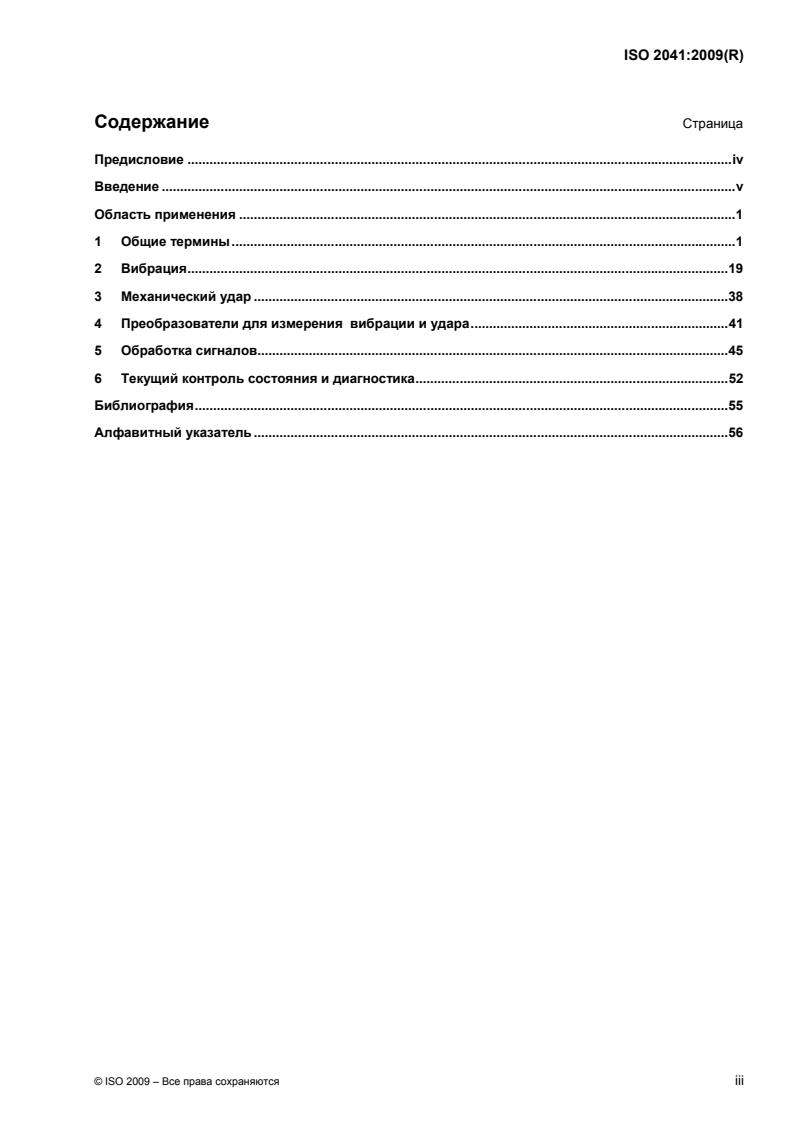
Contents Page
Foreword .iv
Introduction.v
Scope.1
1 General.1
2 Vibration.15
3 Mechanical shock.29
4 Transducers for shock and vibration measurement .31
5 Signal processing.34
6 Condition monitoring and diagnostics .40
Bibliography.43
Alphabetical index.44
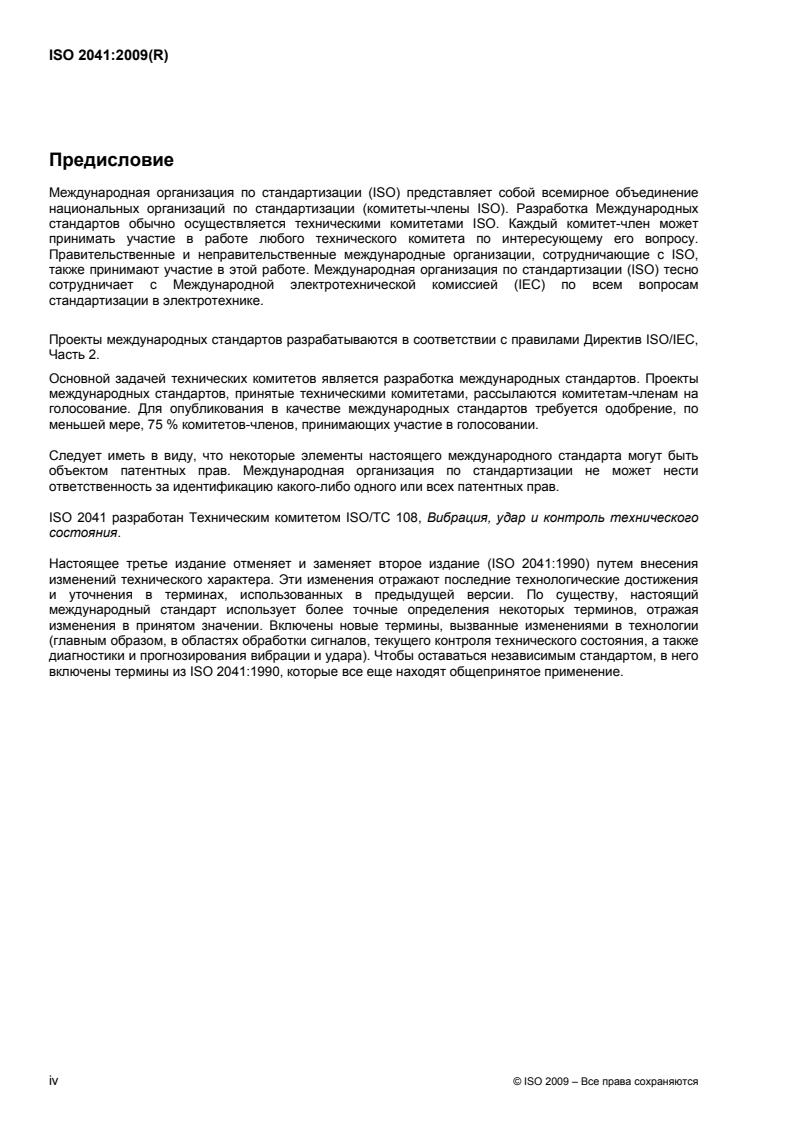
Foreword
ISO (the International Organization for Standardization) is a worldwide federation of national standards bodies
(ISO member bodies). The work of preparing International Standards is normally carried out through ISO
technical committees. Each member body interested in a subject for which a technical committee has been
established has the right to be represented on that committee. International organizations, governmental and
non-governmental, in liaison with ISO, also take part in the work. ISO collaborates closely with the
International Electrotechnical Commission (IEC) on all matters of electrotechnical standardization.
International Standards are drafted in accordance with the rules given in the ISO/IEC Directives, Part 2.
The main task of technical committees is to prepare International Standards. Draft International Standards
adopted by the technical committees are circulated to the member bodies for voting. Publication as an
International Standard requires approval by at least 75 % of the member bodies casting a vote.
Attention is drawn to the possibility that some of the elements of this document may be the subject of patent
rights. ISO shall not be held responsible for identifying any or all such patent rights.
ISO 2041 was prepared by Technical Committee ISO/TC 108, Mechanical vibration, shock and condition
monitoring.
This third edition cancels and replaces the second edition (ISO 2041:1990) which has been technically
revised. This revision reflects advances in technology and refinements in terms used in the previous version.
As such, it incorporates more precise definitions of some terms reflecting changes in accepted meaning. New
terms which were driven by changes in technology (primarily in the areas of signal processing, condition
monitoring and vibration and shock diagnostics and prognostics) and, in order to be a stand-alone standard,
terms from ISO 2041:1990 still in common usage are incorporated.
iv © ISO 2009 – All rights reserved
Introduction
Vocabulary is the most basic of subjects for standardization. Without an accepted standard for the definition of
terminology, the development of other technical standards in a technical area becomes a laborious and time-
consuming task that would ultimately result in the inefficient use of time and a high probability of
misinterpretation.
INTERNATIONAL STANDARD ISO 2041:2009(E)
Mechanical vibration, shock and condition monitoring —
Vocabulary
Scope
This International Standard defines terms and expressions unique to the areas of mechanical vibration, shock
and condition monitoring.
1 General
1.1
displacement
relative displacement
〈vibration and shock〉 time varying quantity that specifies the change in position of a point on a body with
respect to a reference frame
NOTE 1 The reference frame is usually a set of axes at a mean position or a position of rest. In general, a rotation
displacement vector, a translation displacement vector, or both can represent the displacement.
NOTE 2 A displacement is designated as relative displacement if it is measured with respect to a reference frame other
than the primary reference frame designated in a given case.
NOTE 3 Displacement can be:
— oscillatory, in which case simple harmonic components can be defined by the displacement amplitude (and
frequency), or
— random, in which case the root-mean-square (rms) displacement (and band-width and probability density distribution)
can be used to define the probability that the displacement will have values within any given range.
Displacements of short time duration are defined as transient displacements. Non-oscillatory displacements are defined as
sustained displacements, if of long duration, or as displacement pulses, if of short duration.
1.2
velocity
relative velocity
〈vibration and shock〉 rate of change of displacement
NOTE 1 In general, velocity is time-dependent.
NOTE 2 The reference frame is usually a set of axes at a mean position or a position of rest. In general, a rotation
velocity vector, a translation velocity vector, or both can represent the velocity.
NOTE 3 A velocity is designated as relative velocity if it is measured with respect to a reference frame other than the
primary reference frame designated in a given case. The relative velocity between two points is the vector difference
between the velocities of the two points.
NOTE 4 Velocity can be:
— oscillatory, in which case simple harmonic components can be defined by the velocity amplitude (and frequency), or
— random, in which case the root-mean-square (rms) velocity (and band-width and probability density distribution) can
be used to define the probability that the velocity will have values within any given range.
Velocities of short time duration are defined as transient velocities. Non-oscillatory velocities are defined as sustained
velocities, if of long duration.
1.3
acceleration
relative acceleration
〈vibration and shock〉 rate of change of velocity
NOTE 1 In general, acceleration is time-dependent.
NOTE 2 The reference frame is usually a set of axes at a mean position or a position of rest. In general, a rotation
acceleration vector, a translation acceleration vector, or both and the Coriolis acceleration can represent the acceleration.
NOTE 3 An acceleration is designated as relative acceleration if it is measured with respect to a reference frame other
than the inertial reference frame designated in a given case. The relative acceleration between two points is the vector
difference between the accelerations of the two points.
NOTE 4 In the case of time-dependent accelerations, various self-explanatory modifiers, such as peak, average, and
rms (root-mean-square), are often used. The time intervals over which the average or root-mean-square values are taken
should be indicated or implied.
NOTE 5 Acceleration can be:
— oscillatory, in which case simple harmonic components can be defined by the acceleration amplitude (and
frequency), or
— random, in which case the rms acceleration (and band-width and probability density distribution) can be used to
define the probability that the acceleration will have values within any given range.
Accelerations of short time duration are defined as transient accelerations. Non-oscillatory accelerations are defined as
sustained accelerations, if of long duration, or as acceleration pulses, if of short duration.
1.4
standard acceleration due to gravity
g
n
unit, 9,806 65 metres per second-squared (9,806 65 m/s )
NOTE 1 Value adopted in the International Service of Weights and Measures and confirmed in 1913 by the 5th CGPM
as the standard for acceleration due to gravity.
2 2 2 2
NOTE 2 This “standard value” (g = 9,806 65 m/s = 980,665 cm/s ≈ 386,089 in/s ≈ 32,174 0 ft/s ) should be used for
n
reduction to standard gravity of measurements made in any location on Earth.
NOTE 3 Frequently, the magnitude of acceleration is expressed in units of g .
n
NOTE 4 The actual acceleration produced by the force of gravity at or below the surface of the Earth varies with the
latitude and elevation of the point of observation. This variable is often expressed using the symbol g. Caution should be
exercised if this is done so as not to create an ambiguity with this use and the standard symbol for the unit of the gram.
1.5
force
dynamic influence that changes a body from a state of rest to one of motion or changes its rate of motion
NOTE 1 A force could also change a body’s size or shape if the body resists motion.
NOTE 2 The newton is the unit of force. One newton is the force required to give a mass of one kilogram an
acceleration of one metre per second squared.
1.6
restoring force
reaction force caused by the elastic property of a structure when it is being deformed
1.7
jerk
rate of change of acceleration
2 © ISO 2009 – All rights reserved
1.8
inertial reference system
inertial reference frame
coordinate system or frame which is fixed in space or moves at constant velocity without rotational motion and
thus, not accelerating
1.9
inertial force
reaction force exerted by a mass when it is being accelerated
1.10
oscillation
variation, usually with time, of the magnitude of a quantity with respect to a specified reference when the
magnitude is alternately greater and smaller than the specified reference
NOTE 1 See vibration (2.1).
NOTE 2 Variations with time such as shock processes or creeping motions are also considered to be oscillations in a
more general sense of the word.
1.11
environment
aggregate, at a given moment, of all external conditions and influences to which a system is subjected
NOTE See induced environment (1.12) and natural environment (1.13).
1.12
induced environment
conditions external to a system generated as a result of the operation of the system
1.13
natural environment
conditions generated by the forces of nature and the effects of which are experienced by a system when it is
at rest as well as when it is in operation
1.14
preconditioning
climatic and/or mechanical and/or electrical treatment procedure which may be specified for a particular
system so that it attains a defined state
1.15
conditioning
climatic and/or mechanical and/or electrical conditions to which a system is subjected in order to determine
the effect of such conditions upon it
1.16
excitation
stimulus
external force (or other input) applied to a system that causes the system to respond in some way
1.17
response (of a system)
output quantity of a system
1.18
transmissibility
non-dimensional complex ratio of the response of a system in forced vibration to the excitation
NOTE 1 The ratio may be one of forces, displacements, velocities or accelerations.
NOTE 2 This is sometimes known as a transmissibility function.
1.19
overshoot
when the maximum transient response exceeds the desired response
NOTE 1 If the output of a system is changed from a steady value A to a steady value B by varying the input, such that
value B is greater than A, then the response is said to overshoot when the maximum transient response exceeds value B.
NOTE 2 The difference between the maximum transient response and the value B is the value of the overshoot. This is
usually expressed as a percentage.
1.20
undershoot
when the minimum transient response falls below the desired response
NOTE 1 If the output of a system is changed from a steady value A to a steady value B by varying the input, such that
value B is less than A, then the response is said to undershoot when the minimum transient response is less than value B.
NOTE 2 The difference between the minimum transient response and the value B is the value of the undershoot. This is
usually expressed as a percentage.
1.21
system
set of interrelated elements considered in a defined context as a whole and separated from their environment
1.22
linear system
system in which the magnitude of the response is proportional to the magnitude of the excitation
NOTE This definition implies that the principle of superposition can be applied to the relationship between output
response and input excitation.
1.23
mechanical system
system comprising elements of mass, stiffness and damping
1.24
foundation
structure that supports a mechanical system
NOTE It can be fixed in a specified reference frame or it can undergo a motion.
1.25
seismic system
system consisting of a mechanical system attached to a reference base by one or more flexible elements, with
damping normally included
NOTE 1 Seismic systems are usually idealized as single-degree-of-freedom systems with viscous damping.
NOTE 2 The natural frequencies of the mass as supported by the flexible elements are relatively low for seismic
systems associated with displacement or velocity transducers, and are relatively high for acceleration transducers, as
compared with the range of frequencies to be measured.
NOTE 3 When the natural frequency of the seismic system is low relative to the frequency range of interest, the mass of
the seismic system may be considered to be at rest over this range of frequencies.
1.26
equivalent system
system that can be substituted for another system for the purpose of analysis
4 © ISO 2009 – All rights reserved
NOTE Many types of equivalence are common in vibration and shock technology:
a) a torsional system equivalent to a translational system;
b) an electrical or acoustical system equivalent to a mechanical system, etc.;
c) equivalent stiffness;
d) equivalent damping.
1.27
degrees of freedom
minimum number of generalized coordinates required to define completely the configuration of a mechanical
system
NOTE 1 This applies to mechanical systems, not to be confused with statistical degrees of freedom.
NOTE 2 It is often referred to by the acronym DOF.
1.28
discrete system
lumped parameter system
mechanical system in which the mass, stiffness, and/or damping elements are discretely located
1.29
single-degree-of-freedom system
SDOF
system requiring only one coordinate to define completely its configuration at any instant
1.30
multi-degree-of-freedom system
system for which two or more coordinates are required to define completely the configuration of the system at
any instant
1.31
continuous system
mechanical system in which the mass, stiffness, and/or damping properties are spatially distributed rather
than discretely located
NOTE The configuration of a continuous system is specified by a function of a continuous spatial variable, or variables,
in contrast to a discrete or lumped parameter system that requires only a finite number of coordinates to specify its
configuration.
1.32
centre of gravity
point through which the resultant of the weights of its component particles passes without resulting in moment
for all orientations of the body with respect to a gravitational field
NOTE If the field is uniform, the centre of gravity coincides with the centre of mass (1.33).
1.33
centre of mass
point of a body where the first moment of the overall mass with reference to a Cartesian coordinate system is
equal to the first moments of mass of all points of the body
NOTE This is the point at which an object is in balance in a uniform gravitational field.
1.34
principal axes of inertia
three mutually perpendicular axes intersecting each other at a given point about which the products of inertia
of a solid body are zero
NOTE 1 If the point is the centre of mass of the body, the axes and moments are called central principal axes and
central principal moments of inertia.
NOTE 2 In balancing, the term “principal inertia axis” is used to designate the one central principal axis (of the three
such axes) most nearly coincident with the shaft axis of the rotor and is sometimes referred to as the balance axis or the
mass axis.
1.35
moment of inertia
sum (integral) of the product of the masses of the individual particles (elements of mass) of a body and the
square of their perpendicular distances from the axis of rotation
1.36
product of inertia
sum (integral) of the product of the masses of the individual particles (elements of mass) of a body and their
distances from two mutually perpendicular planes
1.37
stiffness
ratio of change of force (or torque) to the corresponding change in translational (or rotational) deformation of
an elastic element
NOTE See also dynamic stiffness (1.58).
1.38
compliance
reciprocal of stiffness
NOTE See also dynamic compliance (1.57).
1.39
neutral surface
neutral surface of a beam in simple flexure
surface in which there is no strain
NOTE It should be stated whether or not the neutral surface is a result of the flexure alone, or whether it is a result of the
flexure and other superimposed loads.
1.40
neutral axis
neutral axis of a beam in simple flexure
line or plane in a beam where the longitudinal stress, tensile or compressive is zero
1.41
transfer function
mathematical representation of the relationship between the input and output of a linear time-invariant system
NOTE 1 A transfer function is usually a complex function defined as the ratio of the Laplace transforms of the output to
the input of a linear time-invariant system.
NOTE 2 It is usually given as a function of frequency, and is usually a complex function. See response (1.17),
transmissibility (1.18) and transfer impedance (1.50).
1.42
complex excitation
excitation expressed as a complex quantity with amplitude and phase angle
NOTE 1 The concepts of complex excitations and responses were evolved historically in order to simplify calculations.
The actual excitation and response are the real parts of the complex excitation and response. If the system is linear, the
concept is valid because superposition holds in such a situation.
NOTE 2 This term should not be confused with excitation by a complex vibration, or vibration of complex waveform. The
use of the term “complex vibration” in this sense is deprecated.
6 © ISO 2009 – All rights reserved
1.43
complex response
response of a system expressed as a complex quantity with amplitude and phase angle from a specified
excitation
NOTE See the notes under complex excitation (1.42).
1.44
modal analysis
vibration analysis method that characterizes a complex structural system by its modes of vibration, i.e. its
natural frequencies, modal damping and mode shapes, and based on the principle of superposition
1.45
modal matrix
linear transformation matrix which consists of the eigen vectors or modal vectors of a system
NOTE It renders the system both inertially and elastically uncoupled, i.e. the modal mass and modal stiffness matrices
are transformed into diagonal matrices.
1.46
modal stiffness
stiffness element associated with a specified mode of vibration
1.47
modal density
number of modes per unit bandwidth
NOTE Modal density is a measure widely used in structural dynamics as a diagnostic tool in assessing vibration power
flow in complex, structural systems. It can play a crucial role in determining changes in vibration power flow that may be a
precursor to fatigue failure in some part of the structure, or a metric used in structural condition monitoring evaluations. In
addition to these applications, it is a parameter required by the Statistical Energy Analysis method for evaluating the high-
frequency response of complex structures and in selecting appropriate vibration-control methods and devices.
1.48
mechanical impedance
complex ratio of force to velocity at a specified point and degree-of-freedom in a mechanical system
NOTE 1 The force and velocity may be taken at the same or different points and degrees-of-freedom in the system
undergoing simple harmonic motion.
NOTE 2 In the case of torsional mechanical impedance, the terms “force” and “velocity” should be replaced by “torque”
and “angular velocity”, respectively.
NOTE 3 In general, the term “impedance” applies to linear systems only.
NOTE 4 The concept is extended to non-linear systems where the term “incremental impedance” is used to describe a
similar quantity.
1.49
direct mechanical impedance
driving point mechanical impedance
complex ratio of the force to velocity taken at the same point or degree-of-freedom in a mechanical system
during simple harmonic motion
NOTE See the notes under mechanical impedance (1.48).
1.50
transfer (mechanical) impedance
complex ratio of the force applied at point i, in a specified degree-of-freedom in a mechanical system, to the
velocity at another point j in a specified direction or degree-of-freedom in the same system, during simple
harmonic motion
NOTE See the notes under mechanical impedance (1.48).
1.51
free impedance
ratio of the applied excitation complex force to the resulting complex velocity with all other connection points of
the system free, i.e. having zero restraining forces
NOTE 1 Historically, often no distinction has been made between blocked impedance and free impedance. Caution
should, therefore, be exercised in interpreting published data.
NOTE 2 Free impedance is the arithmetic reciprocal of a single element of the mobility matrix. While experimentally
determined free impedances could be assembled into a matrix, this matrix would be quite different from the blocked
impedance matrix resulting from mathematical modelling of the structure and, therefore, would not conform to the
requirements for using mechanical impedance in an overall theoretical analysis of the system.
1.52
blocked impedance
impedance at the input when all output degrees of freedom are connected to a load of infinite mechanical
impedance
NOTE 1 Blocked impedance is the frequency-response function formed by the ratio of the phasor of the blocking or
driving-point force response at point i, to the phasor of the applied excitation velocity at point j, with all other measurement
points on the structure “blocked”, i.e. constrained to have zero velocity. All forces and moments required to fully constrain
all points of interest on the structure need to be measured in order to obtain a valid blocked impedance matrix.
NOTE 2 Any changes in the number of measurement points or their location will change the blocked impedances at all
measurement points.
NOTE 3 The primary usefulness of blocked impedance is in the mathematical modelling of a structure using lumped
mass, stiffness and damping elements or finite element techniques. When combining or comparing such mathematical
models with experimental mobility data, it is necessary to convert the analytical blocked impedance matrix into a mobility
matrix or vice versa.
1.53
frequency-response function
frequency-dependent ratio of the motion-response Fourier transform to the Fourier transform of the excitation
force of a linear system
NOTE 1 Excitation can be harmonic, random or transient functions of time. The test results obtained with one type of
excitation can thus be used for predicting the response of the system to any other type of excitation.
NOTE 2 Motion may be expressed in terms of velocity, acceleration or displacement; the corresponding frequency-
response function designations are mobility, accelerance and dynamic compliance or impedance, effective (i.e. apparent)
mass and dynamic stiffness, respectively (see Table 1).
1.54
mobility
mechanical mobility
complex ratio of the velocity, taken at a point in a mechanical system, to the force, taken at the same or
another point in the system
NOTE 1 Mobility is the ratio of the complex velocity-response at point i to the complex excitation force at point j with all
other measurement points on the structure allowed to respond freely without any constraints other than those constraints
which represent the normal support of the structure in its intended application.
NOTE 2 The term “point” designates both a location and a direction.
NOTE 3 The velocity response can be either translational or rotational, and the excitation force can be either a
rectilinear force or a moment.
NOTE 4 If the velocity response measured is a translational one and if the excitation force applied is a rectilinear one,
the units of the mobility term will be m/(N⋅s) in the SI system.
NOTE 5 Mechanical mobility is the matrix inverse of mechanical impedance.
8 © ISO 2009 – All rights reserved
1.55
direct (mechanical) mobility
driving-point (mechanical) mobility
complex ratio of velocity and force taken at the same point in a mechanical system
NOTE Driving-point mobility is the frequency-response function formed by the ratio, in metres per Newton second, of the
velocity-response complex amplitude at point j to the excitation force complex amplitude applied at the same point with all
other measurement points on the structure allowed to respond freely without any constraints other than those constraints
which represent the normal support of the structure in its intended application.
1.56
transfer (mechanical) mobility
mechanical mobility where the velocity and the force are considered at different points of the system
1.57
dynamic compliance
frequency-dependent ratio of the spectrum, or spectral density, of the displacement to the spectrum, or
spectral density, of the force
1.58
dynamic stiffness
complex ratio of the force, taken at a point in a mechanical system, to the displacement, taken at the same or
another point in the system
NOTE 1 The terms “dynamic elastic constant” and “dynamic spring constant” are sometimes used.
NOTE 2 The dynamic stiffness may be dependent upon strain (amplitude and frequency), strain-rate, temperature or
other conditions.
∗
NOTE 3 The dynamic stiffness, k , of a linear translational single-degree-of-freedom system characterized by the
equation
ddxx
iωt
mc++kx=F where F = F e
dt
dt
is equal to
kF=+()mωωx− icx/x
00 00
where
c is the linear (viscous) damping coefficient;
e is the base of natural logarithms;
F is the force amplitude;
i =−1 ;
k is the elastic (spring) constant;
m is the mass;
t is the time;
x is the displacement;
x is the displacement amplitude;
ω is the angular frequency.
Table 1 — Equivalent definitions to be used for various kinds of output/input ratios
Motion expressed Motion expressed Motion expressed
as displacement as velocity as acceleration
a b c
Term Dynamic compliance Mobility Accelerance
Symbol x /F Y = v /F a /F
i j ij i j i j
2 –1
Unit m/N m/(N⋅s) m/(N⋅s ) = kg
Boundary conditions F = 0; i ≠ j F = 0; i ≠ j F = 0; i ≠ j
j j j
See Figure 3 1 2
Comment Boundary conditions are easy to achieve experimentally.
Term Dynamic stiffness Blocked impedance Blocked effective mass
Symbol F /x Z = F /v F /a
i j ij i j i j
Unit N/m N⋅s/m N⋅s /m = kg
Boundary conditions X = 0; i ≠ j v = 0; i ≠ j A = 0; i ≠ j
j j j
Comment Boundary conditions are very difficult or impossible to achieve experimentally.
Term Free dynamic stiffness Free impedance Effective (apparent) mass
(free effective mass)
Symbol F /x F /v = 1/Y F /a
j i j i ij
j i
Unit N/m N⋅s/m N⋅s /m = kg
Boundary conditions F = 0; i ≠ j F = 0; i ≠ j F = 0; i ≠ j
j j j
Comment Boundary conditions are easy to achieve, but results shall be used with great caution in
system modelling.
a
Dynamic compliance is also called receptance.
b
Mobility is sometimes called mechanical admittance.
c
Accelerance has unfortunately been called inertance in some publications. Inertance is not a standard term and is not acceptable
because it is in conflict with the common definition of acoustic inertance and is also contrary to the implication carried by the word
inertance.
10 © ISO 2009 – All rights reserved
Key
X frequency, in hertz (Hz)
Y1 phase angle, in degrees
Y2 mobility magnitude, in decibels (dB), [ref. 1 m/(N⋅s)]
a
Downwards sloping lines are used for mass.
b
Upwards sloping lines are used for stiffness.
Figure 1 — Mobility plot
Key
X frequency, in hertz (Hz)
Y accelerance, in decibels (dB), [ref. 1 m/(N⋅s )]
a
Upwards sloping lines represent stiffness.
b
Horizontal lines represent mass.
Figure 2 — Accelerance magnitude plot corresponding to the mobility graph
plotted in Figure 1
12 © ISO 2009 – All rights reserved
Key
X frequency, in hertz (Hz)
Y dynamic compliance, in decibels (dB), [ref. 1 m/N]
a
Horizontal lines represent stiffness.
b
Downwards sloping lines represent mass.
Figure 3 — Dynamic compliance magnitude plot corresponding to the mobility graph
plotted in Figure 1
1.59
dynamic mass
complex ratio of force to acceleration
1.60
accelerance
frequency-dependent ratio of the spectrum, or spectral density, of the acceleration to the spectrum, or spectral
density, of the force
1.61
spectrum
description of a quantity as a function of frequency or wavelength
1.62
level (of a quantity)
logarithm of the ratio of the quantity to a reference of the same kind
NOTE 1 The base of the logarithm, the reference quantity and the kind of level shall be specified.
NOTE 2 Examples of kinds of levels in common use are electric-power level, sound-pressure level, and voltage-
squared level.
NOTE 3 The definition is expressed symbolically as:
q
L = log
r
q
where
L is the level of the kind determined by the kind of quantity under consideration, measured in units of log ;
r
r is the base of the logarithms and the reference ratio;
q is the quantity under consideration;
q is the reference quantity of the same kind.
NOTE 4 A difference in the levels of two like quantities q and q is described by the same formula because, by the
1 2
rules of logarithms, the reference quantity is automatically divided out as follows:
qq q
12 1
log −=log log
rrr
qq q
NOTE 5 In vibration terminology, the term “level” is sometimes used to denote amplitude, average value, root-mean-
square value, or ratios of these values. These uses are deprecated.
1.63
bel
unit of level when the base of the logarithm is 10
NOTE Use of the bel is restricted to levels of quantities proportional to power. See also the notes under level (1.62) and
decibel (1.64).
1.64
decibel
dB
one tenth of a bel
NOTE 1 The magnitude of a level in decibels is ten times the logarithm to the base 10 of the ratio of power-like
quantities, i.e.
X X
L==10 lg 20 lg
X X
NOTE 2 Examples of quantities that qualify as power-like quantities are sound-pressure squared, particle-velocity squared,
sound intensity, sound-energy density and voltage squared. Thus, the bel is a unit of sound-pressure-squared level;
however, it is common practice to shorten this to sound-pressure level because ordinarily no ambiguity results from so
doing.
14 © ISO 2009 – All rights reserved
2 Vibration
2.1
vibration
mechanical oscillations about an equilibrium point. The oscillations may be periodic or random
NOTE See oscillation (1.10).
2.2
periodic vibration
vibration where the values of the vibration parameter recur for certain equal increments of the independent
time variable
NOTE 1 A periodic quantity, y, which is a function of time, t, can be expressed as:
y = f (t) = f (t ± nτ)
where
n is a whole number;
t is the independent time variable;
τ is the period.
NOTE 2 A quasi-periodic vibration is a vibration which deviates only slightly from a periodic vibration.
2.3
simple harmonic vibration
sinusoidal vibration
periodic vibration where the values of the vibration parameters can be described as sinusoidal functions of the
independent time variable
NOTE 1 Simple harmonic motion can be described as:
ˆ
yy=+sin(ωt ϕ )
where
yˆ is the amplitude;
t is the independent time variable;
y is the simple harmonic vibration;
ϕ is the initial phase angle of the vibration;
ω is the angular frequency.
NOTE 2 A periodic vibration consisting of the sum of more than one sinusoid, each having a frequency which is a
multiple of the fundamental frequency, is often referred to as a multi-sinusoidal vibration. The use of the term “complex
vibration” in this context is deprecated.
NOTE 3 A quasi-sinusoidal vibration has the appearance of a sinusoid, but varies relatively slowly in frequency and/or
in amplitude.
2.4
random vibration
stochastic vibration
vibration where the instantaneous value cannot be predicted
NOTE The probability that the magnitude of a random vibration is within a given range can be described by a probability
distribution function.
2.5
angular vibration
vibration associated with the three rotational degrees of freedom of a point on a body
2.6
torsional vibration
periodic vibration caused by an object twisting about its own axis
NOTE 1 See angular vibration (2.5).
NOTE 2 This term is commonly used when referring to the rotation of shafts in the plane of the shaft cross-section.
2.7
angular displacement
displacement of a body, characterized by one of its rotational degrees of freedom
2.8
angular velocity
velocity of a body, characterized by one of its rotational degrees of freedom
2.9
angular acceleration
acceleration of a body, characterized by one of its rotational degrees of freedom
2.10
non-stationary vibration
vibration with time-dependent statistical properties
2.11
stationary vibration
vibration that has statistical characteristics that do not change with time; therefore, the amplitude does not
increase or decrease with time
NOTE The vibration can be deterministic or random.
2.12
noise
undesired signal, generally of a random nature, the spectrum of which does not exhibit clearly defined
frequency components
NOTE By extension of the above definition, noise may consist of electrical oscillations of an undesired or random nature.
If ambiguity exists as to the nature of the noise, a term such as “acoustic noise” or “electrical noise” should be used.
2.13
random noise
stochastic noise
noise for which the instantaneous value cannot be predicted
NOTE See random vibration (2.4) and the accompanying note.
2.14
Gaussian random vibration
Gaussian stochastic vibration
random vibration whose instantaneous magnitudes have a Gaussian distribution
2.15
white random vibration
white stochastic vibration
vibration that has equal energy for any frequency band of constant width (or per unit bandwidth) over the
spectrum of interest
16 © ISO 2009 – All rights reserved
2.16
pink random vibration
pink stochastic vibration
vibration that has a constant energy within a bandwidth proportional to the centre frequency of the band
NOTE The energy spectrum of pink vibration as determined by an octave bandwidth (or any fractional part of an octave
bandwidth) filter will have a constant value.
2.17
narrow-band random vibration
narrow-band stochastic vibration
random vibration having its frequency components within a narrow band only
NOTE 1 The defining of what is meant by “narrow” is a relative matter depending upon the problem involved. It is
usually equal to or less than one-third octave.
NOTE 2 The waveform of a narrow-band random vibration has the appearance of a sine wave, the amplitude and
phase of which vary in an unpredictable manner.
NOTE 3 See random vibration (2.4).
2.18
broad-band random vibration
broad-band stochastic vibration
random vibration having its frequency components distributed over a broad frequency band
NOTE 1 The definition of what is meant by “broad” is a relative matter depending upon the problem involved. It is
usually one octave or greater.
NOTE 2 See random vibration (2.4).
2.19
dominant frequency
frequency at which a maximum value occurs in a spectrum
2.20
steady-state vibration
continuous vibration that has on average reached equilibrium
2.21
transient vibration
vibration, typically of short duration, that decays with time
NOTE This term is basically associated with mechanical shock (3.1).
2.22
forced vibration
vibration of a system due to an external time-dependent force
NOTE The vibration (for linear systems) has the same frequencies as the excitation.
2.23
free vibration
vibration of a system that occurs after the removal of excitation or restraint
NOTE A linear system vibrates as a linear combination of natural modes.
2.24
non-linear vibration
vibration of a system which has a non-linear response and can only be described by non-linear differential
equations
NOTE In a non-linear system, the relationship between cause and effect is no longer proportional and the principle of
superposition does not hold for their solution.
2.25
longitudinal vibration
vibration along longitudinal axis in an elastic body
2.26
self-induced vibration
self-excited vibration
vibration of a mechanical system resulting from conversion, within the system, of energy to oscillatory
excitation
2.27
ambient vibration
all-encompassing vibration associated with a given environment usually a composite vibration from many
surrounding sources
2.28
extraneous vibration
total vibration other than the vibration of principal interest
NOTE Ambient vibration contributes to the magnitude of extraneous vibration.
2.29
aperiodic vibration
vibration that is not periodic
2.30
jump
phenomenon where vibration response changes suddenly due to small change in frequency of an excitation
force
2.31
cycle, noun
complete range of states or values through which a periodic phenomenon or function passes before repeating
itself identically
NOTE See cycle, verb (2.111).
2.32
fundamental period
period
smallest increment of time for which a periodic function repeats itself
NOTE 1 If no ambiguity is likely, the fundamental period is called the period.
NOTE 2 See periodic vibration (2.2).
2.33
frequency
reciprocal of the period
NOTE The unit of frequency is the hertz (Hz), which corresponds to one cycle per second.
2.34
fundamental frequency
lowest natural frequency in an oscillating system
NOTE 1 The normal mode of vibration associated with the lowest natural frequency is known as the fundamental mode.
NOTE 2 See natural frequency (2.88).
18 © ISO 2009 – All rights reserved
2.35
harmonic (of a periodic quantity)
harmonic vibration, the frequency of which is an integral multiple of the fundamental frequency
NOTE The term “overtone” has frequently been used in place of harmonic, the nth harmonic being called the (n – 1)th
overtone. The term “overtone” is deprecated.
2.36
sub harmonic
harmonic vibration, the frequency of which is an integral sub-multiple of the fundamental frequency of the
quantity to which it is related
2.37
harmonic excitation
sinusoidal excitation
2.38
beats
periodic variation in the magnitude of an oscillation resulting from the combination of two oscillations of slightly
different frequencies
NOTE The beat occurs at the difference frequency.
2.39
beat frequency
absolute value of the difference in frequency of two oscillations of slightly different frequencies
2.40
angular frequency
pulsatance
product of the frequency of a sinusoidal quantity and the factor 2π
NOTE The unit of angular frequency is the radian (rad) per unit of time.
2.41
phase angle
angle of a complex response which characterizes a shift in time at a given frequency
2.42
phase difference
phase angle difference
between two harmonic vibrations of the same frequency, the difference between their respective phases or, in
the case of sinusoidal vibrations, between their phase angles measured from the same origin
2.43
amplitude
magnitude, size or value of a quantity
2.44
peak value
peak magnitude
positive peak value
negative peak value
maximum value of a vibration during a specified time interval
NOTE A peak value vibration is usual
...
МЕЖДУНАРОДНЫЙ ISO
СТАНДАРТ 2041
Третье издание
2009-08-01
Вибрация, удар и контроль
технического состояния. Словарь
Mechanical vibration, shock and condition monitoring — Vocabulary
Ответственность за подготовку русской версии несёт GOST R
(Российская Федерация) в соответствии со статьёй 18.1 Устава ISO
Ссылочный номер
©
ISO 2009
Отказ от ответственности при работе в PDF
Настоящий файл PDF может содержать интегрированные шрифты. В соответствии с условиями лицензирования, принятыми
фирмой Adobe, этот файл можно распечатать или смотреть на экране, но его нельзя изменить, пока не будет получена
лицензия на интегрированные шрифты и они не будут установлены на компьютере, на котором ведется редактирование. В
случае загрузки настоящего файла заинтересованные стороны принимают на себя ответственность за соблюдение
лицензионных условий фирмы Adobe. Центральный секретариат ISO не несет никакой ответственности в этом отношении.
Adobe – торговый знак фирмы Adobe Systems Incorporated.
Подробности, относящиеся к программным продуктам, использованные для создания настоящего файла PDF, можно найти в
рубрике General Info файла; параметры создания PDF были оптимизированы для печати. Были приняты во внимание все
меры предосторожности с тем, чтобы обеспечить пригодность настоящего файла для использования комитетами-членами
ISO. В редких случаях возникновения проблемы, связанной со сказанным выше, просьба проинформировать Центральный
секретариат по адресу, приведенному ниже.
ДОКУМЕНТ ЗАЩИЩЁН АВТОРСКИМ ПРАВОМ
© ISO 2009
Воспроизведение терминов и определений, содержащихся в настоящем международном стандарте, разрешается в учебных
пособиях, инструкциях, технических изданиях и журналах строго в целях образования или реализации. Условия для такого
воспроизведения заключаются в том, что нельзя вносить изменения в термины и определения, не разрешается их
использование в словарях или подобных публикациях, предлагаемых для продажи, но можно ссылаться на этот международный
стандарт в качестве исходного документа.
Учитывая только упомянутые выше исключения, никакую часть настоящей публикации нельзя копировать или использовать в
какой-либо форме или каким-либо электронным или механическим способом, включая фотокопии и микрофильмы, без
предварительного письменного согласия офиса ISO по адресу, указанному ниже, или членов ISO в стране регистрации
пребывания.
ISO copyright office
Case postale 56 • CH-1211 Geneva 20
Tel. + 41 22 749 01 11
Fax + 41 22 749 09 47
E-mail copyright@iso.org
Web www.iso.org
Опубликовано в Швейцарии
ii © ISO 2009 – Все права сохраняются
Содержание Страница
Предисловие .iv
Введение .v
Область применения .1
1 Общие термины .1
2 Вибрация.19
3 Механический удар .38
4 Преобразователи для измерения вибрации и удара.41
5 Обработка сигналов.45
6 Текущий контроль состояния и диагностика.52
Библиография.55
Алфавитный указатель .56
Предисловие
Международная организация по стандартизации (ISO) представляет собой всемирное объединение
национальных организаций по стандартизации (комитеты-члены ISO). Разработка Международных
стандартов обычно осуществляется техническими комитетами ISO. Каждый комитет-член может
принимать участие в работе любого технического комитета по интересующему его вопросу.
Правительственные и неправительственные международные организации, сотрудничающие с ISO,
также принимают участие в этой работе. Международная организация по стандартизации (ISO) тесно
сотрудничает с Международной электротехнической комиссией (IEC) по всем вопросам
стандартизации в электротехнике.
Проекты международных стандартов разрабатываются в соответствии с правилами Директив ISO/IEC,
Часть 2.
Основной задачей технических комитетов является разработка международных стандартов. Проекты
международных стандартов, принятые техническими комитетами, рассылаются комитетам-членам на
голосование. Для опубликования в качестве международных стандартов требуется одобрение, по
меньшей мере, 75 % комитетов-членов, принимающих участие в голосовании.
Следует иметь в виду, что некоторые элементы настоящего международного стандарта могут быть
объектом патентных прав. Международная организация по стандартизации не может нести
ответственность за идентификацию какого-либо одного или всех патентных прав.
ISO 2041 разработан Техническим комитетом ISO/TC 108, Вибрация, удар и контроль технического
состояния.
Настоящее третье издание отменяет и заменяет второе издание (ISO 2041:1990) путем внесения
изменений технического характера. Эти изменения отражают последние технологические достижения
и уточнения в терминах, использованных в предыдущей версии. По существу, настоящий
международный стандарт использует более точные определения некоторых терминов, отражая
изменения в принятом значении. Включены новые термины, вызванные изменениями в технологии
(главным образом, в областях обработки сигналов, текущего контроля технического состояния, а также
диагностики и прогнозирования вибрации и удара). Чтобы оставаться независимым стандартом, в него
включены термины из ISO 2041:1990, которые все еще находят общепринятое применение.
iv © ISO 2009 – Все права сохраняются
Введение
Терминология является одним из самых важных предметов стандартизации. Без общепринятого
стандарта для определения терминологии разработка других технических стандартов превращается в
трудоемкую и затратную по времени задачу, что, в конечном счете, имеет результатом неэффективное
использование времени и высокую вероятность ошибочного, неверного истолкования.
МЕЖДУНАРОДНЫЙ СТАНДАРТ ISO 2041:2009(R)
Вибрация, удар и контроль технического состояния.
Словарь
Область применения
Настоящий международный стандарт устанавливает термины и выражения, единственные в области
вибрации, удара и текущего контроля технического состояния.
1 Общие термины
1.1
смещение
относительное смещение
displacement
relative displacement
〈применительно к вибрации и удару〉 переменная величина, определяющая изменение положения
относительно системы отсчета
ПРИМЕЧАНИЕ 1 Система отсчета является обычно совокупностью осей в среднем положении или состоянии
покоя. В общем случае, вектор вращательного, вектор переходного (неустановившегося) процесса или оба
вектора могут представлять смещение.
ПРИМЕЧАНИЕ 2 Смещение обозначается как относительная величина, если она измеряется относительно
системы отсчета, которая является другой, чем первичная система отсчета, назначенная в данном случае.
ПРИМЕЧАНИЕ 3 Смещение может быть:
⎯ колебательным, в этом случае простые гармонические составляющие колебания могут быть определены
амплитудой (и частотой) сдвига,
— случайным, в этом случае среднеквадратичное смещение (широкополосное и вероятностное распределение
плотности) может быть использовано для определения вероятности, что смещение будет иметь значения в
пределах любого данного диапазона.
Кратковременные смещения определяются как переходные процессы. Смещения, не относящиеся к колебаниям,
определяются как непрерывные, если они являются длительными, или как импульсы сдвига, если они являются
кратковременными.
1.2
скорость
относительная скорость
velocity
relative velocity
<применительно к вибрации и удару> скорость изменения перемещения
ПРИМЕЧАНИЕ 1 Вообще, скорость зависит от времени.
ПРИМЕЧАНИЕ 2 Система отсчета является обычно совокупностью осей в среднем положении или состоянии
покоя. В общем случае, вектор вращательного, вектор переходного (неустановившегося) процесса или оба
вектора могут представлять скорость.
ПРИМЕЧАНИЕ 3 Скорость обозначается как относительная величина, если она измеряется относительно
системы отсчета, которая является другой, чем первичная система отсчета, назначенная в данном случае.
Относительная скорость между двумя точками есть разность векторов между скоростями этих двух точек.
ПРИМЕЧАНИЕ 4 Скорость может быть:
— колебательной, в этом случае простые гармонические составляющие могут быть определены амплитудой (и
частотой) скорости, или
— случайной, в этом случае среднеквадратичное значение скорости (широкополосное и вероятностное
распределение плотности) может быть использовано для определения вероятности, что скорость будет
иметь значения в пределах любого данного диапазона.
Кратковременные скорости определяются как переходные процессы. Скорости, не относящиеся к колебаниям,
определяются как непрерывные, если они являются длительными.
1.3
ускорение
относительное ускорение
acceleration
relative acceleration
〈применительно к вибрации и удару〉 степень изменения скорости
ПРИМЕЧАНИЕ 1 Вообще, ускорение зависит от времени.
ПРИМЕЧАНИЕ 2 Система отсчета является обычно совокупностью осей в среднем положении или состоянии
покоя. Вообще, вектор вращательного, вектор переходного (неустановившегося) процесса или оба вектора могут
представлять ускорение, в том числе кориолисово ускорение.
ПРИМЕЧАНИЕ 3 Ускорение обозначается как относительная величина, если она измеряется относительно
системы отсчета, которая является другой, чем первичная система отсчета, назначенная в данном случае.
Относительное ускорение между двумя точками есть разность векторов между ускорениями этих двух точек.
ПРИМЕЧАНИЕ 4 В случае ускорений, зависимых от времени, часто используются такие характеристики, как
пиковое, среднее и среднеквадратичное значение. Временные интервалы, за которые берутся средние или
среднеквадратичные значения, следует указывать или предполагать.
ПРИМЕЧАНИЕ 5 Ускорение может быть:
— колебательным, в этом случае простые гармонические составляющие могут быть определены амплитудой (и
частотой) ускорения,
— случайным, в этом случае среднеквадратичное значение ускорения (широкополосное и вероятностное
распределение плотности) может быть использовано для определения вероятности, что ускорение будет
иметь значения в пределах любого данного диапазона.
Кратковременные скорости определяются как переходные процессы. Ускорения, не относящиеся к колебаниям,
определяются как непрерывные, если они являются длительными, или как импульсы ускорения, если они
являются кратковременными.
2 © ISO 2009 – Все права сохраняются
1.4
стандартное ускорение свободного падения
standard acceleration due to gravity
g
n
единица измерения, равная 9,806 65 метров за секунду в квадрате (9,806 65 м/с )
ПРИМЕЧАНИЕ 1 Значение принято Международной службой мер и весов и подтверждено в 1913 г. пятой
Генеральной конференцией по мерам и весам в качестве стандартного ускорения вследствие силы тяжести.
2 2 2 2
ПРИМЕЧАНИЕ 2 Это “стандартное значение” (g = 9,806 65 м/с = 980,665 см/с ≈ 386,089 дюймов/с ≈ 32,174 0 футов/с )
n
следует использовать для приведения к стандартной силе тяжести измерений, сделанных в любом месте Земли.
ПРИМЕЧАНИЕ 3 Часто абсолютное значение ускорения выражают в единицах g .
n
ПРИМЕЧАНИЕ 4 Действительное ускорения под действием силы тяжести на или ниже поверхности Земли
изменяется с географической широтой и возвышением точки наблюдения. Это изменение часто выражается,
используя символ g . Следует быть внимательным при использовании этого символа с тем, чтобы не возникала
двусмысленность между стандартным ускорением вследствие силы тяжести и стандартным символом для
единицы измерения веса в граммах.
1.5
сила
force
динамическое воздействие, которое выводит тело из состояния покоя в состояние движения или
изменяет его скорость движения
ПРИМЕЧАНИЕ 1 Сила может также изменять размер или форму тела, если это тело оказывает сопротивление
движению.
ПРИМЕЧАНИЕ 2 Ньютон является единицей измерения силы. Один ньютон есть сила, необходимая для
придания массе один килограмм ускорения один метр за секунду в квадрате.
1.6
восстанавливающая сила
restoring force
сила реакции, создаваемая за счет упругих свойств деформируемой структуры
1.7
рывок
jerk
скорость изменения ускорения
1.8
инерциальная система координат
инерциальная система отсчета
inertial reference system
inertial reference frame
система координат или система отсчета, которая является неподвижной в пространстве или
перемещается с постоянной скоростью без вращения и, следовательно, без ускорения
1.9
сила инерции
inertial force
сила реакции, вызванная массой при ее ускорении
1.10
колебание
oscillation
изменение (обычно во времени) абсолютного значения величины относительно опорного уровня, когда
абсолютное значение попеременно больше и меньше, чем заданный опорный уровень
ПРИМЕЧАНИЕ 1 См. вибрация (2.1).
ПРИМЕЧАНИЕ 2 Изменения во времени, например, ударные процессы или ползучие перемещения также
считаются колебаниями в более широком смысле этого слова.
1.11
окружающая среда
environment
множество, в данный момент, всех внешних условий и воздействий, которым подвергается система
ПРИМЕЧАНИЕ См. искусственная среда (1.12) и естественная (природная) среда (1.13).
1.12
искусственная среда
induced environment
условия, внешние по отношению к системе, созданные в результате работы этой системы
1.13
естественная (природная) среда
natural environment
условия, созданные силами природы и оказывающие влияние на систему, когда она находится в
состоянии покоя или в действии
1.14
предварительная обработка
preconditioning
климатическая и/или механическая и/или электрическая процедура обработки, которая может быть
задана для конкретной системы с тем, чтобы она достигла определенного состояния
1.15
кондиционирование
conditioning
климатический и/или механический и/или электрический режим, которому подвергается система для
того, чтобы установить влияние такого режима на эту систему
4 © ISO 2009 – Все права сохраняются
1.16
возбуждение
стимул
excitation
stimulus
внешняя сила (или другая подводимая мощность), приложенная к системе, которая заставляет
систему реагировать некоторым образом
1.17
отклик (системы)
response (of a system)
величина на выходе системы
1.18
коэффициент передачи
transmissibility
безразмерное сложное отношение отклика системы в состоянии вынужденной вибрации к
определенному возбуждению
ПРИМЕЧАНИЕ 1 Данное отношение может быть коэффициентом сил, смещений, скоростей или ускорений.
ПРИМЕЧАНИЕ 2 Этот коэффициент иногда известен в качестве передаточной функции.
1.19
выход за установленные пределы
overshoot
когда переходная характеристика превышает желаемый отклик
ПРИМЕЧАНИЕ 1 Если за счет регулирования входного сигнала выходной сигнал системы изменяется от
установившегося значения A до установившегося значения B, так что B > A, то говорят, что происходит выход
отклика за установленные пределы, когда максимальная переходная характеристика превышает значение B.
ПРИМЕЧАНИЕ 2 Разность между максимумом переходной характеристики и значением В является величиной,
характеризующей выход за установленные пределы. Эта разность обычно выражается в процентах.
1.20
недорегулирование
undershoot
когда минимальная переходная характеристика выпадает за нижний предел желаемого значения
ПРИМЕЧАНИЕ 1 Если за счет недорегулирования входного сигнала выходной сигнал системы изменяется от
установившегося значения A до установившегося значения B, так что B < A, то говорят, что происходит выход
отклика ниже установленного предела, когда минимальная переходная характеристика меньше, чем значение B.
ПРИМЕЧАНИЕ 2 Разность между минимумом переходной характеристики и значением В является величиной,
характеризующей недорегулирование. Эта величина обычно выражается в процентах.
1.21
система
system
совокупность взаимосвязанных элементов, рассматриваемых в определенном контексте как единое
целое и отделенных от их окружения
1.22
линейная система
linear system
система, в которой абсолютная величина отклика является пропорциональной абсолютной величине
возбуждения
ПРИМЕЧАНИЕ Данное определение предполагает, что принцип наложения может быть применен к
взаимоотношению между выходным откликом и входным возбуждением.
1.23
механическая система
mechanical system
система, включающая в себе элементы массы, жесткости и амортизации
1.24
основание, фундамент
foundation
конструкция, поддерживающая механическую систему
ПРИМЕЧАНИЕ Основание может быть неподвижным в заданной системе отсчета или оно может
подвергаться движению.
1.25
сейсмическая система
seismic system
система, состоящая из механической системы, прикрепленной к опорной базе одним или большим
числом гибких элементов, обычно с включением амортизации
ПРИМЕЧАНИЕ 1 Сейсмические системы обычно представляют как системы, имеющие одну степень свободы, с
вязкой амортизацией.
ПРИМЕЧАНИЕ 2 Собственные частоты масс, поддерживаемых гибкими элементами, являются относительно
низкими для сейсмических систем, связанных с преобразователями смещения или скорости, но относительно
высокими для преобразователей ускорения, если сравнивать по диапазону частот, которые надо измерять.
ПРИМЕЧАНИЕ 3 Когда собственная частота сейсмической системы является низкой относительно частотного
диапазона, представляющего интерес, то массу сейсмической системы можно считать в состоянии покоя для
этого частотного диапазона.
1.26
эквивалентная система
equivalent system
система, которая в целях анализа может быть заменой для другой системы
ПРИМЕЧАНИЕ Многие типы эквивалентности являются общими в технологии вибрации и удара:
a) система, работающая на кручение, эквивалентная поступательной системе;
b) электрическая или акустическая система, эквивалентная механической системе и т.д.;
c) эквивалентная жесткость;
d) эквивалентная амортизация.
6 © ISO 2009 – Все права сохраняются
1.27
степени свободы
degrees of freedom
минимальное число обобщенных координат, необходимое для полного определения конфигурации
механической системы
ПРИМЕЧАНИЕ 1 Данный термин, применяемый к механическим системам, не следует путать со
статистическими степенями свободы.
ПРИМЕЧАНИЕ 2 На этот термин часто ссылаются с помощью акронима DOF.
1.28
дискретная система
система с сосредоточенными параметрами
discrete system
lumped parameter system
механическая система, в которой масса, жесткость и/или амортизирующие элементы располагаются
дискретно
1.29
система с одной степенью свободы
single-degree-of-freedom system
SDOF
система, требующая только одну координату, чтобы в любой момент полностью определять свою
конфигурацию
1.30
система с многими степенями свободы
multi-degree-of-freedom system
система, для которой требуются две или больше координат, чтобы в любой момент полностью
определять конфигурацию системы
1.31
непрерывная система
continuous system
механическая система, в которой масса, упругость и/или амортизирующие элементы скорее
распределяются пространственно, чем располагаются дискретно
ПРИМЕЧАНИЕ Конфигурация непрерывной системы задается функцией непрерывной пространственной
переменной или переменными в отличие от дискретной системы или системы с сосредоточенными параметрами,
которая требует только конечное число координат, чтобы точно определять свою конфигурацию.
1.32
центр тяжести
centre of gravity
точка, через которую проходит результирующая весовых коэффициентов ее составляющих частиц, не
вызывая момент для всех ориентаций тела по отношению к гравитационному полю
ПРИМЕЧАНИЕ Если гравитационное поле однородно, то центр тяжести совпадает с центром массы (1.33).
1.33
центр массы
centre of mass
точка тела, где первый момент общей массы в прямоугольной системе координат равен первым
моментам массы всех точек этого тела
ПРИМЕЧАНИЕ Имеется в виду точка равновесия объекта в однородном гравитационном поле.
1.34
главные оси инерции
principal axes of inertia
три взаимно-перпендикулярные оси, пересекающие друг друга в данной точке, относительно которой
произведения инерции твердого тела равны нулю
ПРИМЕЧАНИЕ 1 Если эта точка пересечения является центром массы тела, то оси и моменты называются
центральными главными осями и центральными главными моментами инерции.
ПРИМЕЧАНИЕ 2 При балансировке термин «главная ось инерции» используется для обозначения одной
центральной главной оси (из трех таких осей), которая наиболее близко совпадает с осью вала ротора, а иногда
на нее ссылаются как ось равновесия или ось определенной массы.
1.35
момент инерции
moment of inertia
сумма (интеграл) произведения масс отдельных частиц (элементов массы) тела и квадрата их
перпендикулярных расстояний от оси вращения
1.36
центробежный момент инерции
product of inertia
сумма (интеграл) произведения масс отдельных частиц (элементов массы) тела и их расстояний от
двух взаимно-перпендикулярных плоскостей
1.37
жесткость
stiffness
отношение изменения силы (или вращающего момента) к соответствующему изменению в
поступательной (или вращательной) деформации гибкого элемента
ПРИМЕЧАНИЕ См. также (1.58) динамическая жесткость.
1.38
податливость
compliance
величина, обратная жесткости
ПРИМЕЧАНИЕ См. также (1.57) динамическая податливость.
1.39
нейтральная поверхность
нейтральная плоскость балки в простом изгибе
neutral surface
neutral surface of a beam in simple flexure
поверхность (плоскость), в которой нет механического напряжения
ПРИМЕЧАНИЕ Следует заявить, является или нет нейтральная поверхность результатом только одного изгиба
или она есть результат изгиба и других наложенных нагрузок.
8 © ISO 2009 – Все права сохраняются
1.40
нейтральная ось
нейтральная ось балки в простом изгибе
neutral axis
neutral axis of a beam in simple flexure
линия или плоскость в балке для случая, когда продольное напряжение, растяжение или сжатие, равно
нулю
1.41
передаточная функция
transfer function
математическое представление взаимоотношения между входом и выходом линейной стационарной
системы
ПРИМЕЧАНИЕ 1 Обычно передаточная функция является комплексной функцией, определенной как
отношение преобразований Лапласа выхода ко входу линейной стационарной системы.
ПРИМЕЧАНИЕ 2 Передаточная функция обычно задается как функция частоты и она обычно является сложной
функцией . См. отклик (1.17), коэффициент передачи (1.18) и переходный импеданс (1.50).
1.42
сложное возбуждение
complex excitation
возбуждение, выраженное в виде комплексной величины с амплитудой и сдвигом по фазе
ПРИМЕЧАНИЕ 1 Концепции сложных возбуждений и откликов выведены исторически для упрощения расчетов.
Реальное возбуждение и отклик являются действительными частями сложного возбуждения и отклика. В
линейной системе эта концепция является действительной, потому что наложение удерживает такую ситуацию.
ПРИМЕЧАНИЕ 2 Этот термин не следует путать с возбуждением сложной вибрации или c вибрацией сложной
формы волны. Использование термина “сложная вибрация” в этом смысле встречает резкое возражение.
1.43
сложный отклик
complex response
отклик системы, выраженный в виде комплексной величины с амплитудой и сдвигом по фазе из
заданного возбуждения
ПРИМЕЧАНИЕ См. примечания к (1.42) сложное возбуждение.
1.44
модальный анализ
modal analysis
метод анализа вибрации, который характеризует сложную структурную систему по ее видам вибрации,
т.е. по собственным частотам, модальному гашению и формам колебаний, на основе принципа
наложения
1.45
модальная матрица
modal matrix
матрица линейного преобразования, которая состоит из характеристических (собственных) или
модальных векторов системы
ПРИМЕЧАНИЕ Данное преобразование позволяет привести матрицы модальной массы и модальной жесткости к
диагональному виду.
1.46
модальная жесткость
modal stiffness
элемент жесткости, связанный с заданным видом вибрации
1.47
модальная плотность
modal density
количество видов колебаний в ширине полосы частот элемента
ПРИМЕЧАНИЕ Модальная плотность – характеристика, широко используемая в структурной динамике в качестве
диагностического средства при оценке потока вибрационной мощности в сложных конструкциях. Она может играть
важную роль в определении изменений потока вибрационной мощности, что может свидетельствовать о
зарождении усталостных повреждений некоторой часть конструкции, или служить в качестве меры, используемой
в оценках мониторинга структурного состояния. В дополнение к этим применениям, модальная плотность
является параметром, который требует метод статистического энергетического анализа для оценки
высокочастотного отклика сложных конструкций, а также для выбора соответствующих методов и средств
контроля вибрации.
1.48
механический импеданс
mechanical impedance
комплексное отношение силы к скорости на заданной точке и степени свободы в механической
системе
ПРИМЕЧАНИЕ 1 Сила и скорость могут быть измерены на одних и тех же или разных точках и степени свободы
в определенной системе, подвергающейся гармоническому движению.
ПРИМЕЧАНИЕ 2 Для крутильного механического импеданса термины “сила” и “скорость” следует заменить на
“крутящий момент” и “угловую скорость” соответственно.
ПРИМЕЧАНИЕ 3 Вообще, термин “импеданс” применяют только к линейным системам.
ПРИМЕЧАНИЕ 4 Концепция механического импеданса расширяется до нелинейных систем в случае, когда
используется термин “дифференциальный импеданс”, чтобы характеризовать подобную величину.
1.49
непосредственный механический импеданс
механический импеданс в точке возбуждения
direct mechanical impedance
driving point mechanical impedance
комплексное отношение силы к скорости, измеренные на одной и той же точке или степени свободы в
механической системе во время простого гармонического движения
ПРИМЕЧАНИЕ См. примечания к механический импеданс (1.48).
1.50
передаточный (механический) импеданс
transfer (mechanical) impedance
комплексное отношение силы, приложенной в точке i на заданной степени свободы в механической
системе, к скорости в другой точке j на заданной степени свободы в той же самой системе во время
простого гармонического движения
ПРИМЕЧАНИЕ См. примечания механический импеданс (1.48).
10 © ISO 2009 – Все права сохраняются
1.51
импеданс ненагруженной (короткозамкнутой) электромеханической системы
free impedance
отношение приложенной комплексной силы возбуждения к результирующей комплексной скорости,
когда все другие точки соединений определенной системы не нагружены, т.е. имеют нулевую
удерживающую эдс
ПРИМЕЧАНИЕ 1 Исторически, часто не делали различия между полным сопротивлением холостого хода и
импедансом ненагруженной (короткозамкнутой) системы. Поэтому следует быть внимательным в интерпретации
опубликованных данных.
ПРИМЕЧАНИЕ 2 Импеданс короткозамкнутой системы является арифметической обратной величиной
единичного элемента матрицы мобильности. Хотя экспериментально установленные полные сопротивления
ненагруженной системы можно было бы собрать в матрице, эта матрица был бы совсем другой по сравнению с
матрицей полного сопротивления холостого хода, которая получается в результате математического
моделирования определенной конструкции. Поэтому матрица полного сопротивления холостого хода не будет
соответствовать требованиям для применения механического импеданса при всестороннем теоретическом
анализе определенной системы.
1.52
импеданс холостого хода электромеханической системы
blocked impedance
полное сопротивление на входе, когда все выходные степени свободы подсоединяются к нагрузке
бесконечно большого механического импеданса
ПРИМЕЧАНИЕ 1 Импеданс холостого хода является функцией частотной характеристики, которая
формируется с помощью отношения вектора блокировки или отклика силы в точке возбуждения i к вектору
скорости приложенного возбуждения в точке j. При этом все остальные точки измерения на конструкции
“блокированы”, т.е. скорости в этих точках удерживаются на нуле. Чтобы получить действительную матрицу
полного сопротивления холостого хода, необходимо измерить все силы и моменты, которые требуются для
ограничения во всех точках конструкции, представляющих интерес.
ПРИМЕЧАНИЕ 2 Любые изменения в количестве точек измерений или их местоположении будет изменять
полное сопротивление холостого хода во всех точках измерений.
в математическом
ПРИМЕЧАНИЕ 3 Главная польза от измерения импеданса холостого хода заключается
моделировании конструкции, используя сосредоточенную массу, жесткость и амортизирующие элементы или
технологии конечного элемента. При составлении или сравнении таких математических моделей с
экспериментальными данными мобильности необходимо преобразовывать расчетную матрицу импеданса
холостого хода в матрицу мобильности или наоборот.
1.53
функция частотной характеристики
frequency-response function
зависимое от частоты отношение Фурье-преобразования отклика на движение к Фурье-
преобразованию силы возбуждения линейной системы
ПРИМЕЧАНИЕ 1 Возбуждение может быть гармонической, случайной или переходной функцией времени.
Результаты испытаний, полученные с одним типом возбуждения, можно, таким образом, использовать для
прогнозирования реакции системы на любой другой тип возбуждения.
ПРИМЕЧАНИЕ 2 Движение может быть выражено в терминах скорости, ускорения или смещения. Тогда
обозначениями соответствующих функций частотных характеристик являются мобильность, ускоряемость и
динамическая податливость или полное сопротивление, эффективная (т.е кажущаяся) масса и динамическая
жесткость соответственно (см. Таблицу 1).
1.54
мобильность
механическая мобильность
mobility
mechanical mobility
комплексное отношение скорости, измеренной в точке механической системы, к силе, измеренной в
той же самой или другой точке этой системы
ПРИМЕЧАНИЕ 1 Мобильность есть отношение комплексного отклика на скорость в точке i к комплексной силе
возбуждения в точке j, когда для всех других точек измерения на конструкции допускается свободный отклик без
каких-либо ограничений кроме тех, которые представляют нормальную опору конструкции в ее применении по
назначению.
ПРИМЕЧАНИЕ 2 Термин “точка” обозначает как местоположение, так и направление движения.
ПРИМЕЧАНИЕ 3 Отклик на скорость может быть либо последовательным, либо вращательным, а сила
возбуждения может быть либо прямолинейной или моментом.
ПРИМЕЧАНИЕ 4 Если измеренный отклик на скорость является поступательным, а приложенная сила
возбуждение - прямолинейной, то единицей измерения термина мобильности в системе СИ будет м/(Н⋅с).
ПРИМЕЧАНИЕ 5 Механическая мобильность (подвижность) представляет собой матрицу, обратную
механическому полному сопротивлению.
1.55
непосредственная (механическая) мобильность
(механическая) подвижность точки возбуждения
direct (mechanical) mobility
driving-point (mechanical) mobility
комплексное отношение скорости и силы, которые измерены в той же точке механической системы
ПРИМЕЧАНИЕ Подвижность точки возбуждения представляет собой функцию частотной характеристики,
сформированную с помощью отношения (в метрах на Ньютон секунду) комплексной амплитуды частотной
характеристики в точке j к комплексной амплитуде силы возбуждения, приложенной в той же самой точке. При
этом на всех остальных измерительных точках конструкции разрешается свободно реагировать без каких-либо
ограничений, но других, чем те ограничения, которые представляют нормальную опору конструкции при ее
применении по назначению.
1.56
передаточная (механическая) мобильность
transfer (mechanical) mobility
механическая мобильность в случае, когда определенная скорость и сила рассматриваются на разных
точках системы
1.57
динамическая податливость
dynamic compliance
частотно-зависимое отношение спектра или спектральной плотности смещения к спектру или
спектральной плотности силы
1.58
динамическая жесткость
dynamic stiffness
комплексное отношение силы, измеренной в точке механической системы, к смещению в той же самой
или иной точке этой системы
ПРИМЕЧАНИЕ 1 Иногда для обозначения этой величины используют термин “динамическая упругая
постоянная” и “динамическая жесткость пружины”.
12 © ISO 2009 – Все права сохраняются
ПРИМЕЧАНИЕ 2 Динамическая жесткость может зависеть от механического напряжения (амплитуды и
частоты), степени напряжения, температуры или других условий.
∗
ПРИМЕЧАНИЕ 3 Динамическая жесткость, k , для линейной поступательной системы с одной степенью
свободы системы с одной степенью свободы, характеризуемая уравнением
ddxx
iωt
mc++kx=F , где F = F e
dt
dt
равна
kF=+()mωωx− icx/x
00 00
где
c коэффициент линейного вязкого демпфирования;
e основание натуральных логарифмов;
F амплитуда силы;
i =−1 ;
k упругая постоянная (пружины);
m масса;
t время;
x смещение;
x амплитуда смещения;
ω угловая частота.
Таблица 1 —— Соотношения между частотными характеристиками механической системы
Движение выражено как Движение выражено как Движение выражено как
смещение скорость ускорение
b c
Динамическая Мобильность Ускоримость
Название
a
податливость
x /F Y = v /F a /F
i j ij i j i j
Обозначение
2 –1
м/Н
Размерность м/(Н⋅с) м/(Н⋅с ) = кг
F = 0; i ≠ j F = 0; i ≠ j F = 0; i ≠ j
j j j
Граничные условия
3 1 2
См. рисунок
Граничные условия легко достигаются экспериментально.
Комментарий
Динамическая жесткость Импеданс холостого Эффективная масса
Название
хода холостого хода
F /x Z = F /v F /a
Обозначение i j ij i j i j
Н/м
Размерность Н⋅с/м Н⋅с /м = кг
X = 0; i ≠ j v = 0; i ≠ j A = 0; i ≠ j
j j j
Граничные условия
Граничные условия очень трудно или невозможно реализовать в эксперименте.
Комментарий
Свободная динамическая Импеданс короткого Эффективная (кажущаяся)
Термин
жесткость замыкания масса (свободная
эффективная масса)
F /x F /v = 1/Y F /a
Символ j i j i ij
j i
Н/м Н⋅с/м Н⋅с /м = кг
Размерность
F = 0; i ≠ j F = 0; i ≠ j F = 0; i ≠ j
Граничные условия j j j
Граничные условия легко достигаются, но результаты следует использовать с
Комментарий
большой осторожностью при моделировании системы.
a
Динамическая податливость также называется приемистостью.
b
Мобильность иногда называется полной проводимостью.
c
К сожалению, ускоряемость назвали инерцией в некоторых изданиях. .Инерция не является стандартным термином и не
приемлем, потому что противоречит общему определению акустической инерции, а также является противоположностью
смысла, называемого словом инерция.
14 © ISO 2009 – Все права сохраняются
Обозначение
X частота, в герцах (Гц)
Y1 фазовый угол, в градусах
Y2 абсолютная величина мобильности, в децибелах (dB), [относительно 1 м/(Н⋅с)]
a
Линии с наклоном вниз используются для массы.
b
Линии с наклоном вверх используются для жесткости.
Рисунок 1 — График мобильности (подвижности)
Обозначение
X частота, в герцах (Гц)
Y ускоримость, в децибелах (dB), [относительно 1 м/(Н⋅с )]
a
Линии с наклоном вниз представляют жесткость.
b
Горизонтальные линии представляют массу.
Рисунок 2 — График амплитуды ускоряемости, соответствующей графику мобильности на
Рисунке 1
16 © ISO 2009 – Все права сохраняются
Обозначение
X частота, в герцах (Гц)
Y динамическая податливость, в децибелах (dB), [относительно 1 м/Н]
a
Горизонтальные линии представляют жесткость
b
Линии с наклоном вниз представляют массу
Рисунок 3 — График амплитуды динамической податливости, соответствующей графику
мобильности на Рисунке 1
1.59
эффективная масса
dynamic mass
комплексное отношение силы к ускорению
1.60
ускоримость
accelerance
частотно-зависимое отношение спектра или спектральной плотности ускорения к спектру или
спектральной плотности силы
1.61
спектр
spectrum
описание величины как функции частоты или длины волны
1.62
уровень (физической величины)
level (of a quantity)
логарифм отношения физической величины к опорному значению того же самого вида
ПРИМЕЧАНИЕ 1 Основание логарифма, опорное значение и вид уровня должны быть заданы.
ПРИМЕЧАНИЕ 2 Примерами широко применяемых видов уровней широко являются уровень электрической
мощности, уровень звукового давления, уровень квадрата напряжения.
ПРИМЕЧАНИЕ 3 Это определение выражается символически следующим образом:
q
L= log
r
q
где
L уровень вида, установленного с помощью рассматриваемого вида физической величины, измеренный
как log ;
r i
r основание логарифмов и нормированный коэффициент отношения;
q рассматриваемая физическая величина;
q опорное значение физической величины такого же вида.
ПРИМЕЧАНИЕ 4 Разность в уровнях двух подобных физических величин q и q характеризуется той же
1 2
формулой, так как, по правилам действия с логарифмами, опорное значение автоматически сокращается:
qq q
12 1
log−=log log
rr r
qq q
00 2
ПРИМЕЧАНИЕ 5 В терминологии вибрации термин «уровень» иногда используют для обозначения амплитуды,
среднего значения, среднеквадратичного значения или отношений этих величин. Такое использование термина
“уровень" встречает резкое возражение.
1.63
бел
bel
единица измерения уровня физической величины при основании логарифма равном 10
ПРИМЕЧАНИЕ Данную единицу измерений применяют только в отношении энергетических параметров. См.
также примечания к уровень (1.62) и децибел (1.64).
18 © ISO 2009 – Все права сохраняются
1.64
децибел
decibel
dB
десятая часть бела
ПРИМЕЧАНИЕ 1 Величина уровня в децибелах есть десятикратный логарифм по основанию 10 для отношения
двух энергетических величин, т. е.
X X
L==10 lg 20 lg
X X
ПРИМЕЧАНИЕ 2 Примерами величин, которые называются энергетическим величинами, являются звуковое
давления в квадрате, скорость частицы в квадрате, интенсивность звука, плотность звуковой энергии и
напряжение в квадрате. Таким образом, бел является единицей измерения уровня звукового давления в квадрате,
однако практически общепринято сокращать до уровня звукового давления, поскольку обычно это не дает
неопределенность результатов.
2 Вибрация
2.1
вибрация
vibration
механические колебания относительно точки равновесия. Они могут быть периодическими или
случайными
ПРИМЕЧАНИЕ См. колебание (1.10).
2.2
периодическая вибрация
periodic vibration
вибрация в случае, когда значения параметра колебания повторяются для определенных равных
приращений независимой функции времени
ПРИМЕЧАНИЕ 1 Периодическую величину, y, являющуюся функцией времени, t, можно представить в виде
y = f (t) = f (t ± nτ)
где
n целое число;
t независимая функция времени;
τ период.
ПРИМЕЧАНИЕ 2 Квазипериодическая вибрация есть вибрация, которая слегка отклоняется от периодической
вибрации.
2.3
простая гармоническая вибрация
синусоидальная вибрация
simple harmonic vibration
sinusoidal vibration
периодическая вибрация в случае, когда значения параметров вибрации могут быть описаны как
синусоидальные функции независимой функции времени
ПРИМЕЧАНИЕ 1 Простое гармоническое движение определяется формулой:
yy=+€sin(ωt ϕ )
где
y€ амплитуда;
t независимая функция времени;
y простая гармоническая вибрация;
ϕ начальный фазовый угол вибрации;
ω угловая частота.
ПРИМЕЧАНИЕ 2 Периодическую вибрацию часто называют много синусоидальной, если она состоит из суммы
более чем одной синусоиды, каждая имеющая частоту, кратную основной частоте.
ПРИМЕЧАНИЕ 3 Квазисинусоидальная вибрация имеет вид синусоиды, но она изменяется относительно
медленно по частоте и/или амплитуде.
2.4
случайная вибрация
стохастическая вибрация
random vibration
stochastic vibration
вибрация в случае, когда мгновенное значение не может быть предсказано
ПРИМЕЧАНИЕ Вероятность того, что параметр случайной вибрации находится в пределах данного
диапазона, может быть описана с помощью функции распределения вероятностей.
2.5
угловая вибрация
angular vibration
вибрация, ассоциированная с тремя вращательными степенями свободы точки на теле
2.6
колебание крутильное
torsional vibration
периодическая вибрация, вызванная кручением объекта вокруг собственной оси
ПРИМЕЧАНИЕ 1 См. угловая вибрация (2.5).
ПРИМЕЧАНИЕ 2 Данный термин обычно используют при обращении к вращению валов в плоскости
поперечного сечения вала.
2.7
угловое смещение
angular displacement
перемещение тела, характеризуемое одной из его вращательных степеней свободы
2.8
угловая скорость
angular velocity
скорость тела, характеризуемая одной из его вращательных степеней свободы
2.9
угловое ускорение
angular acceleration
ускорение тела, характеризуемое одной из его вращательных степеней свободы
20 © ISO 2009 – Все права сохраняются
2.10
нестационарная вибрация
non-stationary vibration
вибрация, имеющая статистические свойства, зависимые от времени
2.11
стационарная вибрация
stationary vibration
вибрация, которая имеет статистические характеристики, не изменяющиеся со временем,
следовательно, ее амплитуда не увеличивается и не уменьшается со временем
ПРИМЕЧАНИЕ Такая вибрация может быть детерминированный или случайной.
2.12
шум
noise
нежелательный сигнал, обычно случайный по своей природе, спектр которого не показывает четко
определенные частотные составляющие
ПРИМЕЧАНИЕ Расширяя упомянутое выше определение, шум может состоять из электрических колебаний
нежелательной или случайной природы. Если существует неопределенность в отношении природы
определенного шума, то следует использовать термин, например, “акустический шум” или “электрический шум”.
2.13
случайный шум
стохастический шум
random noise
stochastic noise
шум, для которого мгновенное значение не может быть предсказано
ПРИМЕЧАНИЕ См. (2.4) случайная вибрация и соответствующее примечание.
2.14
гауссова случайная вибрация
гауссова стохастическая вибрация
Gaussian random vibration
...
Questions, Comments and Discussion
Ask us and Technical Secretary will try to provide an answer. You can facilitate discussion about the standard in here.
Loading comments...