

ISO 11810:2015
(Main)Lasers and laser-related equipment — Test method and classification for the laser resistance of surgical drapes and/or patient protective covers — Primary ignition, penetration, flame spread and secondary ignition
General Information
- Abstract
ISO 11810:2015 is applicable to disposable and reusable, as well as woven and non-woven materials used as surgical drapes and other patient-protective covers which claim to be laser-resistant. The purpose of this International Standard is to provide a standardized method for testing and classifying surgical drapes and other patient-protective covers with respect to laser-induced hazards. An appropriate classification system is given. It is not the purpose of this International Standard to serve as a general fire safety specification, and as such, this International Standard does not cover other sources of ignition. All materials reflect portions of the beam and it is necessary for the user to decide whether specular reflectance can be a hazard. This measurement, however, is not covered in this International Standard. The test procedure can be used to assess the laser induced flammability properties of non-laser-resistant items NOTE Users of products tested by this method are cautioned that the laser resistance of a surgical drape and/or patient-protective cover will be wavelength sensitive and that a surgical drape and/or patient-protective cover are better tested at the wavelength for which it is intended to be used. If tested using other wavelengths, it is necessary to explicitly state the power settings and modes of delivery.
- Status
- Published
- Publication Date
- 13-Dec-2015
- Technical Committee
- ISO/TC 172/SC 9 - Laser and electro-optical systems
- Drafting Committee
- ISO/TC 172/SC 9/WG 4 - Laser systems for medical applications
- Current Stage
- 9092 - International Standard to be revised
- Start Date
- 22-Dec-2025
- Completion Date
- 29-Aug-2026
Buy Documents
ISO 11810:2015 - Lasers and laser-related equipment -- Test method and classification for the laser resistance of surgical drapes and/or patient protective covers -- Primary ignition, penetration, flame spread and secondary ignition

ISO 11810:2015 - Lasers and laser-related equipment — Test method and classification for the laser resistance of surgical drapes and/or patient protective covers — Primary ignition, penetration, flame spread and secondary ignition/14/2015

ISO 11810:2015 - Lasers et équipements associés aux lasers -- Méthode d'essai et classification de la résistance au laser pour des draps chirurgicaux et/ou des couvertures de protection des patients -- Inflammation principale, pénétration et inflammation secondaire
ISO 11810:2015 - Lasers et équipements associés aux lasers — Méthode d'essai et classification de la résistance au laser pour des draps chirurgicaux et/ou des couvertures de protection des patients — Inflammation principale, pénétration et inflammation secondaire/14/2015
Overview
ISO 11810:2015 specifies a standardized test method and classification for the laser resistance of surgical drapes and patient‑protective covers. It covers disposable and reusable, woven and non‑woven materials that claim laser resistance and defines how to evaluate laser‑induced hazards such as primary ignition, penetration, flame spread and secondary ignition. The standard is focused specifically on laser sources (not general fire hazards or specular reflectance measurements) and emphasizes that laser resistance is wavelength and delivery‑mode sensitive.
Key topics and technical requirements
- Scope and purpose: Test surgical drapes and patient covers for laser‑induced threats; provide a consistent classification system for results.
- Test focus: Primary ignition, penetration resistance, flame spread and secondary ignition under controlled laser exposure.
- Laser source guidance: Uses representative medical laser conditions (e.g., CO2 continuous wave conditions are referenced as a challenging case). Users are advised to test at the wavelengths and power modes relevant to intended use.
- Apparatus and environment: Specifies test equipment components including containment box, specimen holder, laser system and power meter, gas supply, environmental controls (ambient and oxygen‑enriched atmospheres) and smoke evacuation.
- Specimen preparation: Sampling for single‑use and reusable products, conditioning, quantities and test orientations are defined to ensure repeatability.
- Measurements and definitions: Terms such as afterflame, afterglow, beam diameter (d95), penetration resistance and melting behaviour are standardized for reporting.
- Classification and reporting: Test outcomes are classified (e.g., laser‑induced primary ignition (I), penetration resistance (P), secondary ignition (SI)) and require a documented test report with conditions, power settings and modes of delivery.
Practical applications and users
ISO 11810:2015 is intended for:
- Manufacturers of surgical drapes and patient‑protective covers to substantiate laser‑resistant claims.
- Test laboratories performing flammability and penetration testing for medical textiles.
- Hospitals and procurement teams evaluating products for procedures that use medical lasers.
- Regulators and conformity assessment bodies assessing safety claims for laser‑related medical devices.
- Standards committees and researchers studying laser–material interactions.
Practical uses include product development, vendor comparison, risk assessment for laser procedures, and ensuring materials are tested at the appropriate laser wavelengths and power settings for intended clinical use.
Related standards and references
Key normative references cited in ISO 11810:2015:
- ISO 11145 (laser vocabulary and symbols)
- ISO 11146‑1 (beam width and propagation tests)
- ISO 80000‑4 (quantities and units - mechanics)
- IEC 60825‑1 (laser product safety classification)
CAUTION: The test method can involve hazardous operations and materials. Users must follow appropriate safety and regulatory requirements and explicitly state test wavelengths, power and delivery modes when reporting results.
Relations
- Effective Date
- 25-Aug-2026
- Effective Date
- 12-Feb-2026
- Effective Date
- 06-Jun-2022
- Consolidated By
ISO 128-100:2020 - Technical product documentation — General principles of representation — Part 100: Index - Effective Date
- 06-Jun-2022
- Effective Date
- 09-Nov-2013
- Effective Date
- 09-Nov-2013
Buy Documents
ISO 11810:2015 - Lasers and laser-related equipment -- Test method and classification for the laser resistance of surgical drapes and/or patient protective covers -- Primary ignition, penetration, flame spread and secondary ignition
ISO 11810:2015 - Lasers and laser-related equipment — Test method and classification for the laser resistance of surgical drapes and/or patient protective covers — Primary ignition, penetration, flame spread and secondary ignition/14/2015
ISO 11810:2015 - Lasers et équipements associés aux lasers -- Méthode d'essai et classification de la résistance au laser pour des draps chirurgicaux et/ou des couvertures de protection des patients -- Inflammation principale, pénétration et inflammation secondaire
ISO 11810:2015 - Lasers et équipements associés aux lasers — Méthode d'essai et classification de la résistance au laser pour des draps chirurgicaux et/ou des couvertures de protection des patients — Inflammation principale, pénétration et inflammation secondaire/14/2015
Get Certified
Connect with accredited certification bodies for this standard

BSI Group
BSI (British Standards Institution) is the business standards company that helps organizations make excellence a habit.

TÜV Rheinland
TÜV Rheinland is a leading international provider of technical services.

TÜV SÜD
TÜV SÜD is a trusted partner of choice for safety, security and sustainability solutions.
Sponsored listings
Frequently Asked Questions
ISO 11810:2015 is a standard published by the International Organization for Standardization (ISO). Its full title is "Lasers and laser-related equipment — Test method and classification for the laser resistance of surgical drapes and/or patient protective covers — Primary ignition, penetration, flame spread and secondary ignition". This standard covers: ISO 11810:2015 is applicable to disposable and reusable, as well as woven and non-woven materials used as surgical drapes and other patient-protective covers which claim to be laser-resistant. The purpose of this International Standard is to provide a standardized method for testing and classifying surgical drapes and other patient-protective covers with respect to laser-induced hazards. An appropriate classification system is given. It is not the purpose of this International Standard to serve as a general fire safety specification, and as such, this International Standard does not cover other sources of ignition. All materials reflect portions of the beam and it is necessary for the user to decide whether specular reflectance can be a hazard. This measurement, however, is not covered in this International Standard. The test procedure can be used to assess the laser induced flammability properties of non-laser-resistant items NOTE Users of products tested by this method are cautioned that the laser resistance of a surgical drape and/or patient-protective cover will be wavelength sensitive and that a surgical drape and/or patient-protective cover are better tested at the wavelength for which it is intended to be used. If tested using other wavelengths, it is necessary to explicitly state the power settings and modes of delivery.
ISO 11810:2015 is applicable to disposable and reusable, as well as woven and non-woven materials used as surgical drapes and other patient-protective covers which claim to be laser-resistant. The purpose of this International Standard is to provide a standardized method for testing and classifying surgical drapes and other patient-protective covers with respect to laser-induced hazards. An appropriate classification system is given. It is not the purpose of this International Standard to serve as a general fire safety specification, and as such, this International Standard does not cover other sources of ignition. All materials reflect portions of the beam and it is necessary for the user to decide whether specular reflectance can be a hazard. This measurement, however, is not covered in this International Standard. The test procedure can be used to assess the laser induced flammability properties of non-laser-resistant items NOTE Users of products tested by this method are cautioned that the laser resistance of a surgical drape and/or patient-protective cover will be wavelength sensitive and that a surgical drape and/or patient-protective cover are better tested at the wavelength for which it is intended to be used. If tested using other wavelengths, it is necessary to explicitly state the power settings and modes of delivery.
ISO 11810:2015 is classified under the following ICS (International Classification for Standards) categories: 11.040.30 - Surgical instruments and materials; 13.340.99 - Other protective equipment; 31.260 - Optoelectronics. Laser equipment. The ICS classification helps identify the subject area and facilitates finding related standards.
ISO 11810:2015 has the following relationships with other standards: It is inter standard links to EN ISO 11990:2018, EN ISO 11810:2015, ISO 3454:2008, ISO 128-100:2020, ISO 11810-2:2007, ISO 11810-1:2005. Understanding these relationships helps ensure you are using the most current and applicable version of the standard.
ISO 11810:2015 is available in PDF format for immediate download after purchase. The document can be added to your cart and obtained through the secure checkout process. Digital delivery ensures instant access to the complete standard document.
Standards Content (Sample)
INTERNATIONAL ISO
STANDARD 11810
Second edition
2015-12-15
Lasers and laser-related equipment —
Test method and classification for the
laser resistance of surgical drapes
and/or patient protective covers —
Primary ignition, penetration, flame
spread and secondary ignition
Lasers et équipements associés aux lasers — Méthode d’essai et
classification de la résistance au laser pour des draps chirurgicaux
et/ou des couvertures de protection des patients — Inflammation
principale, pénétration et inflammation secondaire
Reference number
©
ISO 2015
© ISO 2015, Published in Switzerland
All rights reserved. Unless otherwise specified, no part of this publication may be reproduced or utilized otherwise in any form
or by any means, electronic or mechanical, including photocopying, or posting on the internet or an intranet, without prior
written permission. Permission can be requested from either ISO at the address below or ISO’s member body in the country of
the requester.
ISO copyright office
Ch. de Blandonnet 8 • CP 401
CH-1214 Vernier, Geneva, Switzerland
Tel. +41 22 749 01 11
Fax +41 22 749 09 47
copyright@iso.org
www.iso.org
ii © ISO 2015 – All rights reserved
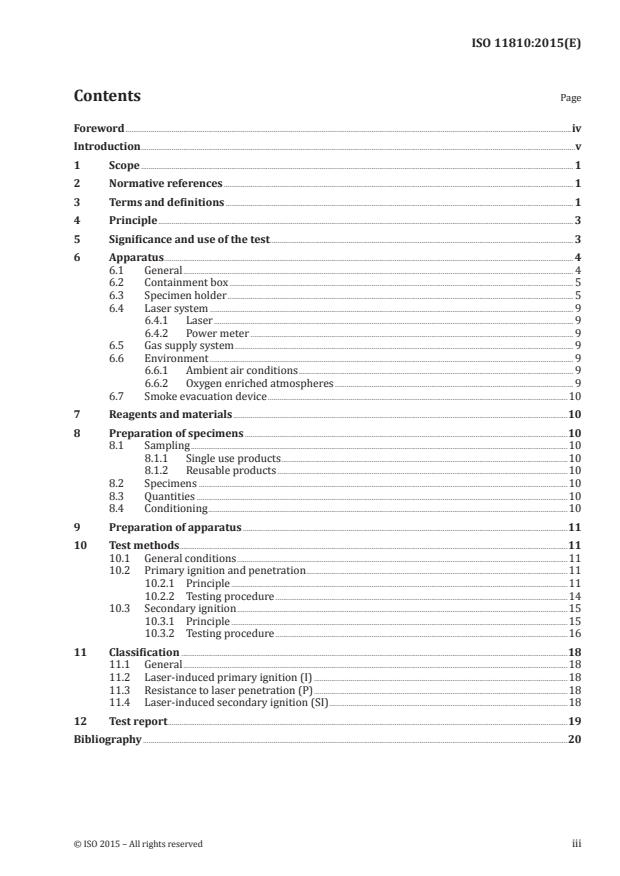
Contents Page
Foreword .iv
Introduction .v
1 Scope . 1
2 Normative references . 1
3 Terms and definitions . 1
4 Principle . 3
5 Significance and use of the test. 3
6 Apparatus . 4
6.1 General . 4
6.2 Containment box . 5
6.3 Specimen holder . 5
6.4 Laser system . 9
6.4.1 Laser . 9
6.4.2 Power meter . 9
6.5 Gas supply system . 9
6.6 Environment . 9
6.6.1 Ambient air conditions . 9
6.6.2 Oxygen enriched atmospheres . 9
6.7 Smoke evacuation device .10
7 Reagents and materials .10
8 Preparation of specimens .10
8.1 Sampling .10
8.1.1 Single use products .10
8.1.2 Reusable products .10
8.2 Specimens .10
8.3 Quantities .10
8.4 Conditioning .10
9 Preparation of apparatus .11
10 Test methods .11
10.1 General conditions .11
10.2 Primary ignition and penetration .11
10.2.1 Principle .11
10.2.2 Testing procedure .14
10.3 Secondary ignition .15
10.3.1 Principle .15
10.3.2 Testing procedure .16
11 Classification .18
11.1 General .18
11.2 Laser-induced primary ignition (I) .18
11.3 Resistance to laser penetration (P) .18
11.4 Laser-induced secondary ignition (SI) .18
12 Test report .19
Bibliography .20
Foreword
ISO (the International Organization for Standardization) is a worldwide federation of national standards
bodies (ISO member bodies). The work of preparing International Standards is normally carried out
through ISO technical committees. Each member body interested in a subject for which a technical
committee has been established has the right to be represented on that committee. International
organizations, governmental and non-governmental, in liaison with ISO, also take part in the work.
ISO collaborates closely with the International Electrotechnical Commission (IEC) on all matters of
electrotechnical standardization.
The procedures used to develop this document and those intended for its further maintenance are
described in the ISO/IEC Directives, Part 1. In particular the different approval criteria needed for the
different types of ISO documents should be noted. This document was drafted in accordance with the
editorial rules of the ISO/IEC Directives, Part 2 (see www.iso.org/directives).
Attention is drawn to the possibility that some of the elements of this document may be the subject of
patent rights. ISO shall not be held responsible for identifying any or all such patent rights. Details of
any patent rights identified during the development of the document will be in the Introduction and/or
on the ISO list of patent declarations received (see www.iso.org/patents).
Any trade name used in this document is information given for the convenience of users and does not
constitute an endorsement.
For an explanation on the meaning of ISO specific terms and expressions related to conformity
assessment, as well as information about ISO’s adherence to the WTO principles in the Technical
Barriers to Trade (TBT) see the following URL: Foreword - Supplementary information
The committee responsible for this document is ISO/TC 172, Optics and photonics, Subcommittee SC 9,
Electro-optical systems.
This second edition cancels and replaces ISO 11810-1:2005 and ISO 11810-2:2007 which have been
technically revised.
iv © ISO 2015 – All rights reserved
Introduction
Some laser applications in medicine can require laser-resistant surgical drapes or other patient-
protective covers. Surgical drapes or other patient-protective covers are necessary when a sterile
procedure is performed and the surrounding area needs to be protected from liquids, secretions and
inadvertent laser radiation. While conventional surgical drapes or other patient-protective covers are not
necessarily laser-resistant, specifically designed surgical drapes offer the possibility of laser resistance.
Laser induced risks include ignition, flammability, melting, penetration, thermal transfer and
reflectivity. Textile and non-woven drape materials can have other risks but they can provide a laser
barrier. While there are many potential ignition devices present in the operating room (e.g. fibre optic
illumination systems, electro-surgical units, hot wire cauteries), this test method addresses only the
laser ignition source. This International Standard is intended for use in testing a surgical drape or other
patient-protective cover that claims to be laser-resistant. In addition, areas within this product can
vary in material composition or design. Depending on the claims being made by the manufacturer or
end-user requirements, all areas for which laser resistance is claimed might need to be tested.
CO lasers can induce the most challenging conditions of all medical lasers. Ignition/flammability tests
and penetration tests can reveal more challenging laser wavelengths as well as modes of laser delivery,
for example Q-switching in the nanosecond range. The 20 W CO laser (continuous wave) has been
selected as the laser for this International Standard.
Users of this test method are cautioned that the laser resistance of a surgical drape or other patient-
protective cover will be wavelength sensitive and that a surgical drape or other patient-protective
cover should be tested at the wavelengths for which it is intended to be used. If tested using other
wavelengths, it is necessary to explicitly state the power settings and modes of delivery.
The results from this International Standard should not be applied to other wavelengths and
temporal formats.
The performance of laser-resistant surgical drapes or other patient-protective covers can be changed
when used in combination rather than individually.
INTERNATIONAL STANDARD ISO 11810:2015(E)
Lasers and laser-related equipment — Test method and
classification for the laser resistance of surgical drapes
and/or patient protective covers — Primary ignition,
penetration, flame spread and secondary ignition
CAUTION — This test method can involve hazardous materials, operations and equipment.
This International Standard provides advice on minimizing some of the risks associated with
its use but does not purport to address all such risks. It is the responsibility of the user of this
International Standard to establish appropriate safety and health practices and to determine
the applicability of regulatory limitations prior to use.
1 Scope
This International Standard is applicable to disposable and reusable, as well as woven and non-woven
materials used as surgical drapes and other patient-protective covers which claim to be laser-resistant.
The purpose of this International Standard is to provide a standardized method for testing and
classifying surgical drapes and other patient-protective covers with respect to laser-induced hazards.
An appropriate classification system is given. It is not the purpose of this International Standard to
serve as a general fire safety specification, and as such, this International Standard does not cover other
sources of ignition.
All materials reflect portions of the beam and it is necessary for the user to decide whether specular
reflectance can be a hazard. This measurement, however, is not covered in this International Standard.
The test procedure can be used to assess the laser induced flammability properties of non-laser-
resistant items
NOTE Users of products tested by this method are cautioned that the laser resistance of a surgical drape
and/or patient-protective cover will be wavelength sensitive and that a surgical drape and/or patient-protective
cover are better tested at the wavelength for which it is intended to be used. If tested using other wavelengths, it
is necessary to explicitly state the power settings and modes of delivery.
2 Normative references
The following documents, in whole or in part, are normatively referenced in this document and are
indispensable for its application. For dated references, only the edition cited applies. For undated
references, the latest edition of the referenced document (including any amendments) applies.
ISO 11145, Optics and photonics — Lasers and laser-related equipment — Vocabulary and symbols
ISO 11146-1, Lasers and laser-related equipment — Test methods for laser beam widths, divergence angles
and beam propagation ratios — Part 1: Stigmatic and simple astigmatic beams
ISO 80000-4, Quantities and units — Part 4: Mechanics
IEC 60825-1, Safety of laser products — Part 1: Equipment classification and requirements
3 Terms and definitions
For the purposes of this document, the following terms and definitions apply.
3.1
afterflame
persistence of flaming of a material, under specified test conditions, after the ignition source has been
removed
3.2
afterflame time
length of time for which a material continues to flame, under specified test conditions, after the ignition
source has been removed
3.3
afterglow
persistence of glowing of a material, under specified test conditions, after cessation of flaming or, if no
flaming occurs, after the ignition source has been removed
3.4
afterglow time
time during which a material continues to glow, under specified test conditions, after cessation of
flaming or, if no flaming occurs, after the ignition source has been removed
3.5
beam diameter
d
diameter of an aperture in a plane perpendicular to the beam axis which contains 95 % of the total
beam power
3.6
beam cross-sectional area
A
smallest area containing 95 % of the total beam power
Note 1 to entry: Adapted from ISO 11145:2006, 3.2.1.
3.7
combustion
any continuing burning process that occurs in or on the specimen caused by a chemical process of
oxidation with the liberation of heat
EXAMPLE Flame, smouldering, rapid evolution of smoke.
3.8
damage
any change, other than combustion, which can affect the safety of the patient or efficacy of the product
due to increasing the risk of ignition
EXAMPLE Local heating, melting, creation of holes, pyrolysis.
3.9
flammable
subject to ignition and flaming combustion
3.10
ignition
creation of combustion induced by the delivery of power
3.11
laser resistance
measure of the ability of a material to withstand laser power without ignition or damage
2 © ISO 2015 – All rights reserved
3.12
melting behaviour
softening of a material under the influence of heat (including shrinking, dripping and burning of molten
material, etc.)
3.13
patient-protective cover
material, other than a surgical drape, intended to protect a patient
3.14
penetration resistance
ability of a material to prevent the passage of laser energy
3.15
product
finished medical device (surgical drape or other patient-protective cover) that can be composed of one
or more homogeneous materials (samples)
3.16
reusable product
product intended to be laundered and re-sterilized for multiple use
3.17
secondary ignition
ignition of a specimen by an underlying material caused to burn by a laser beam transmitted
through the specimen
3.18
single use
product intended to be used once and then discarded
3.19
surgical drape
material intended to be draped over a patient during surgery
3.20
thermal resistance
ability of a material to resist conduction of heat
4 Principle
WARNING — This test method can result in a rocket-like fire involving the surgical drape. Such a
fire can produce intense heat and light and toxic gases.
To simulate worst-case conditions, the material is exposed to laser power of known characteristics in
an environment of up to 98 % ± 2 % oxygen.
5 Significance and use of the test
5.1 This International Standard describes a uniform and repeatable test method for measuring the
primary ignition, penetration, flame spread and secondary ignition of surgical drapes and other patient-
protective covers. Variables involved in laser ignition have been fixed in order to establish a basis for
comparison. This test method can be used to compare differing types and designs.
5.2 A large number and range of variables is involved in ignition of surgical drapes. A change in one
variable can affect the outcome of the test. Caution should be exercised, since the direct applicability of
the results of this test method to the clinical situation has not been fully established.
5.3 Since an oxygen-enriched atmosphere is often present in the clinical situation, either intentionally
or unintentionally, the test is performed in ambient air and an environment of 60 % ± 2% and 98 % ± 2 %
oxygen, respectively.
5.4 The preparation of the specimen shall be in accordance with the manufacturer’s instructions for use.
5.5 Many manufacturers of laser-resistant surgical drapes recommend using isotonic saline or water
to moisten the material. In case of water-proof surgical drapes, the underlying material cannot be
moistened and so can have the original burning behaviour.
NOTE 1 This method can be applied to study the effect of changing the test conditions, but this is outside the
scope of this International Standard.
NOTE 2 Use of beam cross-sectional shape, other than circular, or mode of laser power delivery, other than
continuous wave, can affect the ignition characteristics.
6 Apparatus
6.1 General
The test apparatus shall consist of a draught-resistant ventilated containment box, specimen holder,
specimen rack, laser energy source and associated parts (see Figure 1).
O
2 2
N
Key
1 specimen 6 flashback arrestor
2 specimen holder (see Figures 2, 3 and 4 for more detail) 7 oxygen flow meter and controller
3 opening for laser access 8 pressure regulator with inlet and outlet gauges
4 laser 9 quick-action inert gas valve
5 containment box (lateral view)
Figure 1 — Typical test apparatus (schematic)
4 © ISO 2015 – All rights reserved
6.2 Containment box
The containment box controls the environment around the specimen while allowing the laser beam to
be directed onto the specimen.
The containment box shall have the following characteristics:
a) it is rectangular in shape and measures approximately 46 cm × 46 cm × 46 cm;
b) it is fire-proof and easily cleaned of soot and residue from burned specimens;
c) it allows the mounting of the specimen at an angle such that by gravity the underlying material is
removed spontaneously;
d) it allows access to the specimen;
e) it allows direct access of the laser beam to the specimen;
f) it allows observation with video cameras on the top and on all sides of the box, a minimum of three
video cameras (one camera positioned above the containment box and two cameras positioned at
two of the sides of the containment box) is needed for recording purposes;
g) it exhausts the gas and any products of combustion to a safe area;
h) it allows cleaning of the box, and cleaning of the covers and/or windows themselves;
i) it is capable of maintaining an environment of 98 % ± 2 % oxygen around the specimen;
j) it can be rapidly flooded with nitrogen or another gas to extinguish any fire inside the box;
k) the internal surfaces are non-reflective to protect the specimen from reflections;
l) a piece of clean filter paper shall be positioned on the floor of the test chamber directly beneath the
test specimen for detection of dropped particles capable of igniting other materials.
Other configurations may be used, as long as the requirements of the test method as defined herein are
not affected.
6.3 Specimen holder
The specimen holder (see Figure 2) shall consist of three metal plates (of stainless steel or equivalent,
approximately 2 mm thick). The specimen shall be clamped between the top two plates (top frame and
mount). The connection between these two plates shall be stable and may be achieved by clamps or
screws. The plates shall be slotted and loosely pinned for alignment. The third plate (bottom frame)
...
INTERNATIONAL ISO
STANDARD 11810
Second edition
2015-12-15
Lasers and laser-related equipment —
Test method and classification for the
laser resistance of surgical drapes
and/or patient protective covers —
Primary ignition, penetration, flame
spread and secondary ignition
Lasers et équipements associés aux lasers — Méthode d’essai et
classification de la résistance au laser pour des draps chirurgicaux
et/ou des couvertures de protection des patients — Inflammation
principale, pénétration et inflammation secondaire
Reference number
©
ISO 2015
© ISO 2015, Published in Switzerland
All rights reserved. Unless otherwise specified, no part of this publication may be reproduced or utilized otherwise in any form
or by any means, electronic or mechanical, including photocopying, or posting on the internet or an intranet, without prior
written permission. Permission can be requested from either ISO at the address below or ISO’s member body in the country of
the requester.
ISO copyright office
Ch. de Blandonnet 8 • CP 401
CH-1214 Vernier, Geneva, Switzerland
Tel. +41 22 749 01 11
Fax +41 22 749 09 47
copyright@iso.org
www.iso.org
ii © ISO 2015 – All rights reserved
Contents Page
Foreword .iv
Introduction .v
1 Scope . 1
2 Normative references . 1
3 Terms and definitions . 1
4 Principle . 3
5 Significance and use of the test. 3
6 Apparatus . 4
6.1 General . 4
6.2 Containment box . 5
6.3 Specimen holder . 5
6.4 Laser system . 9
6.4.1 Laser . 9
6.4.2 Power meter . 9
6.5 Gas supply system . 9
6.6 Environment . 9
6.6.1 Ambient air conditions . 9
6.6.2 Oxygen enriched atmospheres . 9
6.7 Smoke evacuation device .10
7 Reagents and materials .10
8 Preparation of specimens .10
8.1 Sampling .10
8.1.1 Single use products .10
8.1.2 Reusable products .10
8.2 Specimens .10
8.3 Quantities .10
8.4 Conditioning .10
9 Preparation of apparatus .11
10 Test methods .11
10.1 General conditions .11
10.2 Primary ignition and penetration .11
10.2.1 Principle .11
10.2.2 Testing procedure .14
10.3 Secondary ignition .15
10.3.1 Principle .15
10.3.2 Testing procedure .16
11 Classification .18
11.1 General .18
11.2 Laser-induced primary ignition (I) .18
11.3 Resistance to laser penetration (P) .18
11.4 Laser-induced secondary ignition (SI) .18
12 Test report .19
Bibliography .20
Foreword
ISO (the International Organization for Standardization) is a worldwide federation of national standards
bodies (ISO member bodies). The work of preparing International Standards is normally carried out
through ISO technical committees. Each member body interested in a subject for which a technical
committee has been established has the right to be represented on that committee. International
organizations, governmental and non-governmental, in liaison with ISO, also take part in the work.
ISO collaborates closely with the International Electrotechnical Commission (IEC) on all matters of
electrotechnical standardization.
The procedures used to develop this document and those intended for its further maintenance are
described in the ISO/IEC Directives, Part 1. In particular the different approval criteria needed for the
different types of ISO documents should be noted. This document was drafted in accordance with the
editorial rules of the ISO/IEC Directives, Part 2 (see www.iso.org/directives).
Attention is drawn to the possibility that some of the elements of this document may be the subject of
patent rights. ISO shall not be held responsible for identifying any or all such patent rights. Details of
any patent rights identified during the development of the document will be in the Introduction and/or
on the ISO list of patent declarations received (see www.iso.org/patents).
Any trade name used in this document is information given for the convenience of users and does not
constitute an endorsement.
For an explanation on the meaning of ISO specific terms and expressions related to conformity
assessment, as well as information about ISO’s adherence to the WTO principles in the Technical
Barriers to Trade (TBT) see the following URL: Foreword - Supplementary information
The committee responsible for this document is ISO/TC 172, Optics and photonics, Subcommittee SC 9,
Electro-optical systems.
This second edition cancels and replaces ISO 11810-1:2005 and ISO 11810-2:2007 which have been
technically revised.
iv © ISO 2015 – All rights reserved
Introduction
Some laser applications in medicine can require laser-resistant surgical drapes or other patient-
protective covers. Surgical drapes or other patient-protective covers are necessary when a sterile
procedure is performed and the surrounding area needs to be protected from liquids, secretions and
inadvertent laser radiation. While conventional surgical drapes or other patient-protective covers are not
necessarily laser-resistant, specifically designed surgical drapes offer the possibility of laser resistance.
Laser induced risks include ignition, flammability, melting, penetration, thermal transfer and
reflectivity. Textile and non-woven drape materials can have other risks but they can provide a laser
barrier. While there are many potential ignition devices present in the operating room (e.g. fibre optic
illumination systems, electro-surgical units, hot wire cauteries), this test method addresses only the
laser ignition source. This International Standard is intended for use in testing a surgical drape or other
patient-protective cover that claims to be laser-resistant. In addition, areas within this product can
vary in material composition or design. Depending on the claims being made by the manufacturer or
end-user requirements, all areas for which laser resistance is claimed might need to be tested.
CO lasers can induce the most challenging conditions of all medical lasers. Ignition/flammability tests
and penetration tests can reveal more challenging laser wavelengths as well as modes of laser delivery,
for example Q-switching in the nanosecond range. The 20 W CO laser (continuous wave) has been
selected as the laser for this International Standard.
Users of this test method are cautioned that the laser resistance of a surgical drape or other patient-
protective cover will be wavelength sensitive and that a surgical drape or other patient-protective
cover should be tested at the wavelengths for which it is intended to be used. If tested using other
wavelengths, it is necessary to explicitly state the power settings and modes of delivery.
The results from this International Standard should not be applied to other wavelengths and
temporal formats.
The performance of laser-resistant surgical drapes or other patient-protective covers can be changed
when used in combination rather than individually.
INTERNATIONAL STANDARD ISO 11810:2015(E)
Lasers and laser-related equipment — Test method and
classification for the laser resistance of surgical drapes
and/or patient protective covers — Primary ignition,
penetration, flame spread and secondary ignition
CAUTION — This test method can involve hazardous materials, operations and equipment.
This International Standard provides advice on minimizing some of the risks associated with
its use but does not purport to address all such risks. It is the responsibility of the user of this
International Standard to establish appropriate safety and health practices and to determine
the applicability of regulatory limitations prior to use.
1 Scope
This International Standard is applicable to disposable and reusable, as well as woven and non-woven
materials used as surgical drapes and other patient-protective covers which claim to be laser-resistant.
The purpose of this International Standard is to provide a standardized method for testing and
classifying surgical drapes and other patient-protective covers with respect to laser-induced hazards.
An appropriate classification system is given. It is not the purpose of this International Standard to
serve as a general fire safety specification, and as such, this International Standard does not cover other
sources of ignition.
All materials reflect portions of the beam and it is necessary for the user to decide whether specular
reflectance can be a hazard. This measurement, however, is not covered in this International Standard.
The test procedure can be used to assess the laser induced flammability properties of non-laser-
resistant items
NOTE Users of products tested by this method are cautioned that the laser resistance of a surgical drape
and/or patient-protective cover will be wavelength sensitive and that a surgical drape and/or patient-protective
cover are better tested at the wavelength for which it is intended to be used. If tested using other wavelengths, it
is necessary to explicitly state the power settings and modes of delivery.
2 Normative references
The following documents, in whole or in part, are normatively referenced in this document and are
indispensable for its application. For dated references, only the edition cited applies. For undated
references, the latest edition of the referenced document (including any amendments) applies.
ISO 11145, Optics and photonics — Lasers and laser-related equipment — Vocabulary and symbols
ISO 11146-1, Lasers and laser-related equipment — Test methods for laser beam widths, divergence angles
and beam propagation ratios — Part 1: Stigmatic and simple astigmatic beams
ISO 80000-4, Quantities and units — Part 4: Mechanics
IEC 60825-1, Safety of laser products — Part 1: Equipment classification and requirements
3 Terms and definitions
For the purposes of this document, the following terms and definitions apply.
3.1
afterflame
persistence of flaming of a material, under specified test conditions, after the ignition source has been
removed
3.2
afterflame time
length of time for which a material continues to flame, under specified test conditions, after the ignition
source has been removed
3.3
afterglow
persistence of glowing of a material, under specified test conditions, after cessation of flaming or, if no
flaming occurs, after the ignition source has been removed
3.4
afterglow time
time during which a material continues to glow, under specified test conditions, after cessation of
flaming or, if no flaming occurs, after the ignition source has been removed
3.5
beam diameter
d
diameter of an aperture in a plane perpendicular to the beam axis which contains 95 % of the total
beam power
3.6
beam cross-sectional area
A
smallest area containing 95 % of the total beam power
Note 1 to entry: Adapted from ISO 11145:2006, 3.2.1.
3.7
combustion
any continuing burning process that occurs in or on the specimen caused by a chemical process of
oxidation with the liberation of heat
EXAMPLE Flame, smouldering, rapid evolution of smoke.
3.8
damage
any change, other than combustion, which can affect the safety of the patient or efficacy of the product
due to increasing the risk of ignition
EXAMPLE Local heating, melting, creation of holes, pyrolysis.
3.9
flammable
subject to ignition and flaming combustion
3.10
ignition
creation of combustion induced by the delivery of power
3.11
laser resistance
measure of the ability of a material to withstand laser power without ignition or damage
2 © ISO 2015 – All rights reserved
3.12
melting behaviour
softening of a material under the influence of heat (including shrinking, dripping and burning of molten
material, etc.)
3.13
patient-protective cover
material, other than a surgical drape, intended to protect a patient
3.14
penetration resistance
ability of a material to prevent the passage of laser energy
3.15
product
finished medical device (surgical drape or other patient-protective cover) that can be composed of one
or more homogeneous materials (samples)
3.16
reusable product
product intended to be laundered and re-sterilized for multiple use
3.17
secondary ignition
ignition of a specimen by an underlying material caused to burn by a laser beam transmitted
through the specimen
3.18
single use
product intended to be used once and then discarded
3.19
surgical drape
material intended to be draped over a patient during surgery
3.20
thermal resistance
ability of a material to resist conduction of heat
4 Principle
WARNING — This test method can result in a rocket-like fire involving the surgical drape. Such a
fire can produce intense heat and light and toxic gases.
To simulate worst-case conditions, the material is exposed to laser power of known characteristics in
an environment of up to 98 % ± 2 % oxygen.
5 Significance and use of the test
5.1 This International Standard describes a uniform and repeatable test method for measuring the
primary ignition, penetration, flame spread and secondary ignition of surgical drapes and other patient-
protective covers. Variables involved in laser ignition have been fixed in order to establish a basis for
comparison. This test method can be used to compare differing types and designs.
5.2 A large number and range of variables is involved in ignition of surgical drapes. A change in one
variable can affect the outcome of the test. Caution should be exercised, since the direct applicability of
the results of this test method to the clinical situation has not been fully established.
5.3 Since an oxygen-enriched atmosphere is often present in the clinical situation, either intentionally
or unintentionally, the test is performed in ambient air and an environment of 60 % ± 2% and 98 % ± 2 %
oxygen, respectively.
5.4 The preparation of the specimen shall be in accordance with the manufacturer’s instructions for use.
5.5 Many manufacturers of laser-resistant surgical drapes recommend using isotonic saline or water
to moisten the material. In case of water-proof surgical drapes, the underlying material cannot be
moistened and so can have the original burning behaviour.
NOTE 1 This method can be applied to study the effect of changing the test conditions, but this is outside the
scope of this International Standard.
NOTE 2 Use of beam cross-sectional shape, other than circular, or mode of laser power delivery, other than
continuous wave, can affect the ignition characteristics.
6 Apparatus
6.1 General
The test apparatus shall consist of a draught-resistant ventilated containment box, specimen holder,
specimen rack, laser energy source and associated parts (see Figure 1).
O
2 2
N
Key
1 specimen 6 flashback arrestor
2 specimen holder (see Figures 2, 3 and 4 for more detail) 7 oxygen flow meter and controller
3 opening for laser access 8 pressure regulator with inlet and outlet gauges
4 laser 9 quick-action inert gas valve
5 containment box (lateral view)
Figure 1 — Typical test apparatus (schematic)
4 © ISO 2015 – All rights reserved
6.2 Containment box
The containment box controls the environment around the specimen while allowing the laser beam to
be directed onto the specimen.
The containment box shall have the following characteristics:
a) it is rectangular in shape and measures approximately 46 cm × 46 cm × 46 cm;
b) it is fire-proof and easily cleaned of soot and residue from burned specimens;
c) it allows the mounting of the specimen at an angle such that by gravity the underlying material is
removed spontaneously;
d) it allows access to the specimen;
e) it allows direct access of the laser beam to the specimen;
f) it allows observation with video cameras on the top and on all sides of the box, a minimum of three
video cameras (one camera positioned above the containment box and two cameras positioned at
two of the sides of the containment box) is needed for recording purposes;
g) it exhausts the gas and any products of combustion to a safe area;
h) it allows cleaning of the box, and cleaning of the covers and/or windows themselves;
i) it is capable of maintaining an environment of 98 % ± 2 % oxygen around the specimen;
j) it can be rapidly flooded with nitrogen or another gas to extinguish any fire inside the box;
k) the internal surfaces are non-reflective to protect the specimen from reflections;
l) a piece of clean filter paper shall be positioned on the floor of the test chamber directly beneath the
test specimen for detection of dropped particles capable of igniting other materials.
Other configurations may be used, as long as the requirements of the test method as defined herein are
not affected.
6.3 Specimen holder
The specimen holder (see Figure 2) shall consist of three metal plates (of stainless steel or equivalent,
approximately 2 mm thick). The specimen shall be clamped between the top two plates (top frame and
mount). The connection between these two plates shall be stable and may be achieved by clamps or
screws. The plates shall be slotted and loosely pinned for alignment. The third plate (bottom frame)
...
NORME ISO
INTERNATIONALE 11810
Deuxième édition
2015-12-15
Lasers et équipements associés
aux lasers — Méthode d’essai et
classification de la résistance au laser
pour des draps chirurgicaux et/ou
des couvertures de protection des
patients — Inflammation principale,
pénétration et inflammation
secondaire
Lasers and laser-related equipment — Test method and
classification for the laser resistance of surgical drapes and/or
patient protective covers — Primary ignition, penetration, flame
spread and secondary ignition
Numéro de référence
©
ISO 2015
DOCUMENT PROTÉGÉ PAR COPYRIGHT
© ISO 2015, Publié en Suisse
Droits de reproduction réservés. Sauf indication contraire, aucune partie de cette publication ne peut être reproduite ni utilisée
sous quelque forme que ce soit et par aucun procédé, électronique ou mécanique, y compris la photocopie, l’affichage sur
l’internet ou sur un Intranet, sans autorisation écrite préalable. Les demandes d’autorisation peuvent être adressées à l’ISO à
l’adresse ci-après ou au comité membre de l’ISO dans le pays du demandeur.
ISO copyright office
Ch. de Blandonnet 8 • CP 401
CH-1214 Vernier, Geneva, Switzerland
Tel. +41 22 749 01 11
Fax +41 22 749 09 47
copyright@iso.org
www.iso.org
ii © ISO 2015 – Tous droits réservés
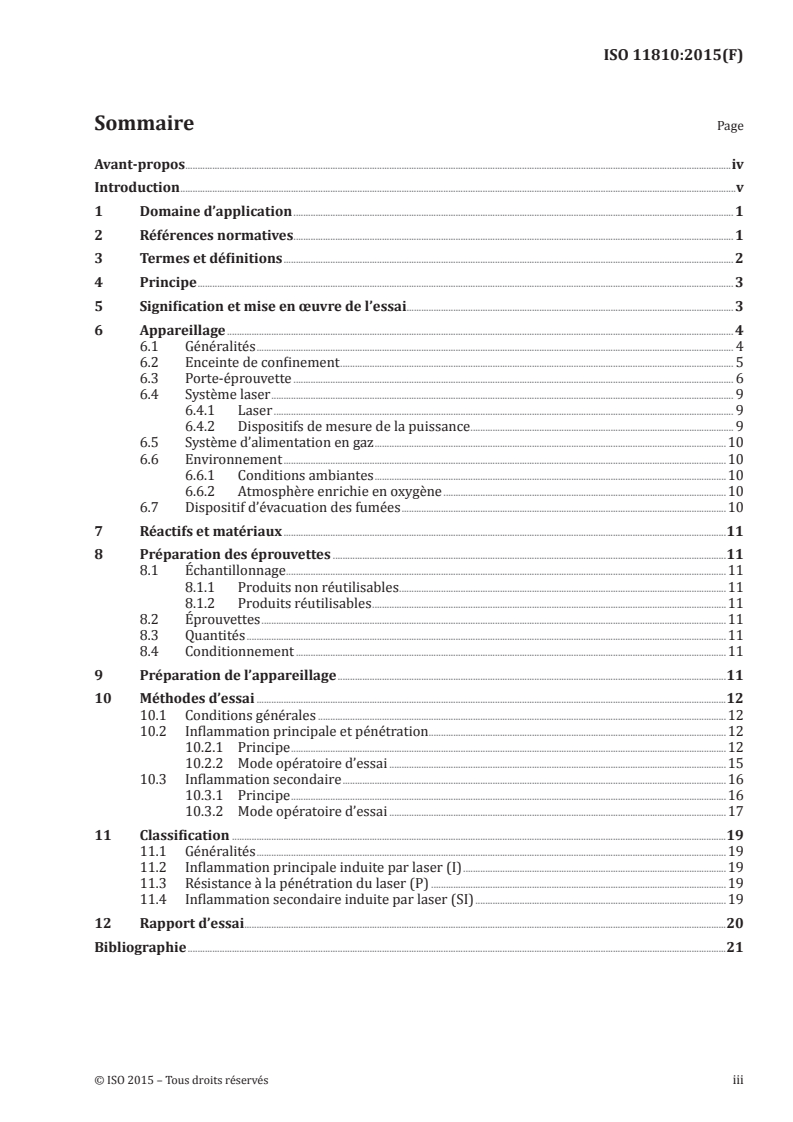
Sommaire Page
Avant-propos .iv
Introduction .v
1 Domaine d’application . 1
2 Références normatives . 1
3 Termes et définitions . 2
4 Principe . 3
5 Signification et mise en œuvre de l’essai . 3
6 Appareillage . 4
6.1 Généralités . 4
6.2 Enceinte de confinement . 5
6.3 Porte-éprouvette . 6
6.4 Système laser . 9
6.4.1 Laser . 9
6.4.2 Dispositifs de mesure de la puissance . 9
6.5 Système d’alimentation en gaz .10
6.6 Environnement .10
6.6.1 Conditions ambiantes .10
6.6.2 Atmosphère enrichie en oxygène .10
6.7 Dispositif d’évacuation des fumées .10
7 Réactifs et matériaux .11
8 Préparation des éprouvettes .11
8.1 Échantillonnage .11
8.1.1 Produits non réutilisables .11
8.1.2 Produits réutilisables .11
8.2 Éprouvettes .11
8.3 Quantités .11
8.4 Conditionnement .11
9 Préparation de l’appareillage .11
10 Méthodes d’essai .12
10.1 Conditions générales .12
10.2 Inflammation principale et pénétration.12
10.2.1 Principe .12
10.2.2 Mode opératoire d’essai .15
10.3 Inflammation secondaire .16
10.3.1 Principe .16
10.3.2 Mode opératoire d’essai .17
11 Classification .19
11.1 Généralités .19
11.2 Inflammation principale induite par laser (I) .19
11.3 Résistance à la pénétration du laser (P) .19
11.4 Inflammation secondaire induite par laser (SI) .19
12 Rapport d’essai .20
Bibliographie .21
Avant-propos
L’ISO (Organisation internationale de normalisation) est une fédération mondiale d’organismes
nationaux de normalisation (comités membres de l’ISO). L’élaboration des Normes internationales est
en général confiée aux comités techniques de l’ISO. Chaque comité membre intéressé par une étude
a le droit de faire partie du comité technique créé à cet effet. Les organisations internationales,
gouvernementales et non gouvernementales, en liaison avec l’ISO participent également aux travaux.
L’ISO collabore étroitement avec la Commission électrotechnique internationale (IEC) en ce qui
concerne la normalisation électrotechnique.
Les procédures utilisées pour élaborer le présent document et celles destinées à sa mise à jour sont
décrites dans les Directives ISO/IEC, Partie 1. Il convient, en particulier de prendre note des différents
critères d’approbation requis pour les différents types de documents ISO. Le présent document a été
rédigé conformément aux règles de rédaction données dans les Directives ISO/IEC, Partie 2 (voir www.
iso.org/directives).
L’attention est appelée sur le fait que certains des éléments du présent document peuvent faire l’objet de
droits de propriété intellectuelle ou de droits analogues. L’ISO ne saurait être tenue pour responsable
de ne pas avoir identifié de tels droits de propriété et averti de leur existence. Les détails concernant
les références aux droits de propriété intellectuelle ou autres droits analogues identifiés lors de
l’élaboration du document sont indiqués dans l’Introduction et/ou dans la liste des déclarations de
brevets reçues par l’ISO (voir www.iso.org/brevets).
Les appellations commerciales éventuellement mentionnées dans le présent document sont données
pour information, par souci de commodité, à l’intention des utilisateurs et ne sauraient constituer
un engagement.
Pour une explication de la signification des termes et expressions spécifiques de l’ISO liés à
l’évaluation de la conformité, ou pour toute information au sujet de l’adhésion de l’ISO aux principes
de l’OMC concernant les obstacles techniques au commerce (OTC), voir le lien suivant: Avant-propos —
Informations supplémentaires.
Le comité chargé de l’élaboration du présent document est l’ISO/TC 172, Optique et photonique, sous-
comité SC 9, Systèmes électro-optiques.
Cette deuxième édition annule et remplace l’ISO 11810-1:2005 et l’ISO 11810-2:2007 qui ont fait l’objet
d’une révision technique.
iv © ISO 2015 – Tous droits réservés
Introduction
Certaines applications utilisant les lasers en médecine peuvent nécessiter des draps chirurgicaux ou
autres couvertures de protection des patients résistant aux lasers. Les draps chirurgicaux ou autres
couvertures de protection des patients sont requis lorsqu’un mode opératoire stérile est mis en œuvre
et que la zone environnante nécessite d’être protégée des liquides, des sécrétions et des rayonnements
laser émis par inadvertance. Alors que les draps chirurgicaux conventionnels ou autres couvertures
de protection des patients ne sont pas nécessairement résistants aux lasers, des draps chirurgicaux
spécialement conçus offrent la possibilité de résistance aux lasers.
Les risques induits par les lasers incluent l’inflammation, l’inflammabilité, la fusion, la pénétration, le
transfert thermique et la réflectivité. Les textiles et les matériaux de draps non tissés peuvent présenter
d’autres risques mais ils sont susceptibles de constituer une barrière contre les lasers. Alors que de
nombreux dispositifs susceptibles de générer une inflammation sont présents dans la salle d’opération
(par exemple les systèmes d’éclairage par fibre optique, les unités électro-chirurgicales, les cautères
à fil chaud), la présente méthode d’essai concerne uniquement les sources d’inflammation par laser.
La présente Norme internationale s’applique aux essais de draps chirurgicaux ou d’autres couvertures
de protection des patients déclarés comme étant résistants aux lasers. En outre, certaines parties de
ces produits peuvent varier en termes de conception et de composition. Toutes les parties devant être
résistantes aux lasers peuvent être soumises à essai, en fonction des déclarations du fabricant ou des
exigences de l’utilisateur final.
Parmi tous les lasers médicaux, ce sont les lasers au CO qui sont susceptibles d’induire les conditions
les plus dangereuses. Les essais d’inflammation/d’inflammabilité et les essais de pénétration peuvent
révéler des longueurs d’onde de laser ainsi que des modes de distribution laser plus dangereux, par
exemple le fonctionnement déclenché dans la plage des nanosecondes. Néanmoins, le laser au CO de
20 W (laser continu) a été choisi comme laser par défaut pour la présente Norme internationale.
II est porté à l’attention des utilisateurs de cette méthode d’essai que la résistance au laser d’un drap
chirurgical ou d’une autre couverture de protection des patients sera sensible à la longueur d’onde
et qu’il convient de soumettre à essai un drap chirurgical ou une autre couverture de protection des
patients à la longueur d’onde pour laquelle il/elle est prévu(e). Si les essais sont réalisés à l’aide d’autres
longueurs d’onde, il est nécessaire de spécifier explicitement les réglages de puissance et les modes de
distribution.
Il convient de ne pas appliquer les résultats de la présente Norme internationale aux autres formats
temporels et longueurs d’onde.
Les performances des draps chirurgicaux et autres couvertures de protection des patients déclarés
résistants aux lasers peuvent être altérées si ceux-ci sont utilisés ensemble plutôt que séparément.
NORME INTERNATIONALE ISO 11810:2015(F)
Lasers et équipements associés aux lasers — Méthode
d’essai et classification de la résistance au laser pour des
draps chirurgicaux et/ou des couvertures de protection
des patients — Inflammation principale, pénétration et
inflammation secondaire
ATTENTION — La présente méthode d’essai peut impliquer des matériaux, des opérations et
le recours à un équipement susceptibles d’être dangereux. La présente Norme internationale
apporte des conseils pour réduire le plus possible certains des risques associés à cette
méthode mais elle ne prétend pas couvrir l’ensemble de ces risques. Il est de la responsabilité
de l’utilisateur de la présente Norme internationale d’établir des pratiques appropriées en ce
qui concerne la sécurité et la santé et de déterminer l’applicabilité des éventuelles limitations
réglementaires avant utilisation.
1 Domaine d’application
La présente Norme internationale s’applique aux matériaux non réutilisables et réutilisables, ainsi
qu’aux matériaux tissés et non tissés utilisés comme draps chirurgicaux ou couvertures de protection
des patients et déclarés résistants aux lasers. La présente Norme internationale a pour objet de fournir
une méthode normalisée pour les essais et la classification des draps chirurgicaux et autres couvertures
de protection des patients en fonction des risques liés aux lasers. Un système de classification approprié
est indiqué. La présente Norme internationale n’a pas pour objet de servir de spécification générale de
sécurité contre le feu et, en tant que telle, elle ne couvre pas d’autres sources d’inflammation.
Tous les matériaux réfléchissent des portions du faisceau laser et il est nécessaire que l’utilisateur
décide si le facteur de réflexion spéculaire peut constituer un risque. Ce mesurage n’est cependant pas
traité dans la présente Norme internationale.
Le mode opératoire d’essai peut être utilisé pour évaluer les propriétés d’inflammabilité induite par
laser des produits non résistants aux lasers.
NOTE Il est porté à l’attention des utilisateurs de cette méthode d’essai que la résistance aux lasers d’un drap
chirurgical et/ou d’une couverture de protection des patients sera sensible à la longueur d’onde et qu’il convient
de soumettre à essai un drap chirurgical et/ou une couverture de protection des patients à la longueur d’onde
pour laquelle il/elle est prévu(e). Si les essais sont réalisés à l’aide d’autres longueurs d’onde, il est nécessaire de
spécifier explicitement les réglages de puissance et les modes de distribution.
2 Références normatives
Les documents suivants, en totalité ou en partie, sont référencés de manière normative dans le présent
document et sont indispensables pour son application. Pour les références datées, seule l’édition citée
s’applique. Pour les références non datées, la dernière édition du document de référence s’applique (y
compris les éventuels amendements).
ISO 11145, Optique et photonique — Lasers et équipements associés aux lasers — Vocabulaire et symboles
ISO 11146-1, Lasers et équipements associés aux lasers — Méthodes d’essai des largeurs du faisceau, angles
de divergence et facteurs de limite de diffraction — Partie 1: Faisceaux stigmatiques et astigmatiques simples
ISO 80000-4, Grandeurs et unités — Partie 4: Mécanique
IEC 60825-1, Sécurité des appareils à laser — Partie 1: Classification des matériels et exigences
3 Termes et définitions
Pour les besoins du présent document, les termes et définitions suivants s’appliquent.
3.1
persistance de flamme
persistance de flamme sur un matériau, dans des conditions d’essai spécifiées, après retrait de la source
d’inflammation
3.2
durée de persistance de flamme
durée pendant laquelle un matériau continue à flamber, dans des conditions d’essai spécifiées, après
retrait de la source d’inflammation
3.3
incandescence résiduelle
combustion d’un matériau, dans des conditions d’essai spécifiées, avec incandescence persistant après
disparition des flammes ou, s’il n’y a pas de flammes, après retrait de la source d’inflammation
3.4
durée d’incandescence résiduelle
période pendant laquelle l’incandescence persiste sur un matériau, dans des conditions d’essai
spécifiées, après disparition des flammes ou, s’il n’y a pas de flammes, après retrait de la source
d’inflammation
3.5
diamètre du faisceau
d
diamètre d’une ouverture dans un plan perpendiculaire à l’axe du faisceau contenant 95 % de la
puissance totale du faisceau
3.6
aire de la section du faisceau
A
plus petite aire contenant 95 % de la puissance totale du faisceau
[SOURCE: ISO 11145:2006, définition 3.2.1, modifiée]
3.7
combustion
tout processus continu d’inflammation observé sur l’éprouvette et causé par un processus chimique
d’oxydation avec libération de chaleur
EXEMPLE Flamme, feu couvant, évolution rapide de fumée.
3.8
endommagement
toute modification, autre que la combustion, susceptible d’affecter la sécurité du patient ou l’efficacité
du produit en raison du risque accru d’inflammation
EXEMPLE Échauffement local, fusion, création de trous, pyrolyse.
3.9
inflammable
sujet à une inflammation et à une combustion avec flamme
3.10
inflammation
création d’une combustion déclenchée par la distribution d’une puissance
2 © ISO 2015 – Tous droits réservés
3.11
résistance au laser
mesure de l’aptitude d’un matériau à résister à la puissance du laser sans inflammation ni
endommagement
3.12
comportement thermofusible
phénomènes accompagnant le ramollissement d’un matériau sous l’influence de la chaleur (comprenant
la rétraction, la formation de gouttes et la combustion de matières fondues, etc.)
3.13
couverture de protection d’un patient
matériau autre qu’un drap chirurgical destiné à protéger un patient
3.14
résistance à la pénétration
aptitude d’un matériau à empêcher le passage de l’énergie laser
3.15
produit
dispositif médical fini (drap chirurgical ou autre couverture de protection d’un patient) pouvant être
composé d’un ou de plusieurs matériaux homogènes (échantillons)
3.16
produit réutilisable
produit destiné à être blanchi et restérilisé en vue d’un usage multiple
3.17
inflammation secondaire
inflammation d’une éprouvette par un matériau sous-jacent conduit à brûler par un faisceau laser
transmis au travers de l’éprouvette
3.18
non réutilisable
produit destiné à n’être utilisé qu’une seule fois puis à être mis au rebut
3.19
drap chirurgical
matériau destiné à couvrir un patient pendant une opération
3.20
résistance thermique
aptitude d’un matériau à résister à la conduction de chaleur
4 Principe
AVERTISSEMENT — La présente méthode d’essai peut provoquer un embrasement éclair du
drap chirurgical. Ce type de feu peut produire une chaleur et une lumière intenses et générer
des gaz toxiques.
Afin de simuler les conditions les plus défavorables, le matériau est exposé à une puissance de laser de
caractéristiques connues dans un environnement contenant jusqu’à 98 % ± 2 % d’oxygène.
5 Signification et mise en œuvre de l’essai
5.1 La présente Norme internationale spécifie une méthode d’essai uniforme et répétable permettant de
mesurer l’inflammation principale, la pénétration, la propagation de flamme et l’inflammation secondaire
des draps chirurgicaux et autres couvertures de protection des patients. Les variables impliquées par
l’inflammation par laser ont été définies afin de pouvoir établir une base de comparaison. Cette méthode
d’essai peut ainsi permettre de comparer des produits de types et de conceptions différents.
5.2 Un très grand nombre de variables intervient dans l’inflammation des draps chirurgicaux et
la modification d’une seule d’entre elles peut influencer le résultat de l’essai. Il convient donc d’être
particulièrement attentif car l’applicabilité directe des résultats de cette méthode d’essai à une situation
clinique n’a pas été totalement établie.
5.3 Étant donné qu’une atmosphère enrichie en oxygène, intentionnelle ou non, est souvent présente
dans une situation clinique, l’essai est réalisé dans l’air ambiant et dans un environnement contenant
60 % ± 2 % et 98 % ± 2 % d’oxygène, respectivement.
5.4 La préparation de l’éprouvette doit être réalisée conformément aux instructions d’utilisation
du fabricant.
5.5 De nombreux fabricants de draps chirurgicaux résistants aux lasers préconisent l’utilisation
d’une solution saline isotonique ou d’eau pour humidifier le matériau. Dans le cas de draps chirurgicaux
imperméables, le matériau sous-jacent ne peut pas être humidifié et conserve donc le comportement
au feu initial.
NOTE 1 Cette méthode peut être appliquée pour étudier l’effet que peut avoir la modification des conditions
d’essai. Toutefois, cette utilisation n’entre pas dans le domaine d’application de la présente Norme internationale.
NOTE 2 L’utilisation d’une section de laser autre que circulaire ou d’un mode de distribution de puissance
autre que le laser continu peut influencer les caractéristiques d’inflammation.
6 Appareillage
6.1 Généralités
L’appareillage d’essai doit être constitué d’une enceinte de confinement ventilée résistant aux courants
d’air, d’un porte-éprouvette, d’un support d’éprouvettes, d’une source laser et des éléments associés
(voir Figure 1).
4 © ISO 2015 – Tous droits réservés
O
2 2
N
Légende
1 éprouvette 6 dispositif antiretour de flamme
2 porte-éprouvette (voir Figures 2, 3 et 4 pour plus de 7 dispositif de régulation et de contrôle du débit
détails) d’oxygène
3 ouverture pour passage du laser 8 régulateur de pression avec jauges d’entrée et
de sortie
4 laser 9 vanne à manœuvre rapide pour gaz inerte
5 enceinte de confinement (vue latérale)
Figure 1 — Appareillage d’essai type (vue schématique)
6.2 Enceinte de confinement
L’enceinte de confinement permet de contrôler l’environnement dans lequel se trouve l’éprouvette, tout
en laissant passer le faisceau laser dirigé vers l’éprouvette.
Les caractéristiques de l’enceinte de confinement doivent être les suivantes:
a) elle doit être rectangulaire et mesurer approximativement 46 cm x 46 cm x 46 cm;
b) elle doit être résistante au feu, et la suie et les résidus issus des éprouvettes brûlées doivent pouvoir
être facilement nettoyés;
c) elle doit permettre le montage de l’éprouvette à un angle tel que la séparation du matériau sous-
jacent est spontanément provoquée par la gravité;
d) elle doit permettre l’accès à l’éprouvette;
e) elle doit permettre au faisceau laser d’être au contact direct de l’éprouvette;
f) elle doit permettre une observation au moyen de caméras vidéo placées sur le dessus et sur tous
les côtés de l’enceinte; trois caméras vidéo au minimum sont nécessaires (une caméra au-dessus de
l’enceinte de confinement et deux sur deux de ses côtés);
g) elle doit évacuer les gaz et les produits de combustion vers une zone sûre;
h) le nettoyage de l’enceinte ainsi que le nettoyage des couvercles et/ou fenêtres doit être possible;
i) elle doit pouvoir maintenir un environnement contenant 98 % ± 2 % d’oxygène autour de
l’éprouvette;
j) elle doit pouvoir être rapidement remplie d’azote ou d’un autre gaz permettant l’extinction d’un
éventuel feu à l’intérieur de l’enceinte;
k) les surfaces intérieures sont non réfléchissantes afin de protéger l’éprouvette des réflexions;
l) une feuille de papier-filtre propre doit être placée au fond de la chambre d’essai directement sous le
fond de l’éprouvette pour détecter des particules susceptibles d’enflammer d’autres matériaux.
D’autres configurations peuvent être utilisées, sous réserve que les exigences de la méthode d’essai
définies dans le présent document soient respectées.
6.3 Porte-éprouvette
Le porte-éprouvette (voir Figure 2) doit se composer de trois plaques métalliques (en acier inoxydable
ou équivalent, mesurant approximativement 2 mm d’épaisseur). L’éprouvette doit être fixée entre les
deux plaques du dessus (cadre supérieur et support). La connexion entre ces deux plaques doit être
stable et peut être complétée par des pinces ou des vis. Les plaques doivent être entaillées et maintenues
par des goupilles libres en vue de leur alignement. La troisième plaque (cadre inférieur) permet de fixer
la gaze de coton. La construction du dispositif de serrage doit garantir que lo
...
NORME ISO
INTERNATIONALE 11810
Deuxième édition
2015-12-15
Lasers et équipements associés
aux lasers — Méthode d’essai et
classification de la résistance au laser
pour des draps chirurgicaux et/ou
des couvertures de protection des
patients — Inflammation principale,
pénétration et inflammation
secondaire
Lasers and laser-related equipment — Test method and
classification for the laser resistance of surgical drapes and/or
patient protective covers — Primary ignition, penetration, flame
spread and secondary ignition
Numéro de référence
©
ISO 2015
DOCUMENT PROTÉGÉ PAR COPYRIGHT
© ISO 2015, Publié en Suisse
Droits de reproduction réservés. Sauf indication contraire, aucune partie de cette publication ne peut être reproduite ni utilisée
sous quelque forme que ce soit et par aucun procédé, électronique ou mécanique, y compris la photocopie, l’affichage sur
l’internet ou sur un Intranet, sans autorisation écrite préalable. Les demandes d’autorisation peuvent être adressées à l’ISO à
l’adresse ci-après ou au comité membre de l’ISO dans le pays du demandeur.
ISO copyright office
Ch. de Blandonnet 8 • CP 401
CH-1214 Vernier, Geneva, Switzerland
Tel. +41 22 749 01 11
Fax +41 22 749 09 47
copyright@iso.org
www.iso.org
ii © ISO 2015 – Tous droits réservés
Sommaire Page
Avant-propos .iv
Introduction .v
1 Domaine d’application . 1
2 Références normatives . 1
3 Termes et définitions . 2
4 Principe . 3
5 Signification et mise en œuvre de l’essai . 3
6 Appareillage . 4
6.1 Généralités . 4
6.2 Enceinte de confinement . 5
6.3 Porte-éprouvette . 6
6.4 Système laser . 9
6.4.1 Laser . 9
6.4.2 Dispositifs de mesure de la puissance . 9
6.5 Système d’alimentation en gaz .10
6.6 Environnement .10
6.6.1 Conditions ambiantes .10
6.6.2 Atmosphère enrichie en oxygène .10
6.7 Dispositif d’évacuation des fumées .10
7 Réactifs et matériaux .11
8 Préparation des éprouvettes .11
8.1 Échantillonnage .11
8.1.1 Produits non réutilisables .11
8.1.2 Produits réutilisables .11
8.2 Éprouvettes .11
8.3 Quantités .11
8.4 Conditionnement .11
9 Préparation de l’appareillage .11
10 Méthodes d’essai .12
10.1 Conditions générales .12
10.2 Inflammation principale et pénétration.12
10.2.1 Principe .12
10.2.2 Mode opératoire d’essai .15
10.3 Inflammation secondaire .16
10.3.1 Principe .16
10.3.2 Mode opératoire d’essai .17
11 Classification .19
11.1 Généralités .19
11.2 Inflammation principale induite par laser (I) .19
11.3 Résistance à la pénétration du laser (P) .19
11.4 Inflammation secondaire induite par laser (SI) .19
12 Rapport d’essai .20
Bibliographie .21
Avant-propos
L’ISO (Organisation internationale de normalisation) est une fédération mondiale d’organismes
nationaux de normalisation (comités membres de l’ISO). L’élaboration des Normes internationales est
en général confiée aux comités techniques de l’ISO. Chaque comité membre intéressé par une étude
a le droit de faire partie du comité technique créé à cet effet. Les organisations internationales,
gouvernementales et non gouvernementales, en liaison avec l’ISO participent également aux travaux.
L’ISO collabore étroitement avec la Commission électrotechnique internationale (IEC) en ce qui
concerne la normalisation électrotechnique.
Les procédures utilisées pour élaborer le présent document et celles destinées à sa mise à jour sont
décrites dans les Directives ISO/IEC, Partie 1. Il convient, en particulier de prendre note des différents
critères d’approbation requis pour les différents types de documents ISO. Le présent document a été
rédigé conformément aux règles de rédaction données dans les Directives ISO/IEC, Partie 2 (voir www.
iso.org/directives).
L’attention est appelée sur le fait que certains des éléments du présent document peuvent faire l’objet de
droits de propriété intellectuelle ou de droits analogues. L’ISO ne saurait être tenue pour responsable
de ne pas avoir identifié de tels droits de propriété et averti de leur existence. Les détails concernant
les références aux droits de propriété intellectuelle ou autres droits analogues identifiés lors de
l’élaboration du document sont indiqués dans l’Introduction et/ou dans la liste des déclarations de
brevets reçues par l’ISO (voir www.iso.org/brevets).
Les appellations commerciales éventuellement mentionnées dans le présent document sont données
pour information, par souci de commodité, à l’intention des utilisateurs et ne sauraient constituer
un engagement.
Pour une explication de la signification des termes et expressions spécifiques de l’ISO liés à
l’évaluation de la conformité, ou pour toute information au sujet de l’adhésion de l’ISO aux principes
de l’OMC concernant les obstacles techniques au commerce (OTC), voir le lien suivant: Avant-propos —
Informations supplémentaires.
Le comité chargé de l’élaboration du présent document est l’ISO/TC 172, Optique et photonique, sous-
comité SC 9, Systèmes électro-optiques.
Cette deuxième édition annule et remplace l’ISO 11810-1:2005 et l’ISO 11810-2:2007 qui ont fait l’objet
d’une révision technique.
iv © ISO 2015 – Tous droits réservés
Introduction
Certaines applications utilisant les lasers en médecine peuvent nécessiter des draps chirurgicaux ou
autres couvertures de protection des patients résistant aux lasers. Les draps chirurgicaux ou autres
couvertures de protection des patients sont requis lorsqu’un mode opératoire stérile est mis en œuvre
et que la zone environnante nécessite d’être protégée des liquides, des sécrétions et des rayonnements
laser émis par inadvertance. Alors que les draps chirurgicaux conventionnels ou autres couvertures
de protection des patients ne sont pas nécessairement résistants aux lasers, des draps chirurgicaux
spécialement conçus offrent la possibilité de résistance aux lasers.
Les risques induits par les lasers incluent l’inflammation, l’inflammabilité, la fusion, la pénétration, le
transfert thermique et la réflectivité. Les textiles et les matériaux de draps non tissés peuvent présenter
d’autres risques mais ils sont susceptibles de constituer une barrière contre les lasers. Alors que de
nombreux dispositifs susceptibles de générer une inflammation sont présents dans la salle d’opération
(par exemple les systèmes d’éclairage par fibre optique, les unités électro-chirurgicales, les cautères
à fil chaud), la présente méthode d’essai concerne uniquement les sources d’inflammation par laser.
La présente Norme internationale s’applique aux essais de draps chirurgicaux ou d’autres couvertures
de protection des patients déclarés comme étant résistants aux lasers. En outre, certaines parties de
ces produits peuvent varier en termes de conception et de composition. Toutes les parties devant être
résistantes aux lasers peuvent être soumises à essai, en fonction des déclarations du fabricant ou des
exigences de l’utilisateur final.
Parmi tous les lasers médicaux, ce sont les lasers au CO qui sont susceptibles d’induire les conditions
les plus dangereuses. Les essais d’inflammation/d’inflammabilité et les essais de pénétration peuvent
révéler des longueurs d’onde de laser ainsi que des modes de distribution laser plus dangereux, par
exemple le fonctionnement déclenché dans la plage des nanosecondes. Néanmoins, le laser au CO de
20 W (laser continu) a été choisi comme laser par défaut pour la présente Norme internationale.
II est porté à l’attention des utilisateurs de cette méthode d’essai que la résistance au laser d’un drap
chirurgical ou d’une autre couverture de protection des patients sera sensible à la longueur d’onde
et qu’il convient de soumettre à essai un drap chirurgical ou une autre couverture de protection des
patients à la longueur d’onde pour laquelle il/elle est prévu(e). Si les essais sont réalisés à l’aide d’autres
longueurs d’onde, il est nécessaire de spécifier explicitement les réglages de puissance et les modes de
distribution.
Il convient de ne pas appliquer les résultats de la présente Norme internationale aux autres formats
temporels et longueurs d’onde.
Les performances des draps chirurgicaux et autres couvertures de protection des patients déclarés
résistants aux lasers peuvent être altérées si ceux-ci sont utilisés ensemble plutôt que séparément.
NORME INTERNATIONALE ISO 11810:2015(F)
Lasers et équipements associés aux lasers — Méthode
d’essai et classification de la résistance au laser pour des
draps chirurgicaux et/ou des couvertures de protection
des patients — Inflammation principale, pénétration et
inflammation secondaire
ATTENTION — La présente méthode d’essai peut impliquer des matériaux, des opérations et
le recours à un équipement susceptibles d’être dangereux. La présente Norme internationale
apporte des conseils pour réduire le plus possible certains des risques associés à cette
méthode mais elle ne prétend pas couvrir l’ensemble de ces risques. Il est de la responsabilité
de l’utilisateur de la présente Norme internationale d’établir des pratiques appropriées en ce
qui concerne la sécurité et la santé et de déterminer l’applicabilité des éventuelles limitations
réglementaires avant utilisation.
1 Domaine d’application
La présente Norme internationale s’applique aux matériaux non réutilisables et réutilisables, ainsi
qu’aux matériaux tissés et non tissés utilisés comme draps chirurgicaux ou couvertures de protection
des patients et déclarés résistants aux lasers. La présente Norme internationale a pour objet de fournir
une méthode normalisée pour les essais et la classification des draps chirurgicaux et autres couvertures
de protection des patients en fonction des risques liés aux lasers. Un système de classification approprié
est indiqué. La présente Norme internationale n’a pas pour objet de servir de spécification générale de
sécurité contre le feu et, en tant que telle, elle ne couvre pas d’autres sources d’inflammation.
Tous les matériaux réfléchissent des portions du faisceau laser et il est nécessaire que l’utilisateur
décide si le facteur de réflexion spéculaire peut constituer un risque. Ce mesurage n’est cependant pas
traité dans la présente Norme internationale.
Le mode opératoire d’essai peut être utilisé pour évaluer les propriétés d’inflammabilité induite par
laser des produits non résistants aux lasers.
NOTE Il est porté à l’attention des utilisateurs de cette méthode d’essai que la résistance aux lasers d’un drap
chirurgical et/ou d’une couverture de protection des patients sera sensible à la longueur d’onde et qu’il convient
de soumettre à essai un drap chirurgical et/ou une couverture de protection des patients à la longueur d’onde
pour laquelle il/elle est prévu(e). Si les essais sont réalisés à l’aide d’autres longueurs d’onde, il est nécessaire de
spécifier explicitement les réglages de puissance et les modes de distribution.
2 Références normatives
Les documents suivants, en totalité ou en partie, sont référencés de manière normative dans le présent
document et sont indispensables pour son application. Pour les références datées, seule l’édition citée
s’applique. Pour les références non datées, la dernière édition du document de référence s’applique (y
compris les éventuels amendements).
ISO 11145, Optique et photonique — Lasers et équipements associés aux lasers — Vocabulaire et symboles
ISO 11146-1, Lasers et équipements associés aux lasers — Méthodes d’essai des largeurs du faisceau, angles
de divergence et facteurs de limite de diffraction — Partie 1: Faisceaux stigmatiques et astigmatiques simples
ISO 80000-4, Grandeurs et unités — Partie 4: Mécanique
IEC 60825-1, Sécurité des appareils à laser — Partie 1: Classification des matériels et exigences
3 Termes et définitions
Pour les besoins du présent document, les termes et définitions suivants s’appliquent.
3.1
persistance de flamme
persistance de flamme sur un matériau, dans des conditions d’essai spécifiées, après retrait de la source
d’inflammation
3.2
durée de persistance de flamme
durée pendant laquelle un matériau continue à flamber, dans des conditions d’essai spécifiées, après
retrait de la source d’inflammation
3.3
incandescence résiduelle
combustion d’un matériau, dans des conditions d’essai spécifiées, avec incandescence persistant après
disparition des flammes ou, s’il n’y a pas de flammes, après retrait de la source d’inflammation
3.4
durée d’incandescence résiduelle
période pendant laquelle l’incandescence persiste sur un matériau, dans des conditions d’essai
spécifiées, après disparition des flammes ou, s’il n’y a pas de flammes, après retrait de la source
d’inflammation
3.5
diamètre du faisceau
d
diamètre d’une ouverture dans un plan perpendiculaire à l’axe du faisceau contenant 95 % de la
puissance totale du faisceau
3.6
aire de la section du faisceau
A
plus petite aire contenant 95 % de la puissance totale du faisceau
[SOURCE: ISO 11145:2006, définition 3.2.1, modifiée]
3.7
combustion
tout processus continu d’inflammation observé sur l’éprouvette et causé par un processus chimique
d’oxydation avec libération de chaleur
EXEMPLE Flamme, feu couvant, évolution rapide de fumée.
3.8
endommagement
toute modification, autre que la combustion, susceptible d’affecter la sécurité du patient ou l’efficacité
du produit en raison du risque accru d’inflammation
EXEMPLE Échauffement local, fusion, création de trous, pyrolyse.
3.9
inflammable
sujet à une inflammation et à une combustion avec flamme
3.10
inflammation
création d’une combustion déclenchée par la distribution d’une puissance
2 © ISO 2015 – Tous droits réservés
3.11
résistance au laser
mesure de l’aptitude d’un matériau à résister à la puissance du laser sans inflammation ni
endommagement
3.12
comportement thermofusible
phénomènes accompagnant le ramollissement d’un matériau sous l’influence de la chaleur (comprenant
la rétraction, la formation de gouttes et la combustion de matières fondues, etc.)
3.13
couverture de protection d’un patient
matériau autre qu’un drap chirurgical destiné à protéger un patient
3.14
résistance à la pénétration
aptitude d’un matériau à empêcher le passage de l’énergie laser
3.15
produit
dispositif médical fini (drap chirurgical ou autre couverture de protection d’un patient) pouvant être
composé d’un ou de plusieurs matériaux homogènes (échantillons)
3.16
produit réutilisable
produit destiné à être blanchi et restérilisé en vue d’un usage multiple
3.17
inflammation secondaire
inflammation d’une éprouvette par un matériau sous-jacent conduit à brûler par un faisceau laser
transmis au travers de l’éprouvette
3.18
non réutilisable
produit destiné à n’être utilisé qu’une seule fois puis à être mis au rebut
3.19
drap chirurgical
matériau destiné à couvrir un patient pendant une opération
3.20
résistance thermique
aptitude d’un matériau à résister à la conduction de chaleur
4 Principe
AVERTISSEMENT — La présente méthode d’essai peut provoquer un embrasement éclair du
drap chirurgical. Ce type de feu peut produire une chaleur et une lumière intenses et générer
des gaz toxiques.
Afin de simuler les conditions les plus défavorables, le matériau est exposé à une puissance de laser de
caractéristiques connues dans un environnement contenant jusqu’à 98 % ± 2 % d’oxygène.
5 Signification et mise en œuvre de l’essai
5.1 La présente Norme internationale spécifie une méthode d’essai uniforme et répétable permettant de
mesurer l’inflammation principale, la pénétration, la propagation de flamme et l’inflammation secondaire
des draps chirurgicaux et autres couvertures de protection des patients. Les variables impliquées par
l’inflammation par laser ont été définies afin de pouvoir établir une base de comparaison. Cette méthode
d’essai peut ainsi permettre de comparer des produits de types et de conceptions différents.
5.2 Un très grand nombre de variables intervient dans l’inflammation des draps chirurgicaux et
la modification d’une seule d’entre elles peut influencer le résultat de l’essai. Il convient donc d’être
particulièrement attentif car l’applicabilité directe des résultats de cette méthode d’essai à une situation
clinique n’a pas été totalement établie.
5.3 Étant donné qu’une atmosphère enrichie en oxygène, intentionnelle ou non, est souvent présente
dans une situation clinique, l’essai est réalisé dans l’air ambiant et dans un environnement contenant
60 % ± 2 % et 98 % ± 2 % d’oxygène, respectivement.
5.4 La préparation de l’éprouvette doit être réalisée conformément aux instructions d’utilisation
du fabricant.
5.5 De nombreux fabricants de draps chirurgicaux résistants aux lasers préconisent l’utilisation
d’une solution saline isotonique ou d’eau pour humidifier le matériau. Dans le cas de draps chirurgicaux
imperméables, le matériau sous-jacent ne peut pas être humidifié et conserve donc le comportement
au feu initial.
NOTE 1 Cette méthode peut être appliquée pour étudier l’effet que peut avoir la modification des conditions
d’essai. Toutefois, cette utilisation n’entre pas dans le domaine d’application de la présente Norme internationale.
NOTE 2 L’utilisation d’une section de laser autre que circulaire ou d’un mode de distribution de puissance
autre que le laser continu peut influencer les caractéristiques d’inflammation.
6 Appareillage
6.1 Généralités
L’appareillage d’essai doit être constitué d’une enceinte de confinement ventilée résistant aux courants
d’air, d’un porte-éprouvette, d’un support d’éprouvettes, d’une source laser et des éléments associés
(voir Figure 1).
4 © ISO 2015 – Tous droits réservés
O
2 2
N
Légende
1 éprouvette 6 dispositif antiretour de flamme
2 porte-éprouvette (voir Figures 2, 3 et 4 pour plus de 7 dispositif de régulation et de contrôle du débit
détails) d’oxygène
3 ouverture pour passage du laser 8 régulateur de pression avec jauges d’entrée et
de sortie
4 laser 9 vanne à manœuvre rapide pour gaz inerte
5 enceinte de confinement (vue latérale)
Figure 1 — Appareillage d’essai type (vue schématique)
6.2 Enceinte de confinement
L’enceinte de confinement permet de contrôler l’environnement dans lequel se trouve l’éprouvette, tout
en laissant passer le faisceau laser dirigé vers l’éprouvette.
Les caractéristiques de l’enceinte de confinement doivent être les suivantes:
a) elle doit être rectangulaire et mesurer approximativement 46 cm x 46 cm x 46 cm;
b) elle doit être résistante au feu, et la suie et les résidus issus des éprouvettes brûlées doivent pouvoir
être facilement nettoyés;
c) elle doit permettre le montage de l’éprouvette à un angle tel que la séparation du matériau sous-
jacent est spontanément provoquée par la gravité;
d) elle doit permettre l’accès à l’éprouvette;
e) elle doit permettre au faisceau laser d’être au contact direct de l’éprouvette;
f) elle doit permettre une observation au moyen de caméras vidéo placées sur le dessus et sur tous
les côtés de l’enceinte; trois caméras vidéo au minimum sont nécessaires (une caméra au-dessus de
l’enceinte de confinement et deux sur deux de ses côtés);
g) elle doit évacuer les gaz et les produits de combustion vers une zone sûre;
h) le nettoyage de l’enceinte ainsi que le nettoyage des couvercles et/ou fenêtres doit être possible;
i) elle doit pouvoir maintenir un environnement contenant 98 % ± 2 % d’oxygène autour de
l’éprouvette;
j) elle doit pouvoir être rapidement remplie d’azote ou d’un autre gaz permettant l’extinction d’un
éventuel feu à l’intérieur de l’enceinte;
k) les surfaces intérieures sont non réfléchissantes afin de protéger l’éprouvette des réflexions;
l) une feuille de papier-filtre propre doit être placée au fond de la chambre d’essai directement sous le
fond de l’éprouvette pour détecter des particules susceptibles d’enflammer d’autres matériaux.
D’autres configurations peuvent être utilisées, sous réserve que les exigences de la méthode d’essai
définies dans le présent document soient respectées.
6.3 Porte-éprouvette
Le porte-éprouvette (voir Figure 2) doit se composer de trois plaques métalliques (en acier inoxydable
ou équivalent, mesurant approximativement 2 mm d’épaisseur). L’éprouvette doit être fixée entre les
deux plaques du dessus (cadre supérieur et support). La connexion entre ces deux plaques doit être
stable et peut être complétée par des pinces ou des vis. Les plaques doivent être entaillées et maintenues
par des goupilles libres en vue de leur alignement. La troisième plaque (cadre inférieur) permet de fixer
la gaze de coton. La construction du dispositif de serrage doit garantir que lo
...