


ISO/TS 19104:2008
(Main)Geographic information — Terminology
Geographic information — Terminology
ISO TS 19104:2008 is applicable to international communication in the field of geographic information. It provides the guidelines for collection and maintenance of terminology in the field of geographic information. It establishes criteria for selection of concepts to be included in other standards concerning geographic information, which are developed by ISO/TC 211, specifies the structure of the terminological record, and describes the principles for definition writing. ISO TS 19104:2008 also lays down the guidelines for maintenance of a Terminology Repository.
Information géographique — Terminologie
Geografske informacije - Terminologija
General Information
- Status
- Withdrawn
- Publication Date
- 04-Nov-2008
- Withdrawal Date
- 04-Nov-2008
- Technical Committee
- ISO/TC 211 - Geographic information/Geomatics
- Drafting Committee
- ISO/TC 211 - Geographic information/Geomatics
- Current Stage
- 9599 - Withdrawal of International Standard
- Start Date
- 23-Sep-2016
- Completion Date
- 12-Feb-2026
Relations
- Effective Date
- 09-Feb-2026
- Effective Date
- 09-Feb-2013






Get Certified
Connect with accredited certification bodies for this standard

BSI Group
BSI (British Standards Institution) is the business standards company that helps organizations make excellence a habit.

NYCE
Mexican standards and certification body.
Sponsored listings
Frequently Asked Questions
ISO/TS 19104:2008 is a technical specification published by the International Organization for Standardization (ISO). Its full title is "Geographic information — Terminology". This standard covers: ISO TS 19104:2008 is applicable to international communication in the field of geographic information. It provides the guidelines for collection and maintenance of terminology in the field of geographic information. It establishes criteria for selection of concepts to be included in other standards concerning geographic information, which are developed by ISO/TC 211, specifies the structure of the terminological record, and describes the principles for definition writing. ISO TS 19104:2008 also lays down the guidelines for maintenance of a Terminology Repository.
ISO TS 19104:2008 is applicable to international communication in the field of geographic information. It provides the guidelines for collection and maintenance of terminology in the field of geographic information. It establishes criteria for selection of concepts to be included in other standards concerning geographic information, which are developed by ISO/TC 211, specifies the structure of the terminological record, and describes the principles for definition writing. ISO TS 19104:2008 also lays down the guidelines for maintenance of a Terminology Repository.
ISO/TS 19104:2008 is classified under the following ICS (International Classification for Standards) categories: 01.040.35 - Information technology (Vocabularies); 35.240.70 - IT applications in science. The ICS classification helps identify the subject area and facilitates finding related standards.
ISO/TS 19104:2008 has the following relationships with other standards: It is inter standard links to EN ISO 19146:2010, ISO 19104:2016. Understanding these relationships helps ensure you are using the most current and applicable version of the standard.
ISO/TS 19104:2008 is available in PDF format for immediate download after purchase. The document can be added to your cart and obtained through the secure checkout process. Digital delivery ensures instant access to the complete standard document.
Standards Content (Sample)
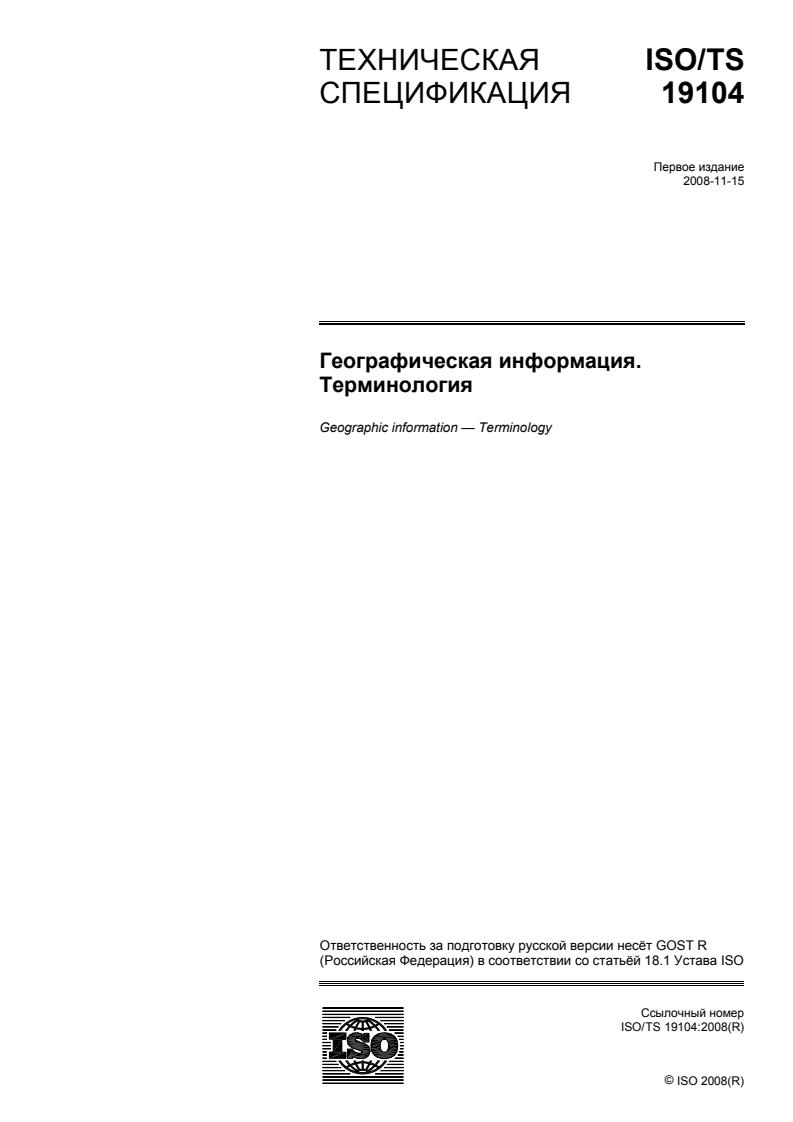
TECHNICAL ISO/TS
SPECIFICATION 19104
First edition
2008-11-15
Geographic information — Terminology
Information géographique — Terminologie
Reference number
©
ISO 2008
PDF disclaimer
This PDF file may contain embedded typefaces. In accordance with Adobe's licensing policy, this file may be printed or viewed but
shall not be edited unless the typefaces which are embedded are licensed to and installed on the computer performing the editing. In
downloading this file, parties accept therein the responsibility of not infringing Adobe's licensing policy. The ISO Central Secretariat
accepts no liability in this area.
Adobe is a trademark of Adobe Systems Incorporated.
Details of the software products used to create this PDF file can be found in the General Info relative to the file; the PDF-creation
parameters were optimized for printing. Every care has been taken to ensure that the file is suitable for use by ISO member bodies. In
the unlikely event that a problem relating to it is found, please inform the Central Secretariat at the address given below.
© ISO 2008
The reproduction of the terms and definitions contained in this International Standard is permitted in teaching manuals, instruction
booklets, technical publications and journals for strictly educational or implementation purposes. The conditions for such reproduction are:
that no modifications are made to the terms and definitions; that such reproduction is not permitted for dictionaries or similar publications
offered for sale; and that this International Standard is referenced as the source document.
With the sole exceptions noted above, no other part of this publication may be reproduced or utilized in any form or by any means,
electronic or mechanical, including photocopying and microfilm, without permission in writing from either ISO at the address below or
ISO's member body in the country of the requester.
ISO copyright office
Case postale 56 • CH-1211 Geneva 20
Tel. + 41 22 749 01 11
Fax + 41 22 749 09 47
E-mail copyright@iso.org
Web www.iso.org
Published in Switzerland
ii © ISO 2008 – All rights reserved
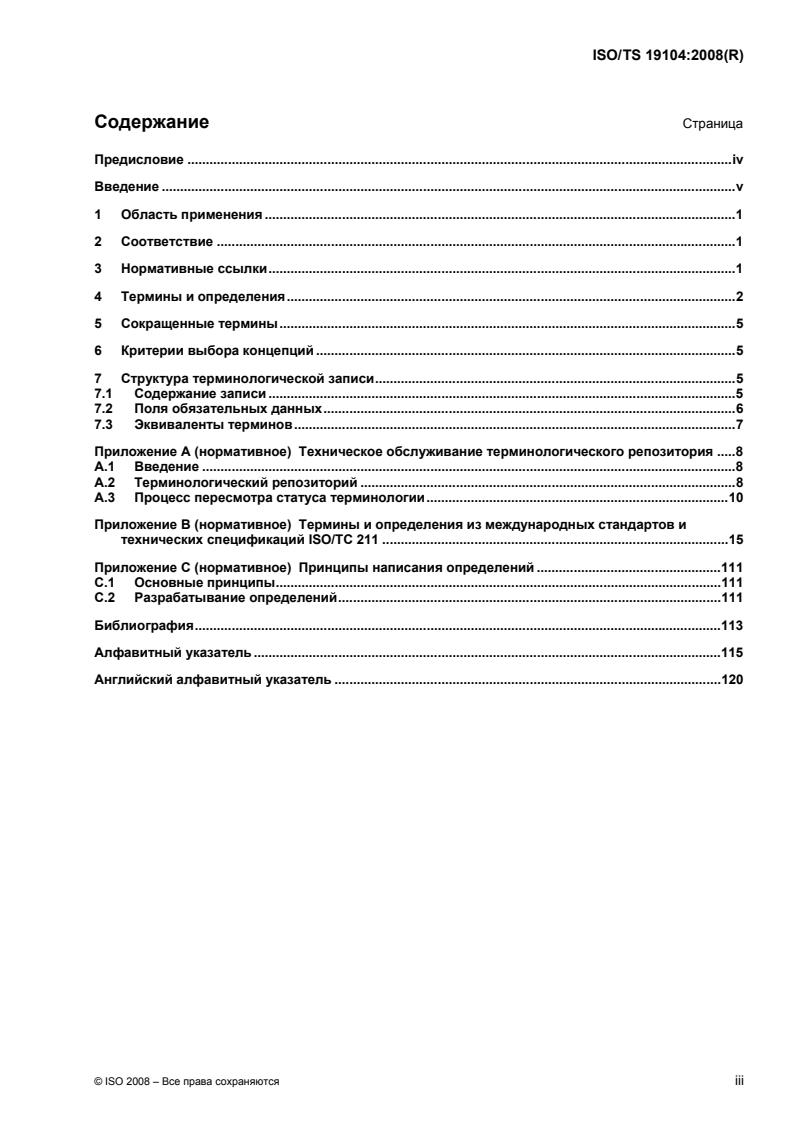
Contents Page
Foreword .iv
Introduction.v
1 Scope.1
2 Conformance .1
3 Normative references.1
4 Terms and definitions.1
5 Abbreviated terms.4
6 Criteria for the selection of concepts.4
7 Structure of the terminological record.4
7.1 Record content .4
7.2 Mandatory data fields.5
7.3 Term equivalents.5
Annex A (normative) Maintenance of the Terminology Repository .6
A.1 Introduction.6
A.2 Terminology Repository .6
A.3 Terminology status review process .7
Annex B (normative) Terms and Definitions from ISO/TC 211 International Standards and
Technical Specifications .11
Annex C (normative) Principles for definition writing .95
C.1 Basic principles.95
C.2 Developing definitions .95
Bibliography.97
Alphabetical index.99
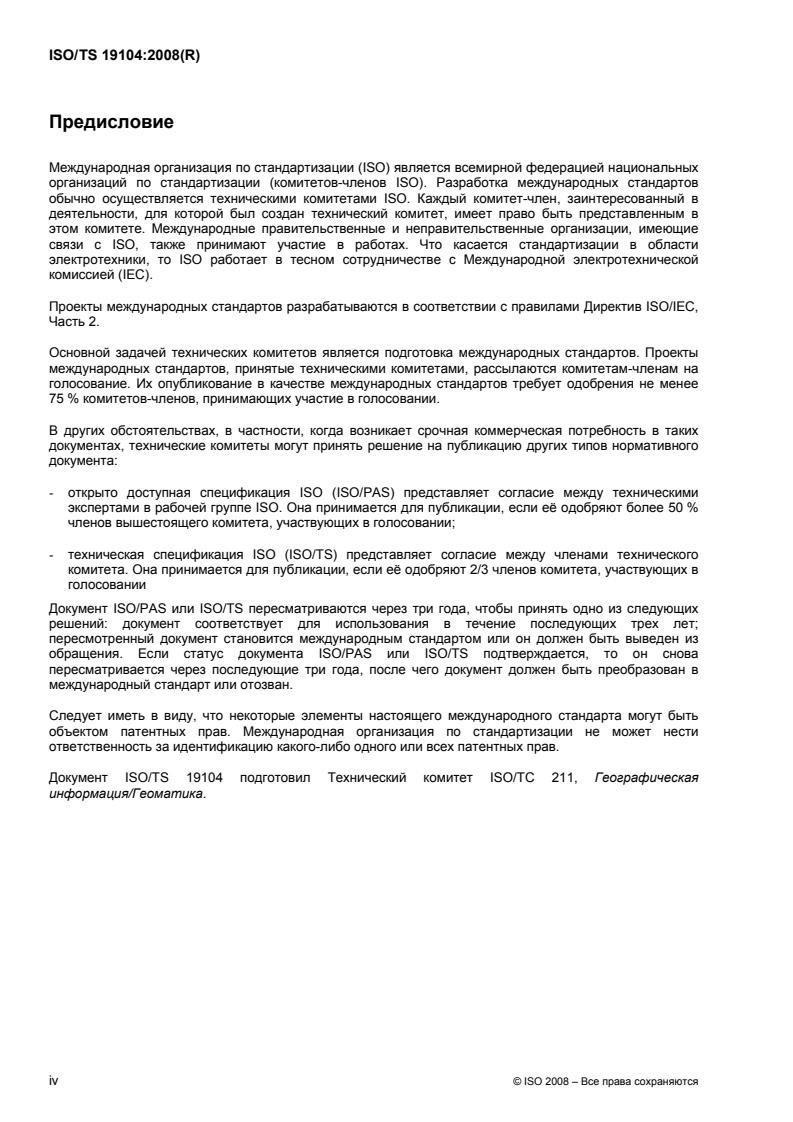
Foreword
ISO (the International Organization for Standardization) is a worldwide federation of national standards bodies
(ISO member bodies). The work of preparing International Standards is normally carried out through ISO
technical committees. Each member body interested in a subject for which a technical committee has been
established has the right to be represented on that committee. International organizations, governmental and
non-governmental, in liaison with ISO, also take part in the work. ISO collaborates closely with the
International Electrotechnical Commission (IEC) on all matters of electrotechnical standardization.
International Standards are drafted in accordance with the rules given in the ISO/IEC Directives, Part 2.
The main task of technical committees is to prepare International Standards. Draft International Standards
adopted by the technical committees are circulated to the member bodies for voting. Publication as an
International Standard requires approval by at least 75 % of the member bodies casting a vote.
In other circumstances, particularly when there is an urgent market requirement for such documents, a
technical committee may decide to publish other types of document:
— an ISO Publicly Available Specification (ISO/PAS) represents an agreement between technical experts in
an ISO working group and is accepted for publication if it is approved by more than 50 % of the members
of the parent committee casting a vote;
— an ISO Technical Specification (ISO/TS) represents an agreement between the members of a technical
committee and is accepted for publication if it is approved by 2/3 of the members of the committee
casting a vote.
An ISO/PAS or ISO/TS is reviewed after three years in order to decide whether it will be confirmed for a
further three years, revised to become an International Standard, or withdrawn. If the ISO/PAS or ISO/TS is
confirmed, it is reviewed again after a further three years, at which time it must either be transformed into an
International Standard or be withdrawn.
Attention is drawn to the possibility that some of the elements of this document may be the subject of patent
rights. ISO shall not be held responsible for identifying any or all such patent rights.
ISO/TS 19104 was prepared by Technical Committee ISO/TC 211, Geographic information/Geomatics.
iv © ISO 2008 – All rights reserved
Introduction
This Technical Specification, along with a repository of geographic information system (GIS) terminology in
the form of a terminological database, is expected to be a central reference for the shared language between
participants and users alike. It defines the criteria for including concepts in the vocabulary, specifies the
terminological data to be recorded, and, within the electronically processable repository, introduces an initial
set of concepts with definitions that will be subject to ongoing maintenance.
This Technical Specification describes the structure of entries and the types of terminological data that are to
be recorded. In addition, it includes principles for definition writing as outlined in ISO 10241 and ISO 704. The
structure of a terminological record is given in Clause 7.
TECHNICAL SPECIFICATION ISO/TS 19104:2008(E)
Geographic information — Terminology
1 Scope
This Technical Specification is applicable to international communication in the field of geographic information.
This Technical Specification provides the guidelines for collection and maintenance of terminology in the field
of geographic information. It establishes criteria for selection of concepts to be included in other standards
concerning geographic information, which are developed by ISO/TC 211, specifies the structure of the
terminological record, and describes the principles for definition writing.
This Technical Specification also lays down the guidelines for maintenance of a Terminology Repository
(see Annex A).
2 Conformance
Any product that claims conformance with this Technical Specification shall comply with the requirements
described in the normative clauses and annexes.
Where a new term has been created for an existing concept, or an existing term has been incorrectly applied,
the candidate document shall not be in conformance. Concepts and their definitions may be included with the
candidate terms until conformance is demonstrated.
3 Normative references
The following referenced documents are indispensable for the application of this document. For dated
references, only the edition cited applies. For undated references, the latest edition of the referenced
document (including any amendments) applies.
ISO 639-2, Codes for the representation of names of languages — Part 2: Alpha-3 code
ISO 704, Terminology work — Principles and methods
ISO 3166-1, Codes for the representation of names of countries and their subdivisions — Part 1: Country
codes
ISO 10241, International terminology standards — Preparation and layout
ISO 19108:2002, Geographic information — Temporal schema
4 Terms and definitions
The core list of terms and definitions from the ISO/TC 211 geographic information International Standards and
Technical Specifications is given in Annex B.
For the purposes of this document, the following terms and definitions apply.
4.1
abbreviation
designation formed by omitting words or letters from a longer form and designating the same concept
[ISO 1087-1:2000]
4.2
admitted term
term rated according to the scale of the term acceptability rating as a synonym for a preferred term
[ISO 1087-1:2000]
4.3
concept
unit of knowledge created by a unique combination of characteristics
[ISO 1087-1:2000]
NOTE Concepts are not necessarily bound to particular languages. They are, however, influenced by the social or
cultural background which often leads to different categorizations.
4.4
concept harmonization
activity leading to the establishment of a correspondence between two or more closely related or overlapping
concepts having professional, technical, scientific, social, economic, linguistic, cultural or other differences, in
order to eliminate or reduce minor differences between them
[ISO 860:2007]
NOTE The purpose of concept harmonization is to improve communication.
4.5
concept system
set of concepts structured according to the relations among them
[ISO 1087-1:2000]
4.6
definition
representation of a concept by a descriptive statement which serves to differentiate it from related concepts
[ISO 1087-1:2000]
4.7
deprecated term
term rated according to the scale of the term acceptability rating as undesired
[ISO 1087-1:2000]
4.8
designation
designator
representation of a concept by a sign which denotes it
NOTE In terminology work, three types of designations are distinguished: symbols, appellations and terms.
[ISO 1087-1:2000]
2 © ISO 2008 – All rights reserved
4.9
extension
totality of objects to which a concept corresponds
[ISO 1087-1:2000]
4.10
language
system of signs for communications, usually consisting of vocabulary and rules
[ISO 5127-1]
NOTE In this Technical Specification, language refers to natural language or special languages but not to programming
languages or artificial languages unless specifically identified.
4.11
language identifier
information in a terminological entry which indicates the name of a language
[ISO 1087-1:2000]
4.12
obsolete term
term which is no longer in common use
[ISO 1087-1:2000]
4.13
preferred term
term rated according to the scale of the term acceptability rating as the primary term for a given concept
[ISO 1087-1]
4.14
subordinate concept
narrower concept
concept which is either a specific concept or a partitive concept
[ISO 1087-1:2000]
4.15
term
verbal designation of a general concept in a specific subject field
[ISO 1087-1]
NOTE A term may contain symbols and can have variants, e.g. different forms of spelling.
4.16
term equivalent
term in another language which designates the same concept
NOTE A term equivalent should be accompanied by a definition of the designated concept expressed in the same
language as the term equivalent.
4.17
term instance classification
classification identifying the status of a term
4.18
terminological record
structured collection of terminological data relevant to one concept
4.19
terminological record identifier
unique, unambiguous, and linguistically neutral identifier assigned to a terminological record
4.20
terminology repository
data store or document in which terms and their associated definitions are stored or recorded
5 Abbreviated terms
CD committee draft
DIS draft International Standard
FDIS final draft International Standard
GIS geographic information system
IT information technology
IUT implementation under test
ODP open distributed processing
PT project team
TC technical committee
TMG terminology maintenance group
WD working draft
WG working group
6 Criteria for the selection of concepts
Any concept requiring a definition for the clarity of reading of any of the ISO/TC 211 geographic information
International Standards or Technical Specifications shall be included in that document and within Annex B of
this Technical Specification, subject to the following conditions:
a) the term that represents the concept is not a trade name, name of research project, or colloquial term
(local informal term to describe a formal term e.g. “guy” instead of “man”);
b) the concept is not selected if its definition in general language dictionaries corresponds to its definition in
the field of geographic information;
c) only concepts with a single definition are included;
d) the concept is central to understanding the standard and is not self-explanatory.
7 Structure of the terminological record
7.1 Record content
The terminological record may contain the following terminological data fields, in the order listed below:
a) record number – a terminological record identifier;
4 © ISO 2008 – All rights reserved
b) entry language identifier – the code representing natural language utilized for the terminological record
based on ISO 639-2;
c) preferred term;
d) abbreviation – if preferred, the abbreviation shall precede the full form, otherwise an abbreviated form
shall follow the full form;
e) admitted term(s) – if these are national variants, they shall be followed by a code as defined in
ISO 3166-1; the numeric 3-digit code is used for the IT interface (i.e. stored in the database), while the
meaning of this code is presented in the human language used by the user (i.e. the human interface);
f) definition – if taken from another normative document, a reference shall be added in square brackets after
the definition; or, if referring to another concept in the vocabulary, that concept shall be named by its
preferred term and presented in bold face characters; the principles for definition writing are given in
ISO 704 (see Annex C);
g) deprecated or obsolete terms (in alphabetical order);
h) references to related entries;
i) examples of term usage;
j) notes – may be used to provide additional information (if a definition has been adapted from a source, this
may be explained in a note);
k) term instance status (for online repository only);
l) beginning date of the instance (for online repository only) (see ISO 19108);
m) ending date of the instance (for online repository only) (see ISO 19108).
Provision shall be made for specifying language identifiers and, if needed, country codes for equivalents in
other languages.
7.2 Mandatory data fields
The following terminological data fields are mandatory for a terminological record. The rest of the data fields
listed in 7.1 are optional.
a) entry number;
b) preferred term;
c) definition;
d) beginning date of the instance;
e) term instance status (for online repository only).
7.3 Term equivalents
Term equivalents in national languages may be submitted by national bodies and class A liaisons to the
Terminology Maintenance Group for consideration. Term equivalents shall be preceded by:
a) the numeric 3 character country code as defined in ISO 3166-1, if needed;
b) the language code as defined in ISO 639-2 (e.g. “fra” for French, “deu” for German);
Annex A
(normative)
Maintenance of the Terminology Repository
A.1 Introduction
A Terminology Repository will be maintained by the TMG, see A.3.1. Maintenance mechanisms have been
developed that will
— enable proposed terms (and their associated definitions) to be added to, or amended in, the Terminology
Repository as required, and
— facilitate the assessment and harmonization of proposed terms prior to their parent draft standards
becoming final.
A.2 Terminology Repository
A.2.1 Overview
A Terminology Repository shall be maintained for ISO geographic information standards.
The Terminology Repository shall take the form of an online computer database.
Online read-only access will be available to all ISO/TC 211 members. Write and update access will be
available to WG convenors, PT leaders and editors. Public access to terms and definition that appear in
published ISO/TC 211 International Standards shall be made available. All terms (existing and proposed)
defined in ISO geographic information standards and drafts shall be included in the Terminology Repository.
A.2.2 Terminology entry and update
The relevant WG convenor or PT leader will be responsible for electronically submitting all terms and
definitions from a new ISO geographic information standard WD, CD, DIS or FDIS to the Repository. The
person responsible for entering the term shall also be responsible for entering the status of the term and any
related useful terms from outside ISO/TC 211.
All concepts, terms and definitions submitted to the Terminology Repository shall satisfy the criteria for the
selection of concepts as specified in Clause 6.
All terminological records shall be structured as specified in Clause 7.
At the time of entry to the Repository, terms shall be classified as being Candidate, regardless of whether the
same term is classified as being Draft or Harmonized elsewhere in the Repository.
A.2.3 Attribution and classification of terms
Every term in the Terminology Repository shall be accompanied by its parent document's ISO standard
number (for example, ISO 19107) where applicable, the document type (for example, WD or CD) and the date
of entry. A term may also have a status type indicating that it is to be deleted or requires harmonization.
Specific fields will be included in each Terminology Repository record to accommodate this information.
Each term in the Terminology Repository shall be assigned one of the following six status types.
— Candidate – newly entered term, or a term that is associated with multiple definitions and/or concepts.
6 © ISO 2008 – All rights reserved
— Draft – term that appears in a single draft ISO geographic information standard and that conforms to the
“one term, one definition, one concept” principle.
— Harmonized – term that appears in multiple ISO geographic information draft standards but for which the
“one term, one definition, one concept” principle has been negotiated by the relevant working groups.
— Normative – term that has already been published in an International Standard or Technical Specification
and does not conflict with the terms and definitions in the ISO geographic information standards.
— Normative/Conflict – term that has been published in more than one International Standard or Technical
Specification with different definitions in different standards.
— Deleted – term that has been identified for deletion from the repository.
These status types will be assigned to a code list to be referred to as “term instance classification” as
illustrated in Table A.1.
Table A.1 — Term instance status
Instance status code Status type
001 Candidate
002 Draft
003 Harmonized
004 Normative
005 Normative/Conflict
006 Deleted
Progression of a term from Candidate to Draft to Harmonized status will depend on either
— an assessment by the TMG, or
— harmonization consultations between affected working groups.
Draft or Harmonized status indicates that significant stability has been achieved as regards the term and its
definition. Progression to Normative status can only occur when the term, with its associated definition, is
published in an International Standard or Technical Specification.
A.2.4 Authority of the Terminology Repository
The Terminology Repository and its associated maintenance processes are not a substitute for normal ISO
practices in relation to standards development. The Repository provides a summary for existing and proposed
ISO/TC 211 terminology and helps facilitate harmonization where necessary. The Candidate, Draft and
Harmonized status types have no official meaning or authority beyond the Terminology Repository.
A.3 Terminology status review process
A.3.1 Terminology Maintenance Group (TMG)
Assessment of Candidate terms shall be the responsibility of the TMG.
The TMG shall comprise:
— a convenor;
— at least two members from each ISO/TC 211 working group (preferably representing different national
bodies); ideally there should be more than one language represented;
— additional members as necessary to ensure the representation of at least two languages, the inclusion of
terminology expertise and the engagement of national bodies and liaisons.
Membership of the TMG shall be for a two-year term or for the balance of a two-year term in the case of a
working group that is established part-way through a term. Each term shall commence on 1st January of
even-numbered years (2002, 2004, etc.). Members of the TMG will be eligible for reappointment for further
terms.
In the event of a working group being dissolved (for example, as a result of all its work items being
completed), the representatives from the working group shall remain members of the TMG until all related
terminology issues have been resolved. They will then withdraw.
In the event of all working groups being dissolved, the chair of ISO/TC 211, upon the completion of all related
terminology work, shall suspend the TMG until such time as new work items are introduced.
A.3.2 Responsibilities
The Chair of ISO/TC 211 shall be responsible for ensuring the existence of the TMG and for nominating the
convenor.
Each ISO/TC 211 working group leader shall be responsible for nominating representatives to the TMG and
for advising the convenor of the availability of relevant new documents.
The convenor shall be responsible for the operation of the TMG.
The convenor shall be responsible for advising members of the TMG regarding the availability of new
documents and for ensuring the update of the status of terms.
A.3.3 Assessment by TMG
A.3.3.1 Objective
The TMG shall review Candidate terms within two months of receipt. The objective of the review shall be to
ensure that Candidate terms conform to the “one term, one definition, one concept” criterion (i.e. a one-to-one
correspondence between a term and a concept, and a one-to-one association between a definition and a
concept) and do not conflict with existing terminology. Candidate terms that satisfy the criterion shall be
nominated as Draft terms pending their publication in an International Standard or Technical Specification.
Candidate terms that do not satisfy the criterion shall retain their Candidate status and be referred for
harmonization. The TMG will work online whenever possible and, when necessary, convene meetings in
accordance with the ISO directives.
NOTE In instances where a Candidate term/definition conflicts with an existing Draft term/definition, the existing
term/definition shall retain its status pending harmonization deliberations.
A.3.3.2 Candidate terms
The review process shall consider each Candidate term individually and shall proceed as follows.
a) Perform Concept, Structure and Circularity Tests;
1) Determine if the criteria for the selection of concepts in Clause 6 have been satisfied.
2) Determine if the terminological record is currently structured in the parent document according to
Clause 7.
3) Determine if the definition can be understood and is non-circular.
4) Refer terms from working drafts that fail to satisfy the above requirements back to the appropriate
working group for correction. Terms from committee drafts or later that fail to satisfy the above
requirements will be referred back through appropriate national body comments.
8 © ISO 2008 – All rights reserved
b) Perform the “One Concept, One Definition” Test;
1) Determine if there are other records for the same concept in the Repository originating from other
standards or earlier drafts of the standard in question. If yes, extract all definition records for the
concept from the Repository. If no, classify the concept as having satisfied the “One Concept, One
Definition” criterion but requiring “One Term, One Concept” testing.
2) If a record for the same concept, originating from an earlier draft of the same standard, has been
extracted from the Repository, determine if the definitions are identical. If yes, classify the earlier
record for removal from the Repository. If no, retain the concept's Candidate status and document
the need for harmonization with other standards that have adopted the definition in the earlier draft.
3) If other records for the same concept, originating from other draft standards, have been extracted
from the Repository, determine if all definitions are identical to those of the Candidate term. If yes,
reclassify the Candidate concept as Draft. If no, retain the concept's Candidate status and document
the need for harmonization.
4) If other records for the same concept, originating from published International Standards or Technical
Specifications, have been extracted from the Repository, determine if all definitions are identical to
those of the Candidate concept. If yes, the concept is already Normative. Ensure that
cross-referencing is correct. If no, retain the concept's Candidate status and document the need for
harmonization.
c) Perform the “One Term, One Concept” Test;
Each Candidate term that has not previously appeared in other standards or earlier drafts of the standard
in question will be subjected to a “One Term, One Concept” test by members of the TMG. The members
shall individually examine the Terminology Repository to determine whether the concept described by the
definition is already adequately described by another term. Consultation with relevant working groups will
be required. If an alternative term exists, retain the term's Candidate status and classify it as requiring
harmonization. Do not change the status of the alternative term. If no alternative term is identified, classify
the term as being Draft.
A.3.3.3 Normative terms
A working draft or committee draft may include normative terms that have been adopted from other
International Standards. The TMG shall review these terms to ensure that they harmonize with ISO 19100
series concepts and terminology. The TMG shall refer any problems to the appropriate working group or
editing committee (in the latter case through national body comments).
A.3.3.4 Deleted terms
The test for deleted terms is to be performed if the terminology from an earlier draft of the standard has been
entered into the Terminology Repository.
— For each item in the earlier draft, check if an identical Candidate term occurs in the current draft.
— If a Candidate term does not exist in the current draft, check if the term appears in other standards.
— If a Candidate term does not exist in the current draft and the term does not appear in other standards,
classify the term and its definition as deleted in the Terminology Repository.
Terms that have been specifically nominated for deletion shall be classified accordingly in the Terminology
Repository. ISO/TC 211 shall be formally advised of the intention to delete the terms. Deletion shall take place
following a plenary meeting of ISO/TC 211.
A.3.4 Harmonization
Candidate terms that require harmonization shall be directly referred to the appropriate working groups. In
addition, where the source document is at CD or DIS, the convenor of the TMG shall identify terminology
harmonization issues in comments formally forwarded to the TC secretariat.
It is expected that harmonization issues will mostly occur in working drafts and early committee drafts. The
TMG will facilitate discussions between the interested parties (generally via e-mail) to achieve a resolution of
the issues. Should resolution not be possible within the period allowed for consideration and comment, the
TMG convenor will call a meeting at the next ISO/TC 211 plenary to resolve the issues.
A.3.5 Revision of terminology status
In instances where there is consensus in relation to the harmonization of the term, the term shall be
reclassified as Harmonized pending publication in an ISO standard.
In instances where there is consensus as regards the retention or deletion of a term nominated for deletion,
the term shall be retained or classified as deleted in the Terminology Repository as appropriate.
Any terms for which consensus cannot be achieved during the consultation process will retain their Candidate
status and will be considered further by the relevant ISO/TC 211 working groups. The TMG will facilitate this
process. The TMG will not make decisions about the definitions to be adopted for concepts but may make
recommendations to the working groups.
A.3.6 Additional terms
There will be instances where it will be desirable to include terms from documents other than ISO/TC 211
sponsored standards. In such cases, the following will apply.
— The nomination of additional terms will only be accepted from ISO/TC 211 members and liaisons.
— The inclusion of any proposed term, definition and concept shall be driven by a clear business need.
Unnecessary proliferation of terminology will be discouraged.
— Every proposal shall be submitted to the TMG in English. The proposal shall include the term, its
definition, a description of the associated concept, and the relationship to existing ISO/TC 211 terms
and/or concepts. A description of the business driver shall also be included.
— The TMG will issue an ISO/TC 211 document containing details of the proposal. This will be circulated to
members for comment through the ISO/TC 211 Secretariat. The period for submitting comments will be
one month. Comment resolution processes will subsequently be implemented.
— The decision to accept or reject the proposed record will be taken by resolution of ISO/TC 211 at the next
Plenary meeting.
10 © ISO 2008 – All rights reserved
Annex B
(normative)
Terms and definitions from ISO/TC 211
International Standards and Technical Specifications
This list of terms has been compiled from International Standards and Technical Specifications developed by
ISO/TC 211 and other sources. Its purpose is to encourage consistency in the use and interpretation of
geospatial terms. It is freely available for use by all interested people and organizations.
NOTE In notes and examples below, references to International Standards and Technical Specifications refer to the
source document.
B.1
abbreviation
designation (B.132) formed by omitting words or letters from a longer form and designating the same
concept (B.60)
[ISO 1087-1:2000]
B.2
abstract test case
generalized test for a particular requirement
NOTE An abstract test case is a formal basis for deriving executable test cases (B.171). One or more test purposes
are encapsulated in the abstract test case. An abstract test case is independent of both the implementation (B.244) and
the values (B.515). It should be complete in the sense that it is sufficient to enable a test verdict to be assigned
unambiguously to each potentially observable test outcome [i.e. sequence (B.425) of test events (B.170)].
[ISO 19105:2000]
B.3
abstract test method
method (B.312) for testing implementation (B.244) independent of any particular test procedure
[ISO 19105:2000]
B.4
abstract test module
set (B.433) of related abstract test cases (B.2)
NOTE Abstract test modules may be nested in a hierarchical way.
[ISO 19105:2000]
B.5
ATS
abstract test suite
abstract test module (B.4) specifying all the requirements to be satisfied for conformance (B.67)
NOTE Abstract test suites are described in a conformance clause (B.69).
[ISO 19105:2000]
B.6
acceptance testing
〈user〉 process of determining whether an implementation (B.244) satisfies acceptance criteria and enables
the user (B.512) to determine whether to accept the implementation
NOTE 1 This includes the planning and execution of several kinds of tests (e.g. functional, volume, performance tests)
that demonstrate that the implementation satisfies the user requirements.
NOTE 2 This is not a part of conformance testing (B.73).
[ISO 19105:2000]
B.7
accuracy
closeness of agreement between a test result and the accepted reference value (B.515)
NOTE A test result can be observations or measurements (B.301).
[ISO 3534-1:1993]
B.8
active object
object (B.326) that is capable of independent actions, and therefore of initiating interactions between itself
and other objects without immediate prior external stimulation
NOTE 1 See passive object (B.341)
NOTE 2 An active object can represent a user (B.512) or an active service (B.427) that depends on internal (and
therefore not visible) triggers to start actions. Active and passive states (B.452) can exist for the same object, and such a
service can transition between these two states depending on invocation of an activation or deactivation operation
(B.332) protocol.
[ISO 19132:2007]
B.9
actor
〈UML〉 coherent set (B.433) of roles that users of use cases play when interacting with these use cases
NOTE An actor may be considered to play a separate role with regard to each use case with which it communicates.
[ISO/TS 19103:2005 – adapted from ISO/IEC 19501]
B.10
admitted term
term (B.475) rated according to the scale of the term acceptability rating as a synonym for a preferred term
(B.369)
[ISO 1087-1:2000]
B.11
affine coordinate system
coordinate system (B.90) in Euclidean space with straight axes that are not necessarily mutually
perpendicular
[ISO 19111:2007]
12 © ISO 2008 – All rights reserved
B.12
aggregation
〈UML〉 special form of association (B.16) that specifies a whole-part relationship (B.395) between the
aggregate (whole) and a component (B.50) part
NOTE See composition (B.54).
[ISO/TS 19103:2005 – adapted from ISO/IEC 19501]
B.13
annotation
any marking on illustrative material for the purpose of clarification (B.39)
NOTE Numbers, letters, symbols, and signs are examples of annotation.
[ISO 19117:2005]
B.14
application
manipulation and processing of data (B.103) in support of user (B.512) requirements
[ISO 19101:2002]
B.15
application schema
conceptual schema (B.65) for data (B.103) required by one or more applications (B.14)
[ISO 19101:2002]
B.16
association
〈UML〉 semantic relationship (B.395) between two or more classifiers (B.41) that specifies connections
among their instances (B.254)
NOTE A binary association is an association among exactly two classifiers (including the possibility of an association
from a classifier to itself).
[ISO/TS 19103:2005 – adapted from ISO/IEC 19501]
B.17
attitude
orientation of a body, described by the angles between the axes of that body's coordinate system (B.90) and
the axes of an external coordinate system
NOTE In positioning services (B.427), this is usually the orientation of the user's platform, such as an aircraft, boat, or
automobile.
[ISO 19116:2004]
B.18
attribute
〈UML〉 feature (B.179) within a classifier (B.41) that describes a range (B.381) of values (B.515) that
instances (B.254) of the classifier may hold
NOTE 1 An attribute is semantically equivalent to a composition (B.54) association (B.16); however, the intent and
usage is normally different.
NOTE 2 “Feature” used in this definition (B.126) is the UML meaning of the term (B.475) and is not meant as defined
in 4.1 of this Technical Specification.
[ISO/TS 19103:2005 – adapted from ISO/IEC 19501]
B.19
attribute
〈XML〉 name-value pair contained in an element (B.153)
NOTE In this document, an attribute is an XML attribute unless otherwise specified. The syntax of an XML attribute is
“Attribute::= Name = AttValue”. An attribute typically acts as an XML element modifier (e.g. ; here
gml:id is an attribute).
[ISO 19136:2007]
B.20
bag
finite, unordered collection of related items (B.269) [objects (B.326) or values (B.515)] that may be repeated
NOTE Logically, a bag is a set (B.433) of pairs .
[ISO 19107:2003]
B.21
band
range (B.381) of wavelengths of electromagnetic radiation that produce a single response (B.403) by a
sensing device
[ISO/TS 19101-2:2008]
B.22
base representation
〈moving features〉 representation, using a local origin and local ordinate vectors (B.517), of a geometric
object (B.219) at a given reference time
NOTE 1 A rigid geometric object may undergo translation or rotation, but remains congruent with its base
representation.
NOTE 2 The local origin and ordinate vectors establish an engineering coordinate reference system (B.164)
(ISO 19111), also called a local frame or a local Euclidean coordinate system (B.90).
[ISO 19141:2008]
14 © ISO 2008 – All rights reserved
B.23
base standard
ISO geographic information (B.211) standard or other information (B.250) technology standard issued as a
source from which a profile (B.374) may be constructed
[ISO 19106:2004]
B.24
basic service
service (B.427) providing a basic function (B.194) to other services or applications (B.14) in a functional
manner
NOTE 1 See interoperate (B.264)
NOTE 2 Basic services lack any persistent, user-specific state (B.452) information (B.250) between invocations and
are not meant for direct access by users (B.512). Because they act in a functional manner, they are readily replaceable at
runtime by other services using the same interfaces (B.260).
[ISO 19132:2007]
B.25
basic test
initial capability test (B.33) intended to identify clear cases of non-conformance (B.324)
[ISO 19105:2000]
B.26
behaviour
〈UML〉 observable effects of an operation (B.333) or event (B.170), including its results
[ISO/TS 19103:2005 – adapted from ISO/IEC 19501]
B.27
boundary
set (B.433) that represents the limit of an entity
NOTE Boundary is most commonly used in the context of geometry, where the set is a collection of points (B.352) or a
collection of objects (B.326) that represent those points. In other arenas, the term (B.475) is used metaphorically to
describe the transition between an entity and the rest of its domain (B.149) of discourse.
[ISO 19107:2003]
B.28
buffer
geometric object (B.219) that contains all direct positions (B.138) whose distance from a specified
geometric object (B.326) is less than or equal to a given distance
[ISO 19107:2003]
B.29
calendar
discrete temporal reference system (B.473) that provides a basis for defining temporal position (B.472) to
a resolution of one day (B.125)
[ISO 19108:2002]
B.30
calendar era
sequence (B.425) of periods (B.345) of one of the types (B.503) used in a calendar (B.29), counted from a
specified event (B.170)
[ISO 19108:2002]
B.31
calibration
process of quantitatively defining a system’s responses (B.403) to known, controlled signal inputs
[ISO/TS 19101-2:2008]
B.32
candidate route
any route (B.409) that satisfies all constraints (B.76) of the routing (B.412) request (B.399) with the
possible exception of optimality of the cost function (B.95)
NOTE Navigation (B.319) is the process of finding the candidate route that optimizes a chosen cost function.
[ISO 19133:2005]
B.33
capability test
test designed to determine whether an IUT conforms to a particular characteristic of an International Standard
as described in the test purpose
[ISO 19105:2000]
B.34
cardinality
〈UML〉 number of elements (B.153) in a set (B.433)
NOTE Contrast: multiplicity (B.317).
[ISO/TS 19103:2005 – adapted from ISO/IEC 19501]
B.35
Cartesian coordinate system
coordinate system (B.90) which gives the position (B.365) of points (B.352) relative to n mutually
perpendicular axes
NOTE n is 1, 2 or 3 for the purposes of this International Standard.
[ISO 19111:2007]
B.36
character
member of a set (B.433) of elements (B.153) that is used for the representation, organization, or control of
data (B.103)
[ISO/IEC 2382-1:1993]
16 © ISO 2008 – All rights reserved
B.37
child element
〈XML〉 immediate descendant element (B.153) of an element
[ISO 19136:2007]
B.38
circular sequence
sequence (B.425) which has no logical beginning and is therefore equivalent to any circular
...
SLOVENSKI STANDARD
oSIST-TS ISO/TS 19104:2009
01-maj-2009
Geografske informacije - Terminologija
Geographic information - Terminology
Information géographique - Terminologie
Ta slovenski standard je istoveten z: ISO/TS 19104:2008
ICS:
01.040.35 Informacijska tehnologija. Information technology.
Pisarniški stroji (Slovarji) Office machines
(Vocabularies)
35.240.70 Uporabniške rešitve IT v IT applications in science
znanosti
oSIST-TS ISO/TS 19104:2009 en
2003-01.Slovenski inštitut za standardizacijo. Razmnoževanje celote ali delov tega standarda ni dovoljeno.
oSIST-TS ISO/TS 19104:2009
oSIST-TS ISO/TS 19104:2009
TECHNICAL ISO/TS
SPECIFICATION 19104
First edition
2008-11-15
Geographic information — Terminology
Information géographique — Terminologie
Reference number
©
ISO 2008
oSIST-TS ISO/TS 19104:2009
PDF disclaimer
This PDF file may contain embedded typefaces. In accordance with Adobe's licensing policy, this file may be printed or viewed but
shall not be edited unless the typefaces which are embedded are licensed to and installed on the computer performing the editing. In
downloading this file, parties accept therein the responsibility of not infringing Adobe's licensing policy. The ISO Central Secretariat
accepts no liability in this area.
Adobe is a trademark of Adobe Systems Incorporated.
Details of the software products used to create this PDF file can be found in the General Info relative to the file; the PDF-creation
parameters were optimized for printing. Every care has been taken to ensure that the file is suitable for use by ISO member bodies. In
the unlikely event that a problem relating to it is found, please inform the Central Secretariat at the address given below.
© ISO 2008
The reproduction of the terms and definitions contained in this International Standard is permitted in teaching manuals, instruction
booklets, technical publications and journals for strictly educational or implementation purposes. The conditions for such reproduction are:
that no modifications are made to the terms and definitions; that such reproduction is not permitted for dictionaries or similar publications
offered for sale; and that this International Standard is referenced as the source document.
With the sole exceptions noted above, no other part of this publication may be reproduced or utilized in any form or by any means,
electronic or mechanical, including photocopying and microfilm, without permission in writing from either ISO at the address below or
ISO's member body in the country of the requester.
ISO copyright office
Case postale 56 • CH-1211 Geneva 20
Tel. + 41 22 749 01 11
Fax + 41 22 749 09 47
E-mail copyright@iso.org
Web www.iso.org
Published in Switzerland
ii © ISO 2008 – All rights reserved
oSIST-TS ISO/TS 19104:2009
Contents Page
Foreword .iv
Introduction.v
1 Scope.1
2 Conformance .1
3 Normative references.1
4 Terms and definitions.1
5 Abbreviated terms.4
6 Criteria for the selection of concepts.4
7 Structure of the terminological record.4
7.1 Record content .4
7.2 Mandatory data fields.5
7.3 Term equivalents.5
Annex A (normative) Maintenance of the Terminology Repository .6
A.1 Introduction.6
A.2 Terminology Repository .6
A.3 Terminology status review process .7
Annex B (normative) Terms and Definitions from ISO/TC 211 International Standards and
Technical Specifications .11
Annex C (normative) Principles for definition writing .95
C.1 Basic principles.95
C.2 Developing definitions .95
Bibliography.97
Alphabetical index.99
oSIST-TS ISO/TS 19104:2009
Foreword
ISO (the International Organization for Standardization) is a worldwide federation of national standards bodies
(ISO member bodies). The work of preparing International Standards is normally carried out through ISO
technical committees. Each member body interested in a subject for which a technical committee has been
established has the right to be represented on that committee. International organizations, governmental and
non-governmental, in liaison with ISO, also take part in the work. ISO collaborates closely with the
International Electrotechnical Commission (IEC) on all matters of electrotechnical standardization.
International Standards are drafted in accordance with the rules given in the ISO/IEC Directives, Part 2.
The main task of technical committees is to prepare International Standards. Draft International Standards
adopted by the technical committees are circulated to the member bodies for voting. Publication as an
International Standard requires approval by at least 75 % of the member bodies casting a vote.
In other circumstances, particularly when there is an urgent market requirement for such documents, a
technical committee may decide to publish other types of document:
— an ISO Publicly Available Specification (ISO/PAS) represents an agreement between technical experts in
an ISO working group and is accepted for publication if it is approved by more than 50 % of the members
of the parent committee casting a vote;
— an ISO Technical Specification (ISO/TS) represents an agreement between the members of a technical
committee and is accepted for publication if it is approved by 2/3 of the members of the committee
casting a vote.
An ISO/PAS or ISO/TS is reviewed after three years in order to decide whether it will be confirmed for a
further three years, revised to become an International Standard, or withdrawn. If the ISO/PAS or ISO/TS is
confirmed, it is reviewed again after a further three years, at which time it must either be transformed into an
International Standard or be withdrawn.
Attention is drawn to the possibility that some of the elements of this document may be the subject of patent
rights. ISO shall not be held responsible for identifying any or all such patent rights.
ISO/TS 19104 was prepared by Technical Committee ISO/TC 211, Geographic information/Geomatics.
iv © ISO 2008 – All rights reserved
oSIST-TS ISO/TS 19104:2009
Introduction
This Technical Specification, along with a repository of geographic information system (GIS) terminology in
the form of a terminological database, is expected to be a central reference for the shared language between
participants and users alike. It defines the criteria for including concepts in the vocabulary, specifies the
terminological data to be recorded, and, within the electronically processable repository, introduces an initial
set of concepts with definitions that will be subject to ongoing maintenance.
This Technical Specification describes the structure of entries and the types of terminological data that are to
be recorded. In addition, it includes principles for definition writing as outlined in ISO 10241 and ISO 704. The
structure of a terminological record is given in Clause 7.
oSIST-TS ISO/TS 19104:2009
oSIST-TS ISO/TS 19104:2009
TECHNICAL SPECIFICATION ISO/TS 19104:2008(E)
Geographic information — Terminology
1 Scope
This Technical Specification is applicable to international communication in the field of geographic information.
This Technical Specification provides the guidelines for collection and maintenance of terminology in the field
of geographic information. It establishes criteria for selection of concepts to be included in other standards
concerning geographic information, which are developed by ISO/TC 211, specifies the structure of the
terminological record, and describes the principles for definition writing.
This Technical Specification also lays down the guidelines for maintenance of a Terminology Repository
(see Annex A).
2 Conformance
Any product that claims conformance with this Technical Specification shall comply with the requirements
described in the normative clauses and annexes.
Where a new term has been created for an existing concept, or an existing term has been incorrectly applied,
the candidate document shall not be in conformance. Concepts and their definitions may be included with the
candidate terms until conformance is demonstrated.
3 Normative references
The following referenced documents are indispensable for the application of this document. For dated
references, only the edition cited applies. For undated references, the latest edition of the referenced
document (including any amendments) applies.
ISO 639-2, Codes for the representation of names of languages — Part 2: Alpha-3 code
ISO 704, Terminology work — Principles and methods
ISO 3166-1, Codes for the representation of names of countries and their subdivisions — Part 1: Country
codes
ISO 10241, International terminology standards — Preparation and layout
ISO 19108:2002, Geographic information — Temporal schema
4 Terms and definitions
The core list of terms and definitions from the ISO/TC 211 geographic information International Standards and
Technical Specifications is given in Annex B.
For the purposes of this document, the following terms and definitions apply.
oSIST-TS ISO/TS 19104:2009
4.1
abbreviation
designation formed by omitting words or letters from a longer form and designating the same concept
[ISO 1087-1:2000]
4.2
admitted term
term rated according to the scale of the term acceptability rating as a synonym for a preferred term
[ISO 1087-1:2000]
4.3
concept
unit of knowledge created by a unique combination of characteristics
[ISO 1087-1:2000]
NOTE Concepts are not necessarily bound to particular languages. They are, however, influenced by the social or
cultural background which often leads to different categorizations.
4.4
concept harmonization
activity leading to the establishment of a correspondence between two or more closely related or overlapping
concepts having professional, technical, scientific, social, economic, linguistic, cultural or other differences, in
order to eliminate or reduce minor differences between them
[ISO 860:2007]
NOTE The purpose of concept harmonization is to improve communication.
4.5
concept system
set of concepts structured according to the relations among them
[ISO 1087-1:2000]
4.6
definition
representation of a concept by a descriptive statement which serves to differentiate it from related concepts
[ISO 1087-1:2000]
4.7
deprecated term
term rated according to the scale of the term acceptability rating as undesired
[ISO 1087-1:2000]
4.8
designation
designator
representation of a concept by a sign which denotes it
NOTE In terminology work, three types of designations are distinguished: symbols, appellations and terms.
[ISO 1087-1:2000]
2 © ISO 2008 – All rights reserved
oSIST-TS ISO/TS 19104:2009
4.9
extension
totality of objects to which a concept corresponds
[ISO 1087-1:2000]
4.10
language
system of signs for communications, usually consisting of vocabulary and rules
[ISO 5127-1]
NOTE In this Technical Specification, language refers to natural language or special languages but not to programming
languages or artificial languages unless specifically identified.
4.11
language identifier
information in a terminological entry which indicates the name of a language
[ISO 1087-1:2000]
4.12
obsolete term
term which is no longer in common use
[ISO 1087-1:2000]
4.13
preferred term
term rated according to the scale of the term acceptability rating as the primary term for a given concept
[ISO 1087-1]
4.14
subordinate concept
narrower concept
concept which is either a specific concept or a partitive concept
[ISO 1087-1:2000]
4.15
term
verbal designation of a general concept in a specific subject field
[ISO 1087-1]
NOTE A term may contain symbols and can have variants, e.g. different forms of spelling.
4.16
term equivalent
term in another language which designates the same concept
NOTE A term equivalent should be accompanied by a definition of the designated concept expressed in the same
language as the term equivalent.
4.17
term instance classification
classification identifying the status of a term
4.18
terminological record
structured collection of terminological data relevant to one concept
oSIST-TS ISO/TS 19104:2009
4.19
terminological record identifier
unique, unambiguous, and linguistically neutral identifier assigned to a terminological record
4.20
terminology repository
data store or document in which terms and their associated definitions are stored or recorded
5 Abbreviated terms
CD committee draft
DIS draft International Standard
FDIS final draft International Standard
GIS geographic information system
IT information technology
IUT implementation under test
ODP open distributed processing
PT project team
TC technical committee
TMG terminology maintenance group
WD working draft
WG working group
6 Criteria for the selection of concepts
Any concept requiring a definition for the clarity of reading of any of the ISO/TC 211 geographic information
International Standards or Technical Specifications shall be included in that document and within Annex B of
this Technical Specification, subject to the following conditions:
a) the term that represents the concept is not a trade name, name of research project, or colloquial term
(local informal term to describe a formal term e.g. “guy” instead of “man”);
b) the concept is not selected if its definition in general language dictionaries corresponds to its definition in
the field of geographic information;
c) only concepts with a single definition are included;
d) the concept is central to understanding the standard and is not self-explanatory.
7 Structure of the terminological record
7.1 Record content
The terminological record may contain the following terminological data fields, in the order listed below:
a) record number – a terminological record identifier;
4 © ISO 2008 – All rights reserved
oSIST-TS ISO/TS 19104:2009
b) entry language identifier – the code representing natural language utilized for the terminological record
based on ISO 639-2;
c) preferred term;
d) abbreviation – if preferred, the abbreviation shall precede the full form, otherwise an abbreviated form
shall follow the full form;
e) admitted term(s) – if these are national variants, they shall be followed by a code as defined in
ISO 3166-1; the numeric 3-digit code is used for the IT interface (i.e. stored in the database), while the
meaning of this code is presented in the human language used by the user (i.e. the human interface);
f) definition – if taken from another normative document, a reference shall be added in square brackets after
the definition; or, if referring to another concept in the vocabulary, that concept shall be named by its
preferred term and presented in bold face characters; the principles for definition writing are given in
ISO 704 (see Annex C);
g) deprecated or obsolete terms (in alphabetical order);
h) references to related entries;
i) examples of term usage;
j) notes – may be used to provide additional information (if a definition has been adapted from a source, this
may be explained in a note);
k) term instance status (for online repository only);
l) beginning date of the instance (for online repository only) (see ISO 19108);
m) ending date of the instance (for online repository only) (see ISO 19108).
Provision shall be made for specifying language identifiers and, if needed, country codes for equivalents in
other languages.
7.2 Mandatory data fields
The following terminological data fields are mandatory for a terminological record. The rest of the data fields
listed in 7.1 are optional.
a) entry number;
b) preferred term;
c) definition;
d) beginning date of the instance;
e) term instance status (for online repository only).
7.3 Term equivalents
Term equivalents in national languages may be submitted by national bodies and class A liaisons to the
Terminology Maintenance Group for consideration. Term equivalents shall be preceded by:
a) the numeric 3 character country code as defined in ISO 3166-1, if needed;
b) the language code as defined in ISO 639-2 (e.g. “fra” for French, “deu” for German);
oSIST-TS ISO/TS 19104:2009
Annex A
(normative)
Maintenance of the Terminology Repository
A.1 Introduction
A Terminology Repository will be maintained by the TMG, see A.3.1. Maintenance mechanisms have been
developed that will
— enable proposed terms (and their associated definitions) to be added to, or amended in, the Terminology
Repository as required, and
— facilitate the assessment and harmonization of proposed terms prior to their parent draft standards
becoming final.
A.2 Terminology Repository
A.2.1 Overview
A Terminology Repository shall be maintained for ISO geographic information standards.
The Terminology Repository shall take the form of an online computer database.
Online read-only access will be available to all ISO/TC 211 members. Write and update access will be
available to WG convenors, PT leaders and editors. Public access to terms and definition that appear in
published ISO/TC 211 International Standards shall be made available. All terms (existing and proposed)
defined in ISO geographic information standards and drafts shall be included in the Terminology Repository.
A.2.2 Terminology entry and update
The relevant WG convenor or PT leader will be responsible for electronically submitting all terms and
definitions from a new ISO geographic information standard WD, CD, DIS or FDIS to the Repository. The
person responsible for entering the term shall also be responsible for entering the status of the term and any
related useful terms from outside ISO/TC 211.
All concepts, terms and definitions submitted to the Terminology Repository shall satisfy the criteria for the
selection of concepts as specified in Clause 6.
All terminological records shall be structured as specified in Clause 7.
At the time of entry to the Repository, terms shall be classified as being Candidate, regardless of whether the
same term is classified as being Draft or Harmonized elsewhere in the Repository.
A.2.3 Attribution and classification of terms
Every term in the Terminology Repository shall be accompanied by its parent document's ISO standard
number (for example, ISO 19107) where applicable, the document type (for example, WD or CD) and the date
of entry. A term may also have a status type indicating that it is to be deleted or requires harmonization.
Specific fields will be included in each Terminology Repository record to accommodate this information.
Each term in the Terminology Repository shall be assigned one of the following six status types.
— Candidate – newly entered term, or a term that is associated with multiple definitions and/or concepts.
6 © ISO 2008 – All rights reserved
oSIST-TS ISO/TS 19104:2009
— Draft – term that appears in a single draft ISO geographic information standard and that conforms to the
“one term, one definition, one concept” principle.
— Harmonized – term that appears in multiple ISO geographic information draft standards but for which the
“one term, one definition, one concept” principle has been negotiated by the relevant working groups.
— Normative – term that has already been published in an International Standard or Technical Specification
and does not conflict with the terms and definitions in the ISO geographic information standards.
— Normative/Conflict – term that has been published in more than one International Standard or Technical
Specification with different definitions in different standards.
— Deleted – term that has been identified for deletion from the repository.
These status types will be assigned to a code list to be referred to as “term instance classification” as
illustrated in Table A.1.
Table A.1 — Term instance status
Instance status code Status type
001 Candidate
002 Draft
003 Harmonized
004 Normative
005 Normative/Conflict
006 Deleted
Progression of a term from Candidate to Draft to Harmonized status will depend on either
— an assessment by the TMG, or
— harmonization consultations between affected working groups.
Draft or Harmonized status indicates that significant stability has been achieved as regards the term and its
definition. Progression to Normative status can only occur when the term, with its associated definition, is
published in an International Standard or Technical Specification.
A.2.4 Authority of the Terminology Repository
The Terminology Repository and its associated maintenance processes are not a substitute for normal ISO
practices in relation to standards development. The Repository provides a summary for existing and proposed
ISO/TC 211 terminology and helps facilitate harmonization where necessary. The Candidate, Draft and
Harmonized status types have no official meaning or authority beyond the Terminology Repository.
A.3 Terminology status review process
A.3.1 Terminology Maintenance Group (TMG)
Assessment of Candidate terms shall be the responsibility of the TMG.
The TMG shall comprise:
— a convenor;
— at least two members from each ISO/TC 211 working group (preferably representing different national
bodies); ideally there should be more than one language represented;
oSIST-TS ISO/TS 19104:2009
— additional members as necessary to ensure the representation of at least two languages, the inclusion of
terminology expertise and the engagement of national bodies and liaisons.
Membership of the TMG shall be for a two-year term or for the balance of a two-year term in the case of a
working group that is established part-way through a term. Each term shall commence on 1st January of
even-numbered years (2002, 2004, etc.). Members of the TMG will be eligible for reappointment for further
terms.
In the event of a working group being dissolved (for example, as a result of all its work items being
completed), the representatives from the working group shall remain members of the TMG until all related
terminology issues have been resolved. They will then withdraw.
In the event of all working groups being dissolved, the chair of ISO/TC 211, upon the completion of all related
terminology work, shall suspend the TMG until such time as new work items are introduced.
A.3.2 Responsibilities
The Chair of ISO/TC 211 shall be responsible for ensuring the existence of the TMG and for nominating the
convenor.
Each ISO/TC 211 working group leader shall be responsible for nominating representatives to the TMG and
for advising the convenor of the availability of relevant new documents.
The convenor shall be responsible for the operation of the TMG.
The convenor shall be responsible for advising members of the TMG regarding the availability of new
documents and for ensuring the update of the status of terms.
A.3.3 Assessment by TMG
A.3.3.1 Objective
The TMG shall review Candidate terms within two months of receipt. The objective of the review shall be to
ensure that Candidate terms conform to the “one term, one definition, one concept” criterion (i.e. a one-to-one
correspondence between a term and a concept, and a one-to-one association between a definition and a
concept) and do not conflict with existing terminology. Candidate terms that satisfy the criterion shall be
nominated as Draft terms pending their publication in an International Standard or Technical Specification.
Candidate terms that do not satisfy the criterion shall retain their Candidate status and be referred for
harmonization. The TMG will work online whenever possible and, when necessary, convene meetings in
accordance with the ISO directives.
NOTE In instances where a Candidate term/definition conflicts with an existing Draft term/definition, the existing
term/definition shall retain its status pending harmonization deliberations.
A.3.3.2 Candidate terms
The review process shall consider each Candidate term individually and shall proceed as follows.
a) Perform Concept, Structure and Circularity Tests;
1) Determine if the criteria for the selection of concepts in Clause 6 have been satisfied.
2) Determine if the terminological record is currently structured in the parent document according to
Clause 7.
3) Determine if the definition can be understood and is non-circular.
4) Refer terms from working drafts that fail to satisfy the above requirements back to the appropriate
working group for correction. Terms from committee drafts or later that fail to satisfy the above
requirements will be referred back through appropriate national body comments.
8 © ISO 2008 – All rights reserved
oSIST-TS ISO/TS 19104:2009
b) Perform the “One Concept, One Definition” Test;
1) Determine if there are other records for the same concept in the Repository originating from other
standards or earlier drafts of the standard in question. If yes, extract all definition records for the
concept from the Repository. If no, classify the concept as having satisfied the “One Concept, One
Definition” criterion but requiring “One Term, One Concept” testing.
2) If a record for the same concept, originating from an earlier draft of the same standard, has been
extracted from the Repository, determine if the definitions are identical. If yes, classify the earlier
record for removal from the Repository. If no, retain the concept's Candidate status and document
the need for harmonization with other standards that have adopted the definition in the earlier draft.
3) If other records for the same concept, originating from other draft standards, have been extracted
from the Repository, determine if all definitions are identical to those of the Candidate term. If yes,
reclassify the Candidate concept as Draft. If no, retain the concept's Candidate status and document
the need for harmonization.
4) If other records for the same concept, originating from published International Standards or Technical
Specifications, have been extracted from the Repository, determine if all definitions are identical to
those of the Candidate concept. If yes, the concept is already Normative. Ensure that
cross-referencing is correct. If no, retain the concept's Candidate status and document the need for
harmonization.
c) Perform the “One Term, One Concept” Test;
Each Candidate term that has not previously appeared in other standards or earlier drafts of the standard
in question will be subjected to a “One Term, One Concept” test by members of the TMG. The members
shall individually examine the Terminology Repository to determine whether the concept described by the
definition is already adequately described by another term. Consultation with relevant working groups will
be required. If an alternative term exists, retain the term's Candidate status and classify it as requiring
harmonization. Do not change the status of the alternative term. If no alternative term is identified, classify
the term as being Draft.
A.3.3.3 Normative terms
A working draft or committee draft may include normative terms that have been adopted from other
International Standards. The TMG shall review these terms to ensure that they harmonize with ISO 19100
series concepts and terminology. The TMG shall refer any problems to the appropriate working group or
editing committee (in the latter case through national body comments).
A.3.3.4 Deleted terms
The test for deleted terms is to be performed if the terminology from an earlier draft of the standard has been
entered into the Terminology Repository.
— For each item in the earlier draft, check if an identical Candidate term occurs in the current draft.
— If a Candidate term does not exist in the current draft, check if the term appears in other standards.
— If a Candidate term does not exist in the current draft and the term does not appear in other standards,
classify the term and its definition as deleted in the Terminology Repository.
Terms that have been specifically nominated for deletion shall be classified accordingly in the Terminology
Repository. ISO/TC 211 shall be formally advised of the intention to delete the terms. Deletion shall take place
following a plenary meeting of ISO/TC 211.
A.3.4 Harmonization
Candidate terms that require harmonization shall be directly referred to the appropriate working groups. In
addition, where the source document is at CD or DIS, the convenor of the TMG shall identify terminology
harmonization issues in comments formally forwarded to the TC secretariat.
oSIST-TS ISO/TS 19104:2009
It is expected that harmonization issues will mostly occur in working drafts and early committee drafts. The
TMG will facilitate discussions between the interested parties (generally via e-mail) to achieve a resolution of
the issues. Should resolution not be possible within the period allowed for consideration and comment, the
TMG convenor will call a meeting at the next ISO/TC 211 plenary to resolve the issues.
A.3.5 Revision of terminology status
In instances where there is consensus in relation to the harmonization of the term, the term shall be
reclassified as Harmonized pending publication in an ISO standard.
In instances where there is consensus as regards the retention or deletion of a term nominated for deletion,
the term shall be retained or classified as deleted in the Terminology Repository as appropriate.
Any terms for which consensus cannot be achieved during the consultation process will retain their Candidate
status and will be considered further by the relevant ISO/TC 211 working groups. The TMG will facilitate this
process. The TMG will not make decisions about the definitions to be adopted for concepts but may make
recommendations to the working groups.
A.3.6 Additional terms
There will be instances where it will be desirable to include terms from documents other than ISO/TC 211
sponsored standards. In such cases, the following will apply.
— The nomination of additional terms will only be accepted from ISO/TC 211 members and liaisons.
— The inclusion of any proposed term, definition and concept shall be driven by a clear business need.
Unnecessary proliferation of terminology will be discouraged.
— Every proposal shall be submitted to the TMG in English. The proposal shall include the term, its
definition, a description of the associated concept, and the relationship to existing ISO/TC 211 terms
and/or concepts. A description of the business driver shall also be included.
— The TMG will issue an ISO/TC 211 document containing details of the proposal. This will be circulated to
members for comment through the ISO/TC 211 Secretariat. The period for submitting comments will be
one month. Comment resolution processes will subsequently be implemented.
— The decision to accept or reject the proposed record will be taken by resolution of ISO/TC 211 at the next
Plenary meeting.
10 © ISO 2008 – All rights reserved
oSIST-TS ISO/TS 19104:2009
Annex B
(normative)
Terms and definitions from ISO/TC 211
International Standards and Technical Specifications
This list of terms has been compiled from International Standards and Technical Specifications developed by
ISO/TC 211 and other sources. Its purpose is to encourage consistency in the use and interpretation of
geospatial terms. It is freely available for use by all interested people and organizations.
NOTE In notes and examples below, references to International Standards and Technical Specifications refer to the
source document.
B.1
abbreviation
designation (B.132) formed by omitting words or letters from a longer form and designating the same
concept (B.60)
[ISO 1087-1:2000]
B.2
abstract test case
generalized test for a particular requirement
NOTE An abstract test case is a formal basis for deriving executable test cases (B.171). One or more test purposes
are encapsulated in the abstract test case. An abstract test case is independent of both the implementation (B.244) and
the values (B.515). It should be complete in the sense that it is sufficient to enable a test verdict to be assigned
unambiguously to each potentially observable test outcome [i.e. sequence (B.425) of test events (B.170)].
[ISO 19105:2000]
B.3
abstract test method
method (B.312) for testing implementation (B.244) independent of any particular test procedure
[ISO 19105:2000]
B.4
abstract test module
set (B.433) of related abstract test cases (B.2)
NOTE Abstract test modules may be nested in a hierarchical way.
[ISO 19105:2000]
B.5
ATS
abstract test suite
abstract test module (B.4) specifying all the requirements to be satisfied for conformance (B.67)
NOTE Abstract test suites are described in a conformance clause (B.69).
[ISO 19105:2000]
oSIST-TS ISO/TS 19104:2009
B.6
acceptance testing
〈user〉 process of determining whether an implementation (B.244) satisfies acceptance criteria and enables
the user (B.512) to determine whether to accept the implementation
NOTE 1 This includes the planning and execution of several kinds of tests (e.g. functional, volume, performance tests)
that demonstrate that the implementation satisfies the user requirements.
NOTE 2 This is not a part of conformance testing (B.73).
[ISO 19105:2000]
B.7
accuracy
closeness of agreement between a test result and the accepted reference value (B.515)
NOTE A test result can be observations or measurements (B.301).
[ISO 3534-1:1993]
B.8
active object
object (B.326) that is capable of independent actions, and therefore of initiating interactions between itself
and other objects without immediate prior external stimulation
NOTE 1 See passive object (B.341)
NOTE 2 An active object can represent a user (B.512) or an active service (B.427) that depends on internal (and
therefore not visible) triggers to start actions. Active and passive states (B.452) can exist for the same object, and such a
service can transition between these two states depending on invocation of an activation or deactivation operation
(B.332) protocol.
[ISO 19132:2007]
B.9
actor
〈UML〉 coherent set (B.433) of roles that users of use cases play when interacting with these use cases
NOTE An actor may be considered to play a separate role with regard to each use case with which it communicates.
[ISO/TS 19103:2005 – adapted from ISO/IEC 19501]
B.10
admitted term
term (B.475) rated according to the scale of the term acceptability rating as a synonym for a preferred term
(B.369)
[ISO 1087-1:2000]
B.11
affine coordinate system
coordinate system (B.90) in Euclidean space with straight axes that are not necessarily mutually
perpendicular
[ISO 19111:2007]
12 © ISO 2008 – All rights reserved
oSIST-TS ISO/TS 19104:2009
B.12
aggregation
〈UML〉 special form of association (B.16) that specifies a whole-part relationship (B.395) between the
aggregate (whole) and a component (B.50) part
NOTE See composition (B.54).
[ISO/TS 19103:2005 – adapted from ISO/IEC 19501]
B.13
annotation
any marking on illustrative material for the purpose of clarification (B.39)
NOTE Numbers, letters, symbols, and signs are examples of annotation.
[ISO 19117:2005]
B.14
application
manipulation and processing of data (B.103) in support of user (B.512) requirements
[ISO 19101:2002]
B.15
application schema
conceptual schema (B.65) for data (B.103) required by one or more applications (B.14)
[ISO 19101:2002]
B.16
association
〈UML〉 semantic relationship (B.395) between two or more classifiers (B.41) that specifies connections
among their instances (B.254)
NOTE A binary association is an association among exactly two classifiers (including the possibility of an association
from a classifier to itself).
[ISO/TS 19103:2005 – adapted from ISO/IEC 19501]
B.17
attitude
orientation of a body, described by the angles between the axes of that body's coordinate system (B.90) and
the axes of an external coordinate system
NOTE In positioning services (B.427), this is usually the orientation of the user's platform, such as an aircraft, boat, or
automobile.
[ISO 19116:2004]
oSIST-TS ISO/TS 19104:2009
B.18
attribute
〈UML〉 feature (B.179) within a classifier (B.41) that describes a range (B.381) of values (B.515) that
instances (B.254) of the classifier may hold
NOTE 1 An attribute is semantically equivalent to a composition (B.54) association (B.16); however, the intent and
usage is normally different.
NOTE 2 “Feature” used in this definition (B.126) is the UML meaning of the term (B.475) and is not meant as defined
in 4.1 of this Technical Specification.
[ISO/TS 19103:2005 – adapted from ISO/IEC 19501]
B.19
attribute
〈XML〉 name-value pair contained in an element (B.153)
NOTE In this document, an attribute is an XML attribute unless otherwise specified. The syntax of an XML attribute is
“Attribute::= Name = AttValue”. An attribute typically acts as an XML element modifier (e.g. ; here
gml:id is an attribute).
[ISO 19136:2007]
B.20
bag
finite, unordered collection of related items (B.269) [objects (B.326) or values (B.515)] that may be repeated
NOTE Logically, a bag is a set (B.433) of pairs .
[ISO 19107:2003]
B.21
band
range (B.381) of wavelengths of electromagnetic radiation that produce a single response (B.403) by a
sensing device
[ISO/TS 19101-2:2008]
B.22
base representation
〈moving features〉 representation, using a local origin and local ordinate vectors (B.517), of a geometric
object (B.219) at a given reference time
NOTE 1 A rigid geometric object may undergo translation or rotation, but remains congruent with its base
representation.
NOTE 2 The local origin and ordinate vectors establish an engineering coordinate reference system (B.164)
(ISO 19111), also called a local frame or a local Euclidean coordinate system (B.90).
[ISO 19141:2008]
14 © ISO 2008 – All rights reserved
oSIST-TS ISO/TS 19104:2009
B.23
base standard
ISO geographic information (B.211) standard or other information (B.250) technology standard issued as a
source from which a profile (B.374) may be constructed
[ISO 19106:2004]
B.24
basic service
service (B.427) providing a basic function (B.194) to other services or applications (B.14) in a functional
manner
NOTE 1 See interoperate (B.264)
NOTE 2 Basic services lack any persistent, user-specific state (B.452) information (B.250) between invocations and
are not meant for direct access by users (B.512). Because they act in a functional manner, they are readily replaceable at
runtime by other services using the same interfaces (B.260).
[ISO 19132:2007]
B.25
basic test
initial capability test (B.33) intended to identify clear cases of non-conformance (B.324)
[ISO 19105:2000]
B.26
behaviour
〈UML〉 observable effects of an operation (B.333) or event (B.170), including its results
[ISO/TS 19103:2005 – adapted from ISO/IEC 19501]
B.27
boundary
set (B.433) that represents the limit of an entity
NOTE Boundary is most commonly used in the context of geometry, where the set is a collection of points (B.352) or a
collection of objects (B.326) that represent those points. In other arenas, the term (B.475) is used metaphorically to
describe the transition between an entity and the rest of its domain (B.149) of discourse.
[ISO 19107:2003]
B.28
buffer
geometric object (B.219) that contains all direct positions (B.138) whose distance from a specified
geometric object (B.326) is less than or equal to a given distance
[ISO 19107:2003]
B.29
calendar
discrete temporal reference system (B.473) that provides a basis for defining temporal position (B.472) to
a resolution of one day (B.125)
[ISO 19108:2002]
oSIST-TS ISO/TS 19104:2009
B.30
calendar era
sequence (B.425) of periods (B.345) of one of the types (B.503) used in a calendar (B.29), counted from a
specified event (B.170)
[ISO 19108:2002]
B.31
calibration
process of quantitatively defining a system’s responses (B.403) to known, controlled signal inputs
[ISO/TS 19101-
...
SLOVENSKI STANDARD
01-september-2009
Geografske informacije - Terminologija
Geographic information - Terminology
Information géographique - Terminologie
Ta slovenski standard je istoveten z: ISO/TS 19104:2008
ICS:
01.040.35 Informacijska tehnologija. Information technology.
Pisarniški stroji (Slovarji) Office machines
(Vocabularies)
35.240.70 Uporabniške rešitve IT v IT applications in science
znanosti
2003-01.Slovenski inštitut za standardizacijo. Razmnoževanje celote ali delov tega standarda ni dovoljeno.
TECHNICAL ISO/TS
SPECIFICATION 19104
First edition
2008-11-15
Geographic information — Terminology
Information géographique — Terminologie
Reference number
©
ISO 2008
PDF disclaimer
This PDF file may contain embedded typefaces. In accordance with Adobe's licensing policy, this file may be printed or viewed but
shall not be edited unless the typefaces which are embedded are licensed to and installed on the computer performing the editing. In
downloading this file, parties accept therein the responsibility of not infringing Adobe's licensing policy. The ISO Central Secretariat
accepts no liability in this area.
Adobe is a trademark of Adobe Systems Incorporated.
Details of the software products used to create this PDF file can be found in the General Info relative to the file; the PDF-creation
parameters were optimized for printing. Every care has been taken to ensure that the file is suitable for use by ISO member bodies. In
the unlikely event that a problem relating to it is found, please inform the Central Secretariat at the address given below.
© ISO 2008
The reproduction of the terms and definitions contained in this International Standard is permitted in teaching manuals, instruction
booklets, technical publications and journals for strictly educational or implementation purposes. The conditions for such reproduction are:
that no modifications are made to the terms and definitions; that such reproduction is not permitted for dictionaries or similar publications
offered for sale; and that this International Standard is referenced as the source document.
With the sole exceptions noted above, no other part of this publication may be reproduced or utilized in any form or by any means,
electronic or mechanical, including photocopying and microfilm, without permission in writing from either ISO at the address below or
ISO's member body in the country of the requester.
ISO copyright office
Case postale 56 • CH-1211 Geneva 20
Tel. + 41 22 749 01 11
Fax + 41 22 749 09 47
E-mail copyright@iso.org
Web www.iso.org
Published in Switzerland
ii © ISO 2008 – All rights reserved
Contents Page
Foreword .iv
Introduction.v
1 Scope.1
2 Conformance .1
3 Normative references.1
4 Terms and definitions.1
5 Abbreviated terms.4
6 Criteria for the selection of concepts.4
7 Structure of the terminological record.4
7.1 Record content .4
7.2 Mandatory data fields.5
7.3 Term equivalents.5
Annex A (normative) Maintenance of the Terminology Repository .6
A.1 Introduction.6
A.2 Terminology Repository .6
A.3 Terminology status review process .7
Annex B (normative) Terms and Definitions from ISO/TC 211 International Standards and
Technical Specifications .11
Annex C (normative) Principles for definition writing .95
C.1 Basic principles.95
C.2 Developing definitions .95
Bibliography.97
Alphabetical index.99
Foreword
ISO (the International Organization for Standardization) is a worldwide federation of national standards bodies
(ISO member bodies). The work of preparing International Standards is normally carried out through ISO
technical committees. Each member body interested in a subject for which a technical committee has been
established has the right to be represented on that committee. International organizations, governmental and
non-governmental, in liaison with ISO, also take part in the work. ISO collaborates closely with the
International Electrotechnical Commission (IEC) on all matters of electrotechnical standardization.
International Standards are drafted in accordance with the rules given in the ISO/IEC Directives, Part 2.
The main task of technical committees is to prepare International Standards. Draft International Standards
adopted by the technical committees are circulated to the member bodies for voting. Publication as an
International Standard requires approval by at least 75 % of the member bodies casting a vote.
In other circumstances, particularly when there is an urgent market requirement for such documents, a
technical committee may decide to publish other types of document:
— an ISO Publicly Available Specification (ISO/PAS) represents an agreement between technical experts in
an ISO working group and is accepted for publication if it is approved by more than 50 % of the members
of the parent committee casting a vote;
— an ISO Technical Specification (ISO/TS) represents an agreement between the members of a technical
committee and is accepted for publication if it is approved by 2/3 of the members of the committee
casting a vote.
An ISO/PAS or ISO/TS is reviewed after three years in order to decide whether it will be confirmed for a
further three years, revised to become an International Standard, or withdrawn. If the ISO/PAS or ISO/TS is
confirmed, it is reviewed again after a further three years, at which time it must either be transformed into an
International Standard or be withdrawn.
Attention is drawn to the possibility that some of the elements of this document may be the subject of patent
rights. ISO shall not be held responsible for identifying any or all such patent rights.
ISO/TS 19104 was prepared by Technical Committee ISO/TC 211, Geographic information/Geomatics.
iv © ISO 2008 – All rights reserved
Introduction
This Technical Specification, along with a repository of geographic information system (GIS) terminology in
the form of a terminological database, is expected to be a central reference for the shared language between
participants and users alike. It defines the criteria for including concepts in the vocabulary, specifies the
terminological data to be recorded, and, within the electronically processable repository, introduces an initial
set of concepts with definitions that will be subject to ongoing maintenance.
This Technical Specification describes the structure of entries and the types of terminological data that are to
be recorded. In addition, it includes principles for definition writing as outlined in ISO 10241 and ISO 704. The
structure of a terminological record is given in Clause 7.
TECHNICAL SPECIFICATION ISO/TS 19104:2008(E)
Geographic information — Terminology
1 Scope
This Technical Specification is applicable to international communication in the field of geographic information.
This Technical Specification provides the guidelines for collection and maintenance of terminology in the field
of geographic information. It establishes criteria for selection of concepts to be included in other standards
concerning geographic information, which are developed by ISO/TC 211, specifies the structure of the
terminological record, and describes the principles for definition writing.
This Technical Specification also lays down the guidelines for maintenance of a Terminology Repository
(see Annex A).
2 Conformance
Any product that claims conformance with this Technical Specification shall comply with the requirements
described in the normative clauses and annexes.
Where a new term has been created for an existing concept, or an existing term has been incorrectly applied,
the candidate document shall not be in conformance. Concepts and their definitions may be included with the
candidate terms until conformance is demonstrated.
3 Normative references
The following referenced documents are indispensable for the application of this document. For dated
references, only the edition cited applies. For undated references, the latest edition of the referenced
document (including any amendments) applies.
ISO 639-2, Codes for the representation of names of languages — Part 2: Alpha-3 code
ISO 704, Terminology work — Principles and methods
ISO 3166-1, Codes for the representation of names of countries and their subdivisions — Part 1: Country
codes
ISO 10241, International terminology standards — Preparation and layout
ISO 19108:2002, Geographic information — Temporal schema
4 Terms and definitions
The core list of terms and definitions from the ISO/TC 211 geographic information International Standards and
Technical Specifications is given in Annex B.
For the purposes of this document, the following terms and definitions apply.
4.1
abbreviation
designation formed by omitting words or letters from a longer form and designating the same concept
[ISO 1087-1:2000]
4.2
admitted term
term rated according to the scale of the term acceptability rating as a synonym for a preferred term
[ISO 1087-1:2000]
4.3
concept
unit of knowledge created by a unique combination of characteristics
[ISO 1087-1:2000]
NOTE Concepts are not necessarily bound to particular languages. They are, however, influenced by the social or
cultural background which often leads to different categorizations.
4.4
concept harmonization
activity leading to the establishment of a correspondence between two or more closely related or overlapping
concepts having professional, technical, scientific, social, economic, linguistic, cultural or other differences, in
order to eliminate or reduce minor differences between them
[ISO 860:2007]
NOTE The purpose of concept harmonization is to improve communication.
4.5
concept system
set of concepts structured according to the relations among them
[ISO 1087-1:2000]
4.6
definition
representation of a concept by a descriptive statement which serves to differentiate it from related concepts
[ISO 1087-1:2000]
4.7
deprecated term
term rated according to the scale of the term acceptability rating as undesired
[ISO 1087-1:2000]
4.8
designation
designator
representation of a concept by a sign which denotes it
NOTE In terminology work, three types of designations are distinguished: symbols, appellations and terms.
[ISO 1087-1:2000]
2 © ISO 2008 – All rights reserved
4.9
extension
totality of objects to which a concept corresponds
[ISO 1087-1:2000]
4.10
language
system of signs for communications, usually consisting of vocabulary and rules
[ISO 5127-1]
NOTE In this Technical Specification, language refers to natural language or special languages but not to programming
languages or artificial languages unless specifically identified.
4.11
language identifier
information in a terminological entry which indicates the name of a language
[ISO 1087-1:2000]
4.12
obsolete term
term which is no longer in common use
[ISO 1087-1:2000]
4.13
preferred term
term rated according to the scale of the term acceptability rating as the primary term for a given concept
[ISO 1087-1]
4.14
subordinate concept
narrower concept
concept which is either a specific concept or a partitive concept
[ISO 1087-1:2000]
4.15
term
verbal designation of a general concept in a specific subject field
[ISO 1087-1]
NOTE A term may contain symbols and can have variants, e.g. different forms of spelling.
4.16
term equivalent
term in another language which designates the same concept
NOTE A term equivalent should be accompanied by a definition of the designated concept expressed in the same
language as the term equivalent.
4.17
term instance classification
classification identifying the status of a term
4.18
terminological record
structured collection of terminological data relevant to one concept
4.19
terminological record identifier
unique, unambiguous, and linguistically neutral identifier assigned to a terminological record
4.20
terminology repository
data store or document in which terms and their associated definitions are stored or recorded
5 Abbreviated terms
CD committee draft
DIS draft International Standard
FDIS final draft International Standard
GIS geographic information system
IT information technology
IUT implementation under test
ODP open distributed processing
PT project team
TC technical committee
TMG terminology maintenance group
WD working draft
WG working group
6 Criteria for the selection of concepts
Any concept requiring a definition for the clarity of reading of any of the ISO/TC 211 geographic information
International Standards or Technical Specifications shall be included in that document and within Annex B of
this Technical Specification, subject to the following conditions:
a) the term that represents the concept is not a trade name, name of research project, or colloquial term
(local informal term to describe a formal term e.g. “guy” instead of “man”);
b) the concept is not selected if its definition in general language dictionaries corresponds to its definition in
the field of geographic information;
c) only concepts with a single definition are included;
d) the concept is central to understanding the standard and is not self-explanatory.
7 Structure of the terminological record
7.1 Record content
The terminological record may contain the following terminological data fields, in the order listed below:
a) record number – a terminological record identifier;
4 © ISO 2008 – All rights reserved
b) entry language identifier – the code representing natural language utilized for the terminological record
based on ISO 639-2;
c) preferred term;
d) abbreviation – if preferred, the abbreviation shall precede the full form, otherwise an abbreviated form
shall follow the full form;
e) admitted term(s) – if these are national variants, they shall be followed by a code as defined in
ISO 3166-1; the numeric 3-digit code is used for the IT interface (i.e. stored in the database), while the
meaning of this code is presented in the human language used by the user (i.e. the human interface);
f) definition – if taken from another normative document, a reference shall be added in square brackets after
the definition; or, if referring to another concept in the vocabulary, that concept shall be named by its
preferred term and presented in bold face characters; the principles for definition writing are given in
ISO 704 (see Annex C);
g) deprecated or obsolete terms (in alphabetical order);
h) references to related entries;
i) examples of term usage;
j) notes – may be used to provide additional information (if a definition has been adapted from a source, this
may be explained in a note);
k) term instance status (for online repository only);
l) beginning date of the instance (for online repository only) (see ISO 19108);
m) ending date of the instance (for online repository only) (see ISO 19108).
Provision shall be made for specifying language identifiers and, if needed, country codes for equivalents in
other languages.
7.2 Mandatory data fields
The following terminological data fields are mandatory for a terminological record. The rest of the data fields
listed in 7.1 are optional.
a) entry number;
b) preferred term;
c) definition;
d) beginning date of the instance;
e) term instance status (for online repository only).
7.3 Term equivalents
Term equivalents in national languages may be submitted by national bodies and class A liaisons to the
Terminology Maintenance Group for consideration. Term equivalents shall be preceded by:
a) the numeric 3 character country code as defined in ISO 3166-1, if needed;
b) the language code as defined in ISO 639-2 (e.g. “fra” for French, “deu” for German);
Annex A
(normative)
Maintenance of the Terminology Repository
A.1 Introduction
A Terminology Repository will be maintained by the TMG, see A.3.1. Maintenance mechanisms have been
developed that will
— enable proposed terms (and their associated definitions) to be added to, or amended in, the Terminology
Repository as required, and
— facilitate the assessment and harmonization of proposed terms prior to their parent draft standards
becoming final.
A.2 Terminology Repository
A.2.1 Overview
A Terminology Repository shall be maintained for ISO geographic information standards.
The Terminology Repository shall take the form of an online computer database.
Online read-only access will be available to all ISO/TC 211 members. Write and update access will be
available to WG convenors, PT leaders and editors. Public access to terms and definition that appear in
published ISO/TC 211 International Standards shall be made available. All terms (existing and proposed)
defined in ISO geographic information standards and drafts shall be included in the Terminology Repository.
A.2.2 Terminology entry and update
The relevant WG convenor or PT leader will be responsible for electronically submitting all terms and
definitions from a new ISO geographic information standard WD, CD, DIS or FDIS to the Repository. The
person responsible for entering the term shall also be responsible for entering the status of the term and any
related useful terms from outside ISO/TC 211.
All concepts, terms and definitions submitted to the Terminology Repository shall satisfy the criteria for the
selection of concepts as specified in Clause 6.
All terminological records shall be structured as specified in Clause 7.
At the time of entry to the Repository, terms shall be classified as being Candidate, regardless of whether the
same term is classified as being Draft or Harmonized elsewhere in the Repository.
A.2.3 Attribution and classification of terms
Every term in the Terminology Repository shall be accompanied by its parent document's ISO standard
number (for example, ISO 19107) where applicable, the document type (for example, WD or CD) and the date
of entry. A term may also have a status type indicating that it is to be deleted or requires harmonization.
Specific fields will be included in each Terminology Repository record to accommodate this information.
Each term in the Terminology Repository shall be assigned one of the following six status types.
— Candidate – newly entered term, or a term that is associated with multiple definitions and/or concepts.
6 © ISO 2008 – All rights reserved
— Draft – term that appears in a single draft ISO geographic information standard and that conforms to the
“one term, one definition, one concept” principle.
— Harmonized – term that appears in multiple ISO geographic information draft standards but for which the
“one term, one definition, one concept” principle has been negotiated by the relevant working groups.
— Normative – term that has already been published in an International Standard or Technical Specification
and does not conflict with the terms and definitions in the ISO geographic information standards.
— Normative/Conflict – term that has been published in more than one International Standard or Technical
Specification with different definitions in different standards.
— Deleted – term that has been identified for deletion from the repository.
These status types will be assigned to a code list to be referred to as “term instance classification” as
illustrated in Table A.1.
Table A.1 — Term instance status
Instance status code Status type
001 Candidate
002 Draft
003 Harmonized
004 Normative
005 Normative/Conflict
006 Deleted
Progression of a term from Candidate to Draft to Harmonized status will depend on either
— an assessment by the TMG, or
— harmonization consultations between affected working groups.
Draft or Harmonized status indicates that significant stability has been achieved as regards the term and its
definition. Progression to Normative status can only occur when the term, with its associated definition, is
published in an International Standard or Technical Specification.
A.2.4 Authority of the Terminology Repository
The Terminology Repository and its associated maintenance processes are not a substitute for normal ISO
practices in relation to standards development. The Repository provides a summary for existing and proposed
ISO/TC 211 terminology and helps facilitate harmonization where necessary. The Candidate, Draft and
Harmonized status types have no official meaning or authority beyond the Terminology Repository.
A.3 Terminology status review process
A.3.1 Terminology Maintenance Group (TMG)
Assessment of Candidate terms shall be the responsibility of the TMG.
The TMG shall comprise:
— a convenor;
— at least two members from each ISO/TC 211 working group (preferably representing different national
bodies); ideally there should be more than one language represented;
— additional members as necessary to ensure the representation of at least two languages, the inclusion of
terminology expertise and the engagement of national bodies and liaisons.
Membership of the TMG shall be for a two-year term or for the balance of a two-year term in the case of a
working group that is established part-way through a term. Each term shall commence on 1st January of
even-numbered years (2002, 2004, etc.). Members of the TMG will be eligible for reappointment for further
terms.
In the event of a working group being dissolved (for example, as a result of all its work items being
completed), the representatives from the working group shall remain members of the TMG until all related
terminology issues have been resolved. They will then withdraw.
In the event of all working groups being dissolved, the chair of ISO/TC 211, upon the completion of all related
terminology work, shall suspend the TMG until such time as new work items are introduced.
A.3.2 Responsibilities
The Chair of ISO/TC 211 shall be responsible for ensuring the existence of the TMG and for nominating the
convenor.
Each ISO/TC 211 working group leader shall be responsible for nominating representatives to the TMG and
for advising the convenor of the availability of relevant new documents.
The convenor shall be responsible for the operation of the TMG.
The convenor shall be responsible for advising members of the TMG regarding the availability of new
documents and for ensuring the update of the status of terms.
A.3.3 Assessment by TMG
A.3.3.1 Objective
The TMG shall review Candidate terms within two months of receipt. The objective of the review shall be to
ensure that Candidate terms conform to the “one term, one definition, one concept” criterion (i.e. a one-to-one
correspondence between a term and a concept, and a one-to-one association between a definition and a
concept) and do not conflict with existing terminology. Candidate terms that satisfy the criterion shall be
nominated as Draft terms pending their publication in an International Standard or Technical Specification.
Candidate terms that do not satisfy the criterion shall retain their Candidate status and be referred for
harmonization. The TMG will work online whenever possible and, when necessary, convene meetings in
accordance with the ISO directives.
NOTE In instances where a Candidate term/definition conflicts with an existing Draft term/definition, the existing
term/definition shall retain its status pending harmonization deliberations.
A.3.3.2 Candidate terms
The review process shall consider each Candidate term individually and shall proceed as follows.
a) Perform Concept, Structure and Circularity Tests;
1) Determine if the criteria for the selection of concepts in Clause 6 have been satisfied.
2) Determine if the terminological record is currently structured in the parent document according to
Clause 7.
3) Determine if the definition can be understood and is non-circular.
4) Refer terms from working drafts that fail to satisfy the above requirements back to the appropriate
working group for correction. Terms from committee drafts or later that fail to satisfy the above
requirements will be referred back through appropriate national body comments.
8 © ISO 2008 – All rights reserved
b) Perform the “One Concept, One Definition” Test;
1) Determine if there are other records for the same concept in the Repository originating from other
standards or earlier drafts of the standard in question. If yes, extract all definition records for the
concept from the Repository. If no, classify the concept as having satisfied the “One Concept, One
Definition” criterion but requiring “One Term, One Concept” testing.
2) If a record for the same concept, originating from an earlier draft of the same standard, has been
extracted from the Repository, determine if the definitions are identical. If yes, classify the earlier
record for removal from the Repository. If no, retain the concept's Candidate status and document
the need for harmonization with other standards that have adopted the definition in the earlier draft.
3) If other records for the same concept, originating from other draft standards, have been extracted
from the Repository, determine if all definitions are identical to those of the Candidate term. If yes,
reclassify the Candidate concept as Draft. If no, retain the concept's Candidate status and document
the need for harmonization.
4) If other records for the same concept, originating from published International Standards or Technical
Specifications, have been extracted from the Repository, determine if all definitions are identical to
those of the Candidate concept. If yes, the concept is already Normative. Ensure that
cross-referencing is correct. If no, retain the concept's Candidate status and document the need for
harmonization.
c) Perform the “One Term, One Concept” Test;
Each Candidate term that has not previously appeared in other standards or earlier drafts of the standard
in question will be subjected to a “One Term, One Concept” test by members of the TMG. The members
shall individually examine the Terminology Repository to determine whether the concept described by the
definition is already adequately described by another term. Consultation with relevant working groups will
be required. If an alternative term exists, retain the term's Candidate status and classify it as requiring
harmonization. Do not change the status of the alternative term. If no alternative term is identified, classify
the term as being Draft.
A.3.3.3 Normative terms
A working draft or committee draft may include normative terms that have been adopted from other
International Standards. The TMG shall review these terms to ensure that they harmonize with ISO 19100
series concepts and terminology. The TMG shall refer any problems to the appropriate working group or
editing committee (in the latter case through national body comments).
A.3.3.4 Deleted terms
The test for deleted terms is to be performed if the terminology from an earlier draft of the standard has been
entered into the Terminology Repository.
— For each item in the earlier draft, check if an identical Candidate term occurs in the current draft.
— If a Candidate term does not exist in the current draft, check if the term appears in other standards.
— If a Candidate term does not exist in the current draft and the term does not appear in other standards,
classify the term and its definition as deleted in the Terminology Repository.
Terms that have been specifically nominated for deletion shall be classified accordingly in the Terminology
Repository. ISO/TC 211 shall be formally advised of the intention to delete the terms. Deletion shall take place
following a plenary meeting of ISO/TC 211.
A.3.4 Harmonization
Candidate terms that require harmonization shall be directly referred to the appropriate working groups. In
addition, where the source document is at CD or DIS, the convenor of the TMG shall identify terminology
harmonization issues in comments formally forwarded to the TC secretariat.
It is expected that harmonization issues will mostly occur in working drafts and early committee drafts. The
TMG will facilitate discussions between the interested parties (generally via e-mail) to achieve a resolution of
the issues. Should resolution not be possible within the period allowed for consideration and comment, the
TMG convenor will call a meeting at the next ISO/TC 211 plenary to resolve the issues.
A.3.5 Revision of terminology status
In instances where there is consensus in relation to the harmonization of the term, the term shall be
reclassified as Harmonized pending publication in an ISO standard.
In instances where there is consensus as regards the retention or deletion of a term nominated for deletion,
the term shall be retained or classified as deleted in the Terminology Repository as appropriate.
Any terms for which consensus cannot be achieved during the consultation process will retain their Candidate
status and will be considered further by the relevant ISO/TC 211 working groups. The TMG will facilitate this
process. The TMG will not make decisions about the definitions to be adopted for concepts but may make
recommendations to the working groups.
A.3.6 Additional terms
There will be instances where it will be desirable to include terms from documents other than ISO/TC 211
sponsored standards. In such cases, the following will apply.
— The nomination of additional terms will only be accepted from ISO/TC 211 members and liaisons.
— The inclusion of any proposed term, definition and concept shall be driven by a clear business need.
Unnecessary proliferation of terminology will be discouraged.
— Every proposal shall be submitted to the TMG in English. The proposal shall include the term, its
definition, a description of the associated concept, and the relationship to existing ISO/TC 211 terms
and/or concepts. A description of the business driver shall also be included.
— The TMG will issue an ISO/TC 211 document containing details of the proposal. This will be circulated to
members for comment through the ISO/TC 211 Secretariat. The period for submitting comments will be
one month. Comment resolution processes will subsequently be implemented.
— The decision to accept or reject the proposed record will be taken by resolution of ISO/TC 211 at the next
Plenary meeting.
10 © ISO 2008 – All rights reserved
Annex B
(normative)
Terms and definitions from ISO/TC 211
International Standards and Technical Specifications
This list of terms has been compiled from International Standards and Technical Specifications developed by
ISO/TC 211 and other sources. Its purpose is to encourage consistency in the use and interpretation of
geospatial terms. It is freely available for use by all interested people and organizations.
NOTE In notes and examples below, references to International Standards and Technical Specifications refer to the
source document.
B.1
abbreviation
designation (B.132) formed by omitting words or letters from a longer form and designating the same
concept (B.60)
[ISO 1087-1:2000]
B.2
abstract test case
generalized test for a particular requirement
NOTE An abstract test case is a formal basis for deriving executable test cases (B.171). One or more test purposes
are encapsulated in the abstract test case. An abstract test case is independent of both the implementation (B.244) and
the values (B.515). It should be complete in the sense that it is sufficient to enable a test verdict to be assigned
unambiguously to each potentially observable test outcome [i.e. sequence (B.425) of test events (B.170)].
[ISO 19105:2000]
B.3
abstract test method
method (B.312) for testing implementation (B.244) independent of any particular test procedure
[ISO 19105:2000]
B.4
abstract test module
set (B.433) of related abstract test cases (B.2)
NOTE Abstract test modules may be nested in a hierarchical way.
[ISO 19105:2000]
B.5
ATS
abstract test suite
abstract test module (B.4) specifying all the requirements to be satisfied for conformance (B.67)
NOTE Abstract test suites are described in a conformance clause (B.69).
[ISO 19105:2000]
B.6
acceptance testing
〈user〉 process of determining whether an implementation (B.244) satisfies acceptance criteria and enables
the user (B.512) to determine whether to accept the implementation
NOTE 1 This includes the planning and execution of several kinds of tests (e.g. functional, volume, performance tests)
that demonstrate that the implementation satisfies the user requirements.
NOTE 2 This is not a part of conformance testing (B.73).
[ISO 19105:2000]
B.7
accuracy
closeness of agreement between a test result and the accepted reference value (B.515)
NOTE A test result can be observations or measurements (B.301).
[ISO 3534-1:1993]
B.8
active object
object (B.326) that is capable of independent actions, and therefore of initiating interactions between itself
and other objects without immediate prior external stimulation
NOTE 1 See passive object (B.341)
NOTE 2 An active object can represent a user (B.512) or an active service (B.427) that depends on internal (and
therefore not visible) triggers to start actions. Active and passive states (B.452) can exist for the same object, and such a
service can transition between these two states depending on invocation of an activation or deactivation operation
(B.332) protocol.
[ISO 19132:2007]
B.9
actor
〈UML〉 coherent set (B.433) of roles that users of use cases play when interacting with these use cases
NOTE An actor may be considered to play a separate role with regard to each use case with which it communicates.
[ISO/TS 19103:2005 – adapted from ISO/IEC 19501]
B.10
admitted term
term (B.475) rated according to the scale of the term acceptability rating as a synonym for a preferred term
(B.369)
[ISO 1087-1:2000]
B.11
affine coordinate system
coordinate system (B.90) in Euclidean space with straight axes that are not necessarily mutually
perpendicular
[ISO 19111:2007]
12 © ISO 2008 – All rights reserved
B.12
aggregation
〈UML〉 special form of association (B.16) that specifies a whole-part relationship (B.395) between the
aggregate (whole) and a component (B.50) part
NOTE See composition (B.54).
[ISO/TS 19103:2005 – adapted from ISO/IEC 19501]
B.13
annotation
any marking on illustrative material for the purpose of clarification (B.39)
NOTE Numbers, letters, symbols, and signs are examples of annotation.
[ISO 19117:2005]
B.14
application
manipulation and processing of data (B.103) in support of user (B.512) requirements
[ISO 19101:2002]
B.15
application schema
conceptual schema (B.65) for data (B.103) required by one or more applications (B.14)
[ISO 19101:2002]
B.16
association
〈UML〉 semantic relationship (B.395) between two or more classifiers (B.41) that specifies connections
among their instances (B.254)
NOTE A binary association is an association among exactly two classifiers (including the possibility of an association
from a classifier to itself).
[ISO/TS 19103:2005 – adapted from ISO/IEC 19501]
B.17
attitude
orientation of a body, described by the angles between the axes of that body's coordinate system (B.90) and
the axes of an external coordinate system
NOTE In positioning services (B.427), this is usually the orientation of the user's platform, such as an aircraft, boat, or
automobile.
[ISO 19116:2004]
B.18
attribute
〈UML〉 feature (B.179) within a classifier (B.41) that describes a range (B.381) of values (B.515) that
instances (B.254) of the classifier may hold
NOTE 1 An attribute is semantically equivalent to a composition (B.54) association (B.16); however, the intent and
usage is normally different.
NOTE 2 “Feature” used in this definition (B.126) is the UML meaning of the term (B.475) and is not meant as defined
in 4.1 of this Technical Specification.
[ISO/TS 19103:2005 – adapted from ISO/IEC 19501]
B.19
attribute
〈XML〉 name-value pair contained in an element (B.153)
NOTE In this document, an attribute is an XML attribute unless otherwise specified. The syntax of an XML attribute is
“Attribute::= Name = AttValue”. An attribute typically acts as an XML element modifier (e.g. ; here
gml:id is an attribute).
[ISO 19136:2007]
B.20
bag
finite, unordered collection of related items (B.269) [objects (B.326) or values (B.515)] that may be repeated
NOTE Logically, a bag is a set (B.433) of pairs .
[ISO 19107:2003]
B.21
band
range (B.381) of wavelengths of electromagnetic radiation that produce a single response (B.403) by a
sensing device
[ISO/TS 19101-2:2008]
B.22
base representation
〈moving features〉 representation, using a local origin and local ordinate vectors (B.517), of a geometric
object (B.219) at a given reference time
NOTE 1 A rigid geometric object may undergo translation or rotation, but remains congruent with its base
representation.
NOTE 2 The local origin and ordinate vectors establish an engineering coordinate reference system (B.164)
(ISO 19111), also called a local frame or a local Euclidean coordinate system (B.90).
[ISO 19141:2008]
14 © ISO 2008 – All rights reserved
B.23
base standard
ISO geographic information (B.211) standard or other information (B.250) technology standard issued as a
source from which a profile (B.374) may be constructed
[ISO 19106:2004]
B.24
basic service
service (B.427) providing a basic function (B.194) to other services or applications (B.14) in a functional
manner
NOTE 1 See interoperate (B.264)
NOTE 2 Basic services lack any persistent, user-specific state (B.452) information (B.250) between invocations and
are not meant for direct access by users (B.512). Because they act in a functional manner, they are readily replaceable at
runtime by other services using the same interfaces (B.260).
[ISO 19132:2007]
B.25
basic test
initial capability test (B.33) intended to identify clear cases of non-conformance (B.324)
[ISO 19105:2000]
B.26
behaviour
〈UML〉 observable effects of an operation (B.333) or event (B.170), including its results
[ISO/TS 19103:2005 – adapted from ISO/IEC 19501]
B.27
boundary
set (B.433) that represents the limit of an entity
NOTE Boundary is most commonly used in the context of geometry, where the set is a collection of points (B.352) or a
collection of objects (B.326) that represent those points. In other arenas, the term (B.475) is used metaphorically to
describe the transition between an entity and the rest of its domain (B.149) of discourse.
[ISO 19107:2003]
B.28
buffer
geometric object (B.219) that contains all direct positions (B.138) whose distance from a specified
geometric object (B.326) is less than or equal to a given distance
[ISO 19107:2003]
B.29
calendar
discrete temporal reference system (B.473) that provides a basis for defining temporal position (B.472) to
a resolution of one day (B.125)
[ISO 19108:2002]
B.30
calendar era
sequence (B.425) of periods (B.345) of one of the types (B.503) used in a calendar (B.29), counted from a
specified event (B.170)
[ISO 19108:2002]
B.31
calibration
process of quantitatively defining a system’s responses (B.403) to known, controlled signal inputs
[ISO/TS 19101-2:2008]
B.32
cand
...
ТЕХНИЧЕСКАЯ ISO/TS
СПЕЦИФИКАЦИЯ 19104
Первое издание
2008-11-15
Географическая информация.
Терминология
Geographic information — Terminology
Ответственность за подготовку русской версии несёт GOST R
(Российская Федерация) в соответствии со статьёй 18.1 Устава ISO
Ссылочный номер
©
ISO 2008(R)
Отказ от ответственности при работе в PDF
Настоящий файл PDF может содержать интегрированные шрифты. В соответствии с условиями лицензирования, принятыми
фирмой Adobe, этот файл можно распечатать или смотреть на экране, но его нельзя изменить, пока не будет получена
лицензия на установку интегрированных шрифтов в компьютере, на котором ведется редактирование. В случае загрузки
настоящего файла заинтересованные стороны принимают на себя ответственность за соблюдение лицензионных условий
фирмы Adobe. Центральный секретариат ISO не несет никакой ответственности в этом отношении.
Adobe – торговый знак Adobe Systems Incorporated.
Подробности, относящиеся к программным продуктам, использованным для создания настоящего файла PDF, можно найти в
рубрике General Info файла; параметры создания PDF оптимизированы для печати. Были приняты во внимание все меры
предосторожности с тем, чтобы обеспечить пригодность настоящего файла для использования комитетами – членами ISO. В
редких случаях возникновения проблемы, связанной со сказанным выше, просим информировать Центральный секретариат
по адресу, приведенному ниже.
ДОКУМЕНТ ЗАЩИЩЕН АВТОРСКИМ ПРАВОМ
Воспроизведение терминов и определений, содержащихся в настоящем международном стандарте, разрешается в учебниках,
инструкциях, технических публикациях и журналах, используемых строго в целях образования или реализации некоторого
замысла. Условия для такого воспроизведения следующие: никакие изменения не вносятся в термины и определения; это
воспроизведение не разрешается в словарях или подобных изданиях, предложенных для продажи; и что настоящий
международный стандарт является ссылкой в качестве исходного документа.
С отдельными исключениями, упомянутыми выше, никакую часть настоящей публикации нельзя копировать или использовать в
какой-либо форме или каким-либо электронным или механическим способом, включая фотокопии и микрофильмы, без
предварительного письменного согласия ISO по адресу ниже или членов ISO в стране регистрации пребывания.
ISO copyright office
Case postale 56 • CH-1211 Geneva 20
Tel. + 41 22 749 01 11
Fax + 41 22 749 09 47
E-mail copyright@iso.org
Web www.iso.org
Опубликовано в Швейцарии
ii © ISO 2008 – Все права сохраняются
Содержание Страница
Предисловие .iv
Введение .v
1 Область применения .1
2 Соответствие .1
3 Нормативные ссылки.1
4 Термины и определения.2
5 Сокращенные термины.5
6 Критерии выбора концепций .5
7 Структура терминологической записи.5
7.1 Содержание записи .5
7.2 Поля обязательных данных.6
7.3 Эквиваленты терминов.7
Приложение A (нормативное) Техническое обслуживание терминологического репозитория .8
A.1 Введение .8
A.2 Терминологический репозиторий .8
A.3 Процесс пересмотра статуса терминологии.10
Приложение B (нормативное) Термины и определения из международных стандартов и
технических спецификаций ISO/TC 211 .15
Приложение C (нормативное) Принципы написания определений .111
С.1 Основные принципы.111
C.2 Разрабатывание определений.111
Библиография.113
Алфавитный указатель .115
Английский алфавитный указатель .120
Предисловие
Международная организация по стандартизации (ISO) является всемирной федерацией национальных
организаций по стандартизации (комитетов-членов ISO). Разработка международных стандартов
обычно осуществляется техническими комитетами ISO. Каждый комитет-член, заинтересованный в
деятельности, для которой был создан технический комитет, имеет право быть представленным в
этом комитете. Международные правительственные и неправительственные организации, имеющие
связи с ISO, также принимают участие в работах. Что касается стандартизации в области
электротехники, то ISO работает в тесном сотрудничестве с Международной электротехнической
комиссией (IEC).
Проекты международных стандартов разрабатываются в соответствии с правилами Директив ISO/IEC,
Часть 2.
Основной задачей технических комитетов является подготовка международных стандартов. Проекты
международных стандартов, принятые техническими комитетами, рассылаются комитетам-членам на
голосование. Их опубликование в качестве международных стандартов требует одобрения не менее
75 % комитетов-членов, принимающих участие в голосовании.
В других обстоятельствах, в частности, когда возникает срочная коммерческая потребность в таких
документах, технические комитеты могут принять решение на публикацию других типов нормативного
документа:
- открыто доступная спецификация ISO (ISO/PAS) представляет согласие между техническими
экспертами в рабочей группе ISO. Она принимается для публикации, если её одобряют более 50 %
членов вышестоящего комитета, участвующих в голосовании;
- техническая спецификация ISO (ISO/TS) представляет согласие между членами технического
комитета. Она принимается для публикации, если её одобряют 2/3 членов комитета, участвующих в
голосовании
Документ ISO/PAS или ISO/TS пересматриваются через три года, чтобы принять одно из следующих
решений: документ соответствует для использования в течение последующих трех лет;
пересмотренный документ становится международным стандартом или он должен быть выведен из
обращения. Если статус документа ISO/PAS или ISO/TS подтверждается, то он снова
пересматривается через последующие три года, после чего документ должен быть преобразован в
международный стандарт или отозван.
Следует иметь в виду, что некоторые элементы настоящего международного стандарта могут быть
объектом патентных прав. Международная организация по стандартизации не может нести
ответственность за идентификацию какого-либо одного или всех патентных прав.
Документ ISO/TS 19104 подготовил Технический комитет ISO/TC 211, Географическая
информация/Геоматика.
iv © ISO 2008 – Все права сохраняются
Введение
Ожидается, что настоящая техническая спецификация вместе с репозиторием терминологии
географической информационной системы (GIS) в форме терминологической базы данных, станет
центральной справочной информацией для совместно используемого языка общения между
участниками и подобными пользователями. Она определяет критерии включения концепций в
словарный состав, задает терминологические данные, которые надо регистрировать, и, в пределах
репозитория с электронной обработкой данных, представляет исходный набор концепций с
определениями, которые подлежат непрерывному поддержанию.
Настоящая техническая спецификация характеризует структуру вводов и типы терминологических
данных, которые надо регистрировать. Кроме того, она включает принципы записи определений, как
намечено в общих чертах в ISO 10241 и ISO 704. Структура терминологической записи дается в
Разделе 7.
ТЕХНИЧЕСКАЯ СПЕЦИФИКАЦИЯ ISO/TS 19104:2008(R)
Географическая информация. Терминология
1 Область применения
Настоящая техническая спецификация применяется к международному процессу общения в области
передачи географической информации.
Настоящая техническая спецификация дает руководящие указания по сбору и поддержанию
терминологии в области географической информации. Она устанавливает критерии выбора
концепций, которые надо включать в другие стандарты, имеющие отношение к географической
информации. Эти критерии разработаны в комитете ISO/TC 211. Кроме того, в ней задается структура
регистрации терминов и дается описание принципов записи определений.
Настоящая техническая спецификация формулирует также руководящие указания для поддержания
репозитория терминологии (см. Приложение A).
2 Соответствие
Любой продукт, который претендует на соответствие с настоящей технической спецификацией, должен
отвечать требованиям, изложенным в нормативных разделах и приложениях.
В случае, когда сформулирован новый термин для существующей концепции или неправильно
применен существующий термин, то потенциальный документ не должен считаться соответствующим
настоящей технической спецификации. Концепции и их определения могут включаться с пригодными
для применения терминами до тех пор, пока они демонстрируют свое соответствие настоящей
технической спецификации.
3 Нормативные ссылки
Следующие ссылочные документы являются обязательными для применения настоящего документа.
Для устаревших ссылок применяется только цитируемое издание. Для недатированных ссылок
применяется самое последнее издание ссылочного документа (включая поправки).
ISO 639-2, Коды для представления названий языков. Часть 2. Трехбуквенный код
ISO 704, Терминологическая деятельность. Принципы и методы.
ISO 3166-1, Коды для представления названий стран и их административно–территориальных
делений. Часть 1. Коды стран.
ISO 10241, Международные стандарты по терминологии. Подготовка и компоновка
ISO 19108:2002, Географическая информация. Временная схема
4 Термины и определения
Корневой перечень терминов и сокращений из международных стандартов и технический
спецификаций по географической информации, которые разработаны техническим комитетом
ISO/TC 211, даются в Приложении B.
В настоящем документе применяются следующие термины и определения.
4.1
аббревиатура
abbreviation
обозначение, которое образуется из удлиненной формы, минуя слова или буквы, и указывает на одну
и ту же концепцию
[ISO 1087-1:2000]
4.2
признанный термин
admitted term
термин, определенный по шкале оценки приемлемости как синоним предпочтительного термина
[ISO 1087-1:2000]
4.3
концепция
concept
единица знания, полученная путем единственной в своем роде комбинации характеристик
[ISO 1087-1:2000]
ПРИМЕЧАНИЕ Не обязательно связывать концепции с конкретными языками. Однако социальная или
культурная предпосылка влияет на концепции, что часто ведет к разному распределению по категориям
4.4
гармонизация концепций
concept harmonization
действие, ведущее к установлению соответствия между двумя или близко связанными, или
перекрывающимися концепциями, имеющими профессиональные, технические, научные,
социальные, экономические, лингвистические, культурные или другие различия, чтобы исключить или
уменьшить небольшие разногласия между ними
[ISO 860:2007]
ПРИМЕЧАНИЕ Гармонизации концепций осуществляется в целях улучшения обмена информацией.
4.5
система концепций
concept system
набор концепций, структурированных согласно отношениям среди них
[ISO 1087-1:2000]
2 © ISO 2008 – Все права сохраняются
4.6
определение
definition
представление концепции путем описательного заявления, которое служит для того, чтобы отличать
его от родственных концепций
[ISO 1087-1:2000]
4.7
нерекомендуемый термин
deprecated term
термин, определенный по шкале оценки приемлемости как нежелательный
[ISO 1087-1:2000]
4.8
обозначение
указатель
designation
designator
представление концепции с помощью знака, которым она отмечается
ПРИМЕЧАНИЕ В терминологической деятельности различают три типа обозначений; символы, названия и термины.
[ISO 1087-1:2000]
4.9
расширение
extension
совокупность объектов, которой соответствует концепция
[ISO 1087-1:2000]
4.10
язык
language
система знаков для обмена информацией, обычно состоящая из словаря и правил
[ISO 5127-1]
ПРИМЕЧАНИЕ В настоящей технической спецификации к языку относят естественный язык или специальные
языки, но не языки программирования или искусственные языки, если они специально не идентифицированы.
4.11
идентификатор языка
language identifier
информация в терминологическом вводе, которая показывает название языка
[ISO 1087-1:2000]
4.12
устаревший термин
obsolete term
термин, который больше не находит общепринятого применения
[ISO 1087-1:2000]
4.13
предпочтительный термин
preferred term
термин, определенный по шкале оценки приемлемости как первичный термин для данной концепции
[ISO 1087-1]
4.14
подчиненное понятие
subordinate concept
ограниченное понятие
narrower concept
концепция, которая является специфическим или частичным понятием
[ISO 1087-1:2000]
4.15
термин
term
устное обозначение общей концепции в специальной предметной области
[ISO 1087-1]
ПРИМЕЧАНИЕ Термин может содержать символы и может иметь варианты, например, разные формы орфографии.
4.16
эквивалент термина
term equivalent
термин на другом языке, который обозначает ту же самую концепцию
ПРИМЕЧАНИЕ Эквивалент термина следует сопровождать определением назначенной концепции,
выраженной на таком же языке как эквивалент термина.
4.17
классификация экземпляров терминов
term instance classification
классификация, идентифицирующая статус термина
4.18
терминологическая запись
terminological record
структурированная совокупность терминологических данных, имеющих отношение к одной концепции
4.19
указатель терминологической записи
terminological record identifier
уникальный, недвусмысленный и лингвинистически нейтральный указатель, присвоенный к
терминологической записи
4.20
репозиторий терминологии
terminology repository
хранение данных или документ, в котором термины и связанные с ними определения хранятся или регистрируются
4 © ISO 2008 – Все права сохраняются
5 Сокращенные термины
CD committee draft проект комитета
DIS draft International Standard проект Международного стандарта
FDIS final draft International Standard окончательный проект Международного стандарта
GIS geographic information system географическая информационная система
IT information technology информационная технология
IUT implementation under test тестируемое выполнение
ODP open distributed processing открытая распределенная обработка
PT project team группа разработчиков проекта
TC technical committee технический комитет
TMG terminology maintenance group группа поддержки терминологии
WD working draft рабочий черновик
WG working group рабочая группа
6 Критерии выбора концепций
Любая концепция, требующая определение для ясности прочтения любого из подготовленных
комитетом ISO/TC 211 Международных стандартов или Технических спецификаций по географической
информации, должна быть включена в этот документ и Приложение B настоящей технической
спецификации при следующих условиях:
a) термин, который представляет концепцию, не является торговой маркой, названием
исследовательского проекта или разговорным термином (местным неофициальным термином для
описания формального термина, например, “guy” (парень) вместо “man” (мужчина));
b) концепция не выбирается, если ее определение в общих языковых словарях соответствует ее
определению в области географической информации;
c) включаются только концепции с одним определением;
d) концепция является центральной для понимания стандарта и не является самоочевидной.
e) концепция является центральной для понимания стандарта и не является самоочевидной.
7 Структура терминологической записи
7.1 Содержание записи
Терминологическая запись может содержать следующие поля терминологических данных в указанном
ниже порядке перечисления:
a) номер записи – идентификатор терминологической записи;
b) идентификатор языка ввода – код, представляющий естественный язык, примененный для
терминологической записи на основе ISO 639-2;
c) предпочтительный термин;
d) аббревиатура – если термин предпочтительный, то его аббревиатура должна предшествовать
полной форме, в противном случае сокращение должно следовать за полной формой;
e) признанный термин(ы) – если они являются национальными вариантами, то за ними должен следовать
код, как определено в ISO 3166-1; цифровой 3-разрядный код используется для интерфейса в
информационной технологии (т.е. для хранения в базе данных), в то время как смысл этого кода
представляется на естественном языке пользователя (т.е для интерфейса с пользователем);
f) определение – если взято из другого нормативного документа, то ссылка на документ должна быть
добавлена в квадратных скобках после определения. Или при ссылке на другую концепцию в
словаре, эта концепция должна быть названа ее предпочтительным термином и представлена
символами жирного начертания; принципы манеры письма определения даются в ISO 704 (см.
Приложение C);
g) нерекомендуемые или устаревшие термины (в алфавитном порядке);
h) ссылки на связанные с ними вводы;
i) примеры использования терминов;
j) примечания – могут быть использованы для предоставления дополнительной информации (если
определение было адаптировано из источника, то это может быть отмечено в приложении);
k) статус экземпляра термина (только для репозитория, доступного в режиме ”он-лайн”);
l) начальная дата экземпляра (только для репозитория, доступного в режиме ”он-лайн”) (см.
ISO 19108);
m) конечная дата экземпляра (только для репозитория, доступного в режиме ”он-лайн”) (см.
ISO 19108).
Должны быть приняты меры предосторожности при точном определении идентификаторов языка и, в
необходимых случаях, национальных кодов эквивалентов в других языках.
7.2 Поля обязательных данных
Поля следующих терминологических данных являются обязательными для терминологической записи.
Остальные поля данных, перечисленные в 7.1, применяются на усмотрение пользователя.
a) номер ввода;
b) предпочтительный термин;
c) определение;
d) начальная дата экземпляра;
e) статус экземпляра термина (только репозитория, доступного в режиме ”он-лайн”).
6 © ISO 2008 – Все права сохраняются
7.3 Эквиваленты терминов
Эквиваленты терминов в национальных языках могут быть представлены национальными органами и
посредниками класса A в группу поддержки терминологии для рассмотрения. Эквивалентам терминов
должно предшествовать следующее:
a) цифровой 3-значный код страны, как определено в ISO 3166-1, если это необходимо;
b) код языка как определено в ISO 639-2 (например. “фра” для Французского, “нем” для немецкого).
Приложение A
(нормативное)
Техническое обслуживание терминологического репозитория
A.1 Введение
Терминологический репозиторий обслуживает группа поддержки терминологии, см. 3.1. Разработаны
механизмы технического обслуживания, которые позволяют:
— если требуется, добавлять в терминологический репозиторий рекомендованные термины (и их
соответствующие определения) или вносить в них изменения, и
— облегчать оценку и гармонизацию рекомендованных терминов до того, как их родительские
разрабатываемые стандарты становятся окончательными.
A.2 Терминологический репозиторий
A.2.1 Общее представление
Терминологический репозиторий должен сохраняться для географических информационных
стандартов ISO.
Терминологический репозиторий должен быть в виде компьютерной базы данных, функционирующей в
диалоговом режиме.
Оперативный доступ только для чтения может быть предоставлен для всех членов технического
комитета ISO/TC 211. Доступ к записи и обновлению возможен для членов, которые готовят совещание
WG, руководителей PT и редакторов. Должен быть открытый доступ к терминам и определениям,
которые появляются в международных стандартах технического комитета ISO/TC 211. Все термины
(существующие и рекомендованные), определенные в географических информационных стандартах и
проектах ISO, должны быть включены в репозиторий терминологии.
A.2.2 Ввод и обновление терминологии
Соответствующий член WG, который подготавливает совещание, или руководитель PT берут на себя
ответственность за электронное представление в репозиторий всех терминов и определений из нового
географического информационного стандарта ISO, существующего в виде WD, CD, DIS или FDIS. Тот,
кто отвечает за ввод термина, должен также брать на себя ответственность за ввод статуса этого
термина и любые связанные полезные термины, разработанные вне рамок деятельности ISO/TC 211.
Все концепции, термины и определения, представленные в терминологическом репозитории, должны
удовлетворять критерии выборки концепций, как задано в Разделе 6.
Все терминологические записи должны быть структурированы, как задано в Разделе 7.
На момент ввода в репозиторий термины должны быть включены в класс кандидатов (Candidate),
независимо от того, классифицируется ли к один и тот же термин где-нибудь в репозитории в качестве
чернового (Draft) или гармонизированного (Harmonized) варианта.
8 © ISO 2008 – Все права сохраняются
A.2.3 Атрибуция и классификация терминов
Каждый термин в терминологическом репозитории должен иметь сопроводительную информацию:
номер его родительского стандарта ISO (например, ISO 19107), тип документа (например, WD или CD)
и дату ввода. Термин может также иметь тип статуса, указывающий, что его надо исключить или
гармонизировать. Чтобы разместить эту информацию, каждую запись в репозитории терминологии
необходимо обеспечить специальными полями.
Каждому термину в репозитории терминологии должен быть присвоен один из шести типов статуса.
— Кандидат (Candidate) – заново введенный термин или термин, который ассоциируется с
множеством определений и/или концепций.
— Проект (Draft) – термин, который появляется в одном проекте географического информационного
стандарта ISO и который соответствует принципу “один термин, одно определение, одна
концепция”.
— Гармонизированный (Harmonized) – термин, который появляется во многих проектах
географических информационных стандартов ISO, но для которого принцип “один термин, одно
определение, одна концепция” достигнут во время обсуждения между соответствующими
рабочими группами.
— Нормативный (Normative) – термин, который уже публиковался в международном стандарте или
технической спецификации и не противоречит терминам и определениям в географических
информационных стандартах ISO.
— Нормативный/Конфликтный (Normative/Conflict) – термин, который был опубликован в более чем
одном международном стандарте или технической спецификации с разными определениями в
разных стандартах.
— Удаленный (Deleted) – термин, который был идентифицирован для удаления из репозитория.
Эти типы статуса назначаются к перечню кодов со ссылкой “классификация экземпляров терминов”,
как показано в Таблице A.1.
Таблица A.1 — Статус экземпляра термина
Код статуса экземпляра Тип статуса
001 Кандидат (Candidate)
002 Проект (Draft)
003 Гармонизированный (Harmonized)
004 Нормативный (Normative)
005 Нормативный/конфликтный
(Normative/Conflict)
006 Удаленный (Deleted)
Перевод термина из статуса Кандидата в Черновой вариант и в Гармонизированный термин зависит от
— оценки группой поддержки терминологии (TMG), или
— консультаций по гармонизации между вовлеченными рабочими группами.
Статус Проект (Draft) или Гармонизированный (Harmonized) указывает на достижение значимой
стабильности в отношении определенного термина и его определения. Переход в нормативный статус
возможен только в случае, когда термин с ассоциированным определением публикуется в
международном стандарте или технической спецификации.
A.2.4 Полномочия терминологического репозитория
Терминологический репозиторий и его процессы технического обслуживания не являются заменой
нормальной практики ISO в отношении разработки стандартов. Репозиторий дает краткое изложение
для существующей и рекомендованной терминологии ISO/TC 211 и облегчает гармонизацию в
необходимых случаях. Типы статуса Candidate, Draft и Harmonized не имеют официального значения и
полномочий за пределами терминологического репозитория.
A.3 Процесс пересмотра статуса терминологии
A.3.1 Группа поддержки терминологии (TMG)
Группа TMG должна брать на себя ответственность за оценку терминов, имеющих статус Кандидата.
В состав TMG должны быть включены следующие эксперты:
— член группы, который готовит проведение совещания;
— по меньшей мере, два члена от каждой рабочей группы технического комитета ISO/TC 211
(предпочтительно представляющие разные национальные органы); в идеале следует иметь
больше чем одного члена, представляющего другой язык;
— при необходимости, другие члены для обеспечения представительства, по меньшей мере, двух
языков, эксперт по терминологии и привлечение представителей от других национальных органов
и служб связи.
Членство в TMG должно быть ограничено двумя годами или остатком двухгодичного срока для
рабочей группы, учрежденной на протяжении части этого срока. Каждый срок должен начинаться с 1-го
января четного года (2002, 2004, и т.д.). Члены TMG имеют право переназначения на последующие
сроки.
В случае роспуска рабочей группы (например, в результате завершения всех этапов своей работы)
представители от этой рабочей группы должны оставаться членами TMG до тех пор, пока не будут
решены все вопросы соответствующей терминологии. Затем они выходят из состава TMG.
В случае роспуска всех рабочих групп по завершению всей работы, имеющей отношение к
терминологии, председатель технического комитета ISO/TC 211 временно приостанавливает работу
TMG до тех пор, пока не будут представлены вопросы новой работы.
10 © ISO 2008 – Все права сохраняются
A.3.2 Обязанности
Председатель технического комитета ISO/TC 211 должен отвечать за формирование TMG и
назначение организатора, который подготавливает совещание или собрание.
Каждый руководитель рабочей группы в составе ISO/TC 211 обязан назначать представителей в TMG
и помогать организатору совещания в получении необходимых новых документов.
Организатор совещания отвечает за работу TMG.
Организатор совещания обязан консультировать членов TMG о наличии новых документов и гарантий
обновления статусов терминов.
A.3.3 Оценка со стороны TMG
A.3.3.1 Цель
Группа TMG должна рассмотреть термины в статусе Кандидата в течение двух месяцев с момента
получения. В ходе этого рассмотрения необходимо определить, что термины-кандидаты
соответствуют критерию “один термин, одно определение, одна концепция” (т.е. имеется
соответствие один к одному между термином и концепцией и связь один к одному между
определением и концепцией) и не противоречат существующей терминологии. Термины-кандидаты,
которые удовлетворяют этот критерий, должны быть номинированы на термины в статусе Проект
(Draft) в ожидании их публикации в международном стандарте или технической спецификации.
Термины-кандидаты, которые не отвечают упомянутому выше критерию, должны сохранять свой
статус Кандидата со ссылкой для гармонизации. Работа TMG должна осуществляться, где это
возможно, в диалоговом режиме, а совещания должны проводиться в соответствии с директивами
ISO.
ПРИМЕЧАНИЕ В случае конфликта между терминами/определениями Кандидата и Проекта существующий
термин/определение должен сохранять свой статус в ожидании дискуссий о гармонизации.
A.3.3.2 Термины в статусе Кандидат
В процессе критического обзора каждый термин-кандидат должен быть рассмотрен индивидуально
следующим образом.
a) Провести концептуальные, структурные и циклические проверки;
1) Установить, насколько удовлетворен критерий выборки концепций в Разделе 6.
2) Установить, в какой степени терминологическая запись структурируется в настоящее время в
исходном (родительском) документе в соответствии с Разделом 7.
3) Установить, можно ли понимать определение и не является ли оно повторением.
4) Направить термины из рабочих проектов, которые не удовлетворяют упомянутые выше
требования, обратно в соответствующую рабочую группу для коррекции. К терминам из
черновых или более поздних разработок комитета, которые не удовлетворяют упомянутые
выше требования, следует снова обращаться через замечания соответствующих
национальных органов.
b) Выполнить проверку “одна концепция, одно определение”;
1) Установить, есть ли в репозитории для одной и той же концепции другие записи,
происходящие из других стандартов или более ранних проектов рассматриваемого стандарта.
Если да, то извлеките из репозитория все записи определения для этой концепции. Если нет,
то классифицируйте эту концепцию, как имеющую удовлетворительный критерий “одна
концепция, одно определение”, но требующую проверку по критерию “один термин, одна
концепция”.
2) Если запись для одной и той же концепции, происходящей из более раннего проекта одного и
того же стандарта, была извлечена из репозитория, то установите, являются ли определения
идентичными. Если да, то классифицируйте запись для изъятия из репозитория. Если нет, то
сохраните статус Кандидат концепции и подтвердите документально необходимость
гармонизации с другими стандартами, которые одобрили это определение в более раннем
проекте.
3) Если другие записи одной и той же концепции, берущей начало из других проектов
стандартов, были извлечены из репозитория, то установите, все ли определения идентичны
определениям термина – кандидата. Если да, то переклассифицируйте концепцию из статуса
Кандидат в статус Проект. Если нет, то сохраните для этой концепции статус Кандидат и
документально подтвердите необходимость гармонизации.
4) Если другие записи для одной и той же концепции, происходящей из опубликованных
международных стандартов или технических спецификаций, извлечены из репозитория, то
установите, являются ли все определения идентичными с теми, которые связаны с
концепцией Кандидат. Если да, то эта концепция уже является нормативной. Убедитесь в
правильности перекрестных ссылок. Если нет, то сохраните для концепции статус Кандидата и
подтвердите документально необходимость гармонизации.
c) Выполните проверку “один термин, одна концепция”;
Каждый термин-кандидат, который раньше не появлялся в других стандартах или других
проектах рассматриваемого стандарта, подлежит проверке “один термин, одна концепция”,
проводимой членами TMG. Эти члены должны индивидуально проверить предположение, что
концепция, описанная определением, уже имеет в репозитории терминологии адекватное
описание другим термином. Для этого потребуется консультация с уместными рабочими
группами. Если альтернативный термин существует, то сохраните для термина статус
Кандидата и классифицируйте его как требующий гармонизацию. Не изменяйте статус
альтернативного термина. Если альтернативный термин не распознается, то классифицируйте
термин как Проект.
A.3.3.3 Нормативные термины
Рабочий проект или проект комитета может включать нормативные термины, которые приняты из
других международных стандартов. Группа TMG должна пересмотреть эти термины для гарантии, что
они гармонизируют с концепциями и терминологией в серии стандартов ISO 19100. Группа TMG
должна передать решение любых проблем в подходящую рабочую группу или редакторский комитет (в
последнем случае через замечания национального органа).
A.3.3.4 Удаленные термины
Проверку в отношении удаленных терминов надо выполнять в случае, если терминология из ранее
разрабатываемого проекта стандарта была введена в депозиторий хранения терминологии.
— По каждому пункту ранее разрабатываемого проекта необходимо проверить возможность
включения в текущий проект идентичного термина в статусе Кандидат.
— Если термин – кандидат не существует в текущем проекте, то надо проверить вероятность его
появления в других стандартах.
12 © ISO 2008 – Все права сохраняются
— Если термин – кандидат не существует в текущем проекте и не появляется в других стандартах, то
классифицируйте этот термин и его определение как удаленный из депозитория. терминологии
Термины, которые специально предложены для удаления, должны быть соответственно
классифицированы в депозитории терминологии. Технический комитет ISO/TC 211 должен быть
официально информирован о намерении исключить определенные термины. Исключение должно
осуществляться после пленарного заседания ISO/TC 211.
A.3.4 Гармонизация
Термины в статусе Кандидата, которым требуется гармонизация, должны быть непосредственно
переданы в соответствующие рабочие группы. Кроме того, когда исходный документ является
черновым вариантом комитета (CD) или проектом международного стандарта (DIS), то организатор
совещания TMG должен идентифицировать вопросы гармонизации в комментариях, официально
направленных секретариату технического комитета.
Ожидается, что вопросы гармонизации возникают в большинстве случаев в рабочих проектах и более
ранних разработках комитета. Группа TMG облегчает подробные обсуждения проблем между
заинтересованными сторонами (обычно через электронную почту), чтобы решить эти проблемы. Если
невозможно принять решение в течение периода, выделенного для рассмотрения и высказывания
мнений, то организатор TMG назначает встречу на следующем пленарном заседании ISO/TC 211,
чтобы решить возникшие проблемы.
A.3.5 Ревизия статуса терминологии
Когда имеется согласованная позиция по вопросу гармонизации определенного термина, то этот
термин должен быть переквалифицирован как Гармонизированный в ожидании его публикации в
стандарте ISO.
В случаях, когда имеется согласованная позиция в отношении сохранения или удаления термина,
предложенного для удаления, то в зависимости от ситуации этот термин должен быть сохранен в
терминологическом репозитории или классифицирован в нем как удаленный.
Любые термины, по которым консенсус не может быть достигнут в процессе консультаций, будут
удерживать свой статус Кандидата и будут рассматриваться далее соответствующим рабочими
группами ISO/TC 211. Группа TMG будет оказывать свое содействие этому процессу. Группа TMG не
принимает решений в отношении утверждения концепций, но она может давать рекомендации
рабочим группам.
A.3.6 Дополнительные термины
Могут возникать отдельные случаи, когда желательно включить термины из документов, которые не
входят в число стандартов, разработанных под руководством технического комитета ISO/TC 211. В
таких случаях применяется следующее.
— Выдвижение дополнительных терминов будет приемлемым только от членов технического
комитета ISO/TC 211 и связанных с ним организаций.
— Включение любого рекомендованного термина, определения или концепции должно быть вызвано
ясной потребностью бизнеса. Ненужное разрастание терминологии путем новообразований не
будет поддерживаться.
— Каждое предложение должно быть представлено в TMG на английском языке. Это предложение
должно включать термин и его взаимоотношение с существующими терминами и/или концепциями
ISO/TC 211. Необходимо также дать описание коммерческой потребности этого термина и/ или
концепции.
— Группа TMG опубликует документ технического комитета ISO/TC 211 с подробным описанием
определенного предложения. Это документ будет направлен членам комитета через секретариат
ISO/TC 211 для комментирования. Последовательно будут реализованы процессы разрешения
спорных вопросов и замечаний.
— Решение об одобрении или отклонении рекомендованной записи принимает технический комитет
ISO/TC 211 на следующем пленарном заседании.
14 © ISO 2008 – Все права сохраняются
Приложение B
(нормативное)
Термины и определения из международных стандартов и
технических спецификаций ISO/TC 211
Настоящий перечень терминов был выбран из международных стандартов и технических
спецификаций, разработанных техническим комитетом ISO/TC 211, а также из других источников. Он
направлен на содействие последовательности в использовании и интерпретации геопространственных
терминов. Этот перечень доступен для использования всеми заинтересованными людьми и
организациями.
ПРИМЕЧАНИЕ В примечаниях и примерах ниже по тексту имеются ссылки на международные стандарты и
технические спецификации, которые являются исходным документом для рассматриваемого термина.
B.1
аббревиатура
abbreviation
обозначение (B.132), которое образуется из удлиненной формы, минуя слова или буквы, и указывает
на одну и ту же концепцию (B.60)
[ISO 1087-1:2000]
B.2
абстрактный тестовый случай
abstract test case
обобщенная проверка для конкретного требования
ПРИМЕЧАНИЕ Абстрактный тестовый случай есть формальный базис для вывода выполнимых тестовых
случаев (B.171). Одна или больше проверочных целей формируются в абстрактном тестовом случае. Он не
зависит от выполнения (B.244) и значений (B.515). Его следует завершить в том смысле, что он является
достаточным, чтобы дать возможность однозначного применения тестового вердикта для каждого потенциально
наблюдаемого результата тестирования [т.е. последовательности (B.425) тестовых событий (B.170)].
[ISO 19105:2000]
B.3
абстрактный метод тестирования
abstract test method
метод (B.312) выполнения (B.244) тестирования, независимый от какой-либо частной процедуры его
проведения
[ISO 19105:2000]
B.4
абстрактный тестовый модуль
ATS
abstract test module
набор (B.433) связанных абстрактных тестовых случаев (B.2)
ПРИМЕЧАНИЕ Абстрактные тестовые модули могут формировать гнездо иерархическим способом.
[ISO 19105:2000]
B.5
абстрактный тестовый комплект
ATS
abstract test suite
абстрактный тестовый модуль (B.4), задающий все требования, которые надо удовлетворять для
соответствия (B.67)
ПРИМЕЧАНИЕ Характеристики абстрактных тестовых комплектов даны в пункте соответствия (B.69)
[ISO 19105:2000]
B.6
приемочное испытание
acceptance testing
〈для пользователя〉 процесс определения, удовлетворяет ли выполнение (B.244) приемочные
критерии, чтобы пользователь (B.512) мог принять это выполнение
ПРИМЕЧАНИЕ 1 Этот термин включает планирование и выполнение нескольких видов испытаний (например,
функциональные, нагрузочные и эксплуатационные испытания), которые демонстрируют, что выполнение
отвечает требованиям пользователя.
ПРИМЕЧАНИЕ 2 Приемочное испытание не является частью тестирования на соответствие (B.73).
[ISO 19105:2000]
B.7
правильность
accuracy
близость согласия между результатом испытания и приемлемым контрольным значением (B.515)
ПРИМЕЧАНИЕ Результатом испытания могут быть наблюдения или измерения (B.301).
[ISO 3534-1:1993]
B.8
активный объект
active object
объект (B.326), способный осуществлять независимые действия и, следовательно, инициирующий
свои взаимодействия с другими объектами без прямой предварительной внутренней стимуляции
ПРИМЕЧАНИЕ 1 См. пассивный объект (B.341)
ПРИМЕЧАНИЕ 2 Активный объект может представлять пользователя (B.512) или активный сервис (B.427)
в зависимости от внутренних (и поэтому не видимых) триггеров, чтобы начать действия. Активное и
пассивное состояния (B.452) могут существовать в одном и том же объекте, так что сервис может
осуществлять переход между этими двумя состояниями в зависимости от активации или деактивации
протокола операции (B.332)
[ISO 19132:2007]
B.9
актор
actor
〈UML- унифицированный язык моделирования〉 когерентны й набор (B.433) ролей, которые
пользователи используемых случаев играют при взаимодействии с этими случаями использования
ПРИМЕЧАНИЕ Можно считать, что актор играет отдельную роль в том, что касается каждого случая
использования, с которым он поддерживает связь.
16 © ISO 2008 – Все права сохраняются
[ISO/TS 19103:2005 – адаптировано из ISO/IEC 19501]
B.10
признанный термин
admitted term
термин, определенный по шкале оценки приемлемости как синоним предпочтительного термина
(B.369)
[ISO 1087-1:2000]
B.11
аффинная система координат
affine coordinate system
система координат (B.90) в евклидовом пространстве с прямыми осями, которые необязательно
являются взаимно перпендикулярными
[ISO 19111:2007]
B.12
агрегирование
aggregation
〈UML〉 специальная форма ассоциации (B.16), которая задает взаимоотношение (B.395) части –
целого между совокупностью (целое) и частью компонента (B.50)
ПРИМЕЧАНИЕ См. композиция (B.54).
[ISO/TS 19103:2005 – адаптировано из ISO/IEC 19501]
B.13
аннотация
annotation
любая надпись на иллюстративном материале в целях уточнения (B.39)
ПРИМЕЧАНИЕ Числа, буквы, символы и знаки являются примерами аннотации.
[ISO 19117:2005]
B.14
приложение (прикладная программа)
application
манипулирование и обработка данных (B.103) в поддержку требований пользователя (B.512)
[ISO 19101:2002]
B.15
схема приложений
application schema
концептуальная схема (B.65) для данных (B.103), которые требуются для одного или больше
приложений (B.14)
[ISO 19101:2002]
B.16
ассоциация
association
〈UML〉 семантическое взаимоотношение (B.395) между двумя или больше классификаторами (B.41),
которые задают соединения среди своих экземпляров (B.254)
ПРИМЕЧАНИЕ Двоичная ассоциация есть связь точно между двумя классификаторами (включая возможность
связи от классификатора к самому себе).
[ISO/TS 19103:2005 – адаптировано из ISO/IEC 19501]
B.17
положение в прост
...
Questions, Comments and Discussion
Ask us and Technical Secretary will try to provide an answer. You can facilitate discussion about the standard in here.
Loading comments...