


ISO/FDIS 20305
(Main)Mine closure and reclamation — Vocabulary
Mine closure and reclamation — Vocabulary
This document establishes a vocabulary for mine closure and reclamation management.
Fermeture et remise en état des mines — Vocabulaire
Le présent document établit un vocabulaire sur la gestion de la fermeture et de la remise en état des mines.
General Information
- Status
- Not Published
- Technical Committee
- ISO/TC 82/SC 7 - Mine closure and reclamation management
- Drafting Committee
- ISO/TC 82/SC 7 - Mine closure and reclamation management
- Current Stage
- 5020 - FDIS ballot initiated: 2 months. Proof sent to secretariat
- Start Date
- 02-Feb-2026
- Completion Date
- 02-Feb-2026
Relations
- Effective Date
- 06-Jun-2022
Overview
ISO/FDIS 20305: Mine closure and reclamation - Vocabulary is an international standard developed by ISO Technical Committee 82, Subcommittee 7 on Sustainable mining and mine closure. This standard provides a clear, consistent vocabulary for mine closure and reclamation management, supporting effective communication and harmonized practices among mining professionals, regulators, consultants, and stakeholders around the globe. The document addresses key terms related to mine closure processes, post-mining land use, management of closure risks, legal obligations, cost considerations, and more.
A common vocabulary is essential for aligning understanding and expectations regarding mine closure and reclamation activities. By standardizing terms used in mining rehabilitation, environmental management, and regulatory contexts, ISO/FDIS 20305 helps reduce misunderstanding and fosters collaboration throughout a mine’s lifecycle.
Key Topics
ISO/FDIS 20305 classifies mine closure and reclamation vocabulary under multiple thematic headings, including:
- Mine closure phases: Definitions of periods such as pre-closure, active closure, post-closure, completion, and relinquishment.
- Closure processes: Terms for planning, decommissioning, mitigation, remediation, reclamation, restoration, and rehabilitation activities.
- Mine status: Vocabulary describing operational, closed, abandoned, suspended, reclaimed, and relinquished mines or features.
- Governance and management: Terms for stakeholders, institutional control, stewardship, and management obligations to enable responsible closure outcomes.
- Legal and other obligations: Definitions covering legal obligation, constructive and cultural obligations, and the events that generate these requirements.
- Land use and closure outcomes: Terms that describe reclamation outcomes and the intended use of mined land post-closure.
- Risk management: Vocabulary for identifying, assessing, and managing closure risks, including environmental, social, and economic aspects.
- Cost considerations: Standardized language for closure costs, liabilities, and financial aspects associated with mine abandonment and reclamation.
This classification ensures coverage of all critical components in mine closure vocabulary, making the standard valuable for implementation across diverse mining operations.
Applications
ISO/FDIS 20305 is widely applicable throughout the mining sector:
- Mine operators and planners: Use the vocabulary to draft clear mine closure plans, communicate with regulators, and align internal policies with industry best practices.
- Regulatory authorities: Refer to standardized terms for legislation, permitting, compliance assessment, and stakeholder communication concerning mine closure and rehabilitation.
- Consultants and technical advisors: Apply the standard vocabulary when advising clients, preparing reports, and conducting closure risk assessments.
- Stakeholders and local communities: Benefit from improved clarity in public consultations, environmental reporting, and post-mining land use agreements.
- Education and training: Serve as a key resource for developing curricula in mining engineering and environmental sciences.
By integrating ISO/FDIS 20305 vocabulary, organizations can streamline documentation, facilitate multi-stakeholder dialogue, and enhance the quality and transparency of closure and reclamation projects.
Related Standards
ISO/FDIS 20305 aligns with and complements several international standards in mining and environmental management, including:
- ISO 21975: Addresses technical standards for mine closure planning and execution.
- ISO 24419 (series): Focuses on the management of mining residues and tailings.
- Other ISO and IEC terminological databases: Enhance consistency in terminology throughout related fields of standardization.
This vocabulary standard is essential for ensuring alignment with leading practice and other ISO standards in sustainable mining, environmental stewardship, and post-mining land use.
Keywords: ISO/FDIS 20305, mine closure, reclamation, mining vocabulary, environmental rehabilitation, mine closure management, mine rehabilitation, mining standards, ISO mining standards, mine closure risk, mining governance, land reuse, closure costs.
Buy Documents

ISO/FDIS 20305 - Mine closure and reclamation — Vocabulary Released:19. 01. 2026
REDLINE ISO/FDIS 20305 - Mine closure and reclamation — Vocabulary Released:19. 01. 2026

ISO/FDIS 20305 - Fermeture et remise en état des mines — Vocabulaire
Get Certified
Connect with accredited certification bodies for this standard

Bureau Veritas Chile
Bureau Veritas certification services in Chile.
Bureau Veritas Peru
Bureau Veritas certification services in Peru.
BVQI Peru
Bureau Veritas certification in Peru.
Sponsored listings
Frequently Asked Questions
ISO/FDIS 20305 is a draft published by the International Organization for Standardization (ISO). Its full title is "Mine closure and reclamation — Vocabulary". This standard covers: This document establishes a vocabulary for mine closure and reclamation management.
This document establishes a vocabulary for mine closure and reclamation management.
ISO/FDIS 20305 is classified under the following ICS (International Classification for Standards) categories: 01.040.73 - Mining and minerals (Vocabularies); 73.020 - Mining and quarrying. The ICS classification helps identify the subject area and facilitates finding related standards.
ISO/FDIS 20305 has the following relationships with other standards: It is inter standard links to ISO 20305:2020. Understanding these relationships helps ensure you are using the most current and applicable version of the standard.
ISO/FDIS 20305 is available in PDF format for immediate download after purchase. The document can be added to your cart and obtained through the secure checkout process. Digital delivery ensures instant access to the complete standard document.
Standards Content (Sample)
FINAL DRAFT
International
Standard
ISO/TC 82/SC 7
Mine closure and reclamation —
Secretariat: KATS
Vocabulary
Voting begins on:
Fermeture et remise en état des mines — Vocabulaire 2026-02-02
Voting terminates on:
2026-03-30
RECIPIENTS OF THIS DRAFT ARE INVITED TO SUBMIT,
WITH THEIR COMMENTS, NOTIFICATION OF ANY
RELEVANT PATENT RIGHTS OF WHICH THEY ARE AWARE
AND TO PROVIDE SUPPOR TING DOCUMENTATION.
IN ADDITION TO THEIR EVALUATION AS
BEING ACCEPTABLE FOR INDUSTRIAL, TECHNO
LOGICAL, COMMERCIAL AND USER PURPOSES, DRAFT
INTERNATIONAL STANDARDS MAY ON OCCASION HAVE
TO BE CONSIDERED IN THE LIGHT OF THEIR POTENTIAL
TO BECOME STAN DARDS TO WHICH REFERENCE MAY BE
MADE IN NATIONAL REGULATIONS.
Reference number
FINAL DRAFT
International
Standard
ISO/TC 82/SC 7
Mine closure and reclamation —
Secretariat: KATS
Vocabulary
Voting begins on:
Fermeture et remise en état des mines — Vocabulaire
Voting terminates on:
RECIPIENTS OF THIS DRAFT ARE INVITED TO SUBMIT,
WITH THEIR COMMENTS, NOTIFICATION OF ANY
RELEVANT PATENT RIGHTS OF WHICH THEY ARE AWARE
AND TO PROVIDE SUPPOR TING DOCUMENTATION.
© ISO 2026
IN ADDITION TO THEIR EVALUATION AS
All rights reserved. Unless otherwise specified, or required in the context of its implementation, no part of this publication may
BEING ACCEPTABLE FOR INDUSTRIAL, TECHNO
LOGICAL, COMMERCIAL AND USER PURPOSES, DRAFT
be reproduced or utilized otherwise in any form or by any means, electronic or mechanical, including photocopying, or posting on
INTERNATIONAL STANDARDS MAY ON OCCASION HAVE
the internet or an intranet, without prior written permission. Permission can be requested from either ISO at the address below
TO BE CONSIDERED IN THE LIGHT OF THEIR POTENTIAL
or ISO’s member body in the country of the requester.
TO BECOME STAN DARDS TO WHICH REFERENCE MAY BE
MADE IN NATIONAL REGULATIONS.
ISO copyright office
CP 401 • Ch. de Blandonnet 8
CH-1214 Vernier, Geneva
Phone: +41 22 749 01 11
Email: copyright@iso.org
Website: www.iso.org
Published in Switzerland Reference number
ii
Contents Page
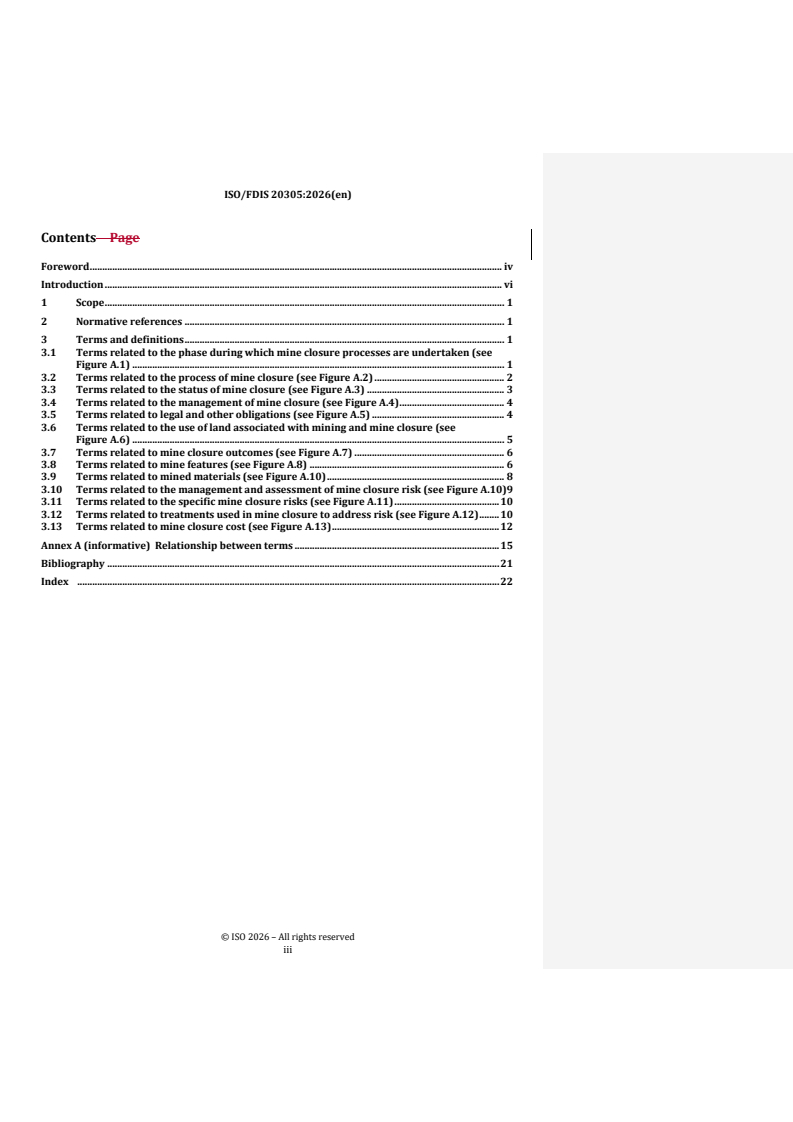
Foreword .iv
Introduction .v
1 Scope . 1
2 Normative references . 1
3 Terms and definitions . 1
3.1 Terms related to the phase during which mine closure processes are undertaken (see
Figure A.1) .1
3.2 Terms related to the process of mine closure (see Figure A.2) .2
3.3 Terms related to the status of mine closure (see Figure A.3) .3
3.4 Terms related to the management of mine closure (see Figure A.4) .4
3.5 Terms related to legal and other obligations (see Figure A.5).4
3.6 Terms related to the use of land associated with mining and mine closure (see
Figure A.6) .5
3.7 Terms related to mine closure outcomes (see Figure A.7) .5
3.8 Terms related to mine features (see Figure A.8) .6
3.9 Terms related to mined materials (see Figure A.10) .7
3.10 Terms related to the management and assessment of mine closure risk (see Figure A.10) .8
3.11 Terms related to the specific mine closure risks (see Figure A.11) .9
3.12 Terms related to treatments used in mine closure to address risk (see Figure A.12).10
3.13 Terms related to mine closure cost (see Figure A.13) .11
Annex A (informative) Relationship between terms .13
Bibliography . 19
Index .20
iii
Foreword
ISO (the International Organization for Standardization) is a worldwide federation of national standards
bodies (ISO member bodies). The work of preparing International Standards is normally carried out through
ISO technical committees. Each member body interested in a subject for which a technical committee
has been established has the right to be represented on that committee. International organizations,
governmental and non-governmental, in liaison with ISO, also take part in the work. ISO collaborates closely
with the International Electrotechnical Commission (IEC) on all matters of electrotechnical standardization.
The procedures used to develop this document and those intended for its further maintenance are described
in the ISO/IEC Directives, Part 1. In particular, the different approval criteria needed for the different types
of ISO document should be noted. This document was drafted in accordance with the editorial rules of the
ISO/IEC Directives, Part 2 (see www.iso.org/directives).
ISO draws attention to the possibility that the implementation of this document may involve the use of (a)
patent(s). ISO takes no position concerning the evidence, validity or applicability of any claimed patent
rights in respect thereof. As of the date of publication of this document, ISO had not received notice of (a)
patent(s) which may be required to implement this document. However, implementers are cautioned that
this may not represent the latest information, which may be obtained from the patent database available at
www.iso.org/patents. ISO shall not be held responsible for identifying any or all such patent rights.
Any trade name used in this document is information given for the convenience of users and does not
constitute an endorsement.
For an explanation of the voluntary nature of standards, the meaning of ISO specific terms and expressions
related to conformity assessment, as well as information about ISO's adherence to the World Trade
Organization (WTO) principles in the Technical Barriers to Trade (TBT), see www.iso.org/iso/foreword.html.
This document was prepared by Technical Committee ISO/TC 82, Mining, Subcommittee SC 7, Sustainable
mining and mine closure.
This second edition cancels and replaces the first edition (ISO 20305:2020), which has been technically
revised.
The main changes are as follows:
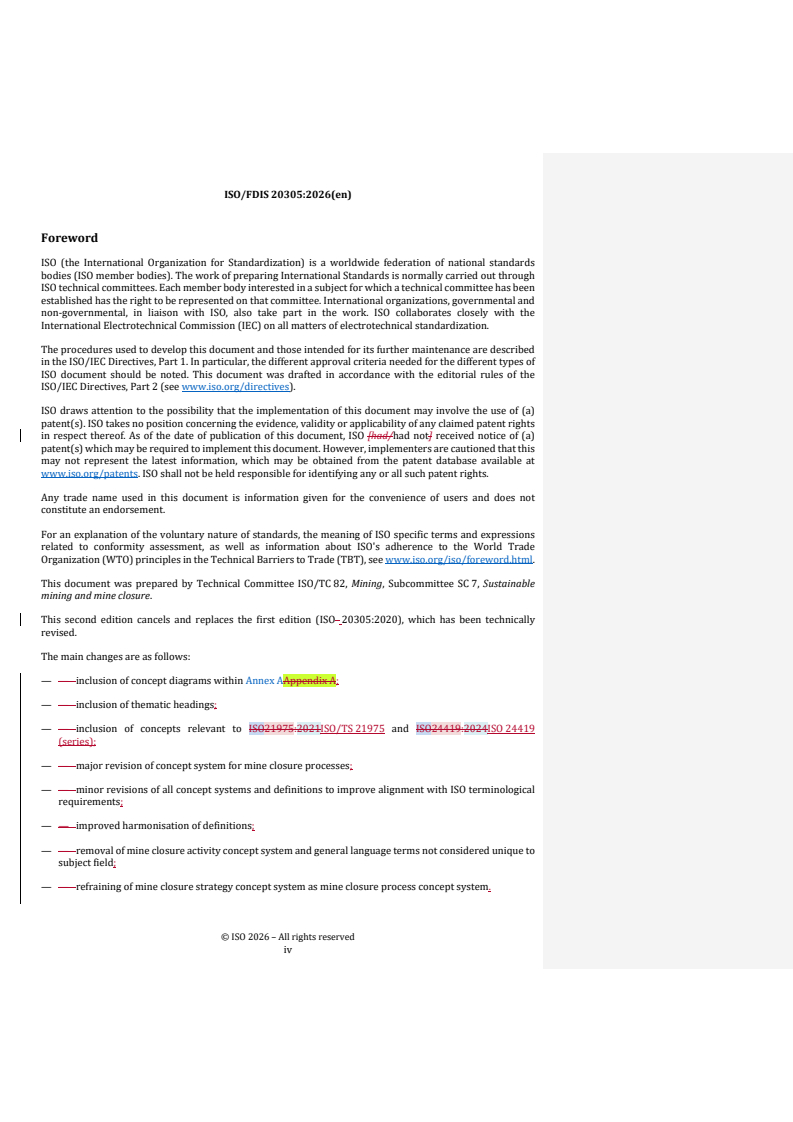
— inclusion of concept diagrams within Annex A;
— inclusion of thematic headings;
— inclusion of concepts relevant to ISO/TS 21975 and ISO 24419 (series);
— major revision of concept system for mine closure processes;
— minor revisions of all concept systems and definitions to improve alignment with ISO terminological
requirements;
— improved harmonisation of definitions;
— removal of mine closure activity concept system and general language terms not considered unique to
subject field;
— refraining of mine closure strategy concept system as mine closure process concept system.
Any feedback or questions on this document should be directed to the user’s national standards body. A
complete listing of these bodies can be found at www.iso.org/members.html.
iv
Introduction
This vocabulary has been prepared to support the application of concepts presented within mine closure
and reclamation standards, as well as to facilitate effective communication within the subject field of mine
closure and reclamation.
Identified concepts were assessed and filtered based on the following criteria:
— the concept is used within, and considered critical to, ISO mine closure and reclamation standards or
documentation either existing or being prepared;
— the concept is sufficiently important to avoid misunderstanding or ambiguity, such as where an
alternative or conflicting definition exists or is in common use;
— the concept is required to achieve a common understanding within the field of mine closure and
reclamation, including amongst non-experts.
In selecting concepts for inclusion within this standard every effort has been made to avoid:
— general concepts used across, and common to, subject fields other than mine closure and reclamation;
— use of a single term for multiple concepts or multiple terms for a single concept;
— contradictions occurring in terminological entries in other standards prepared under TC 82.
Where a concept was identified within the ISO Online Browsing Platform the definition was reviewed
and adopted, if applicable in the mine closure and reclamation context. Definitions presented in publicly
available and relevant documents were also reviewed and included where appropriate.
Where concepts have been defined within a specific mine closure and reclamation standard or jurisdictional
statute that definition will supersede any term or definition presented within this document.
Concepts on mine closure and reclamation management have been classified into the following thematic
headings:
— mine closure phase;
— mine closure process;
— mine status;
— mine closure governance;
— legal and other obligations;
— land use;
— mine closure outcome;
— mine feature;
— mine material;
— mine closure risk;
— mine closure treatment;
— mine closure cost.
This document is not intended to present a comprehensive list of all terms or concepts utilized within mine
closure and reclamation.
v
FINAL DRAFT International Standard ISO/FDIS 20305:2026(en)
Mine closure and reclamation — Vocabulary
1 Scope
This document establishes a vocabulary for mine closure and reclamation management.
2 Normative references
There are no normative references in this document.
3 Terms and definitions
For the purposes of this document, the following terms and definitions apply.
ISO and IEC maintain terminology databases for use in standardization at the following addresses:
— ISO Online browsing platform: available at https:// www .iso .org/ obp
— IEC Electropedia: available at https:// www .electropedia .org/
3.1 Terms related to the phase during which mine closure processes are undertaken (see
Figure A.1)
3.1.1
life of mine
phase when a mine is, or is planned to be, in production
Note 1 to entry: Based on a mine plan developed in consideration of the available capital and ore reserves, or a
reasonable and justifiable extension of the reserve estimate.
[3]
[SOURCE: ICMM 2019 , modified — Note 1 to entry has been added.]
3.1.1.1
pre-closure
part of life of mine (3.1.1), during which mine closure (3.2.1) is planning to progressively develop the scope of
closure (3.1.1.2)
Note 1 to entry: Pre-closure can include development, operation, and care and maintenance (3.1.1.1.1) phases.
3.1.1.1.1
care and maintenance
temporary mine closure
part of pre-closure (3.1.1.1) when a mine or mine facility (3.8.1.1) is suspended (3.3.1.4), and is maintained in
anticipation of production recommencing
Note 1 to entry: Care and maintenance can also refer, in some jurisdictions, to the post closure (3.1.1.3) phase.
3.1.1.2
closure
part of life of mine (3.1.1) when a mine or mine feature (3.8.1) is closed (3.3.1.2) and during which the mine
closure plan (3.2.1.5) is executed
Note 1 to entry: Closure can be referred to as active closure in combination with post-closure (3.1.1.3).
3.1.1.3
post closure
part of life of mine (3.1.1), when monitoring and maintenance and other relevant management activities are
undertaken
Note 1 to entry: Post closure includes active maintenance and monitoring undertaken to assess and maintain the
performance of mine closure treatment (3.12.1).
Note 2 to entry: Post closure can be referred to as active closure in combination with closure (3.1.1.2).
3.1.1.4
completion
part of life of mine (3.1.1), when relinquishment (3.2.1.6) occurs
Note 1 to entry: Completion can be referred to as passive closure.
3.2 Terms related to the process of mine closure (see Figure A.2)
3.2.1
mine closure
process to plan and implement strategies to carry out the related activities associated with the cessation of
mining and to achieve relinquishment (3.2.1.6) and transition to the post mining land use (3.6.1.1)
Note 1 to entry: Mine closure can be implemented progressively for specific features within a mine site or operation.
3.2.1.1
mine closure design
part of mine closure (3.2.1) for design of closure (3.1.1.2) of a specific mine feature (3.8.1),domain (3.8.2) or
other aspect (3.10.1)
3.2.1.2
decommissioning
part of mine closure (3.2.1) for the safe de-activation, removal and disposal of a redundant mine facility
(3.8.1.1)
3.2.1.3
mitigation
part of mine closure (3.2.1) bearing on the management of the adverse effects of mining
3.2.1.3.1
remediation
mitigation (3.2.1.3) removing, reducing or neutralizing hazardous material, or other not-desired substances
Note 1 to entry: Post-mining hazards can include soil and water contamination, unstable ground, gas emission or
similar events which impact the environment.
Note 2 to entry: Remediation is often the first step in reclamation (3.2.1.3.2) and is conducted in parallel or immediately
after decommissioning (3.2.1.2).
3.2.1.3.2
reclamation
mitigation (3.2.1.3) recovering disturbed land to safe, stable, non-polluting state
Note 1 to entry: Reclamation can also be referred to as alleviation.
3.2.1.3.2.1
restoration
reclamation (3.2.1.3.2) of a mine feature (3.8.1), domain (3.8.2) or other area disturbed by mining to a
sustainable condition corresponding with its natural or reference state
3.2.1.3.3
rehabilitation
outcome of reclamation (3.2.1.3.2)
3.2.1.4
repurposing
redevelopment
part of mine closure (3.2.1) converting a mine feature (3.8.1), domain (3.8.2) of other area disturbed by mining
to a productive condition
3.2.1.5
mine closure plan
part of mine closure (3.2.1) comprising documented information
3.2.1.6
relinquishment
part of mine closure (3.2.1) verifying that completion criteria (3.7.2.2) have been met and closureliability
(3.13.2) and ownership of the mine or mine feature (3.8.1) have been transferred to the government or a
third party
3.2.2
transition
planned change of an aspect (3.10.1) of mine closure (3.2.1) from its operational state to the intended closure
status (3.3.1)
Note 1 to entry: Transition can include environmental, social and economic aspects of mine closure.
3.3 Terms related to the status of mine closure (see Figure A.3)
3.3.1
closure status
status of a mine or mine feature (3.8.1) with respect to the closure phase
3.3.1.1
abandoned
status of a mine or mine feature (3.8.1) having not been formally relinquished (3.3.1.5) and for which the
responsibility for mine closure (3.2.1) cannot be allocated to an individual or organization
Note 1 to entry: Closure liability (3.13.2) can fall to the landowner if freehold land.
Note 2 to entry: Abandoned can also be referred to as a “derelict”, “orphaned” or “legacy mine”.
3.3.1.2
closed
status of a mine or mine feature (3.8.1) for which mining has ceased and for which the mine owner or
operator is implementing, or has yet to commence implementation of, mine closure (3.2.1)
3.3.1.3
reclaimed
status of a mine or mine feature (3.8.1) for which mine closure (3.2.1) has been implemented, and the post
closure (3.1.1.3) phase has commenced
3.3.1.4
suspended
status of a mine or mine feature (3.8.1) for which mining, or processing, has temporarily ceased and
operations have been placed in care and maintenance (3.1.1.1.1)
3.3.1.5
relinquished
status of a mine or mine feature (3.8.1) for which relinquishment (3.2.1.6) has been completed
3.4 Terms related to the management of mine closure (see Figure A.4)
3.4.1
interested party
stakeholder
person, group or organization with the potential to affect, or be affected by mine closure (3.2.1)
3.4.2
stewardship
care, maintenance and management of mined land after mine closure (3.2.1) ensuring ongoing management
of risk (3.10.3)
Note 1 to entry: Stewardship includes surveillance, aftercare, monitoring and maintenance for a mining legacy
(3.10.2.1) and sites subject to regulation.
Note 2 to entry: Stewardship may not be associated with institutional control (3.4.3).
3.4.3
institutional control
legal or administrative action, or requirement, imposed on non-operational mined land
Note 1 to entry: Institutional control aims to protect and maintain mitigation (3.2.1.3) works and minimize human
exposure to harm while protecting values and particular ongoing uses.
Note 2 to entry: Institutional control can include deeds, land use zoning, security and monitoring.
Note 3 to entry: Institutional control can also be referred to as ”surveillance”.
3.5 Terms related to legal and other obligations (see Figure A.5)
3.5.1
obliging event
event generating a present obligation (3.5.2)
3.5.2
present obligation
obligation resulting in an entity having no realistic alternative to settling the obligation
3.5.2.1
legal obligation
present obligation (3.5.2) derived from the application of law
3.5.2.2
constructive obligation
present obligation (3.5.2) derived from an organization’s actions or stated commitment
Note 1 to entry: Constructive obligation is established when an organization has created a valid expectation that it
will accept responsibility.
Note 2 to entry: Constructive obligation can be established by a pattern of past practice, published policies or a
sufficiently specific current statement.
Note 3 to entry: Constructive obligation is often established through stakeholder (3.4.1) engagement.
3.5.2.2.1
cultural obligation
constructive obligation (3.5.2.2) founded in the customs, traditions and values of a particular culture or
community
Note 1 to entry: Cultural obligation is generally based on moral, ethical, and social principles rather than legal statutes
or contractual agreements.
Note 2 to entry: Cultural obligation is often upheld through community norms and shared values.
3.5.2.2.2
social obligation
constructive obligation (3.5.2.2) founded in behaviour, relationships and values within broad societal context
3.6 Terms related to the use of land associated with mining and mine closure (see
Figure A.6)
3.6.1
land use
human use or management of land within a relevant boundary
Note 1 to entry: Land use is, generally, for the purpose of habitation, production, recreation or conserva
...
ISO/TC 82/SC 7
Secretariat: KATS
Date: 2025-12-172026-xx
Mine closure and reclamation — Vocabulary
Fermeture et remise en état des mines — Vocabulaire
FDIS stage
All rights reserved. Unless otherwise specified, or required in the context of its implementation, no part of this publication
may be reproduced or utilized otherwise in any form or by any means, electronic or mechanical, including photocopying
and microfilm, or posting on the internet or an intranet, without prior written permission in writing. Permission can be
requested from either ISO at the address below or ISO'sISO’s member body in the country of the requester.
ISO copyright office
Case postale 56 • CP 401 • Ch. de Blandonnet 8
CH-12111214 Vernier, Geneva 20
Tel.Phone: + 41 22 749 01 11
Fax + 41 22 734 10 79
E-mail : copyright@iso.org
WebWebsite: www.iso.chorg
Field Code Changed
PrintedPublished in Switzerland
ii
Contents Page
Foreword . iv
Introduction . vi
1 Scope . 1
2 Normative references . 1
3 Terms and definitions . 1
3.1 Terms related to the phase during which mine closure processes are undertaken (see
Figure A.1) . 1
3.2 Terms related to the process of mine closure (see Figure A.2) . 2
3.3 Terms related to the status of mine closure (see Figure A.3) . 3
3.4 Terms related to the management of mine closure (see Figure A.4) . 4
3.5 Terms related to legal and other obligations (see Figure A.5) . 4
3.6 Terms related to the use of land associated with mining and mine closure (see
Figure A.6) . 5
3.7 Terms related to mine closure outcomes (see Figure A.7) . 6
3.8 Terms related to mine features (see Figure A.8) . 6
3.9 Terms related to mined materials (see Figure A.10) . 8
3.10 Terms related to the management and assessment of mine closure risk (see Figure A.10)9
3.11 Terms related to the specific mine closure risks (see Figure A.11) . 10
3.12 Terms related to treatments used in mine closure to address risk (see Figure A.12) . 10
3.13 Terms related to mine closure cost (see Figure A.13) . 12
Annex A (informative) Relationship between terms . 15
Bibliography . 21
Index . 22
iii
Foreword
ISO (the International Organization for Standardization) is a worldwide federation of national standards
bodies (ISO member bodies). The work of preparing International Standards is normally carried out through
ISO technical committees. Each member body interested in a subject for which a technical committee has been
established has the right to be represented on that committee. International organizations, governmental and
non-governmental, in liaison with ISO, also take part in the work. ISO collaborates closely with the
International Electrotechnical Commission (IEC) on all matters of electrotechnical standardization.
The procedures used to develop this document and those intended for its further maintenance are described
in the ISO/IEC Directives, Part 1. In particular, the different approval criteria needed for the different types of
ISO document should be noted. This document was drafted in accordance with the editorial rules of the
ISO/IEC Directives, Part 2 (see www.iso.org/directives).
ISO draws attention to the possibility that the implementation of this document may involve the use of (a)
patent(s). ISO takes no position concerning the evidence, validity or applicability of any claimed patent rights
in respect thereof. As of the date of publication of this document, ISO [had/had not] received notice of (a)
patent(s) which may be required to implement this document. However, implementers are cautioned that this
may not represent the latest information, which may be obtained from the patent database available at
www.iso.org/patents. ISO shall not be held responsible for identifying any or all such patent rights.
Any trade name used in this document is information given for the convenience of users and does not
constitute an endorsement.
For an explanation of the voluntary nature of standards, the meaning of ISO specific terms and expressions
related to conformity assessment, as well as information about ISO's adherence to the World Trade
Organization (WTO) principles in the Technical Barriers to Trade (TBT), see www.iso.org/iso/foreword.html.
This document was prepared by Technical Committee ISO/TC 82, Mining, Subcommittee SC 7, Sustainable
mining and mine closure.
This second edition cancels and replaces the first edition (ISO 20305:2020), which has been technically
revised.
The main changes are as follows:
— — inclusion of concept diagrams within Annex AAppendix A;
— — inclusion of thematic headings;
— — inclusion of concepts relevant to ISO21975:2021ISO/TS 21975 and ISO24419:2024ISO 24419
(series);
— — major revision of concept system for mine closure processes;
— — minor revisions of all concept systems and definitions to improve alignment with ISO terminological
requirements;
— — improved harmonisation of definitions;
— — removal of mine closure activity concept system and general language terms not considered unique to
subject field;
— — refraining of mine closure strategy concept system as mine closure process concept system.
iv
Any feedback or questions on this document should be directed to the user’s national standards body. A
complete listing of these bodies can be found at www.iso.org/members.html.
v
Introduction
This vocabulary has been prepared to support the application of concepts presented within mine closure and
reclamation standards , as well as to facilitate effective communication within the subject field of mine closure
and reclamation.
Identified concepts were assessed and filtered based on the following criteria:
— — the concept is used within, and considered critical to, ISO mine closure and reclamation standards or
documentation either existing or being prepared;
— — the concept is sufficiently important to avoid misunderstanding or ambiguity, such as where an
alternative or conflicting definition exists or is in common use;
— — the concept is required to achieve a common understanding within the field of mine closure and
reclamation, including amongst non-experts.
In selecting concepts for inclusion within this standard every effort has been made to avoid:
— — general concepts used across, and common to, subject fields other than mine closure and reclamation;
— — use of a single term for multiple concepts or multiple terms for a single concept;
— — contradictions occurring in terminological entries in other standards prepared under TC 82.
Where a concept was identified within the ISO Online Browsing Platform the definition was reviewed and
adopted, if applicable in the mine closure and reclamation context. Definitions presented in publicly available
and relevant documents were also reviewed and included where appropriate.
Where concepts have been defined within a specific mine closure and reclamation standard or jurisdictional
statute that definition will supersede any term or definition presented within this standarddocument.
Concepts on mine closure and reclamation management have been classified into the following thematic
headings:
— — mine closure phase;
— — mine closure process;
— — mine status;
— — mine closure governance;
— — legal and other obligations;
— — land use;
— — mine closure outcome;
— — mine feature;
— — mine material;
— — mine closure risk;
vi
— — mine closure treatment;
— — mine closure cost.
This document is not intended to present a comprehensive list of all terms or concepts utilized within mine
closure and reclamation.
vii
Mine closure and reclamation — Vocabulary
1 Scope
This document establishes a vocabulary for mine closure and reclamation management.
2 Normative references
There are no normative references in this document.
3 Terms and definitions
For the purposes of this document, the following terms and definitions apply.
ISO and IEC maintain terminologicalterminology databases for use in standardization at the following
addresses:
— — ISO Online browsing platform: available at https://www.iso.org/obp
— — IEC Electropedia: available at https://www.electropedia.org/
3.1 Terms related to the phase during which mine closure processes are undertaken (see
Figure A.1)
3.1.1 3.1.1
life of mine
phase when a mine is, or is planned to be, in production
Note 1 to entry: Based on a mine plan developed in consideration of the available capital and ore reserves, or a
reasonable and justifiable extension of the reserve estimate.
[3 ]
[SOURCE: ICMM 2019 : , modified — Note 1 to entry has been added.]
3.1.1.1 3.1.1.1
pre-closure
part of life of mine (3.1.1(3.1.1),), during which mine closure (3.2.1(3.2.1)) is planning to progressively develop
the scope of closure (3.1.1.2(3.1.1.2))
Note 1 to entry: Pre-closure can include development, operation, and care and maintenance (3.1.1.1.1(3.1.1.1.1))
phases.
3.1.1.1.1 3.1.1.1.1
care and maintenance
temporary mine closure
part of pre-closure (3.1.1.1(3.1.1.1)) when a mine or mine facility (3.8.1.1(3.8.1.1)) is suspended
(3.3.1.4(3.3.1.4),), and is maintained in anticipation of production recommencing
Note 1 to entry: Care and maintenance can also refer, in some jurisdictions, to the post closure (3.1.1.3(3.1.1.3)) phase.
3.1.1.2 3.1.1.2
closure
part of life of mine (3.1.1(3.1.1)) when a mine or mine feature (3.8.1(3.8.1)) is closed (3.3.1.2(3.3.1.2)) and
during which the mine closure plan (3.2.1.5(3.2.1.5)) is executed
Note 1 to entry: Closure can be referred to as active closure in combination with post-closure (3.1.1.3(3.1.1.3).).
3.1.1.3 3.1.1.3
post closure
part of life of mine (3.1.1(3.1.1),), when monitoring and maintenance and other relevant management activities
are undertaken
Note 1 to entry: Post closure includes active maintenance and monitoring undertaken to assess and maintain the
performance of mine closure treatment (3.12.1(3.12.1).).
Note 2 to entry: Post closure can be referred to as active closure in combination with closure (3.1.1.2(3.1.1.2).).
3.1.1.4 3.1.1.4
completion
part of life of mine (3.1.1(3.1.1),), when relinquishment (3.2.1.6(3.2.1.6)) occurs
Note 1 to entry: Completion can be referred to as passive closure.
3.2 Terms related to the process of mine closure (see Figure A.2)
3.2.1 3.2.1
mine closure
process to plan and implement strategies to carry out the related activities associated with the cessation of
mining and to achieve relinquishment (3.2.1.6(3.2.1.6)) and transition to the post mining land use
(3.6.1.1(3.6.1.1))
Note 1 to entry: Mine closure can be implemented progressively for specific features within a mine site or operation.
3.2.1.1 3.2.1.1
mine closure design
part of mine closure (3.2.1(3.2.1)) for design of closure (3.1.1.2(3.1.1.2)) of a specific mine feature (3.8.1(3.8.1),
),domain (3.8.2(3.8.2)) or other aspect (3.10.1(3.10.1))
3.2.1.2 3.2.1.2
decommissioning
part of mine closure (3.2.1(3.2.1)) for the safe de-activation, removal and disposal of a redundant mine facility
(3.8.1.1(3.8.1.1))
3.2.1.3 3.2.1.3
mitigation
part of mine closure (3.2.1(3.2.1)) bearing on the management of the adverse effects of mining
3.2.1.3.1 3.2.1.3.1
remediation
mitigation (3.2.1.3(3.2.1.3)) removing, reducing or neutralizing hazardous material, or other not-desired
substances
Note 1 to entry: Post-mining hazards can include soil and water contamination, unstable ground, gas emission or similar
events which impact the environment.
Note 2 to entry: Remediation is often the first step in reclamation (3.2.1.3.2(3.2.1.3.2)) and is conducted in parallel or
immediately after decommissioning (3.2.1.2(3.2.1.2).).
3.2.1.3.2 3.2.1.3.2
reclamation
mitigation (3.2.1.3(3.2.1.3)) recovering disturbed land to safe, stable, non-polluting state
Note 1 to entry: Reclamation can also be referred to as alleviation.
3.2.1.3.2.1 3.2.1.3.2.1
restoration
reclamation (3.2.1.3.2(3.2.1.3.2)) of a mine feature (3.8.1(3.8.1),), domain (3.8.2(3.8.2)) or other area disturbed
by mining to a sustainable condition corresponding with its natural or reference state
3.2.1.3.3 3.2.1.3.3
rehabilitation
outcome of reclamation (3.2.1.3.2(3.2.1.3.2))
3.2.1.4 3.2.1.4
repurposing
redevelopment
part of mine closure (3.2.1(3.2.1)) converting a mine feature (3.8.1(3.8.1),), domain (3.8.2(3.8.2)) of other area
disturbed by mining to a productive condition
3.2.1.5 3.2.1.5
mine closure plan
part of mine closure (3.2.1(3.2.1)) comprising documented information
3.2.1.6 3.2.1.6
relinquishment
part of mine closure (3.2.1(3.2.1)) verifying that completion criteria (3.7.2.2(3.7.2.2)) have been met and
closureliability (3.13.2closure liability (3.13.2)) and ownership of the mine or mine feature (3.8.1(3.8.1)) have
been transferred to the government or a third party
3.2.2 3.2.2
transition
planned change of an aspect (3.10.1(3.10.1)) of mine closure (3.2.1(3.2.1)) from its operational state to the
intended closure status (3.3.1(3.3.1))
Note 1 to entry: Transition can include environmental, social and economic aspects of mine closure.
3.3 Terms related to the status of mine closure (see Figure A.3)
3.3.1 3.3.1
closure status
status of a mine or mine feature (3.8.1(3.8.1)) with respect to the closure phase
3.3.1.1 3.3.1.1
abandoned
status of a mine or mine feature (3.8.1(3.8.1)) having not been formally relinquished (3.3.1.5(3.3.1.5)) and for
which the responsibility for mine closure (3.2.1(3.2.1)) cannot be allocated to an individual or organization
Note 1 to entry: Closure liability (3.13.2(3.13.2)) can fall to the landowner if freehold land.
Note 2 to entry: Abandoned can also be referred to as a “derelict”, “orphaned” or “legacy mine”.
3.3.1.2 3.3.1.2
closed
status of a mine or mine feature (3.8.1(3.8.1)) for which mining has ceased and for which the mine owner or
operator is implementing, or has yet to commence implementation of, mine closure (3.2.1(3.2.1))
3.3.1.3 3.3.1.3
reclaimed
status of a mine or mine feature (3.8.1(3.8.1)) for which mine closure (3.2.1(3.2.1)) has been implemented, and
the post closure (3.1.1.3(3.1.1.3)) phase has commenced
3.3.1.4 3.3.1.4
suspended
status of a mine or mine feature (3.8.1(3.8.1)) for which mining, or processing, has temporarily ceased and
operations have been placed in care and maintenance (3.1.1.1.1(3.1.1.1.1))
3.3.1.5 3.3.1.5
relinquished
status of a mine or mine feature (3.8.1(3.8.1)) for which relinquishment (3.2.1.6(3.2.1.6)) has been completed
3.4 Terms related to the management of mine closure (see Figure A.4)
3.4.1 3.4.1
interested party
stakeholder
person, group or organization with the potential to affect, or be affected by mine closure (3.2.1(3.2.1))
3.4.2 3.4.2
stewardship
care, maintenance, and management of mined land after mine closure (3.2.1(3.2.1)) ensuring ongoing
management of risk (3.10.3(3.10.3))
Note 1 to entry: Stewardship includes surveillance, aftercare, monitoring and maintenance for a mining legacy
(3.10.2.1(3.10.2.1)) and sites subject to regulation.
Note 2 to entry: Stewardship may not be associated with institutional control (3.4.3(3.4.3).).
3.4.3 3.4.3
institutional control
legal or administrative action, or requirement, imposed on non-operational mined land
Note 1 to entry: Institutional control aims to protect and maintain mitigation (3.2.1.3(3.2.1.3)) works and minimize
human exposure to harm while protecting values and particular ongoing uses.
Note 2 to entry: Institutional control can include deeds, land use zoning, security and monitoring.
Note 3 to entry: Institutional control can also be referred to as ”surveillance”.
3.5 Terms related to legal and other obligations (see Figure A.5.)
3.5.1 3.5.1
obliging event
event generating a present obligation (3.5.2(3.5.2))
3.5.2 3.5.2
present obligation
obligation resulting in an entity having no realistic alternative to settling the obligation
3.5.2.1 3.5.2.1
legal obligation
present obligation (3.5.2(3.5.2)) derived from the application of law
3.5.2.2 3.5.2.2
constructive obligation
present obligation (3.5.2(3.5.2)) derived from an organization’s actions or stated commitment
Note 1 to entry: Constructive obligation is established when an organization has created a valid expectation that it will
accept responsibility.
Note 2 to entry: Constructive obligation can be established by a pattern of past practice, published policies or a
sufficiently specific current statement.
Note 3 to entry: Constructive obligation is often established through stakeholder (3.4.1(3.4.1)) engagement.
3.5.2.2.1 3.5.2.2.1
cultural obligation
constructive obligation (3.5.2.2(3.5.2.2)) founded in the customs, traditions and values of a particular culture
or community
Note 1 to entry: Cultural obligation is generally based on moral, ethical, and social principles rather than legal statutes
or contractual agreements.
Note 2 to entry: Cultural obligation is often upheld through community norms and shared values.
3.5.2.2.2 3.5.2.2.2
social obligation
constructive obligation (3.5.2.2(3.5.2.2)) founded in behaviour, relationships and values within broad societal
context
3.6 Terms related to the use of land associated with mining and mine closure (see
Figure A.6)
3.6.1 3.6.1
land use
human use or management of land within a relevant boundary
Note 1 to entry: Land use is, generally, for the purpose of habitation, production, recreation or conservation.
Note 2 to entry: Land use can be classed as wilderness or natural environment.
Note 3 to entry: Land use can occur concurrently with mining.
3.6.1.1 3.6.1.1
pre-mining land use
part of land use (3.6.1(3.6.1)) prior to the commencement of mining
3.6.1.2 3.6.1.2
post closure land use
part of land use (3.6.1(3.6.1)) following completion (3.1.1.4(3.1.1.4))
3.6.2 3.6.2
land capability
ability of land to support a given post closure landclosureland use (3.6.1.2(3.6.1.2),), based on an evaluation of
the physical, chemical and biological characteristics
3.6.3 3.6.3
land suitability
ability of land to support a given post closure land use (3.6.1.2(3.6.1.2),), based on an evaluation of the land
capability (3.6.2(3.6.2),), as well as social, economic and cultural characteristics
Note 1 to entry: Land suitability can be interchangeable with land capability (3.6.2(3.6.2)) is some jurisdictions.
3.6.4 3.6.4
offset
measurable compensation for the loss of, or reduction in post-closure land suitability (3.6.3(3.6.3))
Note 1 to entry: An offset remains due to impact (3.10.2(3.10.2)) or residual risk (3.10.3.2(3.10.3.2)) after appropriate
prevention and mitigation (3.2.1.3(3.2.1.3)) has been taken.
Note 2 to entry: An offset can be applied where a specified post closure land use (3.6.1.2(3.6.1.2)) cannot be achieved
due to post mining land capability (3.6.2(3.6.2)) or land suitability (3.6.3(3.6.3)).
Note 3 to entry: Offsets can last in perpetuity or for as long as the impact or residual risk exists.
Note 4 to entry: An offset can include mitigation of a mining legacy (3.10.2.1(3.10.2.1)) in some jurisdictions.
Note 5 to entry: An offset can still be required even if a previous offset was established as part of mining approvals.
3.7 Terms related to mine closure outcom
...
PROJET FINAL
Norme
internationale
ISO/TC 82/SC 7
Fermeture et remise en état des
Secrétariat: KATS
mines — Vocabulaire
Début de vote:
Mine closure and reclamation — Vocabulary 2026-02-02
Vote clos le:
2026-03-30
LES DESTINATAIRES DU PRÉSENT PROJET SONT
INVITÉS À PRÉSENTER, AVEC LEURS OBSERVATIONS,
NOTIFICATION DES DROITS DE PROPRIÉTÉ DONT ILS
AURAIENT ÉVENTUELLEMENT CONNAISSANCE ET À
FOURNIR UNE DOCUMENTATION EXPLICATIVE.
OUTRE LE FAIT D’ÊTRE EXAMINÉS POUR
ÉTABLIR S’ILS SONT ACCEPTABLES À DES FINS
INDUSTRIELLES, TECHNOLOGIQUES ET COM-MERCIALES,
AINSI QUE DU POINT DE VUE DES UTILISATEURS, LES
PROJETS DE NORMES
INTERNATIONALES DOIVENT PARFOIS ÊTRE CONSIDÉRÉS
DU POINT DE VUE DE LEUR POSSI BILITÉ DE DEVENIR DES
NORMES POUVANT
SERVIR DE RÉFÉRENCE DANS LA RÉGLEMENTATION
NATIONALE.
Numéro de référence
PROJET FINAL
Norme
internationale
ISO/TC 82/SC 7
Fermeture et remise en état des
Secrétariat: KATS
mines — Vocabulaire
Début de vote:
Mine closure and reclamation — Vocabulary
2026-02-02
Vote clos le:
2026-03-30
LES DESTINATAIRES DU PRÉSENT PROJET SONT
INVITÉS À PRÉSENTER, AVEC LEURS OBSERVATIONS,
NOTIFICATION DES DROITS DE PROPRIÉTÉ DONT ILS
AURAIENT ÉVENTUELLEMENT CONNAISSANCE ET À
FOURNIR UNE DOCUMENTATION EXPLICATIVE.
DOCUMENT PROTÉGÉ PAR COPYRIGHT
OUTRE LE FAIT D’ÊTRE EXAMINÉS POUR
ÉTABLIR S’ILS SONT ACCEPTABLES À DES FINS
© ISO 2026 INDUSTRIELLES, TECHNOLOGIQUES ET COM-MERCIALES,
AINSI QUE DU POINT DE VUE DES UTILISATEURS, LES
Tous droits réservés. Sauf prescription différente ou nécessité dans le contexte de sa mise en œuvre, aucune partie de cette
PROJETS DE NORMES
INTERNATIONALES DOIVENT PARFOIS ÊTRE CONSIDÉRÉS
publication ne peut être reproduite ni utilisée sous quelque forme que ce soit et par aucun procédé, électronique ou mécanique,
DU POINT DE VUE DE LEUR POSSI BILITÉ DE DEVENIR DES
y compris la photocopie, ou la diffusion sur l’internet ou sur un intranet, sans autorisation écrite préalable. Une autorisation peut
NORMES POUVANT
être demandée à l’ISO à l’adresse ci-après ou au comité membre de l’ISO dans le pays du demandeur.
SERVIR DE RÉFÉRENCE DANS LA RÉGLEMENTATION
NATIONALE.
ISO copyright office
Case postale 401 • Ch. de Blandonnet 8
CH-1214 Vernier, Genève
Tél.: +41 22 749 01 11
E-mail: copyright@iso.org
Web: www.iso.org
Publié en Suisse Numéro de référence
ii
Sommaire Page
Avant-propos .iv
Introduction .v
1 Domaine d'application . 1
2 Références normatives . 1
3 Termes et définitions . 1
3.1 Termes relatifs à la phase pendant laquelle les processus de fermeture de la mine sont
entrepris (voir Figure A.1) .1
3.2 Termes relatifs au processus de fermeture de la mine (voir Figure A.2) .2
3.3 Termes relatifs au statut de fermeture de la mine (voir Figure A.3) .3
3.4 Termes relatifs à la gestion de la fermeture de la mine (voir Figure A.4) .4
3.5 Termes relatifs aux obligations légales et autres (voir Figure A.5) . .4
3.6 Termes relatifs à l'utilisation des terrains associés à l'exploitation minière et à la
fermeture de la mine (voir Figure A.6) .5
3.7 Termes relatifs aux résultats de la fermeture de la mine (voir Figure A.7) .6
3.8 Termes relatifs aux éléments miniers (voir Figure A.8) .6
3.9 Termes relatifs aux matériaux résultant de l'exploitation minière (voir Figure A.10) .8
3.10 Termes relatifs à la gestion et à l'évaluation des risques liés à la fermeture de la mine
(voir Figure A.10) .9
3.11 Termes relatifs aux risques spécifiques liés à la fermeture de la mine (voir Figure A.11) .10
3.12 Termes relatifs aux traitements de fermeture de la mine utilisés pour faire face aux
risques (voir Figure A.12) .10
3.13 Termes relatifs aux coûts de fermeture de la mine (voir Figure A.13) . 12
Annexe A (informative) Relation entre les termes . 14
Bibliographie .20
Index .21
iii
Avant-propos
L'ISO (Organisation internationale de normalisation) est une fédération mondiale d'organismes nationaux
de normalisation (comités membres de l'ISO). L'élaboration des Normes internationales est en général
confiée aux comités techniques de l'ISO. Chaque comité membre intéressé par une étude a le droit de faire
partie du comité technique créé à cet effet. Les organisations internationales, gouvernementales et non
gouvernementales, en liaison avec l'ISO participent également aux travaux. L'ISO collabore étroitement avec
la Commission électrotechnique internationale (IEC) en ce qui concerne la normalisation électrotechnique.
Les procédures utilisées pour élaborer le présent document et celles destinées à sa mise à jour sont
décrites dans les Directives ISO/IEC, Partie 1. Il convient, en particulier, de prendre note des différents
critères d'approbation requis pour les différents types de documents ISO. Le présent document a
été rédigé conformément aux règles de rédaction données dans les Directives ISO/IEC, Partie 2 (voir
www.iso.org/directives).
L'ISO attire l'attention sur le fait que la mise en application du présent document peut entraîner l'utilisation
d'un ou de plusieurs brevets. L'ISO ne prend pas position quant à la preuve, à la validité et à l'applicabilité de
tout droit de brevet revendiqué à cet égard. À la date de publication du présent document, l'ISO n'avait pas
reçu notification qu'un ou plusieurs brevets pouvaient être nécessaires à sa mise en application. Toutefois,
il y a lieu d'avertir les responsables de la mise en application du présent document que des informations
plus récentes sont susceptibles de figurer dans la base de données de brevets, disponible à l'adresse
www.iso.org/brevets. L'ISO ne saurait être tenue pour responsable de ne pas avoir identifié de tels droits de
propriété et averti de leur existence.
Les appellations commerciales éventuellement mentionnées dans le présent document sont données pour
information, par souci de commodité, à l'intention des utilisateurs et ne sauraient constituer un engagement.
Pour une explication de la nature volontaire des normes, la signification des termes et expressions
spécifiques de l'ISO liés à l'évaluation de la conformité, ou pour toute information au sujet de l'adhésion de
l'ISO aux principes de l'Organisation mondiale du commerce (OMC) concernant les obstacles techniques au
commerce (OTC), voir www.iso.org/iso/fr/avant-propos.html.
Le présent document a été élaboré par le comité technique ISO/TC 82, Exploitation minière, sous-comité SC 7,
Fermeture et gestion de la restauration des mines.
Cette deuxième édition annule et remplace la première édition (ISO 20305:2020), qui a fait l'objet d'une
révision technique.
Les principales modifications sont les suivantes:
— inclusion de diagrammes conceptuels dans l'Annexe A;
— inclusion de rubriques thématiques;
— inclusion de concepts pertinents pour l'ISO/TS 21975 et l'ISO 24419 (série);
— révision majeure du système conceptuel des processus de fermeture de la mine;
— révisions mineures de tous les systèmes conceptuels et définitions pour améliorer l'alignement avec les
exigences terminologiques de l'ISO;
— amélioration de l'harmonisation des définitions;
— suppression du système conceptuel d'activité de fermeture de la mine et des termes généraux non
considérés comme propres au domaine concerné;
— redéfinition du système conceptuel de la stratégie de fermeture de la mine comme système conceptuel
de processus de fermeture de la mine.
Il convient que l'utilisateur adresse tout retour d'information ou toute question concernant le présent
document à l'organisme national de normalisation de son pays. Une liste exhaustive desdits organismes se
trouve à l'adresse www.iso.org/fr/members.html.
iv
Introduction
Le présent vocabulaire a été élaboré afin de soutenir l'application des concepts présentés dans les normes
relatives à la fermeture et à la remise en état des mines, et afin de faciliter la communication efficace dans le
domaine de la fermeture et de la remise en état des mines.
Les concepts identifiés ont été évalués et filtrés en fonction des critères suivants:
— le concept est utilisé dans les normes ISO relatives à la fermeture et à la remise en état des mines ou
dans la documentation existante ou en cours d'élaboration et est considéré comme critique pour ces
documents;
— le concept est suffisamment important pour éviter tout malentendu ou toute ambiguïté, notamment
lorsqu'une définition alternative ou en conflit existe ou est couramment utilisée;
— le concept est nécessaire pour parvenir à une compréhension commune dans le domaine de la fermeture
et de la remise en état des mines, y compris parmi les non-experts.
Lors du choix des concepts à inclure dans la présente norme, tout a été fait pour éviter:
— les concepts généraux utilisés dans d'autres domaines et communs à plusieurs domaines autres que la
fermeture et la remise en état des mines;
— d'utiliser un seul terme pour désigner plusieurs concepts ou plusieurs termes pour désigner un même
concept;
— les contradictions avec les entrées terminologiques figurant dans d'autres normes élaborées par le TC 82.
Lorsqu'un concept a été identifié sur la plateforme de consultation en ligne (OBP) de l'ISO, la définition a
été examinée et adoptée, si elle était applicable dans le contexte de la fermeture et la remise en état des
mines. Les définitions présentées dans les documents accessibles au public et pertinents ont également été
examinées et incluses le cas échéant.
Lorsque des concepts ont été définis dans une norme spécifique relative à la fermeture et la remise en
état des mines ou dans une loi juridictionnelle, la définition en question va remplacer tout terme ou toute
définition figurant dans le présent document.
Les concepts sur la gestion de la fermeture et de la remise en état des mines ont été classés dans les rubriques
thématiques suivantes:
— phase de fermeture de la mine;
— processus de fermeture de la mine;
— statut de la mine;
— gouvernance de la fermeture de la mine;
— obligations légales et autres;
— utilisation des terrains;
— résultat de la fermeture de la mine;
— élément minier;
— matériau résultant de l'exploitation minière;
— risques liés à la fermeture de la mine;
— traitement lors de la fermeture de la mine;
— coût de fermeture de la mine.
v
Le présent document n'est pas destiné à présenter une liste exhaustive de tous les termes ou concepts
utilisés dans le domaine de la fermeture et la remise en état des mines.
vi
PROJET FINAL Norme internationale ISO/FDIS 20305:2026(fr)
Fermeture et remise en état des mines — Vocabulaire
1 Domaine d'application
Le présent document établit un vocabulaire sur la gestion de la fermeture et de la remise en état des mines.
2 Références normatives
Le présent document ne contient aucune référence normative.
3 Termes et définitions
Pour les besoins du présent document, les termes et définitions suivants s'appliquent.
L'ISO et l'IEC tiennent à jour des bases de données terminologiques destinées à être utilisées en normalisation,
consultables aux adresses suivantes:
— ISO Online browsing platform: disponible à l'adresse https:// www .iso .org/ obp
— IEC Electropedia: disponible à l'adresse https:// www .electropedia .org/
3.1 Termes relatifs à la phase pendant laquelle les processus de fermeture de la mine sont
entrepris (voir Figure A.1)
3.1.1
vie de la mine
phase pendant laquelle une mine est, ou est prévue d'être, en production
Note 1 à l'article: Sur la base d'un plan minier élaboré en tenant compte du capital disponible et des réserves de
minerai, ou d'une extension raisonnable et dûment justifiée de l'estimation des réserves.
[3]
[SOURCE: ICMM 2019, modifiée — Note 1 à l'article ajoutée]
3.1.1.1
pré-fermeture
partie de la vie de la mine (3.1.1) pendant laquelle la fermeture de la mine (3.2.1) est planifiée afin de définir
progressivement les modalités de fermeture (3.1.1.2)
Note 1 à l'article: La pré-fermeture peut inclure des phases de développement, d'exploitation et d'entretien et
maintenance (3.1.1.1.1).
3.1.1.1.1
entretien et maintenance
fermeture temporaire de la mine
partie de la pré-fermeture (3.1.1.1) pendant laquelle une mine ou une installation minière (3.8.1.1) est
suspendue (3.3.1.4), et est entretenue en anticipation d'une possible reprise de la production
Note 1 à l'article: L'entretien et la maintenance peuvent également renvoyer, dans certaines juridictions, à la phase
après exploitation (3.1.1.3).
3.1.1.2
fermeture
partie de la vie de la mine (3.1.1) pendant laquelle une mine ou un élément minier (3.8.1.1) est fermé(e)
(3.3.1.2) et le plan de fermeture de la mine (3.2.1.5) exécuté
Note 1 à l'article: La fermeture peut être désignée par le terme «fermeture active» lorsqu'elle est associée à l'après
exploitation (3.1.1.3).
3.1.1.3
après exploitation
partie de la vie de la mine (3.1.1) pendant laquelle les activités de surveillance et de maintenance et d'autres
activités de gestion pertinentes sont réalisées
Note 1 à l'article: L'après exploitation comprend la maintenance et la surveillance actives entreprises pour évaluer et
maintenir la performance du traitement lors de la fermeture de la mine (3.12.1).
Note 2 à l'article: L'après exploitation peut être désignée par le terme «fermeture active» lorsqu'elle est associée à la
fermeture (3.1.1.2).
3.1.1.4
renonciation
partie de la vie de la mine (3.1.1) pendant laquelle se produit la renonciation (3.2.1.6)
Note 1 à l'article: La renonciation peut être désignée par le terme «fermeture passive».
3.2 Termes relatifs au processus de fermeture de la mine (voir Figure A.2)
3.2.1
fermeture de la mine
processus de planification et de mise en œuvre de stratégies pour mener à bien les activités connexes
associées à l'arrêt de l'exploitation minière et pour parvenir à la renonciation (3.2.1.6) et à la transition vers
l'utilisation des terrains après exploitation (3.6.1.1)
Note 1 à l'article: La fermeture de la mine peut être mise en œuvre progressivement pour des éléments spécifiques au
sein d'un site ou d'une exploitation minière.
3.2.1.1
conception de la fermeture de la mine
partie de la fermeture de la mine (3.2.1) concernant la conception de la fermeture (3.1.1.2) d'un élément minier
(3.8.1), d'un secteur (3.8.2) ou d'un autre aspect (3.10.1) spécifique
3.2.1.2
démantèlement
partie de la fermeture de la mine (3.2.1) concernant la désactivation, le retrait et la mise en décharge en toute
sécurité d'une installation minière (3.8.1.1) désaffectée
3.2.1.3
mitigation
partie de la fermeture de la mine (3.2.1) portant sur la gestion des impacts négatifs de l'exploitation minière
3.2.1.3.1
dépollution
mitigation (3.2.1.3), élimination, réduction ou neutralisation des matières dangereuses ou d'autres
substances non désirées
Note 1 à l'article: Les dangers après exploitation peuvent inclure la contamination du sol et de l'eau, l'instabilité du sol,
les émissions de gaz ou des événements similaires qui ont un impact sur l'environnement.
Note 2 à l'article: La dépollution est souvent la première étape de la remise en état (3.2.1.3.2) et est effectuée en
parallèle ou immédiatement après le démantèlement (3.2.1.2).
3.2.1.3.2
remise en état
mitigation (3.2.1.3), restauration des terrains perturbés à un état sûr, stable et non polluant
Note 1 à l'article: La remise en état peut également être désignée par le terme «mitigation».
3.2.1.3.2.1
restauration
remise en état (3.2.1.3.2) d'un élément minier (3.8.1), d'un secteur (3.8.2) ou de toute zone perturbée par
l'exploitation minière à un état durable correspondant à son état naturel ou de référence
3.2.1.3.3
réhabilitation
résultat de la remise en état (3.2.1.3.2)
3.2.1.4
changement de destination
réaménagement
partie de la fermeture de la mine (3.2.1) qui convertit un élément minier (3.8.1), un secteur (3.8.2) ou toute
zone perturbée par l'exploitation minière à une autre destination
3.2.1.5
plan de fermeture de la mine
partie de la fermeture de la mine (3.2.1) qui comprend des informations documentées
3.2.1.6
renonciation
partie de la fermeture de la mine (3.2.1) consistant à vérifier que les critères de performance (3.7.2.2) ont été
remplis et que la responsabilité de la fermeture (3.13.2) et la propriété de la mine ou de l'élément minier (3.8.1)
ont été transférées au gouvernement ou à une tierce partie
3.2.2
transition
changement prévu d'un aspect (3.10.1) de la fermeture de la mine (3.2.1) de son état opérationnel au statut de
fermeture (3.3.1) prévu
Note 1 à l'article: La transition peut inclure les aspects environnementaux, sociaux et économiques de la fermeture de
la mine.
3.3 Termes relatifs au statut de fermeture de la mine (voir Figure A.3)
3.3.1
statut de fermeture
statut d'une mine ou d'un élément minier (3.8.1) au regard de la phase de fermeture
3.3.1.1
abandonné(e)
statut d'une mine ou d'un élément minier (3.8.1) n'ayant pas été formellement renoncé(e) (3.3.1.5) et pour
laquelle/lequel la responsabilité de la fermeture de la mine (3.2.1) ne peut pas être attribuée à un individu ou
une organisation
Note 1 à l'article: La responsabilité de fermeture (3.13.2) peut relever du propriétaire foncier si les terres sont en pleine
propriété.
Note 2 à l'article: Le terme «mine orpheline» peut également être utilisé.
3.3.1.2
fermé(e)
statut d'une mine ou d'un élémentminier (3.8.1) pour laquelle/lequel l'extraction minière a cessé et le
propriétaire ou l'exploitant de la mine met en œuvre, ou doit commencer à mettre en œuvre, un arrêt des
travaux en vue de la fermeture de la mine (3.2.1)
3.3.1.3
remis(e) en état
statut d'une mine ou d'un élément minier (3.8.1) pour laquelle/lequel la fermeture de la mine (3.2.1) a été
mise en œuvre, et la phase après exploitation (3.1.1.3) a commencé
3.3.1.4
suspendu(e)
statut d'une mine ou d'un élémentminier (3.8.1) pour laquelle/lequel l'extraction minière ou le traitement des
minerais a temporairement cessé et dont les opérations ont été placées en entretien et maintenance (3.1.1.1.1)
3.3.1.5
renoncé(e)
statut d'une mine ou d'un élément minier (3.8.1) pour laquelle/lequel la renonciation (3.2.1.6) a été effectuée
3.4 Termes relatifs à la gestion de la fermeture de la mine (voir Figure A.4)
3.4.1
porteur d'enjeux
partie prenante
personne, groupe ou organisation ayant le potentiel d'influer sur, ou d'être influencé par, la fermeture de la
mine (3.2.1)
3.4.2
gestion responsable
entretien, maintenance et gestion des terrains miniers après la fermeture de la mine (3.2.1) garantissant une
gestion continue des risques (3.10.3)
Note 1 à l'article: La gestion responsable comprend la surveillance, la gestion post-fermeture, le suivi et la maintenance
d'un héritage minier (3.10.2.1) et des sites soumis à la réglementation.
Note 2 à l'article: La gestion responsable ne peut pas être associée au contrôle institutionnel (3.4.3).
3.4.3
contrôle institutionnel
action ou exigence légale ou administrative imposée sur les terrains miniers non exploités
Note 1 à l'article: Le contrôle institutionnel vise à protéger et à maintenir les travaux de mitigation (3.2.1.3) et à
minimiser l'exposition humaine aux dommages tout en protégeant les valeurs et les utilisations continues particulières.
Note 2 à l'article: Le contrôle institutionnel peut inclure les actes, le zonage de l'utilisation des terrains, la sécurité et
la surveillance.
Note 3 à l'article: Le contrôle institutionnel peut également être désigné par le terme «surveillance».
3.5 Termes relatifs aux obligations légales et autres (voir Figure A.5)
3.5.1
événement contraignant
événement générant une obligation (3.5.2)
3.5.2
obligation
obligation qui a pour effet de ne laisser à l'entité aucune alternative réaliste autre que de répondre à cette
obligation
3.5.2.1
obligation légale
obligation (3.5.2) découlant de l'application de la loi
3.5.2.2
obligation implicite
obligation (3.5.2) découlant des actions ou de l'engagement déclaré d'une organisation
Note 1 à l'article: Une obligation implicite est établie lorsqu'une organisation a créé une attente valide dont elle
acceptera la responsabilité.
Note 2 à l'article: L'obligation implicite peut être établie par un modèle de pratique passée, des politiques déployées ou
une déclaration suffisamment spécifique.
Note 3 à l'article: L'obligation implicite est souvent établie par l'engagement des parties prenantes (3.4.1).
3.5.2.2.1
obligation culturelle
obligation implicite (3.5.2.2) fondée sur les coutumes, les traditions et les valeurs d'une culture ou d'une
communauté particulière
Note 1 à l'article: L'obligation culturelle repose généralement sur des principes moraux, éthiques et sociaux plutôt que
sur des dispositions légales ou des accords contractuels.
Note 2 à l'article: L'obligation culturelle résulte souvent de normes communautaires et de valeurs partagées.
3.5.2.2.2
obligation sociale
obligation implicite (3.5.2.2) fondée sur des comportements, des relations et des valeurs dans un contexte
sociétal large
3.6 Termes relatifs à l'utilisation des terrains associés à l'exploitation minière et à la
fermeture de la mine (voir Figure A.6)
3.6.1
utilisation des terrains
utilisation humaine ou gestion des terrains à l'intérieur d'une frontière pertinente
Note 1 à l'article: L'utilisation des terrains est généralement dédiée à des fins d'habitation, de production, de loisirs ou
de conservation.
Note 2 à l'article: L'utilisation des terrains peut être classée comme terrain sauvage ou environnement naturel.
Note 3 à l'article: L'utilisation des terrains peut intervenir en même temps que l'exploitation minière.
3.6.1.1
utilisation des terrains avant exploitation
utilisation des terrains (3.6.1) avant le début de l'exploitation minière
3.6.1.2
utilisation des terrains après exploitation
utilisation des terrains (3.6.1) après la renonciation (3.1.1.4)
3.6.2
capacité d'utilisation des sols
aptitude d'un terrain à favoriser une utilisation donnée après exploitation (3.6.1.2), reposant sur une
évaluation des caractéristiques physiques, chimiques et biologiques
3.6.3
adéqu
...
Questions, Comments and Discussion
Ask us and Technical Secretary will try to provide an answer. You can facilitate discussion about the standard in here.
Loading comments...