

ISO 22932-7:2025
(Main)Mining — Vocabulary — Part 7: Ventilation
General Information
- Abstract
This document specifies the commonly used terms and definitions in underground mine ventilation. Only those terms and definitions that have a specific meaning in this field are included. NOTE Some terms and definitions are also applicable to surface mining.
- Status
- Published
- Publication Date
- 07-Jul-2025
- Technical Committee
- ISO/TC 82 - Mining
- Drafting Committee
- ISO/TC 82 - Mining
- Current Stage
- 6060 - International Standard published
- Start Date
- 08-Jul-2025
- Due Date
- 12-Jan-2026
- Completion Date
- 08-Jul-2025


Overview
ISO 22932-7:2025 - Mining - Vocabulary - Part 7: Ventilation is the first edition (2025) part of the ISO 22932 series that standardizes terminology used in underground mine ventilation. The document specifies commonly used terms and definitions that have specific meaning in underground mine ventilation (some entries are also applicable to surface mining). It is a vocabulary standard intended to remove ambiguity and align language across engineering, safety, regulatory and research activities.
Key topics and technical content
ISO 22932-7:2025 organizes terminology into clear subject areas, including:
- Gases in mine air (e.g., mine air, damp, afterdamp, blackdamp, white damp, noxious gas, return air)
- Combustible gases environment (e.g., firedamp/methane, gas migration, combustible gas layers, methane drainage, outbursts)
- Dusts in mine air (e.g., coal dust, bug dust, caked dust, coal-dust and mixed explosions)
- Devices and security devices used for ventilation and safety (definitions for lamps, sensors, guards)
- Fans usage and auxiliary mine ventilation (terms for ventilation fans, auxiliary systems)
- Installations for passage, diversion or prevention of mine air (airways, seals, stoppings, regulators)
- Mine ventilation management (layout, surveillance, general concepts)
- Measurement (terminology related to monitoring and measurement of airflow, gas and dust)
- Bibliography and index for cross-reference
The standard contains no normative references and points users to ISO and IEC terminology databases (ISO OBP, Electropedia) for additional context.
Practical applications and users
ISO 22932-7:2025 is primarily a reference vocabulary that supports:
- Mining and ventilation engineers - consistent terminology in designs, ventilation plans and models
- Safety managers and inspectors - unambiguous terms for risk assessments, incident reports and emergency procedures
- Regulators and legislators - harmonized language in regulations and guidance
- Equipment manufacturers and suppliers - standardized product descriptions, specs and documentation
- Trainers, auditors and researchers - consistent glossary for education, training materials and publications
- Software developers and modelers - standardized labels and metadata in ventilation and monitoring systems
Use cases include writing SOPs, specifying contracts, documenting ventilation layouts, preparing training curricula, and improving interoperability of monitoring data and reports.
Related standards (if applicable)
- ISO 22932 series (other parts) - for broader mining vocabulary across disciplines
- ISO/TC 82 (Mining) - the technical committee responsible for the series
For terminology lookup: ISO Online Browsing Platform and IEC Electropedia.
Keywords: ISO 22932-7:2025, mining ventilation, mine ventilation vocabulary, underground mine ventilation, firedamp, methane drainage, coal dust, ventilation management, ventilation measurement.
Get Certified
Connect with accredited certification bodies for this standard

Bureau Veritas Chile
Bureau Veritas certification services in Chile.
Bureau Veritas Peru
Bureau Veritas certification services in Peru.
BVQI Peru
Bureau Veritas certification in Peru.
Sponsored listings
Frequently Asked Questions
ISO 22932-7:2025 is a standard published by the International Organization for Standardization (ISO). Its full title is "Mining — Vocabulary — Part 7: Ventilation". This standard covers: This document specifies the commonly used terms and definitions in underground mine ventilation. Only those terms and definitions that have a specific meaning in this field are included. NOTE Some terms and definitions are also applicable to surface mining.
This document specifies the commonly used terms and definitions in underground mine ventilation. Only those terms and definitions that have a specific meaning in this field are included. NOTE Some terms and definitions are also applicable to surface mining.
ISO 22932-7:2025 is classified under the following ICS (International Classification for Standards) categories: 01.040.73 - Mining and minerals (Vocabularies); 73.020 - Mining and quarrying. The ICS classification helps identify the subject area and facilitates finding related standards.
ISO 22932-7:2025 is available in PDF format for immediate download after purchase. The document can be added to your cart and obtained through the secure checkout process. Digital delivery ensures instant access to the complete standard document.
Standards Content (Sample)
International
Standard
ISO 22932-7
First edition
Mining — Vocabulary —
2025-07
Part 7:
Ventilation
Exploitation minière — Vocabulaire —
Partie 7: Ventilation
Reference number
© ISO 2025
All rights reserved. Unless otherwise specified, or required in the context of its implementation, no part of this publication may
be reproduced or utilized otherwise in any form or by any means, electronic or mechanical, including photocopying, or posting on
the internet or an intranet, without prior written permission. Permission can be requested from either ISO at the address below
or ISO’s member body in the country of the requester.
ISO copyright office
CP 401 • Ch. de Blandonnet 8
CH-1214 Vernier, Geneva
Phone: +41 22 749 01 11
Email: copyright@iso.org
Website: www.iso.org
Published in Switzerland
ii
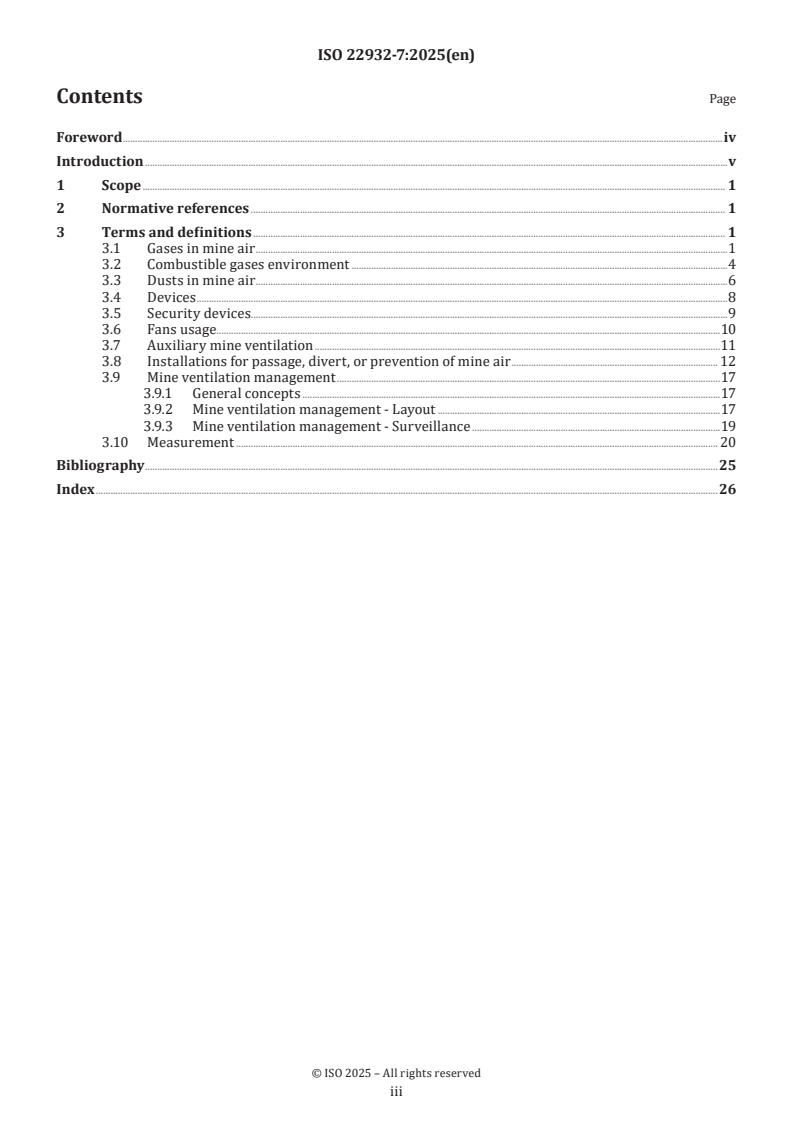
Contents Page
Foreword .iv
Introduction .v
1 Scope . 1
2 Normative references . 1
3 Terms and definitions . 1
3.1 Gases in mine air .1
3.2 Combustible gases environment .4
3.3 Dusts in mine air .6
3.4 Devices .8
3.5 Security devices.9
3.6 Fans usage.10
3.7 Auxiliary mine ventilation .11
3.8 Installations for passage, divert, or prevention of mine air . 12
3.9 Mine ventilation management .17
3.9.1 General concepts .17
3.9.2 Mine ventilation management - Layout .17
3.9.3 Mine ventilation management - Surveillance .19
3.10 Measurement . 20
Bibliography .25
Index .26
iii
Foreword
ISO (the International Organization for Standardization) is a worldwide federation of national standards
bodies (ISO member bodies). The work of preparing International Standards is normally carried out through
ISO technical committees. Each member body interested in a subject for which a technical committee
has been established has the right to be represented on that committee. International organizations,
governmental and non-governmental, in liaison with ISO, also take part in the work. ISO collaborates closely
with the International Electrotechnical Commission (IEC) on all matters of electrotechnical standardization.
The procedures used to develop this document and those intended for its further maintenance are described
in the ISO/IEC Directives, Part 1. In particular, the different approval criteria needed for the different types
of ISO document should be noted. This document was drafted in accordance with the editorial rules of the
ISO/IEC Directives, Part 2 (see www.iso.org/directives).
ISO draws attention to the possibility that the implementation of this document may involve the use of (a)
patent(s). ISO takes no position concerning the evidence, validity or applicability of any claimed patent
rights in respect thereof. As of the date of publication of this document, ISO had not received notice of (a)
patent(s) which may be required to implement this document. However, implementers are cautioned that
this may not represent the latest information, which may be obtained from the patent database available at
www.iso.org/patents. ISO shall not be held responsible for identifying any or all such patent rights.
Any trade name used in this document is information given for the convenience of users and does not
constitute an endorsement.
For an explanation of the voluntary nature of standards, the meaning of ISO specific terms and expressions
related to conformity assessment, as well as information about ISO's adherence to the World Trade
Organization (WTO) principles in the Technical Barriers to Trade (TBT), see www.iso.org/iso/foreword.html.
This document was prepared by Technical Committee ISO/TC 82, Mining.
A list of all parts in the ISO 22932 series can be found on the ISO website.
Any feedback or questions on this document should be directed to the user’s national standards body. A
complete listing of these bodies can be found at www.iso.org/members.html.
iv
Introduction
The ISO 22932 series has been prepared in order to standardize and to co-ordinate the global use of
technical terms and definitions in mining, for the benefit of the experts working on different types of mining
activities.
The need for the ISO 22932 series arose from the widely varying interpretation of terms used within the
industry and the prevalent use of more than one synonym.
v
International Standard ISO 22932-7:2025(en)
Mining — Vocabulary —
Part 7:
Ventilation
1 Scope
This document specifies the commonly used terms and definitions in underground mine ventilation. Only
those terms and definitions that have a specific meaning in this field are included.
NOTE Some terms and definitions are also applicable to surface mining.
2 Normative references
There are no normative references in this document.
3 Terms and definitions
For the purposes of this document, the following terms and definitions apply.
ISO and IEC maintain terminology databases for use in standardization at the following addresses:
— ISO Online browsing platform: available at https:// www .iso .org/ obp
— IEC Electropedia: available at https:// www .electropedia .org/
3.1 Gases in mine air
3.1.1
mine air
mixture of gases circulating through the workings
3.1.1.1
damp
mine air (3.1.1) deficient in oxygen
3.1.1.1.1
afterdamp
damp (3.1.1.1) that remain in a mine after a mine fire or an explosion of combustible gases (3.2.1)
Note 1 to entry: Afterdamp consists of carbonic acid gas, water vapor (quickly condensed), nitrogen, oxygen, carbon
monoxide, and in some cases free hydrogen.
Note 2 to entry: Afterdamp is breathable.
Note 3 to entry: See also blackdamp; damp.
Note 4 to entry: See Reference [1].
3.1.1.1.2
blackdamp
afterdamp (3.1.1.1.1) containing carbon dioxide and nitrogen in excess of the normal percentage, and in
which a flame safety lamp (3.4.1.1) will not burn owing to a deficiency of oxygen
Note 1 to entry: The average blackdamp contains 10 % to 15 % carbon dioxide and 85 % to 90 % nitrogen.
Note 2 to entry: Blackdamp is formed by mine fires and the explosion of combustible gases in mines, and hence forms
a part of the afterdamp.
Note 3 to entry: It extinguishes light and suffocates its victims. Hence, it is sometimes known as chokedamp.
Note 4 to entry: See Reference [1].
3.1.1.1.3
chokedamp
mine atmosphere that causes choking or suffocation due to insufficient oxygen
Note 1 to entry: See Reference [1].
3.1.1.1.4
white damp
damp (3.1.1.1) composed of carbon monoxide (CO)
Note 1 to entry: White damp can be present in the afterdamp of a gas- or coal-dust explosion, or in the gases given off
by a mine fire; also one of the gases produced by blasting.
Note 2 to entry: White damp is an important constituent of illuminating gas, supports combustion, and is very
poisonous because it is absorbed by the hemoglobin of the blood to the exclusion of oxygen.
Note 3 to entry: See Reference [1].
3.1.2
noxious gas
mine air (3.1.1) that contains gas which is injurious to health
3.1.2.1
ill air
noxious gas, as from underground fires or chokedamp
Note 1 to entry: Ill air stagnant state of the atmosphere underground.
Note 2 to entry: See Reference [1].
3.1.2.2
stifle
noxious gas (3.1.2) resulting from an underground fire
Note 1 to entry: See Reference [1].
3.1.3
foul air
main air contaminated by powder fumes, noxious gases, or respirable dust
Note 1 to entry: See Reference [1].
3.1.4
stythe
mine air (3.1.1) containing carbonic acid gas, often found in old workings and given off in most shallow mines
Note 1 to entry: Also spelled stithe.
Note 2 to entry: See Reference [1].
3.1.5
air blast
strong rush of mine air (3.1.1) through the workings
Note 1 to entry: Air blasts can occur caused by an explosion, a movement of large masses of strata, an outburst of coal
or by a movement of a body of water.
3.1.6
air current
air flow
flow of mine air (3.1.1) ventilating the workings of a mine
3.1.6.1
circulation of mine air
dominated air current
Note 1 to entry: The circulation of air aims to ensure adequate ventilation of all workings and roadways.
Note 2 to entry: See Reference [1].
3.1.6.1.1
re-circulation
continuous circulation ofmine air (3.1.6.1) of all or some part of the same air in part of a mine ventilation
system (3.9.2.1)
3.1.7
air requirement
quantity of mine air (3.1.1) required by law or practical considerations to maintain adequate ventilation of a mine
Note 1 to entry: This quantity will depend on (1) the length of face room in production, (2) the average distance from
the shafts to the faces, (3) the gas emission rate, (4) the depth of the workings, (5) the volumetric efficiency of the mine
ventilation, (6) heat loads and (7) time to evacuate blast gases.
Note 2 to entry: See Reference [1].
3.1.8
air power
air horsepower
horsepower of ventilation
energy is used in moving mine air (3.1.1) between two points of a mine, in “W”, “kW” and “hp”
Note 1 to entry: Air power is measured by the quantity circulated multiplied by the ventilating pressure required as follow
N = PQ
where
P pressure of air, in Pascal;
Q quantity of air flowing, in cubic meters per second.
3.1.9
fugitive air
mine air (3.1.1) moving through the fan that never reaches the working faces
Note 1 to entry: See Reference [1].
3.1.10
dead air
stagnant mine air (3.1.1)
3.1.11
return air
mine air (3.1.1) travelling in a return and typically exhausting to atmosphere
3.2 Combustible gases environment
3.2.1
combustible gas
firedamp
marsh gas
flammable gas, consisting mainly of methane
Note 1 to entry: Generally, combustible gas is found naturally in coal mines.
Note 2 to entry: If the decaying matter at the bottom of a marsh or pond is stirred, bubbles of methane rise to the
surface, thus the name marsh gas.
Note 3 to entry: It is nonexplosive until met with mine air or oxygen and a heat or ignition source.
Note 4 to entry: See Reference [1].
3.2.1.1
combustible gas migration
movement of firedamp (3.2.1) through the strata or the waste left in old mine workings
3.2.2
combustible gas fringe
zone of contact between the goaf gases and the ventilating air current (3.1.6) at the face
Note 1 to entry: See Reference [1].
3.2.3
layering of combustible gas
formation of a of combustible gas layer (3.2.3) at the roof of a mine working and above the ventilating air current
Note 1 to entry: See Reference [1].
3.2.3.1
combustible gas layer
formation of a of combustible gas layer at the roof of a mine working and above the ventilating air current
Note 1 to entry: A combustible gases layer can be specified as one in which the gas is 5 % or over and of a length
greater than the width of the road in which it occurs on the other hand a combustible gases layer can be specified as
one in which the gas is 5 % or over.
Note 2 to entry: Combustible gas layer frequently appears as sheetlike accumulation of combustible gas where the
ventilation is too sluggish to dilute and remove the gas.
Note 3 to entry: See Reference [1].
3.2.3.2
roof layer
combustible gas layer (3.2.3) under the roof of a mine working
Note 1 to entry: Roof layer can flow either with or against the ventilation.
3.2.3.2.1
backing
action of a roof layer (3.2.3.2) of combustible gases (3.2.1) flowing uphill against the direction of the
ventilation
3.2.3.3
free streaming
combustible gases (3.2.1)roof layer (3.2.3.2) flowing under the action of buoyancy without ventilation
Note 1 to entry: See Reference [1].
3.2.4
flammable fringe
explosive fringe
region in a mine ventilation system (3.9.2.1) where mine air (3.1.1) or other reactant gas and a flammable gas
are present, in which the two gases have mixed to produce a gas capable of propagating flame
3.2.5
methane drainage
capture of the concentrated methane through boreholes drilled into a coalbed or associated strata
Note 1 to entry: See Reference [1].
3.2.5.1
gas emission rate
quantity of methane discharged from the strata and coal seams into the ventilating air of a coal mine
Note 1 to entry: The gas emission rate can be expressed on a time or tonnage basis. Gas emission varies with
— the rate of advance of the workings;
— the nature of the face operation such as cutting, blasting, loading, etc. and
— the barometric reading.
Note 2 to entry: See Reference [1].
3.2.6
combustible gas drainage
collection of combustible gas (3.2.1) from coal measures strata
Note 1 to entry: Combustible gas drainage, generally is fed into pipes, with or without the use of suction.
Note 2 to entry: See Reference [1].
3.2.7
leakage
unintentional diversion of ventilation air from its designed path
3.2.7.1
leakage intake
gate road ventilated by a supervised leakage (3.2.7) of air from an intake airway
3.2.7.2
waste drainage
dominated leakage (3.2.7) of air through a waste
Note 1 to entry: Waste drainage is carried out to ensure that large concentrations of mine gases do not accumulate in
that waste.
3.2.8
blower
high emission
discharge of gas, normally combustible gas, under pressure
Note 1 to entry: Compare with outburst.
Note 2 to entry: See also venture.
3.2.9
outburst (gas)
sudden violent discharge of gas
Note 1 to entry: Outburst is of short duration, accompanied by the displacement of fine coal or rock.
Note 2 to entry: Compare with blower.
3.2.9.1
dempy
condition of a mine or part of it that is prone to outbursts (3.2.9) and accumulations of noxious gas (3.1.2)
Note 1 to entry: See Reference [1].
3.3 Dusts in mine air
3.3.1
bug dust
fine coal or other material resulting from a boring or cutting
Note 1 to entry: Bug dust can be produced by a drill, a mining machine, or even a pick.
Note 2 to entry: Bug dust appears when compressed air, instead of a liquid, is used as a cuttings removal agent.
Note 3 to entry: See Reference [1].
3.3.2
caked dust
dust particles with sufficient cohesion that a light stroke with a brush or a light air blast (3.1.5), such as from
the mouth, will not cause the dust to be dispersed
Note 1 to entry: See Reference [1].
3.3.3
calcareous dust
limestone, quicklime, hydrated lime, and cement dusts
Note 1 to entry: Calcareous dust is not considered as coal dust.
Note 2 to entry: These dusts are more or less soluble in the body fluids, and are eventually absorbed.
Note 3 to entry: See Reference [1].
3.3.4
coal dust
general name for coal particles of small size
Note 1 to entry: In experimental mine testing, particles that will not pass through a 20-mesh screen- (0,8 mm square
openings) are not considered as coal dust.
Note 2 to entry: See Reference [1].
3.3.4.1
coal-dust explosion
explosion caused by the ignition of fine coal dust
Note 1 to entry: It is considered that an explosion involving coal dust alone is relatively rare.
Note 2 to entry: See Reference [1].
3.3.4.1.1
mixed explosion
explosion that occurs when both combustible gas (3.2.1) and coal dust (3.3.4) are present below their lower
limits, but in combination produce sufficient heat of combustion to propagate an explosion
Note 1 to entry: See Reference [1].
3.3.4.2
coke dust
coal dust (3.3.4) that has been coked by the heat of an explosion and has assumed different forms under
different conditions
Note 1 to entry: Coke dust is usually found either near the origin of the explosion or in a room or wide place where the
velocity of the explosion is low and there is insufficient oxygen for complete combustion of the coal dust.
Note 2 to entry: See Reference [1].
3.3.4.3
dust cloud flammability
ability of coal dust (3.3.4) to promote spreading flames away from the source of ignition
Note 1 to entry: See Reference [1].
3.3.4.4
fiery
condition arising from the presence of combustible gas (3.2.1) or coal dust
3.3.5
mine dust
dust from rock drills, blasting, or handling rock
Note 1 to entry: The mine dust can be classified as dangerous, harmless, and borderline, although this classification is
purely arbitrary.
Note 2 to entry: Silica is a dangerous dust and aluminum hydroxide is borderline.
Note 3 to entry: See Reference [1].
3.3.6
primary dust source
operation that produces mine dust (3.3.5)
Note 1 to entry: See also secondary dust source.
Note 2 to entry: See Reference [1].
3.3.6.1
secondary dust source
operation that agitates primary dust
operation that agitates primary dust source
Note 1 to entry: See also primary source.
Note 2 to entry: See Reference [1].
3.3.7
rock dust
general name for any kind of inert dust
Note 1 to entry: Rock dust is used in rendering coal dust inert or in filling rock-dust barriers.
Note 2 to entry: All fine dusts are health hazards when inhaled but the most dangerous dusts are silica, sericite, and
asbestos.
Note 3 to entry: The smaller sizes, 10 microns and less, are more dangerous than the larger sizes.
Note 4 to entry: Wet drills, sprays, water infusion, local dust collection/capture and ample ventilation are employed to
reduce the dust menace.
Note 5 to entry: See Reference [1].
3.3.8
scrubber
device used to separate soluble gases with extracting liquids, or to remove dust from mine air (3.1.1) by
entrapping dust particles with liquid and removing them as a sludge
Note 1 to entry: See Reference [1].
3.3.9
toxic dust
dusts poisonous to body organs, tissue, etc.
Note 1 to entry: They include ores of beryllium, arsenic, lead, uranium, radium, thorium, chromium, vanadium, mercury,
cadmium, antimony, selenium, manganese, tungsten, nickel, and silver (principally the oxides and carbonates)
Note 2 to entry: See Reference [1].
3.4 Devices
3.4.1
safety lamp
locked lamp which is so enclosed and protected as to preclude the ignition of an ambient firedamp (3.2.1)
mine air (3.1.1) mixture
Note 1 to entry: Safety lamps are available as flame safety lamp or electric safety lamp.
3.4.1.1
flame safety lamp
oil or spirit burning lamp designed and approved for use in testing for combustible gas
3.4.1.1.1
bonnet
metal part of a miner's flame safety lamp, with openings at the top and a hook for carrying it
Note 1 to entry: The bonnet protects the inner gauze from damage and from the impact of high-velocity air.
Note 2 to entry: See Reference [1].
3.4.1.1.2
gauzes
wire mesh used to prevent the passage of flame from a flame safety lamp (3.4.1.1) to the external atmosphere
3.4.1.1.3
Garforth lamp
flame safety lamp (3.4.1.1) with more accurate sampling of mine air (3.1.1) by injecting the sample directly on
to the flame
Note 1 to entry: Sample is taken, by injection from a sampling bulb so as to surround the base of the flame.
3.4.1.1.4
probe lamp
flame safety lamp (3.4.1.1) incorporating in the bonnet (3.4.1.1.1) a nipple through which mine air (3.1.1)
drawn through a sampling probe can be delivered into the body of the lamp
Note 1 to entry: Probe lamp incorporates in the bonnet a nipple through which mine air drawn through a sampling
probe can be delivered into the body of the probe lamp.
3.4.1.1.5
relighter flame safety lamp
locked spirit-burning flame safety lamp (3.4.1.1) fitted with an internal relighting device
3.4.1.1.6
testing flame
lowered flame of flame safety lamp (3.4.1.1)
Note 1 to entry: Test flame detects the presence of small percentages of combustible gases in mine air.
Note 2 to entry: See Reference [1].
3.4.1.2
relighting station
place in a mine at which safety lamps (3.4.1) can be relighted under surveyed conditions
Note 1 to entry: See Reference [1].
3.4.2
lampman
battery charger
lamp cleaner
lamp-house man
lamp keeper
lamp repairer
safety-lamp keeper
person in charge of the lamp room at a mine responsible for the maintenance of the safety lamps
Note 1 to entry: One who cleans, tests, and repairs lamps used underground by miners.
Note 2 to entry: Safety-lamp keeper frequently are accountable for the maintenance of the safety lamps.
Note 3 to entry: See Reference [1].
3.4.3
naked light
open light
light which is not so enclosed and protected as to preclude the ignition of an ambient combustible gases
(3.2.1)- mine air (3.1.1) mixture
Note 1 to entry: Naked light not a safety light.
Note 2 to entry: See Reference [1].
3.5 Security devices
3.5.1
self-rescuer
small filtering device carried by a person underground
Note 1 to entry: The self-rescuer generally is carried either on a belt or in a pocket.
Note 2 to entry: The self-rescuer provides the carrier with immediate protection against carbon monoxide and smoke
in case of a mine fire or explosion.
Note 3 to entry: The device is used for escape purposes only because it does not sustain life in atmospheres containing
deficient oxygen.
Note 4 to entry: The length of time a self-rescuer can be used is governed mainly by the humidity in the mine air; e.g.,
in moist air it will last for a minimum period of 30 min, and in moderately dry atmospheres, for a period of 1 h or more.
Note 5 to entry: See Reference [1].
3.5.2
gas alarm
device or signal system that warns underground workers of dangerous concentration of combustible gas (3.2.1)
Note 1 to entry: See Reference [1].
3.5.3
self-contained self-rescuer
respiratory device for the purpose of escape during mine fires and explosions
Note 1 to entry: It provides the wearer a closed-circuit supply of oxygen for a minimum of 10 min and up to 1 h.
Note 2 to entry: See Reference [1].
3.6 Fans usage
3.6.1
auxiliary fan
small fan installed underground for ventilating headings that are not adequately ventilated by the air current
(3.1.6) produced by the mine fan (3.6.3)
Note 1 to entry: Auxiliary fans are used in all types of workings.
Note 2 to entry: Auxiliary fan is usually from 0,5 to 1,0 m in diameter.
Note 3 to entry: Auxiliary fans are driven by compressed air or electricity.
Note 4 to entry: The auxiliary fan can be used to force or exhaust ventilate the workplace.
Note 5 to entry: See Reference [1].
3.6.1.1
blower
auxiliary fan (3.6.1) forcing air either into a mine or into one portion of a mine
Note 1 to entry: The blower is used in ventilating small dead-end places like rooms and entries or gangways.
Note 2 to entry: See Reference [1].
3.6.1.1.1
portable mine blower
mobile blower (3.6.1.1) to provide secondary ventilation into spaces inadequately ventilated by the mine
ventilation system (3.9.2.1)
Note 1 to entry: Portable mine blower is motor driven and c/w standalone starter.
Note 2 to entry: The air is directed to such spaces through a duct.
Note 3 to entry: See Reference [1].
3.6.2
forcing fan
fan which blows or forces the intake air into the mine workings, as opposed to an exhaust fan
Note 1 to entry: A mine exhaust fan may become a forcing fan (with reduced efficiency) when the ventilation is
reversed in an emergency.
Note 2 to entry: See Reference [1].
3.6.3
mine fan
main fan for the mine
Note 1 to entry: The mine fan is normally situated at the surface.
3.6.4
secondary fan
fan installed underground to ventilate roadway or workings
Note 1 to entry: See Reference [1].
3.6.5
mine total head
sum of all energy losses in the ventilation system
Note 1 to entry: See Reference [1].
3.6.5.1
mine static head
part of mine total head (3.6.5) to overcome all flow head losses
Note 1 to entry: Mine static head includes all the decreases in total head (supplied from static head) that occur between
the entrance and discharge of the system.
Note 2 to entry: See Reference [1].
3.6.5.2
mine velocity head
part of mine total head (3.6.5) at the discharge of the mine ventilation system (3.9.2.1) and the dynamic pressure
is created by the movement of air or the pressure exerted by a moving fluid in the direction of its motion
Note 1 to entry: See Reference [1].
3.7 Auxiliary mine ventilation
3.7.1
auxiliary mine ventilation
complementary ventilation system that aims to ensure adequate circulation of fresh air and the removal of
stale air in specific areas of the mine, such as work fronts, ramps and tunnels under construction or areas of
difficult access
Note 1 to entry: Auxiliary mine ventilation uses a small fan to draw air from the main air current and force it through
canvas or metal pipe to some particular place, such as the ends of drifts, crosscuts, raises, entries, or other workings
driven in a mine
3.7.1.1
overlap auxiliary mine ventilation
auxiliary fan (3.6.1) forcing air into a mine opening
3.7.1.2
reversible auxiliary mine ventilation
auxiliary mine ventilation (3.7.1) which in each working face is ventilated by a separate air current (3.1.6)
Note 1 to entry: For the purpose of reversible auxiliary ventilation a single duct is provided.
Note 2 to entry: See Reference [1].
3.7.1.3
unit ventilation
mobile
...