

ISO 22932-9:2025
(Main)Mining — Vocabulary — Part 9: Drainage
General Information
- Abstract
This document specifies the commonly used terms in mine drainage.
- Status
- Published
- Publication Date
- 06-Jul-2025
- Technical Committee
- ISO/TC 82 - Mining
- Drafting Committee
- ISO/TC 82 - Mining
- Current Stage
- 6060 - International Standard published
- Start Date
- 07-Jul-2025
- Due Date
- 26-Sep-2025
- Completion Date
- 04-Jul-2025


Overview
ISO 22932-9:2025 - "Mining - Vocabulary - Part 9: Drainage" is an international vocabulary standard that defines the commonly used terms related to mine drainage. Published by ISO/TC 82, this part of the ISO 22932 series harmonizes language used in groundwater and dewatering topics for mining operations, reducing ambiguity in technical reports, design documents, contracts and regulatory submissions.
Key topics and technical coverage
The standard focuses on terminology rather than prescriptive design requirements. Key topics covered include:
- Ground water - definitions for concepts such as aquifer, aquifuge, water table, zone of saturation, zone of aeration, piezometric surface and related terms used in subsurface hydrology.
- Drainage planning - vocabulary for planning and layout including pumping head, pump lift (note: the standard records theoretical and practical lift examples), pump load, booster station, hogger pump, and terms for drainage patterns and water reactions.
- Pumps - standardized names and terms covering pump types and aspects:
- Centrifugal pumps
- Air-displacement (airlift) pumps
- Reciprocating pumps (includes terms like pump slip)
- Operation and performance terminology and components of pumping systems.
- Drainage installation - terms for physical installations such as sump, main pump, pipelines, drainage systems, and measures for prevention of water entering the mine and prevention of mine water contamination.
The document is a vocabulary (no normative references) and contains indexed terms to support consistent use of language.
Practical applications - who uses this standard
ISO 22932-9:2025 is primarily useful to professionals and organizations that require consistent terminology for mine water management:
- Mining engineers and dewatering designers - for clear specification and communication of drainage system components and performance terms.
- Hydrogeologists and groundwater specialists - to align subsurface hydrology terms with mining practice.
- Contractors and equipment suppliers - to avoid misunderstandings in tenders and technical supply contracts.
- Safety, environmental and regulatory teams - to ensure consistent language in compliance reports and environmental impact assessments.
- Technical authors and trainers - to produce standards-aligned manuals, training materials and documentation.
Using a standardized vocabulary supports clearer contracts, fewer design errors, better cross-disciplinary collaboration, and improved regulatory and environmental reporting.
Related standards and resources
- ISO 22932 series - other parts in the mining vocabulary series cover additional mining disciplines.
- ISO Online Browsing Platform and ISO/TC 82 publications - for the full list of terms and related parts in the series.
Keywords: ISO 22932-9, mine drainage, mining vocabulary, drainage planning, pumps, groundwater, dewatering, mining standards.
Get Certified
Connect with accredited certification bodies for this standard

Bureau Veritas Chile
Bureau Veritas certification services in Chile.
Bureau Veritas Peru
Bureau Veritas certification services in Peru.
BVQI Peru
Bureau Veritas certification in Peru.
Sponsored listings
Frequently Asked Questions
ISO 22932-9:2025 is a standard published by the International Organization for Standardization (ISO). Its full title is "Mining — Vocabulary — Part 9: Drainage". This standard covers: This document specifies the commonly used terms in mine drainage.
This document specifies the commonly used terms in mine drainage.
ISO 22932-9:2025 is classified under the following ICS (International Classification for Standards) categories: 01.040.73 - Mining and minerals (Vocabularies); 73.020 - Mining and quarrying. The ICS classification helps identify the subject area and facilitates finding related standards.
ISO 22932-9:2025 is available in PDF format for immediate download after purchase. The document can be added to your cart and obtained through the secure checkout process. Digital delivery ensures instant access to the complete standard document.
Standards Content (Sample)
International
Standard
ISO 22932-9
First edition
Mining — Vocabulary —
2025-07
Part 9:
Drainage
Exploitation minière — Vocabulaire —
Partie 9: Drainage
Reference number
© ISO 2025
All rights reserved. Unless otherwise specified, or required in the context of its implementation, no part of this publication may
be reproduced or utilized otherwise in any form or by any means, electronic or mechanical, including photocopying, or posting on
the internet or an intranet, without prior written permission. Permission can be requested from either ISO at the address below
or ISO’s member body in the country of the requester.
ISO copyright office
CP 401 • Ch. de Blandonnet 8
CH-1214 Vernier, Geneva
Phone: +41 22 749 01 11
Email: copyright@iso.org
Website: www.iso.org
Published in Switzerland
ii
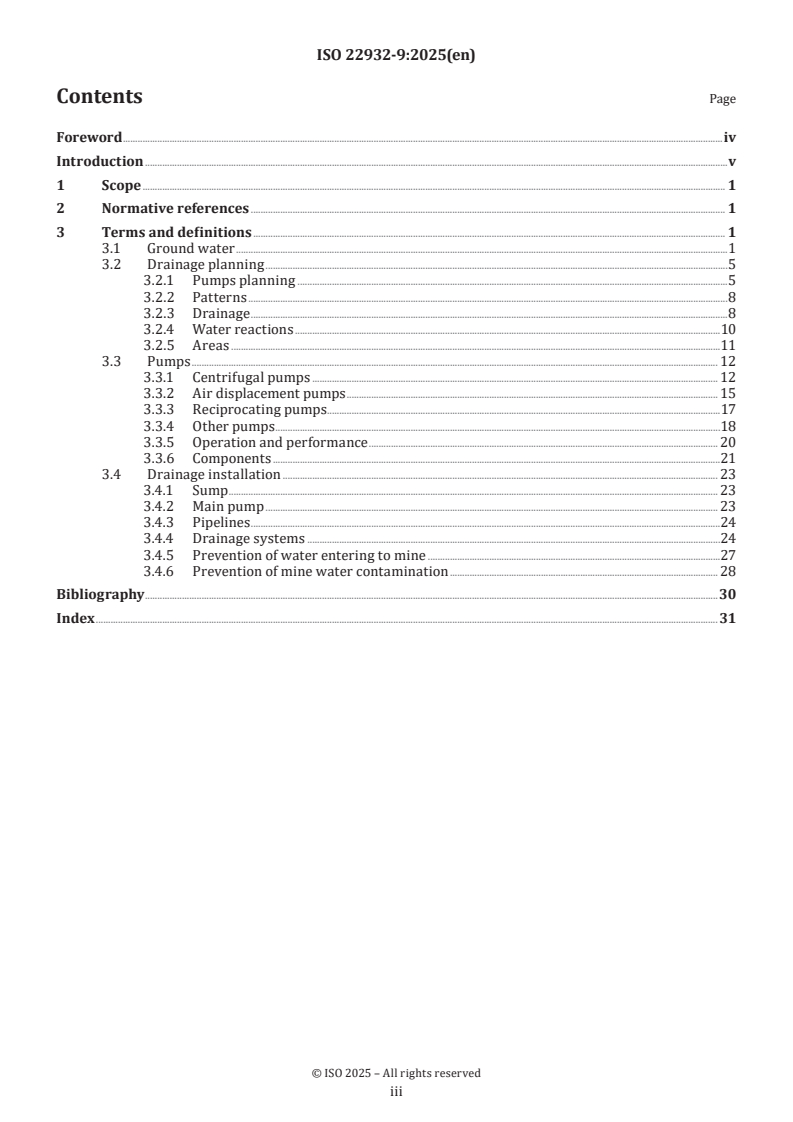
Contents Page
Foreword .iv
Introduction .v
1 Scope . 1
2 Normative references . 1
3 Terms and definitions . 1
3.1 Ground water .1
3.2 Drainage planning .5
3.2.1 Pumps planning .5
3.2.2 Patterns .8
3.2.3 Drainage .8
3.2.4 Water reactions .10
3.2.5 Areas .11
3.3 Pumps . 12
3.3.1 Centrifugal pumps . 12
3.3.2 Air displacement pumps . 15
3.3.3 Reciprocating pumps .17
3.3.4 Other pumps .18
3.3.5 Operation and performance . 20
3.3.6 Components .21
3.4 Drainage installation . 23
3.4.1 Sump . 23
3.4.2 Main pump . 23
3.4.3 Pipelines .24
3.4.4 Drainage systems .24
3.4.5 Prevention of water entering to mine .27
3.4.6 Prevention of mine water contamination . 28
Bibliography .30
Index .31
iii
Foreword
ISO (the International Organization for Standardization) is a worldwide federation of national standards
bodies (ISO member bodies). The work of preparing International Standards is normally carried out through
ISO technical committees. Each member body interested in a subject for which a technical committee
has been established has the right to be represented on that committee. International organizations,
governmental and non-governmental, in liaison with ISO, also take part in the work. ISO collaborates closely
with the International Electrotechnical Commission (IEC) on all matters of electrotechnical standardization.
The procedures used to develop this document and those intended for its further maintenance are described
in the ISO/IEC Directives, Part 1. In particular, the different approval criteria needed for the different types
of ISO document should be noted. This document was drafted in accordance with the editorial rules of the
ISO/IEC Directives, Part 2 (see www.iso.org/directives).
ISO draws attention to the possibility that the implementation of this document may involve the use of (a)
patent(s). ISO takes no position concerning the evidence, validity or applicability of any claimed patent
rights in respect thereof. As of the date of publication of this document, ISO had not received notice of (a)
patent(s) which may be required to implement this document. However, implementers are cautioned that
this may not represent the latest information, which may be obtained from the patent database available at
www.iso.org/patents. ISO shall not be held responsible for identifying any or all such patent rights.
Any trade name used in this document is information given for the convenience of users and does not
constitute an endorsement.
For an explanation of the voluntary nature of standards, the meaning of ISO specific terms and expressions
related to conformity assessment, as well as information about ISO's adherence to the World Trade
Organization (WTO) principles in the Technical Barriers to Trade (TBT), see www.iso.org/iso/foreword.html.
This document was prepared by Technical Committee ISO/TC 82, Mining.
A list of all parts in the ISO 22932 series can be found on the ISO website.
Any feedback or questions on this document should be directed to the user’s national standards body. A
complete listing of these bodies can be found at www.iso.org/members.html.
iv
Introduction
The ISO 22932 series has been prepared in order to standardize and to co-ordinate the global use of
technical terms and definitions in mining, for the benefit of the experts working on different types of mining
activities.
The need for the ISO 22932 series arose from the widely varying interpretation of terms used within the
industry and the prevalent use of more than one synonym.
v
International Standard ISO 22932-9:2025(en)
Mining — Vocabulary —
Part 9:
Drainage
1 Scope
This document specifies the commonly used terms in mine drainage.
2 Normative references
There are no normative references in this document.
3 Terms and definitions
For the purposes of this document, the following terms and definitions apply.
ISO and IEC maintain terminology databases for use in standardization at the following addresses:
— ISO Online browsing platform: available at https:// www .iso .org/ obp
— IEC Electropedia: available at https:// www .electropedia .org/
3.1 Ground water
3.1.1
aquifer
porous water bearing stratum
3.1.2
aquifer test
in situ procedure, such as single-well (bail test or slug test) and multiple-well pumping (3.3.5.9) tests, used to
determine hydraulic properties of an aquifer
Note 1 to entry: See Reference [1].
3.1.3
aquifuge
rock that contains no interconnected openings or interstices and therefore neither absorbs nor transmits water
Note 1 to entry: That can be as the opposite of aquifer.
Note 2 to entry: Compare with confining bed.
Note 3 to entry: See Reference [1].
3.1.4
attached ground water
that portion of the subsurface water adhering to the pore walls
Note 1 to entry: It is assumed to be equal in quantity to the pellicular water, and it is measured by specific retention.
Note 2 to entry: See Reference [1].
3.1.5
capillary
action by which the surface of a liquid is elevated at the point at which it is in contact with a solid
Note 1 to entry: Such as in a lamp wick.
Note 2 to entry: See Reference [1].
3.1.5.1
capillarity
capillary action
action by which a fluid, such as water, is drawn up (or depressed) in small interstices or tubes as a result of
surface tension
Note 1 to entry: See Reference [1].
3.1.5.2
zone of capillarity
subsurface zone that overlies the zone of saturation (3.1.20) in which capillary (3.1.5) voids hold water above
the zone of saturation (3.1.20) by molecular attraction acting against gravity
Note 1 to entry: Compare with zone of aeration.
Note 2 to entry: See Reference [1].
3.1.6
confining bed
aquiclude
impervious stratum above and/or below an aquifer
Note 1 to entry: Compare with aquifuge.
3.1.7
connate water
inherent water contemporary with the rocks containing it, as opposed to water subsequently permeating
the rocks
Note 1 to entry: Compare with interstitial water and formation water.
3.1.8
depressed water level
pumping water level
lowest level of ground water (3.1.10) during drainage (3.2.3.2) or pumping
3.1.9
formation water
native water
water present in a water-bearing formation under natural conditions, as opposed to introduced fluids, such
as drilling mud
Note 1 to entry: Compare with connate water.
Note 2 to entry: See Reference [1].
3.1.10
ground water
meteoric water
subterranean water
water penetrating from the surface and filling naturally the pores and fissures of the strata below the water table
3.1.11
ground water hydrology
aspect of hydrology (3.1.13) which is concerned with the physical and chemical characteristics of water and
similar liquids found in the ground
3.1.12
ground water province
area or region in which geology and climate combine to produce ground-water conditions consistent enough
to permit useful generalizations
Note 1 to entry: See Reference [1].
3.1.13
hydrology
study of the movement of water above, on and within the earth’s crust
3.1.14
interstitial water
pore water
subsurface water in the voids of a rock
Note 1 to entry: Compare with connate water.
Note 2 to entry: See Reference [1].
3.1.15
piestic level
level at which water in a confined aquifer (3.1.1) will rise under its full hydrostatic head
3.1.16
piezometric surface
potentiometric surface
imaginary surface that coincides with the hydrostatic pressure level of the water in a confined aquifer (3.1.1)
3.1.16.1
cone of depression
space enclosed between the water table, at which water would stand naturally in the ground, and the
position at which it in fact stands owing to drainage (3.2.3.2) or pumping at some point in the vicinity
Note 1 to entry: In the case of confined water under pressure, the cone of depression is the space between the
undisturbed piezometric surface and the piezometric surface after pumping.
3.1.16.2
piezometer
instrument for measuring pressure head
Note 1 to entry: Usually consisting of a small pipe tapped into the side of a closed or open conduit and flush with the
inside; connected with a pressure gage, mercury, water column, or other device for indicating head.
Note 2 to entry: See Reference [1].
3.1.17
secondary water
water entering the mine from other workings, as opposed to water inherent in the area worked by the mine
3.1.18
water table
free water elevation
free water surface
ground water level
ground water surface
ground water table
level of saturation
phreatic surface
plane of saturation
saturated surface
plane or surface below which fissures and pores in the strata are naturally saturated with water
3.1.18.1
perched water table
water table (3.1.18) of a body of perched ground water
Note 1 to entry: See Reference [1].
3.1.18.1.1
perched ground water
perched water
unconfined ground water (3.1.10) separated from an underlying main body of ground water (3.1.10) by an
unsaturated zone
Note 1 to entry: See Reference [1].
3.1.18.2
water table contour
line drawn on a map to represent an imaginary line in the water table (3.1.18) of a definite level.
Note 1 to entry: These contours are constructed from the data provided by the water-table levels, corrected for
differences in surface level at the respective boreholes. A site investigation or opencast plan sometimes show water-
table contours.
Note 2 to entry: See Reference [1].
3.1.18.3
water table level
level showing the depth of the water table (3.1.18) below the surface
Note 1 to entry: Also is the depth at which water is encountered in trial pits or boreholes.
Note 2 to entry: See Reference [1].
3.1.18.4
water table map
contour map of the upper surface of the saturated zone
Note 1 to entry: See Reference [1].
3.1.18.5
water table stream
concentrated ground water (3.1.10) flow at the water table (3.1.18) in a formation or structure of high
permeability
Note 1 to entry: See Reference [1].
3.1.19
zone of aeration
subsurface zone containing water under pressure less than that of the atmosphere, including water held by
capillarity, and containing air or gases generally under atmospheric pressure
Note 1 to entry: This zone is limited above by the land surface and below by the water table. It contains vadose water.
Note 2 to entry: Compare with zone of capillarity.
Note 3 to entry: See Reference [1].
3.1.19.1
vadose water
suspended water
water of the zone of aeration
Note 1 to entry: See Reference [1].
3.1.20
zone of saturation
phreatic zone
saturated zone
subsurface zone in which all the interstices are filled with water under pressure greater than that of the
atmosphere
Note 1 to entry: This zone is separated from the zone of aeration by the water table.
Note 2 to entry: See Reference [1].
3.2 Drainage planning
3.2.1 Pumps planning
3.2.1.1
booster pump
pump that operates in the discharge line of another pump, either to increase pressure or to restore pressure
lost by friction in the line or by lift
Note 1 to entry: See Reference [1].
3.2.1.2
booster station
in long-distance pumping (3.3.5.9) of liquids or mineral slurries, an intermediate pump station
Note 1 to entry: See Reference [1].
3.2.1.3
hogger pump
topmost pump in a shaft
Note 1 to entry: See Reference [1].
3.2.1.4
pump chamber
underground pumping (3.3.5.9) station
Note 1 to entry: See Reference [1].
3.2.1.5
pitwright
plugman
person who operates one or a battery of pumps to force excess water from a lower level to the surface or to
a drainage (3.2.3.2) tunnel
Note 1 to entry: See Reference [1].
3.2.1.6
pumping head
distance from the surface to the level of the water during pumping (3.3.5.9)
Note 1 to entry: It equals static head plus drop.
Note 1 to entry: See Reference [1].
3.2.1.7
pumping shaft
shaft containing the pumping (3.3.5.9) machinery of a mine
Note 1 to entry: See Reference [1].
3.2.1.8
pump lift
vertical distance that a pump can suck up water or the vertical distance a pump can force water to flow
Note 1 to entry: Theoretically, the vertical distance that a pump can suck up water should be about 10,4 m at sea level
but practically, the limit is about 7,9 m.
Note 2 to entry: See Reference [1].
3.2.1.9
pump load
back pressure and/or resistance to flow of fluids that a pump must overcome to force a fluid to flow through
a pipeline, drill string, etc.
Note 1 to entry: See Reference [1].
3.2.1.10
pump pressure
force per unit area or pressure against which a pump acts to force a fluid to flow through a pipeline, drill
string, etc.
Note 1 to entry: Also, it's the pressure imposed on the fluid ejected from a pump.
Note 2 to entry: See Reference [1].
3.2.1.11
pump slip
leakage past the valves and the plunger in a reciprocating pump (3.3.3.7), which should not be greater than
2 % or 3 % for a pump in good condition
Note 1 to entry: See Reference [1].
3.2.1.12
pump slope
slope in which pumps are operated
Note 1 to entry: See Reference [1].
3.2.1.13
pump station
chamber near the shaft at depth, where a pump is installed
Note 1 to entry: See Reference [1].
3.2.1.14
rest water level
level of water in a well or borehole when pumping (3.3.5.9) is not in progress
3.2.1.15
runback water
water from a set of pumps that is run back and pumped up again to keep the pump from going "on air" while
the other pumps are at work
Note 1 to entry: See Reference [1].
3.2.1.16
specific speed
factor by which the performance of any particular design of impeller for a centrifugal pump (3.3.1.1) or water
turbine can be computed
Note 1 to entry: It is the speed in revolutions per minute at which a geometrically similar impeller of suitable diameter
will rotate to deliver 3,785 l/min at 30,5 cm head in the case of a pump. In a water turbine, the specific speed is that at
which a geometrically similar runner of suitable diameter will turn to develop 746 W under a head of 30,5 cm.
Note 2 to entry: See Reference [1].
3.2.1.17
stage pumping
draining a mine by means of two or more pumps placed at different levels, each of which raises the water to
the next pump above or to the surface
Note 1 to entry: See Reference [1].
3.2.1.18
sucking pump
suction pump
Note 1 to entry: See Reference [1].
3.2.1.19
tie pumping
when track is not adequately drained and water enters the ballast and roadbed
Note 1 to entry: Under the action of the rolling stock, pressure on the tie discharges water to the surface, washing the
ballast from beneath and around the tie.
Note 2 to entry: See Reference [1].
3.2.1.20
vertical pump
this pump is often of the single-acting bucket or ram type with single or double cylinders and either with or
without a flywheel
Note 1 to entry: Vertical pumps may be used where headroom is adequate but area restricted, although horizontal
reciprocating pumps are more generally used.
Note 2 to entry: See Reference [1].
3.2.2 Patterns
3.2.2.1
annular-drainage pattern
drainage (3.2.3.2) pattern in which streams follow a roughly circular or concentric path along a belt of weak
rock, resembling in plan a ringlike pattern
Note 1 to entry: It is best displayed by streams draining a maturely dissected structural dome or basin where erosion
has exposed rimming sedimentary strata of greatly varying degrees of hardness,
Note 2 to entry: See Reference [1].
3.2.2.2
radial drainage pattern
drainage (3.2.3.2) pattern in which consequent streams radiate or diverge outward
Note 1 to entry: like the spokes of a wheel, from a high central area; it is best developed on the slopes of a young,
unbreached domal structure or of a volcanic cone.
Note 2 to entry: See Reference [1].
3.2.2.3
rectangular drainage pattern
drainage (3.2.3.2) pattern in which the main streams and their tributaries display many right-angle bends
and exhibit sections of approximate
Note 1 to entry: to entry The same length; it is indicative of streams following prominent fault or joint systems that
break the rocks into rectangular blocks.
Note 2 to entry: See Reference [1].
3.2.2.4
centripetal drainage
drainage (3.2.3.2) more or less radially inward toward a centre
Note 1 to entry: See Reference [1].
3.2.3 Drainage
3.2.3.1
dewatering
removal of water from a drowned shaft or a waterlogged workings by pumping (3.3.5.9) or drainage (3.2.3.2)
as a safety measurement or as a preliminary step to resumption of development in the area
Note 1 to entry: Compare with unwatering.
Note 2 to entry: See Reference [1].
3.2.3.2
drainage
manner of gravity flow of water or the process of channelization, for removal at a point remote from a mining
operation
Note 1 to entry: See Reference [1].
3.2.3.3
drainage basin
area from which water is carried off by a drainage (3.2.3.2) system
Note 1 to entry: See Reference [1].
3.2.3.4
drainage head
furthest or highest spot in a drainage (3.2.3.2) area
Note 1 to entry: See Reference [1].
3.2.3.5
drainage level
level at which, by natural or artificial drainage (3.2.3.2), water is removed from a mine or mineral deposit
Note 1 to entry: See Reference [1].
3.2.3.6
drainage trench
gutter
channel cut alongside a mine roadway to provide for drainage (3.2.3.2) and enable the proper ballasting of
the rail track
Note 1 to entry: The trench may be lined with precast concrete sections to a carefully laid gradient.
Note 2 to entry: See Reference [1].
3.2.3.7
free-drainage level
level that drains through an adit
Note 1 to entry: See Reference [1].
3.2.3.8
hydraulic discharge
direct discharge of ground water (3.1.10) from the zone of saturation, as via springs, wells, or infiltration
(3.2.4.7)ditches (3.4.4.8) or tunnels
Note 1 to entry: See Reference [1].
3.2.3.9
separate system
drainage (3.2.3.2) system in which sewerage and surface water are carried in separate sewers
Note 1 to entry: See also surface-water drain.
Note 2 to entry: See Reference [1].
3.2.3.10
tail of water
edge of water standing in mine workings
3.2.3.11
unwatering
pumping (3.3.5.9) or draining the water from mines
Note 1 to entry: Compare with dewatering.
Note 2 to entry: See Reference [1].
3.2.3.12
water hoist
simple method of disposing of mine water using tanks with an engine or a motor on the surface
Note 1 to entry: The machinery can be easily repaired and the plant is in no danger of being flooded. The high cost of
this system and the fact that the shaft cannot be used for other purposes while water is being hoisted are important
disadvantages. Water is delivered intermittently and at a decreasing rate as the depth of hoisting increases. This
method is less economical than pumping but is useful as an emergency measure in reclaiming a flooded mine.
Note 2 to entry: See Reference [1].
3.2.3.13
water holding capacity
smallest value to which the water content of a soil can be reduced by gravity drainage (3.2.3.2)
Note 1 to entry: See Reference [1].
3.2.4 Water reactions
3.2.4.1
bleeding
exudation of small amounts of water from coal or a stratum of some other rock
Note 1 to entry: See Reference [1].
3.2.4.2
ditch water
stale or stagnant water collected in a ditch (3.4.4.8)
Note 1 to entry: See Reference [1].
3.2.4.3
equipotential line
isopiestic line
line along which water will rise to the same elevation in piezometric tubes
Note 1 to entry: See Reference [1].
3.2.4.4
feeder
flow of water or gas entering a mine
3.2.4.5
field capacity
field-moisture capacity
normal moisture capacity
quantity of water held by soil or rock against the pull of gravity
Note 1 to entry: It is sometimes limited to a certain drainage period, thereby distinguishing it from specific retention,
which is not limited by time.
Note 2 to entry: See Reference [1].
3.2.4.6
hydrograph
graph showing stage, flow, velocity, or other characteristics of water with respect to time
Note 1 to entry: A stream hydrograph commonly shows rate of flow; a ground-water hydrograph, water level or head.
Note 2 to entry: See Reference [1].
3.2.4.7
infiltration
flow of a fluid into a solid substance through pores or small openings, specifically the movement of water
into soil or porous rock
Note 1 to entry: See Reference [1].
3.2.4.8
inrush
flush
sudden flow of material and water into underground workings
3.2.4.9
make of water
growth
rate of entry of water into a mine or part of a mine
3.2.4.10
nonuniform flow
flow the velocity of which is undergoing a positive or negative change
Note 1 to entry: If the flow is constant it is referred to as uniform flow.
Note 2 to entry: See Reference [1].
3.2.4.11
V notch
miner’s inch
water inch
device for measuring the flow of water in an open channel
3.2.4.12
water blast
expulsion of water under pressure, in mine workings, caused by trapped air expanding as the water level
is lowered
3.2.4.13
water seal
water accumulation in a depression in an underground roadway or in a pipe, sufficient to form a seal
3.2.5 Areas
3.2.5.1
cautionary zone
zone in which any unworked mineral lies within a specified distance from unconsolidated deposits or other
source of danger, particularly water
3.2.5.2
drowned level
inverted siphon
part of a drainage (3.2.3.2) drift which, being below both discharge and entry levels, is constantly full of water
3.2.5.3
specific retention
ratio of the volume of water that a given body of rock or soil will hold against the pull of gravity to the
volume of the body itself
Note 1 to entry: It is usually expressed as a percentage.
Note 2 to entry: CF: field capacity.
Note 3 to entry: See Reference [1].
3.2.5.4
weeping rock
porous rock from which water oozes
Note 1 to entry: See Reference [1].
3.3 Pumps
3.3.1 Centrifugal pumps
3.3.1.1
centrifugal pump
form of pump in which water is drawn through the eye of a rotating impeller and discharged from its
periphery into a chamber or series of passages of gradually increasing cross section
Note 1 to entry: The kinetic energy given to the water by its centrifugal discharge is thus largely converted to
pressure energy.
Note 2 to entry: See also turbine pump.
Note 3 to entry: Compare with duplex pump.
3.3.1.2
cavitation
formation and instantaneous collapse of innumerable tiny voids or cavities within a liquid subjected to rapid
and intense pressure changes
Note 1 to entry: See Reference [1].
3.3.1.3
deep well turbine
simple type of vertical centrifugal pump (3.3.1.1) having one or more stages or bowls, which are supported
from the motor head on the surface by means of screwed or flanged column (3.3.5.2) pipe sections, each
usually 3 m long
Note 1 to entry: See Reference [1].
3.3.1.4
diffuser
inner shell and water passages of a centrifugal pump (3.3.1.1)
Note 1 to entry: See Reference [1].
3.3.1.4.1
diffuser chamber
chamber in a turbine pump (3.3.1.14) consisting of a number of fixed blades
Note 1 to entry: On leaving the impeller, the water is guided outward by these blades with the minimum of eddying
and swirling.
Note 2 to entry: See also turbine pump.
Note 3 to entry: See Reference [1].
3.3.1.5
electric sponge
electric centrifugal pump (3.3.1.1) consisting of a small vertical centrifugal pump (3.3.1.1) so designed that it
will draw water if it is only 5,1 cm to 7,6 cm deep
Note 1 to entry: It is placed in the water at the bottom of a shaft and lifts the water up to a horizontal centrifugal pump
placed about 15,2 m above.
Note 2 to entry: See Reference [1].
3.3.1.6
gravel pump
centrifugal pump (3.3.1.1) with renewable impellers and lining, suitable for pumping (3.3.5.9) a mixture of
gravel and water
Note 1 to entry: Rubber is sometimes used as lining to the pump and pipes owing to its high resistance to abrasion.
Note 2 to entry: See also sand pump.
Note 3 to entry: See Reference [1].
3.3.1.7
jet pump
consists of a centrifugal pump (3.3.1.1) and motor at the ground surface and a jet down in the well below the
water level, discharging at high velocity through a contracted section into the lift pipe
Note 1 to entry: See Reference [1].
3.3.1.8
La Bour centrifugal pump
self-priming centrifugal pump (3.3.1.1) containing a trap, which always ensures sufficient water for the pump
to function, and also a separator to remove the entrained air in the water
Note 1 to entry: See Reference [1].
3.3.1.9
multi-stage pump
centrifugal pump (3.3.1.1) having two or more impellers
Note 1 to entry: They can absorb and pressure water in different levels and times, so that the water can be ascend to a
high position.
Note 2 to entry: Compare with single-stage pump.
3.3.1.10
sand pump
sandhog
pump, usually a centrifugal type, capable of handling sand- and gravel-laden liquids without clogging or
wearing unduly
Note 1 to entry: See also gravel pump.
Note 2 to entry: See also sludge pump.
Note 3 to entry: See also swab.
Note 4 to entry: See Reference [1].
3.3.1.10.1
Frenier sand pump
spiral ribbon of steel enclosed between two steel disks, mounted on a horizontal hollow shaft into which
pulp picked up peripherally is discharged during slow rotation
Note 1 to entry: See Reference [1].
3.3.1.10.2
sand pump dredger
suction dredger
long pipe reaching down from a vessel into the sand, the latter being raised under the suction of a centrifugal
pump (3.3.1.1) and discharged into the vessel itself or an attendant barge
Note 1 to entry: See Reference [1].
3.3.1.10.3
sand-pump sampler
sand sampler made and used in the same manner as an American pump or sand pump
Note 1 to entry: See Reference [1].
3.3.1.10.4
shell pump
simple form of sand pump (3.3.1.10) or sludger (3.3.1.13) consisting of a hollow cylinder with a ball or clack
valve (3.4.5.4) at the bottom, which is used with a flush (3.2.4.8) of water to remove detritus
Note 1 to entry: See also sand pump.
Note 2 to entry: See also sludger
Note 3 to entry: See Reference [1].
3.3.1.11
self priming centrifugal pump
pump of the centrifugal type that combines in a single hydraulic stage and with a single hydraulic impeller
and casing the dual ability to pump, under vacuum, either liquids or gases
Note 1 to entry: See Reference [1].
3.3.1.12
single-stage pump
centrifugal pump (3.3.1.1) having only one impeller
Note 1 to entry: Compare with multi-stage pump.
3.3.1.12.1
washery pump
pump generally of the single-stage type as heads are small, with a solid casing of steel or cast iron about
twice the normal thickness to provide against erosive action
Note 1 to entry: This pump is generally of simple construction and heavy design since slurry presents a difficult
pumping problem owing to its erosive action.
Note 2 to entry: See Reference [1].
3.3.1.13
sludger
centrifugal pump (3.3.1.1) designed for dealing with sand and slime
Note 1 to entry: See Reference [1].
3.3.1.14
turbine pump
multi stage centrifugal pump (3.3.1.1) fitted with stationary diffuser (3.3.1.4) vanes on the outlet side of the
impellers
Note 1 to entry: See also diffuser chamber.
3.3.1.14.1
peripheral turbine pump
regenerative pump
type of centrifugal pump (3.3.1.1) with different design to develop several times the head obtained from a
centrifugal pump (3.3.1.1) having the same-diameter impeller and the same speed
Note 1 to entry: The maximum head developed does not have the same relation to the impeller diameter and speed of
the centrifugal pump; it involves size and spacing of the impeller vanes, fluid channels, and other factors.
Note 2 to entry: See Reference [1].
3.3.1.15
vacuum pump
centrifugal or reciprocating pump (3.3.3.7) that extracts steam or air from a chamber or pipe to create a
partial vacuum
Note 1 to entry: A vacuum pump, hand or power-operated, is part of a pump station equipment where gravity flow is absent.
Note 2 to entry: See Reference [1].
3.3.1.16
volute pump
centrifugal pump (3.3.1.1) housed in a spiral casing
Note 1 to entry: The impellers may be open, closed or semi-enclosed, single suction, double suction, or nonclogging.
They discharge into casings that are progressively expanding spiral designs of one or more stages (multistage). The
casings housing the rotating elements may be vertically or horizontally split, and a few designs have casings divided
on an angle from the horizontal.
Note 2 to entry: See Reference [1].
3.3.1.17
water ring
type of centrifugal exhauster attached to pumps which might have to operate on snore (3.3.5.7)
3.3.1.18
well-point pump
centrifugal pump (3.3.1.1) that can handle considerable quantities of air that used for removing under ground
water (3.1.10) to dry up an excavation
Note 1 to entry: See Reference [1].
3.3.2 Air displacement pumps
3.3.2.1
air displacement pump
pump consisting of a closed vessel from which water is expelled through a delivery valve (3.3.6.1) and pipe by
means of compressed air admitted to the top of the vessel
3.3.2.2
bladder pump
positive displacement pump (3.3.2.6) in which compressed air is forced down an input column (3.3.5.2) to
squeeze a water-filled bladder, thereby forcing water up a discharge column (3.3.5.2) to the ground surface
Note 1 to entry: See Reference [1].
3.3.2.3
diaphragm pump
positive displacement pump (3.3.2.6) used for lifting small quantities of water and discharging them under
low heads
Note 1 to entry: It has a plunger arm operating either on an eccentric shaft or a rocker arm thrusting on a rubber
diaphragm stretched over a cylinder. As the diaphragm is depressed, the water and air in the cylinder are forced out
through the discharge side of the pump. As the diaphragm is lifted, a vacuum is created in the cylinder, and water is
forced in.
Note 2 to entry: See Reference [1].
3.3.2.4
duplex pump
positive displacement pump (3.3.2.6) with two water or liquid cylinders side by side and geared so that the
piston strokes in the cylinders alternate
Note 1 to entry: Such a pump may be either single or double action, depending on the number and placement of intake
and discharge valves on the cylinder and may be designed so as to deliver a low volume of liquid at high pressures.
Note 2 to entry: Compare with centrifugal pump and triplex pump.
Note 3 to entry: See Reference [1].
3.3.2.5
plunger pump
reciprocating pump (3.3.3.7) used for moving water or pulp, in which a solid piston displaces the fluid
Note 1 to entry: See Reference [1].
3.3.2.6
positive displacement pump
pump which discharges the same amount of water for a given power, regardless of the head against which it
operates
Note 1 to entry: See Reference [1].
3.3.2.7
pulsometer
displacement pump with valves for raising water by steam, partly by atmospheric pressure, and partly by
the direct action of the steam on the water, without intervention of a piston
Note 1 to entry: See Reference [1].
3.3.2.8
rotary pump
positive displacement pump (3.3.2.6) in which the liquid-propelling parts are cams, gears, impeller wheels,
etc., rotating within a case, as distinguished from those pumps that move liquids by means of the to-and-fro
motion of a piston within a cylinder
Note 1 to entry: Compare with centrifugal pump.
Note 2 to entry: See Reference [1].
3.3.2.9
spout delivery pump
pump, similar to a diaphragm pump, that is not capable of delivering water above its own height
Note 1 to entry: See also force pump.
Note 2 to entry: See Reference [1].
3.3.2.10
triplex pump
positive displacement piston pump having three water cylinders mounted side by side
Note 1 to entry: It may be either a single- or double-action type.
Note 2 to entry: Compare with duplex pump.
Note 3 to entry: See Reference [1].
3.3.3 Reciprocating pumps
3.3.3.1
air vessel
small air chamber fixed to the pipeline on the discharge side of a reciprocating pump (3.3.3.7) that acts as a
cushion to minimize the shock produced by the pulsations of the pump
Note 1 to entry: See Reference [1].
3.3.3.2
bucket pump
reciprocating lift pump formerly much used in shafts and sinkings
Note 1 to entry: See Reference [1].
3.3.3.3
double acting pump
pump that discharges at both forward and backward stroke
Note 1 to entry: See Reference [1].
3.3.3.4
double action pump
pump whose water cylinders are equipped with intake and discharge valves at each end; hence liquid is
delivered by the pump on both the forward and the backward strokes of the pump piston
Note 1 to entry: Compare with single -action pump.
Note 2 to entry: See Reference [1].
3.3.3.5
plunger pump
reciprocating pump (3.3.3.7) used for moving water or pulp, in which a solid piston displaces the fluid
Note 1 to entry: Compare with plunger pump.
Note 2 to entry: See Reference [1].
3.3.3.6
ram pump
single-acting reciprocating pump (3.3.3.7) that has a ram instead of a piston
Note 1 to entry: The ram has a constant diameter and does not fit closely in the cylinder, pumping only by displacement.
Note 2 to entry: See Reference [1].
3.3.3.6.1
three-throw ram pump
type of pump consists essentially of three single-acting ram pumps side by side, either vertical or horizontal,
and driven from a triple crankshaft with cranks set at angles of 120 degrees
Note 1 to entry: The three-throw pump can deal with heads up to 900 m in a single lift.
Note 2 to entry: See Reference [1].
3.3.3.7
reciprocating pump
pump depending for its action on the movement of a piston or plunger within a cylinder
3.3.3.8
simplex pump
reciprocating single- or double-action piston pump having one water cylinder
Note 1 to entry: See Reference [1].
3.3.3.9
single action pump
pump valved so as to discharge liquid at only one end of the water cylinder
Note 1 to entry: Compare with double-action pump.
Note 2 to entry: See Reference [1].
3.3.3.10
suction valve
inlet valve forming part of a reciprocating pump (3.3.3.7)
3.3.3.11
tilting disc valve
form of quick-closing reflux valve (3.3.6.11) used with high lift pumps in order to minimize water hammer
or closing
Note 1 to entry: Usually pivoted on a diameter.
3.3.4 Other pumps
3.3.4.1
air lift pump
means of raising water by admitting compressed air near the lower end of a submerged pipe column (3.3.5.2),
thus producing a mixture of air and water, in the pipe, of lower specific gravity than the standing water
outside the pipe
3.3.4.1.1
submergence
in an air lift, the distance below the water level, during pumping (3.3.5.9), at which the air picks up water
Note 1 to entry: See Reference [1].
3.3.4.2
axial flow pump
use of a propeller or impeller to accelerate the load along the axis of the impeller
Note 1 to entry: See Reference [1].
Note 2 to entry: Axial flow pumps are used in high flow and low head applications.
3.3.4.3
deep well pump
kind of pump delivering from a well, shaft or borehole
3.3.4.3.1
ball and test
deep well pump (3.3.4.3) valve in which a ball fits into a seat and prevents the backflow of oil or water
Note 1 to entry: Each standing valve and each traveling valve has a ball and seat.
Note 2 to entry: See Reference [1].
3.3.4.3.2
unlimited pump
deep well pump (3.3.4.3) operated from the level of the ground above
Note 1 to entry: See Reference [1].
3.3.4.4
force pump
pump consisting of a plunger or ram, the up-stroke of which causes the suction valve (3.3.3.10) to open and
the water to rise in the suction pipe
Note 1 to entry: On the down-stroke of the plunger, the suction valve closes and the contained water is forced through
the delivery valve into the rising main or discharge pipe.
Note 2 to entry: See Reference [1].
3.3.4.5
gathering pumps
portable or semiportable pumps that are required when water is encountered while opening a new mine,
for extending headings or entries in an operating mine, for pumprooms or rib sections lying in the dip, for
collecting water from local pools, or for sinking a shaft
Note 1 to entry: They discharge water at an intermediate pumping station or into a drainage ditch or tunnel carrying
water outside a mine.
Note 2 to entry: See Reference [1].
3.3.4.6
heater drain pump
self-regulating pump capable of dealing with water at fairly high temperatures and pressures
Note 1 to entry: It is used to return heater condensate to the feed line instead of to waste.
Note 2 to entry: See Reference [1].
3.3.4.7
hollow plunger pump
pump used for mining and quarrying, as in muddy and gritty water
Note 1 to entry: See Reference [1].
3.3.4.8
mono pump
progressing cavity pump
pump consisting essentially of a rubber stator (3.3.4.8.1) in the form of a double internal helix and a single
helical rotor (3.3.4.8.2) which rolls in the stator (3.3.4.8.1) with a slightly eccentric motion
Note 1 to entry: The rotor maintains a constant seal across the stator and this seal travels continuously through the
pump, giving a positive uniform displacement.
Note 2 to entry: The mono pump is manufactured to meet mining conditions. The rotor is made of special abrasion-
resisting
...