


ISO 2553:2013
(Main)Welding and allied processes — Symbolic representation on drawings — Welded joints
Welding and allied processes — Symbolic representation on drawings — Welded joints
ISO 2553:2013 defines the rules to be applied for symbolic representation of welded joints on technical drawings. This may include information about the geometry, manufacture, quality and testing of the welds. The principles of this standard may also be applied to soldered and brazed joints. It is recognized that there are two different approaches in the global market to designate the arrow side and other side on drawings. In ISO 2553:2013: sections, tables and figures which carry the suffix letter "A" are applicable only to the symbolic representation system based on a dual reference line; sections, tables and figures which carry the suffix letter "B" are applicable only to the symbolic representation system based on a single reference line; sections, tables and figures which do not have the suffix letter "A" or "B" are applicable to both systems. The symbols shown may be combined with other symbols used on technical drawings, for example to show surface finish requirements. An alternative designation method is presented which may be used to represent welded joints on drawings by specifying essential design information such as weld dimensions, quality level, etc. The joint preparation and welding process(es) are then determined by the production unit in order to meet the specified requirements.
Soudage et techniques connexes — Représentations symboliques sur les dessins — Joints soudés
L'ISO 2553:2013 définit les règles à suivre pour représenter symboliquement les joints soudés sur les dessins techniques. Cela peut inclure des informations sur la géométrie, la fabrication, la qualité et les essais des soudures. Les principes de la présente Norme internationale peuvent également être appliqués aux joints soudés et brasés. L'ISO 2553:2013 reconnaît qu'il existe deux méthodes différentes sur le marché mondial pour désigner le côté ligne repère et le côté opposé à la ligne repère sur les dessins. Il convient de noter que les articles, tableaux et figures qui portent le suffixe «A» sont applicables uniquement au système de représentation symbolique fondé sur un double trait de référence; les articles, tableaux et figures qui portent le suffixe «B» sont applicables uniquement au système de représentation symbolique fondé sur un trait de référence simple; les articles, tableaux et figures qui ne portent ni le suffixe «A» ni le suffixe «B» sont applicables aux deux systèmes. Les symboles donnés dans la présente Norme internationale peuvent être combinés à d'autres symboles utilisés sur les dessins techniques, par exemple pour indiquer les exigences de finition de surface. Une autre méthode de désignation est donnée. Elle peut être utilisée pour représenter des joints soudés sur les dessins en spécifiant les informations essentielles de conception, tels que les dimensions de la soudure, le niveau de qualité, etc. La préparation du joint et le(s) procédé(s) de soudage sont ensuite déterminés par l'unité de production afin de satisfaire aux exigences spécifiées.
General Information
- Status
- Withdrawn
- Publication Date
- 12-Dec-2013
- Withdrawal Date
- 12-Dec-2013
- Technical Committee
- ISO/TC 44/SC 7 - Representation and terms
- Drafting Committee
- ISO/TC 44/SC 7/WG 1 - Representation on drawings
- Current Stage
- 9599 - Withdrawal of International Standard
- Start Date
- 18-Mar-2019
- Completion Date
- 12-Feb-2026
Relations
- Effective Date
- 09-Feb-2026
- Referred By
EN 16602-70-39:2018 - Space product assurance - Welding of metallic materials for flight hardware - Effective Date
- 09-Feb-2026
- Referred By
EN ISO 16089:2015 - Machine tools - Safety - Stationary grinding machines (ISO 16089:2015) - Effective Date
- 09-Feb-2026
- Effective Date
- 09-Feb-2026
- Effective Date
- 12-Feb-2026
- Effective Date
- 06-Jun-2022
- Revised
ISO 2553:2019 - Welding and allied processes — Symbolic representation on drawings — Welded joints - Effective Date
- 10-Dec-2016
- Effective Date
- 18-Oct-2008
ISO 2553:2013 - Welding and allied processes -- Symbolic representation on drawings -- Welded joints
ISO 2553:2013 - Soudage et techniques connexes -- Représentations symboliques sur les dessins -- Joints soudés
Get Certified
Connect with accredited certification bodies for this standard

National Aerospace and Defense Contractors Accreditation Program (NADCAP)
Global cooperative program for special process quality in aerospace.
CARES (UK Certification Authority for Reinforcing Steels)
UK certification for reinforcing steels and construction.
DVS-ZERT GmbH
German welding certification society.
Sponsored listings
Frequently Asked Questions
ISO 2553:2013 is a standard published by the International Organization for Standardization (ISO). Its full title is "Welding and allied processes — Symbolic representation on drawings — Welded joints". This standard covers: ISO 2553:2013 defines the rules to be applied for symbolic representation of welded joints on technical drawings. This may include information about the geometry, manufacture, quality and testing of the welds. The principles of this standard may also be applied to soldered and brazed joints. It is recognized that there are two different approaches in the global market to designate the arrow side and other side on drawings. In ISO 2553:2013: sections, tables and figures which carry the suffix letter "A" are applicable only to the symbolic representation system based on a dual reference line; sections, tables and figures which carry the suffix letter "B" are applicable only to the symbolic representation system based on a single reference line; sections, tables and figures which do not have the suffix letter "A" or "B" are applicable to both systems. The symbols shown may be combined with other symbols used on technical drawings, for example to show surface finish requirements. An alternative designation method is presented which may be used to represent welded joints on drawings by specifying essential design information such as weld dimensions, quality level, etc. The joint preparation and welding process(es) are then determined by the production unit in order to meet the specified requirements.
ISO 2553:2013 defines the rules to be applied for symbolic representation of welded joints on technical drawings. This may include information about the geometry, manufacture, quality and testing of the welds. The principles of this standard may also be applied to soldered and brazed joints. It is recognized that there are two different approaches in the global market to designate the arrow side and other side on drawings. In ISO 2553:2013: sections, tables and figures which carry the suffix letter "A" are applicable only to the symbolic representation system based on a dual reference line; sections, tables and figures which carry the suffix letter "B" are applicable only to the symbolic representation system based on a single reference line; sections, tables and figures which do not have the suffix letter "A" or "B" are applicable to both systems. The symbols shown may be combined with other symbols used on technical drawings, for example to show surface finish requirements. An alternative designation method is presented which may be used to represent welded joints on drawings by specifying essential design information such as weld dimensions, quality level, etc. The joint preparation and welding process(es) are then determined by the production unit in order to meet the specified requirements.
ISO 2553:2013 is classified under the following ICS (International Classification for Standards) categories: 01.100.20 - Mechanical engineering drawings; 25.160.40 - Welded joints and welds. The ICS classification helps identify the subject area and facilitates finding related standards.
ISO 2553:2013 has the following relationships with other standards: It is inter standard links to EN 303-1:2017, EN 16602-70-39:2018, EN ISO 16089:2015, EN ISO 9692-3:2016, EN ISO 2553:2013, ISO 20508:2003, ISO 2553:2019, ISO 2553:1992. Understanding these relationships helps ensure you are using the most current and applicable version of the standard.
ISO 2553:2013 is available in PDF format for immediate download after purchase. The document can be added to your cart and obtained through the secure checkout process. Digital delivery ensures instant access to the complete standard document.
Standards Content (Sample)
INTERNATIONAL ISO
STANDARD 2553
Fourth edition
2013-12-15
Welding and allied processes —
Symbolic representation on drawings
— Welded joints
Soudage et techniques connexes — Représentations symboliques sur
les dessins — Joints soudés
Reference number
©
ISO 2013
© ISO 2013
All rights reserved. Unless otherwise specified, no part of this publication may be reproduced or utilized otherwise in any form
or by any means, electronic or mechanical, including photocopying, or posting on the internet or an intranet, without prior
written permission. Permission can be requested from either ISO at the address below or ISO’s member body in the country of
the requester.
ISO copyright office
Case postale 56 • CH-1211 Geneva 20
Tel. + 41 22 749 01 11
Fax + 41 22 749 09 47
E-mail copyright@iso.org
Web www.iso.org
Published in Switzerland
ii © ISO 2013 – All rights reserved
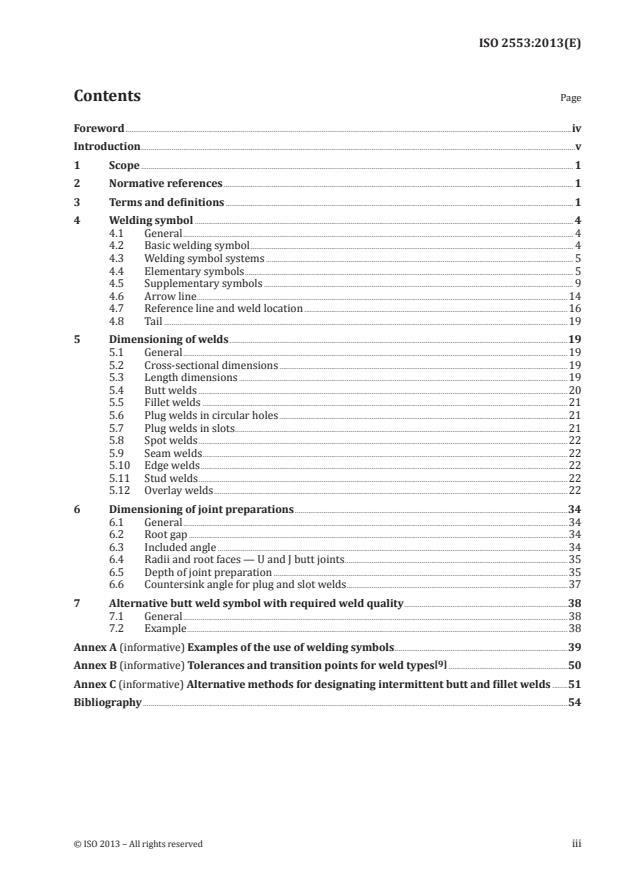
Contents Page
Foreword .iv
Introduction .v
1 Scope . 1
2 Normative references . 1
3 Terms and definitions . 1
4 Welding symbol . 4
4.1 General . 4
4.2 Basic welding symbol . 4
4.3 Welding symbol systems . 5
4.4 Elementary symbols . 5
4.5 Supplementary symbols . 9
4.6 Arrow line .14
4.7 Reference line and weld location .16
4.8 Tail .19
5 Dimensioning of welds .19
5.1 General .19
5.2 Cross-sectional dimensions .19
5.3 Length dimensions .19
5.4 Butt welds .20
5.5 Fillet welds .21
5.6 Plug welds in circular holes .21
5.7 Plug welds in slots .21
5.8 Spot welds .22
5.9 Seam welds .22
5.10 Edge welds .22
5.11 Stud welds .22
5.12 Overlay welds .22
6 Dimensioning of joint preparations .34
6.1 General .34
6.2 Root gap .34
6.3 Included angle .34
6.4 Radii and root faces — U and J butt joints .35
6.5 Depth of joint preparation .35
6.6 Countersink angle for plug and slot welds .37
7 Alternative butt weld symbol with required weld quality .38
7.1 General .38
7.2 Example .38
Annex A (informative) Examples of the use of welding symbols .39
[9]
Annex B (informative) Tolerances and transition points for weld types .50
Annex C (informative) Alternative methods for designating intermittent butt and fillet welds .51
Bibliography .54
Foreword
ISO (the International Organization for Standardization) is a worldwide federation of national standards
bodies (ISO member bodies). The work of preparing International Standards is normally carried out
through ISO technical committees. Each member body interested in a subject for which a technical
committee has been established has the right to be represented on that committee. International
organizations, governmental and non-governmental, in liaison with ISO, also take part in the work.
ISO collaborates closely with the International Electrotechnical Commission (IEC) on all matters of
electrotechnical standardization.
The procedures used to develop this document and those intended for its further maintenance are
described in the ISO/IEC Directives, Part 1. In particular the different approval criteria needed for the
different types of ISO documents should be noted. This document was drafted in accordance with the
editorial rules of the ISO/IEC Directives, Part 2. www.iso.org/directives
Attention is drawn to the possibility that some of the elements of this document may be the subject of
patent rights. ISO shall not be held responsible for identifying any or all such patent rights. Details of any
patent rights identified during the development of the document will be in the Introduction and/or on
the ISO list of patent declarations received. www.iso.org/patents
Any trade name used in this document is information given for the convenience of users and does not
constitute an endorsement.
For an explanation on the meaning of ISO specific terms and expressions related to conformity
assessment, as well as information about ISO’s adherence to the WTO principles in the Technical
Barriers to Trade (TBT) see the following URL: Foreword - Supplementary information
The committee responsible for this document is ISO/TC Welding and allied processes, Subcommittee SC 7,
Representation and terms.
This fourth edition cancels and replaces the third edition (ISO 2553:1992), which has been technically
revised.
Requests for official interpretations of any aspect of this standard should be directed to the Secretariat of
ISO/TC 44/SC 7 via your national standards body, a complete listing of which can be found at ww.iso.org.
iv © ISO 2013 – All rights reserved
Introduction
The symbols given in this standard can be used on technical drawings for welded components. Design-
related specifications, such as type, thickness, and length of weld, weld quality, surface treatment, filler
material and testing specifications, can be indicated directly at the weld by means of the symbols given
in this standard. The principals of this standard can be applied to brazed and soldered joints.
Clarity may be improved by references to collective information in the drawings or references to
additional design-related documents.
Preparation for production may require detailed welding-related planning. The type of representation
described in this standard can be used for this purpose and complemented by additional production-
related information (e.g. welding position, welding process, WPS, weld preparation, preheating …).
This information is often given in production-related documents, such as work schedules or welding
procedure specifications (WPS).
Technical drawings are intended to clearly and understandably illustrate design-related specifications.
Welding-related drawings should be prepared and checked by specially trained personnel (see ISO 14731).
This edition of ISO 2553 recognizes that there are two different approaches in the global market to
designate the arrow side and other side on drawings, and allows for either to be used in isolation, to suit
a particular market need. Application of either approach identifies a welding symbol in accordance with
this International Standard. The approach in accordance with system A is based on ISO 2553:1992. The
approach in accordance with system B is based upon standards used by Pacific Rim countries.
INTERNATIONAL STANDARD ISO 2553:2013(E)
Welding and allied processes — Symbolic representation
on drawings — Welded joints
1 Scope
This International Standard defines the rules to be applied for symbolic representation of welded joints
on technical drawings. This may include information about the geometry, manufacture, quality and
testing of the welds. The principles of this standard may also be applied to soldered and brazed joints.
It is recognized that there are two different approaches in the global market to designate the arrow side
and other side on drawings. In this Interational Standard:
— clauses, tables and figures which carry the suffix letter “A” are applicable only to the symbolic
representation system based on a dual reference line;
— clauses, tables and figures which carry the suffix letter “B” are applicable only to the symbolic
representation system based on a single reference line;
— clauses, tables and figures which do not have the suffix letter “A” or “B” are applicable to both systems.
The symbols shown in this International Standard may be combined with other symbols used on
technical drawings, for example to show surface finish requirements.
An alternative designation method is presented which may be used to represent welded joints on
drawings by specifying essential design information such as weld dimensions, quality level, etc. The
joint preparation and welding process(es) are then determined by the production unit in order to meet
the specified requirements.
NOTE Examples given in this International Standard, including dimensions, are illustrative only and are
intended to demonstrate the proper application of principles. They are not intended to represent good design
practices, or to replace code or specification requirements.
2 Normative references
The following documents, in whole or in part, are normatively referenced in this document and are
indispensable for its application. For dated references, only the edition cited applies. For undated
references, the latest edition of the referenced document (including any amendments) applies.
ISO 128 (all parts), Technical drawings — General principles of presentation
ISO 129-1, Technical drawings — Indication of dimensions and tolerances — Part 1: General principles
ISO 1302, Geometrical Product Specifications (GPS) — Indication of surface texture in technical product
documentation
ISO 3098-2, Technical product documentation — Lettering — Part 2: Latin alphabet, numerals and marks
ISO 4063, Welding and allied processes — Nomenclature of processes and reference numbers
ISO/TR 25901:2007, Welding and related processes — Vocabulary
3 Terms and definitions
For the purposes of this document, the terms and definitions given in ISO/TR 25901 and the following apply.
3.1
welding symbol
symbol consisting of an arrow line and a reference line and which may also include elementary and
supplementary symbols, dimensions and/or tail, used on technical drawings to indicate welded joint
type, location and joint preparation
Note 1 to entry: See Clause 4.
3.2
basic welding symbol
symbol consisting of an arrow line, reference line and tail used when the joint is not specified and only
to indicate that a welded joint is to be made
Note 1 to entry: See 4.2.
3.3
arrow line
leader line used to indicate the joint that is to be welded generally drawn at 135° to the reference line
Note 1 to entry: See 4.6.
3.4
reference line
part of the welding symbol on which the elementary symbol is located, generally drawn parallel to the
bottom edge of the drawing
Note 1 to entry: See 4.7.
3.5
tail
V shaped element added to the end of the continuous reference line away from the arrow line
Note 1 to entry: See 4.8.
3.6
arrow side
side of the joint to which the arrow line is pointing
Note 1 to entry: See 4.7.2.1.
3.7
other side
opposite side of the joint to the arrow side
Note 1 to entry: See 4.7.2.1.
3.8
elementary symbol
symbol forming part of the welding symbol and drawn on the reference line to indicate the type of weld
and joint preparation
Note 1 to entry: See 4.4.
3.9
supplementary symbol
symbol used in conjunction with elementary symbols to convey additional information about the joint
Note 1 to entry: See 4.5.
2 © ISO 2013 – All rights reserved
3.10
complementary information
non-symbolic information, relevant to the welds being made, which may be included in the tail of the
welding symbol
Note 1 to entry: See 4.8.
3.11
intermittent weld
series of weld elements made at intervals along a joint
[SOURCE: ISO/TR 25901:2007]
Note 1 to entry: See 5.3.2.
3.11.1
chain intermittent weld
intermittent weld on each side of a joint (usually fillet welds in T and lap joints) arranged so that the
welds lie opposite one another along the joint
Note 1 to entry: See 5.3.2.2.
3.11.2
staggered intermittent weld
intermittent weld on each side of a joint (usually fillet welds in T and lap joints) arranged so that the
welds on one side lie opposite to the spaces on the other side along the joint
Note 1 to entry: See 5.3.2.3.
3.12
offset
distance between the start of welding on one side of a staggered intermittent weld made on both sides
of the joint and the start of welding on the other side
Note 1 to entry: See 5.3.2.3, Table 3 and Table 5, No 2.6.
3.13
back run
final run deposited on the root side of a fusion weld
3.14
backing weld
backing in the form of a weld
3.15
nominal weld length
design length of a weld
3.15.1
nominal length of weld elements
in intermittent welds, the design length of the elements of the weld
3.16
nominal throat thickness
a
design value of the height of the largest isosceles triangle that can be inscribed in the section of a fillet weld
Note 1 to entry: Other design throat thicknesses may be used, but need to be specified.
3.17
leg length
z
distance from the actual or projected intersection of the fusion faces and the toe of a fillet weld, measured
across the fusion face
3.18
penetration depth
thickness of the weld metal excluding any reinforcement
3.19
deep penetration throat thickness
s
nominal or effective throat thickness to which a certain amount of fusion penetration is added
3.20
flare-bevel weld
butt weld between a joint member with a curved surface and another with a planar surface
Note 1 to entry: See Table 5.
3.21
flare-V weld
butt weld between two members with curved surfaces
Note 1 to entry: See Table 5.
3.22
field weld
weld made outside workshops usually at the place of final installation
4 Welding symbol
4.1 General
A reference line and arrow line are required elements. Additional elements may be included to convey
specific information.
It is preferable that the welding symbol is shown on the same side of the joint that the weld is to be made,
i.e. the arrow side (see 4.6).
The thickness of the arrow lines, reference line, elementary symbols and lettering shall be in accordance
with ISO 128 and ISO 3098-2.
In order not to overburden drawings, reference should be made to notes in the drawing or other design-
related documents.
4.2 Basic welding symbol
If joint details are not specified and the only requirement is to indicate that a joint is to be welded, the
basic symbol shown in Figure 1 may be used. In this case, a dual reference line is not required for system
A (see 4.6.1A) as no details concerning the weld are being conveyed.
The basic welding symbol shall comprise an arrow line, reference line and a tail.
4 © ISO 2013 – All rights reserved
Key
1 arrow line
2 reference line
3 tail
NOTE This symbol is often used to indicate the location of tack welds.
Figure 1 — Basic welding symbol (joint details and type not specified)
4.3 Welding symbol systems
This International standard recognizes two different systems, A and B, to designate the arrow side and
other side on drawings.
The symbolic representation in system A is based on a dual reference line consisting of a continuous line
and a dashed line (see 4.7).
The symbolic representation in system B is based on a single reference line (see 4.7).
Clauses, Tables and Figures which carry the suffix “A” or “B” are applicable only to system A or system
B respectively.
Clauses, tables and figures which do not have a suffix are applicable to both systems.
System A and B shall not be mixed and drawings shall clearly indicate which system is used including
units of measurement in accordance with ISO 129-1.
Examples of comprehensive welding symbols showing the location of elements are given in Figure A.1.
4.4 Elementary symbols
4.4.1 General
Elementary symbols, in accordance with Table 1, can be added to the reference line in both systems A
and B to indicate the type of weld to be made.
Elementary symbols form part of the welding symbol and shall be drawn attached to the reference line
generally at the mid-point.
Elementary symbols may be complemented by:
— supplementary symbols (see 4.5 and Table 3);
— dimensions (see Clause 5);
— complementary information.
The orientation of the elementary symbols shall not be changed to that shown.
Annex B gives guidance on tolerances and transition points for butt welds, edge welds and fillet welds.
If clear illustration by means of symbols is not possible, cross sections of the welds may be drawn
and dimensioned.
Table 1 — Elementary symbols
a
No. Designation Illustration Symbol
(dashed lines show joint preparation prior to welding)
b
1 Square butt
b
2 Single-V butt
Single-V butt with
b
broad root face
b
4 Single-bevel butt
Single-bevel butt
5 with broad root
b
face
b
6 Single-U butt
b
7 Single-J butt
8 Flare V
9 Flare bevel
a
The grey line is not part of the symbol. It indicates the position of the reference line.
b
Butt welds are full penetration unless otherwise indicated by dimensions on the welding symbol or by reference to
other information, for example the WPS.
c
May be used for joints with more than 2 members.
6 © ISO 2013 – All rights reserved
Table 1 (continued)
a
No. Designation Illustration Symbol
(dashed lines show joint preparation prior to welding)
10 Fillet
Plug (in slots or
circular holes)
Resistance spot
(including projec-
tion welding in
system A)
Fusion spot (and
13 projection welding
in system B)
14 Resistance seam
15 Fusion seam
16 Stud
Steep-flanked
b
single-V butt
Steep-flanked
b
single-bevel butt
a
The grey line is not part of the symbol. It indicates the position of the reference line.
b
Butt welds are full penetration unless otherwise indicated by dimensions on the welding symbol or by reference to
other information, for example the WPS.
c
May be used for joints with more than 2 members.
Table 1 (continued)
a
No. Designation Illustration Symbol
(dashed lines show joint preparation prior to welding)
c
19 Edge
Flanged butt/cor-
ner weld
21 Overlay
c
22 Stake
a
The grey line is not part of the symbol. It indicates the position of the reference line.
b
Butt welds are full penetration unless otherwise indicated by dimensions on the welding symbol or by reference to
other information, for example the WPS.
c
May be used for joints with more than 2 members.
4.4.2 Combinations of elementary symbols
Elementary symbols may be combined as required to represent particular weld configurations.
4.4.3 Double-sided butt welds
The elementary symbols shall be arranged opposite each other on the reference line, including all
required information, when used to represent symmetrical welds.
In the case of symmetrical double-sided welds with identical symbols and dimensions, the dashed
reference line should be deleted for system A (see Table 2).
An example of an asymmetrical double-sided weld is shown in Table A.3.
8 © ISO 2013 – All rights reserved
Table 2 — Combined elementary symbols to represent double-sided welds
a b
No. Weld type Illustration of weld Symbol
1 Double-V butt
2 Double bevel butt
3 Double-U butt
Double bevel butt (with
4 broad root face) and
fillet welds
a
Welds may be partial or full penetration which is to be indicated by dimensions on the welding symbol (see Table 5) or
by reference to other information, for example the WPS.
b
The grey line is not part of the symbol. It indicates the position of the reference line.
4.5 Supplementary symbols
4.5.1 General
Additional information concerning the required joint may be provided by the use of supplementary
symbols in accordance with Table 3. Supplementary symbols can, for example, provide information
about the shape of the weld or how the welded joint shall be made.
Table 3 — Supplementary symbols
a a
No. Designation Symbol Application example Illustration of weld
Flat-finished
b
flush
b
2 Convex
b
3 Concave
Toes blended
4 No example
c
smoothly
d
a) Back run
(made after the
single-V butt
weld)
d
b) Backing weld
(made before
the single-V butt
weld)
Specified root
6 reinforcement
e
(butt welds)
Backing (unspeci-
7a
fied)
Permanent back-
7b
f
ing
Removable/tem-
7c
f
porary backing
8 Spacer
a
The grey line is not part of the symbol and is included to show the position of symbol on reference line and/or the arrow
line only.
b
Welds that require approximately flush or convex faces without post weld finishing are specified by use of the flush or
convex contour symbol.
Welds to be finished flush or convex by post weld finishing or that require a flat but not flush surface require additional
information, e.g. addition of a note in the tail of the welding symbol
Other symbols in accordance with ISO 1302 may be used to specify surface finish.
c
The toes shall be blended smoothly by welding or finishing. Processing details may be specified in the work instructions
or WPS.
d
The weld run sequence may be indicated on the drawing e.g. by use of multiple reference lines, a note in the tail or by
reference to a weld procedure specification.
e
In system B, also used to designate flanged butt/corner welds (see 4.5.5.6)
f
M = material to be part of the final welded joint, MR = material to be removed after welding. Further information on the
material can be included in the tail or elsewhere.
g
Explanations of a, z, n, l and (e) are given in Clause 5.
10 © ISO 2013 – All rights reserved
Table 3 (continued)
a a
No. Designation Symbol Application example Illustration of weld
a) Joint showing insert in place
Consumable
insert
b) Welded joint showing root
bead (insert incorporated into
root). Single V but weld not
shown
Example A
10 Weld all-around
Example B
Example C
a
The grey line is not part of the symbol and is included to show the position of symbol on reference line and/or the arrow
line only.
b
Welds that require approximately flush or convex faces without post weld finishing are specified by use of the flush or
convex contour symbol.
Welds to be finished flush or convex by post weld finishing or that require a flat but not flush surface require additional
information, e.g. addition of a note in the tail of the welding symbol
Other symbols in accordance with ISO 1302 may be used to specify surface finish.
c
The toes shall be blended smoothly by welding or finishing. Processing details may be specified in the work instructions
or WPS.
d
The weld run sequence may be indicated on the drawing e.g. by use of multiple reference lines, a note in the tail or by
reference to a weld procedure specification.
e
In system B, also used to designate flanged butt/corner welds (see 4.5.5.6)
f
M = material to be part of the final welded joint, MR = material to be removed after welding. Further information on the
material can be included in the tail or elsewhere.
g
Explanations of a, z, n, l and (e) are given in Clause 5.
Table 3 (continued)
a a
No. Designation Symbol Application example Illustration of weld
Weld between
two points
12 Field weld No example
Staggered inter-
Or
g
mittent welds
a
The grey line is not part of the symbol and is included to show the position of symbol on reference line and/or the arrow
line only.
b
Welds that require approximately flush or convex faces without post weld finishing are specified by use of the flush or
convex contour symbol.
Welds to be finished flush or convex by post weld finishing or that require a flat but not flush surface require additional
information, e.g. addition of a note in the tail of the welding symbol
Other symbols in accordance with ISO 1302 may be used to specify surface finish.
c
The toes shall be blended smoothly by welding or finishing. Processing details may be specified in the work instructions
or WPS.
d
The weld run sequence may be indicated on the drawing e.g. by use of multiple reference lines, a note in the tail or by
reference to a weld procedure specification.
e
In system B, also used to designate flanged butt/corner welds (see 4.5.5.6)
f
M = material to be part of the final welded joint, MR = material to be removed after welding. Further information on the
material can be included in the tail or elsewhere.
g
Explanations of a, z, n, l and (e) are given in Clause 5.
4.5.2 Weld all-around symbol
The weld all-around symbol, added at the junction of the arrow and reference lines, may be used to designate
a continuous weld, single or double-sided, extending around a series of connected joints (see Table 3).
The series of joints may involve different directions and may lie in more than one plane but the weld
shall always be of the same type and dimensions.
The weld all-around symbol shall not be used if:
a) the weld does not start and end at the same point, i.e. it is not continuous;
b) the weld type changes, for example from a fillet weld to a butt weld;
c) the dimensions change, for example the nominal throat thickness of a fillet weld. In this case, each
weld shall be identified using a separate welding symbol;
NOTE The weld all-around symbol is not used to indicate that welds are to be made everywhere.
12 © ISO 2013 – All rights reserved
Welds extending around the circumference of a circular section/hole or slot do not require the use of the
weld all-around symbol to specify a continuous weld.
4.5.3 Welds of the same type made from point to point
The weld between two points symbol may be used to designate a continuous weld, of the same type,
extending between two points. In this case, the weld does not start and stop at the same point, and
the weld all around symbol shall not be used (see Table 3). The end points of the weld shall be clearly
indicated and the welding symbol shall clearly indicate the joint to be welded.
Figure 2 gives an example of how a continuous weld extending around a series of connected points but
where the weld does not start and end at the same point, can be designated by one welding symbol.
Key
1 welding symbol
2 visual response (welded in accordance with the welding symbol)
A, B weld end positions
There is no weld from point B to point A (fillet weld not possible).
Any identifier may be used to identify the points between welds e.g. A, B and X, Y etc.
Figure 2 — Example of a welding symbol for a fillet weld made between two points A and B
4.5.4 Field welds
Field welds shall be specified by adding the field weld symbol at the junction of the arrow and reference
lines (see Table 3). The symbol shall be placed perpendicularly to and above the reference line. The
symbol applies to the whole welding symbol.
4.5.5 Root reinforcement – butt welds made from one side
The root reinforcement symbol shall only be used when complete joint penetration plus a specified
minimum root reinforcement dimension is required in butt welds made from one side (see Figure 3).
The root reinforcement symbol shall be placed opposite the elementary symbol and on the other side of
the reference line.
a) System A welding symbol b) System B welding symbol
c) Weld produced using either system
Figure 3 — Example of a weld with specified root reinforcement
4.5.6 Welds on flanged butt and flanged corner joints
Welds on flanged butt and flanged corner joints shall be specified using the symbols shown in Table 4.
4.6 Arrow line
4.6.1 General
An arrow line shall be used to indicate the joint to be welded.
The arrow line shall:
— point to and shall be in contact with a solid line comprising part of the joint on the drawing (visible line);
— be drawn at an angle to and joined to a reference line and completed with a closed filled arrowhead.
The arrow line may be joined to either end of the reference line.
14 © ISO 2013 – All rights reserved
Table 4 — Welds on flanged butt and flanged corner joints
No. Weld type System A welding symbol Illustration of weld System B welding symbol
FLANGED BUTT JOINTS
1 Edge
2 Flanged butt
FLANGED CORNER JOINTS
3 Edge
Flanged
corner
4.6.2 Multiple arrow lines
Two or more arrow lines may be combined with a single reference line to indicate the locations of
identical welds (see Figure 4).
a) System A welding symbol b) System B welding symbol
c) Weld produced using either system
Figure 4 — Examples of use of multiple arrow lines
4.6.3 Broken arrow line
For butt welds in plates (excluding T-butt welds) when a specific joint member is required to be prepared
(e.g. single-bevel or single-J butt welds), the arrow line shall have a break and point toward that member.
The arrow line need not be broken if it is obvious or if there is no preference as to which member is
to be prepared.
Examples of the use of broken arrow lines are given in Table A.1.
4.7 Reference line and weld location
4.7.1 Reference line
The reference line when combined with elementary symbols, is used to indicate the side of the joint on
which the weld is to be made.
NOTE The reference line can be drawn parallel to the side edge of the drawing (whole welding symbol rotated
by 90°) but should only be done when space does not permit drawing parallel to the bottom edge.
16 © ISO 2013 – All rights reserved
4.7.1A Reference line — System A: The refer- 4.7.1B Reference line — System B: The refer-
ence line consists of two parallel lines of equal ence line shall be drawn as a continuous line (see
length: a continuous line and a dashed line (see Examples in Annex A).
Examples in Annex A).
The dashed line may be drawn above or below
the continuous line but shall preferably be drawn
below.
The dashed line should be omitted for symmetri-
cal welds and for spot and seam welds made at
the interface between two components.
4.7.2 Weld location
4.7.2.1 Arrow side/Other side
The arrow side is the side of the joint to which the arrowhead is pointing (see Figure 5).
The other side is the opposite side of the joint to which the arrowhead is pointing. The arrow side and
other side always form part of the same joint.
The other side of a joint shall not be confused with a hidden weld forming part of a different joint.
Examples of how to designate welds on the arrow side and other side of joints are given in Table A.2.
4.7.2.1A Arrow side/Other side — Sys- 4.7.2.1B Arrow side/Other side — System
tem A: Elementary symbols shall be located on B: Elementary symbols shall be located below the
the continuous line when the weld is to be made reference line when the weld is to be made on the
on the arrow side of the joint. arrow side of the joint.
Elementary symbols shall be located on the Elementary symbols shall be located above the
dashed (identification) line when the weld is to reference line when the weld is to be made on the
be made on the other side of the joint. other side of the joint.
NOTE 1 In system A, the component of the reference line on which the elementary symbol is placed determines
the side of the joint which is to be welded - the dashed line can be drawn above or below the solid line.
NOTE 2 In system B, the position of the elementary symbol above or below the reference line determines the
side of the joint on which the weld is made
4.7.2.2 Plug, slot, spot, seam and projection welds
The arrow line shall point to and be in contact with the outer surface of one of the joint members, at the
centreline of the required weld.
In the case of welds made at the interface between two members, the elementary symbol shall be placed
centrally on the reference line (see Table A.2) and there is no arrow side/other side relevance. In this
case, the dashed reference line may be omitted from system A welding symbols.
4.7.2.2A Projection welds — System A: 4.7.2.2B Projection welds — System B:
The arrow line shall point to the sheet containing The arrow line shall point to the sheets to be
the projection and the elementary symbol shall welded and the elementary symbol shall be placed
be placed centrally on the reference line (see above or below the reference line to designate
Table A.2). The projection welding process shall which sheet contains the projection (see Table
be clearly identified e.g. in the tail (ISO 4063-23). A.2). The projection welding process shall be iden-
tified e.g. in the tail (PW).
4.7.3 Multiple reference lines
Two or more reference lines can be used to indicate a series of operations. The first operation shall
be specified on the reference line closest to the arrowhead. Subsequent operations shall be specified
sequentially on the other reference lines (see Figure 6).
NOTE For joints requiring more than one weld type, combined symbols may also be used (see Table 2).
a) System A — Arrow side (symbol on solid c) System B — Arrow side (symbol below refer-
component of reference line) ence line)
b) System A — Other side (symbol on dashed d) System B — Other side (symbol above refer-
component of reference line) ence line)
e) Same weld produced using four options a) to d)
Figure 5 — Examples of welding symbols to illustrate arrow side and other side
a) Example —System A b) Example — System B
Key
1 first operation
2 second operation
3 third operation
1, 2 and 3 are shown to indicate the order of the welding operations and are not to be included on drawings.
Figure 6 — Multiple reference lines
18 © ISO 2013 – All rights reserved
4.8 Tail
The tail is an optional element which may be added to the end of the continuous reference line (see Figure
7) where additional complementary information is included as part of the welding symbol, for example:
a) quality level for example in accordance with ISO 5817, ISO 10042, ISO 13919 etc.;
b) the welding process, reference number in accordance with ISO 4063 or abbreviation;
c) filler material for example in accordance with ISO 14171, ISO 14341, etc.;
d) welding position for example in accordance with ISO 6947;
e) supplementary information to be considered when making the joint
The information shall be listed and separated by a forward slash (/), [see Figure 7 a)].
A closed tail shall only be used to indicate reference to a specific instruction e.g. reference to a welding
procedure specification (WPS), welding procedure qualification record (WPQR) or other document [see
Figure 7 b)].
Repetition of additional information on symbols on a drawing shall be avoided. A single general note on
the drawing shall be used instead.
a) Open tail b) Closed tail
Figure 7 — Examples of the use of a tail on welding symbols
5 Dimensioning of welds
5.1 General
Dimensions shall be specified on the same side of the reference line as the associated elementary symbol
(see Table 5 and Figure A.1).
Drawings shall clearly indicate the units of measurement. Dual units of measure shall be avoided. If it
is desired to show conversions from one system of measure to another, a table of conversions should be
included on the drawing.
5.2 Cross-sectional dimensions
Cross-sectional dimensions shall be placed to the left of the elementary symbol. Letters shall only be
combined with cross-sectional dimensions for fillet welds (see 5.5).
5.3 Length dimensions
5.3.1 General
Nominal weld length dimensions shall be placed to the right of the elementary symbol.
In the absence of a length dimension, the weld shall be continuous along the entire length of the joint
except when using the weld from point to point symbol where the weld extends only between the
identified points.
Start and end points of welds that are not continuous along the entire length of the joint shall not be part
of the welding symbol but indicated clearly as part of the drawing.
5.3.2 Intermittent welds
5.3.2.1 General
Dimensions of intermittent welds shall be placed to the right of the elementary symbol (see Table 5):
a) number of weld elements, n
b) length of weld elements, l
c) spacing between weld elements, e (in parentheses)
A multiplication symbol shall be placed between the number of elements, n, and the length of the weld
elements, l. If the number of weld elements is not specified, the intermittent weld shall be made along
the whole length of the joint.
NOTE Other methods, commonly used by Pacific Rim countries, for designating intermittent welds are shown
in Annex C.
5.3.2.2 Chain intermittent welds
Chain intermittent welds made on both sides of the joint shall include all information for welds made on
both sides of the joint.
5.3.2.3 Staggered intermittent welds
Staggered intermittent welds made on both sides of the joint, shall be designated using the “Z” symbol
across the reference line (see Table 3, item 13). In the absence of any information concerning the offset,
the centres of the weld elements on one side of the joint shall correspond with the centres of the gaps on
the opposite side of the joint. Otherwise, the offset shall be specified in the tail or elsewhere.
5.3.2.4 Extent of welding
Additional weld lengths at the ends of intermittent welds shall be specified using separate welding symbols.
Unwelded lengths a
...
NORME ISO
INTERNATIONALE 2553
Quatrième édition
2013-12-15
Soudage et techniques connexes —
Représentations symboliques sur les
dessins — Joints soudés
Welding and allied processes — Symbolic representation on drawings
— Welded joints
Numéro de référence
©
ISO 2013
DOCUMENT PROTÉGÉ PAR COPYRIGHT
© ISO 2013
Droits de reproduction réservés. Sauf indication contraire, aucune partie de cette publication ne peut être reproduite ni utilisée
sous quelque forme que ce soit et par aucun procédé, électronique ou mécanique, y compris la photocopie, l’affichage sur
l’internet ou sur un Intranet, sans autorisation écrite préalable. Les demandes d’autorisation peuvent être adressées à l’ISO à
l’adresse ci-après ou au comité membre de l’ISO dans le pays du demandeur.
ISO copyright office
Case postale 56 • CH-1211 Geneva 20
Tel. + 41 22 749 01 11
Fax + 41 22 749 09 47
E-mail copyright@iso.org
Web www.iso.org
Version française parue en 2013
Publié en Suisse
ii © ISO 2013 – Tous droits réservés
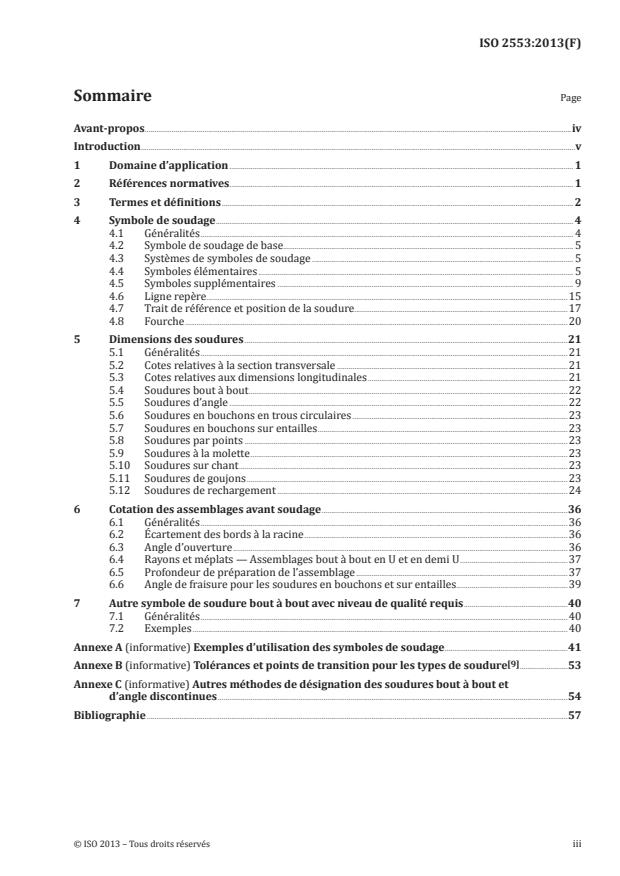
Sommaire Page
Avant-propos .iv
Introduction .v
1 Domaine d’application . 1
2 Références normatives . 1
3 Termes et définitions . 2
4 Symbole de soudage . 4
4.1 Généralités . 4
4.2 Symbole de soudage de base. 5
4.3 Systèmes de symboles de soudage . 5
4.4 Symboles élémentaires . 5
4.5 Symboles supplémentaires . 9
4.6 Ligne repère . .15
4.7 Trait de référence et position de la soudure.17
4.8 Fourche .20
5 Dimensions des soudures .21
5.1 Généralités .21
5.2 Cotes relatives à la section transversale .21
5.3 Cotes relatives aux dimensions longitudinales .21
5.4 Soudures bout à bout.22
5.5 Soudures d’angle .22
5.6 Soudures en bouchons en trous circulaires .23
5.7 Soudures en bouchons sur entailles .23
5.8 Soudures par points .23
5.9 Soudures à la molette .23
5.10 Soudures sur chant .23
5.11 Soudures de goujons .23
5.12 Soudures de rechargement .24
6 Cotation des assemblages avant soudage .36
6.1 Généralités .36
6.2 Écartement des bords à la racine .36
6.3 Angle d’ouverture .36
6.4 Rayons et méplats — Assemblages bout à bout en U et en demi U .37
6.5 Profondeur de préparation de l’assemblage .37
6.6 Angle de fraisure pour les soudures en bouchons et sur entailles .39
7 Autre symbole de soudure bout à bout avec niveau de qualité requis .40
7.1 Généralités .40
7.2 Exemples .40
Annexe A (informative) Exemples d’utilisation des symboles de soudage .41
[9]
Annexe B (informative) Tolérances et points de transition pour les types de soudure .53
Annexe C (informative) Autres méthodes de désignation des soudures bout à bout et
d’angle discontinues .54
Bibliographie .57
Avant-propos
L’ISO (Organisation internationale de normalisation) est une fédération mondiale d’organismes
nationaux de normalisation (comités membres de l’ISO). L’élaboration des Normes internationales est
en général confiée aux comités techniques de l’ISO. Chaque comité membre intéressé par une étude
a le droit de faire partie du comité technique créé à cet effet. Les organisations internationales,
gouvernementales et non gouvernementales, en liaison avec l’ISO participent également aux travaux.
L’ISO collabore étroitement avec la Commission électrotechnique internationale (CEI) en ce qui concerne
la normalisation électrotechnique.
Les procédures utilisées pour élaborer le présent document et celles destinées à sa mise à jour sont
décrites dans les Directives ISO/CEI, Partie 1. Il convient, en particulier de prendre note des différents
critères d’approbation requis pour les différents types de documents ISO. Le présent document a été
rédigé conformément aux règles de rédaction données dans les Directives ISO/CEI, Partie 2 (voir www.
iso.org/directives).
L’attention est appelée sur le fait que certains des éléments du présent document peuvent faire l’objet de
droits de propriété intellectuelle ou de droits analogues. L’ISO ne saurait être tenue pour responsable
de ne pas avoir identifié de tels droits de propriété et averti de leur existence. Les détails concernant les
références aux droits de propriété intellectuelle ou autres droits analogues identifiés lors de l’élaboration
du document sont indiqués dans l’Introduction et/ou sur la liste ISO des déclarations de brevets reçues
(voir www.iso.org/patents).
Les éventuelles appellations commerciales utilisées dans le présent document sont données pour
information à l’intention des utilisateurs et ne constituent pas une approbation ou une recommandation.
Pour une explication de la signification des termes et expressions spécifiques de l’ISO liés à l’évaluation
de la conformité, aussi bien que pour des informations au-sujet de l’adhésion de l’ISO aux principes
de l’OMC concernant les obstacles techniques au commerce (OTC) voir le lien suivant: Foreword -
Supplementary information
Le comité chargé de l’élaboration du présent document est l’ISO/TC 44, Soudage et techniques connexes,
sous-comité SC 7, Représentation et terminologie.
Cette quatrième édition annule et remplace la troisième édition (ISO 2553:1992), qui fait l’objet d’une
révision technique importante.
Il convient d’adresser les demandes d’interprétation officielle de tout aspect de la présente norme au
secrétariat de l’ISO/TC 44/SC 7, par l’intermédiaire de votre organisme national de normalisation; une
liste complète des organismes nationaux de normalisation peut être obtenue à l’adresse www.iso.org.
iv © ISO 2013 – Tous droits réservés
Introduction
Les symboles donnés dans la présente norme peuvent être utilisés sur les dessins techniques pour les
composants soudés. Les spécifications relatives à la conception, tels que le type, et la longueur de la
soudure, la qualité de la soudure, le traitement de surface, le matériau d’apport et les essais peuvent
être indiqués directement sur la soudure au moyen des symboles donnés dans la présente norme. Les
principes de la présente Norme internationale peuvent être appliqués aux joints soudés et brasés.
La clarté peut aussi être améliorée par des références à de l’information collective sur les dessins ou par
des références complémentaires à des documents relatifs à la conception.
La préparation de la fabrication peut demander un planning détaillé relatif au soudage. Le type de
représentation décrit dans la présente norme peut être utilisé dans ce but et complétée par des
informations liées à la fabrication (par exemple la position de soudage, procédé de soudage, DMOS,
préparation de la soudure, préchauffage, etc.)
Cette information est souvent donnée dans les documents liés à la fabrication, tels que les programmes
de travail ou les descriptifs de mode opératoire de soudage (DMOS).
Les dessins techniques sont destinés à illustrer de manière claire et compréhensible les spécifications
relatives à la conception. Il est recommandé que les dessins relatifs au soudage soient préparés et vérifiés
par du personnel spécifiquement formé (voir l’ISO 14731).
La présente édition de l’ISO 2553 reconnaît qu’il existe deux méthodes relativement différentes sur le
marché mondial pour désigner le côté ligne repère et le côté opposé à la ligne repère sur les dessins et
permet d’utiliser l’une ou l’autre isolément pour s’adapter aux besoins d’un marché donné. L’application
de l’une ou l’autre méthode identifie un symbole de soudage conformément à la présente Norme
internationale. La méthode conforme au système A est fondée sur l’ISO 2553:1992. La méthode conforme
au système B est fondée sur les normes utilisées par les pays de la zone Pacifique.
NORME INTERNATIONALE ISO 2553:2013(F)
Soudage et techniques connexes — Représentations
symboliques sur les dessins — Joints soudés
1 Domaine d’application
La présente Norme internationale définit les règles à suivre pour représenter symboliquement les joints
soudés sur les dessins techniques. Cela peut inclure des informations sur la géométrie, la fabrication, la
qualité et les essais des soudures. Les principes de la présente Norme internationale peuvent également
être appliqués aux joints soudés et brasés.
La présente Norme internationale reconnaît qu’il existe deux méthodes différentes sur le marché
mondial pour désigner le côté ligne repère et le côté opposé à la ligne repère sur les dessins. Il convient
de noter que:
— les articles, tableaux et figures qui portent le suffixe «A» sont applicables uniquement au système de
représentation symbolique fondé sur un double trait de référence;
— les articles, tableaux et figures qui portent le suffixe «B» sont applicables uniquement au système de
représentation symbolique fondé sur un trait de référence simple;
— les articles, tableaux et figures qui ne portent ni le suffixe «A» ni le suffixe «B» sont applicables aux
deux systèmes.
Les symboles donnés dans la présente Norme internationale peuvent être combinés à d’autres symboles
utilisés sur les dessins techniques, par exemple pour indiquer les exigences de finition de surface.
Une autre méthode de désignation est donnée. Elle peut être utilisée pour représenter des joints soudés
sur les dessins en spécifiant les informations essentielles de conception, tels que les dimensions de la
soudure, le niveau de qualité, etc. La préparation du joint et le(s) procédé(s) de soudage sont ensuite
déterminés par l’unité de production afin de satisfaire aux exigences spécifiées.
NOTE Les exemples de la présente Norme internationale, y compris les dimensions, ne sont donnés qu’à
titre d’illustration et sont destinés à montrer l’application appropriée des principes. Ils n’ont pas pour but de
représenter les bonnes pratiques de conception ni de remplacer les exigences d’un code ou d’une spécification.
2 Références normatives
Les documents suivants, en totalité ou en partie, sont référencés de manière normative dans le présent
document et sont indispensables pour son application. Pour les références datées, seule l’édition citée
s’applique. Pour les références non datées, la dernière édition du document de référence s’applique (y
compris les éventuels amendements).
ISO 128 (toutes les parties), Dessins techniques — Principes généraux de représentation
ISO 129-1, Dessins techniques — Indication des cotes et tolérances — Partie 1: Principes généraux
ISO 1302, Spécification géométrique des produits (GPS) — Indication des états de surface dans la
documentation technique de produits
ISO 3098-2, Documentation technique de produits — Écriture — Partie 2: Alphabet latin, chiffres et signes
ISO 4063, Soudage et techniques connexes — Nomenclature et numérotation des procédés
ISO/TR 25901, Soudage et techniques connexes — Vocabulaire
3 Termes et définitions
Pour les besoins du présent document, les termes et définitions donnés dans l’ISO/TR 25901 ainsi que
les suivants s’appliquent.
3.1
symbole de soudage
symbole constitué d’une ligne repère et d’un trait de référence qui peut également inclure des symboles
élémentaires et supplémentaires, des dimensions et/ou une fourche, utilisé sur les dessins techniques
pour indiquer le type, la position et la préparation d’un joint soudé
Note 1 à l’article: Voir Article 4.
3.2
symbole de soudage de base
symbole constitué d’une ligne repère, d’un trait de référence et d’une fourche, utilisé lorsque l’assemblage
n’est pas spécifié et uniquement pour indiquer qu’un joint soudé doit être réalisé
Note 1 à l’article: Voir 4.2.
3.3
ligne repère
ligne qui est utilisée pour indiquer l’assemblage qui doit être soudé, généralement tracé à 135° par
rapport au trait de référence
Note 1 à l’article: Voir 4.6.
3.4
trait de référence
partie du symbole de soudage sur lequel le symbole élémentaire est placé, généralement tracé
parallèlement au bord inférieur du dessin
Note 1 à l’article: Voir 4.7.
3.5
fourche
élément en forme de V ajouté à l’extrémité du trait de référence continu à distance de la ligne repère
Note 1 à l’article: Voir 4.8.
3.6
côté ligne repère
côté de l’assemblage vers lequel pointe la ligne repère
Note 1 à l’article: Voir 4.7.2.1.
3.7
côté opposé à ligne repère
côté opposé du joint soudé de la flèche
Note 1 à l’article: Voir 4.7.2.1.
3.8
symbole élémentaire
symbole faisant partie du symbole de soudage et tracé sur le trait de référence pour indiquer le type de
soudure et de préparation de l’assemblage
Note 1 à l’article: Voir 4.4.
2 © ISO 2013 – Tous droits réservés
3.9
symbole supplémentaire
symbole utilisé conjointement à des symboles élémentaires pour transmettre des informations
supplémentaires sur l’assemblage
Note 1 à l’article: Voir 4.5.
3.10
informations complémentaires
informations non symboliques, pertinentes pour les soudures réalisées, qui peuvent être incluses dans
la fourche du symbole de soudage
Note 1 à l’article: Voir 4.8.
3.11
soudure discontinue
série d’éléments de soudures exécutées de façon intermittente le long d’un assemblage
[SOURCE: ISO/TR 25901:2007]
Note 1 à l’article: Voir 5.3.2.
3.11.1
soudure discontinue symétrique
soudure discontinue de chaque côté de l’assemblage (couramment des soudures d’angle en T et d’assemblage
à recouvrement) de sorte que les soudures sont opposées les unes aux autres le long de l’assemblage
Note 1 à l’article: Voir 5.3.2.2.
3.11.2
soudure discontinue alternée
soudure discontinue de chaque côté de l’assemblage (couramment des soudures d’angle en T et
d’assemblage à recouvrement) de sorte que les soudures d’un côté sont opposées aux espaces de l’autre
côté de l’assemblage
Note 1 à l’article: Voir 5.3.2.3.
3.12
décalage
distance entre le début du soudage d’un côté d’une soudure discontinue alternée réalisée des deux côtés
de l’assemblage et le début du soudage de l’autre côté
Note 1 à l’article: Voir 5.3.2.3, Tableau 3 et Tableau 5, n°2.6.
3.13
passe envers
passe finale déposée sur le côté de passe de fond de la soudure par fusion
3.14
soudure envers
support-envers de la soudure
3.15
longueur nominale de la soudure
longueur de conception de la soudure
3.15.1
longueur nominale des éléments de soudure
pour les soudures discontinues, longueur de conception des éléments de la soudure
3.16
épaisseur de gorge nominale
α
valeur de conception de la hauteur du plus large triangle isocèle qui peut être inscrit dans la section de
la soudure d’angle
Note 1 à l’article: D’autres épaisseurs de conception de gorge peuvent être utilisées mais ont besoin d’être spécifiées.
3.17
côté
z
distance entre l’intersection réelle ou projetée des faces à souder et le raccordement d’une soudure
d’angle, mesurée à travers la surface de la soudure
3.18
profondeur de pénétration
pour les soudures bout à bout, épaisseur du métal déposé à l’exclusion de toute surépaisseur
3.19
épaisseur de gorge à pénétration profonde
s
dans une soudure d’angle, épaisseur de gorge nominale ou effective à laquelle est ajoutée une certaine
quantité de métal fondu
3.20
soudure évasée à chanfrein
soudure bout à bout entre une partie de l’assemblage présentant une surface arrondie et une autre
présentant une surface plane
Note 1 à l’article: Voir Tableau 5.
3.21
soudure évasée en V
soudure bout à bout entre deux parties présentant des surfaces arrondies
Note 1 à l’article: Voir Tableau 5.
3.22
soudure faite sur chantier
soudure réalisée en dehors de l’atelier en général sur le lieu final d’installation
4 Symbole de soudage
4.1 Généralités
Un trait de référence et une ligne repère sont des éléments exigés. Des éléments supplémentaires peuvent
être inclus pour transmettre des informations spécifiques.
Il est préférable que le symbole de soudage figure du côté de l’assemblage où doit être réalisée la soudure,
c’est-à-dire le côté ligne repère (voir 4.6).
L’épaisseur des lignes de repère, du trait de référence, des symboles élémentaires et de l’écriture doit
être conforme à l’ISO 128 et à l’ISO 3098-2.
Pour ne pas surcharger les dessins, il convient de faire référence à des notes sur le dessin ou d’autres
documents liés à la conception.
4 © ISO 2013 – Tous droits réservés
4.2 Symbole de soudage de base
Si les détails de l’assemblage ne sont pas spécifiés et que la seule exigence est d’indiquer qu’un
assemblage doit être soudé, le symbole de base représenté à la Figure 1 peut être utilisé. Dans ce cas,
un double trait de référence n’est pas requis pour le système A (voir 4.6.1A) car aucun détail concernant
la soudure n’est communiqué.
Le symbole de soudage de base doit comprendre une ligne repère, un trait de référence et une fourche.
Légende
1 ligne repère
2 trait de référence
3 fourche
NOTE Ce symbole est souvent utilisé pour indiquer la position des soudures de pointage.
Figure 1 — Symbole de soudage de base (type et détails de l’assemblage non spécifiés)
4.3 Systèmes de symboles de soudage
La présente Norme internationale reconnait deux différents systèmes, A et B, pour désigner le côté ligne
repère et le côté opposé à ligne repère sur les dessins.
La représentation symbolique du système A est fondé sur un double trait de référence consistant en une
ligne continue et une ligne interrompue (voir 4.7).
La représentation symbolique du système B est fondée sur un seul trait de référence (voir 4.7).
Les Articles, Tableaux et Figures qui portent le suffixe «A» ou «B» ne s’appliquent respectivement qu’au
système A ou au système B.
Les articles, tableaux et figures qui ne portent pas de suffixe s’appliquent aux deux systèmes.
Les systèmes A ou B ne doivent pas être mélangés et les dessins clairement indiquer quel système est
utilisé y compris les unités de mesure conforme à l’ISO 129-1.
Des exemples de symboles de soudage complets indiquant la position des éléments sont donnés à la
Figure A.1.
4.4 Symboles élémentaires
4.4.1 Généralités
Les symboles élémentaires, conformément au Tableau 1, peuvent être ajoutés au trait de référence dans
les systèmes A et B pour indiquer le type d’assemblage à réaliser.
Les symboles élémentaires font partie du symbole de soudage et doivent être tracés sur le trait de
référence, généralement en son milieu.
Les symboles élémentaires peuvent être complétés par:
— des symboles supplémentaires (voir 4.5 et Tableau 3);
— des dimensions (voir Article 5);
— des informations complémentaires.
L’orientation des symboles élémentaires ne doit pas être différente de celle indiquée.
L’Annexe B donne des lignes directrices sur les tolérances et les points de transition pour les soudures
bout à bout, les soudures sur chant et les soudures d’angle.
Si une représentation claire par des symboles n’est pas réalisable, il est possible de représenter et
dimensionner les sections droites des soudures.
Tableau 1 — Symboles élémentaires
a
N° Désignation Illustration Symbole
(les traits interrompus indiquent la
préparation de l’assemblage avant le
soudage)
Soudure bout à bout à bords
b
droits
b
2 Soudure bout à bout en V
b
3 Soudure bout à bout en Y
b
4 Soudure bout à bout en demi V
b
5 Soudure bout à bout en demi Y
b
6 Soudure bout à bout en U
b
7 Soudure bout à bout en J
8 Soudure évasée en V
a
Le trait gris ne fait pas partie du symbole. Il indique la position du trait de référence.
b
Les soudures sont à pleine pénétration sauf spécification contraire indiquée par les cotes sur le symbole de la soudure
ou par référence à d’autres informations, par exemple le DMOS.
c
Peut-être utilisé pour les assemblages de plus de deux parties.
6 © ISO 2013 – Tous droits réservés
Tableau 1 (suite)
a
N° Désignation Illustration Symbole
(les traits interrompus indiquent la
préparation de l’assemblage avant le
soudage)
9 Soudure évasée à chanfrein
10 Soudure d’angle
Soudure en bouchons ou sur
entailles
Soudure par points par résis-
12 tance (y compris le bossage
pour le système A)
Soudure par points par fusion
13 (et soudure par bossage pour le
système B)
Soudure à la molette par résis-
tance
15 Soudure à la molette fusion
a
Le trait gris ne fait pas partie du symbole. Il indique la position du trait de référence.
b
Les soudures sont à pleine pénétration sauf spécification contraire indiquée par les cotes sur le symbole de la soudure
ou par référence à d’autres informations, par exemple le DMOS.
c
Peut-être utilisé pour les assemblages de plus de deux parties.
Tableau 1 (suite)
a
N° Désignation Illustration Symbole
(les traits interrompus indiquent la
préparation de l’assemblage avant le
soudage)
16 Soudure des goujons
Soudure bout à bout en V à
b
flancs droits
b
Soudure bout à bout en demi V
à flancs droits
c
19 Soudure sur chant
Soudure bout à bout à bords
20 relevés/soudure en angle exté-
rieure
c
21 Soudure par rechargement
22 Soudure par transparence
a
Le trait gris ne fait pas partie du symbole. Il indique la position du trait de référence.
b
Les soudures sont à pleine pénétration sauf spécification contraire indiquée par les cotes sur le symbole de la soudure
ou par référence à d’autres informations, par exemple le DMOS.
c
Peut-être utilisé pour les assemblages de plus de deux parties.
8 © ISO 2013 – Tous droits réservés
4.4.2 Combinaisons de symboles élémentaires
Si nécessaire, des symboles élémentaires peuvent être combinés pour représenter des configurations
particulières de soudures.
4.4.3 Soudures bout à bout des deux côtés
Les symboles élémentaires doivent être disposés l’un en face de l’autre sur le trait de référence, et comprendre
toutes les informations requises, lorsqu’ils sont utilisés pour représenter des soudures symétriques.
Dans le cas de soudures bout à bout des deux côtés avec des symboles et dimensions identiques, il
convient de supprimer les traits de référence interrompus pour le système A (voir Tableau 2).
Un exemple de soudure asymétrique des deux côtés est indiqué dans le Tableau A.3.
Tableau 2 — Symboles élémentaires combinés pour représenter des soudures bout à bout
symétriques
a b
N° Type de soudure Illustration de la soudure Symbole
Soudure bout à bout en
double V
Soudure bout à bout
en K
Soudure bout à bout en
double U
Soudure bout à bout
en K (avec méplat) et
soudure d’angle avec
surépaisseur
a
Les soudures bout à bout peuvent être à pénétration partielle ou à pleine; ce qui doit être indiqué par des dimensions sur
le symbole élémentaire (voir Tableau 5) ou par référence à d’autres informations, par exemple le DMOS.
b
Le trait gris ne fait pas partie du symbole. Il indique la position du trait de référence.
4.5 Symboles supplémentaires
4.5.1 Généralités
Des informations supplémentaires concernant l’assemblage requis peuvent être données en utilisant des
symboles supplémentaires conformément au Tableau 3. Les symboles supplémentaires peuvent, par exemple,
fournir des informations sur la forme de la soudure ou la manière dont le joint soudé doit être réalisé.
Tableau 3 — Symboles supplémentaires
a a
N° Désignation Symbole Exemple d’application Illustration de la soudure
Plate - finition
b
affleurée
b
2 Convexe
b
3 Concave
Bords du cordon
de soudure
4 Pas d’exemple
convenablement
c
mouillés
a) Passe de raci-
d
ne
(réalisée après
une soudure bout
à bout en V)
b) Reprise à
d
l’envers
(réalisée avant
une soudure bout
à bout en V)
Surépaisseur spé-
e
cifiée à la racine
a
Le trait gris ne fait pas partie du symbole; il est inclus uniquement pour montrer la position du symbole sur le trait de
référence et/ou la ligne repère.
b
- Soudures qui nécessitent des faces affleurées ou convexes sans finition après soudage sont spécifiées en utilisant le
symbole de contour plat ou convexe.
- Soudures nécessitant une finition affleurée ou convexe par un traitement après soudage ou nécessitant une surface
plate, mais pas affleurée, requièrent des informations supplémentaires, par exemple l’ajout d’une note dans la fourche du
symbole de soudage
- D’autres symboles conformes à l’ISO 1302 peuvent être utilisés pour spécifier une finition de surface.
c
Les bords du cordon de soudure doivent être convenablement mouillés par soudure ou finition. Le procédé détaillé peut
être spécifié par des instructions spécifiques ou DMOS.
d
la séquence des passes de soudage peut être indiquée sur le dessin, par exemple en utilisant des traits de référence
multiple, une note dans la fourche ou par référence à un descriptif de mode opératoire de soudage.
e
Pour le système B, également utilisé pour désigner les soudures bout à bout entre tôles à bords relevés/soudures en
angle extérieure (voir 4.5.5.6).
f
M = matériau devant faire partie du joint final soudé, MR = matériau devant être éliminé après le soudage. Des
informations supplémentaires sur le matériau peuvent être incluses dans la fourche ou ailleurs.
g
Les définitions de a, z, n, l et (e) sont données à l’Article 5.
10 © ISO 2013 – Tous droits réservés
Tableau 3 (suite)
a a
N° Désignation Symbole Exemple d’application Illustration de la soudure
Support envers
7a
(non spécifié)
Support envers
7b
f
subsistant
Support envers
7c enlevable/tempo-
f
raire
Élément d’écarte-
ment
a) Joint avec insert en place
Insert consom-
mable (carré)
b) Joint final soudé (insert
incorporé dans la racine).
Soudure bouit à bout en V non
visible
a
Le trait gris ne fait pas partie du symbole; il est inclus uniquement pour montrer la position du symbole sur le trait de
référence et/ou la ligne repère.
b
- Soudures qui nécessitent des faces affleurées ou convexes sans finition après soudage sont spécifiées en utilisant le
symbole de contour plat ou convexe.
- Soudures nécessitant une finition affleurée ou convexe par un traitement après soudage ou nécessitant une surface
plate, mais pas affleurée, requièrent des informations supplémentaires, par exemple l’ajout d’une note dans la fourche du
symbole de soudage
- D’autres symboles conformes à l’ISO 1302 peuvent être utilisés pour spécifier une finition de surface.
c
Les bords du cordon de soudure doivent être convenablement mouillés par soudure ou finition. Le procédé détaillé peut
être spécifié par des instructions spécifiques ou DMOS.
d
la séquence des passes de soudage peut être indiquée sur le dessin, par exemple en utilisant des traits de référence
multiple, une note dans la fourche ou par référence à un descriptif de mode opératoire de soudage.
e
Pour le système B, également utilisé pour désigner les soudures bout à bout entre tôles à bords relevés/soudures en
angle extérieure (voir 4.5.5.6).
f
M = matériau devant faire partie du joint final soudé, MR = matériau devant être éliminé après le soudage. Des
informations supplémentaires sur le matériau peuvent être incluses dans la fourche ou ailleurs.
g
Les définitions de a, z, n, l et (e) sont données à l’Article 5.
Tableau 3 (suite)
a a
N° Désignation Symbole Exemple d’application Illustration de la soudure
Exemple A
Soudure tout
autour
Exemple B
Exemple C
Soudure entre
deux points
a
Le trait gris ne fait pas partie du symbole; il est inclus uniquement pour montrer la position du symbole sur le trait de
référence et/ou la ligne repère.
b
- Soudures qui nécessitent des faces affleurées ou convexes sans finition après soudage sont spécifiées en utilisant le
symbole de contour plat ou convexe.
- Soudures nécessitant une finition affleurée ou convexe par un traitement après soudage ou nécessitant une surface
plate, mais pas affleurée, requièrent des informations supplémentaires, par exemple l’ajout d’une note dans la fourche du
symbole de soudage
- D’autres symboles conformes à l’ISO 1302 peuvent être utilisés pour spécifier une finition de surface.
c
Les bords du cordon de soudure doivent être convenablement mouillés par soudure ou finition. Le procédé détaillé peut
être spécifié par des instructions spécifiques ou DMOS.
d
la séquence des passes de soudage peut être indiquée sur le dessin, par exemple en utilisant des traits de référence
multiple, une note dans la fourche ou par référence à un descriptif de mode opératoire de soudage.
e
Pour le système B, également utilisé pour désigner les soudures bout à bout entre tôles à bords relevés/soudures en
angle extérieure (voir 4.5.5.6).
f
M = matériau devant faire partie du joint final soudé, MR = matériau devant être éliminé après le soudage. Des
informations supplémentaires sur le matériau peuvent être incluses dans la fourche ou ailleurs.
g
Les définitions de a, z, n, l et (e) sont données à l’Article 5.
12 © ISO 2013 – Tous droits réservés
Tableau 3 (suite)
a a
N° Désignation Symbole Exemple d’application Illustration de la soudure
Soudure faite sur
12 Pas d’exemple
chantier
Soudures discon-
Ou
f
tinues alternées
a
Le trait gris ne fait pas partie du symbole; il est inclus uniquement pour montrer la position du symbole sur le trait de
référence et/ou la ligne repère.
b
- Soudures qui nécessitent des faces affleurées ou convexes sans finition après soudage sont spécifiées en utilisant le
symbole de contour plat ou convexe.
- Soudures nécessitant une finition affleurée ou convexe par un traitement après soudage ou nécessitant une surface
plate, mais pas affleurée, requièrent des informations supplémentaires, par exemple l’ajout d’une note dans la fourche du
symbole de soudage
- D’autres symboles conformes à l’ISO 1302 peuvent être utilisés pour spécifier une finition de surface.
c
Les bords du cordon de soudure doivent être convenablement mouillés par soudure ou finition. Le procédé détaillé peut
être spécifié par des instructions spécifiques ou DMOS.
d
la séquence des passes de soudage peut être indiquée sur le dessin, par exemple en utilisant des traits de référence
multiple, une note dans la fourche ou par référence à un descriptif de mode opératoire de soudage.
e
Pour le système B, également utilisé pour désigner les soudures bout à bout entre tôles à bords relevés/soudures en
angle extérieure (voir 4.5.5.6).
f
M = matériau devant faire partie du joint final soudé, MR = matériau devant être éliminé après le soudage. Des
informations supplémentaires sur le matériau peuvent être incluses dans la fourche ou ailleurs.
g
Les définitions de a, z, n, l et (e) sont données à l’Article 5.
4.5.2 Symbole soudure tout autour
Le symbole soudure tout autour, ajouté au niveau de la jonction entre les lignes de repère et trait de
référence, peut être utilisé pour désigner une soudure continue, réalisée d’un seul côté ou des deux
côtés, s’étendant autour d’une série d’assemblages raccordés (voir Tableau 3).
La série d’assemblages peut impliquer différentes directions et peut se situer dans plus d’un plan, mais
la soudure doit toujours être de mêmes type et dimensions.
Le symbole soudure tout autour ne doit pas être utilisé si:
a) la soudure ne débute pas et ne se termine pas au même point, c’est-à-dire si elle n’est pas continue;
b) le type de soudure varie, par exemple d’une soudure d’angle à une soudure bout à bout;
c) les dimensions varient, par exemple la gorge nominale d’une soudure d’angle. Dans ce cas, chaque
soudure doit être identifiée par un symbole de soudage distinct.
NOTE Le symbole soudure tout autour n’est pas utilisé pour indiquer que des soudures doivent être
réalisées partout.
Les soudures s’étendant autour de la circonférence d’un profil ou d’un trou circulaire ou d’une fente ne
nécessitent pas l’utilisation du symbole de soudure tout autour pour spécifier une soudure continue.
4.5.3 Soudures du même type réalisées de point en point
Le symbole soudure entre deux points peut être utilisé pour désigner une soudure continue, ou de type
similaire, étendue entre deux points. Dans ce cas, la soudure ne démarre ni ne s’arrête au même point, et
le symbole de soudure tout autour ne peut être utilisé (voir Tableau 3). Les points de terminaison de la
soudure doivent être clairement indiqués et le symbole de soudure doit clairement indiquer le joint à souder.
La Figure 2 donne un exemple de désignation d’une soudure continue (du même type) s’étendant autour
d’une série de points raccordés, mais où la soudure ne débute pas et ne se termine pas au même point.
Légende
1 symbole de soudage
2 réponse visuelle (soudé conformément au symbole de soudage)
A, B positions de fin de soudure
Il n’y a pas de soudure entre le point B et le point A (soudure d’angle impossible).
N’importe quel identifiant peut être utilisé pour identifier les points entre les soudures, par exemple A, B, C et X, Y,
Z, etc.
Figure 2 — Exemple de symbole de soudage pour une soudure d’angle réalisée entre un point A
et un point B
4.5.4 Soudures faites sur chantier
Les soudures faites sur chantier doivent être spécifiées en ajoutant le symbole soudure faite sur chantier
au niveau de la jonction entre les lignes de repère et de référence (voir Tableau 3). Le symbole doit être
positionné perpendiculairement au trait de référence et au-dessus de ce dernier. Le symbole s’applique
à l’ensemble du symbole de soudage.
14 © ISO 2013 – Tous droits réservés
4.5.5 Surépaisseur à la racine – Soudures bout à bout réalisées d’un seul côté
Le symbole de surépaisseur à la racine ne doit être utilisé que lorsqu’une dimension de surépaisseur
minimum à la racine et à pleine pénétration est requise dans des soudures bout à bout réalisées d’un
seul côté (voir Figure 3).
Le symbole surépaisseur à la racine doit être placé à l’opposé du symbole élémentaire du côté du trait
de référence.
a) Symbole de soudage du système A b) Symbole de soudage du système B
c) Soudure produite en utilisant l’un ou l’autre système
Figure 3 — Exemple d’une soudure comportant une surépaisseur à la racine spécifiée
4.5.6 Soudures sur chant à bords relevés sur des assemblages bout à bout ou sur des assem-
blages en angle extérieur
Les soudures sur chant à bords relevés sur des assemblages bout à bout ou sur des assemblages en angle
extérieur doivent être spécifiées en utilisant les symboles du Tableau 4.
4.6 Ligne repère
4.6.1 Généralités
Une ligne repère doit être utilisée pour indiquer le joint à souder. La ligne repère doit:
— pointer et doit être en contact avec un trait plein comprenant une partie de l’assemblage sur le
dessin (trait visible).
— former un angle avec le trait de référence et le rejoindre et doit être terminée par une pointe de
flèche pleine.
La ligne repère peut être rattachée soit au côté soit au trait de référence.
16 © ISO 2013 – Tous droits réservés
Tableau 4 — Soudures sur chant à bords relevés sur des assemblages bout à bout ou des assemblages en d’angle extérieur
Type de Système A Système B
N° Illustration de la soudure
soudure Symbole de soudage Symbole de soudage
ASSEMBLAGES BOUT À BOUT À BORDS RELEVÉS
Soudure sur
chant
Soudure bout
2 à bout à bord
relevés
ASSEMBLAGES EN ANGLE EXTÉRIEUR À BORDS RELEVÉS
Soudure sur
chant
Soudure en
4 angle exté-
rieure
4.6.2 Lignes repère multiples
Deux lignes repère, ou plus, peuvent être combinées à un seul trait de référence pour indiquer les
positions de soudures identiques (voir Figure 4).
a) Symbole de soudage du système A b) Symbole de soudage du système B
c) Soudures produites en utilisant l’un ou l’autre système
Figure 4 — Exemples d’utilisation de lignes de repère multiples
4.6.3 Ligne repère brisée
Pour les soudures bout à bout, pour les tôles (à l’exclusion des soudures bout à bout en T) lorsque une
partie spécifique de l’assemblage (par exemple chanfrein seul ou soudure bout à bout en J seule) doit
être préparé, la ligne repère peut comporter une cassure et pointer vers cette partie.
La ligne repère ne doit pas être brisée si il est évident qu’il n’y a pas de préférence en ce qui concerne la
partie à préparer.
Des exemples d’utilisation de lignes de repère brisées sont donnés dans le Tableau A.1.
4.7 Trait de référence et position de la soudure
4.7.1 Trait de référence
Le trait de référence, associé aux symboles élémentaires, est utilisé pour indiquer le côté de l’assemblage
sur lequel la soudure doit être réalisée.
NOTE Le trait de référence peut être tracé parallèlement au bord latéral du dessin (l’ensemble du symbole
de soudage subissant une rotation de 90°), mais seulement lorsque l’espace disponible ne permet pas de le tracer
parallèlement au bord inférieur.
4.7.1.1A Trait de référence – Système A: 4.7.1.1B Trait de référence – Système B:
Le trait de référence est constitué de deux traits Le trait de référence doit être tracé sous forme
parallèles de longueur égale: un trait droit et un d’un trait droit continu (voir les Exemples à
trait interrompu (voir les Exemples à l’Annexe A). l’Annexe A).
Le trait interrompu peut être tracé au-dessus ou
au-dessous du trait continu; il doit de préférence
être tracé au-dessous du trait continu.
Il convient que le trait interrompu soit omis pour
les soudures symétriques et pour les soudures
par points et les soudures en ligne continue avec
recouvrement réalisées à l’interface entre deux
composants.
4.7.2 Position de la soudure
4.7.2.1 Côté ligne repère/Côté
...
Questions, Comments and Discussion
Ask us and Technical Secretary will try to provide an answer. You can facilitate discussion about the standard in here.
Loading comments...