


ISO 15394:2009
(Main)Packaging — Bar code and two-dimensional symbols for shipping, transport and receiving labels
Packaging — Bar code and two-dimensional symbols for shipping, transport and receiving labels
ISO 15394:2009 specifies the minimum requirements for the design of labels containing linear bar code and two‑dimensional symbols on transport units to convey data between trading partners; provides for traceability of transported units via a unique transport unit identifier (licence plate); provides guidance on the formatting on the label of data presented in linear bar code, two-dimensional symbol or human readable form; provides specific recommendations regarding the choice of bar code symbologies, and specifies quality requirements and classes of bar code density; makes recommendations as to label placement, size and the inclusion of free text and any appropriate graphics; provides guidance on the selection of label material. ISO 15394:2009 is not applicable to the direct printing on to kraft coloured corrugated surfaces. Those wishing to find more information on the direct printing of bar code symbols on to kraft coloured corrugated surfaces may find suitable guidance from texts specific to this subject.
Emballage — Codes à barres et symboles bidimensionnels pour l'expédition, le transport et les étiquettes de réception
General Information
- Status
- Withdrawn
- Publication Date
- 13-Apr-2009
- Withdrawal Date
- 13-Apr-2009
- Technical Committee
- ISO/TC 122 - Packaging
- Drafting Committee
- ISO/TC 122/WG 12 - Supply chain applications of logistics technology
- Current Stage
- 9599 - Withdrawal of International Standard
- Start Date
- 09-Nov-2017
- Completion Date
- 12-Feb-2026
Relations
- Effective Date
- 09-Feb-2026
- Effective Date
- 05-Oct-2013
- Effective Date
- 15-Apr-2008

Get Certified
Connect with accredited certification bodies for this standard

BSI Group
BSI (British Standards Institution) is the business standards company that helps organizations make excellence a habit.

BRCGS (Brand Reputation Compliance Global Standards)
Global food safety and quality standards owner.

NYCE
Mexican standards and certification body.
Sponsored listings
Frequently Asked Questions
ISO 15394:2009 is a standard published by the International Organization for Standardization (ISO). Its full title is "Packaging — Bar code and two-dimensional symbols for shipping, transport and receiving labels". This standard covers: ISO 15394:2009 specifies the minimum requirements for the design of labels containing linear bar code and two‑dimensional symbols on transport units to convey data between trading partners; provides for traceability of transported units via a unique transport unit identifier (licence plate); provides guidance on the formatting on the label of data presented in linear bar code, two-dimensional symbol or human readable form; provides specific recommendations regarding the choice of bar code symbologies, and specifies quality requirements and classes of bar code density; makes recommendations as to label placement, size and the inclusion of free text and any appropriate graphics; provides guidance on the selection of label material. ISO 15394:2009 is not applicable to the direct printing on to kraft coloured corrugated surfaces. Those wishing to find more information on the direct printing of bar code symbols on to kraft coloured corrugated surfaces may find suitable guidance from texts specific to this subject.
ISO 15394:2009 specifies the minimum requirements for the design of labels containing linear bar code and two‑dimensional symbols on transport units to convey data between trading partners; provides for traceability of transported units via a unique transport unit identifier (licence plate); provides guidance on the formatting on the label of data presented in linear bar code, two-dimensional symbol or human readable form; provides specific recommendations regarding the choice of bar code symbologies, and specifies quality requirements and classes of bar code density; makes recommendations as to label placement, size and the inclusion of free text and any appropriate graphics; provides guidance on the selection of label material. ISO 15394:2009 is not applicable to the direct printing on to kraft coloured corrugated surfaces. Those wishing to find more information on the direct printing of bar code symbols on to kraft coloured corrugated surfaces may find suitable guidance from texts specific to this subject.
ISO 15394:2009 is classified under the following ICS (International Classification for Standards) categories: 35.040 - Information coding; 35.040.50 - Automatic identification and data capture techniques; 55.020 - Packaging and distribution of goods in general. The ICS classification helps identify the subject area and facilitates finding related standards.
ISO 15394:2009 has the following relationships with other standards: It is inter standard links to EN 1573:2015, ISO 15394:2017, ISO 15394:2000. Understanding these relationships helps ensure you are using the most current and applicable version of the standard.
ISO 15394:2009 is available in PDF format for immediate download after purchase. The document can be added to your cart and obtained through the secure checkout process. Digital delivery ensures instant access to the complete standard document.
Standards Content (Sample)
INTERNATIONAL ISO
STANDARD 15394
Second edition
2009-04-15
Packaging — Bar code and two-
dimensional symbols for shipping,
transport and receiving labels
Emballage — Codes à barres et symboles bidimensionnels pour
l'expédition, le transport et les étiquettes de réception
Reference number
©
ISO 2009
PDF disclaimer
This PDF file may contain embedded typefaces. In accordance with Adobe's licensing policy, this file may be printed or viewed but
shall not be edited unless the typefaces which are embedded are licensed to and installed on the computer performing the editing. In
downloading this file, parties accept therein the responsibility of not infringing Adobe's licensing policy. The ISO Central Secretariat
accepts no liability in this area.
Adobe is a trademark of Adobe Systems Incorporated.
Details of the software products used to create this PDF file can be found in the General Info relative to the file; the PDF-creation
parameters were optimized for printing. Every care has been taken to ensure that the file is suitable for use by ISO member bodies. In
the unlikely event that a problem relating to it is found, please inform the Central Secretariat at the address given below.
© ISO 2009
All rights reserved. Unless otherwise specified, no part of this publication may be reproduced or utilized in any form or by any means,
electronic or mechanical, including photocopying and microfilm, without permission in writing from either ISO at the address below or
ISO's member body in the country of the requester.
ISO copyright office
Case postale 56 • CH-1211 Geneva 20
Tel. + 41 22 749 01 11
Fax + 41 22 749 09 47
E-mail copyright@iso.org
Web www.iso.org
Published in Switzerland
ii © ISO 2009 – All rights reserved
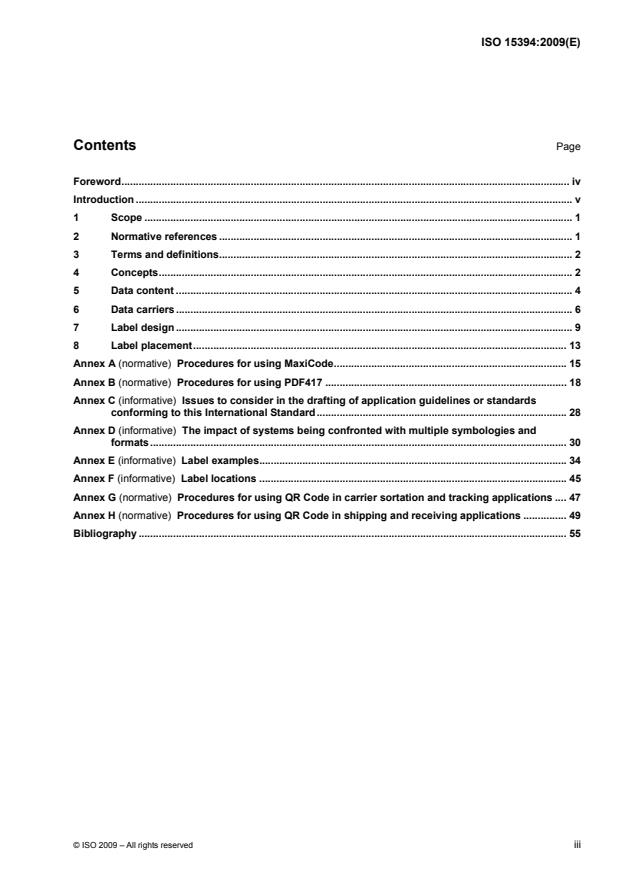
Contents Page
Foreword. iv
Introduction . v
1 Scope . 1
2 Normative references . 1
3 Terms and definitions. 2
4 Concepts. 2
5 Data content . 4
6 Data carriers . 6
7 Label design . 9
8 Label placement. 13
Annex A (normative) Procedures for using MaxiCode. 15
Annex B (normative) Procedures for using PDF417 . 18
Annex C (informative) Issues to consider in the drafting of application guidelines or standards
conforming to this International Standard.28
Annex D (informative) The impact of systems being confronted with multiple symbologies and
formats. 30
Annex E (informative) Label examples. 34
Annex F (informative) Label locations . 45
Annex G (normative) Procedures for using QR Code in carrier sortation and tracking applications . 47
Annex H (normative) Procedures for using QR Code in shipping and receiving applications . 49
Bibliography . 55
Foreword
ISO (the International Organization for Standardization) is a worldwide federation of national standards bodies
(ISO member bodies). The work of preparing International Standards is normally carried out through ISO
technical committees. Each member body interested in a subject for which a technical committee has been
established has the right to be represented on that committee. International organizations, governmental and
non-governmental, in liaison with ISO, also take part in the work. ISO collaborates closely with the
International Electrotechnical Commission (IEC) on all matters of electrotechnical standardization.
International Standards are drafted in accordance with the rules given in the ISO/IEC Directives, Part 2.
The main task of technical committees is to prepare International Standards. Draft International Standards
adopted by the technical committees are circulated to the member bodies for voting. Publication as an
International Standard requires approval by at least 75 % of the member bodies casting a vote.
Attention is drawn to the possibility that some of the elements of this document may be the subject of patent
rights. ISO shall not be held responsible for identifying any or all such patent rights.
ISO 15394 was prepared by Technical Committee ISO/TC 122, Packaging.
This second edition cancels and replaces the first edition (ISO 15394:2000), which has been technically
revised.
iv © ISO 2009 – All rights reserved
Introduction
The use of electronic data interchange (EDI) in association with the physical transport and handling of
packages and when traceability is appropriate, such as that described in ISO 9000, requires a clear and
unique identifier linking the electronic data and the transport unit.
Bar code marked transport labels are in widespread use in the global industries. A number of different
standards exist, each designed to meet the requirements of the specific industry sector. For effective and
economic use within and between industry sectors, one common multi-industry standard is a necessity.
A bar code marked transport label is designed to facilitate the automation of shipping and handling
administrative operations. The bar code information on the transport label may be used as a key to access the
appropriate database that contains detailed information about the transport unit, including information
transmitted via EDI. In addition, a transport label may contain other information as agreed between the trading
partners.
Two-dimensional symbols may be included to assist moving large amounts of shipping label or EDI data from
sender to recipient and to assist the transportation carrier automated sortation and tracking systems.
This International Standard incorporates the technology, data structure and conformance standards of
ISO/IEC JTC 1/SC 31, Automatic identification and data capture techniques, with the user requirements for
shipping labels, into a single application standard.
While this International Standard provides an international shipping label standard, ISO 22742 provides an
International Standard for product packaging. These two standards are complementary. ISO 17365 is an
International Standard on the use of RF tags on shipping/transport units and was prepared by the
ISO/TC 122/104 Joint Working Group (JWG), Supply Chain Applications of RFID.
INTERNATIONAL STANDARD ISO 15394:2009(E)
Packaging — Bar code and two-dimensional symbols for
shipping, transport and receiving labels
1 Scope
This International Standard:
⎯ specifies the minimum requirements for the design of labels containing linear bar code and
two-dimensional symbols on transport units to convey data between trading partners;
⎯ provides for traceability of transported units via a unique transport unit identifier (licence plate);
⎯ provides guidance on the formatting on the label of data presented in linear bar code, two-dimensional
symbol or human readable form;
⎯ provides specific recommendations regarding the choice of bar code symbologies, and specifies quality
requirements and classes of bar code density;
⎯ makes recommendations as to label placement, size and the inclusion of free text and any appropriate
graphics;
⎯ provides guidance on the selection of label material.
This International Standard is not applicable to the direct printing on to kraft coloured corrugated surfaces.
NOTE Guidance on the direct printing of bar code symbols on to kraft coloured corrugated surfaces can be found in
[7]
texts such as The Fibre Box Handbook .
2 Normative references
The following referenced documents are indispensable for the application of this document. For dated
references, only the edition cited applies. For undated references, the latest edition of the referenced
document (including any amendments) applies.
ISO 17365, Supply chain applications of RFID — Transport units
ISO 21067, Packaging — Vocabulary
ISO/IEC 15415, Information technology — Automatic identification and data capture techniques — Bar code
print quality test specification — Two-dimensional symbols
ISO/IEC 15416, Information technology — Automatic identification and data capture techniques — Bar code
print quality test specification — Linear symbols
ISO/IEC 15417, Information technology — Automatic identification and data capture techniques — Code 128
bar code symbology specification
ISO/IEC 15418, Information technology, Automatic identification and data capture techniques — GS1
Application Identifiers and ASC MH10 Data Identifiers and maintenance
ISO/IEC 15434, Information technology — Automatic identification and data capture techniques — Syntax for
high-capacity ADC media
ISO/IEC 15438:2006, Information technology — Automatic identification and data capture techniques —
PDF417 bar code symbology specification
ISO/IEC 15459-1, Information technology — Unique identifiers — Part 1: Unique identifiers of transport units
ISO/IEC 16023:2000, Information technology — International symbology specification — MaxiCode
ISO/IEC 16388, Information technology — Automatic identification and data capture techniques — Code 39
bar code symbology specification
ISO/IEC 18004, Information technology — Automatic identification and data capture techniques —
QR Code 2005 bar code symbology specification
ISO/IEC 19762 (all parts), Information technology — Automatic identification and data capture (AIDC)
techniques — Harmonized vocabulary
3 Terms and definitions
For the purposes of this document, the terms and definitions given in ISO/IEC 19762, ISO 21067 and the
following apply.
3.1
sortation
process by which an automated material-handling system routes packages and freight in a distribution
environment
4 Concepts
4.1 Principles
The purpose of a bar code label is to facilitate the automatic exchange of data among all members within a
channel of distribution, for instance supplier, carrier, purchaser, other intermediaries. The amount of data, in
linear bar code, two-dimensional symbols and in human readable form, is dependent on the requirements of
the trading partners. Where a bar code label is used in conjunction with electronic databases and/or electronic
data interchange (EDI) systems, the amount of data may be significantly reduced and may consist of only one
piece of data, the unique identifier for the transport unit. If radio frequency identification (RFID) enabled labels
or tags are used in conjunction with labels in conformance with this International Standard, ISO 17365 shall be
used for RFID usage with transport units. Human and optically readable data for the representation of RFID
applications should be in accordance with ISO/IEC TR 24729-1.
Trading partners have different information requirements. Some information may be common to two or more
trading partners while other information may be specific to a single trading partner. Information for various
trading partners becomes available at different times, for instance:
⎯ product specific information at the point of manufacture or packaging;
⎯ order processing information at the time of processing the order;
⎯ transport information at the time of shipment.
Trading partners may find it necessary to include significant data elements dealing with the above that may be
presented both in bar code/two-dimensional symbols (see Annexes A and B) and human readable form.
2 © ISO 2009 – All rights reserved
This International Standard shall be used in conjunction with application guidelines defining the parameters
chosen by the trading partners concerned. Annex C gives guidance in the definition of these parameters.
4.2 Unit load and transport package
For the purposes of this International Standard, a unit load is considered to be one or more transport
packages or other items held together by means such as a pallet, a slip sheet, strapping, interlocking, glue,
shrink wrap or net wrap, making them suitable for transport, stacking and storage as a unit. For the purposes
of this International Standard, a transport package is considered to be a package intended for the
transportation and handling of one or more articles, smaller packages or bulk material. Both unit loads and
transport packages are referred to as transport units in this document.
4.3 Unique transport unit identifier
A unique transport unit identifier is assigned to each individual transport unit. This is a common requirement
for all label formats specified by this International Standard. The identifier or “licence plate” is the key
providing access to information stored in computer files and which may be transmitted by EDI. The identifier
may be used by all of the trading partners to retrieve information about the transport unit itself or about the
status of the physical movement of the transport unit along the supply chain. It enables systems to track and
trace individual transport units.
4.4 Label formats
4.4.1 Base shipping/transport/receiving label
The base label defined by this International Standard includes the minimum set of data that fulfils the
requirements of all trading partners in a supply chain when data is exchanged electronically between the
parties involved.
A unique transport unit identifier shall be, and a “Ship to” name and address should be, included on the base
label.
In addition to the unique transport unit identifier (“licence plate”) and the “Ship to” name and address (for
shipment delivery), the following information should be included on a base label:
⎯ “Ship from” name and address (to be able to return the shipment in the event that delivery is not
possible);
⎯ key to carrier’s database (if the licence plate is not this data element);
⎯ key to customer’s database (if the licence plate is not this data element).
4.4.2 Extended shipping/transport/receiving label
In practice, fully automated communication channels which make it possible to rely exclusively on electronic
files for retrieving information on the movements of the transport units are not always available. For this
reason, there is a need to indicate relevant information on the transport units themselves, in addition to their
identification. The various fields of information shall be organized in a standard way in order to facilitate their
interpretation and processing by the trading partners involved.
The extended label is used when the data available from the base label is not sufficient to satisfy the
requirements of all trading partners. The information provided in the extended label is organized in three
segments:
⎯ carrier segment: in addition to the key to the carrier’s database, this segment may contain additional data,
such as shipment identification and delivery instructions;
⎯ customer segment: in addition to the pointer to the customer’s database, this segment may contain
additional data such as the customer part number;
⎯ supplier segment: additional data may be generated by the supplier, such as product identification, batch
number, dimensions.
5 Data content
5.1 Data representation
5.1.1 Data in linear bar code symbols
Such data shall be represented in one of the three permissible combinations of data and bar code symbology:
a) GS1 Application Identifiers (AIs) in accordance with ISO/IEC 15418 shall only be used in conjunction with
GS1-128 (being a subset of Code 128 compliant with ISO/IEC 15417);
b) ASC MH10 Data Identifiers (DIs) in accordance with ISO/IEC 15418 shall be used in conjunction with
Code 39 symbols compliant with ISO/IEC 16388;
c) ASC MH10 Data Identifiers (DIs) in accordance with ISO/IEC 15418 shall be used in conjunction with
Code 128 symbols compliant with ISO/IEC 15417.
Refer to Annex D for information on the use of the options and the issues for users encountering them.
5.1.2 Data in two-dimensional symbols
Information may also be provided in two-dimensional symbols as mutually agreed upon between trading
partners. Data syntax in two-dimensional symbols shall be in accordance with ISO/IEC 15434.
5.1.3 Data in human readable form
The human readable interpretation of information presented in linear bar code form should be provided. Some
information may be presented in human readable form only (see 6.3).
5.2 Data elements
5.2.1 Unique transport unit identifier
A unique transport unit identifier shall be assigned to each individual transport unit.
The unique transport unit identifier shall be either
⎯ the serial shipping container code (SSCC) that uses AI “00”, represented in GS1-128, or
⎯ the unique transport unit identifier using the ASC MH10 Data Identifier “J” or one of the DIs “1J” through
“6J” represented in either Code 39 or Code 128.
The unique transport unit identifier is defined in ISO/IEC 15459-1. The unique transport unit identifier
a) starts with the issuing agency code (IAC), assigned to the issuing agency by the registration authority,
b) conforms to a format specified by the issuing agency,
c) is unique in the sense that no issuer re-issues a number until a sufficient period of time has passed that
the first number has ceased to be of significance to any user of this International Standard,
4 © ISO 2009 – All rights reserved
d) contains only numeric and upper case alphabetic characters (not including lower case characters or
punctuation marks),
e) does not contain more than 20 characters, and
f) does not contain more characters than specified in Table 1.
5.2.2 Ship to
The “Ship to” data element refers to the address of the party to which transport units are to be delivered.
When used, it shall be represented in a maximum of five lines of human readable characters comprised of no
more than 35 alphanumeric (an.35) characters each. It may also be represented by a number identifying the
party, in human readable or in bar code format.
5.2.3 Ship from
The “Ship from” data element refers to the address of the party to which transport units are to be returned, in
case the shipment was unable to be delivered. When used, it shall be represented in a maximum of five lines
of human readable characters comprised of no more than 35 alphanumeric (an.35) characters each. It may
also be represented by a number identifying the party, in human readable or in bar code format.
5.2.4 Key to carrier's database
The key to the carrier's database should be mutually agreed upon with the carrier. If the unique transport unit
identifier described in 5.2.1 does not provide the key to the carrier’s database, one or more of the following
keys may be used:
⎯ the carrier tracking number that includes class of service;
⎯ the carrier code to identify the shipment;
⎯ the carrier code to identify the transport unit.
This data element may be included within a two-dimensional symbol, a linear bar code symbol or both.
5.2.5 Key to customer's database
The key to the customer’s database should be mutually agreed upon with the customer. If the unique transport
unit identifier described in 5.2.1 does not provide the key to the customer's database, one or more of the
following keys may be used:
⎯ customer’s purchase order number;
⎯ part number;
⎯ KANBAN/pull signal number;
⎯ shipment ID.
This data element may be included within a two-dimensional symbol, a linear bar code symbol or both.
5.2.6 Other data elements
As much additional data as required may be included in the extended label to fulfil the needs of the supplier,
carrier and customer.
5.3 Concatenating data fields in linear bar code symbols
5.3.1 Using Application Identifiers
When several AIs and their data are concatenated into one GS1-128 symbol, each variable length field shall
be followed by the FNC1 (Function 1) character, unless it is the last field encoded in the symbol. The FNC1
G
character used for this purpose assumes a value of when transmitted by the decoder.
S
5.3.2 Using Data Identifiers
When several DIs and their data are concatenated into one Code 39 or Code 128 symbol, each field shall be
followed by a plus symbol, “+”, unless it is the last field encoded in the symbol.
5.4 Structured data files
Structured data files, such as documentation supporting the handling of the transport units or complete EDI
messages, may be included, for example delivery note, quality certificate, insurance certificate. High capacity
two-dimensional symbols shall be used to represent this data. Structured data files shall comply with the
syntax described in ISO/IEC 15434.
6 Data carriers
6.1 Linear bar code symbols
6.1.1 Symbology
The linear bar code symbologies shall be one of the following:
⎯ “Code 39” in accordance with ISO/IEC 16388;
⎯ “Code 128” in accordance with ISO/IEC 15417.
NOTE “GS1-128” is a subset of “Code 128”.
6.1.2 Symbol height
The minimum bar height of a bar code symbol shall be 12,7 mm.
6.1.3 Narrow element dimension
The minimum narrow element dimension (x-dimension) shall not be less than 0,25 mm. The x-dimension for
Code 39 and Code 128 symbols should be in the range of 0,25 mm to 0,43 mm, as determined by the printing
capability of the supplier/printer of the label. The x-dimension for GS1-128 symbols should be in the range of
0,25 mm to 0,81 mm, as determined by the printing capability of the supplier/printer of the label. The
x-dimension for GS1-128 SSCC symbols should be in the range of 0,50 mm to 0,81 mm, as determined by the
printing capability of the supplier/printer of the label.
In the case that fewer characters than specified in Table 1 are required, a larger x-dimension may be used as
long as the bar code print quality requirements specified in 6.1.8 and label width recommendations are met.
NOTE Symbols with the x-dimension at the lower end of this range, specifically 0,25 mm to 0,33 mm, may require
special care in order to meet the quality requirements.
6 © ISO 2009 – All rights reserved
6.1.4 Wide-to-narrow ratio for “Code 39” symbols
The wide-to-narrow ratio (N) of elements of “Code 39” symbols should be 3,0:1. The measured ratio shall be
between 2,4:1 and 3,2:1.
6.1.5 Quiet zones
Linear bar code symbols should be printed with leading and trailing quiet zones not less than 6,4 mm. Where
the x-dimension is greater than 0,64 mm the quiet zones shall not be less than 10x. The label registration
parameters of the printer being used should be taken into consideration in order to ensure the minimum quiet
zones.
6.1.6 Orientation
Linear bar code symbols should be presented on transport units with the bars vertical (picket fence
orientation). Subject to agreement between trading partners, bars may be presented horizontally (ladder
orientation).
Linear bar code symbols should be presented on transport units with the bars perpendicular to the longitudinal
axis (ladder orientation) when marked on a tightly curved surface (tubes, rods, cylinders).
6.1.7 Placement
Linear bar code fields should be placed to ensure that they do not interfere with each other when scanned.
No more than two linear symbols should appear side by side on a label. If two linear symbols are placed side
by side, the symbols should be placed so that they will not be in the same horizontal scan path so as to
reduce the possibility of interference with successful bar code scanning.
6.1.8 Linear bar code symbol print quality
The quality of the printed linear bar code symbol shall be measured in accordance with ISO/IEC 15416. The
minimum symbol grade shall be 1,5/10/660 where
⎯ minimum print quality grade at point of production = 1,5 (C),
⎯ measurement aperture = 0,250 mm (reference number 10), and
⎯ inspection wavelength = 650 nm to 670 nm.
It is important that the linear bar code be decodable throughout the system of use. For this reason, quality
tests should not be limited to label production inspection but should also be followed through to the end use.
The above symbol quality and measurement parameters ensure scannability over a broad range of scanning
environments. Labellers should not be required to guarantee the print quality of a label when it is received by
the customer. Print quality at the point of production should be higher than the requirement at the point of use.
Unattended scanning may require a higher print quality grade than identified above. Consequently, those
implementing this International Standard for unattended scanning applications should discuss print quality
requirements with trading partners.
6.2 Two-dimensional symbols
Within this International Standard, linear bar code symbols serve as the default symbology. The use of two-
dimensional symbols and the specific two-dimensional symbol to be used shall be mutually agreed upon
between trading partners. Users should ensure that the scanning technology they select is capable of reading
the symbols they choose to read.
If more data than can be accommodated with a linear bar code is required to be encoded on the label in
optically readable symbol(s), two-dimensional symbols may be used. This International Standard recommends
either “MaxiCode” in accordance with ISO/IEC 16023 or “QR Code” in accordance with ISO/IEC 18004,
subject to trading partner agreement (shippers, carriers, consignees), for carrier sortation and tracking
applications and “PDF 417” in accordance with ISO/IEC 15438 or QR Code for other applications covered by
this International Standard.
Linear bar code symbols and the PDF417 symbology can be read by either 2D-capable imaging or
2D-capable laser scanning technologies. QR Code and MaxiCode require 2D-capable image scanning
technology.
For further information and guidance on the use of two-dimensional symbols, see Annex A, B.2, B.3, Annex G,
and Annex H.
6.3 Human readable information
6.3.1 Human readable interpretation
In order to provide a fall-back key entry and a diagnostic, a human readable interpretation of each linear bar
code symbol shall be provided adjacent to the bar code. Such human readable interpretation shall represent
the encoded data. See Figure E.9.
6.3.2 Human translation
In addition to the human readable interpretation, human translation of linear bar code information may be
provided in a separate section of the label. See Figure E.9.
6.3.3 Data area titles
Data areas comprise information in bar code or human readable form. Data areas shall be identified with the
corresponding data area title in human readable text, which may be prefixed, if relevant, by the appropriate AI
or DI. A data area title is not required when a data area contains
⎯ a single linear bar code symbol concatenating multiple data elements, or
⎯ multiple linear bar code symbols that are intended to be scanned in a single data capture operation, or
⎯ two-dimensional symbols.
6.3.4 Free text and data
Human readable information that is not a translation of the bar code information may be provided according to
the requirements of the trading partners.
6.3.5 Choice of language
6.3.5.1 Applicability
Choice of language is applicable to human translation, data area titles and free text.
6.3.5.2 Domestic shipments
Human-readable information within a single country should be in the national language of that country.
8 © ISO 2009 – All rights reserved
6.3.5.3 Export shipments
Shipments for export should have human-readable information in the language(s) mutually agreed upon
between trading partners.
6.3.5.4 Multiple languages
Regulations may require multiple languages on the shipping label.
7 Label design
7.1 General considerations
The linear bar code representing the unique transport unit identifier (“licence plate”), a mandatory element for
this International Standard, shall be printed in the lowest area of the label.
Label segments are logical groupings of information based on the data needs of the trading partners within the
distribution channel. Three segments are defined: carrier segment, customer segment and supplier segment.
Label segments may or may not be printed at the same time on a single physical label. When the size and
structure of the transport unit permits, segments should be stacked vertically, from top to bottom, in the
following order:
⎯ carrier segment;
⎯ customer segment;
⎯ supplier segment.
Examples of labels are provided in Annex E. The labels shown in Annex E are for illustration only and do not
represent all of the possible choices of label designs.
Separate sections of the label may be applied at different stages to form the complete label.
7.2 Layout
7.2.1 Base label layout
In addition to the unique transport unit identifier, a typical base label may include the following data areas:
⎯ “Ship from” address, human readable;
⎯ “Ship to” address, human readable;
⎯ “Ship to” postal code or location number, linear bar code;
⎯ carrier shipment tracking number (if required), linear bar code;
⎯ customer purchase order number (if required), linear bar code.
Only linear bar codes shall be used to represent data in a machine-readable form on a base label.
The “Ship to” address shall be located below or to the right of the “Ship from” address. “Ship from” characters
shall be noticeably smaller than the “Ship to” characters and the fields shall be easily distinguishable. All
international shipments shall conform to this requirement.
For shipments within a single country and where that country has a national standard recommending an
alternative label layout, e.g. where “Ship from” address and “Ship to” address are reversed, such alternative
label layout may be used with the agreement of the trading partners.
7.2.2 Extended label layout
The extended label comprises more information than the base label. In addition to the information contained in
the base label, the extended label may include
⎯ linear bar codes representing other discrete data elements,
⎯ linear bar codes representing concatenated data elements,
⎯ two-dimensional symbols,
⎯ human translation of linear bar code information,
⎯ human-readable-only information, and
⎯ graphics.
7.2.3 Other data
This International Standard does not supersede or replace any applicable safety or regulatory marking or
labelling requirements. This International Standard is to be applied in addition to any other mandated labelling
requirements. Free areas or certain graphics, such as safety, hazard, quality signs or logos could be required.
7.3 Label dimensions
7.3.1 General considerations
The size of the label shall be consistent with the data requirements of all trading partners in the supply chain
with the only constraint being the size of the transport unit.
The label format described does not dictate a fixed size for the total label. The physical dimensions of the
label shall be determined by the labeller. Considerations for label size selection may include the amount of
data to be printed, the physical characteristics of the printing equipment used or the size of the transport unit.
7.3.2 Label height
The height of the label shall be determined by the labeller.
7.3.3 Label width
The width of the label shall be determined by the labeller. Label width is determined by the x-dimension of the
printed bar code symbol and the maximum bar code message length. Table 2 shows the correlation between
x-dimension and label width for selected x-dimensions, using the data limits set forth in Table 1.
Some existing industry standards have other data limits. If a trading partner needs a single Code 39 bar code
data field that contains more characters than specified in Table 1, the labeller may choose to use a wider label
stock or an x-dimension at the lower limits of this International Standard.
7.3.4 Data limits
Limits on the number of characters which can be required of the labeller for a single bar code symbol are
shown in Table 1.
10 © ISO 2009 – All rights reserved
Table 1 — Maximum character limits for linear symbols
Symbology and format Character limits
Code 128 (numeric) 50 digits (after a single-character DI)
Code 128 (alphanumeric) 27
GS1-128 (all numeric) 48
GS1-128 (alphanumeric) 26
Code 39 19
NOTE 1 For GS1-128, the character count includes all characters between the Function 1 (FNC1) character
and the symbology check character.
NOTE 2 For Code 39, character count includes all characters between the start and stop characters.
Table 2 — Recommended label widths for symbol, maximum characters and x-dimension
Dimensions in millimetres
x-dimension Code 39 Code 128 Code 128 GS1-128 GS1-128 GS1-128
all numeric alphanumeric SSCC all numeric alphanumeric
19 50 27 20 48 26
(single DI) exactly
0,25 105 105 105 105 105
0,33 148 148 148 148 148
Not
recommended
0,38 148 148 148 148 148
0,43 over 148 148 over 148 over 148 over 148
0,50 105 over 148 over 148
0,66 148 over 148 over 148
Not
recommended
0,76 148 over 148 over 148
0,81 over 148 over 148 over 148
NOTE 1 This table is intended to provide guidance to the printer/applier of a label on the size of label stock needed to accommodate
the maximum character limits as stated in Table 1.
NOTE 2 This label width guidance is based on only two label sizes, 105 mm and 148 mm.
NOTE 3 Included in the minimum label width calculations in this table are the following:
— symbology start and stop characters, 2,54 mm print registration and quiet zones of 6,4 mm or 10 times the bar code
symbol x-dimension, whichever is greater;
— for GS1-128 symbols, Function 1 character (FNC1) and symbology check character;
— for Code 39 symbols, a 3:1 wide to narrow ratio and one x-intercharacter gap;
— for Code 128 symbols, the symbology check character.
NOTE 4 GS1-128 SSCC bar code symbols have minimum x-dimensions greater than 0,432 mm. In order to fit on a label size of
102 mm, this symbol should be printed at the smallest x-dimension specified in the GS1 specifications.
7.4 Text size
7.4.1 General considerations
The height of text characters is associated with the number of characters that can be required on a single line.
Nine sizes may be specified for text. The exact character heights corresponding to the nine text sizes shall be
chosen by the labeller based on the capabilities of the printing process.
The characters shall be clearly legible.
Table 3 shows the maximum number of text characters per line that can be required of a labeller.
Table 3 — Character heights and character limits
a
Approximate character height
Character limits for full-width label
(mm)
(number of characters)
25,4 8
12,7 18
8,4 28
6,4 34
5,1 42
4,3 48
3,6 59
3,2 68
2,5 77
a
Calculations for the text character count limits are based on the following
assumptions: a 102 mm wide label segment, clear distinction between the character
sizes used, and fixed-width characters.
7.4.2 Specific text dimensions
The specific heights of the text characters shall be as follows:
⎯ the data area titles shall be no smaller than 2,5 mm;
⎯ the “Ship from” address shall be no smaller than 2,5 mm and in any case shall be smaller than the “Ship
to” address text;
⎯ the “Ship to” address shall be no smaller than 4,3 mm and in any case shall be larger than the “Ship from”
address text;
⎯ the literal translation of the associated linear bar code symbol [also known as human readable
interpretation (HRI)] shall be no smaller than 2,5 mm;
⎯ the primary human readable information (also known as human translation) shall be no smaller than
5,1 mm;
⎯ the secondary human readable information (also known as text or descriptive information) shall be no
smaller than 2,5 mm.
12 © ISO 2009 – All rights reserved
7.5 Material
Label material and the method of attaching the label to the transport unit shall be selected such as to ensure
that the label
⎯ remains attached to the transport unit for the intended life of the label,
⎯ remains readable for the life of the label,
⎯ survives the environments for the life of the label, for example contamination, heat, light, moisture, and
⎯ meets disposability requirements.
8 Label placement
8.1 General considerations
Labels should be affixed at a suitable location where there is a minimum risk of damage. Labels should be
placed on the side of the transport unit with the human readable information parallel to the natural bottom of
the transport unit. The edge of the label(s) should be a minimum of 32 mm from any transport unit edge.
Transport units should have identical labels affixed on two adjacent sides. Parcel carriers may require the
placement of carrier information on the top of a transport unit, in addition to customer and supplier information
which would continue to be placed in accordance with the preceding paragraph.
8.2 Unit loads (pallets)
Each pallet shall have at least one bar code label. The label shall be placed right of centre on a vertical face,
allowing a minimum of 50 mm from either edge. The label should not be placed over a seam nor should
sealing tape or bands be placed over the label in a manner that interferes with the scanning of the label. The
bottom edge of the unique transport unit identifier symbol should be within the range of 400 mm to 800 mm
from the bottom of the pallet. If the pallet is less than 500 mm in height, the label should be placed as high as
possible on the pallet. See Figure 1.
Dimensions in millimetres
>50
Key
1 unique transport unit identifier
Figure 1 — Pallet label location
8.3 Transport packages
For transport packages up to 1 m in height, the target placement for the unique transport unit identifier symbol
is 32 mm from the natural bottom of the package. Transport packages greater than 1 m in height should follow
the recommendations of 8.2.
8.4 Other transport units
Annex F provides examples of the labelling of various transport units. Label placement requirements should
be developed in conjunction with specific application guidelines.
14 © ISO 2009 – All rights reserved
>50
Annex A
(normative)
Procedures for using MaxiCode
A.1 Carrier sortation and tracking applications
Carrier sortation is the process in which transport units are routed between two or more points. Carrier
tracking is the process by which the location of unit loads and transport units being transported by a carrier is
updated in the carrier’s database.
Data to be included comprises that which is required to route transport units between multiple points, to locate
transport units, and other supporting data that is relevant to sortation and/or tracking for internal and external
processing.
When a two-dimensional symbol is used for the carrier sortation and tracking applications, the MaxiCode
symbology (see ISO/IEC 16023) is capable of being read in a high-speed scanning environment. The
structure and syntax of the MaxiCode symbols for the carrier sortation and tracking applications shall conform
with the structure and syntax given in ISO/IEC 15434.
A.2 Data encoding
A.2.1 Code set
When encoding information in a MaxiCode symbol, it is recommended that character selection be limited to
Code Set A where possible (see ISO/IEC 16023).
A.2.2 Mode
A MaxiCode symbol incorporates one mode per symbol. This International Standard recommends the use of
MaxiCode Mode 2 or Mode 3, to ensure that the sortation system can decode the “Ship to” postal code, “Ship
to” country code and class of service in the event of symbol damage (see ISO/IEC 16023).
The determination of which mode to use is established by the data characteristics of the “Ship to” postal code
and class of service. Table A.1 determines the appropriate mode.
Table A.1 — Determining which MaxiCode mode to use
If the “Ship to” postal code is and the class of service is then use
numeric-only numeric-only Mode 2
maximum of 9 digits
alphanumeric numeric-only Mode 3
maximum of 6 characters
other than above numeric-only Mode 4
any of the above alphanumeric Mode 4
A.3 Error correction levels
MaxiCode has fixed levels of error correction. The MaxiCode symbol should use the standard error correction
level identified within ISO/IEC 16023.
A.4 Narrow element dimension
MaxiCode is not a scalable symbol (supporting different x-dimensions). The MaxiCode symbol shall have an
x-dimension (the width of a symbol module) and all other dimensions as defined in ISO/IEC 16023. Each
symbol, including the quiet zone, is of a fixed physical size nominally 28,14 mm wide × 26,91 mm high.
A.5 Quiet zones
For the carrier and sortation application, the MaxiCode symbol shall have a minimum quiet zone of 1 mm
above, below, to the left and to the right.
A.6 MaxiCode symbol print quality
ISO/IEC 15415 shall be used to determine the print quality of the MaxiCode symbol. For carrier sortation and
tracking applications, the minimum symbol grade shall be 2,5/10/W, defined as follows:
⎯ an overall symbol grade greater than or equal to 2,5 (B) at the point of production;
⎯ a measurement aperture equal to 0,25 mm diameter (reference number 10);
⎯ a broad band light source.
The above symbol quality and measurement parameters ensure scannability over a broad range of scanning
environments. Labelle
...
Questions, Comments and Discussion
Ask us and Technical Secretary will try to provide an answer. You can facilitate discussion about the standard in here.
Loading comments...