


ISO 21800:2025
(Main)Guidance for organizations to increase consumer understanding of online terms and conditions
Guidance for organizations to increase consumer understanding of online terms and conditions
This document gives guidance to organizations on creating clear, accessible, fair and easy-to-understand online terms and conditions (T&Cs). This document is applicable to drafting business-to-consumer online T&Cs, including websites facilitating consumer-to-consumer sales, such as online auction sites. It does not apply to consumer-to-consumer and business-to-business online T&Cs.
Recommandations aux organismes pour accroître la compréhension par les consommateurs des conditions générales en ligne
General Information
- Status
- Published
- Publication Date
- 11-Dec-2025
- Current Stage
- 6060 - International Standard published
- Start Date
- 12-Dec-2025
- Due Date
- 03-May-2026
- Completion Date
- 12-Dec-2025
Overview
ISO 21800:2025 - Guidance for organizations to increase consumer understanding of online terms and conditions - provides practical, consumer-focused guidance for drafting clear, accessible and fair online terms and conditions (T&Cs). Applicable to business‑to‑consumer (B2C) T&Cs, including platforms that facilitate consumer‑to‑consumer sales (e.g., online auctions), the standard helps organizations reduce ambiguity, build trust and support informed purchase decisions in e‑commerce.
Key Topics
The standard organizes actionable guidance around principles and user‑centred design techniques. Key topics include:
- Guiding principles: protecting consumers, fairness, transparency, accessibility, understanding, relevance and inclusiveness.
- Consumer needs: identifying target audiences, user testing, accessible formats, plain language and consumer support channels.
- Design & presentation: recommendations for default exposure, standardized formats, summary boxes with icons, diagrams/animation, short chunks, information layering, emphasis of key terms, in‑text links and methods to confirm understanding.
- Encouraging reading: reminders for reading time, prompts to re‑read and techniques to highlight the importance of T&Cs.
- Helping consumers interpret: terminology interpretation, summary versions, FAQs, bespoke information packages and interactive tools.
- Change management & improvement: notifying consumers of T&C changes, collecting consumer feedback, internal feedback loops and evaluating T&C effectiveness.
Note: ISO 21800:2025 is guidance (non‑normative); it specifies recommended practices rather than mandatory technical requirements.
Applications
ISO 21800:2025 is useful for organizations and professionals aiming to make online T&Cs more understandable and user‑friendly:
- E‑commerce teams and product managers designing checkout flows
- Legal and compliance teams drafting consumer T&Cs and policies
- UX/UI designers and content strategists implementing layered information and visual summaries
- Accessibility specialists ensuring T&Cs meet diverse user needs
- Marketplaces and auction platforms facilitating seller‑buyer interactions
- Consumer protection agencies and compliance auditors assessing T&C transparency
Adopting the guidance can improve consumer trust, reduce disputes and lower after‑sales support costs.
Related Standards
ISO 21800 references terminology and related concepts from other ISO publications, such as:
- ISO 25550 (accessibility)
- ISO 22458 (vulnerable consumers)
- ISO/IEC Guide 76 (consumer definition)
- ISO 10303‑2 (data representation)
Keywords: ISO 21800:2025, online terms and conditions, T&Cs, consumer understanding, accessibility, transparency, user testing, summary box, layered information, fair terms.
Get Certified
Connect with accredited certification bodies for this standard

BSI Group
BSI (British Standards Institution) is the business standards company that helps organizations make excellence a habit.

Bureau Veritas
Bureau Veritas is a world leader in laboratory testing, inspection and certification services.

DNV
DNV is an independent assurance and risk management provider.
Sponsored listings
Frequently Asked Questions
ISO 21800:2025 is a standard published by the International Organization for Standardization (ISO). Its full title is "Guidance for organizations to increase consumer understanding of online terms and conditions". This standard covers: This document gives guidance to organizations on creating clear, accessible, fair and easy-to-understand online terms and conditions (T&Cs). This document is applicable to drafting business-to-consumer online T&Cs, including websites facilitating consumer-to-consumer sales, such as online auction sites. It does not apply to consumer-to-consumer and business-to-business online T&Cs.
This document gives guidance to organizations on creating clear, accessible, fair and easy-to-understand online terms and conditions (T&Cs). This document is applicable to drafting business-to-consumer online T&Cs, including websites facilitating consumer-to-consumer sales, such as online auction sites. It does not apply to consumer-to-consumer and business-to-business online T&Cs.
ISO 21800:2025 is classified under the following ICS (International Classification for Standards) categories: 03.100.20 - Trade. Commercial function. Marketing. The ICS classification helps identify the subject area and facilitates finding related standards.
ISO 21800:2025 is available in PDF format for immediate download after purchase. The document can be added to your cart and obtained through the secure checkout process. Digital delivery ensures instant access to the complete standard document.
Standards Content (Sample)
International
Standard
ISO 21800
First edition
Guidance for organizations to
2025-12
increase consumer understanding
of online terms and conditions
Recommandations aux organismes pour accroître la
compréhension par les consommateurs des conditions générales
en ligne
Reference number
© ISO 2025
All rights reserved. Unless otherwise specified, or required in the context of its implementation, no part of this publication may
be reproduced or utilized otherwise in any form or by any means, electronic or mechanical, including photocopying, or posting on
the internet or an intranet, without prior written permission. Permission can be requested from either ISO at the address below
or ISO’s member body in the country of the requester.
ISO copyright office
CP 401 • Ch. de Blandonnet 8
CH-1214 Vernier, Geneva
Phone: +41 22 749 01 11
Email: copyright@iso.org
Website: www.iso.org
Published in Switzerland
ii
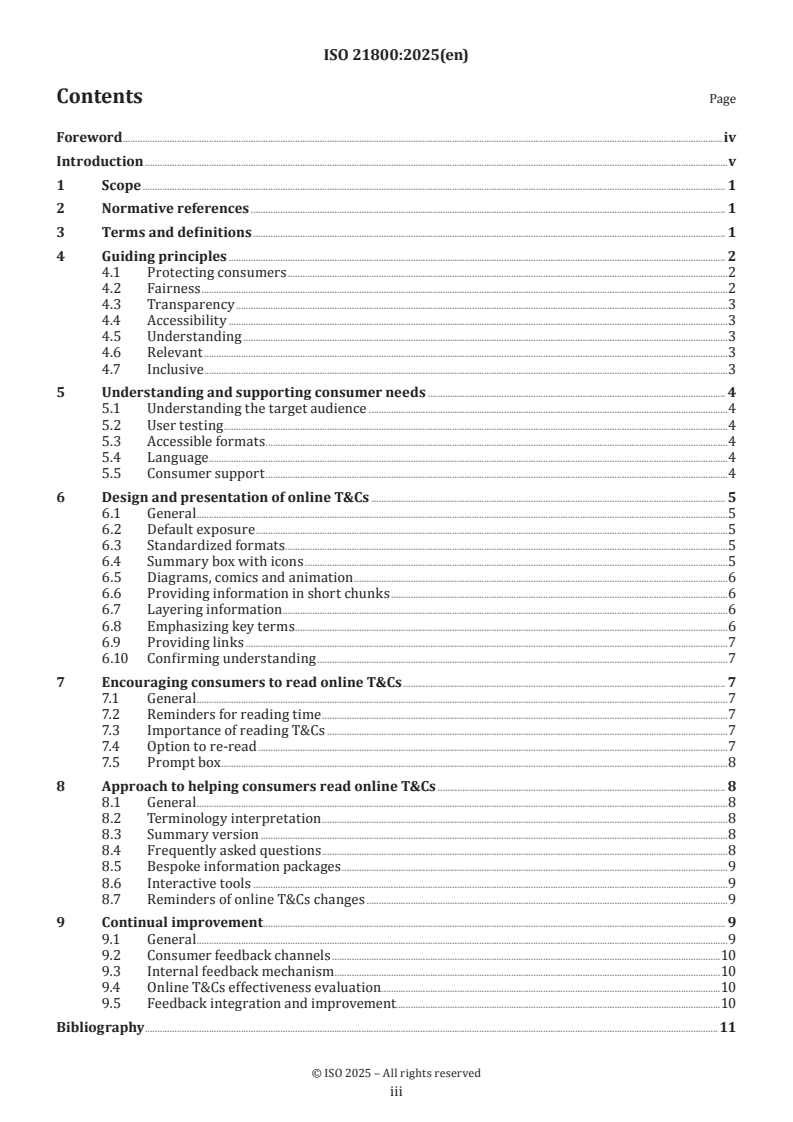
Contents Page
Foreword .iv
Introduction .v
1 Scope . 1
2 Normative references . 1
3 Terms and definitions . 1
4 Guiding principles . 2
4.1 Protecting consumers .2
4.2 Fairness .2
4.3 Transparency .3
4.4 Accessibility .3
4.5 Understanding .3
4.6 Relevant .3
4.7 Inclusive .3
5 Understanding and supporting consumer needs . 4
5.1 Understanding the target audience .4
5.2 User testing .4
5.3 Accessible formats . .4
5.4 Language .4
5.5 Consumer support .4
6 Design and presentation of online T&Cs . 5
6.1 General .5
6.2 Default exposure .5
6.3 Standardized formats .5
6.4 Summary box with icons .5
6.5 Diagrams, comics and animation .6
6.6 Providing information in short chunks .6
6.7 Layering information .6
6.8 Emphasizing key terms . .6
6.9 Providing links .7
6.10 Confirming understanding .7
7 Encouraging consumers to read online T&Cs . 7
7.1 General .7
7.2 Reminders for reading time .7
7.3 Importance of reading T&Cs .7
7.4 Option to re-read .7
7.5 Prompt box .8
8 Approach to helping consumers read online T&Cs . 8
8.1 General .8
8.2 Terminology interpretation .8
8.3 Summary version .8
8.4 Frequently asked questions .8
8.5 Bespoke information packages .9
8.6 Interactive tools .9
8.7 Reminders of online T&Cs changes .9
9 Continual improvement . . 9
9.1 General .9
9.2 Consumer feedback channels .10
9.3 Internal feedback mechanism.10
9.4 Online T&Cs effectiveness evaluation.10
9.5 Feedback integration and improvement.10
Bibliography .11
iii
Foreword
ISO (the International Organization for Standardization) is a worldwide federation of national standards
bodies (ISO member bodies). The work of preparing International Standards is normally carried out through
ISO technical committees. Each member body interested in a subject for which a technical committee
has been established has the right to be represented on that committee. International organizations,
governmental and non-governmental, in liaison with ISO, also take part in the work. ISO collaborates closely
with the International Electrotechnical Commission (IEC) on all matters of electrotechnical standardization.
The procedures used to develop this document and those intended for its further maintenance are described
in the ISO/IEC Directives, Part 1. In particular, the different approval criteria needed for the different types
of ISO document should be noted. This document was drafted in accordance with the editorial rules of the
ISO/IEC Directives, Part 2 (see www.iso.org/directives).
ISO draws attention to the possibility that the implementation of this document may involve the use of (a)
patent(s). ISO takes no position concerning the evidence, validity or applicability of any claimed patent
rights in respect thereof. As of the date of publication of this document, ISO had not received notice of (a)
patent(s) which may be required to implement this document. However, implementers are cautioned that
this may not represent the latest information, which may be obtained from the patent database available at
www.iso.org/patents. ISO shall not be held responsible for identifying any or all such patent rights.
Any trade name used in this document is information given for the convenience of users and does not
constitute an endorsement.
For an explanation of the voluntary nature of standards, the meaning of ISO specific terms and expressions
related to conformity assessment, as well as information about ISO’s adherence to the World Trade
Organization (WTO) principles in the Technical Barriers to Trade (TBT), see www.iso.org/iso/foreword.html.
This document was prepared by Project Committee ISO/PC 335, Guidelines for organizations to increase
consumer understanding of online terms and conditions.
Any feedback or questions on this document should be directed to the user’s national standards body. A
complete listing of these bodies can be found at www.iso.org/members.html.
iv
Introduction
Improving consumer understanding of online terms and conditions (online T&Cs) is a matter of increasing
relevance and importance to consumers as global markets and e-commerce flourish. Most organizations
tend to apply a set of online T&Cs to govern the sale or supply of goods, services or digital content. They set
out, in writing, the extent of the organization’s and consumer’s rights and responsibilities under the sale and
the demarcated risk between them. Clear, accessible, fair and easy-to-understand online T&Cs are vital for
consumers to make a fully informed decision prior to purchase or use of goods, services or digital content,
and to access redress when they are dissatisfied with the product that they have purchased.
Like T&Cs in most consumer contracts, online T&Cs are not negotiated between parties. They are standard
terms, on a “take it or leave it basis”. Consumers are obliged to acquiesce and comply with the T&Cs while
purchasing or using the goods, services or digital content. As the organization drafts the online T&Cs, there
is a risk that these online T&Cs can be drafted to favour the organization rather than the consumer. This can
exacerbate the weaker position the consumer holds in the relationship, making it more likely that detriment
will occur.
In addition, since online T&Cs are often complicated, long and involve legal jargon, evidence shows that a very
small proportion of consumers properly read or understand them. This can make it difficult for consumers
to make informed choices and can result in a range of negative outcomes (e.g. not fully understanding what
they have agreed to or difficulties enforcing their rights). Informed individual choice is important because it
helps drive innovation and competition, which boosts productivity and supports well-functioning markets.
Organizations and consumers are interdependent. Enhancing consumers’ understanding and interpretation
of online T&Cs is conducive to consumers making informed decisions, which can minimize or prevent
aftercare issues, ultimately saving organizations time and money. Meanwhile, a consumer can recognize
that an organization has made an effort for them, which helps the organization to establish a good corporate
image, improves the consumer’s trust, strengthens brand loyalty and enhances market competitiveness.
This document provides guidance for organizations to increase consumer understanding of online T&Cs,
aiming to protect the interests of consumers and increase confidence and trust between organizations and
consumers in the digital economy.
Organizations should consider how they will apply and present T&Cs during the product design stage in
order to enable the best engagement techniques.
v
International Standard ISO 21800:2025(en)
Guidance for organizations to increase consumer
understanding of online terms and conditions
1 Scope
This document gives guidance to organizations on creating clear, accessible, fair and easy-to-understand
online terms and conditions (T&Cs).
This document is applicable to drafting business-to-consumer online T&Cs, including websites facilitating
consumer-to-consumer sales, such as online auction sites. It does not apply to consumer-to-consumer and
business-to-business online T&Cs.
2 Normative references
There are no normative references in this document.
3 Terms and definitions
For the purposes of this document, the following terms and definitions apply.
ISO and IEC maintain terminology databases for use in standardization at the following addresses:
— ISO Online browsing platform: available at https:// www .iso .org/ obp
— IEC Electropedia: available at https:// www .electropedia .org/
3.1
accessibility
extent to which products, systems, services, documents, information, environments and facilities can be
used by people from a population with the widest range of user needs, characteristics and capabilities to
achieve identified goals in identified contexts of use
[SOURCE: ISO 25550:2022, 3.2, modified — “documents, “information” added.]
3.2
consumer
individual member of the general public who is the end user of goods, services and/or digital content (3.5)
for their own private/domestic use
Note 1 to entry: The term “consumer” includes users and potential end users.
Note 2 to entry: The end user is not necessarily the customer who purchased.
[SOURCE: ISO/IEC Guide 76:2020, 3.5, modified — “goods, services and/or digital content for their own
private/domestic use” replaced “services or service-related goods (e.g. a smart speaker)”. Examples deleted
from Notes 1 and 2 to entry.]
3.3
vulnerable consumer
state in which an individual can be placed at risk of harm during their interaction with a service provider
due to the presence of personal, situational and market environment factors
[SOURCE: ISO 22458:2022, 3.5, modified — “vulnerable consumer” replaced “consumer vulnerability” as the
term.]
3.4
data
representation of information in a formal manner suitable for communication, interpretation or processing
by human beings or computers
[SOURCE: ISO 10303-2:2024, 3.1.207]
3.5
digital content
data (3.4) which are produced and supplied in digital form
3.6
organization
person or group of persons operating the digital platform that has its own functions with responsibilities,
authorities and relationships to achieve its objectives
Note 1 to entry: The concept of organization includes, but is not limited to, sole-trader, company, corporation, firm,
enterprise, authority, partnership, association, charity or institution, or part or combination thereof, whether
incorporated or not, public or private.
1)
[SOURCE: ISO 9000:—, 3.1.1, modified — “persons operating the digital platform” replaced “people”. Note
2 to entry deleted.]
3.7
online terms and conditions
online T&Cs
agreement provided by an organization (3.6) through a digital platform (e.g. websites, apps, applets), which
provides an overview of the digital platform and sets out the rights, obligations and liabilities between the
organization and a consumer (3.2)
Note 1 to entry: Online T&Cs include, but are not limited to, user agreement, sales agreement, privacy policy, copyright
statement, disclaimer and usage terms.
3.8
key terms
key information that a consumer (3.2) needs to make a fully informed decision regarding whether or not to
enter into a contract, or whether and how to enforce their rights in the event of a dispute
Note 1 to entry: This information includes business identity and contact details (including offline contact details), the
quantity and quality of goods or services, price, unit price (where relevant) and return information.
Note 2 to entry: What is key information should be considered in the context of the specific contract.
4 Guiding principles
4.1 Protecting consumers
The organization should formulate, design and present online T&Cs from the perspective of protecting
consumers’ interests and enabling them to make fully informed decisions regarding the contract, to ensure:
a) a fair balance between business and consumer interests, minimizing risks of harm;
b) that consumers entering into contracts online receive at least the same level of protection as those
contracting offline.
4.2 Fairness
The organization should communicate with consumers fairly and honestly at all stages of their relationship.
1) Under preparation. Stage at the time of publication: ISO/DIS 9000:2025.
The organization should actively avoid practices that mislead and potentially cause harm to consumers,
particularly with respect to vulnerable consumers.
4.3 Transparency
The organization should provide complete, accurate and not misleading online T&Cs regarding the goods,
services and/or digital content. T&Cs should be clearly named, e.g. “Terms and Conditions”, and should
be easily accessible by one-click access from the website’s home
...
Questions, Comments and Discussion
Ask us and Technical Secretary will try to provide an answer. You can facilitate discussion about the standard in here.
Loading comments...