


ISO 16812:2007
(Main)Petroleum, petrochemical and natural gas industries — Shell-and-tube heat exchangers
Petroleum, petrochemical and natural gas industries — Shell-and-tube heat exchangers
ISO 16812:2007 specifies requirements and gives recommendations for the mechanical design, material selection, fabrication, inspection, testing and preparation for shipment of shell-and-tube heat exchangers for the petroleum, petrochemical and natural gas industries. ISO 16812:2007 is applicable to the following types of shell-and-tube heat exchangers: heaters, condensers, coolers and reboilers. ISO 16812:2007 is not applicable to vacuum-operated steam surface condensers and feed-water heaters.
Industries du pétrole, de la pétrochimie et du gaz naturel — Échangeurs de chaleur à faisceaux
L'ISO 16812:2007 spécifie les exigences et fournit des recommandations relatives à la conception mécanique, à la sélection des matériaux, à la fabrication, au contrôle, aux essais et à la préparation pour l'expédition des échangeurs de chaleur à faisceaux tubulaires pour les industries du pétrole, de la pétrochimie et du gaz naturel. L'ISO 16812:2007 s'applique aux types d'échangeurs de chaleur à faisceaux tubulaires suivants: les réchauffeurs, les condenseurs, les refroidisseurs et les rebouilleurs. L'ISO 16812:2007 ne s'applique pas aux condenseurs de vapeur d'eau et aux réchauffeurs d'eau d'alimentation de chaudière.
General Information
- Status
- Withdrawn
- Publication Date
- 11-Feb-2007
- Withdrawal Date
- 11-Feb-2007
- Technical Committee
- ISO/TC 67/SC 6 - Processing equipment and systems
- Drafting Committee
- ISO/TC 67/SC 6/WG 8 - Process heat transfer equipment
- Current Stage
- 9599 - Withdrawal of International Standard
- Start Date
- 31-Jan-2019
- Completion Date
- 12-Feb-2026
Relations
- Effective Date
- 12-Feb-2026
- Effective Date
- 06-Jun-2022
- Effective Date
- 05-Aug-2017
- Effective Date
- 15-Apr-2008


ISO 16812:2007 - Petroleum, petrochemical and natural gas industries -- Shell-and-tube heat exchangers
ISO 16812:2007 - Petroleum, petrochemical and natural gas industries -- Shell-and-tube heat exchangers
ISO 16812:2007 - Industries du pétrole, de la pétrochimie et du gaz naturel -- Échangeurs de chaleur a faisceaux


ISO 16812:2007 - Industries du pétrole, de la pétrochimie et du gaz naturel -- Échangeurs de chaleur a faisceaux
Get Certified
Connect with accredited certification bodies for this standard

DNV
DNV is an independent assurance and risk management provider.

Lloyd's Register
Lloyd's Register is a global professional services organisation specialising in engineering and technology.

ABS Quality Evaluations Inc.
American Bureau of Shipping quality certification.
Sponsored listings
Frequently Asked Questions
ISO 16812:2007 is a standard published by the International Organization for Standardization (ISO). Its full title is "Petroleum, petrochemical and natural gas industries — Shell-and-tube heat exchangers". This standard covers: ISO 16812:2007 specifies requirements and gives recommendations for the mechanical design, material selection, fabrication, inspection, testing and preparation for shipment of shell-and-tube heat exchangers for the petroleum, petrochemical and natural gas industries. ISO 16812:2007 is applicable to the following types of shell-and-tube heat exchangers: heaters, condensers, coolers and reboilers. ISO 16812:2007 is not applicable to vacuum-operated steam surface condensers and feed-water heaters.
ISO 16812:2007 specifies requirements and gives recommendations for the mechanical design, material selection, fabrication, inspection, testing and preparation for shipment of shell-and-tube heat exchangers for the petroleum, petrochemical and natural gas industries. ISO 16812:2007 is applicable to the following types of shell-and-tube heat exchangers: heaters, condensers, coolers and reboilers. ISO 16812:2007 is not applicable to vacuum-operated steam surface condensers and feed-water heaters.
ISO 16812:2007 is classified under the following ICS (International Classification for Standards) categories: 27.060.30 - Boilers and heat exchangers; 75.180.20 - Processing equipment. The ICS classification helps identify the subject area and facilitates finding related standards.
ISO 16812:2007 has the following relationships with other standards: It is inter standard links to EN ISO 16812:2007, ISO 161-1:1996, ISO 16812:2019, ISO 16812:2002. Understanding these relationships helps ensure you are using the most current and applicable version of the standard.
ISO 16812:2007 is available in PDF format for immediate download after purchase. The document can be added to your cart and obtained through the secure checkout process. Digital delivery ensures instant access to the complete standard document.
Standards Content (Sample)
INTERNATIONAL ISO
STANDARD 16812
Second edition
2007-02-15
Petroleum, petrochemical and natural gas
industries — Shell-and-tube heat
exchangers
Industries du pétrole, de la pétrochimie et du gaz naturel — Échangeurs
de chaleur à faisceaux
Reference number
©
ISO 2007
PDF disclaimer
PDF files may contain embedded typefaces. In accordance with Adobe's licensing policy, such files may be printed or viewed but shall
not be edited unless the typefaces which are embedded are licensed to and installed on the computer performing the editing. In
downloading a PDF file, parties accept therein the responsibility of not infringing Adobe's licensing policy. The ISO Central Secretariat
accepts no liability in this area.
Adobe is a trademark of Adobe Systems Incorporated.
Details of the software products used to create the PDF file(s) constituting this document can be found in the General Info relative to
the file(s); the PDF-creation parameters were optimized for printing. Every care has been taken to ensure that the files are suitable for
use by ISO member bodies. In the unlikely event that a problem relating to them is found, please inform the Central Secretariat at the
address given below.
This CD-ROM contains
1) the complete publication ISO 16812:2007 in portable document format (PDF), which can be viewed
using Adobe® Acrobat® Reader;
2) separate files of the two sets of data sheets, which duplicate the respective subclause of Annex C:
⎯ Clause C.2 — Data sheets (SI units),
⎯ Clause C.3 — Data sheets (USC units).
Adobe and Acrobat are trademarks of Adobe Systems Incorporated.
This second edition cancels and replaces the first edition (ISO 16812:2002), which has been technically
revised.
© ISO 2007
All rights reserved. Unless otherwise specified, no part of this CD-ROM may be reproduced, stored in a retrieval system or transmitted in
any form or by any means without prior permission from ISO. Requests for permission to reproduce th
...
INTERNATIONAL ISO
STANDARD 16812
Second edition
2007-02-15
Petroleum, petrochemical and natural gas
industries — Shell-and-tube heat
exchangers
Industries du pétrole, de la pétrochimie et du gaz naturel — Échangeurs
de chaleur à faisceaux
Reference number
©
ISO 2007
PDF disclaimer
This PDF file may contain embedded typefaces. In accordance with Adobe's licensing policy, this file may be printed or viewed but
shall not be edited unless the typefaces which are embedded are licensed to and installed on the computer performing the editing. In
downloading this file, parties accept therein the responsibility of not infringing Adobe's licensing policy. The ISO Central Secretariat
accepts no liability in this area.
Adobe is a trademark of Adobe Systems Incorporated.
Details of the software products used to create this PDF file can be found in the General Info relative to the file; the PDF-creation
parameters were optimized for printing. Every care has been taken to ensure that the file is suitable for use by ISO member bodies. In
the unlikely event that a problem relating to it is found, please inform the Central Secretariat at the address given below.
© ISO 2007
All rights reserved. Unless otherwise specified, no part of this publication may be reproduced or utilized in any form or by any means,
electronic or mechanical, including photocopying and microfilm, without permission in writing from either ISO at the address below or
ISO's member body in the country of the requester.
ISO copyright office
Case postale 56 • CH-1211 Geneva 20
Tel. + 41 22 749 01 11
Fax + 41 22 749 09 47
E-mail copyright@iso.org
Web www.iso.org
Published in Switzerland
ii © ISO 2007 – All rights reserved
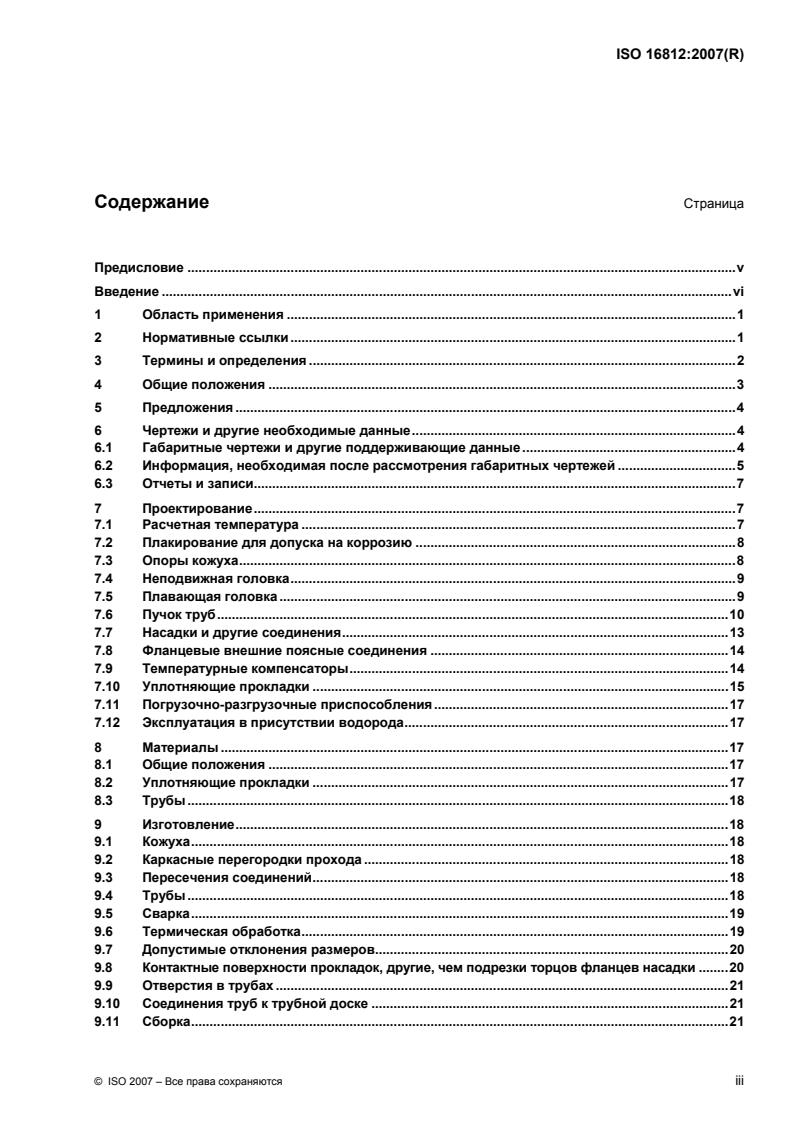
Contents Page
Foreword. v
Introduction . vi
1 Scope . 1
2 Normative references . 1
3 Terms and definitions. 2
4 General. 3
5 Proposals. 3
6 Drawings and other required data . 4
6.1 Outline drawings and other supporting data. 4
6.2 Information required after outline drawings are reviewed . 5
6.3 Reports and records. 6
7 Design . 7
7.1 Design temperature . 7
7.2 Cladding for corrosion allowance. 7
7.3 Shell supports . 7
7.4 Stationary head . 8
7.5 Floating head. 8
7.6 Tube bundle. 9
7.7 Nozzles and other connections. 12
7.8 Flanged external girth joints. 13
7.9 Expansion joints . 13
7.10 Gaskets . 14
7.11 Handling devices . 15
7.12 Hydrogen service. 15
8 Materials . 15
8.1 General. 15
8.2 Gaskets . 16
8.3 Tubes. 16
9 Fabrication. 16
9.1 Shells . 16
9.2 Pass-partition plates. 16
9.3 Connection junctions . 16
9.4 Tubes. 17
9.5 Welding . 17
9.6 Heat treatment. 17
9.7 Dimensional tolerances . 18
9.8 Gasket contact surfaces other than nozzle-flange facings. 18
9.9 Tube holes . 19
9.10 Tube-to-tubesheet joints. 19
9.11 Assembly . 19
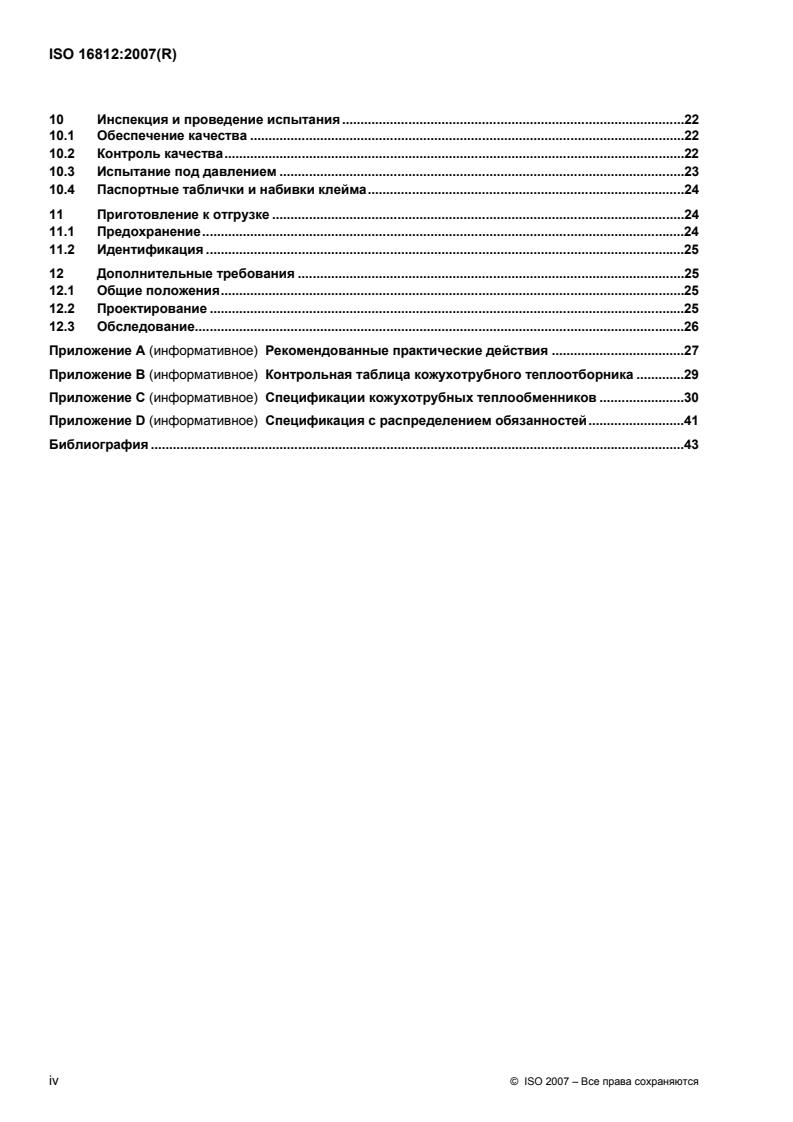
10 Inspection and testing. 20
10.1 Quality assurance. 20
10.2 Quality control. 20
10.3 Pressure testing. 21
10.4 Nameplates and stampings . 22
11 Preparation for shipment . 22
11.1 Protection. 22
11.2 Identification. 23
12 Supplemental requirements. 23
12.1 General . 23
12.2 Design . 23
12.3 Examination. 23
Annex A (informative) Recommended practices. 25
Annex B (informative) Shell-and-tube heat exchanger checklist . 27
Annex C (informative) Shell-and-tube heat exchanger data sheets . 28
Annex D (informative) Responsibility data sheet . 39
Bibliography . 41
iv © ISO 2007 – All rights reserved
Foreword
ISO (the International Organization for Standardization) is a worldwide federation of national standards bodies
(ISO member bodies). The work of preparing International Standards is normally carried out through ISO
technical committees. Each member body interested in a subject for which a technical committee has been
established has the right to be represented on that committee. International organizations, governmental and
non-governmental, in liaison with ISO, also take part in the work. ISO collaborates closely with the
International Electrotechnical Commission (IEC) on all matters of electrotechnical standardization.
International Standards are drafted in accordance with the rules given in the ISO/IEC Directives, Part 2.
The main task of technical committees is to prepare International Standards. Draft International Standards
adopted by the technical committees are circulated to the member bodies for voting. Publication as an
International Standard requires approval by at least 75 % of the member bodies casting a vote.
Attention is drawn to the possibility that some of the elements of this document may be the subject of patent
rights. ISO shall not be held responsible for identifying any or all such patent rights.
ISO 16812 was prepared by Technical Committee ISO/TC 67, Materials, equipment and offshore structures
for petroleum, petrochemical and natural gas industries, Subcommittee SC 6, Processing equipment and
systems.
This second edition cancels and replaces the first edition (ISO 16812:2002), which has been technically
revised.
Introduction
Users of this International Standard should be aware that further or differing requirements may be needed for
individual applications. This International Standard is not intended to inhibit a vendor from offering, or the
purchaser from accepting, alternative equipment or engineering solutions for the individual application. This
may be particularly applicable where there is innovative or developing technology. Where an alternative is
offered, the vendor should identify any variations from this International Standard and provide details.
Annex A provides some optional recommended practices.
A bullet (z) at the beginning of a clause or subclause indicates a requirement for the purchaser to make a
decision or provide information (see checklist in Annex B).
In this International Standard, where practical, US Customary (USC) units are included in parentheses for
information.
vi © ISO 2007 – All rights reserved
INTERNATIONAL STANDARD ISO 16812:2007(E)
Petroleum, petrochemical and natural gas industries —
Shell-and-tube heat exchangers
1 Scope
This International Standard specifies requirements and gives recommendations for the mechanical design,
material selection, fabrication, inspection, testing and preparation for shipment of shell-and-tube heat
exchangers for the petroleum, petrochemical and natural gas industries.
This International Standard is applicable to the following types of shell-and-tube heat exchangers: heaters,
condensers, coolers and reboilers.
This International Standard is not applicable to vacuum-operated steam surface condensers and feed-water
heaters.
2 Normative references
The following referenced documents are indispensable for the application of this document. For dated
references, only the edition cited applies. For undated references, the latest edition of the referenced
document (including any amendments) applies.
ISO 15156 (all parts), Petroleum and natural gas industries — Materials for use in H S-containing
environments in oil and gas production
1)
ASME B 16.5 , Pipe Flanges and Flanged Fittings
ASME B 16.11, Forged Fittings, Socket-Welding and Threaded
ASME B 1.20.1, Pipe Threads, General Purpose (Inch)
2)
EJMA , Standards of the Expansion Joint Manufacturers Association
3)
NACE MR0103 , Materials Resistant to Sulfide Stress Cracking in Corrosive Petroleum Refining
Environments
4) th
TEMA Standards Set , 8 Edition, Standards of the Tubular Exchanger Manufacturers Association
1) ASME International, 3 Park Avenue, New York, NY 10016-5990, USA.
2) Expansion Joint Manufacturers Association, 25 North Broadway, Tarrytown, NY 10591, USA.
3) NACE International, P.O. Box 218340, Houston, TX 77218-8340, USA.
4) Tubular Exchanger Manufacturers Association, 25 North Broadway, Tarrytown, NY 10591, USA.
3 Terms and definitions
For the purposes of this document, the following terms and definitions apply.
3.1
annular distributor
additional chamber incorporated into a shell side nozzle to more evenly distribute shell side fluids entering or
exiting the tube bundle
3.2
category A welded joint
longitudinal welded joint within the main shell, communicating chambers, nozzles or transitions in diameter; or
any welded joint within a sphere or within a formed or flat head; or circumferential welded joint connecting
hemispherical heads to main shells, to transitions in diameters or to communicating chambers
3.3
category B welded joint
circumferential welded joint within the main shell, communicating chambers, nozzles or transitions in diameter,
including joints between the transitions and a cylinder at either the large or small end; or circumferential
welded joint connecting formed heads, other than hemispherical, to main shells, to transitions in diameter, to
nozzles or to communicating chambers
3.4
communicating chamber
heat-exchanger appurtenance that intersects the shell or heads of the heat exchanger and forms an integral
part of the pressure-containing envelope
EXAMPLES Sump, annular distributor.
3.5
effective surface
outside surface area of the tubes that contributes to heat transfer
3.6
full-penetration weld
welded joint that results in weld metal through the entire thickness of the components being joined
3.7
heat-exchanger unit
one or more heat exchangers for a specified service that may include alternative operating conditions
3.8
hydrogen service
service that contains hydrogen at a partial pressure exceeding 700 kPa (100 psi) absolute
3.9
item number
purchaser's identification number for a heat-exchanger unit
3.10
nubbin
projection on the flange gasket surface, positioned at the centre of the gasket, used to concentrate the bolt
load on the gasket
3.11
pressure design code
recognized pressure vessel standard specified or agreed by the purchaser
EXAMPLES ASME Section VIII, EN 13445.
2 © ISO 2007 – All rights reserved
3.12
seal-welded
tube-to-tubesheet joint weld of unspecified strength applied between the tubes and tubesheets for the sole
purpose of reducing the potential for leakage
3.13
strength-welded
tube-to-tubesheet joint welded so that the design strength is equal to, or greater than, the axial tube strength
specified by the pressure design code
4 General
z 4.1 The pressure design code shall be specified or agreed by the purchaser. Pressure components shall
comply with the pressure design code and the supplemental requirements given in this International Standard.
th
4.2 Heat-exchanger construction shall conform to TEMA (8 edition), Class R, unless another TEMA class
is specified.
z 4.3 The vendor shall comply with the applicable local regulations specified by the purchaser.
4.4 Annex A includes some recommended mechanical and design details for information.
4.5 Annex B provides a checklist that can be used by the purchaser to ensure that bulletted items in this
International Standard are addressed.
4.6 Annex C provides examples of data sheets.
4.7 Annex D includes a recommended division of responsibility for completing the data sheet.
5 Proposals
5.1 The vendor's proposal shall include, for each heat exchanger unit, completed data sheets such as those
given in Annex C or, if a data sheet is included in the inquiry, a statement indicating complete compliance with
that data sheet.
th
5.2 Designs that are not fully defined by the nomenclature in TEMA (8 edition), Section 1, shall be
accompanied by sketches that are sufficient to describe the details of construction.
5.3 If an annular distributor is provided, the vendor shall define the type of construction proposed.
5.4 The vendor shall determine the need for, and if required, include expansion joints based on all
conditions supplied by the purchaser. The vendor shall state the type of construction proposed.
5.5 The proposal shall include a detailed description of all exceptions to the requirements of the purchaser's
inquiry.
5.6 For stacked heat exchangers, the vendor shall supply the following components unless otherwise
specified by the purchaser:
a) bolts, nuts and gaskets for interconnecting nozzles;
b) shims and bolting for interconnecting supports.
5.7 The vendor shall provide a separate quotation for the following items unless otherwise specified by the
purchaser:
th
a) a test component consisting of a test ring and gland, in accordance with TEMA (8 edition),
Figure E-4.13-2 or equivalent, for each heat exchanger or group of similar heat exchangers with floating
heads;
b) one spare set of gaskets per heat-exchanger unit.
6 Drawings and other required data
6.1 Outline drawings and other supporting data
6.1.1 The vendor shall submit, for review by the purchaser, outline drawings for each heat exchanger unit.
The drawings shall include the following information:
a) service, item number, project name and location, purchaser's order number, vendor's shop order number
and other special identification numbers;
b) design pressure, test pressure, design temperature, minimum design metal temperature and any
restriction on testing or operation of the heat exchanger;
c) maximum allowable working pressure (MAWP) in the corroded condition and at the design temperature
for the shell side and tube side;
d) connection sizes, location, orientation, projection, direction of flow and, if flanged, the rating and facing;
e) coupling sizes, rating and orientation;
f) dimensions, orientation and location of supports, including bolt holes and slots, and the stacking
arrangement;
g) overall dimensions of the heat exchanger;
h) tube-bundle removal clearance;
i) mass of the heat exchanger, empty and full of water, and of removable components with a mass greater
than 25 kg (60 lb) (e.g. removable tube bundle, channel, channel cover and shell cover);
j) specified corrosion allowance for each side of the heat exchanger;
k) references to the applicable code and the purchaser's specification;
l) requirements for post-weld heat treatment;
m) requirements for radiographic examination;
n) requirements for material impact testing;
o) requirements for surface preparation and painting;
p) gasket materials;
q) insulation thickness;
r) location of expansion joints, annular distributors and any other special components or closures;
s) location and orientation of nameplates, lifting lugs, grounding clips or other attachments;
4 © ISO 2007 – All rights reserved
t) location of the centre of gravity of the heat exchanger;
u) forces and moments on connections as specified by the purchaser.
z 6.1.2 The vendor shall submit flow-induced vibration analysis, if specified by the purchaser.
6.2 Information required after outline drawings are reviewed
6.2.1 Gasket details, including type and material, shall be shown on a separate drawing. This drawing shall
not be marked with any restrictions for use.
z 6.2.2 Qualified welding procedure specifications and procedure qualification records as required by the
pressure design code shall be submitted for review, if specified by the purchaser.
6.2.3 Upon receipt of the purchaser's review comments on the outline drawings, the vendor shall submit
copies of all detailed drawings. These shall fully describe the heat exchanger and shall include at least the
following information:
a) full views and cross-sectional views with all dimensions and materials sufficient for stress calculations for
each part;
b) bundle details, including the following:
⎯ tube layout,
⎯ tube description and number in each pass,
⎯ number of baffles, cross-baffle cut, layout and orientation in a view that shows the cuts,
⎯ details and locations of all sealing and sliding strips,
⎯ details and locations of tie-rods and spacers,
⎯ details and locations of support plates,
⎯ details of tubesheet and tube holes, including cladding or weld overlay if required,
⎯ gasket drawings,
⎯ details of pass-partition plates;
c) details of each pressure-retaining weld, including weld material, weld nominal thickness, weld location
and applicable non-destructive examination method;
d) details of each weld and weld nominal thickness for non-pressure attachments;
e) complete bills of materials, including the material specification;
f) expansion joint details;
g) details of cladding and weld overlay;
h) weld map for each heat exchanger showing the weld joints, including welding procedure number(s);
i) details of tube-to-tubesheet joints, including procedures for installation, welding, expansion, inspection
and testing;
j) flange-face finish;
k) special installation and maintenance instructions including lifting and handling.
6.2.4 The vendor shall submit for the purchaser's review the following documentation.
a) Mechanical design calculations for all the heat exchanger pressure-retaining components. If calculations
are made on a computer, all input and output data shall be detailed so as to facilitate an understanding of
the calculation procedures. The formulas in the applicable sections of the pressure design code and
TEMA shall be referenced.
b) Design calculations based on seismic, wind, transportation and/or piping loads, if these loads are
provided by the purchaser.
c) Proposed procedures for assembly of flanged joints, if controlled bolt-tightening procedures (such as
hydraulic torque wrenches or hydraulic tensioning devices) are used. Any required lubricants shall be
stated.
d) Design calculations for thermal loads imposed on nozzles of stacked heat exchangers.
z 6.2.5 The vendor shall submit design calculations for supports or lifting and pulling devices, if specified by
the purchaser.
6.2.6 After final review, the vendor shall revise all the required drawings and welding procedures and
submit each with the following text marked on every sheet separately and dated: “CERTIFIED FOR
CONSTRUCTION”.
6.3 Reports and records
z After the heat exchanger is completed the vendor shall furnish the purchaser with the following documents in
the format and quantities specified by the purchaser:
a) “as-built” data sheet;
b) all outline and detail drawings, marked “CERTIFIED AS-BUILT”;
c) certified record of all impact tests performed;
d) certified mill test reports for all pressure parts, including tubes (each material test report shall be identified
by a part number);
e) complete certified bill of materials suitable for obtaining all replacement parts, including quantity,
description, material specification and identification of each part;
f) temperature charts of all post-weld heat treatments;
g) completed manufacturer's data report in accordance with the pressure design code;
h) nameplate rubbing or a facsimile;
i) all mechanical design calculations, marked “CERTIFIED AS-BUILT”;
j) non-destructive examination (NDE) map;
k) all associated NDE reports, including radiographic, magnetic-particle, liquid-penetrant, ultrasonic,
hardness, impact, positive material identification (PMI) and any other reports as applicable;
l) tube-to-tubesheet leak-test results;
m) hydrostatic test records in the form of a chart or certification.
6 © ISO 2007 – All rights reserved
7 Design
7.1 Design temperature
z 7.1.1 All heat exchangers shall have two design temperatures for each side, a maximum design
temperature and a minimum design metal temperature (MDMT), as specified by the purchaser (e.g. in the
form shown in Annex C).
7.1.2 The design temperature of a component (including external bolting) influenced by both the shell side
and tube side fluids shall be the shell side or tube side design temperature, whichever is the more severe.
z 7.1.3 The input data needed to design an expansion joint shall be provided by the purchaser (e.g. in the
form shown in Annex C).
7.2 Cladding for corrosion allowance
7.2.1 If cladding (including weld overlay) is used, the full thickness of the cladding shall be used as
corrosion allowance unless specified otherwise or approved by the purchaser.
7.2.2 The minimum cladding thickness at the tube side face of a tubesheet shall not be less than 10 mm
(3/8 in) when tubes are expanded only, and 5 mm (3/16 in) when tubes are welded to the tubesheet. The
minimum cladding thickness on the shell side face shall not be less than 10 mm (3/8 in). Weld overlays shall
have sufficient thickness to provide the specified chemical composition to a depth of at least 1,5 mm (1/16 in).
7.3 Shell supports
7.3.1 The fixed shell support of removable-bundle heat exchangers shall be designed to withstand a
longitudinal force equal to 150 % of the bundle mass applied at the heat exchanger bundle centreline. The
shear stress for supports shall not exceed 40 % of the yield strength of the material.
7.3.2 Horizontal heat exchangers shall be provided with two or more saddles designed to support the heat
exchanger under all specified conditions. Design of the saddles shall be as follows.
a) Saddles shall be attached to saddle-bearing plates.
b) The bearing surface of the saddles shall be at least one-third of the circumference of the shell.
c) The saddle-bearing plates shall have the same nominal chemical composition as the shell and shall be
continuously welded directly to the heat exchanger shells.
d) The saddle-bearing plates shall be provided with vent holes 6 mm (1/4 in) in diameter, located at the
vertical centreline.
e) The saddle-bearing plates shall be at least 6 mm (1/4 in) thick and shall have all corners rounded to a
radius of at least 25 mm (1 in).
7.3.3 The lower shells of stacked removable-bundle heat exchangers shall be designed to carry the
superimposed loads without suffering distortion that can cause binding of the tube bundles.
7.3.4 The vendor’s design shall provide for a shim allowance of approximately 6 mm (1/4 in) between the
faces of stacked heat exchanger intermediate supports.
7.3.5 For horizontal heat exchangers, slotted holes shall be provided in the baseplate of all but one of the
saddles, to allow for longitudinal movement due to thermal expansion or contraction. The width of the slot
shall be equal to the anchor bolt diameter plus 8 mm (5/16 in). The length of the slot shall be equal to the
anchor bolt diameter, plus the allowance for longitudinal movement, plus 8 mm (5/16 in).
7.4 Stationary head
7.4.1 Structural bracing shall not be used to retain pressure.
7.4.2 The pressure differential used to calculate the pass-partition plate thickness in accordance with
th
TEMA (8 edition), RCB-9.132, shall be the allowable tube-side pressure drop of the entire exchanger unit.
7.5 Floating head
th
7.5.1 Floating-head cover bolting shall comply with TEMA (8 edition), Section 5, Paragraph RCB-11. Bolt
spacings and clearances shall be not less than the minimum recommended by TEMA.
7.5.2 Floating-head cover bolting shall be readily accessible and shall have adequate spanner (wrench)
clearance between the floating-head bolts and the shell flange at the cover end when the shell cover is
removed.
7.5.3 Packed floating-head tailpipe and packed floating tubesheet designs (e.g. TEMA types P and W) shall
not be used.
7.5.4 Floating heads shall be designed for design pressure on either side, with atmospheric pressure or
vacuum (if specified) on the other side, unless otherwise specified by the purchaser. Examples of acceptable
floating-head designs are shown in Figure 1.
a) Ring and dish construction b) Flange and dish construction c) Integral construction
Key
1 ring
2 gasket
3 dish
4 full-penetration weld
5 flange
6 integral machined cover
Figure 1 — Typical designs for floating-head covers
7.5.5 Internal floating-head covers shall have the specified corrosion allowance on all wetted surfaces
except gasket-seating surfaces. The specified corrosion allowance shall be included on the back side of the
floating-head backing device.
8 © ISO 2007 – All rights reserved
7.6 Tube bundle
7.6.1 Tubes
7.6.1.1 The minimum outside diameter of the tubes shall be 19,05 mm (3/4 in) unless otherwise specified
or approved by the purchaser.
7.6.1.2 The tube-wall thickness shall be as listed in Table 1, or thicker if required by the design conditions,
unless otherwise specified or approved by the purchaser.
Table 1 — Minimum wall thickness of tubes
Dimensions in millimetres (inches)
a
Tube material
Minimum wall thickness
Carbon steel, low-alloy steel (max. 9 % chromium), aluminium and 2,11 (0,083)
aluminium alloy
Copper and copper alloys 1,65 (0,065)
High-alloy [austenitic, ferritic and austenitic/ferritic (duplex)] steel and 1,473 (0,058)
other non-ferrous materials
Titanium 1,067 (0,042)
a
For low-fin tubing, this shall be the minimum thickness at the root diameter.
7.6.1.3 The mean radius of U-bends shall be not less than 1,5 times the nominal outside diameter of the
tube.
7.6.2 Tubesheets
7.6.2.1 For a vertical heat exchanger where the stationary tubesheet is at the bottom, a suitable means of
holding the bundle in place shall be provided. If collar bolts or drilled-and-tapped holes are used, at least four
shall be provided and their location shall be identified on the drawings and by stamped markings on the OD of
the tubesheet.
7.6.2.2 The distance between the edge of the tube holes and the edge of all gasket grooves shall be not
less than 1,5 mm (1/16 in) for tubesheets with expanded tube-to-tubesheet joints and not less than 3 mm
(1/8 in) for tubesheets with seal-welded or strength-welded tube-to-tubesheet joints.
7.6.2.3 Tubesheets shall be designed for design pressure on either side, with atmospheric pressure or
vacuum, if specified, on the other side unless otherwise specified or approved by the purchaser.
7.6.2.4 A full-diameter stationary tubesheet shall be provided for removable bundle exchangers with
th
bonnets [see TEMA (8 edition), Figure N-1.2, Type B stationary head]. The tubesheet shall be designed to
maintain the gasket seal through the use of collar studs or tapped tubesheet holes and allow hydrotesting of
the shell side without the bonnet installed.
7.6.3 Baffles and support plates
7.6.3.1 The thickness of carbon steel or low-alloy steel (max. 9 % chromium) transverse baffles and
support plates shall be not less than twice the specified shell side corrosion allowance.
7.6.3.2 Transverse baffles and support plates shall have notches that are 10 mm (3/8 in) high to facilitate
drainage.
7.6.3.3 If shell-side longitudinal baffles are used, the minimum clearance between the longitudinal baffle
and the adjacent tubes shall be 3 mm (1/8 in).
7.6.4 Impingement protection
th
7.6.4.1 If required by TEMA (8 edition), RCB-4.61, impingement protection shall be provided by a plate
baffle or rods on the tube bundle, an annular distributor or another means agreed upon by the purchaser and
the vendor.
7.6.4.2 If an impingement plate baffle is used, it shall extend at least 25 mm (1 in) beyond the projection
of the nozzle bore.
7.6.4.3 If an impingement plate baffle is used, the shell entrance and bundle entrance areas (as defined
by TEMA) shall be not less than the flow area of the inlet nozzle.
7.6.4.4 The nominal thickness of the impingement plate baffle shall be not less than 6 mm (1/4 in).
7.6.4.5 The impingement plate baffle shall be adequately supported (e.g. by welding to at least two
spacers) to avoid mechanical damage due to vibration.
7.6.4.6 Perforated impingement plate baffles shall not be used.
7.6.5 Bypass-sealing devices
7.6.5.1 Bypass-sealing devices (such as seal bars, dummy tubes or tie-rods as shown in Figure 2) shall
be used for non-isothermal service if bypass clearances exceed 16 mm (5/8 in) and shall be located as follows.
a) If the distance between baffle-cut edges is six tube pitches or less, a single seal, located approximately
halfway between the baffle cuts, shall be provided.
b) If the distance between baffle-cut edges exceeds six tube pitches, multiple seals shall be provided. A seal
shall be located every five to seven tube pitches between the baffle cuts, with the outermost seals not
more than 75 mm (3 in) from each baffle-cut edge.
7.6.5.2 Peripheral bypass seals shall extend from the peripheral edge of the transverse baffle into the
tube bundle so that the clearance to the nearest tube does not exceed the nominal clearance between tubes.
7.6.5.3 Internal bypass seals shall be installed so that the clearance to the nearest tube does not exceed
the nominal clearance between tubes.
7.6.5.4 Bypass sealing devices shall either be located to minimize obstruction of mechanical cleaning
lanes or shall be readily removable. Continuous cleaning lanes shall be maintained for square (90°) and
rotated-square (45°) pitch.
7.6.5.5 The nominal thickness of seal strips shall be the nominal thickness of the transverse baffles or
6 mm (1/4 in), whichever is less.
7.6.5.6 Bypass seal strips shall be attached to the transverse baffles by continuous welds on one side of
each baffle.
7.6.5.7 The leading and trailing edges of seal strips shall be provided with a radius or a bevel to prevent
damage to the shell when inserting or removing the bundle.
7.6.5.8 Peripheral bypass-seal strips shall not restrict the bundle inlet or outlet flows.
10 © ISO 2007 – All rights reserved
Key
1 peripheral edge of baffle 9 single seal on centreline
2 tie rods, dummy tubes or flat bar 10 multiple seals, evenly spaced
3 edge of baffle cut 11 edge of baffle cut
4 plane of U-tube bend 12 plane of U-tube bend
5 detail of seals and tube clearance 13 U-tube bend
6 tubes 14 impingement plate
7 seal 15 peripheral bundle bypass lane
8 clearance: not to exceed nominal clearance between tubes 16 internal bundle bypass lane
Figure 2 — Typical cross-sections of tube bundle showing locations of bypass sealing devices
7.6.6 Bundle skid bars
7.6.6.1 For all removable bundles with a mass of more than 5 450 kg (12 000 lb), continuous sliding
surfaces shall be provided to facilitate bundle removal.
7.6.6.2 If skid bars are used, the following shall apply.
a) A minimum of two skid bars shall be provided.
b) They shall not be situated in the projected area of the nozzles.
c) They shall be welded to the transverse baffles and support plates.
d) They shall protrude 0,8 mm (1/32 in) beyond the outside diameter of baffle and support plates.
e) Their leading and trailing edges shall be provided with a radius or a bevel to prevent damage to the shell
when inserting or removing the bundle.
7.6.7 Tube-to-tubesheet joint
The tube-to-tubesheet joint shall be expanded only, unless otherwise specified or approved by the purchaser.
If welded joints are specified, the joint shall be made by one of the following methods:
a) strength-welded only;
b) strength-welded and expanded;
c) seal-welded and expanded.
7.7 Nozzles and other connections
z 7.7.1 Connections DN 40 (NPS 1½) and larger shall be flanged. The purchaser shall specify the required
flange design code (e.g. ASME B16.5).
7.7.2 If welded connections are specified, they shall be bevelled.
7.7.3 Non-flanged connections smaller than DN 40 (NPS 1½) shall be forged couplings with an equivalent
rating to ASME B 16.11 class 6000 or shall be integrally reinforced welding fittings with tapered threads
equivalent to ASME B 1.20.1, and shall comply with the pressure design code. Threaded connections shall
not be used in hydrogen or sour service.
7.7.4 Flanged connections shall be of one of the following types:
a) forged integrally flanged;
b) pipe or forged cylinder welded to forged welding-neck flange;
c) pipe welded to a forged slip-on flange, except as noted in 7.7.5.
7.7.5 Slip-on flanges shall not be used in any of the following conditions:
a) design pressure greater than 2 100 kPa (300 psi) gauge;
b) design temperature greater than 400 °C (750 °F);
c) corrosion allowance greater than 3 mm (1/8 in);
d) hydrogen service;
e) cyclic service, if the pressure design code requires fatigue analysis.
z 7.7.6 The projection of flanged connections shall allow through-bolting to be removed from either side of the
flange without removing the insulation. The insulation thickness shall be specified by the purchaser.
7.7.7 Integrally reinforced nozzles shall be designed so that standard spanners (wrenches) fit the nuts
without interference from nozzle neck reinforcement.
z 7.7.8 If chemical-cleaning connections are specified by the purchaser, their nominal size shall be not less
than DN 50 (NPS 2).
z 7.7.9 The design of connections shall be suitable to withstand the loads and moments specified by the
purchaser.
12 © ISO 2007 – All rights reserved
7.8 Flanged external girth joints
7.8.1 Channel and shell external girth joints shall be of through-bolted construction.
7.8.2 Flanges for external girth joints shall be of the forged welding-neck type unless otherwise specified or
approved by the purchaser.
7.8.3 Nubbins shall not be used unless approved by the purchaser, in which case nubbins shall be located
on the female (grooved) flange.
7.8.4 The nominal clearance between flanges after assembly shall be not less than 3 mm (1/8 in). The
clearance between flanges shall extend within the bolt circle to allow flanges to be checked for radial distortion
caused by an excessive bolt load.
7.8.5 Flanges shall be spot-faced or back-faced to the extent required by ASME B 16.5 or the pressure
design code.
7.8.6 Hardened washers shall be provided under nuts for all bolts having diameters of 38 mm (11/2 in) or
larger. The washers shall be at least 6 mm (1/4 in) thick.
z 7.8.7 If the use of bolt-tightening devices is specified by the purchaser, nozzles or girth flanges shall be
designed to allow adequate clearance.
7.8.8 Stationary tubesheet flange assembly shall be designed with the same type of gasket on the tube side
and shell side, i.e. with similar compressive characteristics.
7.8.9 Allowable stresses that have been established on the basis of short-time tensile strength shall not be
used for the design of girth flanges, gasketed tubesheets and gasketed flat covers.
NOTE 1 These allowable stresses can cause permanent deformation.
NOTE 2 In ASME Section II, the allowable stresses of some high-nickel alloys have been established in this way.
7.9 Expansion joints
7.9.1 Expansion joints shall be thin-wall bellows or thick walled (e.g. flanged or flanged and flued).
7.9.2 Expansion joints made of thin-walled bellows shall comply with the following.
a) They shall be protected from internal damage with a metallic liner mounted flush with the inside of the
shell. The liner material shall be compatible with the base material to which it is attached. Carbon-steel
liners shall be at least 6 mm (1/4 in) thick. Liners of stainless steel or other alloys shall be at least 3 mm
(1/8 in) thick. For vertically mounted bellows, the liner shall be attached at the top and open at the bottom
to allow for free drainage.
b) They shall be protected from external damage with a metallic cover that is designed to remain intact
during shipping, handling and operation.
c) They shall be designed to meet the requirements of the pressure design code. In no case shall the cycle
life, as calculated by EJMA, be less than 1 000 normal operating cycles.
d) They shall have the bellows formed from a cylinder that has only longitudinal weld seams.
e) Bellow welds, including attachment welds, shall be 100 % examined by the liquid-penetrant method. The
acceptance criteria shall comply with the pressure design code.
f) They shall be designed with stays to prevent damage during shipping and handling. Stays that require
removal or adjustment prior to operation shall be clearly identified.
g) Floating-head tailpipe expansion joints shall be fitted with permanent stays that prevent damage during
maintenance and hydrostatic testing with the shell cover removed. The stays shall permit the expansion
joint’s full design m
...
NORME ISO
INTERNATIONALE 16812
Deuxième édition
2007-02-15
Industries du pétrole, de la pétrochimie et
du gaz naturel — Échangeurs de chaleur
à faisceaux
Petroleum, petrochemical and natural gas industries — Shell-and-tube
heat exchangers
Numéro de référence
©
ISO 2007
PDF – Exonération de responsabilité
Le présent fichier PDF peut contenir des polices de caractères intégrées. Conformément aux conditions de licence d'Adobe, ce fichier
peut être imprimé ou visualisé, mais ne doit pas être modifié à moins que l'ordinateur employé à cet effet ne bénéficie d'une licence
autorisant l'utilisation de ces polices et que celles-ci y soient installées. Lors du téléchargement de ce fichier, les parties concernées
acceptent de fait la responsabilité de ne pas enfreindre les conditions de licence d'Adobe. Le Secrétariat central de l'ISO décline toute
responsabilité en la matière.
Adobe est une marque déposée d'Adobe Systems Incorporated.
Les détails relatifs aux produits logiciels utilisés pour la création du présent fichier PDF sont disponibles dans la rubrique General Info
du fichier; les paramètres de création PDF ont été optimisés pour l'impression. Toutes les mesures ont été prises pour garantir
l'exploitation de ce fichier par les comités membres de l'ISO. Dans le cas peu probable où surviendrait un problème d'utilisation,
veuillez en informer le Secrétariat central à l'adresse donnée ci-dessous.
DOCUMENT PROTÉGÉ PAR COPYRIGHT
© ISO 2007
Droits de reproduction réservés. Sauf prescription différente, aucune partie de cette publication ne peut être reproduite ni utilisée sous
quelque forme que ce soit et par aucun procédé, électronique ou mécanique, y compris la photocopie et les microfilms, sans l'accord écrit
de l'ISO à l'adresse ci-après ou du comité membre de l'ISO dans le pays du demandeur.
ISO copyright office
Case postale 56 • CH-1211 Geneva 20
Tel. + 41 22 749 01 11
Fax + 41 22 749 09 47
E-mail copyright@iso.org
Web www.iso.org
Version française parue en 2008
Publié en Suisse
ii © ISO 2007 – Tous droits réservés
Sommaire Page
Avant-propos. v
Introduction . vi
1 Domaine d'application. 1
2 Références normatives . 1
3 Termes et définitions. 2
4 Généralités . 3
5 Offres. 3
6 Plans et autres données requises. 4
6.1 Plans d'encombrement et autres éléments justificatifs . 4
6.2 Informations requises après examen des plans d'encombrement . 5
6.3 Rapports et enregistrements. 6
7 Conception . 7
7.1 Température de calcul. 7
7.2 Placage utilisé comme surépaisseur de corrosion. 7
7.3 Supports de calandres . 7
7.4 Tête fixe . 8
7.5 Tête flottante . 8
7.6 Faisceau de tubes. 9
7.7 Tubulures et autres connexions . 13
7.8 Brides de corps. 14
7.9 Compensateurs de dilatation . 14
7.10 Joints d'étanchéité . 15
7.11 Dispositifs de manutention. 16
7.12 Service d'hydrogène. 16
8 Matériaux . 17
8.1 Généralités . 17
8.2 Garnitures d'étanchéité. 17
8.3 Tubes. 17
9 Fabrication. 17
9.1 Calandres. 17
9.2 Cloisons de séparation de passes. 18
9.3 Assemblage des piquages. 18
9.4 Tubes. 18
9.5 Soudage. 18
9.6 Traitement thermique . 19
9.7 Tolérances dimensionnelles. 20
9.8 Portées de joint autres que celles de brides de tubulures. 20
9.9 Trous de tubes . 21
9.10 Assemblages entre le tube et la plaque tubulaire . 21
9.11 Assemblage. 21
10 Contrôles et essais. 22
10.1 Assurance qualité. 22
10.2 Contrôle qualité. 22
10.3 Essais de pression . 24
10.4 Plaques signalétiques et poinçonnages . 24
11 Préparation pour l’expédition . 25
11.1 Protection. 25
11.2 Identification. 25
12 Exigences supplémentaires. 26
12.1 Généralités. 26
12.2 Conception. 26
12.3 Examen. 26
Annexe A (informative) Pratiques recommandées. 28
Annexe B (informative) Liste de contrôle pour les échangeurs de chaleur à faisceaux. 30
Annexe C (informative) Fiches techniques d'échangeurs de chaleur à faisceaux. 31
Annexe D (informative) Fiche de répartition des responsabilités . 42
Bibliographie . 44
iv © ISO 2007 – Tous droits réservés
Avant-propos
L'ISO (Organisation internationale de normalisation) est une fédération mondiale d'organismes nationaux de
normalisation (comités membres de l'ISO). L'élaboration des Normes internationales est en général confiée
aux comités techniques de l'ISO. Chaque comité membre intéressé par une étude a le droit de faire partie du
comité technique créé à cet effet. Les organisations internationales, gouvernementales et non
gouvernementales, en liaison avec l'ISO participent également aux travaux. L'ISO collabore étroitement avec
la Commission électrotechnique internationale (CEI) en ce qui concerne la normalisation électrotechnique.
Les Normes internationales sont rédigées conformément aux règles données dans les Directives ISO/CEI,
Partie 2.
La tâche principale des comités techniques est d'élaborer les Normes internationales. Les projets de Normes
internationales adoptés par les comités techniques sont soumis aux comités membres pour vote. Leur
publication comme Normes internationales requiert l'approbation de 75 % au moins des comités membres
votants.
L'attention est appelée sur le fait que certains des éléments du présent document peuvent faire l'objet de
droits de propriété intellectuelle ou de droits analogues. L'ISO ne saurait être tenue pour responsable de ne
pas avoir identifié de tels droits de propriété et averti de leur existence.
L'ISO 16812 a été élaborée par le comité technique ISO/TC 67, Matériel, équipement et structures en mer
pour les industries pétrolière, pétrochimique et du gaz naturel, sous-comité SC 6, Systèmes et équipements
de traitement, en collaboration avec le comité technique CEN/TC 12, Matériel, équipement et structures en
mer pour les industries du pétrole et du gaz naturel.
Cette deuxième édition annule et remplace la première édition (ISO 16812:2002), qui a fait l'objet d'une
révision technique.
Introduction
Il convient que les utilisateurs de la présente Norme internationale soient conscients que des spécifications
autres ou différentes peuvent être nécessaires pour des applications particulières. La présente Norme
internationale n'est pas destinée à interdire à un vendeur d'offrir, ou à un acheteur d'accepter, d'autres
équipements ou solutions techniques pour une application particulière. Ceci est d'autant plus vrai lorsque la
technologie est innovante ou en cours de développement. Lorsqu'une alternative est proposée, il convient que
le vendeur identifie tous les écarts par rapport à la présente Norme internationale et en fournisse les détails.
L'Annexe A fournit quelques pratiques recommandées et facultatives.
Une puce (�) placée dans la marge, au début d'un article ou d'un paragraphe, indique que l'acheteur doit
prendre une décision ou fournir des informations supplémentaires (voir la liste de contrôle en Annexe B).
Dans la mesure du possible, la présente Norme internationale fournit, entre parenthèses et pour information,
des valeurs en unités de mesure hors-système américaines (USC).
vi © ISO 2007 – Tous droits réservés
NORME INTERNATIONALE ISO 16812:2007(F)
Industries du pétrole, de la pétrochimie et du gaz naturel —
Échangeurs de chaleur à faisceaux
1 Domaine d'application
La présente Norme internationale spécifie les exigences et fournit des recommandations relatives à la
conception mécanique, à la sélection des matériaux, à la fabrication, au contrôle, aux essais et à la
préparation pour l'expédition des échangeurs de chaleur à faisceaux tubulaires pour les industries du pétrole,
de la pétrochimie et du gaz naturel.
Les types d'échangeurs de chaleur à faisceaux tubulaires relevant de la présente Norme internationale sont
les réchauffeurs, les condenseurs, les refroidisseurs et les rebouilleurs.
Les condenseurs de vapeur d’eau et les réchauffeurs d'eau d'alimentation de chaudière ne relèvent pas du
domaine d'application de la présente Norme internationale.
2 Références normatives
Les documents de référence suivants sont indispensables à l'application du présent document. Pour les
références datées, seule l'édition citée s'applique. Pour les références non datées, la dernière édition du
document référencé (y compris les amendements) s'applique.
ISO 15156 (toutes les parties), Industries du pétrole et du gaz naturel — Matériaux pour utilisation en
présence de H S dans la production de pétrole et de gaz naturel
1)
ASME B 16.5 , Pipe Flanges and Flanged Fittings
ASME B 16.11, Forged Fittings, Socket-Welding and Threaded
ASME B 1.20.1, Pipe Threads, General Purpose (Inch)
2)
EJMA , Standards of the Expansion Joint Manufacturers Association
3)
NACE MR0103 , Materials Resistant to Sulfide Stress Cracking in Corrosive Petroleum Refining Environments
4) th
TEMA Standards Set , 8 Edition, Standards of the Tubular Exchanger Manufacturers Association
1) ASME International, 3 Park Avenue, New York, NY 10016-5990, USA.
2) Expansion Joint Manufacturers Association, 25 North Broadway, Tarrytown, NY 10591, USA.
3) NACE International, P.O. Box 218340, Houston, TX 77218-8340, USA.
4) Tubular Exchanger Manufacturers Association, 25 North Broadway, Tarrytown, NY 10591, USA.
3 Termes et définitions
Pour les besoins du présent document, les termes et définitions suivants s’appliquent.
3.1
distributeur annulaire
chambre supplémentaire intégrée à une tubulure du côté calandre pour répartir de manière plus uniforme les
fluides du côté calandre qui entrent ou sortent du faisceau de tubes
3.2
joint soudé de catégorie A
joint soudé longitudinal dans la calandre principale, les chambres communicantes, les tubulures ou les pièces
de transition; ou n'importe quel assemblage soudé d'une sphère ou d'une tête à fond plat ou bombé; ou joint
soudé circonférentiel d'assemblage de têtes à fond hémisphérique à des calandres principales, des pièces de
transition ou des chambres communicantes
3.3
joint soudé de catégorie B
joint soudé circonférentiel dans la calandre principale, les chambres communicantes, les tubulures ou les
pièces de transition, y compris les joints entre les transitions et un cylindre soit au grand soit au petit diamètre;
ou joint soudé circonférentiel d'assemblage de têtes à fond bombé, autres qu'hémisphériques, aux calandres
principales, aux pièces de transition, aux tubulures et aux chambres communicantes
3.4
partie sous pression communicante
accessoire de l'échangeur de chaleur qui croise la calandre ou les têtes de l'échangeur et qui fait partie
intégrante de l'enveloppe sous pression
EXEMPLES Puits de soutirage, distributeur annulaire.
3.5
surface efficace
aire de la surface extérieure des tubes qui contribue au transfert thermique
3.6
soudure pleine pénétration
joint soudé dont le métal fondu traverse toute l'épaisseur des composants à assembler
3.7
ensemble d'échange thermique
un ou plusieurs échangeurs de chaleur utilisés pour un service spécifié et qui peuvent comporter différentes
conditions de fonctionnement
3.8
service d'hydrogène
service comportant de l'hydrogène à une pression partielle supérieure à une pression absolue de 700 kPa
(100 psi)
3.9
numéro d'appareil
numéro d'identification attribué par l'acheteur à un ensemble d'échange thermique
3.10
nubbin
lèvre sur la portée de joint de la bride, positionnée au centre du joint, utilisée pour concentrer la charge
exercée par les boulons sur le joint
2 © ISO 2007 – Tous droits réservés
3.11
code de calcul de la pression
norme reconnue, applicable aux récipients sous pression et spécifiée ou convenue par l'acheteur
EXEMPLES ASME Section VIII, EN 13445.
3.12
soudure d'étanchéité
soudure d'assemblage, de longueur non spécifiée, appliquée entre les tubes et les plaques tubulaires dans le
seul but de réduire le risque de fuite
3.13
soudure de résistance, à
type de soudure d'assemblage entre tubes et plaques tubulaires réalisée de sorte que la résistance de calcul
soit supérieure ou égale à la résistance axiale du tube spécifiée par le code de calcul de la pression
4 Généralités
� 4.1 Le code de calcul de la pression doit être spécifié ou convenu par l’acheteur. Les composants sous
pression doivent être conformes au code de calcul de la pression et aux exigences supplémentaires décrites
dans la présente Norme internationale.
4.2 La construction des échangeurs de chaleur doit être conforme à la Classe R définie par les normes
TEMA (8ème édition), sauf s'il est spécifié une autre classe TEMA.
� 4.3 Le vendeur doit se conformer à la réglementation locale applicable spécifiée par l'acheteur.
4.4 L'Annexe A donne, pour information, un certain nombre de recommandations détaillées en matière de
mécanique et de conception.
4.5 L'Annexe B fournit une liste de contrôle qui peut être utilisée par l'acheteur pour s'assurer que les
éléments marqués d'une puce dans la présente Norme internationale ont bien été pris en compte.
4.6 L'Annexe C fournit des exemples de fiches techniques.
4.7 L'Annexe D recommande un certain partage de responsabilité pour remplir les fiches techniques.
5 Offres
5.1 L'offre du vendeur doit contenir, pour chaque ensemble d'échange thermique, des fiches techniques
remplies telles que celles indiquées à l'Annexe C ou, lorsque la consultation comporte une fiche technique,
une déclaration de conformité pleine et entière à ladite fiche technique.
5.2 Des croquis, suffisamment complets pour décrire les détails de construction, doivent accompagner les
conceptions qui ne sont pas pleinement définies par la nomenclature indiquée dans la Section 1 des normes
TEMA (8ème édition).
5.3 Lorsqu'il est prévu un distributeur annulaire, le vendeur doit définir le type de construction proposé.
5.4 Le vendeur doit déterminer la nécessité de prévoir des compensateurs de dilatation et, le cas échéant,
de les inclure à sa fourniture en se fondant sur l'ensemble des conditions spécifiées par l'acheteur. Le
vendeur doit indiquer le type de construction proposé.
5.5 L'offre doit comprendre une description détaillée de toutes les dérogations ou écarts par rapport aux
exigences de la consultation de l'acheteur.
5.6 Sauf spécification contraire de l'acheteur, pour les échangeurs de chaleur empilés, le vendeur doit
fournir les composants suivants:
a) les boulons, écrous et joints d'étanchéité nécessaires aux tubulures de connexion;
b) les cales d'épaisseur et la boulonnerie nécessaires aux supports de connexion.
5.7 Sauf spécification contraire de l'acheteur, le vendeur doit fournir un devis séparé pour les éléments
suivants:
' ' ' '
a) un jeu dessai constitué dun anneau dépreuve et dun presse-étoupe, conforme à la Figure E-4.13-2 de
la norme TEMA (8ème édition), ou équivalent, pour chaque échangeur de chaleur ou groupe
d'échangeurs de chaleur similaires munis de têtes flottantes;
b) un jeu de joints d'étanchéité de rechange par ensemble d'échange thermique.
6 Plans et autres données requises
6.1 Plans d'encombrement et autres éléments justificatifs
6.1.1 Le vendeur doit soumettre à l'examen de l'acheteur les plans d'encombrement de chaque ensemble
d'échange thermique. Les plans doivent comprendre les informations suivantes:
a) le service, le numéro d'appareil, le nom et le site du projet, le numéro de bon de commande de l'acheteur,
le numéro d'ordre de fabrication du vendeur ainsi que d'autres références d'identification particulières;
b) la pression de calcul, la pression d'épreuve, la température de calcul, la température de calcul minimale
du métal ainsi que toute restriction relative aux essais ou au fonctionnement de l'échangeur de chaleur;
c) la pression de service maximale admissible (MAWP) à l'état corrodé et à la température de calcul pour le
côté calandre et pour le côté tube;
d) les dimensions, la position, l'orientation, la saillie, le sens d'écoulement des connexions et, dans le cas de
tubulures à brides, la série et la portée de joint;
e) les dimensions des raccords, leurs séries et leur orientation;
f) les dimensions, l'orientation et l'emplacement des supports, y compris les orifices et trous oblongs de
boulonnage, ainsi que la disposition de l'empilage;
g) les dimensions hors-tout de l'échangeur de chaleur;
h) le dégagement nécessaire à la dépose du faisceau de tubes;
i) la masse de l'échangeur de chaleur, à vide et rempli d'eau, ainsi que celle des composants amovibles
d'une masse supérieure à 25 kg (60 lb) (par exemple faisceaux de tubes amovibles, chambres de
distribution, couvercles de la chambre de distribution et couvercles de calandre);
j) la surépaisseur de corrosion spécifiée de chaque côté de l'échangeur de chaleur;
k) les références au code applicable et à la spécification de l'acheteur;
l) les exigences relatives au traitement thermique après soudage;
m) les exigences relatives au contrôle par radiographie;
n) les exigences relatives aux essais de résilience des matériaux;
4 © ISO 2007 – Tous droits réservés
o) les exigences relatives à la préparation des surfaces et à la peinture;
p) les matériaux des joints d'étanchéité;
q) l'épaisseur de calorifuge;
r) l'emplacement des compensateurs de dilatation, des distributeurs annulaires, et de tout autre composant
ou dispositif de fermeture spécial;
s) l'emplacement et l'orientation des plaques signalétiques, oreilles de levage, pattes de mise à la terre ou
autres pièces rapportées;
t) l'emplacement du centre de gravité de l'échangeur de chaleur;
u) les forces et les moments qui s'exercent sur les raccordements, tels que spécifiés par l'acheteur.
� 6.1.2 Lorsque cela est spécifié par l'acheteur, le vendeur doit soumettre une analyse des vibrations induites
par l'écoulement.
6.2 Informations requises après examen des plans d'encombrement
6.2.1 Les détails des garnitures d'étanchéité, y compris le type et le matériau, doivent être représentés sur
un plan séparé. Ce plan ne doit comporter aucune restriction d'utilisation.
� 6.2.2 Si cela est spécifié par l'acheteur, les modes opératoires de soudage qualifiés ainsi que les
enregistrements de qualification des procédures tels qu'exigés par le code de calcul de la pression doivent
être soumis pour examen.
6.2.3 Après réception des commentaires faisant suite à l'examen par l'acheteur des plans d'encombrement,
le vendeur doit soumettre des copies de tous les plans détaillés. Ces plans détaillés doivent pleinement
décrire l'échangeur de chaleur et doivent contenir, sans toutefois s'y limiter, les informations suivantes:
a) des vues extérieures et en coupe avec toutes les dimensions et tous les matériaux nécessaires et
suffisants pour les calculs des contraintes de chaque pièce;
b) les détails du faisceau, y compris:
⎯ l'implantation des tubes,
⎯ la description et le nombre de tubes de chaque passe,
⎯ le nombre de chicanes, la section transversale des chicanes, leur disposition et leur orientation selon
une vue qui montre les coupes,
⎯ les détails et les emplacements de tous les dispositifs d'étanchéité et des rails de glissement,
⎯ les détails et les emplacements des tirants et des entretoises,
⎯ les détails et les emplacements des plaques support,
⎯ les détails des plaques tubulaires et des trous de perçage des tubes y compris, le cas échéant, le
placage ou le rechargement par soudure,
⎯ les plans des joints d'étanchéité,
⎯ les détails des cloisons de séparation de passes;
c) les détails de chaque soudure sous pression, y compris le matériau, l'épaisseur nominale et
l'emplacement de la soudure, ainsi que la méthode de contrôle non destructif applicable;
d) les détails et l'épaisseur nominale de chaque soudure pour les assemblages non soumis à la pression;
e) les nomenclatures complètes du matériel, y compris la spécification des matériaux;
f) les détails des compensateurs de dilatation;
g) les détails du placage et du rechargement par soudure;
h) un plan de soudage pour chaque échangeur de chaleur, indiquant les joints de soudure, y compris la (les)
référence(s) de mode(s) opératoire(s) de soudage;
i) les détails des assemblages entre tubes et plaques tubulaires, y compris la procédure d'installation, de
soudage, de dudgeonnage, de contrôle et d'essai;
j) la finition des portées de joint des brides;
k) les instructions particulières d'installation et de maintenance, y compris le levage et la manutention.
6.2.4 Le vendeur doit soumettre à l'examen de l'acheteur la documentation suivante:
a) les calculs dimensionnants de construction mécanique de tous les composants sous pression de
l'échangeur de chaleur. Lorsque les calculs sont effectués par ordinateur, toutes les données d'entrée et
de sortie doivent être détaillées de manière à faciliter la compréhension des procédures de calcul. Les
formules des sections applicables du code de calcul de la pression et des normes TEMA doivent être
référencées;
b) des calculs dimensionnants fondés sur les charges dues au séisme, au vent, au transport et/ou à la
tuyauterie, lorsque ces charges sont indiquées par l'acheteur;
c) les procédures proposées pour les assemblages à brides, lorsqu'il est fait appel à des procédures de
serrage contrôlé des boulons (telles que des clés dynamométriques hydrauliques ou des tendeurs
hydrauliques). Tous les lubrifiants nécessaires doivent être identifiés;
d) des calculs dimensionnants des efforts thermiques imposés aux tubulures d'échangeurs de chaleur
empilés.
� 6.2.5 Lorsque cela est spécifié par l'acheteur, le vendeur doit soumettre les calculs théoriques des supports
ou des dispositifs de levage et d'extraction.
6.2.6 Après l'examen final, le vendeur doit remettre à jour les plans et tous les modes opératoires de
soudage exigés et les soumettre au fournisseur, datés et portant séparément la mention suivante sur chaque
fiche: «CERTIFIÉ POUR CONSTRUCTION».
6.3 Rapports et enregistrements
� Une fois l'échangeur de chaleur terminé, le vendeur doit fournir les documents suivants dans le format et
selon les quantités spécifiées par l'acheteur:
a) une fiche technique «conforme à l'exécution»;
b) tous les plans d'encombrement et de détail portant le marquage «CERTIFIÉ CONFORME À
L'EXÉCUTION»;
c) un enregistrement certifié de tous les essais de résilience effectués;
6 © ISO 2007 – Tous droits réservés
d) les rapports d'essais en usine certifiés de toutes les parties sous pression, y compris les tubes (chaque
rapport d'essai de matériau doit être identifié par une référence de pièce);
e) une nomenclature complète du matériel, certifiée et permettant d'obtenir toutes les pièces de rechange,
indiquant la quantité, la description, la spécification des matériaux et l'identification de chaque pièce;
f) les diagrammes de température de tous les traitements thermiques après soudage;
g) un rapport complet des données du constructeur, conforme au code de calcul de la pression;
h) un calque ou un fac-similé des plaques signalétiques;
i) tous les calculs dimensionnants de construction mécanique, portant le marquage «CERTIFIÉ
CONFORME À L'EXÉCUTION»;
j) les fiches d’examens non destructifs (END);
k) tous les rapports d’END correspondants, y compris les contrôles par radiographie, par magnétoscopie,
par ressuage, par ultrasons, ainsi que les essais de dureté et de résilience, l'identification positive des
matériaux et tout autre rapport applicable;
l) les résultats d'essais d'étanchéité de l'assemblage tubes-plaque tubulaire;
m) les enregistrements des épreuves hydrauliques sous forme de diagrammes ou de certificats.
7 Conception
7.1 Température de calcul
� 7.1.1 Tous les échangeurs de chaleur doivent avoir deux températures de calcul pour chaque côté, à savoir
une température de calcul maximale et une température de calcul minimale du métal (MDMT), telles que
spécifiées par l'acheteur (par exemple sous la forme indiquée en Annexe C).
7.1.2 La température de calcul d'un composant donné (y compris la boulonnerie extérieure), influencée par
les fluides à la fois du côté calandre et du côté tube, doit être la température de calcul la plus contraignante
parmi celles du côté calandre et du côté tube.
� 7.1.3 Toutes les conditions nécessaires à la conception d'un compensateur de dilatation doivent être
fournies par l'acheteur (par exemple sous la forme indiquée en Annexe C).
7.2 Placage utilisé comme surépaisseur de corrosion
7.2.1 Lorsqu'on utilise un placage (ou un rechargement par soudure), toute son épaisseur doit être utilisée
comme surépaisseur de corrosion, sauf spécification contraire ou accord de l'acheteur.
7.2.2 L'épaisseur minimale de placage, au niveau de la paroi du côté tube d'une plaque tubulaire, ne doit
pas être inférieure à 10 mm (3/8 in) lorsque les tubes sont uniquement dudgeonnés et 5 mm (3/16 in) lorsque
les tubes sont soudés à la plaque tubulaire. L'épaisseur minimale du placage sur la paroi côté calandre ne
doit pas être inférieure à 10 mm (3/8 in). L'épaisseur des rechargements par soudure doit être suffisante pour
obtenir la composition chimique spécifiée à une profondeur minimale de 1,5 mm (1/16 in).
7.3 Supports de calandres
7.3.1 Le support fixe de calandre des échangeurs de chaleur à faisceaux amovibles doit être conçu pour
résister à un effort longitudinal égal à 150 % de la masse du faisceau, appliqué au niveau de l'axe du faisceau
de l'échangeur de chaleur. La contrainte de cisaillement dans les supports ne doit pas dépasser 40 % de la
limite d'élasticité du matériau.
7.3.2 Les échangeurs de chaleur horizontaux doivent comporter au moins deux berceaux conçus pour
supporter les appareils dans toutes les conditions spécifiées. La conception des berceaux doit être la suivante.
a) Les berceaux doivent être fixés sur des plaques d'appui.
b) L'appui offert par les berceaux doit s'étendre sur au moins un tiers de la circonférence de la calandre.
c) Les plaques d'appui des berceaux doivent avoir la même composition chimique nominale que la calandre
et doivent être soudées de manière continue directement sur les calandres des échangeurs de chaleur.
d) Les plaques d'appui des berceaux doivent comporter des évents d'un diamètre de 6 mm (1/4 in) situés au
niveau de l'axe vertical.
e) Les plaques d'appui des berceaux doivent avoir une épaisseur minimale de 6 mm (1/4 in) et tous leurs
angles doivent être arrondis sur un rayon minimal de 25 mm (1 in).
7.3.3 Les calandres inférieures des échangeurs de chaleur empilés à faisceaux amovibles doivent être
conçues pour supporter les surcharges sans subir de déformation susceptible d'entraîner le coincement des
faisceaux tubulaires.
7.3.4 La conception du vendeur doit prévoir une marge de rattrapage du jeu d'environ 6 mm (1/4 in) entre
les plans de montage des supports intermédiaires des échangeurs de chaleur empilés.
7.3.5 Pour les échangeurs de chaleur horizontaux, des trous à fente doivent être prévus dans la plaque de
base de tous les berceaux, sauf un, afin de compenser un éventuel mouvement longitudinal dû à la dilatation
ou à la contraction thermique. La largeur de la fente doit être égale au diamètre des boulons d'ancrage plus
8 mm (5/16 in) et sa longueur doit être égale au diamètre des boulons d'ancrage, plus la tolérance de
compensation du mouvement longitudinal, plus 8 mm (5/16 in).
7.4 Tête fixe
7.4.1 Les éléments de contreventement des structures ne doivent pas être utilisés pour résister à la
pression.
7.4.2 Le différentiel de pression utilisé pour calculer l'épaisseur des cloisons de séparation de passes,
conformément aux RCB-9.132 des normes TEMA (8ème édition), doit être la perte de charge admissible du
côté tube de tout l'ensemble d'échange thermique.
7.5 Tête flottante
7.5.1 La boulonnerie des couvercles de têtes flottantes doit être conforme aux exigences du paragraphe
RCB-11 de la Section 5 des normes TEMA (8ème édition). Les espacements et autres jeux de boulons ne
doivent pas être inférieurs au niveau minimum recommandé par les normes TEMA.
7.5.2 La boulonnerie du couvercle de tête flottante doit être facilement accessible et doit comporter un
débattement de clé approprié entre la boulonnerie de la tête flottante et la bride de couvercle de calandre
lorsque le couvercle de la calandre est déposé.
7.5.3 Les conceptions de tubulures arrières de têtes flottantes ou de plaques tubulaires flottantes munies
de presse-étoupes (par exemple les types P et W des normes TEMA) ne doivent pas être utilisées.
7.5.4 Sauf spécification contraire de l'acheteur, les têtes flottantes doivent être conçues pour fonctionner à
la pression de calcul d'un côté et à la pression atmosphérique ou à la dépression -vide- (si cela est spécifié)
de l'autre. La Figure 1 illustre des exemples de conceptions de têtes flottantes acceptables.
8 © ISO 2007 – Tous droits réservés
a) Construction avec anneau b) Construction avec bride c) Construction usinée
et fond bombé et fond bombé
Légende
1 anneau
2 joint d’étanchéité
3 fond d'embout
4 soudure pleine pénétration
5 bride
6 couvercle usiné intégré
Figure 1 — Exemples de conceptions de couvercles de têtes flottantes
7.5.5 La surépaisseur de corrosion spécifiée doit être appliquée pour toutes les surfaces mouillées
intérieures des couvercles de têtes flottantes, à l'exception des surfaces des portées de joints d’étanchéité. La
face arrière du contre-anneau de la tête flottante doit inclure la surépaisseur de corrosion spécifiée.
7.6 Faisceau de tubes
7.6.1 Tubes
7.6.1.1 Le diamètre extérieur minimal du tube doit être de 19,05 mm (3/4 in) sauf spécification contraire
ou accord de l'acheteur.
7.6.1.2 Sauf spécification contraire ou accord de l'acheteur, l'épaisseur de paroi du tube lisse doit être
telle qu'indiquée au Tableau 1, ou plus épaisse lorsque les conditions de calcul l'imposent.
Tableau 1 — Épaisseur de paroi minimale des tubes
Dimensions en millimètres (pouces)
a
Matériau du tube
Épaisseur minimale de paroi
Acier au carbone, acier faiblement allié (au maximum 9 % de 2,11 (0,083)
chrome), aluminium et alliage d'aluminium
Cuivre et alliages de cuivre 1,65 (0,065)
Acier fortement allié [austénitique, ferritique et austéno-ferritique 1,473 (0,058)
(duplex)] et autres matériaux non ferreux
Titane 1,067 (0,042)
a
Pour les tubes à ailettes basses, cette valeur doit être l'épaisseur minimale à la racine.
7.6.1.3 Le rayon moyen des coudes en U ne doit pas être inférieur à 1,5 fois le diamètre extérieur
nominal du tube.
7.6.2 Plaques tubulaires
7.6.2.1 Pour un échangeur de chaleur vertical dont la plaque tubulaire fixe se situe en partie inférieure,
un dispositif approprié doit être prévu pour maintenir le faisceau en place. Lorsqu'on utilise des boulons à
collet ou des trous taraudés, il doit en être prévu au moins quatre et leur emplacement doit être identifié sur
les plans ainsi que par poinçonnage sur le diamètre extérieur (DE) de la plaque tubulaire.
7.6.2.2 La distance entre le bord des trous de tubes et le bord de toutes les rainures des garnitures ne
doit pas être inférieure à 1,5 mm (1/16 in) pour les plaques tubulaires avec tubes dudgeonnés et à 3 mm
(1/8 in) pour les plaques tubulaires avec soudure d'étanchéité ou de résistance entre le tube et la plaque
tubulaire.
7.6.2.3 Sauf spécification contraire ou accord de l'acheteur, les plaques tubulaires doivent être conçues
pour fonctionner à la pression de calcul d'un côté et à la pression atmosphérique ou à la dépression (si cela
est spécifié) de l'autre côté.
7.6.2.4 Une plaque tubulaire fixe à plein diamètre doit être prévue pour les échangeurs à faisceaux
amovibles et munis de chapeaux [voir la Figure N-1.2 dans les normes TEMA (8ème édition), Tête fixe de
type B]. La plaque tubulaire doit être conçue pour que la garniture d'étanchéité soit maintenue au moyen de
boulons à collet ou d'orifices taraudés dans la plaque tubulaire; elle doit permettre la réalisation des essais
hydrauliques du côté calandre sans que le chapeau ne soit installé.
7.6.3 Chicanes et plaques support
7.6.3.1 L'épaisseur des chicanes transversales et des plaques support en acier au carbone ou faiblement
alliés (au maximum 9 % de chrome) ne doit pas être inférieure à deux fois la surépaisseur de corrosion
spécifiée du côté calandre.
7.6.3.2 Les chicanes transversales et les plaques support doivent comporter des encoches de 10 mm
(3/8 in) de haut afin de faciliter la vidange.
7.6.3.3 Si des chicanes longitudinales sont utilisées du côté calandre, le jeu radial minimal entre la
chicane longitudinale et les tubes adjacents doit être de 3 mm (1/8 in).
7.6.4 Déflecteur d'impact
7.6.4.1 Lorsque cela est exigé par le RCB-4.61 dans les normes TEMA (8ème édition), la protection
contre les contacts doit être assurée par une chicane en tôle ou des tiges sur le faisceau de tubes, un
distributeur annulaire ou tout autre moyen convenu entre l'acheteur et le vendeur.
7.6.4.2 Lorsqu'il est utilisé, le déflecteur d'impact doit s'étendre d'au moins 25 mm (1 in) au-delà de la
projection de l'alésage de la tubulure.
7.6.4.3 Lorsqu'un déflecteur d'impact est utilisé, les sections d'entrée de la calandre et du faisceau (telles
que définies par les normes TEMA) ne doivent pas être inférieures à la section d’écoulement de la tubulure
d'entrée.
7.6.4.4 L'épaisseur nominale du déflecteur d'impact ne doit pas être inférieure à 6 mm (1/4 in).
7.6.4.5 Le déflecteur d'impact doit être fixé de façon appropriée (c'est-à-dire par soudage à deux
entretoises au moins) pour éviter les dégâts mécaniques dus aux vibrations.
7.6.4.6 On ne doit pas utiliser de déflecteur d'impact perforé.
10 © ISO 2007 – Tous droits réservés
7.6.5 Dispositifs d'étanchéité de dérivation
7.6.5.1 Les dispositifs d'étanchéité de dérivation (tels que les barres déflectrices, les tubes fictifs ou les
tirants), comme représenté en Figure 2, doivent être utilisés pour un service non isotherme lorsque les
espaces libres des dérivations dépassent 16 mm (5/8 in); ils doivent être disposés comme suit:
a) lorsque la distance entre les bords des coupes de chicanes est inférieure ou égale à six pas de tube, il
doit être prévu un dispositif d'étanchéité unique, situé approximativement à mi-distance entre les coupes
de chicanes;
b) lorsque la distance entre les bords de coupes de chicanes dépasse six pas de tube, plusieurs dispositifs
d'étanchéité doivent être prévus. Un dispositif d'étanchéité doit être disposé tous les cinq à sept pas de
tube entre les coupes de chicanes; les dispositifs d'étanchéité le plus à l'extérieur ne doivent pas être
éloignés de plus de 75 mm (3 in) de chaque bord de coupe de chicane.
7.6.5.2 Les dispositifs d'étanchéité périphériques doivent s'étendre du bord périphérique de la chicane
transversale au faisceau de tubes de sorte que l'espace libre par rapport au tube le plus proche ne dépasse
pas l'espace libre nominal entre les tubes.
7.6.5.3 Les dispositifs d'étanchéité internes doivent être disposés de sorte que l'espace libre par rapport
au tube le plus proche ne dépasse pas l'espace libre nominal entre les tubes.
7.6.5.4 Les dispositifs d'étanchéité doivent être situés de manière à réduire au minimum l'obstruction des
voies de nettoyage mécanique ou doivent pouvoir être démontés facilement. Les passages de nettoyage
permanents doivent être maintenus pour les pas carrés (90°) et les pas carrés tournés (45°).
7.6.5.5 L'épaisseur nominale des bandes d'étanchéité doit être égale à la valeur la plus faible entre
l'épaisseur nominale des chicanes transversales et 6 mm (1/4 in).
7.6.5.6 Les bandes d'étanchéité de dérivation doivent être fixées sur les chicanes transversales par des
soudures continues sur un des côtés de chaque chicane.
7.6.5.7 Les bords d'attaque et de fuite des bandes d'étanchéité doivent comporter un rayon ou un
chanfrein afin de prévenir tout endommagement de la calandre lors de l'introduction et de la dépose du
faisceau.
7.6.5.8 Les bandes d'étanchéité périphériques ne doivent pas limiter les débits à l'entrée ou à la sortie du
faisceau.
Légende
1 bord périphérique supérieur de chicane 9 une étanchéité située sur l'axe
2 tirants, tubes fictifs ou plats 10 plusieurs étanchéités - uniformément espacées
3 bord de coupe de chicane 11 bord de coupe de chicane
4 plan de cintre de tube en U 12 plan de cintre de tube en U
5 détail des étanchéités et des espaces entre tubes 13 cintre de tube en U
6 tubes 14 déflecteur d'impact
7 dispositif d'étanchéité 15 passage de bipasse à la périphérie du faisceau
8 espace libre: ne pas dépasser l'espace nominal entre tubes
...
NORME ISO
INTERNATIONALE 16812
Deuxième édition
2007-02-15
Industries du pétrole, de la pétrochimie et
du gaz naturel — Échangeurs de chaleur
à faisceaux
Petroleum, petrochemical and natural gas industries — Shell-and-tube
heat exchangers
Numéro de référence
©
ISO 2007
PDF – Exonération de responsabilité
Les fichiers PDF peuvent contenir des polices de caractères intégrées. Conformément aux conditions de licence d'Adobe, ils peuvent
être imprimés ou visualisés, mais ne doivent pas être modifiés à moins que l'ordinateur employé à cet effet ne bénéficie d'une licence
autorisant l'utilisation de ces polices et que celles-ci y soient installées. Lors du téléchargement de fichiers PDF, les parties
concernées acceptent de fait la responsabilité de ne pas enfreindre les conditions de licence d'Adobe. Le Secrétariat central de l'ISO
décline toute responsabilité en la matière.
Adobe est une marque déposée d'Adobe Systems Incorporated.
Les détails relatifs aux produits logiciels utilisés pour la création du ou des fichiers PDF qui constituent cette publication sont
disponibles dans la rubrique General Info des fichiers; les paramètres de création PDF ont été optimisés pour l'impression. Toutes les
mesures ont été prises pour garantir l'exploitation de ces fichiers par les comités membres de l'ISO. Dans le cas peu probable où
surviendrait un problème d'utilisation, veuillez en informer le Secrétariat central à l'adresse donnée ci-dessous.
Le présent CD-ROM contient:
1) la publication ISO 16812:2007 au format PDF (portable document format), qui peut être visualisée
en utilisant Adobe® Acrobat® Reader;
2) des fichiers séparés des deux jeux de fiches techniques, reproduisant les articles suivants de
l'Annexe C:
— Article C.2: Fiche technique (unités SI);
— Article C.3: Fiche technique (unités USC).
Adobe et Acrobat sont des marques déposées de Adobe Systems Incorporated.
Cette deuxième édition annule et remplace la première édition (ISO 16812:2002), qui a fait l'objet d'une
révision technique.
DOCUMENT PROTÉGÉ PAR COPYRIGHT
© ISO 2007
Tous droits réservés. Sauf exigence particulière d'installation et sauf stipulation contraire, aucune partie de ce CD-ROM ne peut être
reproduite, enregistrée dans un système d'extraction ou transmise, sous quelque forme que ce soit et par aucun procédé, sans l'accord
préalable de l'ISO. L
...
МЕЖДУНАРОДНЫЙ ISO
СТАНДАРТ 16812
Второе издание
2007-02-15
Промышленность нефтяная,
нефтехимическая и газовая.
Кожухотрубные теплообменники
Petroleum, petrochemical and natural gas industries – Shell-and-tube
heat exchanger
Ответственность за подготовку русской версии несёт GOST R
(Российская Федерация) в соответствии со статьёй 18.1 Устава ISO
Ссылочный номер
©
ISO 2007
Отказ от ответственности при работе в PDF
Настоящий файл PDF может содержать интегрированные шрифты. В соответствии с условиями лицензирования, принятыми
фирмой Adobe, этот файл можно распечатать или смотреть на экране, но его нельзя изменить, пока не будет получена
лицензия на установку интегрированных шрифтов в компьютере, на котором ведется редактирование. В случае загрузки
настоящего файла заинтересованные стороны принимают на себя ответственность за соблюдение лицензионных условий
фирмы Adobe. Центральный секретариат ISO не несет никакой ответственности в этом отношении.
Adobe - торговый знак Adobe Systems Incorporated.
Подробности, относящиеся к программным продуктам, использованным для создания настоящего файла PDF, можно найти в
рубрике General Info файла; параметры создания PDF оптимизированы для печати. Были приняты во внимание все меры
предосторожности с тем, чтобы обеспечить пригодность настоящего файла для использования комитетами – членами ISO. В
редких случаях возникновения проблемы, связанной со сказанным выше, просим информировать Центральный секретариат
по адресу, приведенному ниже.
ДОКУМЕНТ ЗАЩИЩЕН АВТОРСКИМ ПРАВОМ
© ISO 2007
Все права сохраняются. Если не указано иное, никакую часть настоящей публикации нельзя копировать или использовать в
какой-либо форме или каким-либо электронным или механическим способом, включая фотокопии и микрофильмы, без
предварительного письменного согласия ISO по адресу ниже или членов ISO в стране регистрации пребывания.
ISO copyright office
Case postale 56 • CH-1211 Geneva 20
Tel. + 41 22 749 01 11
Fax + 41 22 749 09 47
E-mail copyright@iso.org
Web www.iso.org
Опубликовано в Швейцарии
ii © ISO 2007 – Все права сохраняются
Содержание Страница
Предисловие . v
Введение . vi
1 Область применения . 1
2 Нормативные ссылки . 1
3 Термины и определения . 2
4 Общие положения . 3
5 Предложения . 4
6 Чертежи и другие необходимые данные . 4
6.1 Габаритные чертежи и другие поддерживающие данные . 4
6.2 Информация, необходимая после рассмотрения габаритных чертежей . 5
6.3 Отчеты и записи. 7
7 Проектирование . 7
7.1 Расчетная температура . 7
7.2 Плакирование для допуска на коррозию . 8
7.3 Опоры кожуха . 8
7.4 Неподвижная головка . 9
7.5 Плавающая головка . 9
7.6 Пучок труб . 10
7.7 Насадки и другие соединения . 13
7.8 Фланцевые внешние поясные соединения . 14
7.9 Температурные компенсаторы . 14
7.10 Уплотняющие прокладки . 15
7.11 Погрузочно-разгрузочные приспособления . 17
7.12 Эксплуатация в присутствии водорода . 17
8 Материалы . 17
8.1 Общие положения . 17
8.2 Уплотняющие прокладки . 17
8.3 Трубы . 18
9 Изготовление . 18
9.1 Кожуха . 18
9.2 Каркасные перегородки прохода . 18
9.3 Пересечения соединений . 18
9.4 Трубы . 18
9.5 Сварка . 19
9.6 Термическая обработка . 19
9.7 Допустимые отклонения размеров . 20
9.8 Контактные поверхности прокладок, другие, чем подрезки торцов фланцев насадки . 20
9.9 Отверстия в трубах . 21
9.10 Соединения труб к трубной доске . 21
9.11 Сборка . 21
© ISO 2007 – Все права сохраняются iii
10 Инспекция и проведение испытания .22
10.1 Обеспечение качества .22
10.2 Контроль качества .22
10.3 Испытание под давлением .23
10.4 Паспортные таблички и набивки клейма .24
11 Приготовление к отгрузке .24
11.1 Предохранение .24
11.2 Идентификация .25
12 Дополнительные требования .25
12.1 Общие положения .25
12.2 Проектирование .25
12.3 Обследование .26
Приложение A (информативное) Рекомендованные практические действия .27
Приложение B (информативное) Контрольная таблица кожухотрубного теплоотборника .29
Приложение C (информативное) Спецификации кожухотрубных теплообменников .30
Приложение D (информативное) Спецификация с распределением обязанностей .41
Библиография .43
iv © ISO 2007 – Все права сохраняются
Предисловие
Международная организация по стандартизации (ISO) является всемирной федерацией национальных
организаций по стандартизации (комитетов-членов ISO). Разработка международных стандартов
обычно осуществляется техническими комитетами ISO. Каждый комитет-член, заинтересованный в
деятельности, для которой был создан технический комитет, имеет право быть представленным в этом
комитете. Международные правительственные и неправительственные организации, имеющие связи с
ISO, также принимают участие в работах. Что касается стандартизации в области электротехники, то
ISO работает в тесном сотрудничестве с Международной электротехнической комиссией (IEC).
Проекты международных стандартов разрабатываются в соответствии с правилами Директив ISO/IEC,
Часть 2.
Основная задача технических комитетов заключается в подготовке международных стандартов.
Проекты международных стандартов, принятые техническими комитетами, рассылаются комитетам-
членам на голосование. Их опубликование в качестве международных стандартов требует одобрения
не менее 75 % комитетов-членов, принимающих участие в голосовании.
Следует иметь в виду, что некоторые элементы настоящего международного стандарта могут быть
объектом патентных прав. Международная организация по стандартизации не может нести
ответственность за идентификацию какого-либо одного или всех патентных прав.
ISO 16812 подготовил Технический комитет ISO/TC 67, Материалы, оборудование и сооружения
континентального шельфа для нефтяной, нефтехимической и газовой промышленности,
Подкомитет SC 6, Технологическое оборудование и системы.
Настоящее второе издание отменяет и замещает первое издание (ISO 16812:2002), которое было
технически пересмотрено.
© ISO 2007 – Все права сохраняются v
Введение
Пользователям настоящего международного стандарта следует понимать, что дополнительные или
отличающиеся требования могут потребоваться для отдельных применений. Настоящий
международный стандарт не запрещает фирме-поставщику предлагать или заказчику считать для себя
подходящими альтернативное оборудование или технологические решения, чтобы использовать в
отдельных применениях. Настоящий стандарт может быть особенно пригодным для новой или
развивающейся технологии. В случае, когда фирма-поставщик предлагает альтернативу, то ей следует
идентифицировать любые отклонения от настоящего международного стандарта и указать
подробности.
В Приложении A предлагаются некоторые рекомендованные технологии на усмотрение заказчика.
Жирная метка (z) в начале раздела или подраздела показывает требование, чтобы заказчик мог
принять решение или предоставить информацию (смотрите контрольный перечень в Приложении B).
В настоящем международном стандарте в скобках даются традиционные американские единицы
измерения в случае их практического применения и для информации.
vi © ISO 2007 – Все права сохраняются
МЕЖДУНАРОДНЫЙ СТАНДАРТ ISO 16812:2007(R)
Нефтяная, нефтехимическая и газовая промышленность.
Кожухотрубные теплообменники
1 Область применения
Настоящий международный стандарт устанавливает требования и дает рекомендации для
механического конструирования, выбора материала, изготовления, контроля, проведения испытаний и
приготовления к отгрузке кожухотрубных теплообменников, используемых в нефтяной,
нефтехимической и газовой промышленности.
Этот международный стандарт применяется к следующим типам кожухоторубных теплообменников:
подогревателям, конденсирующим устройствам, охладителям и кипятильникам.
Настоящий международный стандарт не применяется к вакуумным, поверхностным конденсаторам
пара и подогревателям питательной воды.
2 Нормативные ссылки
Следующие нормативные документы являются обязательными для применения с настоящим
международным стандартом. Для жестких ссылок применяются только указанное по тексту издание.
Для плавающих ссылок необходимо использовать самое последнее издание нормативного ссылочного
документа (включая любые изменения).
ISO 15156 (все части), Промышленность нефтяная и газовая. Материалы для применения в
окружающей среде, содержащей H S при добыче нефти и газа
1)
ASME B 16.5 , Трубные фланцы и фланцевые фитинги
ASME B 16.11, Фитинги кованные, привариваемые и с резьбой
ASME B 1.20.1, Трубная резьба общего назначения (в дюймах))
2)
EJMA , Стандарты ассоциации объединенных производителей по расширению
3)
NACE MR0103 , Материалы, стойкие к образованию трещин под действием напряжений,
вызванных сульфидом, в коррозийных средах переработки нефти
4)
Комплект стандартов TEMA t , 8-ое издание, Стандарты ассоциации производителей трубчатых
теплообменников
1) ASME International, 3 Park Avenue, New York, NY 10016-5990, USA.
2) Expansion Joint Manufacturers Association, 25 North Broadway, Tarrytown, NY 10591, USA.
3) NACE International, P.O. Box 218340, Houston, TX 77218-8340, USA.
4) Tubular Exchanger Manufacturers Association, 25 North Broadway, Tarrytown, NY 10591, USA.
© ISO 2007 – Все права сохраняются 1
3 Термины и определения
В настоящем документе применяются следующие термины и определения.
3.1
annular distributor
кольцевой распределитель
дополнительная камера, вставленная в насадку внетрубной зоны теплообменника для более
равномерного распределения внетрубных жидкостей, входящих в связку труб или выходящих из нее
3.2
category A welded joint
соединение сварное категории A
продольный сварной шов в пределах основного кожуха, сообщающихся камер, насадок или участков
перехода диаметра; или любой сварной шов на сфере или в пределах фасонной или плоской головки;
или кольцевой сварной стык, подсоединяющий полукруглые головки к основным кожухам, переходам
диаметров или сообщающимся камерам
3.3
category B welded joint
соединение сварное категории B
кольцевой сварной шов в пределах основного кожуха, сообщающихся камер или участков перехода
диаметра, включая соединения между переходами и цилиндром на одном из двух концов большого и
малого диаметра; или кольцевой сварной шов, соединяющий головки сложной формы (другие, чем
полусферы) к основным кожухам, переходам диаметра, насадкам или сообщающимся камерам
3.4
communicating chamber
сообщающаяся камера
дополнительное устройство теплообменника, которое пересекает его кожух или головки и образует
неотъемлемую часть оболочки, находящейся под давлением
ПРИМЕРЫ отстойник, кольцевой распределитель.
3.5
effective surface
эффективная поверхность
площадь наружных поверхностей труб, которые способствуют передаче тепла
3.6
full-penetration weld
шов полного проплавления (основного металла)
соединение встык путем сварки, которая дает в результате наплавленный металл через всю толщину
соединяемых компонентов
3.7
heat-exchanger unit
секция теплообменника
один или больше теплообменников для заданной эксплуатации, которая может включать
альтернативный рабочий режим
3.8
hydrogen service
снабжение водородом
обслуживание, которое предусматривает содержание водорода под абсолютным парциальным
давлением 700 кПа (100 фунтов на квадратный дюйм)
2 © ISO 2007 – Все права сохраняются
3.9
item number
номер секции
идентификационный (опознавательный) номер секции теплообменника для заказчика
3.10
nubbin
прилив
выступ на поверхности прокладки фланца, расположенный в центре прокладки и используемый для
сосредоточения нагрузки болта на прокладку
3.11
pressure design code
нормы и правила расчета давления
заданный или согласованный с заказчиком общепринятый стандарт для сосудов, работающих под
давлением
ПРИМЕРЫ Правила Американского общества инженеров-механиков, раздел VIII; стандарт EN 13445.
3.12
seal-welded
сварное уплотнение
сварной шов неопределенной прочности, соединяющий трубу к трубной доске, наложенный между
трубами и трубными досками с единственной целью снижения потенциального риска утечки
3.13
strength-welded
сварное усиление
сварное соединение трубы к трубной доске, выполненное таким образом, что расчетный предел
прочности равен или больше осевой прочности трубы, заданной по нормам и правилам расчета
давления
4 Общие положения
z 4.1 Нормы и правила расчета давления должны быть заданы или согласованы заказчиком.
Компоненты, работающие под давлением, должны соответствовать нормам и правилам расчета
давления и дополнительным требованиям, указанным в настоящем международном стандарте.
4.2 Конструкция теплообменника должна соответствовать классу R стандарта Ассоциации
производителей трубчатых теплообменников (TEMA, 8-ое издание), если не задается другой класс
этого стандарта.
z 4.3 Фирма-поставщик должна соблюдать подходящие местные требования, включенные заказчиком
в качестве пунктов спецификации.
4.4 Приложение A включает некоторые рекомендованные механические и проектные подробности
для информации.
4.5 В Приложении B дается контрольная таблица, которая может быть использована заказчиком для
гарантии, что пункты с жирной меткой рассматриваются в настоящем международном стандарте.
4.6 Приложение C предоставляет примеры спецификаций (справочных листков технических данных
изделия).
4.7 Приложение D включает рекомендации по разделению ответственности за правильное
заполнение спецификации.
© ISO 2007 – Все права сохраняются 3
5 Предложения
5.1 Предложение фирмы-поставщика должно включать на каждую секцию теплообменника
заполненные спецификации, например такие, какие даны в Приложении C. Если спецификация
включается в запрос, то должно быть заявление, указывающее на полное соответствие с этой
спецификацией.
5.2 Проекты, неполно определенные по номенклатуре в стандарте TEMA (8-ое издание), Раздел 1,
должны иметь сопроводительные эскизы, которые в достаточной степени характеризуют подробности
конструкции.
5.3 Если предусматривается кольцевой распределитель, то фирма-поставщик должна определить
тип предложенной конструкции.
5.4 Фирма-поставщик должна установить необходимость температурных компенсаторов и, если они
требуются, то включить их в свое предложение на основе всех режимов, предусмотренных заказчиком.
Фирма-поставщик должна заявить тип предложенной конструкции.
5.5 Предложение должно включать подробное описание всех исключений к требованиям запроса
заказчика.
5.6 Для теплообменников пакетной сборки фирма-поставщик должна поставлять следующие
компоненты, если заказчиком не задано иное:
a) болты, гайки и прокладки для соединительных насадок;
b) регулировочные шайбы и болтовое крепление для соединительных опор.
5.7 Фирма-поставщик должна предоставить отдельные расценки на следующие изделия, если
заказчиком не задано иное:
a) компонент для проведения испытаний, включающий в себе испытательное кольцо и уплотнение в
соответствии с TEMA (8-ое издание), Рисунок E-4.13-2 или эквивалент, для каждого
теплообменника или группы подобных теплообменников с плавающими головками;
b) один запасной набор прокладок из расчета на секцию теплообменника.
6 Чертежи и другие необходимые данные
6.1 Габаритные чертежи и другие поддерживающие данные
6.1.1 Фирма-поставщик должна представить на рассмотрение заказчиком габаритные чертежи для
каждой секции теплообменника. Эти чертежи должны включать следующую информацию:
a) работа по назначению, номер секции, название проекта и местоположение, номер заказа
заказчика, заводской номер заказа фирмы-поставщика и другие специальные номера
идентификации;
b) расчетное давление, испытательное давление, расчетная температура, минимальная расчетная
температура металла и любое ограничение на проведение испытания или работу
теплообменника;
c) максимальное допустимое рабочее давление (MAWP) в корродированном состоянии и на
расчетной температуре для внетрубной и трубной зоны теплообменника;
d) размеры соединений, местоположение, ориентация, выступающие части, направление потока, а
при наличии фланцевых соединений их номиналы и сопрягающиеся лицевые поверхности;
4 © ISO 2007 – Все права сохраняются
e) размеры сопряжения, номинал и ориентация;
f) заданные размеры, ориентация и местоположение опор, включая отверстия под болты и прорези,
а также компоновка секций в пакет;
g) габаритные размеры теплообменника;
h) просвет для извлечения пучка труб;
i) масса теплообменника, пустого и наполненного водой, и съемные компоненты, имеющие массу
больше 25 кг (60 фунтов), например, извлекаемый пучок труб, канал, крышка канала и крышка
кожуха;
j) заданный допуск на коррозию для каждой зоны теплообменника;
k) ссылки на приемлемые нормы и правила и спецификация заказчика;
l) требования к термической обработке после сварки;
m) требования к рентгенографическому обследованию;
n) требования к проведению испытания материала на ударное воздействие;
o) требования к подготовке поверхности и покраске;
p) материалы прокладок;
q) толщина изоляции;
r) места установки температурных компенсаторов, кольцевых распределителей, любых других
специальных компонентов или закрытий;
s) местоположение и ориентация паспортных табличек, монтажных проушин, зажимов заземления и
других присоединений;
t) местоположение центра тяжести теплообменника;
u) силы и моменты на соединениях, как задано по техническим условиям заказчика.
z 6.1.2 Фирма-поставщик должна представить анализ вибрации, вызванной потоком, если такой
анализ задается заказчиком.
6.2 Информация, необходимая после рассмотрения габаритных чертежей
6.2.1 Детали прокладок, включая тип и материал, должны быть показаны на отдельном чертеже. На
этом чертеже не должно быть меток с какими-либо ограничениями по использованию.
z 6.2.2 Технические условия на квалификационную технологию сварки и отчеты по квалификации
способа сварки, как это требуется по нормам и правилам расчета давления, должны быть
представлены для обзора, если такой обзор задается заказчиком.
6.2.3 С получением замечаний заказчика после рассмотрения габаритных чертежей, фирма-
поставщик должна представить копии всех рабочих чертежей. Эти чертежи должны содержать полное
описание теплообменника и включать, по меньшей мере, следующую информацию:
a) полные виды проекций и поперечных разрезов со всеми размерами и материалами, достаточными
для вычисления механических напряжений каждой части;
b) детализацию пучков труб, включая следующее:
© ISO 2007 – Все права сохраняются 5
− расположение труб,
− описание труб и их количество в каждом проходе,
− число разделительных перегородок, поперечный разрез перегородки, расположение и
ориентацию в проекции, которая показывает разрезы,
− подробности и местоположения всех полос уплотнения и скольжения,
− подробности и местоположения стяжек и распорок,
− подробности и местоположения опорных плит,
− подробности трубной доски и трубных отверстий, включая плакирование или наплавку сваркой,
если требуется,
− чертежи прокладок,
− подробности пластин перегородок прохода;
c) подробности каждого сварного шва, сдерживающего давление, включая наплавленный металл,
номинальную толщину сварного шва, расположение шва и приемлемый метод неразрушающего
обследования;
d) подробности каждого сварного шва и номинальную толщину шва для безнапорных присоединений;
e) полные ведомости материалов, включая спецификацию материала;
f) подробности температурных компенсаторов;
g) подробности плакирования и наплавки сваркой;
h) карту сварных швов для каждого теплообменника, которая показывает сварные соединения, в том
числе номер(а) технологии сварки;
i) подробности соединений труб к трубной доске, включая порядок действий для установки, сварки,
развальцовки, инспекции и проведения испытаний;
j) чистовую обработку лицевой поверхности фланца;
k) специальные инструкции по установке и техническому обслуживанию, включая операции
подъема/спуска и загрузки/выгрузки.
6.2.4 Фирма-заказчик должна представить на рассмотрение заказчика следующую документацию.
a) Механические проектные расчеты для всех компонентов теплообменника, сдерживающих
давление. Если вычисления делаются на ЭВМ, то все входные и выходные данные должны быть
детализированы с тем, чтобы содействовать пониманию вычислительных методов. Должны быть
сделаны ссылки на формулы в подходящих разделах норм и правил расчета давления и на
стандарты TEMA.
b) Проектные расчеты на основе сейсмических, ветровых, транспортных и/или трубопроводных
нагрузок, если заказчик предоставляет эти нагрузки.
c) Предложенные технологии сборки фланцевых соединений, если используются способы
управляемой затяжки болтов (например, с помощью гидравлических ключей с регулируемым
крутящим моментом). Любые требуемые смазочные материалы должны быть заявлены.
d) Проектные расчеты термических нагрузок, которые испытывают теплообменники, смонтированные
в пакеты из отдельных секций.
6 © ISO 2007 – Все права сохраняются
z 6.2.5 Фирма-поставщик должна представить проектные расчеты для опор или подъемных и тяговых
устройств, если такие расчеты заказчик включил отдельным пунктом спецификации.
6.2.6 После окончательного рассмотрения документации, фирма-поставщик должна пересмотреть
все необходимые чертежи и технологии сварки и представить каждый документ со следующим текстом
и датой на каждом отдельном листе: “CERTIFIED FOR CONSTRUCTION” (официально одобрено для
конструирования).
6.3 Отчеты и записи
z После завершения строительства теплообменника фирма-поставщик должна снабдить заказчика
следующими документами в формате и количестве, установленном заказчиком:
a) листок технических данных изделия (спецификацию) в состоянии “после изготовления“;
b) все габаритные и рабочие чертежи с отметкой “CERTIFIED AS-BUILT”;
c) заверенную регистрацию всех выполненных испытаний на ударное воздействие;
d) заверенные протоколы заводских испытаний всех частей, работающих под давлением, включая
трубы (отчет по испытанию каждого материала должен распознаваться по номеру части);
e) полную заверенную ведомость материалов, подходящих для получения всех частей на замену,
включая количество, описание, спецификацию материала и идентификацию каждой части;
f) карты температур термических обработок после сварки;
g) отчет фирмы – поставщика о завершенной работе в соответствии с нормами и правилами расчета
давления;
h) притирание или факсимиле паспортной таблички;
i) все механические проектные вычисления с пометкой “CERTIFIED AS-BUILT”;
j) карту неразрушающего испытания (NDE);
k) все отчеты, связанные с неразрушающими испытаниями, включая рентгенографические, с
помощью магнитных частиц или проникающей жидкости, ультразвуковые, на твердость, на удар,
позитивную идентификацию материала (PMI) и любые другие приемлемые отчеты;
l) результаты испытаний на утечку соединений труб к трубной доске;
m) материалы гидростатических испытаний в форме диаграммы или сертификата.
7 Проектирование
7.1 Расчетная температура
z 7.1.1 Все теплообменники должны иметь две расчетные температуры для каждой зоны,
максимальную проектную температуру и минимальную расчетную температуру металла (MDMT), как
задано заказчиком (например, по форме, показанной в Приложении C).
7.1.2 Расчетная температура компонента (включая внешнее крепление болтами), на которую
влияют жидкости как во внетрубной (межтрубной), так и трубной зоне, должна быть расчетной
температурой в зоне кожуха или труб. В расчет принимаются более суровые температурные условия.
© ISO 2007 – Все права сохраняются 7
z 7.1.3 Входные данные, необходимые для конструирования температурного компенсатора, должны
быть представлены заказчиком (например, по форме, показанной в Приложении C).
7.2 Плакирование для допуска на коррозию
7.2.1 Если используется плакирование (включая наплавку сваркой), то полная толщина
плакирования должна быть принята в качестве допуска на коррозию, если не задано иное или
одобрено заказчиком.
7.2.2 Минимальная толщина плакирования на лицевой стороне трубной доски в зоне труб должна
быть не меньше 10 мм (3/8 дюйма), когда трубы только развальцовываются, и 5 мм (3/16 дюйма), когда
трубы привариваются к трубной доске. Минимальная толщина плакирования на лицевой стороне
кожуха должна быть меньше 10 мм (3/8 дюйма). Наплавки сваркой должны иметь достаточную
толщину, чтобы обеспечивать заданный химический состав на глубину не меньше 1,5 мм (1/16 дюйма).
7.3 Опоры кожуха
7.3.1 Неподвижная (стационарная) опора кожуха теплообменников с извлекаемыми пучками труб
должна быть рассчитана так, чтобы выдерживать продольную силу, равную 150 % массы пучка,
приложенную по осевой линии пучка труб теплообменника. Напряжение сдвига для опор не должно
превышать 40 % предела текучести материала.
7.3.2 Горизонтальные теплообменники должны быть снабжены двумя или больше седлообразными
опорами, чтобы поддерживать теплообменник при всех заданных режимах. Конструктивное решение
седлообразной опоры должно быть следующее.
a) Седла должны быть прикреплены к своим опорным плитам.
b) Опорная поверхность каждого седла должна составлять, по меньшей мере, 1/3 длины окружности
кожуха.
c) Опорные плиты седел должны иметь такой же номинальный химический состав, как металл кожуха,
и должны быть непрерывно приварены непосредственно к кожухам теплообменников.
d) Опорные плиты седел должны иметь вентиляционные отверстия диаметром 6 мм (1/4 дюйма),
расположенные на вертикальной средней линии.
e) Опорные плиты седел должны быть толщиной не меньше 6 мм (1/4 дюйма) и должны иметь все
углы, закругленные по радиусу не меньше 25 мм (1 дюйм).
7.3.3 Нижние кожуха смонтированных в пакет (штабель) теплообменников с извлекаемыми пучками
труб должны быть рассчитаны так, чтобы нести временные нагрузки, не испытывая деформацию,
которая может вызывать сцепление трубных пучков.
7.3.4 Проект фирмы-изготовителя должен предусматривать допуск на тонкие прокладки величиной
приблизительно 6 мм (1/4 дюйма) между лицевыми поверхностями промежуточных опор
теплообменников, смонтированных в пакет.
7.3.5 В горизонтальных теплообменниках должны быть отверстия с прорезями в опорной плите
всех седел, кроме одного, чтобы обеспечивать продольное перемещение вследствие теплового
расширения или сжатия. Ширина прорези должна быть равна диаметру анкерного болта плюс 8 мм
(5/16 дюйма). Длина прорези должна быть равна диаметру анкерного болта плюс допустимое
отклонение на продольное перемещение, плюс 8 мм (5/16 дюйма).
8 © ISO 2007 – Все права сохраняются
7.4 Неподвижная головка
7.4.1 Структурная система связей жесткости не должна применяться для сдерживания давления.
7.4.2 Перепад давлений, использованный для вычисления толщины каркасной перегородки прохода
согласно стандарту TEMA (8-ое издание), RCB-9.132, должен быть допустимым падением давления в
зоне труб всей секции теплообменника.
7.5 Плавающая головка
7.5.1 Болтовое крепление крышки плавающей головки должно соответствовать требованиям
стандарта TEMA (8-ое издание), раздел 5, параграф RCB-11. Расстояние между болтами и зазоры не
должны быть меньше значения, рекомендованного в стандарте TEMA.
7.5.2 Должен быть легкий доступ к болтовому креплению крышки плавающей головки. Болтовое
крепление должно иметь адекватный зазор под накидной гаечный ключ между болтами плавающей
головки и фланцем кожуха на краю крышки при ее снятии.
7.5.3 Не должны применяться конструкции с выпускной трубой насадочной плавающей головки и
насадочной плавающей трубной доской (например, типы P и W согласно стандарту TEMA).
7.5.4 Если между заказчиком и фирмой-поставщиком не согласован иное, то плавающие головки
должны быть сконструированы на расчетное давление в любой одной зоне при атмосферном
давлении или заданном вакууме в другой зоне. Примеры приемлемых конструктивных решений
плавающей головки показаны на Рисунке 1.
a) Конструкция с кольцом и b) Конструкция с фланцем и c) Конструкция, составляю-
чашей чашей щая одно целое
Обозначение
1 кольцо
2 прокладка
3 чаша
4 сварной шов полного провара
5 фланец
6 цельная обработанная крышка
Рисунок 1 — Типичные конструкции крышек плавающих головок
7.5.5 Внутренние крышки плавающих готовок должны иметь заданный допуск на коррозию всех
смачиваемых поверхностей за исключением опорных поверхностей прокладок. Заданное допустимое
отклонение на коррозию должно быть включено для задней стороны устройства поддержки плавающей
головки.
© ISO 2007 – Все права сохраняются 9
7.6 Пучок труб
7.6.1 Трубы
7.6.1.1 Минимальный наружный диаметр труб должен быть 19,05 мм (3/4 дюйма), если заказчик не
включил пунктом спецификации другое значение.
7.6.1.2 Толщина стенки трубы должна соответствовать значениям, перечисленным в Таблице 1, или
толще по техническим условиям на проектирование, если заказчик не задал или одобрил иное
значение.
Таблица 1. Минимальная толщина стенки труб
Размеры в миллиметрах (дюймах)
a
Материал трубы
Минимальная толщина стенки
Углеродистая сталь, низколегированная сталь (максимум 9 % 2,11 (0,083)
хрома), алюминий и алюминиевый сплав
Медь и медные сплавы 1,65 (0,065)
Высоколегированная [аустенитная, ферритная и 1,473 (0,058)
аустенитно/ферритная (дуплексная)] сталь и другие материалы,
не содержащие железа
Титан 1,067 (0,042)
a
Для слаборебренной трубной обвязки эти значения должны быть минимальной толщиной на корневом
диаметре.
7.6.1.3 Средний радиус двойного (U-образного) изгиба должен быть не меньше 1,5 × номинальный
наружный диаметр трубы.
7.6.2 Трубные доски
7.6.2.1 Для вертикального теплообменника, где неподвижная трубная доска находится внизу,
должны быть обеспечены подходящие средства удержания пучка на своем месте. Если применяются
болты с буртиком или просверленные отверстия под резьбу, то, по меньшей мере, должны быть
предусмотрены четыре болта и отверстия с идентификацией их местоположения на чертежах или с
помощью штампованных маркировок на наружном диаметре трубной доски.
7.6.2.2 Расстояние между кромкой отверстий под трубы и краем всех канавок для прокладок должно
быть не меньше 1,5 мм (1/16 дюйма) в трубных досках с развальцованными соединениями труб к
доскам. Это расстояние должно быть не меньше 3 мм (1/8 дюйма) в трубных досках, имеющих сварные
соединения труб к трубным доскам со сварным уплотнением или сварным усилением.
7.6.2.3 Трубные доски должны быть сконструированы для расчетного давления на одной из двух
сторон при атмосферном давлении или заданном вакууме на другой стороне, если заказчик не указал
или одобрил иное.
7.6.2.4 Неподвижная трубная доска на полный диаметр должна быть предусмотрена для
теплообменников с извлекаемыми пучками труб и колпаками [смотрите неподвижную головку типа B на
Рисунке N-1.2 стандарта TEMA (8-ое издание)]. Трубная доска должна быть сконструирована для
поддержания уплотняющей прокладки через использование штифтов с буртиком или резьбовых
отверстий трубной доски и проведения гидростатического испытания зоны кожуха без установленных
колпаков.
10 © ISO 2007 – Все права сохраняются
7.6.3 Поперечные перегородки и опорные плиты
7.6.3.1 Толщина поперечных перегородок и опорных плит, изготовленных из углеродистой или
низколегированной стали (с максимальным содержанием хрома 9 %), должна быть не меньше
удвоенного заданного допуска на коррозию в межтрубной зоне теплообменника.
7.6.3.2 Поперечные перегородки и опорные плиты должны иметь прорези глубиной 10 мм (3/8 дюйма)
для облегчения дренирования.
7.6.3.3 Если в межтрубной зоне теплообменника используются продольные перегородки, то
минимальный зазор между продольной перегородкой и смежными трубами должен быть 3 мм (1/8 дюйма).
7.6.4 Защита от соударения
7.6.4.1 Если требуется по стандарту TEMA (8-ое издание), RCB-4.61, то защита от соударения
должна быть обеспечена с помощью пластинчатых перегородок или прутков на пучке труб, кольцевого
распределителя или других средств, согласованных между заказчиком и фирмой-поставщиком.
7.6.4.2 Если используется пластинчатая перегородка для защиты от соударения, то она должна
простираться, по меньшей мере, на 25 мм (1 дюйм) за выступ просверленного отверстия насадки.
7.6.4.3 Если используется пластинчатая перегородка для защиты от соударения, то площади входа
в кожух и выхода пучка (по определению стандарта TEMA) должны быть не меньше площади потока
впускной насадки.
7.6.4.4 Номинальная толщина пластинчатой перегородки для защиты от соударения должна быть не
меньше 6 мм (1/4 дюйма).
7.6.4.5 Пластинчатая перегородка от соударения должна быть адекватно поддержана (например,
путем сварки не меньше чем к двум распоркам), чтобы избежать механического повреждения из-за вибрации.
7.6.4.6 Перфорированная пластинчатая перегородка от соударения не должна применяться.
7.6.5 Обходные уплотняющие устройства
7.6.5.1 Обходные уплотняющие устройства (например, уплотнительные стержни, пустые трубки или
стяжки, как показано на Рисунке 2) должны быть использованы для неизотермической эксплуатации,
если обходные зазоры превышают 16 мм (5/8 дюйма), и расположены следующим образом.
a) Если расстояние между кромками среза перегородок составляет шесть трубных шагов или меньше,
то должно быть обеспечено единичное уплотнение, расположенное приблизительно на полпути
между срезами перегородок.
b) Если расстояние между кромками среза перегородок превышает шесть трубных шагов, то должны
быть обеспечены многочисленные уплотнения. Уплотнение должно быть расположено через
каждые пять – семь шагов между срезами перегородок, а крайние уплотнения на расстоянии не
больше 75 мм (3 дюймов) от каждой кромки среза перегородки.
7.6.5.2 Перфорированные обходные уплотнения должны простираться от перфорированной кромки
поперечной перегородки внутрь пучка труб так, что зазор к ближайшей трубе не превышает
номинальный просвет между трубами.
7.6.5.3 Внутренние обходные уплотнения должны быть установлены так, что зазор к ближайшей
трубе не превышает номинальный просвет между трубами.
7.6.5.4 Обходные уплотняющие устройства должны быть либо расположены так, чтобы свести к
минимуму препятствие в проходах для механической очистки, либо они должны легко сниматься.
Непрерывные проходы очистки должны поддерживаться для квадратного (90°) и квадратного
повернутого (на 45°) шага.
© ISO 2007 – Все права сохраняются 11
7.6.5.5 Номинальная толщина уплотняющих полос должна быть номинальной толщиной поперечных
перегородок или величиной 6 мм (1/4 дюйма). В расчет принимается меньшая величина.
7.6.5.6 Обходные уплотнительные полосы должны быть прикреплены к поперечным перегородкам
непрерывными сварными швами на одной стороне каждой перегородки.
7.6.5.7 Передняя и задняя кромки уплотняющих полос должны быть закругленными или скошенными,
чтобы предотвратить повреждение кожуха при вставке или удалении пучка.
7.6.5.8 Перфорированные обводные уплотнительные полосы не должны ограничивать входные и
выходные потоки пучков.
Обозначение
1 перфорированная кромка перегородки 9 единичное уплотнение по средней линии
2 прутки-связки, пустые трубки или плоский брусок 10 уплотнения, равномерно разнесенные
3 кромка среза перегородки 11 кромка среза перегородки
4 плоскость U-образного изгиба трубы 12 плоскость U-образного изгиба трубы
5 деталь уплотнений и зазор труб 13 U-образный изгиб трубы
6 трубы 14 пластина защиты от соударения
7 уплотнение 15 перфорированный обходной проход пучка
8 зазор: не превышать номинальный зазор между 16 внутренний обходной проход пучка
трубами
Рисунок 2 — Типичные поперечные сечения пучка труб, показывающие местоположения
обходных уплотняющих устройств
12 © ISO 2007 – Все права сохраняются
7.6.6 Брусья скольжения пучка
7.6.6.1 Для всех сменных пучков труб массой больше 5 450 кг (12 000 фунтов) должны быть
предусмотрены непрерывные поверхности скольжения, чтобы облегчить извлечение пучка.
7.6.6.2 Если используются брусья скольжения, то должно применяться следующее.
a) Должна быть установлена минимум пара брусьев скольжения.
b) Брусья не должны находиться в зоне выступа насадок.
c) Они должны быть приварены к поперечным перегородкам и опорным плитам.
d) Они должны выступать на 0,8 мм (1/32 дюйма) за наружный диаметр перегородки и опорных плит.
e) Их передние и задние кромки должны быть закруглены или скошены для предотвращения
повреждения кожуха при вставке или извлечении пучка труб.
7.6.7 Соединение трубы с трубной доской
Соединение трубы с трубной доской должно быть развальцованным только в случае, если иное задано
или согласовано заказчиком. Если специфицируются сварные соединения, то они должны быть
сделаны одним из следующих способов:
a) только прочное сварное соединение;
b) сварное соединение прочное и развальцованное;
c) сварное соединение для уплотнения и развальцованное.
7.7 Насадки и другие соединения
z 7.7.1 Соединения размером DN 40 (NPS 1½) и больше должны быть фланцевыми. Заказчик должен
указать необходимые нормы и правила конструкции фланцев (например, ASME B16.5).
7.7.2 Если задаются сварные соединения, то они должны быть скошенными.
7.7.3 Соединения без фланцев размером меньше DN 40 (NPS 1½) должны быть коваными
соединительными муфтами с эквивалентным номиналом класса 6000 ASME B 16.11 или цельно
усиленными сварочными фитингами с конической резьбой, эквивалентной ASME B 1.20.1. Они должны
подчиняться нормам и правилам расчета давления. Соединения на резьбе не должны использоваться
при эксплуатации в водородной или кислой среде.
7.7.4 Фланцевые соединения должны быть од
...
Questions, Comments and Discussion
Ask us and Technical Secretary will try to provide an answer. You can facilitate discussion about the standard in here.
Loading comments...