

IWA 32:2019
(Main)Screening of genetically modified organisms (GMOs) in cotton and textiles
General Information
- Abstract
This document provides requirements and recommendations to laboratories that perform genetically modified organism (GMO) analyses in cottonseed, leaf, cotton fibre and cotton fibre-derived materials. The following are within the scope of this document: a) identifying the materials to be assessed, based on the probability of obtaining good quality, fit for purpose DNA from the materials in subsequent steps in the cotton cloth production process; b) specifying a method for efficient DNA isolation from cotton and cotton-derived materials described under point a); c) specifying the cotton-specific method(s) to be used as control for amplifiable DNA; d) specifying the screening procedure that provides optimal chances to detect GMOs as a result of the performance of the lowest number of genetically modified (GM) element screening assays. NOTE 1 The protocol allows for the screening of all currently known GM cotton events and is set up in a way that optimizes the probability of also detecting unknown GM cotton events that possibly contain similar DNA sequences. Further information is given in CEN/TS 16707. Sampling is outside of the scope of this document. NOTE 2 A recommended sampling method is given in ISO 6497. General guidance for the sampling of bulk materials or for cotton-based products is available in standards such as ASTM D1441‑12 and CEN/TS 15568.
- Status
- Withdrawn
- Publication Date
- 11-Apr-2019
- Technical Committee
- ISO/TC 34/SC 16 - Horizontal methods for molecular biomarker analysis
- Drafting Committee
- ISO/TC 34/SC 16 - Horizontal methods for molecular biomarker analysis
- Parallel Committee
- ISO/TC 34 - Food products
- Current Stage
- 9599 - Withdrawal of International Standard
- Start Date
- 13-Apr-2025
- Completion Date
- 29-Aug-2026
Buy Documents


IWA 32:2019 - Screening of genetically modified organisms (GMOs) in cotton and textiles
IWA 32:2019 - Screening of genetically modified organisms (GMOs) in cotton and textiles/12/2019
Overview
IWA 32:2019 - Screening of genetically modified organisms (GMOs) in cotton and textiles (ISO) provides laboratory requirements and recommendations for detecting GM material in cottonseed, leaf, cotton fibre and cotton fibre‑derived materials. The protocol is PCR‑based and designed to work on the four major commercial cotton species (Gossypium hirsutum, G. barbadense, G. arboreum, G. herbaceum). It defines steps for DNA isolation, DNA quality control and a minimal screening set to maximize detection of known GM cotton events while retaining the capacity to flag potential unknown events that share similar DNA elements.
Key technical topics and requirements
- Scope of materials: cottonseed, leaf, cotton fibre and cotton fibre‑derived products.
- Core methodology: PCR‑based screening methods as the baseline approach for GMO testing in cotton and textiles.
- Three major procedural steps:
- Effective DNA isolation methods optimized for cotton and processed cotton materials.
- DNA quality control using cotton‑specific controls to confirm amplifiable DNA (preferably low‑copy nuclear targets).
- GM element screening with a minimum set of assays covering all currently known GM cotton events and optimized to detect common GM elements with the fewest assays.
- Limitations noted: sampling methodology is outside the standard’s scope; low‑level GM content below method detection limits or truly novel GM events lacking tested elements may not be detected.
- Supporting material: Annex A lists known GM cotton events; Annex B–C describe detection methods and in‑house validation (RIKILT); Annex D lists contributors.
Practical applications
- Ensures consistent GMO testing workflows in laboratories analyzing cotton and textile samples.
- Supports non‑GM certification and supply‑chain compliance by providing standardized screening procedures.
- Used for quality control in textile manufacturing, raw material verification, import/export compliance and regulatory monitoring.
- Helps laboratories optimize assay selection to reduce testing costs while maintaining wide coverage of known GM events.
Who should use this standard
- Commercial and public laboratories performing GMO analyses on cotton/textiles.
- Textile manufacturers, brand compliance teams and supply‑chain managers seeking to verify non‑GM claims.
- Certification bodies, regulators and auditors who require harmonized, reproducible screening methods.
Related standards and guidance
- Sampling is not covered; recommended sampling guidance: ISO 6497. Other relevant documents: CEN/TS 16707, ASTM D1441‑12, CEN/TS 15568.
Keywords: IWA 32:2019, screening GMOs in cotton and textiles, DNA isolation from cotton, PCR-based screening, GM element screening, non-GM certification, cotton textile compliance.
Relations
- Effective Date
- 06-Jun-2022
- Effective Date
- 06-Jun-2022
Buy Documents
IWA 32:2019 - Screening of genetically modified organisms (GMOs) in cotton and textiles
IWA 32:2019 - Screening of genetically modified organisms (GMOs) in cotton and textiles/12/2019
Get Certified
Connect with accredited certification bodies for this standard

Control Union Certifications
Global certification for agriculture and sustainability.

Hohenstein Institut
Textile testing and certification.

Bureau Veritas Bangladesh
Bureau Veritas certification services in Bangladesh.
Sponsored listings
Frequently Asked Questions
IWA 32:2019 is a standard published by the International Organization for Standardization (ISO). Its full title is "Screening of genetically modified organisms (GMOs) in cotton and textiles". This standard covers: This document provides requirements and recommendations to laboratories that perform genetically modified organism (GMO) analyses in cottonseed, leaf, cotton fibre and cotton fibre-derived materials. The following are within the scope of this document: a) identifying the materials to be assessed, based on the probability of obtaining good quality, fit for purpose DNA from the materials in subsequent steps in the cotton cloth production process; b) specifying a method for efficient DNA isolation from cotton and cotton-derived materials described under point a); c) specifying the cotton-specific method(s) to be used as control for amplifiable DNA; d) specifying the screening procedure that provides optimal chances to detect GMOs as a result of the performance of the lowest number of genetically modified (GM) element screening assays. NOTE 1 The protocol allows for the screening of all currently known GM cotton events and is set up in a way that optimizes the probability of also detecting unknown GM cotton events that possibly contain similar DNA sequences. Further information is given in CEN/TS 16707. Sampling is outside of the scope of this document. NOTE 2 A recommended sampling method is given in ISO 6497. General guidance for the sampling of bulk materials or for cotton-based products is available in standards such as ASTM D1441‑12 and CEN/TS 15568.
This document provides requirements and recommendations to laboratories that perform genetically modified organism (GMO) analyses in cottonseed, leaf, cotton fibre and cotton fibre-derived materials. The following are within the scope of this document: a) identifying the materials to be assessed, based on the probability of obtaining good quality, fit for purpose DNA from the materials in subsequent steps in the cotton cloth production process; b) specifying a method for efficient DNA isolation from cotton and cotton-derived materials described under point a); c) specifying the cotton-specific method(s) to be used as control for amplifiable DNA; d) specifying the screening procedure that provides optimal chances to detect GMOs as a result of the performance of the lowest number of genetically modified (GM) element screening assays. NOTE 1 The protocol allows for the screening of all currently known GM cotton events and is set up in a way that optimizes the probability of also detecting unknown GM cotton events that possibly contain similar DNA sequences. Further information is given in CEN/TS 16707. Sampling is outside of the scope of this document. NOTE 2 A recommended sampling method is given in ISO 6497. General guidance for the sampling of bulk materials or for cotton-based products is available in standards such as ASTM D1441‑12 and CEN/TS 15568.
IWA 32:2019 is classified under the following ICS (International Classification for Standards) categories: 59.020 - Processes of the textile industry. The ICS classification helps identify the subject area and facilitates finding related standards.
IWA 32:2019 has the following relationships with other standards: It is inter standard links to ISO/TS 5354-2:2024, ISO 5354-1:2025. Understanding these relationships helps ensure you are using the most current and applicable version of the standard.
IWA 32:2019 is available in PDF format for immediate download after purchase. The document can be added to your cart and obtained through the secure checkout process. Digital delivery ensures instant access to the complete standard document.
Standards Content (Sample)
INTERNATIONAL IWA
WORKSHOP 32
AGREEMENT
First edition
2019-04
Screening of genetically modified
organisms (GMOs) in cotton and
textiles
Criblage pour la détection des organismes génétiquement modifiés
(OGM) dans le coton et les textiles
Reference number
©
ISO 2019
© ISO 2019
All rights reserved. Unless otherwise specified, or required in the context of its implementation, no part of this publication may
be reproduced or utilized otherwise in any form or by any means, electronic or mechanical, including photocopying, or posting
on the internet or an intranet, without prior written permission. Permission can be requested from either ISO at the address
below or ISO’s member body in the country of the requester.
ISO copyright office
CP 401 • Ch. de Blandonnet 8
CH-1214 Vernier, Geneva
Phone: +41 22 749 01 11
Fax: +41 22 749 09 47
Email: copyright@iso.org
Website: www.iso.org
Published in Switzerland
ii © ISO 2019 – All rights reserved
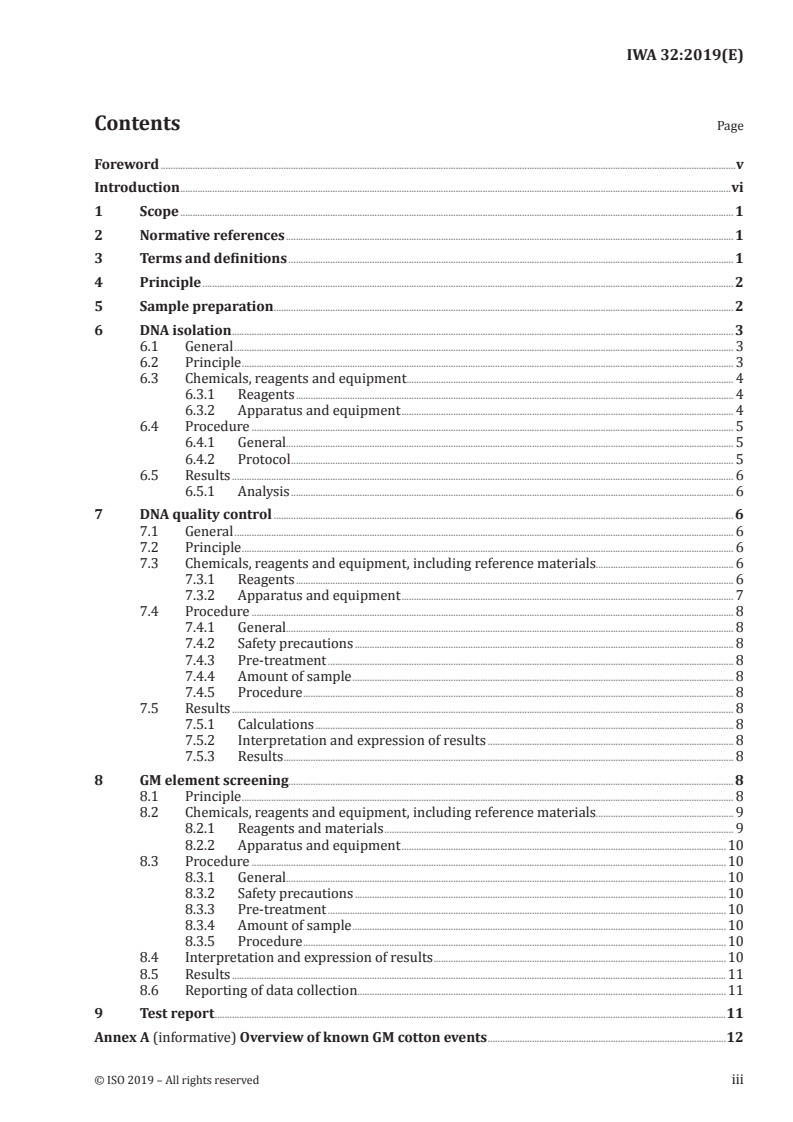
Contents Page
Foreword .v
Introduction .vi
1 Scope . 1
2 Normative references . 1
3 Terms and definitions . 1
4 Principle . 2
5 Sample preparation . 2
6 DNA isolation . 3
6.1 General . 3
6.2 Principle . 3
6.3 Chemicals, reagents and equipment. 4
6.3.1 Reagents . 4
6.3.2 Apparatus and equipment . 4
6.4 Procedure . 5
6.4.1 General. 5
6.4.2 Protocol . 5
6.5 Results . 6
6.5.1 Analysis . 6
7 DNA quality control . 6
7.1 General . 6
7.2 Principle . 6
7.3 Chemicals, reagents and equipment, including reference materials. 6
7.3.1 Reagents . 6
7.3.2 Apparatus and equipment . 7
7.4 Procedure . 8
7.4.1 General. 8
7.4.2 Safety precautions . 8
7.4.3 Pre-treatment . 8
7.4.4 Amount of sample . 8
7.4.5 Procedure . 8
7.5 Results . 8
7.5.1 Calculations . 8
7.5.2 Interpretation and expression of results . 8
7.5.3 Results . 8
8 GM element screening. 8
8.1 Principle . 8
8.2 Chemicals, reagents and equipment, including reference materials. 9
8.2.1 Reagents and materials . 9
8.2.2 Apparatus and equipment .10
8.3 Procedure .10
8.3.1 General.10
8.3.2 Safety precautions .10
8.3.3 Pre-treatment .10
8.3.4 Amount of sample .10
8.3.5 Procedure .10
8.4 Interpretation and expression of results .10
8.5 Results .11
8.6 Reporting of data collection.11
9 Test report .11
Annex A (informative) Overview of known GM cotton events .12
Annex B (informative) Overview of detection methods applied by RIKILT .16
Annex C (informative) In-house validation RIKILT .18
Annex D (informative) Workshop contributors .27
Bibliography .30
iv © ISO 2019 – All rights reserved
Foreword
ISO (the International Organization for Standardization) is a worldwide federation of national standards
bodies (ISO member bodies). The work of preparing International Standards is normally carried out
through ISO technical committees. Each member body interested in a subject for which a technical
committee has been established has the right to be represented on that committee. International
organizations, governmental and non-governmental, in liaison with ISO, also take part in the work.
ISO collaborates closely with the International Electrotechnical Commission (IEC) on all matters of
electrotechnical standardization.
The procedures used to develop this document and those intended for its further maintenance are
described in the ISO/IEC Directives, Part 1. In particular, the different approval criteria needed for the
different types of ISO documents should be noted. This document was drafted in accordance with the
editorial rules of the ISO/IEC Directives, Part 2 (see www .iso .org/directives).
Attention is drawn to the possibility that some of the elements of this document may be the subject of
patent rights. ISO shall not be held responsible for identifying any or all such patent rights. Details of
any patent rights identified during the development of the document will be in the Introduction and/or
on the ISO list of patent declarations received (see www .iso .org/patents).
Any trade name used in this document is information given for the convenience of users and does not
constitute an endorsement.
For an explanation of the voluntary nature of standards, the meaning of ISO specific terms and
expressions related to conformity assessment, as well as information about ISO's adherence to the
World Trade Organization (WTO) principles in the Technical Barriers to Trade (TBT) see www .iso
.org/iso/foreword .html.
International Workshop Agreement IWA 32 was approved at a workshop hosted by the Netherlands
Standardization Institute (NEN), in association with the Organic Cotton Accelerator, held in New Delhi,
India, in January 2019.
Any feedback or questions on this document should be directed to the user’s national standards body. A
complete listing of these bodies can be found at www .iso .org/members .html.
Introduction
0.1 General
This purpose of this document is to provide guidance to laboratories worldwide to assess, in a
standardized way, whether cotton, cotton fibre and/or cotton-derived materials are produced from, or
contain materials from, genetically modified (GM) cotton plants. This document is intended for non-GM
cotton and textiles production lines, but it can be applied to any production line that wants to check the
presence of GM cotton.
0.2 Protocol
The GM screening protocol described in this document is based on Polymerase Chain Reaction (PCR)-
based methods, as these methods are the minimal set of DNA-based methods to cover all known GM-
cotton events. The protocol is written for and tested to work on all four of the major commercial cotton
species: Gossypium hirsutum, G. barbadense, G. arboreum G. herbaceum.
Cotton (Gossypium spp.) has been cultivated for lint for over 8 000 years. There are over 50 species in
the Gossypium genus (Wendel et al., 2009). The Gossypium genome is complex, containing 2,25 to 2,43
gigabase (Arumuganathan and Earle, 1991). While GM-cotton cultivation covers a large part of global
cotton production today, there are countries where the cultivation of GM cotton is not allowed by law
as well as voluntary private and/or public standards that do not allow the intentional use of genetically
modified organisms (GMOs) in the cotton and textile production process. This creates a need for an
adequate and harmonized protocol on the screening of cotton and cotton-derived materials for the
potential presence of GM-cotton related sequences.
This document describes a procedure to screen seed, leaf and (processed) fibre samples in the cotton
production chain for the potential presence of GM-related DNA elements. The protocol describes three
major steps:
a) an effective way to isolate DNA from cotton materials;
b) a method to confirm that the isolated DNA consists of amplifiable cotton DNA, i.e. suitable for PCR,
preferably a low copy nuclear target;
c) A screening method consisting of a minimum set of detection methods covering all the currently
known GM cotton events, to be performed on the cotton DNA isolate.
If the results of the screening methods described in this protocol are ‘not detected’, the likelihood that the
cotton sample is (at least partly) derived from GM cotton is minimal, based on the ability of the screening
methods to detect elements and constructs of the GM cotton events. GM cotton levels below the detection
limit of the method or unknown GM cotton events that do not contain any of the elements or the construct
tested cannot be determined by this detection method. When one or more screening methods indicate
that GM elements are present, the sample should be considered as derived from GM cotton.
Further investigation for the identification of GM-cotton events present in the sample is not part of this
document as such, but some guidance is provided in Annex A as to how further identification of the
related cotton events can be achieved.
0.3 Structure
The structure of this document is illustrated in Figure 1. Clause 4 describes the principle of the
screenings protocol. Clause 5 describes sample preparation for different types of material. Clause 6
describes the DNA isolation method that allows for successful DNA isolation from the respective
cotton-related products. Clause 7 describes the DNA quality control for the different cotton species.
Clause 8 describes the screening of GM-related DNA sequences in a cotton sample. Clause 9 describes
recommendations on the test report (outcome). Annex A gives an overview of known GMO cotton
1)
events. Annex B gives an overview of detection methods applied by RIKILT . Annex C provides
1) https: //www .wur .nl/en/Research -Results/Research -Institutes/rikilt .htm
vi © ISO 2019 – All rights reserved
more information on the inhouse validation as carried out by RIKILT. Annex D provides a list of the
contributos to the International Workshop.
Figure 1 — Structure of this document
International Workshop Agreement IWA 32:2019(E)
Screening of genetically modified organisms (GMOs) in
cotton and textiles
WARNING — The method described in this document implies the use of reagents that pose a
hazard to health. This document does not claim to address all associated safety problems. It
is the responsibility of the user of this document to take appropriate measures for health and
safety protection.
1 Scope
This document provides requirements and recommendations to laboratories that perform genetically
modified organism (GMO) analyses in cottonseed, leaf, cotton fibre and cotton fibre-derived materials.
The following are within the scope of this document:
a) identifying the materials to be assessed, based on the probability of obtaining good quality, fit for
purpose DNA from the materials in subsequent steps in the cotton cloth production process;
b) specifying a method for efficient DNA isolation from cotton and cotton-derived materials described
under point a);
c) specifying the cotton-specific method(s) to be used as control for amplifiable DNA;
d) specifying the screening procedure that provides optimal chances to detect GMOs as a result of the
performance of the lowest number of genetically modified (GM) element screening assays.
NOTE 1 The protocol allows for the screening of all currently known GM cotton events and is set up in a way
that optimizes the probability of also detecting unknown GM cotton events that possibly contain similar DNA
sequences. Further information is given in CEN/TS 16707.
Sampling is outside of the scope of this document.
NOTE 2 A recommended sampling method is given in ISO 6497. General guidance for the sampling of bulk
materials or for cotton-based products is available in standards such as ASTM D1441-12 and CEN/TS 15568.
2 Normative references
The following documents are referred to in the text in such a way that some or all of their content
constitutes requirements of this document. For dated references, only the edition cited applies. For
undated references, the latest edition of the referenced document (including any amendments) applies.
ISO 21570:2005, Foodstuffs — Methods of analysis for the detection of genetically modified organisms and
derived products — Quantitative nucleic acid based methods
ISO 21571, Foodstuffs — Methods of analysis for the detection of genetically modified organisms and
derived products — Nucleic acid extraction
ISO 24276:2006, Foodstuffs — Methods of analysis for the detection of genetically modified organisms and
derived products — General requirements and definitions
3 Terms and definitions
For the purposes of this document, the following terms and definitions apply.
ISO and IEC maintain terminological databases for use in standardization at the following addresses:
— ISO Online browsing platform: available at https: //www .iso .org/obp
— IEC Electropedia: available at http: //www .electropedia .org/
3.1
cottonseed
seed from cotton plants
3.2
cotton leaf
leaves from the cotton plant
3.3
seed cotton
raw cotton that contains both the seed and the fibre before it has been ginned
3.4
cotton lint
raw fibre that has gone through the ginning process
3.5
greige yarn
unprocessed long continuous length of interlocked cotton lint that results from the cleaning and
subsequent spinning of the cotton lint
3.6
greige fabric
unprocessed textiles formed by weaving, knitting or crocheting the yarn and non-wovens
3.7
processed yarn
yarn that has undergone processing, to develop its full textile potential
3.8
processed fabric
fabric that has undergone processing, to develop its full textile potential
4 Principle
This document describes a method for the screening of GMO in cotton and textiles. The screening is
based on realtime PCR methods which depends on obtaining good quality amplifiable DNA. Good quality
DNA samples (those fit for purpose) are defined as those where the amplification of an endogenous
cotton gene (positive control) is observed. The amplification and detection of endogenous cotton is
achieved through isolation methods that result in good quality DNA, applied to cotton and textiles,
while the targeted amplification of six genetic elements can allow for the detection of GM-cotton in
these samples.
NOTE Experimental results have shown that good quality DNA can be isolated from the production stages
of cottonseed up to greige yarn and greige fabric, while it showed not to be possible to isolate amplifiable DNA
in processed yarn and processed fabric. Processed yarn and processed fabric are therefore excluded from this
protocol. See Clause C.3 for the assessment of isolation of good quality DNA at different cotton production stages
by RIKILT.
5 Sample preparation
Homogenize the sample using suitable methods and avoiding excessive heating.
2 © ISO 2019 – All rights reserved
Sample preparation is dependent on sample type. Prepare samples by using either one of the following
techniques: 'teasing', 'cutting', 'crushing' or 'shredding'.
Prepare at least two replicates per sample. Include appropriate controls, as specified in ISO 21571 on
DNA extraction.
The recommended sample preparation for different types of material is as follows.
— Cottonseed: Crush the seeds thoroughly with a suitable method. Use 100 mg in the DNA isolation
procedure.
— Cotton leaf: Crush the leaves thoroughly with a suitable method. Use 100 mg in the DNA isolation
procedure.
— Seed cotton: Seperate the seeds from the fibres, crush the seeds thoroughly with a suitable method.
Use 100 mg in the DNA isolation procedure.
— Cotton lint: The fibre material can be teased thoroughly applying suitable method. Use 100 mg in
the DNA isolation procedure.
— Yarn: Cut the yarn with a suitable method into small parts of a maximum of approximately 0,5 cm
length. Use 100 mg in the DNA isolation procedure.
— Fabric: Cut the fabric with a suitable method in small parts of a maximum of approximately
0,5 × 0,5 cm in size. Use 100 mg in the DNA isolation procedure.
6 DNA isolation
6.1 General
In order to obtain amplifiable DNA from cottonseed, cotton and textiles as per the protocol’s scope, a
DNA isolation method has been selected that allows for successful DNA isolation from the respective
cotton-related products. This method allows for rapid purification of genomic DNA suitable for PCR
with a limited number of protocol steps. The protocol works well for cotton-derived materials that can
contain relatively high levels of PCR inhibitors.
NOTE 1 The DNA isolation procedure described in this document is the QIAamp® Fast DNA Stool Mini Kit. The
2)
rest of this protocol refers to the QIAamp® Fast DNA Stool Mini Kit .
NOTE 2 As an alternative strategy to the DNA isolation method described below, the cotton-adjusted CTAB-
protocol (e.g. CRLVL-14/05XP: JRC 2006) or any other suitable DNA isolation method can be applied, provided
that this method has been proven by means of in-house validation against the QIAamp® Fast DNA Stool Mini
Kit to perform equally well or better compared to the QIAamp® Fast DNA Stool Mini Kit. For seed, certified
reference materials are used for validation.
6.2 Principle
The DNA isolation procedure is based on an inhibition buffer, a lysis buffer and a DNA-binding spin
column. DNA binds specifically to the silica-gel membrane in the spin column, while contaminants pass
through. No phenol-chloroform extraction is required. PCR inhibitors are separated from DNA by the
inhibition buffer.
QIAamp® Fast DNA Stool Mini Kit is an example of a suitable product available commercially. This information is given for the convenience
2)
of users of this document and does not constitute an endorsement by ISO of this product.
6.3 Chemicals, reagents and equipment
Use only reagents of recognized analytical grade. Appropriate facilities should be used in order to avoid
contamination during the steps of preparation and measurement (e.g. uses of laminar flow benches or
3)
comparable clean facilities) .
Unless otherwise stated, only reagents that conform to the specifications of ISO 24276 were used.
6.3.1 Reagents
6.3.1.1 Inhibition buffer: contains lithium chloride (>=1 – 10 % w/w) and sodium dodecyl sulfate
(>=1 - <10 % w/w) (e.g. Inhibitex Buffer Qiagen Cat No./ID: 51604), as provided by the manufacturer.
6.3.1.2 Lysis buffer: lysis buffer contains guanidine hydrochloride (>=30 - <50 % w/w) and maleic
acid (>=0.1 - <1 % w/w), as provided by the manufacturer.
6.3.1.3 Wash Buffer 1; ethanol solution to denature proteins contains guanidine hydrochloride (>=50
- <70 % w/w) ), as provided by the manufacturer.
6.3.1.4 Wash Buffer 2: Tris-based ethanol solution to remove salts, contains sodium azide), as
provided by the manufacturer.
6.3.1.5 Ethanol 96 % to 100 %.
6.3.1.6 Elution Buffer: contains 10 mM Tris-HCl pH8.3, 0.1 mM EDTA, 0.04 % NaN (sodium azide).
6.3.1.7 Proteinase K (>=1 - <10 % w/w).
6.3.1.8 Molecular biology grade water or water of equivalent purity.
6.3.1.9 DNA degrading solution (e.g. 1 % bleach) household bleach (hypochloric acid).
6.3.2 Apparatus and equipment
6.3.2.1 Silica-based mini spin columns, as provided by the manufacturer.
6.3.2.2 Disposable spatulas.
6.3.2.3 Sterile filter pipette tips protecting against aerosols.
6.3.2.4 Microcentrifuge tubes of 1,5 ml and 2,0 ml.
6.3.2.5 Disposable gloves (powder-free).
6.3.2.6 Analytical scale and top weigher.
6.3.2.7 Waterbath and/or thermoshaker (e.g. 24 ml × 2,0 ml).
6.3.2.8 Centrifuge for microcentrifuge tubes (at least 20 000 x g).
Reference to a given product is given for for the convenience of users of this document and does not constitute an endorsement by ISO of
3)
the product named. Equivalent products may be used if they can be shown to lead to the same results.
4 © ISO 2019 – All rights reserved
6.3.2.9 Suitable prepared homogenization equipment.
6.3.2.10 Autoclave, 121 °C, 20 minutes.
6.3.2.11 Pipettes (1-10 μl, 2-20 μl, 20-200 μl, 200-1 000 μl).
6.3.2.12 Vortex.
6.3.2.13 Refrigerator.
6.3.2.14 Freezer.
6.3.2.15 Clean lab coat.
6.4 Procedure
6.4.1 General
The DNA extraction procedure comprises the following steps:
— lysis of, and separation of, impurities from samples in guanidine hydrochloride-containing buffer;
— purification of DNA on mini spin columns.
6.4.2 Protocol
All centrifugation steps should be carried out at room temperature (15 °C to 25 °C).
Perform the DNA isolation according to the protocol of the chosen isolation method or see the
manufacturer’s instructions.
— (1) Weigh 100 mg (+/− 10 mg) homogenized sample, as prepared in Clause 5, in a 2 ml
microcentrifuge tube.
— (2) Add 1 ml inhibition buffer to each sample. Vortex continuously for 1 min or until the sample is
thoroughly mixed.
— (3) Centrifuge sample at 20 000 x g for 1 min to pellet particles.
— (4) Pipette 25 μl proteinase K into a new 2 ml microcentrifuge tube.
— (5) Pipette 600 μl supernatant from step (3) into the 2 ml microcentrifuge tube containing
proteinase K.
— (6) Add 600 μl lysis buffer and vortex for 15 s.
— (7) Incubate at 70 °C for 10 min.
— (8) Add 600 μl of ethanol (96 %) to the lysate, and mix by vortexing.
— (9) Carefully apply 600 μl lysate from step (8) to the silica-based spin column. Close the cap and
centrifuge at 20 000 x g for 1 min. Place the silica-based spin column in a new 2 ml collection tube
and discard the microcentrifuge tube containing the eluate.
— (10) Repeat step (9) until all of the lysate has been loaded on the column.
— (11) Carefully open the silica-based spin column and add 500 μl wash buffer 1. Centrifuge at
20 000 x g for 1 min. Place the silica-based spin column in a new 2 ml collection tube and discard the
collection tube containing the eluate.
— (12) Carefully open the silica-based spin column and add 500 μl wash buffer 2. Centrifuge at
20 000 x g for 3 min. Discard the collection tube containing the eluate.
— (13) Place the silica-based spin column in a new 2 ml collection tube and discard the old
collection tube with the filtrate. Centrifuge at 20 000 x g for 3 min.
— (14) Transfer the silica-based spin column into a new, labelled 1,5 ml microcentrifuge tube
and pipet 100 μl Elution Buffer directly onto the silica-based column. Incubate for 1 min at room
temperature, then centrifuge at 20 000 x g for 1 min to elute the DNA.
6.5 Results
Resulting from the DNA extraction procedure, the extracted DNA is stored until use according to
Clause 7 and Clause 8. DNA solutions may be stored at 4 °C for a maximum of 1 week or at −20 °C for
long-term storage.
6.5.1 Analysis
The DNA quality is assessed according to Clause 7. The DNA isolated from the cotton samples is
used both undiluted and 10 times diluted in a real time PCR and checked for amplifiable DNA for the
endogenous cotton gene SAH7 and inhibiting factors.
7 DNA quality control
7.1 General
The cotton-specific endogenous DNA marker for the Sinapis Arabidopsis Homolog 7 (SAH7 -Baeumler et
al., 2006) should be used as a positive control method for cotton. With the use of SAH7, one can detect
all four commercial cotton species (Gossypium hirsutum, G. barbadense, G. arboreum and G. herbaceum).
More information is provided in Annex C on the inhouse validation by RIKILT.
Amplification of the cotton-specific endogenous DNA marker for SAH7 indicates the quality of the cotton
DNA isolate. Once the SAH7 is found to be adequately amplified, any GM-related sequence that is present
above the detection limit will similarly be able to be amplified and be detected in the same sample.
7.2 Principle
A positive signal for the SAH7 indicates there is amplifiable DNA present in the sample. To check
inhibition, a 10 times dilution is also tested and is expected to give a positive signal that is theoretically
3,32 Cq values later in the PCR. If the Cq difference is less than 3,32 Cq this is an indication that there
is inhibition in the sample DNA. To circumvent inhibition, a 10 times dilution is also tested to dilute the
possible inhibition factors.
7.3 Chemicals, reagents and equipment, including reference materials
General requirements and recommendations related to the laboratory configuration and reagents and
material used that are described in ISO 24276 apply. Reference to a given product and/or company,
reagents and polymerases which lead to equal or better results may also be used.
7.3.1 Reagents
Use only reagents of recognized analytical grade and water conforming to grade 1 of ISO 3696.
7.3.1.1 Water.
7.3.1.2 Master mix for real-time PCR (e.g. DMML-D2-D600; Diagenode, Belgium).
6 © ISO 2019 – All rights reserved
7.3.1.3 Primers and Probes.
See Baeumler et al. (2006) or the JRC GMO Method Database for endogenous cotton method SAH7 (QT-
TAX-GH-021: http: //gmo -crl .jrc .ec .europa .eu/gmomethods/), or see Annex B.
7.3.1.3.1 Sah7-uni-r1: GCATCTTTGAACCGCCTACTG.
7.3.1.3.2 Sah7-uni-f1: AGTTTGTAGGTTTTGATGTTACATTGAG.
7.3.1.3.3 Sah7-uni-s1: FAM-AAACATAAAATAATGGGAACAACCATGACATGT-TAMRA.
7.3.1.4 Sample DNA.
Prepared according to Clause 6.
7.3.1.5 Certified cotton reference material from IRMM or AOCS should be used as positive control
in the PCR.
7.3.1.6 Filter tips.
7.3.1.7 Microcentrifuge tubes 1,5 ml and 2,0 ml.
7.3.1.8 Microcentrifuge tube racks.
7.3.1.9 PCR plates.
7.3.1.10 Aluminium foil.
7.3.1.11 Optical quality sealing tape.
7.3.1.12 Disposable gloves.
7.3.2 Apparatus and equipment
7.3.2.1 PCR thermocycler.
7.3.2.2 Freezer.
7.3.2.3 Refrigerator.
7.3.2.4 Plate centrifuge.
7.3.2.5 Centrifuge (at least 20 000 x g).
7.3.2.6 Vortex for microcentrifuge tubes and 96 well plates.
7.3.2.7 Pipettes (1-10 μl, 2-20 μl, 20-200 μl, 200-1 000 μl).
7.4 Procedure
7.4.1 General
The procedure to amplify the endogenous SAH7 marker is a qualitative cotton endogenous screening
method. For the in-house verification of this cotton endogenous screening method, the minimum
performance requirements of ISO 24276 are applicable.
Perform the controls according to ISO 24276:2006, 5.2.
7.4.2 Safety precautions
No specific requirements. See ISO 24276.
7.4.3 Pre-treatment
DNA isolation according to 6.4.2.
7.4.4 Amount of sample
5 μl undiluted and 5 μl 10 times diluted DNA for each sample isolation are used in a reaction volume
of 25 μl.
NOTE Two samples derive from one sample. The previous step results in two samples. Therefore, the total
amount of samples is four.
7.4.5 Procedure
See the JRC GMO Method Database for the endogenous cotton method SAH7 (QT-TAX-GH-021: http:
//gmo -crl .jrc .ec .europa .eu/gmomethods/entry ?db = gmometh & id = qt -tax -gh -021 & q = sah7) as described
by Mazzara et al. (2006). More information is provided in Annex B.
7.5 Results
7.5.1 Calculations
Calculate results according to ISO 21570:2005, A.1.8. No ambiguous results shall be expressed.
7.5.2 Interpretation and expression of results
According to ISO 24276:2006, Clause 6.
7.5.3 Results
The final result of the detection of SAH7 is reported as “detected” or “not detected”. When no endogenous
SAH7 is detected, there is either no DNA present, or the DNA is not of sufficient quality. Therefore,
the subsequent screening should not be performed. Reporting should be carried out as specified in
ISO 24276 and other applicable standards (ISO 17025).
8 GM element screening
8.1 Principle
In order to detect the potential presence of GM-related DNA sequences in a cotton sample, a minimum
of two detection methods (targeting two of T-nos, P-35S, cry1Ab/Ac, pat otp/mepsps or P-FMV) shall be
applied. If detected, no further testing is required. If not-detected, further testing is necessary up to all
six elements.
8 © ISO 2019 – All rights reserved
Internationally recognized methods should be applied, if possible, e.g.:
— T-nos (e.g. QL-ELE-00-011 JRC; ISO 21569:2005/Amd 1:2013);
— P-35S (e.g. QT-ELE-00-004 JRC; ISO 21570:2005);
— cry1Ab/Ac (e.g. QL-ELE-00-016 JRC; ISO/TS 21569-6:2016);
— pat [e.g. QL-ELE-00-025 JRC; Inter-laboratory study in Food Control 73:452-461 (2016)];
— otp/mepsps (e.g. QT-CON-00-008 JRC; ISO 21570:2005);
— P-FMV (e.g. QL-ELE-00-015 JRC; ISO/TS 21569-5:2016).
NOTE 1 See the JRC GMO Method Database (http: //gmo -crl .jrc .ec .europa .eu/gmomethods/).
Reagents that lead to equal or better results may also be used. Annex B provides an example of an in-
house validated set of methods that could be applied as an alternative to the methods listed above.
NOTE 2 Annex A contains an overview of the tested elements and construct. The targets of these six screening
methods were selected because they cover all known GM cottons events.
8.2 Chemicals, reagents and equipment, including reference materials
8.2.1 Reagents and materials
See 7.3.1.
The following is a list of primers and probes.
T-nos (ISO 21569:2005/Amd 1:2013)
180-F CATGTAATGCATGACGTTATTTATG
180-R TTGTTTTCTATCGCGTATTAAATGT
Tm-180 FAM-ATGGGTTTTTATGATTAGAGTCCCGCAA-TAMRA
P-35S (ISO 21570:2005)
35S-F GCCTCTGCCGACAGTGGT
35S-R AAGACGTGGTTGGAACGTCTTC
35S-TMP FAM-CAAAGATGGACCCCCACCCACG-TAMRA
cry1Ab/Ac (ISO/TS 21569-6:2016)
Bt-F1(mod) GAGGAAATGCGTATTCAATTCAAC
Bt-R TTCTGGACTGCGAACAATGG
Bt-P FAM-ACATGAACAGCGCCTTGACCACAGC-TAMRA
pat (Inter-laboratory study in Food Control 73:452-461 (2016))
pat-F CGCGGTTTGTGATATCGTTAAC
pat-R TCTTGCAACCTCTCTAGATCATCAA
pat-P FAM-AGGACAGAGCCACAAACACCACAAGAGTG-TAMRA
otp/mepsps (ISO 21570:2005)
GA21 3-5’ GAAGCCTCGGCAACGTCA
GA21 3-3’ ATCCGGTTGGAAAGCGACTT
GA21-2-Taq FAM-AAGGATCCGGTGCATGGCCG-TAMRA
P-FMV (ISO/TS 21569-5:2016)
pFMV-F CAAAATAACGTGGAAAAGAGCT
pFMV-R TCTTTTGTGGTCGTCACTGC
Probe pFMV FAM-CTGACAGCCCACTCACTAATGC-BHQ1
Certified cotton CRMs from IRMM or AOCS shall be used as positive control in the PCR of the screening
elements, for example:
AOCS 0804D MON15985: P-35S, T-nos, cry1Ab/Ac
ERM-BF422 3006-210-23x281-24-236: pat
AOCS 1108-A GHB614: otp/mepsps
AOCS 0804-B MON1445: P-FMV
8.2.2 Apparatus and equipment
See 7.3.2.
8.3 Procedure
8.3.1 General
The in-house verification of the screening methods carried out according to ISO 24276 on detection of
genetically modified organisms and derived products.
8.3.2 Safety precautions
See 7.4.2.
8.3.3 Pre-treatment
DNA used as described in Clause 6.
8.3.4 Amount of sample
See 7.4.4.
8.3.5 Procedure
See corresponding protocols mentioned in 6.1.
8.4 Interpretation and expression of results
According to ISO 24276:2006, Clause 6.
10 © ISO 2019 – All rights reserved
8.5 Results
The final result of each target-specific detection method is reported as “detected” or “not detected”.
When one or more targets are “detected”, the sample contains GM-elements that are used in GM cotton.
When the results show “not detected” for all six targets this is considered indicative of the absence of
GM in the sample tested.
8.6 Reporting of data collection
The result should be recorded ensuring the reliability, reproducibility and integrity of the data
according to ISO 24276:2006, Clause 7.
9 Test report
The test report shall contain at least the following information:
a) information necessary for identification of the submitted sample;
b) list of elements and/or constructs checked, detected and, if elucidated, the event(s);
c) results obtained of the screening, expressed as ‘the sample contains GM-elements’ or the ‘sample
does not contain GM-elements’;
d) test method used, with reference to this document;
e) any particular points observed in the course of the test;
f) operating details not specified in this document, or regarded as optional, together with details of
any incidents which might have affected the results.
Annex A
(informative)
Overview of known GM cotton events
A.1 General
This annex provides suggestions to confirm possible GM cotton events in a sample tested positive under
Clause 6. Table A.1 provides an overview of known GM cotton events. The targets of the six screening
methods that cover the larger part of the GM cottons events are shown in bold. Only elements for which
a detection method is available are listed.
Based on elements that are detected and not detected, it should be possible to narrow down and
identify the possible GM cotton source(s). Alternatively, the ‘Analysis tool’ (www .EUginius .eu) can be
used. Here, the detected and not-detected targets aid to narrow-down the possible cotton event(s)
present in the sample.
Once one or more possible candidate-events emerge, they can be confirmed by event-specific methods.
For available event-specific detection methods, see the JRC GMO Method Database for fully validated
methods (http: //gmo -crl .jrc .ec .europa .eu/gmomethods/). For quantification, see ISO 21570.
12 © ISO 2019 – All rights reserved
Table A.1 — Overview of known GM cotton events
OECD Detected
Event-de-
Unique with cry1Ab/ cry- otp/ cp4-ep- cry-
GMO tection T-nos P-35S cry1Ac nptII P-FMV pat T-35S P-ubi1 cry1C T-E9 cry1F
identi- screen- Ac 1Ab mepsps sps 2Ab2
method
fier ing
T A M -
TAM66274 no yes x
66274-5
B C S -
GHB811 no yes x
GH811-4
D A S -
DAS81910 no yes x
81910-7
M ON-
MON88701 yes yes x x
88701-3
B C S -
T303-3 no yes x x x
GH003-6
B C S -
T304-40 yes yes x x x
GH004-7
B C S -
GHB119 yes yes x x X
GH005-8
S Y N-
COT67B no yes x x
IR67B-1
B C S -
GHB614 yes yes x
GH002-5
M ON-
MON88913 yes yes x x x x
88913-8
S Y N-
COT102 no yes x
IR102-7
D A S -
3006-210-23 yes yes x x x
21023-5
D A S -
281-24-236 yes yes x x x
24236-5
AC S -
LLCotton25 yes yes x x
GH001-3
NOTE For a full description of the events, see the following:
— EUginius (www .EUginius .eu)
— ISAAA (http: //www .isaaa .org/gmapprovaldatabase/default .asp)
— USDA-APHIS (https: //www .aphis .usda .gov/aphis/ourfocus/biotechnology/permits -notifications -petitions/petitions/petition -status)
14 © ISO 2019 – All rights reserved
Table A.1 (continued)
OECD Detected
Event-de-
Unique with cry1Ab/ cry- otp/ cp4-ep- cry-
GMO tection T-nos P-35S cry1Ac nptII P-FMV pat T-35S P-ubi1 cry1C T-E9 cry1F
identi- screen- Ac 1Ab mepsps sps 2Ab2
method
fier ing
T A M -
TAM66274 no yes x
66274-5
MON15985: M ON-
yes yes x x x x x x
Bollgard II 15985-7
31807, 31808
etc.: BXN Plus no yes x x x x
Bollgard
1445 M ON-
(MON1445), 01445-2,
yes yes x x x x
1698 M ON-
(MON89383) 89383-1
531, 757, 1076 M ON-
(MON89924): 00531-6,
Bollgard M ON-
yes yes x x x x x
00757-7,
M ON-
89924-2
BXN/ B X N-
BXN10211- 10211-9,
BXN10224 B X N-
1 0 2 1 5 -
no yes x x
4, BXN-
10222-2,
B X N-
10224-4
GK12 no yes x x x x x
GK19 no yes x x x x x
SGK321 no yes x x x x x
Event 1 no yes x x x x x
GFM Cry1A no yes x x x x x
NOTE For a full description of the events, see the following:
— EUginius (www .EUginius .eu)
— ISAAA (http: //www .isaaa .org/gmapprovaldatabase/default .asp)
— USDA-APHIS (https: //www .aphis .usda .gov/aphis/ourfocus/biotechnology/permits -notifications -petitions/petitions/petition -status)
Table A.1 (continued)
OECD Detected
Event-de-
Unique with cry1Ab/ cry- otp/ cp4-ep- cry-
GMO tection T-nos P-35S cry1Ac nptII P-FMV pat T-35S P-ubi1 cry1C T-E9 cry1F
identi- screen- Ac 1Ab mepsps sps 2Ab2
method
fier ing
T A M -
TAM66274 no yes x
66274-5
MLS 9124 no yes x x x X x
BNLA 106
...
INTERNATIONAL IWA
WORKSHOP 32
AGREEMENT
First edition
2019-04
Screening of genetically modified
organisms (GMOs) in cotton and
textiles
Criblage pour la détection des organismes génétiquement modifiés
(OGM) dans le coton et les textiles
Reference number
©
ISO 2019
© ISO 2019
All rights reserved. Unless otherwise specified, or required in the context of its implementation, no part of this publication may
be reproduced or utilized otherwise in any form or by any means, electronic or mechanical, including photocopying, or posting
on the internet or an intranet, without prior written permission. Permission can be requested from either ISO at the address
below or ISO’s member body in the country of the requester.
ISO copyright office
CP 401 • Ch. de Blandonnet 8
CH-1214 Vernier, Geneva
Phone: +41 22 749 01 11
Fax: +41 22 749 09 47
Email: copyright@iso.org
Website: www.iso.org
Published in Switzerland
ii © ISO 2019 – All rights reserved
Contents Page
Foreword .v
Introduction .vi
1 Scope . 1
2 Normative references . 1
3 Terms and definitions . 1
4 Principle . 2
5 Sample preparation . 2
6 DNA isolation . 3
6.1 General . 3
6.2 Principle . 3
6.3 Chemicals, reagents and equipment. 4
6.3.1 Reagents . 4
6.3.2 Apparatus and equipment . 4
6.4 Procedure . 5
6.4.1 General. 5
6.4.2 Protocol . 5
6.5 Results . 6
6.5.1 Analysis . 6
7 DNA quality control . 6
7.1 General . 6
7.2 Principle . 6
7.3 Chemicals, reagents and equipment, including reference materials. 6
7.3.1 Reagents . 6
7.3.2 Apparatus and equipment . 7
7.4 Procedure . 8
7.4.1 General. 8
7.4.2 Safety precautions . 8
7.4.3 Pre-treatment . 8
7.4.4 Amount of sample . 8
7.4.5 Procedure . 8
7.5 Results . 8
7.5.1 Calculations . 8
7.5.2 Interpretation and expression of results . 8
7.5.3 Results . 8
8 GM element screening. 8
8.1 Principle . 8
8.2 Chemicals, reagents and equipment, including reference materials. 9
8.2.1 Reagents and materials . 9
8.2.2 Apparatus and equipment .10
8.3 Procedure .10
8.3.1 General.10
8.3.2 Safety precautions .10
8.3.3 Pre-treatment .10
8.3.4 Amount of sample .10
8.3.5 Procedure .10
8.4 Interpretation and expression of results .10
8.5 Results .11
8.6 Reporting of data collection.11
9 Test report .11
Annex A (informative) Overview of known GM cotton events .12
Annex B (informative) Overview of detection methods applied by RIKILT .16
Annex C (informative) In-house validation RIKILT .18
Annex D (informative) Workshop contributors .27
Bibliography .30
iv © ISO 2019 – All rights reserved
Foreword
ISO (the International Organization for Standardization) is a worldwide federation of national standards
bodies (ISO member bodies). The work of preparing International Standards is normally carried out
through ISO technical committees. Each member body interested in a subject for which a technical
committee has been established has the right to be represented on that committee. International
organizations, governmental and non-governmental, in liaison with ISO, also take part in the work.
ISO collaborates closely with the International Electrotechnical Commission (IEC) on all matters of
electrotechnical standardization.
The procedures used to develop this document and those intended for its further maintenance are
described in the ISO/IEC Directives, Part 1. In particular, the different approval criteria needed for the
different types of ISO documents should be noted. This document was drafted in accordance with the
editorial rules of the ISO/IEC Directives, Part 2 (see www .iso .org/directives).
Attention is drawn to the possibility that some of the elements of this document may be the subject of
patent rights. ISO shall not be held responsible for identifying any or all such patent rights. Details of
any patent rights identified during the development of the document will be in the Introduction and/or
on the ISO list of patent declarations received (see www .iso .org/patents).
Any trade name used in this document is information given for the convenience of users and does not
constitute an endorsement.
For an explanation of the voluntary nature of standards, the meaning of ISO specific terms and
expressions related to conformity assessment, as well as information about ISO's adherence to the
World Trade Organization (WTO) principles in the Technical Barriers to Trade (TBT) see www .iso
.org/iso/foreword .html.
International Workshop Agreement IWA 32 was approved at a workshop hosted by the Netherlands
Standardization Institute (NEN), in association with the Organic Cotton Accelerator, held in New Delhi,
India, in January 2019.
Any feedback or questions on this document should be directed to the user’s national standards body. A
complete listing of these bodies can be found at www .iso .org/members .html.
Introduction
0.1 General
This purpose of this document is to provide guidance to laboratories worldwide to assess, in a
standardized way, whether cotton, cotton fibre and/or cotton-derived materials are produced from, or
contain materials from, genetically modified (GM) cotton plants. This document is intended for non-GM
cotton and textiles production lines, but it can be applied to any production line that wants to check the
presence of GM cotton.
0.2 Protocol
The GM screening protocol described in this document is based on Polymerase Chain Reaction (PCR)-
based methods, as these methods are the minimal set of DNA-based methods to cover all known GM-
cotton events. The protocol is written for and tested to work on all four of the major commercial cotton
species: Gossypium hirsutum, G. barbadense, G. arboreum G. herbaceum.
Cotton (Gossypium spp.) has been cultivated for lint for over 8 000 years. There are over 50 species in
the Gossypium genus (Wendel et al., 2009). The Gossypium genome is complex, containing 2,25 to 2,43
gigabase (Arumuganathan and Earle, 1991). While GM-cotton cultivation covers a large part of global
cotton production today, there are countries where the cultivation of GM cotton is not allowed by law
as well as voluntary private and/or public standards that do not allow the intentional use of genetically
modified organisms (GMOs) in the cotton and textile production process. This creates a need for an
adequate and harmonized protocol on the screening of cotton and cotton-derived materials for the
potential presence of GM-cotton related sequences.
This document describes a procedure to screen seed, leaf and (processed) fibre samples in the cotton
production chain for the potential presence of GM-related DNA elements. The protocol describes three
major steps:
a) an effective way to isolate DNA from cotton materials;
b) a method to confirm that the isolated DNA consists of amplifiable cotton DNA, i.e. suitable for PCR,
preferably a low copy nuclear target;
c) A screening method consisting of a minimum set of detection methods covering all the currently
known GM cotton events, to be performed on the cotton DNA isolate.
If the results of the screening methods described in this protocol are ‘not detected’, the likelihood that the
cotton sample is (at least partly) derived from GM cotton is minimal, based on the ability of the screening
methods to detect elements and constructs of the GM cotton events. GM cotton levels below the detection
limit of the method or unknown GM cotton events that do not contain any of the elements or the construct
tested cannot be determined by this detection method. When one or more screening methods indicate
that GM elements are present, the sample should be considered as derived from GM cotton.
Further investigation for the identification of GM-cotton events present in the sample is not part of this
document as such, but some guidance is provided in Annex A as to how further identification of the
related cotton events can be achieved.
0.3 Structure
The structure of this document is illustrated in Figure 1. Clause 4 describes the principle of the
screenings protocol. Clause 5 describes sample preparation for different types of material. Clause 6
describes the DNA isolation method that allows for successful DNA isolation from the respective
cotton-related products. Clause 7 describes the DNA quality control for the different cotton species.
Clause 8 describes the screening of GM-related DNA sequences in a cotton sample. Clause 9 describes
recommendations on the test report (outcome). Annex A gives an overview of known GMO cotton
1)
events. Annex B gives an overview of detection methods applied by RIKILT . Annex C provides
1) https: //www .wur .nl/en/Research -Results/Research -Institutes/rikilt .htm
vi © ISO 2019 – All rights reserved
more information on the inhouse validation as carried out by RIKILT. Annex D provides a list of the
contributos to the International Workshop.
Figure 1 — Structure of this document
International Workshop Agreement IWA 32:2019(E)
Screening of genetically modified organisms (GMOs) in
cotton and textiles
WARNING — The method described in this document implies the use of reagents that pose a
hazard to health. This document does not claim to address all associated safety problems. It
is the responsibility of the user of this document to take appropriate measures for health and
safety protection.
1 Scope
This document provides requirements and recommendations to laboratories that perform genetically
modified organism (GMO) analyses in cottonseed, leaf, cotton fibre and cotton fibre-derived materials.
The following are within the scope of this document:
a) identifying the materials to be assessed, based on the probability of obtaining good quality, fit for
purpose DNA from the materials in subsequent steps in the cotton cloth production process;
b) specifying a method for efficient DNA isolation from cotton and cotton-derived materials described
under point a);
c) specifying the cotton-specific method(s) to be used as control for amplifiable DNA;
d) specifying the screening procedure that provides optimal chances to detect GMOs as a result of the
performance of the lowest number of genetically modified (GM) element screening assays.
NOTE 1 The protocol allows for the screening of all currently known GM cotton events and is set up in a way
that optimizes the probability of also detecting unknown GM cotton events that possibly contain similar DNA
sequences. Further information is given in CEN/TS 16707.
Sampling is outside of the scope of this document.
NOTE 2 A recommended sampling method is given in ISO 6497. General guidance for the sampling of bulk
materials or for cotton-based products is available in standards such as ASTM D1441-12 and CEN/TS 15568.
2 Normative references
The following documents are referred to in the text in such a way that some or all of their content
constitutes requirements of this document. For dated references, only the edition cited applies. For
undated references, the latest edition of the referenced document (including any amendments) applies.
ISO 21570:2005, Foodstuffs — Methods of analysis for the detection of genetically modified organisms and
derived products — Quantitative nucleic acid based methods
ISO 21571, Foodstuffs — Methods of analysis for the detection of genetically modified organisms and
derived products — Nucleic acid extraction
ISO 24276:2006, Foodstuffs — Methods of analysis for the detection of genetically modified organisms and
derived products — General requirements and definitions
3 Terms and definitions
For the purposes of this document, the following terms and definitions apply.
ISO and IEC maintain terminological databases for use in standardization at the following addresses:
— ISO Online browsing platform: available at https: //www .iso .org/obp
— IEC Electropedia: available at http: //www .electropedia .org/
3.1
cottonseed
seed from cotton plants
3.2
cotton leaf
leaves from the cotton plant
3.3
seed cotton
raw cotton that contains both the seed and the fibre before it has been ginned
3.4
cotton lint
raw fibre that has gone through the ginning process
3.5
greige yarn
unprocessed long continuous length of interlocked cotton lint that results from the cleaning and
subsequent spinning of the cotton lint
3.6
greige fabric
unprocessed textiles formed by weaving, knitting or crocheting the yarn and non-wovens
3.7
processed yarn
yarn that has undergone processing, to develop its full textile potential
3.8
processed fabric
fabric that has undergone processing, to develop its full textile potential
4 Principle
This document describes a method for the screening of GMO in cotton and textiles. The screening is
based on realtime PCR methods which depends on obtaining good quality amplifiable DNA. Good quality
DNA samples (those fit for purpose) are defined as those where the amplification of an endogenous
cotton gene (positive control) is observed. The amplification and detection of endogenous cotton is
achieved through isolation methods that result in good quality DNA, applied to cotton and textiles,
while the targeted amplification of six genetic elements can allow for the detection of GM-cotton in
these samples.
NOTE Experimental results have shown that good quality DNA can be isolated from the production stages
of cottonseed up to greige yarn and greige fabric, while it showed not to be possible to isolate amplifiable DNA
in processed yarn and processed fabric. Processed yarn and processed fabric are therefore excluded from this
protocol. See Clause C.3 for the assessment of isolation of good quality DNA at different cotton production stages
by RIKILT.
5 Sample preparation
Homogenize the sample using suitable methods and avoiding excessive heating.
2 © ISO 2019 – All rights reserved
Sample preparation is dependent on sample type. Prepare samples by using either one of the following
techniques: 'teasing', 'cutting', 'crushing' or 'shredding'.
Prepare at least two replicates per sample. Include appropriate controls, as specified in ISO 21571 on
DNA extraction.
The recommended sample preparation for different types of material is as follows.
— Cottonseed: Crush the seeds thoroughly with a suitable method. Use 100 mg in the DNA isolation
procedure.
— Cotton leaf: Crush the leaves thoroughly with a suitable method. Use 100 mg in the DNA isolation
procedure.
— Seed cotton: Seperate the seeds from the fibres, crush the seeds thoroughly with a suitable method.
Use 100 mg in the DNA isolation procedure.
— Cotton lint: The fibre material can be teased thoroughly applying suitable method. Use 100 mg in
the DNA isolation procedure.
— Yarn: Cut the yarn with a suitable method into small parts of a maximum of approximately 0,5 cm
length. Use 100 mg in the DNA isolation procedure.
— Fabric: Cut the fabric with a suitable method in small parts of a maximum of approximately
0,5 × 0,5 cm in size. Use 100 mg in the DNA isolation procedure.
6 DNA isolation
6.1 General
In order to obtain amplifiable DNA from cottonseed, cotton and textiles as per the protocol’s scope, a
DNA isolation method has been selected that allows for successful DNA isolation from the respective
cotton-related products. This method allows for rapid purification of genomic DNA suitable for PCR
with a limited number of protocol steps. The protocol works well for cotton-derived materials that can
contain relatively high levels of PCR inhibitors.
NOTE 1 The DNA isolation procedure described in this document is the QIAamp® Fast DNA Stool Mini Kit. The
2)
rest of this protocol refers to the QIAamp® Fast DNA Stool Mini Kit .
NOTE 2 As an alternative strategy to the DNA isolation method described below, the cotton-adjusted CTAB-
protocol (e.g. CRLVL-14/05XP: JRC 2006) or any other suitable DNA isolation method can be applied, provided
that this method has been proven by means of in-house validation against the QIAamp® Fast DNA Stool Mini
Kit to perform equally well or better compared to the QIAamp® Fast DNA Stool Mini Kit. For seed, certified
reference materials are used for validation.
6.2 Principle
The DNA isolation procedure is based on an inhibition buffer, a lysis buffer and a DNA-binding spin
column. DNA binds specifically to the silica-gel membrane in the spin column, while contaminants pass
through. No phenol-chloroform extraction is required. PCR inhibitors are separated from DNA by the
inhibition buffer.
QIAamp® Fast DNA Stool Mini Kit is an example of a suitable product available commercially. This information is given for the convenience
2)
of users of this document and does not constitute an endorsement by ISO of this product.
6.3 Chemicals, reagents and equipment
Use only reagents of recognized analytical grade. Appropriate facilities should be used in order to avoid
contamination during the steps of preparation and measurement (e.g. uses of laminar flow benches or
3)
comparable clean facilities) .
Unless otherwise stated, only reagents that conform to the specifications of ISO 24276 were used.
6.3.1 Reagents
6.3.1.1 Inhibition buffer: contains lithium chloride (>=1 – 10 % w/w) and sodium dodecyl sulfate
(>=1 - <10 % w/w) (e.g. Inhibitex Buffer Qiagen Cat No./ID: 51604), as provided by the manufacturer.
6.3.1.2 Lysis buffer: lysis buffer contains guanidine hydrochloride (>=30 - <50 % w/w) and maleic
acid (>=0.1 - <1 % w/w), as provided by the manufacturer.
6.3.1.3 Wash Buffer 1; ethanol solution to denature proteins contains guanidine hydrochloride (>=50
- <70 % w/w) ), as provided by the manufacturer.
6.3.1.4 Wash Buffer 2: Tris-based ethanol solution to remove salts, contains sodium azide), as
provided by the manufacturer.
6.3.1.5 Ethanol 96 % to 100 %.
6.3.1.6 Elution Buffer: contains 10 mM Tris-HCl pH8.3, 0.1 mM EDTA, 0.04 % NaN (sodium azide).
6.3.1.7 Proteinase K (>=1 - <10 % w/w).
6.3.1.8 Molecular biology grade water or water of equivalent purity.
6.3.1.9 DNA degrading solution (e.g. 1 % bleach) household bleach (hypochloric acid).
6.3.2 Apparatus and equipment
6.3.2.1 Silica-based mini spin columns, as provided by the manufacturer.
6.3.2.2 Disposable spatulas.
6.3.2.3 Sterile filter pipette tips protecting against aerosols.
6.3.2.4 Microcentrifuge tubes of 1,5 ml and 2,0 ml.
6.3.2.5 Disposable gloves (powder-free).
6.3.2.6 Analytical scale and top weigher.
6.3.2.7 Waterbath and/or thermoshaker (e.g. 24 ml × 2,0 ml).
6.3.2.8 Centrifuge for microcentrifuge tubes (at least 20 000 x g).
Reference to a given product is given for for the convenience of users of this document and does not constitute an endorsement by ISO of
3)
the product named. Equivalent products may be used if they can be shown to lead to the same results.
4 © ISO 2019 – All rights reserved
6.3.2.9 Suitable prepared homogenization equipment.
6.3.2.10 Autoclave, 121 °C, 20 minutes.
6.3.2.11 Pipettes (1-10 μl, 2-20 μl, 20-200 μl, 200-1 000 μl).
6.3.2.12 Vortex.
6.3.2.13 Refrigerator.
6.3.2.14 Freezer.
6.3.2.15 Clean lab coat.
6.4 Procedure
6.4.1 General
The DNA extraction procedure comprises the following steps:
— lysis of, and separation of, impurities from samples in guanidine hydrochloride-containing buffer;
— purification of DNA on mini spin columns.
6.4.2 Protocol
All centrifugation steps should be carried out at room temperature (15 °C to 25 °C).
Perform the DNA isolation according to the protocol of the chosen isolation method or see the
manufacturer’s instructions.
— (1) Weigh 100 mg (+/− 10 mg) homogenized sample, as prepared in Clause 5, in a 2 ml
microcentrifuge tube.
— (2) Add 1 ml inhibition buffer to each sample. Vortex continuously for 1 min or until the sample is
thoroughly mixed.
— (3) Centrifuge sample at 20 000 x g for 1 min to pellet particles.
— (4) Pipette 25 μl proteinase K into a new 2 ml microcentrifuge tube.
— (5) Pipette 600 μl supernatant from step (3) into the 2 ml microcentrifuge tube containing
proteinase K.
— (6) Add 600 μl lysis buffer and vortex for 15 s.
— (7) Incubate at 70 °C for 10 min.
— (8) Add 600 μl of ethanol (96 %) to the lysate, and mix by vortexing.
— (9) Carefully apply 600 μl lysate from step (8) to the silica-based spin column. Close the cap and
centrifuge at 20 000 x g for 1 min. Place the silica-based spin column in a new 2 ml collection tube
and discard the microcentrifuge tube containing the eluate.
— (10) Repeat step (9) until all of the lysate has been loaded on the column.
— (11) Carefully open the silica-based spin column and add 500 μl wash buffer 1. Centrifuge at
20 000 x g for 1 min. Place the silica-based spin column in a new 2 ml collection tube and discard the
collection tube containing the eluate.
— (12) Carefully open the silica-based spin column and add 500 μl wash buffer 2. Centrifuge at
20 000 x g for 3 min. Discard the collection tube containing the eluate.
— (13) Place the silica-based spin column in a new 2 ml collection tube and discard the old
collection tube with the filtrate. Centrifuge at 20 000 x g for 3 min.
— (14) Transfer the silica-based spin column into a new, labelled 1,5 ml microcentrifuge tube
and pipet 100 μl Elution Buffer directly onto the silica-based column. Incubate for 1 min at room
temperature, then centrifuge at 20 000 x g for 1 min to elute the DNA.
6.5 Results
Resulting from the DNA extraction procedure, the extracted DNA is stored until use according to
Clause 7 and Clause 8. DNA solutions may be stored at 4 °C for a maximum of 1 week or at −20 °C for
long-term storage.
6.5.1 Analysis
The DNA quality is assessed according to Clause 7. The DNA isolated from the cotton samples is
used both undiluted and 10 times diluted in a real time PCR and checked for amplifiable DNA for the
endogenous cotton gene SAH7 and inhibiting factors.
7 DNA quality control
7.1 General
The cotton-specific endogenous DNA marker for the Sinapis Arabidopsis Homolog 7 (SAH7 -Baeumler et
al., 2006) should be used as a positive control method for cotton. With the use of SAH7, one can detect
all four commercial cotton species (Gossypium hirsutum, G. barbadense, G. arboreum and G. herbaceum).
More information is provided in Annex C on the inhouse validation by RIKILT.
Amplification of the cotton-specific endogenous DNA marker for SAH7 indicates the quality of the cotton
DNA isolate. Once the SAH7 is found to be adequately amplified, any GM-related sequence that is present
above the detection limit will similarly be able to be amplified and be detected in the same sample.
7.2 Principle
A positive signal for the SAH7 indicates there is amplifiable DNA present in the sample. To check
inhibition, a 10 times dilution is also tested and is expected to give a positive signal that is theoretically
3,32 Cq values later in the PCR. If the Cq difference is less than 3,32 Cq this is an indication that there
is inhibition in the sample DNA. To circumvent inhibition, a 10 times dilution is also tested to dilute the
possible inhibition factors.
7.3 Chemicals, reagents and equipment, including reference materials
General requirements and recommendations related to the laboratory configuration and reagents and
material used that are described in ISO 24276 apply. Reference to a given product and/or company,
reagents and polymerases which lead to equal or better results may also be used.
7.3.1 Reagents
Use only reagents of recognized analytical grade and water conforming to grade 1 of ISO 3696.
7.3.1.1 Water.
7.3.1.2 Master mix for real-time PCR (e.g. DMML-D2-D600; Diagenode, Belgium).
6 © ISO 2019 – All rights reserved
7.3.1.3 Primers and Probes.
See Baeumler et al. (2006) or the JRC GMO Method Database for endogenous cotton method SAH7 (QT-
TAX-GH-021: http: //gmo -crl .jrc .ec .europa .eu/gmomethods/), or see Annex B.
7.3.1.3.1 Sah7-uni-r1: GCATCTTTGAACCGCCTACTG.
7.3.1.3.2 Sah7-uni-f1: AGTTTGTAGGTTTTGATGTTACATTGAG.
7.3.1.3.3 Sah7-uni-s1: FAM-AAACATAAAATAATGGGAACAACCATGACATGT-TAMRA.
7.3.1.4 Sample DNA.
Prepared according to Clause 6.
7.3.1.5 Certified cotton reference material from IRMM or AOCS should be used as positive control
in the PCR.
7.3.1.6 Filter tips.
7.3.1.7 Microcentrifuge tubes 1,5 ml and 2,0 ml.
7.3.1.8 Microcentrifuge tube racks.
7.3.1.9 PCR plates.
7.3.1.10 Aluminium foil.
7.3.1.11 Optical quality sealing tape.
7.3.1.12 Disposable gloves.
7.3.2 Apparatus and equipment
7.3.2.1 PCR thermocycler.
7.3.2.2 Freezer.
7.3.2.3 Refrigerator.
7.3.2.4 Plate centrifuge.
7.3.2.5 Centrifuge (at least 20 000 x g).
7.3.2.6 Vortex for microcentrifuge tubes and 96 well plates.
7.3.2.7 Pipettes (1-10 μl, 2-20 μl, 20-200 μl, 200-1 000 μl).
7.4 Procedure
7.4.1 General
The procedure to amplify the endogenous SAH7 marker is a qualitative cotton endogenous screening
method. For the in-house verification of this cotton endogenous screening method, the minimum
performance requirements of ISO 24276 are applicable.
Perform the controls according to ISO 24276:2006, 5.2.
7.4.2 Safety precautions
No specific requirements. See ISO 24276.
7.4.3 Pre-treatment
DNA isolation according to 6.4.2.
7.4.4 Amount of sample
5 μl undiluted and 5 μl 10 times diluted DNA for each sample isolation are used in a reaction volume
of 25 μl.
NOTE Two samples derive from one sample. The previous step results in two samples. Therefore, the total
amount of samples is four.
7.4.5 Procedure
See the JRC GMO Method Database for the endogenous cotton method SAH7 (QT-TAX-GH-021: http:
//gmo -crl .jrc .ec .europa .eu/gmomethods/entry ?db = gmometh & id = qt -tax -gh -021 & q = sah7) as described
by Mazzara et al. (2006). More information is provided in Annex B.
7.5 Results
7.5.1 Calculations
Calculate results according to ISO 21570:2005, A.1.8. No ambiguous results shall be expressed.
7.5.2 Interpretation and expression of results
According to ISO 24276:2006, Clause 6.
7.5.3 Results
The final result of the detection of SAH7 is reported as “detected” or “not detected”. When no endogenous
SAH7 is detected, there is either no DNA present, or the DNA is not of sufficient quality. Therefore,
the subsequent screening should not be performed. Reporting should be carried out as specified in
ISO 24276 and other applicable standards (ISO 17025).
8 GM element screening
8.1 Principle
In order to detect the potential presence of GM-related DNA sequences in a cotton sample, a minimum
of two detection methods (targeting two of T-nos, P-35S, cry1Ab/Ac, pat otp/mepsps or P-FMV) shall be
applied. If detected, no further testing is required. If not-detected, further testing is necessary up to all
six elements.
8 © ISO 2019 – All rights reserved
Internationally recognized methods should be applied, if possible, e.g.:
— T-nos (e.g. QL-ELE-00-011 JRC; ISO 21569:2005/Amd 1:2013);
— P-35S (e.g. QT-ELE-00-004 JRC; ISO 21570:2005);
— cry1Ab/Ac (e.g. QL-ELE-00-016 JRC; ISO/TS 21569-6:2016);
— pat [e.g. QL-ELE-00-025 JRC; Inter-laboratory study in Food Control 73:452-461 (2016)];
— otp/mepsps (e.g. QT-CON-00-008 JRC; ISO 21570:2005);
— P-FMV (e.g. QL-ELE-00-015 JRC; ISO/TS 21569-5:2016).
NOTE 1 See the JRC GMO Method Database (http: //gmo -crl .jrc .ec .europa .eu/gmomethods/).
Reagents that lead to equal or better results may also be used. Annex B provides an example of an in-
house validated set of methods that could be applied as an alternative to the methods listed above.
NOTE 2 Annex A contains an overview of the tested elements and construct. The targets of these six screening
methods were selected because they cover all known GM cottons events.
8.2 Chemicals, reagents and equipment, including reference materials
8.2.1 Reagents and materials
See 7.3.1.
The following is a list of primers and probes.
T-nos (ISO 21569:2005/Amd 1:2013)
180-F CATGTAATGCATGACGTTATTTATG
180-R TTGTTTTCTATCGCGTATTAAATGT
Tm-180 FAM-ATGGGTTTTTATGATTAGAGTCCCGCAA-TAMRA
P-35S (ISO 21570:2005)
35S-F GCCTCTGCCGACAGTGGT
35S-R AAGACGTGGTTGGAACGTCTTC
35S-TMP FAM-CAAAGATGGACCCCCACCCACG-TAMRA
cry1Ab/Ac (ISO/TS 21569-6:2016)
Bt-F1(mod) GAGGAAATGCGTATTCAATTCAAC
Bt-R TTCTGGACTGCGAACAATGG
Bt-P FAM-ACATGAACAGCGCCTTGACCACAGC-TAMRA
pat (Inter-laboratory study in Food Control 73:452-461 (2016))
pat-F CGCGGTTTGTGATATCGTTAAC
pat-R TCTTGCAACCTCTCTAGATCATCAA
pat-P FAM-AGGACAGAGCCACAAACACCACAAGAGTG-TAMRA
otp/mepsps (ISO 21570:2005)
GA21 3-5’ GAAGCCTCGGCAACGTCA
GA21 3-3’ ATCCGGTTGGAAAGCGACTT
GA21-2-Taq FAM-AAGGATCCGGTGCATGGCCG-TAMRA
P-FMV (ISO/TS 21569-5:2016)
pFMV-F CAAAATAACGTGGAAAAGAGCT
pFMV-R TCTTTTGTGGTCGTCACTGC
Probe pFMV FAM-CTGACAGCCCACTCACTAATGC-BHQ1
Certified cotton CRMs from IRMM or AOCS shall be used as positive control in the PCR of the screening
elements, for example:
AOCS 0804D MON15985: P-35S, T-nos, cry1Ab/Ac
ERM-BF422 3006-210-23x281-24-236: pat
AOCS 1108-A GHB614: otp/mepsps
AOCS 0804-B MON1445: P-FMV
8.2.2 Apparatus and equipment
See 7.3.2.
8.3 Procedure
8.3.1 General
The in-house verification of the screening methods carried out according to ISO 24276 on detection of
genetically modified organisms and derived products.
8.3.2 Safety precautions
See 7.4.2.
8.3.3 Pre-treatment
DNA used as described in Clause 6.
8.3.4 Amount of sample
See 7.4.4.
8.3.5 Procedure
See corresponding protocols mentioned in 6.1.
8.4 Interpretation and expression of results
According to ISO 24276:2006, Clause 6.
10 © ISO 2019 – All rights reserved
8.5 Results
The final result of each target-specific detection method is reported as “detected” or “not detected”.
When one or more targets are “detected”, the sample contains GM-elements that are used in GM cotton.
When the results show “not detected” for all six targets this is considered indicative of the absence of
GM in the sample tested.
8.6 Reporting of data collection
The result should be recorded ensuring the reliability, reproducibility and integrity of the data
according to ISO 24276:2006, Clause 7.
9 Test report
The test report shall contain at least the following information:
a) information necessary for identification of the submitted sample;
b) list of elements and/or constructs checked, detected and, if elucidated, the event(s);
c) results obtained of the screening, expressed as ‘the sample contains GM-elements’ or the ‘sample
does not contain GM-elements’;
d) test method used, with reference to this document;
e) any particular points observed in the course of the test;
f) operating details not specified in this document, or regarded as optional, together with details of
any incidents which might have affected the results.
Annex A
(informative)
Overview of known GM cotton events
A.1 General
This annex provides suggestions to confirm possible GM cotton events in a sample tested positive under
Clause 6. Table A.1 provides an overview of known GM cotton events. The targets of the six screening
methods that cover the larger part of the GM cottons events are shown in bold. Only elements for which
a detection method is available are listed.
Based on elements that are detected and not detected, it should be possible to narrow down and
identify the possible GM cotton source(s). Alternatively, the ‘Analysis tool’ (www .EUginius .eu) can be
used. Here, the detected and not-detected targets aid to narrow-down the possible cotton event(s)
present in the sample.
Once one or more possible candidate-events emerge, they can be confirmed by event-specific methods.
For available event-specific detection methods, see the JRC GMO Method Database for fully validated
methods (http: //gmo -crl .jrc .ec .europa .eu/gmomethods/). For quantification, see ISO 21570.
12 © ISO 2019 – All rights reserved
Table A.1 — Overview of known GM cotton events
OECD Detected
Event-de-
Unique with cry1Ab/ cry- otp/ cp4-ep- cry-
GMO tection T-nos P-35S cry1Ac nptII P-FMV pat T-35S P-ubi1 cry1C T-E9 cry1F
identi- screen- Ac 1Ab mepsps sps 2Ab2
method
fier ing
T A M -
TAM66274 no yes x
66274-5
B C S -
GHB811 no yes x
GH811-4
D A S -
DAS81910 no yes x
81910-7
M ON-
MON88701 yes yes x x
88701-3
B C S -
T303-3 no yes x x x
GH003-6
B C S -
T304-40 yes yes x x x
GH004-7
B C S -
GHB119 yes yes x x X
GH005-8
S Y N-
COT67B no yes x x
IR67B-1
B C S -
GHB614 yes yes x
GH002-5
M ON-
MON88913 yes yes x x x x
88913-8
S Y N-
COT102 no yes x
IR102-7
D A S -
3006-210-23 yes yes x x x
21023-5
D A S -
281-24-236 yes yes x x x
24236-5
AC S -
LLCotton25 yes yes x x
GH001-3
NOTE For a full description of the events, see the following:
— EUginius (www .EUginius .eu)
— ISAAA (http: //www .isaaa .org/gmapprovaldatabase/default .asp)
— USDA-APHIS (https: //www .aphis .usda .gov/aphis/ourfocus/biotechnology/permits -notifications -petitions/petitions/petition -status)
14 © ISO 2019 – All rights reserved
Table A.1 (continued)
OECD Detected
Event-de-
Unique with cry1Ab/ cry- otp/ cp4-ep- cry-
GMO tection T-nos P-35S cry1Ac nptII P-FMV pat T-35S P-ubi1 cry1C T-E9 cry1F
identi- screen- Ac 1Ab mepsps sps 2Ab2
method
fier ing
T A M -
TAM66274 no yes x
66274-5
MON15985: M ON-
yes yes x x x x x x
Bollgard II 15985-7
31807, 31808
etc.: BXN Plus no yes x x x x
Bollgard
1445 M ON-
(MON1445), 01445-2,
yes yes x x x x
1698 M ON-
(MON89383) 89383-1
531, 757, 1076 M ON-
(MON89924): 00531-6,
Bollgard M ON-
yes yes x x x x x
00757-7,
M ON-
89924-2
BXN/ B X N-
BXN10211- 10211-9,
BXN10224 B X N-
1 0 2 1 5 -
no yes x x
4, BXN-
10222-2,
B X N-
10224-4
GK12 no yes x x x x x
GK19 no yes x x x x x
SGK321 no yes x x x x x
Event 1 no yes x x x x x
GFM Cry1A no yes x x x x x
NOTE For a full description of the events, see the following:
— EUginius (www .EUginius .eu)
— ISAAA (http: //www .isaaa .org/gmapprovaldatabase/default .asp)
— USDA-APHIS (https: //www .aphis .usda .gov/aphis/ourfocus/biotechnology/permits -notifications -petitions/petitions/petition -status)
Table A.1 (continued)
OECD Detected
Event-de-
Unique with cry1Ab/ cry- otp/ cp4-ep- cry-
GMO tection T-nos P-35S cry1Ac nptII P-FMV pat T-35S P-ubi1 cry1C T-E9 cry1F
identi- screen- Ac 1Ab mepsps sps 2Ab2
method
fier ing
T A M -
TAM66274 no yes x
66274-5
MLS 9124 no yes x x x X x
BNLA 106
...