

ISO/IEC 24790:2017
(Main)Information technology — Office equipment — Measurement of image quality attributes for hardcopy output — Monochrome text and graphic images
General Information
- Abstract
ISO/IEC 24790:2017 specifies device-independent image quality attributes, measurement methods and analytical procedures to describe the quality of output images from hardcopy devices. This document is applicable to human-readable monochrome documents produced from printers and copiers. The attributes, methods and procedures rely on measurable properties of printed text and graphic images. Special targets or reference images are not required, but image elements are useful for adequate measurements only if they meet some minimal requirements, e.g. on size or number present. This document is not applicable to images on media other than hardcopy (e.g. images on a visual display) or to images that are intended to be machine readable only (e.g. bar codes).
- Status
- Published
- Publication Date
- 23-Feb-2017
- Technical Committee
- ISO/IEC JTC 1/SC 28 - Office equipment
- Drafting Committee
- ISO/IEC JTC 1/SC 28 - Office equipment
- Current Stage
- 9093 - International Standard confirmed
- Start Date
- 04-Jul-2022
- Completion Date
- 29-Aug-2026
Buy Documents




ISO/IEC 24790:2017 - Information technology -- Office equipment -- Measurement of image quality attributes for hardcopy output -- Monochrome text and graphic images


ISO/IEC 24790:2017 - Information technology — Office equipment — Measurement of image quality attributes for hardcopy output — Monochrome text and graphic images/24/2017
Overview
ISO/IEC 24790:2017 defines device‑independent image quality attributes, measurement methods and analytical procedures to describe the quality of hardcopy output for monochrome text and graphic images. The standard is applicable to human‑readable monochrome documents produced by printers and copiers and targets objective, repeatable measurements that correlate with perceived print legibility and appearance. It does not apply to display images or images intended only for machine reading (e.g., barcodes).
Key Topics
- Device‑independent attributes: A schema of measurable image quality attributes for both large‑area graphics and character/line images (e.g., darkness, graininess, mottle, blurriness, raggedness, voids, banding).
- Measurement methods: Procedures for capturing and quantifying attributes using instrumented measurement systems; emphasis on properties visible at normal viewing distance rather than diagnostic micro‑targets.
- Sampling and reporting: Guidance on page/image sampling schemes (random, discretionary, whole‑page), required test identification and how to report results and conformance.
- System conformance: Criteria and components for validating measurement instruments and procedures, including OECF conversion and MTF compensation, plus normative test objects and goal values.
- Normative annexes: Test bitmaps, chart layouts and conformance test details are provided as annex material to support repeatability.
- Scope limitations: Special test targets are not required, but image elements must meet minimal size/quantity requirements for reliable measurement.
Applications
ISO/IEC 24790 is practical for organizations and professionals who need objective, reproducible hardcopy image quality assessment:
- Quality control engineers performing acceptance testing and production monitoring of office printers and copiers.
- Manufacturers and R&D teams benchmarking device performance, optimizing print processes and validating firmware or hardware changes.
- Test laboratories and service providers delivering standardized image quality reports for customers.
- Procurement and compliance teams specifying minimum image quality requirements for office fleets and vendor evaluations.
- Software/tool vendors developing automated image quality analysis or calibration systems for monochrome output.
Related Standards
- Supersedes ISO/IEC TS 24790:2012 and ISO/IEC 13660:2001 (technical revision and consolidation).
- Developed by ISO/IEC JTC 1/SC 28 (Office equipment) and intended to be used alongside device‑specific test methods where diagnostic, high‑resolution targets are available.
Keywords: ISO/IEC 24790, image quality measurement, hardcopy output, monochrome text and graphics, printers, copiers, sampling scheme, conformance testing.
Relations
- Effective Date
- 18-Dec-2021
- Effective Date
- 04-Feb-2017
- Effective Date
- 05-Nov-2015
Buy Documents
ISO/IEC 24790:2017 - Information technology -- Office equipment -- Measurement of image quality attributes for hardcopy output -- Monochrome text and graphic images
ISO/IEC 24790:2017 - Information technology — Office equipment — Measurement of image quality attributes for hardcopy output — Monochrome text and graphic images/24/2017
Frequently Asked Questions
ISO/IEC 24790:2017 is a standard published by the International Organization for Standardization (ISO). Its full title is "Information technology — Office equipment — Measurement of image quality attributes for hardcopy output — Monochrome text and graphic images". This standard covers: ISO/IEC 24790:2017 specifies device-independent image quality attributes, measurement methods and analytical procedures to describe the quality of output images from hardcopy devices. This document is applicable to human-readable monochrome documents produced from printers and copiers. The attributes, methods and procedures rely on measurable properties of printed text and graphic images. Special targets or reference images are not required, but image elements are useful for adequate measurements only if they meet some minimal requirements, e.g. on size or number present. This document is not applicable to images on media other than hardcopy (e.g. images on a visual display) or to images that are intended to be machine readable only (e.g. bar codes).
ISO/IEC 24790:2017 specifies device-independent image quality attributes, measurement methods and analytical procedures to describe the quality of output images from hardcopy devices. This document is applicable to human-readable monochrome documents produced from printers and copiers. The attributes, methods and procedures rely on measurable properties of printed text and graphic images. Special targets or reference images are not required, but image elements are useful for adequate measurements only if they meet some minimal requirements, e.g. on size or number present. This document is not applicable to images on media other than hardcopy (e.g. images on a visual display) or to images that are intended to be machine readable only (e.g. bar codes).
ISO/IEC 24790:2017 is classified under the following ICS (International Classification for Standards) categories: 37.100.10 - Reproduction equipment. The ICS classification helps identify the subject area and facilitates finding related standards.
ISO/IEC 24790:2017 has the following relationships with other standards: It is inter standard links to ISO/IEC 24790:2017/Amd 1:2022, ISO/IEC 13660:2001, ISO/IEC TS 24790:2012. Understanding these relationships helps ensure you are using the most current and applicable version of the standard.
ISO/IEC 24790:2017 is available in PDF format for immediate download after purchase. The document can be added to your cart and obtained through the secure checkout process. Digital delivery ensures instant access to the complete standard document.
Standards Content (Sample)
INTERNATIONAL ISO/IEC
STANDARD 24790
First edition
2017-02
Information technology — Office
equipment — Measurement of image
quality attributes for hardcopy
output — Monochrome text and
graphic images
Technologies de l’information — Équipement de bureau — Mesurage
des attributs de qualité d’image — Texte monochrome et images
graphiques
Reference number
©
ISO/IEC 2017
© ISO/IEC 2017, Published in Switzerland
All rights reserved. Unless otherwise specified, no part of this publication may be reproduced or utilized otherwise in any form
or by any means, electronic or mechanical, including photocopying, or posting on the internet or an intranet, without prior
written permission. Permission can be requested from either ISO at the address below or ISO’s member body in the country of
the requester.
ISO copyright office
Ch. de Blandonnet 8 • CP 401
CH-1214 Vernier, Geneva, Switzerland
Tel. +41 22 749 01 11
Fax +41 22 749 09 47
copyright@iso.org
www.iso.org
ii © ISO/IEC 2017 – All rights reserved
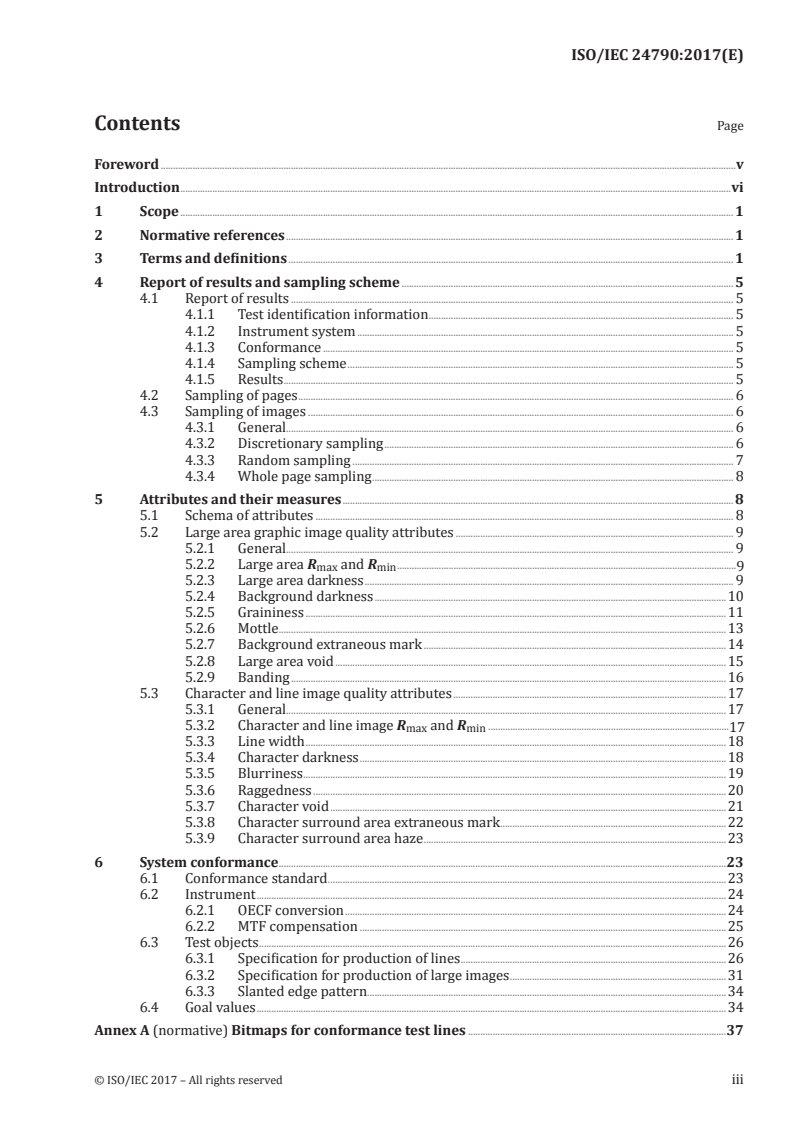
Contents Page
Foreword .v
Introduction .vi
1 Scope . 1
2 Normative references . 1
3 Terms and definitions . 1
4 Report of results and sampling scheme . 5
4.1 Report of results . 5
4.1.1 Test identification information . 5
4.1.2 Instrument system . 5
4.1.3 Conformance . 5
4.1.4 Sampling scheme . 5
4.1.5 Results . 5
4.2 Sampling of pages . 6
4.3 Sampling of images . 6
4.3.1 General. 6
4.3.2 Discretionary sampling . 6
4.3.3 Random sampling . 7
4.3.4 Whole page sampling . 8
5 Attributes and their measures . 8
5.1 Schema of attributes . 8
5.2 Large area graphic image quality attributes . 9
5.2.1 General. 9
5.2.2 Large area R and R .
max min 9
5.2.3 Large area darkness . 9
5.2.4 Background darkness .10
5.2.5 Graininess .11
5.2.6 Mottle .13
5.2.7 Background extraneous mark .14
5.2.8 Large area void .15
5.2.9 Banding .16
5.3 Character and line image quality attributes .17
5.3.1 General.17
5.3.2 Character and line image R and R .
max min 17
5.3.3 Line width .18
5.3.4 Character darkness .18
5.3.5 Blurriness .19
5.3.6 Raggedness .20
5.3.7 Character void .21
5.3.8 Character surround area extraneous mark .22
5.3.9 Character surround area haze .23
6 System conformance .23
6.1 Conformance standard .23
6.2 Instrument .24
6.2.1 OECF conversion .24
6.2.2 MTF compensation .25
6.3 Test objects .26
6.3.1 Specification for production of lines .26
6.3.2 Specification for production of large images .31
6.3.3 Slanted edge pattern . .34
6.4 Goal values .34
Annex A (normative) Bitmaps for conformance test lines .37
© ISO/IEC 2017 – All rights reserved iii
Annex B (informative) How to use this document .41
Annex C (normative) Layout of test images for system conformance test .54
Annex D (informative) Method to determine R , R and ROI .57
max min
Annex E (informative) Development of system conformance test chart .62
Bibliography .65
iv © ISO/IEC 2017 – All rights reserved
Foreword
ISO (the International Organization for Standardization) and IEC (the International Electrotechnical
Commission) form the specialized system for worldwide standardization. National bodies that are
members of ISO or IEC participate in the development of International Standards through technical
committees established by the respective organization to deal with particular fields of technical
activity. ISO and IEC technical committees collaborate in fields of mutual interest. Other international
organizations, governmental and non-governmental, in liaison with ISO and IEC, also take part in the
work. In the field of information technology, ISO and IEC have established a joint technical committee,
ISO/IEC JTC 1.
The procedures used to develop this document and those intended for its further maintenance are
described in the ISO/IEC Directives, Part 1. In particular the different approval criteria needed for the
different types of ISO documents should be noted. This document was drafted in accordance with the
editorial rules of the ISO/IEC Directives, Part 2 (see www .iso .org/ directives).
Attention is drawn to the possibility that some of the elements of this document may be the subject of
patent rights. ISO shall not be held responsible for identifying any or all such patent rights. Details of
any patent rights identified during the development of the document will be in the Introduction and/or
on the ISO list of patent declarations received (see www .iso .org/ patents).
Any trade name used in this document is information given for the convenience of users and does not
constitute an endorsement.
For an explanation on the voluntary nature of standards, the meaning of ISO specific terms and
expressions related to conformity assessment, as well as information about ISO’s adherence to the
World Trade Organization (WTO) principles in the Technical Barriers to Trade (TBT) see the following
URL: w w w . i s o .org/ iso/ foreword .html.
This document was prepared by ISO/IEC JTC 1, Information technology, Subcommittee SC 28, Office
equipment.
This first edition of ISO/IEC 24790 cancels and replaces ISO/IEC TS 24790:2012 and ISO/IEC 13660:2001,
which have been technically revised.
© ISO/IEC 2017 – All rights reserved v
Introduction
This document is designed to help a quality control engineer evaluate the image quality of prints from
office imaging systems.
In traditional imaging systems (such as ink-on-paper printing), an image is evaluated by comparison to
an original or master version of that image. In many electronic imaging systems, however, the image is
created digitally within the system. There is no hardcopy master and so there can be no evaluation by
comparison in the ordinary way.
Often, those who operate electronic imaging systems ensure good image quality by controlling the
imaging process. They use test targets and reference images to evaluate the performance of the system.
If it is not possible to control image quality by controlling the imaging process and if no test target or
reference image is available, we can rely only on direct evaluation of properties of the image itself.
To perform intrinsic evaluations of image quality, consider the nature of an image that is an output. An
image is some organization of information in space. We assume that these signals have some purpose
or are making some attempt at communication. Good image quality means that the image is legible (the
organization and information can be interpreted) and that it has a pleasing appearance.
Our goals in developing this document were to compile a list of image quality attributes that (taken
together) correlate to human perception of print quality and to develop measurement methods for
these attributes that can be automated and carried out on a simple system.
Legibility and appearance have several aspects:
— detail can be detected easily;
— image elements are well isolated from the background;
— the image has a minimum of gross defects;
— the imaging system has good geometric fidelity.
Not all these factors can be covered by evaluation of intrinsic, quantitative image quality attributes.
Many of them have a large psychological or cultural component that is difficult to evaluate.
A print made with large optical reduction or one that is out of focus can still have excellent edge quality
(and be totally lacking in gross defects, banding, noise, etc.) and yet be illegible. This could occur
primarily because of the high process gamma (contrast) that is characteristic of many xerographic
processes. Thus, the process can produce apparently sharp edges in spite of the loss in resolution.
Without a resolution target of some kind, the extent of the resolution loss, and hence legibility, may not
be known.
The purpose of this document is to present a set of objective, measurable attributes that give some
correlation to the perceived quality of an image to a human observer at a standard viewing distance. This
document allows a user of printed material to sort samples into several groups, from excellent to bad.
The attributes and methods for their assessment are based on several assumptions:
— the image represents an attempt at communication;
— there is uniformity within identifiable image elements;
— character images, symbols and graphic elements are regular (that is, they are intended to be identical
when they have multiple, similar occurrences);
— samples with extreme gross defects have been screened out.
vi © ISO/IEC 2017 – All rights reserved
This document applies to monochrome images made up of text, graphics and other image objects with
two tone levels of a single colour (typically black image on white paper) or halftones, images with more
nominal gray levels. This document does not cover continuous tone images, colour images and so on.
Image quality measurement can be thought of as divided into diagnostic (high resolution) and visual
scale (low resolution) procedures. Diagnostic measurements typically use precision test targets and
instrumentation and are key to much engineering work. The present procedure, by contrast, is limited
to phenomena visible to the naked eye and does not permit test patterns.
The working group has taken the approach of selecting simple and (in our judgment) effective metrics,
rather than attempting to prove that our method of doing a given job will always be the most exact.
How will this document actually be implemented? A complete evaluation system has four components:
an image capture device, evaluation software, application-specific quality standards and sampling
plan. The end user may choose to develop all these parts himself or he may choose to purchase one or
more components from a commercial supplier.
Any equipment capable of gathering data appropriate to these measurements is understood to have
a complex instrument function. Rather than attempting to explore the relationship among these
instrument functions, the working group has defined reference images and target values for them. If
these target values are achieved by an instrument, calibration will be acceptably good.
This is not an attempt to break new ground in image science. It is an attempt to provide suppliers and
customers for copies/prints with a practical and objective way to communicate about basic image
quality parameters.
ISO/IEC 13660 was developed and standardized by the point of view described above. ISO/IEC 13660 is
currently the only available systematic image quality attribute measurement standard. ISO/IEC 13660
has had a great influence on related industries and image quality measurement instruments based on
ISO/IEC 13660 are already marketed. However, due to the limited development time, it was standardized
with many issues unresolved and therefore, ISO/IEC 13660 has not been adopted as widely as expected.
The main issues are listed as following:
a) the test chart and methods for measurement system conformance are only specified for some
of character and line attributes. For large area graphic image quality attributes, neither test
charts nor methods are specified. Eight items of image quality attribute for character and line
image and six items of image quality attribute for large area graphic image are defined, and each
measuring method is specified. Of the 14 image quality attributes, the conformance test method,
the conformance test chart and the targeted value for measurement apparatus conformance are
specified for only four of the character and line image quality attributes, leaving 10 of the image
quality attributes with no conformance specifications;
b) physical measures (line width, large area voids) and psychophysical factors (darkness, graininess,
etc.) are intermingled and are all defined as image quality attributes;
c) the goal values for measurement system conformance are available for only four character and line
attributes, and the allowances are very large;
d) when one measures the character and line image quality attributes according to ISO/IEC 13660, the
resulting values have large variation and they do not correspond well with subjective evaluations.
This document added the following content to ISO/IEC 13660 to resolve the issues which ISO/IEC 13660
had and to improve the measurement accuracy.
a) Banding which is a common image quality defect of the hard copy output in a printer or a copying
machine is added as one of the image quality attributes of a large area graphic image.
b) Conformance test charts and the goal values for measurement system qualification are specified
for three character and line image quality attributes and seven large area graphic image quality
attributes.
© ISO/IEC 2017 – All rights reserved vii
c) The fundamental resolution of the scanner for measurement was increased from 600 spi to
1 200 spi to reduce the measurement variation.
d) Nearly all of the image quality attributes defined in ISO/IEC 13660 have been redefined in
ISO/IEC 24790 to eliminate intermingling physical measures and psychophysical factors.
e) In order to improve the correspondence between image quality attributes and subjective
evaluations, an image quality attribute measurement evaluation experiment was conducted on
seven items (graininess, mottle, banding, line width, character darkness, blurriness and raggedness)
of image quality attributes to select prediction algorithms for image quality attributes that have
the highest correlation with subjective evaluation. The measurement evaluation experiment was
conducted by five countries which includes Japan, U.S.A, China, South Korea and the Netherlands.
According to the measuring method of the image quality attributes chosen in the measurement
evaluation experiment, the conformance chart was revised and a measurement tool which can measure
automatically all the image quality attributes specified in this document was developed. An initial set
of conformance chart goal values were defined using those tools, and ISO/IEC TS 24790 was published
in 2012.
Experience with the use of the published Technical Specification over the following three years led to
a second revision of the conformance chart, a revision of the conformance evaluation methods and a
revision of the measurement tool. An international conformance chart measurement experiment
was conducted to refine the conformance chart goal values and to establish realistic measurement
tolerances for these goal values. This document is the result of this collective development and
measurement experience.
viii © ISO/IEC 2017 – All rights reserved
INTERNATIONAL STANDARD ISO/IEC 24790:2017(E)
Information technology — Office equipment —
Measurement of image quality attributes for hardcopy
output — Monochrome text and graphic images
1 Scope
This document specifies device-independent image quality attributes, measurement methods and
analytical procedures to describe the quality of output images from hardcopy devices. This document
is applicable to human-readable monochrome documents produced from printers and copiers.
The attributes, methods and procedures rely on measurable properties of printed text and graphic
images. Special targets or reference images are not required, but image elements are useful for adequate
measurements only if they meet some minimal requirements, e.g. on size or number present. This
document is not applicable to images on media other than hardcopy (e.g. images on a visual display) or
to images that are intended to be machine readable only (e.g. bar codes).
2 Normative references
The following documents are referred to in the text in such a way that some or all of their content
constitutes requirements of this document. For dated references, only the edition cited applies. For
undated references, the latest edition of the referenced document (including any amendments) applies.
ISO 2470-1, Paper, board and pulps — Measurement of diffuse blue reflectance factor — Part 1: Indoor
daylight conditions (ISO brightness)
ISO 14524, Photography — Electronic still-picture cameras — Methods for measuring opto-electronic
conversion functions (OECFs)
ISO 21550, Photography — Electronic scanners for photographic images — Dynamic range measurements
ISO 16067-1, Photography — Spatial resolution measurements of electronic scanners for photographic
images — Part 1: Scanners for reflective media
3 Terms and definitions
For the purposes of this document, the following terms and definitions apply.
ISO and IEC maintain terminological databases for use in standardization at the following addresses:
— IEC Electropedia: available at http:// www .electropedia .org/
— ISO Online browsing platform: available at https:// www .iso .org/ obp/
3.1
background area
region outside the edge of any image element (3.16)
3.2
background darkness
appearance of shade in background area (3.1) due to presence of unintended colourant particles that
cannot be resolved as individual marks
© ISO/IEC 2017 – All rights reserved 1
3.3
background extraneous mark
colourant particle or agglomeration of colourant particles in the background area (3.1) that is visible at
a viewing distance of 25 cm to 40 cm with the unaided eye
3.4
banding
appearance of one dimensional bands within an area that should be homogeneous
3.5
blurriness
appearance of being hazy or indistinct in outline, a noticeable transition of darkness from line element
to background substrate whose intended transition width is zero (i.e. ideally sharp)
3.6
boundary
contour by reflectance threshold (3.35)
3.7
character darkness
appearance of blackness of a line or character image
3.8
character surround area
region runs from the outer edge of the character image or other image element (3.16) out
500 micrometres
3.9
character surround area haze
colourant particles or agglomerations of colourant particles within a character surround area (3.8) that
are visible, but not resolvable as distinct marks
3.10
character surround area extraneous mark
colourant particle or agglomeration of colourant particles within a character surround area (3.8) that is
visible at a viewing distance of 25 cm to 40 cm with the unaided eye as a distinct mark
3.11
character void
appearance of homogeneity of darkness within the boundary (3.6) of a line segment, character image or
other glyph image
3.12
edge threshold
level in the reflectance gradient profile of an edge that is at 40 % of the transition from the minimum
reflectance factor (R ) (3.33) to the maximum reflectance factor (R ) (3.31) as: R = R + 40 %
min max 40 min
(R – R ).
max min
3.13
graininess
appearance of unintended microscopic, but visible aperiodic fluctuations of lightness
Note 1 to entry: Microscopic means: variations with spatial frequencies greater than about 0,4 cy/mm.
3.14
graphic image
images except a character and a symbol
3.15
image area
region inside portion of inner boundary (3.17)
2 © ISO/IEC 2017 – All rights reserved
3.16
image element
single, evidently intentional, object not connected to other objects
3.17
inner boundary
contour of points of an image element (3.16) where edge gradient profiles cross a reflectance level that is
at 10 % of the transition from the minimum reflectance factor (R ) (3.33) to the maximum reflectance
min
factor (R ) (3.31) as: R = R + 10 % (R – R ).
max 10 min max min
3.18
large area darkness
appearance of blackness of a large area graphic image element
3.19
large area
image area (3.15) of graphical element or background that has a minimum size of 12,7 mm in both
dimensions
Note 1 to entry: Equivalent to 600 pixels when sampling resolution is 1 200 spi.
3.20
large area void
visible hole or gap within a solid image area (3.15) that is large enough to be individually distinguished
at a viewing distance of 25 cm to 40 cm
3.21
line image
line at least 1 mm long
3.22
line image density
average optical density (3.27) within the R boundary (3.6)
Note 1 to entry: The average optical density should be converted from average reflectance factor.
3.23
line width
average stroke width, where the stroke width is measured from edge to edge along a line normal to the
center line of the image element (3.16)
3.24
metric
measure of image quality attribute
3.25
monochrome image
image perceived as achromatic colour
3.26
mottle
measure of the appearance of unintended, aperiodic macroscopic fluctuations of lightness
Note 1 to entry: Macroscopic means: variations with spatial frequencies less than about 0,4 cy/mm.
3.27
optical density
negative logarithm to the base 10 of the reflectance factor (3.30), measured using a 0/45-degree
geometry, Illuminant A and ISO visual density calibration as specified in ISO 5-1, ISO 5-3 and ISO 5-4
with an instrument using no polarization filters
© ISO/IEC 2017 – All rights reserved 3
3.28
outer boundary
contour of points of an image element (3.16) where edge gradient profiles cross a reflectance level that is
at 70 % of the transition from the minimum reflectance factor (R ) (3.33) to the maximum reflectance
min
factor (R ) (3.31) as: R = R + 70 % (R – R ).
max 70 min max min
3.29
raggedness
appearance of geometric distortion of an edge from its ideal position
Note 1 to entry: An ideal edge should be absolutely straight along the length of the line.
Note 2 to entry: A ragged edge appears rough or wavy rather than smooth or straight.
3.30
reflectance factor
ratio of the reflected flux as measured to the reflected flux under the same geometrical and spectral
conditions for an ideal 100 % diffuse reflecting surface
3.31
maximum reflectance factor
R
max
highest reflectance factor (3.30) measured by a slit aperture in the background area (3.1), typically of
the substrate
3.32
region of interest
ROI
area (inside defined boundaries) that the user wants to analyse
Note 1 to entry: ROI for character and line image attribute includes image element (3.16) and background area (3.1).
Note 2 to entry: ROI for large area graphic image attribute is within image area (3.15).
Note 3 to entry: The difference between ROI for character and line image (3.21) and large area graphic image is
shown in Annex D.
3.33
minimum reflectance factor
R
min
lowest reflectance factor (3.30) measured by a slit aperture in the image element (3.16), typically of
the image
3.34
spots per inch
spi
spots per 25,4 mm
3.35
reflectance threshold
level in the reflectance gradient profile of an edge that is at some specified percentage of the transition
from the minimum reflectance factor (R ) (3.33) to the maximum reflectance factor (R ) (3.31) as:
min max
R = R + p % (R – R ).
p min max min
4 © ISO/IEC 2017 – All rights reserved
4 Report of results and sampling scheme
4.1 Report of results
4.1.1 Test identification information
The report shall include the date of the measurements, the identity of the test operator, lot
identifications, etc.
4.1.2 Instrument system
The report shall include a description of the instrument system used, noting any of Clause 5, attribute
measurement specifications that are emulated or deviated from in any way.
4.1.3 Conformance
Report the results of the conformance tests, Instrument, specs, Instrument OECF, Instrument dynamic
range, Large area attributes: (7) large area darkness, background darkness, graininess, mottle,
background extraneous mark, large area void, banding, Character and line attributes: (7) line width,
character darkness, blurriness, raggedness, character void, character suround area extraneous mark,
character surround area haze (see Clause 6 and Annex B).
4.1.4 Sampling scheme
The report shall include a complete description of the sampling scheme (4.3) used to select the pages
and images.
4.1.5 Results
For each attribute, the report shall include the number of samples per page and the mean, standard
deviation and range of the results for each page and for the entire lot.
© ISO/IEC 2017 – All rights reserved 5
Table 1 — Sample report of an evaluation
ORIGINATOR XYZ Printing Company
Test Description Results of March 15, 2012 print set
Date of Report April 2, 2012
Test Operator RJC
INSTRUMENTATION XYZ Optical Company, Model XXX
Type 1 200 dpi flatbed scanner
Measurement and analysis software ISO 24790 ANALYZER by ABC Inc.
Instrument OECF compensation software Auto OECF by ABC Inc.
Instrument dynamic range measurement Auto DR by ABC Inc.
software
CONFORMANCE TESTS within the tolerance
Density Measurements within the tolerance
Spatial Measurements within the tolerance
Line Attributes Measurements within the tolerance
Graininess & Mottle Measurements
Random Sampling
SAMPLING SCHEME
LARGE AREA IMAGE QUALITY ATTRIBUTES # of samples/page Mean Std
large area darkness
# of samples/page Mean Std
background darkness
graininess
mottle
background extraneous mark
large area void
banding
CHARACTER AND LINE IMAGE QUALITY ATTRIBUTES
line width
character darkness
blurriness
raggedness
character void
character surround area extraneous mark
character surround area haze
4.2 Sampling of pages
The pages chosen shall be taken from a homogeneous lot. They shall all (as far as can be determined) be
on the same substrate, produced with the same process and be of the same age.
The number of pages to be sampled depends on the user’s optimal balance between risk and cost and on
the uniformity of the process that produced the lot.
Any sampling scheme selected shall allow for the screening of pages with defects beyond the scope of
this document (such as physical damage to pages) and pages with defects which would be unacceptable
to practically all observers. These pages should not be evaluated.
4.3 Sampling of images
4.3.1 General
Three sampling schemes and the information required to specify them in the report of results are given
below. Use one of these three schemes. The report shall contain enough specific information that the
sampling scheme can be duplicated exactly.
4.3.2 Discretionary sampling
In discretionary sampling, a human operator intervenes to select features for analysis, based on some
subjective criteria.
6 © ISO/IEC 2017 – All rights reserved
4.3.2.1 Procedure
a) For each attribute, establish decision rules for selecting regions.
EXAMPLE 1 “Select the 10 regions with the highest apparent mottle.”
EXAMPLE 2 “Find the three lightest character images. Find the three darkest character images.”
b) Visually inspect the page and select regions that meet the criteria.
c) Evaluate the attribute within each region selected.
4.3.2.2 Specification of sampling scheme
If this sampling method is selected, the report shall include
a) all decision rules used, and
b) location of each region evaluated, for each attribute.
4.3.3 Random sampling
4.3.3.1 General
In random sampling, features are taken from a portion of the page that has been selected blindly to
represent the whole page.
4.3.3.2 Procedure
a) Cover the page with a grid of uniform rectangular cells.
b) Select a cell at random (using any random or pseudorandom method that ensures that each cell has
the same chance of being selected as any other).
c) If the attribute being evaluated does not apply to the cell, discard it and select a replacement.
d) Evaluate the attribute within the cell.
e) Sample cells until the desired accuracy is obtained.
4.3.3.3 Specification of sampling scheme
If this sampling method is used, the report shall include the following:
a) dimensions of the grid cells;
b) method of placing grid on page:
1) location of origin;
2) orientation of axes;
c) decision rule for deciding if attribute is applicable to cell;
d) any other decision rules used;
e) decision rule for deciding when to stop sampling;
f) method of randomization in selection of grid cells;
© ISO/IEC 2017 – All rights reserved 7
g) stratification, if any (stratification is dividing the grid into homogeneous sections and then
selecting samples from each section according to a predetermined proportion of the total number
of samples).
4.3.4 Whole page sampling
In whole page sampling, features are extracted from throughout the page.
4.3.4.1 Procedure
Divide the page into the cells and measure each attribute (if present) in each cell.
4.3.4.2 Specification of sampling scheme
If this sampling method is selected, the report shall include the following:
a) dimensions of the grid cells;
b) method of placing grid on page:
1) location of origin;
2) orientation axes;
c) decision rule for deciding if attribute is applicable to cell;
d) any other decision rules used.
5 Attributes and their measures
5.1 Schema of attributes
The table below gives an overview of the image quality attributes. They have been divided into two
groups. The attributes in each group generally require similar assumptions and have similar or related
measurement procedures.
Group of Attribute Attribute Clause
Large area graphic image quality attributes
large area darkness………………. 5.2.3
background darkness……………. 5.2.4
graininess……………………………. 5.2.5
mottle…………………………………… 5.2.6
background extraneous mark… 5.2.7
large area void………………………. 5.2.8
banding………………………………… 5.2.9
Character and line image quality attributes
line width……………………………. 5.3.3
character darkness………………. 5.3.4
8 © ISO/IEC 2017 – All rights reserved
blurriness……………………………. 5.3.5
raggedness……………………………. 5.3.6
character void………………………. 5.3.7
character surround area 5.3.8
extraneous mark……………………
character surround area haze… 5.3.9
5.2 Large area graphic image quality attributes
5.2.1 General
This subclause contains measuring procedures for attributes characterizing areas larger than 161 mm
and with minimum dimension of 12,7 mm (equivalent to 600 pixels when resolution is 1 200 spi).
All measurements described in this subclause shall be made under the conditions prescribed in Clause 6
and Annex B.
5.2.2 Large area R and R
max min
In order to determine the inner boundary, the maximum reflectance factor (R ) is determined by
max
averaging the data measured in the area selected by the user as background area and the minimum
reflectance factor (R ) is determined by averaging the data measured in the area selected by the user
min
as image area. Then, from R and R , R is computed and the inner boundary edge is determined.
max min 10
5.2.3 Large area darkness
a) Find a region of interest (ROI) with a minimum dimension of 12,7 mm contained wholly within the
inner boundary (R ) of an image element.
b) Measure the optical reflectance factor Y (x, y) wholly within the ROI.
c) Compute the average optical density of the ROI as the large area darkness using Formula (1). The
average optical density should be converted from the average reflectance factor.
Large area darkness metric = log (1)
Yx(, y)
∑∑
nm×
yx
© ISO/IEC 2017 – All rights reserved 9
Key
a
smallest dimension ≥12,7 mm
Figure 1 — Large area darkness
5.2.4 Background darkness
a) Find an ROI of a minimum dimension of 12,7 mm in the background area (with marks excluded) at
least 500 micrometres away from the outer boundary of any image element.
b) Measure the optical reflectance factor Y (x, y) wholly within the ROI.
c) Compute the average optical density of the ROI as background darkness using Formula (2). The
average optical density should be converted from the average reflectance factor.
Background darkness metric = log (2)
Yx(, y)
∑∑
nm×
yx
Key
a
at least 50 μm away
Figure 2 — Background darkness
10 © ISO/IEC 2017 – All rights reserved
5.2.5 Graininess
5.2.5.1 Sampling for the graininess measurement
Key
1 wavelet-processed ROI
2 cropped ROI
a
30 pixels at 1 200 spi
b
3 600 measurements
Figure 3 — ROI divided into tiles; a tile (with dimensions)
Find an ROI of a minimum dimension of at least 12,7 mm (600 pixels at 1 200 spi), contained wholly
within the area. Apply the wavelet filtering to this ROI. Remove margins 0,635 mm (30 pixels at
1 200 spi) from each side of the wavelet-processed ROI to get a cropped ROI, as shown in Figure 3.
Divide the cropped ROI into at least 81 (9 × 9) uniform, non-overlapping square tiles. The height and
width of each tile is at least 1,27 mm (60 pixels at 1 200 spi).
Within each tile, make 3 600 (60 × 60) pixels evenly-spaced, non-overlapping measurements of
reflectance.
NOTE For a 1 200 spi detector system, the cropped ROI corresponds to a region of 291 600 (540 × 540) pixels
divided into 81 (9 × 9) tiles of 3 600 (60 × 60) pixels each.
5.2.5.2 Graininess measurement
a) Find an ROI of a minimum dimension of at least 12,7 mm contained wholly within the inner
boundary of an image element.
b) Measure the optical reflectance factor R (x, y), G (x, y) and B (x, y) of 360 000 (600 × 600) pixels,
using red, green and blue filter, respectively. Pixels are evenly-spaced, non-overlapping elements
within the ROI.
c) Convert the three optical reflectance factors to a single CIE Y (x, y), using Formula (3) (see http://
www .color .org/ sRGB .xalter):
Yx,,yR= 0 21260xy,,+ 71520Gx,,yB+ 0722 xy, (3)
() () () ()
d) Apply the wavelet transform (Daubechies wavelets of order 16) to the 600 × 600 pixels ROI. Set the
number of wavelet levels n = 6.
e) Zero all the detail components (horizontal, vertical and diagonal) of the four highest-detail wavelet
levels (scale levels 2, 3, 4 and 5). The frequency band of each wavelet level is shown in Table 2.
© ISO/IEC 2017 – All rights reserved 11
f) Zero the approximation component of the wavelet image (this is the low-pass component at the
lowest scale: level 0).
Table 2 — Frequency band of 6 wavelet levels
Scale level Frequency band (cy/mm)
5 23,6220 to 11,8110
4 11,8110 to 5,9055
High frequencies
to be removed
3 5,9055 to 2,9526
2 2,9526 to 1,4763
1 1,4763 to 0,7382
Frequencies for
graininess
0 0,7382 to 0,3691
g) Apply the inverse wavelet transform to get the filtered image Y (x, y).
h) Crop the filtered image, removing 0,635 mm (30 pixels) from each side (as shown in Figure 3).
i) Divide the cropped image into non-overlapped tiles of uniform size. There shall be at least 81 tiles,
with at least nine tiles vertically and at least nine tiles horizontally. The area of each tile shall be at
least 1,27 mm × 1,27 mm (60 × 60 pixels each).
j) Compute the reflectance variance v of each tile of i-th row and j-th column [Formula (4) assumes a
i,j
total of 60 × 60 = 3 600 pixels per tile]:
60 60
′ ′
vY xy, −Y (4)
()
∑ ∑
i,ji,j i,j
60×−60 1
x=1 y=1
k) Compute the graininess metric as the square root of the average of all tiles’ variances using
Formula (5) [Formula (5) assumes a total of 9 × 9 = 81 tiles, obtained after cropping a
600 × 600 wavelet-processed image into a 540 × 540 image]:
9 9
Graininessmetric = v (5)
∑ ∑
i,j
99×
i=1 j=1
Figure 4 — Graininess
12 © ISO/IEC 2017 – Al
...
INTERNATIONAL ISO/IEC
STANDARD 24790
First edition
2017-02
Information technology — Office
equipment — Measurement of image
quality attributes for hardcopy
output — Monochrome text and
graphic images
Technologies de l’information — Équipement de bureau — Mesurage
des attributs de qualité d’image — Texte monochrome et images
graphiques
Reference number
©
ISO/IEC 2017
© ISO/IEC 2017, Published in Switzerland
All rights reserved. Unless otherwise specified, no part of this publication may be reproduced or utilized otherwise in any form
or by any means, electronic or mechanical, including photocopying, or posting on the internet or an intranet, without prior
written permission. Permission can be requested from either ISO at the address below or ISO’s member body in the country of
the requester.
ISO copyright office
Ch. de Blandonnet 8 • CP 401
CH-1214 Vernier, Geneva, Switzerland
Tel. +41 22 749 01 11
Fax +41 22 749 09 47
copyright@iso.org
www.iso.org
ii © ISO/IEC 2017 – All rights reserved
Contents Page
Foreword .v
Introduction .vi
1 Scope . 1
2 Normative references . 1
3 Terms and definitions . 1
4 Report of results and sampling scheme . 5
4.1 Report of results . 5
4.1.1 Test identification information . 5
4.1.2 Instrument system . 5
4.1.3 Conformance . 5
4.1.4 Sampling scheme . 5
4.1.5 Results . 5
4.2 Sampling of pages . 6
4.3 Sampling of images . 6
4.3.1 General. 6
4.3.2 Discretionary sampling . 6
4.3.3 Random sampling . 7
4.3.4 Whole page sampling . 8
5 Attributes and their measures . 8
5.1 Schema of attributes . 8
5.2 Large area graphic image quality attributes . 9
5.2.1 General. 9
5.2.2 Large area R and R .
max min 9
5.2.3 Large area darkness . 9
5.2.4 Background darkness .10
5.2.5 Graininess .11
5.2.6 Mottle .13
5.2.7 Background extraneous mark .14
5.2.8 Large area void .15
5.2.9 Banding .16
5.3 Character and line image quality attributes .17
5.3.1 General.17
5.3.2 Character and line image R and R .
max min 17
5.3.3 Line width .18
5.3.4 Character darkness .18
5.3.5 Blurriness .19
5.3.6 Raggedness .20
5.3.7 Character void .21
5.3.8 Character surround area extraneous mark .22
5.3.9 Character surround area haze .23
6 System conformance .23
6.1 Conformance standard .23
6.2 Instrument .24
6.2.1 OECF conversion .24
6.2.2 MTF compensation .25
6.3 Test objects .26
6.3.1 Specification for production of lines .26
6.3.2 Specification for production of large images .31
6.3.3 Slanted edge pattern . .34
6.4 Goal values .34
Annex A (normative) Bitmaps for conformance test lines .37
© ISO/IEC 2017 – All rights reserved iii
Annex B (informative) How to use this document .41
Annex C (normative) Layout of test images for system conformance test .54
Annex D (informative) Method to determine R , R and ROI .57
max min
Annex E (informative) Development of system conformance test chart .62
Bibliography .65
iv © ISO/IEC 2017 – All rights reserved
Foreword
ISO (the International Organization for Standardization) and IEC (the International Electrotechnical
Commission) form the specialized system for worldwide standardization. National bodies that are
members of ISO or IEC participate in the development of International Standards through technical
committees established by the respective organization to deal with particular fields of technical
activity. ISO and IEC technical committees collaborate in fields of mutual interest. Other international
organizations, governmental and non-governmental, in liaison with ISO and IEC, also take part in the
work. In the field of information technology, ISO and IEC have established a joint technical committee,
ISO/IEC JTC 1.
The procedures used to develop this document and those intended for its further maintenance are
described in the ISO/IEC Directives, Part 1. In particular the different approval criteria needed for the
different types of ISO documents should be noted. This document was drafted in accordance with the
editorial rules of the ISO/IEC Directives, Part 2 (see www .iso .org/ directives).
Attention is drawn to the possibility that some of the elements of this document may be the subject of
patent rights. ISO shall not be held responsible for identifying any or all such patent rights. Details of
any patent rights identified during the development of the document will be in the Introduction and/or
on the ISO list of patent declarations received (see www .iso .org/ patents).
Any trade name used in this document is information given for the convenience of users and does not
constitute an endorsement.
For an explanation on the voluntary nature of standards, the meaning of ISO specific terms and
expressions related to conformity assessment, as well as information about ISO’s adherence to the
World Trade Organization (WTO) principles in the Technical Barriers to Trade (TBT) see the following
URL: w w w . i s o .org/ iso/ foreword .html.
This document was prepared by ISO/IEC JTC 1, Information technology, Subcommittee SC 28, Office
equipment.
This first edition of ISO/IEC 24790 cancels and replaces ISO/IEC TS 24790:2012 and ISO/IEC 13660:2001,
which have been technically revised.
© ISO/IEC 2017 – All rights reserved v
Introduction
This document is designed to help a quality control engineer evaluate the image quality of prints from
office imaging systems.
In traditional imaging systems (such as ink-on-paper printing), an image is evaluated by comparison to
an original or master version of that image. In many electronic imaging systems, however, the image is
created digitally within the system. There is no hardcopy master and so there can be no evaluation by
comparison in the ordinary way.
Often, those who operate electronic imaging systems ensure good image quality by controlling the
imaging process. They use test targets and reference images to evaluate the performance of the system.
If it is not possible to control image quality by controlling the imaging process and if no test target or
reference image is available, we can rely only on direct evaluation of properties of the image itself.
To perform intrinsic evaluations of image quality, consider the nature of an image that is an output. An
image is some organization of information in space. We assume that these signals have some purpose
or are making some attempt at communication. Good image quality means that the image is legible (the
organization and information can be interpreted) and that it has a pleasing appearance.
Our goals in developing this document were to compile a list of image quality attributes that (taken
together) correlate to human perception of print quality and to develop measurement methods for
these attributes that can be automated and carried out on a simple system.
Legibility and appearance have several aspects:
— detail can be detected easily;
— image elements are well isolated from the background;
— the image has a minimum of gross defects;
— the imaging system has good geometric fidelity.
Not all these factors can be covered by evaluation of intrinsic, quantitative image quality attributes.
Many of them have a large psychological or cultural component that is difficult to evaluate.
A print made with large optical reduction or one that is out of focus can still have excellent edge quality
(and be totally lacking in gross defects, banding, noise, etc.) and yet be illegible. This could occur
primarily because of the high process gamma (contrast) that is characteristic of many xerographic
processes. Thus, the process can produce apparently sharp edges in spite of the loss in resolution.
Without a resolution target of some kind, the extent of the resolution loss, and hence legibility, may not
be known.
The purpose of this document is to present a set of objective, measurable attributes that give some
correlation to the perceived quality of an image to a human observer at a standard viewing distance. This
document allows a user of printed material to sort samples into several groups, from excellent to bad.
The attributes and methods for their assessment are based on several assumptions:
— the image represents an attempt at communication;
— there is uniformity within identifiable image elements;
— character images, symbols and graphic elements are regular (that is, they are intended to be identical
when they have multiple, similar occurrences);
— samples with extreme gross defects have been screened out.
vi © ISO/IEC 2017 – All rights reserved
This document applies to monochrome images made up of text, graphics and other image objects with
two tone levels of a single colour (typically black image on white paper) or halftones, images with more
nominal gray levels. This document does not cover continuous tone images, colour images and so on.
Image quality measurement can be thought of as divided into diagnostic (high resolution) and visual
scale (low resolution) procedures. Diagnostic measurements typically use precision test targets and
instrumentation and are key to much engineering work. The present procedure, by contrast, is limited
to phenomena visible to the naked eye and does not permit test patterns.
The working group has taken the approach of selecting simple and (in our judgment) effective metrics,
rather than attempting to prove that our method of doing a given job will always be the most exact.
How will this document actually be implemented? A complete evaluation system has four components:
an image capture device, evaluation software, application-specific quality standards and sampling
plan. The end user may choose to develop all these parts himself or he may choose to purchase one or
more components from a commercial supplier.
Any equipment capable of gathering data appropriate to these measurements is understood to have
a complex instrument function. Rather than attempting to explore the relationship among these
instrument functions, the working group has defined reference images and target values for them. If
these target values are achieved by an instrument, calibration will be acceptably good.
This is not an attempt to break new ground in image science. It is an attempt to provide suppliers and
customers for copies/prints with a practical and objective way to communicate about basic image
quality parameters.
ISO/IEC 13660 was developed and standardized by the point of view described above. ISO/IEC 13660 is
currently the only available systematic image quality attribute measurement standard. ISO/IEC 13660
has had a great influence on related industries and image quality measurement instruments based on
ISO/IEC 13660 are already marketed. However, due to the limited development time, it was standardized
with many issues unresolved and therefore, ISO/IEC 13660 has not been adopted as widely as expected.
The main issues are listed as following:
a) the test chart and methods for measurement system conformance are only specified for some
of character and line attributes. For large area graphic image quality attributes, neither test
charts nor methods are specified. Eight items of image quality attribute for character and line
image and six items of image quality attribute for large area graphic image are defined, and each
measuring method is specified. Of the 14 image quality attributes, the conformance test method,
the conformance test chart and the targeted value for measurement apparatus conformance are
specified for only four of the character and line image quality attributes, leaving 10 of the image
quality attributes with no conformance specifications;
b) physical measures (line width, large area voids) and psychophysical factors (darkness, graininess,
etc.) are intermingled and are all defined as image quality attributes;
c) the goal values for measurement system conformance are available for only four character and line
attributes, and the allowances are very large;
d) when one measures the character and line image quality attributes according to ISO/IEC 13660, the
resulting values have large variation and they do not correspond well with subjective evaluations.
This document added the following content to ISO/IEC 13660 to resolve the issues which ISO/IEC 13660
had and to improve the measurement accuracy.
a) Banding which is a common image quality defect of the hard copy output in a printer or a copying
machine is added as one of the image quality attributes of a large area graphic image.
b) Conformance test charts and the goal values for measurement system qualification are specified
for three character and line image quality attributes and seven large area graphic image quality
attributes.
© ISO/IEC 2017 – All rights reserved vii
c) The fundamental resolution of the scanner for measurement was increased from 600 spi to
1 200 spi to reduce the measurement variation.
d) Nearly all of the image quality attributes defined in ISO/IEC 13660 have been redefined in
ISO/IEC 24790 to eliminate intermingling physical measures and psychophysical factors.
e) In order to improve the correspondence between image quality attributes and subjective
evaluations, an image quality attribute measurement evaluation experiment was conducted on
seven items (graininess, mottle, banding, line width, character darkness, blurriness and raggedness)
of image quality attributes to select prediction algorithms for image quality attributes that have
the highest correlation with subjective evaluation. The measurement evaluation experiment was
conducted by five countries which includes Japan, U.S.A, China, South Korea and the Netherlands.
According to the measuring method of the image quality attributes chosen in the measurement
evaluation experiment, the conformance chart was revised and a measurement tool which can measure
automatically all the image quality attributes specified in this document was developed. An initial set
of conformance chart goal values were defined using those tools, and ISO/IEC TS 24790 was published
in 2012.
Experience with the use of the published Technical Specification over the following three years led to
a second revision of the conformance chart, a revision of the conformance evaluation methods and a
revision of the measurement tool. An international conformance chart measurement experiment
was conducted to refine the conformance chart goal values and to establish realistic measurement
tolerances for these goal values. This document is the result of this collective development and
measurement experience.
viii © ISO/IEC 2017 – All rights reserved
INTERNATIONAL STANDARD ISO/IEC 24790:2017(E)
Information technology — Office equipment —
Measurement of image quality attributes for hardcopy
output — Monochrome text and graphic images
1 Scope
This document specifies device-independent image quality attributes, measurement methods and
analytical procedures to describe the quality of output images from hardcopy devices. This document
is applicable to human-readable monochrome documents produced from printers and copiers.
The attributes, methods and procedures rely on measurable properties of printed text and graphic
images. Special targets or reference images are not required, but image elements are useful for adequate
measurements only if they meet some minimal requirements, e.g. on size or number present. This
document is not applicable to images on media other than hardcopy (e.g. images on a visual display) or
to images that are intended to be machine readable only (e.g. bar codes).
2 Normative references
The following documents are referred to in the text in such a way that some or all of their content
constitutes requirements of this document. For dated references, only the edition cited applies. For
undated references, the latest edition of the referenced document (including any amendments) applies.
ISO 2470-1, Paper, board and pulps — Measurement of diffuse blue reflectance factor — Part 1: Indoor
daylight conditions (ISO brightness)
ISO 14524, Photography — Electronic still-picture cameras — Methods for measuring opto-electronic
conversion functions (OECFs)
ISO 21550, Photography — Electronic scanners for photographic images — Dynamic range measurements
ISO 16067-1, Photography — Spatial resolution measurements of electronic scanners for photographic
images — Part 1: Scanners for reflective media
3 Terms and definitions
For the purposes of this document, the following terms and definitions apply.
ISO and IEC maintain terminological databases for use in standardization at the following addresses:
— IEC Electropedia: available at http:// www .electropedia .org/
— ISO Online browsing platform: available at https:// www .iso .org/ obp/
3.1
background area
region outside the edge of any image element (3.16)
3.2
background darkness
appearance of shade in background area (3.1) due to presence of unintended colourant particles that
cannot be resolved as individual marks
© ISO/IEC 2017 – All rights reserved 1
3.3
background extraneous mark
colourant particle or agglomeration of colourant particles in the background area (3.1) that is visible at
a viewing distance of 25 cm to 40 cm with the unaided eye
3.4
banding
appearance of one dimensional bands within an area that should be homogeneous
3.5
blurriness
appearance of being hazy or indistinct in outline, a noticeable transition of darkness from line element
to background substrate whose intended transition width is zero (i.e. ideally sharp)
3.6
boundary
contour by reflectance threshold (3.35)
3.7
character darkness
appearance of blackness of a line or character image
3.8
character surround area
region runs from the outer edge of the character image or other image element (3.16) out
500 micrometres
3.9
character surround area haze
colourant particles or agglomerations of colourant particles within a character surround area (3.8) that
are visible, but not resolvable as distinct marks
3.10
character surround area extraneous mark
colourant particle or agglomeration of colourant particles within a character surround area (3.8) that is
visible at a viewing distance of 25 cm to 40 cm with the unaided eye as a distinct mark
3.11
character void
appearance of homogeneity of darkness within the boundary (3.6) of a line segment, character image or
other glyph image
3.12
edge threshold
level in the reflectance gradient profile of an edge that is at 40 % of the transition from the minimum
reflectance factor (R ) (3.33) to the maximum reflectance factor (R ) (3.31) as: R = R + 40 %
min max 40 min
(R – R ).
max min
3.13
graininess
appearance of unintended microscopic, but visible aperiodic fluctuations of lightness
Note 1 to entry: Microscopic means: variations with spatial frequencies greater than about 0,4 cy/mm.
3.14
graphic image
images except a character and a symbol
3.15
image area
region inside portion of inner boundary (3.17)
2 © ISO/IEC 2017 – All rights reserved
3.16
image element
single, evidently intentional, object not connected to other objects
3.17
inner boundary
contour of points of an image element (3.16) where edge gradient profiles cross a reflectance level that is
at 10 % of the transition from the minimum reflectance factor (R ) (3.33) to the maximum reflectance
min
factor (R ) (3.31) as: R = R + 10 % (R – R ).
max 10 min max min
3.18
large area darkness
appearance of blackness of a large area graphic image element
3.19
large area
image area (3.15) of graphical element or background that has a minimum size of 12,7 mm in both
dimensions
Note 1 to entry: Equivalent to 600 pixels when sampling resolution is 1 200 spi.
3.20
large area void
visible hole or gap within a solid image area (3.15) that is large enough to be individually distinguished
at a viewing distance of 25 cm to 40 cm
3.21
line image
line at least 1 mm long
3.22
line image density
average optical density (3.27) within the R boundary (3.6)
Note 1 to entry: The average optical density should be converted from average reflectance factor.
3.23
line width
average stroke width, where the stroke width is measured from edge to edge along a line normal to the
center line of the image element (3.16)
3.24
metric
measure of image quality attribute
3.25
monochrome image
image perceived as achromatic colour
3.26
mottle
measure of the appearance of unintended, aperiodic macroscopic fluctuations of lightness
Note 1 to entry: Macroscopic means: variations with spatial frequencies less than about 0,4 cy/mm.
3.27
optical density
negative logarithm to the base 10 of the reflectance factor (3.30), measured using a 0/45-degree
geometry, Illuminant A and ISO visual density calibration as specified in ISO 5-1, ISO 5-3 and ISO 5-4
with an instrument using no polarization filters
© ISO/IEC 2017 – All rights reserved 3
3.28
outer boundary
contour of points of an image element (3.16) where edge gradient profiles cross a reflectance level that is
at 70 % of the transition from the minimum reflectance factor (R ) (3.33) to the maximum reflectance
min
factor (R ) (3.31) as: R = R + 70 % (R – R ).
max 70 min max min
3.29
raggedness
appearance of geometric distortion of an edge from its ideal position
Note 1 to entry: An ideal edge should be absolutely straight along the length of the line.
Note 2 to entry: A ragged edge appears rough or wavy rather than smooth or straight.
3.30
reflectance factor
ratio of the reflected flux as measured to the reflected flux under the same geometrical and spectral
conditions for an ideal 100 % diffuse reflecting surface
3.31
maximum reflectance factor
R
max
highest reflectance factor (3.30) measured by a slit aperture in the background area (3.1), typically of
the substrate
3.32
region of interest
ROI
area (inside defined boundaries) that the user wants to analyse
Note 1 to entry: ROI for character and line image attribute includes image element (3.16) and background area (3.1).
Note 2 to entry: ROI for large area graphic image attribute is within image area (3.15).
Note 3 to entry: The difference between ROI for character and line image (3.21) and large area graphic image is
shown in Annex D.
3.33
minimum reflectance factor
R
min
lowest reflectance factor (3.30) measured by a slit aperture in the image element (3.16), typically of
the image
3.34
spots per inch
spi
spots per 25,4 mm
3.35
reflectance threshold
level in the reflectance gradient profile of an edge that is at some specified percentage of the transition
from the minimum reflectance factor (R ) (3.33) to the maximum reflectance factor (R ) (3.31) as:
min max
R = R + p % (R – R ).
p min max min
4 © ISO/IEC 2017 – All rights reserved
4 Report of results and sampling scheme
4.1 Report of results
4.1.1 Test identification information
The report shall include the date of the measurements, the identity of the test operator, lot
identifications, etc.
4.1.2 Instrument system
The report shall include a description of the instrument system used, noting any of Clause 5, attribute
measurement specifications that are emulated or deviated from in any way.
4.1.3 Conformance
Report the results of the conformance tests, Instrument, specs, Instrument OECF, Instrument dynamic
range, Large area attributes: (7) large area darkness, background darkness, graininess, mottle,
background extraneous mark, large area void, banding, Character and line attributes: (7) line width,
character darkness, blurriness, raggedness, character void, character suround area extraneous mark,
character surround area haze (see Clause 6 and Annex B).
4.1.4 Sampling scheme
The report shall include a complete description of the sampling scheme (4.3) used to select the pages
and images.
4.1.5 Results
For each attribute, the report shall include the number of samples per page and the mean, standard
deviation and range of the results for each page and for the entire lot.
© ISO/IEC 2017 – All rights reserved 5
Table 1 — Sample report of an evaluation
ORIGINATOR XYZ Printing Company
Test Description Results of March 15, 2012 print set
Date of Report April 2, 2012
Test Operator RJC
INSTRUMENTATION XYZ Optical Company, Model XXX
Type 1 200 dpi flatbed scanner
Measurement and analysis software ISO 24790 ANALYZER by ABC Inc.
Instrument OECF compensation software Auto OECF by ABC Inc.
Instrument dynamic range measurement Auto DR by ABC Inc.
software
CONFORMANCE TESTS within the tolerance
Density Measurements within the tolerance
Spatial Measurements within the tolerance
Line Attributes Measurements within the tolerance
Graininess & Mottle Measurements
Random Sampling
SAMPLING SCHEME
LARGE AREA IMAGE QUALITY ATTRIBUTES # of samples/page Mean Std
large area darkness
# of samples/page Mean Std
background darkness
graininess
mottle
background extraneous mark
large area void
banding
CHARACTER AND LINE IMAGE QUALITY ATTRIBUTES
line width
character darkness
blurriness
raggedness
character void
character surround area extraneous mark
character surround area haze
4.2 Sampling of pages
The pages chosen shall be taken from a homogeneous lot. They shall all (as far as can be determined) be
on the same substrate, produced with the same process and be of the same age.
The number of pages to be sampled depends on the user’s optimal balance between risk and cost and on
the uniformity of the process that produced the lot.
Any sampling scheme selected shall allow for the screening of pages with defects beyond the scope of
this document (such as physical damage to pages) and pages with defects which would be unacceptable
to practically all observers. These pages should not be evaluated.
4.3 Sampling of images
4.3.1 General
Three sampling schemes and the information required to specify them in the report of results are given
below. Use one of these three schemes. The report shall contain enough specific information that the
sampling scheme can be duplicated exactly.
4.3.2 Discretionary sampling
In discretionary sampling, a human operator intervenes to select features for analysis, based on some
subjective criteria.
6 © ISO/IEC 2017 – All rights reserved
4.3.2.1 Procedure
a) For each attribute, establish decision rules for selecting regions.
EXAMPLE 1 “Select the 10 regions with the highest apparent mottle.”
EXAMPLE 2 “Find the three lightest character images. Find the three darkest character images.”
b) Visually inspect the page and select regions that meet the criteria.
c) Evaluate the attribute within each region selected.
4.3.2.2 Specification of sampling scheme
If this sampling method is selected, the report shall include
a) all decision rules used, and
b) location of each region evaluated, for each attribute.
4.3.3 Random sampling
4.3.3.1 General
In random sampling, features are taken from a portion of the page that has been selected blindly to
represent the whole page.
4.3.3.2 Procedure
a) Cover the page with a grid of uniform rectangular cells.
b) Select a cell at random (using any random or pseudorandom method that ensures that each cell has
the same chance of being selected as any other).
c) If the attribute being evaluated does not apply to the cell, discard it and select a replacement.
d) Evaluate the attribute within the cell.
e) Sample cells until the desired accuracy is obtained.
4.3.3.3 Specification of sampling scheme
If this sampling method is used, the report shall include the following:
a) dimensions of the grid cells;
b) method of placing grid on page:
1) location of origin;
2) orientation of axes;
c) decision rule for deciding if attribute is applicable to cell;
d) any other decision rules used;
e) decision rule for deciding when to stop sampling;
f) method of randomization in selection of grid cells;
© ISO/IEC 2017 – All rights reserved 7
g) stratification, if any (stratification is dividing the grid into homogeneous sections and then
selecting samples from each section according to a predetermined proportion of the total number
of samples).
4.3.4 Whole page sampling
In whole page sampling, features are extracted from throughout the page.
4.3.4.1 Procedure
Divide the page into the cells and measure each attribute (if present) in each cell.
4.3.4.2 Specification of sampling scheme
If this sampling method is selected, the report shall include the following:
a) dimensions of the grid cells;
b) method of placing grid on page:
1) location of origin;
2) orientation axes;
c) decision rule for deciding if attribute is applicable to cell;
d) any other decision rules used.
5 Attributes and their measures
5.1 Schema of attributes
The table below gives an overview of the image quality attributes. They have been divided into two
groups. The attributes in each group generally require similar assumptions and have similar or related
measurement procedures.
Group of Attribute Attribute Clause
Large area graphic image quality attributes
large area darkness………………. 5.2.3
background darkness……………. 5.2.4
graininess……………………………. 5.2.5
mottle…………………………………… 5.2.6
background extraneous mark… 5.2.7
large area void………………………. 5.2.8
banding………………………………… 5.2.9
Character and line image quality attributes
line width……………………………. 5.3.3
character darkness………………. 5.3.4
8 © ISO/IEC 2017 – All rights reserved
blurriness……………………………. 5.3.5
raggedness……………………………. 5.3.6
character void………………………. 5.3.7
character surround area 5.3.8
extraneous mark……………………
character surround area haze… 5.3.9
5.2 Large area graphic image quality attributes
5.2.1 General
This subclause contains measuring procedures for attributes characterizing areas larger than 161 mm
and with minimum dimension of 12,7 mm (equivalent to 600 pixels when resolution is 1 200 spi).
All measurements described in this subclause shall be made under the conditions prescribed in Clause 6
and Annex B.
5.2.2 Large area R and R
max min
In order to determine the inner boundary, the maximum reflectance factor (R ) is determined by
max
averaging the data measured in the area selected by the user as background area and the minimum
reflectance factor (R ) is determined by averaging the data measured in the area selected by the user
min
as image area. Then, from R and R , R is computed and the inner boundary edge is determined.
max min 10
5.2.3 Large area darkness
a) Find a region of interest (ROI) with a minimum dimension of 12,7 mm contained wholly within the
inner boundary (R ) of an image element.
b) Measure the optical reflectance factor Y (x, y) wholly within the ROI.
c) Compute the average optical density of the ROI as the large area darkness using Formula (1). The
average optical density should be converted from the average reflectance factor.
Large area darkness metric = log (1)
Yx(, y)
∑∑
nm×
yx
© ISO/IEC 2017 – All rights reserved 9
Key
a
smallest dimension ≥12,7 mm
Figure 1 — Large area darkness
5.2.4 Background darkness
a) Find an ROI of a minimum dimension of 12,7 mm in the background area (with marks excluded) at
least 500 micrometres away from the outer boundary of any image element.
b) Measure the optical reflectance factor Y (x, y) wholly within the ROI.
c) Compute the average optical density of the ROI as background darkness using Formula (2). The
average optical density should be converted from the average reflectance factor.
Background darkness metric = log (2)
Yx(, y)
∑∑
nm×
yx
Key
a
at least 50 μm away
Figure 2 — Background darkness
10 © ISO/IEC 2017 – All rights reserved
5.2.5 Graininess
5.2.5.1 Sampling for the graininess measurement
Key
1 wavelet-processed ROI
2 cropped ROI
a
30 pixels at 1 200 spi
b
3 600 measurements
Figure 3 — ROI divided into tiles; a tile (with dimensions)
Find an ROI of a minimum dimension of at least 12,7 mm (600 pixels at 1 200 spi), contained wholly
within the area. Apply the wavelet filtering to this ROI. Remove margins 0,635 mm (30 pixels at
1 200 spi) from each side of the wavelet-processed ROI to get a cropped ROI, as shown in Figure 3.
Divide the cropped ROI into at least 81 (9 × 9) uniform, non-overlapping square tiles. The height and
width of each tile is at least 1,27 mm (60 pixels at 1 200 spi).
Within each tile, make 3 600 (60 × 60) pixels evenly-spaced, non-overlapping measurements of
reflectance.
NOTE For a 1 200 spi detector system, the cropped ROI corresponds to a region of 291 600 (540 × 540) pixels
divided into 81 (9 × 9) tiles of 3 600 (60 × 60) pixels each.
5.2.5.2 Graininess measurement
a) Find an ROI of a minimum dimension of at least 12,7 mm contained wholly within the inner
boundary of an image element.
b) Measure the optical reflectance factor R (x, y), G (x, y) and B (x, y) of 360 000 (600 × 600) pixels,
using red, green and blue filter, respectively. Pixels are evenly-spaced, non-overlapping elements
within the ROI.
c) Convert the three optical reflectance factors to a single CIE Y (x, y), using Formula (3) (see http://
www .color .org/ sRGB .xalter):
Yx,,yR= 0 21260xy,,+ 71520Gx,,yB+ 0722 xy, (3)
() () () ()
d) Apply the wavelet transform (Daubechies wavelets of order 16) to the 600 × 600 pixels ROI. Set the
number of wavelet levels n = 6.
e) Zero all the detail components (horizontal, vertical and diagonal) of the four highest-detail wavelet
levels (scale levels 2, 3, 4 and 5). The frequency band of each wavelet level is shown in Table 2.
© ISO/IEC 2017 – All rights reserved 11
f) Zero the approximation component of the wavelet image (this is the low-pass component at the
lowest scale: level 0).
Table 2 — Frequency band of 6 wavelet levels
Scale level Frequency band (cy/mm)
5 23,6220 to 11,8110
4 11,8110 to 5,9055
High frequencies
to be removed
3 5,9055 to 2,9526
2 2,9526 to 1,4763
1 1,4763 to 0,7382
Frequencies for
graininess
0 0,7382 to 0,3691
g) Apply the inverse wavelet transform to get the filtered image Y (x, y).
h) Crop the filtered image, removing 0,635 mm (30 pixels) from each side (as shown in Figure 3).
i) Divide the cropped image into non-overlapped tiles of uniform size. There shall be at least 81 tiles,
with at least nine tiles vertically and at least nine tiles horizontally. The area of each tile shall be at
least 1,27 mm × 1,27 mm (60 × 60 pixels each).
j) Compute the reflectance variance v of each tile of i-th row and j-th column [Formula (4) assumes a
i,j
total of 60 × 60 = 3 600 pixels per tile]:
60 60
′ ′
vY xy, −Y (4)
()
∑ ∑
i,ji,j i,j
60×−60 1
x=1 y=1
k) Compute the graininess metric as the square root of the average of all tiles’ variances using
Formula (5) [Formula (5) assumes a total of 9 × 9 = 81 tiles, obtained after cropping a
600 × 600 wavelet-processed image into a 540 × 540 image]:
9 9
Graininessmetric = v (5)
∑ ∑
i,j
99×
i=1 j=1
Figure 4 — Graininess
12 © ISO/IEC 2017 – Al
...