

ISO/IEC 22592-3:2025
(Main)Office equipment — Print quality measurement methods for colour prints — Part 3: Physical durability measurement methods
General Information
- Abstract
This document specifies test methods as well as test charts for measuring the physical durability attributes of duplex colour prints, typically used in office environment. This document is applicable to duplex prints comprising several sheets with colour images printed on both sides of a substrate. A multifunction or single function printer is used to form the duplex prints. This document is intended to be used to evaluate the durability of colour prints under environment and stress conditions assuming general office use, including transportation from the place of printing to where practically used. Permanence and durability in archival and storage environments are out of scope of this document and can be evaluated by the methods in ISO 11798. The physical durability attributes included are thermal and humidity blocking, water resistance, abrasion resistance and scratch resistance. All of these attributes are also applicable to a simplex print set comprising several sheets with colour images printed on one side of a substrate and no image on the other side.
- Status
- Published
- Publication Date
- 27-Jan-2025
- Technical Committee
- ISO/IEC JTC 1/SC 28 - Office equipment
- Drafting Committee
- ISO/IEC JTC 1/SC 28 - Office equipment
- Current Stage
- 6060 - International Standard published
- Start Date
- 28-Jan-2025
- Due Date
- 02-Dec-2024
- Completion Date
- 28-Jan-2025
Overview
ISO/IEC 22592-3:2025 - Office equipment - Print quality measurement methods for colour prints - Part 3: Physical durability measurement methods defines standardized test methods and digital test charts to evaluate the physical durability of duplex colour print sets used in office environments. The standard focuses on objective, repeatable measurements for duplex (and applicable simplex) prints produced by multifunction or single-function printers, under environmental and handling stresses typical of general office use. Long‑term archival permanence is explicitly out of scope (see ISO 11798).
Key topics and technical requirements
- Scope and sample preparation
- Applies to duplex print sets (several sheets printed on both sides); also adaptable to simplex sets.
- Specifies printing environment, materials, printer settings and post‑print conditioning to ensure repeatability.
- Measurement environment and reporting
- Defines environmental control, colour measurement protocols and mandatory reporting items for consistent comparisons.
- Colour test charts are defined in the sRGB colour space and colourimetric results use CIE 1976 Lab* computations in line with ISO 13655.
- Physical durability test methods
- Thermal and humidity blocking - procedures for assessing blocking (sticking/transfer) under hot/dry, warm/humid and short‑term transport conditions.
- Water resistance - test chart and method to quantify image stability when exposed to water or moisture.
- Abrasion resistance - rub/abrasion test procedures (references include ISO 18947‑2) to measure surface wear.
- Scratch resistance - test charts and mechanical scratch evaluation methods.
- Tools and calibration
- Requirements for equipment, calibration and scanner conformance for line/colour quality when used for evaluation.
- Reporting
- Detailed reporting templates and required items to ensure results are reproducible and comparable across labs and products.
Practical applications
- Enables objective comparison of printer substrates, inks/toners and printer settings with respect to durability in everyday office use.
- Used to validate product claims (e.g., water or scratch resistance) for office printers, multifunction devices and consumables.
- Guides R&D and QA teams during product development, production acceptance testing and supplier qualification.
- Useful for procurement teams specifying durability requirements for office printing solutions.
Who should use ISO/IEC 22592-3:2025
- Printer and consumable manufacturers (ink, toner, paper)
- Independent test laboratories and conformity assessment bodies
- Corporate IT/office services and procurement teams
- Print quality engineers, product managers and researchers in imaging technology
Related standards
- ISO 13655 (spectral measurement and colourimetric computation)
- ISO 11798 (permanence and durability for archival storage) - out of scope for this part
- ISO 18947-2 (abrasion resistance)
- IEC 61966-2-1 (sRGB colour space)
- ISO/IEC 24790 and ISO 15184 (related measurement and material hardness methods)
By following ISO/IEC 22592-3:2025, organizations can achieve consistent, reproducible evaluations of office print durability to support product development, quality assurance and procurement decisions.
Frequently Asked Questions
ISO/IEC 22592-3:2025 is a standard published by the International Organization for Standardization (ISO). Its full title is "Office equipment — Print quality measurement methods for colour prints — Part 3: Physical durability measurement methods". This standard covers: This document specifies test methods as well as test charts for measuring the physical durability attributes of duplex colour prints, typically used in office environment. This document is applicable to duplex prints comprising several sheets with colour images printed on both sides of a substrate. A multifunction or single function printer is used to form the duplex prints. This document is intended to be used to evaluate the durability of colour prints under environment and stress conditions assuming general office use, including transportation from the place of printing to where practically used. Permanence and durability in archival and storage environments are out of scope of this document and can be evaluated by the methods in ISO 11798. The physical durability attributes included are thermal and humidity blocking, water resistance, abrasion resistance and scratch resistance. All of these attributes are also applicable to a simplex print set comprising several sheets with colour images printed on one side of a substrate and no image on the other side.
This document specifies test methods as well as test charts for measuring the physical durability attributes of duplex colour prints, typically used in office environment. This document is applicable to duplex prints comprising several sheets with colour images printed on both sides of a substrate. A multifunction or single function printer is used to form the duplex prints. This document is intended to be used to evaluate the durability of colour prints under environment and stress conditions assuming general office use, including transportation from the place of printing to where practically used. Permanence and durability in archival and storage environments are out of scope of this document and can be evaluated by the methods in ISO 11798. The physical durability attributes included are thermal and humidity blocking, water resistance, abrasion resistance and scratch resistance. All of these attributes are also applicable to a simplex print set comprising several sheets with colour images printed on one side of a substrate and no image on the other side.
ISO/IEC 22592-3:2025 is classified under the following ICS (International Classification for Standards) categories: 37.100.10 - Reproduction equipment. The ICS classification helps identify the subject area and facilitates finding related standards.
ISO/IEC 22592-3:2025 is available in PDF format for immediate download after purchase. The document can be added to your cart and obtained through the secure checkout process. Digital delivery ensures instant access to the complete standard document.
Standards Content (Sample)
International
Standard
ISO/IEC 22592-3
First edition
Office equipment — Print quality
2025-01
measurement methods for colour
prints —
Part 3:
Physical durability
measurement methods
Équipements de bureau — Méthodes de mesure de la qualité
d'impression en couleurs —
Partie 3: Méthodes de mesure de la durabilité physique
Reference number
© ISO/IEC 2025
All rights reserved. Unless otherwise specified, or required in the context of its implementation, no part of this publication may
be reproduced or utilized otherwise in any form or by any means, electronic or mechanical, including photocopying, or posting on
the internet or an intranet, without prior written permission. Permission can be requested from either ISO at the address below
or ISO’s member body in the country of the requester.
ISO copyright office
CP 401 • Ch. de Blandonnet 8
CH-1214 Vernier, Geneva
Phone: +41 22 749 01 11
Email: copyright@iso.org
Website: www.iso.org
Published in Switzerland
© ISO/IEC 2025 – All rights reserved
ii
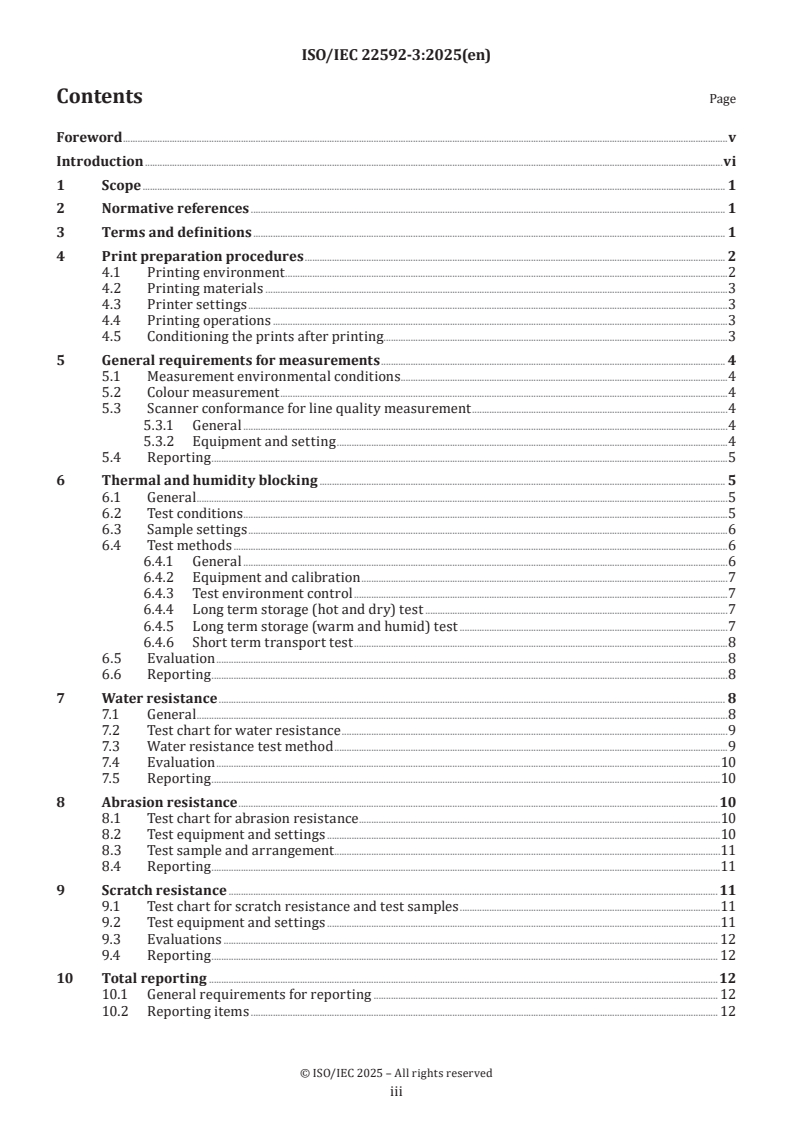
Contents Page
Foreword .v
Introduction .vi
1 Scope .1
2 Normative references .1
3 Terms and definitions .1
4 Print preparation procedures . 2
4.1 Printing environment .2
4.2 Printing materials .3
4.3 Printer settings .3
4.4 Printing operations .3
4.5 Conditioning the prints after printing.3
5 General requirements for measurements .4
5.1 Measurement environmental conditions .4
5.2 Colour measurement .4
5.3 Scanner conformance for line quality measurement .4
5.3.1 General .4
5.3.2 Equipment and setting .4
5.4 Reporting .5
6 Thermal and humidity blocking . 5
6.1 General .5
6.2 Test conditions .5
6.3 Sample settings .6
6.4 Test methods .6
6.4.1 General .6
6.4.2 Equipment and calibration .7
6.4.3 Test environment control .7
6.4.4 Long term storage (hot and dry) test .7
6.4.5 Long term storage (warm and humid) test .7
6.4.6 Short term transport test .8
6.5 Evaluation .8
6.6 Reporting .8
7 Water resistance .8
7.1 General .8
7.2 Test chart for water resistance .9
7.3 Water resistance test method .9
7.4 Evaluation .10
7.5 Reporting .10
8 Abrasion resistance . 10
8.1 Test chart for abrasion resistance .10
8.2 Test equipment and settings .10
8.3 Test sample and arrangement . .11
8.4 Reporting .11
9 Scratch resistance .11
9.1 Test chart for scratch resistance and test samples .11
9.2 Test equipment and settings .11
9.3 Evaluations . 12
9.4 Reporting . 12
10 Total reporting .12
10.1 General requirements for reporting . 12
10.2 Reporting items . 12
© ISO/IEC 2025 – All rights reserved
iii
Annex A (informative) Thermal, light and ozone stability .13
Bibliography .14
© ISO/IEC 2025 – All rights reserved
iv
Foreword
ISO (the International Organization for Standardization) and IEC (the International Electrotechnical
Commission) form the specialized system for worldwide standardization. National bodies that are
members of ISO or IEC participate in the development of International Standards through technical
committees established by the respective organization to deal with particular fields of technical activity.
ISO and IEC technical committees collaborate in fields of mutual interest. Other international organizations,
governmental and non-governmental, in liaison with ISO and IEC, also take part in the work.
The procedures used to develop this document and those intended for its further maintenance are described
in the ISO/IEC Directives, Part 1. In particular, the different approval criteria needed for the different types
of document should be noted. This document was drafted in accordance with the editorial rules of the ISO/
IEC Directives, Part 2 (see www.iso.org/directives or www.iec.ch/members_experts/refdocs).
ISO and IEC draw attention to the possibility that the implementation of this document may involve the
use of (a) patent(s). ISO and IEC take no position concerning the evidence, validity or applicability of any
claimed patent rights in respect thereof. As of the date of publication of this document, ISO and IEC had not
received notice of (a) patent(s) which may be required to implement this document. However, implementers
are cautioned that this may not represent the latest information, which may be obtained from the patent
database available at www.iso.org/patents and https://patents.iec.ch. ISO and IEC shall not be held
responsible for identifying any or all such patent rights.
Any trade name used in this document is information given for the convenience of users and does not
constitute an endorsement.
For an explanation of the voluntary nature of standards, the meaning of ISO specific terms and expressions
related to conformity assessment, as well as information about ISO's adherence to the World Trade
Organization (WTO) principles in the Technical Barriers to Trade (TBT) see www.iso.org/iso/foreword.html.
In the IEC, see www.iec.ch/understanding-standards.
This document was prepared by Joint Technical Committee ISO/IEC JTC 1, Information technology,
Subcommittee SC 28, Office equipment.
A list of all parts in the ISO/IEC 22592 series can be found on the ISO and IEC websites.
Any feedback or questions on this document should be directed to the user’s national standards
body. A complete listing of these bodies can be found at www.iso.org/members.html and
www.iec.ch/national-committees.
© ISO/IEC 2025 – All rights reserved
v
Introduction
There is a need for the standardization of measurement methods that quantitatively evaluate the physical
durability attributes of duplex print sets, as most office documents are currently printed as duplex print sets
comprising several sheets printed with colour images on both sides of substrates.
The measurement methods described in this document are used to assess the physical durability of a print
set formed by a printing system on a substrate. When test results are compared among various printing
systems, it is important to use the same product of substrates and to set the equivalent printing conditions
under default printer settings among the printing systems.
Electrophotography, thermal inkjet or piezoelectric inkjet technologies are commonly used to form such prints.
The main purpose of this document is to provide objective measurement methods for physical durability
attributes of duplex print sets, however, some attributes are also applicable for a set of simplex prints.
This document specifies the following:
— digital test charts for the measurements;
— measurement methods for the following physical durability attributes:
— thermal and humidity blocking caused by environmental stress;
— water resistance;
— abrasion resistance;
— scratch resistance.
The above attributes are also applicable for a simplex print set comprising several sheets which are printed
colour images on one side of a substrate and no image on the other side. In such case, test parameters are
configured to conform with the print set. For example, in thermal and humidity blocking measurement, a
print surface of an image area is contacted with an unimaged area of the same paper.
Long term durability affected by light exposure, ozone exposure or thermal storage as described in Annex A
is important for long term preservation use cases but not essential for general office use cases.
In this document, colour codes for the test charts are defined in the sRGB colour space specified in
IEC 61966-2-1 as is common in office documents, and colour measurements in terms of CIE 1976 L*a*b*
(CIELAB) are based on ISO 13655:2017,5.3.
© ISO/IEC 2025 – All rights reserved
vi
International Standard ISO/IEC 22592-3:2025(en)
Office equipment — Print quality measurement methods for
colour prints —
Part 3:
Physical durability measurement methods
IMPORTANT — The electronic file of this document contains colours which are considered to be
useful for the correct understanding of this document. Users should therefore consider printing this
document using a colour printer.
1 Scope
This document specifies test methods as well as test charts for measuring the physical durability attributes
of duplex colour prints, typically used in office environment.
This document is applicable to duplex prints comprising several sheets with colour images printed on both
sides of a substrate. A multifunction or single function printer is used to form the duplex prints.
This document is intended to be used to evaluate the durability of colour prints under environment and
stress conditions assuming general office use, including transportation from the place of printing to where
practically used. Permanence and durability in archival and storage environments are out of scope of this
document and can be evaluated by the methods in ISO 11798.
The physical durability attributes included are thermal and humidity blocking, water resistance, abrasion
resistance and scratch resistance.
All of these attributes are also applicable to a simplex print set comprising several sheets with colour images
printed on one side of a substrate and no image on the other side.
2 Normative references
The following documents are referred to in the text in such a way that some or all of their content constitutes
requirements of this document. For dated references, only the edition cited applies. For undated references,
the latest edition of the referenced document (including any amendments) applies.
ISO 13655:2017, Graphic technology — Spectral measurement and colorimetric computation for graphic arts images
ISO 15184, Paints and varnishes — Determination of film hardness by pencil test
ISO 18947-2:2021, Imaging materials and prints — Abrasion resistance — Part 2: Rub testing of photographic prints
ISO/IEC 24790:2017, Information technology — Office equipment — Measurement of image quality attributes
for hardcopy output — Monochrome text and graphic images
IEC 61966-2-1, Multimedia systems and equipment — Colour measurement and management — Part 2-1: Colour
management — Default RGB colour space — sRGB
3 Terms and definitions
For the purposes of this document, the following terms and definitions apply.
© ISO/IEC 2025 – All rights reserved
ISO and IEC maintain terminology databases for use in standardization at the following addresses:
— ISO Online browsing platform: available at https:// www .iso .org/ obp
— IEC Electropedia: available at https:// www .electropedia .org/
3.1
abrasion
process of wearing away or damaging the surface by friction
3.2
back side
print side (3.6) corresponding to an even page of input data in a duplex print set (3.5)
3.3
curl
deviation from a flat surface
Note 1 to entry: Its measurement has three major components:
— its magnitude;
— the angle of the curl axis in relation to the paper or board's machine direction;
— the side towards which the sheet curls.
[SOURCE: ISO 11556:2005, 3.1]
3.4
front side
print side (3.6) corresponding to an odd page of input data in a duplex print set (3.5)
3.5
print set
set of sheets printed in a print operation
3.6
print side
one of the duplex print surfaces, either front side (3.4) or back side (3.2)
3.7
scratch resistance
resistance against plastic deformations of a print surface or wearing of print surface materials caused by an
action of a sharp-pointed tip pushed across the surface
3.8
thermal and humidity blocking
undesired adhesion between sheets of printed material that occurs under moderate pressure, high
temperature, or high humidity, while in storage or in use, that leads to undesirable effects
3.9
water resistance
ability of a print to resist fading or bleeding upon exposure to water or high humidity
4 Print preparation procedures
4.1 Printing environment
Printers shall be installed in an environment with a temperature range of (23 ± 5) °C and a relative humidity
(RH) of (50 ± 10) % at least 2 h prior to print operations. Print operations shall be completed in the same
environment range. The substrate shall be placed in a paper tray when the printers are installed. Prior to
the installation of printers, additional conditioning of papers is recommended under the same temperature
© ISO/IEC 2025 – All rights reserved
and humidity conditions for more than 24 h, in order to stabilize the water content of the papers which often
affects image quality of prints.
If a printer has not been used for a long period or if the environmental difference between storage and the
evaluation area is large, installation should be done 12 h prior to the test and 10 or more sheets should be
printed before the test to warm it up.
4.2 Printing materials
Plain papers shall be used, in order to simulate typical use of office prints. Coated papers for inkjet or
lithography can be used in specific cases as long as a rational explanation is included in the report. The
2 2
grammage of the paper shall be from 60 g/m to 90 g/m . Any other grammage for paper can be used for a
specific usage case with a rational explanation in reporting. The name, grammage and supplier of the paper
shall be reported.
The printer manufacturer's instructions regarding the toner or ink materials shall be used. Any other
materials provided by third party suppliers may be used as long as product name and supplier are included
in the report.
Any other printing materials, such as photoreceptors in an electrophotographic printer, print heads in an ink
jet printer, shall be in accordance with the printer manufacturer's instructions. Printing materials provided
by third party suppliers may be used if the product name and supplier are included in the report.
4.3 Printer settings
Modifications in colour and tone reproduction, sharpness enhancement, or noise reduction in the printer
settings shall not be used. No reduction or enlargement in printed size shall be made.
Test prints shall be formed using driver and printer settings that are appropriate for typical office use,
except the settings relating to the optional conditions for papers described in 4.2. Initial settings for each
substrate when a printer shipped out should be used for evaluations. When printing systems are compared,
the default settings for each printing system shall be selected. The driver and printer settings used shall be
described in the test report.
Colorant compositions in each printed colour patch depend on printer setting and cannot be controlled by
users. On the other hand, colorant compositions, especially for black colorant depending on under colour
removal (UCR, as described in Reference [11]) policy with printer settings, can affect test results. It is
difficult for users to specify colorant compositions in a printed colour patch. Colorant compositions should
be reported for each printed colour patch if specified.
Caution is advised, users should check if the size and position in a substrate are consistent. In some
application viewers or printer settings for PDF files, settings related to size modification or printed position
in a substrate at the previous print operation remain unchanged.
4.4 Printing operations ®
Printing can be initiated under any operational mode, for example, that defined in “ENERGY STAR Product
Specification for Imaging Equipment - Eligibility Criteria Version 3.2 (2021)”, i.e. "Active State", "Ready
State", "Off Mode" or "Sleep Mode". In order to compare test results, it shall be used the same operational
mode among the tests. In order to evaluate overall performance of a printing system, the tests should be
carried out under multiple operational modes. When performances of printing systems are compared, the
same operational mode shall be used. The operational mode selected shall be included in the report.
A duplicated print set should be prepared for each measurement for backup and measurement noise
reduction.
4.5 Conditioning the prints after printing
Prior to measurements, each print set shall be conditioned in a controlled environment for at least 24 h after
printing to stabilize the dimension of sheet comprising the print set in addition to mitigate colour changes
© ISO/IEC 2025 – All rights reserved
caused by the exposure of environmental factors, such as light, high temperature and humidity during the
conditioning. The controlled environment shall be of a RH between 30 % to 70 % and temperature between
15 °C to 28 °C, with average ambient illuminance on the print surface less than 1 000 lx.
5 General requirements for measurements
5.1 Measurement environmental conditions
All measurements in this document shall be completed in a controlled environment of RH between 30 %
to 70 % and temperature between 15 °C to 28 °C. It is recommended to complete a series of measurements
continuously in a shorter duration to prevent from the change in colour reproductions with environmental
factors.
5.2 Colour measurement
The CIELAB colour space values shall be obtained from measurements using measurement conditions
specified in ISO 13655:2017, 5.3.
In accordance with ISO 13655:2017, calculated tristimulus values and corresponding CIELAB coordinates of
the colorimetry shall be computed using CIE standard illuminant D50 and the CIE 1931 standard colorimetric
observer (often referred to as the 2° standard observer). “Self-backing” or “white-backing” is recommended
with respect to a typical office document composed of several sheets of a low area coverage print. The same
measurement condition, either M0, M1 or M2, shall be maintained for a series of colour measurements. It
is recommended to apply M2, which is insensitive to the variation of optical brightener in papers when the
colour variations originated by the performance of print equipment are evaluated.
Measurement instruments shall be calibrated in accordance with manufacturer’s instructions. The same
measurement instrument is recommended to be used for all of the same kind of measurements.
5.3 Scanner conformance for line quality measurement
5.3.1 General
In case a scanning system is used for the line quality measurements, the scanning system shall meet the
requirements described in ISO/IEC 24790:2017, Clause 6.
A scanning system used for the measurements in this document shall be tested using the test charts and
procedures specified in ISO/IEC 24790:2017, Clause 6.
The scanning system is calibrated suitably if it can obtain a value within acceptable tolerances of the goal
values given in ISO/IEC 24790:2017, 6.4. The conformance test shall be completed at least within six months
prior to evaluations.
5.3.2 Equipment and setting
The measurements of line qualities in this document shall be carried out with a scanning system that has a
minimum of 1 200 spots per inch (spi) and 8 bits per pixel (256 grey levels), with a scanning field equal to or
larger than A4 area.
The scanner settings shall be as follows:
— scanning resolution: 1 200 spi;
— number of bits: 8 bit;
— colour mode: RGB;
— scanning speed: default;
© ISO/IEC 2025 – All rights reserved
— no spatial filter applied;
— no colour or tone correction applied.
Under the settings specified in 5.3.2, the scanning system shall be demonstrated to conform to the
requirements in ISO/IEC 24790:2017, Clause 6.
5.4 Reporting
The following items shall be reported:
— date, place, temperature and humidity when the scanner conformance measurements carried out;
— settings of measurement systems;
— conformance of the scanner for the goal values in ISO/IEC 24790:2017, 6.4.
6 Thermal and humidity blocking
6.
...