

ISO/IEC 19752:2025
(Main)Information technology — Office equipment — Method for the determination of toner cartridge yield for monochromatic electrophotographic printers and multi-function devices that contain printer components
General Information
- Abstract
This document is limited to the evaluation of toner cartridge page yield for toner containing cartridges (i.e. all-in-one toner cartridges and toner cartridges without a photoconductor) for monochrome electrophotographic print systems. This document can also be applied to the printer component of any multifunctional device that has a digital input-printing path, including multi-function devices that contain printer components. This document is only intended for the measurement of toner cartridge yield. No other claims may be made from this testing regarding quality, reliability, etc. This document is not for use with printers whose minimum printable size is equal to or greater than A3 or for photo-only printers. Application of this document for yield measurement of toner replenishment systems (i.e. toner cartridge- and bottle-type systems where the toner reservoir is internal to the printing system and not user-replaceable) implies some procedural modifications specifically noted herein. This document is intended for equipment used in the office space and does not apply to production volume or large format printing machines where the major cost of ownership is not caused by the consumable yield measured in this document. NOTE 1 An all-in-one toner cartridge is a cartridge that includes at least a toner containment part, a photoreceptor part and a developer part (see ISO/IEC 29142-1). NOTE 2 This document can be used for the measurement of one of the contributions to cost per page (CPP). This document does not directly measure CPP, only the yield of the toner cartridges. In most cases, these are not the only contributors to the CPP. It is beyond the scope of this document to provide a methodology for calculation of CPP.
- Status
- Published
- Publication Date
- 19-Nov-2025
- Technical Committee
- ISO/IEC JTC 1/SC 28 - Office equipment
- Drafting Committee
- ISO/IEC JTC 1/SC 28/WG 2 - Consumables
- Current Stage
- 6060 - International Standard published
- Start Date
- 20-Nov-2025
- Due Date
- 01-Dec-2025
- Completion Date
- 20-Nov-2025
Buy Documents



ISO/IEC 19752:2025 - Information technology — Office equipment — Method for the determination of toner cartridge yield for monochromatic electrophotographic printers and multi-function devices that contain printer components Released:20. 11. 2025
Overview
ISO/IEC 19752:2025 - "Information technology - Office equipment - Method for the determination of toner cartridge yield for monochromatic electrophotographic printers and multi-function devices that contain printer components" - defines a standardized laboratory method to measure toner cartridge page yield for monochrome office laser printers and the printer components of multifunction devices. The third edition updates scope and environmental requirements and clarifies that the method is limited to office-scale devices (not A3-or-larger minimum printable size, photo-only, production or large-format machines).
Key topics and technical requirements
- Scope and limits: Applies to toner-containing cartridges (all‑in‑one and cartridges without a photoconductor) for monochromatic electrophotographic systems; excludes A3+-minimum or photo-only printers and high‑volume production machines.
- End‑of‑life criteria: Yield is determined when a printer signals toner out or when fade (noticeable density reduction) is observed. Fade is judged relative to the 100th printed page.
- Declared cartridge yield: Manufacturers declare yield at or below the lower 90% confidence bound derived from test results - ensuring conservative, statistically defensible claims.
- Test setup and conditions: Specifies installation, driver and firmware defaults, image/quality settings, and environmental conditions (newly emphasized in clause 4.4).
- Sample size and test population: Minimum test combination is three cartridges run across at least three printers (minimum nine cartridges); larger samples are recommended when feasible.
- Test methodology and reporting: Includes standardized test files, procedures for handling defective cartridges/printers, end‑of‑life procedures, and detailed reporting formats (see normative Annexes C and D).
- Special cases: Notes procedural modifications for toner replenishment systems (systems with internal, non‑user‑replaceable reservoirs).
Practical applications - who uses ISO/IEC 19752:2025
- Printer and cartridge manufacturers - to generate reproducible, marketable yield claims and ensure consistency across models and market identifiers.
- Independent test laboratories - to perform certified yield testing and produce comparable reports.
- Procurement and fleet managers - to estimate consumable lifecycle and one input to cost‑per‑page (CPP) planning (standard measures yield only; CPP requires additional cost inputs).
- Regulatory bodies and retailers - to verify manufacturer claims and support transparent consumer information.
Related standards
- ISO/IEC 29142‑1 (referenced for definition of all‑in‑one toner cartridge)
- ISO/IEC JTC 1/SC 28 - the committee responsible for office equipment standards
Keywords: ISO/IEC 19752:2025, toner cartridge yield, page yield testing, monochromatic electrophotographic printers, declared cartridge yield, toner replenishment systems, end of life, standard test page.
Relations
- Effective Date
- 27-Jan-2024
Buy Documents
ISO/IEC 19752:2025 - Information technology — Office equipment — Method for the determination of toner cartridge yield for monochromatic electrophotographic printers and multi-function devices that contain printer components Released:20. 11. 2025
Frequently Asked Questions
ISO/IEC 19752:2025 is a standard published by the International Organization for Standardization (ISO). Its full title is "Information technology — Office equipment — Method for the determination of toner cartridge yield for monochromatic electrophotographic printers and multi-function devices that contain printer components". This standard covers: This document is limited to the evaluation of toner cartridge page yield for toner containing cartridges (i.e. all-in-one toner cartridges and toner cartridges without a photoconductor) for monochrome electrophotographic print systems. This document can also be applied to the printer component of any multifunctional device that has a digital input-printing path, including multi-function devices that contain printer components. This document is only intended for the measurement of toner cartridge yield. No other claims may be made from this testing regarding quality, reliability, etc. This document is not for use with printers whose minimum printable size is equal to or greater than A3 or for photo-only printers. Application of this document for yield measurement of toner replenishment systems (i.e. toner cartridge- and bottle-type systems where the toner reservoir is internal to the printing system and not user-replaceable) implies some procedural modifications specifically noted herein. This document is intended for equipment used in the office space and does not apply to production volume or large format printing machines where the major cost of ownership is not caused by the consumable yield measured in this document. NOTE 1 An all-in-one toner cartridge is a cartridge that includes at least a toner containment part, a photoreceptor part and a developer part (see ISO/IEC 29142-1). NOTE 2 This document can be used for the measurement of one of the contributions to cost per page (CPP). This document does not directly measure CPP, only the yield of the toner cartridges. In most cases, these are not the only contributors to the CPP. It is beyond the scope of this document to provide a methodology for calculation of CPP.
This document is limited to the evaluation of toner cartridge page yield for toner containing cartridges (i.e. all-in-one toner cartridges and toner cartridges without a photoconductor) for monochrome electrophotographic print systems. This document can also be applied to the printer component of any multifunctional device that has a digital input-printing path, including multi-function devices that contain printer components. This document is only intended for the measurement of toner cartridge yield. No other claims may be made from this testing regarding quality, reliability, etc. This document is not for use with printers whose minimum printable size is equal to or greater than A3 or for photo-only printers. Application of this document for yield measurement of toner replenishment systems (i.e. toner cartridge- and bottle-type systems where the toner reservoir is internal to the printing system and not user-replaceable) implies some procedural modifications specifically noted herein. This document is intended for equipment used in the office space and does not apply to production volume or large format printing machines where the major cost of ownership is not caused by the consumable yield measured in this document. NOTE 1 An all-in-one toner cartridge is a cartridge that includes at least a toner containment part, a photoreceptor part and a developer part (see ISO/IEC 29142-1). NOTE 2 This document can be used for the measurement of one of the contributions to cost per page (CPP). This document does not directly measure CPP, only the yield of the toner cartridges. In most cases, these are not the only contributors to the CPP. It is beyond the scope of this document to provide a methodology for calculation of CPP.
ISO/IEC 19752:2025 is classified under the following ICS (International Classification for Standards) categories: 37.100.10 - Reproduction equipment. The ICS classification helps identify the subject area and facilitates finding related standards.
ISO/IEC 19752:2025 has the following relationships with other standards: It is inter standard links to ISO/IEC 19752:2017. Understanding these relationships helps ensure you are using the most current and applicable version of the standard.
ISO/IEC 19752:2025 is available in PDF format for immediate download after purchase. The document can be added to your cart and obtained through the secure checkout process. Digital delivery ensures instant access to the complete standard document.
Standards Content (Sample)
International
Standard
ISO/IEC 19752
Third edition
Information technology —
2025-11
Office equipment — Method
for the determination of toner
cartridge yield for monochromatic
electrophotographic printers and
multi-function devices that contain
printer components
Technologies de l'information — Équipement de bureau —
Méthode pour la détermination du rendement des cartouches
de toner pour les imprimantes électrophotographiques
monochromatiques et pour les dispositifs multifonctionnels qui
contiennent des composants d'imprimantes
Reference number
© ISO/IEC 2025
All rights reserved. Unless otherwise specified, or required in the context of its implementation, no part of this publication may
be reproduced or utilized otherwise in any form or by any means, electronic or mechanical, including photocopying, or posting on
the internet or an intranet, without prior written permission. Permission can be requested from either ISO at the address below
or ISO’s member body in the country of the requester.
ISO copyright office
CP 401 • Ch. de Blandonnet 8
CH-1214 Vernier, Geneva
Phone: +41 22 749 01 11
Email: copyright@iso.org
Website: www.iso.org
Published in Switzerland
© ISO/IEC 2025 – All rights reserved
ii
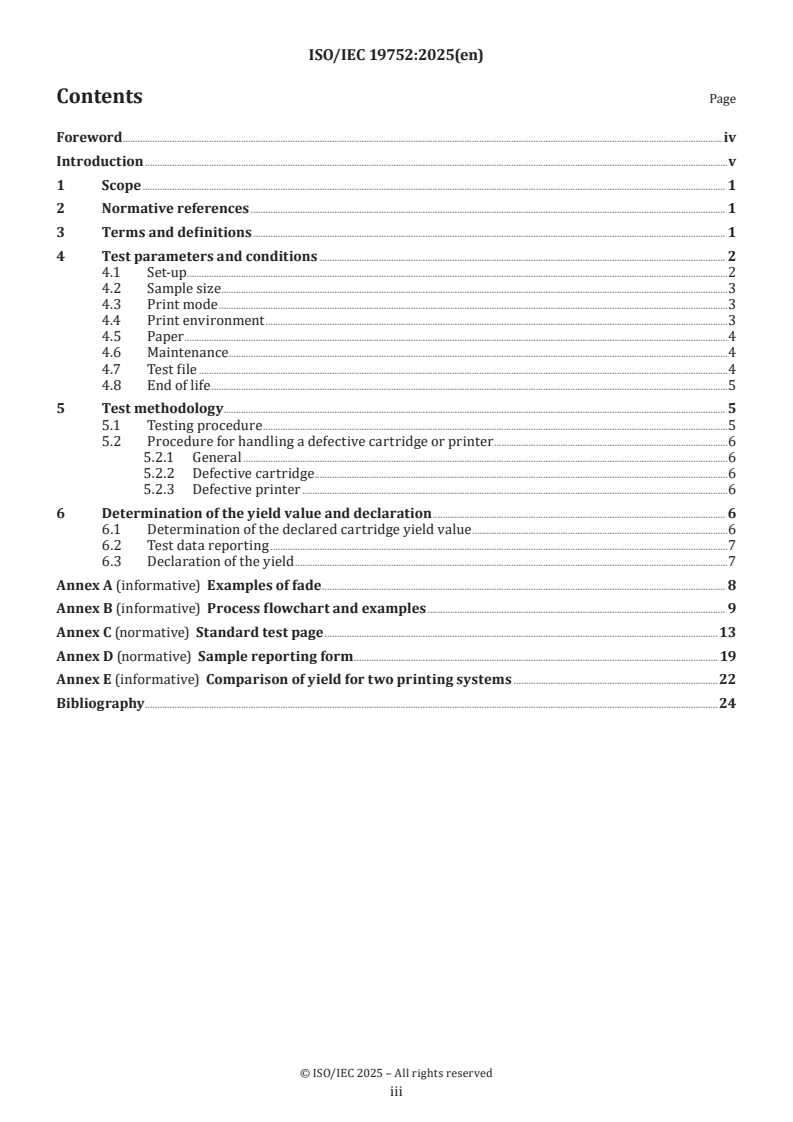
Contents Page
Foreword .iv
Introduction .v
1 Scope . 1
2 Normative references . 1
3 Terms and definitions . 1
4 Test parameters and conditions . 2
4.1 Set-up.2
4.2 Sample size .3
4.3 Print mode .3
4.4 Print environment .3
4.5 Paper .4
4.6 Maintenance .4
4.7 Test file .4
4.8 End of life .5
5 Test methodology . 5
5.1 Testing procedure .5
5.2 Procedure for handling a defective cartridge or printer .6
5.2.1 General .6
5.2.2 Defective cartridge .6
5.2.3 Defective printer .6
6 Determination of the yield value and declaration . 6
6.1 Determination of the declared cartridge yield value .6
6.2 Test data reporting .7
6.3 Declaration of the yield .7
Annex A (informative) Examples of fade . 8
Annex B (informative) Process flowchart and examples . 9
Annex C (normative) Standard test page .13
Annex D (normative) Sample reporting form . 19
Annex E (informative) Comparison of yield for two printing systems .22
Bibliography .24
© ISO/IEC 2025 – All rights reserved
iii
Foreword
ISO (the International Organization for Standardization) and IEC (the International Electrotechnical
Commission) form the specialized system for worldwide standardization. National bodies that are
members of ISO or IEC participate in the development of International Standards through technical
committees established by the respective organization to deal with particular fields of technical activity.
ISO and IEC technical committees collaborate in fields of mutual interest. Other international organizations,
governmental and non-governmental, in liaison with ISO and IEC, also take part in the work.
The procedures used to develop this document and those intended for its further maintenance are described
in the ISO/IEC Directives, Part 1. In particular, the different approval criteria needed for the different types
of document should be noted. This document was drafted in accordance with the editorial rules of the ISO/
IEC Directives, Part 2 (see www.iso.org/directives or www.iec.ch/members_experts/refdocs).
ISO and IEC draw attention to the possibility that the implementation of this document may involve the
use of (a) patent(s). ISO and IEC take no position concerning the evidence, validity or applicability of any
claimed patent rights in respect thereof. As of the date of publication of this document, ISO and IEC had not
received notice of (a) patent(s) which may be required to implement this document. However, implementers
are cautioned that this may not represent the latest information, which may be obtained from the patent
database available at www.iso.org/patents and https://patents.iec.ch. ISO and IEC shall not be held
responsible for identifying any or all such patent rights.
Any trade name used in this document is information given for the convenience of users and does not
constitute an endorsement.
For an explanation of the voluntary nature of standards, the meaning of ISO specific terms and expressions
related to conformity assessment, as well as information about ISO's adherence to the World Trade
Organization (WTO) principles in the Technical Barriers to Trade (TBT) see www.iso.org/iso/foreword.html.
In the IEC, see www.iec.ch/understanding-standards.
This document was prepared by Joint Technical Committee ISO/IEC JTC 1, Information technology,
Subcommittee SC 28, Office equipment.
This third edition cancels and replaces the second edition (ISO/IEC 19752:2017), which has been technically
revised.
The main changes are as follows:
— the Scope was limited ” This document is not for use with printers whose minimum printable size is
equal to or greater than A3 or for photo-only printers”;
— editorial changes;
— requirements were added in 4.4 regarding environmental conditions.
Any feedback or questions on this document should be directed to the user’s national standards
body. A complete listing of these bodies can be found at www.iso.org/members.html and
www.iec.ch/national-committees.
© ISO/IEC 2025 – All rights reserved
iv
Introduction
The purpose of this document is to provide a process for determining the page yield for toner cartridges for
monochromatic print systems using a standard office consumer type test page. In the case where a cartridge
can be used in multiple printer models, only one yield test is performed as long as the difference between
printer models does not impact yield.
A cartridge supplier can choose to use more than one market identifier for a single physical cartridge. In this
case, only one yield test is performed as long as there are no differences in the cartridges other than market
identifiers.
This document prescribes the following:
— the test method that manufacturers, test laboratories, etc. used to determine cartridge yield;
— the method for determination of declared yield values from the test results;
— the appropriate method of describing the yield of cartridges in the documentation supplied to the
consumer by the manufacturer.
The cartridge yield is determined by an end of life judgment, or signalled with either of two phenomena:
fade caused by depletion of the useable toner in the cartridge or automatic printing stop caused by a toner
out detection function.
NOTE A comparison of yield for two printing systems is shown in Annex E.
© ISO/IEC 2025 – All rights reserved
v
International Standard ISO/IEC 19752:2025(en)
Information technology — Office equipment — Method for
the determination of toner cartridge yield for monochromatic
electrophotographic printers and multi-function devices that
contain printer components
1 Scope
This document is limited to the evaluation of toner cartridge page yield for toner containing cartridges
(i.e. all-in-one toner cartridges and toner cartridges without a photoconductor) for monochrome
electrophotographic print systems. This document can also be applied to the printer component of any
multifunctional device that has a digital input-printing path, including multi-function devices that contain
printer components.
This document is only intended for the measurement of toner cartridge yield. No other claims may be made
from this testing regarding quality, reliability, etc.
This document is not for use with printers whose minimum printable size is equal to or greater than A3 or
for photo-only printers.
Application of this document for yield measurement of toner replenishment systems (i.e. toner cartridge- and
bottle-type systems where the toner reservoir is internal to the printing system and not user-replaceable)
implies some procedural modifications specifically noted herein. This document is intended for equipment
used in the office space and does not apply to production volume or large format printing machines where
the major cost of ownership is not caused by the consumable yield measured in this document.
NOTE 1 An all-in-one toner cartridge is a cartridge that includes at least a toner containment part, a photoreceptor
part and a developer part (see ISO/IEC 29142-1).
NOTE 2 This document can be used for the measurement of one of the contributions to cost per page (CPP). This
document does not directly measure CPP, only the yield of the toner cartridges. In most cases, these are not the only
contributors to the CPP. It is beyond the scope of this document to provide a methodology for calculation of CPP.
2 Normative references
There are no normative references in this document.
3 Terms and definitions
For the purposes of this document, the following terms and definitions apply.
ISO and IEC maintain terminology databases for use in standardization at the following addresses:
— ISO Online browsing platform: available at https:// www .iso .org/ obp
— IEC Electropedia: available at https:// www .electropedia .org/
3.1
fade
phenomenon whereby a noticeable reduction in density uniformity across the page occurs
Note 1 to entry: In this test, fade is defined as a noticeably lighter, 3 mm or greater, gap located in the text or boxes
around the periphery of the test page. The determination of the change in lightness is to be made referenced to the
100th page printed for each cartridge in testing. For examples of fade, see Annex A (Figure A.1).
© ISO/IEC 2025 – All rights reserved
3.2
shake procedure
specified method to carry out the shaking of a cartridge according to the user manual
3.3
toner low
signal generated by the printer when it has been detected that the amount of toner is such that a toner
change will be required soon
Note 1 to entry: It does not indicate that the system is out of toner.
3.4
toner out
signal generated by the printer when the toner in the system is depleted and the printer is incapable of
reliable printing without user intervention
Note 1 to entry: For the purpose of this test, the toner out signal will only be used if it causes the printer to stop
printing and requires toner replacement to continue printing.
3.5
end of life
point when the printer declares “toner out” (3.4) or when fade (3.1) is observed
Note 1 to entry: For more information about the exact requirements for judging end of life, see 4.8.
3.6
individual cartridge yield
number of “standard page file” pages printed between cartridge installation and end of life (3.5)
Note 1 to entry: For replenishment systems, the individual cartridge yield is determined by counting the number of
“standard page file” pages printed between prescribed quasi-end of life conditions, see 4.8.
3.7
declared cartridge yield
value at or below the lower 90 % confidence bound
Note 1 to entry: Detail of the value is described in 6.1.
4 Test parameters and conditions
4.1 Set-up
Place the printer on a horizontal surface and set-up the printer according to the installation guide provided
in the printer user’s manual. Use the most recent printer driver available from the manufacturer’s website
or the supplied driver with the printer. The driver version shall be specified on the test report. Cartridge
installation shall be completed following the instructions in the cartridge installation guide. If there is a
contradiction between the printer and cartridge manuals for the cartridge installation, the cartridge manual
takes precedence except if changes are recommended for printer or driver settings.
If the cartridge used in testing is a toner replenishment or toner bottle type, then one complete toner
cartridge shall be used in each printer before the start of the test. The pages printed to deplete this priming
cartridge do not have to be recorded and printing may be conducted at any environment. This priming
cartridge is used to bring the printing system to a set toner level condition.
All image and print quality modifiers shall be set to their factory pre-set configuration for the printer and
the default installed condition for the driver. If there are discrepancies between the printer and driver
settings, the driver defaults shall be used. Any user selectable toner conservation modes shall be disabled
during testing.
For printers that default to duplex printing, the default shall be overridden and the printer shall be set to
simplex for yield testing.
© ISO/IEC 2025 – All rights reserved
If the printer under test uses an internal PDF interpreter, it is okay to use it as long as the printer defaults are
set to not substitute fonts. If the internal interpreter is used, this shall be noted on the report.
To ensure that the test page is rendered correctly, any page size modifiers such as “Fit to Page”, “Page
Centring” and font substitution shall be turned off. To further ensure that font substitution does not occur,
fonts shall be downloaded as TrueType fonts if the driver provides that option. If the option exists, rendering
of graphics shall be performed by the printer, not the application software or operating system. The file shall
be printed using the fonts embedded in the file and shall be rendered on the page in a size corresponding to
the dimensions in the test page description. Page placement modifiers, such as page centring, may be used to
place the image properly on the page. If there is a question about rendering settings affecting the yield, the
setting shall be noted in the report.
TM1)
The application software (i.e. Adobe Acrobat Reader ), printer driver and printer can have page size
modifier functions, such as “Fit to Page”. Make sure that all of these functions are disabled.
4.2 Sample size
A combination of at least three cartridges shall be run on a combination of at least three printers (for a
minimum of nine cartridges and three printers). This is the minimum number of engines and cartridges that
shall be used for testing. When feasible, it is recommended that additional engines and cartridges be used
in testing. When testing additional engines and cartridges above the minimum, an effort shall be made to
test equal number of cartridges on each engine. For example, if an additional engine is to be tested then the
minimum number of cartridges to be tested would be 12 (3 cartridges × 4 engines). When testing cartridges
for a released product, it is recommended that cartridges and printers are procured from various sources,
or selected from different production lots. The printers and cartridges shall be within their useful life as
stated in their user’s manual.
It is recommended that an additional cartridge be procured to allow for the possibility of cartridge failure
during testing.
4.3 Print mode
For reporting cartridge yield, the test shall be run in semi-continuous print mode simplex printing. The actual
print speed will be semi-continuous because of printing being interrupted for paper replenishment, etc. Every
attempt shall be made to have printing be continuous from the start of a cartridge to the end of cartridge life.
If the printer is powered down at the end of day during testing, this shall be noted on the test report.
4.4 Print environment
The temperature and humidity can have a profound effect on test results. For this reason, the test shall be
carried out according to the following test conditions.
Temperature: Testing room average 23,0 °C ± 2 °C.
Readings shall be made with a running average of 1 h with readings
recorded at least every 15 min, all running average temperatures are
to be between 20,0 °C and 26,0 °C.
Relative humidity (RH): Testing room average 50 % RH ± 10 % RH
Readings shall be made with a running average of 1 h with readings
recorded at least every 15 min, all running average RHs are to be
between 35 % and 65 %.
An example of the calculation of the temperature is shown Table 1 for temperature readings taken on 15-
min intervals for the testing of one cartridge.
TM
1) Adobe Acrobat Reader is an example of a suitable product available commercially. This information is given for the
convenience of users of this document and does not constitute an endorsement by ISO or IEC of this product.
© ISO/IEC 2025 – All rights reserved
Table 1 — Example of the calculation for the temperature
Testing room
T T T T T T T T T T T T average
1 2 3 4 5 6 7 8 9 10 11 12
Temperature T
i
[°C] 24,0 23,4 20,5 24,2 23,6 22,0 25,5 24,7 22,1 20,8 22,0 23,5 23,0
Running average
T [°C] N/A N/A N/A 23,0 22,9 22,6 23,8 24,0 23,6 23,3 22,4 22,1
n
Running average T = (T +T +T +T )/4
n i-3 i-2 i-1 i
where n = i
Testing room average = (T +T + … +T )/12
1 2 12
From these formulae, the testing room average would be 23,0 °C, the maximum running average reading 24,0 °C and the minimum
running average reading 22,1 °C. These values can be found highlighted in the table of temperature measurements. It shall be
noted that the testing room average for temperature are averages of all measurements, not the running averages.
Environmental conditions shall be included in the test report. The maximum and minimum running
averages for temperature and humidity shall be reported for each cartridge tested. See Annex D for a sample
reporting form.
Prior to testing, the printer, paper and cartridges shall be acclimated to the above conditions for a minimum
of 8 h. Before acclimation, packaging and shipping materials shall be opened with care taken to prevent
any light damage from occurring to the cartridge during acclimation. Paper may be acclimated in the ream
wrapper. Before final acclimation, all materials shall be temperature acclimated to an office environment.
Any water condensation shall be avoided when printer, paper and cartridges are carried in the test
environment.
4.5 Paper
The paper used in this test shall represent a “common” medium grammage (weight) paper and shall conform
to the printer’s list of approved papers. The paper manufacturer, grammage (weight) and size, A4 or
equivalent, used in the test shall be noted on the report.
4.6 Maintenance
Printer maintenance shall be performed throughout yield testing per the printer and cartridge user’s manual
(e.g. developer roller or fuser replacement).
4.7 Test file
The print test file shall be as outlined and specified in Annex C. The test shall be conducted using the
most recent official electronic test file as the input. The most recent official file can be located at https://
standards .iso .org/ iso -iec/ 19752/ ed -2/ en/ . Failure to use the exact file specifications invalidates test results.
In addition to the test file, a publicly available PDF reader shall be used in conjunction with the latest version
of the printer driver to generate the printer input and send the files directly to the printer. The method
used for connection between the host computer and the printer shall be recorded on the test report. For
automated testing, a pre-generated print file may be used if the results are equivalent to direct printing
methods. This shall be recorded on the test report. The version of the test file, the printer driver version and
the PDF reader version shall be included in the test report. The printer under test may use an internal PDF
interpreter as long as the test file fonts are not substituted from the original PDF. If an internal interpreter is
used, this shall be noted on the report. Before starting the test, a sample file set shall be printed to check the
image and ensure the proper size. A measurement should be made between A and B for short edge feeding
paper and the dimension should be 170,0 mm ± 1,7 mm. For long edge feeding paper, these measurements
shall be between A and C and the dimension should be 250,0 mm ± 2,5 mm as shown in Annex C. This is done
because image stretch can occur in the feeding direction that does not affect the use of toner.
To allow for automated testing, the complete original ISO/IEC PDF test file may be encapsulated within a
secondary file in order to be compatible with automated print systems. This method shall be documented
© ISO/IEC 2025 – All rights reserved
and the resulting print shall be proven to be equivalent in operation with sending the PDF file directly to the
printer via a PC host.
The host computer environment, such as the Operating System (OS), RAM size, CPU type and application
software, can affect the yield test results; the computer environment recommended by the printer’s user
manual shall be used for the test. All of this information will be recorded on the test report.
To aid in counting and tracking pages, a header or footer may be added to the test page. Every attempt should
be made to reduce the size of this addition to minimize the effect on the calculated yield. If this header or
footer is added to the test pages, it shall be noted on the test report.
If the given tolerances cannot be met with all scaling modifiers off, then testing cannot continue.
4.8 End of life
If the printer is equipped with a toner-out device, then end of life occurs when the printer declares toner out.
However, when fade occurs before toner out and no shake procedure is specified, then end of life is declared
at the fade. If a shake procedure is specified for a printer with a toner out device, then up to two shake
procedures ma
...