

ISO/IEC 15775:2022
(Main)Information technology — Office equipment — Method of specifying image reproduction of colour copying machines and multifunction devices with copying modes by printed test charts
General Information
- Abstract
- Status
- Published
- Publication Date
- 19-Dec-2022
- Technical Committee
- ISO/IEC JTC 1/SC 28 - Office equipment
- Drafting Committee
- ISO/IEC JTC 1/SC 28/WG 5 - Office Colour
- Current Stage
- 6060 - International Standard published
- Start Date
- 20-Dec-2022
- Due Date
- 11-Aug-2022
- Completion Date
- 20-Dec-2022
Buy Documents

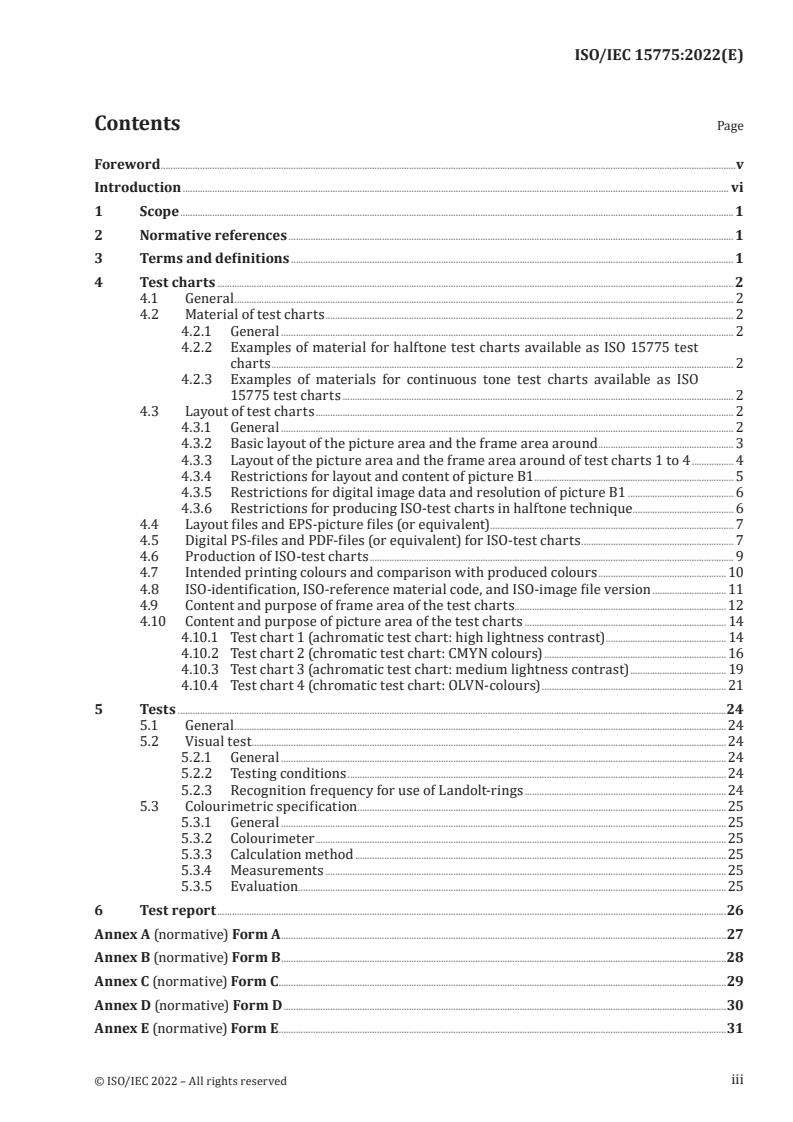
ISO/IEC 15775:2022 - Information technology — Office equipment — Method of specifying image reproduction of colour copying machines and multifunction devices with copying modes by printed test charts Released:20. 12. 2022
Overview
ISO/IEC 15775:2022 - Information technology - Office equipment - Method of specifying image reproduction of colour copying machines and multifunction devices with copying modes by printed test charts - defines a standardized method to specify and assess image reproduction quality of colour copying machines and multifunction devices (MFDs) using printed test charts. The second edition (2022) replaces the 1999 edition and its amendment, updates the title and scope, provides electronic versions of test charts, and updates the default viewing illuminant.
This standard applies to devices that produce colour on opaque substrates and is intended to characterize performance, reveal limitations, and enable objective comparison between machines.
Key topics and technical requirements
- Test charts: Four standardized test charts (two achromatic, two chromatic) are defined. Tests use at least two charts (one achromatic and one chromatic), available in both halftone and continuous tone productions.
- Chart construction and layout: Charts are defined in A4 format with a defined picture area and a surrounding frame. Layout files are provided as PS/PDF/EPS (or equivalent) and reduced preview figures are included in the standard.
- Materials: Examples of substrate materials for halftone and continuous-tone charts are given (photographic papers and fine art papers with specified weights and finishes).
- Production and identification: Requirements for producing ISO-test charts, intended printing colours versus produced colours, and ISO-identification/image-file versioning are specified.
- Visual and instrument tests: Procedures include visual tests (Landolt-ring recognition frequency, viewing conditions per referenced standards) and colourimetric specifications (measurement instruments, calculation methods, measurements and evaluation).
- Reporting: The standard provides normative forms (Annexes A–F) for recording visual and frame-area test results and informative annexes for colourimetric data, intended/produced colours, production guidelines, raster data, colour names and material properties.
- Normative references: Key referenced standards include ISO 3664 (viewing conditions) and ISO 13655 (spectral measurement and colorimetric computation).
Practical applications and users
ISO/IEC 15775:2022 is practical for:
- Printer and MFD manufacturers - to validate and document reproduction performance.
- Test laboratories and QA teams - to run standardized visual and colourimetric evaluations.
- Procurement and specification writers - to compare devices objectively and specify minimum reproduction performance.
- R&D and product managers - to benchmark improvements and identify reproduction limits for achromatic and chromatic content.
Typical uses include device comparison, pre‑release quality checks, and vendor claims verification.
Related standards
- ISO 3664 - Graphic technology and photography - Viewing conditions
- ISO 13655 - Graphic technology - Spectral measurement and colorimetric computation for graphic arts images
Keywords: ISO/IEC 15775:2022, colour copying machines, multifunction devices, test charts, image reproduction, halftone, continuous tone, colourimetric specification, visual test, A4 layout.
Relations
- Effective Date
- 23-Apr-2020
- Effective Date
- 23-Apr-2020
Buy Documents
ISO/IEC 15775:2022 - Information technology — Office equipment — Method of specifying image reproduction of colour copying machines and multifunction devices with copying modes by printed test charts Released:20. 12. 2022
Frequently Asked Questions
ISO/IEC 15775:2022 is a standard published by the International Organization for Standardization (ISO). Its full title is "Information technology — Office equipment — Method of specifying image reproduction of colour copying machines and multifunction devices with copying modes by printed test charts". This standard covers: Information technology — Office equipment — Method of specifying image reproduction of colour copying machines and multifunction devices with copying modes by printed test charts
Information technology — Office equipment — Method of specifying image reproduction of colour copying machines and multifunction devices with copying modes by printed test charts
ISO/IEC 15775:2022 is classified under the following ICS (International Classification for Standards) categories: 37.100.10 - Reproduction equipment. The ICS classification helps identify the subject area and facilitates finding related standards.
ISO/IEC 15775:2022 has the following relationships with other standards: It is inter standard links to ISO/IEC 15775:1999, ISO/IEC 15775:1999/Amd 1:2005. Understanding these relationships helps ensure you are using the most current and applicable version of the standard.
ISO/IEC 15775:2022 is available in PDF format for immediate download after purchase. The document can be added to your cart and obtained through the secure checkout process. Digital delivery ensures instant access to the complete standard document.
Standards Content (Sample)
INTERNATIONAL ISO/IEC
STANDARD 15775
Second edition
2022-12
Information technology — Office
equipment — Method of specifying
image reproduction of colour copying
machines and multifunction devices
with copying modes by printed test
charts
Reference number
© ISO/IEC 2022
© ISO/IEC 2022
All rights reserved. Unless otherwise specified, or required in the context of its implementation, no part of this publication may
be reproduced or utilized otherwise in any form or by any means, electronic or mechanical, including photocopying, or posting on
the internet or an intranet, without prior written permission. Permission can be requested from either ISO at the address below
or ISO’s member body in the country of the requester.
ISO copyright office
CP 401 • Ch. de Blandonnet 8
CH-1214 Vernier, Geneva
Phone: +41 22 749 01 11
Email: copyright@iso.org
Website: www.iso.org
Published in Switzerland
ii
© ISO/IEC 2022 – All rights reserved
Contents Page
Foreword .v
Introduction . vi
1 Scope . 1
2 Normative references . 1
3 Terms and definitions . 1
4 Test charts .2
4.1 General . 2
4.2 Material of test charts . 2
4.2.1 General . 2
4.2.2 Examples of material for halftone test charts available as ISO 15775 test
charts . 2
4.2.3 Examples of materials for continuous tone test charts available as ISO
15775 test charts . 2
4.3 Layout of test charts . 2
4.3.1 General . 2
4.3.2 Basic layout of the picture area and the frame area around . 3
4.3.3 Layout of the picture area and the frame area around of test charts 1 to 4 . 4
4.3.4 Restrictions for layout and content of picture B1 . 5
4.3.5 Restrictions for digital image data and resolution of picture B1 . 6
4.3.6 Restrictions for producing ISO-test charts in halftone technique . 6
4.4 Layout files and EPS-picture files (or equivalent) . 7
4.5 Digital PS-files and PDF-files (or equivalent) for ISO-test charts . 7
4.6 Production of ISO-test charts . 9
4.7 Intended printing colours and comparison with produced colours . 10
4.8 ISO-identification, ISO-reference material code, and ISO-image file version . 11
4.9 Content and purpose of frame area of the test charts .12
4.10 Content and purpose of picture area of the test charts . 14
4.10.1 Test chart 1 (achromatic test chart: high lightness contrast) . 14
4.10.2 Test chart 2 (chromatic test chart: CMYN colours) . 16
4.10.3 Test chart 3 (achromatic test chart: medium lightness contrast) . 19
4.10.4 Test chart 4 (chromatic test chart: OLVN-colours) . 21
5 Tests .24
5.1 General . 24
5.2 Visual test . 24
5.2.1 General . 24
5.2.2 Testing conditions . 24
5.2.3 Recognition frequency for use of Landolt-rings . 24
5.3 Colourimetric specification.25
5.3.1 General . 25
5.3.2 Colourimeter . 25
5.3.3 Calculation method .25
5.3.4 Measurements . 25
5.3.5 Evaluation . .25
6 Test report .26
Annex A (normative) Form A .27
Annex B (normative) Form B .28
Annex C (normative) Form C . .29
Annex D (normative) Form D .30
Annex E (normative) Form E . .31
iii
© ISO/IEC 2022 – All rights reserved
Annex F (normative) Form F .32
Annex G (informative) Colourimetric specification .33
Annex H (informative) Intended and produced colours .40
Annex I (informative) Guideline for ISO-test chart production .49
Annex J (informative) Halftone raster-cell data.51
Annex K (informative) Colour names .57
Annex L (informative) Material of test charts .59
Annex M (informative) Information on websites .62
Bibliography .64
iv
© ISO/IEC 2022 – All rights reserved
Foreword
ISO (the International Organization for Standardization) and IEC (the International Electrotechnical
Commission) form the specialized system for worldwide standardization. National bodies that are
members of ISO or IEC participate in the development of International Standards through technical
committees established by the respective organization to deal with particular fields of technical
activity. ISO and IEC technical committees collaborate in fields of mutual interest. Other international
organizations, governmental and non-governmental, in liaison with ISO and IEC, also take part in the
work.
The procedures used to develop this document and those intended for its further maintenance
are described in the ISO/IEC Directives, Part 1. In particular, the different approval criteria
needed for the different types of document should be noted. This document was drafted in
accordance with the editorial rules of the ISO/IEC Directives, Part 2 (see www.iso.org/directives or
www.iec.ch/members_experts/refdocs).
Attention is drawn to the possibility that some of the elements of this document may be the subject
of patent rights. ISO and IEC shall not be held responsible for identifying any or all such patent
rights. Details of any patent rights identified during the development of the document will be in the
Introduction and/or on the ISO list of patent declarations received (see www.iso.org/patents) or the IEC
list of patent declarations received (see https://patents.iec.ch).
Any trade name used in this document is information given for the convenience of users and does not
constitute an endorsement.
For an explanation of the voluntary nature of standards, the meaning of ISO specific terms and
expressions related to conformity assessment, as well as information about ISO's adherence to
the World Trade Organization (WTO) principles in the Technical Barriers to Trade (TBT) see
www.iso.org/iso/foreword.html. In the IEC, see www.iec.ch/understanding-standards.
This document was prepared by Joint Technical Committee ISO/IEC JTC 1, Information technology,
Subcommittee SC 28, Office equipment.
This second edition cancels and replaces the first edition (ISO/IEC 15775:1999), which has been
technically revised. It also incorporates the Amendment ISO/IEC 15775:1999/Amd. 1:2005.
The main changes are as follows:
— the title has been changed;
— the scope has been changed;
— the citation of the references has been updated;
— some terms and definitions have been deleted;
— the electronic version of the test charts has been provided;
— the default illuminant has been updated;
— the document has been updated according to the rules in the current ISO/IEC Directives, Part 2.
Any feedback or questions on this document should be directed to the user’s national standards
body. A complete listing of these bodies can be found at www.iso.org/members.html and
www.iec.ch/national-committees.
v
© ISO/IEC 2022 – All rights reserved
Introduction
This document is applicable to colour copying machines and multifunction devices with copying
modes that produce colour on opaque substrate and the usage is to characterize the performance and
limitation of image reproduction quality for comparison.
vi
© ISO/IEC 2022 – All rights reserved
INTERNATIONAL STANDARD ISO/IEC 15775:2022(E)
Information technology — Office equipment — Method of
specifying image reproduction of colour copying machines
and multifunction devices with copying modes by printed
test charts
1 Scope
This document provides requirements for test charts and their use to assess the imaging quality of
colour copying machines and multifunction devices with copying modes. This document is applicable
to testing of reproduction properties of colour copying machines and multifunction devices having
copying function, in order to help to recognize the possibilities and limits of various machines and for
their comparison.
2 Normative references
The following documents are referred to in the text in such a way that some or all of their content
constitutes requirements of this document. For dated references, only the edition cited applies. For
undated references, the latest edition of the referenced document (including any amendments) applies.
ISO 3664, Graphic technology and photography — Viewing conditions
ISO 13655, Graphic technology — Spectral measurement and colorimetric computation for graphic arts
images
3 Terms and definitions
For the purposes of this document, the following terms and definitions apply.
ISO and IEC maintain terminology databases for use in standardization at the following addresses:
— ISO Online browsing platform: available at https:// www .iso .org/ obp
— IEC Electropedia: available at https:// www .electropedia .org
3.1
colour difference
perceived dissimilarity between two colour stimuli
[SOURCE: ISO/IEC 17823:2015, 2.5]
3.2
lightness
L*
power of a perceived light (inseparably combined with perceived colour)
3.3
Landolt-ring
standard optotype defined by a ring with an open segment which can be in eight different positions
© ISO/IEC 2022 – All rights reserved
4 Test charts
4.1 General
This document identifies the techniques to manufacture test charts. Four test charts are produced by
different manufacturers both in halftone and continuous tone. For the tests according to this document
two or more out of eight test charts are used, at least one achromatic test chart (1 or 3) and at least one
chromatic test chart (2 or 4).
On each test chart there is a picture area and a frame area around it, see Figure 1. Each of the test
charts 1, 2, 3 and 4 contains a form (see Annexes A, B, C, and D respectively) used for visual tests of the
picture area and two forms (see Annexes E and F) used for tests of the frame area around it.
At least four forms shall be filled out, two for an achromatic test chart (no. 1: form A and E or no. 3: form
C and E) and two for a chromatic test chart (no. 2: form B and F or no. 4: form D and F). The four forms
filled out should belong to two test charts both either in halftone or continuous tone.
Colour copying machines are often used for reproduction of achromatic charts. Therefore, an achromatic
test chart should also be used for testing colour copying machines.
4.2 Material of test charts
4.2.1 General
The material of test charts depends on whether the chart is halftone or continuous tone.
4.2.2 Examples of material for halftone test charts available as ISO 15775 test charts
Test chart 1: photographic paper for black and white pictures, glossy, 85 g/m
Test chart 2: fine art paper, glossy, natural white, non-fading, 100 % non-chlorine bleached, 150 g/m
Test chart 3: fine art paper, glossy, natural white, non-fading, 100 % non-chlorine bleached, 150 g/m
Test chart 4: fine art paper, glossy, natural white, non-fading, 100 % non-chlorine bleached, 150 g/m
For the characteristic of example production, see Table L.1 in Annex L.
4.2.3 Examples of materials for continuous tone test charts available as ISO 15775 test charts
Test chart 1: photographic paper for colour pictures, glossy, 225 g/m
Test chart 2: photographic paper for colour pictures, glossy, 225 g/m
Test chart 3: photographic paper for colour pictures, glossy, 225 g/m
Test chart 4: photographic paper for colour pictures, glossy, 225 g/m
For the characteristic of example production see Table L.2 in Annex L.
4.3 Layout of test charts
4.3.1 General
The layout of the test charts is defined in the standard format A4 (297 mm × 210 mm) within PostScript
(PS)-files (or equivalent). The following layout is reduced to half size. The layout in standard format
A4 can be found on the ISO maintenance portal (see Annex M). Figures 1 to 3 show the layout and in
Figures 4 to 7 the content is shown.
© ISO/IEC 2022 – All rights reserved
4.3.2 Basic layout of the picture area and the frame area around
Figure 1 — Basic layout of the figures and the frame area around
Figure 1 shows the basic layout of the test charts which includes in the central area the layout of 16
pictures (without content) and in the frame area around text and other elements. The basic format is A4
(297 mm × 210 mm) described by the outer rectangle. The inner rectangle has a thicker line (0,30 mm
instead of 0,15 mm) and the size is 282 mm × 194 mm.
Figure 1 includes x- and y-data in mm for all test elements shown with an arrow point at the left bottom
corner of the format A4. One can find the x- and y-data of:
— left bottom corner of 16 pictures,
— four position marks,
— centre of four squares with black colours N of a 5-step grey scale,
— five rectangles located 2 mm up and to the right compared to the outer one and 4 mm smaller on
both sides.
NOTE 1 Arrows help to detect the distance to the outer rectangle of the format A4. There is no visual test
based on arrows within this document.
NOTE 2 There are some additional lines dividing the format A4 in four equal formats A6. There is a need to get
the pixel picture B1 (equal to D1) in the format A6 and on slide and negative film for special applications. The four
parts of the format A6 can be mounted to one part of the format A4 if this is useful for special applications.
NOTE 3 The position marks allow exact positioning of colourimeters to measure the L*a*b* colourimetric data
for the colour samples in the test charts. Figures 2 and 3 include the position data of all samples in all test charts
and simplify colourimetric measurements.
© ISO/IEC 2022 – All rights reserved
4.3.3 Layout of the picture area and the frame area around of test charts 1 to 4
Figure 2 — Layout of picture and frame area of test charts 1 and 3
Figure 2 shows the layout of test charts 1 and 3 with six pictures and a frame area around. The layout
of the pictures and the frame area is very similar to the basic layout of Figure 1. Instead of 16 there are
now six pictures A1 to A6 and C1 to C6 in test charts 1 and 3 respectively.
Within the area of pictures A2 and A3 there is a square which represents the first sample (black) of the
5-step and 16-step grey scales. The x- and y-data of the square centre is given relative to the left bottom
corner of pictures A2 and A3. The grey sample distance of the 5- or 16-step grey series is 14 mm.
NOTE There are two additional samples which appear black (N ) and white (W ). In digital PS-files (or
0 1
equivalent) absolute or relative colourimetric space with lightness L* or l * = ( L* –L* ) / ( L* –L* ) can be
relative N W N
used. The colourimetric data L* = 0 and L* = 100 produce the darkest black (N ) and lightest white (W ) on the
0 1
material used, which can be different compared to L* and L* of the contrast range.
N W
© ISO/IEC 2022 – All rights reserved
Figure 3 — Layout of picture and frame area of test charts 2 and 4
Figure 3 shows the layout of test charts 2 and 4 with seven pictures and a frame area around. The
layout of the pictures and the frame area is very similar to the basic layout of Figure 1. Instead of 16
there are now seven pictures B1 to B7 and D1 to D7 in test charts 2 and 4 respectively.
Within the pictures B1 and B3 (or D1 and D3) there are two squares which represent the first CIE-test
colour and the black sample of the 16-step grey scale. The x- and y-data of the square centres are given
relative to the left bottom corner of pictures B1 and B3 (D1 and D3). The sample distance of the steps is
7,7 mm.
Within the picture B4 (or D4) there are four squares which represent the first samples of colour series
W–C, W–M, W–Y, and W–N (or W–O, W–L, W–V, and W–N). The sample distance of the steps is 7,0 mm.
4.3.4 Restrictions for layout and content of picture B1
In picture B1 of test chart 2 (which is identical to picture D1 of test chart 4) the subject matter may be
chosen by the manufacturer. Any picture which satisfies the following restrictions is allowed for an
ISO-test chart manufacturer:
The picture B1 consists of three parts (compare layout of picture B1 in Figure 5).
Restrictions for the three parts of the picture B1:
Part 1: the picture shall include a large variety of colours in the upper part (130 mm × 60 mm);
Part 2: shall include 14 CIE-test colours plus black N (darkest black) and white W (whitest white)
0 1
(130 mm × 11 mm);
© ISO/IEC 2022 – All rights reserved
Part 3: shall include a 16-step equidistant grey scale between black N (L* = 10) and white W (L* = 94)
N W
(130 mm × 15 mm).
NOTE 1 An ISO-test chart manufacturer can add in part 1 a black and white Siemens-star equal in size and
colour (L* and L* ) to the Siemens-star N–W of picture B2. A user will get important information about the
N W
actual resolution of identical Siemens-stars by the pixel image (picture B1) and direct vector-based reproduction
(picture B2).
The intended colourimetric data for the 14 CIE-test colours and the 16-step equidistant grey samples
are equal to the intended data of these colours in picture B3.
NOTE 2 The photographic process (film material, taken illuminant exposure, development) used to take the
picture B1 (with the three parts in one exposure) and the scanning process producing the digital image will
result in different CIE-test colours and grey samples in pictures B1 and B3.
NOTE 3 By a least squares technique, a transformation of the digital image data (e.g. RGB) is used to calculate
L*a*b* colourimetric data. If the L*a*b*-data of picture B1 are equal within 3 CIELAB units to the L*a*b*-data of
picture B3 then the colours in picture B1 and B3 appear equal.
4.3.5 Restrictions for digital image data and resolution of picture B1
ISO-test chart manufacturers shall publish RGB-image data of the picture B1 in five resolutions: 192 ×
128, 384 × 256, 786 × 512, 1 536 × 1 024, and 3 072 × 2 048.
1)
NOTE 1 RGB-image data in these five resolutions can be, for example, produced by the Kodak Photo CD --
process with the option “Transfer to EPS (Encapsulated PostScript) (or equivalent) with 24 bit colour”.
NOTE 2 A transformation from RGB-image data to L*a*b*-image data can be recommended by the ISO-test
chart manufacturer.
NOTE 3 In ISO-test charts within the header of the EPS-file (or equivalent) of the picture B1, numerical data
of a 3 × 4 matrix transform are given. The transformation from RGB-image data to L*a*b*-image data can be (for
example) calculated by a PS-interpreter (or equivalent).
NOTE 4 The transformation from RGB-image data to L*a*b*-image data is the same for all image resolutions.
The lowest resolution can be used to get a table of the RGB-image data of the 32 colours (14 CIE-test colours + N
+ W and the 16-step grey samples).
NOTE 5 The intended CIE-test and grey colours are known. This allows to calculate an optimized
transformation from RGB-image data to L*a*b*-image data.
NOTE 6 For negative film between two stops underexposure and three stops overexposure the RGB-image
data are very different. An optimized transform leads to L*a*b*-image data which produce very similar output.
4.3.6 Restrictions for producing ISO-test charts in halftone technique
A test pattern producer can use any line screen and shall disclose the line screen used. The line screen
used shall be described by a complete definition of the halftone type.
The halftone type definition includes either the entries:
— “width, height and threshold” of “HalftoneType 3” and/or
— “frequency, orientation and spot function” of “HalftoneType 1”.
An example of a “HalftoneType 3”-matrix used to produce halftone test charts is given in Annex J.
NOTE 1 This allows repeating the production at any time.
NOTE 2 Copiers often produce different output with test charts of identical colourimetric L*a*b*-data but with
a different halftone type.
1) Kodak Photo CD is an example of a suitable product available commercially. This information is given for the
convenience of users of this document and does not constitute an endorsement by ISO or IEC of this product.
© ISO/IEC 2022 – All rights reserved
4.4 Layout files and EPS-picture files (or equivalent)
Standard PS- and PDF-layout files (or equivalent) produce the A4-layout of the ISO-test charts. The
standard layout files produce only the layout without any picture content.
At specific lines within a PS-layout file (or equivalent) the content of the pictures is included. The
content is defined in “EPS-picture files” (or equivalent).
Each EPS-picture file (or equivalent) of test charts 1 and 3 produces only one picture different in size
between 120 mm × 40 mm (A2, A4, A5, and A6), 120 mm × 84 mm (A1), 245 mm × 40 mm (A3) (see
Figure 2).
Each EPS-picture file (or equivalent) of test charts 2 and 4 produces only one picture different in size
between 130 mm × 86 mm (B1), 130 mm × 40 mm (B2 and B3), and 112 mm × 40 mm (B4, B5, B6 and
B7) (see Figure 3).
The EPS-picture files (or equivalent) can be found as “technical information”. The standard EPS-picture
files produce the picture content located 25,4 mm in x- and y-direction from the left bottom corner of
the output paper (see Annex M).
4.5 Digital PS-files and PDF-files (or equivalent) for ISO-test charts
Combined PS-files (or equivalent) include both the layout specification and the picture content. These
PS-files (or equivalent) are called the “digital” ISO-test charts no. 1 to 4. They are shown in Figure 4 to
Figure 7 reduced to half size.
NOTE The output of line rasters in pictures A5, A6, C5, and C6 is often different for PS- and PDF-files (or
equivalent). ISO-test charts 1 and 3 show the reference output with line rasters.
Figure 4 — PS-file (or equivalent) output of digital ISO-test chart 1 (reduced to half size)
© ISO/IEC 2022 – All rights reserved
Figure 5 — PS-file (or equivalent) output of digital ISO-test chart 2 (reduced to half size)
Figure 6 — PS-file (or equivalent) output of digital ISO-test chart 3 (reduced to half size)
© ISO/IEC 2022 – All rights reserved
Figure 7 — PS-file (or equivalent) output of digital ISO-test chart 4 (reduced to half size)
The output of the digital standard PS-files (or equivalent) in the format A4 are shown separately on the
ISO maintenance portal (see Annex M). Manufacturers of ISO-test charts will use these digital PS-files
(or equivalent) as starting files for the production of analogue ISO-test charts 1 to 4.
Analogue test charts 1 to 4 are available in References [16] and [17].
The digital ISO-test charts include both the layout and the picture content including the colourimetric
data of each test sample. Most of the intended colourimetric data can be found in Table 1 and Table 2,
and in Annexes G and H. The colourimetric agreement of the produced colours of analogue test charts
and the intended colours of digital test charts can be measured and evaluated by the method given in
Annexes G and H.
4.6 Production of ISO-test charts
The production of the ISO-test charts by different manufacturers will show colourimetric differences.
No colourimetric tolerance is given within this document for the manufacturers. The differences
between intended and produced colours within the production of ISO-test charts 1 to 4 are given in
Table 3 and Tables H.1 to H.11. Differences between intended and produced colours in these tables set
an orientation tolerance for a possible ISO-colourimetric tolerance in the future.
All hard copy patterns (analogue test charts) produced according to this document should be discarded
after three years. Due to time, temperature, and humidity, they change and therefore need replacement.
Test charts should be kept in a sealed opaque container when not in use.
The usage of the produced ISO-test charts is limited for a three years’ time beginning with the ISO
identification date.
© ISO/IEC 2022 – All rights reserved
4.7 Intended printing colours and comparison with produced colours
Table 1 — Intended printing colours CMYOLVNW and comparison with produced colours
Intended CIELAB data Produced CIELAB data CIELAB differences
Basic
CIELAB test col-
ISO 2846-1 (CMYNW) DIN 33866 series (all) of test colours
test
our difference
DIN 33866 series (OLV) ITU-R BT.709-2 (all) Difference (o-r)
colour
name
L* a* b* L* a* b* ∆ L* ∆ a* ∆ b* ∆ E*
r r r o o o o-r o-r o-r o-r
C 58,62 -30,62 -42,74 59,96 -27,80 -43,15 1,34 2,82 -0,41 3,15
M 48,13 75,2 -6,79 49,19 74,03 -7,40 1,06 -1,17 -0,61 1,69
Y 90,37 -11,15 96,17 87,12 -5,58 105,61 -3,25 5,57 9,44 11,43
2,55
O 47,94 65,31 52,07 47,94 65,31 52,07 0,00 0,00 0,00 0,00
(average
L 50,90 -62,96 36,71 50,90 -62,96 36,71 0,00 0,00 0,00 0,00
∆E* )
ab,m
V 25,72 31,45 -44,35 25,72 31,45 -44,35 0,00 0,00 0,00 0,00
N 18,01 0,50 -0,46 17,16 -0,06 -2,71 -0,85 -0,56 -2,25 2,47
W 95,41 -0,98 4,76 94,98 -0,58 3,28 -0,43 0,40 -1,48 1,59
C 58,62 -30,62 -42,74 86,88 -46,17 -13,56 28,26 -15,55 29,18 43,50
M 48,13 75,20 -6,79 57,30 94,35 -20,70 9,17 19,15 -13,91 25,38
Y 90,37 -11,15 96,17 92,66 -20,70 90,75 2,29 -9,55 -5,42 11,22
O 47,94 65,31 52,07 (R) 50,50 76,92 64,55 2,56 11,61 12,48 17,24
31,33
(average
L 50,90 -62,96 36,71 (G) 83,63 -82,76 79,90 32,73 -19,80 43,19 57,69
∆E* )
ab,,m
-44,35
V 25,72 31,45 30,39 76,06 -103,59 4,67 44,61 -59,24 74,31
(B)
N 18,01 0,50 -0,46 1,57 0,00 0,00 -16,44 -0,50 0,46 16,45
W 95,41 -0,98 4,76 95,41 0,01 0,01 0,00 0,99 -4,75 4,85
Table 1 shows intended colours CMYOLVNW compared to produced colours of the DIN 33866 series in
the upper part. The intended colours are additionally compared with television colours according to
ITU-R BT.709-2 in the lower part.
ISO 2846-1:2017, Table D.3 defines the intended colours of offset printing. Five colours CMYNW (PR
PR
= Print) are given for CIE-standard illuminant D65, the 2°-standard observer and the 45°/0°-standard
geometry. Additionally, a nonfluorescent reference paper is described. The chromatic colours OLV are
PR
not given.
The DIN 33866 series test charts 2 to 4 are produced on this ISO-reference paper W and with chromatic
inks CMYN according to ISO 2846-1.
PR
The colourimetric data L*a*b* of reference (r = ISO 2846-1:2017, Table D.3) and the average colourimetric
data of production (o = output) are given in the upper part of Table 1. The differences between reference
and production (output) are small for the colours CMYNW . The largest difference is ΔE* = 11,43 for
PR ab
yellow Y and the average difference is ΔE* = 2,55. Less than three units between pictural images
ab,m
cannot be detected by human viewers. Therefore, the colours OLV of production can be added up to get
the colourimetric L*a*b*-data for the full intended colour set CMYOLVNW .
PR
This document is used for colour copying machines and only the difference between copy and reference
is of importance and not the absolute colourimetric L*a*b*-data.
In the DIN 33866 series the short terms OLV are used for the colours OLV . These short terms help to
PR
keep in mind that there are very large differences compared to the colours OLV which are in standards
TV
usually called RGB. The short terms RGB used for colours on monitors conflict with the short terms R, G,
and B for elementary colours (see Annex K).
In the lower part of Table 1 the printing colours are compared to the television colours defined in ITU-R
BT.709-2 for CIE-standard illuminant D65 and the 2°-standard observer. The normalization to L* =
© ISO/IEC 2022 – All rights reserved
95,41 for white D65 as defined in ISO 2846-1 for white is used (see tables in DIN 33866-1). This part
shows the differences between the colours CMYOLVNW and CMYOLVNW . There are differences up
PR TV
to ΔE* = 74,31 for the colour violet blue V (called blue B in television) and the average difference is
ab
ΔE* = 31,33.
ab,m
Table 2 — Reference and production of CIE-test colours
Intended CIELAB data Produced CIELAB data CIELAB differences CIELAB-
CIE
CIE 13.3 DIN 33866, Picture B6 of test colours test colour
test
Reference (r) Output (o) difference (o-r) difference
colour
no,
L* a* b* L* a* b* ∆L* ∆ a* ∆b* ∆E*
r r r o o o o-r o-r o-r ab
1 61,45 17,53 11,74 56,8 12,93 19,60 -4,65 -4,60 7,86 10,23
2 60,69 0,08 28,92 55,00 -2,42 35,85 -5,69 -2,50 6,93 9,31
3 62,02 -20,58 44,41 56,74 -24,61 42,51 -5,28 -4,03 -1,90 6,91
4 61,20 -33,16 17,07 60,90 -48,14 23,62 -0,30 -14,98 6,55 16,35
5 62,40 -17,47 -8,55 58,17 -19,98 -13,31 -4,23 -2,51 -4,76 6,84
6 61,51 -0,36 -28,39 57,44 0,10 -31,83 -4,07 0,46 -3,44 5,35
7 61,12 20,15 -24,55 56,85 18,29 -25,86 -4,27 -1,86 -1,31 4,84
8 62,77 27,42 -13,63 57,87 27,63 -21,75 -4,90 0,21 -8,12 9,49
9 39,92 58,74 27,99 41,87 38,70 33,27 1,95 -20,04 5,28 20,82
10 81,26 -2,89 71,56 75,56 4,20 74,01 -5,70 7,09 2,45 9,42
11 52,23 -42,42 13,6 47,15 -47,28 18,53 -5,08 -4,86 4,93 8,59
12 30,57 1,41 -46,47 34,8 1,37 -28,60 4,23 -0,04 17,87 18,36
13 80,23 11,37 21,04 77,59 15,62 29,57 -2,64 4,25 8,53 9,89
14 40,75 -13,80 24,23 36,07 -18,23 23,81 -4,68 -4,43 -0,42 6,46
Mean CIELAB colour difference: ∆E* = 10,2
ab,m
Table 2 shows intended CIE-test colours compared to produced CIE-test colours in DIN-test chart 2,
picture B6. The mean CIELAB colour difference is ∆E* = 10,2. The largest colour differences occur
ab,m
for the CIE-test colours red (no. 9) and blue (no. 12) with ∆E* = 20,82 and 18,36 respectively.
ab
The intended and produced colours may differ. The original test charts produced by different
manufacturers may be different. Therefore, copies from a specific original should only be compared
with each other or with the original which was used to produce the copies.
4.8 ISO-identification, ISO-reference material code, and ISO-image file version
Different ISO-codes are useful to manage, sort and distinguish the different ISO-test charts. Figures 1
to 7 include examples of the following codes:
— ISO-reference material code on the right bottom side;
— ISO-identification code on the right top side;
— ISO-image version code on the left bottom side;
The ISO-reference material code is described in the following Table 3.
Table 3 — ISO-reference material code and examples for colour copying machines
ISO-Reference materials for colour devices in different sizes and modes
1. Different sizes: A4, A6, 36 mm × 24 mm slide or negative film
2. Different tone techniques: continuous tone or halftone
3. Different modes: reflectance or transmittance mode
4. PS-program code (digital) or image to be viewed and measured (analogue)
© ISO/IEC 2022 – All rights reserved
TTabablele 3 3 ((ccoonnttiinnueuedd))
Colour device = Colour copying machine
Example 1: Copy halftone test charts 2 to 3 and compare
Test chart 1 Test chart 2 Test chart 3 Test chart 4
N-photographic CMYN-offset N-offset OLVN-offset
iha4ra = rha4ra iha4ra = rha4ra iha4ra = rha4ra iha4ra = rha4ra
oha4ra<>rha4ra oha4ra<>rha4ra oha4ra<>rha4ra oha4ra<>rha4ra
Example 2: Copy continuous tone test charts 1 to 2 and compare
Test chart 1 Test chart 2 Test chart 3 Test chart 4
N-photographic CMYN-photographic N-photographic OLVN-photographic
ica4ra = rca4ra ica4ra = rca4ra ica4ra = rca4ra ica4ra = rca4ra
oha4ra<>rca4ra oha4ra<>rca4ra oha4ra<>rca4ra oha4ra<>rca4ra
Abbreviation at code-position: (<> compare . with .)
Test chart for test mostly used: bold font, frequently used: italic font
position no. 1: i=input; o=output; r=reference
position no. 2: c=continuous tone; h=halftone
position no. 3 and 4: a4=format A4; a6=A6, sf=slide or nf=negative film
position no. 5: r=reflectance mode; t=transmittance mode
position no. 6: a=analog mode; d=digital mode
Table 3 shows the information for the ISO-reference material code and two examples for colour copying
machines. In the lower part of Table 3 the abbreviations at code-positions 1 to 6 are given. Example
codes for a colour copying machine with different test charts are given in the central part.
The ISO-identification code consists of the date (year, month, day), e.g. 19980615, the letter I ( = ISO)
and the ISO-test chart number ( = 01 to 04). For more details see Annex I.
The date within the identification code should be the production date of the test pattern. This date
helps to decide whether the ISO-test chart can be used or should be discarded after a three years’ time
beginning with the production date.
The ISO-image version code consists of the letter E (for E = English text), the digits 1 to 5 (for 5 different
resolutions: 192 × 128 up to 3 072 × 2 048), the letter T (for text mode) or C (for colour mode), the letter
S (for PostScript-format) or D (for PDF-format), and two digits for a version number. For more details
see Annex I.
4.9 Content and purpose of frame area of the test charts
The ISO-test charts 1 to 4 contain a picture area and a frame area around. The frame area is very similar
on all test charts and described here. The picture area is described in 4.10 separately for ISO-test charts
1 to 4.
In the frame area there are different text and image elements: text with codes for identification,
rectangles, 5-step grey scales, and position marks.
NOTE 1 Some frame area specifications cannot work exactly if users place the test charts on the platen-glass
inadequately.
Use of text with codes for identification:
Content:
The text in the frame region describes the ISO-test chart number, the ISO-identification code, the ISO-
reference material code, the image file version of the test chart, and order information depending and
defined by the manufacturer.
Purpose:
© ISO/IEC 2022 – All rights reserved
The text is for identification of the ISO-test chart. To fill out forms E and F the following information is
necessary: test chart text (bottom text), identification code, material code, and the image file version of
test charts (see Annexes E and F).
Visual test:
There is no visual test of text in frame region.
Test of copied lines of rectangle:
NOTE 2 An ISO-reference test chart is in accordance with this document if there are at least complete lines for
the inner (thicker line) rectangle. Therefore, there are between 4 lines and 20 lines on an ISO-test chart.
Content:
On the test charts there are up to five rectangles which are on each side 4 mm smaller. The outer
rectangle is defined by the format A4 of the paper (297 mm × 210 mm).
Purpose:
The five frame rectangles help to detect visually how far the copying machine can copy.
Visual test:
In a visual test a yes or no decision shall be made how many lines are on the ISO-test chart and how
many lines are copied.
Test of 5-step grey scales:
Content:
There are four equidistant grey scales near the four position marks (for exact position see “layout”
4.3.2).
NOTE 3 The grey samples in test charts 1 and 3 are equal to the 5-step samples of picture A2 or C2 respectively.
There is no picture of 5-step grey scales in test charts 2 and 4 for direct comparison.
Purpose:
It is an agreement test of the four grey scales. Differences can be found by visual comparison of the four
grey scales.
Visual test:
In an approximated test a yes or no decision shall be made if visual differences of the four grey scales can
be clearly seen. If the four are different a decision shall indicate the most different grey scale compared
to the average. A decision shall indicate the direction of deviation (darker or lighter) compared to the
average.
Test of x- and y-scale factors by position marks:
Content:
The four position marks consist of circular rings (2 mm, 4 mm, 6 mm and 8 mm diameter) centred at
crosses. They are located 17 mm in x- and y-direction from the corners of the format A4 (297 mm ×
210 mm).
Purpose:
The position marks serve to measure the x- and y-scale factor of the copying machine.
Test: the difference of the position marks shall be measured in x- and y-direction in mm of both the
original and the copy. The x- and y-scale factor shall be calculated.
© ISO/IEC 2022 – All rights reserved
The ISO-reference difference of position marks is defined in PS-file (or equivalent) as 264 mm in x-
direction and 176 mm in y-direction. For high accuracy of the two
...