

ISO/IEC 17823:2024
(Main)Information technology — Office equipment — Vocabulary for office colour equipment
General Information
- Abstract
This document provides definitions for colour terms used with office equipment, in particular for use with colour scanning and printing devices that have digital imaging capabilities, including multi-function devices. This document is not intended to replace terms and definitions published in documents or user interfaces issued or created by manufacturers.
- Status
- Published
- Publication Date
- 30-Jun-2024
- Technical Committee
- ISO/IEC JTC 1/SC 28 - Office equipment
- Drafting Committee
- ISO/IEC JTC 1/SC 28 - Office equipment
- Current Stage
- 6060 - International Standard published
- Start Date
- 01-Jul-2024
- Due Date
- 02-Aug-2024
- Completion Date
- 01-Jul-2024
Overview
ISO/IEC 17823:2024 - Information technology - Office equipment - Vocabulary for office colour equipment - is a second‑edition international standard that defines and organizes colour terminology for office imaging devices. It provides agreed definitions for colour terms used with colour scanning and printing devices that have digital imaging capabilities, including multi‑function devices (MFDs). The standard is expressly not intended to replace manufacturer‑specific terms or user‑interface labels.
Key topics and technical scope
This vocabulary standard organizes and defines terms across the colour imaging workflow. Major technical topics covered include:
- Colour appearance and attributes: brightness, colourfulness, vividness, metamerism, highlight colour.
- Colour balance and grey balance: adjustments and practical/theoretical definitions for achieving achromatic greys.
- Types of black: composite black, pure black, rich black.
- Colour encoding and palettes: full colour, indexed colour, named colours, metallic, spot and special colours, and multi‑colour process variations.
- Colour management concepts: ICC, ICC profiles, print settings profile, characterization, rendering intent, gamut mapping, gamut boundary descriptors.
- Colour spaces and encodings: device‑dependent vs device‑independent colour spaces, colour space encoding.
- Colourant and media terms: colourant sets, fluorescent toner/ink.
- Measurement and viewing environment: calibration, daylight illuminants, dynamic range, adapted white, glare, image surround.
- Structure and navigation: terms and definitions (clause 3), classification and alphabetical index (clause 4), informative annexes on classification and device/market differences for primary colours.
Notes:
- The document contains no normative references.
- This edition updates and adds terms relative to ISO/IEC 17823:2015.
Practical applications and who uses it
ISO/IEC 17823:2024 is intended to improve clarity and reduce misunderstandings between suppliers and users of office colour equipment. Practical uses include:
- Manufacturers and product teams - harmonize documentation, service manuals and UI labels with standardized terminology.
- Colour management and IT specialists - align internal specifications, ICC profile workflows, and gamut mapping discussions.
- Procurement and test labs - specify and evaluate device capabilities (colour gamut, dynamic range, calibration).
- Technical writers and trainers - produce consistent user guides, help systems and training materials for MFDs, scanners and printers.
- Standards writers and integrators - reference a common vocabulary when developing related interoperability or quality standards.
Related structure and resources
- Contains classified and alphabetical indexes, informative annexes (A: classification of terms; B: primary colours and device inputs by market segment), bibliography and an index.
- Useful SEO keywords: ISO/IEC 17823:2024, office colour equipment vocabulary, colour management, ICC profile, colour gamut, colour calibration, grey balance, multi‑function devices.
Relations
- Effective Date
- 06-Jun-2022
Frequently Asked Questions
ISO/IEC 17823:2024 is a standard published by the International Organization for Standardization (ISO). Its full title is "Information technology — Office equipment — Vocabulary for office colour equipment". This standard covers: This document provides definitions for colour terms used with office equipment, in particular for use with colour scanning and printing devices that have digital imaging capabilities, including multi-function devices. This document is not intended to replace terms and definitions published in documents or user interfaces issued or created by manufacturers.
This document provides definitions for colour terms used with office equipment, in particular for use with colour scanning and printing devices that have digital imaging capabilities, including multi-function devices. This document is not intended to replace terms and definitions published in documents or user interfaces issued or created by manufacturers.
ISO/IEC 17823:2024 is classified under the following ICS (International Classification for Standards) categories: 37.100.10 - Reproduction equipment. The ICS classification helps identify the subject area and facilitates finding related standards.
ISO/IEC 17823:2024 has the following relationships with other standards: It is inter standard links to ISO/IEC 17823:2015. Understanding these relationships helps ensure you are using the most current and applicable version of the standard.
ISO/IEC 17823:2024 is available in PDF format for immediate download after purchase. The document can be added to your cart and obtained through the secure checkout process. Digital delivery ensures instant access to the complete standard document.
Standards Content (Sample)
International
Standard
ISO/IEC 17823
Second edition
Information technology — Office
2024-07
equipment — Vocabulary for office
colour equipment
Reference number
© ISO/IEC 2024
All rights reserved. Unless otherwise specified, or required in the context of its implementation, no part of this publication may
be reproduced or utilized otherwise in any form or by any means, electronic or mechanical, including photocopying, or posting on
the internet or an intranet, without prior written permission. Permission can be requested from either ISO at the address below
or ISO’s member body in the country of the requester.
ISO copyright office
CP 401 • Ch. de Blandonnet 8
CH-1214 Vernier, Geneva
Phone: +41 22 749 01 11
Email: copyright@iso.org
Website: www.iso.org
Published in Switzerland
© ISO/IEC 2024 – All rights reserved
ii
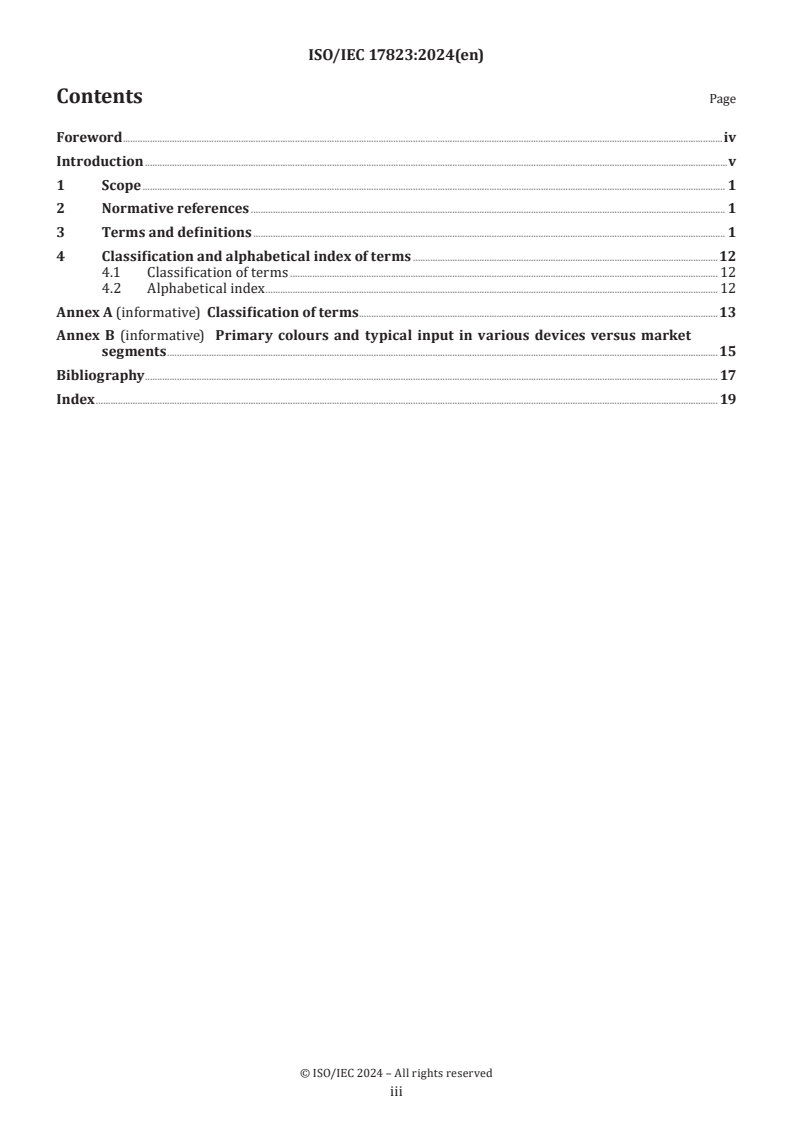
Contents Page
Foreword .iv
Introduction .v
1 Scope . 1
2 Normative references . 1
3 Terms and definitions . 1
4 Classification and alphabetical index of terms .12
4.1 Classification of terms . 12
4.2 Alphabetical index . 12
Annex A (informative) Classification of terms .13
Annex B (informative) Primary colours and typical input in various devices versus market
segments .15
Bibliography . 17
Index . 19
© ISO/IEC 2024 – All rights reserved
iii
Foreword
ISO (the International Organization for Standardization) and IEC (the International Electrotechnical
Commission) form the specialized system for worldwide standardization. National bodies that are
members of ISO or IEC participate in the development of International Standards through technical
committees established by the respective organization to deal with particular fields of technical activity.
ISO and IEC technical committees collaborate in fields of mutual interest. Other international organizations,
governmental and non-governmental, in liaison with ISO and IEC, also take part in the work.
The procedures used to develop this document and those intended for its further maintenance are described
in the ISO/IEC Directives, Part 1. In particular, the different approval criteria needed for the different types
of document should be noted. This document was drafted in accordance with the editorial rules of the ISO/
IEC Directives, Part 2 (see www.iso.org/directives or www.iec.ch/members_experts/refdocs).
ISO and IEC draw attention to the possibility that the implementation of this document may involve the
use of (a) patent(s). ISO and IEC take no position concerning the evidence, validity or applicability of any
claimed patent rights in respect thereof. As of the date of publication of this document, ISO and IEC had not
received notice of (a) patent(s) which may be required to implement this document. However, implementers
are cautioned that this may not represent the latest information, which may be obtained from the patent
database available at www.iso.org/patents and https://patents.iec.ch. ISO and IEC shall not be held
responsible for identifying any or all such patent rights.
Any trade name used in this document is information given for the convenience of users and does not
constitute an endorsement.
For an explanation of the voluntary nature of standards, the meaning of ISO specific terms and expressions
related to conformity assessment, as well as information about ISO's adherence to the World Trade
Organization (WTO) principles in the Technical Barriers to Trade (TBT) see www.iso.org/iso/foreword.html.
In the IEC, see www.iec.ch/understanding-standards.
This document was prepared by Joint Technical Committee ISO/IEC JTC 1, Information technology,
Subcommittee SC 28, Office equipment.
This second edition cancels and replaces the first edition (ISO/IEC 17823:2015), which has been technically
revised.
The main changes are as follows:
— new terms and definitions have been added;
— references have been updated.
Any feedback or questions on this document should be directed to the user’s national standards
body. A complete listing of these bodies can be found at www.iso.org/members.html and
www.iec.ch/national-committees.
© ISO/IEC 2024 – All rights reserved
iv
Introduction
Technical colour terms have been published in various fields of standards such as colour photography,
graphic technology printing and computer graphics. However, no standard colour terms have been published
for office equipment.
As a result, misunderstandings between users and colour office equipment providers can occur when terms
are interpreted differently.
The purpose of this document is to provide terminology for use by office equipment providers to help
customers use their colour equipment effectively.
© ISO/IEC 2024 – All rights reserved
v
International Standard ISO/IEC 17823:2024(en)
Information technology — Office equipment — Vocabulary
for office colour equipment
1 Scope
This document provides definitions for colour terms used with office equipment, in particular for use with
colour scanning and printing devices that have digital imaging capabilities, including multi-function devices.
This document is not intended to replace terms and definitions published in documents or user interfaces
issued or created by manufacturers.
2 Normative references
There are no normative references in this document.
3 Terms and definitions
ISO and IEC maintain terminology databases for use in standardization at the following addresses:
— ISO Online browsing platform: available at https:// www .iso .org/ obp
— IEC Electropedia: available at https:// www .electropedia .org/
3.1
colour balance
adjustment of colour channel gains or processing
3.1.1
grey balance
set of tone-values for cyan, magenta and yellow that are expected to appear as an achromatic grey under
specified viewing conditions (3.12.11) when printed using the specified printing conditions
Note 1 to entry: There are three practical definitions and one theoretical definition for grey:
a) practical definitions:
1) colour having the same CIELAB a* and b* values as the print substrate;
2) colour that has the same CIELAB a* and b* values as a half-tone tint (3.16.2) of similar L* value
printed with black ink;
3) functional (linear or nonlinear) combination of both.
b) theoretical definition:
1) colour that the CIELAB a* and b* values both equal to 0.
[SOURCE: ISO/TS 10128:2023, 3.4, modified — Note 1 to entry has been modified.]
3.2
black
© ISO/IEC 2024 – All rights reserved
3.2.1
composite black
black printed with multiple colourants (3.9)
3.2.2
pure black
black generated only in black colourant (3.9) in a printing device
3.2.3
rich black
black generated by a mixture of black colourant (3.9) and other colourants in a printing device
3.3
calibration
set of operations that establish, under specified conditions, the relationship between values of quantities
indicated by a measuring instrument or measuring system, or values represented by a material measure or
a reference material, and the corresponding values realized by standards
[SOURCE: ISO 14807:2001, 3.11]
3.4
colour appearance
aspect of visual perception through which an object is perceived to have a colour with certain attributes
[SOURCE: CIE S 017/E:2020, 17-22-058]
3.4.1
brightness
attribute of a visual perception according to which an area appears to emit, transmit or reflect, more or less light
[SOURCE: CIE S 017/E: 2020, 17-22-059]
3.4.2
colourfulness
attribute of a visual perception according to which the perceived colour of an area appears to be more or less
chromatic
[SOURCE: IEC 60050-845:2020, 845-22-072, modified — Notes to entry have been removed.]
3.4.3
highlight colour
adjustment of colour channel gains or processing
3.4.4
metamerism
phenomenon perceived when two specimens have the same colour under the lighting of an illuminant, but
different spectral reflection and transmission curves
[SOURCE: ISO 4618:2023, 3.154]
3.4.5
vividness
attribute of colour used to indicate the degree of departure of the colour from a neutral black colour
3.5
colour difference
perceived dissimilarity between two colour stimuli
[SOURCE: CIE S 017/E: 2020, 17-22-041]
3.6
colour encoding
© ISO/IEC 2024 – All rights reserved
3.6.1
colour palette
fixed set or range of available colours that can be selected
3.6.2
full colour
representation of colours with 3-channel or more, and each channel has 8-bit or more information
Note 1 to entry: Each channel may have 12-bit or 16-bit. In "commercial printing", there are multi-channel colour
reproductions such as “Cyan(C), Magenta(M), Yellow(Y), black(K), Orange(O) and Green(G)”.
3.6.3
indexed colour
palette colour
colour selection scheme in which the colour index is used to retrieve colour values from a colour table
[SOURCE: ISO/IEC 8632-1:1999, 4.1.62, modified — The term "palette colour" has been added.]
3.6.4
metallic colour
colour associated with polished metal, the brightness (3.4.1) of which varies with the angle of the incident
light and the viewing angle
Note 1 to entry: Typically, metallic colour cannot be reproduced well by mixture of device process colours (3.6.7).
3.6.5
multi colour
multi-colour
additional colour(s) other than device process colours (3.6.7), used in printing process that enhance(s) colour
image quality
Note 1 to entry: Typically, complementary colours of process colours such as red, green, violet are used to expand
colour gamut (3.7.2).
Note 2 to entry: Sometimes light colourants (3.9) such as light cyan, light magenta, light black or grey are used to
improve image granularity and colour gamut in highlight.
3.6.6
named colour
colour with associated colour expression specification
3.6.7
process colour
colour that is the outcome of a colour separation operation
Note 1 to entry: A process colour typically requires one or more printing units and process inks to be reproduced.
Note 2 to entry: It is typically cyan, magenta, yellow, black for four-colour printing.
[SOURCE: ISO/TS 19303-1:2020, 3.10, modified — Note 2 to entry has been added.]
3.6.8
special colour
specific colour of single colourant (3.9) designated, that cannot be reproduced by mixture of device process
colours (3.6.7)
3.6.9
spot colour
colour of single colourant (3.9), identified by name, the printing tone-values of which are specified
independently from the colour values specified in a colour coordinate system
[SOURCE: ISO 12639:2004, 4.1.10, modified — The word “colour” is added.]
© ISO/IEC 2024 – All rights reserved
3.7
colour management
communication of the associated data required for unambiguous interpretation of colour content data, and
application of colour data conversions, as required, to produce the intended reproductions
[SOURCE: ISO 15076-1:2010, 3.1.11, modified — Notes to entry have been removed.]
3.7.1
characterization
process of relating device-dependent colour values to device-independent colour values
Note 1 to entry: Adapted from ISO 12637-2:2008, 2.7.
3.7.2
colour gamut
volume, area or solid in a colour space (3.8), consisting of all those colours that are either one of the following:
a) present in a specific scene, artwork, photograph, photomechanical, or other reproduction;
b) capable of being created using a particular output device and/or medium
Note 1 to entry: In reproduction and media applications, only the volume or solid in colour space is regarded as colour
gamut. In applications such as signal lighting, the colour gamut is an area.
[SOURCE: CIE S 017/E: 2020, 17-32-007]
3.7.3
colour gamut boundary
surface determined by a colour gamut's (3.7.2) extremes
[SOURCE: ISO/IEC TR 29186:2012, 3.3]
3.7.4
gamut boundary descriptor
GBD
overall way of approximately describing a colour gamut boundary (3.7.3)
[SOURCE: ISO/IEC TR 29186:2012, 3.4]
3.7.5
gamut mapping
mapping of the colour space (3.8) coordinates of the elements of a source image to colour space coordinates
of the elements of a reproduction to compensate for differences in the source and output medium colour
gamut (3.7.2) capability
Note 1 to entry: The term "gamut mapping" is somewhat more restrictive than the term "colour rendering" because
gamut mapping is performed on colourimetry that has already been adjusted to compensate for viewing condition
differences and viewer preferences, although these processing operations are frequently combined in reproduction
and preferred reproduction models.
[SOURCE: ISO 22028-2:2013, 3.14]
3.7.6
ICC
International Color Consortium
industry association formed to develop standardized mechanisms for colour management (3.7)
[SOURCE: ISO 15930-3:2002, 3.9]
© ISO/IEC 2024 – All rights reserved
3.7.7
ICC profile
file format of the International Color Consortium (3.7.6), used to store transforms from one colour encoding
to another
[SOURCE: ISO 22028-1:2016, 3.24, modified — Example has been removed from the definition.]
3.7.8
print settings profile
digital file that is or contains an International Color Consortium (3.7.6) output profile along with colourant
settings (3.21.1) and optional, additional metadata
[SOURCE: ISO/IEC 22954:2022, 3.10]
3.7.9
rendering intent
style of mapping colour values from one image description to another
[SOURCE: ISO 15076-1:2010, 3.1.27, modified — Note 1 to entry has been removed.]
3.8
colour space
geometric representation of colours in space
Note 1 to entry: A colour space is usually of three dimensions.
[SOURCE: IEC 60050-845:2020, 845-23-041]
3.8.1
colour space encoding
digital encoding of a colour space (3.8), including the specification of a digital encoding method, and a colour
space value range
Note 1 to entry: Multiple colour space encodings may be defined based on a single colour space where the different
colour space encodings have different digital encoding methods and/or colour space value ranges. For example, 8-bit
sRGB and 10-bit bg-sRGB are different colour space encodings based on a particular additive RGB colour space.
[SOURCE: ISO 22028-1:2016, 3.14]
3.8.2
device-dependent colour space
colour space (3.8) defined by the characteristics of a real or idealized imaging device
Note 1 to entry: Device-dependent colour spaces having a simple functional relationship to CIE colourimetry can
also be categorized as colourimetric colour spaces. For example, additive RGB colour spaces corresponding to real or
idealized CRT displays can be treated as colourimetric colour spaces.
[SOURCE: ISO 22028-1:2016, 3.17, modified — The spelling of the word colorimetry has been changed to
colourimetry and the spelling of the word colorimetric has been changed to colourimetric.]
3.8.3
device-independent colour space
colour coordinate system defined in terms of the amounts of visual stimuli colour capabilities independent
of the specific device characteristics
[SOURCE: ISO 12637-2:2008, 2.47]
3.9
colourant
physical substance such as ink or toner which is used to produce a colour
Note 1 to entry: The term “colourant” sometimes means dye or pigment component of toner or ink.
[SOURCE: ISO 19302:2018, 3.2, modified — Definition has been shortened and Note 1 to entry has been added.]
© ISO/IEC 2024 – All rights reserved
3.9.1
colourant set
identifier for colourants (3.9) having unique reproduction characteristics
[SOURCE: ISO/IEC 22954:2022, 3.7, modified — Note 1 to entry has been removed.]
3.9.2
fluorescent toner
fluorescent ink
toner or ink that absorbs optical radiation at particular wavelengths and emits optical radiation at longer
wavelengths
Note 1 to entry: Sometimes it is called "neon toner/ink", such as "neon yellow" for "fluorescent yellow".
3.10
daylight illuminant
D illuminant
illuminant having the same or nearly the same relative spectral distribution of the radiant flux as a phase of
daylight
[SOURCE: IEC 60050-845:2020, 845-23-020]
3.11
dynamic range
difference between peak white and black level
[SOURCE: ISO 22493:2014, 4.7.2]
3.12
environment
3.12.1
adapted white
colour stimulus that an observer who is adapted to the viewing environment (3.12.12) would judge to be
perfectly achromatic and to have a luminance factor of unity, i.e. absolute colourimetric coordinates that an
observer would consider to be a perfect white diffuser
Note 1 to entry: The adapted white may vary within a scene.
[SOURCE: ISO 22028-1:2016, 3.2, modified — The spelling of the word colorimetric has been changed to
colourimetric.]
3.12.2
glare
discomfort or impairment of vision experienced when parts of the visual field are excessively bright in
relation to the brightness (3.4.1) of the general surroundings to which the eyes are adapted
[SOURCE: ISO 11064-6:2005, 3.7]
3.12.3
image surround
characteristics of the field surrounding the image being viewed, filling the field of vision
[SOURCE: ISO/IEC TR 29186:2012, 3.7, modified —Notes to entry have been removed.]
3.12.4
measurement condition M0
M0
standard measurement condition using incandescent lamp with undefined UV content
Note 1 to entry: Measurement condition is defined in ISO 13655.
© ISO/IEC 2024 – All rights reserved
3.12.5
measurement condition M1
M1
standard measurement condition using D50 including UV content
Note 1 to entry: Measurement condition is defined in ISO 13655.
3.12.6
measurement condition M2
M2
standard measurement condition using D50 excluding UV content
Note 1 to entry: Measurement condition is defined in ISO 13655.
3.12.7
measurement condition M3
M3
standard measurement condition using D50 excluding UV content and polarized
Note 1 to entry: Measurement condition is defined in ISO 13655.
3.12.8
surface colour
colour perceived as belonging to a surface from which the light appears to be diffusely reflected or radiated
[SOURCE: IEC 60050-845:2020, 845-22-043]
3.12.9
surround
area adjacent to the border of an image, which, upon viewing the image, can affect the local state of
adaptation of the eye
[SOURCE: ISO 3664:2009, 3.16, modified — Note 1 to entry has been removed.]
3.12.10
veiling glare
light, reflected from an imaging medium, that has not been modulated by the means used to produce the image
[SOURCE: ISO/IEC TR 29186:2012, 3.5, modified — Notes to entry have been removed.]
3.12.11
viewing conditions
description of the surrounding environmental conditions during the process of viewing
[SOURCE: ISO/TS 18173:2005, 2.28]
3.12.12
viewing environment
environment in which something is viewed
[SOURCE: ISO/IEC TR 21565:2018, 3.1]
3.12.13
viewing flare
veiling glare (3.12.10) that is observed in a viewing environment (3.12.12) but not accounted for in radiometric
measurements made using a prescribed measurement geometry
[SOURCE: ISO/IEC TR 29186:2012, 3.6, modified —Note 1 to entry has been removed.]
3.13
grey
© ISO/IEC 2024 – All rights reserved
3.13.1
composite grey
grey printed with multiple colourants (3.9)
3.13.2
greyscale
image represen
...