

ISO 22940:2021
(Main)Solid recovered fuels — Determination of elemental composition by X-ray fluorescence
General Information
- Abstract
This document specifies the procedure for a determination of major and minor element concentrations in solid recovered fuel material by energy-dispersive X-ray fluorescence (EDXRF) spectrometry or wavelength-dispersive X-ray fluorescence (WDXRF) spectrometry using a calibration with solid recovered fuel reference materials or solid recovered fuel samples with known content. A semiquantitative determination can be carried out using matrix independent standards. This document is applicable to the following elements: Na, Mg, Al, Si, P, S, Cl, K, Ca, Ti, V, Cr, Mn, Fe, Co, Ni, Cu, Zn, As, Br, Mo, Cd, Sb, Sn, Tl and Pb. Concentration levels between approximately 0,000 1 % and 100 % can be determined depending on the element, the calibration materials used and the instrument used. NOTE X-ray fluorescence spectrometry can be used as a fast method for a qualitative overview of elements and impurities and after suitable calibration it is very useful for determining major elements or even minor elements (except Hg) in order to quickly identify increased concentrations of minor elements in solid recovered fuels (SRF), for example during SRF-production.
- Status
- Published
- Publication Date
- 24-Aug-2021
- Technical Committee
- ISO/TC 300 - Solid recovered materials, including solid recovered fuels
- Drafting Committee
- ISO/TC 300/WG 5 - Chemical tests and determination of biomass content
- Current Stage
- 9020 - International Standard under periodical review
- Start Date
- 15-Jul-2026
- Completion Date
- 15-Jul-2026
Buy Documents


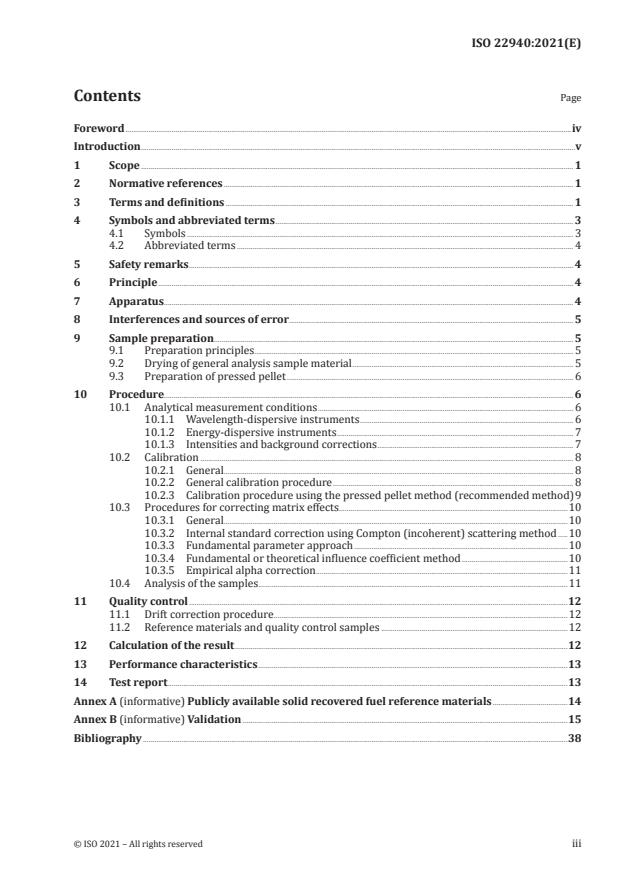

ISO 22940:2021 - Solid recovered fuels -- Determination of elemental composition by X-ray fluorescence
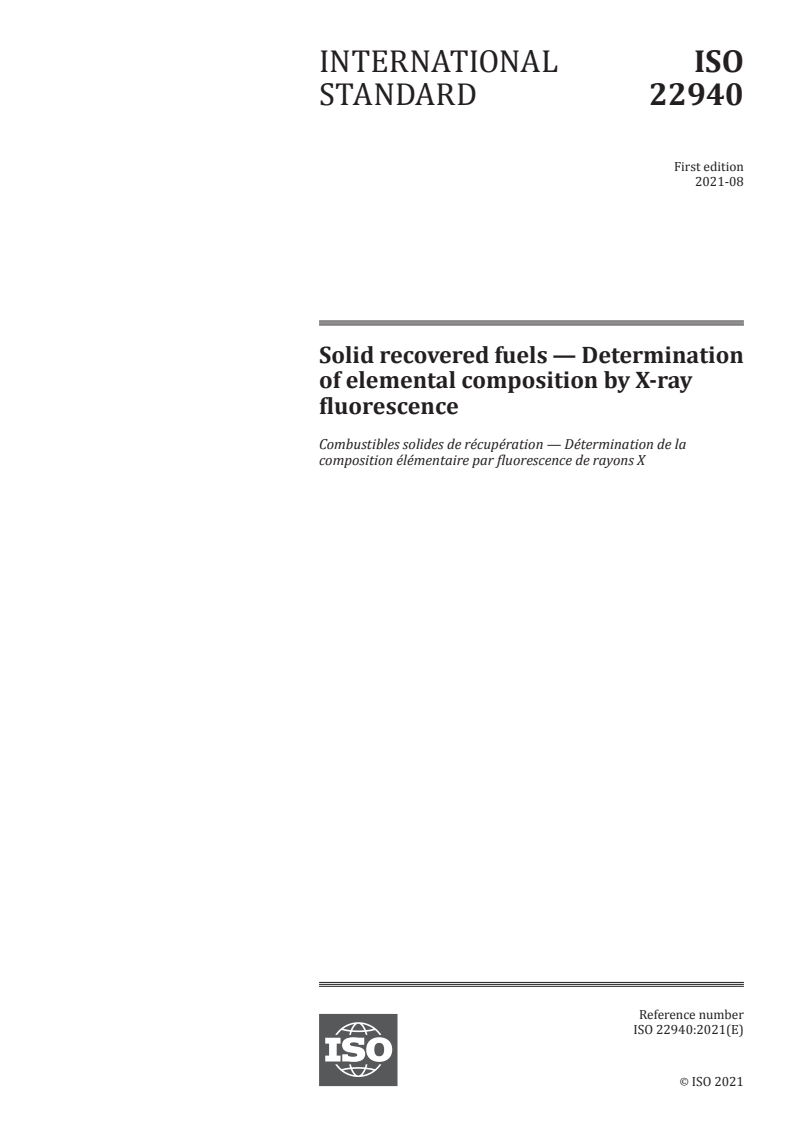

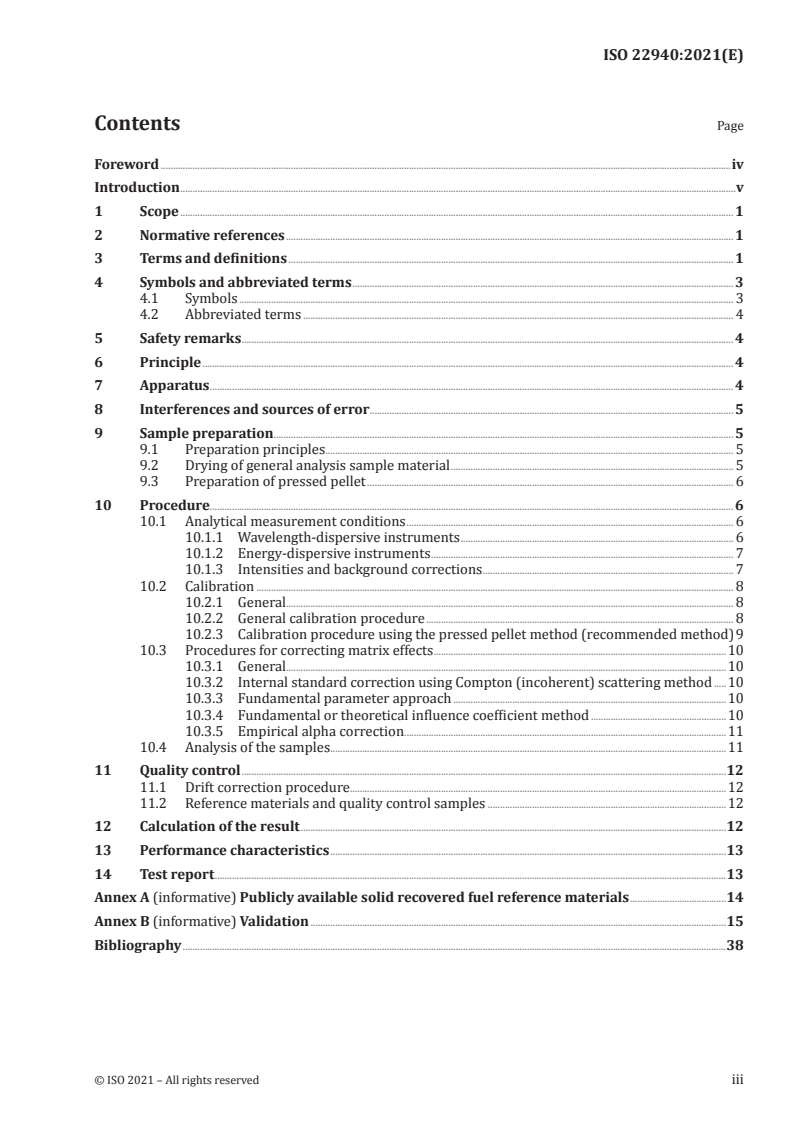

ISO 22940:2021 - Solid recovered fuels — Determination of elemental composition by X-ray fluorescence/25/2021


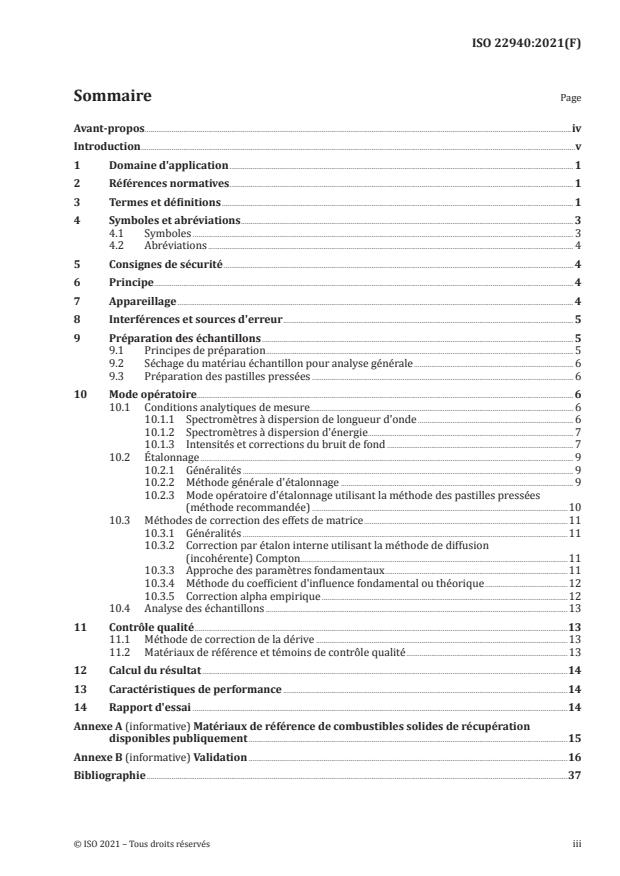
ISO 22940:2021 - Combustibles solides de récupération -- Détermination de la composition élémentaire par fluorescence de rayons X

ISO 22940:2021 - Combustibles solides de récupération — Détermination de la composition élémentaire par fluorescence de rayons X/25/2021
Overview
ISO 22940:2021 - Solid recovered fuels - Determination of elemental composition by X‑ray fluorescence (XRF) - specifies standardized procedures for determining major and minor element concentrations in solid recovered fuels (SRF) using energy‑dispersive (EDXRF) or wavelength‑dispersive (WDXRF) XRF spectrometry. The standard covers both quantitative analyses based on calibration with SRF reference materials or matrix‑matched samples and semiquantitative screening using matrix‑independent standards. Elemental coverage includes Na, Mg, Al, Si, P, S, Cl, K, Ca, Ti, V, Cr, Mn, Fe, Co, Ni, Cu, Zn, As, Br, Mo, Cd, Sb, Sn, Tl and Pb. Concentrations from approximately 0.0001% to 100% are achievable depending on element, calibration and instrument. Hg is excluded.
Key topics and technical requirements
- Analytical techniques: Procedures for EDXRF and WDXRF instrument setups and measurement conditions.
- Calibration strategies:
- Quantitative calibration using SRF reference materials or homogenized SRF samples with independently verified contents.
- Semiquantitative (matrix‑independent) calibration for rapid screening.
- Sample preparation:
- Drying, milling and preparation of pressed pellets or powder cups (pressed pellet method is recommended).
- Matrix effects and corrections:
- Internal standard/Compton (incoherent) scattering correction
- Fundamental parameter approaches and theoretical influence coefficient methods
- Empirical alpha correction
- Interferences & error sources: Guidance on spectral interferences, background corrections and limitations of XRF for trace elements.
- Quality control:
- Drift correction procedures, use of certified reference materials or stable quality control samples
- Performance characteristics and test reporting requirements
- Scope limits: Fast qualitative overviews are supported; quantification quality depends on instrument performance and availability of matrix‑matched calibration materials.
Practical applications and users
ISO 22940:2021 is designed for organizations involved in SRF production, quality assurance and regulatory compliance:
- Laboratories performing SRF elemental analysis and screening
- SRF producers and processors monitoring feedstock and product composition
- Waste‑to‑energy facilities assessing ash‑forming elements to predict melting behavior, slagging and fouling
- Environmental and regulatory bodies verifying compliance with metal/halogen limits
- Instrument manufacturers and service providers implementing validated XRF workflows for SRF matrices
The standard supports rapid in‑process screening for elevated minor elements and provides a traceable framework for quantitative XRF when reference materials and appropriate calibrations are available.
Related standards
- ISO 21637 - Solid recovered fuels - Vocabulary
- ISO 21646 - Solid recovered fuels - Sample preparation
- ISO 21660‑3 - Solid recovered fuels - Determination of moisture content (oven dry method), Part 3
Keywords: ISO 22940:2021, solid recovered fuels, X‑ray fluorescence, EDXRF, WDXRF, elemental composition, SRF, pressed pellet, calibration, matrix effects, reference material.
Relations
- Effective Date
- 25-Aug-2026
- Effective Date
- 25-Aug-2026
- Effective Date
- 12-Feb-2026
- Effective Date
- 06-Jun-2022
Buy Documents
ISO 22940:2021 - Solid recovered fuels -- Determination of elemental composition by X-ray fluorescence
ISO 22940:2021 - Solid recovered fuels — Determination of elemental composition by X-ray fluorescence/25/2021
ISO 22940:2021 - Combustibles solides de récupération -- Détermination de la composition élémentaire par fluorescence de rayons X
ISO 22940:2021 - Combustibles solides de récupération — Détermination de la composition élémentaire par fluorescence de rayons X/25/2021
Get Certified
Connect with accredited certification bodies for this standard

Element Materials Technology
Materials testing and product certification.

ABS Group Brazil
ABS Group certification services in Brazil.

ABS Quality Evaluations Inc.
American Bureau of Shipping quality certification.
Sponsored listings
Frequently Asked Questions
ISO 22940:2021 is a standard published by the International Organization for Standardization (ISO). Its full title is "Solid recovered fuels — Determination of elemental composition by X-ray fluorescence". This standard covers: This document specifies the procedure for a determination of major and minor element concentrations in solid recovered fuel material by energy-dispersive X-ray fluorescence (EDXRF) spectrometry or wavelength-dispersive X-ray fluorescence (WDXRF) spectrometry using a calibration with solid recovered fuel reference materials or solid recovered fuel samples with known content. A semiquantitative determination can be carried out using matrix independent standards. This document is applicable to the following elements: Na, Mg, Al, Si, P, S, Cl, K, Ca, Ti, V, Cr, Mn, Fe, Co, Ni, Cu, Zn, As, Br, Mo, Cd, Sb, Sn, Tl and Pb. Concentration levels between approximately 0,000 1 % and 100 % can be determined depending on the element, the calibration materials used and the instrument used. NOTE X-ray fluorescence spectrometry can be used as a fast method for a qualitative overview of elements and impurities and after suitable calibration it is very useful for determining major elements or even minor elements (except Hg) in order to quickly identify increased concentrations of minor elements in solid recovered fuels (SRF), for example during SRF-production.
This document specifies the procedure for a determination of major and minor element concentrations in solid recovered fuel material by energy-dispersive X-ray fluorescence (EDXRF) spectrometry or wavelength-dispersive X-ray fluorescence (WDXRF) spectrometry using a calibration with solid recovered fuel reference materials or solid recovered fuel samples with known content. A semiquantitative determination can be carried out using matrix independent standards. This document is applicable to the following elements: Na, Mg, Al, Si, P, S, Cl, K, Ca, Ti, V, Cr, Mn, Fe, Co, Ni, Cu, Zn, As, Br, Mo, Cd, Sb, Sn, Tl and Pb. Concentration levels between approximately 0,000 1 % and 100 % can be determined depending on the element, the calibration materials used and the instrument used. NOTE X-ray fluorescence spectrometry can be used as a fast method for a qualitative overview of elements and impurities and after suitable calibration it is very useful for determining major elements or even minor elements (except Hg) in order to quickly identify increased concentrations of minor elements in solid recovered fuels (SRF), for example during SRF-production.
ISO 22940:2021 is classified under the following ICS (International Classification for Standards) categories: 75.160.10 - Solid fuels. The ICS classification helps identify the subject area and facilitates finding related standards.
ISO 22940:2021 has the following relationships with other standards: It is inter standard links to EN ISO 4349:2024, EN ISO 3884:2025, EN ISO 22940:2021, ISO 16784-1:2024. Understanding these relationships helps ensure you are using the most current and applicable version of the standard.
ISO 22940:2021 is available in PDF format for immediate download after purchase. The document can be added to your cart and obtained through the secure checkout process. Digital delivery ensures instant access to the complete standard document.
Standards Content (Sample)
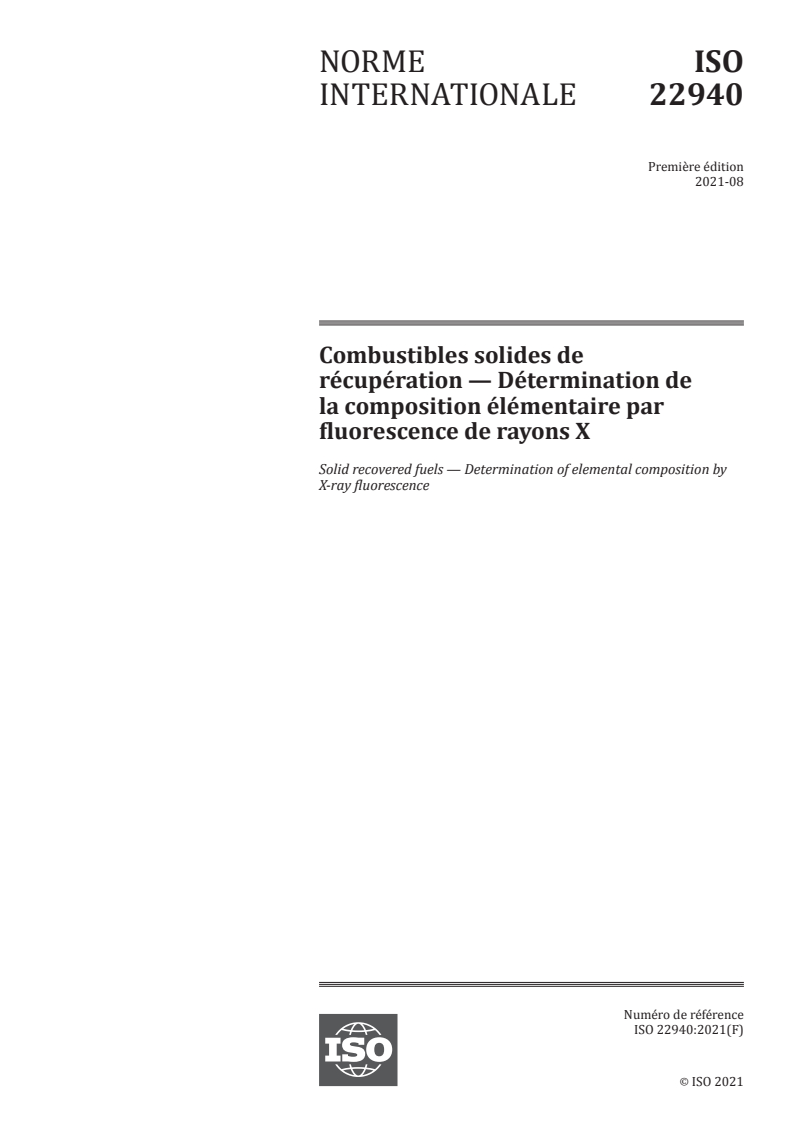
INTERNATIONAL ISO
STANDARD 22940
First edition
2021-08
Solid recovered fuels — Determination
of elemental composition by X-ray
fluorescence
Combustibles solides de récupération — Détermination de la
composition élémentaire par fluorescence de rayons X
Reference number
©
ISO 2021
© ISO 2021
All rights reserved. Unless otherwise specified, or required in the context of its implementation, no part of this publication may
be reproduced or utilized otherwise in any form or by any means, electronic or mechanical, including photocopying, or posting
on the internet or an intranet, without prior written permission. Permission can be requested from either ISO at the address
below or ISO’s member body in the country of the requester.
ISO copyright office
CP 401 • Ch. de Blandonnet 8
CH-1214 Vernier, Geneva
Phone: +41 22 749 01 11
Email: copyright@iso.org
Website: www.iso.org
Published in Switzerland
ii © ISO 2021 – All rights reserved
Contents Page
Foreword .iv
Introduction .v
1 Scope . 1
2 Normative references . 1
3 Terms and definitions . 1
4 Symbols and abbreviated terms . 3
4.1 Symbols . 3
4.2 Abbreviated terms . 4
5 Safety remarks . 4
6 Principle . 4
7 Apparatus . 4
8 Interferences and sources of error . 5
9 Sample preparation . 5
9.1 Preparation principles . 5
9.2 Drying of general analysis sample material . 5
9.3 Preparation of pressed pellet . 6
10 Procedure. 6
10.1 Analytical measurement conditions . 6
10.1.1 Wavelength-dispersive instruments . 6
10.1.2 Energy-dispersive instruments . 7
10.1.3 Intensities and background corrections . 7
10.2 Calibration . 8
10.2.1 General. 8
10.2.2 General calibration procedure . 8
10.2.3 Calibration procedure using the pressed pellet method (recommended method) 9
10.3 Procedures for correcting matrix effects .10
10.3.1 General.10
10.3.2 Internal standard correction using Compton (incoherent) scattering method .10
10.3.3 Fundamental parameter approach .10
10.3.4 Fundamental or theoretical influence coefficient method .10
10.3.5 Empirical alpha correction . .11
10.4 Analysis of the samples .11
11 Quality control .12
11.1 Drift correction procedure .12
11.2 Reference materials and quality control samples .12
12 Calculation of the result .12
13 Performance characteristics .13
14 Test report .13
Annex A (informative) Publicly available solid recovered fuel reference materials .14
Annex B (informative) Validation .15
Bibliography .38
Foreword
ISO (the International Organization for Standardization) is a worldwide federation of national standards
bodies (ISO member bodies). The work of preparing International Standards is normally carried out
through ISO technical committees. Each member body interested in a subject for which a technical
committee has been established has the right to be represented on that committee. International
organizations, governmental and non-governmental, in liaison with ISO, also take part in the work.
ISO collaborates closely with the International Electrotechnical Commission (IEC) on all matters of
electrotechnical standardization.
The procedures used to develop this document and those intended for its further maintenance are
described in the ISO/IEC Directives, Part 1. In particular, the different approval criteria needed for the
different types of ISO documents should be noted. This document was drafted in accordance with the
editorial rules of the ISO/IEC Directives, Part 2 (see www .iso .org/ directives).
Attention is drawn to the possibility that some of the elements of this document may be the subject of
patent rights. ISO shall not be held responsible for identifying any or all such patent rights. Details of
any patent rights identified during the development of the document will be in the Introduction and/or
on the ISO list of patent declarations received (see www .iso .org/ patents).
Any trade name used in this document is information given for the convenience of users and does not
constitute an endorsement.
For an explanation of the voluntary nature of standards, the meaning of ISO specific terms and
expressions related to conformity assessment, as well as information about ISO's adherence to the
World Trade Organization (WTO) principles in the Technical Barriers to Trade (TBT), see www .iso .org/
iso/ foreword .html.
This document was prepared by Technical Committee ISO/TC 300, Solid recovered materials, including
solid recovered fuels, in collaboration with the European Committee for Standardization (CEN)
Technical Committee CEN/TC 343, Solid Recovered Fuels, in accordance with the Agreement on technical
cooperation between ISO and CEN (Vienna Agreement).
Any feedback or questions on this document should be directed to the user’s national standards body. A
complete listing of these bodies can be found at www .iso .org/ members .html.
iv © ISO 2021 – All rights reserved
Introduction
X-ray fluorescence spectrometry can be used as a fast method for a qualitative overview of ash forming
elements and impurities. When calibration is based on reference materials or on matrix-matched
homogeneous solid recovered fuel samples with known content, X-ray fluorescence spectrometry can
be used for a quantitative analysis of the total content of the specified elements within different solid
recovered fuels.
The quality of the results obtained depends very closely on the type of instrument used, e.g. bench
top or high performance, energy-dispersive or wavelength-dispersive instruments. When selecting a
specific instrument, several factors need to be considered, such as the matrices to be analysed, elements
to be determined, detection limits required and the measuring time.
Due to the wide range of matrix compositions and the lack of suitable reference materials in the case
of solid recovered fuels from various origin, it is generally difficult to set up a calibration with matrix-
matched reference materials. Therefore, it is important to use several homogenized solid recovered fuel
samples with properties that sufficiently match the matrices of interest and whose content has been
derived by independent measurement techniques, for example total digestion of solid recovered fuels
and characterization of major and minor elements by measurement of digestion solutions with ICP-MS
or ICP-OES, or by other techniques such as elemental analysis using combustion technology on sulfur or
by combustion and ion chromatographic determination for chlorine.
This document describes two different procedures:
1) Quantitative analytical procedure for major elements of solid recovered fuels. The calibration is
based on different reference materials and solid recovered fuel samples with known content.
The elements described as major elements of solid recovered fuels are in fact major elements of the
fuel ashes more than of the fuels. The determination of these elements can be helpful to predict the
melting behaviour and slagging of the ashes. Moreover, contamination of fuel with sand or soil is
indicated by high values of several elements.
2) Total element characterization at a semiquantitative level for major and minor elements of solid
recovered fuels. The calibration is based on matrix-independent calibration curves, previously set
up by the manufacturer.
In general, the sensitivity of X-ray fluorescence is not sufficient for a determination of the content of
minor elements (trace metals) in solid recovered fuels. However, it is possible to use determination
of minor elements after calibration with solid recovered fuel samples with known content or at a
semiquantitative level based on matrix-independent calibration curves to collect data for higher
sample numbers, taking into account lower achievable precision. Therefore, it may be used to
reveal excessive contents of minor elements in solid recovered fuels.
INTERNATIONAL STANDARD ISO 22940:2021(E)
Solid recovered fuels — Determination of elemental
composition by X-ray fluorescence
1 Scope
This document specifies the procedure for a determination of major and minor element concentrations
in solid recovered fuel material by energy-dispersive X-ray fluorescence (EDXRF) spectrometry
or wavelength-dispersive X-ray fluorescence (WDXRF) spectrometry using a calibration with
solid recovered fuel reference materials or solid recovered fuel samples with known content. A
semiquantitative determination can be carried out using matrix independent standards.
This document is applicable to the following elements: Na, Mg, Al, Si, P, S, Cl, K, Ca, Ti, V, Cr, Mn, Fe, Co,
Ni, Cu, Zn, As, Br, Mo, Cd, Sb, Sn, Tl and Pb. Concentration levels between approximately 0,000 1 % and
100 % can be determined depending on the element, the calibration materials used and the instrument
used.
NOTE X-ray fluorescence spectrometry can be used as a fast method for a qualitative overview of elements
and impurities and after suitable calibration it is very useful for determining major elements or even minor
elements (except Hg) in order to quickly identify increased concentrations of minor elements in solid recovered
fuels (SRF), for example during SRF-production.
2 Normative references
The following documents are referred to in the text in such a way that some or all of their content
constitutes requirements of this document. For dated references, only the edition cited applies. For
undated references, the latest edition of the referenced document (including any amendments) applies.
ISO 21637, Solid recovered fuels — Vocabulary
1)
ISO 21646, Solid recovered fuels — Sample preparation
ISO 21660-3, Solid recovered fuels — Determination of moisture content using the oven dry method —
Part 3: Moisture in general analysis sample
3 Terms and definitions
For the purposes of this document, the terms and definitions given in ISO 21637 and the following apply.
ISO and IEC maintain terminological databases for use in standardization at the following addresses:
— ISO Online browsing platform: available at https:// www .iso .org/ obp
— IEC Electropedia: available at http:// www .electropedia .org/
3.1
absorption edge
abrupt change in mass absorption coefficient at a specific wavelength or energy
3.2
absorption
loss of intensity of X-rays due to isotropic and homogenous material, as described by the Beer-Lambert
law
1) Under preparation. Stage at the time of publication: ISO/DIS 21646:2021.
3.3
analytical line
specific characteristic X-ray spectral line of the atom or ion of the analyte used for determination of the
analyte content
3.4
continuous radiation (Bremsstrahlung)
electromagnetic radiation produced by the acceleration of a charged particle, such as an electron, when
deflected by another charged particle, such as an atomic nucleus
3.5
Compton line
spectral line due to incoherent scattering (Compton effect), occurring when the incident X-ray photon
strikes an atom without promoting fluorescence
Note 1 to entry: Energy is lost in the collision and, therefore, the resulting scattered X-ray photon is of lower
energy than the incident X-ray photon.
3.6
drift correction monitors
physically stable samples used to correct for instrumental drift
3.7
emitted radiation
emitted sample X-rays
radiation emitted by sample consisting of X-ray fluorescence radiation (3.13) and scattered primary
X-rays (3.11)
3.8
mass absorption coefficient
constant describing the fractional decrease in the intensity of a beam of X-radiation as it passes through
an absorbing medium
Note 1 to entry: It is expressed in cm /g.
Note 2 to entry: The mass absorption coefficient is a function of the wavelength of the absorbed radiation and the
atomic number of the absorbing element.
3.9
powder sample
analyte sample submitted as a powder for direct measurement in the sample cup
3.10
pressed pellet
analyte sample prepared by pressing milled material into a disk
3.11
primary X-rays
X-rays by which the sample is radiated
3.12
quality control sample
stable sample with known contents, for example (certified) reference material (CRM) or homogenized
solid recovered fuel samples from known origin whose contents have been derived by independent
analysis used to monitor instrument and calibration performance
3.13
X-ray fluorescence radiation
emission of characteristic X-rays from a sample that has been bombarded by high-energy X-rays or
gamma rays
2 © ISO 2021 – All rights reserved
4 Symbols and abbreviated terms
4.1 Symbols
Al aluminium
As arsenic
Br bromine
Ca calcium
Cd cadmium
Cl chlorine
Co cobalt
Cr chromium
Cu copper
Fe iron
K potassium
Mg magnesium
Mn manganese
Mo molybdenum
Na sodium
Ni nickel
P phosphorus
Pb lead
S sulfur
Sb antimony
Si silicon
Sn tin
Ti titanium
Tl thallium
V vanadium
Zn zinc
4.2 Abbreviated terms
EDXRF energy-dispersive x-ray fluorescence
MCA multi-channel analyser
WDXRF wavelength-dispersive x-ray fluorescence
5 Safety remarks
The organization shall be aware of applicable legal requirements relating to the X-ray fluorescence
spectrometer.
The person responsible for managing or supervising the operation of X-ray equipment shall provide
evidence of their knowledge of national regulations relating to radiation protection.
6 Principle
After a suitable preparation, the sample is introduced into an XRF-spectrometer and excited by primary
X-rays. The intensities of the secondary fluorescent energy lines specific for each element are measured
and the elemental composition of the sample is determined by reference to previously established
calibration graphs or equations and applying corrections for inter-element effects. The calibration
equations and inter-element corrections are established using pure reagents and/or series of internal
or reference materials, provided that they meet all the requirements of the relevant preparation
technique.
7 Apparatus
7.1 X-ray fluorescence spectrometer, which shall be able to analyse the elements according to the
scope of this document. The following types of X-ray fluorescence spectrometers are applicable:
— EDXRF spectrometer that achieves the dispersion of the emitted X-ray fluorescence radiation by an
energy-dispersive detector;
— WDXRF spectrometer that achieves the dispersion of the emitted X-ray fluorescence radiation by
diffraction by a crystal or a synthetic multilayer.
The spectrometer consists of the following components:
— primary X-ray source, an X-ray tube with a high-voltage generator;
— sample holder;
— detector unit including electronic equipment;
— source modifiers to modify the shape or intensity of the source spectrum or the beam shape (e.g.
source filters, secondary targets, polarizing targets, collimators, focusing optics).
The detector unit is different for WDXRF and for EDXRF spectrometers. WDXRF spectrometers take
advantage of the dispersion of the emitted radiation by diffraction by a crystal or a synthetic multilayer.
The detector does not need to be capable of energy discrimination. EDXRF spectrometers use an
energy-dispersive detector. Pulses of current from the detector, which are a measure of the energy of
the incoming X-rays, are segregated into channels according to energy using an MCA.
NOTE 1 The use of a high-energy X-ray tube increases the potential for losses of volatile analytes from samples
by heating in the spectrometer during analysis.
4 © ISO 2021 – All rights reserved
NOTE 2 The new generation of EDXRF spectrometers takes advantage of the polarizing target theory. The
excitation is performed by polarized radiation. The emitted X-ray fluorescence radiation is detected along the
direction of polarization, resulting in a significant decrease of the background scattering, therefore lower limits
of detection can be achieved (comparable to WDXRF).
7.2 Pellet press, capable of providing a pressure of at least 30 kN. The pellet press may be a cold press
or a hot mould press, operating at temperatures not exceeding 180 °C.
8 Interferences and sources of error
Interferences in X-ray fluorescence spectrometry are due to spectral line overlaps, matrix effects,
spectral artefacts and particle size or mineralogical effects.
Spectral line overlaps occur when an analytical line cannot be resolved from the line of a different
element. Corrections for these interferences are made using the algorithms provided with the
instrument software.
Matrix effects occur when the X-ray fluorescence radiation from the analyte element is absorbed or
enhanced by other elements in the sample before it reaches the detector. In the case of complex matrices,
these effects generally shall be corrected. The correction procedure depends on the X-ray fluorescence
spectrometry system (EDXRF or WDXRF) and the apparatus type itself.
Spectral artefacts, for example escape peaks, sum peaks, pulse pile up lines, dead time and continuous
radiation (Bremsstrahlung) correction, are accounted for by the provided instrument software.
Spectral artefacts differ for energy-dispersive and wavelength-dispersive XRF spectrometry.
9 Sample preparation
9.1 Preparation principles
The sample preparation is very critical for XRF analysis of solid recovered fuels. The quality of sample
preparation strongly influences the accuracy of the results. The following different options exist:
— For quantitative analysis of solid recovered fuel samples, the preparation of pressed pellets from
prepared general analysis sample material is recommended.
— For semiquantitative analysis of solid recovered fuels, the general analysis material may be used
directly (in powder form); concerning samples of solid recovered fuel pellets, the original pellets may
be used directly without any sample preparation. It may be used to provide fast basic information
about the approximate composition of a sample. Similar results can be obtained using portable XRF
instruments for field analysis.
For a given calibration, the same preparation method shall be used throughout, for both samples and
standards.
For precise quantitative measurements, homogeneous and representative test portions are necessary.
The nominal top size of the material shall be 0,5 mm or less, following the procedure according to
ISO 21646.
9.2 Drying of general analysis sample material
Dry a sufficient amount of general analysis sample material in accordance with ISO 21660-3 immediately
before pressing pellets for XRF-analysis.
NOTE Concerning some XRF instruments, the applied vacuum will dry the general analysis sample material
during the determination, giving the same results as if the sample had been previously dried.
9.3 Preparation of pressed pellet
A pellet is prepared in the pellet press (7.2). Before pressing, the sample shall be mixed and homogenized.
Use the same weight for any single set of standards and samples and add binder (e.g. wax or liquid
organic binder), if necessary.
For the preparation, follow the manufacturer’s instructions.
NOTE 1 Different binders can be used. In the case of organic liquid binders (approximately 0,6 % weight of
sample) the pressed pellet will be placed in an oven at between 70 °C and 100 °C for a minimum of 10 minutes
to evaporate the organic solvent or for the formation of long chain polymers formed by heating (e.g. PVP-
methylcellulose binders).
NOTE 2 In the case of wax binder, the ratio of the sample weight to wax is around 10:1.
10 Procedure
10.1 Analytical measurement conditions
10.1.1 Wavelength-dispersive instruments
10.1.1.1 General
The analytical lines to be used and suggested operating conditions are given in Table 1. The settings
strongly depend on the spectrometer configuration, e.g. the type of X-ray tube (Rh, Cr), tube power,
available crystals and type of collimators. The instrument manufacturer’s recommendations should be
followed in all cases.
10.1.1.2 Intensities and background corrections
For the determination of trace elements, the measured intensities shall be background corrected. The
measured background positions should be free of spectral line interferences. The net peak intensity, I ,
expressed as the number of counts per second of the element of interest (i), is calculated as the
difference between the measured peak intensity of the element and the background intensity, as given
in Formula (1):
II=− I (1)
pb
where
I
is the count rate of the element i, expressed as the number of counts per second;
p
I
is the background count rate of the element i with no analyte present, expressed as the number
b
of counts per second.
10.1.1.3 Counting time
The minimum counting time is the time necessary to achieve an uncertainty (2σ ) which is less than
%
the desired precision of the measurement. Choose a reference material or quality control sample with a
concentration level in the middle of the working range and measure the count rate. The counting time
for each element can be calculated according to Formula (2):
TI=×10021σ − I (2)
()()
%p b
where
6 © ISO 2021 – All rights reserved
T
is the total counting time for the peaks and background, expressed in seconds;
2σ
is the relative target precision at a confidence level of 95 %, expressed as a percentage.
%
10.1.2 Energy-dispersive instruments
The analytical lines to be used and suggested operating conditions are given in Table 1. The settings
strongly depend on the spectrometer configuration, e.g. type of X-ray tube (Rh, Pd), tube power,
available targets and types of filters. The instrument manufacturer’s recommendations should be
followed in all cases.
10.1.3 Intensities and background corrections
Deconvolution of the spectra and background correction are needed when analysing samples with
overlapping lines. Usually, XRF instruments are supplied with a specific software module for that
purpose.
Table 1 — Suggested analytical lines, spectral line overlaps and correction methods
Element Line Spectral line overlap Type of matrix correction method
Na Kα ZnLβ Alpha or FP
Mg Kα AsLα Alpha or FP
Al Kα BrLα Alpha or FP
Si Kα Alpha or FP
P Kα Alpha or FP
S Kα CoKα PbMα NbLβ Alpha or FP or MAC
Cl Kα Alpha or FP or MAC
K Kα Alpha or FP
Ca Kα Alpha or FP
Ti Kα BaLα ILβ Alpha or FP
V Kα Ti Kβ Alpha or FP or MAC
Cr Kα VKβ PbLα Alpha or FP or MAC
Mn Kα CrKβ Alpha or FP
Fe Kα MnKβ Alpha or FP
Co Kα FeKβ Alpha or FP or MAC
Ni Kα CoKβ Compton or FP or MAC
Cu Kα TaLα ThLβ Compton or FP or MAC
Zn Kα WLα Compton or FP or MAC
Kα PbLα
As Compton or FP or MAC
Kβ BrKα
Br Kα AsKβ Compton or FP or MAC
Mo Kα ZrKβ ULβ Compton or FP or MAC
Kα Compton or FP or MAC
Ag CrKβ
Lα Alpha or FP
Kα Compton or FP or MAC
Cd AgLβ
Lα Alpha or FP
Kα Compton or FP or MAC
Sb CoKβ
Lβ Alpha or FP or MAC
Table 1 (continued)
Element Line Spectral line overlap Type of matrix correction method
Kα Compton or FP or MAC
Sn CoKα
Lβ Alpha or FP or MAC
Tl Lβ PbLβ Compton or FP or MAC
Pb Lβ ThLα BiLβ SnKα Compton or FP or MAC
NOTE See 10.2.1 for additional information on the type of matrix correction methods.
10.2 Calibration
10.2.1 General
The calibration procedure is similar for energy-dispersive and wavelength-dispersive techniques.
In general, calibration is established by using matrix-matched reference materials (if available) or
samples with known content of minor and major elements. The calibration equations and inter-element
corrections are calculated by the software of the instrument. An accuracy check is performed with
CRMs (if available for the matrix) or samples with known composition.
Different procedures for correcting matrix effects may be used according to the analytical accuracy
required.
— Scattered radiation method is based on the principle that the intensities of the analyte line and of
the Compton line are affected in the same proportion due to the overall mass absorption coefficient
of the sample. This linear relationship holds true when all analytes are at low concentrations (minor
elements) and their absorption coefficients are not affected by an adjacent absorption edge. In this
case, an internal Compton correction can be used. Besides that, a correction method using the
Compton intensity with mass absorption coefficients (MAC) is also applicable. In this method, the
intensities of the major elements are measured to apply a jump edge correction for the analysed
trace elements.
— Correction using the fundamental parameter approach (FP).
— Correction using theoretical correction coefficients (alphas), taking basic physical principles,
instrumental geometry and so on into account.
— Correction using empirical correction coefficients (alphas) based on regression analysis of standards
with known elemental concentrations. This procedure will normally need more standards than a
calibration based on theoretical correction coefficients.
10.2.2 General calibration procedure
The measurements of analyte lines of samples of known composition are needed for calibration
purposes. The basic formula implies a linear relationship between the intensity and the concentration,
as given in Formula (3):
Ca=+aI× (3)
ii,0 i,1i
where
8 © ISO 2021 – All rights reserved
C
is the concentration of the element of interest, expressed as mg/kg or percentage dry matter;
i
a
is the intercept of the calibration curve;
i,0
a
is the slope of the calibration curve;
i,1
I
is the net intensity of the element of interest, expressed as counts per second.
i
Matrix effects shall be taken into account in X-ray spectrometry according to Formula (4):
Ca=+aI× ×M (4)
()
ii,0 i,1i
where M is the correction factor due to the matrix effects.
The matrix effect correction factor may consist of an internal standard Compton correction factor or
may be calculated from mathematical models.
10.2.3 Calibration procedure using the pressed pellet method (recommended method)
The pressed pellet method is used to determine the concentrations of major and minor elements.
Select calibration standards with a similar composition as the samples under investigation containing
the elements of interest and covering the concentration range of interest. The use of reference
materials from different recognized producers is recommended, if available for the matrix (see
Annex A). Otherwise, solid recovered fuel samples shall be used whose composition has been assessed
by independent analysis techniques (total contents of major and minor elements). The element
concentrations shall vary independently in the standards. If the calibration covers many elements in a
wide range of concentrations, a large number of calibration samples will possibly be necessary.
Prepare pressed pellets from the selected calibration standards according to 9.3.
Specify the analytical measurement method for EDXRF or WDXRF as described in 10.1.
Start up the XRF equipment according to the instrument manufacturer’s manual and measure the
calibration standards using the specified measurement method. All measurements shall be performed
under vacuum or inert atmosphere. A minimum of four different calibration samples with different
concentration should be used.
Follow the instructions in the instrument manufacturer’s manual to perform the regression, the
background correction, the line overlap correction and the matrix corrections for all elements
under consideration. In Table 1, the possible spectral line overlaps are indicated (dependent on the
configuration of the instrument) and also the matrix correction method that can be applied. For minor
elements with an absorption edge above the absorption edge of iron, a Compton internal standard
correction can be applied. Otherwise, a theoretical alpha correction or correction for the absorption
edge should be performed (for these corrections, all elements in the sample shall be analysed).
Depending on the type of instrument and the software programs available, alternative correction
methods can be applied. Validation of the final calibration curves shall demonstrate the measurement
uncertainty (=accuracy and precision) of the method.
Perform the regression calculation and verify that the correlation factors are within the limits required.
NOTE In the case of determination of minor elements it can be sufficient to take into account higher
measurement uncertainties.
10.3 Procedures for correcting matrix effects
10.3.1 General
The use of correcting methods should be performed by users with a high level of expertise. The choice
for the different procedures should be taken in compliance with the manufacturer’s instructions.
10.3.2 Internal standard correction using Compton (incoherent) scattering method
The measured intensity of incoherent scattering may be used directly to compensate for matrix effects
or indirectly for the determination of the effective mass absorption coefficient, μ, to correct for matrix
effects. The compensation for matrix effects is based on a combination of sample preparation and
experimental intensity data but not on fundamental and experimental parameters.
The Compton scattering method can be expressed as Formula (5):
CC=×II× II (5)
() ()
i,ui,r inc,ri,r i,uinc,u
where
is the concentration of the element of interest i of the sample, expressed as mg/kg or percent-
C
i,u
age dry matter;
is the concentration of the element of interest i of the calibration reference material, expressed
C
i,r
as mg/kg or percentage dry matter;
I
is the intensity of the incoherent Compton line of the sample, expressed as counts per second;
inc,u
I
is the intensity of the incoherent Compton line element of the calibration reference material,
inc,r
expressed as counts per second;
is the intensity of the element of interest i of the sample, expressed as counts per second;
I
i,u
is the intensity of the element of interest i of the calibration reference material, expressed as
I
i,r
counts per second.
10.3.3 Fundamental parameter approach
The fundamental parameter approach uses the physical processes forming the basis of X-ray fluorescence
emission and scattering to construct a theoretical model for the correction of matrix effects in practice.
The correction term M is calculated from first principle expressions. These are derived from basic
X-ray physics and contain physical constants and parameters that include absorption and scattering
coefficients, fluorescence yield, primary spectral distributions and spectrometry geometry.
The use of scattered radiation (Compton, Rayleigh or both) allows the determination of matrix effects
caused by sample elements that cannot be measured directly. The calculation of analyte concentrations
in samples is based on making successively better estimates of composition by an iteration procedure.
These iteration cycles are performed until the difference between the compared results is below a
defined value.
NOTE The algorithm used for the procedure is usually implemented in the manufacturer’s software.
10.3.4 Fundamental or theoretical influence coefficient method
The fundamental influence coefficient method encompasses any mathematical expression relating
emitted intensities and concentrations in which the influence coefficients are defined and derived
explicitly in terms of fundamental parameters.
10 © ISO 2021 – All rights reserved
The calculation of the concentration from the intensities is performed by linear regression whereby
the net intensities are corrected for the present matrix effects. For each element, the concentration is
calculated according to Formula (6) and Formula (7):
CC=× IC1+∑α ××IM (6)
()()()
i,ui,r i,rijjri,u
CC=× IC11+∑αα××IC+∑ (7)
()()() ()
i,ui,r i,rijjri,u ij ju
where
is the concentration of the element of interest i of the sample, expressed as mg/kg or percentage
C
i,u
dry matter;
is the concentration of the element of interest i of the calibration reference material, expressed
C
i,r
as mg/kg or percentage dry matter;
is the intensity of the element of interest i of the calibration reference material, expressed as
I
i,r
counts per second;
is the intensity of the element of interest i of the sample, expressed as counts per second;
I
i,u
is the concentration of the matrix element j of the calibration reference material, expressed as
C
j,r
mg/kg or percentage dry matter;
is the concentration of the matrix element j of the sample, expressed as mg/kg or percentage
C
j,u
dry matter;
M
is the matrix correction factor;
α is the correction coefficient α (called alphas) calculated from theory, although some approxi-
ij ij
mations are involved.
Different types of alpha coefficient exist, but all of them are calculated without reference to experimental
data; they are calculated using intensity data resulting from a fundamental parameter expression. The
alpha coefficients vary as a function of sample composition and are calculated by an iterative process.
10.3.5 Empirical alpha correction
Empirical alphas are obtained experimentally using regression analysis of data from reference materials
in which the elements to be measured are known and the total concentration range is covered.
Best results are achieved when the samples and reference materials are of similar composition. Thus,
empirical alphas are based strictly on experimental data and do not take fundamental and instrumental
parameters into account. Different models can be applied, but generally they are based on Formula (6)
and Formula (7) where the correction factor for matrix effects is a function of concentrations.
The empirical alphas are only applicable for a limited concentration range and a well-defined analytical
method where the matrices of samples and standards are similar. The reference materials used should
contain each analyte together with fairly wide concentration ranges of each matrix element.
Poor analytical results are obtained when inappropriate combinations of analytes are chosen. A large
number of reference materials shall be analysed to define the alphas (as a rule of thumb, a minimum of
three times the number of parameters to be calculated).
10.4 Analysis of the samples
Follow the instrument manufacturer’s instructions for set-up, conditioning, preparation and
maintenance of the XRF spectrometer.
Select the required preparation method and prepare the samples. For the quantification of major and
minor elements, the pressed pellet method is recommended; for the semiquantitative determination of
major elements, the powder method can be used.
To analyse the prepared samples, an analytical measurement method has to be specified. The
measurement method describes the analytical lines to be measured and the measurement parameters,
e.g. the XRF generator settings (tube voltage and current), selection of primary beam filters, targets
and crystals, detector to be used and measurement time.
The same measurement parameters used for the calibration according to 10.2 are applied to the
samples.
At the beginning of analysis and at frequent intervals, quality control samples shall be measured to
check the instrument stability and the quality of the analyses, in accordance with the manufacturer’s
instructions.
Introduce the prepared sample into the XRF spectrometer and analyse it in accordance with the
manufacturer’s instructions.
11 Quality control
11.1 Drift correction procedure
XRF calibrations, once established, tend to be stable over long periods of time. Small amounts of
instrumental drift can be corrected by analysing stable monitor samples as frequency and performance
experience indicate.
Drift correction monitors are stable beads that should contain all the elements to be determined and at
concentration levels comparable to or higher than those from the samples.
The monitor samples shall be measured together with the calibration standard in order to get the
initial intensities stored. When drift correction is needed, they are measured again. The initial set and
the actual set of intensities are used to adjust the calibration regression. The procedure described is
usually part of the instrument software.
For EDXRF spectrometers, an additional energy calibration shall be performed on a regular basis, as
defined by the manufacturer’s instructions.
11.2 Reference materials and quality control samples
Verify the accuracy of the results by applying the procedure to one or more reference materials or stable
quality control samples with known content not used for calibration and covering the concentration
range of interest.
The element content of the reference material and quality control samples used shall be in accordance
with the concentration range of interest.
NOTE 1 Certified reference materials are available, for example from BCR (see Annex A).
NOTE 2 As it can be difficult to find certified reference materials for solid recovered fuels other than sludges,
homogenized quality control samples (real samples) with known content for minor and major elements are
recommended.
12 Calculation of the result
Follow the guidelines in the instrument manufacturer’s manual on how to perform the regression, the
background correction and the overlap correction.
12 © ISO 2021 – All rights reserved
...
INTERNATIONAL ISO
STANDARD 22940
First edition
2021-08
Solid recovered fuels — Determination
of elemental composition by X-ray
fluorescence
Combustibles solides de récupération — Détermination de la
composition élémentaire par fluorescence de rayons X
Reference number
©
ISO 2021
© ISO 2021
All rights reserved. Unless otherwise specified, or required in the context of its implementation, no part of this publication may
be reproduced or utilized otherwise in any form or by any means, electronic or mechanical, including photocopying, or posting
on the internet or an intranet, without prior written permission. Permission can be requested from either ISO at the address
below or ISO’s member body in the country of the requester.
ISO copyright office
CP 401 • Ch. de Blandonnet 8
CH-1214 Vernier, Geneva
Phone: +41 22 749 01 11
Email: copyright@iso.org
Website: www.iso.org
Published in Switzerland
ii © ISO 2021 – All rights reserved
Contents Page
Foreword .iv
Introduction .v
1 Scope . 1
2 Normative references . 1
3 Terms and definitions . 1
4 Symbols and abbreviated terms . 3
4.1 Symbols . 3
4.2 Abbreviated terms . 4
5 Safety remarks . 4
6 Principle . 4
7 Apparatus . 4
8 Interferences and sources of error . 5
9 Sample preparation . 5
9.1 Preparation principles . 5
9.2 Drying of general analysis sample material . 5
9.3 Preparation of pressed pellet . 6
10 Procedure. 6
10.1 Analytical measurement conditions . 6
10.1.1 Wavelength-dispersive instruments . 6
10.1.2 Energy-dispersive instruments . 7
10.1.3 Intensities and background corrections . 7
10.2 Calibration . 8
10.2.1 General. 8
10.2.2 General calibration procedure . 8
10.2.3 Calibration procedure using the pressed pellet method (recommended method) 9
10.3 Procedures for correcting matrix effects .10
10.3.1 General.10
10.3.2 Internal standard correction using Compton (incoherent) scattering method .10
10.3.3 Fundamental parameter approach .10
10.3.4 Fundamental or theoretical influence coefficient method .10
10.3.5 Empirical alpha correction . .11
10.4 Analysis of the samples .11
11 Quality control .12
11.1 Drift correction procedure .12
11.2 Reference materials and quality control samples .12
12 Calculation of the result .12
13 Performance characteristics .13
14 Test report .13
Annex A (informative) Publicly available solid recovered fuel reference materials .14
Annex B (informative) Validation .15
Bibliography .38
Foreword
ISO (the International Organization for Standardization) is a worldwide federation of national standards
bodies (ISO member bodies). The work of preparing International Standards is normally carried out
through ISO technical committees. Each member body interested in a subject for which a technical
committee has been established has the right to be represented on that committee. International
organizations, governmental and non-governmental, in liaison with ISO, also take part in the work.
ISO collaborates closely with the International Electrotechnical Commission (IEC) on all matters of
electrotechnical standardization.
The procedures used to develop this document and those intended for its further maintenance are
described in the ISO/IEC Directives, Part 1. In particular, the different approval criteria needed for the
different types of ISO documents should be noted. This document was drafted in accordance with the
editorial rules of the ISO/IEC Directives, Part 2 (see www .iso .org/ directives).
Attention is drawn to the possibility that some of the elements of this document may be the subject of
patent rights. ISO shall not be held responsible for identifying any or all such patent rights. Details of
any patent rights identified during the development of the document will be in the Introduction and/or
on the ISO list of patent declarations received (see www .iso .org/ patents).
Any trade name used in this document is information given for the convenience of users and does not
constitute an endorsement.
For an explanation of the voluntary nature of standards, the meaning of ISO specific terms and
expressions related to conformity assessment, as well as information about ISO's adherence to the
World Trade Organization (WTO) principles in the Technical Barriers to Trade (TBT), see www .iso .org/
iso/ foreword .html.
This document was prepared by Technical Committee ISO/TC 300, Solid recovered materials, including
solid recovered fuels, in collaboration with the European Committee for Standardization (CEN)
Technical Committee CEN/TC 343, Solid Recovered Fuels, in accordance with the Agreement on technical
cooperation between ISO and CEN (Vienna Agreement).
Any feedback or questions on this document should be directed to the user’s national standards body. A
complete listing of these bodies can be found at www .iso .org/ members .html.
iv © ISO 2021 – All rights reserved
Introduction
X-ray fluorescence spectrometry can be used as a fast method for a qualitative overview of ash forming
elements and impurities. When calibration is based on reference materials or on matrix-matched
homogeneous solid recovered fuel samples with known content, X-ray fluorescence spectrometry can
be used for a quantitative analysis of the total content of the specified elements within different solid
recovered fuels.
The quality of the results obtained depends very closely on the type of instrument used, e.g. bench
top or high performance, energy-dispersive or wavelength-dispersive instruments. When selecting a
specific instrument, several factors need to be considered, such as the matrices to be analysed, elements
to be determined, detection limits required and the measuring time.
Due to the wide range of matrix compositions and the lack of suitable reference materials in the case
of solid recovered fuels from various origin, it is generally difficult to set up a calibration with matrix-
matched reference materials. Therefore, it is important to use several homogenized solid recovered fuel
samples with properties that sufficiently match the matrices of interest and whose content has been
derived by independent measurement techniques, for example total digestion of solid recovered fuels
and characterization of major and minor elements by measurement of digestion solutions with ICP-MS
or ICP-OES, or by other techniques such as elemental analysis using combustion technology on sulfur or
by combustion and ion chromatographic determination for chlorine.
This document describes two different procedures:
1) Quantitative analytical procedure for major elements of solid recovered fuels. The calibration is
based on different reference materials and solid recovered fuel samples with known content.
The elements described as major elements of solid recovered fuels are in fact major elements of the
fuel ashes more than of the fuels. The determination of these elements can be helpful to predict the
melting behaviour and slagging of the ashes. Moreover, contamination of fuel with sand or soil is
indicated by high values of several elements.
2) Total element characterization at a semiquantitative level for major and minor elements of solid
recovered fuels. The calibration is based on matrix-independent calibration curves, previously set
up by the manufacturer.
In general, the sensitivity of X-ray fluorescence is not sufficient for a determination of the content of
minor elements (trace metals) in solid recovered fuels. However, it is possible to use determination
of minor elements after calibration with solid recovered fuel samples with known content or at a
semiquantitative level based on matrix-independent calibration curves to collect data for higher
sample numbers, taking into account lower achievable precision. Therefore, it may be used to
reveal excessive contents of minor elements in solid recovered fuels.
INTERNATIONAL STANDARD ISO 22940:2021(E)
Solid recovered fuels — Determination of elemental
composition by X-ray fluorescence
1 Scope
This document specifies the procedure for a determination of major and minor element concentrations
in solid recovered fuel material by energy-dispersive X-ray fluorescence (EDXRF) spectrometry
or wavelength-dispersive X-ray fluorescence (WDXRF) spectrometry using a calibration with
solid recovered fuel reference materials or solid recovered fuel samples with known content. A
semiquantitative determination can be carried out using matrix independent standards.
This document is applicable to the following elements: Na, Mg, Al, Si, P, S, Cl, K, Ca, Ti, V, Cr, Mn, Fe, Co,
Ni, Cu, Zn, As, Br, Mo, Cd, Sb, Sn, Tl and Pb. Concentration levels between approximately 0,000 1 % and
100 % can be determined depending on the element, the calibration materials used and the instrument
used.
NOTE X-ray fluorescence spectrometry can be used as a fast method for a qualitative overview of elements
and impurities and after suitable calibration it is very useful for determining major elements or even minor
elements (except Hg) in order to quickly identify increased concentrations of minor elements in solid recovered
fuels (SRF), for example during SRF-production.
2 Normative references
The following documents are referred to in the text in such a way that some or all of their content
constitutes requirements of this document. For dated references, only the edition cited applies. For
undated references, the latest edition of the referenced document (including any amendments) applies.
ISO 21637, Solid recovered fuels — Vocabulary
1)
ISO 21646, Solid recovered fuels — Sample preparation
ISO 21660-3, Solid recovered fuels — Determination of moisture content using the oven dry method —
Part 3: Moisture in general analysis sample
3 Terms and definitions
For the purposes of this document, the terms and definitions given in ISO 21637 and the following apply.
ISO and IEC maintain terminological databases for use in standardization at the following addresses:
— ISO Online browsing platform: available at https:// www .iso .org/ obp
— IEC Electropedia: available at http:// www .electropedia .org/
3.1
absorption edge
abrupt change in mass absorption coefficient at a specific wavelength or energy
3.2
absorption
loss of intensity of X-rays due to isotropic and homogenous material, as described by the Beer-Lambert
law
1) Under preparation. Stage at the time of publication: ISO/DIS 21646:2021.
3.3
analytical line
specific characteristic X-ray spectral line of the atom or ion of the analyte used for determination of the
analyte content
3.4
continuous radiation (Bremsstrahlung)
electromagnetic radiation produced by the acceleration of a charged particle, such as an electron, when
deflected by another charged particle, such as an atomic nucleus
3.5
Compton line
spectral line due to incoherent scattering (Compton effect), occurring when the incident X-ray photon
strikes an atom without promoting fluorescence
Note 1 to entry: Energy is lost in the collision and, therefore, the resulting scattered X-ray photon is of lower
energy than the incident X-ray photon.
3.6
drift correction monitors
physically stable samples used to correct for instrumental drift
3.7
emitted radiation
emitted sample X-rays
radiation emitted by sample consisting of X-ray fluorescence radiation (3.13) and scattered primary
X-rays (3.11)
3.8
mass absorption coefficient
constant describing the fractional decrease in the intensity of a beam of X-radiation as it passes through
an absorbing medium
Note 1 to entry: It is expressed in cm /g.
Note 2 to entry: The mass absorption coefficient is a function of the wavelength of the absorbed radiation and the
atomic number of the absorbing element.
3.9
powder sample
analyte sample submitted as a powder for direct measurement in the sample cup
3.10
pressed pellet
analyte sample prepared by pressing milled material into a disk
3.11
primary X-rays
X-rays by which the sample is radiated
3.12
quality control sample
stable sample with known contents, for example (certified) reference material (CRM) or homogenized
solid recovered fuel samples from known origin whose contents have been derived by independent
analysis used to monitor instrument and calibration performance
3.13
X-ray fluorescence radiation
emission of characteristic X-rays from a sample that has been bombarded by high-energy X-rays or
gamma rays
2 © ISO 2021 – All rights reserved
4 Symbols and abbreviated terms
4.1 Symbols
Al aluminium
As arsenic
Br bromine
Ca calcium
Cd cadmium
Cl chlorine
Co cobalt
Cr chromium
Cu copper
Fe iron
K potassium
Mg magnesium
Mn manganese
Mo molybdenum
Na sodium
Ni nickel
P phosphorus
Pb lead
S sulfur
Sb antimony
Si silicon
Sn tin
Ti titanium
Tl thallium
V vanadium
Zn zinc
4.2 Abbreviated terms
EDXRF energy-dispersive x-ray fluorescence
MCA multi-channel analyser
WDXRF wavelength-dispersive x-ray fluorescence
5 Safety remarks
The organization shall be aware of applicable legal requirements relating to the X-ray fluorescence
spectrometer.
The person responsible for managing or supervising the operation of X-ray equipment shall provide
evidence of their knowledge of national regulations relating to radiation protection.
6 Principle
After a suitable preparation, the sample is introduced into an XRF-spectrometer and excited by primary
X-rays. The intensities of the secondary fluorescent energy lines specific for each element are measured
and the elemental composition of the sample is determined by reference to previously established
calibration graphs or equations and applying corrections for inter-element effects. The calibration
equations and inter-element corrections are established using pure reagents and/or series of internal
or reference materials, provided that they meet all the requirements of the relevant preparation
technique.
7 Apparatus
7.1 X-ray fluorescence spectrometer, which shall be able to analyse the elements according to the
scope of this document. The following types of X-ray fluorescence spectrometers are applicable:
— EDXRF spectrometer that achieves the dispersion of the emitted X-ray fluorescence radiation by an
energy-dispersive detector;
— WDXRF spectrometer that achieves the dispersion of the emitted X-ray fluorescence radiation by
diffraction by a crystal or a synthetic multilayer.
The spectrometer consists of the following components:
— primary X-ray source, an X-ray tube with a high-voltage generator;
— sample holder;
— detector unit including electronic equipment;
— source modifiers to modify the shape or intensity of the source spectrum or the beam shape (e.g.
source filters, secondary targets, polarizing targets, collimators, focusing optics).
The detector unit is different for WDXRF and for EDXRF spectrometers. WDXRF spectrometers take
advantage of the dispersion of the emitted radiation by diffraction by a crystal or a synthetic multilayer.
The detector does not need to be capable of energy discrimination. EDXRF spectrometers use an
energy-dispersive detector. Pulses of current from the detector, which are a measure of the energy of
the incoming X-rays, are segregated into channels according to energy using an MCA.
NOTE 1 The use of a high-energy X-ray tube increases the potential for losses of volatile analytes from samples
by heating in the spectrometer during analysis.
4 © ISO 2021 – All rights reserved
NOTE 2 The new generation of EDXRF spectrometers takes advantage of the polarizing target theory. The
excitation is performed by polarized radiation. The emitted X-ray fluorescence radiation is detected along the
direction of polarization, resulting in a significant decrease of the background scattering, therefore lower limits
of detection can be achieved (comparable to WDXRF).
7.2 Pellet press, capable of providing a pressure of at least 30 kN. The pellet press may be a cold press
or a hot mould press, operating at temperatures not exceeding 180 °C.
8 Interferences and sources of error
Interferences in X-ray fluorescence spectrometry are due to spectral line overlaps, matrix effects,
spectral artefacts and particle size or mineralogical effects.
Spectral line overlaps occur when an analytical line cannot be resolved from the line of a different
element. Corrections for these interferences are made using the algorithms provided with the
instrument software.
Matrix effects occur when the X-ray fluorescence radiation from the analyte element is absorbed or
enhanced by other elements in the sample before it reaches the detector. In the case of complex matrices,
these effects generally shall be corrected. The correction procedure depends on the X-ray fluorescence
spectrometry system (EDXRF or WDXRF) and the apparatus type itself.
Spectral artefacts, for example escape peaks, sum peaks, pulse pile up lines, dead time and continuous
radiation (Bremsstrahlung) correction, are accounted for by the provided instrument software.
Spectral artefacts differ for energy-dispersive and wavelength-dispersive XRF spectrometry.
9 Sample preparation
9.1 Preparation principles
The sample preparation is very critical for XRF analysis of solid recovered fuels. The quality of sample
preparation strongly influences the accuracy of the results. The following different options exist:
— For quantitative analysis of solid recovered fuel samples, the preparation of pressed pellets from
prepared general analysis sample material is recommended.
— For semiquantitative analysis of solid recovered fuels, the general analysis material may be used
directly (in powder form); concerning samples of solid recovered fuel pellets, the original pellets may
be used directly without any sample preparation. It may be used to provide fast basic information
about the approximate composition of a sample. Similar results can be obtained using portable XRF
instruments for field analysis.
For a given calibration, the same preparation method shall be used throughout, for both samples and
standards.
For precise quantitative measurements, homogeneous and representative test portions are necessary.
The nominal top size of the material shall be 0,5 mm or less, following the procedure according to
ISO 21646.
9.2 Drying of general analysis sample material
Dry a sufficient amount of general analysis sample material in accordance with ISO 21660-3 immediately
before pressing pellets for XRF-analysis.
NOTE Concerning some XRF instruments, the applied vacuum will dry the general analysis sample material
during the determination, giving the same results as if the sample had been previously dried.
9.3 Preparation of pressed pellet
A pellet is prepared in the pellet press (7.2). Before pressing, the sample shall be mixed and homogenized.
Use the same weight for any single set of standards and samples and add binder (e.g. wax or liquid
organic binder), if necessary.
For the preparation, follow the manufacturer’s instructions.
NOTE 1 Different binders can be used. In the case of organic liquid binders (approximately 0,6 % weight of
sample) the pressed pellet will be placed in an oven at between 70 °C and 100 °C for a minimum of 10 minutes
to evaporate the organic solvent or for the formation of long chain polymers formed by heating (e.g. PVP-
methylcellulose binders).
NOTE 2 In the case of wax binder, the ratio of the sample weight to wax is around 10:1.
10 Procedure
10.1 Analytical measurement conditions
10.1.1 Wavelength-dispersive instruments
10.1.1.1 General
The analytical lines to be used and suggested operating conditions are given in Table 1. The settings
strongly depend on the spectrometer configuration, e.g. the type of X-ray tube (Rh, Cr), tube power,
available crystals and type of collimators. The instrument manufacturer’s recommendations should be
followed in all cases.
10.1.1.2 Intensities and background corrections
For the determination of trace elements, the measured intensities shall be background corrected. The
measured background positions should be free of spectral line interferences. The net peak intensity, I ,
expressed as the number of counts per second of the element of interest (i), is calculated as the
difference between the measured peak intensity of the element and the background intensity, as given
in Formula (1):
II=− I (1)
pb
where
I
is the count rate of the element i, expressed as the number of counts per second;
p
I
is the background count rate of the element i with no analyte present, expressed as the number
b
of counts per second.
10.1.1.3 Counting time
The minimum counting time is the time necessary to achieve an uncertainty (2σ ) which is less than
%
the desired precision of the measurement. Choose a reference material or quality control sample with a
concentration level in the middle of the working range and measure the count rate. The counting time
for each element can be calculated according to Formula (2):
TI=×10021σ − I (2)
()()
%p b
where
6 © ISO 2021 – All rights reserved
T
is the total counting time for the peaks and background, expressed in seconds;
2σ
is the relative target precision at a confidence level of 95 %, expressed as a percentage.
%
10.1.2 Energy-dispersive instruments
The analytical lines to be used and suggested operating conditions are given in Table 1. The settings
strongly depend on the spectrometer configuration, e.g. type of X-ray tube (Rh, Pd), tube power,
available targets and types of filters. The instrument manufacturer’s recommendations should be
followed in all cases.
10.1.3 Intensities and background corrections
Deconvolution of the spectra and background correction are needed when analysing samples with
overlapping lines. Usually, XRF instruments are supplied with a specific software module for that
purpose.
Table 1 — Suggested analytical lines, spectral line overlaps and correction methods
Element Line Spectral line overlap Type of matrix correction method
Na Kα ZnLβ Alpha or FP
Mg Kα AsLα Alpha or FP
Al Kα BrLα Alpha or FP
Si Kα Alpha or FP
P Kα Alpha or FP
S Kα CoKα PbMα NbLβ Alpha or FP or MAC
Cl Kα Alpha or FP or MAC
K Kα Alpha or FP
Ca Kα Alpha or FP
Ti Kα BaLα ILβ Alpha or FP
V Kα Ti Kβ Alpha or FP or MAC
Cr Kα VKβ PbLα Alpha or FP or MAC
Mn Kα CrKβ Alpha or FP
Fe Kα MnKβ Alpha or FP
Co Kα FeKβ Alpha or FP or MAC
Ni Kα CoKβ Compton or FP or MAC
Cu Kα TaLα ThLβ Compton or FP or MAC
Zn Kα WLα Compton or FP or MAC
Kα PbLα
As Compton or FP or MAC
Kβ BrKα
Br Kα AsKβ Compton or FP or MAC
Mo Kα ZrKβ ULβ Compton or FP or MAC
Kα Compton or FP or MAC
Ag CrKβ
Lα Alpha or FP
Kα Compton or FP or MAC
Cd AgLβ
Lα Alpha or FP
Kα Compton or FP or MAC
Sb CoKβ
Lβ Alpha or FP or MAC
Table 1 (continued)
Element Line Spectral line overlap Type of matrix correction method
Kα Compton or FP or MAC
Sn CoKα
Lβ Alpha or FP or MAC
Tl Lβ PbLβ Compton or FP or MAC
Pb Lβ ThLα BiLβ SnKα Compton or FP or MAC
NOTE See 10.2.1 for additional information on the type of matrix correction methods.
10.2 Calibration
10.2.1 General
The calibration procedure is similar for energy-dispersive and wavelength-dispersive techniques.
In general, calibration is established by using matrix-matched reference materials (if available) or
samples with known content of minor and major elements. The calibration equations and inter-element
corrections are calculated by the software of the instrument. An accuracy check is performed with
CRMs (if available for the matrix) or samples with known composition.
Different procedures for correcting matrix effects may be used according to the analytical accuracy
required.
— Scattered radiation method is based on the principle that the intensities of the analyte line and of
the Compton line are affected in the same proportion due to the overall mass absorption coefficient
of the sample. This linear relationship holds true when all analytes are at low concentrations (minor
elements) and their absorption coefficients are not affected by an adjacent absorption edge. In this
case, an internal Compton correction can be used. Besides that, a correction method using the
Compton intensity with mass absorption coefficients (MAC) is also applicable. In this method, the
intensities of the major elements are measured to apply a jump edge correction for the analysed
trace elements.
— Correction using the fundamental parameter approach (FP).
— Correction using theoretical correction coefficients (alphas), taking basic physical principles,
instrumental geometry and so on into account.
— Correction using empirical correction coefficients (alphas) based on regression analysis of standards
with known elemental concentrations. This procedure will normally need more standards than a
calibration based on theoretical correction coefficients.
10.2.2 General calibration procedure
The measurements of analyte lines of samples of known composition are needed for calibration
purposes. The basic formula implies a linear relationship between the intensity and the concentration,
as given in Formula (3):
Ca=+aI× (3)
ii,0 i,1i
where
8 © ISO 2021 – All rights reserved
C
is the concentration of the element of interest, expressed as mg/kg or percentage dry matter;
i
a
is the intercept of the calibration curve;
i,0
a
is the slope of the calibration curve;
i,1
I
is the net intensity of the element of interest, expressed as counts per second.
i
Matrix effects shall be taken into account in X-ray spectrometry according to Formula (4):
Ca=+aI× ×M (4)
()
ii,0 i,1i
where M is the correction factor due to the matrix effects.
The matrix effect correction factor may consist of an internal standard Compton correction factor or
may be calculated from mathematical models.
10.2.3 Calibration procedure using the pressed pellet method (recommended method)
The pressed pellet method is used to determine the concentrations of major and minor elements.
Select calibration standards with a similar composition as the samples under investigation containing
the elements of interest and covering the concentration range of interest. The use of reference
materials from different recognized producers is recommended, if available for the matrix (see
Annex A). Otherwise, solid recovered fuel samples shall be used whose composition has been assessed
by independent analysis techniques (total contents of major and minor elements). The element
concentrations shall vary independently in the standards. If the calibration covers many elements in a
wide range of concentrations, a large number of calibration samples will possibly be necessary.
Prepare pressed pellets from the selected calibration standards according to 9.3.
Specify the analytical measurement method for EDXRF or WDXRF as described in 10.1.
Start up the XRF equipment according to the instrument manufacturer’s manual and measure the
calibration standards using the specified measurement method. All measurements shall be performed
under vacuum or inert atmosphere. A minimum of four different calibration samples with different
concentration should be used.
Follow the instructions in the instrument manufacturer’s manual to perform the regression, the
background correction, the line overlap correction and the matrix corrections for all elements
under consideration. In Table 1, the possible spectral line overlaps are indicated (dependent on the
configuration of the instrument) and also the matrix correction method that can be applied. For minor
elements with an absorption edge above the absorption edge of iron, a Compton internal standard
correction can be applied. Otherwise, a theoretical alpha correction or correction for the absorption
edge should be performed (for these corrections, all elements in the sample shall be analysed).
Depending on the type of instrument and the software programs available, alternative correction
methods can be applied. Validation of the final calibration curves shall demonstrate the measurement
uncertainty (=accuracy and precision) of the method.
Perform the regression calculation and verify that the correlation factors are within the limits required.
NOTE In the case of determination of minor elements it can be sufficient to take into account higher
measurement uncertainties.
10.3 Procedures for correcting matrix effects
10.3.1 General
The use of correcting methods should be performed by users with a high level of expertise. The choice
for the different procedures should be taken in compliance with the manufacturer’s instructions.
10.3.2 Internal standard correction using Compton (incoherent) scattering method
The measured intensity of incoherent scattering may be used directly to compensate for matrix effects
or indirectly for the determination of the effective mass absorption coefficient, μ, to correct for matrix
effects. The compensation for matrix effects is based on a combination of sample preparation and
experimental intensity data but not on fundamental and experimental parameters.
The Compton scattering method can be expressed as Formula (5):
CC=×II× II (5)
() ()
i,ui,r inc,ri,r i,uinc,u
where
is the concentration of the element of interest i of the sample, expressed as mg/kg or percent-
C
i,u
age dry matter;
is the concentration of the element of interest i of the calibration reference material, expressed
C
i,r
as mg/kg or percentage dry matter;
I
is the intensity of the incoherent Compton line of the sample, expressed as counts per second;
inc,u
I
is the intensity of the incoherent Compton line element of the calibration reference material,
inc,r
expressed as counts per second;
is the intensity of the element of interest i of the sample, expressed as counts per second;
I
i,u
is the intensity of the element of interest i of the calibration reference material, expressed as
I
i,r
counts per second.
10.3.3 Fundamental parameter approach
The fundamental parameter approach uses the physical processes forming the basis of X-ray fluorescence
emission and scattering to construct a theoretical model for the correction of matrix effects in practice.
The correction term M is calculated from first principle expressions. These are derived from basic
X-ray physics and contain physical constants and parameters that include absorption and scattering
coefficients, fluorescence yield, primary spectral distributions and spectrometry geometry.
The use of scattered radiation (Compton, Rayleigh or both) allows the determination of matrix effects
caused by sample elements that cannot be measured directly. The calculation of analyte concentrations
in samples is based on making successively better estimates of composition by an iteration procedure.
These iteration cycles are performed until the difference between the compared results is below a
defined value.
NOTE The algorithm used for the procedure is usually implemented in the manufacturer’s software.
10.3.4 Fundamental or theoretical influence coefficient method
The fundamental influence coefficient method encompasses any mathematical expression relating
emitted intensities and concentrations in which the influence coefficients are defined and derived
explicitly in terms of fundamental parameters.
10 © ISO 2021 – All rights reserved
The calculation of the concentration from the intensities is performed by linear regression whereby
the net intensities are corrected for the present matrix effects. For each element, the concentration is
calculated according to Formula (6) and Formula (7):
CC=× IC1+∑α ××IM (6)
()()()
i,ui,r i,rijjri,u
CC=× IC11+∑αα××IC+∑ (7)
()()() ()
i,ui,r i,rijjri,u ij ju
where
is the concentration of the element of interest i of the sample, expressed as mg/kg or percentage
C
i,u
dry matter;
is the concentration of the element of interest i of the calibration reference material, expressed
C
i,r
as mg/kg or percentage dry matter;
is the intensity of the element of interest i of the calibration reference material, expressed as
I
i,r
counts per second;
is the intensity of the element of interest i of the sample, expressed as counts per second;
I
i,u
is the concentration of the matrix element j of the calibration reference material, expressed as
C
j,r
mg/kg or percentage dry matter;
is the concentration of the matrix element j of the sample, expressed as mg/kg or percentage
C
j,u
dry matter;
M
is the matrix correction factor;
α is the correction coefficient α (called alphas) calculated from theory, although some approxi-
ij ij
mations are involved.
Different types of alpha coefficient exist, but all of them are calculated without reference to experimental
data; they are calculated using intensity data resulting from a fundamental parameter expression. The
alpha coefficients vary as a function of sample composition and are calculated by an iterative process.
10.3.5 Empirical alpha correction
Empirical alphas are obtained experimentally using regression analysis of data from reference materials
in which the elements to be measured are known and the total concentration range is covered.
Best results are achieved when the samples and reference materials are of similar composition. Thus,
empirical alphas are based strictly on experimental data and do not take fundamental and instrumental
parameters into account. Different models can be applied, but generally they are based on Formula (6)
and Formula (7) where the correction factor for matrix effects is a function of concentrations.
The empirical alphas are only applicable for a limited concentration range and a well-defined analytical
method where the matrices of samples and standards are similar. The reference materials used should
contain each analyte together with fairly wide concentration ranges of each matrix element.
Poor analytical results are obtained when inappropriate combinations of analytes are chosen. A large
number of reference materials shall be analysed to define the alphas (as a rule of thumb, a minimum of
three times the number of parameters to be calculated).
10.4 Analysis of the samples
Follow the instrument manufacturer’s instructions for set-up, conditioning, preparation and
maintenance of the XRF spectrometer.
Select the required preparation method and prepare the samples. For the quantification of major and
minor elements, the pressed pellet method is recommended; for the semiquantitative determination of
major elements, the powder method can be used.
To analyse the prepared samples, an analytical measurement method has to be specified. The
measurement method describes the analytical lines to be measured and the measurement parameters,
e.g. the XRF generator settings (tube voltage and current), selection of primary beam filters, targets
and crystals, detector to be used and measurement time.
The same measurement parameters used for the calibration according to 10.2 are applied to the
samples.
At the beginning of analysis and at frequent intervals, quality control samples shall be measured to
check the instrument stability and the quality of the analyses, in accordance with the manufacturer’s
instructions.
Introduce the prepared sample into the XRF spectrometer and analyse it in accordance with the
manufacturer’s instructions.
11 Quality control
11.1 Drift correction procedure
XRF calibrations, once established, tend to be stable over long periods of time. Small amounts of
instrumental drift can be corrected by analysing stable monitor samples as frequency and performance
experience indicate.
Drift correction monitors are stable beads that should contain all the elements to be determined and at
concentration levels comparable to or higher than those from the samples.
The monitor samples shall be measured together with the calibration standard in order to get the
initial intensities stored. When drift correction is needed, they are measured again. The initial set and
the actual set of intensities are used to adjust the calibration regression. The procedure described is
usually part of the instrument software.
For EDXRF spectrometers, an additional energy calibration shall be performed on a regular basis, as
defined by the manufacturer’s instructions.
11.2 Reference materials and quality control samples
Verify the accuracy of the results by applying the procedure to one or more reference materials or stable
quality control samples with known content not used for calibration and covering the concentration
range of interest.
The element content of the reference material and quality control samples used shall be in accordance
with the concentration range of interest.
NOTE 1 Certified reference materials are available, for example from BCR (see Annex A).
NOTE 2 As it can be difficult to find certified reference materials for solid recovered fuels other than sludges,
homogenized quality control samples (real samples) with known content for minor and major elements are
recommended.
12 Calculation of the result
Follow the guidelines in the instrument manufacturer’s manual on how to perform the regression, the
background correction and the overlap correction.
12 © ISO 2021 – All rights reserved
...
NORME ISO
INTERNATIONALE 22940
Première édition
2021-08
Combustibles solides de
récupération — Détermination de
la composition élémentaire par
fluorescence de rayons X
Solid recovered fuels — Determination of elemental composition by
X-ray fluorescence
Numéro de référence
©
ISO 2021
DOCUMENT PROTÉGÉ PAR COPYRIGHT
© ISO 2021
Tous droits réservés. Sauf prescription différente ou nécessité dans le contexte de sa mise en œuvre, aucune partie de cette
publication ne peut être reproduite ni utilisée sous quelque forme que ce soit et par aucun procédé, électronique ou mécanique,
y compris la photocopie, ou la diffusion sur l’internet ou sur un intranet, sans autorisation écrite préalable. Une autorisation peut
être demandée à l’ISO à l’adresse ci-après ou au comité membre de l’ISO dans le pays du demandeur.
ISO copyright office
Case postale 401 • Ch. de Blandonnet 8
CH-1214 Vernier, Genève
Tél.: +41 22 749 01 11
E-mail: copyright@iso.org
Web: www.iso.org
Publié en Suisse
ii © ISO 2021 – Tous droits réservés
Sommaire Page
Avant-propos .iv
Introduction .v
1 Domaine d'application . 1
2 Références normatives . 1
3 Termes et définitions . 1
4 Symboles et abréviations . 3
4.1 Symboles . 3
4.2 Abréviations . 4
5 Consignes de sécurité . 4
6 Principe . 4
7 Appareillage . 4
8 Interférences et sources d'erreur . 5
9 Préparation des échantillons . 5
9.1 Principes de préparation . 5
9.2 Séchage du matériau échantillon pour analyse générale . 6
9.3 Préparation des pastilles pressées . 6
10 Mode opératoire. 6
10.1 Conditions analytiques de mesure . 6
10.1.1 Spectromètres à dispersion de longueur d'onde . 6
10.1.2 Spectromètres à dispersion d'énergie. 7
10.1.3 Intensités et corrections du bruit de fond . 7
10.2 Étalonnage . 9
10.2.1 Généralités . 9
10.2.2 Méthode générale d'étalonnage . 9
10.2.3 Mode opératoire d'étalonnage utilisant la méthode des pastilles pressées
(méthode recommandée) .10
10.3 Méthodes de correction des effets de matrice .11
10.3.1 Généralités .11
10.3.2 Correction par étalon interne utilisant la méthode de diffusion
(incohérente) Compton .11
10.3.3 Approche des paramètres fondamentaux .11
10.3.4 Méthode du coefficient d'influence fondamental ou théorique .12
10.3.5 Correction alpha empirique .12
10.4 Analyse des échantillons .13
11 Contrôle qualité .13
11.1 Méthode de correction de la dérive .13
11.2 Matériaux de référence et témoins de contrôle qualité .13
12 Calcul du résultat .14
13 Caractéristiques de performance .14
14 Rapport d'essai .14
Annexe A (informative) Matériaux de référence de combustibles solides de récupération
disponibles publiquement .15
Annexe B (informative) Validation .16
Bibliographie .37
Avant-propos
L'ISO (Organisation internationale de normalisation) est une fédération mondiale d'organismes
nationaux de normalisation (comités membres de l'ISO). L'élaboration des Normes internationales est
en général confiée aux comités techniques de l'ISO. Chaque comité membre intéressé par une étude
a le droit de faire partie du comité technique créé à cet effet. Les organisations internationales,
gouvernementales et non gouvernementales, en liaison avec l'ISO participent également aux travaux.
L'ISO collabore étroitement avec la Commission électrotechnique internationale (IEC) en ce qui
concerne la normalisation électrotechnique.
Les procédures utilisées pour élaborer le présent document et celles destinées à sa mise à jour sont
décrites dans les Directives ISO/IEC, Partie 1. Il convient, en particulier, de prendre note des différents
critères d'approbation requis pour les différents types de documents ISO. Le présent document a été
rédigé conformément aux règles de rédaction données dans les Directives ISO/IEC, Partie 2 (voir www
.iso .org/ directives).
L'attention est attirée sur le fait que certains des éléments du présent document peuvent faire l'objet de
droits de propriété intellectuelle ou de droits analogues. L'ISO ne saurait être tenue pour responsable
de ne pas avoir identifié de tels droits de propriété et averti de leur existence. Les détails concernant
les références aux droits de propriété intellectuelle ou autres droits analogues identifiés lors de
l'élaboration du document sont indiqués dans l'Introduction et/ou dans la liste des déclarations de
brevets reçues par l'ISO (voir www .iso .org/ brevets).
Les appellations commerciales éventuellement mentionnées dans le présent document sont données
pour information, par souci de commodité, à l’intention des utilisateurs et ne sauraient constituer un
engagement.
Pour une explication de la nature volontaire des normes, la signification des termes et expressions
spécifiques de l'ISO liés à l'évaluation de la conformité, ou pour toute information au sujet de l'adhésion
de l'ISO aux principes de l’Organisation mondiale du commerce (OMC) concernant les obstacles
techniques au commerce (OTC), voir www .iso .org/ avant -propos.
Le présent document a été élaboré par le comité technique ISO/TC 300, Combustibles solides de
récupération, en collaboration avec le comité technique CEN/TC 343, Combustibles solides de récupération
du Comité européen de normalisation (CEN), conformément à l'Accord de coopération technique entre
l'ISO et le CEN (Accord de Vienne).
Il convient que l’utilisateur adresse tout retour d’information ou toute question concernant le présent
document à l’organisme national de normalisation de son pays. Une liste exhaustive desdits organismes
se trouve à l’adresse www .iso .org/ fr/ members .html.
iv © ISO 2021 – Tous droits réservés
Introduction
La spectrométrie de fluorescence X peut être utilisée pour obtenir rapidement une vue générale
qualitative des éléments et impuretés conduisant à la formation de cendres. Lorsque l'étalonnage
est basé sur des matériaux de référence ou des échantillons homogènes de combustible solide de
récupération correspondant à la matrice dont la teneur est connue, la spectrométrie de fluorescence X
peut être utilisée pour une analyse quantitative de la teneur totale des éléments spécifiés dans
différents combustibles solides de récupération.
La qualité des résultats obtenus dépend énormément du type d'appareillage employé, par exemple
spectromètre de faible encombrement ou appareillage haute performance, à dispersion d'énergie ou à
dispersion de longueur d'onde. Lors du choix d'un spectromètre, plusieurs facteurs doivent être pris en
considération, comme le type des matrices à analyser, les éléments à déterminer, les limites de détection
requises et la durée de mesure.
Du fait de la grande diversité des compositions de matrice et du manque de matériaux de référence
adaptés pour les combustibles solides de récupération d'origines diverses, il est souvent difficile
d'établir un étalonnage avec des matériaux de référence correspondant à la matrice. Il est donc
important d'utiliser plusieurs échantillons homogénéisés de combustibles solides de récupération
présentant des propriétés qui correspondent suffisamment aux matrices d'intérêt et dont la teneur a
été déterminée par des techniques de mesurage indépendantes, par exemple la digestion totale des
combustibles solides de récupération et la caractérisation des éléments majeurs et mineurs par le
mesurage des solutions de digestion par ICP-MS ou ICP-OES ou par d'autres techniques comme l'analyse
élémentaire à l'aide de la technologie de combustion sur soufre ou par combustion puis détermination
par chromatographie ionique pour le chlore.
Le présent document décrit deux méthodes différentes:
1) Méthode analytique quantitative pour les éléments majeurs des combustibles solides de
récupération. L'étalonnage s'appuie sur différents matériaux de référence et échantillons de
combustibles solides de récupération dont la teneur est connue.
Les éléments qualifiés d'éléments majeurs des combustibles solides de récupération sont en
réalité bien plus les éléments majeurs des cendres de combustible que ceux des combustibles. La
détermination de ces éléments peut aider à prédire le comportement de fusion et de scorification des
cendres. De plus, des teneurs élevées de certains éléments mettent en évidence une contamination
du combustible par du sable ou de la terre;
2) Caractérisation élémentaire totale à un niveau semi-quantitatif pour les éléments majeurs et
mineurs des combustibles solides de récupération. L'étalonnage est basé sur des droites d'étalonnage
ne dépendant pas de la matrice, préalablement établies par le fabricant du spectromètre.
En général, la sensibilité de la fluorescence X n'est pas suffisante pour la détermination de la
teneur des éléments mineurs (traces de métaux) dans les combustibles solides de récupération.
Toutefois, il est possible d'utiliser la détermination des éléments mineurs après étalonnage avec
des échantillons de combustibles solides de récupération dont la teneur est connue ou à un niveau
semi-quantitatif fondé sur des courbes d'étalonnage indépendantes de la matrice pour collecter des
données pour des nombres d'échantillons plus importants en tenant compte d'un niveau de fidélité
moindre. Il est donc admis d'effectuer une détermination pour révéler des teneurs excessives des
éléments mineurs dans les combustibles solides de récupération.
NORME INTERNATIONALE ISO 22940:2021(F)
Combustibles solides de récupération — Détermination de
la composition élémentaire par fluorescence de rayons X
1 Domaine d'application
Le présent document spécifie la méthode de détermination des concentrations d'éléments majeurs et
mineurs dans un matériau de combustible solide de récupération par spectrométrie de fluorescence X
à dispersion d'énergie (EDXRF) ou par spectrométrie de fluorescence X à dispersion de longueur
d'onde (WDXRF) à partir d'un étalonnage avec des matériaux de référence ou des échantillons de
combustibles solides de récupération dont la teneur est connue. Une détermination semi-quantitative
peut être effectuée en utilisant des étalons ne dépendant pas de la matrice.
Le présent document s'applique aux éléments suivants: Na, Mg, Al, Si, P, S, Cl, K, Ca, Ti, V, Cr, Mn, Fe, Co,
Ni, Cu, Zn, As, Br, Mo, Cd, Sb, Sn, Tl et Pb. Il est possible de déterminer des niveaux de concentration
de l'ordre de 0,000 1 % et 100 % en fonction de l'élément, des matériaux d'étalonnage employés et du
spectromètre utilisé.
NOTE La spectrométrie de fluorescence X peut être utilisée pour obtenir rapidement une vue générale
qualitative des éléments et impuretés et, après un étalonnage approprié, se révèle très utile pour déterminer
les éléments majeurs ou même les éléments mineurs (sauf le Hg) afin d'identifier rapidement les concentrations
accrues d'éléments mineurs dans les combustibles solides de récupération (CRF) (par exemple, lors de la
production de CSR).
2 Références normatives
Les documents suivants sont cités dans le texte de sorte qu’ils constituent, pour tout ou partie de leur
contenu, des exigences du présent document. Pour les références datées, seule l’édition citée s’applique.
Pour les références non datées, la dernière édition du document de référence s'applique (y compris les
éventuels amendements).
ISO 21637, Combustibles solides de récupération — Vocabulaire
1)
ISO 21646, Combustibles solides de récupération — Préparation des échantillons
ISO 21660-3, Combustibles solides de récupération — Détermination de l'humidité par la méthode de
séchage à l'étuve — Partie 3: Humidité de l'échantillon pour analyse générale
3 Termes et définitions
Pour les besoins du présent document, les termes et les définitions de l'ISO 21637 ainsi que les suivants
s’appliquent.
L’ISO et l’IEC tiennent à jour des bases de données terminologiques destinées à être utilisées en
normalisation, consultables aux adresses suivantes:
— ISO Online browsing platform: disponible à l’adresse https:// www .iso .org/ obp
— IEC Electropedia: disponible à l’adresse http:// www .electropedia .org/
3.1
saut d'absorption
brusque variation du coefficient d'absorption massique à une longueur d'onde ou énergie donnée
1) En cours d'élaboration. Stade à la date de publication: ISO/DIS 21646:2021.
3.2
absorption
diminution de l'intensité des rayons X due à un matériau isotrope et homogène, telle que décrite par la
loi de Beer-Lambert
3.3
signal analytique
raie spectrale de rayons X caractéristique et spécifique de l'atome ou de l'ion utilisé pour la
détermination de la teneur en analyte
3.4
radiation continue (Bremsstrahlung)
rayonnement électromagnétique généré par l'accélération d'une particule chargée, telle qu'un électron,
survenant lorsque sa trajectoire est déviée par une autre particule chargée, telle qu'un noyau atomique
3.5
signal Compton
raie spectrale due à une diffusion incohérente (effet Compton), apparaissant lorsque le photon de
rayon X incident heurte un atome sans favoriser la fluorescence
Note 1 à l'article: La collision entraîne une perte d'énergie et par conséquent, le photon de rayon X diffusé
résultant a moins d'énergie que le photon de rayon X incident.
3.6
témoins pour correction de dérive
échantillons physiquement stables utilisés pour corriger la dérive instrumentale
3.7
rayonnement émis
rayons X d'échantillon émis
rayonnement émis par un échantillon, constitué du rayonnement de fluorescence X (3.13) et des rayons X
primaires (3.11) diffusés
3.8
coefficient d'absorption massique
constante décrivant l'atténuation proportionnelle de l'intensité d'un faisceau de rayonnement X lorsqu'il
traverse un milieu absorbant
Note 1 à l'article: Il est exprimé en cm /g.
Note 2 à l'article: Le coefficient d'absorption massique dépend de la longueur d'onde du rayonnement absorbé et
du numéro atomique de l'élément absorbant.
3.9
échantillon de poudre
échantillon d'analyte soumis à analyse sous forme de poudre pour un mesurage direct dans le creuset
d'échantillon
3.10
pastille pressée
échantillon d'analyte préparé en comprimant un matériau broyé dans un disque
3.11
rayons X primaires
rayons X irradiant l'échantillon
2 © ISO 2021 – Tous droits réservés
3.12
témoin de contrôle qualité
échantillon stable dont les teneurs des différents éléments sont connues, par exemple un matériau
de référence certifié (MRC) ou des échantillons homogénéisés de combustible solide de récupération
d'origine connue dont la teneur a été déterminée par analyse indépendante, utilisé pour contrôler les
performances de l'appareillage et l'exactitude de l'étalonnage
3.13
rayonnement de fluorescence X
rayons X caractéristiques émis par un échantillon lorsqu'il est bombardé de rayons X de haute énergie
ou de rayons gamma
4 Symboles et abréviations
4.1 Symboles
Al aluminium
As arsenic
Br brome
Ca calcium
Cd cadmium
Cl chlore
Co cobalt
Cr chrome
Cu cuivre
Fe fer
K potassium
Mg magnésium
Mn manganèse
Mo molybdène
Na sodium
Ni nickel
P phosphore
Pb plomb
S soufre
Sb antimoine
Si silicium
Sn étain
Ti titane
Tl thallium
V vanadium
Zn zinc
4.2 Abréviations
EDXRF fluorescence X à dispersion d'énergie (energy dispersive x-ray fluorescence)
MCA analyseur multicanaux (multi-channel analyser)
WDXRF fluorescence X à dispersion de longueur d'onde (wavelength dispersive x-ray fluorescence)
5 Consignes de sécurité
L'organisme doit avoir pris connaissance des exigences légales applicables au spectromètre de
fluorescence X.
La personne chargée de mettre en œuvre le spectromètre à rayons X et de superviser son bon
fonctionnement doit démontrer ses connaissances de la réglementation nationale relative à la protection
contre les rayonnements.
6 Principe
Après avoir été convenablement préparé, l'échantillon est introduit dans un spectromètre XRF, puis
excité par des rayons X primaires. Les intensités des spectres d'énergie de fluorescence secondaire
propres à chaque élément sont mesurées et la composition élémentaire des échantillons est déterminée
à partir des tracés ou équations d'étalonnage préalablement établis en appliquant des facteurs de
correction pour tenir compte des effets d'interférence entre éléments. Les équations d'étalonnage et les
facteurs de correction des effets d'interférence entre éléments sont établis à l'aide de réactifs purs et/ou
d'un ensemble de matériaux internes ou de référence satisfaisant à toutes les exigences de la technique
de préparation appropriée.
7 Appareillage
7.1 Spectromètre de fluorescence X, qui doit permettre d'analyser les éléments conformément au
domaine d'application du présent document. Il est possible d'utiliser les deux types de spectromètres de
fluorescence X ci-dessous:
— spectromètre EDXRF qui réalise la dispersion du rayonnement de fluorescence X émis par un
détecteur de dispersion d'énergie;
— spectromètre WDXRF qui réalise la dispersion du rayonnement de fluorescence X émis par
diffraction à l'aide d'un cristal ou d'une surface à multiples couches synthétiques.
Le spectromètre est composé des éléments suivants:
— source de rayons X primaires, un tube à rayons X avec un générateur haute tension;
— porte-échantillon;
— unité de détecteur incluant un module d'acquisition électronique;
4 © ISO 2021 – Tous droits réservés
— modules de modification de source permettant de modifier la forme et l'intensité du spectre de la
source ou la forme du faisceau (par exemple, les filtres de source, les cibles secondaires, les cibles de
polarisation, les collimateurs, l'optique de focalisation).
L'unité de détecteur d'un spectromètre WDXRF est différente de celle d'un spectromètre EDXRF. Pour
les spectromètres WDXRF, la détection repose sur la dispersion du rayonnement émis, obtenue par
diffraction à l'aide d'un cristal ou d'une surface à multiples couches synthétiques. Le détecteur n'a
pas à avoir de fonction de discrimination d'énergie. Les spectromètres EDXRF utilisent un détecteur
à dispersion d'énergie. Les impulsions de courant électrique générées par le détecteur, qui constituent
une mesure de l'énergie des rayons X entrant dans le détecteur, sont triées dans des canaux en fonction
de l'énergie à l'aide d'un MCA.
NOTE 1 L'emploi d'un tube à rayons X haute tension augmente le risque de perte d'analytes volatils présents
dans l'échantillon due à l'augmentation de la température dans le spectromètre pendant l'analyse.
NOTE 2 La dernière génération de spectromètres EDXRF fait appel à la théorie de la cible de polarisation.
L'excitation est réalisée par un rayonnement polarisé. Le rayonnement de fluorescence X émis est détecté le long
de la direction de polarisation, qui diminue fortement la diffraction de bruit de fond. Il permet par conséquent
d'atteindre des limites de détection plus basses (par comparaison au WDXRF).
7.2 Presse à pastiller, pouvant appliquer une pression d'au moins 30 kN. La presse à pastiller peut
être une presse à froid ou à moule chaud, fonctionnant à des températures ne dépassant pas les 180 °C.
8 Interférences et sources d'erreur
Les interférences en spectrométrie de fluorescence X sont dues aux chevauchements des raies
spectrales, aux effets de matrice, aux artefacts spectraux et aux effets liés à la granulométrie ou à la
structure minéralogique.
Les chevauchements de raies spectrales sont rencontrés lorsque la distance entre le signal analytique
d'un élément donné et celui d'un autre élément (ou résolution) n'est pas suffisante. Les corrections de ces
interférences sont effectuées à l'aide des algorithmes fournis avec le logiciel pilotant le spectromètre.
Les effets de matrice sont rencontrés lorsque le rayonnement de fluorescence X émis par l'élément
analyte est absorbé ou accentué par d'autres éléments présents dans l'échantillon avant qu'il n'atteigne
le détecteur. Pour les matrices complexes, ces effets doivent en général être corrigés. La méthode de
correction dépend du système de spectrométrie de fluorescence X (EDXRF ou WDXRF) et du type de
spectromètre.
Les artefacts spectraux, par exemple les pics d'échappement, les pics de somme, les raies dues à
une superposition d'impulsions, le temps mort, la correction de la radiation continue de freinage
(Bremsstrahlung), sont traités par le logiciel du spectromètre. Les artefacts spectraux de la
spectrométrie XRF à dispersion d'énergie sont différents de ceux de la spectrométrie XRF à dispersion
de longueur d'onde.
9 Préparation des échantillons
9.1 Principes de préparation
La préparation des échantillons est une étape cruciale pour l'analyse XRF des combustibles solides
de récupération. L'exactitude des résultats dépend fortement de la qualité de la préparation des
échantillons. Plusieurs options existent:
— pour une analyse quantitative d'échantillons de combustibles solides de récupération, il est
recommandé de réaliser des pastilles pressées à partir du matériau échantillon pour analyse
générale préparé;
— pour une analyse semi-quantitative de combustibles solides de récupération, il est admis d'utiliser
directement le matériau pour analyse générale (sous forme de poudre); en ce qui concerne les
échantillons de granulés de combustibles solides de récupération, il est admis d'analyser directement
les granulés d'origine sans aucune préparation d'échantillon préalable. Cette analyse peut être
effectuée afin d'obtenir rapidement les premières informations sur la composition approximative
d'un échantillon. Des résultats analogues peuvent être obtenus au moyen de spectromètres XRF
portables destinés aux analyses sur site.
Pour un étalonnage donné, la même méthode de préparation doit être utilisée pour les échantillons et
les étalons.
Il est nécessaire de prélever des prises d'essai homogènes et représentatives afin d'obtenir des résultats
quantitatifs fidèles. La granulométrie nominale supérieure du matériau doit être de 0,5 mm ou moins,
selon la procédure de l'ISO 21646.
9.2 Séchage du matériau échantillon pour analyse générale
Sécher une quantité suffisante de matériau échantillon pour analyse générale conformément à
l'ISO 21660-3 juste avant de préparer les pastilles pressées destinées à l'analyse XRF.
NOTE Pour certains spectromètres XRF, le vide appliqué permettra de sécher le matériau échantillon pour
analyse générale pendant la détermination, en conduisant aux mêmes résultats que si l'échantillon avait été séché
avant analyse.
9.3 Préparation des pastilles pressées
Une pastille est préparée dans une presse à pastiller (7.2). Avant d'être pastillé, l'échantillon doit être
mélangé et homogénéisé. Utiliser le même poids pour tout ensemble d'étalons et d'échantillons et
ajouter un liant (par exemple, de la cire ou un liant organique liquide), si nécessaire.
Pour la préparation, suivre les instructions du fabricant.
NOTE 1 Différents liants peuvent être utilisés. Dans le cas de liants liquides organiques (environ 0,6 % du
poids de l'échantillon), la pastille pressée sera placée dans un four à une température comprise entre 70 °C et
100 °C pendant au moins 10 minutes afin d'évaporer le solvant organique ou pour permettre la formation de
polymères à longue chaîne formés par chauffage (par exemple les liants PVP-méthylcellulose).
NOTE 2 Dans le cas de liants à base de cire, le rapport du poids de l'échantillon par rapport à celui de la cire est
d'environ 10:1.
10 Mode opératoire
10.1 Conditions analytiques de mesure
10.1.1 Spectromètres à dispersion de longueur d'onde
10.1.1.1 Généralités
Les signaux analytiques à utiliser et les conditions opératoires conseillées sont donnés dans le
Tableau 1. Les paramètres de réglage dépendent fortement de la configuration du spectromètre, par
exemple du type de tube à rayons X (Rh, Cr), de la puissance du tube, des cristaux à disposition et du
type de collimateurs. Dans tous les cas, il convient de suivre les recommandations du fabricant.
10.1.1.2 Intensités et corrections du bruit de fond
Pour la détermination des éléments traces, les intensités mesurées doivent être corrigées du bruit de
fond. Il convient qu'il n'y ait pas d'interférences de raies spectrales au niveau des positions de bruit de
fond mesurées. L'intensité nette d'un pic, I , exprimée par le nombre de coups par seconde de l'élément
6 © ISO 2021 – Tous droits réservés
d'intérêt (i), est calculée en soustrayant l'intensité du bruit de fond à l'intensité mesurée du pic, comme
spécifié dans la Formule (1):
II=− I (1)
pb
où
I
est la fréquence de coups de l'élément i, exprimée par le nombre de coups par seconde;
p
I
est la fréquence de coups de bruit de fond de l'élément i en l'absence de l'analyte, exprimée par
b
le nombre de coups par seconde.
10.1.1.3 Durée d'acquisition
La durée d'acquisition minimale correspond au temps nécessaire pour obtenir une incertitude (2σ )
%
inférieure à la fidélité souhaitée de la mesure. Sélectionner un matériau de référence ou un témoin de
contrôle qualité dont la concentration se situe au milieu de la gamme de travail et mesurer la fréquence
de coups. La durée d'acquisition de chaque élément peut être calculée conformément à la Formule (2):
TI=×10021σ − I (2)
()()
%p b
où
T
est la durée d'acquisition totale pour les pics et le bruit de fond, exprimée en secondes;
2σ
est la fidélité par rapport à la cible à un niveau de confiance de 95 %, exprimée en pourcentage.
%
10.1.2 Spectromètres à dispersion d'énergie
Les signaux analytiques à utiliser et les conditions opératoires conseillées sont donnés dans le Tableau 1.
Les paramètres de réglage dépendent fortement de la configuration du spectromètre, par exemple du
type de tube à rayons X (Rh, Pd), de la puissance du tube, des cibles à disposition et du type de filtres.
Dans tous les cas, il convient de suivre les recommandations du fabricant.
10.1.3 Intensités et corrections du bruit de fond
Une déconvolution des spectres et une correction du bruit de fond sont nécessaires pour l'analyse
d'échantillons dont les raies se chevauchent. Habituellement, les spectromètres XRF sont équipés d'un
module logiciel dédié.
Tableau 1 — Signaux analytiques conseillés, chevauchements de raies spectrales et méthodes
de correction
Élément Ligne Chevauchement de raies spectrales Type de méthode de correction des effets de
matrice
Na Kα ZnLβ Coefficient alpha ou méthode des paramètres
fondamentaux
Mg Kα AsLα Coefficient alpha ou méthode des paramètres
fondamentaux
Al Kα BrLα Coefficient alpha ou méthode des paramètres
fondamentaux
Si Kα Coefficient alpha ou méthode des paramètres
fondamentaux
P Kα Coefficient alpha ou méthode des paramètres
fondamentaux
Tableau 1 (suite)
Élément Ligne Chevauchement de raies spectrales Type de méthode de correction des effets de
matrice
S Kα CoKα PbMα NbLβ Coefficient alpha ou méthode des paramètres
fondamentaux ou coefficient MAC
Cl Kα Coefficient alpha ou méthode des paramètres
fondamentaux ou coefficient MAC
K Kα Coefficient alpha ou méthode des paramètres
fondamentaux
Ca Kα Coefficient alpha ou méthode des paramètres
fondamentaux
Ti Kα BaLα ILβ Coefficient alpha ou méthode des paramètres
fondamentaux
V Kα Ti Kβ Coefficient alpha ou méthode des paramètres
fondamentaux ou coefficient MAC
Cr Kα VKβ PbLα Coefficient alpha ou méthode des paramètres
fondamentaux ou coefficient MAC
Mn Kα CrKβ Coefficient alpha ou méthode des paramètres
fondamentaux
Fe Kα MnKβ Coefficient alpha ou méthode des paramètres
fondamentaux
Co Kα FeKβ Coefficient alpha ou méthode des paramètres
fondamentaux ou coefficient MAC
Ni Kα CoKβ Correction Compton ou méthode des paramètres
fondamentaux ou coefficient MAC
Cu Kα TaLα ThLβ Correction Compton ou méthode des paramètres
fondamentaux ou coefficient MAC
Zn Kα WLα Correction Compton ou méthode des paramètres
fondamentaux ou coefficient MAC
Kα PbLα
Correction Compton ou méthode des paramètres
As
fondamentaux ou coefficient MAC
Kβ BrKα
Correction Compton ou méthode des paramètres
Br Kα AsKβ
fondamentaux ou coefficient MAC
Correction Compton ou méthode des paramètres
Mo Kα ZrKβ ULβ
fondamentaux ou coefficient MAC
Correction Compton ou méthode des paramètres
Kα fondamentaux ou coefficient MAC
Ag CrKβ
Lα Coefficient alpha ou méthode des paramètres
fondamentaux
Correction Compton ou méthode des paramètres
Kα fondamentaux ou coefficient MAC
Cd AgLβ
Lα Coefficient alpha ou méthode des paramètres
fondamentaux
Correction Compton ou méthode des paramètres
Kα fondamentaux ou coefficient MAC
Sb CoKβ
Lβ Coefficient alpha ou méthode des paramètres
fondamentaux ou coefficient MAC
Correction Compton ou méthode des paramètres
Kα fondamentaux ou coefficient MAC
Sn CoKα
Lβ Coefficient alpha ou méthode des paramètres
fondamentaux ou coefficient MAC
8 © ISO 2021 – Tous droits réservés
Tableau 1 (suite)
Élément Ligne Chevauchement de raies spectrales Type de méthode de correction des effets de
matrice
Correction Compton ou méthode des paramètres
Tl Lβ PbLβ
fondamentaux ou coefficient MAC
Correction Compton ou méthode des paramètres
Pb Lβ ThLα BiLβ SnKα
fondamentaux ou coefficient MAC
NOTE Voir 10.2.1 pour de plus amples informations sur le type de méthodes de correction des effets de
matrice.
10.2 Étalonnage
10.2.1 Généralités
La méthode d'étalonnage est la même pour les techniques à dispersion d'énergie et à dispersion de
longueur d'onde.
En général, l'étalonnage est établi en utilisant des matériaux de référence correspondant à la matrice
(si disponibles) ou des échantillons présentant une teneur connue en éléments mineurs et majeurs.
Les équations d'étalonnage et les facteurs de correction des effets d'interférence entre éléments sont
calculés par le logiciel du spectromètre. Un contrôle de l'exactitude est effectué à l'aide de plusieurs
MRC (s'ils sont disponibles pour la matrice) ou échantillons de composition connue.
Différentes méthodes de correction des effets de matrice peuvent être utilisées selon l'exactitude
analytique requise.
— La méthode de rayonnement diffusé est basée sur le principe selon lequel les intensités du signal
analytique et du signal Compton sont influencées en même proportion grâce au coefficient
d'absorption massique global de l'échantillon. Cette relation linéaire n'est vraie que si tous les
analytes sont présents à de faibles concentrations (éléments mineurs) et que leurs coefficients
d'absorption ne sont pas influencés par un saut d'absorption adjacent. Si tel est le cas, une correction
Compton par étalon interne peut être utilisée. En outre, une méthode de correction fondée sur
l'intensité Compton et les coefficients d'absorption massiques (MAC, abréviation de l'anglais «Mass
Absorption Coefficients ») peut également être appliquée. Dans le cadre de cette méthode, les
intensités des éléments majeurs sont mesurées pour appliquer une correction de saut pour les
éléments traces analysés.
— Correction se basant sur l'approche des paramètres fondamentaux.
— Correction fondée sur des coefficients de correction (coefficients alpha) théoriques s'appuyant sur
des principes physiques de base, la géométrie du spectromètre, etc.
— Correction utilisant des coefficients de correction (coefficients alpha) empiriques basés sur une
analyse de régression des étalons de concentrations connues en éléments. Cette méthode nécessitera
en principe un plus grand nombre d'étalons que l'étalonnage fondé sur les coefficients de correction
théoriques.
10.2.2 Méthode générale d'étalonnage
Les mesures des raies d'analytes d'échantillons de composition connue sont nécessaires aux fins de
l'étalonnage. La formule de base suppose une relation linéaire entre l'intensité et la concentration,
comme spécifié dans la Formule (3):
Ca=+aI× (3)
ii,0 i,1i
où
C
est la concentration de l'élément d'intérêt, exprimée en mg/kg ou en pourcentage de matière
i
sèche;
a
est l'ordonnée à l'origine de la droite d'étalonnage;
i,0
a
est la pente de la courbe d'étalonnage;
i,1
I
est l'intensité nette de l'élément d'intérêt, exprimée en coups par seconde.
i
Les effets de matrice doivent être pris en compte en spectrométrie des rayons X selon la Formule (4):
Ca=+aI× ×M (4)
()
ii,0 i,1i
où M est le facteur de correction des effets de matrice.
Le facteur de correction des effets de matrice peut être un facteur de correction Compton par étalon
interne ou peut être calculé à partir de modèles mathématiques.
10.2.3 Mode opératoire d'étalonnage utilisant la méthode des pastilles pressées (méthode
recommandée)
La méthode des pastilles pressées est utilisée pour déterminer les concentrations des éléments majeurs
et mineurs.
Sélectionner des étalons de composition similaire à celle des échantillons à analyser, contenant les
éléments d'intérêt et couvrant la gamme de concentrations d'intérêt. Le cas échéant, il est recommandé
d'utiliser des matériaux de référence provenant de différents fournisseurs reconnus (voir Annexe A). Il
faut autrement utiliser des échantillons de combustibles solides de récupération dont la composition a
été évaluée par des techniques d'analyse indépendantes (teneur totale en éléments majeurs et mineurs).
Les concentrations en éléments doivent varier de manière indépendante dans les étalons. Si l'étalonnage
couvre plusieurs éléments dans une large gamme de concentrations, un grand nombre d'échantillons
d'étalonnage sera peut-être nécessaire.
Préparer des pastilles pressées à partir des étalons sélectionnés conformément à 9.3.
Spécifier la méthode analytique de mesure pour EDXRF ou WDXRF comme décrit en 10.1.
Démarrer le spectromètre XRF conformément au manuel du fabricant et mesurer les étalons en utilisant
la méthode de mesure spécifiée. Tous les mesurages doivent être effectués sous vide ou en atmosphère
inerte. Il convient d'utiliser au moins quatre échantillons d'étalonnage différents de concentrations
différentes.
Suivre les instructions du manuel du fabricant du spectromètre pour réaliser la régression, la correction
du bruit de fond, la correction de chevauchement de raies et la correction des effets de matrice pour
tous les éléments analysés. Le Tableau 1 présente les chevauchements de raies spectrales possibles
(lesquels dépendent de la configuration du spectromètre) ainsi que la méthode de correction des effets
de matrice qu'il est possible d'appliquer. Pour les éléments mineurs présentant un saut d'absorption
supérieur à celui du fer, une correction Compton par étalon interne peut être appliquée. À défaut, il
convient de réaliser une correction alpha théorique ou une correction de saut d'absorption (pour ces
corrections, tous les éléments présents dans l'échantillon doivent être analysés).
En fonction du type de spectromètre et des programmes logiciels disponibles, d'autres méthodes
de correction peuvent être appliquées. La validation des droites d'étalonnage final doit démontrer
l'incertitude (c'est-à-dire l'exactitude et la fidélité) de la méthode.
Réaliser le calcul de régression et vérifier que les facteurs de corrélation respectent bien les limites
requises.
NOTE Dans le cas de la détermination des éléments mineurs, il peut être suffisant de prendre en compte des
incertitudes de mesure plus élevées.
10 © ISO 2021 – Tous droits réservés
10.3 Méthodes de correction des effets de matrice
10.3.1 Généralités
Il convient que la mise en œuvre des méthodes de correction soit confiée à des utilisateurs très
expérimentés. Il convient de choisir les différentes méthodes conformément aux instructions du
fabricant.
10.3.2 Correction par étalon interne utilisant la méthode de diffusion (incohérente) Compton
L'intensité mesurée de la diffusion incohérente peut être utilisée directement pour compenser les effets
de matrice ou indirectement via la détermination du coefficient d'absorption massique effectif, μ, pour
corriger les effets de matrice. La compensation des effets de matrice est fondée sur une combinaison
de préparation d'échantillons et de données d'intensité expérimentales, et non sur des paramètres
fondamentaux et expérimentaux.
La méthode de diffusion Compton peut être exprimée par la Formule (5):
CC=×II× II (5)
() ()
i,ui,r inc,ri,r i,uinc,u
où
est la concentration de l'élément d'intérêt i de l'échantillon, exprimée en mg/kg ou en pour-
C
i,u
centage de matière sèche;
est la concentration de l'élément d'intérêt i du matériau de référence d'étalonnage, expri-
C
i,r
mée en mg/kg ou en pourcentage de matière sèche;
I
est l'intensité du signal Compton incohérent de l'échantillon, exprimée en coups par seconde;
inc,u
I
est l'intensité du signal Compton incohérent du matériau de référence d'étalonnage, exprimée
inc,r
en coups par seconde;
est l'intensité de l'élément d'intérêt i de l'échantillon, exprimée en coups par seconde;
I
i,u
est l'intensité de l'élément d'intérêt i du matériau de référence d'étalonnage, exprimée
I
i,r
en coups par seconde.
10.3.3 Approche des paramètres fondamentaux
L'approche des paramètres fondamentaux utilise les processus physiques constituant la base de
l'émission et de la diffusion de la fluorescence X pour établir un modèle théorique pour la correction en
pratique des effets de matrice. Le terme de correction M est calculé d'après les expressions du premier
principe. Celles-ci sont dérivées de la physique de base sur les rayons X et contiennent des constantes
physiques et des paramètres qui incluent les coefficients d'absorption et de diffusion, le rendement de
fluor
...
NORME ISO
INTERNATIONALE 22940
Première édition
2021-08
Combustibles solides de
récupération — Détermination de
la composition élémentaire par
fluorescence de rayons X
Solid recovered fuels — Determination of elemental composition by
X-ray fluorescence
Numéro de référence
©
ISO 2021
DOCUMENT PROTÉGÉ PAR COPYRIGHT
© ISO 2021
Tous droits réservés. Sauf prescription différente ou nécessité dans le contexte de sa mise en œuvre, aucune partie de cette
publication ne peut être reproduite ni utilisée sous quelque forme que ce soit et par aucun procédé, électronique ou mécanique,
y compris la photocopie, ou la diffusion sur l’internet ou sur un intranet, sans autorisation écrite préalable. Une autorisation peut
être demandée à l’ISO à l’adresse ci-après ou au comité membre de l’ISO dans le pays du demandeur.
ISO copyright office
Case postale 401 • Ch. de Blandonnet 8
CH-1214 Vernier, Genève
Tél.: +41 22 749 01 11
E-mail: copyright@iso.org
Web: www.iso.org
Publié en Suisse
ii © ISO 2021 – Tous droits réservés
Sommaire Page
Avant-propos .iv
Introduction .v
1 Domaine d'application . 1
2 Références normatives . 1
3 Termes et définitions . 1
4 Symboles et abréviations . 3
4.1 Symboles . 3
4.2 Abréviations . 4
5 Consignes de sécurité . 4
6 Principe . 4
7 Appareillage . 4
8 Interférences et sources d'erreur . 5
9 Préparation des échantillons . 5
9.1 Principes de préparation . 5
9.2 Séchage du matériau échantillon pour analyse générale . 6
9.3 Préparation des pastilles pressées . 6
10 Mode opératoire. 6
10.1 Conditions analytiques de mesure . 6
10.1.1 Spectromètres à dispersion de longueur d'onde . 6
10.1.2 Spectromètres à dispersion d'énergie. 7
10.1.3 Intensités et corrections du bruit de fond . 7
10.2 Étalonnage . 9
10.2.1 Généralités . 9
10.2.2 Méthode générale d'étalonnage . 9
10.2.3 Mode opératoire d'étalonnage utilisant la méthode des pastilles pressées
(méthode recommandée) .10
10.3 Méthodes de correction des effets de matrice .11
10.3.1 Généralités .11
10.3.2 Correction par étalon interne utilisant la méthode de diffusion
(incohérente) Compton .11
10.3.3 Approche des paramètres fondamentaux .11
10.3.4 Méthode du coefficient d'influence fondamental ou théorique .12
10.3.5 Correction alpha empirique .12
10.4 Analyse des échantillons .13
11 Contrôle qualité .13
11.1 Méthode de correction de la dérive .13
11.2 Matériaux de référence et témoins de contrôle qualité .13
12 Calcul du résultat .14
13 Caractéristiques de performance .14
14 Rapport d'essai .14
Annexe A (informative) Matériaux de référence de combustibles solides de récupération
disponibles publiquement .15
Annexe B (informative) Validation .16
Bibliographie .37
Avant-propos
L'ISO (Organisation internationale de normalisation) est une fédération mondiale d'organismes
nationaux de normalisation (comités membres de l'ISO). L'élaboration des Normes internationales est
en général confiée aux comités techniques de l'ISO. Chaque comité membre intéressé par une étude
a le droit de faire partie du comité technique créé à cet effet. Les organisations internationales,
gouvernementales et non gouvernementales, en liaison avec l'ISO participent également aux travaux.
L'ISO collabore étroitement avec la Commission électrotechnique internationale (IEC) en ce qui
concerne la normalisation électrotechnique.
Les procédures utilisées pour élaborer le présent document et celles destinées à sa mise à jour sont
décrites dans les Directives ISO/IEC, Partie 1. Il convient, en particulier, de prendre note des différents
critères d'approbation requis pour les différents types de documents ISO. Le présent document a été
rédigé conformément aux règles de rédaction données dans les Directives ISO/IEC, Partie 2 (voir www
.iso .org/ directives).
L'attention est attirée sur le fait que certains des éléments du présent document peuvent faire l'objet de
droits de propriété intellectuelle ou de droits analogues. L'ISO ne saurait être tenue pour responsable
de ne pas avoir identifié de tels droits de propriété et averti de leur existence. Les détails concernant
les références aux droits de propriété intellectuelle ou autres droits analogues identifiés lors de
l'élaboration du document sont indiqués dans l'Introduction et/ou dans la liste des déclarations de
brevets reçues par l'ISO (voir www .iso .org/ brevets).
Les appellations commerciales éventuellement mentionnées dans le présent document sont données
pour information, par souci de commodité, à l’intention des utilisateurs et ne sauraient constituer un
engagement.
Pour une explication de la nature volontaire des normes, la signification des termes et expressions
spécifiques de l'ISO liés à l'évaluation de la conformité, ou pour toute information au sujet de l'adhésion
de l'ISO aux principes de l’Organisation mondiale du commerce (OMC) concernant les obstacles
techniques au commerce (OTC), voir www .iso .org/ avant -propos.
Le présent document a été élaboré par le comité technique ISO/TC 300, Combustibles solides de
récupération, en collaboration avec le comité technique CEN/TC 343, Combustibles solides de récupération
du Comité européen de normalisation (CEN), conformément à l'Accord de coopération technique entre
l'ISO et le CEN (Accord de Vienne).
Il convient que l’utilisateur adresse tout retour d’information ou toute question concernant le présent
document à l’organisme national de normalisation de son pays. Une liste exhaustive desdits organismes
se trouve à l’adresse www .iso .org/ fr/ members .html.
iv © ISO 2021 – Tous droits réservés
Introduction
La spectrométrie de fluorescence X peut être utilisée pour obtenir rapidement une vue générale
qualitative des éléments et impuretés conduisant à la formation de cendres. Lorsque l'étalonnage
est basé sur des matériaux de référence ou des échantillons homogènes de combustible solide de
récupération correspondant à la matrice dont la teneur est connue, la spectrométrie de fluorescence X
peut être utilisée pour une analyse quantitative de la teneur totale des éléments spécifiés dans
différents combustibles solides de récupération.
La qualité des résultats obtenus dépend énormément du type d'appareillage employé, par exemple
spectromètre de faible encombrement ou appareillage haute performance, à dispersion d'énergie ou à
dispersion de longueur d'onde. Lors du choix d'un spectromètre, plusieurs facteurs doivent être pris en
considération, comme le type des matrices à analyser, les éléments à déterminer, les limites de détection
requises et la durée de mesure.
Du fait de la grande diversité des compositions de matrice et du manque de matériaux de référence
adaptés pour les combustibles solides de récupération d'origines diverses, il est souvent difficile
d'établir un étalonnage avec des matériaux de référence correspondant à la matrice. Il est donc
important d'utiliser plusieurs échantillons homogénéisés de combustibles solides de récupération
présentant des propriétés qui correspondent suffisamment aux matrices d'intérêt et dont la teneur a
été déterminée par des techniques de mesurage indépendantes, par exemple la digestion totale des
combustibles solides de récupération et la caractérisation des éléments majeurs et mineurs par le
mesurage des solutions de digestion par ICP-MS ou ICP-OES ou par d'autres techniques comme l'analyse
élémentaire à l'aide de la technologie de combustion sur soufre ou par combustion puis détermination
par chromatographie ionique pour le chlore.
Le présent document décrit deux méthodes différentes:
1) Méthode analytique quantitative pour les éléments majeurs des combustibles solides de
récupération. L'étalonnage s'appuie sur différents matériaux de référence et échantillons de
combustibles solides de récupération dont la teneur est connue.
Les éléments qualifiés d'éléments majeurs des combustibles solides de récupération sont en
réalité bien plus les éléments majeurs des cendres de combustible que ceux des combustibles. La
détermination de ces éléments peut aider à prédire le comportement de fusion et de scorification des
cendres. De plus, des teneurs élevées de certains éléments mettent en évidence une contamination
du combustible par du sable ou de la terre;
2) Caractérisation élémentaire totale à un niveau semi-quantitatif pour les éléments majeurs et
mineurs des combustibles solides de récupération. L'étalonnage est basé sur des droites d'étalonnage
ne dépendant pas de la matrice, préalablement établies par le fabricant du spectromètre.
En général, la sensibilité de la fluorescence X n'est pas suffisante pour la détermination de la
teneur des éléments mineurs (traces de métaux) dans les combustibles solides de récupération.
Toutefois, il est possible d'utiliser la détermination des éléments mineurs après étalonnage avec
des échantillons de combustibles solides de récupération dont la teneur est connue ou à un niveau
semi-quantitatif fondé sur des courbes d'étalonnage indépendantes de la matrice pour collecter des
données pour des nombres d'échantillons plus importants en tenant compte d'un niveau de fidélité
moindre. Il est donc admis d'effectuer une détermination pour révéler des teneurs excessives des
éléments mineurs dans les combustibles solides de récupération.
NORME INTERNATIONALE ISO 22940:2021(F)
Combustibles solides de récupération — Détermination de
la composition élémentaire par fluorescence de rayons X
1 Domaine d'application
Le présent document spécifie la méthode de détermination des concentrations d'éléments majeurs et
mineurs dans un matériau de combustible solide de récupération par spectrométrie de fluorescence X
à dispersion d'énergie (EDXRF) ou par spectrométrie de fluorescence X à dispersion de longueur
d'onde (WDXRF) à partir d'un étalonnage avec des matériaux de référence ou des échantillons de
combustibles solides de récupération dont la teneur est connue. Une détermination semi-quantitative
peut être effectuée en utilisant des étalons ne dépendant pas de la matrice.
Le présent document s'applique aux éléments suivants: Na, Mg, Al, Si, P, S, Cl, K, Ca, Ti, V, Cr, Mn, Fe, Co,
Ni, Cu, Zn, As, Br, Mo, Cd, Sb, Sn, Tl et Pb. Il est possible de déterminer des niveaux de concentration
de l'ordre de 0,000 1 % et 100 % en fonction de l'élément, des matériaux d'étalonnage employés et du
spectromètre utilisé.
NOTE La spectrométrie de fluorescence X peut être utilisée pour obtenir rapidement une vue générale
qualitative des éléments et impuretés et, après un étalonnage approprié, se révèle très utile pour déterminer
les éléments majeurs ou même les éléments mineurs (sauf le Hg) afin d'identifier rapidement les concentrations
accrues d'éléments mineurs dans les combustibles solides de récupération (CRF) (par exemple, lors de la
production de CSR).
2 Références normatives
Les documents suivants sont cités dans le texte de sorte qu’ils constituent, pour tout ou partie de leur
contenu, des exigences du présent document. Pour les références datées, seule l’édition citée s’applique.
Pour les références non datées, la dernière édition du document de référence s'applique (y compris les
éventuels amendements).
ISO 21637, Combustibles solides de récupération — Vocabulaire
1)
ISO 21646, Combustibles solides de récupération — Préparation des échantillons
ISO 21660-3, Combustibles solides de récupération — Détermination de l'humidité par la méthode de
séchage à l'étuve — Partie 3: Humidité de l'échantillon pour analyse générale
3 Termes et définitions
Pour les besoins du présent document, les termes et les définitions de l'ISO 21637 ainsi que les suivants
s’appliquent.
L’ISO et l’IEC tiennent à jour des bases de données terminologiques destinées à être utilisées en
normalisation, consultables aux adresses suivantes:
— ISO Online browsing platform: disponible à l’adresse https:// www .iso .org/ obp
— IEC Electropedia: disponible à l’adresse http:// www .electropedia .org/
3.1
saut d'absorption
brusque variation du coefficient d'absorption massique à une longueur d'onde ou énergie donnée
1) En cours d'élaboration. Stade à la date de publication: ISO/DIS 21646:2021.
3.2
absorption
diminution de l'intensité des rayons X due à un matériau isotrope et homogène, telle que décrite par la
loi de Beer-Lambert
3.3
signal analytique
raie spectrale de rayons X caractéristique et spécifique de l'atome ou de l'ion utilisé pour la
détermination de la teneur en analyte
3.4
radiation continue (Bremsstrahlung)
rayonnement électromagnétique généré par l'accélération d'une particule chargée, telle qu'un électron,
survenant lorsque sa trajectoire est déviée par une autre particule chargée, telle qu'un noyau atomique
3.5
signal Compton
raie spectrale due à une diffusion incohérente (effet Compton), apparaissant lorsque le photon de
rayon X incident heurte un atome sans favoriser la fluorescence
Note 1 à l'article: La collision entraîne une perte d'énergie et par conséquent, le photon de rayon X diffusé
résultant a moins d'énergie que le photon de rayon X incident.
3.6
témoins pour correction de dérive
échantillons physiquement stables utilisés pour corriger la dérive instrumentale
3.7
rayonnement émis
rayons X d'échantillon émis
rayonnement émis par un échantillon, constitué du rayonnement de fluorescence X (3.13) et des rayons X
primaires (3.11) diffusés
3.8
coefficient d'absorption massique
constante décrivant l'atténuation proportionnelle de l'intensité d'un faisceau de rayonnement X lorsqu'il
traverse un milieu absorbant
Note 1 à l'article: Il est exprimé en cm /g.
Note 2 à l'article: Le coefficient d'absorption massique dépend de la longueur d'onde du rayonnement absorbé et
du numéro atomique de l'élément absorbant.
3.9
échantillon de poudre
échantillon d'analyte soumis à analyse sous forme de poudre pour un mesurage direct dans le creuset
d'échantillon
3.10
pastille pressée
échantillon d'analyte préparé en comprimant un matériau broyé dans un disque
3.11
rayons X primaires
rayons X irradiant l'échantillon
2 © ISO 2021 – Tous droits réservés
3.12
témoin de contrôle qualité
échantillon stable dont les teneurs des différents éléments sont connues, par exemple un matériau
de référence certifié (MRC) ou des échantillons homogénéisés de combustible solide de récupération
d'origine connue dont la teneur a été déterminée par analyse indépendante, utilisé pour contrôler les
performances de l'appareillage et l'exactitude de l'étalonnage
3.13
rayonnement de fluorescence X
rayons X caractéristiques émis par un échantillon lorsqu'il est bombardé de rayons X de haute énergie
ou de rayons gamma
4 Symboles et abréviations
4.1 Symboles
Al aluminium
As arsenic
Br brome
Ca calcium
Cd cadmium
Cl chlore
Co cobalt
Cr chrome
Cu cuivre
Fe fer
K potassium
Mg magnésium
Mn manganèse
Mo molybdène
Na sodium
Ni nickel
P phosphore
Pb plomb
S soufre
Sb antimoine
Si silicium
Sn étain
Ti titane
Tl thallium
V vanadium
Zn zinc
4.2 Abréviations
EDXRF fluorescence X à dispersion d'énergie (energy dispersive x-ray fluorescence)
MCA analyseur multicanaux (multi-channel analyser)
WDXRF fluorescence X à dispersion de longueur d'onde (wavelength dispersive x-ray fluorescence)
5 Consignes de sécurité
L'organisme doit avoir pris connaissance des exigences légales applicables au spectromètre de
fluorescence X.
La personne chargée de mettre en œuvre le spectromètre à rayons X et de superviser son bon
fonctionnement doit démontrer ses connaissances de la réglementation nationale relative à la protection
contre les rayonnements.
6 Principe
Après avoir été convenablement préparé, l'échantillon est introduit dans un spectromètre XRF, puis
excité par des rayons X primaires. Les intensités des spectres d'énergie de fluorescence secondaire
propres à chaque élément sont mesurées et la composition élémentaire des échantillons est déterminée
à partir des tracés ou équations d'étalonnage préalablement établis en appliquant des facteurs de
correction pour tenir compte des effets d'interférence entre éléments. Les équations d'étalonnage et les
facteurs de correction des effets d'interférence entre éléments sont établis à l'aide de réactifs purs et/ou
d'un ensemble de matériaux internes ou de référence satisfaisant à toutes les exigences de la technique
de préparation appropriée.
7 Appareillage
7.1 Spectromètre de fluorescence X, qui doit permettre d'analyser les éléments conformément au
domaine d'application du présent document. Il est possible d'utiliser les deux types de spectromètres de
fluorescence X ci-dessous:
— spectromètre EDXRF qui réalise la dispersion du rayonnement de fluorescence X émis par un
détecteur de dispersion d'énergie;
— spectromètre WDXRF qui réalise la dispersion du rayonnement de fluorescence X émis par
diffraction à l'aide d'un cristal ou d'une surface à multiples couches synthétiques.
Le spectromètre est composé des éléments suivants:
— source de rayons X primaires, un tube à rayons X avec un générateur haute tension;
— porte-échantillon;
— unité de détecteur incluant un module d'acquisition électronique;
4 © ISO 2021 – Tous droits réservés
— modules de modification de source permettant de modifier la forme et l'intensité du spectre de la
source ou la forme du faisceau (par exemple, les filtres de source, les cibles secondaires, les cibles de
polarisation, les collimateurs, l'optique de focalisation).
L'unité de détecteur d'un spectromètre WDXRF est différente de celle d'un spectromètre EDXRF. Pour
les spectromètres WDXRF, la détection repose sur la dispersion du rayonnement émis, obtenue par
diffraction à l'aide d'un cristal ou d'une surface à multiples couches synthétiques. Le détecteur n'a
pas à avoir de fonction de discrimination d'énergie. Les spectromètres EDXRF utilisent un détecteur
à dispersion d'énergie. Les impulsions de courant électrique générées par le détecteur, qui constituent
une mesure de l'énergie des rayons X entrant dans le détecteur, sont triées dans des canaux en fonction
de l'énergie à l'aide d'un MCA.
NOTE 1 L'emploi d'un tube à rayons X haute tension augmente le risque de perte d'analytes volatils présents
dans l'échantillon due à l'augmentation de la température dans le spectromètre pendant l'analyse.
NOTE 2 La dernière génération de spectromètres EDXRF fait appel à la théorie de la cible de polarisation.
L'excitation est réalisée par un rayonnement polarisé. Le rayonnement de fluorescence X émis est détecté le long
de la direction de polarisation, qui diminue fortement la diffraction de bruit de fond. Il permet par conséquent
d'atteindre des limites de détection plus basses (par comparaison au WDXRF).
7.2 Presse à pastiller, pouvant appliquer une pression d'au moins 30 kN. La presse à pastiller peut
être une presse à froid ou à moule chaud, fonctionnant à des températures ne dépassant pas les 180 °C.
8 Interférences et sources d'erreur
Les interférences en spectrométrie de fluorescence X sont dues aux chevauchements des raies
spectrales, aux effets de matrice, aux artefacts spectraux et aux effets liés à la granulométrie ou à la
structure minéralogique.
Les chevauchements de raies spectrales sont rencontrés lorsque la distance entre le signal analytique
d'un élément donné et celui d'un autre élément (ou résolution) n'est pas suffisante. Les corrections de ces
interférences sont effectuées à l'aide des algorithmes fournis avec le logiciel pilotant le spectromètre.
Les effets de matrice sont rencontrés lorsque le rayonnement de fluorescence X émis par l'élément
analyte est absorbé ou accentué par d'autres éléments présents dans l'échantillon avant qu'il n'atteigne
le détecteur. Pour les matrices complexes, ces effets doivent en général être corrigés. La méthode de
correction dépend du système de spectrométrie de fluorescence X (EDXRF ou WDXRF) et du type de
spectromètre.
Les artefacts spectraux, par exemple les pics d'échappement, les pics de somme, les raies dues à
une superposition d'impulsions, le temps mort, la correction de la radiation continue de freinage
(Bremsstrahlung), sont traités par le logiciel du spectromètre. Les artefacts spectraux de la
spectrométrie XRF à dispersion d'énergie sont différents de ceux de la spectrométrie XRF à dispersion
de longueur d'onde.
9 Préparation des échantillons
9.1 Principes de préparation
La préparation des échantillons est une étape cruciale pour l'analyse XRF des combustibles solides
de récupération. L'exactitude des résultats dépend fortement de la qualité de la préparation des
échantillons. Plusieurs options existent:
— pour une analyse quantitative d'échantillons de combustibles solides de récupération, il est
recommandé de réaliser des pastilles pressées à partir du matériau échantillon pour analyse
générale préparé;
— pour une analyse semi-quantitative de combustibles solides de récupération, il est admis d'utiliser
directement le matériau pour analyse générale (sous forme de poudre); en ce qui concerne les
échantillons de granulés de combustibles solides de récupération, il est admis d'analyser directement
les granulés d'origine sans aucune préparation d'échantillon préalable. Cette analyse peut être
effectuée afin d'obtenir rapidement les premières informations sur la composition approximative
d'un échantillon. Des résultats analogues peuvent être obtenus au moyen de spectromètres XRF
portables destinés aux analyses sur site.
Pour un étalonnage donné, la même méthode de préparation doit être utilisée pour les échantillons et
les étalons.
Il est nécessaire de prélever des prises d'essai homogènes et représentatives afin d'obtenir des résultats
quantitatifs fidèles. La granulométrie nominale supérieure du matériau doit être de 0,5 mm ou moins,
selon la procédure de l'ISO 21646.
9.2 Séchage du matériau échantillon pour analyse générale
Sécher une quantité suffisante de matériau échantillon pour analyse générale conformément à
l'ISO 21660-3 juste avant de préparer les pastilles pressées destinées à l'analyse XRF.
NOTE Pour certains spectromètres XRF, le vide appliqué permettra de sécher le matériau échantillon pour
analyse générale pendant la détermination, en conduisant aux mêmes résultats que si l'échantillon avait été séché
avant analyse.
9.3 Préparation des pastilles pressées
Une pastille est préparée dans une presse à pastiller (7.2). Avant d'être pastillé, l'échantillon doit être
mélangé et homogénéisé. Utiliser le même poids pour tout ensemble d'étalons et d'échantillons et
ajouter un liant (par exemple, de la cire ou un liant organique liquide), si nécessaire.
Pour la préparation, suivre les instructions du fabricant.
NOTE 1 Différents liants peuvent être utilisés. Dans le cas de liants liquides organiques (environ 0,6 % du
poids de l'échantillon), la pastille pressée sera placée dans un four à une température comprise entre 70 °C et
100 °C pendant au moins 10 minutes afin d'évaporer le solvant organique ou pour permettre la formation de
polymères à longue chaîne formés par chauffage (par exemple les liants PVP-méthylcellulose).
NOTE 2 Dans le cas de liants à base de cire, le rapport du poids de l'échantillon par rapport à celui de la cire est
d'environ 10:1.
10 Mode opératoire
10.1 Conditions analytiques de mesure
10.1.1 Spectromètres à dispersion de longueur d'onde
10.1.1.1 Généralités
Les signaux analytiques à utiliser et les conditions opératoires conseillées sont donnés dans le
Tableau 1. Les paramètres de réglage dépendent fortement de la configuration du spectromètre, par
exemple du type de tube à rayons X (Rh, Cr), de la puissance du tube, des cristaux à disposition et du
type de collimateurs. Dans tous les cas, il convient de suivre les recommandations du fabricant.
10.1.1.2 Intensités et corrections du bruit de fond
Pour la détermination des éléments traces, les intensités mesurées doivent être corrigées du bruit de
fond. Il convient qu'il n'y ait pas d'interférences de raies spectrales au niveau des positions de bruit de
fond mesurées. L'intensité nette d'un pic, I , exprimée par le nombre de coups par seconde de l'élément
6 © ISO 2021 – Tous droits réservés
d'intérêt (i), est calculée en soustrayant l'intensité du bruit de fond à l'intensité mesurée du pic, comme
spécifié dans la Formule (1):
II=− I (1)
pb
où
I
est la fréquence de coups de l'élément i, exprimée par le nombre de coups par seconde;
p
I
est la fréquence de coups de bruit de fond de l'élément i en l'absence de l'analyte, exprimée par
b
le nombre de coups par seconde.
10.1.1.3 Durée d'acquisition
La durée d'acquisition minimale correspond au temps nécessaire pour obtenir une incertitude (2σ )
%
inférieure à la fidélité souhaitée de la mesure. Sélectionner un matériau de référence ou un témoin de
contrôle qualité dont la concentration se situe au milieu de la gamme de travail et mesurer la fréquence
de coups. La durée d'acquisition de chaque élément peut être calculée conformément à la Formule (2):
TI=×10021σ − I (2)
()()
%p b
où
T
est la durée d'acquisition totale pour les pics et le bruit de fond, exprimée en secondes;
2σ
est la fidélité par rapport à la cible à un niveau de confiance de 95 %, exprimée en pourcentage.
%
10.1.2 Spectromètres à dispersion d'énergie
Les signaux analytiques à utiliser et les conditions opératoires conseillées sont donnés dans le Tableau 1.
Les paramètres de réglage dépendent fortement de la configuration du spectromètre, par exemple du
type de tube à rayons X (Rh, Pd), de la puissance du tube, des cibles à disposition et du type de filtres.
Dans tous les cas, il convient de suivre les recommandations du fabricant.
10.1.3 Intensités et corrections du bruit de fond
Une déconvolution des spectres et une correction du bruit de fond sont nécessaires pour l'analyse
d'échantillons dont les raies se chevauchent. Habituellement, les spectromètres XRF sont équipés d'un
module logiciel dédié.
Tableau 1 — Signaux analytiques conseillés, chevauchements de raies spectrales et méthodes
de correction
Élément Ligne Chevauchement de raies spectrales Type de méthode de correction des effets de
matrice
Na Kα ZnLβ Coefficient alpha ou méthode des paramètres
fondamentaux
Mg Kα AsLα Coefficient alpha ou méthode des paramètres
fondamentaux
Al Kα BrLα Coefficient alpha ou méthode des paramètres
fondamentaux
Si Kα Coefficient alpha ou méthode des paramètres
fondamentaux
P Kα Coefficient alpha ou méthode des paramètres
fondamentaux
Tableau 1 (suite)
Élément Ligne Chevauchement de raies spectrales Type de méthode de correction des effets de
matrice
S Kα CoKα PbMα NbLβ Coefficient alpha ou méthode des paramètres
fondamentaux ou coefficient MAC
Cl Kα Coefficient alpha ou méthode des paramètres
fondamentaux ou coefficient MAC
K Kα Coefficient alpha ou méthode des paramètres
fondamentaux
Ca Kα Coefficient alpha ou méthode des paramètres
fondamentaux
Ti Kα BaLα ILβ Coefficient alpha ou méthode des paramètres
fondamentaux
V Kα Ti Kβ Coefficient alpha ou méthode des paramètres
fondamentaux ou coefficient MAC
Cr Kα VKβ PbLα Coefficient alpha ou méthode des paramètres
fondamentaux ou coefficient MAC
Mn Kα CrKβ Coefficient alpha ou méthode des paramètres
fondamentaux
Fe Kα MnKβ Coefficient alpha ou méthode des paramètres
fondamentaux
Co Kα FeKβ Coefficient alpha ou méthode des paramètres
fondamentaux ou coefficient MAC
Ni Kα CoKβ Correction Compton ou méthode des paramètres
fondamentaux ou coefficient MAC
Cu Kα TaLα ThLβ Correction Compton ou méthode des paramètres
fondamentaux ou coefficient MAC
Zn Kα WLα Correction Compton ou méthode des paramètres
fondamentaux ou coefficient MAC
Kα PbLα
Correction Compton ou méthode des paramètres
As
fondamentaux ou coefficient MAC
Kβ BrKα
Correction Compton ou méthode des paramètres
Br Kα AsKβ
fondamentaux ou coefficient MAC
Correction Compton ou méthode des paramètres
Mo Kα ZrKβ ULβ
fondamentaux ou coefficient MAC
Correction Compton ou méthode des paramètres
Kα fondamentaux ou coefficient MAC
Ag CrKβ
Lα Coefficient alpha ou méthode des paramètres
fondamentaux
Correction Compton ou méthode des paramètres
Kα fondamentaux ou coefficient MAC
Cd AgLβ
Lα Coefficient alpha ou méthode des paramètres
fondamentaux
Correction Compton ou méthode des paramètres
Kα fondamentaux ou coefficient MAC
Sb CoKβ
Lβ Coefficient alpha ou méthode des paramètres
fondamentaux ou coefficient MAC
Correction Compton ou méthode des paramètres
Kα fondamentaux ou coefficient MAC
Sn CoKα
Lβ Coefficient alpha ou méthode des paramètres
fondamentaux ou coefficient MAC
8 © ISO 2021 – Tous droits réservés
Tableau 1 (suite)
Élément Ligne Chevauchement de raies spectrales Type de méthode de correction des effets de
matrice
Correction Compton ou méthode des paramètres
Tl Lβ PbLβ
fondamentaux ou coefficient MAC
Correction Compton ou méthode des paramètres
Pb Lβ ThLα BiLβ SnKα
fondamentaux ou coefficient MAC
NOTE Voir 10.2.1 pour de plus amples informations sur le type de méthodes de correction des effets de
matrice.
10.2 Étalonnage
10.2.1 Généralités
La méthode d'étalonnage est la même pour les techniques à dispersion d'énergie et à dispersion de
longueur d'onde.
En général, l'étalonnage est établi en utilisant des matériaux de référence correspondant à la matrice
(si disponibles) ou des échantillons présentant une teneur connue en éléments mineurs et majeurs.
Les équations d'étalonnage et les facteurs de correction des effets d'interférence entre éléments sont
calculés par le logiciel du spectromètre. Un contrôle de l'exactitude est effectué à l'aide de plusieurs
MRC (s'ils sont disponibles pour la matrice) ou échantillons de composition connue.
Différentes méthodes de correction des effets de matrice peuvent être utilisées selon l'exactitude
analytique requise.
— La méthode de rayonnement diffusé est basée sur le principe selon lequel les intensités du signal
analytique et du signal Compton sont influencées en même proportion grâce au coefficient
d'absorption massique global de l'échantillon. Cette relation linéaire n'est vraie que si tous les
analytes sont présents à de faibles concentrations (éléments mineurs) et que leurs coefficients
d'absorption ne sont pas influencés par un saut d'absorption adjacent. Si tel est le cas, une correction
Compton par étalon interne peut être utilisée. En outre, une méthode de correction fondée sur
l'intensité Compton et les coefficients d'absorption massiques (MAC, abréviation de l'anglais «Mass
Absorption Coefficients ») peut également être appliquée. Dans le cadre de cette méthode, les
intensités des éléments majeurs sont mesurées pour appliquer une correction de saut pour les
éléments traces analysés.
— Correction se basant sur l'approche des paramètres fondamentaux.
— Correction fondée sur des coefficients de correction (coefficients alpha) théoriques s'appuyant sur
des principes physiques de base, la géométrie du spectromètre, etc.
— Correction utilisant des coefficients de correction (coefficients alpha) empiriques basés sur une
analyse de régression des étalons de concentrations connues en éléments. Cette méthode nécessitera
en principe un plus grand nombre d'étalons que l'étalonnage fondé sur les coefficients de correction
théoriques.
10.2.2 Méthode générale d'étalonnage
Les mesures des raies d'analytes d'échantillons de composition connue sont nécessaires aux fins de
l'étalonnage. La formule de base suppose une relation linéaire entre l'intensité et la concentration,
comme spécifié dans la Formule (3):
Ca=+aI× (3)
ii,0 i,1i
où
C
est la concentration de l'élément d'intérêt, exprimée en mg/kg ou en pourcentage de matière
i
sèche;
a
est l'ordonnée à l'origine de la droite d'étalonnage;
i,0
a
est la pente de la courbe d'étalonnage;
i,1
I
est l'intensité nette de l'élément d'intérêt, exprimée en coups par seconde.
i
Les effets de matrice doivent être pris en compte en spectrométrie des rayons X selon la Formule (4):
Ca=+aI× ×M (4)
()
ii,0 i,1i
où M est le facteur de correction des effets de matrice.
Le facteur de correction des effets de matrice peut être un facteur de correction Compton par étalon
interne ou peut être calculé à partir de modèles mathématiques.
10.2.3 Mode opératoire d'étalonnage utilisant la méthode des pastilles pressées (méthode
recommandée)
La méthode des pastilles pressées est utilisée pour déterminer les concentrations des éléments majeurs
et mineurs.
Sélectionner des étalons de composition similaire à celle des échantillons à analyser, contenant les
éléments d'intérêt et couvrant la gamme de concentrations d'intérêt. Le cas échéant, il est recommandé
d'utiliser des matériaux de référence provenant de différents fournisseurs reconnus (voir Annexe A). Il
faut autrement utiliser des échantillons de combustibles solides de récupération dont la composition a
été évaluée par des techniques d'analyse indépendantes (teneur totale en éléments majeurs et mineurs).
Les concentrations en éléments doivent varier de manière indépendante dans les étalons. Si l'étalonnage
couvre plusieurs éléments dans une large gamme de concentrations, un grand nombre d'échantillons
d'étalonnage sera peut-être nécessaire.
Préparer des pastilles pressées à partir des étalons sélectionnés conformément à 9.3.
Spécifier la méthode analytique de mesure pour EDXRF ou WDXRF comme décrit en 10.1.
Démarrer le spectromètre XRF conformément au manuel du fabricant et mesurer les étalons en utilisant
la méthode de mesure spécifiée. Tous les mesurages doivent être effectués sous vide ou en atmosphère
inerte. Il convient d'utiliser au moins quatre échantillons d'étalonnage différents de concentrations
différentes.
Suivre les instructions du manuel du fabricant du spectromètre pour réaliser la régression, la correction
du bruit de fond, la correction de chevauchement de raies et la correction des effets de matrice pour
tous les éléments analysés. Le Tableau 1 présente les chevauchements de raies spectrales possibles
(lesquels dépendent de la configuration du spectromètre) ainsi que la méthode de correction des effets
de matrice qu'il est possible d'appliquer. Pour les éléments mineurs présentant un saut d'absorption
supérieur à celui du fer, une correction Compton par étalon interne peut être appliquée. À défaut, il
convient de réaliser une correction alpha théorique ou une correction de saut d'absorption (pour ces
corrections, tous les éléments présents dans l'échantillon doivent être analysés).
En fonction du type de spectromètre et des programmes logiciels disponibles, d'autres méthodes
de correction peuvent être appliquées. La validation des droites d'étalonnage final doit démontrer
l'incertitude (c'est-à-dire l'exactitude et la fidélité) de la méthode.
Réaliser le calcul de régression et vérifier que les facteurs de corrélation respectent bien les limites
requises.
NOTE Dans le cas de la détermination des éléments mineurs, il peut être suffisant de prendre en compte des
incertitudes de mesure plus élevées.
10 © ISO 2021 – Tous droits réservés
10.3 Méthodes de correction des effets de matrice
10.3.1 Généralités
Il convient que la mise en œuvre des méthodes de correction soit confiée à des utilisateurs très
expérimentés. Il convient de choisir les différentes méthodes conformément aux instructions du
fabricant.
10.3.2 Correction par étalon interne utilisant la méthode de diffusion (incohérente) Compton
L'intensité mesurée de la diffusion incohérente peut être utilisée directement pour compenser les effets
de matrice ou indirectement via la détermination du coefficient d'absorption massique effectif, μ, pour
corriger les effets de matrice. La compensation des effets de matrice est fondée sur une combinaison
de préparation d'échantillons et de données d'intensité expérimentales, et non sur des paramètres
fondamentaux et expérimentaux.
La méthode de diffusion Compton peut être exprimée par la Formule (5):
CC=×II× II (5)
() ()
i,ui,r inc,ri,r i,uinc,u
où
est la concentration de l'élément d'intérêt i de l'échantillon, exprimée en mg/kg ou en pour-
C
i,u
centage de matière sèche;
est la concentration de l'élément d'intérêt i du matériau de référence d'étalonnage, expri-
C
i,r
mée en mg/kg ou en pourcentage de matière sèche;
I
est l'intensité du signal Compton incohérent de l'échantillon, exprimée en coups par seconde;
inc,u
I
est l'intensité du signal Compton incohérent du matériau de référence d'étalonnage, exprimée
inc,r
en coups par seconde;
est l'intensité de l'élément d'intérêt i de l'échantillon, exprimée en coups par seconde;
I
i,u
est l'intensité de l'élément d'intérêt i du matériau de référence d'étalonnage, exprimée
I
i,r
en coups par seconde.
10.3.3 Approche des paramètres fondamentaux
L'approche des paramètres fondamentaux utilise les processus physiques constituant la base de
l'émission et de la diffusion de la fluorescence X pour établir un modèle théorique pour la correction en
pratique des effets de matrice. Le terme de correction M est calculé d'après les expressions du premier
principe. Celles-ci sont dérivées de la physique de base sur les rayons X et contiennent des constantes
physiques et des paramètres qui incluent les coefficients d'absorption et de diffusion, le rendement de
fluor
...