

ISO 6509-1:2014
(Main)Corrosion of metals and alloys — Determination of dezincification resistance of copper alloys with zinc — Part 1: Test method
General Information
- Abstract
ISO 6509-1:2014 specifies a method for the determination of dezincification depth of copper alloys with zinc exposed to fresh, saline waters or drinking water. The method is intended for copper alloys with a mass fraction of zinc more than 15 %. ISO 6509-1:2014 describes only the test methodology and does not set out criteria for acceptability of materials for a specific application. Acceptance criteria are described in ISO 6509‑2.
- Status
- Published
- Publication Date
- 14-May-2014
- Technical Committee
- ISO/TC 156 - Corrosion of metals and alloys
- Drafting Committee
- ISO/TC 156/WG 2 - Environmentally assisted cracking
- Current Stage
- 9093 - International Standard confirmed
- Start Date
- 18-Dec-2024
- Completion Date
- 29-Aug-2026
Buy Documents
ISO 6509-1:2014 - Corrosion of metals and alloys — Determination of dezincification resistance of copper alloys with zinc — Part 1: Test method Released:5/15/2014
ISO 6509-1:2014 - Corrosion des métaux et alliages — Détermination de la résistance a la dézincification des alliages de cuivre avec le zinc — Partie 1: Méthode d'essai Released:5/15/2014
ISO 6509-1:2014 - Corrosion of metals and alloys — Determination of dezincification resistance of copper alloys with zinc — Part 1: Test method Released:1/11/2017
Overview
ISO 6509-1:2014 - "Corrosion of metals and alloys - Determination of dezincification resistance of copper alloys with zinc - Part 1: Test method" specifies a laboratory procedure to determine the dezincification resistance of copper‑zinc alloys (brasses) exposed to fresh, saline or drinking water. The standard defines the test environment, specimen preparation, exposure conditions and microscopic measurement procedures used to calculate dezincification depth. ISO 6509‑1:2014 provides the test methodology only; acceptance criteria are given separately in ISO 6509‑2.
Key technical topics and requirements
- Scope: Applies to copper alloys with a mass fraction of zinc greater than 15% (used for research, control or specified testing).
- Test reagent: Freshly prepared 1% copper(II) chloride solution (example: dissolve 12.7 g CuCl2·2H2O in deionized water to 1 000 ml).
- Water quality: Deionized water with conductivity ≤ 20 µS/cm at 25 °C.
- Specimen preparation:
- Embed specimens in a non‑conducting mounting material (e.g., phenolic resin).
- Exposed test surface ground wet to 500 grade (or finer).
- Minimum exposed area: approximately 100 mm2 per specimen (or largest possible if component is small).
- Exposure conditions:
- Test specimens suspended vertically in Cu(II) chloride solution.
- Temperature maintained at 75 °C ± 5 °C.
- Continuous exposure for 24 h ± 0.5 h.
- Typical solution volume: 250 (+50/‑10) ml per 100 mm2 exposed surface.
- Measurement & assessment:
- Section specimens perpendicular to exposed surface, polish for optical microscopy.
- Use an optical microscope with a calibrated scale; record maximum and average dezincification depth across contiguous fields.
- Account for localized vs. layered dezincification and avoid edge effects from mounting interfaces.
- Reporting: Material/product identification, specimen counts, exposed area, section length, magnification, measured maximum/average depths, dezincification distribution and test conditions.
Practical applications and users
- Useful for manufacturers, QA/QC laboratories, material engineers and corrosion specialists who need a standardized method to:
- Evaluate susceptibility of brass components (valves, fittings, plumbing) to dezincification.
- Compare alloy formulations or production lots under controlled conditions.
- Support product qualification, failure analysis and research on corrosion resistance.
- Relevant to industries involved in potable water systems, marine or saline exposures, plumbing and HVAC where dezincification can impair mechanical integrity or performance.
Related standards
- ISO 6509‑2 - Acceptance criteria for dezincification (consult for pass/fail limits).
- ISO 8044 - Corrosion of metals and alloys - Basic terms and definitions.
- ASTM F21 referenced for solvent/film cleaning verification.
Keywords: ISO 6509‑1:2014, dezincification, copper alloys, brass testing, corrosion test method, copper(II) chloride, dezincification resistance, microscopic examination.
Relations
- Effective Date
- 25-Aug-2026
- Effective Date
- 25-Aug-2026
- Effective Date
- 25-Aug-2026
- Effective Date
- 25-Aug-2026
- Effective Date
- 29-Jul-2026
- Effective Date
- 03-Jun-2026
- Effective Date
- 18-Mar-2026
- Effective Date
- 12-Feb-2026
- Effective Date
- 06-Jun-2022
- Effective Date
- 09-Jul-2011
Buy Documents
ISO 6509-1:2014 - Corrosion of metals and alloys — Determination of dezincification resistance of copper alloys with zinc — Part 1: Test method Released:5/15/2014
ISO 6509-1:2014 - Corrosion des métaux et alliages — Détermination de la résistance a la dézincification des alliages de cuivre avec le zinc — Partie 1: Méthode d'essai Released:5/15/2014
ISO 6509-1:2014 - Corrosion of metals and alloys — Determination of dezincification resistance of copper alloys with zinc — Part 1: Test method Released:1/11/2017
Get Certified
Connect with accredited certification bodies for this standard

Element Materials Technology
Materials testing and product certification.

Inštitut za kovinske materiale in tehnologije
Institute of Metals and Technology. Materials testing, metallurgical analysis, NDT.
Sponsored listings
Frequently Asked Questions
ISO 6509-1:2014 is a standard published by the International Organization for Standardization (ISO). Its full title is "Corrosion of metals and alloys — Determination of dezincification resistance of copper alloys with zinc — Part 1: Test method". This standard covers: ISO 6509-1:2014 specifies a method for the determination of dezincification depth of copper alloys with zinc exposed to fresh, saline waters or drinking water. The method is intended for copper alloys with a mass fraction of zinc more than 15 %. ISO 6509-1:2014 describes only the test methodology and does not set out criteria for acceptability of materials for a specific application. Acceptance criteria are described in ISO 6509‑2.
ISO 6509-1:2014 specifies a method for the determination of dezincification depth of copper alloys with zinc exposed to fresh, saline waters or drinking water. The method is intended for copper alloys with a mass fraction of zinc more than 15 %. ISO 6509-1:2014 describes only the test methodology and does not set out criteria for acceptability of materials for a specific application. Acceptance criteria are described in ISO 6509‑2.
ISO 6509-1:2014 is classified under the following ICS (International Classification for Standards) categories: 77.060 - Corrosion of metals. The ICS classification helps identify the subject area and facilitates finding related standards.
ISO 6509-1:2014 has the following relationships with other standards: It is inter standard links to EN ISO 9093:2021, EN ISO 15874-3:2013, EN ISO 15876-3:2017, EN ISO 21003-3:2008, EN ISO 15875-3:2025, EN ISO 15875-3:2003, EN ISO 22391-3:2009, EN ISO 6509-1:2014, ISO 17873:2004, ISO 6509:1981. Understanding these relationships helps ensure you are using the most current and applicable version of the standard.
ISO 6509-1:2014 is available in PDF format for immediate download after purchase. The document can be added to your cart and obtained through the secure checkout process. Digital delivery ensures instant access to the complete standard document.
Standards Content (Sample)
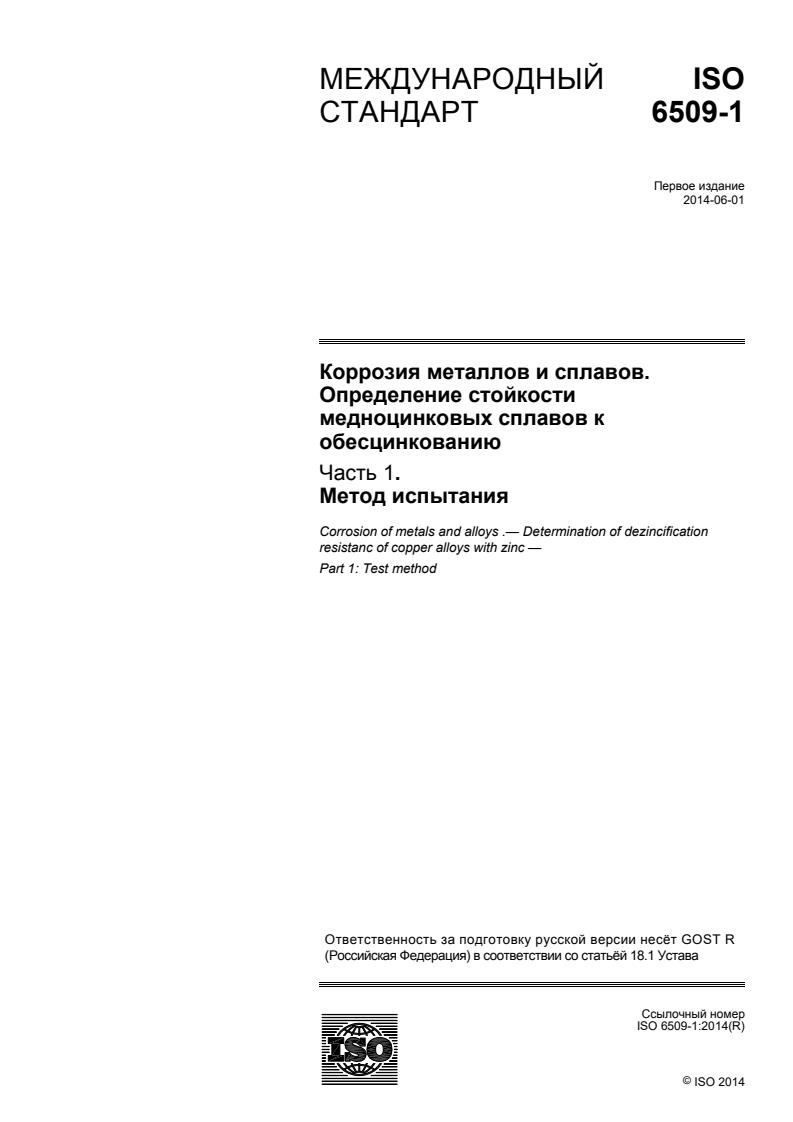
INTERNATIONAL ISO
STANDARD 6509-1
First edition
2014-06-01
Corrosion of metals and alloys —
Determination of dezincification
resistance of copper alloys with
zinc —
Part 1:
Test method
Corrosion des métaux et alliages — Détermination de la résistance à
la dézincification des alliages de cuivre avec le zinc —
Partie 1: Méthode d’essai
Reference number
©
ISO 2014
© ISO 2014
All rights reserved. Unless otherwise specified, no part of this publication may be reproduced or utilized otherwise in any form
or by any means, electronic or mechanical, including photocopying, or posting on the internet or an intranet, without prior
written permission. Permission can be requested from either ISO at the address below or ISO’s member body in the country of
the requester.
ISO copyright office
Case postale 56 • CH-1211 Geneva 20
Tel. + 41 22 749 01 11
Fax + 41 22 749 09 47
E-mail copyright@iso.org
Web www.iso.org
Published in Switzerland
ii © ISO 2014 – All rights reserved
Contents Page
Foreword .iv
1 Scope . 1
2 Normative references . 1
3 Terms and definitions . 1
4 Principle . 1
5 Reagents and materials . 1
6 Apparatus . 2
7 Test specimens. 2
8 Preparation of test specimens . 3
9 Procedure. 4
9.1 Positioning of test specimens for test . 4
9.2 Operating conditions . 4
9.3 Duration of test . 4
9.4 Preparation of sections for microscopic examination . 4
9.5 Microscopic examination . 4
10 Test report . 6
Bibliography . 7
Foreword
ISO (the International Organization for Standardization) is a worldwide federation of national standards
bodies (ISO member bodies). The work of preparing International Standards is normally carried out
through ISO technical committees. Each member body interested in a subject for which a technical
committee has been established has the right to be represented on that committee. International
organizations, governmental and non-governmental, in liaison with ISO, also take part in the work.
ISO collaborates closely with the International Electrotechnical Commission (IEC) on all matters of
electrotechnical standardization.
The procedures used to develop this document and those intended for its further maintenance are
described in the ISO/IEC Directives, Part 1. In particular the different approval criteria needed for the
different types of ISO documents should be noted. This document was drafted in accordance with the
editorial rules of the ISO/IEC Directives, Part 2. www.iso.org/directives
Attention is drawn to the possibility that some of the elements of this document may be the subject of
patent rights. ISO shall not be held responsible for identifying any or all such patent rights. Details of any
patent rights identified during the development of the document will be in the Introduction and/or on
the ISO list of patent declarations received. www.iso.org/patents
Any trade name used in this document is information given for the convenience of users and does not
constitute an endorsement.
For an explanation on the meaning of ISO specific terms and expressions related to conformity
assessment, as well as information about ISO’s adherence to the WTO principles in the Technical Barriers
to Trade (TBT), see the following URL: Foreword - Supplementary information
The committee responsible for this document is ISO/TC 156, Corrosion of metals and alloys.
This first edition of ISO 6509-1, together with ISO 6509-2, cancels and replaces ISO 6509:1981, which
has been technically revised. The clause formerly concerning acceptance limits has been removed since
it has been taken up in the new Part 2.
ISO 6509 consists of the following parts, under the general title Corrosion of metals and alloys —
Determination of dezincification resistance of copper alloys with zinc:
1)
— Part 2: Acceptance criteria
1) In preparation.
iv © ISO 2014 – All rights reserved
INTERNATIONAL STANDARD ISO 6509-1:2014(E)
Corrosion of metals and alloys — Determination of
dezincification resistance of copper alloys with zinc —
Part 1:
Test method
1 Scope
This part of ISO 6509 specifies a method for the determination of dezincification depth of copper alloys
with zinc exposed to fresh, saline waters or drinking water. The method is intended for copper alloys
with a mass fraction of zinc more than 15 %.
This part of ISO 6509 describes only the test methodology and does not set out criteria for acceptability
of materials for a specific application. Acceptance criteria are described in ISO 6509-2.
NOTE The method may be used outside its scope for control or research purposes.
2 Normative references
The following documents, in whole or in part, are normatively referenced in this document and are
indispensable for its application. For dated references, only the edition cited applies. For undated
references, the latest edition of the referenced document (including any amendments) applies.
ISO 8044, Corrosion of metals and alloys — Basic terms and definitions
3 Terms and definitions
For the purposes of this document the terms and definitions given in ISO 8044 apply.
4 Principle
Exposure of test specimens to copper (ll) chloride solution followed by microscopic examination.
5 Reagents and materials
5.1 Copper (ll) chloride, mass fraction 1 % solution, freshly prepared.
Dissolve 12,7 g of copper(II) chloride dihydrate (CuCl ·2H 0) in deionized water (5.2) and make up the
2 2
volume to 1 000 ml.
5.2 Water, deionized with a conductivity not higher than 20 µS/cm at 25 °C ± 2 °C.
5.3 Non-conducting mounting material, such as phenolic resin for embedding the test specimens.
5.4 Appropriate solvent, for cleaning the test specimens.
6 Apparatus
6.1 Beaker of glass, covered with suitable plastic foil,
...
NORME ISO
INTERNATIONALE 6509-1
Première édition
2014-06-01
Corrosion des métaux et alliages —
Détermination de la résistance à la
dézincification des alliages de cuivre
avec le zinc —
Partie 1:
Méthode d’essai
Corrosion of metals and alloys — Determination of dezincification
resistance of copper alloys with zinc —
Part 1: Test method
Numéro de référence
©
ISO 2014
DOCUMENT PROTÉGÉ PAR COPYRIGHT
© ISO 2014
Droits de reproduction réservés. Sauf indication contraire, aucune partie de cette publication ne peut être reproduite ni utilisée
sous quelque forme que ce soit et par aucun procédé, électronique ou mécanique, y compris la photocopie, l’affichage sur
l’internet ou sur un Intranet, sans autorisation écrite préalable. Les demandes d’autorisation peuvent être adressées à l’ISO à
l’adresse ci-après ou au comité membre de l’ISO dans le pays du demandeur.
ISO copyright office
Case postale 56 • CH-1211 Geneva 20
Tel. + 41 22 749 01 11
Fax + 41 22 749 09 47
E-mail copyright@iso.org
Web www.iso.org
Publié en Suisse
ii © ISO 2014 – Tous droits réservés
Sommaire Page
Avant-propos .iv
1 Domaine d’application . 1
2 Références normatives . 1
3 Termes et définitions . 1
4 Principe . 1
5 Réactifs et produits . 1
6 Appareillage . 2
7 Éprouvettes . 2
8 Préparation des éprouvettes . 3
9 Mode opératoire. 4
9.1 Positionnement des éprouvettes pour l’essai . 4
9.2 Conditions opératoires . 4
9.3 Durée de l’essai . 4
9.4 Préparation des coupes pour l’examen microscopique . 4
9.5 Examen microscopique . 4
10 Rapport d’essai . 6
Bibliographie . 7
Avant-propos
L’ISO (Organisation internationale de normalisation) est une fédération mondiale d’organismes
nationaux de normalisation (comités membres de l’ISO). L’élaboration des Normes internationales est
en général confiée aux comités techniques de l’ISO. Chaque comité membre intéressé par une étude
a le droit de faire partie du comité technique créé à cet effet. Les organisations internationales,
gouvernementales et non gouvernementales, en liaison avec l’ISO participent également aux travaux.
L’ISO collabore étroitement avec la Commission électrotechnique internationale (IEC) en ce qui concerne
la normalisation électrotechnique.
Les procédures utilisées pour élaborer le présent document et celles destinées à sa mise à jour sont
décrites dans les Directives ISO/IEC, Partie 1. Il convient, en particulier de prendre note des différents
critères d’approbation requis pour les différents types de documents ISO. Le présent document a été
rédigé conformément aux règles de rédaction données dans les Directives ISO/IEC, Partie 2 (voir www.
iso.org/directives).
L’attention est appelée sur le fait que certains des éléments du présent document peuvent faire l’objet de
droits de propriété intellectuelle ou de droits analogues. L’ISO ne saurait être tenue pour responsable
de ne pas avoir identifié de tels droits de propriété et averti de leur existence. Les détails concernant les
références aux droits de propriété intellectuelle ou autres droits analogues identifiés lors de l’élaboration
du document sont indiqués dans l’Introduction et/ou dans la liste des déclarations de brevets reçues par
l’ISO (voir www.iso.org/brevets).
Les appellations commerciales éventuellement mentionnées dans le présent document sont données
pour information, par souci de commodité, à l’intention des utilisateurs et ne sauraient constituer un
engagement.
Pour une explication de la signification des termes et expressions spécifiques de l’ISO liés à l’évaluation de
la conformité, ou pour toute information au sujet de l’adhésion de l’ISO aux principes de l’OMC concernant
les obstacles techniques au commerce (OTC), voir le lien suivant: Avant-propos — Informations
supplémentaires.
Le comité chargé de l’élaboration du présent document est l’ISO/TC 156, Corrosion des métaux et alliages.
Cette première édition de l’ISO 6509-1, conjointement avec l’ISO 6509-2, annule et remplace
l’ISO 6509:1981, qui a fait l’objet d’une révision technique. En raison de sa reprise dans la nouvelle
Partie 2, l’ancien article concernant les limites de réception a été retiré.
L’ISO 6509 comprend les parties suivantes, présentées sous le titre général Corrosion des métaux et
alliages — Détermination de la résistance à la dézincification des alliages de cuivre avec le zinc:
1)
— Partie 2: Critères d’acceptation
1) En préparation.
iv © ISO 2014 – Tous droits réservés
NORME INTERNATIONALE ISO 6509-1:2014(F)
Corrosion des métaux et alliages — Détermination de la
résistance à la dézincification des alliages de cuivre avec le
zinc —
Partie 1:
Méthode d’essai
1 Domaine d’application
La présente partie de l’ISO 6509 spécifie une méthode permettant de déterminer la profondeur de
dézincification du cuivre allié avec le zinc, exposé aux eaux douces ou salées, ou à l’eau potable. Cette
méthode est applicable aux alliages de cuivre ayant une fraction massique en zinc supérieure à 15 %.
La présente partie de l’ISO 6509 décrit uniquement la méthodologie d’essai et n’indique pas les critères
d’acceptabilité des matériaux dans le cadre d’une application spécifique. Les critères d’acceptation sont
décrits dans l’ISO 6509-2.
NOTE La méthode peut être utilisée en dehors de son domaine d’application, à des fins de contrôle ou de
recherche.
2 Références normatives
Les documents de référence suivants sont indispensables pour l’application du présent document. Pour
les références datées, seule l’édition citée s’applique. Pour les références non datées, la dernière édition
du document de référence s’applique (y compris les éventuels amendements).
ISO 8044, Corrosion des métaux et alliages — Termes principaux et définitions
3 Termes et définitions
Pour les besoins du présent document, les termes et définitions donnés dans l’ISO 8044 s’appliquent.
4 Principe
Exposition d’éprouvettes à une solution de chlorure de cuivre (II), suivie d’un examen microscopique.
5 Réactifs et produits
5.1 Solution de chlorure de cuivre (ll), ayant une fraction massique de 1 %, fraîchement préparée.
Dissoudre 12,7 g de chlorure de cuivre (II) dihydraté (CuCl , 2H 0) dans de l’eau désionisée (5.2) et
2 2
compléter au volume à 1 000 ml.
5.2 Eau, désionisée, ayant une conductivité inférieure ou égale à 20 µS/cm à 25 °C ± 2 °C.
5.3 Matériau de montage non conducteur, tel qu’une résine phénolique, pour enrober les éprouvettes.
5.4 Solvant approprié, pour le nettoyage des éprouvettes.
6 Appareillage
6.1 Bécher en verre, recouvert d’une feuille de plastique appropriée, par exemple
...
МЕЖДУНАРОДНЫЙ ISO
СТАНДАРТ 6509-1
Первое издание
2014-06-01
Коррозия металлов и сплавов.
Определение стойкости
медноцинковых сплавов к
обесцинкованию
Часть 1.
Метод испытания
Corrosion of metals and alloys .— Determination of dezincification
resistanc of copper alloys with zinc —
Part 1: Test method
Ответственность за подготовку русской версии несёт GOST R
(Российская Федерация) в соответствии со статьёй 18.1 Устава
Ссылочный номер
©
ISO 2014
ДОКУМЕНТ ЗАЩИЩЕН АВТОРСКИМ ПРАВОМ
© ISO 2014
Все права сохраняются. Если не указано иное, никакую часть настоящей публикации нельзя копировать или использовать в
какой-либо форме или каким-либо электронным или механическим способом, включая фотокопии или отправкой по интернету
или внутри сети, без предварительного письменного согласия. Разрешение может быть получено от ISO по адресу,
приведенному ниже, или от комитета-члена ISO в стране запрашивающей стороны.
ISO copyright office
Case postale 56 CH-1211 Geneva 20
Tel. + 41 22 749 01 11
Fax + 41 22 749 09 47
E-mail copyright@iso.org
Web www.iso.org
Опубликовано в Швейцарии
ii © ISO 2014 Все права сохраняются
Содержание Страница
Предисловие .3
1 Область применения .1
2 Нормативные ссылки .1
3 Термины и определения .1
4 Принцип .1
5 Реактивы и материалы .1
6 Аппаратура .2
7 Испытательные образцы .2
8 Приготовление испытательных образцов .3
9 Процедура .4
9.1 Расположение образцов при испытании .4
9.2 Рабочие условия .4
9.3 Продолжительность испытания .4
9.4 Приготовление срезов для микроскопического анализа .4
9.5 Микроскопический анализ .4
10 Протокол испытания .6
Библиография .7
Предисловие
Международная организация по стандартизации (ISO) является всемирной федерацией национальных
организаций по стандартизации (комитетов-членов ISO). Разработка международных стандартов
обычно осуществляется техническими комитетами ISO. Каждый комитет-член, заинтересованный в
деятельности, для которой был создан технический комитет, имеет право быть представленным в
этом комитете. Международные правительственные и неправительственные организации, имеющие
связи с ISO, также принимают участие в работах. ISO работает в тесном сотрудничестве с
Международной электротехнической комиссией (IEC) по всем вопросам стандартизации в области
электротехники.
Методики, использованные для разработки данного документа и те, которые предназначены для их
дальнейшего сохранения, описаны в Части 1 Директив ISO/IEC. Особенно следует указывать
различные критерии утверждения, необходимые для разных типов документов ISO. Данный документ
составлен в соответствии с редакторскими правилами Части 2 Директив ISO/IEC
(www.iso.org/directives).
Следует иметь в виду, что некоторые элементы этого документа могут быть объектом патентных прав.
Организация ISO не должна нести ответственность за идентификацию какого-либо одного или всех
патентных прав. Детали любого патентного права, идентифицированного при разработке документа
должны находиться во Введении и/или в перечне полученных патентных заявок ISO.
(www.iso.org/patents)
Любое фирменное наименование, используемое в этом документе является информацией для
удобства пользователей и не является одобрением.
О толковании значения специфических терминов ISO и выражений, относящихся к оценке
соответствия, а также информации о строгом соблюдении ISO принципов ВТО в отношении
Технических барьеров в торговле (TBT) см. следующую URL: Предисловие. Дополнительная
информация
Техническим Комитетом, ответственным за данный документ, является ISO/TC 156, Коррозия
металлов и сплавов.
Настоящее первое издание ISO 6509-1 вместе с ISO 6509-2 отменяет и заменяет ISO 6509:1981,
которое было технически пересмотрено. Раздел ранее относящийся к пределам приемки удален,
поскольку он вошел в новую Часть 2.
ISO 6509 состоит из следующих частей под общим заголовком: Коррозия металлов и сплавов.
Определение стойкости медноцинковых сплавов к обесцинкованию:
)
— Часть 2. Критерии приемки
)
В стадии подготовки
iv © ISO 2014 – Все права сохраняются
МЕЖДУНАРОДНЫЙ СТАНДАРТ ISO 6509-1:2014(R)
Коррозия металлов и сплавов. Определение стойкости
медноцинковых сплавов к обесцинкованию
Часть 1.
Метод испытания
1 Область применения
Данная часть ISO 6509 устанавливает метод определения глубины обесцинкования медноцинковых
сплавов, подвергаемых воздействию чистых, минерализованных вод или питьевой воды. Метод
предназначен для медных сплавов с массовой долей цинка более 15 %.
Данная часть ISO 6509 описывает только методологию испытания и не устанавливает критерии
приемки материала для целевого назначения. Критерии приемки описаны в ISO 6509-2.
ПРИМЕЧАНИЕ Метод может также использоваться для контрольных и исследовательских целей.
2 Нормативные ссылки
Следующие ссылочные нормативные документы являются обязательными для применения
настоящего документа. Для жестких ссылок применяется только цитируемое издание документа. Для
плавающих ссылок необходимо использовать самое последнее издание нормативного ссылочного
документа (включая любые изменения).
ISO 8044, Коррозия металлов и сплавов. Общие термины и определения
3 Термины и определения
Термины и определения для данного документа приведены в ISO 8044.
4 Принцип
Испытательные образцы подвергаются воздействию раствора хлорида меди (II), а затем
микроскопическому исследованию.
5 Реактивы и материалы
5.1 Хлорид меди (ll), свежеприготовленный 1 %-ный раствор по массовой фракции.
Растворяют12,7 г дигидрата хлорида меди (II) (CuCl ·2H 0) в деионизированной воде (5.2) доводят
2 2
объем до 1 000 мл.
5.2 Вода, деионизированная с удельной проводимостью не выше 20 мкСм/см при 25 °C ± 2 °C.
5.3 Непроводящий установочный материал, такой как феноло-альдегидный полимер для
вставления испытательных образцов.
5.4 Соответствующий растворитель, для очистки испытательных образцов.
6 Аппаратура
6.1 Стеклянный химический стакан, покрытый подходящей полимерной пленкой, например
полиэтиленовой, которая закрепляется упругой нитью или другим методом герметизации с
применением неметаллического материала.
6.2 Прибор термостатического контроля, имеющий возможность поддерживать температуру при
75 °C ± 5 °C. На рисунке 1 приведен пример метода нагревания испытательного раствора.
6.3 Oоптический микроскоп, оснащенный шкалой для измерения.
Обозначения
1 нагревательное устройство
2 водяная или масляная ванна
3 пластмассовая пленка закрепленная эластичной нитью
4 химический стакан, содержащий раствор хло
...