

ISO/DTS 6671
(Main)Ductile iron pipes, fittings, accessories and their joints for hot water applications — Requirements and test methods
- Abstract
This document specifies the requirements and test methods applicable to Thermal preinsulated ductile iron pipes, fittings, accessories and their joints for the construction of pipelines : — to convey hot water up to 130℃; — to be operated with pressure up to 25Bar; — to be installed below or above ground; — to limit temperature variations of the conveyed fluids. This document specifies materials, dimensions and tolerances, mechanical properties, standard coatings, thermal properties of the thermal insulation layer and external casing of preinsulated ductile iron pipes, fittings and accessories. It also gives performance requirements for all components including joints and gaskets. This document covers preinsulated ductile iron pipes, fittings and accessories of a size range extending from DN 100 to DN 1600 inclusive, which are — manufactured with socket, flanged or spigot ends, — preinsulated in the works, and — normally delivered internally and externally coated.
- Status
- Not Published
- Technical Committee
- ISO/TC 5/SC 2 - Cast iron pipes, fittings and their joints
- Drafting Committee
- ISO/TC 5/SC 2/WG 28 - Hot water applications
- Current Stage
- 5020 - Proof sent to secretariat or FDIS ballot initiated: 8 weeks - 50 Approval
- Start Date
- 16-Oct-2026
- Due Date
- 16-Oct-2026
- Completion Date
- 16-Oct-2026
Buy Documents


ISO/DTS 6671 - Ductile iron pipes, fittings, accessories and their joints for hot water applications — Requirements and test methods

REDLINE ISO/DTS 6671 - Ductile iron pipes, fittings, accessories and their joints for hot water applications — Requirements and test methods
ISO/DTS 6671 is an ISO technical specification for ductile iron pipes, fittings, accessories and their joints for hot water applications. It sets requirements and test methods for factory-produced, preinsulated components used in hot-water pipelines, so manufacturers, purchasers, designers and test laboratories can specify, check and qualify the system.
What does ISO/DTS 6671 specify?
ISO/DTS 6671 specifies requirements and test methods for thermal preinsulated ductile iron pipes, fittings, accessories and their joints used in hot-water pipeline construction. It covers service for hot water up to 130 °C, operation with or without pressure, installation below or above ground, and measures intended to limit temperature variation of the conveyed water.
The document applies to factory-preinsulated products with socket, flanged or spigot ends, normally delivered with internal and external coating. It organizes the subject into scope, normative references, terms and definitions, technical requirements, cyclic type test methods, and two normative annexes.
| Annex | What it covers |
|---|---|
| Annex A | Gasket for hot water - material classes, physical-property requirements, ageing, ozone resistance, tear strength, life-time estimation, and test piece preparation |
| Annex B | Measurement of adhesion of the thermal insulation layer on the ductile iron pipe - specimen preparation, test procedure, calculation, and ageing-related checks |
What are the key requirements of ISO/DTS 6671?
Temperature classes and system use
ISO/DTS 6671 classifies products by the allowable operating temperature of the conveyed water using the T class system. The document uses T80, T110 and T130, and a product qualified for a higher class is treated as suitable for any lower class under the same operating conditions.
In practice, this means the supplier has to state the temperature rating clearly and the buyer has to match the class to the intended service, such as district and industrial cooling, hot water supply, or heating. The document also notes that all pressures are relative pressures in bar.
Pipes, fittings, coatings and joints
ISO/DTS 6671 builds on the basic requirements in ISO 2531 or ISO 7186, then adds temperature-related limitations for pipe and fitting use. External coatings must withstand the temperature class of the pipeline, and zinc-based protection for spigots and sockets is permitted when it follows ISO 8179-1 or ISO 8179-2.
The document also addresses internal lining. In open-loop systems, the lining has to suit the characteristics of the hot water, while closed-loop systems may use lined or unlined products by agreement between manufacturer and purchaser. For unlined closed-loop pipes, the internal surface roughness may need to be declared.
Flexible joints and restrained joints are treated separately. Flexible joints must be type tested with the cyclic reciprocating movement test in 5.1, while restrained joints must pass the cyclic internal hydraulic pressure test with hot water in 5.2. Both test programmes are carried out without preinsulation on the joint and look for leakage or failure during repeated cycling.
Preinsulation, casing and thermal insulation
ISO/DTS 6671 requires the preinsulation system to include a thermal insulation layer between the ductile iron conveying part and an external casing. Casings may be made of HDPE, PVC or steel, and the document sets property checks for these materials, including density and tensile-related properties.
The casing design matters because it protects the insulation against damage and moisture ingress. For above-ground use, HDPE and PVC casings need ultraviolet resistance, and above-ground load effects on HDPE casing and PU foam insulation must be assessed so the system does not deform or crush in service. For below-ground use, casing design must take soil granularity and backfill compaction into account.
The document also limits how far the casing may be offset from the pipe axis, and it requires the internal surfaces to be dry and clean before insulation is applied. For fittings, preformed casings are used and the welded casing joints must remain watertight after insulation.
Thermal insulation layer and adhesion
ISO/DTS 6671 allows different thermal insulation materials by agreement, but it gives specific requirements for rigid polyurethane (PU) foam. The foam has to have a closed-cell structure and meet property limits for density, compressive strength and thermal conductivity.
Adhesion between the PU foam and the ductile iron pipe is a key performance point. Annex B gives the test method, and the measured adhesion has to meet the temperature-dependent minimum values in the document in both unaged and aged conditions. In practice, this check helps confirm that the insulation stays bonded during long-term hot-water service.
End pieces and marking
The document requires the ends of the insulation and the casing to be tied together after assembly so thermal continuity and casing watertightness are maintained. It gives examples such as a flexible foam ring, a rubber sleeve or a heat-shrink polyethylene sleeve.
Marking is also mandatory. Pipes and fittings must be durably and legibly marked with the document reference, manufacturer identification, year of conveying pipe manufacture, ductile iron identification, DN, PN if applicable, C pressure class, T rating and casing diameter DR. Some additional marking items may be agreed between manufacturer and purchaser.
What terms does ISO/DTS 6671 define?
- Conveying pipe - the ductile iron pipe itself, excluding the insulation layer.
- Conveying fitting - the ductile iron fitting itself, excluding the insulation layer.
- Preinsulated pipe - a factory-made ductile iron pipe with conveying pipe, external thermal insulation and casing.
- Preinsulated fitting - a factory-made ductile iron fitting with conveying fitting, external thermal insulation and casing.
- Casing - the outer protective layer around the insulation, made from PE, PVC or steel.
- Thermal insulation - the layer between the conveying part and the casing that reduces heat transfer.
- DR - the external casing diameter adjacent to the spigot end.
- T class - the allowable operating temperature class of the product.
Who uses ISO/DTS 6671?
ISO/DTS 6671 is used by manufacturers of ductile iron pipes, fittings and accessories, because it defines the product characteristics and type tests they have to meet. It is also used by designers and specifiers of hot-water pipelines, including district heating, industrial cooling, geothermal hot water and heating systems, because it links product class to service temperature and installation conditions.
Purchasers and quality managers use it to compare offers and set acceptance criteria, while laboratories use it for cyclic testing, adhesion testing and gasket evaluation. Installers and project engineers use it when the pipeline will be laid above ground or below ground and when the insulation, casing and joint behaviour all need to be coordinated.
Which standards are used with ISO/DTS 6671?
| Standard | What it contributes |
|---|---|
| ISO 2531 | Base requirements for ductile iron pipes, fittings, accessories and joints for water applications |
| ISO 7186 | Base requirements for ductile iron products for sewerage applications, used where referenced for dimensions, joints and material characteristics |
| ISO 10804 | Design rules and type testing for restrained joint systems |
| ISO 8179-1 | External zinc-based coating with metallic zinc and finishing layer |
| ISO 8179-2 | External zinc-based coating with zinc-rich paint |
| ISO 9631:2018 | Material specification for joint rings for hot-water supply up to 110 °C and guidance for QA testing |
| ISO 9001 | Quality management system framework recommended for production control |
| ISO 34-2 | Tear strength test for rubber materials |
| ISO 37 | Tensile stress-strain properties of rubber |
| ISO 48-2 | Hardness of rubber, including micro-test method |
| ISO 188 / ISO 188:2023 | Accelerated ageing and heat resistance tests for rubber |
| ISO 527-2 | Tensile properties of plastics |
| ISO 815-1 / ISO 815-1:2019 | Compression set of rubber at ambient or elevated temperatures |
| ISO 844 | Compression properties of rigid cellular plastics |
| ISO 845 | Apparent density of cellular plastics and rubbers |
| ISO 1183-3 | Density of non-cellular plastics |
| ISO 1431-1 | Ozone cracking resistance of rubber |
| ISO 1629 | Rubber and latex nomenclature |
| ISO 1817 | Effect of liquids on rubber |
| ISO 2285:2019 | Tension set, elongation and creep under constant tensile load |
| ISO 3302-1 | Dimensional tolerances for rubber products |
| ISO 3384-1:2024 / ISO 3384-1 | Stress relaxation in compression |
| ISO 6892-1 | Tensile testing of metallic materials |
| ISO 6914:2021 / ISO 6914 | Stress relaxation in tension |
| ISO 7743 | Compression stress-strain properties of rubber |
| ISO 8497 | Steady-state thermal transmission of thermal insulation for circular pipes |
| ISO 11346 | Estimation of lifetime and maximum temperature of use |
| ISO 12162:2009 | Classification and design coefficient for thermoplastics materials |
| ISO 23529 | Preparation and conditioning of rubber test pieces |
What does the ISO/DTS 6671 document contain?
ISO/DTS 6671 contains technical tables for material properties, dimensional limits, eccentricity of insulation and acceptance criteria for gasket materials. It also contains a thermal resistance formula, an adhesion-strength formula and figures showing the structure of a preinsulated pipe, end-face protection of the insulation layer, and the cyclic reciprocating movement test.
The document gives two detailed cyclic test methods for joints and one adhesion test method for the insulation layer. Annex A adds gasket qualification requirements, including hardness, tensile properties, compression set, ageing in hot water, stress relaxation, volume change, ozone resistance, tear strength and lifetime estimation.
Annex B sets out how to prepare pipe samples and how to calculate adhesion strength from the measured axial force. Together, these parts support product design, type testing, production control and technical acceptance of hot-water pipeline components.
Buy Documents
ISO/DTS 6671 - Ductile iron pipes, fittings, accessories and their joints for hot water applications — Requirements and test methods
REDLINE ISO/DTS 6671 - Ductile iron pipes, fittings, accessories and their joints for hot water applications — Requirements and test methods
Get Certified
Connect with accredited certification bodies for this standard

DIBt (Deutsches Institut für Bautechnik)
German Institute for Building Technology.

DIN CERTCO
DIN Group product certification.

Aboma Certification B.V.
Specialized in construction, metal, and transport sectors.
Sponsored listings
Frequently Asked Questions
ISO/DTS 6671 is a draft published by the International Organization for Standardization (ISO). Its full title is "Ductile iron pipes, fittings, accessories and their joints for hot water applications — Requirements and test methods". This standard covers: This document specifies the requirements and test methods applicable to Thermal preinsulated ductile iron pipes, fittings, accessories and their joints for the construction of pipelines : — to convey hot water up to 130℃; — to be operated with pressure up to 25Bar; — to be installed below or above ground; — to limit temperature variations of the conveyed fluids. This document specifies materials, dimensions and tolerances, mechanical properties, standard coatings, thermal properties of the thermal insulation layer and external casing of preinsulated ductile iron pipes, fittings and accessories. It also gives performance requirements for all components including joints and gaskets. This document covers preinsulated ductile iron pipes, fittings and accessories of a size range extending from DN 100 to DN 1600 inclusive, which are — manufactured with socket, flanged or spigot ends, — preinsulated in the works, and — normally delivered internally and externally coated.
This document specifies the requirements and test methods applicable to Thermal preinsulated ductile iron pipes, fittings, accessories and their joints for the construction of pipelines : — to convey hot water up to 130℃; — to be operated with pressure up to 25Bar; — to be installed below or above ground; — to limit temperature variations of the conveyed fluids. This document specifies materials, dimensions and tolerances, mechanical properties, standard coatings, thermal properties of the thermal insulation layer and external casing of preinsulated ductile iron pipes, fittings and accessories. It also gives performance requirements for all components including joints and gaskets. This document covers preinsulated ductile iron pipes, fittings and accessories of a size range extending from DN 100 to DN 1600 inclusive, which are — manufactured with socket, flanged or spigot ends, — preinsulated in the works, and — normally delivered internally and externally coated.
ISO/DTS 6671 is classified under the following ICS (International Classification for Standards) categories: 23.040.10 - Iron and steel pipes; 23.040.40 - Metal fittings; 91.140.65 - Water heating equipment. The ICS classification helps identify the subject area and facilitates finding related standards.
ISO/DTS 6671 is available in PDF format for immediate download after purchase. The document can be added to your cart and obtained through the secure checkout process. Digital delivery ensures instant access to the complete standard document.
Standards Content (Sample)
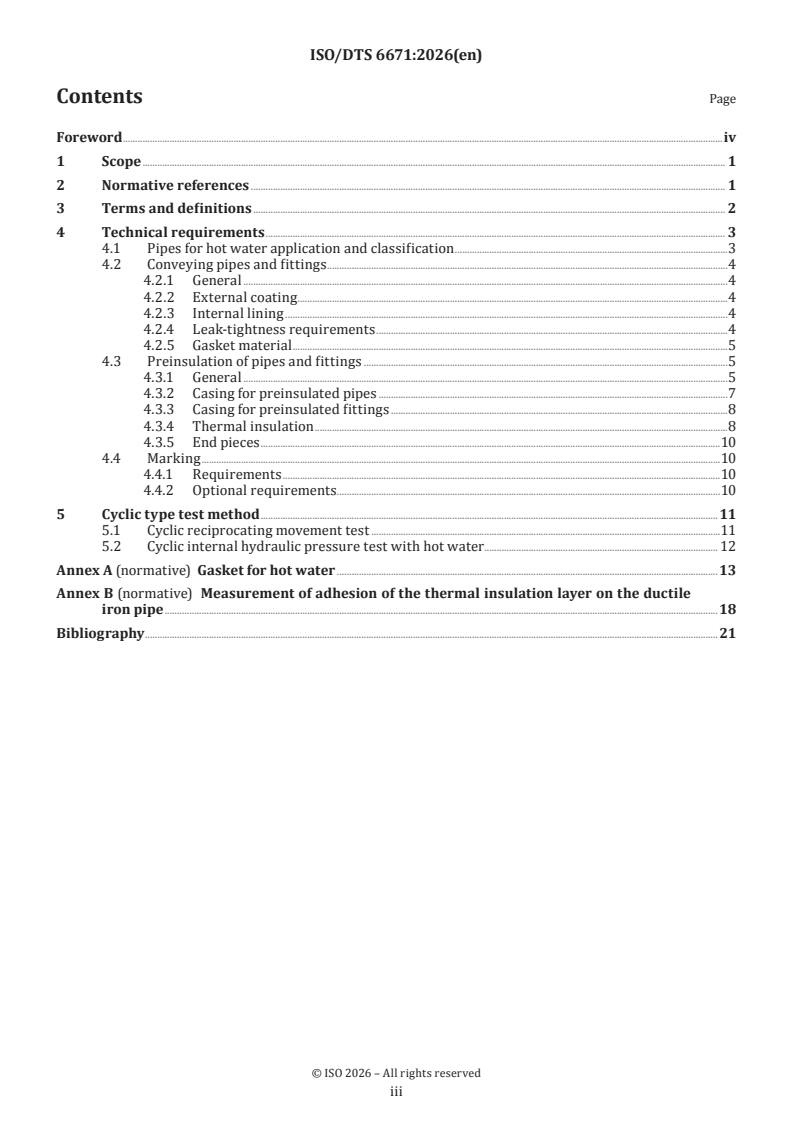
Contents
- 1 Scope
- 2 Normative references
- 3 Terms and definitions
- 3.1 conveying pipe
- 3.2 conveying fitting
- 3.3 preinsulated pipe
- 3.4 preinsulated fitting
- 3.5 casing
- 3.6 thermal insulation
- 3.7 external casing diameter
- 3.8 T class
- 4 Technical requirements
- 4.1 Pipes for hot water application and classification
- 4.2 Conveying pipes and fittings
- 4.3 Preinsulation of pipes and fittings
- 4.4 Marking
- 5 Cyclic type test method
- 5.1 Cyclic reciprocating movement test
- 5.2 Cyclic internal hydraulic pressure test with hot water
- Annex A
- Annex B
- Bibliography
1 Scope
This document specifies the requirements and test methods applicable to ductile iron pipes, fittings, accessories and their joints for the construction of pipelines:
a) to convey hot water in three range temperatures:
1) class T80 up to 80 °C for district and industrial cooling water application, 2) class T110 up to 110 °C for hot water application, 3) class T130 up to 130 °C for heating application; b) to be operated with or without pressure; c) to be installed below or above ground; d) to limit temperature variations of the conveyed water.
NOTE In this document, all pressures are relative pressures expressed in bars. This document specifies materials, dimensions and tolerances, mechanical properties, standard coatings, thermal properties of ductile iron pipes, fittings and accessories. It also gives performance requirements for all components including joints and gaskets.
This document is applicable to ductile iron pipes, fittings and accessories of a size range extending from DN 60 to DN 1600 inclusive, which are manufactured with socket, flanged or spigot ends.
2 Normative references
The following documents are referred to in the text in such a way that some or all of their content constitutes requirements of this document. For dated references, only the edition cited applies. For undated references, the latest edition of the referenced document (including any amendments) applies. ISO 34-2, Rubber, vulcanized or thermoplastic — Determination of tear strength — Part 2: Small (Delft) test pieces ISO 37, Rubber, vulcanized or thermoplastic — Determination of tensile stress-strain properties ISO 48-2, Rubber, vulcanized or thermoplastic — Determination of hardness — Part 2: Hardness between 10 IRHD and 100 IRHD ISO 188, Rubber, vulcanized or thermoplastic — Accelerated ageing and heat resistance tests ISO 188:2023, Rubber, vulcanized or thermoplastic — Accelerated ageing and heat resistance tests ISO 527-2, Plastics — Determination of tensile properties — Part 2: Test conditions for moulding and extrusion plastics ISO 815-1:2019, Rubber, vulcanized or thermoplastic — Determination of compression set — Part 1: At ambient or elevated temperatures
ISO/DTS 6671:2026(en) ISO 815-1, Rubber, vulcanized or thermoplastic — Determination of compression set — Part 1: At ambient or elevated temperatures ISO 1183-3, Plastics — Methods for determining the density of non-cellular plastics — Part 3: Gas pyknometer method ISO 1431-1, Rubber, vulcanized or thermoplastic — Resistance to ozone cracking — Part 1: Static and dynamic strain testing ISO 1629, Rubber and latices — Nomenclature ISO 1817, Rubber, vulcanized or thermoplastic — Determination of the effect of liquids ISO 2531, Ductile iron pipes, fittings, accessories and their joints for water applications ISO 3302-1, Rubber — Tolerances for products — Part 1: Dimensional tolerances ISO 3384-1:2024, Rubber, vulcanized or thermoplastic — Determination of stress relaxation in compression — Part 1: Testing at constant temperature ISO 3384-1, Rubber, vulcanized or thermoplastic — Determination of stress relaxation in compression — Part 1:
Testing at constant temperature ISO 6892-1, Metallic materials — Tensile testing — Part 1: Method of test at room temperature ISO 6914, Rubber, vulcanized or thermoplastic — Determination of ageing characteristics by measurement of stress relaxation in tension ISO 7186, Ductile iron products for sewerage applications ISO 9631:2018, Rubber seals — Joint rings for pipelines for hot-water supply up to 110 °C — Specification for the material ISO 9691, Rubber — Recommendations for the workmanship of pipe joint rings — Description and classification of imperfections ISO 9691:1992, Rubber — Recommendations for the workmanship of pipe joint rings — Description and classification of imperfections ISO 10804, Restrained joint systems for ductile iron pipelines — Design rules and type testing ISO 11346, Rubber, vulcanized or thermoplastic — Estimation of life-time and maximum temperature of use ISO 23529, Rubber — General procedures for preparing and conditioning test pieces for physical test methods
3 Terms and definitions
For the purposes of this document, the terms and definitions given in ISO 1629, ISO 2531 and the following apply.
ISO and IEC maintain terminology databases for use in standardization at the following addresses:
- ISO Online browsing platform: available at https:// www .iso .org/ obp
- IEC Electropedia: available at https:// www .electropedia .org/
3.1 conveying pipe
ductile iron pipe excluding the insulation layer
3.2 conveying fitting
ductile iron fitting excluding the insulation layer
ISO/DTS 6671:2026(en)
3.3 preinsulated pipe
factory-produced ductile iron pipe comprising a conveying pipe (3.1) , external thermal insulation (3.6) and casing (3.5)
3.4 preinsulated fitting
factory-produced ductile iron fitting comprising a conveying fitting (3.2), external thermal insulation (3.6) and casing (3.5)
3.5 casing
external protection of the thermal insulation (3.6) layer made from polyethylene (PE), polyvinyl chloride (PVC) or steel, in tubular or other suitable shape
3.6 thermal insulation
layer between the conveying pipe (3.1) or conveying fitting (3.2) and casing (3.5), intended to reduce heat transfer between the water in the conveying pipe (3.1) and the external environment
3.7 external casing diameter
outer contour diameter of the casing (3.5) adjacent to the conveying pipe (3.1) spigot
3.8 T class
allowable operating temperature that the products can withstand Note 1 to entry: T class is expressed in Celsius.
4 Technical requirements
4.1 Pipes for hot water application and classification
Pipes, fittings and their accessories for hot water application are designed for use in three types of systems:
cooling district and industrial water up to 80 °C, transporting geothermal hot water up to 110 °C, supplying hot water up to 130 °C.
A preinsulated pipe (or fitting) is generally manufactured by using a conveying pipe (or fitting) on which an external thermal protection to limit temperature variation of the conveyed water is applied in the plant. Such pipes may be supplied with or without an internal lining, depending on whether the system operates as a closed-loop or an open-loop system.
Socketed joints allow axial sliding or longitudinal movement resulting from pipe length variations caused by temperature changes. A specific cyclic type test is specified in Clause 5. All components shall be classified by the allowable operating temperature (Celsius) of the conveyed water, prefixed by the letter T as follows:
- Class T80: up to 80 °C;
- Class T110: up to 110 °C;
- Class T130: up to 130 °C.
A product classified in a given T class is implicitly considered qualified for any lower class under the same operating conditions.
ISO/DTS 6671:2026(en)
4.2 Conveying pipes and fittings
4.2.1 General
The technical requirements of pipes and fittings shall conform to ISO 2531 or ISO 7186, including dimensional requirements and material characteristics, type of joints (flexible and flanged joints), pressure classification, surface condition and repairs.
Additional specifications and limitations are given in 4.2 to take into account the effect of the temperature of the water.
The standard nominal sizes (DN) of pipes and fittings are the following: 60, 80, 100, 125, 150, 200, 250, 300, 350, 400, 450, 500, 600, 700, 800, 900, 1000, 1100, 1200, 1400, 1500, 1600.
4.2.2 External coating
External coating of the conveying pipes and fittings shall be resistant to the temperature the pipeline system is designed for, according to its temperature class (T80, T110 or T130). When a thermal insulation solution is chosen in order to limit temperature variation of the conveyed water, preinsulation of pipes and fittings shall meet the requirements of 4.3. Pipe spigots and sockets can be protected by the application of a zinc-based coating (conforming to [1] [2] ISO 8179-1 or ISO 8179-2 ) either without a finishing layer or with any other suitable layer. It is the responsibility of the pipe manufacturer to assess, by appropriate means, that the protection is suitable for the relevant temperature class and conforms to the requirements of the cyclic reciprocating movement type test specified in 5.1.
4.2.3 Internal lining
Pipes and fittings can be delivered with or without lining.
In open-loop systems with internal lining, the lining shall be selected according to the characteristics of the conveyed hot water.
In closed-loop systems, pipes may be supplied either with or without internal lining, depending on the pipeline system design and heat exchange system, and subject to the agreement of the manufacturer and the purchaser.
For unlined pipes used in closed-loop systems, the internal barrel surface may be either machined or left ascast. Where machining is applied, the manufacturer shall declare the internal surface roughness (R ). z For hot water supply, an R value lower than 100 μm is recommended, which may be achieved, for example, z by grinding or shot blasting. Where the internal surface is left as-cast, the purchaser may request that the manufacturer provide an estimated roughness value.
4.2.4 Leak-tightness requirements
4.2.4.1 Pipes and fittings
Pipes and fittings shall be designed to be leak-tight at their allowable site test pressure. They shall be tested according to ISO 2531 or ISO 7186 and shall not exhibit any visible leakage, sweating or sign of failure.
4.2.4.2 Flexible joints
All flexible joints shall be designed and tested in accordance with ISO 2531 or ISO 7186. In addition, flexible joints shall be type tested according to the cyclic reciprocating movement test set out in 5.1. The joint shall be tested without preinsulation and exhibit no visible leakage after 100 cycles. More than 100 cycles may be agreed between the manufacturer and the purchaser.
ISO/DTS 6671:2026(en)
4.2.4.3 Restrained joints
All restrained joints shall be designed and tested in accordance with ISO 10804. In addition, restrained joints shall be type tested according the cyclic internal hydraulic pressure test of 5.2. The joint shall be tested without preinsulation and exhibit no visible leakage after 100 cycles. More than 100 cycles may be agreed between the manufacturer and the purchaser.
4.2.5 Gasket material
For hot water application, the material for gaskets shall meet the requirements of Annex A according to the class of temperature (T80, T110 or T130) they are designed for.
4.3 Preinsulation of pipes and fittings
4.3.1 General
A preinsulated pipe (or preinsulated fitting) is generally manufactured by using a thermal insulation layer between the conveying pipe (or conveying fitting) and a casing which provides external protection against mechanical damage and moisture ingress (see Figure 1).
ISO/DTS 6671:2026(en) a) b) c) Key 1 pipe 2 thermal insulation layer 3 casing D external casing diameter r L length of exposed spigot
L length of exposed socket
e minimum casing thickness
Figure 1 — Structure of preinsulated pipe
ISO/DTS 6671:2026(en)
4.3.2 Casing for preinsulated pipes
4.3.2.1 Material characteristics of casings
Casings are generally made of high density polyethylene (HDPE), PVC or steel. Their characteristics shall comply with the requirements of Table 1 and national standards in the country of use. The HDPE resin [3] should not be lower than class PE80, which is classified in ISO 12162:2009 . For above-ground application, HDPE and PVC casings shall be resistant to ultraviolet radiation. All steel casings shall be externally coated (e.g. galvanized).
For below-ground application, the casing design and selection shall take into account soil granularity and backfill compaction operations.
For aboveground applications, the effects of point loads imposed by supports on the HDPE casing and polyurethane (PU) foam insulation shall be verified by mechanical calculation in order to prevent indentation or crushing, particularly for large-diameter pipes.
Prior to applying thermal insulation, the internal surface of the casings shall be dry and clean. The variation in the external casing diameter (D ) during application of the thermal insulation shall not r exceed +2 %.
Table 1 — Casing materials and characteristics Casing Characteristics Specified value Test method
HDPE Density ≥ 940 kg/m ISO 1183-3 Yield stress ≥ 19 MPa ISO 527-2 Percentage elongation at fracture ≥ 350 % ISO 527-2
PVC Density ≥ 1 350 kg/m ISO 1183-3 Percentage elongation at fracture 50 % to 150 % ISO 527-2 Tensile strength ≥ 47 MPa ISO 527-2 Steel (pipe or spirally Tensile strength ≥ 320 MPa ISO 6892-1 wound) Percentage elongation at fracture ≥ 15 % ISO 6892-1 Other materials can be used upon agreement of the manufacturer and purchaser.
4.3.2.2 Eccentricity of the casing relative to the conveying pipe
The eccentricity of the insulation layer, defined as the distance between the ductile iron conveying pipe axis and the casing axis, shall not exceed the values given in Table 2. Table 2 — Maximum eccentricity of the insulation layer External casing diameter (D ) Maximum value of the eccentricity r D ≤ 170 3,0 r 170 ˂ D ≤ 410 4,5 r 410 ˂ D ≤ 630 6,0 r 630 ˂ D ≤ 800 8,0 r 800 ˂ D ≤ 1 400 10,0 r 1 400 ˂ D ≤ 1 900 14,0 r
ISO/DTS 6671:2026(en)
...
Contents
- 1 Scope
- 2 Normative references
- 3 Terms and definitions
- 3.1 conveying pipe
- 3.2 conveying fitting
- 3.3 preinsulated pipe
- 3.4 preinsulated fitting
- 3.5 casing
- 3.6 thermal insulation
- 3.7 casing external casing diameter
- 3.8 T class T
- 4 Technical requirements
- 4.1 Pipes for hot water applicationsapplication and classification
- 4.2 Conveying pipes and fittings
- 4.3 Preinsulation of pipes and fittings
- 4.4 Marking
- 5 Cyclic type test method
- 5.1 Cyclic reciprocating movement test
- 5.2 Cyclic internal hydraulic pressure test with hot water
- Annex A
- Annex B
- 1 Ductileductile iron pipe
- 2 Thermalthermal insulation layer
- 3 Casingcasing
- Bibliography
1 Scope
This document specifies the requirements and test methods applicable to ductile iron pipes, fittings, accessories and their joints for the construction of pipelines:
a) — to convey hot water in 3-three range temperaturetemperatures:
1) class T80 up to 80℃ °C for district and industrial cooling water application;, 2) class T110 up to 110℃ °C for hot water application;, 3) class T130 up to 130℃ °C for heating application.; b) — to be operated with or without pressure; c) — to be installed below or above ground; d) — to limit temperature variations of the conveyed water;.
NOTE In this document, all pressures are relative pressures expressed in bars. This document specifies materials, dimensions and tolerances, mechanical properties, standard coatings, thermal properties of ductile iron pipes, fittings and accessories for hot water supply.. It also gives performance requirements for all components including joints and gaskets. This document coversis applicable to ductile iron pipes, fittings and accessories of a size range extending from DN 60 to DN 1600 inclusive, which are manufactured with socket, flanged or spigot ends.
2 Normative references
The following documents are referred to in the text in such a way that some or all of their content constitutes requirements of this document. For dated references, only the edition cited applies. For undated references, the latest edition of the referenced document (including any amendments) applies. ISO 34-2, Rubber, vulcanized or thermoplastic — Determination of tear strength — Part 2: Small (Delft) test pieces ISO 37, Rubber, vulcanized or thermoplastic — Determination of tensile stress-strain properties ISO 48-2, Rubber, vulcanized or thermoplastic — Determination of hardness — Part 2: Hardness between 10 IRHD and 100 IRHD ISO 188, Rubber, vulcanized or thermoplastic — Accelerated ageing and heat resistance tests ISO 188:2023, Rubber, vulcanized or thermoplastic — Accelerated ageing and heat resistance tests ISO 527-2, Plastics — Determination of tensile properties — Part 2: Test conditions for moulding and extrusion plastics ISO 815-1:2019, Rubber, vulcanized or thermoplastic — Determination of compression set — Part 1: At ambient or elevated temperatures
ISO/CD TSDTS 6671:2026(en) ISO 815-1, Rubber, vulcanized or thermoplastic — Determination of compression set — Part 1: At ambient or elevated temperatures ISO 844, Rigid cellular plastics — Determination of compression properties ISO 845, Cellular plastics and rubbers — Determination of apparent density ISO 1183-3, Plastics — Methods for determining the density of non-cellular plastics — Part 3: Gas pyknometer method ISO 1431-1, Rubber, vulcanized or thermoplastic — Resistance to ozone cracking — Part 1: Static and dynamic strain testing ISO 1629, Rubber and latices — Nomenclature ISO 1817, Rubber, vulcanized or thermoplastic — Determination of the effect of liquids ISO 2285:2019, Rubber, vulcanized or thermoplastic — Determination of tension set under constant elongation, and of tension set, elongation and creep under constant tensile load ISO 2531, Ductile iron pipes, fittings, accessories and their joints for water applications ISO 3302-1, Rubber — Tolerances for products — Part 1: Dimensional tolerances ISO 3384-1:2024, Rubber, vulcanized or thermoplastic — Determination of stress relaxation in compression — Part 1: Testing at constant temperature ISO 3384-1, Rubber, vulcanized or thermoplastic — Determination of stress relaxation in compression — Part 1:
Testing at constant temperature ISO 6892-1, Metallic materials — Tensile testing — Part 1: Method of test at room temperature ISO 6914:2021, Rubber, vulcanized or thermoplastic — Determination of ageing characteristics by measurement of stress relaxation in tension ISO 6914, Rubber, vulcanized or thermoplastic — Determination of ageing characteristics by measurement of stress relaxation in tension ISO 7186, Ductile iron products for sewerage applications ISO 7743, Rubber, vulcanized or thermoplastic — Determination of compression stress-strain properties ISO 8179-1, Ductile iron pipes, fittings, accessories and their joints — External zinc-based coating — Part 1:
Metallic zinc with finishing layer ISO 8179-2, Ductile iron pipes, fittings, accessories and their joints — External zinc-based coating — Part 2: Zincrich paint ISO 8497, Thermal insulation — Determination of steady-state thermal transmission properties of thermal insulation for circular pipes ISO 9001, Quality management systems — Requirements ISO 9631:2018, Rubber seals — Joint rings for pipelines for hot-water supply up to 110 °C — Specification for the material
ISO/CD TSDTS 6671:2026(en) ISO 9691, Rubber — Recommendations for the workmanship of pipe joint rings — Description and classification of imperfections ISO 9691:1992, Rubber — Recommendations for the workmanship of pipe joint rings — Description and classification of imperfections ISO 10804, Restrained joint systems for ductile iron pipelines — Design rules and type testing ISO 11346, Rubber, vulcanized or thermoplastic — Estimation of life-time and maximum temperature of use ISO 12162:2009, Thermoplastics materials for pipes and fittings for pressure applications — Classification, designation and design coefficient ISO 23529, Rubber — General procedures for preparing and conditioning test pieces for physical test methods
3 Terms and definitions
For the purposes of this document, the terms and definitions given in ISO 1629, ISO 2531 and the following apply.
ISO and IEC maintain terminologicalterminology databases for use in standardization at the following addresses:
- IEC Electropedia: available at http://www.electropedia.org/
- ISO Online browsing platform: available at http://www.iso.org/obphttps://www.iso.org/obp
- IEC Electropedia: available at https://www.electropedia.org/
3.1 conveying pipe
a ductile iron pipe without consideringexcluding the insulation layer.
3.2 conveying fitting
a ductile iron fitting without consideringexcluding the insulation layer.
3.3 preinsulated pipe
factory-produced ductile iron pipe comprising a conveying pipe (3.1) , external thermal insulation (3.6) and casing. (3.5)
3.4 preinsulated fitting
factory-produced ductile iron fitting comprising a conveying fitting, (3.2), external thermal insulation (3.6) and casing (3.5)
3.5 casing
external protection of the thermal insulation (3.6) layer made from polyethylene (PE or ), polyvinyl chloride (PVC) or steel, in tubular or anyother suitable shape.
ISO/CD TSDTS 6671:2026(en)
3.6 thermal insulation
layer between the conveying pipe/fittings (3.1) or conveying fitting (3.2) and casing, (3.5), intended to reduce heat transfer between the water in the conveying pipe (3.1) and the external environment.
3.7 casing external casing diameter
DR, noun 𝐷𝐷 r outer contour diameter of the casing (3.5) adjacent to the conveying pipe (3.1) spigot.
3.8 T class T
theallowable operating allowable temperature (Celsius),that the products can bearwithstand Note 1 to entry: T class is expressed in Celsius.
4 Technical requirements
4.1 Pipes for hot water applicationsapplication and classification
Pipes, fittings and their accessories for hot water application are designed for use in three types of systems:
suitable forcooling district and industrial water cooling up to 80℃, suitable for °C, transporting geothermal hot water up to 110℃, suitable for heat °C, supplying hot water supply up to 130℃. °C. A preinsulated pipe (or fitting) is generally manufactured by using a conveying pipe (or fitting) on which an external thermal protection to limit temperature variation of the conveyed water is applied in the plant. Such pipes may be supplied with or without an internal lining, depending on whether the system operates as a closed-loop or an open-loop system.
Socketed joints allow axial sliding or longitudinal movement resulting from pipe length variations caused by temperature changes, and a. A specific cyclic type test is specified in Clause Clause 5. All components shall be classified by the allowable operating allowable temperature (Celsius) of the conveyed water, prefixed by the letter T as follows:
- Class T80: up to 80℃; °C;
- Class T110: up to 110℃; °C;
- Class T130: up to 130℃. °C.
A product classified in a given T class T is implicitly considered qualified for any lower class Tunderunder the same operating conditions.
4.2 Conveying pipes and fittings
4.2.1 General
The technical requirements of pipes and fittings shall comply withconform to ISO 2531 or ISO 7186, including dimensional requirements and material characteristics, type of joints, ( (flexible and flanged joints)), pressure classification, surface condition and repairs.
AdditionAdditional specifications and limitations are given in the following sections of this technical specification4.2 to take ininto account the effect of the temperature of the water.
ISO/CD TSDTS 6671:2026(en) The standard nominal size, sizes (DN,) of pipes and fittings are the following: 60, 80, 100, 125, 150, 200, 250, 300, 350, 400, 450, 500, 600, 700, 800, 900, 1000, 1100, 1200, 1400, 1500, 1600.
4.2.2 External coating
External coating of the conveying pipes and fittings shall be resistant to the temperature the pipeline system is designed for, according to its class of temperature class (T80, T110 andor T130). When a thermal insulation solution is chosen in order to be applied for limit temperature variation of the conveyed water, preinsulation of pipes and fittings shall meet the requirements of 4.3. Pipe spigots and sockets can be protected by the application of a zinc-based coating (complying with ISO 8179- [1] [2] 1 or ISO 8179-2)conforming to ISO 8179-1 or ISO 8179-2 ) either without a finishing layer or with any other suitable layer. It is the responsibility of the pipe manufacturer to assess, by appropriate means, that the protection is suitable for the relevant temperature class and complies withconforms to the requirements of the cyclic reciprocating movement type test specified in 5.1.
4.2.3 Internal lining
Pipes and fittings can be delivered with or without lining.
In open-loop systems with internal lining, the lining shall be selected according to the characteristics of the conveyed hot water.
In closed-loop systems, pipes may be supplied either with or without internal lining, depending on the pipeline system design and heat exchange system, and only subject to the agreement betweenof the manufacturer and the customerpurchaser.
For unlined pipes used in closed-loop systems, the internal barrel surface may be either machined or left ascast. Where machining is applied, the manufacturer shall declare the internal surface roughness (R .( ). z For heathot water supply, an Rz value lower than 100 μm is recommended, which may be achieved, for example, by grinding or shot blasting.). Where the internal surface is left as-cast, the customerpurchaser may request that the manufacturer to provide an estimated roughness value.
4.2.4 Leak-tightness requirements
4.2.4.1 Pipes and fittings
Pipes and fittings shall be designed to be leak-tight at their allowable site test pressure (PEA).. They shall be tested according to ISO 2531 or ISO 7186 and shall not exhibit noany visible leakage, sweating or any other sign of failure.
4.2.4.2 Flexible joints
All Flexibleflexible joints shall be designed and tested in accordance with ISO 2531 or ISO 7186. In addition, flexible joints shall be type tested according to the cyclic reciprocating movement test ofset out in 5.1. The joint shall be tested without preinsulation and exhibit no visible leakage after 100 cycles . More than 100 cycles may be agreed between manufacturethe manufacturer and the purchaser.
4.2.4.3 Restrained joints
All restrained joints shall be designed and tested in accordance with ISO 10804 .
ISO/CD TSDTS 6671:2026(en) In addition, restrained joints shall be type tested according the cyclic internal hydraulic pressure test of 5.2. The joint shall be tested without preinsulation and exhibit no visible leakage after 100 cycles .. More than 100 cycles may be agreed between manufacturethe manufacturer and the purchaser.
4.2.5 Gasket material
For hot water application, the material for gaskets shall meet the requirements of Annex A according to itsthe class of temperature (T80, T110 andor T130) they are designed for.
4.3 Preinsulation of pipes and fittings
4.3.1 General
A preinsulated pipe (or preinsulated fitting) is generally manufactured by using a thermal insulation layer between the conveying pipe (or conveying fitting) and a casing which provides the external protection against mechanical damage and moisture ingress (see Figure 1).
ISO/CD TSDTS 6671:2026(en)
ISO/CD TSDTS 6671:2026(en)
a)
ISO/CD TSDTS 6671:2026(en)
ISO/CD TSDTS 6671:2026(en)
b)
ISO/CD TSDTS 6671:2026(en)
c) Key
ISO/CD TSDTS 6671:2026(en) 1 pipe 2 thermal insulation layer 3 casing DRDr external casing diameter of the casing L length of exposed spigot
L length of exposed socket
ec minimum casing thickness of the casing Figure 1 — Structure of preinsulated pipe
4.3.2 Casing for preinsulated pipes
4.3.2.1 Material characteristics of casings
Casings are generally made of high density polyethylene (HDPE), poly (vinyl chloride) (PVC) or steel. Their characteristics shall comply with the requirements of Table 1 and national standards in the country of use. [3] The HDPE resin should not be lower than class PE80, which is classified in ISO 12162:2009.ISO 12162:2009 . For above -ground applicationsapplication, HDPE and PVC casings shall be resistant to ultraviolet radiation. All steel casings shall be externally coated (e.g. galvanized). For below -ground application, the casing design and selection of casing shall considertake into account soil granularity, and backfill compaction operation (to comply with international standards or national guidelines, or agreed technical specifications).operations.
For above-groundaboveground applications, the effects of point loads appliedimposed by supports toon the HDPE casing and polyurethane (PU) foam insulation shall be assessedverified by appropriate mechanical calculations, typically performed by the system designer,calculation in order to prevent indentation or crushing, particularly for large-diameter pipes.
Prior to applying thermal insulation application, the internal surface of the casings shall be dry and clean. The variation in the casing external casing diameter(DR (D ) during application of the thermal insulation shall r not exceed +2 %.
Table 1 — Casing materials and their characteristics Casing Characteristics Specified value Test method
High density polyethylene Density ≥940kg 940 kg/m ISO 1183-3 (HDPE) Yield stress ≥19MPa 19 MPa ISO 527-2 Percentage elongation at fracture ≥ 350 % ISO 527-2 Poly(vinyl chloride) (PVC) Density ≥1350kg 1 350 ISO 1183-3
kg/m Percentage elongation at fracture ISO 527-2 50%— % to 150 % Tensile strength ISO 527-2 ≥47MPa 47 MPa Steel (pipe or spirally Tensile strength ≥320MPa 320 MPa ISO 6892-1 wound) Percentage elongation at fracture ≥ 15 % ISO 6892-1 Other materials can be used byupon agreement betweenof the manufacturer and purchaser.
ISO/CD TSDTS 6671:2026(en)
...