

IWA 33-3:2021
(Main)Technical guidelines for the development of small hydropower plants — Part 3: Design principles and requirements
General Information
- Abstract
This document specifies the general principles and basic requirements of design for small hydropower (SHP) projects up to 30 MWe, mainly including hydrology, geology, energy calculations, project layout, hydraulics, electromechanical equipment selection, construction planning, project cost estimates, economic appraisal, social and environmental assessments. Application of this document is intended to be site specific, with the principles and requirements of design applied in accordance with the needs of proposed hydropower plant.
- Status
- Published
- Publication Date
- 15-Mar-2021
- Technical Committee
- ISO/TMBG - Technical Management Board - groups
- Drafting Committee
- ISO/TMBG - Technical Management Board - groups
- Current Stage
- 6060 - International Standard published
- Start Date
- 16-Mar-2021
- Due Date
- 23-May-2022
- Completion Date
- 16-Mar-2021
Buy Documents


IWA 33-3:2021 - Technical guidelines for the development of small hydropower plants


IWA 33-3:2021 - Technical guidelines for the development of small hydropower plants — Part 3: Design principles and requirements/16/2021
Overview
IWA 33-3:2021 - Technical guidelines for the development of small hydropower plants (Part 3: Design principles and requirements) is an ISO workshop agreement that sets out general principles and basic design requirements for small hydropower (SHP) projects up to 30 MWe. The document is intended for site‑specific application and covers the lifecycle of design decisions from hydrology and geology through hydraulics, electromechanical selection, construction planning, cost estimation, economic appraisal, and social and environmental assessment.
Keywords: IWA 33-3:2021, small hydropower, SHP design principles, 30 MWe, hydrology, hydraulic engineering
Key Topics and Requirements
The standard addresses technical topics and practical design requirements, including:
- Hydrology
- Data collection, runoff/discharge analysis, flood assessment, stage–discharge relationships, sediment and ice considerations.
- Engineering geology
- Regional and site geology, reservoir and hydraulic structure geotechnical evaluation, natural construction materials.
- Hydraulic engineering & energy calculation
- Runoff regulation, hydraulic energy computations, load forecasting, reservoir operation, selection of normal and dead storage levels.
- Project layout & hydraulic structures
- Reservoir, dam/retaining structures, spillways, diversion works, powerhouse siting, structural durability and monitoring.
- Hydraulic machinery & electromechanical equipment
- Turbine and generator selection, unit capacity, reaction vs impulse turbines, transient performance, governing systems, cooling, oil and compressed air systems, lifting and maintenance equipment.
- Electrical systems
- Plant connection to the grid, transformers, HV equipment, earthing, protection relays, excitation, SCADA/monitoring and communications.
- Hydro‑mechanical equipment
- Gate design, hoists, anti‑corrosion and operational arrangements.
- Construction planning
- Diversions, borrow areas, roads, site facilities, safety and construction scheduling.
- Environmental & social assessment
- Environmental impact assessment, resettlement, soil/water conservation and social impacts.
- Costing & economic appraisal
- Project division, cost estimates, unit prices, benefits and financial/economic evaluation.
Applications and Users
IWA 33-3:2021 is practical for:
- Hydropower developers and project managers planning SHP up to 30 MWe
- Civil, hydraulic and mechanical engineers designing dams, intakes, penstocks and powerhouses
- Electrical engineers responsible for grid connection and protection
- Consultants and environmental practitioners conducting EIA and social impact assessments
- Financiers and planners preparing cost estimates and economic appraisals
- Regulators and standards bodies seeking consistent design criteria for small hydropower
Benefits include improved design consistency, reduced technical and environmental risk, and clearer basis for permitting, procurement and financing.
Related Standards
- ISO environmental management standards (e.g., ISO 14001) for environmental systems
- Other ISO/IEC standards relevant to electrical installations, safety, and monitoring
- Complementary national or regional hydropower design codes and environmental assessment guidance
For project‑specific implementation, follow the principles in IWA 33-3:2021 and adapt requirements to local site conditions, permitting rules and grid codes.
Buy Documents
IWA 33-3:2021 - Technical guidelines for the development of small hydropower plants
IWA 33-3:2021 - Technical guidelines for the development of small hydropower plants — Part 3: Design principles and requirements/16/2021
Get Certified
Connect with accredited certification bodies for this standard

DNV
DNV is an independent assurance and risk management provider.

Lloyd's Register
Lloyd's Register is a global professional services organisation specialising in engineering and technology.
DNV Energy Systems
Energy and renewable energy certification.
Sponsored listings
Frequently Asked Questions
IWA 33-3:2021 is a standard published by the International Organization for Standardization (ISO). Its full title is "Technical guidelines for the development of small hydropower plants — Part 3: Design principles and requirements". This standard covers: This document specifies the general principles and basic requirements of design for small hydropower (SHP) projects up to 30 MWe, mainly including hydrology, geology, energy calculations, project layout, hydraulics, electromechanical equipment selection, construction planning, project cost estimates, economic appraisal, social and environmental assessments. Application of this document is intended to be site specific, with the principles and requirements of design applied in accordance with the needs of proposed hydropower plant.
This document specifies the general principles and basic requirements of design for small hydropower (SHP) projects up to 30 MWe, mainly including hydrology, geology, energy calculations, project layout, hydraulics, electromechanical equipment selection, construction planning, project cost estimates, economic appraisal, social and environmental assessments. Application of this document is intended to be site specific, with the principles and requirements of design applied in accordance with the needs of proposed hydropower plant.
IWA 33-3:2021 is classified under the following ICS (International Classification for Standards) categories: 27.140 - Hydraulic energy engineering. The ICS classification helps identify the subject area and facilitates finding related standards.
IWA 33-3:2021 is available in PDF format for immediate download after purchase. The document can be added to your cart and obtained through the secure checkout process. Digital delivery ensures instant access to the complete standard document.
Standards Content (Sample)
INTERNATIONAL IWA
WORKSHOP 33-3
AGREEMENT
First edition
2021-03
Technical guidelines for the
development of small hydropower
plants —
Part 3:
Design principles and requirements
Reference number
©
ISO 2021
© ISO 2021
All rights reserved. Unless otherwise specified, or required in the context of its implementation, no part of this publication may
be reproduced or utilized otherwise in any form or by any means, electronic or mechanical, including photocopying, or posting
on the internet or an intranet, without prior written permission. Permission can be requested from either ISO at the address
below or ISO’s member body in the country of the requester.
ISO copyright office
CP 401 • Ch. de Blandonnet 8
CH-1214 Vernier, Geneva
Phone: +41 22 749 01 11
Email: copyright@iso.org
Website: www.iso.org
Published in Switzerland
ii © ISO 2021 – All rights reserved
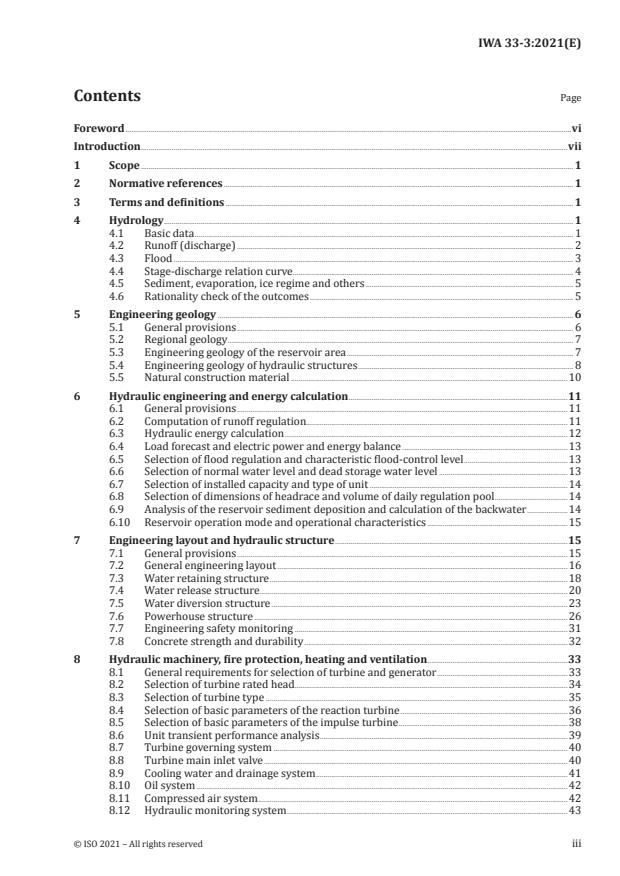
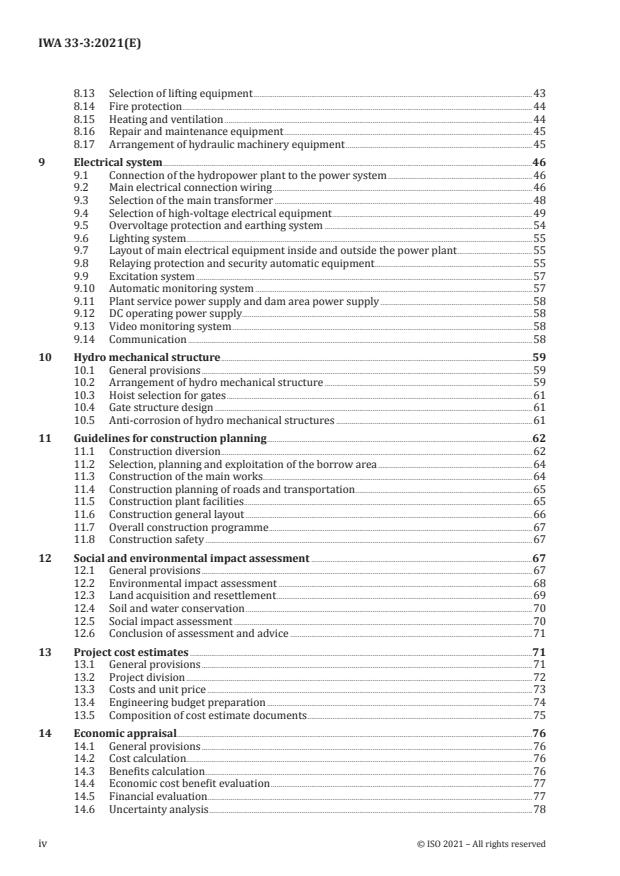
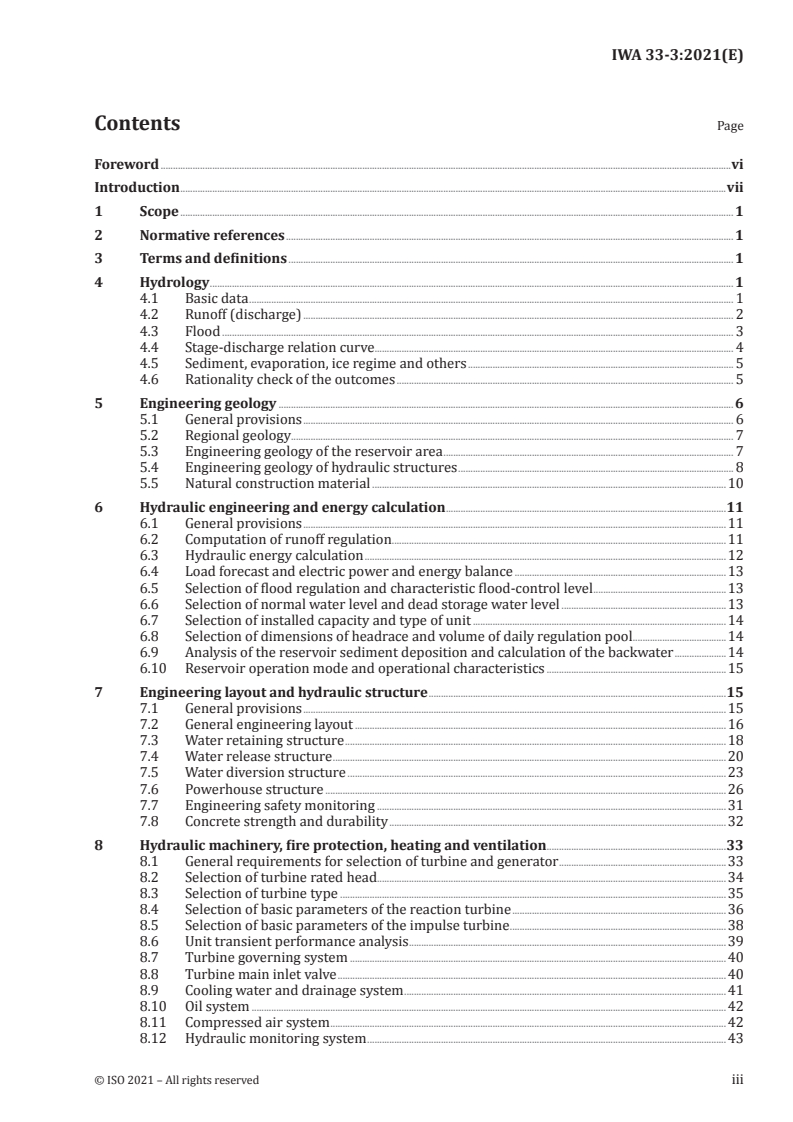
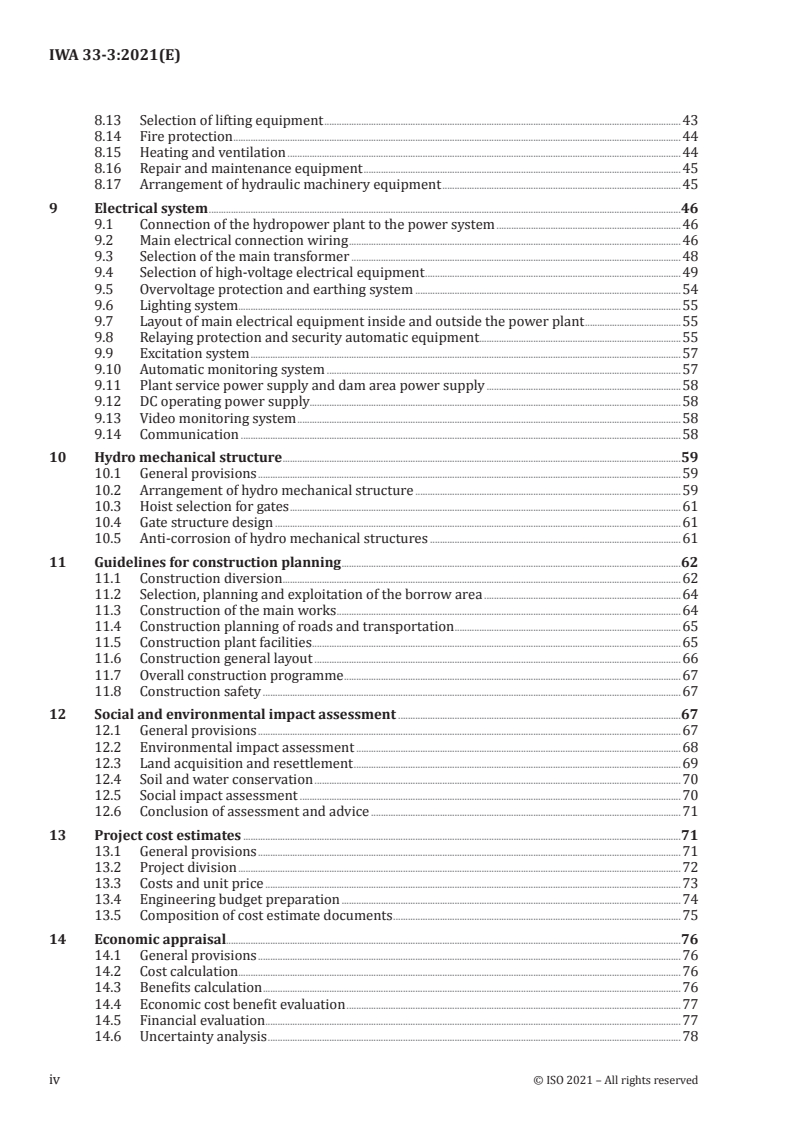
Contents Page
Foreword .vi
Introduction .vii
1 Scope . 1
2 Normative references . 1
3 Terms and definitions . 1
4 Hydrology . 1
4.1 Basic data . 1
4.2 Runoff (discharge) . 2
4.3 Flood . 3
4.4 Stage-discharge relation curve . 4
4.5 Sediment, evaporation, ice regime and others . 5
4.6 Rationality check of the outcomes . 5
5 Engineering geology . 6
5.1 General provisions . 6
5.2 Regional geology. 7
5.3 Engineering geology of the reservoir area . 7
5.4 Engineering geology of hydraulic structures . 8
5.5 Natural construction material .10
6 Hydraulic engineering and energy calculation .11
6.1 General provisions .11
6.2 Computation of runoff regulation . .11
6.3 Hydraulic energy calculation .12
6.4 Load forecast and electric power and energy balance .13
6.5 Selection of flood regulation and characteristic flood-control level .13
6.6 Selection of normal water level and dead storage water level .13
6.7 Selection of installed capacity and type of unit .14
6.8 Selection of dimensions of headrace and volume of daily regulation pool .14
6.9 Analysis of the reservoir sediment deposition and calculation of the backwater .14
6.10 Reservoir operation mode and operational characteristics .15
7 Engineering layout and hydraulic structure .15
7.1 General provisions .15
7.2 General engineering layout .16
7.3 Water retaining structure .18
7.4 Water release structure .20
7.5 Water diversion structure .23
7.6 Powerhouse structure .26
7.7 Engineering safety monitoring .31
7.8 Concrete strength and durability .32
8 Hydraulic machinery, fire protection, heating and ventilation .33
8.1 General requirements for selection of turbine and generator .33
8.2 Selection of turbine rated head.34
8.3 Selection of turbine type .35
8.4 Selection of basic parameters of the reaction turbine .36
8.5 Selection of basic parameters of the impulse turbine .38
8.6 Unit transient performance analysis .39
8.7 Turbine governing system .40
8.8 Turbine main inlet valve .40
8.9 Cooling water and drainage system .41
8.10 Oil system .42
8.11 Compressed air system .42
8.12 Hydraulic monitoring system .43
8.13 Selection of lifting equipment .43
8.14 Fire protection .44
8.15 Heating and ventilation .44
8.16 Repair and maintenance equipment .45
8.17 Arrangement of hydraulic machinery equipment .45
9 Electrical system .46
9.1 Connection of the hydropower plant to the power system .46
9.2 Main electrical connection wiring .46
9.3 Selection of the main transformer .48
9.4 Selection of high-voltage electrical equipment .49
9.5 Overvoltage protection and earthing system .54
9.6 Lighting system.55
9.7 Layout of main electrical equipment inside and outside the power plant .55
9.8 Relaying protection and security automatic equipment .55
9.9 Excitation system .57
9.10 Automatic monitoring system .57
9.11 Plant service power supply and dam area power supply .58
9.12 DC operating power supply.58
9.13 Video monitoring system .58
9.14 Communication .58
10 Hydro mechanical structure .59
10.1 General provisions .59
10.2 Arrangement of hydro mechanical structure .59
10.3 Hoist selection for gates .61
10.4 Gate structure design .61
10.5 Anti-corrosion of hydro mechanical structures .61
11 Guidelines for construction planning .62
11.1 Construction diversion .62
11.2 Selection, planning and exploitation of the borrow area .64
11.3 Construction of the main works .64
11.4 Construction planning of roads and transportation .65
11.5 Construction plant facilities .65
11.6 Construction general layout .66
11.7 Overall construction programme .67
11.8 Construction safety .67
12 Social and environmental impact assessment .67
12.1 General provisions .67
12.2 Environmental impact assessment .68
12.3 Land acquisition and resettlement .69
12.4 Soil and water conservation .70
12.5 Social impact assessment .70
12.6 Conclusion of assessment and advice .71
13 Project cost estimates .71
13.1 General provisions .71
13.2 Project division .72
13.3 Costs and unit price .73
13.4 Engineering budget preparation .74
13.5 Composition of cost estimate documents .75
14 Economic appraisal.76
14.1 General provisions .76
14.2 Cost calculation.76
14.3 Benefits calculation .76
14.4 Economic cost benefit evaluation .77
14.5 Financial evaluation.77
14.6 Uncertainty analysis .78
iv © ISO 2021 – All rights reserved
14.7 Methods of scheme comparison .78
Annex A (informative) Workshop contributors .79
Foreword
ISO (the International Organization for Standardization) is a worldwide federation of national standards
bodies (ISO member bodies). The work of preparing International Standards is normally carried out
through ISO technical committees. Each member body interested in a subject for which a technical
committee has been established has the right to be represented on that committee. International
organizations, governmental and non-governmental, in liaison with ISO, also take part in the work.
ISO collaborates closely with the International Electrotechnical Commission (IEC) on all matters of
electrotechnical standardization.
The procedures used to develop this document and those intended for its further maintenance are
described in the ISO/IEC Directives, Part 1. In particular, the different approval criteria needed for the
different types of ISO documents should be noted. This document was drafted in accordance with the
editorial rules of the ISO/IEC Directives, Part 2 (see www .iso .org/ directives).
Attention is drawn to the possibility that some of the elements of this document may be the subject of
patent rights. ISO shall not be held responsible for identifying any or all such patent rights. Details of
any patent rights identified during the development of the document will be in the Introduction and/or
on the ISO list of patent declarations received (see www .iso .org/ patents).
Any trade name used in this document is information given for the convenience of users and does not
constitute an endorsement.
For an explanation of the voluntary nature of standards, the meaning of ISO specific terms and
expressions related to conformity assessment, as well as information about ISO's adherence to the
World Trade Organization (WTO) principles in the Technical Barriers to Trade (TBT), see www .iso .org/
iso/ foreword .html.
International Workshop Agreement IWA 33 was approved at a workshop hosted by the Standardization
Administration of China (SAC) and Austrian Standards International (ASI), in association with the
th rd
International Center on Small Hydro Power (ICSHP), held virtually from 19 to 23 October, 2020.
Any feedback or questions on this document should be directed to the user’s national standards body. A
complete listing of these bodies can be found at www .iso .org/ members .html.
A list of all parts in the IWA 33 series can be found on the ISO website.
vi © ISO 2021 – All rights reserved
Introduction
Small hydropower (SHP) is well recognized as an important renewable energy solution to the challenge
of increasing access to electricity in remote rural areas. However, while most countries in Europe,
North and South America, China and India have high degrees of installed capacity, the potential of SHP
in many developing countries remains untapped and is hindered by a number of factors, including the
lack of best practices or standards for SHP development.
The technical guidelines for the development of small hydropower plants contained in this document
address the current limitations of the regulations applied to technical guidelines for SHP plants by
applying the expertise and best practices that exist across the globe. It is intended for countries to
utilize this document to support their current policy, technology and legislation. Countries that have
limited institutional and technical capacities will be able to enhance their knowledge base in developing
SHP plants on rivers/streams and existing water resource structures outlets such as dams, barrages,
navigation lock, canal falls, outfalls and flowing water (kinetic flow), including renovating/upgrading
the old SHP plants, thereby attracting more investment in SHP projects, encouraging favourable policies
and subsequently assisting in economic development at a national level. This document will be valuable
for all countries, but also allow for the sharing of experience and best practices between countries.
This document is the result of a collaborative effort between the United Nations Industrial Development
Organization (UNIDO) and the International Network on Small Hydro Power (INSHP). About 80
international experts and 40 international agencies were involved in this document’s preparation
and peer review. This document can be used as the principles and basis for the planning, design,
construction and management of SHP plants up to 30 MWe.
International Workshop Agreement IWA 33-3:2021(E)
Technical guidelines for the development of small
hydropower plants —
Part 3:
Design principles and requirements
1 Scope
This document specifies the general principles and basic requirements of design for small hydropower
(SHP) projects up to 30 MWe, mainly including hydrology, geology, energy calculations, project layout,
hydraulics, electromechanical equipment selection, construction planning, project cost estimates,
economic appraisal, social and environmental assessments.
Application of this document is intended to be site specific, with the principles and requirements of
design applied in accordance with the needs of proposed hydropower plant.
2 Normative references
The following documents are referred to in the text in such a way that some or all of their content
constitutes requirements of this document. For dated references, only the edition cited applies. For
undated references, the latest edition of the referenced document (including any amendments) applies.
IWA 33-1, Technical guidelines for the development of small hydropower plants — Part 1: Vocabulary
3 Terms and definitions
For the purposes of this document, the terms and definitions given in IWA 33-1 apply.
ISO and IEC maintain terminological databases for use in standardization at the following addresses:
— ISO Online browsing platform: available at https:// www .iso .org/ obp
— IEC Electropedia: available at http:// www .electropedia .org/
4 Hydrology
4.1 Basic data
4.1.1 The basic data include hydrometeorological data, river basin physiographic characteristics data,
information about the human activities impact, hydrological computation results of the basin and nearby
areas and the other relevant data. The changes in water resources management that occur upstream of a
hydropower plant during its long lifespan will alter the runoff regime. Thus, the present and foreseeable
needs of the population living on both sides of the river shall be taken into account for water supply,
irrigation, industrial, ecology and recreation purposes.
4.1.2 The data series upon which hydrological computation is based shall be checked for reliability,
consistency and representativeness.
4.1.3 The investigation of historical floods and dry seasons shall be carried out for the regions with
insufficient or no data; if the conditions permit, observation and survey of water level, flow and sediment
shall be carried out, and a long-term water regime monitoring and reporting system may be set up if
necessary.
4.1.4 Considering the impacts of climate change on the evolution of river flows is necessary as the SHP
plants normally are on smaller catchment not having much channel storage becoming more vulnerable
for changes in flows in terms of discharge, intensity, spatial and temporal distribution variation. These
shall be studied for the basin from the simulation with hydrological models. The entire hydrograph set
shall be considered in planning and in fixing the capacity. Results of these specialized study should be
used for finalising the runoff data.
4.2 Runoff (discharge)
4.2.1 According to the design requirement and data availability, all or part of the following design
runoff results shall be provided:
a) historic daily runoff series measured or simulated at the site of the proposed hydropower plant;
b) annual mean runoff as well as the annual runoff, runoff in flood season, runoff during dry season
with the designated frequency (return period) or the design representative years;
c) the annual distribution of the runoff in the design representative years.
4.2.2 According to data availabilities, the design runoff should be calculated by the following method.
a) When sufficient measured runoff data are available on the project site, the frequency analysis shall
be used.
b) When there is a runoff gauging station in the downstream/upstream of the project site, in the river
basin, adjacent basin or nearby basin with similar homogeneous meteorological and hydrological
conditions, the hydrologic analogy method should be adopted.
c) If measured runoff data are not available, the rainfall-runoff relationship or model method may be
adopted according to the precipitation data and physiographic characteristics of the watershed.
d) When the runoff data are not available, it may be estimated by relevant hydrological manual and
calculated on the basis of comprehensive analysis of regional results, taking into account variations
in topography, geology, vegetation cover and land use.
4.2.3 The runoff frequency computation shall meet the following requirements.
a) In the n -term consecutive runoff series, the empirical frequency P of term m in descending order,
m
shall be computed using Formula (1):
m
P = ×100% (1)
m
n+1
where
n is the number of terms of the observation series;
m is the order in the observation series;
th
P is the m empirical frequency.
m
b) The runoff frequency curve usually uses the Pearson curve III, while other types adaptive to the
local conditions may also be selected according to the geological, meteorological and hydrological
conditions of the project location.
2 © ISO 2021 – All rights reserved
4.2.4 The consecutive runoff series for the frequency analysis and computation should meet the
following requirements.
a) Long time runoff series of up to 20 years or more in principle may be used. However, shorter
time series of 10 to 20 years may also be used appropriately when limited data are available.
The measured data shall be used even if the stream has been modified in accordance with the
requirements of 4.2.
b) When the measured runoff data are insufficient, the interpolation shall be adopted to extend the
runoff series and then the frequency analysis shall be carried out.
c) The relevant parameters used for interpolating and/or extending the existing runoff series shall
be measured within an appropriate period in a continuous or discontinuous way simultaneously.
The extension amplitude of the relevant line shall not be more than 50 % of the measured variation
amplitude. The correlation coefficient should be more than 0,8.
4.2.5 The annual distribution in the design representative year may be determined by using the
homogeneous multiple adjustment method over the controlled annual water flow; when the measured
runoff data are insufficient, the existing synthesis chart of runoff area may be used with caution.
4.2.6 The daily mean flow duration curve can be adopted with the following method according to the
runoff data availabilities.
a) When sufficient runoff data are available, the daily mean flow ranking statistics of long series
or the daily mean flow in the typical high-flow (up to 25 % dependable) year, median-flow (50 %
dependable) year and low-flow (higher than 75 % dependable) year should be used.
b) When the measured runoff data are insufficient, the monthly average flow duration curve may be
deduced first, and then converted to the daily average flow duration curve through comparative
analysis of the daily and monthly average flow duration curves of the runoff gauging station or the
regional synthesis.
4.2.7 When the low water runoff data are insufficient, the low-flow investigation may be performed,
especially in the dry season.
4.2.8 When runoff is significantly affected by human activities, the same may be accounted for.
4.2.9 The design runoff shall account for the cases of the complex landform with extremely uneven or
unstable river channels, and special geological conditions such as karst.
4.3 Flood
4.3.1 According to the data availability and the engineering design requirements, all or part of the
following design flood results shall be provided:
a) annual maximum peak flow at design frequency;
b) staged maximum peak flow at design frequency;
c) annual and staged period flood at design frequency;
d) annual and staged design flood hydrograph at design frequency.
4.3.2 When sufficient measured flood data are available, frequency analysis and computation shall
be carried out to deduce the design flood. The frequency curve shall be based on the most appropriate
statistical distribution. When the frequency curve is deduced from the empirical frequency points, the
statistical parameters should be estimated preliminarily by the mathematical expectation equation, and
then determined after adjustment with the curve-fitting method. When the curve-fitting method is adopted,
the relatively reliable big flood events shall be considered on the basis of the fitting point group trend.
4.3.3 When measured flood data are available, the design flood hydrograph shall be deduced by
amplifying the typical flood hydrograph, and the large flood which can reflect the flood characteristics
and is relatively adverse to the flood control of the project shall be selected as the typical flood.
4.3.4 When the design flood is deduced from the design storm, the regional synthesis results of the
storm flood charts shall be used for the design of the rainfall pattern, runoff yield and runoff concentration
parameters and the design flood hydrograph. Comprehensive selection shall be based on the analysis
and synthesis according to the measured rainstorm flood data of the gauging station. Alternatively, the
empirical equation of flood peak flow in this region may be used.
4.3.5 According to the catchment area of the site and the comprehensive analysis results of the
measured storm flood data from the gauging station, the short-duration peak storm period controlled by
the same frequency in the design rain pattern shall be reasonably determined.
4.3.6 When the measured storm flood data are insufficient or the design basin storm flood parameters
cannot be determined, the relation curve of the “measured and investigated big flood peak flow modular
(M) - catchment area (F) - recurrence interval (N)” at the gauging stations in the region or the nearby
areas may be ascertained, and the design flood may be estimated with the regional synthetic method.
4.3.7 Close attention shall be paid to investigation and review of historical floods and the following
requirements shall be met:
a) reliable or relatively reliable data on major or relatively major historical floods shall be used in
the frequency analysis and computation, or to verify design flood results determined by regional
synthesis analysis, or to assist the derivation of the stage-discharge relation curve.
b) when data are limited, the design flood may be estimated according to historical flood results.
4.3.8 The design flood of cascade hydropower plants shall be calculated according to the layout of
cascade projects, the discharge or diversion modes of the plant and the intervening catchment areas
between two plants.
4.3.9 When computing the design flood by construction stages, the design requirements of the
engineering construction stages shall be considered, and the variation rules and characteristics of flood
causes shall be basically compiled within the period from the beginning to the end.
4.4 Stage-discharge relation curve
4.4.1 The stage-discharge relation curve between the upstream inlet section and the downstream tail
water section of the hydropower plant shall be drawn up.
4.4.2 When there are gauging stations near the upstream/downstream areas of the project site, the
stage-discharge relationship at the design cross-section may be obtained after the water level is corrected
through water level correlation or investigation and measurements.
4.4.3 The high-water level extension of the stage-discharge relationship may be calculated by slope
method and determined by the comprehensive analysis of flood investigation.
4.4.4 When there is no gauging station in the river reach of the project site, the stage-discharge
relationship shall be determined with the single-section slope method according to longitudinal profile
of the river reach and the cross-section profile, and with reference to the average bed slope of the main
channel/river as well as the water surface slope and its estimated flow during floods and dry season.
4 © ISO 2021 – All rights reserved
4.5 Sediment, evaporation, ice regime and others
4.5.1 With regard to the location of the project on the river carrying significant sediment or carrying
more sediment during the flood season, all or part of the following sediment computation results shall be
provided according to the data availability and the engineering design requirements:
a) annual average suspended sediment and sediment runoff ratio;
b) monthly average suspended sediment at the annual maximum cross-section and the month of
occurrence;
c) annual average suspended sediment size distribution or average and maximum particle diameter;
d) results of bed load sediment in the flood season [if conditions permit, the Sediment Rating Curves
(Discharge vs Sediment Concentration) may also be developed for analysis].
4.5.2 The suspended sediment may be computed with the following method.
a) When there is a sediment gauging station in the basin of the site, the sediment yield modulus of the
gauging station should be used.
b) When there is no sediment gauging station in the basin of the site, the sediment yield modulus
may be used directly if their climatic conditions and underlying surface conditions are similar,
otherwise they may be used after being corrected.
c) When the above data are not available, the existing regional synthesis diagrams of the sediment
may be used; the sediment may be measured temporarily if necessary.
4.5.3 Bed load sediment may be computed with the suspended and bed load ratio.
4.5.4 For a reservoir-based hydropower plant, it is advisable to calculate the annual average water
surface evaporation rate and its annual distribution according to the data from the evaporation
measuring station in the basin or the regional synthesis diagrams of the evaporation rate in basin with
similar hydrometeorological conditions.
4.5.5 For the hydrological analysis and computation in cold regions, the following ice regime at the
plant site shall be provided according to the statistical data of local hydrological and meteorological
characteristics:
a) river condition when freezing and unfreezing; occurrence of shore ice and floating ice and the
freezing characteristics of the whole river;
b) earliest, latest and yearly average icing and melting dates;
c) ice thickness, ice clogging, ice wall, ice flakes and floating ice and their potential hazards during the
freezing period.
4.6 Rationality check of the outcomes
4.6.1 The rationality check of the outcomes shall meet the following requirements.
a) The measured data and the analysis and computation results from all the relevant gauging stations
shall be used.
b) The comparative analysis of the results of multiple methods in a single station and the study of the
surface distribution of the results of multi-stations with the same methods shall be carried out.
c) The final results shall follow the principle of “based on one method, compared with multiple
methods, by analysing comprehensively and selecting rationally”.
4.6.2 The rationality check shall include the following main parameters or items:
a) annual mean runoff;
b) design peak flood and flood volume;
c) determination of the peak flood, and the roughness coefficient (n) in the computational equation of
the slope method;
d) shape and characteristics of the flow-duration curve and the stage-discharge relation curve.
4.6.3 The rationality check of the design annual runoff and the design peak flood results shall meet the
following requirements.
a) The computed results shall be consistent with the results of the regional synthesis contour map,
the correlation curve or the empirical equation.
b) The distribution in the basin, region and along the upstream/downstream segment and the
mainstream and tributaries shall basically be rational. The result shall basically be adaptive to the
spatial variation in the precipitation.
c) If there is a big difference in the computed results, or unreasonable, or there is a big difference with
the spatial variation of the precipitation, the causes shall be found out in time and re-analysed/
computed if necessary.
4.6.4 The rationality check of the flow duration curve and the stage-discharge relation curve shall
include the following contents:
a) the relationship between the flow duration curves as well as the influence of flow variation
amplitude and base flow on the curve shape;
b) the relationship between the cross-section feature and the stage-discharge relation curve.
5 Engineering geology
5.1 General provisions
5.1.1 The engineering geological investigations shall include the following aspects:
a) regional geological conditions;
b) basic geological conditions and major engineering geological issues of the project area;
c) hydro-geological condition and assessment of aggressiveness of water;
d) availability, distribution, quantity and quality of natural construction materials.
5.1.2 The investigation shall be carried out in stages in accordance with planning and design stages.
5.1.3 The existing topographic and geological data shall be collected. According to the characteristics
of the project, the complexity of the topographic and geological conditions and the requirements of
the investigation extent in each stage, a variety of investigation methods shall be applied. Appropriate
geological mapping, geophysical prospecting, drilling, pit exploration and laboratory tests shall be
conducted, supplemented by adit exploration and in-situ field test depending on the situation.
5.1.4 The physical-mechanical parameters of foundation materials can be determined by engineering
geological analogy and experience-based judgment; laboratory and field tests shall be performed if
necessary.
6 © ISO 2021 – All rights reserved
5.2 Regional geology
5.2.1 The regional geological investigation shall mainly include five aspects, namely topography,
geomorphology, geologic structure, regional tectonic stability and seismicity, geophysical phenomenon
and hydrogeology.
5.2.2 Under the topographic and geomorphic investigations, the topographic and geomorphic
characteristics of the region, especially the development situation and scope of the terrace, and the karst
development characteristics in the karst area shall be studied.
5.2.3 Under geologic structure investigation, the strength and permeability of the structure, the
distribution range, formation age and petrographic characteristics of various types of rocks shall be
studied.
5.2.4 For the regional structural stability and seismic survey, the available regional geological data
of the project area shall be studied to determine the geotectonic element of the project area and shall
...
INTERNATIONAL IWA
WORKSHOP 33-3
AGREEMENT
First edition
2021-03
Technical guidelines for the
development of small hydropower
plants —
Part 3:
Design principles and requirements
Reference number
©
ISO 2021
© ISO 2021
All rights reserved. Unless otherwise specified, or required in the context of its implementation, no part of this publication may
be reproduced or utilized otherwise in any form or by any means, electronic or mechanical, including photocopying, or posting
on the internet or an intranet, without prior written permission. Permission can be requested from either ISO at the address
below or ISO’s member body in the country of the requester.
ISO copyright office
CP 401 • Ch. de Blandonnet 8
CH-1214 Vernier, Geneva
Phone: +41 22 749 01 11
Email: copyright@iso.org
Website: www.iso.org
Published in Switzerland
ii © ISO 2021 – All rights reserved
Contents Page
Foreword .vi
Introduction .vii
1 Scope . 1
2 Normative references . 1
3 Terms and definitions . 1
4 Hydrology . 1
4.1 Basic data . 1
4.2 Runoff (discharge) . 2
4.3 Flood . 3
4.4 Stage-discharge relation curve . 4
4.5 Sediment, evaporation, ice regime and others . 5
4.6 Rationality check of the outcomes . 5
5 Engineering geology . 6
5.1 General provisions . 6
5.2 Regional geology. 7
5.3 Engineering geology of the reservoir area . 7
5.4 Engineering geology of hydraulic structures . 8
5.5 Natural construction material .10
6 Hydraulic engineering and energy calculation .11
6.1 General provisions .11
6.2 Computation of runoff regulation . .11
6.3 Hydraulic energy calculation .12
6.4 Load forecast and electric power and energy balance .13
6.5 Selection of flood regulation and characteristic flood-control level .13
6.6 Selection of normal water level and dead storage water level .13
6.7 Selection of installed capacity and type of unit .14
6.8 Selection of dimensions of headrace and volume of daily regulation pool .14
6.9 Analysis of the reservoir sediment deposition and calculation of the backwater .14
6.10 Reservoir operation mode and operational characteristics .15
7 Engineering layout and hydraulic structure .15
7.1 General provisions .15
7.2 General engineering layout .16
7.3 Water retaining structure .18
7.4 Water release structure .20
7.5 Water diversion structure .23
7.6 Powerhouse structure .26
7.7 Engineering safety monitoring .31
7.8 Concrete strength and durability .32
8 Hydraulic machinery, fire protection, heating and ventilation .33
8.1 General requirements for selection of turbine and generator .33
8.2 Selection of turbine rated head.34
8.3 Selection of turbine type .35
8.4 Selection of basic parameters of the reaction turbine .36
8.5 Selection of basic parameters of the impulse turbine .38
8.6 Unit transient performance analysis .39
8.7 Turbine governing system .40
8.8 Turbine main inlet valve .40
8.9 Cooling water and drainage system .41
8.10 Oil system .42
8.11 Compressed air system .42
8.12 Hydraulic monitoring system .43
8.13 Selection of lifting equipment .43
8.14 Fire protection .44
8.15 Heating and ventilation .44
8.16 Repair and maintenance equipment .45
8.17 Arrangement of hydraulic machinery equipment .45
9 Electrical system .46
9.1 Connection of the hydropower plant to the power system .46
9.2 Main electrical connection wiring .46
9.3 Selection of the main transformer .48
9.4 Selection of high-voltage electrical equipment .49
9.5 Overvoltage protection and earthing system .54
9.6 Lighting system.55
9.7 Layout of main electrical equipment inside and outside the power plant .55
9.8 Relaying protection and security automatic equipment .55
9.9 Excitation system .57
9.10 Automatic monitoring system .57
9.11 Plant service power supply and dam area power supply .58
9.12 DC operating power supply.58
9.13 Video monitoring system .58
9.14 Communication .58
10 Hydro mechanical structure .59
10.1 General provisions .59
10.2 Arrangement of hydro mechanical structure .59
10.3 Hoist selection for gates .61
10.4 Gate structure design .61
10.5 Anti-corrosion of hydro mechanical structures .61
11 Guidelines for construction planning .62
11.1 Construction diversion .62
11.2 Selection, planning and exploitation of the borrow area .64
11.3 Construction of the main works .64
11.4 Construction planning of roads and transportation .65
11.5 Construction plant facilities .65
11.6 Construction general layout .66
11.7 Overall construction programme .67
11.8 Construction safety .67
12 Social and environmental impact assessment .67
12.1 General provisions .67
12.2 Environmental impact assessment .68
12.3 Land acquisition and resettlement .69
12.4 Soil and water conservation .70
12.5 Social impact assessment .70
12.6 Conclusion of assessment and advice .71
13 Project cost estimates .71
13.1 General provisions .71
13.2 Project division .72
13.3 Costs and unit price .73
13.4 Engineering budget preparation .74
13.5 Composition of cost estimate documents .75
14 Economic appraisal.76
14.1 General provisions .76
14.2 Cost calculation.76
14.3 Benefits calculation .76
14.4 Economic cost benefit evaluation .77
14.5 Financial evaluation.77
14.6 Uncertainty analysis .78
iv © ISO 2021 – All rights reserved
14.7 Methods of scheme comparison .78
Annex A (informative) Workshop contributors .79
Foreword
ISO (the International Organization for Standardization) is a worldwide federation of national standards
bodies (ISO member bodies). The work of preparing International Standards is normally carried out
through ISO technical committees. Each member body interested in a subject for which a technical
committee has been established has the right to be represented on that committee. International
organizations, governmental and non-governmental, in liaison with ISO, also take part in the work.
ISO collaborates closely with the International Electrotechnical Commission (IEC) on all matters of
electrotechnical standardization.
The procedures used to develop this document and those intended for its further maintenance are
described in the ISO/IEC Directives, Part 1. In particular, the different approval criteria needed for the
different types of ISO documents should be noted. This document was drafted in accordance with the
editorial rules of the ISO/IEC Directives, Part 2 (see www .iso .org/ directives).
Attention is drawn to the possibility that some of the elements of this document may be the subject of
patent rights. ISO shall not be held responsible for identifying any or all such patent rights. Details of
any patent rights identified during the development of the document will be in the Introduction and/or
on the ISO list of patent declarations received (see www .iso .org/ patents).
Any trade name used in this document is information given for the convenience of users and does not
constitute an endorsement.
For an explanation of the voluntary nature of standards, the meaning of ISO specific terms and
expressions related to conformity assessment, as well as information about ISO's adherence to the
World Trade Organization (WTO) principles in the Technical Barriers to Trade (TBT), see www .iso .org/
iso/ foreword .html.
International Workshop Agreement IWA 33 was approved at a workshop hosted by the Standardization
Administration of China (SAC) and Austrian Standards International (ASI), in association with the
th rd
International Center on Small Hydro Power (ICSHP), held virtually from 19 to 23 October, 2020.
Any feedback or questions on this document should be directed to the user’s national standards body. A
complete listing of these bodies can be found at www .iso .org/ members .html.
A list of all parts in the IWA 33 series can be found on the ISO website.
vi © ISO 2021 – All rights reserved
Introduction
Small hydropower (SHP) is well recognized as an important renewable energy solution to the challenge
of increasing access to electricity in remote rural areas. However, while most countries in Europe,
North and South America, China and India have high degrees of installed capacity, the potential of SHP
in many developing countries remains untapped and is hindered by a number of factors, including the
lack of best practices or standards for SHP development.
The technical guidelines for the development of small hydropower plants contained in this document
address the current limitations of the regulations applied to technical guidelines for SHP plants by
applying the expertise and best practices that exist across the globe. It is intended for countries to
utilize this document to support their current policy, technology and legislation. Countries that have
limited institutional and technical capacities will be able to enhance their knowledge base in developing
SHP plants on rivers/streams and existing water resource structures outlets such as dams, barrages,
navigation lock, canal falls, outfalls and flowing water (kinetic flow), including renovating/upgrading
the old SHP plants, thereby attracting more investment in SHP projects, encouraging favourable policies
and subsequently assisting in economic development at a national level. This document will be valuable
for all countries, but also allow for the sharing of experience and best practices between countries.
This document is the result of a collaborative effort between the United Nations Industrial Development
Organization (UNIDO) and the International Network on Small Hydro Power (INSHP). About 80
international experts and 40 international agencies were involved in this document’s preparation
and peer review. This document can be used as the principles and basis for the planning, design,
construction and management of SHP plants up to 30 MWe.
International Workshop Agreement IWA 33-3:2021(E)
Technical guidelines for the development of small
hydropower plants —
Part 3:
Design principles and requirements
1 Scope
This document specifies the general principles and basic requirements of design for small hydropower
(SHP) projects up to 30 MWe, mainly including hydrology, geology, energy calculations, project layout,
hydraulics, electromechanical equipment selection, construction planning, project cost estimates,
economic appraisal, social and environmental assessments.
Application of this document is intended to be site specific, with the principles and requirements of
design applied in accordance with the needs of proposed hydropower plant.
2 Normative references
The following documents are referred to in the text in such a way that some or all of their content
constitutes requirements of this document. For dated references, only the edition cited applies. For
undated references, the latest edition of the referenced document (including any amendments) applies.
IWA 33-1, Technical guidelines for the development of small hydropower plants — Part 1: Vocabulary
3 Terms and definitions
For the purposes of this document, the terms and definitions given in IWA 33-1 apply.
ISO and IEC maintain terminological databases for use in standardization at the following addresses:
— ISO Online browsing platform: available at https:// www .iso .org/ obp
— IEC Electropedia: available at http:// www .electropedia .org/
4 Hydrology
4.1 Basic data
4.1.1 The basic data include hydrometeorological data, river basin physiographic characteristics data,
information about the human activities impact, hydrological computation results of the basin and nearby
areas and the other relevant data. The changes in water resources management that occur upstream of a
hydropower plant during its long lifespan will alter the runoff regime. Thus, the present and foreseeable
needs of the population living on both sides of the river shall be taken into account for water supply,
irrigation, industrial, ecology and recreation purposes.
4.1.2 The data series upon which hydrological computation is based shall be checked for reliability,
consistency and representativeness.
4.1.3 The investigation of historical floods and dry seasons shall be carried out for the regions with
insufficient or no data; if the conditions permit, observation and survey of water level, flow and sediment
shall be carried out, and a long-term water regime monitoring and reporting system may be set up if
necessary.
4.1.4 Considering the impacts of climate change on the evolution of river flows is necessary as the SHP
plants normally are on smaller catchment not having much channel storage becoming more vulnerable
for changes in flows in terms of discharge, intensity, spatial and temporal distribution variation. These
shall be studied for the basin from the simulation with hydrological models. The entire hydrograph set
shall be considered in planning and in fixing the capacity. Results of these specialized study should be
used for finalising the runoff data.
4.2 Runoff (discharge)
4.2.1 According to the design requirement and data availability, all or part of the following design
runoff results shall be provided:
a) historic daily runoff series measured or simulated at the site of the proposed hydropower plant;
b) annual mean runoff as well as the annual runoff, runoff in flood season, runoff during dry season
with the designated frequency (return period) or the design representative years;
c) the annual distribution of the runoff in the design representative years.
4.2.2 According to data availabilities, the design runoff should be calculated by the following method.
a) When sufficient measured runoff data are available on the project site, the frequency analysis shall
be used.
b) When there is a runoff gauging station in the downstream/upstream of the project site, in the river
basin, adjacent basin or nearby basin with similar homogeneous meteorological and hydrological
conditions, the hydrologic analogy method should be adopted.
c) If measured runoff data are not available, the rainfall-runoff relationship or model method may be
adopted according to the precipitation data and physiographic characteristics of the watershed.
d) When the runoff data are not available, it may be estimated by relevant hydrological manual and
calculated on the basis of comprehensive analysis of regional results, taking into account variations
in topography, geology, vegetation cover and land use.
4.2.3 The runoff frequency computation shall meet the following requirements.
a) In the n -term consecutive runoff series, the empirical frequency P of term m in descending order,
m
shall be computed using Formula (1):
m
P = ×100% (1)
m
n+1
where
n is the number of terms of the observation series;
m is the order in the observation series;
th
P is the m empirical frequency.
m
b) The runoff frequency curve usually uses the Pearson curve III, while other types adaptive to the
local conditions may also be selected according to the geological, meteorological and hydrological
conditions of the project location.
2 © ISO 2021 – All rights reserved
4.2.4 The consecutive runoff series for the frequency analysis and computation should meet the
following requirements.
a) Long time runoff series of up to 20 years or more in principle may be used. However, shorter
time series of 10 to 20 years may also be used appropriately when limited data are available.
The measured data shall be used even if the stream has been modified in accordance with the
requirements of 4.2.
b) When the measured runoff data are insufficient, the interpolation shall be adopted to extend the
runoff series and then the frequency analysis shall be carried out.
c) The relevant parameters used for interpolating and/or extending the existing runoff series shall
be measured within an appropriate period in a continuous or discontinuous way simultaneously.
The extension amplitude of the relevant line shall not be more than 50 % of the measured variation
amplitude. The correlation coefficient should be more than 0,8.
4.2.5 The annual distribution in the design representative year may be determined by using the
homogeneous multiple adjustment method over the controlled annual water flow; when the measured
runoff data are insufficient, the existing synthesis chart of runoff area may be used with caution.
4.2.6 The daily mean flow duration curve can be adopted with the following method according to the
runoff data availabilities.
a) When sufficient runoff data are available, the daily mean flow ranking statistics of long series
or the daily mean flow in the typical high-flow (up to 25 % dependable) year, median-flow (50 %
dependable) year and low-flow (higher than 75 % dependable) year should be used.
b) When the measured runoff data are insufficient, the monthly average flow duration curve may be
deduced first, and then converted to the daily average flow duration curve through comparative
analysis of the daily and monthly average flow duration curves of the runoff gauging station or the
regional synthesis.
4.2.7 When the low water runoff data are insufficient, the low-flow investigation may be performed,
especially in the dry season.
4.2.8 When runoff is significantly affected by human activities, the same may be accounted for.
4.2.9 The design runoff shall account for the cases of the complex landform with extremely uneven or
unstable river channels, and special geological conditions such as karst.
4.3 Flood
4.3.1 According to the data availability and the engineering design requirements, all or part of the
following design flood results shall be provided:
a) annual maximum peak flow at design frequency;
b) staged maximum peak flow at design frequency;
c) annual and staged period flood at design frequency;
d) annual and staged design flood hydrograph at design frequency.
4.3.2 When sufficient measured flood data are available, frequency analysis and computation shall
be carried out to deduce the design flood. The frequency curve shall be based on the most appropriate
statistical distribution. When the frequency curve is deduced from the empirical frequency points, the
statistical parameters should be estimated preliminarily by the mathematical expectation equation, and
then determined after adjustment with the curve-fitting method. When the curve-fitting method is adopted,
the relatively reliable big flood events shall be considered on the basis of the fitting point group trend.
4.3.3 When measured flood data are available, the design flood hydrograph shall be deduced by
amplifying the typical flood hydrograph, and the large flood which can reflect the flood characteristics
and is relatively adverse to the flood control of the project shall be selected as the typical flood.
4.3.4 When the design flood is deduced from the design storm, the regional synthesis results of the
storm flood charts shall be used for the design of the rainfall pattern, runoff yield and runoff concentration
parameters and the design flood hydrograph. Comprehensive selection shall be based on the analysis
and synthesis according to the measured rainstorm flood data of the gauging station. Alternatively, the
empirical equation of flood peak flow in this region may be used.
4.3.5 According to the catchment area of the site and the comprehensive analysis results of the
measured storm flood data from the gauging station, the short-duration peak storm period controlled by
the same frequency in the design rain pattern shall be reasonably determined.
4.3.6 When the measured storm flood data are insufficient or the design basin storm flood parameters
cannot be determined, the relation curve of the “measured and investigated big flood peak flow modular
(M) - catchment area (F) - recurrence interval (N)” at the gauging stations in the region or the nearby
areas may be ascertained, and the design flood may be estimated with the regional synthetic method.
4.3.7 Close attention shall be paid to investigation and review of historical floods and the following
requirements shall be met:
a) reliable or relatively reliable data on major or relatively major historical floods shall be used in
the frequency analysis and computation, or to verify design flood results determined by regional
synthesis analysis, or to assist the derivation of the stage-discharge relation curve.
b) when data are limited, the design flood may be estimated according to historical flood results.
4.3.8 The design flood of cascade hydropower plants shall be calculated according to the layout of
cascade projects, the discharge or diversion modes of the plant and the intervening catchment areas
between two plants.
4.3.9 When computing the design flood by construction stages, the design requirements of the
engineering construction stages shall be considered, and the variation rules and characteristics of flood
causes shall be basically compiled within the period from the beginning to the end.
4.4 Stage-discharge relation curve
4.4.1 The stage-discharge relation curve between the upstream inlet section and the downstream tail
water section of the hydropower plant shall be drawn up.
4.4.2 When there are gauging stations near the upstream/downstream areas of the project site, the
stage-discharge relationship at the design cross-section may be obtained after the water level is corrected
through water level correlation or investigation and measurements.
4.4.3 The high-water level extension of the stage-discharge relationship may be calculated by slope
method and determined by the comprehensive analysis of flood investigation.
4.4.4 When there is no gauging station in the river reach of the project site, the stage-discharge
relationship shall be determined with the single-section slope method according to longitudinal profile
of the river reach and the cross-section profile, and with reference to the average bed slope of the main
channel/river as well as the water surface slope and its estimated flow during floods and dry season.
4 © ISO 2021 – All rights reserved
4.5 Sediment, evaporation, ice regime and others
4.5.1 With regard to the location of the project on the river carrying significant sediment or carrying
more sediment during the flood season, all or part of the following sediment computation results shall be
provided according to the data availability and the engineering design requirements:
a) annual average suspended sediment and sediment runoff ratio;
b) monthly average suspended sediment at the annual maximum cross-section and the month of
occurrence;
c) annual average suspended sediment size distribution or average and maximum particle diameter;
d) results of bed load sediment in the flood season [if conditions permit, the Sediment Rating Curves
(Discharge vs Sediment Concentration) may also be developed for analysis].
4.5.2 The suspended sediment may be computed with the following method.
a) When there is a sediment gauging station in the basin of the site, the sediment yield modulus of the
gauging station should be used.
b) When there is no sediment gauging station in the basin of the site, the sediment yield modulus
may be used directly if their climatic conditions and underlying surface conditions are similar,
otherwise they may be used after being corrected.
c) When the above data are not available, the existing regional synthesis diagrams of the sediment
may be used; the sediment may be measured temporarily if necessary.
4.5.3 Bed load sediment may be computed with the suspended and bed load ratio.
4.5.4 For a reservoir-based hydropower plant, it is advisable to calculate the annual average water
surface evaporation rate and its annual distribution according to the data from the evaporation
measuring station in the basin or the regional synthesis diagrams of the evaporation rate in basin with
similar hydrometeorological conditions.
4.5.5 For the hydrological analysis and computation in cold regions, the following ice regime at the
plant site shall be provided according to the statistical data of local hydrological and meteorological
characteristics:
a) river condition when freezing and unfreezing; occurrence of shore ice and floating ice and the
freezing characteristics of the whole river;
b) earliest, latest and yearly average icing and melting dates;
c) ice thickness, ice clogging, ice wall, ice flakes and floating ice and their potential hazards during the
freezing period.
4.6 Rationality check of the outcomes
4.6.1 The rationality check of the outcomes shall meet the following requirements.
a) The measured data and the analysis and computation results from all the relevant gauging stations
shall be used.
b) The comparative analysis of the results of multiple methods in a single station and the study of the
surface distribution of the results of multi-stations with the same methods shall be carried out.
c) The final results shall follow the principle of “based on one method, compared with multiple
methods, by analysing comprehensively and selecting rationally”.
4.6.2 The rationality check shall include the following main parameters or items:
a) annual mean runoff;
b) design peak flood and flood volume;
c) determination of the peak flood, and the roughness coefficient (n) in the computational equation of
the slope method;
d) shape and characteristics of the flow-duration curve and the stage-discharge relation curve.
4.6.3 The rationality check of the design annual runoff and the design peak flood results shall meet the
following requirements.
a) The computed results shall be consistent with the results of the regional synthesis contour map,
the correlation curve or the empirical equation.
b) The distribution in the basin, region and along the upstream/downstream segment and the
mainstream and tributaries shall basically be rational. The result shall basically be adaptive to the
spatial variation in the precipitation.
c) If there is a big difference in the computed results, or unreasonable, or there is a big difference with
the spatial variation of the precipitation, the causes shall be found out in time and re-analysed/
computed if necessary.
4.6.4 The rationality check of the flow duration curve and the stage-discharge relation curve shall
include the following contents:
a) the relationship between the flow duration curves as well as the influence of flow variation
amplitude and base flow on the curve shape;
b) the relationship between the cross-section feature and the stage-discharge relation curve.
5 Engineering geology
5.1 General provisions
5.1.1 The engineering geological investigations shall include the following aspects:
a) regional geological conditions;
b) basic geological conditions and major engineering geological issues of the project area;
c) hydro-geological condition and assessment of aggressiveness of water;
d) availability, distribution, quantity and quality of natural construction materials.
5.1.2 The investigation shall be carried out in stages in accordance with planning and design stages.
5.1.3 The existing topographic and geological data shall be collected. According to the characteristics
of the project, the complexity of the topographic and geological conditions and the requirements of
the investigation extent in each stage, a variety of investigation methods shall be applied. Appropriate
geological mapping, geophysical prospecting, drilling, pit exploration and laboratory tests shall be
conducted, supplemented by adit exploration and in-situ field test depending on the situation.
5.1.4 The physical-mechanical parameters of foundation materials can be determined by engineering
geological analogy and experience-based judgment; laboratory and field tests shall be performed if
necessary.
6 © ISO 2021 – All rights reserved
5.2 Regional geology
5.2.1 The regional geological investigation shall mainly include five aspects, namely topography,
geomorphology, geologic structure, regional tectonic stability and seismicity, geophysical phenomenon
and hydrogeology.
5.2.2 Under the topographic and geomorphic investigations, the topographic and geomorphic
characteristics of the region, especially the development situation and scope of the terrace, and the karst
development characteristics in the karst area shall be studied.
5.2.3 Under geologic structure investigation, the strength and permeability of the structure, the
distribution range, formation age and petrographic characteristics of various types of rocks shall be
studied.
5.2.4 For the regional structural stability and seismic survey, the available regional geological data
of the project area shall be studied to determine the geotectonic element of the project area and shall
...