


ISO 4254-13:2012
(Main)Agricultural machinery — Safety — Part 13: Large rotary mowers
Agricultural machinery — Safety — Part 13: Large rotary mowers
ISO 4254-13:2012, when used together with ISO 4254-1, specifies the safety requirements and their verification for the design and construction of towed, semi-mounted, or mounted large rotary mowers with single or multiple cutting elements which have a cutting diameter of 1 000 mm or greater for any single cutting element assembly, mounted on a propelling tractor or machine, intended for agricultural mowing equipment and designed for shredding crop residue, grass and small brush by impact. It describes methods for the elimination or reduction of hazards arising from the intended use and reasonable foreseeable misuse of these machines by one person (the operator) in the course of normal operation and service. In addition, it specifies the type of information on safe working practices to be provided by the manufacturer. When requirements of this part of ISO 4254 are different from those which are stated in ISO 4254-1, the requirements of ISO 4254-13:2012 take precedence over the provisions of ISO 4254-1 for machines that have been designed and built according to the provisions of this part of ISO 4254. ISO 4254-13:2012, taken together with ISO 4254-1, deals with all the significant hazards, hazardous situations and events relevant to large rotary mowers used as intended and under the conditions foreseen by the manufacturer. ISO 4254-13:2012 is not applicable to environmental hazards, road safety, electromagnetic compatibility, vibration and hazards related to moving parts for power transmission. It is also not applicable to hazards related to maintenance or repairs to be carried out by professional service personnel. ISO 4254-13:2012 is not applicable to large rotary mowers which are manufactured before the date of publication of this document by ISO.
Matériel agricole — Sécurité — Partie 13: Grandes faucheuses rotatives
L'ISO 4254-13 :2012, destinée à être utilisée conjointement avec l'ISO 4254‑1, spécifie les exigences de sécurité et leur vérification pour la conception et la construction de grandes faucheuses rotatives tractées, semi-portées ou portées pourvues d'un ou de plusieurs éléments de coupe, le diamètre de coupe de chacun des ensembles d'élément de coupe étant supérieur ou égal à 1 000 mm, montées sur un tracteur ou une machine motrice, destinées au matériel de fauchage agricole et conçues pour le broyage de résidus végétaux, d'herbe et de broussailles par impact. Elle décrit des méthodes permettant de réduire ou d'éliminer les phénomènes dangereux découlant d'une utilisation normale et d'une mauvaise utilisation raisonnablement prévisible de ces machines par une personne (l'opérateur) au cours du fonctionnement normal et de l'entretien. En outre, elle spécifie le type d'informations que le fabricant doit donner sur les pratiques d'utilisation sûre. NOTE 1 Ces machines peuvent être utilisées pour broyer de l'herbe. En cas d'utilisation dans une activité non agricole, des exigences supplémentaires non spécifiées dans l'ISO 4254-13 :2012 peuvent s'appliquer. Elle ne s'applique pas: - aux faucheuses rotatives à disques, aux faucheuses rotatives à tambours et aux faucheuses-broyeuses conçues pour la récolte de fourrage qui sont couvertes par l'ISO 4254‑12; - aux grandes faucheuses rotatives à bras; - aux motofaucheuses à conducteur à pied; - aux tondeuses à gazon qui sont couvertes par l'ISO 5395. Lorsque des exigences de l'ISO 4254-13 :2012 sont différentes de celles énoncées dans l'ISO 4254‑1, les exigences de l'ISO 4254-13 :2012 prévalent sur les dispositions de l'ISO 4254‑1 pour les machines conçues et fabriquées conformément aux dispositions de l'ISO 4254-13 :2012. L'ISO 4254-13 :2012, utilisée conjointement avec l'ISO 4254‑1, traite de tous les phénomènes dangereux et situations et événements dangereux significatifs inhérents aux grandes faucheuses rotatives dans le cadre d'une utilisation normale et des conditions prévues par le fabricant. (Une liste de phénomènes dangereux significatifs est fournie à l'Annexe A.) NOTE 2 À titre d'exemple, deux illustrations de faucheuses (une grande faucheuse rotative à châssis rigide et une grande faucheuse rotative traînée à ailes repliables multisection) couvertes par l'ISO 4254-13 :2012 sont présentées en C.1. NOTE 3 À titre d'exemple, des illustrations de faucheuses non couvertes par l'ISO 4254-13 :2012 sont présentées en C.2. L'ISO 4254-13 :2012 ne s'applique pas aux phénomènes dangereux liés à environnement, à la sécurité routière, à la compatibilité électromagnétique, aux vibrations ni aux phénomènes dangereux liés aux éléments mobiles de transmission de puissance. Elle ne s'applique pas non plus aux phénomènes dangereux liés aux opérations de maintenance ou de réparation qui doivent être exécutées par des professionnels habilités. NOTE 4 L'ISO 14982 spécifie des méthodes d'essai et des critères d'acceptation pour l'évaluation de la compatibilité électromagnétique de tous les types de matériel agricole mobile. L'ISO 4254-13 :2012 ne s'applique pas aux grandes faucheuses rotatives fabriquées avant sa date de publication par l'ISO.
General Information
- Status
- Withdrawn
- Publication Date
- 07-Aug-2012
- Technical Committee
- ISO/TC 23/SC 7 - Equipment for harvesting and conservation
- Drafting Committee
- ISO/TC 23/SC 7 - Equipment for harvesting and conservation
- Current Stage
- 9599 - Withdrawal of International Standard
- Start Date
- 19-Apr-2023
- Completion Date
- 12-Feb-2026
Relations
- Effective Date
- 23-Apr-2020



Get Certified
Connect with accredited certification bodies for this standard

Control Union Certifications
Global certification for agriculture and sustainability.

ECOCERT
Organic and sustainability certification.

Rainforest Alliance Certification
Sustainable agriculture and forestry certification.
Sponsored listings
Frequently Asked Questions
ISO 4254-13:2012 is a standard published by the International Organization for Standardization (ISO). Its full title is "Agricultural machinery — Safety — Part 13: Large rotary mowers". This standard covers: ISO 4254-13:2012, when used together with ISO 4254-1, specifies the safety requirements and their verification for the design and construction of towed, semi-mounted, or mounted large rotary mowers with single or multiple cutting elements which have a cutting diameter of 1 000 mm or greater for any single cutting element assembly, mounted on a propelling tractor or machine, intended for agricultural mowing equipment and designed for shredding crop residue, grass and small brush by impact. It describes methods for the elimination or reduction of hazards arising from the intended use and reasonable foreseeable misuse of these machines by one person (the operator) in the course of normal operation and service. In addition, it specifies the type of information on safe working practices to be provided by the manufacturer. When requirements of this part of ISO 4254 are different from those which are stated in ISO 4254-1, the requirements of ISO 4254-13:2012 take precedence over the provisions of ISO 4254-1 for machines that have been designed and built according to the provisions of this part of ISO 4254. ISO 4254-13:2012, taken together with ISO 4254-1, deals with all the significant hazards, hazardous situations and events relevant to large rotary mowers used as intended and under the conditions foreseen by the manufacturer. ISO 4254-13:2012 is not applicable to environmental hazards, road safety, electromagnetic compatibility, vibration and hazards related to moving parts for power transmission. It is also not applicable to hazards related to maintenance or repairs to be carried out by professional service personnel. ISO 4254-13:2012 is not applicable to large rotary mowers which are manufactured before the date of publication of this document by ISO.
ISO 4254-13:2012, when used together with ISO 4254-1, specifies the safety requirements and their verification for the design and construction of towed, semi-mounted, or mounted large rotary mowers with single or multiple cutting elements which have a cutting diameter of 1 000 mm or greater for any single cutting element assembly, mounted on a propelling tractor or machine, intended for agricultural mowing equipment and designed for shredding crop residue, grass and small brush by impact. It describes methods for the elimination or reduction of hazards arising from the intended use and reasonable foreseeable misuse of these machines by one person (the operator) in the course of normal operation and service. In addition, it specifies the type of information on safe working practices to be provided by the manufacturer. When requirements of this part of ISO 4254 are different from those which are stated in ISO 4254-1, the requirements of ISO 4254-13:2012 take precedence over the provisions of ISO 4254-1 for machines that have been designed and built according to the provisions of this part of ISO 4254. ISO 4254-13:2012, taken together with ISO 4254-1, deals with all the significant hazards, hazardous situations and events relevant to large rotary mowers used as intended and under the conditions foreseen by the manufacturer. ISO 4254-13:2012 is not applicable to environmental hazards, road safety, electromagnetic compatibility, vibration and hazards related to moving parts for power transmission. It is also not applicable to hazards related to maintenance or repairs to be carried out by professional service personnel. ISO 4254-13:2012 is not applicable to large rotary mowers which are manufactured before the date of publication of this document by ISO.
ISO 4254-13:2012 is classified under the following ICS (International Classification for Standards) categories: 65.060.01 - Agricultural machines and equipment in general. The ICS classification helps identify the subject area and facilitates finding related standards.
ISO 4254-13:2012 has the following relationships with other standards: It is inter standard links to ISO 4254-13:2023. Understanding these relationships helps ensure you are using the most current and applicable version of the standard.
ISO 4254-13:2012 is available in PDF format for immediate download after purchase. The document can be added to your cart and obtained through the secure checkout process. Digital delivery ensures instant access to the complete standard document.
Standards Content (Sample)
INTERNATIONAL ISO
STANDARD 4254-13
First edition
2012-08-01
Corrected version
2014-12-15
Agricultural machinery — Safety —
Part 13:
Large rotary mowers
Matériel agricole — Sécurité —
Partie 13: Grandes faucheuses rotatives
Reference number
©
ISO 2012
© ISO 2012
All rights reserved. Unless otherwise specified, no part of this publication may be reproduced or utilized otherwise in any form
or by any means, electronic or mechanical, including photocopying, or posting on the internet or an intranet, without prior
written permission. Permission can be requested from either ISO at the address below or ISO’s member body in the country of
the requester.
ISO copyright office
Case postale 56 • CH-1211 Geneva 20
Tel. + 41 22 749 01 11
Fax + 41 22 749 09 47
E-mail copyright@iso.org
Web www.iso.org
Published in Switzerland
ii © ISO 2012 – All rights reserved
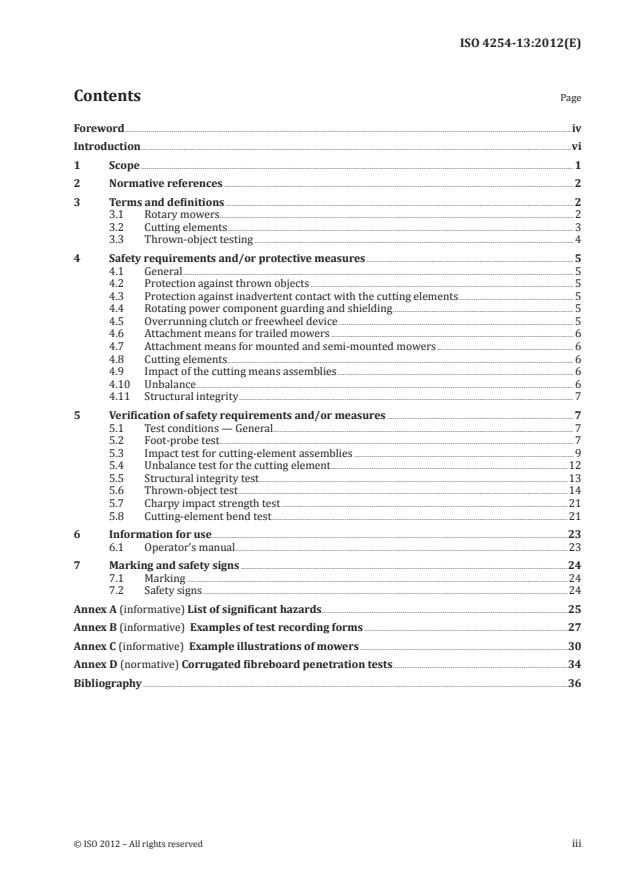
Contents Page
Foreword .iv
Introduction .vi
1 Scope . 1
2 Normative references . 2
3 Terms and definitions . 2
3.1 Rotary mowers . 2
3.2 Cutting elements . 3
3.3 Thrown-object testing . 4
4 Safety requirements and/or protective measures . 5
4.1 General . 5
4.2 Protection against thrown objects . 5
4.3 Protection against inadvertent contact with the cutting elements. 5
4.4 Rotating power component guarding and shielding . 5
4.5 Overrunning clutch or freewheel device . 5
4.6 Attachment means for trailed mowers . 6
4.7 Attachment means for mounted and semi-mounted mowers . 6
4.8 Cutting elements . 6
4.9 Impact of the cutting means assemblies . 6
4.10 Unbalance . 6
4.11 Structural integrity . 7
5 Verification of safety requirements and/or measures . 7
5.1 Test conditions — General . 7
5.2 Foot-probe test . 7
5.3 Impact test for cutting-element assemblies . 9
5.4 Unbalance test for the cutting element .12
5.5 Structural integrity test .13
5.6 Thrown-object test .14
5.7 Charpy impact strength test .21
5.8 Cutting-element bend test .21
6 Information for use .23
6.1 Operator’s manual.23
7 Marking and safety signs .24
7.1 Marking .24
7.2 Safety signs .24
Annex A (informative) List of significant hazards.25
Annex B (informative) Examples of test recording forms .27
Annex C (informative) Example illustrations of mowers .30
Annex D (normative) Corrugated fibreboard penetration tests .34
Bibliography .36
Foreword
ISO (the International Organization for Standardization) is a worldwide federation of national standards
bodies (ISO member bodies). The work of preparing International Standards is normally carried out
through ISO technical committees. Each member body interested in a subject for which a technical
committee has been established has the right to be represented on that committee. International
organizations, governmental and non-governmental, in liaison with ISO, also take part in the work.
ISO collaborates closely with the International Electrotechnical Commission (IEC) on all matters of
electrotechnical standardization.
The procedures used to develop this document and those intended for its further maintenance are
described in the ISO/IEC Directives, Part 1. In particular the different approval criteria needed for the
different types of ISO documents should be noted. This document was drafted in accordance with the
editorial rules of the ISO/IEC Directives, Part 2 (see www.iso.org/directives).
Attention is drawn to the possibility that some of the elements of this document may be the subject of
patent rights. ISO shall not be held responsible for identifying any or all such patent rights. Details of
any patent rights identified during the development of the document will be in the Introduction and/or
on the ISO list of patent declarations received (see www.iso.org/patents).
Any trade name used in this document is information given for the convenience of users and does not
constitute an endorsement.
For an explanation on the meaning of ISO specific terms and expressions related to conformity
assessment, as well as information about ISO’s adherence to the WTO principles in the Technical Barriers
to Trade (TBT) see the following URL: Foreword - Supplementary information
The committee responsible for this document is ISO/TC 23, Tractors and machinery for agriculture and
forestry, Subcommittee SC 7, Equipment for harvesting and conservation.
ISO 4254 consists of the following parts, under the general title Agricultural machinery — Safety:
1)
— Part 1: General requirements
— Part 5: Power-driven soil-working machines
— Part 6: Sprayers and liquid fertilizer distributors
— Part 7: Combine harvesters, forage harvesters and cotton harvesters
— Part 8: Solid fertilizer distributors
— Part 9: Seed drills
— Part 10: Rotary tedders and rakes
— Part 11: Pick-up balers
— Part 12: Rotary disc and drum mowers and flail mowers
— Part 13: Large rotary mowers
— Part 14: Bale wrappers
ISO 4254-2, Tractors and machinery for agriculture and forestry — Technical means for providing safety —
Part 2: Anhydrous ammonia applicators, has been withdrawn; ISO 4254-3, Tractors and machinery for
1) For the purposes of global relevance, the requirements related to the guarding of moving parts for
power transmission have been transferred and published as two separate Technical Specifications: ISO/TS
28923, Agricultural machinery — Guards for moving parts of power transmission — Guard opening with tool, and
ISO/TS 28923, Agricultural machinery — Guards for moving parts of power transmission — Guard opening without
tool.
iv © ISO 2012 – All rights reserved
agriculture and forestry — Technical means for providing safety — Part 3: Tractors, has been cancelled and
is to be replaced by ISO 26322 (all parts), Tractors for agriculture and forestry — Safety; and ISO 4254-4,
Tractors and machinery for agriculture and forestry — Technical means for providing safety —Part 4:
Forestry winches, has been cancelled and replaced by ISO 19472, Machinery for forestry — Winches —
Dimensions, performance and safety.
In this corrected version of ISO 4254-13:2012, the following corrections have been made:
a
— in Table A.1, the column title has been corrected from ISO 4254-1:2008 to ISO 4254-1:2013 and the
a
Note removed from the last row.
— in Table A.1, rows 1.7, 2.1, 2.2, 4.3 and 5.1, the cross-references in the fourth column (subclause of
ISO 4254-1) have been corrected;
— in Table A.1, rows 1.6, 1.8, 7.1, 7.2 and 9.2, the cross-references in the last column have been corrected;
— in D.2.3, the mass has been corrected from 25 kg to 25 g.
Introduction
The structure of safety standards in the field of machinery is as follows:
— type-A standards (basis safety standards) giving basic concepts, principle for design, and general
aspects that can be applied to machinery;
— type-B standards (generic safety standards) dealing with one safety aspect or one type of safeguards
that can be used across a wide range of machinery;
— type-B1 standards on particular safety aspects (e.g. safety distances, surface temperature, noise);
— type-B2 standards on safeguards (e.g. two-hand control devices, interlocking devices, pressure-
sensitive devices, guards);
— type-C standards (machinery safety standards) dealing with detailed safety requirements for a
particular machine or group of machines.
This document is a type-C standard as stated in ISO 12100:2010.
When provisions of this type-C standard are different from those which are stated in type-A or -B
standards, the provisions of this type-C standard take precedence over the provisions of the other
standards, for machines that have been designed and built according to the provisions of this type-C
standard.
The machinery concerned and the extent to which hazards, hazardous situations and events are covered
are indicated in the scope of this part of ISO 4254. These hazards are specific to large rotary mowers.
Significant hazards that are common to all agricultural machines (self-propelled ride-on, mounted,
semi-mounted and trailed) are dealt with in ISO 4254-1.
vi © ISO 2012 – All rights reserved
INTERNATIONAL STANDARD ISO 4254-13:2012(E)
Agricultural machinery — Safety —
Part 13:
Large rotary mowers
1 Scope
This part of ISO 4254, when used together with ISO 4254-1, specifies the safety requirements and their
verification for the design and construction of towed, semi-mounted, or mounted large rotary mowers
with single or multiple cutting elements which have a cutting diameter of 1 000 mm or greater for any
single cutting element assembly, mounted on a propelling tractor or machine, intended for agricultural
mowing equipment and designed for shredding crop residue, grass and small brush by impact.
It describes methods for the elimination or reduction of hazards arising from the intended use and
reasonable foreseeable misuse of these machines by one person (the operator) in the course of normal
operation and service. In addition, it specifies the type of information on safe working practices to be
provided by the manufacturer.
NOTE 1 These machines can be used for shredding grass. When used outside agriculture, additional
requirements not specified in this part of ISO 4254 can be applicable.
This part of ISO 4254 is not applicable to:
— rotary disc mowers, rotary drum mowers, and flail mowers designed for forage crop harvesting as
covered by ISO 4254-12;
— arm-type large rotary mowers.
— pedestrian-controlled motor mowers;
— lawn mowers covered by ISO 5395.
When requirements of this part of ISO 4254 are different from those which are stated in ISO 4254-1, the
requirements of this part of ISO 4254 take precedence over the provisions of ISO 4254-1 for machines
that have been designed and built according to the provisions of this part of ISO 4254.
This part of ISO 4254, taken together with ISO 4254-1, deals with all the significant hazards, hazardous
situations and events relevant to large rotary mowers used as intended and under the conditions
foreseen by the manufacturer. (A list of significant hazards is provided in Annex A.)
NOTE 2 Example illustrations of two mowers (a rigid-deck large rotary mower and a trail-type multi-section
foldable-wing large rotary mower) dealt with in this part of ISO 4254 are shown in C.1.
NOTE 3 Example illustrations of mowers not dealt with in this part of ISO 4254 are shown in C.2.
This part of ISO 4254 is not applicable to environmental hazards, road safety, electromagnetic
compatibility, vibration and hazards related to moving parts for power transmission. It is also not
applicable to hazards related to maintenance or repairs to be carried out by professional service
personnel.
NOTE 4 ISO 14982 specifies test methods and acceptance criteria for evaluating the electromagnetic
compatibility of all kinds of mobile agricultural machinery.
This part of ISO 4254 is not applicable to large rotary mowers which are manufactured before the date
of publication of this document by ISO.
2 Normative references
The following documents, in whole or in part, are normatively referenced in this document and are
indispensable for its application. For dated references, only the edition cited applies. For undated
references, the latest edition of the referenced document (including any amendments) applies.
ISO 148-1:2009, Metallic materials — Charpy pendulum impact test — Part 1: Test method
ISO 730:2009, Agricultural wheeled tractors — Rear-mounted three-point linkage — Categories 1N, 1, 2N,
2, 3N, 3, 4N and 4
ISO 3600:1996, Tractors, machinery for agriculture and forestry, powered lawn and garden equipment —
Operator’s manuals — Content and presentation
ISO 4254-1, Agricultural machinery — Safety — Part 1: General requirements
ISO 4254-12:2012, Agricultural machinery — Safety — Part 12: Rotary disc and drum mowers and flail
mowers
ISO 5673-1:2005, Agricultural tractors and machinery — Power take-off drive shafts and power-input
connection — Part 1: General manufacturing and safety requirements
ISO 6508-1:2005, Metallic materials — Rockwell hardness test — Part 1: Test method (scales A, B, C, D, E,
F, G, H, K, N, T)
ISO 11684:1995, Tractors, machinery for agriculture and forestry, powered lawn and garden equipment —
Safety signs and hazard pictorials — General principles
ISO 12100:2010, Safety of machinery — General principles for design — Risk assessment and risk reduction
ISO 13857:2008, Safety of machinery — Safety distances to prevent hazard zones being reached by upper
and lower limbs
3 Terms and definitions
For the purposes of this document, the terms and definitions given in ISO 4254-1, ISO 4254-12, ISO 12100,
and the following apply.
3.1 Rotary mowers
3.1.1
large rotary mower
mower, which may include mulching, with single or multiple cutting-element assemblies which have
a cutting diameter of 1 000 mm or greater powered by a propelling machine in which one or more
functional components rotate(s) about a vertical axis to cut or shear crop residue, grass and small brush
by impact
3.1.1.1
rigid-deck large rotary mowers
large rotary mowers with single or multiple cutting-element assemblies on a common rigid deck
3.1.1.2
multi-section, foldable-wing large rotary mowers
large rotary mowers with multiple cutting-element assemblies and with a single wing or multiple wings
that are capable of following the terrain
Note 1 to entry: The wings are foldable for transport and to clear obstacles, but are intended to operate only with
all sections in close proximity to the ground surface when mowing.
2 © ISO 2012 – All rights reserved
3.2 Cutting elements
3.2.1
cutting element
mower tool designed to cut or shear crop residue, grass and small brush by impact
Note 1 to entry: This can include mulching.
Note 2 to entry: Knives, blades and sickles are common cutting elements.
3.2.2
cutting-element lot
determined by the cutting-element manufacturer, traceable to the mill heat and manufacturing process
Note 1 to entry: A new cutting-element lot is established when there is a change in the heat of steel.
3.2.3
heat of steel
metal produced by a single cycle of a batch-melting process
Note 1 to entry: The heat analysis is obtained from a small sample of molten metal from the ladle or furnace. The
sample is allowed to solidify, then, a spectrochemical analysis is performed. If the chemical analysis is within
specification, the balance of molten metal can be cast as one heat treat number. Typically, heats are over 50 t with
many mills running heats about 300 t.
3.2.4
permanent set angle
angle formed by the back of the cutting element or test coupon in the area of the bend after removal from
the cutting-element bend-test fixture
Note 1 to entry: See Figure 1.
Key
1 permanent set angle
Figure 1 — Permanent set angle of cutting element after the bend test
3.2.5
total deflection angle
sum of the permanent set angle and the estimated spring back
Note 1 to entry: This angle is for ease of fixture design and not acceptance criteria. (See 5.8, Table 1.)
3.2.6
test coupon
flat specimen with the same cross-section and of the same cutting-element lot as the cutting elements
it represents
3.3 Thrown-object testing
3.3.1
normal operating position
space within the operator zone occupied by the operator while operating the mower
Note 1 to entry: The operator is sitting on the seat of the propelling machine with hands on the steering controls
and feet on controls or areas provided for foot placement.
Note 2 to entry: For examples of target configurations, see Figures 7 and 8.
3.3.2
projectile impact
rupture of the front layer but not the back layer of the target material by a test projectile
3.3.3
projectile hit
rupture of all layers of the target material by a test projectile
3.3.4
target material
material used for the thrown-object test
Note 1 to entry: See Annex D.
3.3.5
test projectile
common steel nail or steel wire with the approximate dimensions shown in Figure 2
Note 1 to entry: The wire projectile should be capable of bending 180° with no cracks or breaks.
Dimensions in millimetres
a) Criteria for nail projectile b) Criteria for wire projectile
Figure 2 — Test projectile
3.3.6
operator zone
space within the target area in which operator is seated in the normal operating position on the
propelling machine while operating the mower
Note 1 to entry: See Figures 7 and 8.
3.3.7
target walls
arrangement of target material and supports
Note 1 to entry: See the cross-section in Figure 9 with the configuration shown in Figures 7 and 8.
4 © ISO 2012 – All rights reserved
4 Safety requirements and/or protective measures
4.1 General
4.1.1 Machinery shall comply with the safety requirements and/or protective measures of Clauses 4
and 5. Machinery shall meet the test requirements and acceptance criteria as specified in 5.3, 5.4 and 5.5.
In addition, the machine shall be designed according to the principles of ISO 12100:2010 for relevant but
not significant hazards which are not dealt with by this document.
4.1.2 Unless otherwise specified in this part of ISO 4254, the machine shall comply with the requirements
of ISO 4254-1 and with Tables 1, 3, 4 and 6 of ISO 13857:2008.
4.1.3 The maximum tip speed for the cutting elements shall not exceed 96,5 m/s.
4.2 Protection against thrown objects
The mower shall be designed to minimize thrown objects so that tests defined in 5.6 are satisfied.
Protective devices (e.g. protective skirts, chains or rubber strips) may be used.
4.3 Protection against inadvertent contact with the cutting elements
4.3.1 The mower shall be designed or guarded in such a way that any inadvertent contact with the
cutting elements at the sides and on the top is prevented when the mower is operated according to the
manufacturer’s instructions in the operator’s manual.
4.3.2 The mower shall be designed or guarded in such a way that any inadvertent contact with the
cutting elements at the front (normally the intake) and at the rear (normally the exhaust) is minimized
when the mower is operated according to the manufacturer’s instructions in the operator’s manual.
4.3.3 The top protection shall be achieved by a rigid guard or by the device used to prevent thrown-
objects.
4.3.4 At the sides, at the front (intake area) and at the rear (exhaust area), there shall be protection
by rigid or flexible guard; the device used to minimize projections; or a combination of these devices so
when tested according to 5.2, there will be no contact between the test probe and the cutting element or
the cutting-element assembly.
4.4 Rotating power component guarding and shielding
4.4.1 The mower shall be designed or guarded in such a way that any inadvertent contact with the
rotating power component is minimized when the mower is operated according to the manufacturer’s
instructions in the operator’s manual.
4.4.2 Drive shafts and their connecting points shall be guarded in accordance with ISO 5673-1:2005.
Other moving parts for power transmission shall be guarded against contact to comply with the safety
distances of Tables 1, 3, 4 and 6 of ISO 13857:2008.
4.5 Overrunning clutch or freewheel device
4.5.1 Mowers equipped with an overrunning clutch or a free-wheel device shall be guarded as described
in 4.4.
4.5.2 Rotating elements that can be inadvertently contacted shall have evidence of rotation and a
suitable safety sign to warn of the hazard.
4.5.3 There shall be instructions in the instruction handbook stating to wait until all movement is
stopped before servicing.
4.6 Attachment means for trailed mowers
Any trailed unit shall be designed in such a manner that there is a remaining downward load of 3 % of
the total weight, or at least 500 N on the hitch point, in order to avoid an uncontrolled upward movement
when it is disconnected.
4.7 Attachment means for mounted and semi-mounted mowers
Three-point hitch-mounted and semi-mounted mowers shall be attached to the propelling machine by
means of one or a combination of the standardized attachment methods as defined in ISO 730:2009.
4.8 Cutting elements
4.8.1 Cutting-element identification and marking
Every cutting element shall include the following information, stamped or otherwise permanently
affixed, in a non-critical-stress area that will be readable on a used cutting element:
— cutting-element manufacturer identification;
— date of manufacture or lot number or production run number.
4.8.2 Hardness
The Rockwell hardness value shall be at least 38 HRC in accordance with ISO 6508-1:2005.
4.8.3 Charpy impact strength
The cutting element shall have an average Charpy value of at least 20,3 J when tested according to 5.7.
4.8.4 Bending
The cutting element shall not have any cracks visible to the naked eye after being submitted to the bend
test in 5.8.
4.9 Impact of the cutting means assemblies
4.9.1 The mower shall withstand a sudden impact to the cutting means.
4.9.2 Compliance is checked by conducting the test in 5.3 without loss of any part of the mower or
failure of any mower component, excluding portions of the cutting element with a mass of 30 g or less, in
a manner that can be hazardous to the operator or bystanders. There shall be no punctures made in the
target walls by any part of the mower or cutting elements.
4.10 Unbalance
The mower shall withstand unbalanced cutting means. No part of the mower shall loosen, break up or
be ejected, if they are necessary for compliance with the requirements of this part of ISO 4254, nor shall
any other component or part of the mower, puncture all the target walls, when tested in accordance with
5.4.
6 © ISO 2012 – All rights reserved
4.11 Structural integrity
4.11.1 The cutting means assemblies shall withstand the impact stresses to which they are subjected
when used.
4.11.2 The top or side deck shall be designed with a mild carbon steel material of 3 mm thickness or
more.
4.11.3 For other materials, and for materials < 3 mm thick, compliance is checked by conducting the
test in 5.5. There shall be no break-through of test rods through the cutting-element housing or cutting-
element enclosure and there shall be no failure of other shielding.
5 Verification of safety requirements and/or measures
5.1 Test conditions — General
5.1.1 Assembly
5.1.1.1 The mower shall be completely assembled and mounted on, or attached to, its propelling
machine except for tests where mounting on a suitable test fixture is designated; or, where necessary, the
mower unit may be tested while separated from the power unit and power be provided by some other
means. However, the speeds shall be the same as those attained when on, or attached to, the propelling
machine, and the fixed parts of the mower which extend into the trajectory area shall also be duplicated
as nearly as practicable.
5.1.1.2 Adjustable guards shall be set in the most open position for the test.
5.1.2 Mower position
The mower shall rest on a horizontal surface that is flat within 2°.
Means to restrain the mower in position during the test should be employed, if necessary. Resilient
restraints (e.g. chains) may be used.
5.1.3 Test speed
Except for static tests, the mower shall be operated at the highest operating speed recommended in the
operator’s manual.
5.1.4 Number of tests
All tests shall be run once for each cutting-element assembly of the mower, except where otherwise
herein designated. A new mower can be used for each test, except for the structural integrity test and
the thrown-object test.
5.2 Foot-probe test
5.2.1 Foot-probe test equipment
Foot-probe test equipment shall be constructed in accordance with Figure 3.
Dimensions in millimetres
Figure 3 — Foot-probe test equipment
Dimensions in millimetres
Key
1 cutting-element tip circle
2 foot probe
3 ground level
4 mower cutting element
Figure 4 — Foot-probe test
5.2.2 Test conditions
5.2.2.1 The test shall be conducted under static conditions on a flat surface attached to a tractor.
8 © ISO 2012 – All rights reserved
5.2.2.2 The cutting element shall be clamped to the cutting-element holder simulating the maximum
cutting-tip diameter in the cutting plane.
5.2.2.3 Components of the mowers or machine, or both, such as frames, etc., can be considered as part
of the cutting-element enclosure for the purpose of this test.
5.2.3 Test procedure
5.2.3.1 The foot probe shall be introduced with the lower part horizontally to the mower and be held
with the upper part in a vertical plane and rotated horizontally and vertically a maximum of 15° to either
side of the centreline while simultaneously being raised and lowered as shown in Figure 4.
5.2.3.2 The probe shall be applied until a horizontal force of 110 N ± 10 is reached, or until any portion of
the cutting means enclosure lifts from its original position, or until contact is made with the cutting means
path, whichever occurs first. If the cutting-element path height is different for different cutting-element
speeds or cutting-element options, the test shall include the two cutting-element-height extremes.
5.2.4 Test acceptance
The requirement that there be no contact between the probe and the cutting element or cutting-element
assemblies shall be verified by slow manual rotation of the cutting elements with all power off.
5.3 Impact test for cutting-element assemblies
5.3.1 Test equipment
5.3.1.1 The mower shall be completely encircled at the time of test by a wall of target material, in
accordance with 3.3.7 and tested to Annex D, resting on the floor. Testing can be performed on sand, soil
or concrete.
5.3.1.2 The target wall shall be positioned in accordance with Figures 7, 8 and 9.
5.3.1.3 A protective barrier shall be provided to protect the operator.
5.3.1.4 The test rod shall be 51 mm ± 1 mm diameter, medium-carbon steel with a tensile strength of
1 050 MPa ± 50 MPa.
5.3.1.5 The test fixture shall be constructed as shown in Figure 5.
5.3.2 Test conditions
5.3.2.1 The mower shall be adjusted for approximately 75 mm static height of cut or the cutting height
setting closest to 75 mm.
5.3.2.2 The mower shall be set to run at a speed as specified in 5.1.3.
5.3.3 Test procedure
5.3.3.1 The mower shall be positioned over a fixture that holds the test rod stationary and dropped
onto the test rod such that the cutting element makes positive contact with the rod.
NOTE Examples of the construction and configuration of this fixture are shown in Figures 5 and 6.
5.3.3.2 The mower shall be dropped fast enough so that mower speed is not materially reduced by
glancing contact before solid contact is made.
NOTE Modifications to the mowers lift mechanism can be made to increase the mowers drop velocity.
5.3.3.3 The mower shall be dropped onto the rod and allowed to continue for at least 2 s before
disengaging the power or lifting the mower.
5.3.3.4 The test shall be conducted once in each of the two following manners.
a) The mower is positioned so that the contact between the cutting element and the rod is at a point
as close to the cutting-element holder connection as possible. If the cutting element has a bent
configuration such that it is raised close to the cutting-element holder, then the rod shall be elevated
to ensure adequate cutting-element contact.
b) The mower is positioned so that the contact between the cutting element and centreline of the rod
is approximately 25 mm from the outer tip of the cutting element.
Dimensions in millimetres
Key
1 300 mm × 300 mm square × 12,7 mm steel plate
2 16 mm diameter through-hole
3 10 mm steel gusset welded to pipe and plate (6 places)
4 54 mm ± 3 mm diameter hole
5 63 mm ASA Schedule 80 steel pipe welded to plate
Figure 5 — Cutting-element test fixture construction
10 © ISO 2012 – All rights reserved
Dimensions in millimetres
Dimensions in millimetres
*
1 525 ±3
a) Example of a cutting-element impact test fixture configuration surrounded by sand
Key
1 test rod
2 16 mm bolt or pin
3 1 525 mm diameter concrete-cured for a minimum of 4 days
4 sand (see 5.6.2.5 and 5.6.2.6 for details)
5 test fixture (see Figure 5)
6 300 mm × 300 mm square × 12,7 mm steel plate with a 54 mm diameter through-hole
* nominal dimension
460 ±3 178 ±3
76 ±3 102 ±12
*
1 525 ±3
b) Example of a cutting-element impact test fixture configuration in concrete
Key
1 test rod
2 1 525 mm diameter concrete-cured for a minimum of 4 days
3 16 mm bolt or pin
4 test fixture (see Figure 5)
* nominal dimension
Figure 6 — Examples of cutting-element impact test fixture configurations
5.3.4 Acceptance criteria
The test shall be completed without loss of any part of the mower or failure of any mower component,
excluding portions of the cutting element with a mass of 30 g or less, in a manner that could be hazardous
to the operator or bystanders. Any target puncture by any part of the mower or any part of the cutting
elements weighing 30 g or more shall constitute failure.
5.4 Unbalance test for the cutting element
5.4.1 Test equipment
5.4.1.1 The mower shall be completely encircled at the time of test by a wall of target material, in
accordance with 3.3.7 and tested according to the specifications in Annex D, resting on the floor. Testing
can be performed on sand, soil or concrete.
12 © ISO 2012 – All rights reserved
460 ±3
102 ±12
5.4.1.2 The target wall shall be positioned in accordance with Figures 7, 8 and 9.
5.4.1.3 A protective barrier shall be provided to protect the operator.
5.4.2 Test conditions — Multi-piece cutting-element construction
For each spindle assembly, remove the cutting elements and fasteners from one end of the cutting-
element carrier assembly.
5.4.3 Test conditions — One-piece cutting-element construction
For each spindle assembly, remove the bevelled or sharpened length of the cutting element on one end
only.
5.4.4 Test procedure
The mower shall be run for 2 min before shutoff. For multi-spindle mowers, the test can be conducted
on all spindles concurrently.
5.4.5 Test acceptance
The requirements in 4.9 are met if there is no loss of any part of the unit or failure of any component in a
manner that could be hazardous to the operator or bystanders, or if a puncture penetrates all the layers
of the target walls.
5.5 Structural integrity test
5.5.1 Test equipment
5.5.1.1 Target walls shall be positioned around the mower as specified in Figures 7, 8 and 9 and
constructed with a material which meets the penetration test specification in Annex D.
5.5.1.2 Use low-carbon hot-finish test rods with the following dimensions.
— For mowers with cutting elements with a tip-circle diameter up to 1 220 mm, use test rods with the
following dimensions: 9,5 mm diameter and 50,8 mm long.
— For mowers with one or more cutting elements with a tip-circle diameter over 1 220 mm, use test
rods with the following dimensions: 12,7 mm diameter and 50,8 mm long.
5.5.1.3 Rod lengths are to be ± 3 mm.
5.5.2 Test conditions
5.5.2.1 The mower shall be positioned so the cutting edge of a stationary cutting element is
305 mm ± 13 mm above the sand base.
5.5.2.2 When supports are necessary to position the mower such that the cutting edge of the cutting
element is 305 mm above the sand base, the supports shall consist of round steel bars or tubing no larger
than 40 mm in diameter, and no more than six shall be used per frame unit. The supports shall be placed,
as necessary, under wheels, side skids, or other structural components which normally rest on the ground
if the mower were at the minimum cutting height. If additional supports are needed, they shall be located
at least 150 mm outside the cutting-element enclosure.
NOTE The mower can also be supported from above.
5.5.3 Test procedure
5.5.3.1 The test shall consist of vertical downward introduction of test rods inserted into each of eight
equally spaced holes for each cutting-element assembly in accordance with Figure 10.
5.5.3.2 The test rods shall be introduced through the tube and funnel arrangement as specified by
Figure 11 or through a similar arrangement with air or mechanical assist.
5.5.3.3 A sufficient number of test rods shall be dropped into each of the eight positions so that a
cutting-element contacts at least 12 test rods per position.
WARNING — Test rods can puncture the test enclosure as noted in Figures 7, 8 and 9. Additional
protection, such as straw bales or steel sheets, around the exterior of the target enclosure from
the cutting-element line to the sand should be in place.
5.5.4 Test acceptance
The test rods shall not break through the cutting-element housing or cutting-element enclosure but can
escape through deflector-type shields such as chain shielding as long as no failure is caused to shielding.
5.6 Thrown-object test
The thrown-object test shall only be conducted after the structural integrity test, if required, has been
completed and has met the requirements of 5.5.4.
5.6.1 Operator zone
5.6.1.1 The operator-zone height shall be 610 mm above the cutting-element line to the top of the
target wall.
5.6.1.2 The operator-zone width shall be defined by 25° included angle projected to the target wall and
shall not exceed 2 000 mm.
5.6.1.3 For multiple spindle mowers, the operator-zone focal point shall be on a line, in the forward
direction of travel, midway between the hitch pins, or on the centreline of the tongue hole.
14 © ISO 2012 – All rights reserved
Dimensions in millimetres
12,5°
Key
1 direction of forward travel 5 mower to be as centrally located as possible
2 width of the operator zone 6 cutting-element tip circle
3 125° (min.) angle between optional flat 7 minimum wall distance from blade tip circle in operator
panels zone
4 target wall 8 intersection points of the projected lines and the wall
Figure 7 — Target wall configuration and operator zone for a single spindle mower
+610
1 830 -305
≥1 830
Dimensions in millimetres
12,5° 12,5°
+610
1 830 -305
Key
1 direction of forward travel
2 operator-zone focal point
3 125° (min.) angle between optional flat panels
4 target wall
5 mower to be as centrally located as possible
6 width of the operator zone
7 cutting-element tip circle
8 minimum wall distance from the blade tip circle in the operator zone
9 intersection points of the projected lines and the wall
Figure 8 — Target wall configuration and operator zone for a multiple spindle mower
16 © ISO 2012 – All rights reserved
≥1 830
1 525
Dimensions in millimetres
Key
1 secondary wall
2 target material
3 target material supports
4 cutting-element line drawn on target wall
5 horizontal plane of static cutting element(s)
6 sand base (see 5.6.2.5 and 5.6.2.6 for details)
Figure 9 — Target wall construction detail and cross-section of target wall configuration
5.6.2 Test equipment
5.6.2.1 Test shall be performed using test projectiles as described in 3.3.5 and shown in Figure 2.
5.6.2.2 Target walls shall be constructed as shown in Figure 9 and configured as shown in Figure 7 or
Figure 8, as applicable.
If more than one panel is used in a corner, the panels should be approximately the same width.
75 ≥1 620
5.6.2.3 For under-mounted units, a 915 mm diameter vertical cylinder of target material shall be placed
in the operator zone such that the back of the cylinder is 76 mm behind the back of the operator’s seat, or
76 mm behind the rear position of an actual operator if there is no back support on the seat.
5.6.2.4 The target cylinder shall extend from the operator’s normal foot position to a height of 1 m
above the operator’s seat.
5.6.2.5 The sand base shall be a minimum of 75 mm in depth.
5.6.2.6 Sand particle size shall be in a range from 0,074 mm to 0,476 mm.
5.6.3 Test conditions
5.6.3.1 In the situation where introduction tube locations can be varied as necessary to clear structural
components, these tube locations shall be positioned to direct the vector of impacted test projectiles
toward the target enclosure rather than toward adjacent cutting elements or the sides of the unit.
5.6.3.2 During tests, all holes shall be plugged with the introduction tube or by other means.
5.6.3.3 Provisions shall be made to protect the operator during the test.
5.6.3.4 If the mower is equipped with multiple-level cutting elements, the upper blade(s) shall be
removed for the test.
5.6.3.5 Sand for the base as described in 5.6.2.6 shall be moistened to prevent blowing.
Dimensions in millimetres
25 ±3
Key
1 45° basic between holes (see note)
2 primary hole located on line of travel
18 © ISO 2012 – All rights reserved
3 hole diameter to fit introduction tube
NOTE Each hole can be varied as necessary to clear structural components.
Figure 10 — Typical introduc
...
NORME ISO
INTERNATIONALE 4254-13
Première édition
2012-08-01
Matériel agricole — Sécurité —
Partie 13:
Grandes faucheuses rotatives
Agricultural machinery — Safety —
Part 13: Large rotary mowers
Numéro de référence
©
ISO 2012
DOCUMENT PROTÉGÉ PAR COPYRIGHT
© ISO 2012, Publié en Suisse
Droits de reproduction réservés. Sauf indication contraire, aucune partie de cette publication ne peut être reproduite ni utilisée
sous quelque forme que ce soit et par aucun procédé, électronique ou mécanique, y compris la photocopie, l’affichage sur
l’internet ou sur un Intranet, sans autorisation écrite préalable. Les demandes d’autorisation peuvent être adressées à l’ISO à
l’adresse ci-après ou au comité membre de l’ISO dans le pays du demandeur.
ISO copyright office
Ch. de Blandonnet 8 • CP 401
CH-1214 Vernier, Geneva, Switzerland
Tel. +41 22 749 01 11
Fax +41 22 749 09 47
copyright@iso.org
www.iso.org
ii © ISO 2012 – Tous droits réservés
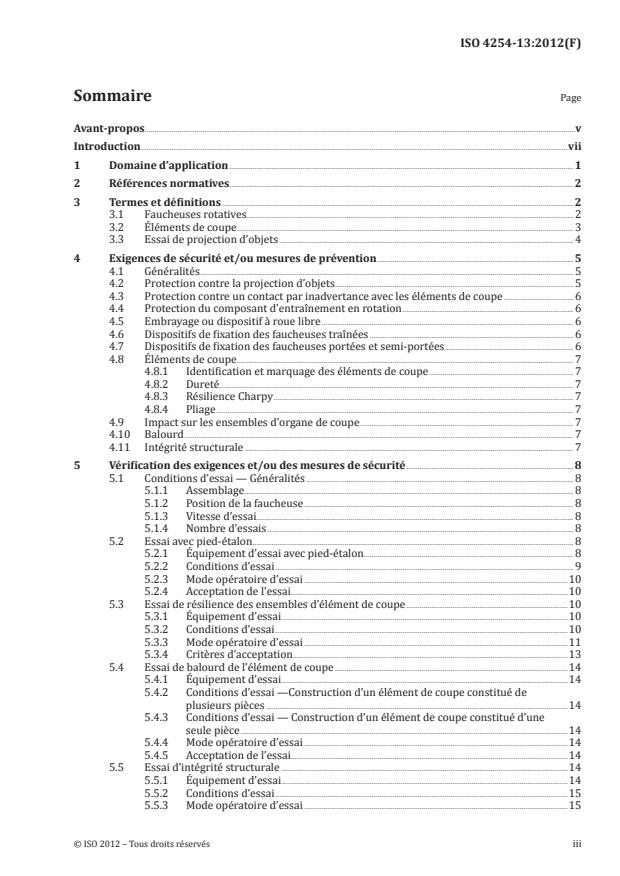
Sommaire Page
Avant-propos .v
Introduction .vii
1 Domaine d’application . 1
2 Références normatives . 2
3 Termes et définitions . 2
3.1 Faucheuses rotatives . 2
3.2 Éléments de coupe . 3
3.3 Essai de projection d’objets . 4
4 Exigences de sécurité et/ou mesures de prévention . 5
4.1 Généralités . 5
4.2 Protection contre la projection d’objets . 5
4.3 Protection contre un contact par inadvertance avec les éléments de coupe . 6
4.4 Protection du composant d’entraînement en rotation . 6
4.5 Embrayage ou dispositif à roue libre . 6
4.6 Dispositifs de fixation des faucheuses traînées . 6
4.7 Dispositifs de fixation des faucheuses portées et semi-portées . 6
4.8 Éléments de coupe . 7
4.8.1 Identification et marquage des éléments de coupe . 7
4.8.2 Dureté . 7
4.8.3 Résilience Charpy . 7
4.8.4 Pliage . 7
4.9 Impact sur les ensembles d’organe de coupe . 7
4.10 Balourd . 7
4.11 Intégrité structurale . 7
5 Vérification des exigences et/ou des mesures de sécurité . 8
5.1 Conditions d’essai — Généralités . 8
5.1.1 Assemblage . 8
5.1.2 Position de la faucheuse . 8
5.1.3 Vitesse d’essai. 8
5.1.4 Nombre d’essais . 8
5.2 Essai avec pied-étalon . 8
5.2.1 Équipement d’essai avec pied-étalon . 8
5.2.2 Conditions d’essai . 9
5.2.3 Mode opératoire d’essai .10
5.2.4 Acceptation de l’essai . .10
5.3 Essai de résilience des ensembles d’élément de coupe .10
5.3.1 Équipement d’essai . .10
5.3.2 Conditions d’essai .10
5.3.3 Mode opératoire d’essai .11
5.3.4 Critères d’acceptation . .13
5.4 Essai de balourd de l’élément de coupe .14
5.4.1 Équipement d’essai . .14
5.4.2 Conditions d’essai —Construction d’un élément de coupe constitué de
plusieurs pièces .14
5.4.3 Conditions d’essai — Construction d’un élément de coupe constitué d’une
seule pièce .14
5.4.4 Mode opératoire d’essai .14
5.4.5 Acceptation de l’essai . .14
5.5 Essai d’intégrité structurale .14
5.5.1 Équipement d’essai . .14
5.5.2 Conditions d’essai .15
5.5.3 Mode opératoire d’essai .15
5.5.4 Acceptation de l’essai . .15
5.6 Essai de projection d’objets .15
5.6.1 Zone de l’opérateur.15
5.6.2 Équipement d’essai . .18
5.6.3 Conditions d’essai .19
5.6.4 Mode opératoire d’essai .21
5.6.5 Résultats .22
5.6.6 Acceptation de l’essai . .22
5.7 Essai de résilience Charpy .23
5.8 Essai de pliage de l’élément de coupe .23
5.8.1 Échantillonnage .23
5.8.2 Installation d’essai .23
5.8.3 Mode opératoire de l’essai de pliage de l’élément de coupe .24
5.8.4 Autre méthode .25
5.8.5 Critères d’acceptation . .25
5.8.6 Mesures correctives .25
6 Informations pour l’utilisation .25
6.1 Notice d’instructions .25
7 Marquage et signaux de sécurité .26
7.1 Marquage .26
7.2 Signaux de sécurité.26
Annexe A (informative) Liste des phénomènes dangereux significatifs .28
Annexe B (informative) Exemples de formulaires de rapport d’essai .30
Annexe C (informative) Exemples d’illustrations de faucheuses .32
Annexe D (normative) Essais de pénétration du carton ondulé .36
Bibliographie .38
iv © ISO 2012 – Tous droits réservés
Avant-propos
L’ISO (Organisation internationale de normalisation) est une fédération mondiale d’organismes
nationaux de normalisation (comités membres de l’ISO). L’élaboration des Normes internationales est
en général confiée aux comités techniques de l’ISO. Chaque comité membre intéressé par une étude
a le droit de faire partie du comité technique créé à cet effet. Les organisations internationales,
gouvernementales et non gouvernementales, en liaison avec l’ISO participent également aux travaux.
L’ISO collabore étroitement avec la Commission électrotechnique internationale (IEC) en ce qui
concerne la normalisation électrotechnique.
Les procédures utilisées pour élaborer le présent document et celles destinées à sa mise à jour sont
décrites dans les Directives ISO/IEC, Partie 1. Il convient, en particulier de prendre note des différents
critères d’approbation requis pour les différents types de documents ISO. Le présent document a été
rédigé conformément aux règles de rédaction données dans les Directives ISO/IEC, Partie 2 (voir www.
iso.org/directives).
L’attention est appelée sur le fait que certains des éléments du présent document peuvent faire l’objet de
droits de propriété intellectuelle ou de droits analogues. L’ISO ne saurait être tenue pour responsable
de ne pas avoir identifié de tels droits de propriété et averti de leur existence. Les détails concernant
les références aux droits de propriété intellectuelle ou autres droits analogues identifiés lors de
l’élaboration du document sont indiqués dans l’Introduction et/ou dans la liste des déclarations de
brevets reçues par l’ISO (voir www.iso.org/brevets).
Les appellations commerciales éventuellement mentionnées dans le présent document sont données
pour information, par souci de commodité, à l’intention des utilisateurs et ne sauraient constituer un
engagement.
Pour une explication de la signification des termes et expressions spécifiques de l’ISO liés à
l’évaluation de la conformité, ou pour toute information au sujet de l’adhésion de l’ISO aux principes
de l’OMC concernant les obstacles techniques au commerce (OTC), voir le lien suivant: Avant-propos —
Informations supplémentaires
Le comité chargé de l’élaboration du présent document est l’ISO/TC 23, Tracteurs et matériels agricoles
et forestiers, sous-comité SC 7, Matériel de récolte et de conservation.
L’ISO 4254 comprend les parties suivantes, présentées sous le titre général Matériel agricole — Sécurité:
1)
— Partie 1: Exigences générales
— Partie 5: Machines de travail du sol à outils animés
— Partie 6: Pulvérisateurs et distributeurs d’engrais liquides
— Partie 7: Moissonneuses-batteuses, récolteuses-hacheuses-chargeuses de fourrage et récolteuses de coton
— Partie 8: Distributeurs d’engrais solides
— Partie 9: Semoirs
— Partie 10: Faneuses et andaineuses rotatives
— Partie 11: Ramasseuses-presses
— Partie 12: Faucheuses rotatives à disques, faucheuses rotatives à tambours et faucheuses-broyeuses
— Partie 13: Grandes faucheuses rotatives
1) À des fins de cohérence globale, les exigences relatives à la protection des éléments mobiles de transmission
de puissance ont été transférées et publiées dans deux Spécifications techniques distinctes: ISO/TS 28923, Matériel
agricole — Protecteurs pour éléments mobiles de transmission de puissance — Protecteur à ouverture avec outil et
ISO/TS 28924, Matériel agricole — Protecteurs pour éléments mobiles de transmission de puissance — Protecteur à
ouverture sans outil.
— Partie 14: Enrubanneuses
L’ISO 4254-2, Tracteurs et matériels agricoles et forestiers — Dispositifs techniques permettant d’assurer la
sécurité — Partie 2: Applicateurs d’ammoniac anhydre, a été annulée. L’ISO 4254-3, Tracteurs et matériels
agricoles et forestiers — Dispositifs techniques permettant d’assurer la sécurité — Partie 3: Tracteurs, a
été annulée et doit être remplacée par l’ISO 26322 (toutes les parties), Tracteurs agricoles et forestiers —
Sécurité. L’ISO 4254-4, Tracteurs et matériels agricoles et forestiers — Dispositifs techniques permettant
d’assurer la sécurité — Partie 4: Treuils pour matériels forestier et de sylviculture, a été annulée et
remplacée par l’ISO 19472, Matériel forestier — Treuils — Dimensions, performance et sécurité.
La présente version française tient compte de la version anglaise corrigée le 2014-12-15.
vi © ISO 2012 – Tous droits réservés
Introduction
La structure des normes de sécurité dans le domaine des machines est la suivante:
— normes de type A (normes fondamentales de sécurité), contenant des notions fondamentales, des
principes de conception et des aspects généraux relatifs aux machines;
— normes de type B (normes génériques de sécurité), traitant d’un aspect de la sécurité ou d’un moyen
de protection valable pour une large gamme de machines:
— normes de type B1, traitant d’aspects particuliers de la sécurité (par exemple, distances de sécurité,
température superficielle, bruit),
— normes de type B2, traitant de moyens de protection (par exemple, dispositifs de commande
bimanuelle, dispositifs de verrouillage, dispositifs sensibles à la pression, protecteurs);
— normes de type C (normes de sécurité par catégorie de machines), traitant des exigences de sécurité
détaillées s’appliquant à une machine particulière ou à un groupe de machines particulier.
Le présent document est une norme de type C tel que mentionné dans l’ISO 12100:2010.
Lorsque des dispositions de la présente norme de type C sont différentes de celles énoncées dans des
normes de type A ou de type B, les dispositions de la présente norme de type C prévalent sur celles des
autres normes pour les machines conçues et fabriquées conformément aux dispositions de la présente
norme de type C.
Les machines concernées et l’étendue des phénomènes dangereux, des situations dangereuses et des
événements dangereux couverts sont indiquées dans le domaine d’application de la présente partie de
l’ISO 4254. Ces phénomènes dangereux sont spécifiques aux grandes faucheuses rotatives.
Les phénomènes dangereux significatifs communs à toutes les machines agricoles (automotrices à
conducteur porté, portées, semi-portées ou traînées) sont traités dans l’ISO 4254-1.
NORME INTERNATIONALE ISO 4254-13:2012(F)
Matériel agricole — Sécurité —
Partie 13:
Grandes faucheuses rotatives
1 Domaine d’application
La présente partie de l’ISO 4254, destinée à être utilisée conjointement avec l’ISO 4254-1, spécifie les
exigences de sécurité et leur vérification pour la conception et la construction de grandes faucheuses
rotatives tractées, semi-portées ou portées pourvues d’un ou de plusieurs éléments de coupe, le
diamètre de coupe de chacun des ensembles d’élément de coupe étant supérieur ou égal à 1 000 mm,
montées sur un tracteur ou une machine motrice, destinées au matériel de fauchage agricole et conçues
pour le broyage de résidus végétaux, d’herbe et de broussailles par impact. Elle décrit des méthodes
permettant de réduire ou d’éliminer les phénomènes dangereux découlant d’une utilisation normale et
d’une mauvaise utilisation raisonnablement prévisible de ces machines par une personne (l’opérateur)
au cours du fonctionnement normal et de l’entretien. En outre, elle spécifie le type d’informations que le
fabricant doit donner sur les pratiques d’utilisation sûre.
NOTE 1 Ces machines peuvent être utilisées pour broyer de l’herbe. En cas d’utilisation dans une activité non
agricole, des exigences supplémentaires non spécifiées dans la présente partie de l’ISO 4254 peuvent s’appliquer.
La présente partie de l’ISO 4254 ne s’applique pas:
— aux faucheuses rotatives à disques, aux faucheuses rotatives à tambours et aux faucheuses-broyeuses
conçues pour la récolte de fourrage qui sont couvertes par l’ISO 4254-12;
— aux grandes faucheuses rotatives à bras;
— aux motofaucheuses à conducteur à pied;
— aux tondeuses à gazon qui sont couvertes par l’ISO 5395.
Lorsque des exigences de la présente partie de l’ISO 4254 sont différentes de celles énoncées dans
l’ISO 4254-1, les exigences de la présente partie de l’ISO 4254 prévalent sur les dispositions de
l’ISO 4254-1 pour les machines conçues et fabriquées conformément aux dispositions de la présente
partie de l’ISO 4254.
La présente partie de l’ISO 4254, utilisée conjointement avec l’ISO 4254-1, traite de tous les phénomènes
dangereux et situations et événements dangereux significatifs inhérents aux grandes faucheuses
rotatives dans le cadre d’une utilisation normale et des conditions prévues par le fabricant. (Une liste
de phénomènes dangereux significatifs est fournie à l’Annexe A.)
NOTE 2 À titre d’exemple, deux illustrations de faucheuses (une grande faucheuse rotative à châssis rigide
et une grande faucheuse rotative traînée à ailes repliables multisection) couvertes par la présente partie de
l’ISO 4254 sont présentées en C.1.
NOTE 3 À titre d’exemple, des illustrations de faucheuses non couvertes par la présente partie de l’ISO 4254
sont présentées en C.2.
La présente partie de l’ISO 4254 ne s’applique pas aux phénomènes dangereux liés à environnement, à
la sécurité routière, à la compatibilité électromagnétique, aux vibrations ni aux phénomènes dangereux
liés aux éléments mobiles de transmission de puissance. Elle ne s’applique pas non plus aux phénomènes
dangereux liés aux opérations de maintenance ou de réparation qui doivent être exécutées par des
professionnels habilités.
NOTE 4 L’ISO 14982 spécifie des méthodes d’essai et des critères d’acceptation pour l’évaluation de la
compatibilité électromagnétique de tous les types de matériel agricole mobile.
La présente partie de l’ISO 4254 ne s’applique pas aux grandes faucheuses rotatives fabriquées avant sa
date de publication par l’ISO.
2 Références normatives
Les documents suivants, en tout ou en partie, sont référencés de manière normative dans le présent
document et sont indispensables pour son application. Pour les références datées, seule l’édition citée
s’applique. Pour les références non datées, la dernière édition du document de référence s’applique (y
compris les éventuels amendements).
ISO 148-1:2009, Matériaux métalliques — Essai de flexion par choc sur éprouvette Charpy — Partie 1:
Méthode d’essai
ISO 730:2009, Tracteurs agricoles à roues — Attelage trois points monté à l’arrière — Catégories 1N, 1, 2N,
2, 3N, 3, 4N et 4
ISO 3600:1996, Tracteurs, matériels agricoles et forestiers, matériel à moteur pour jardins et pelouses —
Manuels d’utilisation — Contenu et présentation
ISO 4254-1, Matériel agricole — Sécurité — Partie 1: Exigences générales
ISO 4254-12:2012, Matériel agricole — Sécurité — Partie 12: Faucheuses rotatives à disques, faucheuses
rotatives à tambours et faucheuses-broyeuses
ISO 5673-1:2005, Tracteurs et matériels agricoles — Arbres de transmission à cardans de prise de force et
arbre récepteur de la machine — Partie 1: Exigences générales de fabrication et de sécurité
ISO 6508-1:2005, Matériaux métalliques — Essai de dureté Rockwell — Partie 1: Méthode d’essai
(échelles A, B, C, D, E, F, G, H, K, N, T)
ISO 11684:1995, Tracteurs et matériels agricoles et forestiers, matériels à moteur pour jardins et
pelouses — Signaux de sécurité et de danger — Principes généraux
ISO 12100:2010, Sécurité des machines — Principes généraux de conception — Appréciation du risque et
réduction du risque
ISO 13857:2008, Sécurité des machines — Distances de sécurité empêchant les membres supérieurs et
inférieurs d’atteindre les zones dangereuses
3 Termes et définitions
Pour les besoins du présent document, les termes et définitions donnés dans l’ISO 4254-1, l’ISO 4254-12
et l’ISO 12100 ainsi que les suivants s’appliquent.
3.1 Faucheuses rotatives
3.1.1
grande faucheuse rotative
faucheuse, pouvant comporter une fonction de broyage, pourvue d’un ou de plusieurs ensembles
d’élément de coupe de diamètre de coupe supérieur ou égal à 1 000 mm, mue par une machine motrice,
dans laquelle un ou plusieurs composants fonctionnels tournent autour d’un axe vertical pour couper
ou cisailler des résidus végétaux, de l’herbe ou des broussailles par impact
2 © ISO 2012 – Tous droits réservés
3.1.1.1
grandes faucheuses rotatives à châssis rigide
grandes faucheuses rotatives comportant un ou plusieurs ensembles d’élément de coupe sur un châssis
rigide commun
3.1.1.2
grandes faucheuses rotatives à ailes repliables multisection
grandes faucheuses rotatives comportant plusieurs ensembles d’élément de coupe et un ou plusieurs
ailes aptes à suivre le terrain
Note 1 à l’article: Les ailes peuvent être repliées pour le transport et le franchissement d’obstacles, mais ils sont
destinés à être utilisés uniquement avec toutes les sections à proximité de la surface du sol lors du fauchage.
3.2 Éléments de coupe
3.2.1
élément de coupe
outil de la faucheuse conçu pour couper ou cisailler des résidus végétaux, de l’herbe et des broussailles
par impact
Note 1 à l’article: L’élément de coupe peut comporter une fonction de broyage.
Note 2 à l’article: Les barres de coupe, lames et faucilles sont des éléments de coupe courants.
3.2.2
lot d’éléments de coupe
ensemble défini par le fabricant d’éléments de coupe, qui peut être rapporté au procédé de fabrication
et à la coulée de l’usine
Note 1 à l’article: Des coulées d’acier différentes conduisent à des lots d’éléments de coupe différents.
3.2.3
coulée d’acier
métal produit au cours d’un seul cycle d’un procédé de fusion discontinue
Note 1 à l’article: L’analyse de coulée est effectuée à partir d’un petit échantillon de métal en fusion prélevé dans
la poche ou dans le four. Une fois l’échantillon solidifié, une analyse spectrochimique est réalisée. Si les résultats
de l’analyse chimique sont conformes aux spécifications, le reste du métal en fusion peut être coulé et recevoir
un même numéro de coulée. En général, les coulées font plus de 50 t, de nombreuses usines travaillant avec des
coulées d’environ 300 t.
3.2.4
angle de déformation permanente
angle formé par le dos de l’élément de coupe ou de l’éprouvette au niveau du pli une fois l’élément ou
l’éprouvette retiré(e) de l’installation d’essai de pliage de l’élément de coupe
Note 1 à l’article: Voir Figure 1.
Légende
1 angle de déformation permanente
Figure 1 — Angle de déformation permanente de l’élément de coupe après l’essai de pliage
3.2.5
angle de déflexion totale
somme de l’angle de déformation permanente et du retour élastique estimé
Note 1 à l’article: Cet angle est destiné à faciliter la conception de l’installation et ne constitue pas un critère
d’acceptation (voir 5.8, Tableau 1).
3.2.6
éprouvette
échantillon plat présentant la même section et provenant du même lot d’éléments de coupe que les
éléments de coupe qu’il représente
3.3 Essai de projection d’objets
3.3.1
position normale d’utilisation
espace situé à l’intérieur de la zone de l’opérateur, que l’opérateur occupe lorsqu’il utilise la faucheuse
Note 1 à l’article: L’opérateur est assis sur le siège de la machine motrice, les mains sur les commandes de
direction et les pieds sur les commandes ou dans les zones prévues à cet effet.
Note 2 à l’article: Des exemples de configurations cibles sont donnés sur les Figures 7 et 8.
3.3.2
impact de projectile
rupture par un projectile d’essai, de la couche avant du matériau cible, mais pas de la couche arrière
3.3.3
perforation de projectile
rupture par un projectile d’essai, de toutes les couches du matériau cible
3.3.4
matériau cible
matériau utilisé pour l’essai de projection d’objets
Note 1 à l’article: Voir l’Annexe D.
3.3.5
projectile d’essai
clou en acier ordinaire ou fil d’acier présentant les dimensions approximatives illustrées sur la Figure 2
Note 1 à l’article: Il convient que le projectile de type fil puisse être plié à 180° sans se fissurer ni se rompre.
4 © ISO 2012 – Tous droits réservés
Dimensions en millimètres
a) Critères relatifs au projectile de type clou b) Critères relatifs au projectile de type fil
Figure 2 — Projectile d’essai
3.3.6
zone de l’opérateur
espace situé à l’intérieur de la zone cible, où l’opérateur est assis en position normale d’utilisation sur la
machine motrice lorsqu’il utilise la faucheuse
Note 1 à l’article: Voir Figures 7 et 8.
3.3.7
parois cibles
agencement du matériau cible et des supports
Note 1 à l’article: Voir la vue en coupe de la Figure 9 pour la configuration représentée sur les Figures 7 et 8.
4 Exigences de sécurité et/ou mesures de prévention
4.1 Généralités
4.1.1 Les machines doivent être conformes aux exigences de sécurité et/ou aux mesures de
prévention des Articles 4 et 5. Les machines doivent respecter les exigences d’essai et les critères
d’acceptation spécifiés en 5.3, 5.4 et 5.5. De plus, les machines doivent être conçues selon les principes
de l’ISO 12100:2010 pour les phénomènes dangereux pertinents mais non significatifs qui ne sont pas
traités dans le présent document.
4.1.2 Sauf spécification contraire dans la présente partie de l’ISO 4254, les machines doivent être
conformes aux exigences de l’ISO 4254-1 et aux Tableaux 1, 3, 4 et 6 de l’ISO 13857:2008.
4.1.3 La vitesse maximale à l’extrémité des éléments de coupe ne doit pas dépasser 96,5 m/s.
4.2 Protection contre la projection d’objets
La faucheuse doit être conçue pour réduire au minimum la projection d’objets, de sorte à satisfaire aux
essais définis en 5.6.
Des dispositifs de protection (par exemple, jupes protectrices, chaînes, bavettes) peuvent être utilisés.
4.3 Protection contre un contact par inadvertance avec les éléments de coupe
4.3.1 La faucheuse doit être conçue ou protégée de manière à empêcher tout contact par inadvertance
avec les éléments de coupe sur les côtés et sur le dessus lorsque la faucheuse est utilisée conformément
aux instructions du fabricant figurant dans la notice d’instructions.
4.3.2 La faucheuse doit être conçue ou protégée de manière à réduire au minimum tout contact par
inadvertance avec les éléments de coupe à l’avant (normalement l’entrée) et à l’arrière (normalement
la sortie) lorsque la faucheuse est utilisée conformément aux instructions du fabricant figurant dans la
notice d’instructions.
4.3.3 La protection du dessus doit être assurée par un protecteur rigide ou par le dispositif utilisé pour
empêcher la projection d’objets.
4.3.4 Sur les côtés, à l’avant (zone d’entrée) et à l’arrière (zone de sortie), la protection doit être
assurée par un protecteur rigide ou souple et/ou par le dispositif utilisé pour réduire au minimum les
projections, de telle sorte que lors d’un essai selon 5.2, il n’y ait aucun contact entre le pied-étalon et
l’élément de coupe ou l’ensemble d’élément de coupe.
4.4 Protection du composant d’entraînement en rotation
4.4.1 La faucheuse doit être conçue ou protégée de manière à réduire au minimum tout contact
par inadvertance avec le composant d’entraînement en rotation lorsque la faucheuse est utilisée
conformément aux instructions du fabricant figurant dans la notice d’instructions.
4.4.2 Les arbres récepteurs et leurs points de raccordement doivent être protégés conformément à
l’ISO 5673-1:2005. Les autres éléments mobiles de transmission de puissance doivent être protégés
contre tout contact de sorte à se conformer aux distances de sécurité des Tableaux 1, 3, 4 et 6 de
l’ISO 13857:2008.
4.5 Embrayage ou dispositif à roue libre
4.5.1 Les faucheuses équipées d’un embrayage ou d’un dispositif à roue libre doivent être protégées
comme décrit en 4.4.
4.5.2 S’il existe un risque de contact par inadvertance avec des éléments en rotation, ceux-ci doivent
être munis d’un dispositif mettant en évidence la rotation et comporter un signal de sécurité avertissant
du danger.
4.5.3 La notice d’instructions doit comporter des instructions indiquant d’attendre l’arrêt de tous les
mouvements avant toute intervention d’entretien.
4.6 Dispositifs de fixation des faucheuses traînées
Les unités traînées doivent être conçues de telle sorte qu’une charge dirigée vers le bas représentant
3 % du poids total, ou au moins 500 N, persiste sur le point d’attelage, afin d’éviter tout mouvement
intempestif vers le haut au moment de la déconnexion.
4.7 Dispositifs de fixation des faucheuses portées et semi-portées
Les faucheuses portées et semi-portées à l’aide d’un attelage à trois points doivent être fixées à
la machine motrice selon une ou plusieurs des méthodes de fixation normalisées définies dans
l’ISO 730:2009.
6 © ISO 2012 – Tous droits réservés
4.8 Éléments de coupe
4.8.1 Identification et marquage des éléments de coupe
Chaque élément de coupe doit comporter les informations suivantes, gravées ou apposées de façon
permanente de quelque autre manière que ce soit, dans une zone non critique du point de vue des
contraintes, qui doit être lisible sur un élément de coupe utilisé:
— identification du fabricant d’éléments de coupe;
— date de fabrication, numéro de lot ou numéro de série de fabrication.
4.8.2 Dureté
La valeur de dureté Rockwell doit être supérieure ou égale à 38 HRC conformément à l’ISO 6508-1:2005.
4.8.3 Résilience Charpy
L’élément de coupe doit avoir une valeur de résilience Charpy moyenne supérieure ou égale à 20,3 J lors
d’un essai selon 5.7.
4.8.4 Pliage
L’élément de coupe ne doit présenter aucune fissure visible à l’œil nu après avoir été soumis à l’essai de
pliage de 5.8.
4.9 Impact sur les ensembles d’organe de coupe
4.9.1 La faucheuse doit résister à un impact soudain sur l’organe de coupe.
4.9.2 La conformité est vérifiée par la réalisation de l’essai de 5.3 sans que la faucheuse perde de pièce ni
qu’un de ses composants se brise, à l’exclusion de morceaux de l’élément de coupe de masse inférieure ou
égale à 30 g, d’une manière susceptible de présenter un danger pour l’opérateur ou les personnes se tenant
à proximité. Aucune pièce de la faucheuse ou des éléments de coupe ne doit perforer les parois cibles.
4.10 Balourd
La faucheuse doit résister au balourd de l’organe de coupe. Aucune pièce de la faucheuse ne doit se
desserrer, se casser ou être éjectée si elle est nécessaire pour garantir la conformité aux exigences de
la présente partie de l’ISO 4254, et aucun autre composant ni aucune autre pièce de la faucheuse ne doit
perforer toutes les parois cibles, lorsqu’un essai est réalisé conformément à 5.4.
4.11 Intégrité structurale
4.11.1 Les ensembles d’organe de coupe doivent résister aux contraintes de choc auxquelles ils sont
soumis en fonctionnement.
4.11.2 Le châssis supérieur ou latéral doit être conçu en acier demi-doux d’une épaisseur supérieure ou
égale à 3 mm.
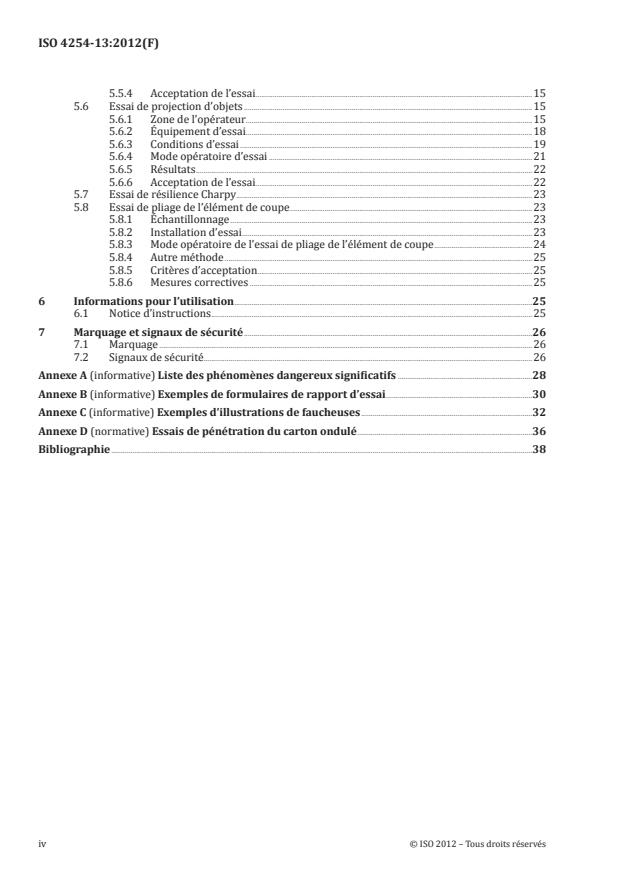
4.11.3 Pour les autres matériaux, et pour les matériaux d’une épaisseur inférieure à 3 mm, la conformité
est vérifiée par la réalisation de l’essai de 5.5. Aucune des tiges d’essai ne doit transpercer le logement ou
l’enceinte de l’élément de coupe et aucune autre protection ne doit être mise en défaut.
5 Vérification des exigences et/ou des mesures de sécurité
5.1 Conditions d’essai — Généralités
5.1.1 Assemblage
5.1.1.1 La faucheuse doit être complètement assemblée et montée sur la machine motrice associée
ou fixée à cette dernière, excepté pour les essais pour lesquels le montage sur une installation d’essai
appropriée est indiqué. Ou bien, si nécessaire, l’essai sur l’unité de faucheuse peut être réalisé lorsque
celle-ci est séparée de l’unité d’entraînement, la puissance pouvant être fournie par un autre moyen.
Toutefois, les vitesses doivent être identiques à celles atteintes lorsque la faucheuse est montée sur la
machine motrice ou fixée à cette dernière, et les pièces fixes de la faucheuse qui se prolongent dans la
trajectoire doivent également être reproduites aussi fidèlement que possible.
5.1.1.2 Pour l’essai, les protecteurs réglables doivent être placés dans la position la plus ouverte.
5.1.2 Position de la faucheuse
La faucheuse doit reposer sur une surface horizontale plane à 2° près.
Si nécessaire, il convient d’utiliser un dispositif permettant de maintenir la faucheuse en position
pendant l’essai. Des dispositifs de retenue souples (comme des chaînes) peuvent être utilisés.
5.1.3 Vitesse d’essai
Hormis pour les essais statiques, la faucheuse doit être utilisée à la vitesse de fonctionnement la plus
élevée recommandée dans la notice d’instructions.
5.1.4 Nombre d’essais
Sauf indication contraire dans le présent document, tous les essais doivent être réalisés une fois pour
chaque ensemble d’élément de coupe de la faucheuse. Une faucheuse neuve peut être utilisée pour
chaque essai, sauf pour l’essai d’intégrité structurale et pour l’essai de projection d’objets.
5.2 Essai avec pied-étalon
5.2.1 Équipement d’essai avec pied-étalon
L’équipement d’essai avec pied-étalon doit être construit conformément à la Figure 3.
8 © ISO 2012 – Tous droits réservés
Dimensions en millimètres
Figure 3 — Équipement d’essai avec pied-étalon
Dimensions en millimètres
Légende
1 circonférence de coupe de l’élément de coupe
2 pied-étalon
3 niveau du sol
4 élément de coupe de la faucheuse
Figure 4 — Essai avec pied-étalon
5.2.2 Conditions d’essai
5.2.2.1 L’essai doit être réalisé dans des conditions statiques, sur une surface plane, la faucheuse fixée
à un tracteur.
5.2.2.2 L’élément de coupe doit être fixé au support d’élément de coupe de manière à simuler le
diamètre de coupe maximal dans le plan de coupe.
5.2.2.3 Pour les besoins de cet essai, il peut être considéré que les composants des faucheuses et/ou de
la machine, comme les châssis, font partie de l’enceinte de l’élément de coupe.
5.2.3 Mode opératoire d’essai
5.2.3.1 Le pied-étalon doit être présenté à la faucheuse avec la partie inférieure horizontale et
être maintenu avec la partie supérieure dans un plan vertical; il doit être tourné horizontalement et
verticalement d’au plus 15° d’un côté ou de l’autre de l’axe, tout en étant soulevé et abaissé comme
illustré sur la Figure 4.
5.2.3.2 Le pied-étalon doit être appliqué jusqu’à ce qu’une force horizontale de 110 N ± 10 N soit
atteinte, jusqu’à ce qu’une partie de l’enceinte de l’organe de coupe se soulève par rapport à sa position
d’origine ou jusqu’à ce qu’un contact soit établi avec la trajectoire de l’organe de coupe, le premier
événement étant retenu. Si la hauteur de la trajectoire de l’élément de coupe est différente selon les
vitesses ou les options d’élément de coupe, l’essai doit porter sur les deux hauteurs extrêmes de l’élément
de coupe.
5.2.4 Acceptation de l’essai
Il faut vérifier l’exigence stipulant l’absence de contact entre le pied-étalon et l’élément de coupe ou les
ensembles d’élément de coupe en faisant tourner lentement les éléments de coupe à la main, moteur à
l’arrêt.
5.3 Essai de résilience des ensembles d’élément de coupe
5.3.1 Équipement d’essai
5.3.1.1 Au moment de l’essai, la faucheuse doit être entièrement entourée d’une paroi de matériau
cible conforme à 3.3.7 et être soumise à l’essai selon l’Annexe D, la faucheuse reposant sur le sol. L’essai
peut être réalisé sur du sable, de la terre ou du béton.
5.3.1.2 La paroi cible doit être positionnée conformément aux Figures 7, 8 et 9.
5.3.1.3 Une barrière de protection doit être mise en place pour protéger l’opérateur.
5.3.1.4 La tige d’essai doit avoir un diamètre de 51 mm ± 1 mm et être constituée d’acier demi-doux
présentant une résistance à la traction de 1 050 MPa ± 50 MPa.
5.3.1.5 L’installation d’essai doit être construite comme illustré sur la Figure 5.
5.3.2 Conditions d’essai
5.3.2.1 La faucheuse doit être réglée à une hauteur de coupe statique d’environ 75 mm ou au réglage
de hauteur de coupe le plus proche de 75 mm.
5.3.2.2 La faucheuse doit être réglée de sorte à fonctionner à la vitesse spécifiée en 5.1.3.
10 © ISO 2012 – Tous droits réservés
5.3.3 Mode opératoire d’essai
5.3.3.1 La faucheuse doit être positionnée sur une installation maintenant la tige d’essai fixe et être
lâchée sur cette dernière de telle sorte que l’élément de coupe touche directement la tige.
NOTE Des exemples de construction et de configuration de cette installation sont représentés sur les
Figures 5 et 6.
5.3.3.2 La faucheuse doit être lâchée suffisamment vite pour que sa vitesse ne soit pas nettement
réduite par un contact tangentiel avant qu’un plein contact n’ait lieu.
NOTE Il est possible de modifier le mécanisme de levage des faucheuses pour accroître leur vitesse de chute.
5.3.3.3 Il faut lâcher la faucheuse sur la tige et la laisser fonctionner au moins 2 s avant de l’éteindre ou
de la relever.
5.3.3.4 L’essai doi
...
Questions, Comments and Discussion
Ask us and Technical Secretary will try to provide an answer. You can facilitate discussion about the standard in here.
Loading comments...