


IEC 61691-1:1997
(Main)Design automation - Part 1: VHDL language reference manual
General Information
- Abstract
This standard is based on IEEE Std 1076. It describes the Very High Speed Integrated Circuit (VHSIC) Hardware Description Language (VHDL)
- Status
- Replaced
- Publication Date
- 17-Jul-1997
- Technical Committee
- TC 91 - Electronics assembly technology
- Drafting Committee
- WG 2 - TC 91/WG 2
- Current Stage
- WPUB - Publication withdrawn
- Start Date
- 01-Oct-2004
- Completion Date
- 28-Aug-2026
Relations
- Effective Date
- 05-Sep-2023
Get Certified
Connect with accredited certification bodies for this standard

BSI Group
BSI (British Standards Institution) is the business standards company that helps organizations make excellence a habit.

DVS-ZERT GmbH
German welding certification society.
CARES (UK Certification Authority for Reinforcing Steels)
UK certification for reinforcing steels and construction.
Sponsored listings
Frequently Asked Questions
IEC 61691-1:1997 is a standard published by the International Electrotechnical Commission (IEC). Its full title is "Design automation - Part 1: VHDL language reference manual". This standard covers: This standard is based on IEEE Std 1076. It describes the Very High Speed Integrated Circuit (VHSIC) Hardware Description Language (VHDL)
This standard is based on IEEE Std 1076. It describes the Very High Speed Integrated Circuit (VHSIC) Hardware Description Language (VHDL)
IEC 61691-1:1997 is classified under the following ICS (International Classification for Standards) categories: 25.040.01 - Industrial automation systems in general; 35.240.50 - IT applications in industry. The ICS classification helps identify the subject area and facilitates finding related standards.
IEC 61691-1:1997 has the following relationships with other standards: It is inter standard links to IEC 61691-1-1:2004. Understanding these relationships helps ensure you are using the most current and applicable version of the standard.
IEC 61691-1:1997 is available in PDF format for immediate download after purchase. The document can be added to your cart and obtained through the secure checkout process. Digital delivery ensures instant access to the complete standard document.
Standards Content (Sample)
INTERNATIONAL
IEC
STANDARD
61691-1
First edition
1997-06
Design automation –
Part 1:
VHDL language reference manual
Automatisation de la conception –
Partie 1:
Manuel de référence du langage VHDL
Numéro de référence
Reference number
IEC 61691-1: 1997 (E)
Validité de la présente publication Validity of this publication
Le contenu technique des publications de la CEI est The technical content of IEC publications is kept under
constamment revu par la CEI afin qu'il reflète l'état constant review by the IEC, thus ensuring that the
actuel de la technique. content reflects current technology.
Des renseignements relatifs à la date de Information relating to the date of the reconfirmation
reconfirmation de la publication sont disponibles of the publication is available from the IEC Central
auprès du Bureau Central de la CEI. Office.
Les renseignements relatifs à ces révisions, à Information on the revision work, the issue of revised
l'établissement des éditions révisées et aux editions and amendments may be obtained from IEC
amendements peuvent être obtenus auprès des National Committees and from the following IEC
Comités nationaux de la CEI et dans les documents sources:
ci-dessous:
• Bulletin de la CEI • IEC Bulletin
• Annuaire de la CEI • IEC Yearbook
Publié annuellement Published yearly
• Catalogue des publications de la CEI • Catalogue of IEC publications
Publié annuellement et mis à jour régulièrement Published yearly with regular updates
Terminologie Terminology
En ce qui concerne la terminologie générale, le lecteur For general terminology, readers are referred to
se reportera à la CEI 60050: Vocabulaire IEC 60050: International Electrotechnical Vocabulary
Electrotechnique International (VEI), qui se présente (IEV), which is issued in the form of separate chapters
sous forme de chapitres séparés traitant chacun d'un each dealing with a specific field. Full details of the
sujet défini. Des détails complets sur le VEI peuvent IEV will be supplied on request. See also the IEC
être obtenus sur demande. Voir également le Multilingual Dictionary.
dictionnaire multilingue de la CEI.
Les termes et définitions figurant dans la présente The terms and definitions contained in the present
publication ont été soit tirés du VEI, soit publi-cation have either been taken from the IEV or
spécifiquement approuvés aux fins de cette have been specifically approved for the purpose of this
publication. publication.
Symboles graphiques et littéraux Graphical and letter symbols
Pour les symboles graphiques, les symboles littéraux For graphical symbols, and letter symbols and signs
et les signes d'usage général approuvés par la CEI, le approved by the IEC for general use, readers are
lecteur consultera: referred to publications:
– IEC 60027: Letter symbols to be used in electrical
– la CEI 60027: Symboles littéraux à utiliser en
technology;
électrotechnique;
– IEC 60417: Graphical symbols for use on
– la CEI 60417: Symboles graphiques utilisables sur
equipment. Index, survey and compilation of the
le matériel. Index, relevé et compilation des feuilles
individuelles; single sheets;
Symboles graphiques pour schémas; – IEC 60617: Graphical symbols for diagrams;
– la CEI 60617:
and for medical electrical equipment,
et pour les appareils électromédicaux,
– IEC 60878: Graphical symbols for electromedical
– la CEI 60878: Symboles graphiques pour
equipment in medical practice.
équipements électriques en pratique médicale.
Les symboles et signes contenus dans la présente The symbols and signs contained in the present
publication ont été soit tirés de la CEI 60027, de la publication have either been taken from IEC 60027,
IEC 60417, IEC 60617 and/or IEC 60878, or have
CEI 60417, de la CEI 60617 et/ou de la CEI 60878,
been specifically approved for the purpose of this
soit spécifiquement approuvés aux fins de cette
publication.
publication.
Publications de la CEI établies par le IEC publications prepared by the same
même comité d'études technical committee
The attention of readers is drawn to the end pages of
L'attention du lecteur est attirée sur les listes figurant
this publication which list the IEC publications issued
à la fin de cette publication, qui énumèrent les
by the technical committee which has prepared the
publications de la CEI préparées par le comité
present publication.
d'études qui a établi la présente publication.
INTERNATIONAL IEC
STANDARD
61691-1
First edition
1997-06
Design automation –
Part 1:
VHDL language reference manual
Automatisation de la conception –
Partie 1:
Manuel de référence du langage VHDL
© IEC 1997 Droits de reproduction réservés – Copyright - all rights reserved
Aucune partie de cette publication ne peut être reproduite ni No part of this publication may be reproduced or utilized in
utilisée sous quelque forme que ce soit et par aucun procédé, any form or by any means, electronic or mechanical, including
électronique ou mécanique, y compris la photo-copie et les photocopying and microfilm, without permission in writing
microfilms, sans l'accord écrit de l'éditeur. from the publisher.
International Electrotechnical Commission 3, rue de Varembé Geneva, Switzerland
Telefax: +41 22 919 0300 e-mail: inmail@iec.ch IEC web site http: //www.iec.ch
CODE PRIX
Commission Electrotechnique Internationale
PRICE CODE XH
International Electrotechnical Commission
Pour prix, voir catalogue en vigueur
For price, see current catalogue
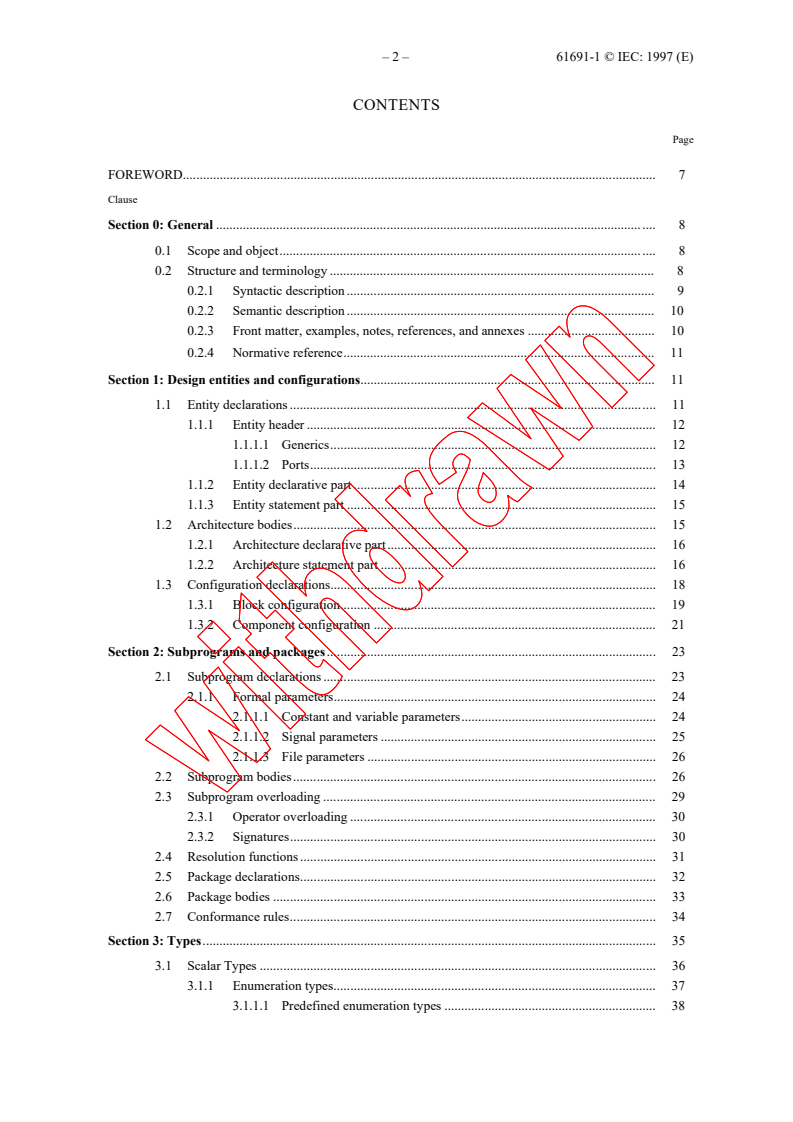
– 2 – 61691-1 © IEC: 1997 (E)
CONTENTS
Page
FOREWORD. 7
Clause
Section 0: General . . 8
0.1 Scope and object. . 8
0.2 Structure and terminology . 8
0.2.1 Syntactic description . 9
0.2.2 Semantic description . 10
0.2.3 Front matter, examples, notes, references, and annexes . 10
0.2.4 Normative reference. 11
Section 1: Design entities and configurations. 11
1.1 Entity declarations . 11
1.1.1 Entity header . 12
1.1.1.1 Generics. 12
1.1.1.2 Ports. 13
1.1.2 Entity declarative part . 14
1.1.3 Entity statement part . 15
1.2 Architecture bodies. 15
1.2.1 Architecture declarative part . 16
1.2.2 Architecture statement part . 16
1.3 Configuration declarations. 18
1.3.1 Block configuration. 19
1.3.2 Component configuration . 21
Section 2: Subprograms and packages . 23
2.1 Subprogram declarations . 23
2.1.1 Formal parameters. 24
2.1.1.1 Constant and variable parameters. 24
2.1.1.2 Signal parameters . 25
2.1.1.3 File parameters . 26
2.2 Subprogram bodies.26
2.3 Subprogram overloading . 29
2.3.1 Operator overloading . 30
2.3.2 Signatures. 30
2.4 Resolution functions . 31
2.5 Package declarations. 32
2.6 Package bodies . 33
2.7 Conformance rules. 34
Section 3: Types. 35
3.1 Scalar Types . 36
3.1.1 Enumeration types. 37
3.1.1.1 Predefined enumeration types . 38
61691-1 © IEC: 1997 (E) – 3 –
3.1.2 Integer types. 38
3.1.2.1 Predefined integer types . 39
3.1.3 Physical types. 39
3.1.3.1 Predefined physical types . 41
3.1.4 Floating point types. 41
3.1.4.1 Predefined floating point types. 42
3.2 Composite types . 42
3.2.1 Array types. 42
3.2.1.1 Index constraints and discrete ranges . 44
3.2.1.2 Predefined array types . 47
3.2.2 Record types. 47
3.3 Access types . 48
3.3.1 Incomplete type declarations. 48
3.3.2 Allocation and deallocation of objects. 49
3.4 File types. 50
3.4.1 File operations. 50
Section 4: Declarations. 52
4.1 Type declarations. 53
4.2 Subtype declarations. 54
4.3 Objects. 55
4.3.1 Object declarations. 55
4.3.1.1 Constant declarations. 56
4.3.1.2 Signal declarations. 56
4.3.1.3 Variable declarations . 58
4.3.1.4 File declarations. 59
4.3.2 Interface declarations . 60
4.3.2.1 Interface lists . 62
4.3.2.2 Association lists. 63
4.3.3 Alias declarations. 65
4.3.3.1 Object aliases. 66
4.3.3.2 Nonobject aliases. 67
4.4 Attribute declarations. 68
4.5 Component declarations . 69
4.6 Group template declarations. 69
4.7 Group declarations. 70
Section 5: Specifications. 71
5.1 Attribute specification . 71
5.2 Configuration specification . 73
5.2.1 Binding indication. 74
5.2.1.1 Entity aspect . 76
5.2.1.2 Generic map and port map aspects. 77
5.2.2 Default binding indication. 79
5.3 Disconnection specification. 80
– 4 – 61691-1 © IEC: 1997 (E)
Section 6: Names. . 82
6.1 Names . 82
6.2 Simple names. 84
6.3 Selected names . 84
6.4 Indexed names . 87
6.5 Slice names. 87
6.6 Attribute names. 88
Section 7: Expressions. 88
7.1 Expressions. 88
7.2 Operators . 90
7.2.1 Logical operators. 90
7.2.2 Relational operators . 91
7.2.3 Shift operators. 92
7.2.4 Adding operators. 94
7.2.5 Sign operators . 96
7.2.6 Multiplying operators. 96
7.2.7 Miscellaneous operators. 98
7.3 Operands. 99
7.3.1 Literals . 99
7.3.2 Aggregates . 100
7.3.2.1 Record aggregates . 100
7.3.2.2 Array aggregates. 101
7.3.3 Function calls . 102
7.3.4 Qualified expressions. 102
7.3.5 Type conversions . 103
7.3.6 Allocators. 104
7.4 Static expressions. 105
7.4.1 Locally static primaries . 105
7.4.2 Globally static primaries . 106
7.5 Universal expressions . 107
Section 8: Sequential statements . 108
8.1 Wait statement . 109
8.2 Assertion statement. 111
8.3 Report statement . 111
8.4 Signal assignment statement. 112
8.4.1 Updating a projected output waveform. 114
8.5 Variable assignment statement . 117
8.5.1 Array variable assignments . 117
8.6 Procedure call statement. 118
8.7 If statement . 118
8.8 Case statement . 119
8.9 Loop statement . 120
8.10 Next statement . 121
8.11 Exit statement . 121
8.12 Return statement . 121
8.13 Null statement. 122
61691-1 © IEC: 1997 (E) – 5 –
Section 9: Concurrent statements . 122
9.1 Block statement . 123
9.2 Process statement. 124
9.3 Concurrent procedure call statements. 125
9.4 Concurrent assertion statements . 126
9.5 Concurrent signal assignment statements . 127
9.5.1 Conditional signal assignments. 129
9.5.2 Selected signal assignments . 130
9.6 Component instantiation statements . 131
9.6.1 Instantiation of a component. 132
9.6.2 Instantiation of a design entity . 134
9.7 Generate statements. 137
Section 10: Scope and visibility . 138
10.1 Declarative region. . 138
10.2 Scope of declarations. 139
10.3 Visibility . 140
10.4 Use clauses . 143
10.5 The context of overload resolution. 144
Section 11: Design units and their analysis . 145
11.1 Design units . 145
11.2 Design libraries. 145
11.3 Context clauses . 146
11.4 Order of analysis. 147
Section 12: Elaboration and execution . 147
12.1 Elaboration of a design hierarchy. 148
12.2 Elaboration of a block header. 14 9
12.2.1 The generic clause. 149
12.2.2 The generic map aspect. 150
12.2.3 The port clause. 150
12.2.4 The port map aspect . 150
12.3 Elaboration of a declarative part. 15 1
12.3.1 Elaboration of a declaration . 151
12.3.1.1 Subprogram declarations and bodies. 152
12.3.1.2 Type declarations. 152
12.3.1.3 Subtype declarations. 152
12.3.1.4 Object declarations . 153
12.3.1.5 Alias declarations . 153
12.3.1.6 Attribute declarations . 153
12.3.1.7 Component declarations . 153
12.3.2 Elaboration of a specification. 153
12.3.2.1 Attribute specifications. 154
12.3.2.2 Configuration specifications. 154
12.3.2.3 Disconnection specifications . 154
– 6 – 61691-1 © IEC: 1997 (E)
12.4 Elaboration of a statement part. 155
12.4.1 Block statements . 155
12.4.2 Generate statements . 155
12.4.3 Component instantiation statements. 157
12.4.4 Other concurrent statements. 157
12.5 Dynamic elaboration. 157
12.6 Execution of a model. 158
12.6.1 Drivers. 158
12.6.2 Propagation of signal values . 159
12.6.3 Updating implicit signals . 162
12.6.4 The simulation cycle . 163
Section 13: Lexical elements. 164
13.1 Character set . 164
13.2 Lexical elements, separators, and delimiters . 166
13.3 Identifiers. 167
13.3.1 Basic identifiers. 167
13.3.2 Extended identifiers . 168
13.4 Abstract literals. 168
13.4.1 Decimal literals . 168
13.4.2 Based literals . 169
13.5 Character literals . 169
13.6 String literals . 170
13.7 Bit string literals. 170
13.8 Comments . 172
13.9 Reserved words . 172
13.10 Allowable replacements of characters. 173
Section 14: Predefined language environment. 173
14.1 Predefined attributes. 173
14.2 Package STANDARD. 187
14.3 Package TEXTIO . 194
Annex A – Syntax summary . 199
Annex B – Glossary . . 216
Annex C – Potentially nonportable constructs . 233
Annex D – Changes from IEEE Std 1076-1987 . 235
Annex E – Related standards . 236
Index. 237
61691-1 © IEC: 1997 (E) – 7 –
INTERNATIONAL ELECTROTECHNICAL COMMISSION
_________
DESIGN AUTOMATION –
Part 1: VHDL language reference manual
FOREWORD
1) The IEC (International Electrotechnical Commission) is a worldwide organization for standardization
comprising all national electrotechnical committees (IEC National Committees). The object of the IEC is to
promote international co-operation on all questions concerning standardization in the electrical and
electronic fields. To this end and in addition to other activities, the IEC publishes International Standards.
Their preparation is entrusted to technical committees; any IEC National Committee interested in the
subject dealt with may participate in this preparatory work. International, governmental and non-
governmental organizations liaising with the IEC also participate in this preparation. The IEC collaborates
closely with the International Organization for Standardization (ISO) in accordance with conditions
determined by agreement between the two organizations.
2) The formal decisions or agreements of the IEC on technical matters express, as nearly as possible, an
international consensus of opinion on the relevant subjects since each technical committee has
representation from all interested National Committees.
3) The documents produced have the form of recommendations for international use and are published in the
form of standards, technical reports or guides and they are accepted by the National Committees in that
sense.
4) In order to promote international unification, IEC National Committees undertake to apply IEC International
Standards transparently to the maximum extent possible in their national and regional standards. Any
divergence between the IEC Standard and the corresponding national or regional standard shall be clearly
indicated in the latter.
5) The IEC provides no marking procedure to indicate its approval and cannot be rendered responsible for
any equipment declared to be in conformity with one of its standards.
6) Attention is drawn to the possibility that some of the elements of this International Standard may be the
subject of patent rights. The IEC shall not be held responsible for identifying any or all such patent rights.
International Standard IEC 61691-1 has been prepared by IEC technical committee 93:
Design automation.
This standard is based on IEEE Std 1076: IEEE Standard VHDL language Reference
Manual (1993).
IEC 61691 consists of the following parts, under the general title Design automation:
– Part 1: 1997, VHDL language reference manual
1)
– Part 2, – Multivalue logic system for VHDL model interoperability
This standard does not follow the rules for the structure of international standards given in
Part 3 of the ISO/IEC Directives.
The text of this standard is based on the following documents:
FDIS Report on voting
93/42/FDIS 93/45/RVD
Full information on the voting for the approval of this standard can be found in the report
on voting indicated in the above table.
Annexes A, B, C, D, and E are for information only.
—————
1)
To be published
– 8 – 61691-1 © IEC: 1997 (E)
Design automation – VHDL language
reference manual
Section 0: General
This section describes the purpose and organization of this International Standard, Very High Speed
Integrated Circuit (VHSIC) Hardware Description Language (VHDL) language reference manual.
0.1 Scope and object
The object of this international standard is to define VHDL accurately. Its primary audiences are the
implementors of tools supporting the language and the advanced users of the language. Other users are
encouraged to use commercially available books, tutorials, and classes to learn the language in some detail
prior to reading this standard. These resources generally focus on how to use the language, rather than how
a VHDL-compliant tool is required to behave.
At the time of its publication, this standard was the authoritative definition of VHDL. From time to time, it
may become necessary to correct and/or clarify portions of this standard. Such corrections and
clarifications may be published in separate standards. These modify this standard at the time of their
publication and remain in effect until superseded by subsequent standards, or until the standard is officially
revised.
0.2 Structure and terminology
This standard is organized into sections, each of which focuses on some particular area of the language.
Within each section, individual constructs or concepts are discussed in each clause.
Each clause describing a specific construct begins with an introductory paragraph. Next, the syntax of the
construct is described using one or more grammatical “productions.”
A set of paragraphs describing the meaning and restrictions of the construct in narrative form then follow.
Unlike many other IEEE standards, which use the verb “shall” to indicate mandatory requirements of the
standard and “may” to indicate optional features, the verb “is” is used uniformly throughout this standard.
In all cases, “is” is to be interpreted as having mandatory weight.
61691-1 © IEC: 1997 (E) – 9 –
Additionally, the word “must” is used to indicate mandatory weight. This word is preferred over the more
common “shall,” as “must” denotes a different meaning to different readers of this standard.
a) To the developer of tools that process VHDL, “must” denotes a requirement that the
standard imposes. The resulting implementation is required to enforce the requirement and
to issue an error if the requirement is not met by some VHDL source text.
b) To the VHDL model developer, “must” denotes that the characteristics of VHDL are
natural consequences of the language definition. The model developer is required to
adhere to the constraint implied by the characteristic.
c) To the VHDL model user, “must” denotes that the characteristics of the models are natural
consequences of the language definition. The model user can depend on the characteristics
of the model implied by its VHDL source text.
Finally, each clause may end with examples, notes, and references to other pertinent clauses.
0.2.1 Syntactic description
The form of a VHDL description is described by means of context-free syntax, using a simple variant of
Backus-Naur form; in particular:
a) Lowercased words in roman font, some containing embedded underlines, are used to denote
syntactic categories, for example:
formal_port_list
Whenever the name of a syntactic category is used, apart from the syntax rules themselves,
spaces take the place of underlines (thus, “formal port list” would appear in the narrative
description when referring to the above syntactic category).
b) Boldface words are used to denote reserved words, for example:
array
Reserved words must be used only in those places indicated by the syntax.
c) A production consists of a left-hand side, the symbol “::=” (which is read as “can be replaced
by”), and a right-hand side. The left-hand side of a production is always a syntactic category;
the right-hand side is a replacement rule.
The meaning of a production is a textual-replacement rule: any occurrence of the left-hand side
may be replaced by an instance of the right-hand side.
d) A vertical bar separates alternative items on the right-hand side of a production unless it occurs
immediately after an opening brace, in which case it stands for itself:
letter_or_digit ::= letter | digit
choices ::= choice { | choice }
In the first instance, an occurrence of “letter_or_digit” can be replaced by either “letter” or
“digit.” In the second case, “choices” can be replaced by a list of “choice,” separated by vertical
bars [see item f) for the meaning of braces].
e) Square brackets enclose optional items on the right-hand side of a production; thus the two
following productions are equivalent:
return_statement ::= return [ expression ] ;
return_statement ::= return ; | return expression ;
Note, however, that the initial and terminal square brackets in the right-hand side of the
production for signatures (in 2.3.2) are part of the syntax of signatures and do not indicate that
the entire right-hand side is optional.
– 10 – 61691-1 © IEC: 1997 (E)
f) Braces enclose a repeated item or items on the right-hand side of a production. The items may
appear zero or more times; the repetitions occur from left to right as with an equivalent left-
recursive rule. Thus, the following two productions are equivalent:
term ::= factor { multiplying_operator factor }
term ::= factor | term multiplying_operator factor
g) If the name of any syntactic category starts with an italicized part, it is equivalent to the category
name without the italicized part. The italicized part is intended to convey some semantic
information. For example, type_name and subtype_name are both syntactically equivalent to
name alone.
h) The term simple_name is used for any occurrence of an identifier that already denotes some
declared entity.
0.2.2 Semantic description
The meaning and restrictions of a particular construct are described with a set of narrative rules
immediately following the syntactic productions. In these rules, an italicized term indicates the definition
of that term and identifiers appearing entirely in uppercase refer to definitions in package STANDARD
(see clause 14.2).
The following terms are used in these semantic descriptions with the following meaning:
erroneous: The condition described represents an ill-formed description; however, implementations are not
required to detect and report this condition.
Conditions are deemed erroneous only when it is impossible in general to detect the condition during the
processing of the language.
error: The condition described represents an ill-formed description; implementations are required to detect
the condition and report an error to the user of the tool.
illegal: A synonym for “error.”
legal: The condition described represents a well-formed description.
0.2.3 Front matter, examples, notes, references, and annexes
Some clauses of this standard contain examples, notes, and cross-references to other clauses of the
standard; these parts always appear at the end of a clause. Examples are meant to illustrate the possible
forms of the construct described. Illegal examples are italicized. Notes are meant to emphasize
consequences of the rules described in the clause or elsewhere. In order to distinguish notes from the other
narrative portions of this standard, notes are in a type smaller than the rest of the text. Cross-references are
meant to guide the user to other relevant clauses of the standard. Examples, notes, and cross-references are
not part of the definition of the language.
0.2.4 Normative reference
The following normative document contains provisions which, through reference in this text, constitute
provisions of this International Standard. At the time of publication, the edition indicated was valid. All
normative documents are subject to revision, and parties to agreements based on this International Standard
are encouraged to investigate the possibility of applying the most recent edition of the normative document
indicated below. Members of IEC and ISO maintain registers of currently valid International Standards.
ISO 8859-1: 1987, Information processing – 8-bit single-byte coded graphic character sets – Part 1: Latin
alphabet No. 1
61691-1 © IEC: 1997 (E) – 11 –
Section 1: Design entities and configurations
The design en
...