


IEC PAS 62405:2005
(Main)Real-time Ethernet Vnet/IP TM specification
General Information
- Abstract
describes the communication profile of the whole Vnet/IP, services of each layer and the specifications of the protocols for each layer.
- Status
- Replaced
- Publication Date
- 27-Jun-2005
- Technical Committee
- SC 65C - Industrial networks
- Drafting Committee
- WG 9 - TC 65/SC 65C/WG 9
- Current Stage
- DELPUB - Deleted Publication
- Start Date
- 14-Dec-2007
- Completion Date
- 28-Aug-2026
Relations
- Effective Date
- 05-Sep-2023
- Effective Date
- 05-Sep-2023
- Effective Date
- 05-Sep-2023
- Effective Date
- 05-Sep-2023
Get Certified
Connect with accredited certification bodies for this standard

BSI Group
BSI (British Standards Institution) is the business standards company that helps organizations make excellence a habit.

DVS-ZERT GmbH
German welding certification society.
CARES (UK Certification Authority for Reinforcing Steels)
UK certification for reinforcing steels and construction.
Sponsored listings
Frequently Asked Questions
IEC PAS 62405:2005 is a technical specification published by the International Electrotechnical Commission (IEC). Its full title is "Real-time Ethernet Vnet/IP TM specification". This standard covers: describes the communication profile of the whole Vnet/IP, services of each layer and the specifications of the protocols for each layer.
describes the communication profile of the whole Vnet/IP, services of each layer and the specifications of the protocols for each layer.
IEC PAS 62405:2005 is classified under the following ICS (International Classification for Standards) categories: 25.040.40 - Industrial process measurement and control; 35.100.05 - Multilayer applications; 35.240.50 - IT applications in industry. The ICS classification helps identify the subject area and facilitates finding related standards.
IEC PAS 62405:2005 has the following relationships with other standards: It is inter standard links to IEC 61158-6-17:2007, IEC 61158-5-17:2007, IEC 61158-3-17:2007, IEC 61158-4-17:2007. Understanding these relationships helps ensure you are using the most current and applicable version of the standard.
IEC PAS 62405:2005 is available in PDF format for immediate download after purchase. The document can be added to your cart and obtained through the secure checkout process. Digital delivery ensures instant access to the complete standard document.
Standards Content (Sample)
PUBLICLY
IEC
AVAILABLE
PAS 62405
SPECIFICATION
First edition
2005-06
TM
Real-time Ethernet Vnet/IP specification
Reference number
IEC/PAS 62405:2005(E)
Publication numbering
As from 1 January 1997 all IEC publications are issued with a designation in the
60000 series. For example, IEC 34-1 is now referred to as IEC 60034-1.
Consolidated editions
The IEC is now publishing consolidated versions of its publications. For example,
edition numbers 1.0, 1.1 and 1.2 refer, respectively, to the base publication, the
base publication incorporating amendment 1 and the base publication incorporating
amendments 1 and 2.
Further information on IEC publications
The technical content of IEC publications is kept under constant review by the IEC,
thus ensuring that the content reflects current technology. Information relating to
this publication, including its validity, is available in the IEC Catalogue of
publications (see below) in addition to new editions, amendments and corrigenda.
Information on the subjects under consideration and work in progress undertaken
by the technical committee which has prepared this publication, as well as the list
of publications issued, is also available from the following:
• IEC Web Site (www.iec.ch)
• Catalogue of IEC publications
The on-line catalogue on the IEC web site (www.iec.ch/searchpub) enables you to
search by a variety of criteria including text searches, technical committees
and date of publication. On-line information is also available on recently issued
publications, withdrawn and replaced publications, as well as corrigenda.
• IEC Just Published
This summary of recently issued publications (www.iec.ch/online_news/ justpub)
is also available by email. Please contact the Customer Service Centre (see
below) for further information.
• Customer Service Centre
If you have any questions regarding this publication or need further assistance,
please contact the Customer Service Centre:
Email: custserv@iec.ch
Tel: +41 22 919 02 11
Fax: +41 22 919 03 00
PUBLICLY
IEC
AVAILABLE
PAS 62405
SPECIFICATION
First edition
2005-06
TM
Real-time Ethernet Vnet/IP specification
IEC 2005 Copyright - all rights reserved
No part of this publication may be reproduced or utilized in any form or by any means, electronic or
mechanical, including photocopying and microfilm, without permission in writing from the publisher.
International Electrotechnical Commission, 3, rue de Varembé, PO Box 131, CH-1211 Geneva 20, Switzerland
Telephone: +41 22 919 02 11 Telefax: +41 22 919 03 00 E-mail: inmail@iec.ch Web: www.iec.ch
PRICE CODE
Commission Electrotechnique Internationale
XG
International Electrotechnical Commission
Международная Электротехническая Комиссия
For price, see current catalogue
– 2 – PAS 62405 © IEC:2005(E)
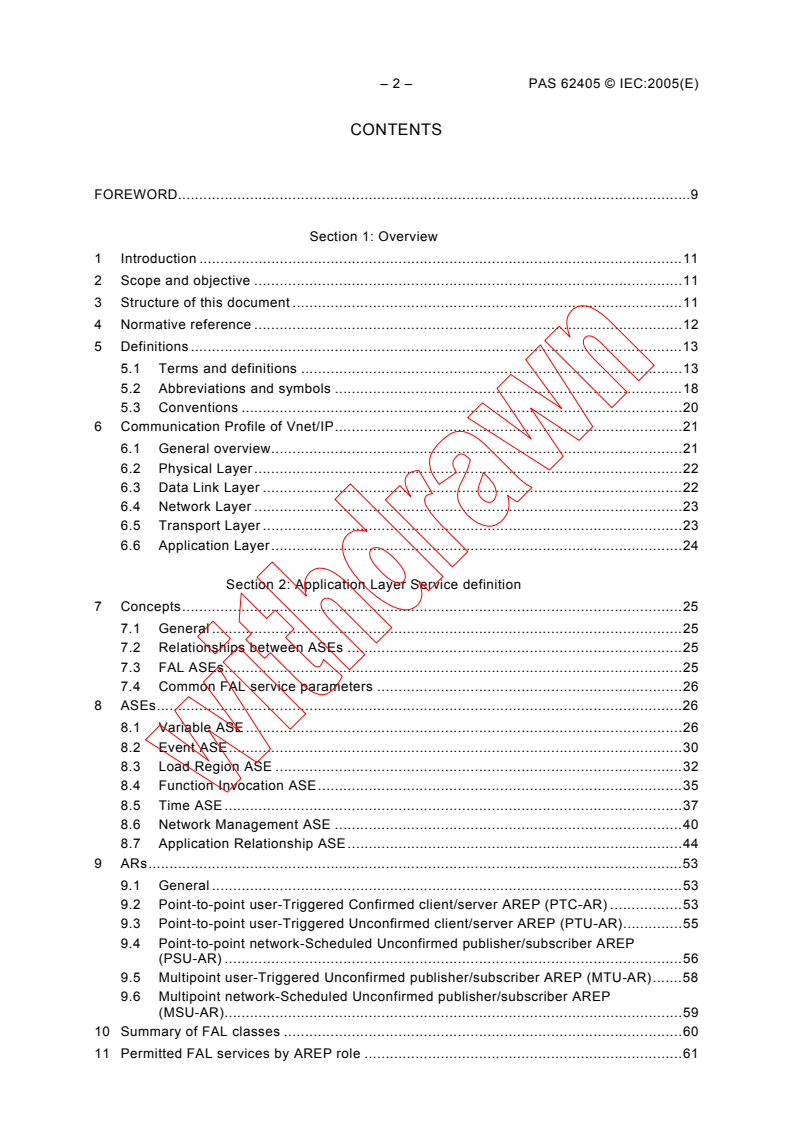
CONTENTS
FOREWORD.9
Section 1: Overview
1 Introduction .11
2 Scope and objective .11
3 Structure of this document .11
4 Normative reference .12
5 Definitions .13
5.1 Terms and definitions .13
5.2 Abbreviations and symbols .18
5.3 Conventions .20
6 Communication Profile of Vnet/IP.21
6.1 General overview.21
6.2 Physical Layer.22
6.3 Data Link Layer .22
6.4 Network Layer .23
6.5 Transport Layer .23
6.6 Application Layer.24
Section 2: Application Layer Service definition
7 Concepts.25
7.1 General .25
7.2 Relationships between ASEs .25
7.3 FAL ASEs.25
7.4 Common FAL service parameters .26
8 ASEs.26
8.1 Variable ASE.26
8.2 Event ASE.30
8.3 Load Region ASE .32
8.4 Function Invocation ASE.35
8.5 Time ASE .37
8.6 Network Management ASE .40
8.7 Application Relationship ASE.44
9 ARs.53
9.1 General .53
9.2 Point-to-point user-Triggered Confirmed client/server AREP (PTC-AR) .53
9.3 Point-to-point user-Triggered Unconfirmed client/server AREP (PTU-AR).55
9.4 Point-to-point network-Scheduled Unconfirmed publisher/subscriber AREP
(PSU-AR) .56
9.5 Multipoint user-Triggered Unconfirmed publisher/subscriber AREP (MTU-AR).58
9.6 Multipoint network-Scheduled Unconfirmed publisher/subscriber AREP
(MSU-AR).59
10 Summary of FAL classes .60
11 Permitted FAL services by AREP role .61
PAS 62405 © IEC:2005(E) – 3 –
Section 3: Application Layer protocol specification
12 Abstract syntax.62
12.1 FAL PDU abstract syntax.62
12.2 Abstract syntax of PDU Body .62
12.3 PDUs for ASEs .64
12.4 Type definitions .67
12.5 Data types.70
13 Transfer syntax .72
13.1 Overview of encoding .72
13.2 APDU Header encoding .72
13.3 APDU Body encoding .73
13.4 Data type encoding rules .74
14 FAL protocol state machines structure .78
15 AP-Context state machine .79
16 FAL Service Protocol Machines (FSPMs) .79
16.1 General .79
16.2 Common parameters of the primitives .79
16.3 Variable ASE Protocol Machine (VARM).80
16.4 Event ASE Protocol Machine (EVTM).83
16.5 Load Region ASE Protocol Machine (LDRM) .85
16.6 Function Invocation ASE Protocol Machine (FNIM) .87
16.7 Time ASE Protocol Machine (TIMM).91
16.8 Network Management ASE Protocol Machine (NWMM).94
17 Application Relationship Protocol Machines (ARPMs).97
17.1 General .97
17.2 Primitive definitions .98
17.3 State machine .98
17.4 Functions .106
18 DLL Mapping Protocol Machine (DMPM) .107
18.1 General .107
18.2 Primitive definitions .108
18.3 DMPM state machine.109
Part 4: Data Link Service definition
19 Overview.112
19.1 General .112
19.2 Overview of network structure.112
19.3 Overview of addressing .113
19.4 Types of Data Link Service .113
20 DLSAP management service.113
20.1 Overview .113
20.2 Facilities of the DLSAP management service.113
20.3 Model of the DLSAP management service.114
20.4 Sequence of primitives at one DLSAP .114
20.5 Create.115
20.6 Delete .116
20.7 Bind .117
– 4 – PAS 62405 © IEC:2005(E)
20.8 Unbind .119
21 Connectionless-mode Data Link Service .119
21.1 Overview .119
21.2 Facilities of the Connectionless-mode Data Link Service .120
21.3 Model of the Data Link Service .120
21.4 Quality of service.121
21.5 Sequence of primitives .123
21.6 Connectionless-mode function .124
21.7 Types of primitives and parameters.124
22 DL-management Service.125
22.1 Scope and inheritance .125
22.2 Facilities of the DL-management service .126
22.3 Model of the DL-management service .126
22.4 Constraints on sequence of primitives .126
22.5 Set .126
22.6 Get.127
22.7 Action.128
22.8 Event .129
23 Overview of the DL-protocol.130
23.1 General .130
23.2 Characteristics of the protocol.130
23.3 Data Link Layer architecture .130
23.4 Services provided by the DLL .131
23.5 Network sharing with other protocols.133
24 DLPDU-parameter structure and encoding .133
24.1 Overview .133
24.2 DLPDU common header format.134
24.3 DLPDU body format.135
25 Local parameters and resources .139
25.1 General .139
25.2 Parameters and resources related to network structure .140
25.3 Parameters and resources to support real-time data transfer .141
25.4 Parameters and resources to support the scheduling function.142
25.5 Parameters and resources to support the security function .143
26 DL-service elements of procedure.144
26.1 Unacknowledged Unitdata transfer Service (UUS) .144
26.2 Acknowledged Unitdata transfer Service (AUS) .144
26.3 Acknowledged Sequence of unitdata transfer Service (ASS).144
26.4 Multipoint Unitdata transfer Service (MUS).145
26.5 Multipoint Sequence of unitdata transfer Service (MSS).145
27 DL-support protocol .146
27.1 Transmission scheduling.146
27.2 Redundancy .147
27.3 DLPDU authentication .149
PAS 62405 © IEC:2005(E) – 5 –
Figure 1 – FAL ASEs .25
Figure 2 – The AR ASE conveys APDUs between APs .45
Figure 3 – APDU overview .72
Figure 4 – Type Field.73
Figure 5 – Identifier Octet 73
Figure 6 – Length octet (one-octet format).74
Figure 7 – Length octets (three-octet format).74
Figure 8 – Relationships among protocol machines and adjacent layers.78
Figure 9 – State transition diagram of VARM .81
Figure 10 – State transition diagram of EVTM.84
Figure 11 – State transition diagram of LDRM .86
Figure 12 – State transition diagram of FNIM.88
Figure 13 – State transition diagram of TIMM .92
Figure 14 – State transition diagram of NWMM.95
Figure 15 – State transition diagram of the PTC-ARPM.99
Figure 16 – State transition diagram of the PTU-ARPM.101
Figure 17 – State transition diagram of the PSU-ARPM .102
Figure 18 – State transition diagram of the MTU-ARPM .104
Figure 19 – State transition diagram of the MSU-ARPM .105
Figure 20 – State transition diagram of DMPM.109
Figure 21 – Sequence of primitives for the DLSAP management DLS.115
Figure 22 – Summary of DL-connectionless-mode service primitive time-sequence
diagrams .123
Figure 23 – State transition diagram for sequences of connectionless-mode primitives
at one DLSAP.124
Figure 24 – Sequence of primitives for the DLM action service.126
Table 1 – Concept of DL/AL to separate service and protocol parts.12
Table 2 – Conventions used for AE state machine definitions.20
Table 3 – Conventions used for protocol procedure definitions.21
Table 4 – OSI layers and Vnet/IP layers .22
Table 5 – Overview of Vnet/IP profile .22
Table 6 – Transport Layer Parameter selection.24
Table 7 – Read service parameters .28
Table 8 – Write service parameters .29
Table 9 – Information Report service parameters.29
Table 10 – Event Notification service parameters .31
Table 11 – Event Notification Recovery service parameters .32
Table 12 – Download service parameters .34
Table 13 – Upload service parameters .34
Table 14 – Start service parameters.36
Table 15 – Stop service parameters .36
Table 16 – Resume service parameters.37
Table 17 – Get Network Time service parameters.39
– 6 – PAS 62405 © IEC:2005(E)
Table 18 – Set Network Time service parameters .39
Table 19 – Set Network Time service parameters .40
Table 20 – Get Network Status service parameters.41
Table 21 – Get Station Status service parameters .42
Table 22 – Network Status Change Report service parameters .43
Table 23 – Station Status Change Report service parameters.43
Table 24 – Conveyance of service primitives by AREP role.45
Table 25 – Valid combinations of AREP roles involved in an AR .46
Table 26 – AR-Unconfirmed Send .49
Table 27 – AR-Confirmed Send.50
Table 28 – AR-Establish service.52
Table 29 – AR-Abort .53
Table 30 – FAL class summary .61
Table 31 – FAL services by AR type.61
Table 32 – Encoding of FalArHeader Field .72
Table 33 – Primitives exchanged between FAL user and VARM .80
Table 34 – Parameters used with primitives exchanged FAL user and VARM .80
Table 35 – VARM state table – Sender transitions .81
Table 36 – VARM state table – Receiver transitions.82
Table 37 – Functions used by the VARM .83
Table 38 – Primitives exchanged between FAL user and EVTM .83
Table 39 – Parameters used with primitives exchanged FAL user and EVTM .83
Table 40 – EVTM state table – Sender transitions .84
Table 41 – EVTM state table – Receiver transitions .84
Table 42 – Functions used by the EVTM .84
Table 43 – Primitives exchanged between FAL user and LDRM .85
Table 44 – Parameters used with primitives exchanged FAL user and LDRM .85
Table 45 – LDRM state table – Sender transitions .86
Table 46 – LDRM state table – Receiver transitions.87
Table 47 – Functions used by the LDRM .87
Table 48 – Primitives exchanged between FAL user and FNIM .88
Table 49 – Parameters used with primitives exchanged FAL user and FNIM.88
Table 50 – FNIM state table – Sender transitions.89
Table 51 – FNIM state table – Receiver transitions .89
Table 52 – Functions used by the FNIM .91
Table 53 – Primitives exchanged between FAL user and TIMM .91
Table 54 – Parameters used with primitives exchanged FAL user and TIMM .91
Table 55 – TIMM states .92
Table 56 – TIMM state table – Sender transitions .92
Table 57 – TIMM state table – Receiver transitions.93
Table 58 – Functions used by the TIMM .94
Table 59 – Primitives exchanged between FAL user and NWMM.94
Table 60 – Parameters used with primitives exchanged FAL user and NWMM.95
PAS 62405 © IEC:2005(E) – 7 –
Table 61 – NWMM states .95
Table 62 – NWMM state table – Sender transitions.96
Table 63 – NWMM state table – Receiver transitions .96
Table 64 – Functions used by the NWMM.97
Table 65 – Primitives exchanged between FSPM and ARPM.98
Table 66 – Parameters used with primitives exchanged FSPM user and ARPM .98
Table 67 – PTC-ARPM states.99
Table 68 – PTC-ARPM state table – Sender transitions .99
Table 69 – PTC-ARPM state table – Receiver transitions.100
Table 70 – PTU-ARPM states.101
Table 71 – PTU-ARPM state table – Sender transitions .101
Table 72 – PTU-ARPM state table – Receiver transitions.102
Table 73 – PSU-ARPM states .102
Table 74 – PSU-ARPM state table – Sender transitions .103
Table 75 – PSU-ARPM state table – Receiver transitions.103
Table 76 – MTU-ARPM states .104
Table 77 – MTU-ARPM state table – Sender transitions.104
Table 78 – MTU-ARPM state table – Receiver transitions .105
Table 79 – MSU-ARPM states.105
Table 80 – MSU-ARPM state table – Sender transitions.106
Table 81 – MSU-ARPM state table – Receiver transitions .106
Table 82 – Functions used by the ARPMs .107
Table 83 – Primitives exchanged between DMPM and ARPM.108
Table 84 – Primitives exchanged between Data Link Layer and DMPM .108
Table 85 – DMPM states.109
Table 86 – DMPM state table – Sender transitions.109
Table 87 – DMPM state table – Receiver transitions .111
Table 88 – Functions used by the DMPM.111
Table 89 – Summary of DLSAP management primitives and parameters .114
Table 90 – DLSAP-management CREATE primitive and parameters .115
Table 91 – DLSAP-management DELETE primitive and parameters.116
Table 92 – DLSAP management BIND primitive and parameters .117
Table 93 – DLSAP management UNBIND primitive and parameter.119
Table 94 – Data delivery features of each type of service .121
Table 95 – Summary of DL-connectionless-mode primitives and parameters .123
Table 96 – DL-connectionless-mode UNITDATA transfer primitives and parameters.124
Table 97 – Summary of DL-management primitives and parameters.126
Table 98 – DLM-SET primitive and parameters.127
Table 99 – DLM-GET primitive and parameters .127
Table 100 – DLM-ACTION primitive and parameters.128
Table 101 – DLM-EVENT primitive and parameters .129
Table 102 – Referenced standards for the layers.131
Table 103 – Bit Positions .134
– 8 – PAS 62405 © IEC:2005(E)
Table 104 – Common Header format .135
Table 105 – DLPDU Types.135
Table 106 – Service subtype and PDU type of DLPDUs .136
Table 107 – UUS_DT_PDU .136
Table 108 – AUS_DT_PDU .137
Table 109 – AUS_RSP_PDU.137
Table 110 – ASS_DT_PDU .138
Table 111 – ASS_ENQ_PDU.138
Table 112 – ASS_RSP_PDU .138
Table 113 – MUS_DT_PDU.139
Table 114 – MSS_DT_PDU.139
Table 115 – Parameters and resources for the network structure .140
Table 116 – Ranges of parameters for the network structure.141
Table 117 – Parameters and resources real-time data transfer .141
Table 118 – Ranges of parameters for real-time data transfer.141
Table 119 – Parameters and resources for scheduling function.142
Table 120 – Ranges of parameters for scheduling .143
Table 121 – Parameters and resources for security function .143
Table 122 – Ranges of parameters for security function.143
Table 123 – UUS Procedure.144
Table 124 – AUS Procedure.144
Table 125 – ASS Procedure .145
Table 126 – MUS Procedure .145
Table 127 – MSS Procedure .146
PAS 62405 © IEC:2005(E) – 9 –
INTERNATIONAL ELECTROTECHNICAL COMMISSION
____________
TM
Real-time Ethernet Vnet/IP specification
FOREWORD
1) The International Electrotechnical Commission (IEC) is a worldwide organization for standardization comprising
all national electrotechnical committees (IEC National Committees). The object of IEC is to promote
international co-operation on all questions concerning standardization in the electrical and electronic fields. To
this end and in addition to other activities, IEC publishes International Standards, Technical Specifications,
Technical Reports, Publicly Available Specifications (PAS) and Guides (hereafter referred to as “IEC
Publication(s)”). Their preparation is entrusted to technical committees; any IEC National Committee interested
in the subject dealt with may participate in this preparatory work. International, governmental and non-
governmental organizations liaising with the IEC also participate in this preparation. IEC collaborates closely
with the International Organization for Standardization (ISO) in accordance with conditions determined by
agreement between the two organizations.
2) The formal decisions or agreements of IEC on technical matters express, as nearly as possible, an international
consensus of opinion on the relevant subjects since each technical committee has representation from all
interested IEC National Committees.
3) IEC Publications have the form of recommendations for international use and are accepted by IEC National
Committees in that sense. While all reasonable efforts are made to ensure that the technical content of IEC
Publications is accurate, IEC cannot be held responsible for the way in which they are used or for any
misinterpretation by any end user.
4) In order to promote international uniformity, IEC National Committees undertake to apply IEC Publications
transparently to the maximum extent possible in their national and regional publications. Any divergence
between any IEC Publication and the corresponding national or regional publication shall be clearly indicated in
the latter.
5) IEC provides no marking procedure to indicate its approval and cannot be rendered responsible for any
equipment declared to be in conformity with an IEC Publication.
6) All users should ensure that they have the latest edition of this publication.
7) No liability shall attach to IEC or its directors, employees, servants or agents including individual experts and
members of its technical committees and IEC National Committees for any personal injury, property damage or
other damage of any nature whatsoever, whether direct or indirect, or for costs (including legal fees) and
expenses arising out of the publication, use of, or reliance upon, this IEC Publication or any other IEC
Publications.
8) Attention is drawn to the Normative references cited in this publication. Use of the referenced publications is
indispensable for the correct application of this publication.
The International Electrotechnical Commission (IEC) draws attention to the fact that it is claimed that compliance
with this document may involve the use of a patent concerning Vnet/IP .
The Vnet/IP has the patent applications listed below:
PCT Application No. PCT/JP2004/011537
PCT Application No. PCT/JP2004/011538.
IEC takes no position concerning the evidence, validity and scope of this patent right.
The holder of this patent right has assured the IEC that he is willing to negotiate licences under reasonable and
non-discriminatory terms and conditions with applicants throughout the world. In this respect, the statement of the
holder of this patent right is registered with IEC. Information may be obtained from:
Yokogawa Electric Corporation
Intellectual Property & Standardization Center
2-9-32 Nakacho, Musashino-shi, 180-8750
Tokyo, Japan.
Attention is drawn to the possibility that some of the elements of this document may be the subject of patent rights
other than those identified above. IEC shall not be held responsible for identifying any or all such patent rights.
———————
Vnet/IP is the trade name of Yokogawa Electric Corporation. This information is given for the convenience of
users of this PAS and does not constitute an endorsement by IEC of the trademark holder or any of its products.
Compliance to this profile does not require use of the trade name Vnet/IP. Use of the trade name Vnet/IP
requires permission of the Yokogawa Electric Corporation.
– 10 – PAS 62405 © IEC:2005(E)
A PAS is a technical specification not fulfilling the requirements for a standard but made
available to the public .
IEC-PAS 62405 has been processed by subcommittee 65C: Digital communications, of IEC
technical committee 65: Industrial-process measurement and control.
The text of this PAS is based on the This PAS was approved for
following document: publication by the P-members of the
committee concerned as indicated in
the following document
Draft PAS Report on voting
65C/352/NP 65C/369/RVN
Following publication of this PAS, the technical committee or subcommittee concerned will
transform it into an International Standard.
It is intended that the content of this PAS will be incorporated in the future new edition of the
various parts of IEC 61158 series according to the structure of this series.
This PAS shall remain valid for an initial maximum period of three years starting from
2005-06. The validity may be extended for a single three-year period, following which it shall
be revised to become another type of normative document or shall be withdrawn.
PAS 62405 © IEC:2005(E) – 11 –
TM
Real-time Ethernet Vnet/IP specification
Section 1: Overview
This PAS has been divided into five sections.
Section 1: Overview
Section 2: Application Layer Service definition
Section 3: Application Layer protocol specification
Section 4: Data Link Layer Service definition
Section 5: Data Link Layer protocol specification
1 Introduction
The Vnet/IP is designed for highly reliable real-time communication, and applies to the
operation of process control systems. The process control system consists of many
controllers, human-machine interfaces, process monitors, and gateways to external networks
which are connected to Ethernet-based IP networks. The data transfer between these devices
is performed by peer-to-peer or multicast communication.
It is required that the process control system responds within a deterministic time. At the
same time, it is also required that multi-vendor's multi-devices can be connected to the same
IP network. For example, the process control system shall handle operational signals for the
actuator within a determined time and needs to communicate with other devices connected to
Ethernet-based IP networks to exchange non-realtime information such as files and images.
The Vnet/IP realizes these two conflicting requirements on the same network using a unique
technology as described in this PAS.
2 Scope and objective
This PAS describes the communication profile of the whole Vnet/IP, services of each layer
and the specifications of the protocols for each layer.
3 Structure of this document
Section 1 of this PAS presents an overview of and guidance for the Vnet/IP Specification. It
also explains the structure and content of the Vnet/IP Specification and shows how to use
each section of the document. In addition, it specifies the communication profile of the Vnet/IP.
Sections 2 and 3 present the Vnet/IP Specification for the Application Layer, and Sections 4
and 5 for the Data Link Layer. This PAS refers the appropriate international standards for the
specifications of other layers.
The Data Link and Application Layers are described in complementary ways, in terms of the
services offered and the protocol which provides those services.
Table 1 shows the differences between service and protocol viewpoints of the Data Link and
Application Layers. The protocol parts show the layer implementer’s view and the service
parts show the layer user’s view.
– 12 – PAS 62405 © IEC:2005(E)
Table 1 – Concept of DL/AL to separate service and protocol parts
Lay
...