


IEC PAS 62406:2005
(Main)Real-time Ethernet TCnet (Time-Critical Control Network)
General Information
- Abstract
specifies the protocol set necessary for RTE-TCnet, specifically of the Data Link layer and the Application layer, which is mapped on top of the Data Link layer to exploit the services in terms of the "three-layer" Fieldbus Reference Model which is based in part on the OSI Basic Reference Model. Both Reference Models subdivide the area of standardization for interconnection into a series of layers of specification, each of manageable size
- Status
- Replaced
- Publication Date
- 08-Aug-2005
- Technical Committee
- SC 65C - Industrial networks
- Drafting Committee
- WG 9 - TC 65/SC 65C/WG 9
- Current Stage
- DELPUB - Deleted Publication
- Start Date
- 14-Dec-2007
- Completion Date
- 28-Aug-2026
Relations
- Effective Date
- 05-Sep-2023
- Effective Date
- 05-Sep-2023
- Effective Date
- 05-Sep-2023
- Effective Date
- 05-Sep-2023
Get Certified
Connect with accredited certification bodies for this standard

BSI Group
BSI (British Standards Institution) is the business standards company that helps organizations make excellence a habit.

DVS-ZERT GmbH
German welding certification society.
CARES (UK Certification Authority for Reinforcing Steels)
UK certification for reinforcing steels and construction.
Sponsored listings
Frequently Asked Questions
IEC PAS 62406:2005 is a technical specification published by the International Electrotechnical Commission (IEC). Its full title is "Real-time Ethernet TCnet (Time-Critical Control Network)". This standard covers: specifies the protocol set necessary for RTE-TCnet, specifically of the Data Link layer and the Application layer, which is mapped on top of the Data Link layer to exploit the services in terms of the "three-layer" Fieldbus Reference Model which is based in part on the OSI Basic Reference Model. Both Reference Models subdivide the area of standardization for interconnection into a series of layers of specification, each of manageable size
specifies the protocol set necessary for RTE-TCnet, specifically of the Data Link layer and the Application layer, which is mapped on top of the Data Link layer to exploit the services in terms of the "three-layer" Fieldbus Reference Model which is based in part on the OSI Basic Reference Model. Both Reference Models subdivide the area of standardization for interconnection into a series of layers of specification, each of manageable size
IEC PAS 62406:2005 is classified under the following ICS (International Classification for Standards) categories: 25.040.40 - Industrial process measurement and control; 35.100.05 - Multilayer applications; 35.240.50 - IT applications in industry. The ICS classification helps identify the subject area and facilitates finding related standards.
IEC PAS 62406:2005 has the following relationships with other standards: It is inter standard links to IEC 61158-5-11:2007, IEC 61158-6-11:2007, IEC 61158-4-11:2007, IEC 61158-3-11:2007. Understanding these relationships helps ensure you are using the most current and applicable version of the standard.
IEC PAS 62406:2005 is available in PDF format for immediate download after purchase. The document can be added to your cart and obtained through the secure checkout process. Digital delivery ensures instant access to the complete standard document.
Standards Content (Sample)
PUBLICLY
IEC
AVAILABLE
PAS 62406
SPECIFICATION
First edition
2005-08
Real-time Ethernet TCnet
(Time-Critical Control Network)
Reference number
IEC/PAS 62406:2005(E)
Publication numbering
As from 1 January 1997 all IEC publications are issued with a designation in the
60000 series. For example, IEC 34-1 is now referred to as IEC 60034-1.
Consolidated editions
The IEC is now publishing consolidated versions of its publications. For example,
edition numbers 1.0, 1.1 and 1.2 refer, respectively, to the base publication, the
base publication incorporating amendment 1 and the base publication incorporating
amendments 1 and 2.
Further information on IEC publications
The technical content of IEC publications is kept under constant review by the IEC,
thus ensuring that the content reflects current technology. Information relating to
this publication, including its validity, is available in the IEC Catalogue of
publications (see below) in addition to new editions, amendments and corrigenda.
Information on the subjects under consideration and work in progress undertaken
by the technical committee which has prepared this publication, as well as the list
of publications issued, is also available from the following:
• IEC Web Site (www.iec.ch)
• Catalogue of IEC publications
The on-line catalogue on the IEC web site (www.iec.ch/searchpub) enables you to
search by a variety of criteria including text searches, technical committees
and date of publication. On-line information is also available on recently issued
publications, withdrawn and replaced publications, as well as corrigenda.
• IEC Just Published
This summary of recently issued publications (www.iec.ch/online_news/ justpub)
is also available by email. Please contact the Customer Service Centre (see
below) for further information.
• Customer Service Centre
If you have any questions regarding this publication or need further assistance,
please contact the Customer Service Centre:
Email: custserv@iec.ch
Tel: +41 22 919 02 11
Fax: +41 22 919 03 00
PUBLICLY
IEC
AVAILABLE
PAS 62406
SPECIFICATION
First edition
2005-08
Real-time Ethernet TCnet
(Time-Critical Control Network)
IEC 2005 Copyright - all rights reserved
No part of this publication may be reproduced or utilized in any form or by any means, electronic or
mechanical, including photocopying and microfilm, without permission in writing from the publisher.
International Electrotechnical Commission, 3, rue de Varembé, PO Box 131, CH-1211 Geneva 20, Switzerland
Telephone: +41 22 919 02 11 Telefax: +41 22 919 03 00 E-mail: inmail@iec.ch Web: www.iec.ch
PRICE CODE
Commission Electrotechnique Internationale
XG
International Electrotechnical Commission
Международная Электротехническая Комиссия
For price, see current catalogue
– 2 – PAS 62406 © IEC:2005 (E)
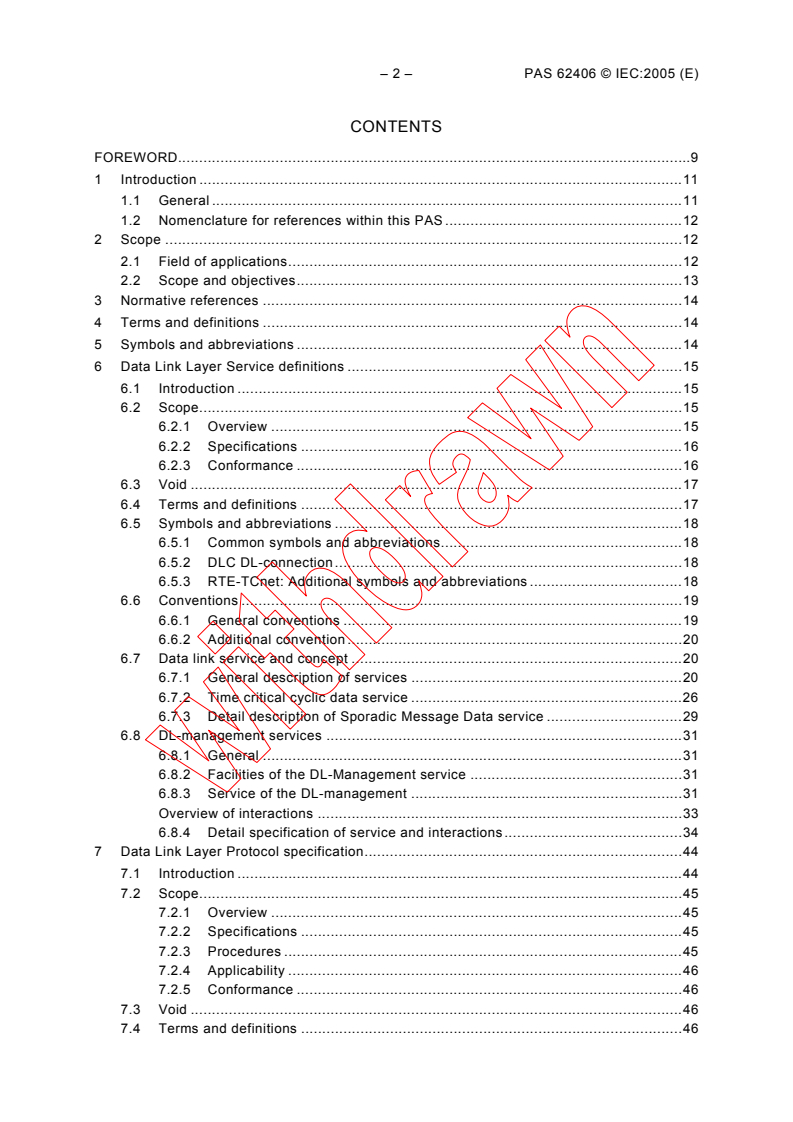
CONTENTS
FOREWORD.9
1 Introduction .11
1.1 General .11
1.2 Nomenclature for references within this PAS .12
2 Scope .12
2.1 Field of applications.12
2.2 Scope and objectives.13
3 Normative references .14
4 Terms and definitions .14
5 Symbols and abbreviations .14
6 Data Link Layer Service definitions .15
6.1 Introduction .15
6.2 Scope.15
6.2.1 Overview .15
6.2.2 Specifications .16
6.2.3 Conformance .16
6.3 Void .17
6.4 Terms and definitions .17
6.5 Symbols and abbreviations .18
6.5.1 Common symbols and abbreviations.18
6.5.2 DLC DL-connection .18
6.5.3 RTE-TCnet: Additional symbols and abbreviations .18
6.6 Conventions .19
6.6.1 General conventions .19
6.6.2 Additional convention .20
6.7 Data link service and concept .20
6.7.1 General description of services .20
6.7.2 Time critical cyclic data service .26
6.7.3 Detail description of Sporadic Message Data service .29
6.8 DL-management services .31
6.8.1 General .31
6.8.2 Facilities of the DL-Management service .31
6.8.3 Service of the DL-management .31
Overview of interactions .33
6.8.4 Detail specification of service and interactions.34
7 Data Link Layer Protocol specification.44
7.1 Introduction .44
7.2 Scope.45
7.2.1 Overview .45
7.2.2 Specifications .45
7.2.3 Procedures .45
7.2.4 Applicability .46
7.2.5 Conformance .46
7.3 Void .46
7.4 Terms and definitions .46
PAS 62406 © IEC:2005 (E) – 3 –
7.5 Symbols and abbreviations .47
7.5.1 Common symbols and abbreviations.47
7.5.2 RTE-TCnet: Additional symbols and abbreviations .48
7.6 Overview of the DL-protocol.49
7.6.1 Overview of the media access control.49
7.6.2 Service assumed from the PhL .50
7.6.3 DLL architecture .51
7.6.4 Access Control Machine and schedule support functions .52
7.6.5 Local parameters, variable, counters, timers.53
7.7 General structure and encoding of PhIDUs and DLPDU and related elements
of procedure.61
7.7.1 Overview .61
7.7.2 PhIDU structure and encoding.61
7.7.3 Common MAC frame structure, encoding and elements of procedure .61
7.7.4 Elements of the MAC frame.62
7.7.5 Order of bit transmission .65
7.7.6 Invalid DLPDU .65
7.8 DLPDU-specific structure, encoding and elements of procedure .65
7.8.1 General .65
7.8.2 Synchronization DLPDU (SYN).66
7.8.3 Transmission Complete DLPDU (CMP).71
7.8.4 In-Ring Request DLPDU (REQ) .72
7.8.5 Claim DLPDU (CLM) .73
7.8.6 Command (COM) DLPDU.74
7.8.7 Cyclic data and Cyclic data with transmission complete DLPDU (DT)
and (DT-CMP).75
7.8.8 RAS DLPDU (RAS) .76
7.9 DLE elements of procedure.77
7.9.1 Overall structure .77
7.9.2 Initialization .78
7.9.3 Cyclic transmission TX/RX Control (CTRC).79
7.9.4 Sporadic TX/RX Control (STRC).83
7.9.5 Access Control Machine (ACM) .86
7.9.6 Redundancy medium control (RMC) .95
7.9.7 Serializer and Deserializer .103
7.9.8 DLL Management protocol.103
8 Application Layer Service definitions.108
8.1 Introduction .108
8.2 Scope.108
8.3 Void .109
8.4 Term and definitions .109
8.4.1 ISO/IEC 7498-1 terms .109
8.4.2 ISO/IEC 8822 terms .109
8.4.3 ISO/IEC 9545 terms .110
8.4.4 ISO/IEC 8824-1 terms .110
8.4.5 Fieldbus Data Link Layer terms .110
8.4.6 Fieldbus Application Layer terms.110
8.4.7 RTE-TCnet specific terms .111
– 4 – PAS 62406 © IEC:2005 (E)
8.4.8 Symbols and abbreviations.111
8.4.9 Conventions.112
8.5 Concept .112
8.5.1 Overview .112
8.5.2 Common memory concept .113
8.5.3 Relationship of common memory and AREP .114
8.5.4 Common memory data type.115
8.5.5 RTE-TCnet ASE and services.115
8.6 Common memory ASE.116
8.6.1 Overview .116
8.6.2 Common memory model class specification .116
8.6.3 Service specification of Common memory (CM) ASE .117
8.7 Application Relationship ASE.119
8.7.1 Overview .119
8.7.2 Application relationship endpoint class specification .121
8.7.3 Application relationship ASE service specifications .122
9 Application Layer Protocol specification .125
9.1 Introduction .125
9.2 Scope.125
9.3 Void .126
9.4 Term and definitions .126
9.4.1 Summary .126
9.4.2 Terms and definitions from other ISO/IEC standards.126
9.4.3 Symbols and abbreviations.127
9.4.4 Conventions.127
9.5 FAL Syntax description .128
9.5.1 General .128
9.5.2 FAL-AR PDU abstract syntax .128
9.5.3 Abstract syntax of PDU Body.128
9.5.4 Data Type.129
9.6 Transfer Syntax .129
9.6.1 Overview and FAL header .129
9.6.2 Encoding Rule .129
9.6.3 Encoding of structured types .131
9.7 FAL protocol state machines structures.131
9.7.1 Overview .131
9.8 FAL service protocol machine (FSPM).133
9.8.1 General .133
9.8.2 Primitives definitions .133
9.8.3 FSPM state tables.133
9.9 Application relationship protocol machine (ARPM).135
9.9.1 General .135
9.9.2 Primitive definitions.135
9.9.3 DLL mapping of BNU-PEC AREP class.136
9.9.4 BNU-PEC ARPM states machine .137
9.10 DLL Mapping Protocol Machine (DMPM) .139
9.10.1 Overview .139
9.10.2 Primitive definitions.140
PAS 62406 © IEC:2005 (E) – 5 –
9.10.3 DLL Mapping Protocol Machine (DMPM).141
9.10.4 Data Link Layer service selection .144
FIGURES
Figure 1 – RTE-TCnet communication profile.11
Figure 2 – Scope of this specification .13
Figure 3 – Relationship of the RTE-TCnet Data link layer to other RTE layers and to
users of RTE Data link service .15
Figure 4 – Overall flow of Data frames during 1 Minimum Cycle period (High-speed
Transmission-period) .22
Figure 5 – Overall flow of Cyclic Data frames over 1 Maximum cycle period (Low-
speed-Transmission-period).22
Figure 6 – Sequence Diagram of Time-critical Cyclic Data service .23
Figure 7 – Sequence diagram of Sporadic Message service.24
Figure 8 – Relationship of DLSAP, DLCEP and DLCEP-address .25
Figure 9 – Sequence diagram of Reset, Set value, Get value, Set CM configuration,
Get CM configuration, Activate Time-critical cyclic data and Deactivate Time-critical
Cyclic data service primitives .33
Figure 10 – Sequence diagram of Sporadic Message service.33
Figure 11 – Relationship of RTE-TCnet Data Link Protocol to other RTE layers and to
users of RTE Data link service .44
Figure 12 – Basic principle of Media Access Control.49
Figure 13 – Interaction of PhS primitives to DLE.50
Figure 14 – Data Link layer internal architecture.52
Figure 15 – Common MAC frame format for RTE-TCnet DLPDU .62
Figure 16 – Sporadic DLPDU format.62
Figure 17 – Structure of FC field .63
Figure 18 – Structure of SYN DLPDU .66
Figure 19 – Structure of CMP DLPDU.71
Figure 20 – Structure of the REQ DLPDU .72
Figure 21 – Structure of CLM DLPDU.73
Figure 22 – Structure of COM DLPDU .74
Figure 23 – Structure of DT DLPDU .75
Figure 24 – Structure of RAS DLPDU .76
Figure 25 – Overall structure of DLL.78
Figure 26 – DLE state transition .79
Figure 27 – State transition diagram of CTRC.81
Figure 28 – State transition diagram of STRC.85
Figure 29 – State transition diagram of ACM .89
Figure 30 – State transition diagram of RMC Sending and Send arbitration .97
Figure 31 – State transition diagram of RMC Receiving .100
Figure 32 – State transition diagram of DLM.104
– 6 – PAS 62406 © IEC:2005 (E)
Figure 33 – Relationship of the RTE-TCnet Application layer to other RTE layers and
to users of RTE Application Layer service .108
Figure 34 – RTE-TCnet Application (Example).113
Figure 35 – Global Common Memory concept over RTE-TCnet .113
Figure 36 – Relationship of Common Memory and AREP .114
Figure 37 – Structure of RTE-TCnet AL ASE. .116
Figure 38 – Common Memory Publisher/Subscriber model.119
Figure 39 – Relationship of RTE-TCnet Application layer to other RTE layers and to
users of RTE Application service.125
Figure 40 – APDU overview .129
Figure 41 – Relationship between FSPM, ARPM, DMPM and External Physical CM .132
Figure 42 – State transition diagram of FSPM.134
Figure 43 – State transition diagram of the BNU-PEC .137
Figure 44 – State transition diagram of DMPM.141
TABLES
Table 1 – Primitives and parameters used on time critical cyclic data service .26
Table 2 – Data request primitives and the parameters .26
Table 3 – Put buffer primitives and parameters.27
Table 4 – Get buffer primitives and parameters .28
Table 5 – Notify buffer received primitives and parameters .29
Table 6 – Primitives and parameters used on Sporadic message data service.29
Table 7 – Submit sporadic message primitives and parameters.30
Table 8 – Summary of DL-management primitives and parameters .33
Table 9 – DLM-Reset primitives and parameters.34
Table 10 – DLM-Set-value primitives and parameters .34
Table 11 – Mandatory DLE-variables and the permissible values .35
Table 12 – DLM-Get-value primitives and parameters.37
Table 13 – Observational variables and the range of values.37
Table 14 – Event primitives and parameters .39
Table 15 – Event related state change variables.39
Table 16 –Set Publisher Configuration primitives and parameters .40
Table 17 – DLM-Get-Publisher-Configuration primitives and parameters .41
Table 18 – DLM-Activate-TCC primitives and the parameters.42
Table 19 – DLM-Deactivate-TCC primitives and the parameters.43
Table 20 – Data Link Layer components.51
Table 21 – F-Type and TCnet DLPDU .64
Table 22– PN -parameter: 3rd Octet.67
Table 23– CW -parameters: 4th Octet .67
Table 24 – PM parameter.67
Table 25 – RMSEL parameter .68
Table 26 – ST-parameter: 5th Octet .68
PAS 62406 © IEC:2005 (E) – 7 –
Table 27 – Th-parameter: 6th, 7th and 8th Octets.68
Table 28 – Tm-parameter: 9th and 10th Octets.69
Table 29 – Ts-parameter: 11th and 12th Octets .69
Table 30 – Tl-parameter: 13th and 14th Octets.69
Table 31 – LL parameters: 15th to 46th Octets .70
Table 32 – CLM-parameter: 4th Octet.73
Table 33 – DT parameter: 3rd and 4th Octet.75
Table 34 - RAS parameter: 3rd and 4th byte.76
Table 35 – Primitives exchanged between DLS-user and CTRC.80
Table 36 – Primitives exchanged between CTRC and ACM.80
Table 37 – Parameters used with primitives exchanged between DLS-user and CTRC .81
Table 38 – CTRC state table .82
Table 39 – CTRC Functions table.83
Table 40 – Primitives exchanged between DLS-user and STRC .84
Table 41 – Primitives exchanged between STRC and ACM.84
Table 42 – Parameters used with primitives exchanged between DLS-user and STRC .84
Table 43 – STRC state table .85
Table 44 – STRC Functions table.86
Table 45 – Primitives exchanged between ACM and RMC .87
Table 46 – Parameters used with primitives exchanged between ACM and RMC.87
Table 47 – Primitives exchanged between ACM and CTRC.87
Table 48 – Parameters used with primitives exchanged between ACM and CTRC .88
Table 49 – Primitives exchanged between ACM and STRC.88
Table 50 – Parameters used with primitives exchanged between ACM and STRC .88
Table 51 – ACM state table.90
Table 52 – ACM Function table .95
Table 53 – Primitives exchanged between ACM and RMC .96
Table 54 – Primitives exchanged between RMC and Serializer / Deserializer .96
Table 55 – Primitives exchanged between RMC and Ph-layer .96
Table 56 – Parameters between RMC and ACM .97
Table 57 – Parameters between RMC and Ph-layer .97
Table 58 – State table of RMC Sending.98
Table 59 – State table of RMC Send arbitration .99
Table 60 – State table for RMC Receiving .100
Table 61 – RMC function table .102
Table 62– Primitives exchanged between DLMS-User and DLM.103
Table 63 – Parameters used with primitives exchanged between DL-user and DLM.104
Table 64 – DLM state table .105
Table 65 – DLM function table.107
Table 66 – Update Memory service parameters .118
Table 67 – Memory-Status service parameters .118
Table 68 – AR-Unconfirmed Send .122
– 8 – PAS 62406 © IEC:2005 (E)
Table 69 – AR-Gut Buffered message service .123
Table 70 – AR-Status service.124
Table 71 – FAL header .129
Table 72 – Primitives issued by FAL user to FSPM .133
Table 73 – Primitives issued by FSPM to FAL user .133
Table 74 – FSPM state table – sender transactions .134
Table 75 – FSPM state table – receiver transactions .134
Table 76 – Function SelectArep .135
Table 77 – Primitives issued by FSPM to ARPM .135
Table 78 – Primitives issued by ARPM to FSPM .135
Table 79 – Parameters used with primitives exchanged between FSPM and ARPM .136
Table 80 – BNU-PEC state descriptions .137
Table 81 – BNU-PEC ARPM state table – sender transactions .137
Table 82 – BNU-PEC ARPM state table – receiver transactions .138
Table 83 – Function GetArepId () .138
Table 84 – Function BuildFAL-PDU .139
Table 85 – Function FAL_Pdu_Type.139
Table 86 – Primitives issued by ARPM to DMPM .140
Table 87 – Primitives issued by DMPM to ARPM .140
Table 88 – Parameters used with primitives exchanged between ARPM and DMPM .140
Table 89 – Primitives exchanged between Data Link Layer and DMPM .141
Table 90 – DMPM state descriptions .141
Table 91 – DMPM state table – sender transactions .142
Table 92 – DMPM state table – receiver transactions.143
Table 93 – Function PickArep .143
Table 94 – Function FindAREP .144
PAS 62406 © IEC:2005 (E) – 9 –
INTERNATIONAL ELECTROTECHNICAL COMMISSION
____________
Real-time Ethernet TCnet (Time-Critical Control Network)
FOREWORD
1) The International Electrotechnical Commission (IEC) is a worldwide organization for standardization comprising
all national electrotechnical committees (IEC National Committees). The object of IEC is to promote
international co-operation on all questions concerning standardization in the electrical and electronic fields. To
this end and in addition to other activities, IEC publishes International Standards, Technical Specifications,
Technical Reports, Publicly Available Specifications (PAS) and Guides (hereafter referred to as “IEC
Publication(s)”). Their preparation is entrusted to technical committees; any IEC National Committee interested
in the subject dealt with may participate in this preparatory work. International, governmental and non-
governmental organizations liaising with the IEC also participate in this preparation. IEC collaborates closely
with the International Organization for Standardization (ISO) in accordance with conditions determined by
agreement between the two organizations.
2) The formal decisions or agreements of IEC on technical matters express, as nearly as possible, an international
consensus of opinion on the relevant subjects since each technical committee has representation from all
interested IEC National Committees.
3) IEC Publications have the form of recommendations for international use and are accepted by IEC National
Committees in that sense. While all reasonable efforts are made to ensure that the technical content of IEC
Publications is accurate, IEC cannot be held responsible for the way in which they are used or for any
misinterpretation by any end user.
4) In order to promote international uniformity, IEC National Committees undertake to apply IEC Publications
transparently to the maximum extent possible in their national and regional publications. Any divergence
between any IEC Publication and the corresponding national or regional publication shall be clearly indicated in
the latter.
5) IEC provides no marking procedure to indicate its approval and cannot be rendered responsible for any
equipment declared to be in conformity with an IEC Publication.
6) All users should ensure that they have the latest edition of this publication.
7) No liability shall attach to IEC or its directors, employees, servants or agents including individual experts and
members of its technical committees and IEC National Committees for any personal injury, property damage or
other damage of any nature whatsoever, whether direct or indirect, or for costs (including legal fees) and
expenses arising out of the publication, use of, or reliance upon, this IEC Publication or any other IEC
Publications.
8) Attention is drawn to the Normative references cited in this publication. Use of the referenced publications is
indispensable for the correct application of this publication.
The International Electrotechnical Commission (IEC) draws attention to the fact that it is claimed that compliance
with this document may involve the use of a patent concerning TCnet.
TOSHIBA has the patent applications listed below:
– US Publication Number 6711131 and its counterpart patents in other countries
– US Publication Number 5414813 and its counterpart patents in other countries
– US Publication Number 4930121 and its counterpart patents in other countries
IEC takes no position concerning the evidence, validity and scope of this patent right.
The holder of this patent right has assured the IEC that he is willing to negotiate licences under reasonable and
non-discriminatory terms and conditions with applicants throughout the world. In this respect, the statement of the
holder of this patent right is registered with IEC. Information may be obtained from:
Toshiba Corporation
1-1, Shibaura 1-Chome
Minato-ku Tokyo 105-8001, Japan
Attention is drawn to the possibility that some of the elements of this document may be the subject of patent rights
other than those identified above. IEC shall not be held responsible for identifying any or all such patent rights.
– 10 – PAS 62406 © IEC:2005 (E)
A PAS is a technical specification not fulfilling the requirements for a standard but made
available to the public .
IEC-PAS 62406 has been processed by subcommittee 65C: Digital communications, of IEC
technical committee 65: Industrial-process measurement and control.
The text of this PAS is based on the This PAS was approved for
following document: publication by the P-members of the
committee concerned as indicated in
the following document
Draft PAS Report on voting
65C/353/NP 65C/370/RVN
Following publication of this PAS, the technical committee or subcommittee concerned will
transform it into an International Standard.
It is intended that the content of this PAS will be incorporated in the futures new editions of
the various parts of IEC 61158 series according to the structure of this series.
This PAS shall remain valid for an initial maximum period of three years starting from
2005-08. The validity may be extended for a single three-year period, following which it shall
be revised to become another type of normative document or shall be withdrawn.
PAS 62406 © IEC:2005 (E) – 11 –
Real-time Ethernet TCnet (Time-Critical Control Network)
1 Introduction
1.1 General
This PAS describes a set of the specifications essential for the ISO/IEC 8802-3 based “Time-
critical Control Network (TCnet)”, which is one of the communication networks for Real- Time
Ethernet (RTE) defined in IEC 61784-2 and is referred to as “RTE-TCnet” hereafter, and each
specification in this PAS is to be classified into a separate part of IEC 61158 series.
This PAS meets the industrial automation market objective of providing predictable time
deterministic and reliable time-critical data transfer and means, which allow co-existing with
non time-critical data transfer over the ISO/IEC 8802-3 series communications medium, for
support of cooperation and synchronization between automation processes on field devices in
real time application system. The term “time-critical” is used to represent the presence of a
time-window, within which one or more specified actions are required to be completed with
some defined level of certainty.
This PAS specifies the part of the protocol set of the RTE-TCnet communication profile and/or
of one or more communication profiles related to a common family of RTE-TCnet. The RTE-
TCnet communication profile, shown in Figure 1 as one of the profile set, is based on the 7
layer OSI Basic Reference model. For regular ISO/IEC 8802-3 based applications the upper
layers mapped over the Data Link layer is in the ordinary way, on the other hand for time-
critical applications with Common Memory running in parallel the specific application layer for
RTE-TCnet is specified. The Data Link layer for RTE-TCnet has the extension, but compliant
to the ISO/IEC 8802-3 MAC protocol in order to provide both services for time-critical
communications and common memory applications respectively.
Time-critical applications
Regular ISO/IEC 8802-3
with Common memory
based applications
TELNET, FTP, HTTP Common memory
Application layer
OPC XML-DA etc
Transport layer RFC 768(UDP)
RFC 793 (TCP)
null
Network layer
RFC 791 (IP)
ISO/IEC 8802-3
Data Link layer
Specific scheduling extension
Physical layer
ISO/IEC 8802-3 (Redundant)
Figure 1 – RTE-TCnet communication profile
– 12 – PAS 62406 © IEC:2005 (E)
This PAS addresses the essential part of the RTE-TCnet profile, which are the extension part
of ISO/IEC 8802-3 based Data Link layer and the Application layer exploiting the services of
the Data Link layer immediately below.
This PAS describes the specifications essential for RTE-TCnet profile, specifically on the Data
Link layer and the Application layer, in terms of the “three-layer” Fieldbus Reference Model
which is based in part on the OSI Basic Reference Model. Other part of RTE-TCnet profile is
not in the scope of this PAS.
1.2 Nomenclature for references within this PAS
Clauses, including annexes, can be referenced in their entirety, including any subordinate
subclauses, as “Clause N” or “Annex N”, where N is the number of the clause or letter of the
anne
...