

IEC 60115-2:2014
(Main)Fixed resistors for use in electronic equipment - Part 2: Sectional specification: Leaded fixed low power film resistors
General Information
- Abstract
IEC 60115-2:2014 is applicable to leaded fixed low-power film resistors for use in electronic equipment. These resistors are typically described according to types (different geometric shapes) and styles (different dimensions) and product technology. The resistive element of these resistors is typically protected by a conformal lacquer coating. These resistors have wire terminations and are primarily intended to be mounted on a circuit board in through-hole technique. The object of this standard is to prescribe preferred ratings and characteristics and to select from IEC 60115-1, the appropriate quality assessment procedures, tests and measuring methods and to give general performance requirements for this type of resistor. This edition includes the following significant technical changes with respect to the previous edition:
- it includes test conditions and requirements for lead-free soldering and assessment procedures meeting the requirements of a "zero defect" approach;
- it introduces a product classification based on application requirements;
- it includes an extension of the list of styles and dimensions;
- it includes the use of an extended scope of stability class definitions;
- it includes the extension of the lists of preferred values of ratings;
- it includes test conditions and requirements for lead-free soldering, for periodic overload and for resistance to electrostatic discharge (ESD);
- it includes a new set of severities for a shear test;
- it includes definitions for a test board;
- it includes the replacement of assessment level E and possible others by the sole assessment level EZ, meeting the requirements of a "zero defect" approach;
- it includes an extended endurance test, a flammability test, a temperature rise test, vibration tests, an extended rapid change of temperature test, and a single pulse high-voltage overload test;
- it includes requirements applicable to 0-ohm resistors (jumpers);
- it includes recommendations for the denomination, description, packaging and quality assessment of radial formed styles;
- it includes prescriptions for endurance testing at room temperature, supplementary to the rulings of IEC 60115-1.
- Status
- Published
- Publication Date
- 13-May-2014
- Technical Committee
- TC 40 - Capacitors and resistors for electronic equipment
- Drafting Committee
- MT 60115-2 - TC 40/MT 60115-2
- Current Stage
- DELPUB - Deleted Publication
- Start Date
- 15-Feb-2023
- Completion Date
- 28-Jun-2019
Overview
IEC 60115-2:2014 is an international standard published by the International Electrotechnical Commission (IEC) that specifies requirements for leaded fixed low-power film resistors used in electronic equipment. These resistors typically feature wire terminations and are intended for through-hole circuit board mounting. The standard defines preferred ratings, performance characteristics, test methods, and quality assessment procedures aligned with IEC 60115-1.
This edition introduces significant updates including conditions for lead-free soldering, a zero-defect quality approach, new product classifications, extended style and dimension lists, and additional tests such as electrostatic discharge (ESD), flammability, and endurance testing.
By adopting IEC 60115-2:2014, manufacturers and electronic component users can ensure high reliability and consistency in fixed low-power film resistors critical for electronic circuit performance and safety.
Key Topics
Scope and Application: Defines leaded low-power film resistors for electronic use, covering metal film, metal oxide, metal glaze, and carbon film technologies.
Product Classification: Introduces classification based on application requirements, with detailed style, dimension, and stability class definitions.
Preferred Characteristics: Specifies climatic categories, resistance ranges, tolerances, rated dissipation, element voltage limits, insulation voltage and resistance.
Testing Methods: Comprehensive tests include:
- Lead-free soldering and soldering heat resistance
- Rapid temperature change and endurance at various temperatures
- Voltage proof and single pulse high-voltage overload
- Vibration and moisture resistance tests
- Flammability and electrostatic discharge (ESD) tests
- Robustness of terminations and shear tests with new severity levels
Quality Assessment Procedures: Defines assessment levels with a focus on the EZ level to meet zero-defect manufacturing, qualification approval, conformance inspections, and technology approval.
Marking and Packaging: Guidelines for component and packaging markings ensure traceability and accurate specification communication, including provisions for 0-ohm resistors (jumpers) and radial formed styles.
Applications
IEC 60115-2:2014 applies widely in the design, manufacturing, and quality control of low-power fixed film resistors, which are essential components in:
- Consumer electronic devices requiring reliable resistor performance under varying temperature and environmental conditions.
- Industrial and automotive electronic equipment where stable resistance and durability against vibration, temperature cycling, and humidity are critical.
- Communication systems that demand resistors with tight tolerance and stability during soldering and long-term operation.
- Medical and measurement instruments requiring standardized resistor characteristics and assurance of quality through rigorous testing.
- Leaded through-hole assembly electronic products where compliance with lead-free soldering is mandatory.
The standard supports manufacturers in producing consistent, high-quality resistors that meet industry expectations for performance and safety, contributing to improved product reliability and lifecycle.
Related Standards
- IEC 60115-1: General requirements and measuring methods for fixed resistors-used as a foundation for the sectional specifications in IEC 60115-2.
- IEC 60068 series: Environmental testing protocols complementary to durability and climatic tests required by IEC 60115-2.
- IEC 60950: Safety standards for information technology equipment referencing resistor performance in safety circuits.
- RoHS Directive and Lead-Free Soldering Standards: Regulatory requirements for lead-free materials supported by IEC 60115-2 soldering and assessment procedures.
- ISO 9001: Quality management systems aligned with the quality assessment approaches promoted by this IEC standard.
By adhering to IEC 60115-2:2014 alongside these related standards, industry stakeholders can optimize fixed resistor reliability, environmental compliance, and manufacturing consistency essential for modern electronic equipment design and production.
Relations
- Effective Date
- 05-Sep-2023
Frequently Asked Questions
IEC 60115-2:2014 is a standard published by the International Electrotechnical Commission (IEC). Its full title is "Fixed resistors for use in electronic equipment - Part 2: Sectional specification: Leaded fixed low power film resistors". This standard covers: IEC 60115-2:2014 is applicable to leaded fixed low-power film resistors for use in electronic equipment. These resistors are typically described according to types (different geometric shapes) and styles (different dimensions) and product technology. The resistive element of these resistors is typically protected by a conformal lacquer coating. These resistors have wire terminations and are primarily intended to be mounted on a circuit board in through-hole technique. The object of this standard is to prescribe preferred ratings and characteristics and to select from IEC 60115-1, the appropriate quality assessment procedures, tests and measuring methods and to give general performance requirements for this type of resistor. This edition includes the following significant technical changes with respect to the previous edition: - it includes test conditions and requirements for lead-free soldering and assessment procedures meeting the requirements of a "zero defect" approach; - it introduces a product classification based on application requirements; - it includes an extension of the list of styles and dimensions; - it includes the use of an extended scope of stability class definitions; - it includes the extension of the lists of preferred values of ratings; - it includes test conditions and requirements for lead-free soldering, for periodic overload and for resistance to electrostatic discharge (ESD); - it includes a new set of severities for a shear test; - it includes definitions for a test board; - it includes the replacement of assessment level E and possible others by the sole assessment level EZ, meeting the requirements of a "zero defect" approach; - it includes an extended endurance test, a flammability test, a temperature rise test, vibration tests, an extended rapid change of temperature test, and a single pulse high-voltage overload test; - it includes requirements applicable to 0-ohm resistors (jumpers); - it includes recommendations for the denomination, description, packaging and quality assessment of radial formed styles; - it includes prescriptions for endurance testing at room temperature, supplementary to the rulings of IEC 60115-1.
IEC 60115-2:2014 is applicable to leaded fixed low-power film resistors for use in electronic equipment. These resistors are typically described according to types (different geometric shapes) and styles (different dimensions) and product technology. The resistive element of these resistors is typically protected by a conformal lacquer coating. These resistors have wire terminations and are primarily intended to be mounted on a circuit board in through-hole technique. The object of this standard is to prescribe preferred ratings and characteristics and to select from IEC 60115-1, the appropriate quality assessment procedures, tests and measuring methods and to give general performance requirements for this type of resistor. This edition includes the following significant technical changes with respect to the previous edition: - it includes test conditions and requirements for lead-free soldering and assessment procedures meeting the requirements of a "zero defect" approach; - it introduces a product classification based on application requirements; - it includes an extension of the list of styles and dimensions; - it includes the use of an extended scope of stability class definitions; - it includes the extension of the lists of preferred values of ratings; - it includes test conditions and requirements for lead-free soldering, for periodic overload and for resistance to electrostatic discharge (ESD); - it includes a new set of severities for a shear test; - it includes definitions for a test board; - it includes the replacement of assessment level E and possible others by the sole assessment level EZ, meeting the requirements of a "zero defect" approach; - it includes an extended endurance test, a flammability test, a temperature rise test, vibration tests, an extended rapid change of temperature test, and a single pulse high-voltage overload test; - it includes requirements applicable to 0-ohm resistors (jumpers); - it includes recommendations for the denomination, description, packaging and quality assessment of radial formed styles; - it includes prescriptions for endurance testing at room temperature, supplementary to the rulings of IEC 60115-1.
IEC 60115-2:2014 is classified under the following ICS (International Classification for Standards) categories: 31.040.10 - Fixed resistors. The ICS classification helps identify the subject area and facilitates finding related standards.
IEC 60115-2:2014 has the following relationships with other standards: It is inter standard links to IEC 60115-2:2023. Understanding these relationships helps ensure you are using the most current and applicable version of the standard.
IEC 60115-2:2014 is available in PDF format for immediate download after purchase. The document can be added to your cart and obtained through the secure checkout process. Digital delivery ensures instant access to the complete standard document.
Standards Content (Sample)
IEC 60115-2 ®
Edition 3.0 2014-05
INTERNATIONAL
STANDARD
NORME
INTERNATIONALE
Fixed resistors for use in electronic equipment –
Part 2: Sectional specification: Leaded fixed low power film resistors
Résistances fixes utilisées dans les équipements électroniques –
Partie 2: Spécification intermédiaire: Résistances fixes à broches à couches, à
faible dissipation
All rights reserved. Unless otherwise specified, no part of this publication may be reproduced or utilized in any form
or by any means, electronic or mechanical, including photocopying and microfilm, without permission in writing from
either IEC or IEC's member National Committee in the country of the requester. If you have any questions about IEC
copyright or have an enquiry about obtaining additional rights to this publication, please contact the address below or
your local IEC member National Committee for further information.
Droits de reproduction réservés. Sauf indication contraire, aucune partie de cette publication ne peut être reproduite
ni utilisée sous quelque forme que ce soit et par aucun procédé, électronique ou mécanique, y compris la photocopie
et les microfilms, sans l'accord écrit de l'IEC ou du Comité national de l'IEC du pays du demandeur. Si vous avez des
questions sur le copyright de l'IEC ou si vous désirez obtenir des droits supplémentaires sur cette publication, utilisez
les coordonnées ci-après ou contactez le Comité national de l'IEC de votre pays de résidence.
IEC Central Office Tel.: +41 22 919 02 11
3, rue de Varembé Fax: +41 22 919 03 00
CH-1211 Geneva 20 info@iec.ch
Switzerland www.iec.ch
About the IEC
The International Electrotechnical Commission (IEC) is the leading global organization that prepares and publishes
International Standards for all electrical, electronic and related technologies.
About IEC publications
The technical content of IEC publications is kept under constant review by the IEC. Please make sure that you have the
latest edition, a corrigenda or an amendment might have been published.
IEC Catalogue - webstore.iec.ch/catalogue Electropedia - www.electropedia.org
The stand-alone application for consulting the entire The world's leading online dictionary of electronic and
bibliographical information on IEC International Standards, electrical terms containing more than 30 000 terms and
Technical Specifications, Technical Reports and other definitions in English and French, with equivalent terms in 14
documents. Available for PC, Mac OS, Android Tablets and additional languages. Also known as the International
iPad. Electrotechnical Vocabulary (IEV) online.
IEC publications search - www.iec.ch/searchpub IEC Glossary - std.iec.ch/glossary
The advanced search enables to find IEC publications by a More than 55 000 electrotechnical terminology entries in
variety of criteria (reference number, text, technical English and French extracted from the Terms and Definitions
committee,…). It also gives information on projects, replaced clause of IEC publications issued since 2002. Some entries
and withdrawn publications. have been collected from earlier publications of IEC TC 37,
77, 86 and CISPR.
IEC Just Published - webstore.iec.ch/justpublished
Stay up to date on all new IEC publications. Just Published IEC Customer Service Centre - webstore.iec.ch/csc
details all new publications released. Available online and If you wish to give us your feedback on this publication or
also once a month by email. need further assistance, please contact the Customer Service
Centre: csc@iec.ch.
A propos de l'IEC
La Commission Electrotechnique Internationale (IEC) est la première organisation mondiale qui élabore et publie des
Normes internationales pour tout ce qui a trait à l'électricité, à l'électronique et aux technologies apparentées.
A propos des publications IEC
Le contenu technique des publications IEC est constamment revu. Veuillez vous assurer que vous possédez l’édition la
plus récente, un corrigendum ou amendement peut avoir été publié.
Catalogue IEC - webstore.iec.ch/catalogue Electropedia - www.electropedia.org
Application autonome pour consulter tous les renseignements
Le premier dictionnaire en ligne de termes électroniques et
bibliographiques sur les Normes internationales,
électriques. Il contient plus de 30 000 termes et définitions en
Spécifications techniques, Rapports techniques et autres
anglais et en français, ainsi que les termes équivalents dans
documents de l'IEC. Disponible pour PC, Mac OS, tablettes
14 langues additionnelles. Egalement appelé Vocabulaire
Android et iPad.
Electrotechnique International (IEV) en ligne.
Recherche de publications IEC - www.iec.ch/searchpub
Glossaire IEC - std.iec.ch/glossary
Plus de 55 000 entrées terminologiques électrotechniques, en
La recherche avancée permet de trouver des publications IEC
en utilisant différents critères (numéro de référence, texte, anglais et en français, extraites des articles Termes et
comité d’études,…). Elle donne aussi des informations sur les Définitions des publications IEC parues depuis 2002. Plus
projets et les publications remplacées ou retirées. certaines entrées antérieures extraites des publications des
CE 37, 77, 86 et CISPR de l'IEC.
IEC Just Published - webstore.iec.ch/justpublished
Service Clients - webstore.iec.ch/csc
Restez informé sur les nouvelles publications IEC. Just
Published détaille les nouvelles publications parues. Si vous désirez nous donner des commentaires sur cette
Disponible en ligne et aussi une fois par mois par email. publication ou si vous avez des questions contactez-nous:
csc@iec.ch.
IEC 60115-2 ®
Edition 3.0 2014-05
INTERNATIONAL
STANDARD
NORME
INTERNATIONALE
Fixed resistors for use in electronic equipment –
Part 2: Sectional specification: Leaded fixed low power film resistors
Résistances fixes utilisées dans les équipements électroniques –
Partie 2: Spécification intermédiaire: Résistances fixes à broches à couches, à
faible dissipation
INTERNATIONAL
ELECTROTECHNICAL
COMMISSION
COMMISSION
ELECTROTECHNIQUE
PRICE CODE
INTERNATIONALE
CODE PRIX XB
ICS 31.040.10 ISBN 978-2-8322-1584-5
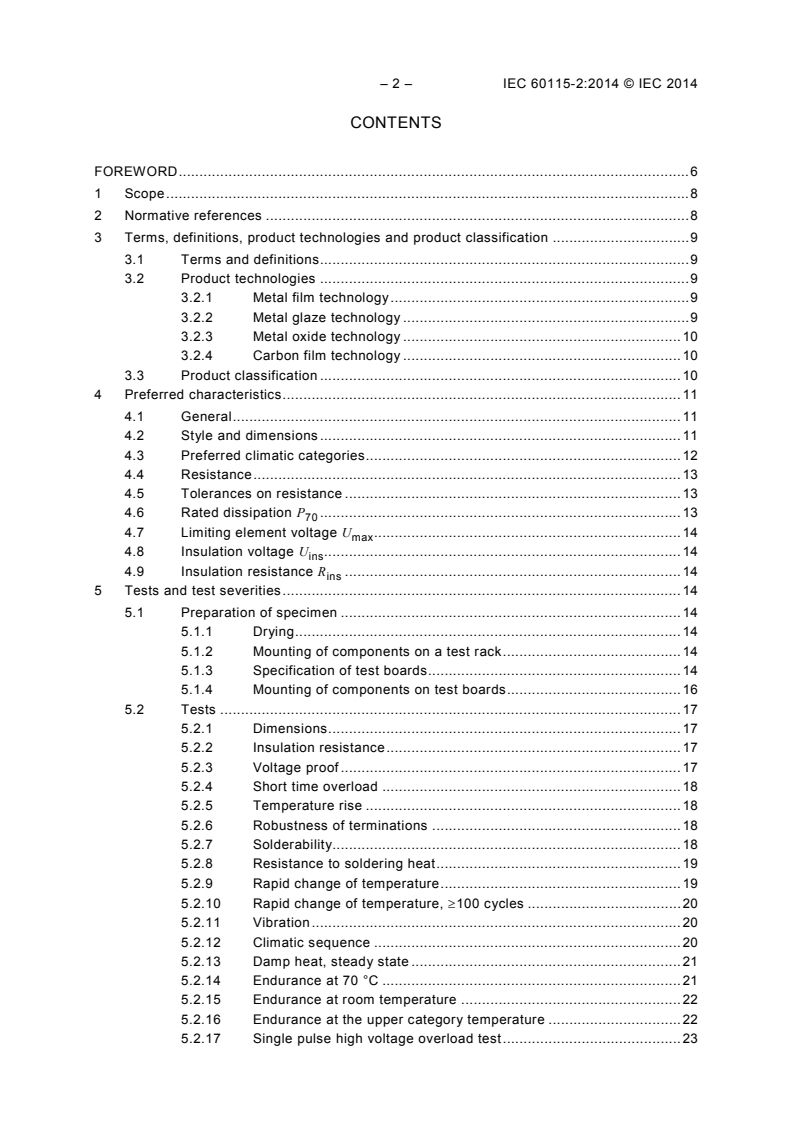
– 2 – IEC 60115-2:2014 © IEC 2014
CONTENTS
FOREWORD . 6
1 Scope . 8
2 Normative references . 8
3 Terms, definitions, product technologies and product classification . 9
3.1 Terms and definitions . 9
3.2 Product technologies . 9
3.2.1 Metal film technology . 9
3.2.2 Metal glaze technology . 9
3.2.3 Metal oxide technology . 10
3.2.4 Carbon film technology . 10
3.3 Product classification . 10
4 Preferred characteristics . 11
4.1 General . 11
4.2 Style and dimensions . 11
4.3 Preferred climatic categories . 12
4.4 Resistance . 13
4.5 Tolerances on resistance . 13
4.6 Rated dissipation P . 13
4.7 Limiting element voltage U . 14
max
4.8 Insulation voltage U . 14
ins
4.9 Insulation resistance R . 14
ins
5 Tests and test severities . 14
5.1 Preparation of specimen . 14
5.1.1 Drying . 14
5.1.2 Mounting of components on a test rack . 14
5.1.3 Specification of test boards . 14
5.1.4 Mounting of components on test boards . 16
5.2 Tests . 17
5.2.1 Dimensions . 17
5.2.2 Insulation resistance . 17
5.2.3 Voltage proof . 17
5.2.4 Short time overload . 18
5.2.5 Temperature rise . 18
5.2.6 Robustness of terminations . 18
5.2.7 Solderability. 18
5.2.8 Resistance to soldering heat . 19
5.2.9 Rapid change of temperature . 19
5.2.10 Rapid change of temperature, ≥100 cycles . 20
5.2.11 Vibration . 20
5.2.12 Climatic sequence . 20
5.2.13 Damp heat, steady state . 21
5.2.14 Endurance at 70 °C . 21
5.2.15 Endurance at room temperature . 22
5.2.16 Endurance at the upper category temperature . 22
5.2.17 Single pulse high voltage overload test . 23
5.2.18 Component solvent resistance . 23
5.2.19 Solvent resistance of marking . 23
5.2.20 Flammability test . 24
5.2.21 Electrostatic discharge (ESD) test . 24
5.2.22 Periodic pulse overload test . 24
6 Performance requirements . 25
6.1 General . 25
6.2 Limits for change of resistance . 25
6.3 Insulation resistance . 27
6.4 Variation of resistance with temperature . 27
6.5 Temperature rise . 28
6.6 Solderability . 28
6.7 Flammability . 28
7 Marking, packaging and ordering information . 28
7.1 Marking of the component . 28
7.2 Packaging . 28
7.3 Marking of the packaging . 28
7.4 Ordering information . 28
8 Detail specifications. 29
8.1 General . 29
8.2 Information to be specified in a detail specification . 29
8.2.1 Outline drawing or illustration . 29
8.2.2 Style and dimensions . 29
8.2.3 Climatic category . 29
8.2.4 Resistance range . 29
8.2.5 Tolerances on resistance . 30
8.2.6 Rated dissipation P . 30
8.2.7 Limiting element voltage U . 30
max
8.2.8 Insulation voltage U . 30
ins
8.2.9 Insulation resistance R . 30
ins
8.2.10 Test severities . 30
8.2.11 Limits of resistance change after testing . 30
8.2.12 Temperature coefficient of resistance . 30
8.2.13 Marking . 30
8.2.14 Ordering information . 30
8.2.15 Mounting . 31
8.2.16 Storage. 31
8.2.17 Additional information . 31
8.2.18 Quality assessment procedures . 31
8.2.19 0 Ω resistors . 31
9 Quality assessment procedures . 31
9.1 General . 31
9.2 Definitions. 31
9.2.1 Primary stage of manufacture . 31
9.2.2 Structurally similar components . 31
9.2.3 Assessment level EZ . 32
9.3 Formation of inspection lots . 32
9.4 Qualification approval (QA) procedures . 33
– 4 – IEC 60115-2:2014 © IEC 2014
9.5 Quality conformance inspection . 33
9.6 Capability approval (CA) procedures . 33
9.7 Technology approval (TA) procedures . 34
9.8 Delayed delivery . 34
9.9 Certified test records. 34
9.10 Certificate of conformity (CoC) . 34
Annex A (normative) 0 Ω Resistors (Jumper) . 45
A.1 General . 45
A.2 Preferred characteristics . 45
A.3 Tests and test severities . 45
A.4 Performance requirements . 46
A.5 Marking, packaging and ordering information . 46
A.6 Detail specification . 46
A.7 Quality assessment procedures . 46
Annex B (informative) Radial formed styles . 48
B.1 General . 48
B.1.1 Scope of this annex . 48
B.1.2 Denomination of radial formed styles . 48
B.1.3 Coated lead wires . 49
B.1.4 Means for support of mounting height . 49
B.1.5 Means for retention . 49
B.2 Radial formed styles . 50
B.2.1 Radial formed style with lateral body position . 50
B.2.2 Radial formed style with upright body position . 51
B.3 Packaging . 54
B.4 Quality assessment . 55
B.4.1 General . 55
B.4.2 Quality assessment of formed resistors . 55
B.4.3 Forming of finished resistors of assessed quality . 55
B.4.4 Special inspection requirements . 55
Annex C (normative) Endurance at room temperature . 57
C.1 Remark on the temporary relevance of this annex . 57
C.2 General . 57
C.3 Test chamber and mounting of specimen . 57
C.4 Initial measurement . 58
C.5 Temperature and load . 58
C.6 Duration . 60
C.7 Intermediate measurements . 60
C.8 Final inspection, measurements and requirements . 60
Annex D (informative) Letter symbols and abbreviations . 62
D.1 Letter symbols . 62
D.2 Abbreviations . 64
Annex X (informative) Cross reference for references to the prior revision of this
standard . 66
Bibliography . 68
Figure 1 – Shape and dimensions of axial leaded resistors . 11
Figure 2 – Alternative methods for specification of the length of excessive protective
coating on axial leaded resistors . 12
Figure 3 – Lead-wire spacing of axial leaded resistors with bent leads . 12
Figure 4 – Derating curve . 13
Figure 5 – Basic layout for mechanical, environmental and electrical tests,
Kelvin (4 point) connections . 15
Figure 6 – Basic layout for mechanical, environmental and electrical tests,
standard connections . 16
Figure 7 – Assembly of specimen to the test board . 17
Figure B.1 – Shape and dimensions of radial formed resistor for lateral body position . 50
Figure B.2 – Shape and dimensions of radial formed resistor for lateral body position
with kinked lead wires . 50
Figure B.3 – Shape and dimensions of a radial formed resistor for upright body position . 52
Figure B.4 – Shape and dimensions of a radial formed resistor for upright body position
and wide spacing . 52
Figure B.5 – Shape and dimensions of a radial formed resistor for upright body position
and wide spacing, with kinked lead wire . 53
Figure C.1 – Derating curve with specification of a suitable test dissipation . 59
Figure C.2 – Derating curve without specification of a suitable test dissipation . 59
Table 1 – Preferred styles of axial leaded resistors . 11
Table 2 – Test board dimensions . 15
Table 3 – Limits for change of resistance at tests . 26
Table 4 – Permitted change of resistance due to variation of temperature . 27
Table 5 – Test schedule for qualification approval. 35
Table 6 – Test schedule for quality conformance inspection . 40
Table B.1 – Feasible lead-wire spacing of radial formed resistor for
lateral body position . 51
Table B.2 – Feasible lead-wire spacing of a radial formed resistor for
upright body position. 54
– 6 – IEC 60115-2:2014 © IEC 2014
INTERNATIONAL ELECTROTECHNICAL COMMISSION
____________
FIXED RESISTORS FOR USE IN ELECTRONIC EQUIPMENT –
Part 2: Sectional specification:
Leaded fixed low power film resistors
FOREWORD
1) The International Electrotechnical Commission (IEC) is a worldwide organization for standardization comprising
all national electrotechnical committees (IEC National Committees). The object of IEC is to promote
international co-operation on all questions concerning standardization in the electrical and electronic fields. To
this end and in addition to other activities, IEC publishes International Standards, Technical Specifications,
Technical Reports, Publicly Available Specifications (PAS) and Guides (hereafter referred to as “IEC
Publication(s)”). Their preparation is entrusted to technical committees; any IEC National Committee interested
in the subject dealt with may participate in this preparatory work. International, governmental and non-
governmental organizations liaising with the IEC also participate in this preparation. IEC collaborates closely
with the International Organization for Standardization (ISO) in accordance with conditions determined by
agreement between the two organizations.
2) The formal decisions or agreements of IEC on technical matters express, as nearly as possible, an international
consensus of opinion on the relevant subjects since each technical committee has representation from all
interested IEC National Committees.
3) IEC Publications have the form of recommendations for international use and are accepted by IEC National
Committees in that sense. While all reasonable efforts are made to ensure that the technical content of IEC
Publications is accurate, IEC cannot be held responsible for the way in which they are used or for any
misinterpretation by any end user.
4) In order to promote international uniformity, IEC National Committees undertake to apply IEC Publications
transparently to the maximum extent possible in their national and regional publications. Any divergence
between any IEC Publication and the corresponding national or regional publication shall be clearly indicated in
the latter.
5) IEC itself does not provide any attestation of conformity. Independent certification bodies provide conformity
assessment services and, in some areas, access to IEC marks of conformity. IEC is not responsible for any
services carried out by independent certification bodies.
6) All users should ensure that they have the latest edition of this publication.
7) No liability shall attach to IEC or its directors, employees, servants or agents including individual experts and
members of its technical committees and IEC National Committees for any personal injury, property damage or
other damage of any nature whatsoever, whether direct or indirect, or for costs (including legal fees) and
expenses arising out of the publication, use of, or reliance upon, this IEC Publication or any other IEC
Publications.
8) Attention is drawn to the Normative references cited in this publication. Use of the referenced publications is
indispensable for the correct application of this publication.
9) Attention is drawn to the possibility that some of the elements of this IEC Publication may be the subject of
patent rights. IEC shall not be held responsible for identifying any or all such patent rights.
International Standard IEC 60115-2 has been prepared by IEC technical committee 40:
Capacitors and resistors for electronic equipment.
This third edition cancels and replaces the second edition, published in 1982, and it
constitutes a technical revision.
This edition includes the following significant technical changes with respect to the previous
edition:
– it includes test conditions and requirements for lead-free soldering and assessment
procedures meeting the requirements of a “zero defect” approach;
– it introduces a product classification based on application requirements;
– it includes an extension of the list of styles and dimensions;
– it includes the use of an extended scope of stability class definitions;
– it includes the extension of the lists of preferred values of ratings;
– it includes test conditions and requirements for lead-free soldering, for periodic overload
and for resistance to electrostatic discharge (ESD);
– it includes a new set of severities for a shear test;
– it includes definitions for a test board;
– it includes the replacement of assessment level E and possible others by the sole
assessment level EZ, meeting the requirements of a “zero defect” approach;
– it includes an extended endurance test, a flammability test, a temperature rise test,
vibration tests, an extended rapid change of temperature test, and a single pulse high-
voltage overload test;
– it includes requirements applicable to 0 Ω resistors (jumpers);
– it includes recommendations for the denomination, description, packaging and quality
assessment of radial formed styles;
– it includes prescriptions for endurance testing at room temperature, supplementary to the
rulings of IEC 60115-1.
The text of this standard is based on the following documents:
FDIS Report on voting
40/2282/FDIS 40/2289/RVD
Full information on the voting for the approval of this standard can be found in the report on
voting indicated in the above table.
A list of all parts in the IEC 60115 series, published under the general title Fixed resistors for
use in electronic equipment, can be found on the IEC website.
This publication has been drafted in accordance with the ISO/IEC Directives, Part 2.
The committee has decided that the contents of this publication will remain unchanged until
the stability date indicated on the IEC web site under "http://webstore.iec.ch" in the data
related to the specific publication. At this date, the publication will be
• reconfirmed,
• withdrawn,
• replaced by a revised edition, or
• amended.
– 8 – IEC 60115-2:2014 © IEC 2014
FIXED RESISTORS FOR USE IN ELECTRONIC EQUIPMENT –
Part 2: Sectional specification:
Leaded fixed low power film resistors
1 Scope
This part of IEC 60115 is applicable to leaded fixed low-power film resistors for use in
electronic equipment.
These resistors are typically described according to types (different geometric shapes) and
styles (different dimensions) and product technology. The resistive element of these resistors
is typically protected by a conformal lacquer coating. These resistors have wire terminations
and are primarily intended to be mounted on a circuit board in through-hole technique.
The object of this standard is to prescribe preferred ratings and characteristics and to select
from IEC 60115-1, the appropriate quality assessment procedures, tests and measuring
methods and to give general performance requirements for this type of resistor.
2 Normative references
The following documents, in whole or in part, are normatively referenced in this document and
are indispensable for its application. For dated references, only the edition cited applies. For
undated references, the latest edition of the referenced document (including any
amendments) applies.
IEC 60062:2004, Marking codes for resistors and capacitors
IEC 60068-1:2013, Environmental testing – Part 1: General and guidance
IEC 60068-2-1, Environmental testing – Part 2-1: Tests – Test A: Cold
IEC 60068-2-2, Environmental testing – Part 2-2: Tests – Test B: Dry heat
IEC 60068-2-6:2007, Environmental testing – Part 2-6: Tests – Test Fc: Vibration
(sinusoidal)
IEC 60068-2-20:2008, Environmental testing – Part 2-20: Tests – Test T: Test methods for
solderability and resistance to soldering heat of devices with leads
IEC 60115-1:2008, Fixed resistors for use in electronic equipment – Part 1: Generic
specification
IEC 60286-1, Packaging of components for automatic handling – Part 1: Tape packaging of
components with axial leads on continuous tapes
IEC 60294:2012, Measurement of the dimensions of a cylindrical component with axial
terminations
IEC 60301, Preferred diameters of wire terminations of capacitors and resistors
IEC 61193-2:2007, Quality assessment systems – Part 2: Selection and use of sampling
plans for inspection of electronic components and packages
IEC 61760-1:2006, Surface mounting technology – Part 1: Standard method for the
specification of surface mounting components (SMDs)
3 Terms, definitions, product technologies and product classification
3.1 Terms and definitions
For the purposes of this document, the terms and definitions given in IEC 60115-1:2008, 2.2,
as well as the following, apply.
3.1.1
axial style
physical design of a component with leads extending to both sides along the longitudinal axis
of the components body
3.1.2
radial style
physical design of a component with leads extending to one side along the longitudinal or
along the diagonal axis of the component body
Note 1 to entry: The single direction of the leads may originate from inside the component body or by forming one
or both leads outside of the component body.
3.2 Product technologies
3.2.1 Metal film technology
The resistive element of a metal film resistor is a thin and homogeneous layer of a metal
alloy, deposited on a ceramic core or substrate. Typical examples for such metal alloys are
nickel chrome in various compositions and complexities, or tantalum nitride, which are
typically deposited by sputtering or by evaporation. The typical thickness of a metal film layer
is in the range of 50 nm to 4 µm.
Metal film technology permits achievement of specific levels of temperature stability by choice
of material and variation of processing.
Where coding of the resistor technology is required, character M shall be used to identify the
metal film technology.
NOTE A common alternative designation for metal film is thin film, which is mainly used for surface mount
resistors.
3.2.2 Metal glaze technology
The resistive element of a metal glaze resistor is a thick and heterogeneous layer of a glaze,
deposited on a ceramic core or substrate. The glaze is typically filled with ruthenium oxide
(noble metal) or with tantalum nitride (non-noble metal) and deposited by coating a cylindrical
core, or by printing on a flat substrate. The typical thickness of a metal glaze layer is in the
range of 3 µm to 20 µm.
Metal glaze technology permits achievement of several specific levels of temperature stability,
mainly by choice of material.
Where coding of the resistor technology is required, character G shall be used to identify the
metal glaze technology.
– 10 – IEC 60115-2:2014 © IEC 2014
NOTE A common alternative designation for metal glaze is thick film, which is mainly used for flat chip surface
mount resistors.
3.2.3 Metal oxide technology
The resistive element of a metal oxide resistor is typically a layer of tin oxide with an addition
of antimony, possibly stabilized in a glaze.
Metal oxide technology permits achievement of several specific levels of limited temperature
stability.
Where coding of the resistor technology is required, character X shall be used to identify the
metal oxide technology.
3.2.4 Carbon film technology
The resistive element of a carbon film resistor is a homogeneous layer of carbon, deposited
by fractioning on a ceramic core or substrate.
The temperature stability of carbon film resistors does not offer any controlled variation, but
typically depends on the actual resistance.
Where coding of the resistor technology is required, character C shall be used to identify the
carbon film technology.
3.3 Product classification
The introduction of a product classification permits the user to select performance
requirements according to the conditions of the intended end-use application.
Two general end product levels have been established to reflect characteristic differences in
functional, performance and reliability requirements and to permit the use of suitable
inspection and test schedules. It should be recognized that there may be overlaps of
applications between the levels.
Level G – General electronic equipment, typically operated under benign or moderate
environmental conditions, where the major requirement is function. Examples for level G
include consumer products and telecommunication user terminals.
Level P – High performance electronic equipment, where one or more of the following criteria
applies:
– uninterrupted performance is desired or mandatory;
– operation in harsh environmental conditions;
– extended lifetime.
Examples for level P include professional equipment, telecommunication transmission
systems, industrial control and measurement systems and most automotive applications
operated outside the passenger compartment.
Level P is the suitable basis for detail specifications aiming at the approval of components
with established reliability.
Each level shall be used in individual detail specifications.
4 Preferred characteristics
4.1 General
The values given in detail specifications shall preferably be selected from 4.2 to 4.9.
4.2 Style and dimensions
The shape and dimensions of axial leaded resistors are shown in Figure 1, with preferred
styles and their respective dimensions given in Table 1. Style designators of axial leaded film
resistors begin with RA.
L D
l l d
IEC 1589/14
Figure 1 – Shape and dimensions of axial leaded resistors
Table 1 – Preferred styles of axial leaded resistors
Dimensions
a
c b d e
Style
Body diameter D Body length L Lead diameter d Lead length l
min
mm mm mm mm
+1,0
RA_0204 2 4 0,5 21
−0,7 −1,0
+0,5 +0,2
RA_0207 2 7 0,6 21
0 −2,0
0 +0,2
RA_0309 3 9 0,7 21
−0,5 −2,5
0 +0,2
RA_0411 4 11 0,7 21
−1,0 −3,5
+0,2 +0,2
RA_0414 4 14 0,8 21
−0,5 −4,0
+0,5 +0,2
RA_0617 6 17 0,8 21
−1,0 −4,0
+0,5 +0,2
RA_0922 9 22 0,8 21
−3,0 −5,0
a
The style reference is completed by a third character for the product technology, as given in 3.2:
M = metal film; G = metal glaze; C = carbon film; X = metal oxide.
Examples for complete style references are RAM0204, RAX0414.
b
The body length of the resistor L shall be measured according to IEC 60294, see 5.2.1.
c
The body diameter of the resistor D shall be gauged as prescribed in IEC 60294.
d
Nominal diameter of the lead wires d, with permissible tolerances according to IEC 60301.
e
The minimum lead length l applies only to the free lead length in tape packaging according to IEC 60286-1.
min
The detail specification may specify the permissible length of excessive protective coating
extending onto the leads of the resistor, using one of the alternative methods given in
Figure 2.
– 12 – IEC 60115-2:2014 © IEC 2014
L
c c c
IEC 1590/14
IEC 1591/14
a) Length of excessive coating, c b) Length between clean leads, L
c
Figure 2 – Alternative methods for specification of the length
of excessive protective coating on axial leaded resistors
The length of excessive protective coating, dimension c, as shown in Figure 2a, shall be
gauged as prescribed in IEC 60294:2012, Clause 4, using a gauge plate of a thickness
corresponding to the maximum permissible length of excessive protective coating. A method
for measuring or gauging the length between clean leads, dimension L , as shown in
c
Figure 2b, shall be prescribed in the detail specification, if required.
Associated with a style and the actual dimensions of the respective products is the shortest
possible standard distance of the centre line of the lead wires bent to 90° from the direct axis
of the resistor body, the lead-wire spacing S, as shown in Figure 3. The spacing S also
defines the minimum grid dimension G of PCB bores into which the resistor can be assembled
with its body located lateral on the PCB surface, when the required forming is done in the
assembly process.
NOTE The drawing of the resistor with formed leads is not intended to suggest the availability of ready formed
resistors in this standard.
S
IEC 1592/14
NOTE Spacing S is the distance of the centre lines of the bent leads.
Figure 3 – Lead-wire spacing of axial leaded resistors with bent leads
When the component style is other than the one described above, e.g. for radial leaded
resistors, the detail specification shall state such dimensional information as will adequately
describe the resistor.
4.3 Preferred climatic categories
The leaded film resistors covered by this standard are classified into climatic categories
according to the general rules given in IEC 60068-1:2013, Annex A.
The lower and upper category temperature and the duration of the damp heat, steady state
test shall be chosen from the following:
Lower category temperature (LCT) –65 °C; –55 °C; –40 °C; –25 °C and –10 °C.
Upper category temperature (UCT) 85 °C; 100 °C; 125 °C; 155 °C; 175 °C
and 200 °C.
Duration of damp heat, steady state test: 10, 21 and 56 days.
The severities for the cold and dry heat tests are the lower and upper category temperatures
respectively.
4.4 Resistance
See IEC 60115-1:2008, 2.3.2.
4.5 Tolerances on resistance
The preferred tolerances on resistance are:
±10 %; ±5 %; ±2 %; ±1 %; ±0,5 %; ±0,25 %; ±0,1 %; ±0,05 %; ±0,02 % and ±0,01 %.
4.6 Rated dissipation P
The preferred values of rated dissipation P for mounted resistors at 70 °C ambient
temperature are:
0,063 W; 0,125 W; 0,25 W; 0,5 W; 1 W and 2 W.
The detail specification shall specify the conditions under which the rated dissipation applies.
Figure 4 shows the format of a typical derating curve, suitable for providing information on the
required derating of the permissible dissipation for any ambient temperature above the rated
temperature.
100 %
P
LCT 70 °C UCT
Ambient temperature T
amb
IEC 1593/14
Figure 4 – Derating curve
Fraction of the rated dissipation P
– 14 – IEC 60115-2:2014 © IEC 2014
The upper category temperature (UCT), which is used for test procedures, should be based
on the maximum element temperature (MET).
All end points and break points on the derating curve shall be verified by test.
4.7 Limiting element voltage U
max
The preferred values of d.c. or a.c. (r.m.s.) limiting element voltage U are:
max
50 V; 100 V; 200 V; 300 V; 500 V; 750 V and 1 000 V.
4.8 Insulation voltage U
ins
For insulated resistors, the preferred values of d.c. or a.c. (peak) insula
...